

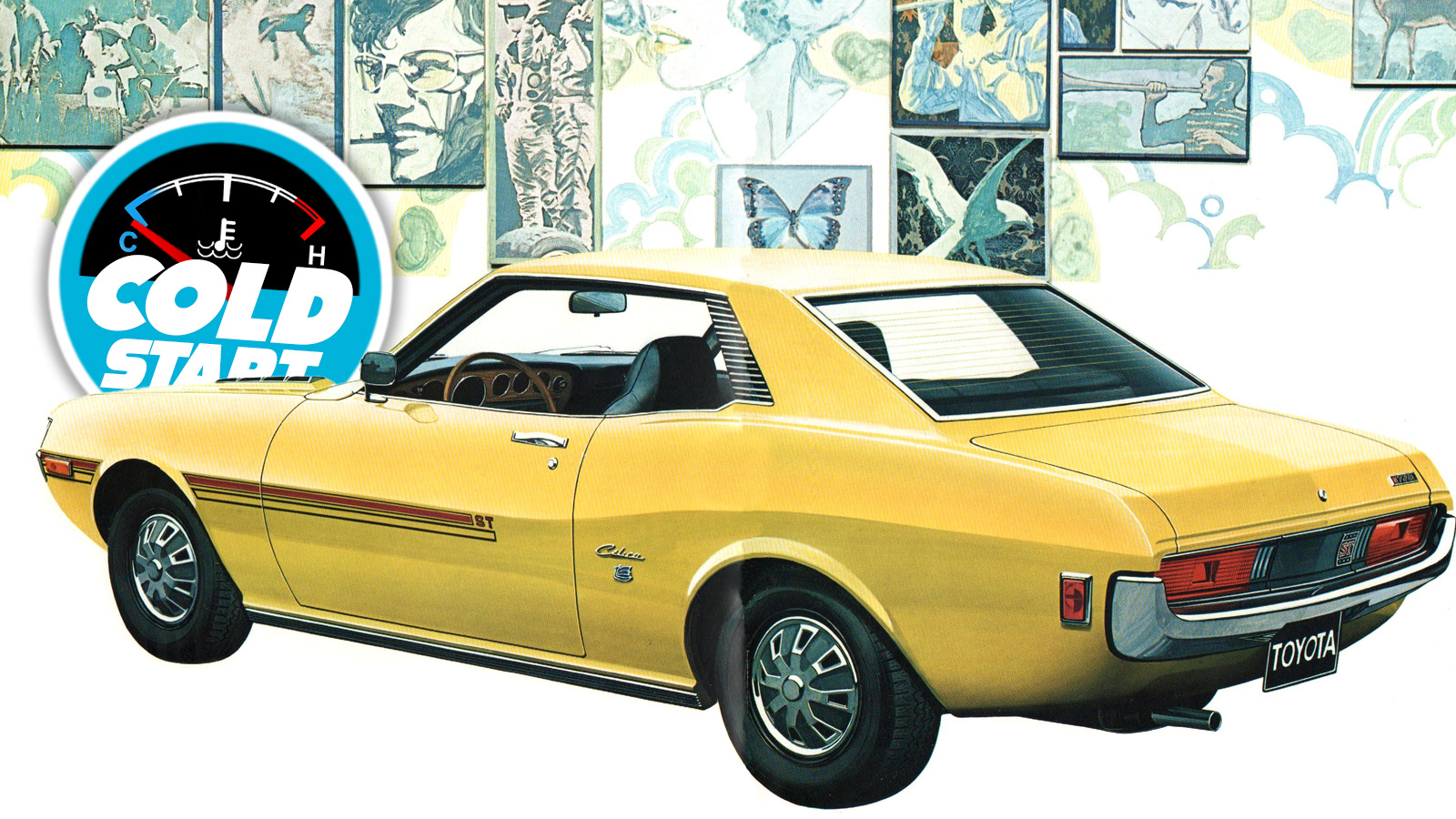
I’m here at a colossal, fancy resort in Ojai, California for a Toyota event about some cars I promised them I wouldn’t tell you about just yet. But I think I can tell you that these cars must be very, very important to Toyota, who seems to really want all of us – and there’s a lot of journalists here– to like them, lots. Which, of course, I get. That’s their business. Mine is to drink gins and tonics, soil hotel bedsheets, and try to figure out what’s interesting about these cars. But, I can’t do that yet – the last thing, I mean, the other two are well under control. So instead, let’s look at this old Toyota brochure from 1971.
A lot happened in the year 1971; Intel released the first single-chip microprocessor, the 4004; A Clockwork Orange, Dirty Harry, and Willy Wonka and the Chocolate Factory were all released; and I was evicted from the womb. Also that year brought the first Toyota Celica (well, I guess it technically came out in December of 1970, but close enough) which was targeted at the North American market and, specifically, the Ford Mustang.


In the same way that the Mustang was based on a modified Falcon unibody/platform, the Celica was also based on a more mass-market sedan, the Carina. These first Celicas were really handsome little cars, with a B-pillar-less hardtop design and some really satisfying proportions. They filled Toyota’s sportscar niche that was once filled by the car I wrote about on the last Toyota event I went to the Toyota Sports 800.
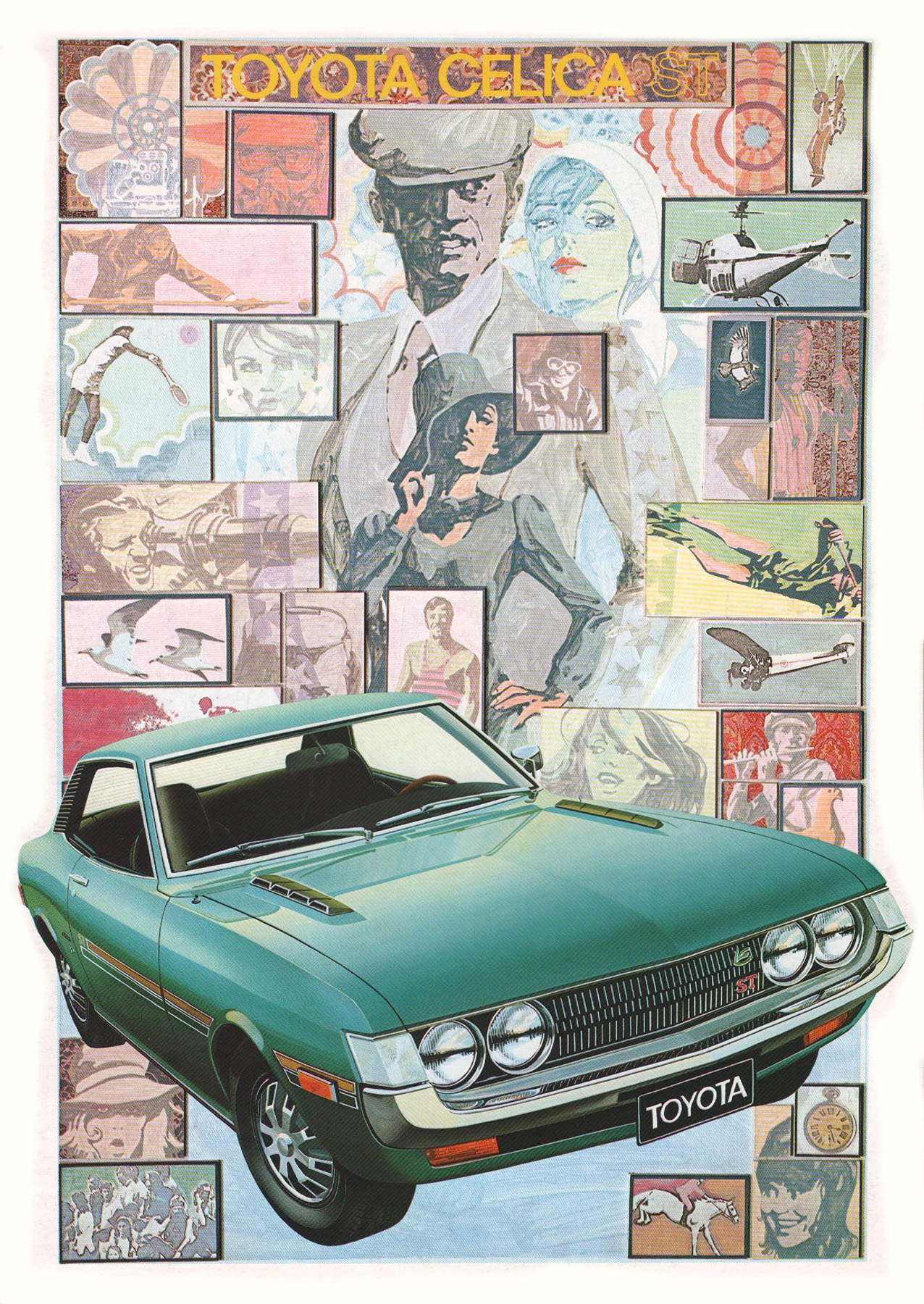
I want to look a bit at this pretty amazing ’71 brochure for the Celica, because it’s full of these peculiar type of illustrations that were popular in the early ’70s, reflecting a strange fixation with 1920s style and culture. There was a reason the first major film adaptation of The Great Gatsby came out just 3 years after this.
Also, it’s worth appreciating the style of the Celica; I really like it’s face, framed by that elongated-U-shaped bumper that merges, pleasingly, into those white sidelights. Those plastic hood heat-extraction vents on each side are a little strange, sure, but the look just works.
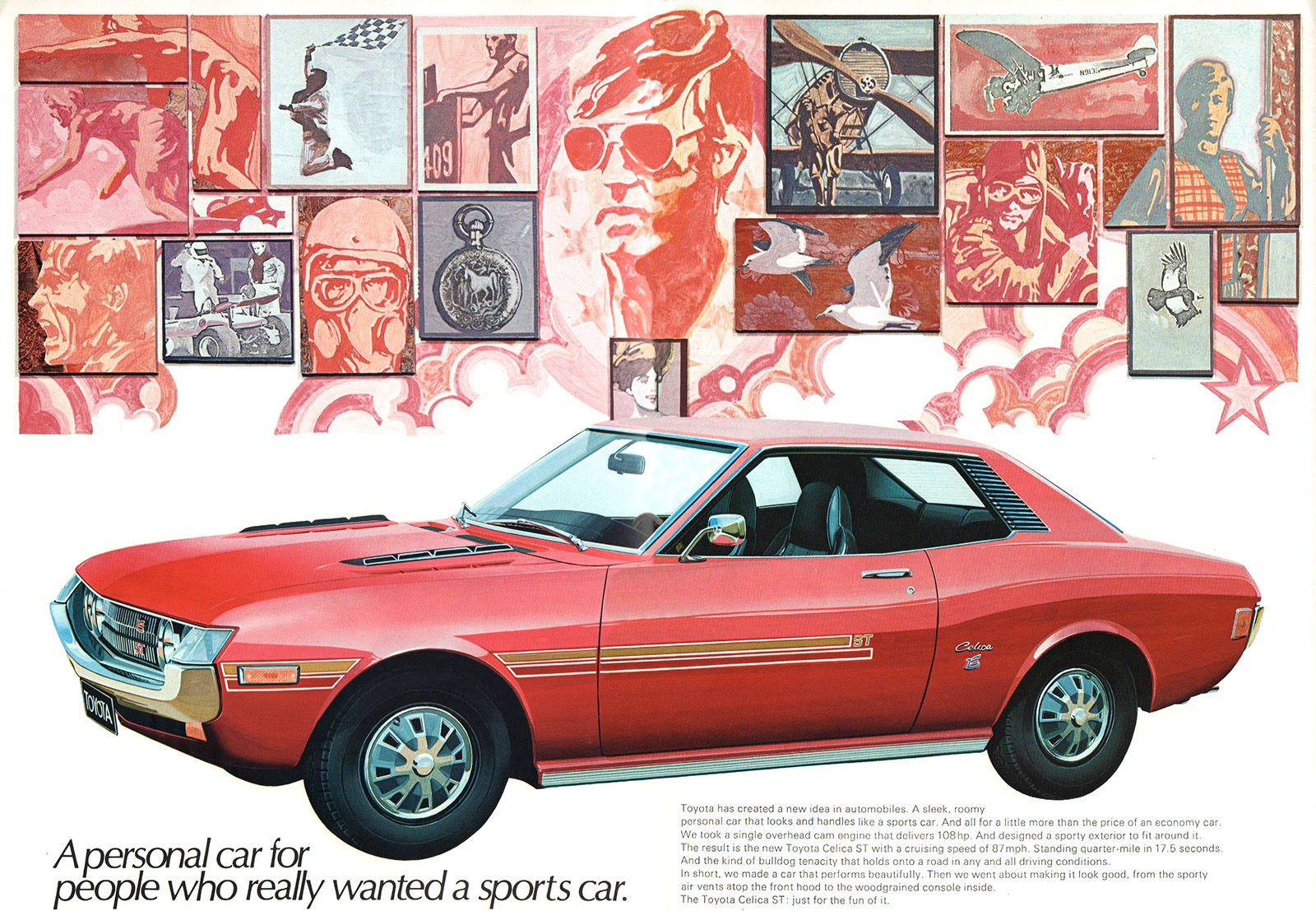
Look how great that lack of a pillar looks! And those door handles; I forgot how elegant and slim early Celica door handles were! Also note Toyota’s use of the “personal car” name, a concept and category that has mostly disappeared today, which is a shame. The personal car existed in a nice blurry space that let it be something of a sports car without having to, you know, prove anything.
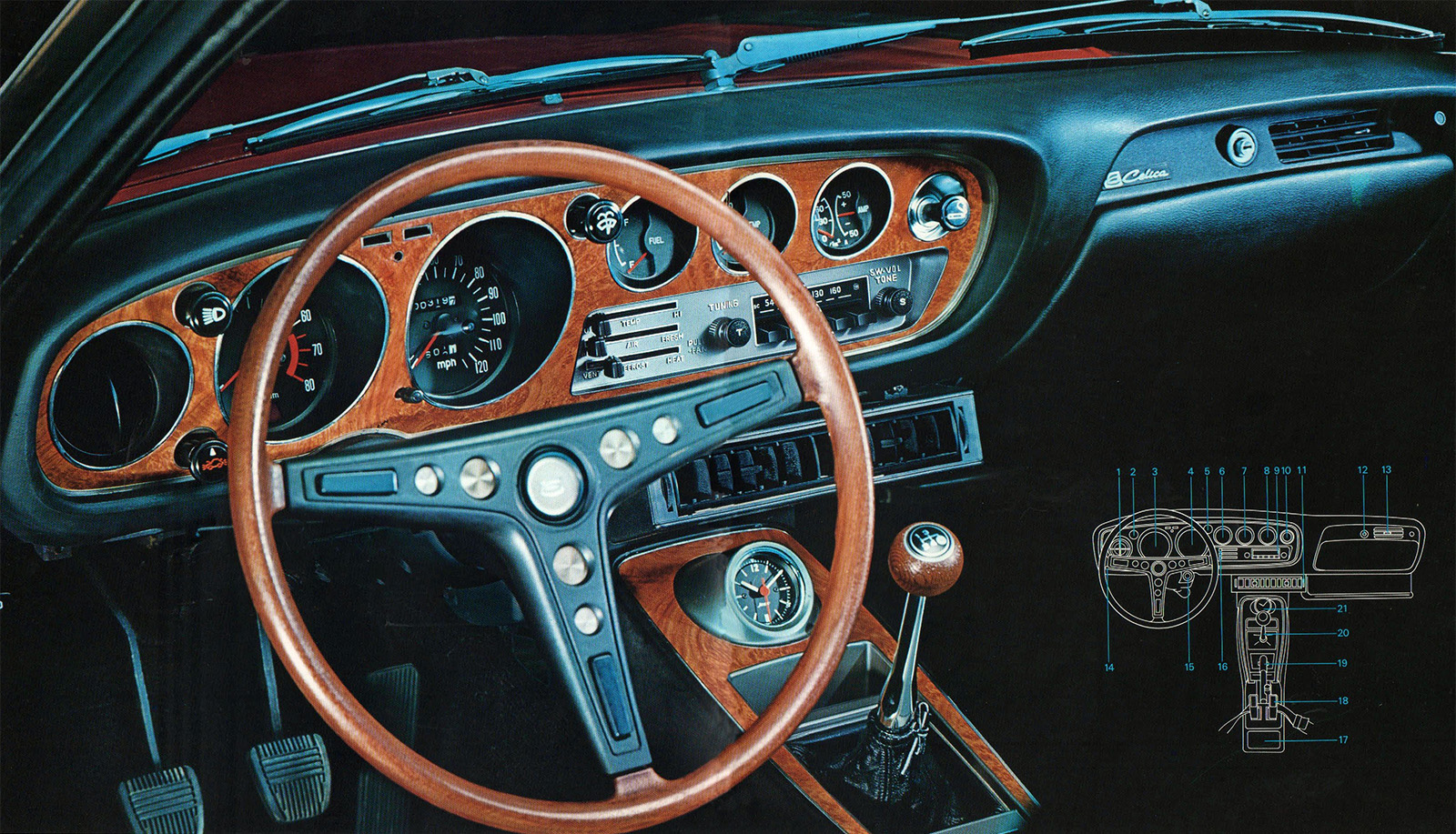
This is a fantastic dash, too. Look at that big clock mounted right above the shifter, ad all those deep-set gauges, but what really catches my eye is the weird graphic on, of all things, the hazard light switch:
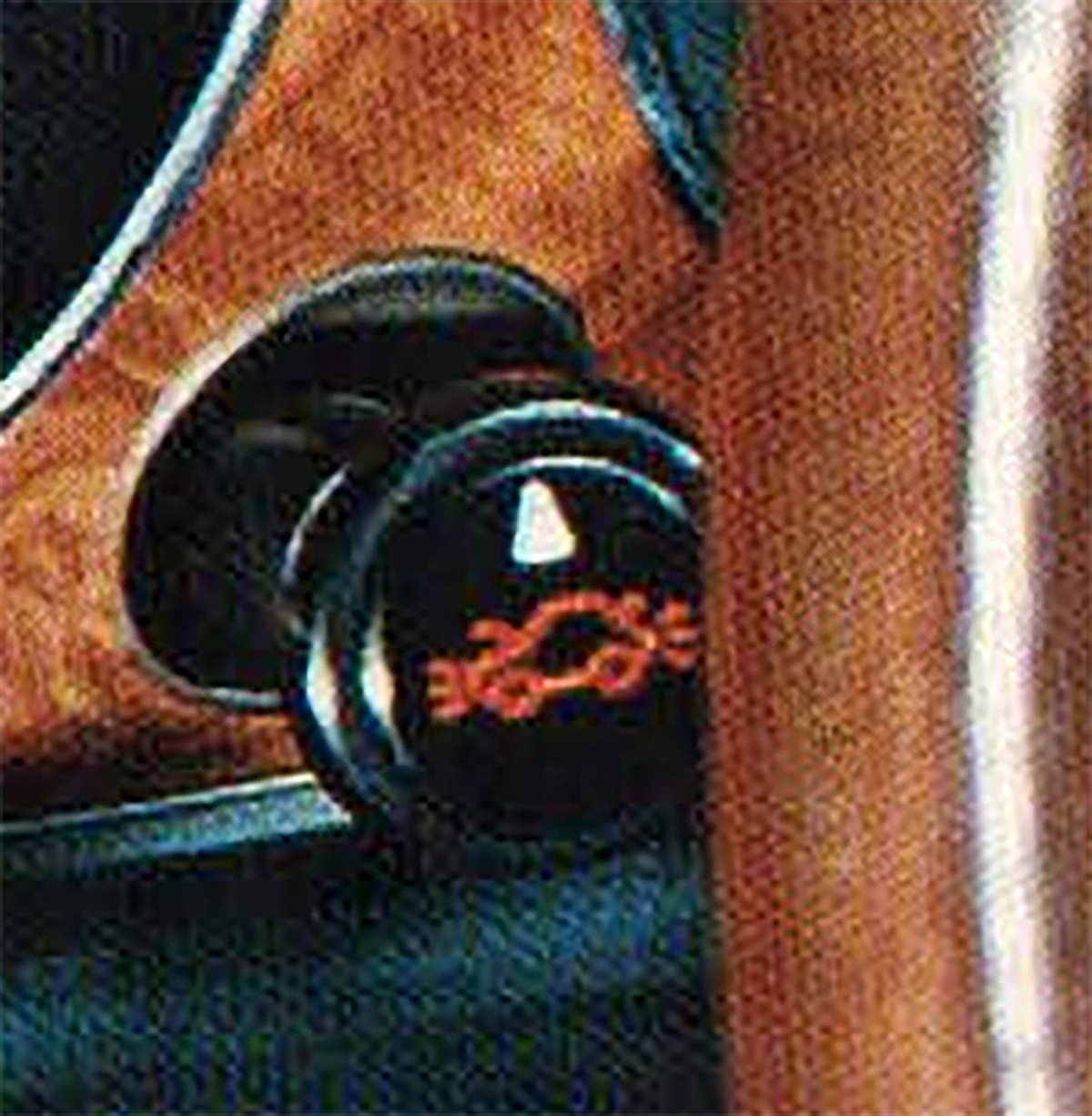
Hazard lights were first mandated in, I think, 1967, though some cars had them a year or so early. The triangular symbol we associate with hazard lights today wasn’t common yet, and many just had the word HAZARD printed excitingly on them. This iconography is like nothing I’ve seen before: an outline of a car with hood and trunk open, light flash (or noise, depending on the context) lines emanating out of both ends.
It definitely gets the idea of what the switch does across, just in kind of a fun cartoony way.
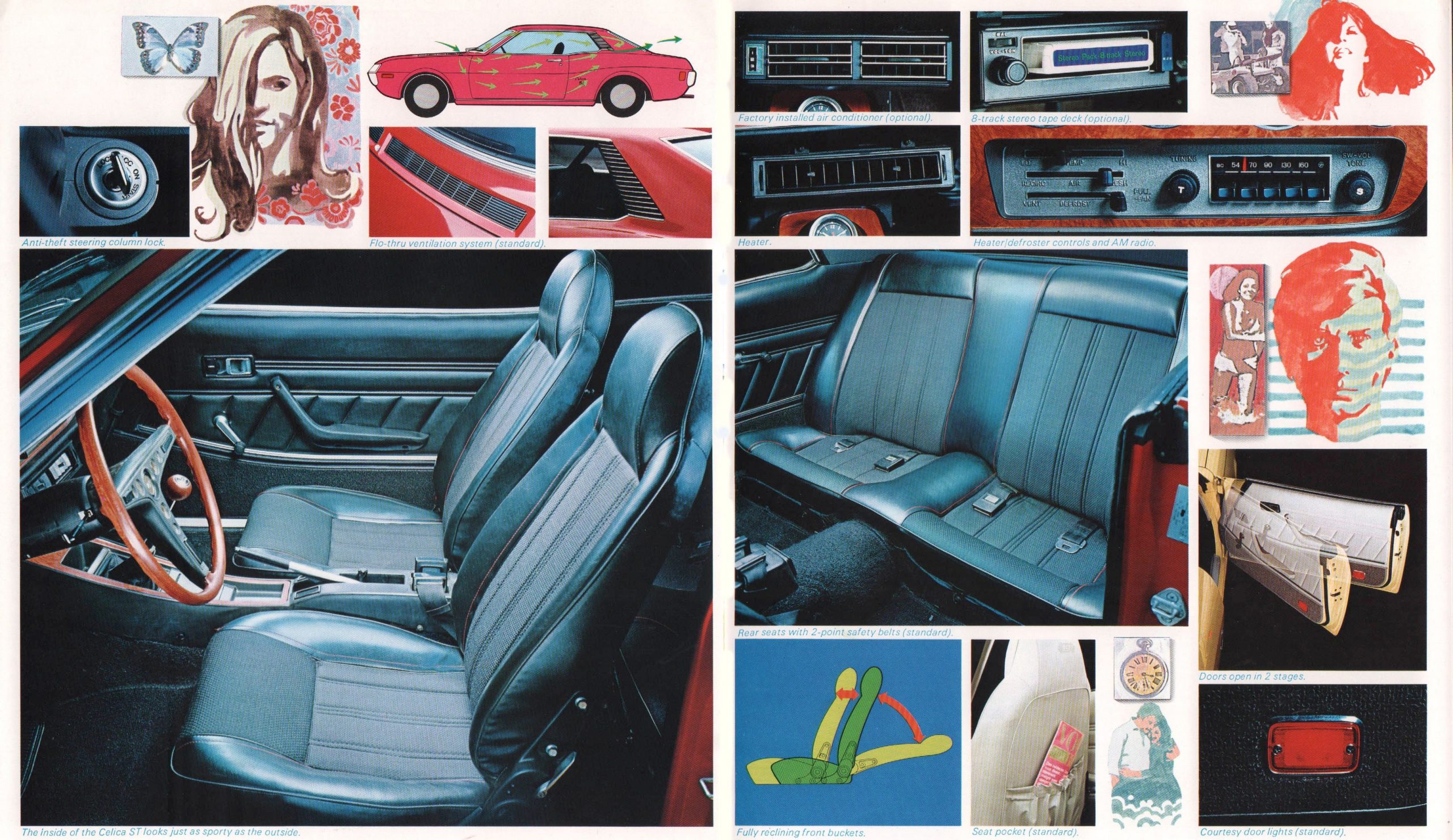
This spread shows a lot of good details, interspersed with some illustrations that don’t make a hell of a lot of sense to me. Take that dude’s head in the mid-right there; why does he look so damn intense? He reminds me of a particular kind of guy seen on old sci-fi paperback covers:

He’s got that same kind of scientist-pushed-too-far look, doesn’t he?
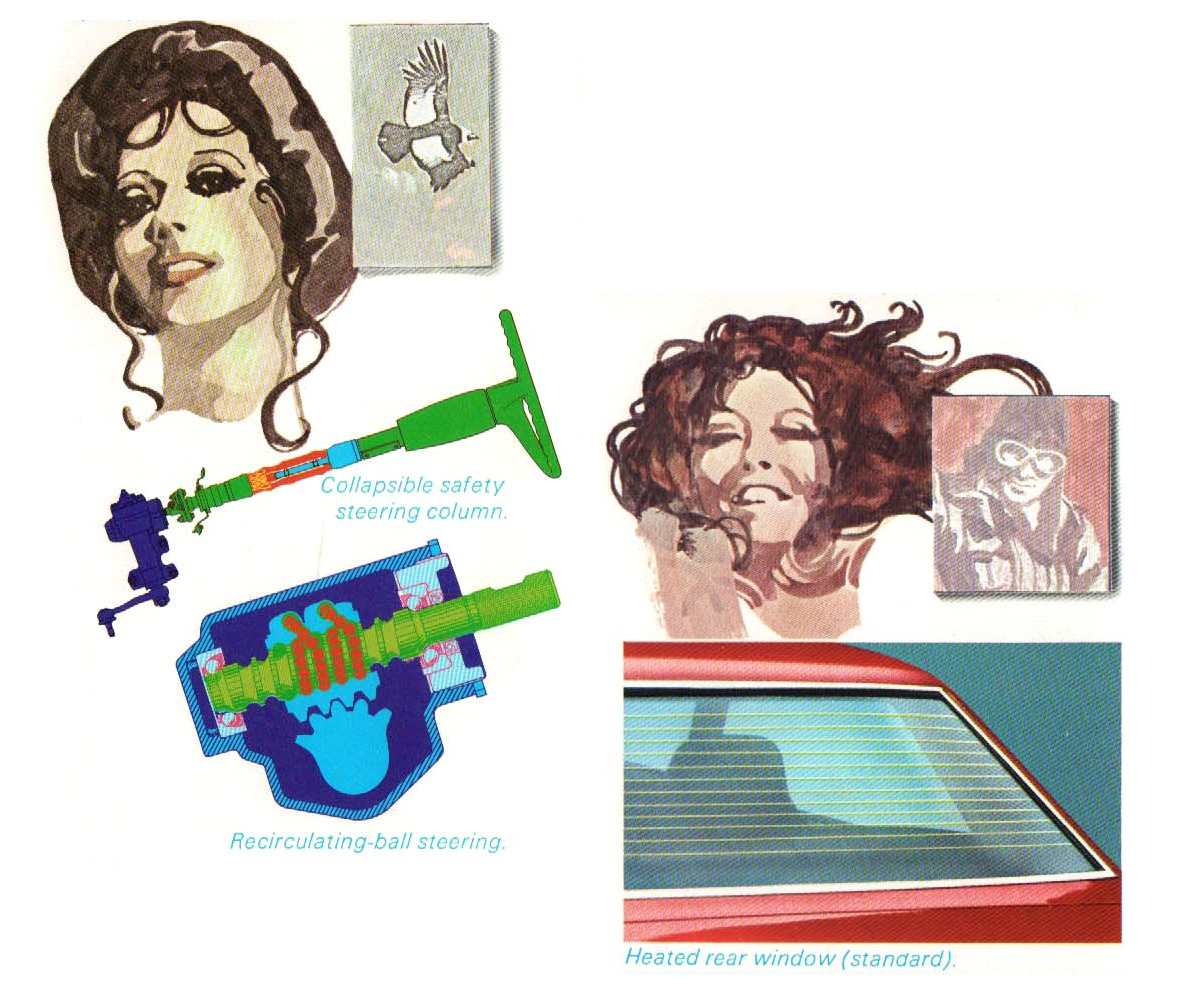
And what the hell do a woman and a soaring hawk have to do with a collapsable steering column? Or a windblown woman and an aviator/aviatrix have to do with rear window defoggers?
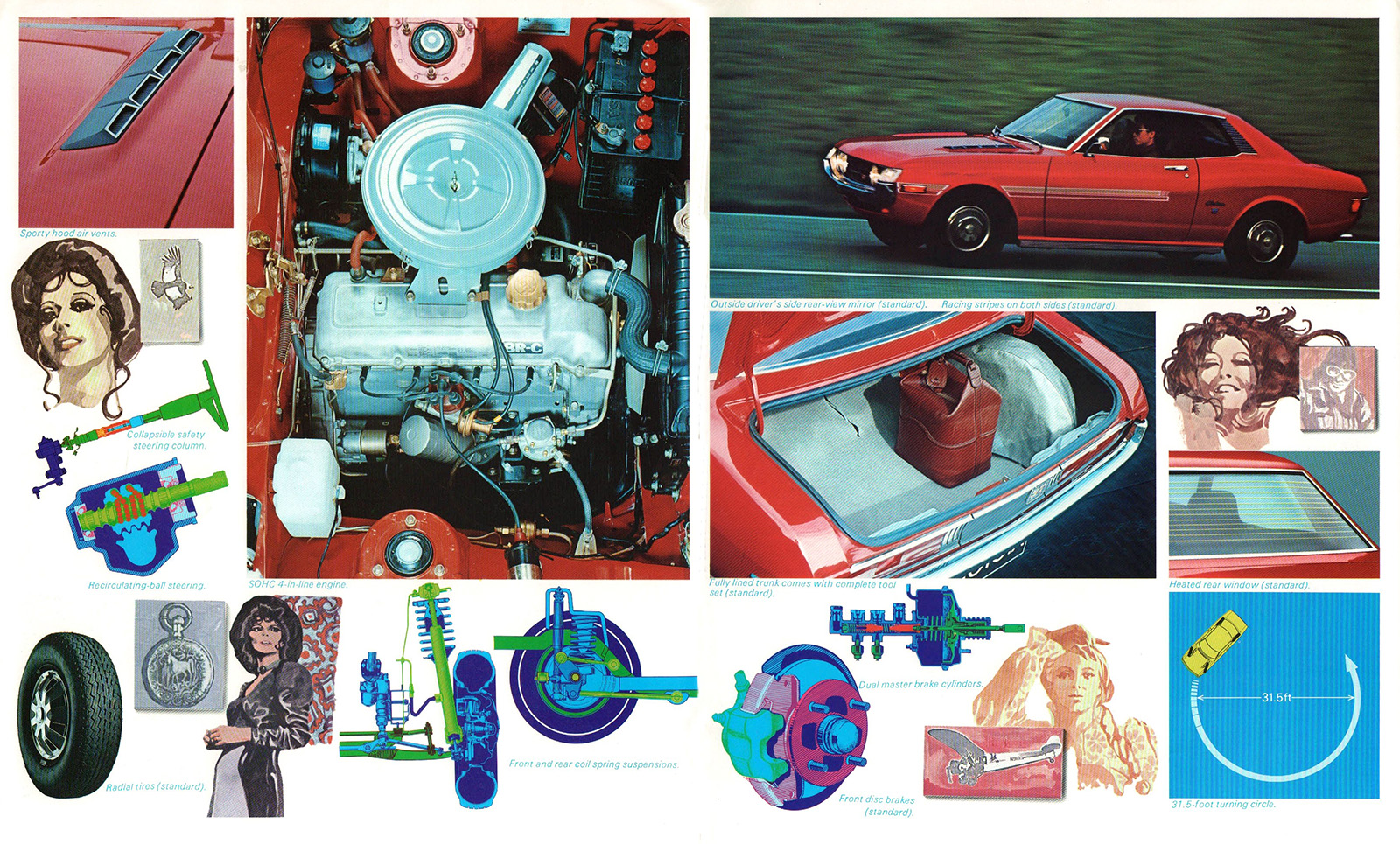
There’s more on that spread, of course. I like how under the picture of the car driving in the upper right the caption notes that the racing stripes are on both sides. Woo-hoo-hoo, what is this, a Rolls-freaking-Royce? Stripes on both sides? Just like a yacht! A yacht with stripes!
Also, that trunk picture is lazy. Just one bag? Come on!
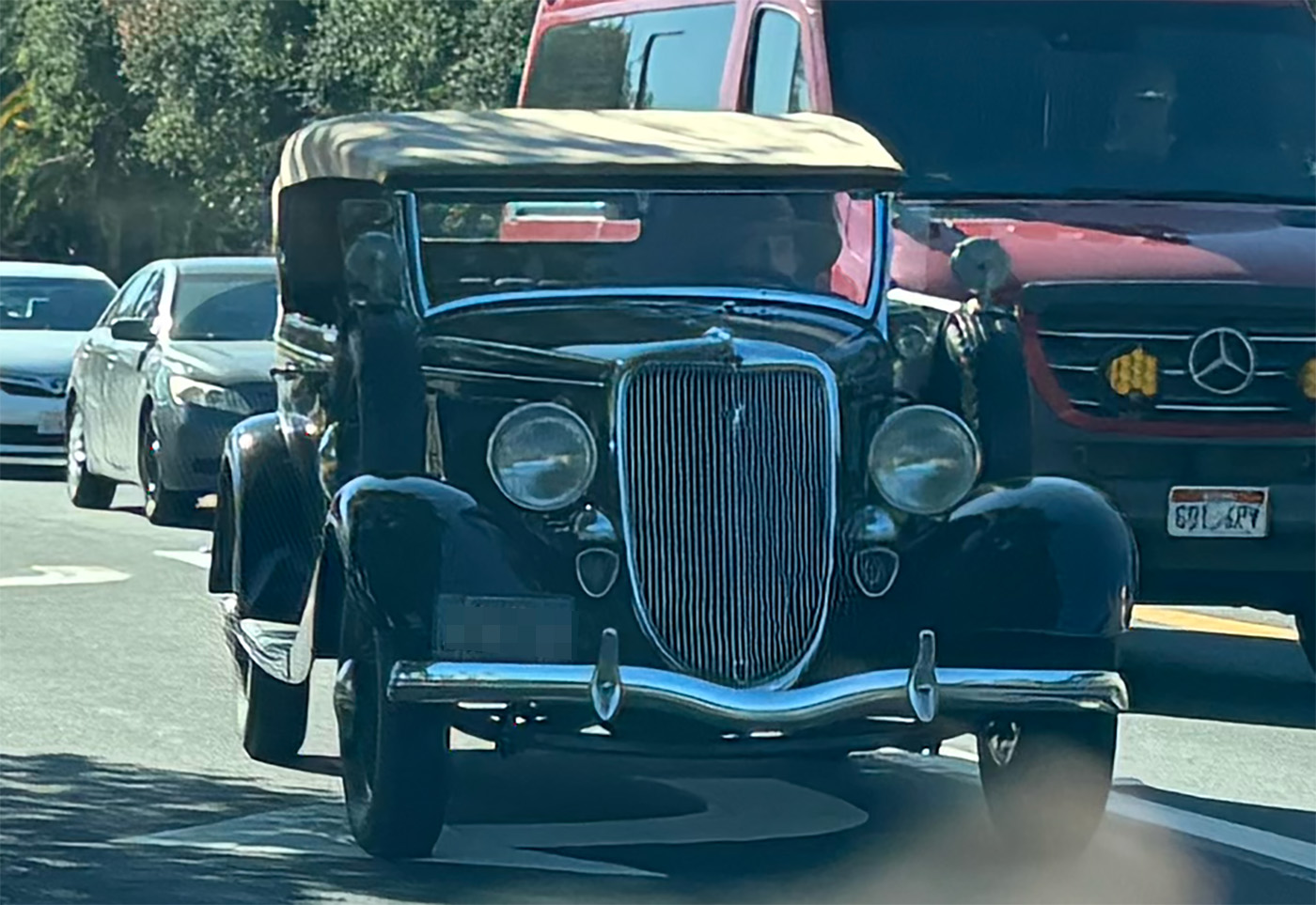
I also just want to show you this lovely old Ford V8 – I think this is a 1934 Model 40, but I’m not an expert on these. This car had what is usually considered to be the first widely affordable V8, the flathead V8, an engine that stayed in production from 1932 all the way into the early 1950s. It was great to see someone out driving theirs, and I never really appreciated before how the little horn grilles sort of mimic the shape of the main radiator grille.
I gotta get to sleep; those sheets aren’t going to soil themselves, after all.


I was just at Lake Casitas this weekend.
Anyway, on to reading the article…
One of my college roommates had a 72 ST. He was pre-med. One evening, he accidentally blew a stop sign and t-boned the university med school dean’s wife’s car. She was uninjured, but I believe he didn’t apply there.
I think his car was totaled, which was too bad because it was a really pleasant car for that era.
If you like the look of the early 1970s Celica, you might enjoy this multi-year resto-mod project by automotive YouTuber Sarah-n-Tuned. She meticulosity restores a 1974 Celica while swapping the original 4-cylinder engine for a 4.7L V8 from a 2005 Toyota Tundra.
I enjoyed every video.
This Toyota event, is it the new MR2 or the GR86 hatchback?
I hope it’s one of those, don’t really mind which one.
For those of you who lived through that era, do you remember that these old Toyotas always had a particular ‘new car smell’ which pretty much doesn’t go away? The vinyl upholstered ones smelled a certain way, and the velour ones smelled a distinctly different way.
Here’s your question: “Also, that trunk picture is lazy. Just one bag? Come on!”
Here’s your answer: “Also note Toyota’s use of the “personal car” name, a concept and category that has mostly disappeared today, which is a shame. The personal car existed in a nice blurry space that let it be something of a sports car without having to, you know, prove anything.”
It’s a personal car. No need for more than one bag.
My first couple of cars were ’79 Supras, which were basically long-nosed Celicas with two more cylinders, but that was probably the least attractive generation of Celica. The earlier Celicas were SO much cooler and prettier, whether in hatchack form (which I prefer of course) or with a trunk.
I’d kill for one of those now, but I’m not up for the time and expense of a restoration/project, and a finished one costs almost as much as a decent new car.
Sarah’n’tuned on Youtube squeezed a Toyota V8 into an early Celica (along with her usual wonderfully OCD full restoration) and that gold car (that I think she gave to her dad?) is perhaps the most desirable restomod I’ve ever seen in my life, including Singer Porsches.
I too prefer the fastback version, but Sarahs build is in a class of it’s own. Her attention to detail is insane. And yeah, she gave it to her dad, although it’s not completely finished or delivered yet.
I went to look at a ’73 Celica once, and I hope the asshole selling it eventually got hosed. Waaaay more rust than pictured. I was assured I could test drive it, but when I showed up it had a dead battery and a flat tire. In hindsight it kept me from making a dumb decision in college (similar story with a ’96 Celica) so there’s that.
My first car at 16 was a used 1972 Celica.
It was a 4spd man, all leather interior and fun to drive. It got close to 50mpg on the highway at a time when 25 was considered good. I can remember filling the gas tank for $8 and lasting me all week which was good because I was usually broke by mid week.
“Also, that trunk picture is lazy. Just one bag? Come on!”
I think that’s a designer leather gas bag.
But seriously, I like that trunk pic. One bag is enough, for a sense of scale, and keeping it otherwise empty lets us see its’ depth, where the floor has any non-flatness to accommodate the rear suspension, how it’s finished and so on.
Yes, showing it that way lets you see the empty volume extending past the far trunk lip. If it were fully packed, you wouldn’t know how far that rear wall may be.
WRT “personal car”
Folks tend to agree that the first “personal luxury car” (or at least the first use of the term) was the 1966 Oldsmobile Toronado. It was a luxury car primarily intended for 1 or 2 people, with occasional rear-seat passengers, and more luxurious than a GT car.
So I guess a “personal car” is a “personal luxury car”, but without the luxury?
I’d argue the 1958 Thunderbird was the first.
Segment definer, but the term didnt come into use later, similar to the 1962 Wagoneer probably being the first luxurious SUV, but only being referred to as a station wagon at the time, because nobody thought of “SUV” yet.
“Personal car”, as opposed to “personal luxury car” or “personal luxury coupe” always was a nebulous term that marketers threw around at will to make just about anything sound more exclusive. The original Ford Taurus was also called a “personal car” when it launched, despite being very obviously a family sedan and wagon that nobody would ever cross shop with a Thunderbird or Cutlass Supreme
Any 77 Corolla SR5 Liftbacks at the event.
Asking for a friend.
I miss mine. A lot.
Ok. I want to think this is a safe space…
I’ve always wondered what “SR5” signifies. It seemed to end up on all sizes of cars and Toyota trucks. Anyone? Bueller?
Sport Runabout 5 Speed
I’m still stuck on that opening line. I can’t think of any such place in quaint and pretty small Ojai.
We are talking about a man who drives a Pao, and a Changli, and a 2CV (when said cars are working). So his standards are more, uhhhh, relaxed.
Well there’s the Ojai Valley Inn, which has tennis and probably golf. It’s expensive.
At least it’s not a personnel car. Well, I guess to Toyota employees who owned one it was.
My uncle had one of these in the late 70’s and my dad has fond memories of it. They would load up the car with their friends and do e-brake turns in parking lots. Then one time they got loaded up themselves but managed to navigate the Celica home by sheer luck. When they woke up (hungover), the car was parked crooked in the front lawn, doors open, headlights on and the engine was still running. My dad misses that car so much.
That immediately makes me think of the Lit song.
It was 1990. One of the gals at our lunch table at the community college drove a mid 70’s Celica. She made the most interesting statement, that driving a stick wasn’t hard at all, she never used the clutch. I ignored the statement at first, thinking it was a misunderstanding, a mismatch of technical terminology. But one of the guys got a ride with her and noticed…
She didn’t use the clutch. The engine would keep running with her foot on the brake. As she accelerated the engine would rev freely for a moment and then start to catch. Sort of like the CVTs of the 2010’s.
Our small group of engineering students held many long debates on how it was even possible.
Hmm I recall there was a car marketed as having an “auto-stick”. Was it this?
(Struggles out of rabbit hole) I don’t think so. Definitely had three pedals and a five speed, I can’t find any reference to an auto stick on the Celica forums. It was the strangest thing and it kept it up for the whole semester. Perhaps there was a mad genius who inserted a torque converter after hours of fabrication. She moved on and I will never know.
“Pitsmokedclutch” knows
Conversely, a co-worker in the mid-90s had an automatic 1973 Chevy Nova four-door sedan; I never rode in it so I don’t have first-hand experience but the co-worker said a few years earlier the automatic transmission went out and he couldn’t afford a replacement but the repair shop happened to have a used manual transmission laying around so they installed that for far less than what an automatic would have cost. He said he had to modulate the gas pedal in order to shift gears and that he was the only one who could drive it because it was too odd for anyone else to try driving. I always wondered about the veracity of what he said…
To be clear, this was done still using the automatic’s two pedals only, no clutch pedal, hence having to make use of the gas pedal to induce gear changes
A torque converter isn’t an impossibility – I believe Mazda for a short time around the RX-5 model built drivetrains that were rotary/torque converter/clutch/transmission, with the torque converter in its own housing that looked like a thick adapter plate between engine and bellhousing. Just maybe, Toyota experimented with something similar and one somehow made its way into that car?
My dad, a commercial truck driver taught me how to downshift without the clutch, and I got pretty good at it but started to think it would be easier on the syncros to do my best to get close to a rev match and still use the clutch.
“There was a reason the first major film adaptation of The Great Gatsby came out just 3 years after this.”
*Ackchyually* the first major film adaptation came out in 1926; F. Scott apparently liked it but Zelda hated it so much she walked out of the theater before the film was over. Alas, the film is lost. Possible, though, that a copy or two has survived. Kids, check your attics, basements, and barns!!
A trailer has survived, however, and it’s funny to see how it’s not as intensly art deco/art moderne as the 1974 and 2013 adaptations despite the film being made in period, lol.
The kid had to watch the 2013 Gatsby for class. We both thought it to be a bit odd, liked the book better.
In the same retro vein, The Sting was 1973. And half the guys in that brochure look like Robert Redford or Paul Newman.
No joke. I was about to look at prices at that resort for an upcoming trip but I figured they were still outrageous as ever. If Toyota is booking events there that’s a bad sign for wallets. And now they can tell us that Jason Torchinsky was once there, too? We’ll never be able to afford it again.
You heard it here first, folks. Toyota is selling 1971 Celicas with Ford flathead V8s in them.
Miss cockpits done right. Nothing required more than a split second of your attention away from the windshield. The “theme” in the artwork is Bonnie and Clyde get away free to an Endless Summer.
It would be fitting then that Bonnie and Clyde met their end in a ’34 Ford model 40 Sedan similar to the Phaeton at the end of the article.
(I think the one in the picture here is a ’33, but still).
Clyde;April 10, 1934, thanking him for the Ford V8 engine. In the letter, Barrow praised the car’s speed and reliability for getaways, stating, “I have drove Fords exclusively when I could get away with one”.
https://share.google/mZKS5AJXkp7q70E6d
At least Toyota put all the ’20s nostalgia in the brochure and not on the car itself.
The 1970s did have a sort of decade nostalgia thing going on for the 1920s and ’30s for adults and 1950s for teenagers, which I guess makes sense, people were looking back 40 or 50 years to when they were young, or 20 years to when they were born and not old enough to experience anything first hand but were exposed to enough pop culture to be fascinated by the period
I still don’t totally get why the 1890s were so popular in the 1950s, seemed like just slightly too long of a gap for that to work
That really revved up in the 1930s but due to depression and war didn’t really flower into the first outburst of modern “decade nostalgia” until the ’50s.
The Celica and my teen years arrived together and I vividly recall the car and the ads. It was the first Toyota I really noticed and the debut of the hatchback version truly signaled a perceptual shift of Toyota in America. Do you think any of the yet-to-be revealed models you’re there to cover will have a similar impact?
That is a nice looking car. I think the proportions really work. I really like that detail of the U shaped chrome bumper front and rear, and the way those front lights – indicators? – flow out of it.
“A personal car for people who really wanted a sports car.”
Way to make your product sound like a consolation prize for people whose actual life is just too boring for true indulgence.
Yeah, I think something got a little lost in translation there.
To be fair, the Celica, as a 2+2, was a little big for what was considered a “sports car” at the time — which was typically a smaller 2-seat car. It was aiming for the Mustang’s original “pony car” niche, but in its own way.