

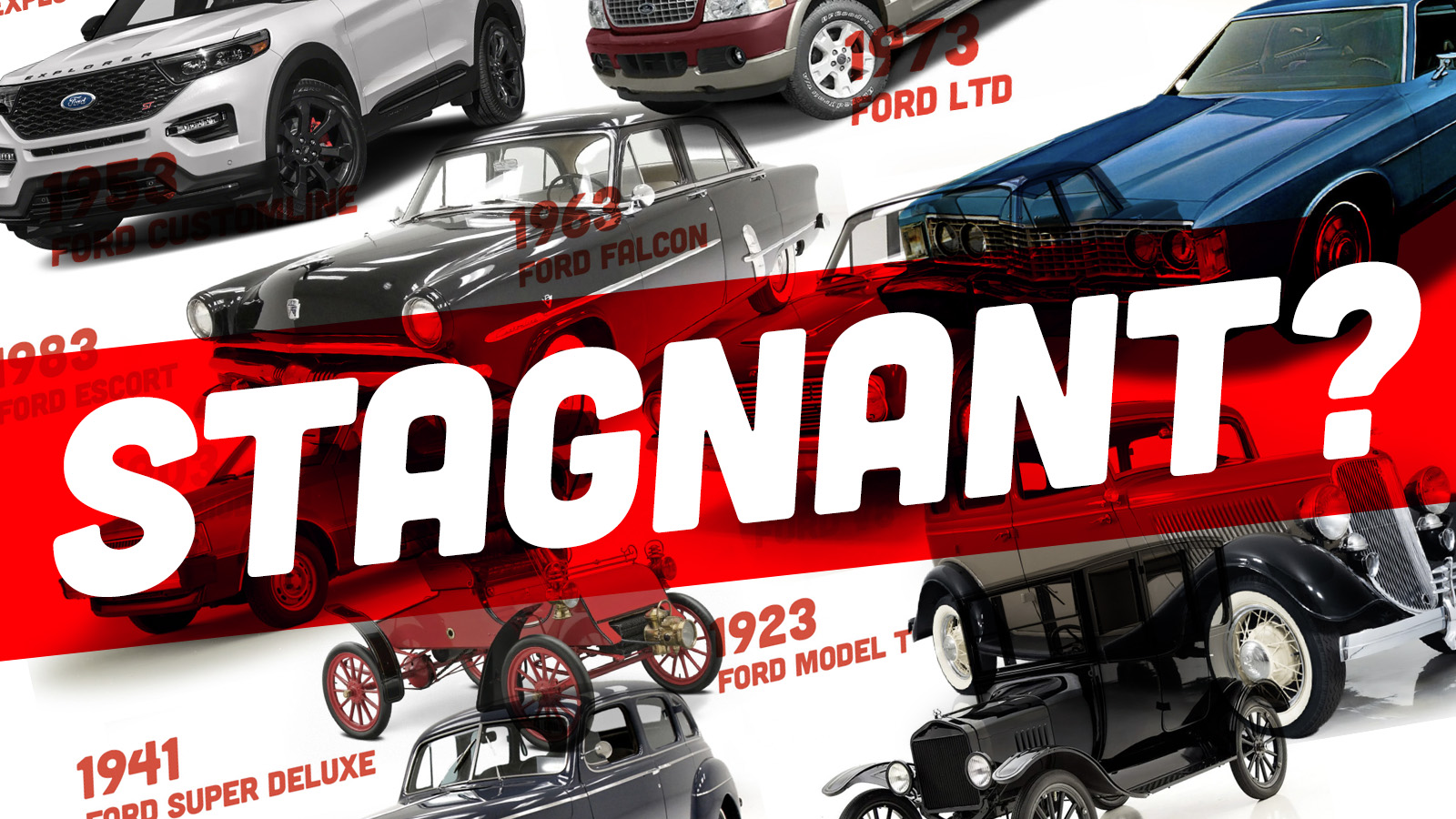
I’ve been reading some interesting things online lately about the pace of cultural, artistic, and technological change. Specifically, it seems that there’s a growing perception that things are, well, stagnating. And this isn’t just a few curmudgeons saying this on various message boards; it’s many curmudgeons saying this in some very large and influential publications.
It’s being noticed in fashion, art, music, and pop culture. Technology, too – old standbys like Moore’s Law (where the number of transistors on a microchip doubles every two years) are largely considered dead, for example. And, of course, people have been saying and thinking the same thing about cars as well, that the development and change in automobiles has slowed down in the past, say, 20 years or so.


Is all this true? Maybe? I mean, yeah, I still have clothes I wore 20 years ago that pass unnoticed today, and it’s easy to imagine that someone dressed in 1960s attire in the 1980s would have, to say the least, stood out. But what if it was just jeans and a T-shirt? Then maybe not. I think it’s possible that changes are happening that, while important, are less obvious than before. And it may be that way with cars, too.
I own cars from the 1970s, 1980s, 1990s, and 2010s, and they all feel quite different. But most of them are weird cars that hang onto deeply archaic designs and technology to begin with, so those aren’t really good examples. I want to try and think this through, so to do so, let’s take cars from one manufacturer that has been around since the beginning of the 20th century, and sold mass-market, mainstream cars. We’ll use Ford, and pick primarily examples of their best-selling passenger cars.
Oh, and it’s probably worth noting I’m focusing on gasoline, internal-combustion cars here. Electric vehicles, I think, are in a different position developmentally, so we’ll maybe address that development in another article.
I want to try and see if there really is a stagnation happening, and if so, what is it about? Is it just a superficial thing, or something deeper? Let’s dive in, decade by decade, and see what we can find out.
Let’s start at the very beginning, 1903, when Ford Motor Company started:
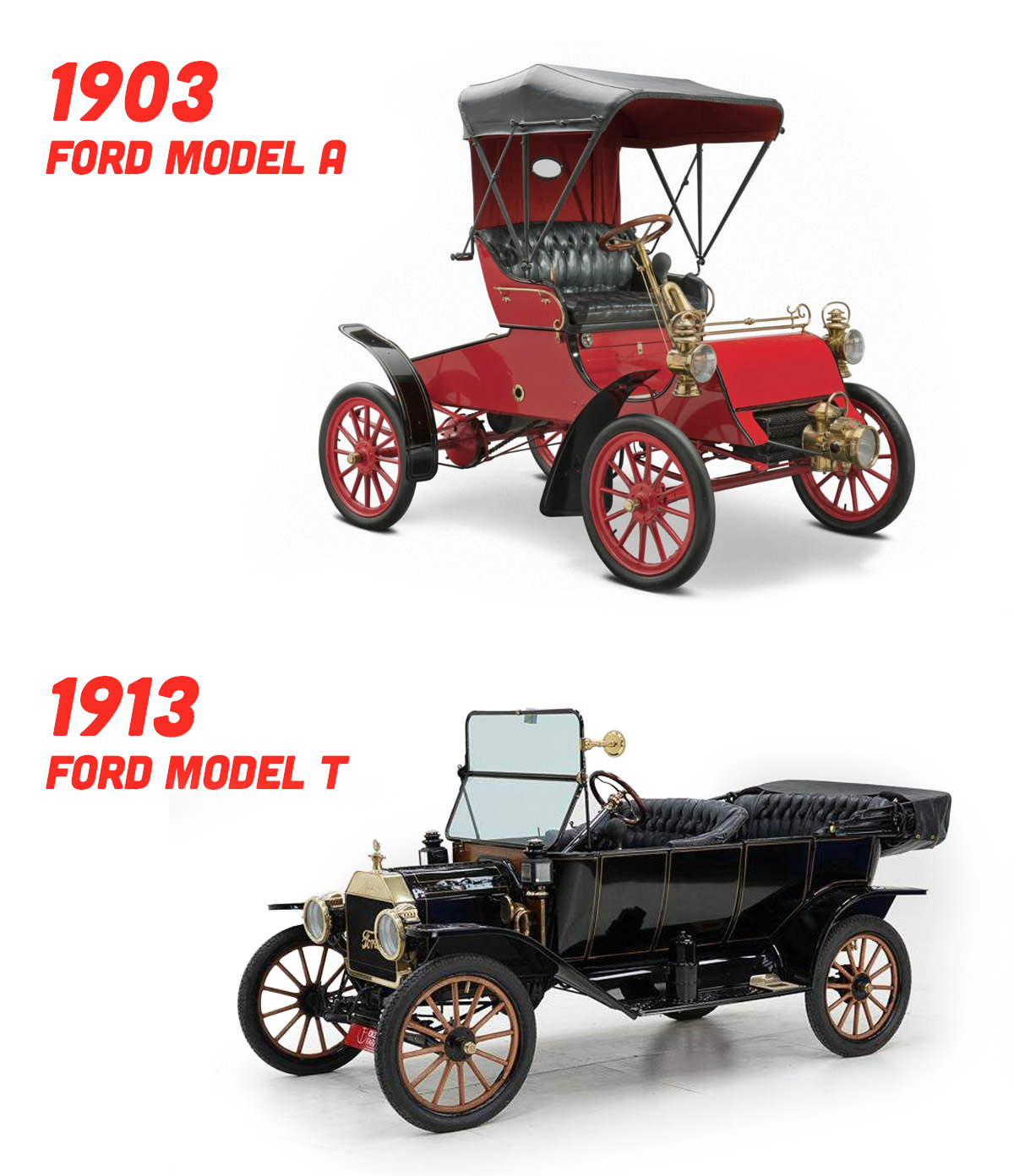
FoMoCo’s first real mass-market car, the Model A, was still very much a product of the natal motor industry. While automobiles had existed in some forms since 1769, gasoline-powered private automobiles were still very new in 1903, and standards and common practices were still being decided.
You were sitting atop the flat-twin, 8-horsepower engine, cooled with big, crude, finned radiator tubes, and a body that was like a loveseat sitting on a wagon. You sat on the car more than in it, and it really wasn’t especially reliable or capable.
Ten years later, though, we have the Model T, built since 1909: a truly mass-produced car, practical and rugged and reliable, with a 20 hp inline-four, a real, encompassing body, front engine/rear drive, and something that could be afforded by huge numbers of people.
These ten years represented a huge leap.
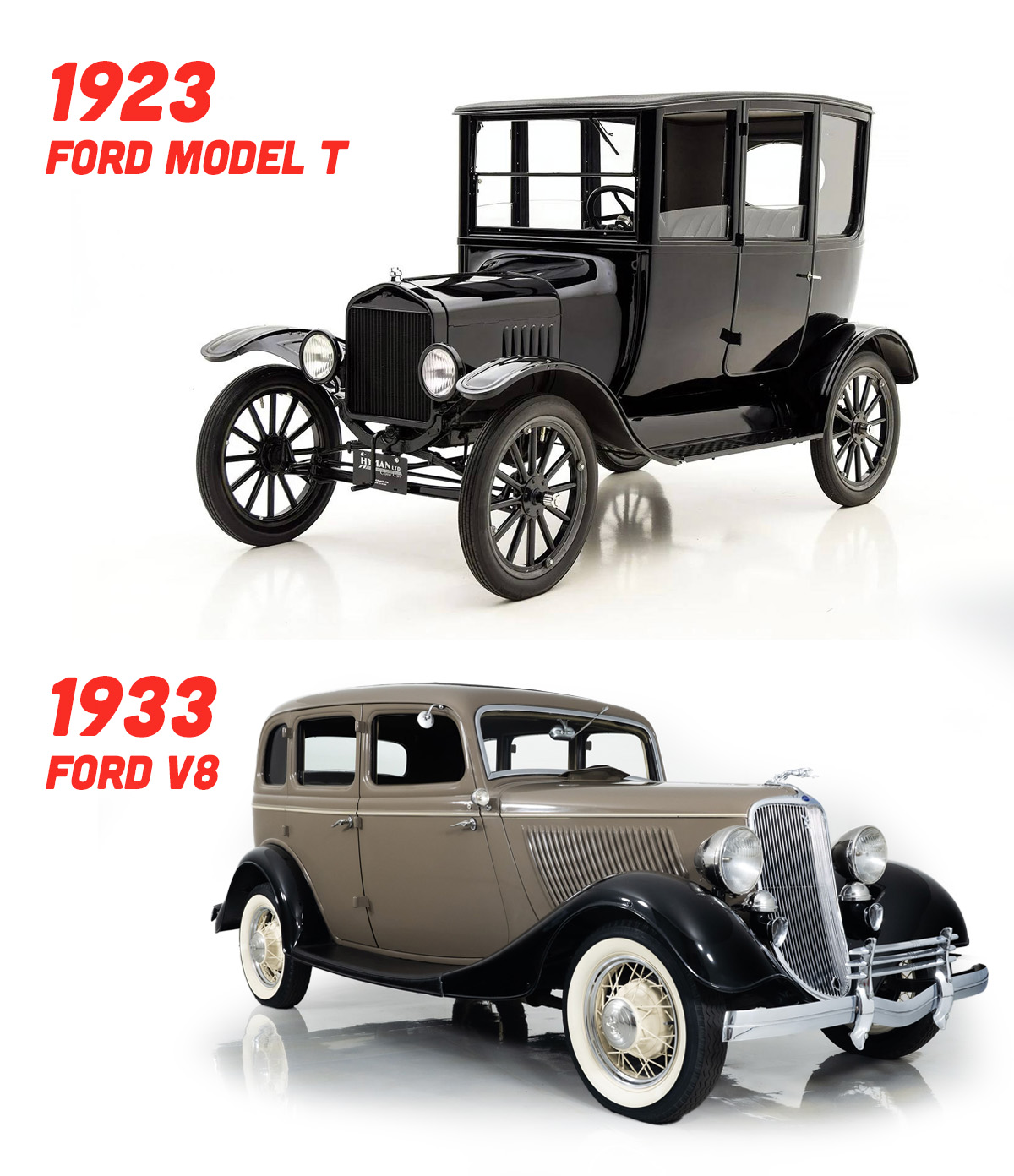
Ten more years, and the Model T has evolved a lot. There were electric lights, an electric starter (even if the crank was still an option), fully enclosed bodies were more common, and the design, while still based on the 1909 original, was getting more unified, less an aggregation of parts.
A decade later, we see some genuinely huge changes: a 1933 Ford had the first mass-produced V8 engine, and automotive design had come a long way, with more complex compound curves, and while fenders, headlights, and running boards were still separate entities, there was a further unification of body elements into a cohesive whole.
Control standards for pedals, wheel, and shifter, and so on, had become standardized by the 1930s, leaving the Model T’s old idiosyncratic three-pedal system and hand-operated spark advance in the dust.
This decade also saw pretty significant changes. A 1930s car generally felt quite different than a 1920s car.
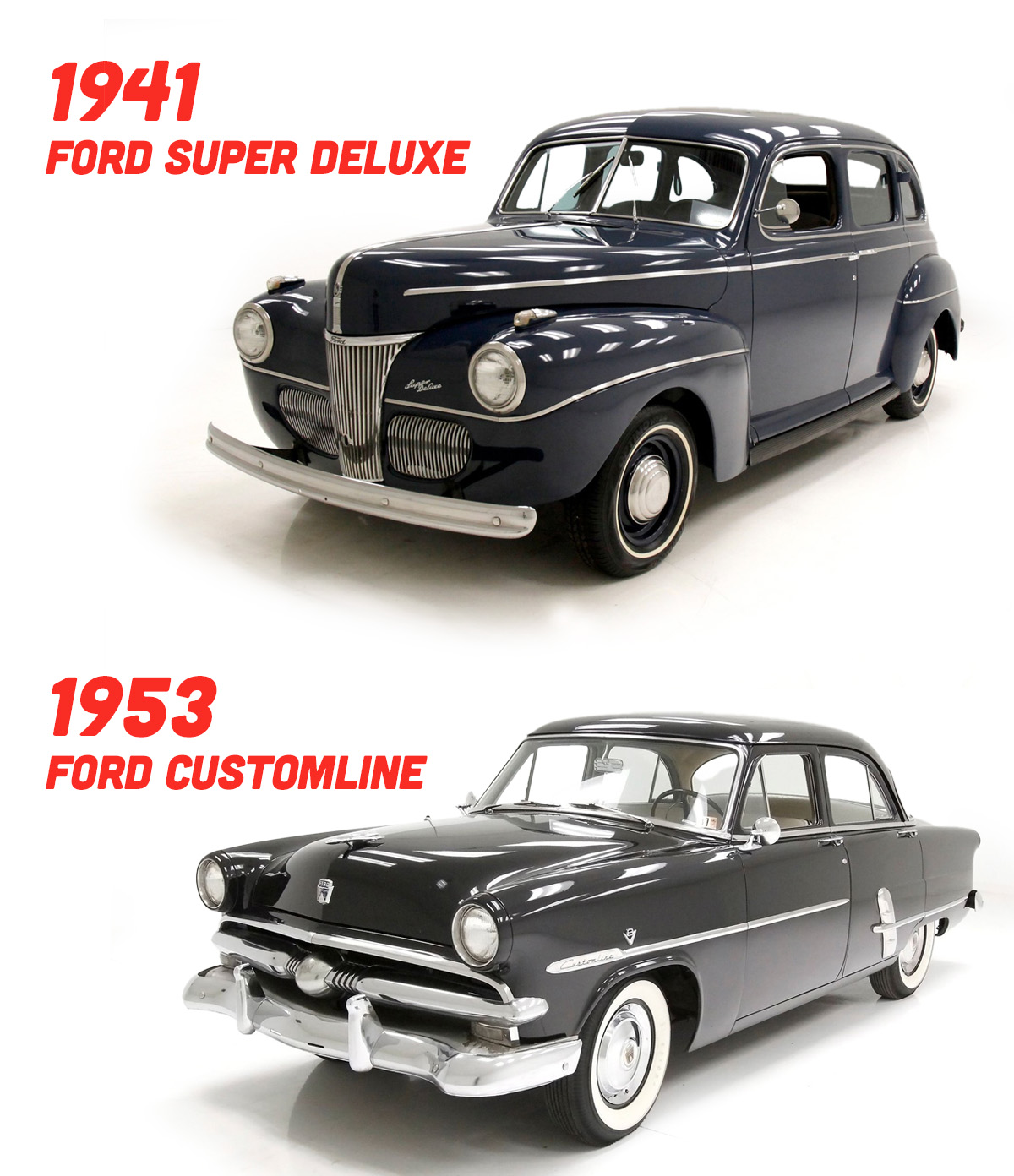
We have to use a 1941 Ford here instead of one a full decade ahead, thanks to a big inconvenience known as WWII. But that’s fine, as there are plenty of significant changes to be seen between the 1930s and 1940s cars. Designs have become far more harmonious, and while fenders are still separate units, the body has still widened overall, and complex curves have become even more pervasive.
The flathead V8 was still in use, but the driving experience was definitely evolving. The next decade would change things even more, as the 1950s brought about fully unified body designs with fully integrated “pontoon” fenders and a lower, longer silhouette that would define the general proportions of cars for decades to come.
Creature comforts and power-assistance would also flower in the 1950s, with vacuum or later electrically-assisted windows, seats, antennae, wipers, and more becoming common. Automatic transmissions would start their rise to popularity in this decade, and cars would generally become significantly easier and more comfortable to use.
Styling would also get more and more exuberant, culminating in the wildly chrome-slathered and tailfinned cars of the later ’50s.
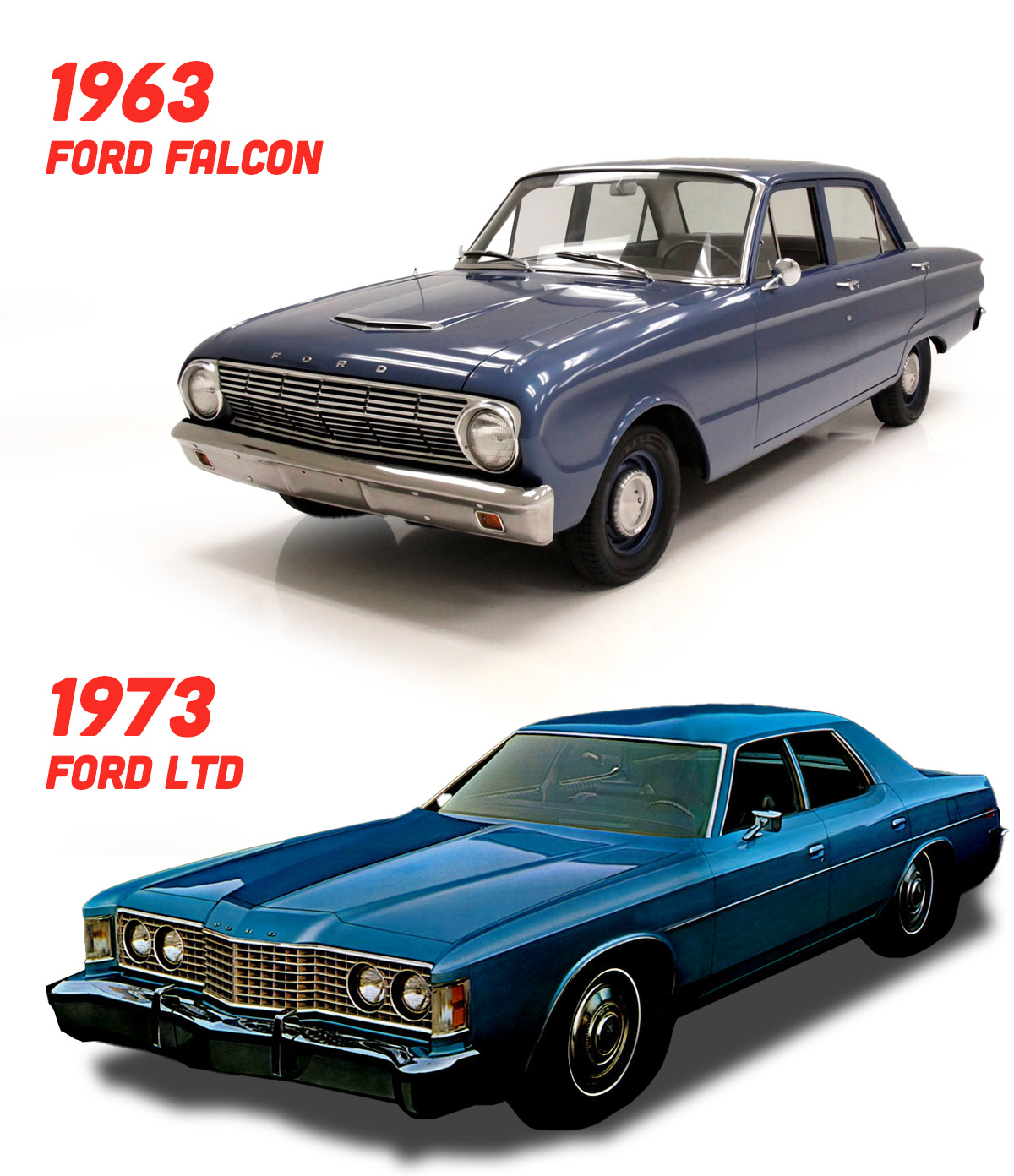
The 1960s were, in many ways, a reaction to the excesses of the 1950s; while there weren’t necessarily massive technological innovations, there were some, like the increasing popularity of unibody construction, like what the 1963 Falcon up there used. The 1960s also saw a swing to some more compact cars and an overall simpler, cleaner aesthetic. Once again, cars from this era felt very different from the decade prior.
While there were still plenty of V8 engines for ’60s cars, inline-6s and fours were not uncommon, and imports (and responses like the Corvair) saw more exotic things like air-cooled opposed engines.
The 1970s were, in turn, a bit of a reaction to the more restrained ’60s, with cars tending a bit bigger and more exuberant styling, with interiors that sometimes resembled space bordellos. Best-selling cars like the big Ford LTD there had massive V8 engines and stuck with body-on-frame construction for a while longer, but also started to at least pretend to care about safety with standard seat belts and even seat belt ignition interlocks.
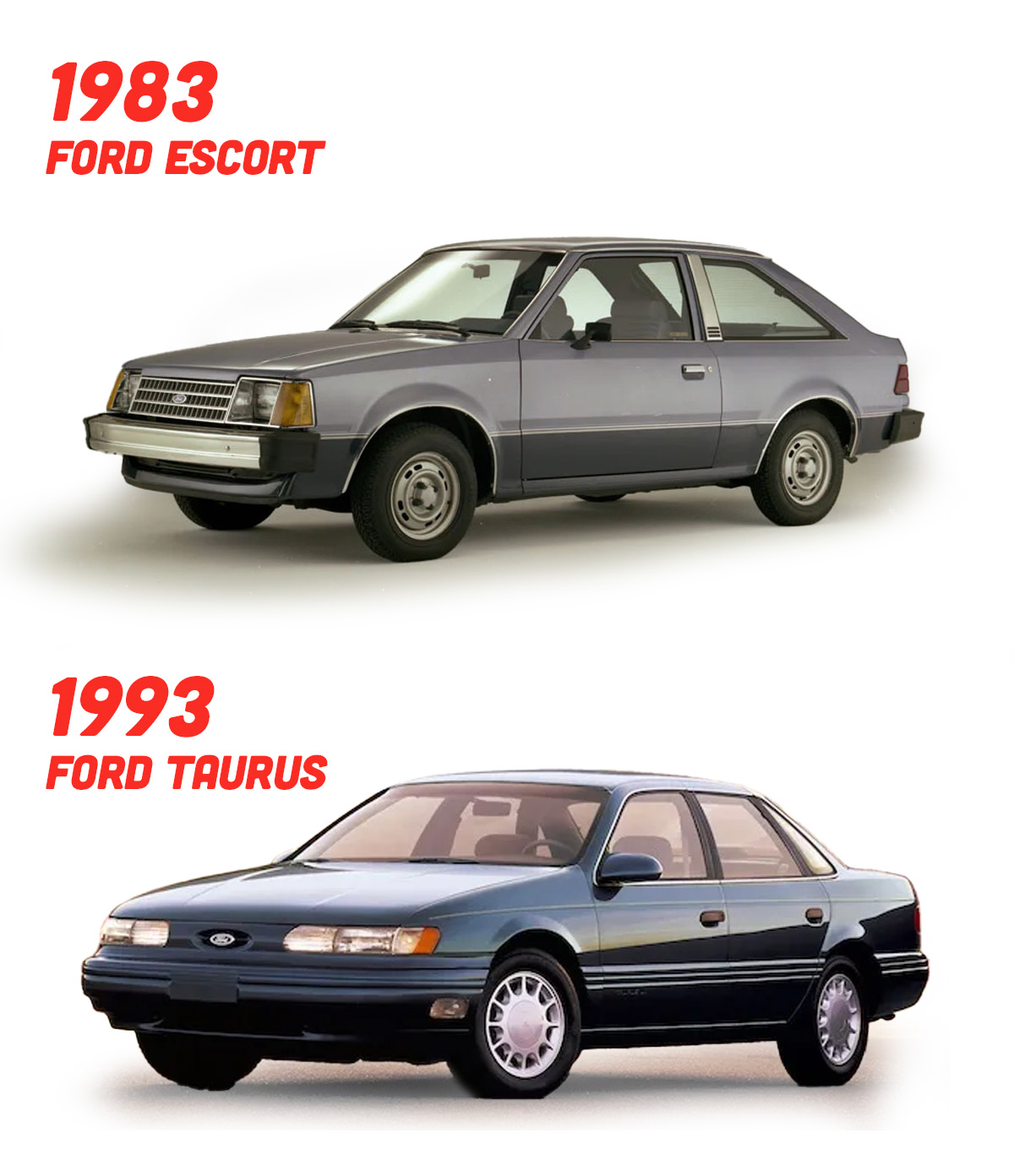
Thanks to oil prices and the increasing presence of Japanese imports in America, Ford made some pretty radical changes in the 1980s, with their best-selling car being pretty wildly different from their best-seller 10 years prior. The Escort was a compact unibody car with a transverse engine and front wheel drive, and fuel injection was even an option for the first time in 1983. All of these technical traits would become dominant in the years to come, even beyond compact cars.
A 1983 Escort looked, drove, and felt very differently from a ’73 LTD. This was a huge shift in how cars were, with the concept of a “world car” – that is, a basic platform that would be used in markets all over the globe – coming into prominence.
Moving into the 1990s, we see the same formula used by the Escort – transverse front engine driving the front wheels – adapted to a mid-size car in the Taurus. Aerodynamics were now a very influential part of exterior design, with regular wind tunnel tests affecting so many details of a car’s hardware. Door handles were more flush, and composite headlights were now becoming rapidly universal, replacing the old round or rectangular sealed beam lights.
I tend to think of the 1990s as the start of the truly “modern” era of cars, and driving a ’90s-era car today doesn’t feel all that different than a new car in many ways. But it felt pretty different from an ’80s car.
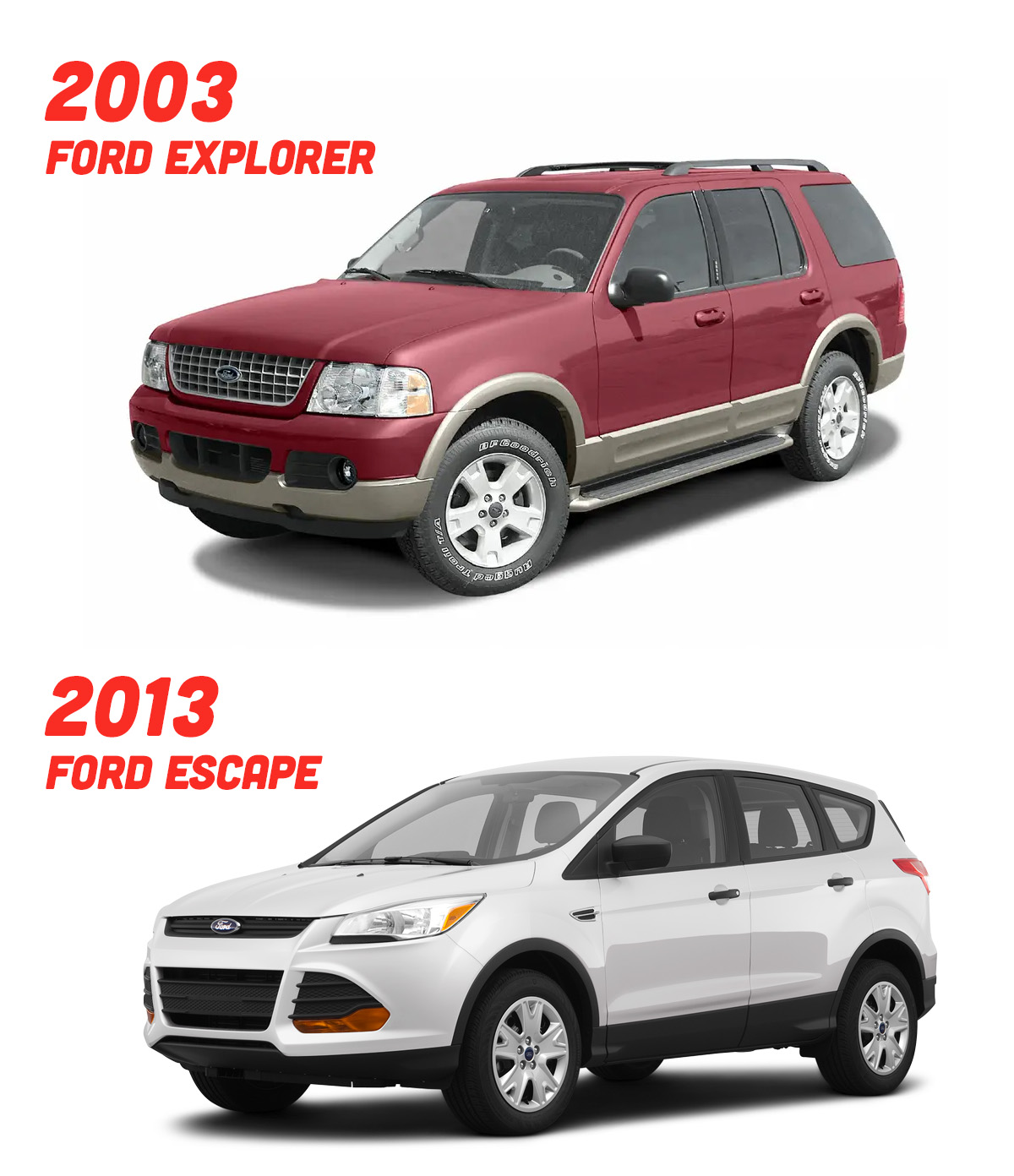
The SUV era was starting in the late 1990s, and by the 2000s had firmly taken root. The average car became a tall, big-tired wagon we all called SUVs. Aerodynamic, eroded river-rock-type styling remained dominant, looking like an evolution of aesthetic ideas that started in the ’90s.
Electronics continued to advance both invisibly, in ECUs and other engine management tech, as well as more noticeably, as features like cruise control and power everything became effectively standardized.
By the 2010s, those electronics were now sprouting very visible center-stack infotainment touch screens on pretty much everything, and styling was getting a bit more aggressive. But these didn’t feel all that different than 2000s-era cars, really.
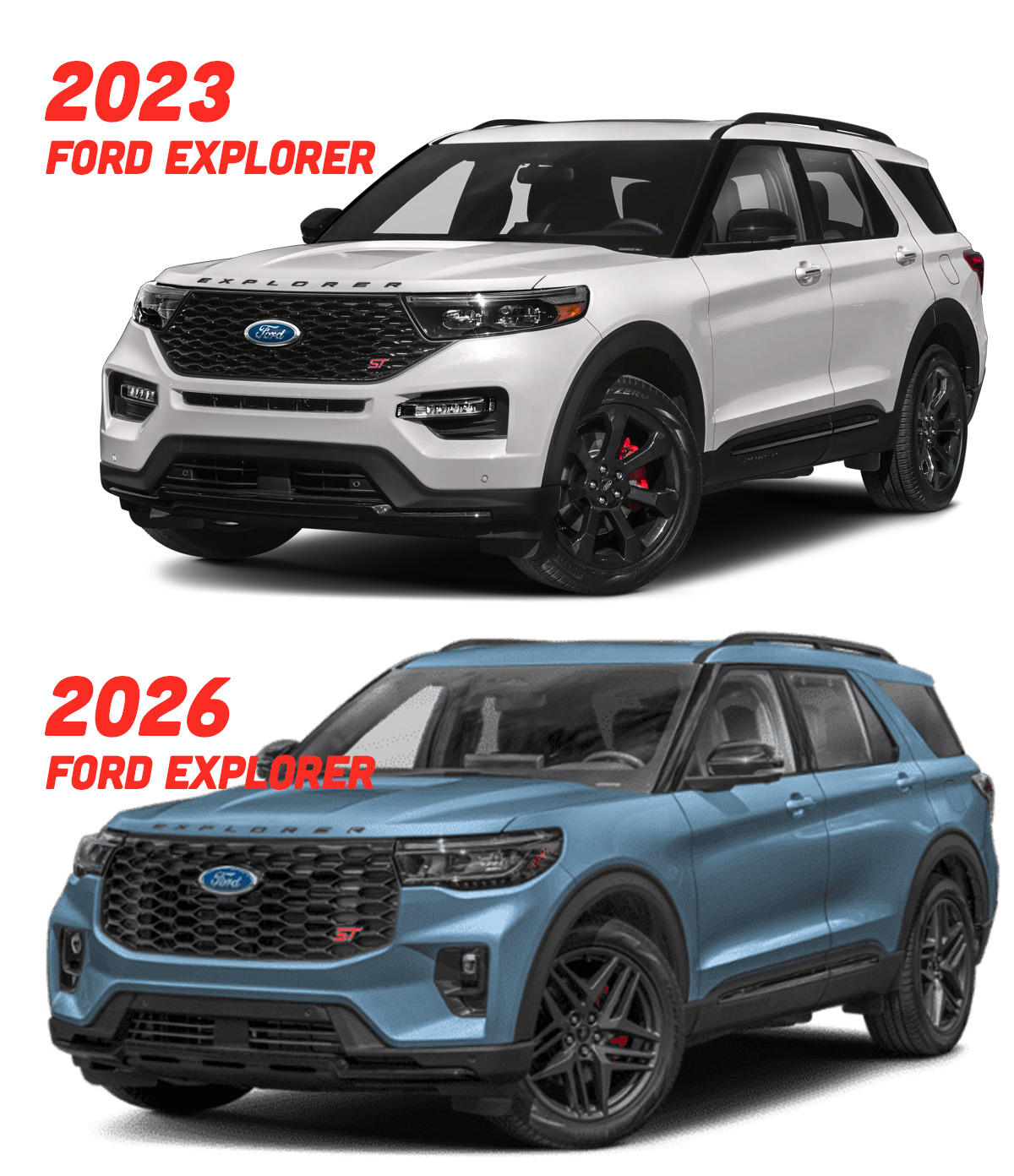
Between the 2010s and 2020s, things have definitely changed, but I think more evolutionary than revolutionary. Buyers seemed to gravitate to even bigger cars, so the Explorer now outsells the Escape, and styling has perhaps gotten a bit more complex and ornate, though still aero-focused and an evolution of what we’ve been seeing since the 2000s.
Touchscreens have become dominant in the interior (though there’s a current backlash to that), and electrification is far more common with not just full battery EVs but hybrids, and advanced driver assist features like lane keeping and dynamic cruise control are now common. Cars of the 2020s are incredibly advanced machines, no question, but when I get in my 2010 Volkswagen Tiguan, it’s not as different from a new 2026 VW Tiguan as, say, getting into a VW from 1994 or so.
Let’s think about this another way; let’s look at whole generation spans of time, say 20 years. How different do cars 20 years apart at various times in history feel? Let’s look:
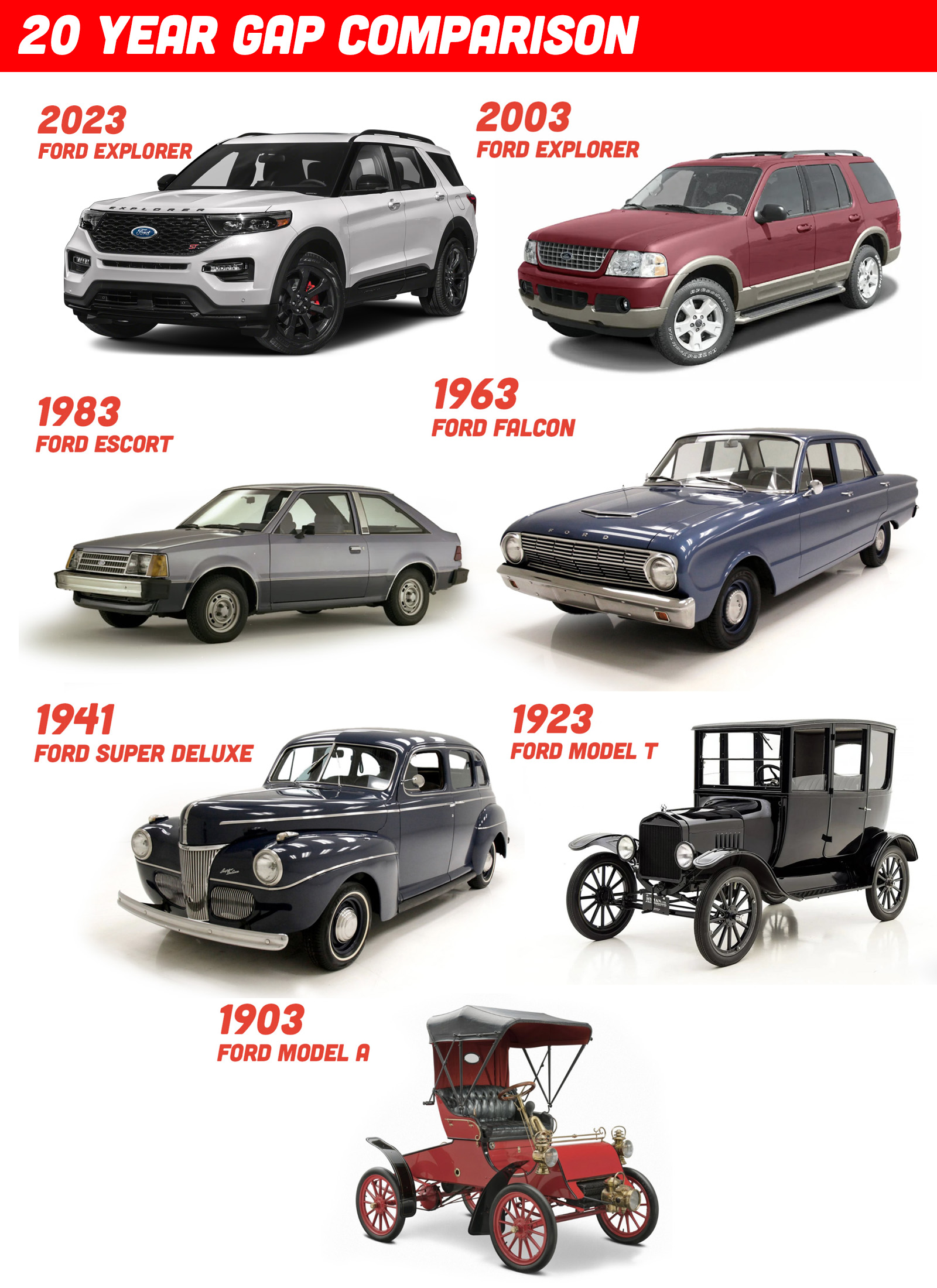
I think it’s safe to say that of all of these, the gap that feels the least significant is 2003 to 2023. Just compare that 2003 Explorer to the 1983 Escort and I think you’ll see what I mean. Those are radically different driving experiences, even beyond the differences in size and type of car.
Or look at the Escort compared to the Falcon – they’re not even close in so many ways: driving experience, safety, efficiency, design, and so on. Same with the jump between 1963 and 1941, or 1941 to the Model T. All of these generational gaps seem positively radical.
Except for the most recent. So maybe there is something to this theory of stagnation.
Or! I actually think something else is at play: the kind of development that is happening. I think maybe it’s less about stagnation as much as it is that we’ve exhausted the low-hanging fruit. The big things to learn about aerodynamics, engine management, or power electronics have already been learned. Now we’re at a point of refinement and deeper development, and those changes simply aren’t as noticeable.
But advancement is still happening every year. Is it all good? I think the fact that heated seat subscriptions and touchscreen glove box releases exist tells us that, no, it is not all good. But it’s definitely happening.
So, I guess I feel comfortable saying this: it is true that obvious and dramatic automotive development and advancement appear to be stagnating. Maybe, like microchips and Moore’s Law, we’re past the easier early stages of dramatic development. Maybe we’re in the early stages of more refined, deeper, and subtler developments.
Just like how computer CPU speeds don’t seem to ramp up as dramatically year-to-year as they once did, other advancements have taken over, and raw MHz speeds aren’t even something geeks crow about anymore, really. All modern cars are, generally, fast, comfortable, and efficient. The big basic problems have been addressed. So what comes next?
That I’m not sure about. I don’t think we’re stagnating, though. I just think it feels that way. If that bothers you too much, you can do what I do and drive genuinely archaic crapboxes; then anytime you step into something even from this century, it’ll feel like you leaped into the future.
Top graphic images: Ford




You know, the more I think about this, I’m also interested in knowing:
I will say that there is a corollary to this, in that a lot of 90s cars were 1970s/1980s cars that were rebodied and reskinned until various safety groups around the world chased those cars off the market (or at least out of the European and American/Canadian markets) in favor of ground up redesigns in the early 2000s.
A car from 2005 is probably similarly safe in a car accident as a car from 2025 (for the occupants at least, and the things a more modern car has to prevent the accident in the first place notwithstanding) and may even have the same basic underpinnings as a car still sold very recently; but a car from 1995 may very well be a car that was finishing development when Ford was president (or older) and no amount of airbags or ABS or traction control systems are going to make it comparable to cars after those ancient underpinnings started being jettisoned for modern chassis.
lol, commented before reading yours – I think today’s car is way safer than 2005’s car – I’m trying to research it…
All of those up until 2003 you could still fix with wrenches and parts without requiring some kind of laptop or advanced computer engineering degree. I suppose that shows my bias. I’m happy to find and drive older vehicles with character.
Just from exterior design perspective, absolutely they change less. Look at 55-56-57 Chevy BelAirs – different sheetmetal each year. 75-76-77 Monte Carlos – same sheetmetal, but a switch from round to rectangular headlights for 76, and a different grill the next year so you can still tell a 76 from a 77. 2024-26 Traverse LT – you can’t tell them apart without checking the VIN.
That is a really nice color on the Taurus. If I could find a well-preserved one of those in that color, there’s no telling what I would be willing to pay.
I’d argue that this point depends solely on the descriptors used in comparison. An ’03 Explorer used a 2v pushrod mod motor, a 2023 uses a DOHC turbo motor of 2/3 the displacement and twice the power. ’03 had a five-speed, ’23 has a ten-speed. ’03 is down 500lbs, and six inches in length/width.
Automotive styling changes have definitely slowed down, but I wouldn’t say they’ve completely stagnated. And comparing to how design is evolving now to the middle twentieth century is not really fair at least with American cars since American companies were releasing all new designs every damn year for a while.
In my opinion, the slower pace of cultural change is directly connected to the internet and social media. everyone talks about how we used to be a monoculture, but that couldn’t be further from the truth. The lack of connectivity made us much more culturally diverse since it was harder to see what everyone was doing and were into. Any biologist will tell you animals living in small groups on islands evolve with much greater diversity than large, continent-spanning populations. And now we’re becoming one big planet-wide culture which may get stuck in a cultural feedback loop if we’re not careful.
I don’t want to just stagnate, lets go BACKWARDS! Bring me some fun colors and even better shapes! Lets get all era’s of cars back on the road with modern safety standards (crash not beeps and boops, those need to be optional).
I miss fun colors. As long as people see cars first as resale value and second as transportation we are in greyscale hell.
I sometimes have an urge to go up to people driving interestingly coloured cars, and thank them for picking something that’s not the usual boring silver/white/black.
I do not see in the comments that hard economic times can lead to conservative ideas and shopping habits. Cars are expensive (queue up the they are cheaper than ever posters) but they feel expensive so people choose the same boring crossover shape for resale value and to not stand out in the crowd. They are boring just like the color choices have gotten boring. One could argue that the boring crossover shape has evolved to the steady state environment and until there is a big change to choose a new shape we are stuck with boring crossover shape.
Along the same lines, you could argue that longevity of modern vehicles plays a part as well. When your bright yellow coupe was starting to wear out at 40k miles and essentially scrap in 4-5 years, it wasn’t as much of a commitment as buying a car today that should reliably last 10+ years and carry you into a whole new era of your life.
good additional point. thanks!!
> we’ve exhausted the low-hanging fruit.
I think that’s right. Mobile phones hit that point maybe 5 years ago? Laptops stagnated until ARM started to be a viable platform (a rare instance where Apple is actually in the lead here). Tech moves faster than large manufactured objects like cars, because so much of it is software and that’s easy to change compared to a production line.
And the tech side of things is where automakers are pushing the updates as well. How do you get someone out of their 5 year old car that still runs perfectly, or into your brand when everyone in the segment offers good reliability, power, fuel economy, etc?
We’ve optimized the hell out of internal combustion engines, mass market suspensions, and basic creature comforts. So now we get 28″ touch screens with HVAC controls buried in them.
And yet GM, Hyundai, Ford, and many others still release engines with catastrophic defects. It’s pretty mind-blowing to me.
The fact that GM has forgotten how to build a reliable pushrod V8 boggles my mind.
Of all makers, you’d think they’d have it on lock.
Two things — around 30 years ago all car makers started using Catia CAD software (from Dassault the jet maker.) If you ask it to draw a curve it does so, and it will be pretty much the same curve as the designers of another car got when they asked it to draw a curve…
And secondly, in Europe, car makers had a very clear schedule to make cleaner engines, and so they spent billions, every five years or so on new engines.
Most very good Purtec and Blue HDi being exceptions….
But the money on motors meant that there was less money for extravagant bodies — so you are right. I drive a car from 2026 and it looks a lot like cars from 2026.
Gas cars I agree with your tentative conclusion that maybe they are stagnating?
Omitting the tectonic shift of modern electric powertrains makes that conclusion possible.
Accounting for modern electric drive though I’d say the last 8 years have been one of the fastest periods of change for cars.
Pretty much, ICE cars are in the plateau of an S-curve. From the few newer ICE cars I’ve had as rentals, not much has changed from the 2006 A3 I used to have other than infotainment. EVs are just starting into the upward ramp of the S-curve, and accelerating.
I feel like there’s not nearly as much available that is different, interesting, or sporty, especially at the lower end of the market. It also seems like engines have become much more unreliable in the interest of fuel efficiency gains. Most of the modern stuff is just an appliance to get you from A to B. What’s the reasonable obtainable car for a younger person to get excited about? My 23 YO drives a Bolt EUV and enjoys the tech and novelty of it, since he’s an Electrical Engineer, but I was the one that picked that out for him. My 21 YO drives a 2016 Miata because I couldn’t pass up a great deal on it and I knew he would enjoy it. But that’s not the norm.
My EV and PHEV are interesting to me and feel different
The MGB obviously feels so different from anything else I have, but I don’t notice anything too crazy between my oldest ICE cars (2006 Miata, 2008 STS) and my newest (21 Ram), other than the RAM can do a lot of the driving tasks with my Comma.
So I guess I agree… There’s nothing that compelling between a modern car and something from the mid 2000’s. It’s just getting hard to get something from the mid 2000’s that has been well maintained with a reasonable amount of miles. The 90’s did seem like a huge step forward in design and features vs. the 80’s.
The one place that seems like a lot of progress is being made is safety and safety systems. You do seem much more likely to avoid or at least walk away from a serious accident in something modern.
My oldest- also an engineering major picked out a 2nd Gen Volt for his car when he started driving, (it was totaled and now he drives a MachE. My youngest wants a Maverick hybrid, or an ecoboost F150. They both like the more efficient vehicles. I think as a whole now engines are better than every (except GM in the big trucks). Even though they are more complex, the amount of power, the increase in the mileage and the fact most (not VAG/Audi) engines are consistently going well beyond 100k miles is amazing. These engines as a whole are on their second generation (eco boost) and are significantly more reliable.
We have some maturing going and I think that even though the outsides don’t look that different the insides are completely new. Let’s think about that Ford Explorer in 2003, that thing had 210hp (V6) and got maybe 20mpg. Now you can get one with 400hp+ (V6) that gets 30mpg, consistently in a vehicle that’s twice as heavy, safe and powerful, 40% power increase with a 33% economy increase.
I would never have bought a 2003 with 100k miles on it- now there’s a legit market for newer Explorers with 100k miles…..
I read and hear a lot something to the effect of your idea that “today’s engines are so much less reliable.” Do stats actually support this? Our expectations have grown along with mechanical capability. I think in the early aughts we started seeing a lot more cars that could go for an absurdly long time. Many of the newer cars haven’t had a chance yet, and we don’t know which ones will do. But I don’t think the fleet as a whole is decreasing in long term reliability as you posit. But I’m glad to be shown to be wrong!!
Cars peaked 15-20 years ago, IMHO, unless you are enthralled by electrification, which I am not.
So you’re ready to stop advancement and happily live in a stagnated past? I’ve got some vacuum tubes I’d like to sell you for your surround sound system.
There is a difference between vacuum tubes and making doorhandles require supercapacitors to operate in the event of power loss because we want them electrically operated for some reason.
Have you listened to a tube amp? Many old things are actually better. That was about the dumbest analogy you possibly could have come up with, LOL. When it comes to music, the major advantage of transistors is that they are a hell of a lot cheaper – they aren’t better in terms of how they sound. if you want to give me a couple of these for my system, I will cheerfully take them:
https://www.mcintoshlabs.com/products/amplifiers/MC1502
But to get back on topic, many things that have changed with cars in the past 15 years, again, unless you are an electron fetishist, are NOT for the better, and many of the things that are “better” are being wasted due to the ever increasing size and weight of them, even as clever marketing makes you think they are. And even electric cars could be a LOT less stupid than they typically are in terms of user interface. And it all literally comes at a price. Cars aren’t significantly more expensive because car companies are doing Scrooge McDuck swan dives into piles of cash, in fact most of them are going broke at the moment.
I feel like cars are starting to become like Cell phones. Every year they are a little bit bigger, more powerful, and more efficient, but it is the same experience all around.
Except everything is actually worse. My phone changed “all filled up” to “Allen filled up” this morning. Why? Wth? I used to be constantly amazed at spell check, but the last few months I am mainly aggravated.
Newer operating systems also require more capacity – the added computing power means sloppy code has become accepted practice and thus the extra memory is all wasted anyhow.
Agreed, early to mid 2010s everything was perfect and worked amazing.
After that I feel like everything has gone downhill.
You may be irritated, but Allen is probably pleased.
I’m pretty sure we can thank AI for that. Another example is Google Maps. It used to be scary good at routing and having correct information about the current state of roads. Now, I get stuff like all the roads in my city being listead at 25 MPH because the city put up “25 MPH, except where otherwise posted” signs all over the place. Apparently the AI bot processing the street view images misses the qualifier on the signs (I’ve seen this on roads with separate truck speed limits too).
This screws up the routing because now it doesn’t have good information to estimate travel times. GPS routing peaked 5 or 10 years ago and has consistently gotten worse since then.
The cost of new developments are higher than ever so all new chassis take longer, and the big money has been spent on EVs lately. So that’s where the big changes are, and realistically that’s one of the biggest changes in the last 100 years. Even more hybrids is a big change but that’s been on a progressive curve for the last 20 years, but should be higher if you ask me.
I recently discovered Cardle, and I’ll say from a styling perspective, guessing the year is often the hardest part, especially with anything from the aughts to the present.
Thank you for posting the link to Cardle. My wife and I do the Wordle every morning over breakfast. Now this will be 2nd cup of coffee ritual as I ease into work.
Edit: And they have a colorblind mode!! Yahoo!
Oh man, I just signed up too.
What a great idea for our kind lol.
Great article that puts it all in perspective. With my average fleet age well over 25 years, any time I get in my Mom’s 2020 RAV-4 hybrid feels like the future. It varies from time to time but my daily driver is now a 94 Accord and that feels modern enough. It starts with a turn of a key even below 0 deg F (no elaborate dance with a choke and gas pedal), has power everything, a couple of air bags, and I don’t really need anything more.
I think one thing that has advanced between the 90s and now and wasn’t mentioned is fuel economy, especially with hybrids. That Accord with its 2.2L engine only gets mid 20s. I blame the 4 speed auto for most of that.
I don’t know so much about the last 5 years or so, it the last ten years or so I think we have seen more significant changes than in the 25 or so before that. The nineties saw reliable comprehensive electronic engine management, power windows and locks and AC getting standard, hardly any truly slow cars or cars with driveability issues.
Last ten years, touch screens, back up cameras, key fobs instead of keys, though some these existed before that, these things pretty much became standard, changed the driving experience. Also driver aids, lane assist, adaptive cruise, backup alerts. Mechanical PRNDL standard disappearing.
Between my wife and I we had a 2007 Honda Fit and a 2002 Lexus IS300 into the 2020s. A 50s car started and drove the same (from a control standpoint) as the early 2000s cars.
Two three years ago we go to a concert with friends, they drink, I drive their new Buick. I get in at night, look around me, I don’t know how to drive it, get it into reverse.
We haven’t even talked about Electric cars and hybrids. Cars are stagnating?, maybe a matter of perspective if you are very young and all the things I just described as new are feeling old to you.
It seems like with the exception of pickup trucks and Teslas the overall design of cars keeps churning for no reason. Safety features a have been making a lot of progress but mostly it’s the same stuff with a different kind of ugly on it. The Volvo 240 was produced from 1974 to 1993, then it was a blur of warmed over Mazdas and I couldn’t tell you what a Volvo looks like. The only brand that has an identity is Tesla, but that’s sort of a liability for them.
I think the carmakers put all their resources into EV development and not doing anything substantial with their current models. Then in the US the administration is doing every they can to kill EVs and cheap energy, so all the cool toys go to places without racing lunatics in charge. That electric Honda E looked great, the Honda Super-ONE looks like it will be great, but in the USA we get a gigantic Chevy that’s pretty ghastly and everything else got cancelled.
The Ford Flex looked kind of nice until you saw it up close and realized how colossal it was.
There really isn’t.any new car that comes to mind that I actually want.
I really can’t think of many in the last 15 years I’d want.
Maybe a Lucid?