

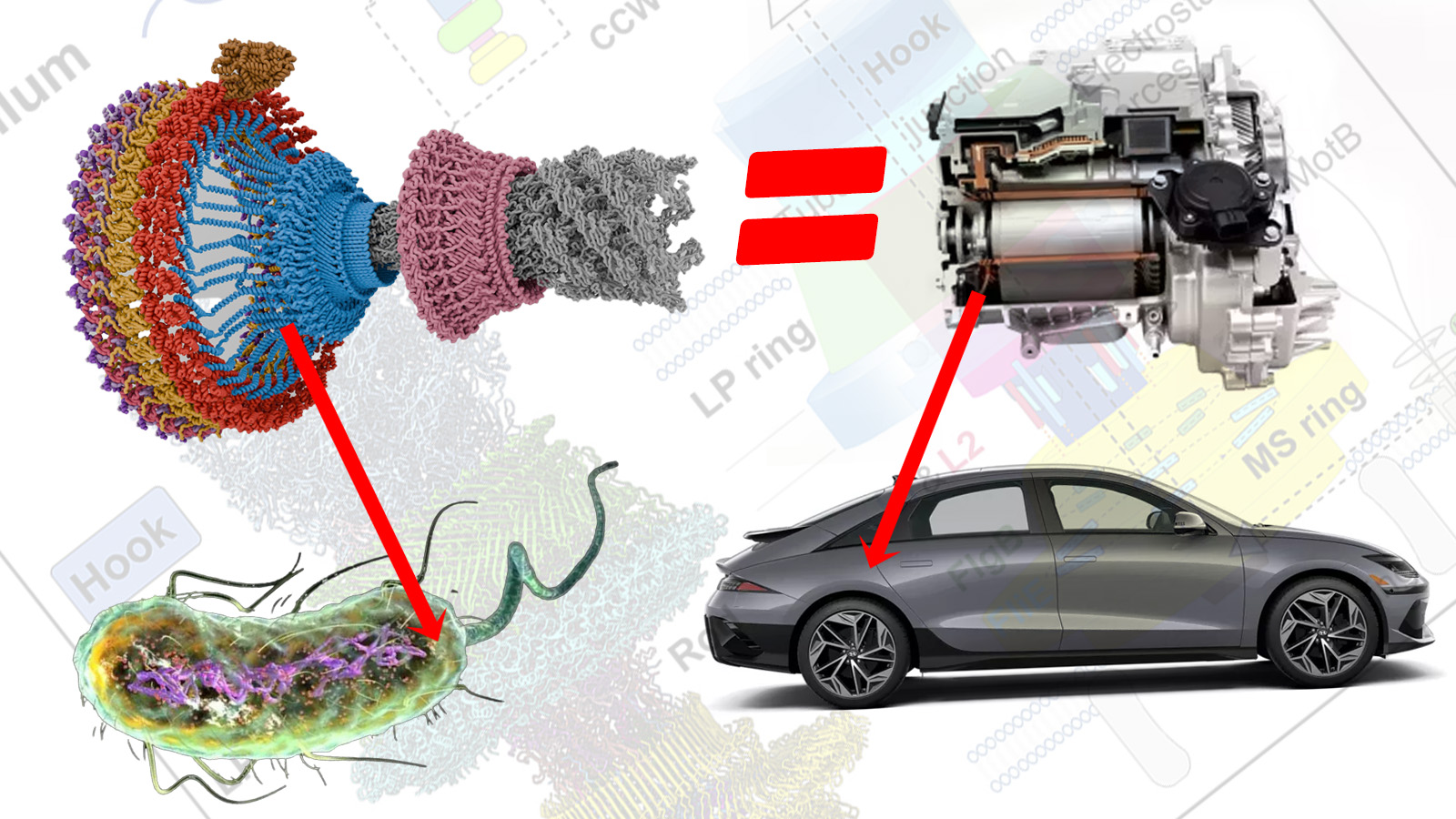
How much of eighth-grade biology do you remember? For whatever reason, I feel like I remember a lot. For example, I still remember that the difference between rough and smooth endoplasmic reticulums – reticuli? – has to do with the presence of ribosomes. Do I remember what ribosomes do? No, not really. I do sort of remember the Golgi apparatus and, of course, the powerhouse of the cell, the mitochondria. But what I remember being most fascinated by was how the flagella of single-celled organisms, like some bacteria, moved, because it sure seemed like a microscopic electric motor, somehow.
Incredibly, we’ve never really been entirely sure just how these biological motors worked. Until now, it seems. After 50 years of study, scientists like Mike Manson finally seem to have cracked the secret to how the flagellar motors actually work, and it’s fascinating and shockingly mechanical in a way that will feel strangely at home in an automotive site like this one.


An article in Quanta Magazine explains the workings of this incredible biological machine quite well and understandably, and in the process reveals the fundamental energy of life itself, called proton motive force.
Bacteria move around using a molecular machine called the flagellar motor that rotates faster than the flywheel of a race car engine and switches directions in an instant. After 50 yrs, scientists have finally figured out how it works. “My lifelong quest is now fulfilled.” Link⤵️ pic.twitter.com/AGiwOGOGXY
— Natalie Wolchover (@nattyover) April 20, 2026
The proton motive force is, wildly simplified – and even in this wildly simplified form I barely comprehend it – the process of “pumping” protons out of the mitochondria via electron transport reactions which creates an electrochemical gradient, which energizes the cell’s membrane. There’s positive protons on the outside of the membrane (which is the same as a hydrogen atom minus an electron), and negatively-charged hydroxide ions (OH-) on the inside of the membrane.
This difference in charges between the outside and the inside of the cell creates an electrochemical potential, which (again, wildly simplified) causes the cell to act a sort of battery, and the energy from that battery can then be used to do things like power this flagellar motor I’ll talk about more here, or be stored as ATP, or adenosine triphosphate, the fundamental energy storage molecule of life.
So, back to these tiny motors – which don’t just spin flagella, but also seem to be part of that mitochondrial ATP synthesis process – and how they work. They’re delightfully mechanical!
It’s a rotational motor, shockingly similar in some basic design to an electric motor; there are even parts called a rotor and stator, just like in an electric motor; you can see them called out in this video at about 1:10 into it:
These things spin at speeds of 6,000 to 18,000 RPM, which encompasses the RPM range of an F1 engine. They’re fast. And these are bi-directional motors, and the mechanism by which the direction switching happens was one of the previously not understood elements, but this study from March seems to have finally figured that out.
The directionality of the spin is a big deal; the way the flagellated bacteria work is they have multiple flagella. When the spin in counterclockwise, the flagella wrap together and provide a coherent directed motive force. This is how it works when the bacteria is actively heading to a food source.
When it spins clockwise, the flagella flap around independently, and there’s no directional motion, just some flailing around. While it’s flailing, if a new food source is detected, the motor switches direction and can then propel the bacteria towards the buffet.
Here’s how this is described in the Quanta article:
Recall that a flagellar motor switches directions, causing the bacterium to tumble, when environmental conditions seem to be getting worse. When fewer nutritious molecules drift in, the bacterium “phosphorylates” proteins called CheY, tagging them with phosphorus atoms. Within milliseconds, phosphorylated CheY molecules diffuse around the cell, and one of them binds to one of the C-ring proteins. This small change triggers a transformation: The protein flips into a different structural configuration, which flips the next protein, and then the next. Almost instantly the whole C ring reshapes itself, like a hair clip snapping into the other of its two stable forms. Samuel’s team confirmed that the system is sensitive to a single signaling molecule(opens a new tab) in a study published in March 2026.
While the C ring is in its altered shape, the stators — the little clockwise-revolving motors — rotate against the inner edge of the C ring, rather than its outer edge. As a result, the C ring turns clockwise too. The flagellar bundle falls apart, and the cell tumbles.
Soon enough, the unstable phosphorus atom falls off the CheY protein, causing the proteins of the C ring to flip back to their original stable formation and turn counterclockwise again. The bacterium returns to forward movement, in a new direction, is search of more food.
The change in direction is handled mechanically; one of the rings physically alters shape so that when it makes contact with the clockwise-spinning stators, they make contact with the inner side of the ring instead of the outside, changing direction:
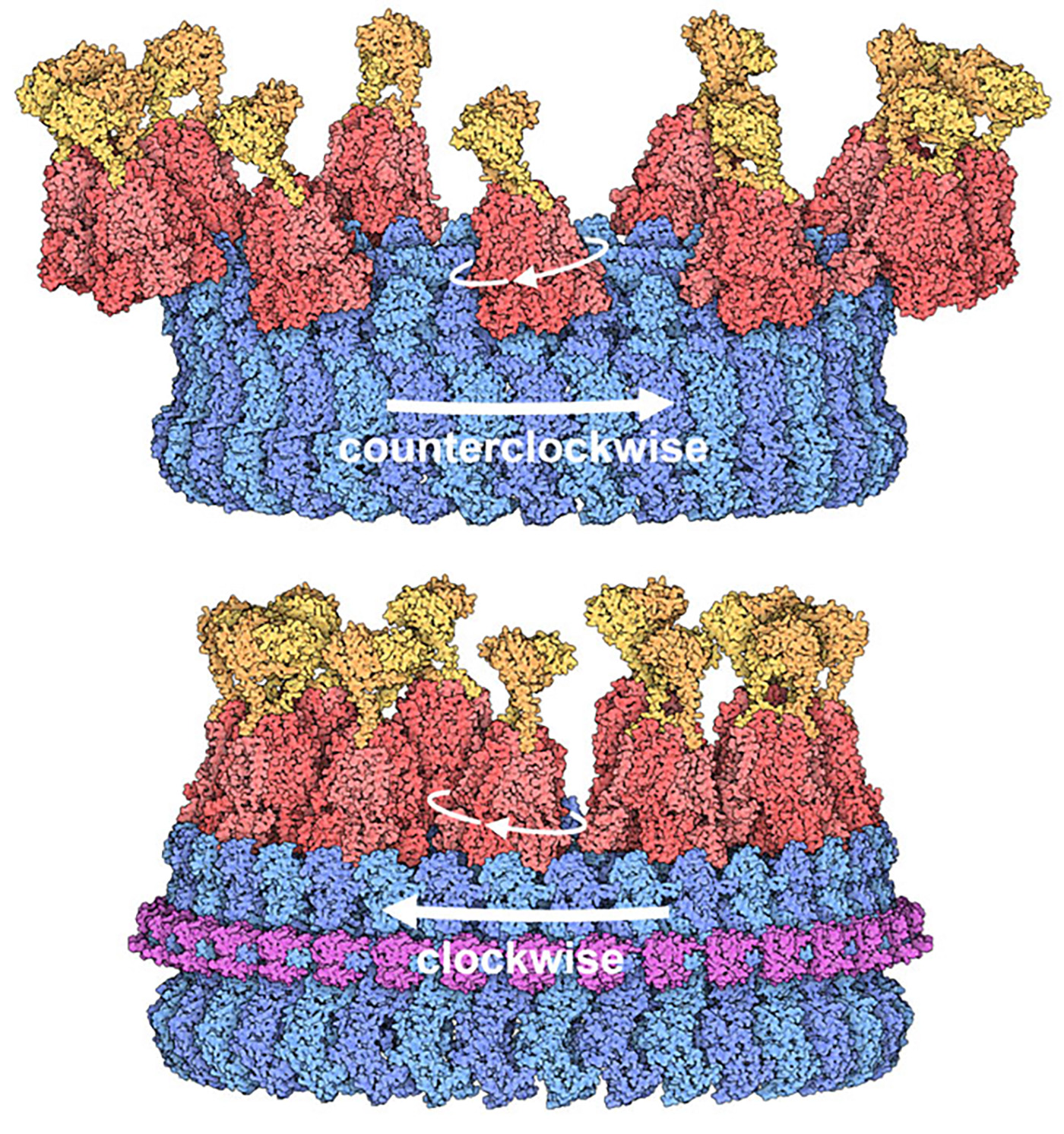
See that? the things on top that look kinda like BBQ chicken legs drive the outside of the ring for counterclockwise motion, and the inside for clockwise.
It’s so clever I want to plotz, and in that process of plotzing I’ll probably release millions of bacteria that have these very motors inside of them.
It’s all so astounding; natural selection created this, and even this level of complexity is possible when you’re dealing with about a billion years to get it right and a cellular generation time of under a half hour. Trial and error works great under those sorts of conditions.
So what does this mean for cars? I’m not entirely sure, but perhaps this direction-switching method could make sense on some future EV motor? Perhaps one that runs on sucrose and has big steel-braided cables for flagella!
Also, there’s the notion that nature is capable of developing things like wheels and gears and motors. Prior to anyone understanding how these motors worked at all, the notion of a biological wheel was considered absurd. But here it is, spinning at over 10,000 RPM, letting e.coli tear ass through your gut so you, in turn, tear your ass.
Howard Berg was the scientist who first figured out flagella were rotary-motor powered back in the 1970s; the Quanta article quotes one of his students, Aravinthan Samuel, who put it perfectly:
“Biology can build wheels. Now we know.”
Can this be adapted to a more macro-scale? Can we grow automotive drivetrains in vast, stinky vats one day? Do we want to?
I’m not sure yet, but I’m happy to be fascinated by all the tiny proton-powered motors swirling around in my gut as I type this.
(Top graphic images: Hyundai, PDB101, an e.coli I used to date; Flagellar motor illustrations by Prash Singh (www.nature.com/articles/s41564-024-01674-1))




Wow, this wild! I didn’t even know that biology could build motor/wheels like this at all…