

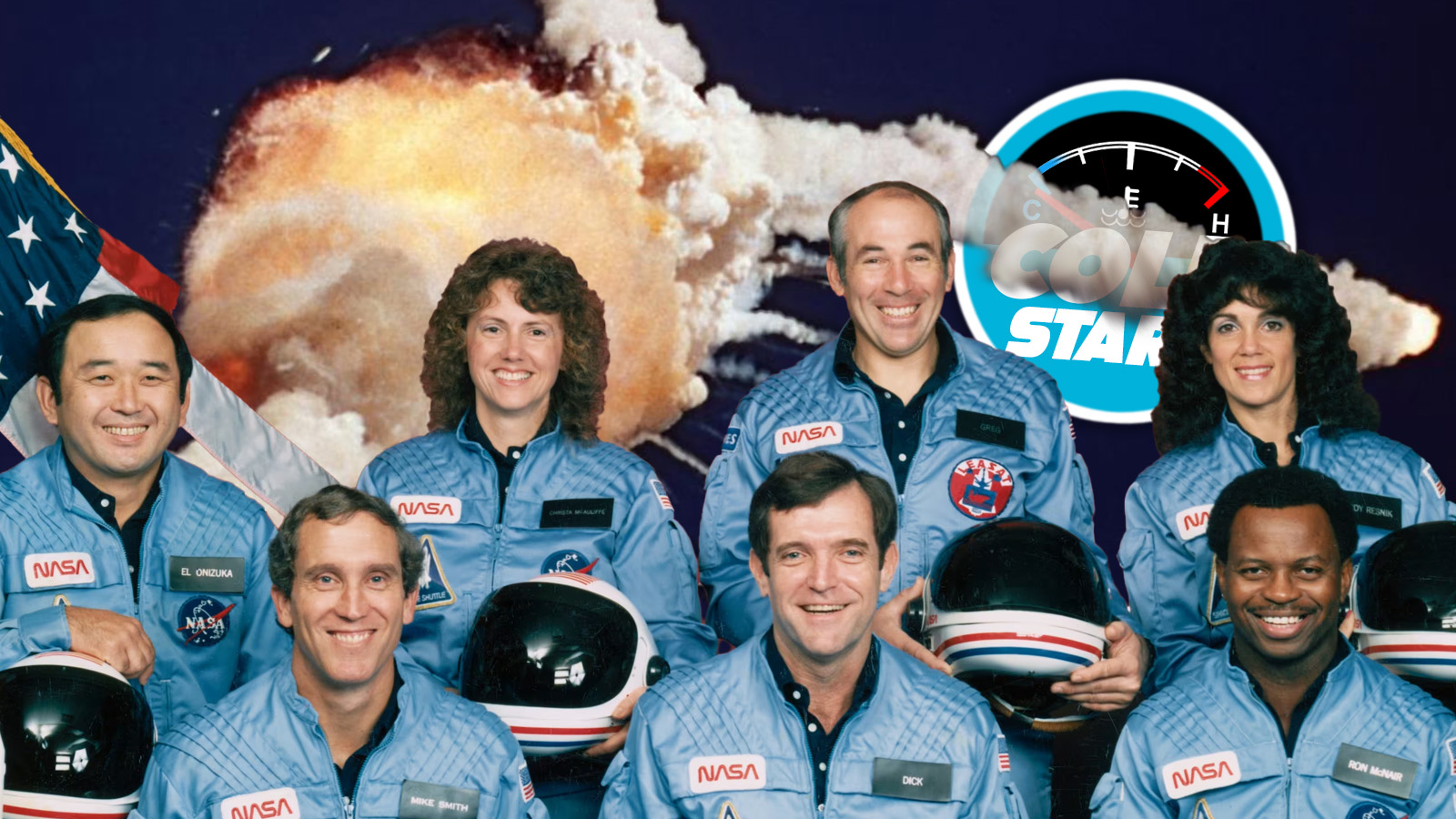
Like many of my generation, I watched the space shuttle Challenger explode on live television, while I was at school. I remember it very well, because I was a colossal space geek as a kid, and still am, as a kid well into his 50s. I was excited because it was unusual to watch a space launch in school in 1986 – the Space Shuttle program, while never coming close to reaching its predicted launch schedule of 50 or more flights per year, nevertheless proved capable of launching more frequent crewed space missions than ever before, with a peak just the year prior to the disaster of nine missions. Watching space shuttles climb that tower of flame and smoke into space had become almost routine. Maybe not “almost”; I think for most people a shuttle launch barely registered as news anymore. But this time there was a teacher aboard, so all of the schools paid attention.
The inclusion of that teacher was a huge deal; I remember the search that led to the selection of Christa McAuliffe, but more importantly I remember how it felt knowing that this was a real, normal person going up on that shuttle. She was just a teacher! I knew what teachers were like, I saw them get flustered and chain smoke in the teacher’s lounge and look exhausted and exasperated by me an all my fellow idiot kids – these were not superhumans, like I imagined astronauts to be, or at least DeLuxe-trim-level humans. They were people, and seeing a normal, bright but likely flawed person go on the shuttle really made it feel like things were changing, and soon space travel would be something we could all aspire to.


Of course, that’s not how it played out. I remember that I was in art class, which I loved, and I remember the big CRT television cart getting wheeled into the room so everyone could watch. I’d seen shuttle launches many times, and had memorized the diagrams and charts that were published in National Geographic, so I eagerly awaited each expected stage of the launch – the three main engines on the orbiter firing first, making their smokeless cones of barely-visible exhaust flame, then the massive bursts from the pair of solid rocket boosters mounted to each side, each one belching out huge columns of white clouds as they flung the whole shuttle stack into the sky, and then finally the two spent boosters ejecting, leaving the orbiter and its big orange fuel tank to continue ascending alone, until the cameras could no longer see it.
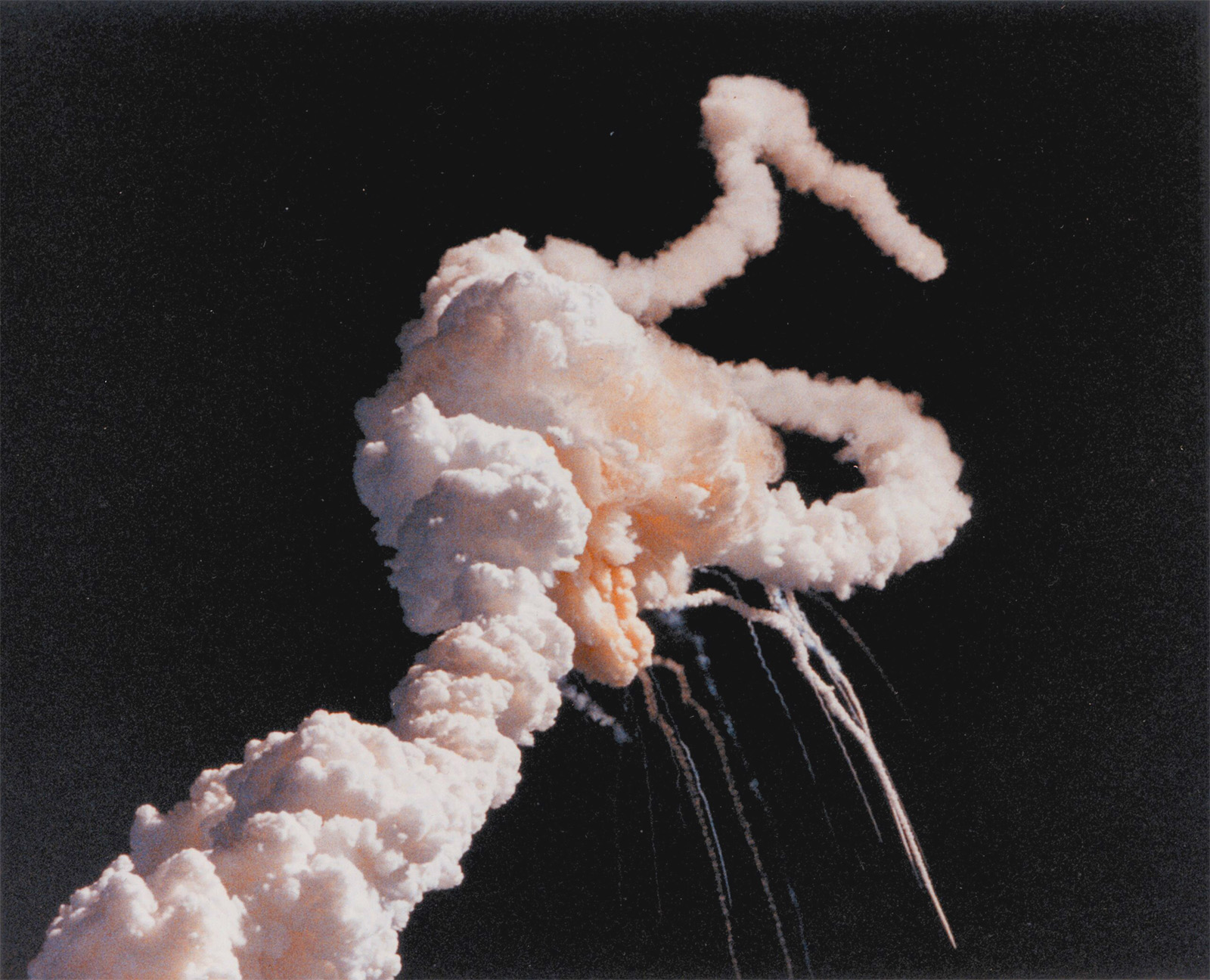
What I expected was not what I got, of course, and as soon as I saw that big ball of cloudy smoke and the two boosters careening around wildly and uncontrolled, I knew something was off. I remember that strange numb feeling for a few seconds while everyone was trying to figure out what the hell was going on, the announcers on the TV seeming confused, and most of my classmates pretty oblivious. That moment seemed like a very long time, but it wasn’t.
The realization of what happened soon came, both to the voices coming from the television and in our messy art room, with its big tables and stacks of pastels and paper and clay, student’s artwork of wildly varying quality lining shelves all around. There wasn’t a big uproar in the class, just a sort of sudden hush, like a huge tarp had been thrown over everyone as we all shared a moment of realization that, sometimes, no matter how well planned, no matter how smart the people in charge are, shit goes bad.
I think to appreciate the widespread impact of the Challenger disaster, you have to remember how much the whole thing was built up, and how hard a fall it was. The shuttle program was a huge success and a huge source of pride for America. These were the first actually re-usable spacecraft (though some in the program described them more as re-salvaged, due to all of the maintenance they required) and they were so much larger and more impressive than the dinky gumdrop capsules that came before.

We’d been launching them with seeming ease many times a year, and had gotten to the point where NASA felt confident enough to send up that teacher, to great publicity; the disaster couldn’t have happened at better moment, if the goal was to remind humanity about the concept of hubris. I feel like for those of us that saw it, there was one big common takeaway, even beyond the expected feelings of loss and tragedy about those seven people whose lives were ended that day. To some degree, they knew there were risks, and they willingly took those risks to do something they genuinely loved and believed in. That doesn’t make what happened less tragic, but it makes it a little easier to understand.
No, I think the more unexpected lesson that we learned then is that, to some degree, we’re all winging it. The people we trust in positions of authorities are still people, flawed people, and they make mistakes and are as susceptible to being influenced by the wrong things as any of us. I think there’s some seeds of the strains of mistrust of authority and expertise that many of us feel today, rationally or otherwise. And I also think once the initial shock and sadness filtered away, we were left with a good bit of cynicism. I remember that just a few days after the tragedy, gallows humor jokes about it were already spreading around the lunchroom. I’m pretty sure it was later that week when I first heard a kid ask “Why does NASA only serve Sprite on the space shuttle? Because they can’t get 7-Up!”
I mean, it’s a well-crafted joke, and gallows humor is always a part of dealing with a tragedy, but there is darkness beneath it, and I think we’re still dealing with some of those repercussions.
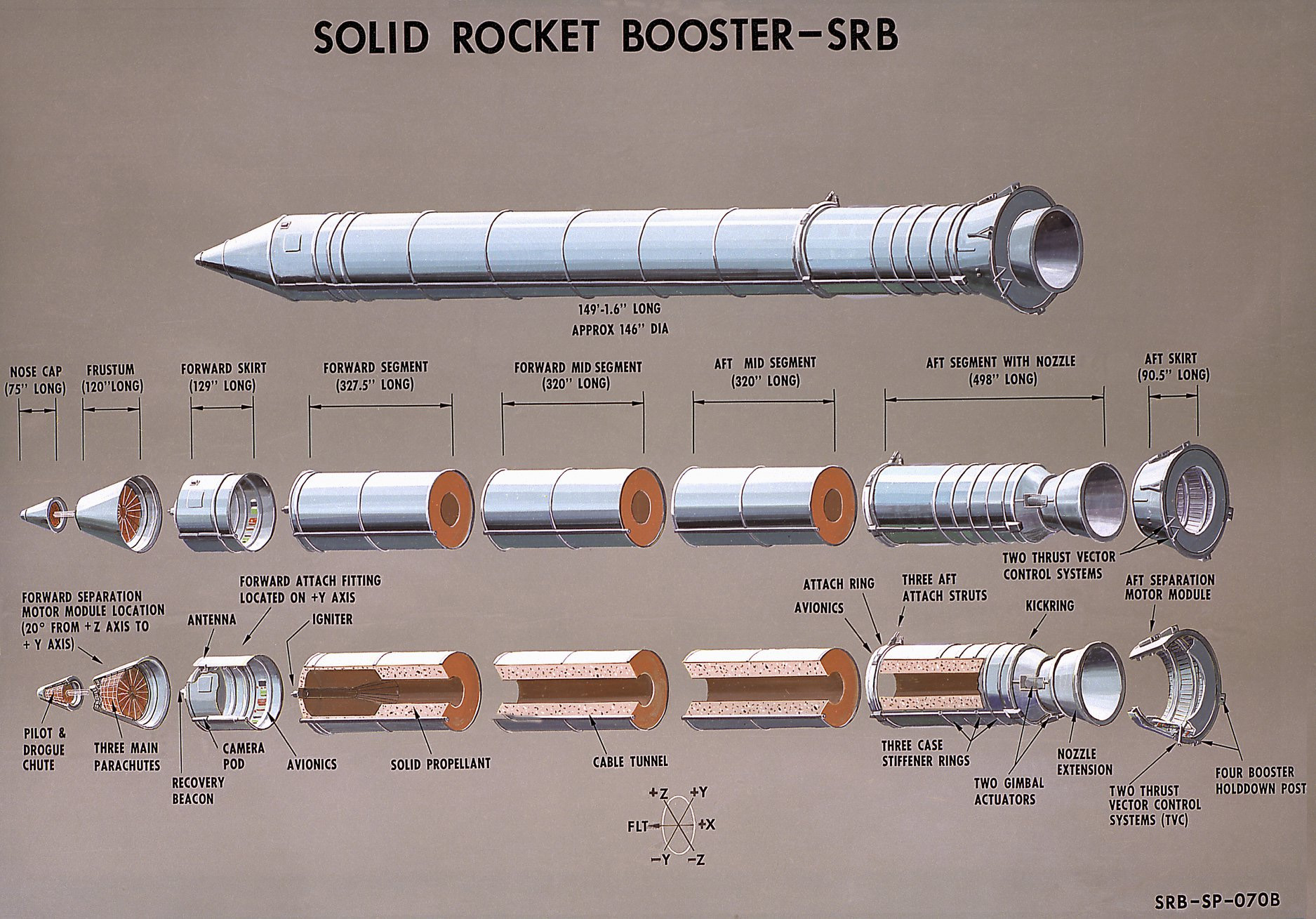
The reason the disaster happened was because of what seems like a small detail in the construction of the solid rocket boosters (SRB). The boosters were pretty remarkable machines – the largest solid rockets ever built, designed to be reused, and were constructed in several segments. The interfaces between those segments were more complex than you may realize, and relied on some rubber O-rings (can there be any type of ring other than an “O?”) to keep things sealed even while things were expanding and contracting based on thermal loads.
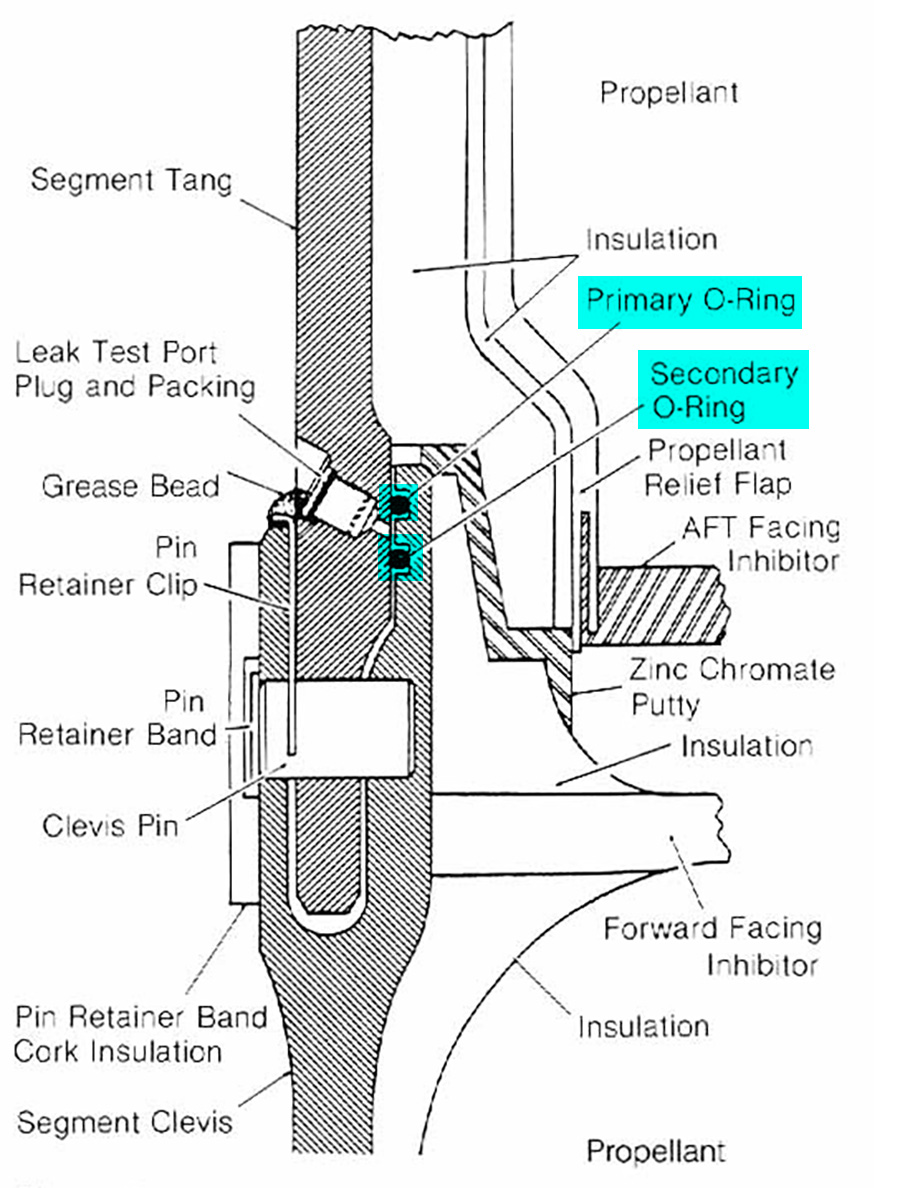
NASA and Morton Thiokol (who built the SRBs) were aware that these rings that sealed the joints in the SRB segments could have issues properly sealing due to loss of elasticity at low temperatures since the 1970s, but the issues were never thought to be particularly severe. NASA had observed these joint seals venting soot on other missions without further incident, and took this as proof that the issue was one that could be tolerated, instead of a symptom of something larger.
On the day of the launch, ambient temperatures were as low as 18 °F; the previously coldest shuttle launch had temperatures above 50°, and Morton Thiokol engineers actually expressed concerns to NASA about the elasticity of the O-rings at those temperatures before the launch, and were only confident in launching in temperatures 51° or higher; NASA managers didn’t accept these concerns as valid, and questioned if they expected the launch to be delayed until April.
The inability of these rubber O-rings to seal the segments caused plumes of hot gases to escape, which melted through the external fuel tank, causing it to break apart, and, from there, the entire assembly to be destroyed, crewed orbiter and all.
Famous physicist Richard Feynman demonstrated what happened to these O-rings very dramatically during one of the hearings about the disaster. He arranged to get a sample O-ring and place it in a clamp, then placed that into a glass of ice water, bringing the O-ring down to 32° F. He was then able to show, right there, that the frozen O-ring lost most of its elasticity and ability to return to its original shape at those low temperatures:
I think most of us know all of this by now; it’s been 40 years, after all. But I think it’s worth remembering, to honor the brave explorers who happily climbed into that delta-winged flying brick strapped to a massive column of fuel and two colossal firecrackers with only the goals of learning more about our universe, and how we can figure out how to explore it further, but also to remember that sometimes even the smartest people, the ones who actually make amazing things happen, make mistakes.
Sometimes huge mistakes. But that doesn’t diminish what they accomplish; if anything, it makes every success more impressive. The Challenger Disaster was a tragedy, but I do think we learned something. Some very specific things about solid rocket boosters of course – evolved versions of these same boosters are used on the new Space Launch System (SLS) rocket that will be sending people around the moon in a few months – but also something about, I don’t know, confidence? Over confidence?
Everything is so complicated. A bit of cold weather is what caused the failure of one of the most complex and carefully-engineered machines in all of human history. Everything is connected, every little thing affects every other little thing and on and on in a cascade of cause and effect that makes you dizzy. And yet somehow, we manage to pull things off, anyway.
We grope, we take risks, we fail, we try again. Seeing this disaster happen was sobering and shattered some illusions, but maybe those illusions were ones that should be shattered. Maybe we should have hope in things and people and ability, but not a blind hope. Maybe knowing that things can go wrong, horribly wrong, is a reality we should all keep in the back of our minds, and find a way to know it’s there and keep going anyway.
I’m not entirely sure of how the Challenger Disaster affected me or the so many others who saw it, but I know it did, somehow. I just hope I figure out how to turn it into something that honors those who died, and makes us better or smarter or something. At least not worse.


And let’s all remember Allan MacDonald, the Morton Thiokol engineer who tried to stop the launch:
“One was on the night before the launch, refusing to sign off on the launch authorization and continuing to argue against it,” Maier says. “And then afterwards in the aftermath, exposing the cover-up that NASA was engaged in.”
MacDonald’s daughter was interviewed for the Netflix documentary about Challenger, and she said she was in the car with him in the morning of the launch and he was banging his hands on the steering wheel and yelling that the launch was going to fail. The engineers knew it would happen and told everyone from their own management to NASA it would happen, and they were ignored.
I seem to recall reading that it haunted him until the day he died, that he didn’t do more to try and stop the launch. Sometimes it sucks to be on the right side of history when the consequences are still tragic.
I was also in art class. Fourth grade, I guess. It was parochial school, so the nun (not the teacher for that class, but she was there) turned the TV off after a minute of everyone being quiet* and trying to process—including herself—and I think she tried to explain a similar thing to what you said about the bravery and all that, but I was lost in my own thoughts (as usual). I already had a cynical lack of trust in adults, so I didn’t learn anything there and I was never interested in the space program, so all I could think was what a waste it was and for what? Ego, it seemed, national pride, propaganda, that those people died so cheerleaders could wave a flag. It took me a while to put those thoughts fully together, but it went along with what my father had always said about wars. (He joined the CG to avoid the draft for Vietnam from which he was later section-8 discharged and he had a few friends who came back as very different people. For all the bad things I could say about him, he hated war, politicians, and other such parasites. Or he did back then—heard he’s a trumper now.) This and 9/11 are the two things I remember as common dramatic experiences seen on a TV. There was OJ’s Bronco chase, I guess, but I remember picking up my friend and his mother pointing it out on the screen when it was happening and neither of us were all that interested.
*Except for one kid who asked if that was supposed to happen. Years later, there was a Simpsons episode where they’re in class and the last bell for summer vacation goes off as the teacher is talking about the assassination of Lincoln, just as she mentions he’s shot and all the kids up and disappear, but Ralph is still there and asks, “Was he OK?” The teacher replies, “No, Ralph, go home.” That made me think of that kid, but that kid wasn’t dumb, they were trying to process the horror, hoping they had it wrong and that has stuck with me ever since. My entire life, I go back and forth between envy for someone sheltered like that and glad that I grew up around cynicism, untrustworthy people, and threat of violence so as to be seldom surprised when anything negative happens.
The jokes I heard after the Challenger disaster were a lot worse. Even as a kid with a dark sense of humor, a few seemed to go a bit too far. I laughed anyway because I still cared to fit in back then.
I was an undergrad engineering student walking through the University Center when I saw a crowd of students around the TV watching the disaster in silence. Several years later we studied the case in an Engineering Ethics class. The takeaway for me was to never give into pressure from mgt or a client when you think something will fail.
I was in 11th grade gym class. My classmates and I were the kids who lived through Three Mile Island 7 years earlier. I got to tour the restarted reactor the year before. I was a space nerd from the mid 1970s. The lesson learned was that big accidents are often a series of interrelated failures and not just one thing.
Oddly enough I was also watching the launch in art class in middle school as well. Those boosters careening wildly is burned into my brain.
If you want to hear an excellent retelling of this, listen to American Scandal. It will make you realize how much hubris there was at NASA at the time. Makes you wonder why the bean counters and inept management is making the calls.
Forth grade for me I think. I remember assembling in the open area of the library. When it happened, they kind of just turned off the TV’s and said something about technical difficulties before shuffling us back to class. Kids aren’t dumb and by the end of the day I’m sure I was already hearing “NASA means: Need Another Seven Astronauts”. Watching it on the news later confirmed what we all thought we saw. I had one of those Estes model kits of the Challenger partially completed, and I remember just putting it back in the box. I came across it a few years ago and it definitely brought back some of those memories, so I threw it away. Nothing good ever comes from remembering things.
My father was a shuttle engineer who had helped design the liquid fueled main engines. When the shuttle blew up he knew exactly what had happened and why (my theory was Libyan terrorists). He told me that even in the earliest stages of the shuttle project the actuaries had estimated a 1 in 25 chance of a catastrophic mission failure.
Guess what # was on Jan 26 1986?
He absolutely HATED working with NASA too. He considered NASA a bunch of idiots with the sole exception of JPL. He had all the respect for those folks.
The founders of JPL were the undisputed masters of their domain. Only Wernher von Braun was on their level but not part of JPL.
Qian Xuesen wasn’t content with being just the founding father of JPL. He went to China (OK not exactly voluntarily) and did it again!
I feel like the Challenger Tragedy was a turning point for public perception of the space program. It’d been utopian optimism for a while, but after this, it seemed like people decided it’s just too dangerous and costs a lot to boot. The lessons learned are valuable, and we probably should’ve been a little more careful and humble before then. But going into space or colonizing a planet lost a lot of appeal, and I’m not sure the space program can recapture the wonder that it used to have.
I’m quite certain that if there was even the barest whisper of hope out there for the sci fi fantasy of gorgeous, nubile, alienish but otherwise fully human women frantic to mate with Earthlings you’d have all the enthusiasm (and funding) you’d ever need.
The truth however is we’ve been to space and found it laughably void of anything worth the current risks to human life. For the forseeable future space is for robots, not meatbags.
I was in undergrad at the time and everyone in my basement lab stopped what they were doing to watch the launch (engineering nerds!). It was one of the few ones they televised as many have noted, so it was easy to find.
When the “incident” happened – everyone (50+ people) in the lab were perfectly silent. I still remember how strange that was still now.
Everyone then started talking about what happened and I still remember that the people in the room had by the end of the conversation focused on the solid rocket probably being the culprit. There were some people in that room that ended up at NASA, and they said they never forgot that day when they were making any key decisions.
I was born in 1990 so didn’t see it like some of you did. But in third grade my teacher put it on the tv. Must have been a recording or maybe a news segment remembering the day.
I don’t know if she prepped us and I wasn’t paying attention, or if she just expected us to somehow know what was going to happen, but I had no clue this was something that had happened over a decade prior. I thought this was live (maybe she led us to believe it was to feel what they all felt? Hard to remember exactly).
When I told my parents about it at dinnertime that night they both went silent and looked at each other and now that I’m a parent myself I’m sure they were debating if they were okay with her having shown us that.
I recall there was some debate in the government and science communities afterward about when the crew would have perished: immediately or upon impact. 🙁 I don’t know if they ever reached an authoritative answer (it was completely moot), but the consensus seemed to be that if they did not perish in the explosion, they would have been unconscious during descent. Or maybe that was a protective rationalization because the alternative – that they were aware the entire time – would have been unbearable.
Yes, indeed. Old motorcycle fuel tank petcocks, for instance, can have oval ones (which I suppose could also be called o[val]-rings) that are e.g. 5cm x 2cm with straight sides – so fairly oblong.
rubber O-rings (can there be any type of ring other than an “O?”)
Square double dovetail kalrez has entered the chat
I went to space camp when I was in high school and by then I think even NASA was admitting they were probably still alive for some time after the explosion. It somehow came up in conversation with my parents afterward and they were shocked because the official public version was still that they all died immediately (for understandable reasons).
ya, 3 emergency breathing packs had been manually activated.
I was in 6th grade on the west coast of Florida walking by myself outside back from lunch and stopped to watch it as it was a clear day and I knew the scheduled lift off time. I truly couldn’t believe my eyes as I saw the contrails/exhaust going every which way. It was only when I got back in class and watched the replays on TV that it hit me what had just happened. And I thought that would be GenX’s JFK moment, but that it was just the first one.
can there be any type of ring other than an “O?”
– Nürburg enters the chat
For a while, loop-shaped rings were a common sight in Nuremburg too.
No, Jason is right.
-Nardo
//I was in 6th grade when we watched this live (on TV) and I can still remember it like it was yesterday. I think the feelings of shock and disbelief are pretty universal; I know that’s what I felt. It was the same feeling I experienced on 9/11. Unbelievably, in 2003, I was also watching the live return of Columbia on TV when it failed, killing its crew.
I was in 5th grade and they brought us all into the library to watch the launch on TV. I remember when it exploded the 2 teachers put their hands to their faces and froze. One girl started crying and the other girls comforted her. Most of us boys jumped up and started cheering, I guess because we didn’t understand this explosion on TV was real. After a moment or two the teachers finally reanimated and took us back to class but weren’t answering any questions, I remember a lot of confusion after that.
I cannot imagine being a teacher in that situation, dealing with the pain while reminding yourself it’s “developmentally appropriate” for 5th grade boys to act like idiots. Bless them, seriously.
Exactly. As a kid I didn’t get it but as an adult I’m 100% sure I would react the same way as my teachers.
This is one of those generational moments. Most Gen X can tell you exactly where they were when this happened, almost all of us in class watching.
I was in 4th grade and we were watching it live in class. I remember the moment like it was yesterday.
I remember when I started in the diesel trade, at my family’s trucking company, as 50% of the maintenance staff for a fleet of about 75 pieces of equipment.
I remember thinking “this place is so Mickey Mouse, I need to get somewhere bigger.”
So I packed up my life and moved away, and started in a dealership. “Well shit, this place is somehow more Mickey Mouse than the family shop!”
So I applied to Municipal Transit. “Here’s the big leagu…shit, this place is half-assed too!”
Then I moved off the floor, into the training department.
Guess what? All the other transit agencies and their governing bodies are winging it as well.
I’m way too dumb to be smarter than this many people. Yet it seems like my tiny team is the only one asking the right questions to move our industry forward.
Agencies who are 3 times our size, and have been running EV buses twice as long, look at our program and go “Wow. You guys are WAY ahead of us!”
HOW.
All of this is to say, that you’re more correct than you know when you say everyone is winging it in some capacity.
One thing I’ve learned over the years is that a lot of what’s wrong with the world can be explained by one simple fact: Most people are terrible at their jobs.
Ironically you know what job people are the absolute worst at? By their very nature of being human?
Astronaut.
Robots OTOH are fine in space. They don’t need air, water or gravity. Robots consume only sunlight or heat and don’t get bored, lonely or depressed. They don’t need company. They don’t need enrichment. They don’t get scared. And best of all when they die and you can abandon them in place without any thought or regrets. You can perhaps even use them for parts someday.
I was 9 years old, school was cancelled that day due to cold and snow. Watched it live in our living room. Alone.
Me too except I was sick and at home. School in Wisconsin was almost never canceled for cold or snow. Also older than nine…
And today is my birthday. My mom’s is 9/11 :\
Weirdly, 9/11 is also the date that the Spaceguard system detects an unidentified object entering our solar system/heading toward us in Arthur C. Clarke’s ’70s classic Rendezvous with Rama.
Great piece, and your recollections of the day track nearly identically with mine. I can still see the metallic speckle of that A/V cart’s finish and the blinking clock on the VCR.
I’d much later study the disaster in depth in school (it’s a now-common case study in catastrophe theory), and I remember that brought it all back again, that feeling of sadness but also pride that we as a species did – and continue to do – stuff like this.
Any politics aside, President Reagan’s invocation at the time of the John Gillespie Magee poem was in my mind nearly perfect.
I was in 2nd grade and lived about 50 miles from the Cape — as would normally happen, any launches during school hours would be like a 30-minute “mini field trip” out to the big grass fields to watch the launch.
Challenger was probably launch #5-7 for me, somewhere in there. As a kid in Florida, watching Shuttle launches was just A Thing You Did. Doubly so for the rare night launches, where you’d go to the beach and watch those massive SRBs just light up the sky. Better than any fireworks show on earth. Modern rockets can’t hold a candle to it, you’d have to go back to the Saturn V to get that kind of flame.
The teachers sort of gasped and ushered us back inside, saying we’d wait for the news on a malfunction. None of us processed what might have happened. The Shuttle was invincible. It had to be. There were 7 people on board! Surely what we just witnessed was a test rocket or something.
Nothing until 9/11 hit me at that level, and Challenger is still #2 in my book.
I was watching that one live too, also in 2nd grade, we were visiting my grandparents who were staying in New Smyrna for the winter. my grandmother had seen a few launches and had a similar reaction.
Yeah, I can’t imagine anything will ever compare with seeing the 2nd plane hit on 9/11 as far as shock and grief, but I felt a similar sense of sorrow on Jan. 6th.
On a cheerier note, how’s the new year treating you, my friend?
So far so good! More layoffs at work, which we knew were coming (collectively) but never know who is next (individually). It seems to be The Cool Thing to Do in mega-corps at the moment. UPS, Amazon, Conoco, and the list goes on…but everyone is in good health and relatively stable, so I can’t complain too much.
Yes, 1/6 doesn’t get the attention it deserves. Right after the second plane on 9/11, there’s no other time I felt like the US was truly under attack, or even on the verge of chaos or a domestic war.
I think the Challenger disaster makes the cut (for me) only because of age and inability to handle seeing it. Fast forward to my young adulthood and I watched Columbia burn up on re-entry. I remember it being sad and unfortunate, but I was much more easily able to write it off as the dangers of space travel.
Glad you & the crew are doing well.
I learned about the Challenger explosion immediately after, but our class was not watching it live. If we had been, I’m sure it would’ve been affected me more deeply.
I remember watching it at home for some reason, but the lack of any kind of counseling during those times was crazy, people wonder why Gen X is so callous to major issues, it’s things like this that shaped our generation. A whole crew died on national television and we had to go to the next class. I was also at work when 9/11 happened, and again had to finish the day like normal. I’m not saying this is a good thing just anyone wonders why we don’t flip out about things so much, well there’s some of it.
My employer sent us home at lunchtime on 9/11. In some ways that was worse – nothing to do but sit in front of CNN the rest of the day and see them fall on live TV.
I had to go to leave for work right after the 1st tower collapsed. I remember that day being confusing. At work we didn’t know what to do so we just pretended it was a normal day, customers would come in and they weren’t really buying anything just talking about NYC. Work was right between a big airport and an airbase and the difference in air traffic was noticeable. I remember The Onion’s page that day and seeing AWACs circling overhead and feeling reassured somehow.
I’m not sure if that’s something everyone remembers, but even in the Midwest going 3 days with no air traffic at all was surreal. It was surprising how different the sky looked without any planes.
I was living in the Roanoke Valley at the time – the utter lack of air traffic was eerie. You don’t notice the jets always in the sky until they are suddenly gone.
A worry for me was the reports that the third plane crashed outside of Pittsburgh. I grew up (and my family still lived) in the suburbs. My first thought was the nuclear power plants on the Ohio river.
I remember the fighter jets and a few bombers flying overhead almost constantly for about 3 days within a few minutes of the 2nd tower being hit. It was awe inspiring the first few times because they were maybe 300 feet off the ground, if that.
We also had a ton of road blocks set up for a week or so afterwards.
I remember seeing American flags everywhere for months afterwards. That’s the last time I can remember us all coming together as one country.
I was still in school and we had tvs on in every class for the rest of the day except, ironically, history. It always struck me as morbidly funny that a major historical event was happening and we were talking about the Tudors or something equally banal.
OMG – definitely in the top 5 Gen-X historical events. It’s like brushing aside the fall of the Berlin Wall.
I’d agree with this, I was in 2nd grade when it happened. After the initial shock they just rolled the tv out of the classroom and we carried on. I think the principal gave a general announcement over the PA later in the day. Same with 9/11, worked at a tire/auto shop at the time, and the rush to get anything done stalled out as we kept most of our time watching tv. Same with customers, they didn’t complain about waiting like usual, everyone seemed to have the same “this doesn’t seem as important now” feeling for the rest of the day.
In their defense, this feels like an end of innocence moment. No one (besides the engineers…) thought this could happen or had any idea what to do after it did. Yeah it seems gross to go on with geometry, but…what would you have done?
Very well said, and something we’ve mostly lost in our Cult of Personality politics and culture. The lack of nuance and compassion is frightening and I don’t understand it at all.
We are similar ages, and while I didn’t watch The Challenger launch in real time, I remember coming in from lunch or recess and seeing my teacher in tears who then had to tell us fourth graders what had just happened.