

“Looks like the police are here,” my friend in Germany nonchalantly chirped at a weekend car show in Nuremberg a few years ago. I turned around to see a small neon green and blue hatchback slowly entering the car show. My heart rate did not increase a single beat per minute; I barely gave the police a second look; and pretty much nobody bothered to pay attention except the folks to whom the officer was talking (their cars may have been blocking traffic or something). This was in stark contrast to pretty much any experience in the U.S. where a police car was involved, and some of that has to do with the fact that carmakers specifically make their police cars look “sinister.” This should change.
The difference between police in the U.S. and Germany (and other countries) is enormous, and spans far beyond simply the types of cars they drive. There’s a lot of history there that I’m not going to get into, nor am I going to get into any sort of police-bashing. I have tremendous respect for many members of America’s law enforcement, and I thank them for putting their lives on the line to protect everyday citizens. At the same time, there are problems with how our police has historically handled… many things.


I consider myself privileged in plenty of ways, and I’m absolutely a straightedge, law-abiding guy, but even I have had to deal with cops more than I’d like to. Back when I lived in Michigan and drove junky, sub $1000 cars, I got harassed by local police regularly. I once got pulled over for — and I kid you not — “looking suspicious” behind the wheel of my crusty, mud-covered 1992 Jeep Cherokee. I also got pulled over, had flashlights beamed into my face from multiple officers, and was handed an enormous ticket that would have cost me three points on my license had I not got gone to court — for passing a cop while going the speed limit in about an inch of snow. I also once got pulled over for passing an officer who was going 70.0 mph on a freeway where nobody goes under 80 (I-70, for you Michiganders); per my old Jeep’s speedometer I was going 71 mph, which was enough for the cop to enjoy a power trip but not enough for him to be able to ticket me. All of this is to say: I’m used to seeing Dodge Chargers and Ford Explorers in my rearview mirror, and the feeling I get when I see those reds and blues is not what it should be.
[Note: Welcome to Sunday Takes, where I (or occasionally Matt) spit out a hot take about cars for your enjoyment/discussion. This Sunday Takes may be going up on Monday; oops! -DT]
[Second Note: There are obviously much, much bigger problems with the U.S.’s law enforcement than the design of police cars, but this is a car website and this is Sunday Takes, so it’s a quick thought about car design. -DT]
Automakers Design Police Cars To Look ‘Sinister,’ And That Needs To Change
I should not be afraid of the police, and while — again, I’ll reiterate that it’s not just car design that causes this fear — it’s not exactly helping that vehicles like the Dodge Charger Pursuit and Ford Police Interceptor shown below are referred to by their manufacturers as “sinister.” Yes, that’s right; cars meant to serve and protect Americans are being designed to look sinister — a term that translates to evil or threatening. From Dodge’s press release:
Behind its sinister face, the Dodge Charger Pursuit offers an all-new standard E-85 capable 3.6-liter Pentastar V-6 engine with variable-valve timing (VVT) and available legendary 5.7-liter HEMI™ V-8 engine with fuel-saving Multi-displacement System (MDS).

Then there’s this from Ford’s press release for the 2010 Ford Stealth Police Interceptor Concept that the company showed at SEMA; look at all the times Ford uses the term “sinister”:
- Revamped grille, lighting, exhaust and interior provide a sleek, yet slightly sinister look designed to blend muscle with mystery
- Sleek, streamlined and slightly sinister, a specialized stealth concept version of Ford’s Police Interceptor will debut at the SEMA

Check out this quote from that same press release:
“The rim section is stacked to give it the illusion of greater width,” [Ford designer Melvin Betancourt] said. “The center of the wheel is glossy black, and the rim is chrome. So we have that racy, hot rod look, but at the same time we’re building a sinister, stealthy, ‘Don’t mess with me’ feeling.”
Why are automakers making police cars look sinister? Why do we want them to convey the message “don’t mess with me”? Shouldn’t we want them to convey “I’m here for you when you need me. I’m protecting you and other motorists, and that may require me to, on occasion, chase after folks”?
Why It Matters What America’s Police Cars Look Like

To explain why the aesthetics of a police car matters, I’m going to reference a well-known military vehicle designer named Nir Kahn. Back when he worked for Plasan, an Israeli company that designs armored military vehicles, he wrote lots of insightful articles on LinkedIn about the particularities of military vehicle styling. One of my favorite articles, published in 2017, is called “The Aesthetics of Armoured Vehicles.” Here are a few paragraphs from that piece, which discusses how up-armoring military vehicles makes them look aggressive, sometimes sowing distrust among those who see the vehicles, and ultimately make certain peaceful missions more challenging:
But the addition of flat and square-edged panels [of armor] ruins the softer appearance of the Jeep-like vehicles and in many ways, although protecting the occupants, this can make their job harder, especially when working in civilian environments where human interaction can be a positive force, and an aggressive appearance can simply lead to increased violence.
The experiences of modern armies operating amongst civilian populations in Iraq and Afghanistan, and of peacekeeping forces and militaries around the world, has led to increased awareness of how the appearance of their vehicles can affect their ability to conduct their missions. Doctrines like “Hearts & Minds” can favour a less aggressive aesthetic, while other users may prefer to create a “Shock & Awe” impression.
[…]
At Plasan we often adjust the styling of our vehicles to the desires of the end user. Sometimes a fine balance needs to be created between projecting a less aggressive image while maintaining a requisite degree of authority. Some customers absolutely want their vehicles to look aggressive; it all depends where they will be operating. The decision about the vehicle’s aesthetic and image is based on a combination of strategic, cultural and political considerations, but most of all it depends on the mission. The needs of a police or paramilitary team are different from the needs of an army, and the needs of an army conducting peace-keeping missions or homeland defence are different from the needs of an army engaged in combat beyond its borders. The Plasan SandCat family has built in design flexibility allowing versions of it to be configured for any of these tasks, whether that means integrating observation or weapons systems, or adopting styling to fit in with the image that the user wants to project.
Making a vehicle look aggressive may make sense for a military trying to intimidate an enemy, but a police force should be considered a peace-keeper, and thus an organization that projects positivity, trust, and community. Police vehicles should not look like hard-core military vehicles.
The Whole Aesthetic Of America’s Police Cars Should Change
I’m not the only one saying this, by the way. It seems, based on a cursory online search, quite a few people agree that American police cars should look a lot friendlier:


Elsewhere around the world, cars do look friendlier. I mean, just check out the police cars in Germany:

And here’s Hong Kong:
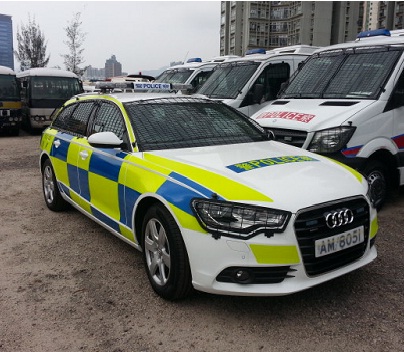
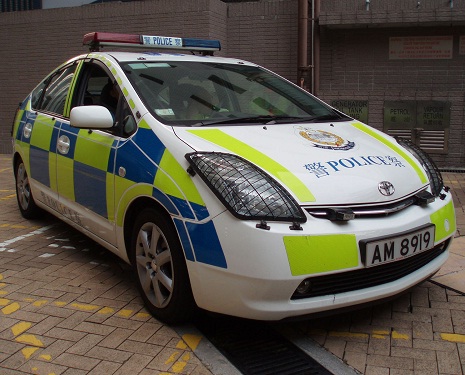
I could go on and on, but you can see that visibility is key here. These officers are meant to protect and serve you, so knowing where they are is important. In the U.S., the mentality is sometimes different, as Government-Fleet — a website about fleet vehicles — makes clear when it talks about police vehicle design choices in Colorado (bold mine):
This color scheme was changed to the current color palette for several reasons, said Sgt. John Hahn, Colorado State Police public information officer. At the time, research indicated black, light blue, and gray would give police vehicles a distinctive look, while allowing them to blend with the surrounding environment.
Lighter blue and gray shades also reflect colors used by early Colorado State Police vehicles, Hahn said.
“Our decision was based on the desire to respect the history and background of our agency while still adhering to some smart, tactical strategies,” Hahn said. “We wanted a new, fresh look that adhered to the progressive nature of our agency while staying mindful of the past.”
State police vehicles that can blend into their surrounding environment offer advantages, Hahn said. The Colorado State Police deploys nearly 700 vehicles in its fleet; the majority includes Ford Crown Victoria with some Dodge Charger and Ford Expedition models.
“If we have vehicles partially hidden, it allows us to address motorists who might not be driving legally,” Hahn said.
The mentality of trying to ensure that vehicles are hard to see seems to imply a relationship between police and everyday citizens that is akin to predator and prey, though to be fair, this is not at all the case with many other police departments. The white part of a black-and-white police car is specifically there to help give the cars visibility, and beyond that, in California it is illegal to paint a CHP car all black; contrasting door panels are required to maintain visibility. There are plenty of states that have colorful police cars and not all-black ones; still, those big Explorers and those Chargers are still far from friendly.

The feeling of predator-and-pray is furthered by this USA Today article about LA’s now-defunct, fuel efficient fleet of small BMW i3 police cars:
LOS ANGELES — The sight of a puny, electric-powered BMW police car with flashing red lights isn’t exactly going to instill fear in the hearts of this city’s criminals.
But on Friday, the Los Angeles Police Department showed off the newest member of its fleet, a black-and-white BMW i3, a diminutive electric car meant for tooling around downtowns, not necessarily for a televised high-speed freeway chase.
BMW is loaning the not-so-intimidating police cruiser to the force for a year as part of Mayor Eric Garcetti’s desire to get more electric or plug-in cars into the city’s fleet.
Why is the article seemingly critical of the new police vehicles because they won’t “instill fear” or “intimate” the public? This concept of “Police cars should be scary” is clearly thoroughly engrained into our national psyche, and I understand why; even the names of these police are not great. Most police cars are called the technical term “Police Pursuit Vehicles,” which I’m not a fan of. Just because pursuing criminals is a thing these cars can do, that shouldn’t be these cars’ entire identity. The vast majority of the time police cars aren’t actually in pursuit. What’s more, the Ford “Interceptor” name technically means “a fast aircraft that attacks enemy aircraft” or “Anyone or anything that catches or blocks an object or person in transit, such as a player blocking a pass.” Again, the car’s name is focused on the stopping of people and less so the helping of people.
At least Dodge Chargers are just called Pursuit vehicles and not “Enforcers,” as they’re in Canada. And at the very least, the Ford F-150 has the excellent name “Ford F-150 Police Responder.” There you go, a nice, friendly name that reminds you that police are here for you and not to get you.
Friendly Police Cars Just Make Sense
America’s police is such a loaded topic that I fear a couple thousand words on a Sunday Take could stoke some flames and lead to some heated comments, so I’ll just say that I want to keep the discussion as much about car design as possible.
And on that front, I believe we need more friendly American police cruisers. The BMW i3 above is a great example, and so is the Toyota Prius police vehicle in Hong Kong. There is a very macho, paramilitary-vibe to many American police departments, and I think having officers drive a friendly hatchback instead of a huge, black truck or SUV that frankly looks like a military war machine will knock everyone down a peg and keep them humble and reminded of what their relationship with citizens should be.

The following might make it seem like I’ve lived in LA too long, but I’ll just say it: vibes matter. And you cannot look at the NYPD officer above in that Smart Car and tell me those vibes aren’t way, way better than seeing an officer in a huge, blacked-out Ford Explorer. It conjures a whole different feeling, and what a police car’s design communicates to people matters.
Back in 2016, Mercedes Benz of Portland wrote a great article on the New York City Smart Car rollout. It makes a lot of the points I’ve made in this article, including the fact that, while many will make fun of friendly cars because they’re used to cop cars looking scary, the reality is that a happy police car can help police in accomplishing their peace-keeping mission. From that story (bold mine):
In New York City’s tabloid newspapers and on blogs, they have been derided as “clown cars.” The previous police commissioner, William J. Bratton, described the subcompacts as “midget cars,” even as he announced their rollout last year.
But the city cannot seem to get enough of the tiny, bean-shaped vehicles, which look like curiously shrunken cousins of the iconic New York Police Department patrol car and which never fail to draw the attention, and sometimes the affection, of curious passers-by.
[…]
Among the department’s fleet of thousands of vehicles, including Ford Explorers racing to 911 calls and tow trucks clearing traffic lanes during the evening rush, the Smart car is quite possibly the only one that has its picture routinely shared on social media, described as “adorable” or, in the case of one parked in the West Village, “Cuuuuuute.”
“It’s just so approachable,” said Robert S. Martinez, the deputy commissioner for support services, who oversees the department’s vehicles. “People want to take pictures with it. People want to hug it, they want to kiss it. It’s just amazing.”
[…]
“It’s nice to have something to break the ice,” Michael Arad, the architect who designed the Sept. 11 memorial at the World Trade Center, said. One of the Smart cars parked in Lower Manhattan had recently caught his eye, and led him to joke to officers standing near it, wearing armor and carrying long guns, that they probably could not fit inside.
“I don’t think I would have joked with them if the car wasn’t there,” Mr. Arad said. “They thought the car was funny, too. It draws people out in a period of time when there’s so much tension around.”
Vehicles have often played a part in the politics of policing. In recent years, amid roiling racial tensions between minority communities and law enforcement, activists have pointed to the hulking armored vehicles mobilized in protests across the country as symptomatic of the militarization of the police.
To be sure, this whole article you’re reading isn’t meant to offer a solution that’s going to necessarily lead to radical change of police-civilian relations, but it could help a tiny bit, and above all, the story is pointing out the obvious: Because police are here to help us and not hunt us, their cars should be highly visible and they should definitely not be sinister.


I never really thought of this issue, but now that I read about it, I agree. It probably doesn’t serve a purpose to have police cars look scary.
That being said, I personally like the aesthetics of police cars. A lot of the design features (less chrome, less unnecessary trim/ornamentation) look cool. I generally think police versions of vehicles look better than their civilian counterparts.
This also made me think about atypical police vehicles I have seen. My personal favorite is a Smart Fortwo owned by a sheriff’s office in Georgia. I used to see it patrolling a very nice bike trail (the Silver Comet trail). It was the friendliest looking police car I have ever seen. The deputies driving also seemed like they were enjoying their jobs – I presume patrolling a scenic trail is one of the better law enforcement jobs if you can get it.
Here is a link to a picture of that car (assuming this link works?)
https://www.paulding.gov/ImageRepository/Document?documentId=11897
Are the police cars actually less ornamental? Sure, they have less chrome, but it’s just been replaced by “stealth” lights and black shit. To me, that’s just as ornamental (and thus the same amount of stuff), it’s just tacticool now. If anything, out of all the pictures in the article, the American cop cars have the most stuff on them (Smart Car withstanding, but that’s obviously not representative of most American offerings). The only thing they are missing compared to the other cars, is Hong Kong’s windshield and headlight
barricadesguards.I’m referring to how the cars look aside from the lights/police gear. Retired police cars (i.e. those with the decals and lights removed) look cool. I have also seen some vehicles that were built as law enforcement vehicles but never put into service (so lights and decals weren’t added); I also like those.
These vehicles basically look like stripped down/low spec versions of civilian cars. They only look remarkable because, in 2026, it can be hard to find a low spec/base model for sale on a dealer’s lot.
This is a great article and is exactly the points I make when having similar discussions with people. Having lived in the uk for the better part of a decade, the only interaction I had with a cop was being pulled over because I had a brake like go out. And that was “go fix that please” and that was it.
In the states, particularly in Texas where I live and see it regularly (But I bet it’s in a lot of places) almost all police cars have been swapped for the tactical revenue building cars. The monochrome black/brown/grey that are hidden in driveways, on ramps, etc specifically to find people, write tickets, and generate revenue. Some small towns that have 1-2 cars literally only have these and some of those are replaced with non-typical vehicles (local town near me has a single police car and it’s a black jeep gladiator). San Antonio used to have a law, I’m not sure if they still do, that said all the city cops had to have reflective marked cars, so they would have the markings made in reflective vinyl in exactly the same shade as the paint so they were hard to see.
Really, those tactics do a discredit to police that are there and need to be there to actually do their job and erode the already shaky trust that is there.
I’d actually love to see the police in my community pull people over for more minor traffic violations to tamp down on out of control and inattentive driving, but only if the results of those stops are less scary and expensive (like your UK interaction). That’s another reason to make the vehicles more friendly–we should be doing everything we can to ensure every traffic stop is a non-event. If every stop carries a risk of a bad outcome for either cop or citizen, then the threshold for pulling people over gets higher.
That’s a really great point. Enforcing actual concerns in a friendlier manner as opposed to just trying to generate revenue and building that trust that there is a reason the interaction exists, not just preparing to defend against the outcome of the interaction.
I’d love to see more driving in the left lane or overt safety issues addressed.
Sadly, traffic stops in the US are inherently engineered as hostile engagements. They’re a large source of arrests for a department, as they often coincidentally pull over a driver with a warrant and add an arrest to their metrics, and officers are actively on the lookout for that. Naturally, someone who knows there’s a warrant out for their arrest might be less than cooperative, and there’s no way to know until they’ve gone over the driver’s license, so officers who’ve been trained with that scenario in mind treat everybody they pull over like Hans Gruber just in case.
The other issue is that officers are encouraged to coax confessions and self-incriminating statements out of people they pull over because they might fight the ticket in court, so they’ll deliver a judgmental lecture to prompt an apology or justification, both of which can count as confessions if recorded on the body cam.
This is in my mind a big factor in why American policing is so ‘competitive’: most countries tend to have one police force for a region/province/city which all police officers are salaried employees of and equipment is purchased collectively, while in the US the fragmentation of the police forces means each department has to raise its own revenue and buy their own vehicles and gear, leading to a profit/competition-driven attitude.
Police cars aren’t need to drive revenue. Basic traffic enforcement like speeding, stop lights, and red lights should be done by cameras so Police can do their real job.
Long past time to get police out into their community doing police work instead of writing tickets.
I agree as long as they aren’t using ai cameras to do it. Speed cameras and red light cameras have been a thing for decades. No reason to not use them really.
ehhhh.
Red light running, sure, but speeding on highways isn’t dangerous. I’ve almost been in tons of accidents, every single one was some idiot not paying attention, failing to use a signal, and changing lanes abruptly. Not one single time can I think of someone speeding AND PAYING ATTENTION, causing a problem on the highway.
Distracted driving is a MUCH bigger problem, and there is basically no enforcement.
I was in the suburbs outside of Austin a couple years ago and had to stop to laugh at a police cruiser that was a Charger painted shiny black with “Sheriff” and the logo written on it in matte black. They’d gone full Spinal Tap with it https://www.youtube.com/watch?v=Ds7FRivVMgA
That nonsense is all over the Colorado front range. It had gotten so bad before I moved away last year that it became noteworthy when a police car was actually easily identifiable instead of sort of looking like one until you could get at an angle to see if there was matte lettering hidden within the gloss of the paint. It also seemed to make it a lot easier for folks who owned old cop cars or Chargers to cosplay as cops, since no immediately recognizable markings didn’t mean anything anymore where whip antennas and push bars did.
I was in Georgia a couple years ago and saw some state patrol cars with a similar all black car with matte black graphics scheme. Kind of ridiculous on multiple levels.
its on purpose. its called ghost marking.
Oh I’m sure it’s on purpose, didn’t know they called it that though.
I see a lot of depts here in RI that use that same scheme. It pisses me off.
They’re road pirates out to generate revenue.
If stopping speeding was actually the goal, they’d park a car where it was easily spotted and EVEYONE would slow own, not just the one car pulled over.
I believe that specific i3 in the photo is now found in pieces under the Metro A line overpass just south of the Chinatown station. It’s a vacant lot that shares a wall with the Homeboy Bakery patio, and on it is a derelict P71 and an i3 – both in salvage-yard condition, with tones of parts missing.
https://maps.app.goo.gl/oz3JVkzafqsEarfP9
There’s a big glaring flaw with your premise:
American cops don’t want to be friendly. They don’t want to appear non-threatening. They have no interest in projecting an approachable, neighborly demeanor. They serve and protect, all right – each other.
And now, when automakers selling cars in the American market are all going out of their way to make their cars look angrier, more aggressive, bigger and louder, it’s easier than ever to have a cruiser that looms, that growls, that intimidates. And why?
<cue the David Chappelle>
Because fuck ’em, that’s why.
I might be just a tad fed up with cops.
this 100%. this is a conscious choice and the image they want to project. I believe there is a court case that says they have no obligation to actually ‘protect’ anybody but themselves.
If that absence of protection obligation is correct, I think we should carefully examine what is in the oath they take, what it means when you call it an oath, and whether “To Serve and Protect” needs an asterisk on the side of each police cruiser explaining who is getting the protection.
Agree. They “serve and protect” the interests of the state., not the people.
I’ll never forget the 100+ cops in Uvalde that cowered in the parking lot while one shooter was slaughtering kids.
When I was in Georgia to watch Petit LeMans a couple years ago noticed all the state patrol cars we saw were all black…with matte black graphics like some kind of SEMA car, not sure whether the goal was looking cool, being stealthy or maybe both. The police serve the public (and often well!) but I can’t see any serious reason they need to go around looking badass.
I heard the term “Tacticool” from an ex military friend of mine to describe a certain type of civilian that likes a lot of psuedo military gear, but it seems to fit here too. And I just can’t see how a military looking police force is setting the right tone in a peaceful democratic country…
There appears to be an uptick in stolen valor people hired by police department too. Most people who have actually been in the military want to leave the gear in the past. Until it’s time to reminisce. You have an understanding it’s not the best quality stuff. Unless you were involved in some kind of special forces and those guys often go out to the civilian market for some of their gear.
I used to experience weird things with those kind of wannabe guys all the time. They would be at gate station say things like “affirmative” and give you a hard time. Even with dod cac cards. Meanwhile actual MPs at an actual military base check your creds might do a quick walk with an inspection mirror if it’s slow and say something like “ok go ahead see ya”.
I know a few people that have said they had an easier time getting in and out of the whitehouse then blue plains the DC sewage treatment plant.
I’ve heard theories about not passing psych evals. From what I’ve seen its likely the case. I talked to some of the wantbees just out of curiosity and they would say things like they were working with a recruiter and it wasn’t going well and had applied for various police forces but hadn’t heard back. They would disappear likey getting hire somewhere they shouldn’t have. I know at least one had been hired by a local police force and bad things happened and he ended up with the mental care he needed in prison.
For sure, my friend who is a vet has very little interest in wearing camo or using tactical looking gear, he did his stint and is happy to be out. I think for a lot of the actual military folks, like the MPs you cite there’s sort of a big dog vibe where they don’t have anything to prove, whereas the regular police often seem to have this almost insecurity about their position?
At the same time I also know the same buddy has told me a lot of people get out of the army and wind up joining the cops…maybe this brings in some militarism while amping up the insecurities of the guys who weren’t in.
Or maybe it’s some weird part of the American psyche that comes out in the people who join law enforcement, when traveling to other countries, at least wealthy developed ones I’ve universally found their Customs and Border Patrol officers to manage to be professional and courteous while still exuding that “don’t f with me” gravitas, meanwhile US Border Patrol and Customs are often outright rude and unpleasant. I fortunately haven’t encountered the police in any other country so can’t compare.
There is a big pipeline from military to civilian police. It didn’t used to be that deep just trained to do a slightly similar job so here is a job. Meanwhile those guys will say it’s not the same at all. Now you get guys saying things like “similar mission” and they will drive though a city or town like they are in Kandahar. Something broke there.
Any little power goes to a lot of these younger guys heads. They really need someone over them to stop it. When there is alot or Federal law enforcement around they tend to behave better. State police can be the worst because they think they are too dogs. If they are around alot of federal law enforcement doesn’t happen as much.
The federal law enforcement always have a specific mission they aren’t really worried about the general population so it works out. I’ve heard stories where a young cop learned a life lesson dealing with some of them. Normally involves a few hours in a cell and a chewing out.
The tsa / border patrol I think greatly depends on port of entry/ airport. The same rules apply. Some are great if they are used to alot or higher up people with power coming though. If not it’s a free for all and power to their heads. I’ve also noticed when federal agencies relocate to an city or an office expands. TSA in the airports around are on much better behavior. I’ve never had a TSA problem in any DC airport. But others you can find some nutjobs with power to their heads.
If anything, the switch to LED lighting has made them look less intimidating (at least until the lights come on). The move to “ghost graphics” has also reduced the intimidation (and easy identification) factor, while unmarked vehicles have always been a “thing”.
Since you’re into lights, in general, you should check out Whelen’s latest trick, synchronized flashing (V2V synchronization) – https://www.youtube.com/watch?v=JamyZcnFaIM
I just noticed that a couple of months ago, that when a couple of cruisers are at a scene with the flasher bars going, they synchronize.
I wonder how much extra that costs, and whether it’s worth it.
I tend to think that most police vehicles should be matched to their purpose. Swat team gets vans, traffic enforcement get’s Smarts, highway patrol gets comfortable cruisers. If someone gets arrested, haul them away in the Black Mariah. All of these vehicles should be readily and oviously identifiable as police, like the European police cars. Unmarked cars should only be used for criminal policing (detectives, that sort of thing.) It was mentioned that deterrence is part of the goal. Well, police cars you can identify deter bad behavior. It’s not disputed that putting a police car at the start of a construction zone slows people down and alerts them to the need to be more careful. Given that, why should we believe that putting unmarked or blended cars out for traffic enforcement are a deterrent? More people drive more attentively when they know the police are there. Anyway, great article.
It’s a chicken-or-egg thing. Cop cars only (start to) look scary once they become the preferred vehicle for cops to drive. The only thing, recently, that makes them “extra scary” is the addition of the massive pushbars on the front.
You SHOULD be afraid of the police. Part of law enforcement’s role is deterrence, and it is by design that the police use what they can to scare would-be criminals.
Of course, you can overdo it and take it too far, as has happened much too often in America. But the logic stands.
That is the fundamental question that needs to be asked. Is the purpose of law enforcement and the courts to punish people or to rehabilitate? If you want to punish people, then hidden, blacked out vehicles let you pounce and punish your victim.
If you want to nudge people in the right direction and rehabilitate them, then a colourful police car that looks friendly goes a long ways.
It is both. Punish wrongful behaviour, and rehabilitate so that it doesn’t repeat.
I can answer this one: in the US, the law and courts are for punishment. We punish endlessly. You might get out of jail, but your punishment is never over.
Applying for a job? Better fess up to that conviction – never mind that you served your time, that means nothing. And depending on the crime, you never get to vote again either! Though I admit that in the case of voter fraud, yeah, that’s fair.
Shouldn’t higher visibility serve as a deterrent just as well if not better than aggressive but stealthy cars? To the extent that criminals are afraid of cops I’d wager the fear is being caught, arrested, and stuck in jail for years not wondering whether they’re going to get in a shootout with the jr SWAT team.
I-70 runs from Utah to Maryland. The closest it gets to Michigan is when it passes through south-central Indiana and Ohio. Did you maybe mean I-75?
Some of those that work forces are the same that burn crosses
They’re more intimidating because the cars they based on are. The look is barely changed if at all from the civilian models. Deleting chrome and adding a bullbar is a thing the are gonna do anyway. They didn’t really do anything to make the cars more intimidating, some marketing clown just decided to put that in the ad copy.
They don’t drive friendly cars because America doesn’t make any friendly cars.
Article should just be “cop cars should be painted in friendlier colors”
Color, model choice, accessory choices, etc. It’s not hard to make a car not look like it wants to eat you, even though I will acknowledge that design trends have been trending too far towards
Yeah, I generally find police cars to be quite a bit less along the lines of trying to intimidate than many of the normal trucks and such driving around. I don’t think I’ve ever had a thought about a cop car looking like it was wanting to eat me, but that happens all the time with pretty much any newer body on frame vehicle.
America yearns for the Crown Vic
The main purpose of a police car is so they don’t have to walk.
Allow me to introduce David to the friendly Montreal police Aztec:
https://upload.wikimedia.org/wikipedia/commons/2/20/%2702-%2705_Pontiac_Aztek_%28Montreal_Police%29.JPG
I’d definitely wave hi to that cop.
The answer to your question is to look at who are buying police cars in the USA. That’s who the design and advertising language is aimed at.
I’m not particularly afraid of the police, which, as an old fat bougie white guy, is about as controversial a statement as saying “pizza’s pretty good.”
I do not care what cop cars look like outside my ability to identify them. They could all be Jeeps with those comical “angry eyes” grilles or even mirror their operators’ “don’t f*** with me, I might have killed people in another country” sleeve tattoos with something akin to bomber nose art, which would honestly be helpful in getting a read on the officer at hand. I just want them standardized.
Cop cars should absolutely be highly visible, which enhances public safety whether they’re parked or barreling through red lights. Bring back the golden days of just about every cruiser being an instantly identifiable Crown Vic (or today, an Explorer with the now-familiar headlights). Studies that have shown the mere visual impact of a standard black-and-white cop car is a moderately effective deterrent to crime. Easy policing is best policing, putting everyone at reduced risk.
The unmarked or stealth car problem is real, and the opposite of the peg this article hangs on. It’s a tool of predatory policing, the sort of thing that goes hand-in-hand with departments and municipalities that claim not to have quotas or depend on asset seizure but absolutely have that revenue stream baked into their budgets.
But gimme a break… making every cop car a dayglo Twingo isn’t going to accomplish much of anything. American cop cars look mean because Americans like mean-looking cars and those are the models that are fit for purpose here. Cue up some police chase videos and it’s largely scowly-faced Chargers all the way down, police and perps both. Drawing a smiley face on things is inconsequential.
If American police cars were in liveries similar to the ones in Europe, it might be harder for wannabes cosplaying cops.
One thinkpiece about policing I keep returning to is this one:
https://seanburns-democracy.medium.com/militarize-the-police-a-thought-experiment-4f65269b764f
100% this. Excellent article.
I would add that this also applies to police uniforms. Sometime back in the eighties, the Toronto police started switching from their bright yellow cars to a more formal looking white with some stripes. At the same time the uniforms became more militaristic (they called it tactical). Curiously this is about when police and community relations started to deteriorate. Coincidence?
The yellow cars were great and visible, but I suspect the police got tired of people hailing them all the time, so maybe the change made sense.
I was pointed to this comic a few years back and it comes back to me semi-regularly: https://popula.com/2019/02/24/about-face/
Thanks, DT, for writing this. It matters what stories we tell ourselves, and America’s persistent need to tell itself manichean stories about its place in the world is behind a great deal of our struggles to build the world our better angels want us to build.
If I saw red and blue lights on a Prius in my rear view, I probably wouldn’t pull over.
why?
Because it’s a Prius!
Another fatal flaw in our cop cars might be the intense, over-the-top lighting array. It’s not enough for them to have ugly red and blue lights. Why do they have to have them flashing at furious speed, in jarring patterns? “For greater visibility to traffic,” they might reply. Setting the lights on full-on speed-rave intensity might save a collision or two when they’re stopped beside high-speed freeways, though aren’t we all trained by life experience to spot that blue and red combination?
The problem is, bright flashing lights in random patterns can be overstimulating for some, of not most, people. Epileptics are one obvious case, but hyperactive lighting could be flipping out the drugged and anxious suspects and civilians, too. Traffic stops are tense enough without all that optical frenzy. I don’t have the science on all this, it just seems true. Based on that, I think the cops should use a slower, less jarring light pattern in most nighttime traffic stops. It would probably lower the officers’ stress levels, too.
In EMS we have a low-spaz mode for lighting once we are on scene for this very purpose
There are two separate parts of the scary-police-vehicle equation, one is deliberate and could be reversed with regulation, and the other is a side effect of a fundamental doctrine that would need a full, deep reform in order to see change.
The dark paintjobs are deliberate , there’s some pragmatism about catching people unaware and doling out more tickets, which is a doctrine problem, but reverting this choice wouldn’t have any negative effect on anything other than the bottom line.
The use of full-size vehicles, however, is a necessity, not so much related to the pursuit side of things, but rather the rear-end crash risk that accompanies traffic enforcement. When an officer pulls someone over, they’re exposing themselves to a rear-end crash by having their vehicle parked on a shoulder, often on high-speed roads. As a result, police vehicles are heavily reinforced in the rear section for rear-end collisions, their mass is the only thing preventing the officer from being run over in many cases.
The problem here isn’t that large vehicles are used, but that their primary purpose is to pull cars over. I won’t get into which system is better, though I have my opinion (that’s a lie, I ended up sharing a lot of my opinion, oops), but elsewhere, the primary method of speed enforcement is passive cameras that don’t create a road hazard when they dish out a violation and don’t give you a lecture at your window, hoping you’ll respond in a self-incriminating way. In these systems, police vehicles are not primarily armored roadblocks for dishing out speeding violations, they’re transportation devices that occasionally need to be parked on the road to block a lane due to a hazard.
The practice of pulling folks over for ticketing is often defended with the claim that traffic enforcement is a big driver of arrests: coincidentally ticketing someone, running their license number and finding an existing warrant is the most common way that occurs. This is a great example of Goodhart’s law, more arrests is a terrible goal for a body ostensibly seeking to keep the peace, and only serves to put more officers and more civilians arbitrarily in danger. Regularly exposing officers to dangerous situations is a great way to turn them into paranoid liabilities with a license to kill, and I don’t need to explain how that’s dangerous to the public.
A few years ago in western Colorado I saw a police vehicle, either a Tahoe or a Durango, with a yellow light strip down by/on the bumper signaling traffic to move over (it flashed sequentially in the direction traffic needed to move – in this case from right to left to tell people to move into the left lane). It was momentarily confusing seeing the red and blue lights along with the more typical yellow road construction lights, but it was absolutely effective and had people queuing up for probably a mile in advance to get into the other lane. I’ve never seen that since, but it still seems like a pretty good design to let people know where to be long before they come up on the police officer. It wouldn’t prevent the police vehicles being hit, but I can’t help but feel it would do something to mitigate the frequency of those hits.
The only thing I would add for consideration to the interesting point you’ve made is at least here in WA, at least in the summer, quite a few of the cops I see hiding out to run speed traps (seems like they do this twice a year, late spring, and early fall) the cops are motorcyles which obviously provide next to no protection in case of rear-ending but are very easy to park and hide.
Bikes are definitely an interesting case, I wonder if there’s a trade-off for how the narrower footprint lets them stay out of the flow of traffic when parked on the shoulder. That kinda shifts the danger over to the person being pulled over, whose car is the most prominent obstacle in that instance.
I recently visited Albania and toured the BunkArt museum which showed all of the horrible facist dictator death and labor camp information. It also had a Gaz 69 vehicle which became a national vehicle of terror since the secret police used it and people would “disappear”. Those tactics are now being used here in the USA, 75 years later. History repeats itself when people are distracted and arguing with one another.
It’s Time For America’s Police
CarsToLookFriendlyAct HumaneCops don’t want to look friendly anymore. The Punisher sticker out front should have told you.
How do you know which car is the personal car owned by a cop or their family member? The PBA sticker and the Punisher sticker.
Also the “Don’t tread on me”, which is ironic because in that scenario they are the boot.
At the very least, glorifying a vigilante whose primary defining characteristic was a willingness to kill law enforcement points to some rather deep inner conflicts I suspect a trained therapist could have a field day with.
The dudes with the Punisher sticker on their cars and trucks aren’t the same dudes who are reading the comics and thinking deeply about the moral implications.