

“Looks like the police are here,” my friend in Germany nonchalantly chirped at a weekend car show in Nuremberg a few years ago. I turned around to see a small neon green and blue hatchback slowly entering the car show. My heart rate did not increase a single beat per minute; I barely gave the police a second look; and pretty much nobody bothered to pay attention except the folks to whom the officer was talking (their cars may have been blocking traffic or something). This was in stark contrast to pretty much any experience in the U.S. where a police car was involved, and some of that has to do with the fact that carmakers specifically make their police cars look “sinister.” This should change.
The difference between police in the U.S. and Germany (and other countries) is enormous, and spans far beyond simply the types of cars they drive. There’s a lot of history there that I’m not going to get into, nor am I going to get into any sort of police-bashing. I have tremendous respect for many members of America’s law enforcement, and I thank them for putting their lives on the line to protect everyday citizens. At the same time, there are problems with how our police has historically handled… many things.


I consider myself privileged in plenty of ways, and I’m absolutely a straightedge, law-abiding guy, but even I have had to deal with cops more than I’d like to. Back when I lived in Michigan and drove junky, sub $1000 cars, I got harassed by local police regularly. I once got pulled over for — and I kid you not — “looking suspicious” behind the wheel of my crusty, mud-covered 1992 Jeep Cherokee. I also got pulled over, had flashlights beamed into my face from multiple officers, and was handed an enormous ticket that would have cost me three points on my license had I not got gone to court — for passing a cop while going the speed limit in about an inch of snow. I also once got pulled over for passing an officer who was going 70.0 mph on a freeway where nobody goes under 80 (I-70, for you Michiganders); per my old Jeep’s speedometer I was going 71 mph, which was enough for the cop to enjoy a power trip but not enough for him to be able to ticket me. All of this is to say: I’m used to seeing Dodge Chargers and Ford Explorers in my rearview mirror, and the feeling I get when I see those reds and blues is not what it should be.
[Note: Welcome to Sunday Takes, where I (or occasionally Matt) spit out a hot take about cars for your enjoyment/discussion. This Sunday Takes may be going up on Monday; oops! -DT]
[Second Note: There are obviously much, much bigger problems with the U.S.’s law enforcement than the design of police cars, but this is a car website and this is Sunday Takes, so it’s a quick thought about car design. -DT]
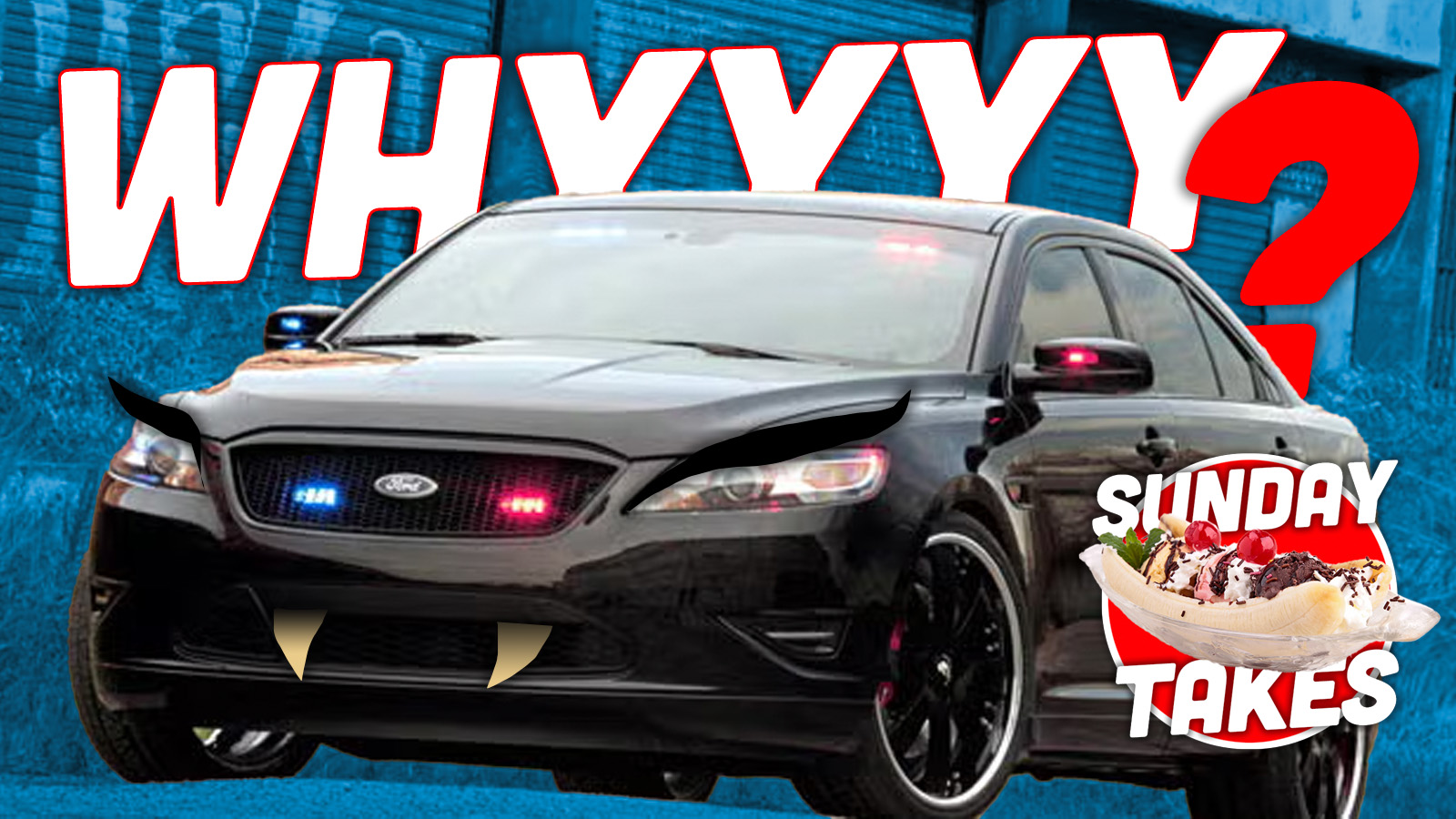
Automakers Design Police Cars To Look ‘Sinister,’ And That Needs To Change
I should not be afraid of the police, and while — again, I’ll reiterate that it’s not just car design that causes this fear — it’s not exactly helping that vehicles like the Dodge Charger Pursuit and Ford Police Interceptor shown below are referred to by their manufacturers as “sinister.” Yes, that’s right; cars meant to serve and protect Americans are being designed to look sinister — a term that translates to evil or threatening. From Dodge’s press release:
Behind its sinister face, the Dodge Charger Pursuit offers an all-new standard E-85 capable 3.6-liter Pentastar V-6 engine with variable-valve timing (VVT) and available legendary 5.7-liter HEMI™ V-8 engine with fuel-saving Multi-displacement System (MDS).

Then there’s this from Ford’s press release for the 2010 Ford Stealth Police Interceptor Concept that the company showed at SEMA; look at all the times Ford uses the term “sinister”:
- Revamped grille, lighting, exhaust and interior provide a sleek, yet slightly sinister look designed to blend muscle with mystery
- Sleek, streamlined and slightly sinister, a specialized stealth concept version of Ford’s Police Interceptor will debut at the SEMA

Check out this quote from that same press release:
“The rim section is stacked to give it the illusion of greater width,” [Ford designer Melvin Betancourt] said. “The center of the wheel is glossy black, and the rim is chrome. So we have that racy, hot rod look, but at the same time we’re building a sinister, stealthy, ‘Don’t mess with me’ feeling.”
Why are automakers making police cars look sinister? Why do we want them to convey the message “don’t mess with me”? Shouldn’t we want them to convey “I’m here for you when you need me. I’m protecting you and other motorists, and that may require me to, on occasion, chase after folks”?
Why It Matters What America’s Police Cars Look Like

To explain why the aesthetics of a police car matters, I’m going to reference a well-known military vehicle designer named Nir Kahn. Back when he worked for Plasan, an Israeli company that designs armored military vehicles, he wrote lots of insightful articles on LinkedIn about the particularities of military vehicle styling. One of my favorite articles, published in 2017, is called “The Aesthetics of Armoured Vehicles.” Here are a few paragraphs from that piece, which discusses how up-armoring military vehicles makes them look aggressive, sometimes sowing distrust among those who see the vehicles, and ultimately make certain peaceful missions more challenging:
But the addition of flat and square-edged panels [of armor] ruins the softer appearance of the Jeep-like vehicles and in many ways, although protecting the occupants, this can make their job harder, especially when working in civilian environments where human interaction can be a positive force, and an aggressive appearance can simply lead to increased violence.
The experiences of modern armies operating amongst civilian populations in Iraq and Afghanistan, and of peacekeeping forces and militaries around the world, has led to increased awareness of how the appearance of their vehicles can affect their ability to conduct their missions. Doctrines like “Hearts & Minds” can favour a less aggressive aesthetic, while other users may prefer to create a “Shock & Awe” impression.
[…]
At Plasan we often adjust the styling of our vehicles to the desires of the end user. Sometimes a fine balance needs to be created between projecting a less aggressive image while maintaining a requisite degree of authority. Some customers absolutely want their vehicles to look aggressive; it all depends where they will be operating. The decision about the vehicle’s aesthetic and image is based on a combination of strategic, cultural and political considerations, but most of all it depends on the mission. The needs of a police or paramilitary team are different from the needs of an army, and the needs of an army conducting peace-keeping missions or homeland defence are different from the needs of an army engaged in combat beyond its borders. The Plasan SandCat family has built in design flexibility allowing versions of it to be configured for any of these tasks, whether that means integrating observation or weapons systems, or adopting styling to fit in with the image that the user wants to project.
Making a vehicle look aggressive may make sense for a military trying to intimidate an enemy, but a police force should be considered a peace-keeper, and thus an organization that projects positivity, trust, and community. Police vehicles should not look like hard-core military vehicles.
The Whole Aesthetic Of America’s Police Cars Should Change
I’m not the only one saying this, by the way. It seems, based on a cursory online search, quite a few people agree that American police cars should look a lot friendlier:


Elsewhere around the world, cars do look friendlier. I mean, just check out the police cars in Germany:

And here’s Hong Kong:
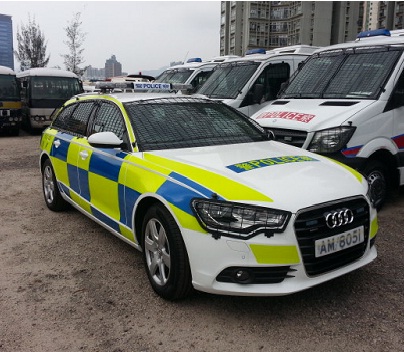
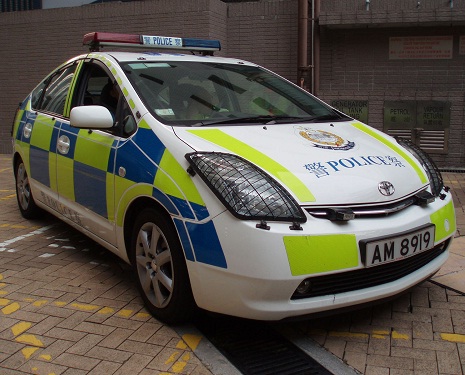
I could go on and on, but you can see that visibility is key here. These officers are meant to protect and serve you, so knowing where they are is important. In the U.S., the mentality is sometimes different, as Government-Fleet — a website about fleet vehicles — makes clear when it talks about police vehicle design choices in Colorado (bold mine):
This color scheme was changed to the current color palette for several reasons, said Sgt. John Hahn, Colorado State Police public information officer. At the time, research indicated black, light blue, and gray would give police vehicles a distinctive look, while allowing them to blend with the surrounding environment.
Lighter blue and gray shades also reflect colors used by early Colorado State Police vehicles, Hahn said.
“Our decision was based on the desire to respect the history and background of our agency while still adhering to some smart, tactical strategies,” Hahn said. “We wanted a new, fresh look that adhered to the progressive nature of our agency while staying mindful of the past.”
State police vehicles that can blend into their surrounding environment offer advantages, Hahn said. The Colorado State Police deploys nearly 700 vehicles in its fleet; the majority includes Ford Crown Victoria with some Dodge Charger and Ford Expedition models.
“If we have vehicles partially hidden, it allows us to address motorists who might not be driving legally,” Hahn said.
The mentality of trying to ensure that vehicles are hard to see seems to imply a relationship between police and everyday citizens that is akin to predator and prey, though to be fair, this is not at all the case with many other police departments. The white part of a black-and-white police car is specifically there to help give the cars visibility, and beyond that, in California it is illegal to paint a CHP car all black; contrasting door panels are required to maintain visibility. There are plenty of states that have colorful police cars and not all-black ones; still, those big Explorers and those Chargers are still far from friendly.

The feeling of predator-and-pray is furthered by this USA Today article about LA’s now-defunct, fuel efficient fleet of small BMW i3 police cars:
LOS ANGELES — The sight of a puny, electric-powered BMW police car with flashing red lights isn’t exactly going to instill fear in the hearts of this city’s criminals.
But on Friday, the Los Angeles Police Department showed off the newest member of its fleet, a black-and-white BMW i3, a diminutive electric car meant for tooling around downtowns, not necessarily for a televised high-speed freeway chase.
BMW is loaning the not-so-intimidating police cruiser to the force for a year as part of Mayor Eric Garcetti’s desire to get more electric or plug-in cars into the city’s fleet.
Why is the article seemingly critical of the new police vehicles because they won’t “instill fear” or “intimate” the public? This concept of “Police cars should be scary” is clearly thoroughly engrained into our national psyche, and I understand why; even the names of these police are not great. Most police cars are called the technical term “Police Pursuit Vehicles,” which I’m not a fan of. Just because pursuing criminals is a thing these cars can do, that shouldn’t be these cars’ entire identity. The vast majority of the time police cars aren’t actually in pursuit. What’s more, the Ford “Interceptor” name technically means “a fast aircraft that attacks enemy aircraft” or “Anyone or anything that catches or blocks an object or person in transit, such as a player blocking a pass.” Again, the car’s name is focused on the stopping of people and less so the helping of people.
At least Dodge Chargers are just called Pursuit vehicles and not “Enforcers,” as they’re in Canada. And at the very least, the Ford F-150 has the excellent name “Ford F-150 Police Responder.” There you go, a nice, friendly name that reminds you that police are here for you and not to get you.
Friendly Police Cars Just Make Sense
America’s police is such a loaded topic that I fear a couple thousand words on a Sunday Take could stoke some flames and lead to some heated comments, so I’ll just say that I want to keep the discussion as much about car design as possible.
And on that front, I believe we need more friendly American police cruisers. The BMW i3 above is a great example, and so is the Toyota Prius police vehicle in Hong Kong. There is a very macho, paramilitary-vibe to many American police departments, and I think having officers drive a friendly hatchback instead of a huge, black truck or SUV that frankly looks like a military war machine will knock everyone down a peg and keep them humble and reminded of what their relationship with citizens should be.

The following might make it seem like I’ve lived in LA too long, but I’ll just say it: vibes matter. And you cannot look at the NYPD officer above in that Smart Car and tell me those vibes aren’t way, way better than seeing an officer in a huge, blacked-out Ford Explorer. It conjures a whole different feeling, and what a police car’s design communicates to people matters.
Back in 2016, Mercedes Benz of Portland wrote a great article on the New York City Smart Car rollout. It makes a lot of the points I’ve made in this article, including the fact that, while many will make fun of friendly cars because they’re used to cop cars looking scary, the reality is that a happy police car can help police in accomplishing their peace-keeping mission. From that story (bold mine):
In New York City’s tabloid newspapers and on blogs, they have been derided as “clown cars.” The previous police commissioner, William J. Bratton, described the subcompacts as “midget cars,” even as he announced their rollout last year.
But the city cannot seem to get enough of the tiny, bean-shaped vehicles, which look like curiously shrunken cousins of the iconic New York Police Department patrol car and which never fail to draw the attention, and sometimes the affection, of curious passers-by.
[…]
Among the department’s fleet of thousands of vehicles, including Ford Explorers racing to 911 calls and tow trucks clearing traffic lanes during the evening rush, the Smart car is quite possibly the only one that has its picture routinely shared on social media, described as “adorable” or, in the case of one parked in the West Village, “Cuuuuuute.”
“It’s just so approachable,” said Robert S. Martinez, the deputy commissioner for support services, who oversees the department’s vehicles. “People want to take pictures with it. People want to hug it, they want to kiss it. It’s just amazing.”
[…]
“It’s nice to have something to break the ice,” Michael Arad, the architect who designed the Sept. 11 memorial at the World Trade Center, said. One of the Smart cars parked in Lower Manhattan had recently caught his eye, and led him to joke to officers standing near it, wearing armor and carrying long guns, that they probably could not fit inside.
“I don’t think I would have joked with them if the car wasn’t there,” Mr. Arad said. “They thought the car was funny, too. It draws people out in a period of time when there’s so much tension around.”
Vehicles have often played a part in the politics of policing. In recent years, amid roiling racial tensions between minority communities and law enforcement, activists have pointed to the hulking armored vehicles mobilized in protests across the country as symptomatic of the militarization of the police.
To be sure, this whole article you’re reading isn’t meant to offer a solution that’s going to necessarily lead to radical change of police-civilian relations, but it could help a tiny bit, and above all, the story is pointing out the obvious: Because police are here to help us and not hunt us, their cars should be highly visible and they should definitely not be sinister.


I never really thought of this issue, but now that I read about it, I agree. It probably doesn’t serve a purpose to have police cars look scary.
That being said, I personally like the aesthetics of police cars. A lot of the design features (less chrome, less unnecessary trim/ornamentation) look cool. I generally think police versions of vehicles look better than their civilian counterparts.
This also made me think about atypical police vehicles I have seen. My personal favorite is a Smart Fortwo owned by a sheriff’s office in Georgia. I used to see it patrolling a very nice bike trail (the Silver Comet trail). It was the friendliest looking police car I have ever seen. The deputies driving also seemed like they were enjoying their jobs – I presume patrolling a scenic trail is one of the better law enforcement jobs if you can get it.
Here is a link to a picture of that car (assuming this link works?)
https://www.paulding.gov/ImageRepository/Document?documentId=11897
Are the police cars actually less ornamental? Sure, they have less chrome, but it’s just been replaced by “stealth” lights and black shit. To me, that’s just as ornamental (and thus the same amount of stuff), it’s just tacticool now. If anything, out of all the pictures in the article, the American cop cars have the most stuff on them (Smart Car withstanding, but that’s obviously not representative of most American offerings). The only thing they are missing compared to the other cars, is Hong Kong’s windshield and headlight
barricadesguards.I’m referring to how the cars look aside from the lights/police gear. Retired police cars (i.e. those with the decals and lights removed) look cool. I have also seen some vehicles that were built as law enforcement vehicles but never put into service (so lights and decals weren’t added); I also like those.
These vehicles basically look like stripped down/low spec versions of civilian cars. They only look remarkable because, in 2026, it can be hard to find a low spec/base model for sale on a dealer’s lot.
This is a great article and is exactly the points I make when having similar discussions with people. Having lived in the uk for the better part of a decade, the only interaction I had with a cop was being pulled over because I had a brake like go out. And that was “go fix that please” and that was it.
In the states, particularly in Texas where I live and see it regularly (But I bet it’s in a lot of places) almost all police cars have been swapped for the tactical revenue building cars. The monochrome black/brown/grey that are hidden in driveways, on ramps, etc specifically to find people, write tickets, and generate revenue. Some small towns that have 1-2 cars literally only have these and some of those are replaced with non-typical vehicles (local town near me has a single police car and it’s a black jeep gladiator). San Antonio used to have a law, I’m not sure if they still do, that said all the city cops had to have reflective marked cars, so they would have the markings made in reflective vinyl in exactly the same shade as the paint so they were hard to see.
Really, those tactics do a discredit to police that are there and need to be there to actually do their job and erode the already shaky trust that is there.
I’d actually love to see the police in my community pull people over for more minor traffic violations to tamp down on out of control and inattentive driving, but only if the results of those stops are less scary and expensive (like your UK interaction). That’s another reason to make the vehicles more friendly–we should be doing everything we can to ensure every traffic stop is a non-event. If every stop carries a risk of a bad outcome for either cop or citizen, then the threshold for pulling people over gets higher.
That’s a really great point. Enforcing actual concerns in a friendlier manner as opposed to just trying to generate revenue and building that trust that there is a reason the interaction exists, not just preparing to defend against the outcome of the interaction.
I’d love to see more driving in the left lane or overt safety issues addressed.
Sadly, traffic stops in the US are inherently engineered as hostile engagements. They’re a large source of arrests for a department, as they often coincidentally pull over a driver with a warrant and add an arrest to their metrics, and officers are actively on the lookout for that. Naturally, someone who knows there’s a warrant out for their arrest might be less than cooperative, and there’s no way to know until they’ve gone over the driver’s license, so officers who’ve been trained with that scenario in mind treat everybody they pull over like Hans Gruber just in case.
The other issue is that officers are encouraged to coax confessions and self-incriminating statements out of people they pull over because they might fight the ticket in court, so they’ll deliver a judgmental lecture to prompt an apology or justification, both of which can count as confessions if recorded on the body cam.
This is in my mind a big factor in why American policing is so ‘competitive’: most countries tend to have one police force for a region/province/city which all police officers are salaried employees of and equipment is purchased collectively, while in the US the fragmentation of the police forces means each department has to raise its own revenue and buy their own vehicles and gear, leading to a profit/competition-driven attitude.
Police cars aren’t need to drive revenue. Basic traffic enforcement like speeding, stop lights, and red lights should be done by cameras so Police can do their real job.
Long past time to get police out into their community doing police work instead of writing tickets.
I agree as long as they aren’t using ai cameras to do it. Speed cameras and red light cameras have been a thing for decades. No reason to not use them really.
ehhhh.
Red light running, sure, but speeding on highways isn’t dangerous. I’ve almost been in tons of accidents, every single one was some idiot not paying attention, failing to use a signal, and changing lanes abruptly. Not one single time can I think of someone speeding AND PAYING ATTENTION, causing a problem on the highway.
Distracted driving is a MUCH bigger problem, and there is basically no enforcement.
I was in the suburbs outside of Austin a couple years ago and had to stop to laugh at a police cruiser that was a Charger painted shiny black with “Sheriff” and the logo written on it in matte black. They’d gone full Spinal Tap with it https://www.youtube.com/watch?v=Ds7FRivVMgA
That nonsense is all over the Colorado front range. It had gotten so bad before I moved away last year that it became noteworthy when a police car was actually easily identifiable instead of sort of looking like one until you could get at an angle to see if there was matte lettering hidden within the gloss of the paint. It also seemed to make it a lot easier for folks who owned old cop cars or Chargers to cosplay as cops, since no immediately recognizable markings didn’t mean anything anymore where whip antennas and push bars did.
I was in Georgia a couple years ago and saw some state patrol cars with a similar all black car with matte black graphics scheme. Kind of ridiculous on multiple levels.
its on purpose. its called ghost marking.
Oh I’m sure it’s on purpose, didn’t know they called it that though.
I see a lot of depts here in RI that use that same scheme. It pisses me off.
They’re road pirates out to generate revenue.
If stopping speeding was actually the goal, they’d park a car where it was easily spotted and EVEYONE would slow own, not just the one car pulled over.
Designing a ‘more friendly American police cruiser’ would be a great article for Bishop.
Amen brother! It always bugged me the way undercover cop cars lurk around just waiting for you to step out of line. I always admired (both visually and respectuflly) the Michigan highway patrol cars with the giant red light on the roof. Good shade of blue too.
At systemic level the police in the USA want to be feared. Fear and intimidation is the desired outcome. The cars are just a symptom.
Yes, this is a HUGE problem, and I have been on this fight for years now! Anybody else remember “Carbon Motors” and their dedicated cop car? Same problem.
I emailed them back in 2008, this is how it went:
> To: contact@carbonmotors.com
> Subject: [carbonmotors.com] Contact Us from web site
>
> Why is your car so “angry”? I do not understand why you are pushing a design which is intimidating and frightening to represent our police officers. They should be available to help the common citizen, not look super macho and badass. Seriously… it’s a testosterone fueled rage machine. Why!?
> From: contact@carbonmotors.com
> Subject: RE: Contact Us from web site
> Date: Wed, 19 Nov 2008 03:12:04 -0500
>
> You’re the first person to opine on the vehicle looking “angry” (the additional expletives and descriptors were unnecessary). To date, the vehicle has been viewed by thousands of people who have agreed that vehicle has a commanding presence that is extremely suitable for law enforcement.
> To: contact@carbonmotors.com
> Subject: RE: RE: [carbonmotors.com] Contact Us from web site
>
>Expletives? Where was I swearing? I find it odd a company that designed such an angry and intimidating car was “offended” by my opinion. You’d think such an angry company would have tougher skin. And sorry, I don’t think an “Angry badass” presence is appropriate for law enforcement. Maybe for a movie, but not for cops in my town. They should be helpful, not threatening.
Thus began my feud with this company, and WHENEVER there was a story on them trying to get funding, you can be assured I was in the comments trashing them on what a stupid idea the whole thing was, from the design to the drivetrain choice.
You won.
Imagine if they all had to drive those older Mazdas with the huge smiling front fascias. 🙂
I’m a retired police officer in Brazil, and I must say I wholeheartedly agree with Dave.
Brazilian police, when I was a young man, used to drive VW Beetles, mostly painted white and light blue. Then they started what was called “Tactical Patrol”, with bigger teams driving a Veraneio (a gorgeous, IMHO, SUV, also painted blue and white), or for road patrol, an Opala (a gentler version of the Chevy Nova).
You can see a slideshow of those cars here:
https://oglobo.globo.com/rio/noticia/2023/03/viaturas-usadas-pelas-policias-civil-e-militar-entre-os-anos-70-e-90-sao-restauradas-e-brilham-em-exposicoes.ghtml
Even nowadays, police cars do not try to blend in at all. They still use a white background and colored stripes with huge letters, like in this Environment Police (they deal with poachers, fire-starting, illegal logging, and the like) car of the state of Minas Gerais:
https://olavrense.com.br/policia-ambiental-recebe-nova-viatura/
The point is that police should be seen from afar, both for intimidation (a police car in the area makes criminals think twice before doing something foolish) and to be always available to those who seek help.
In the police academy, we had classes on what to do when someone literally jumped in front of our car seeking help. It happens all the time, precisely because the cars are highly visible. I have had people literally jumping out of windows to ask for help when they saw our red-and-black-on-white car driving by. They knew we were legally bound to help anyone who sought us.
On the other hand, in the last 30 years or so, the “Special Operations” armored cars appeared; they are used for interventions in gang-controlled areas. Those are made for intimidation, period.
In Rio, they enter the gang-controlled areas with loudspeakers playing a recording or an artificially deep male voice repeating, “If you run away, I will catch you”. It’s the opposite of regular patrol; they are meant for open conflict with heavily armed gangs as those the American government has just declared terrorist organizations. You can see some here:
https://oglobo.globo.com/rio/noticia/2023/06/conheca-a-historia-dos-blindados-da-policia-do-rio-os-primeiros-foram-incorporados-a-frota-ha-pouco-mais-de-30-anos.ghtml
In other words, as the very good motto of many American police forces, “protect and serve,” shows, police cars should broadcast an image of being there as servants of the public. When we see one, we should think, “I’m safe”. You should see them from afar, and they should inspire people to seek the officer’s help.
In special cases (SWAT teams, perhaps, in the American context), “sinister” vehicles can make sense, but not for patrol.
BTW, there is an international treaty that assigns colors for government organizations; according to it, police cars should be green and firefighters red. Some countries respect it, but most don’t.
Former LEO here from the 80s.
The 80’s was a time of police, and cultural, transition.
Started the decade with revolvers and shotguns, ended with pistols and ARs. Neckties went away and body armor emerged. See the 86′ Miami shootout for the rationale, though I thought the reaction was an overreaction. One unique outlier became the standard and everyone suddenly had to be armed for Nam.
Police cars were just cars though, the change to “sinister” came in this century. It’s part of the slow shift that happened in all American culture, see modern pickups.
Sheriff Taylor from the Andy Griffith show was, and remains, my ideal of policing. That’s seen as silly now.
Policing is mostly macho in 2026. So is everything. Is it bad of me to admit I avoid police interactions? I know good cops, to this day, and I know some I don’t want at the doorstep. Best to stay clear.
Got out in 90′.
Cops cars should be highly visible, non threatening, approachable. Cop uniforms should be the same. (some still are)
But what do I know?
Dave seems to have kicked a nest of retired cops here. 😉
I agree with you 100%.
I had a teacher at the police academy, a very long time ago, who deeply despised this new culture. He was proud that he had always worn a suit and tie, with a small .38 in an ankle holster.
I remember when he told us about an officer who went to his office for some bureaucratic BS wearing a tactical vest with his team’s shield (an eagle) on the back and grenades hanging from it, saying, “The guy had a drawing of some sort of chicken on his vest, funny boots with his pants tucked inside, and looked like he had fruit hanging from his belly. He looked like a GI Joe, not a guardian of the peace!”
We had one detective on our small force and he always dressed in a full suit and carried a snub 38. Good guy, gave off an easy going classy vibe.
A lot of the older guys scoffed at the “need” for the new wonder nines when their Python had done the job fine for 30 years. After Miami we were told times had changed and we had to change too.
The world was more dangerous now we were told. I didn’t buy it then and the stats bear that out now.
Some guys retired. Some young ones like me got out. It was a sea change moment and that’s how we got here, with “sinister” cars and cops dressed like they are ready to drop into Khandahar.
If you dress, train and equip the police as paramilitary then you’ll get a paramilitary. With that will come a rise in use of force as the first choice. I can’t believe what civilians get shot for these days.
That’s why I religiously don’t speed, don’t do things to attract LE attention. People get shot for the smallest things.
I think the Brits have the right idea, no firearms for regular beat cops.
I think the 1997 North Hollywood shootout contributed to that culture change as well. The bank robbers had fully automatic assault rifles (AR-15 and AK-47 types) with 100 round magazines and full body armor, LAPD had 9mm pistols and shotguns.
Yes, it did.
Again that was an extreme incident. But it reinforced the move to where we were going.
Ford calls their police vehicles Special service vehicles or SSV, sounds better than pursuit vehicle I guess. Also the US Park Ranger police vehicle Expedition is the exact same shape as the civilian version, some extra cladding, beefy alternator and a skid plate are the only additions as far as I can tell. Clearly police vehicles CAN be made like civilian models if desired.
There are different tiers of vehicles, based on the needs of the organization. There are full “pursuit capable” vehicles, and then there are “special service vehicles”. The pursuit capability is much more intense, with requirements for accel/braking, curb impact, and 32 lap runs at Grattan Raceway for MSP or Pomona Raceway for LA County Sheriffs. Details on Pg 4:
https://www.michigan.gov/msp/-/media/Project/Websites/msp/training/MY2026_Police_Vehicle_Evaluation_Test_Book.pdf?rev=be140e0cf04043169fb191bd1ccb24a9&hash=2E8D99BC1EB31F0B16508C094B2AE79B
Well now that is interesting, a presuit capable vehicle would make an interesting used vehicle.