


I feel like every time I get excited about some extraordinarily affordable car, electric or otherwise, there’s always someone around to tell me why such a thing is impossible in America. And, sure, they usually have some pretty valid reasons, not meeting safety requirements or not having the profit margins that companies demand, or being just too crude or basic to be appealing to the mass market, or something like that. Fine. Whatever. I could do without the weird glee some people seem to have in shooting down my dirt-cheap car dreams, but more importantly, I can’t ignore the fact that these cheap cars do exist in other places. China, for example. And now, it seems, Mexico.
Yes, Mexico! Mexico has a pretty long history with affordable cars, being the final holdout of original Volkswagen Beetle (Vocho, as they say) manufacturing. Now the country – and I mean that at least partially literally, since the Mexican government is backing this new EV startup, Olinia – has put their support into a clever-looking and useful-seeming little electric van that is planned to sell for about 150,000 pesos, which translates to about $8,600. Mexican President Claudia Sheinbaum even drove a prototype around at an event yesterday.

Here, see for yourself:
That’s gloriously cheap. Even better, it seems understandably cheap, not some wild startup wishful thinking kind of crap. The vehicle, the Olina Uno, is realistically modest, but enough to do its intended job just fine. It’s designed for its intended purpose – a flexible, multi-use electric city car – and that’s it. The speed is limited to 50 kph/31 mph, so it’s definitely just a city car, but for a huge amount of driving, this actually is plenty. I learned this lesson when I was driving my Changli every day.

It’s a six-seater van – there’s also a cargo pickup truck variant –that moves around with a 17 horsepower electric motor, sucking electrons from a 14.7kWh LFP (lithium iron phosphate) battery pack, with a range of over 62 miles or so. This is a very basic vehicle, but a clever, useful design. Honestly, it doesn’t seem all that different than similar Chinese small, lower-speed electric vehicles, but that makes sense: this isn’t necessarily the place to re-invent the wheel.
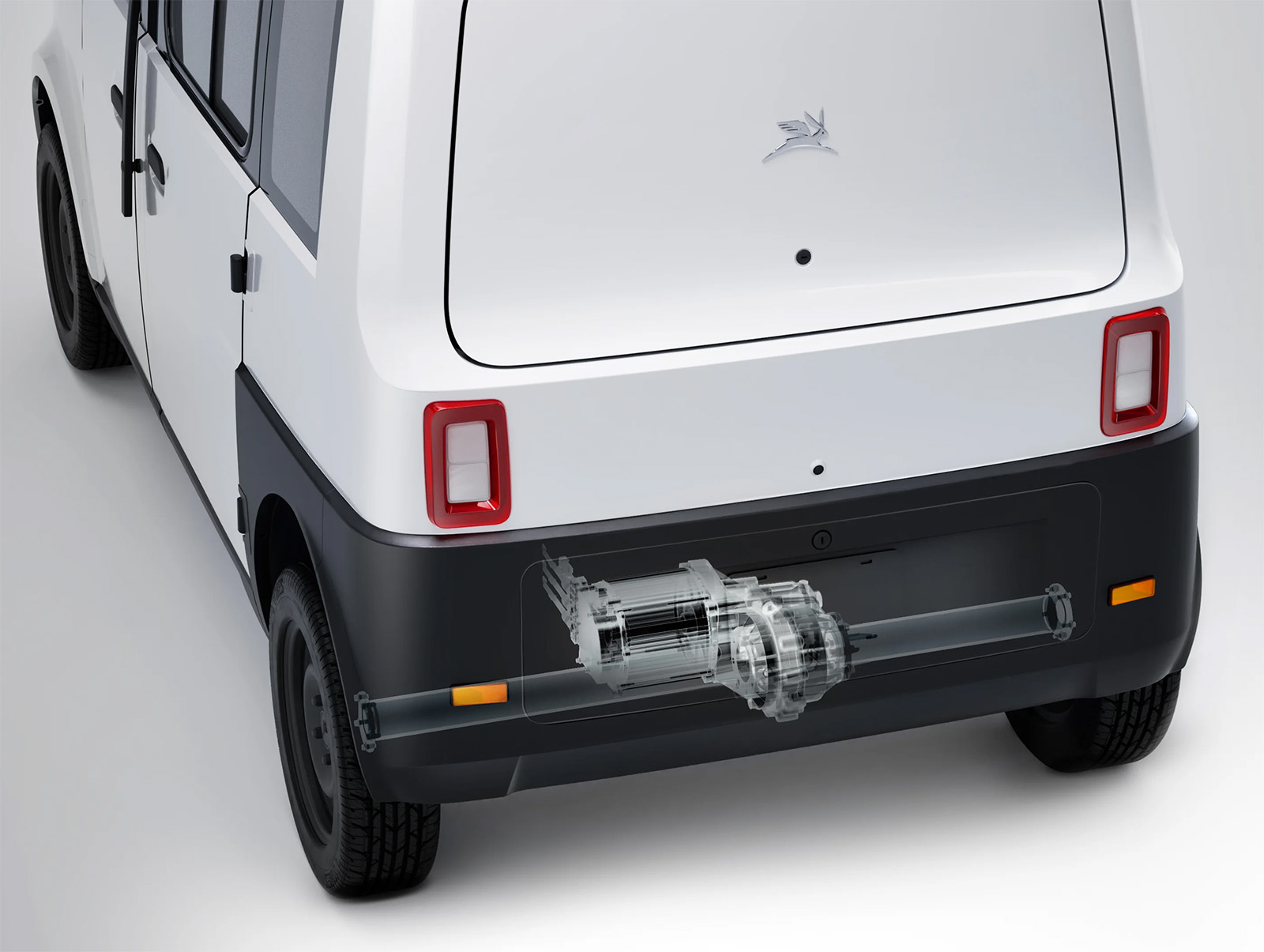
The Olinia Uno will recharge from normal wall outlets, eight hours at 110 volts, four at 220 volts, which, like so many specs relating to this car, isn’t impressive when compared to modern, full-price EVs, but for the use cases that this is targeted? Definitely good enough.

Smaller than even most compacts, the box-on-wheels design allows for more interior volume than most small cars, and provides better weather protection and comfort than three-wheeled tuk-tuks/auto-rickshaws that are in use for similar intra-city travel. The Olinia site offers an operating cost comparison between a regular automobile taxi, a three-wheel moto-taxi/tuk tuk, and the Olinia Uno. Unsurprisingly, the Uno comes out the cheapest, at $900, compared to $2,194 for the moto taxi, and $4,320 for the conventional cab.

This isn’t a sub-$10,000 that’s going to be absolutely everything to everyone. But it is a sub-$10,000 transportation machine that is far more useful and capable than its simple specs would suggest. People could definitely use this thing, in the right locations, of course, as their day-to-day transportation for about 75% of their driving needs. This category of vehicle is viable and, I can tell you from experience, appealing. Small, lower-speed EVs work for so many things, and I think the way they’re handling this in Mexico makes a ton of sense.
I’m excited to see how this all plays out.
Top photo: Olinia


ill bet these will cut tons of pollution from those 2 stroke tuk tuks as cabs in mexico city
¿Necesitas tú un chainsaw para cambiar las baterías?
No.
You pair that same drive system, frame, and battery with an aerodynamic sedan or coupe body with a CdA of under 0.25 m^2 and a modified gear ratio, and you’ve now got a 70 mph capable EV that gets like a 120-150 mile range on the highway, for not much more cost. It will be very slow to get up to speed with only 17 horsepower, but it will get there. Consider that the Loremo AG was claimed to do 0-60 mph in 20 seconds with 19 horsepower, and was able to reach 100 mph top speed on that.
I absolutely adore minimalist car designs like this. I just wish I could get it in something more useful than a “city car”.
This looks like a minivan and a golf cart had a child together.
This would be a perfect vehicle for the urban core of many cities. Get outside that area and the speed/range may become an issue.
This is impressive! No, it won’t work for everyone, but it’s not meant to work for everyone.
That said, they could have put a little more effort into demonstrating the cargo space. Cardboard boxes!?! Where’s the birdcage?? Where are the violin cases and picnic baskets?? There’s not even a fishing rod! How I am supposed to judge the scale of the cargo cavernocity?? 🙂
I am torn. Part of me wants to say, Nice water resistant golf cart. and the other part of me wants to say, very cool and useful, why let angry people who live hours away from everything and feel the need to go 80mph with 8 people for 600 miles towing a camper wreck EVs for the rest of us.
That also need to fully recharge their 500kW pack in no more than 15 minutes
A necessity if you’re running an emergency, coast to coast, 24 hour trombone repair business.
Of course they have nice things, look at their president.
80% of the population of the USA live in urban areas. About 30% are in dense urban areas. Moving that 30% and their goods and services seems like a reasonably large enough market.
I’d settle for just their president to tell the truth.
Seconded. 😀
For nine grand (and presumably lower registration and insurance due to low speed) I’d totally rock this to Trader Joe’s, Rompage Hardware, and other local haunts which make up like 95% of all my driving. I’m even fine with it in white, working on the assumption that it doesn’t have A/C.
That’s about what I spent on my Milan SL velomobile, and that’s exactly how I use it 99% of the time. And this, without using a motor of any kind because it didn’t have one. Cruising speed was about 30 mph on flat ground using nothing but my legs, but I could approach 50 mph in a sprint. A very economical grocery getter.
After converting it into an EV, I started getting more adventurous and taking it on 100+ mile trips using the slow lane on state highways to do 45-50 mph. I’ve even slept in it in parking lots at night. 2 kW is enough to keep up with car traffic and do over 70 mph when I want to(my brakes/tires aren’t up to the task, so I generally don’t).
One day, I’d love to build a micro-sports car with that form factor and aerodynamics, except with beefier components, and like 150+ horsepower and AWD to motivate it. I’d love a dangerous 9-second microcar on crack!
Even if it makes sense for consumers, it wouldn’t for manufactures who seem happy cranking out 60K SUVs all day long.
Also, because we are all irrational, in some world where this does come to market I could see it being a market failure, despite being the best vehicle for a ton of people.
I’m worried about the lack of a front footwell that causes front seat passengers to sit like they just got off a horse.
I could definitely make this work around town as I live on an island with a 25 mph speed limit. Unfortunately, the closest real grocery store is 3 miles away reached by a 45 mph causeway that leads to the rest of the world. I suppose I could use the bike lane (kidding, maybe).
A majority of my driving is a 30mph speed limit which means I do 35. I think the minimum for the US should be 55 to be viable. We’re all about planning for edge cases when it comes to our cars in the US.
It can also fit a wheelchair in the back without further modifications, which is very cool.
Beat me to that. Very cool indeed, and that expands its useability quite a bit.
People in Mexico are hating this, since it was created by the government, or at least pushed by the government and its half baked for Mexico needs. The Renault Kwid (Dacia in other markets) is selling for 11,400 usd and you can travel with it.
Are they really? I know about the narco violence and general corruption and all, but surely Mexican citizens can’t hate this cute little boxy runabout just because the government is supporting/promoting the company that made it, right? Only Americans could manage to be that stupid! 😉 USA! We’re #1! USA!
With that said, I never heard about the Kwid before and at that price (which it would never be if sold here) I think it’s kind of adorable. Plus, it probably has A/C! 🙂
The cautionary tale of the Tata Nano: had a lot going for it, except apparently no one wants the stigma of driving around in the country’s cheapest car.
Honestly, this vehicle seems less like an affordable car for regular people and more like a rich person’s golf cart. Its cheap, because its an entirely useless vehicle. 31 mph may be enough in the city, but it also completely confines you to the city.
82% of the population in Mexico lives in urban areas.
Like 60-80% of the Mexican population lives in urban areas.
I live in an urban area (LA) and literally 95% of my driving is around town (maybe more). I’d happily drive a ‘city car’ for local trips provided it made sense to do so (in terms of savings vs. a full-size car).
It could also appeal to city dwellers who don’t have a car but could appreciate the utility of this. Then again, adding a ton of cars to a city doesn’t seem like a good idea.
At one time I lived in town, and my commute to work was six miles each way. It took about ten minutes and peak speeds might hit 45mph. In a denser city where traffic might struggle to hit even half that speed, 31mph would be plenty. My commute was like that for over ten years, so it’s not like I wouldn’t have gotten a good long use out of something like this. So long as the AC works I’m good. I have a different ride for weekends when I go farther, faster – and at this low price point, that other ride is easier to keep.
This little critter has an instant market, right now, as a cab. As an airport shuttle. As the dinky little runabout my sister could actually use, living in NYC. Stacy I love you and you know this, but 50% of your driving barely exceeds a decent 400m dash velocity and none of it will outrun a bicycle messenger. This would be the car for you and your gigantic boyfriend.
I think it has potential.
Now I want to see the gigantic boyfriend sitting in this car
I’ve seen him standing next to her. My lil sis is 5’2″ and her BF is about 6’5″. I haven’t met him but I’m pretty sure I could pick him out in a crowd. Just look for the people all trying to take pictures of Sasquatch.
Seeing the people in the video standing next to it, I think he’d be an easy fit, assuming the seats can handle him.
I’m more rural and for years had a 4 mile drive to/from work. If it hits 55 to 60 mph I’m good for all of my local errands.
“that moves around with a 17 horsepower electric motor, sucking electrons from a 14.7kWh LFP (lithium iron phosphate) battery pack, with a range of over 62 miles or so.”
Which tells me that it’s cheap because it’s only useful as a local neighborhood vehicle.
I’m not interested in these short-range glorified golf carts.
What I want to see how affordable we can make a 4 door hatchback BEV that can seat 5, has at least 20 cu ft of trunk space with the seats up, has at least 200 miles of range WITH THE HVAC AND LIGHTS TURNED ON IN 0C/32F TEMPS, has a top speed of not less than 75mph and has a 0-60 time of not less than 10 seconds.
Something like that would be useful to me as an affordable daily commuter car.
“. People could definitely use this thing, in the right locations, of course, as their day-to-day transportation for about 75% of their driving needs. ”
Throw in cold temps with the heater/defrost/lights/wipers all turned on and that 62 mile range will be closer to 30-40 miles… Which is to say it won’t even meet the needs of people with shorter commutes. It would barely be adequate for my daily round trip and completely wouldn’t cut it for the weekly 70 mile trip I make to see my GF.
has a 0-60 time of not less than 10 seconds.
Did you mean “more than”?
Whoops… yeah what I meant was “a 0-60 time of 10 seconds or less” or “a 0-60 time of NOT MORE THAN 10 seconds” as you said.
If you can live with a bit less than half the boot space, a basic Renault 5 is $26,000.
“If you can live with a bit less than half the boot space”
Some people can, but I can’t. And in my estimation, with 20cu ft of boot space, you’ll have enough space for the day to day needs of the vast majority vehicle owners.. even when they do a Costco run.
I don’t know if I have translated it well, but 20 cu. ft. are 566L. We are talking Octavia-levels of boot space. That is not a small boot.
We are talking 2008 Honda Fit-level boot space… which was my previous car. It had 21.3 cu.ft or 603L of space with the seats up.
https://www.edmunds.com/honda/fit/2008/features-specs/
The Honda Fit was a very space-efficient design. So many vehicles (CUVs being the worst offenders) have terrible interior/boot space for their given footprint.
Automakers have gotten very VERY lazy about this.
Then sorry, I did the maths wrong. The Renault 5 is quite close in boot capacity to the Jazz / Fit.
I’m in Canada… no Renault 5 here sadly.
Not in the states either of course. 🙁 I weep when I ponder how much more interesting the automotive market could be in America if the three big French brands would return to our shores.
I love the Renault 5, and boots too, but comparing this One to a 5 is apples and oranges. Or something smaller and stranger, like a kiwi, to oranges.
You are not wrong.
Something like the first-generation Scion xB. It doesn’t have to be quick or fast – your 10-second sprint is achievable but by no means a deal breaker as far as I’m concerned. But that form factor, big on the inside and small on the outside – like the Olinia – is deeply attractive.
I’m willing to make an amendment: not a range of at least 200 miles, but a range capped at 200 miles. Lots of people are discovering that the massive range they have demanded is going largely unused. There are going to be edge cases but just a dab of trip planning can handle that. My son recently completed an 800 mile trip in his Ioniq and reported that his longest leg was only 180 miles. Shoot for the everything-on, heat maxxed out at -10 into a 20mph headwind range of 200 miles, and then stop. Build for that and quit. Then focus on aero improvements, weight reductions, ride improvements etc. Don’t try to shovel in the biggest battery, just make the car a damned great place to be. Save a few bucks on the battery so we can save a few bucks on the car, and make the car great.
“, but a range capped at 200 miles.”
Just as long as it’s 200 miles of range in cold weather with the heat/defrost/lights/wipers/radio on.
And this budget BEV wouldn’t have seat heaters, heated steering wheel and other unnecessary luxury features.
Actually the seat heaters are the EV-smart option. They take less wattage to run than heating all the air in the car.
They don’t warm my face or my hands. All they do is roast my nuts which are warm enough as-is.
Nor do seat heaters defrost my windows.
Heated seats are not a replacement for proper heat. They’re at best a half-assed solution.
No, no – it’s the whole ass! The heater goes all the way across.
My car has the seats and steering wheel warmer and while I have my coat on, it’s more than enough. But I freely admit that I’m not that northerly and it would probably be far too little for a lot of folks. It’s enough for me, but Sweetie turns her side of the car on all the way and still looks like she’s dying. That lady is definitely a tropical flower.
Yeah, the defroster…
“No, no – it’s the whole ass! “
My whole ass, like my nuts, is also warm enough.
“Yeah, the defroster…”
And not just the front one, the rear one too.
“That lady is definitely a tropical flower.”
My GF has a very narrow temperature range where she does not need heat or AC. I think it’s between 22.5 and 22.6 Celsius.
I would add fast charging. But other than that, spot on.
I meant to include that. Son’s long trip would’ve taken longer, but he reported that the car was charging at the rate of 860 miles per hour. So he could put 150-180 miles of range back into the battery in under 15 minutes. That’s close to par with a typical long-trip stop in a gas car, fuel up, get coffee and snacks, walk around and shake out the fatigue.
Yeah. It should have “fast enough” charging. It doesn’t need to be the fastest 800V system. But something comparable to the 400V charging commonly seen on modern lower end BEVs these days.
You’re daily commuting 200 miles in the snow with 4 other passengers and 20 cubic feet of crap? You should move.
I do sometimes in the winter. There were many times I’ve had my current vehicle (a C-max Energi with 19cu ft of space) or my previous car (a 2008 Honda fit with 21 cu ft of space) loaded up with passengers and stuff.
Not daily, but often enough.
It’s also about having some buffer in the range so if you have to run some errands after work, you can do it without having to worry about range and whether you can make it home.
And in terms of space, it’s also about having a buffer so you can fit the odd oversized thing so you don’t always have to pay for delivery just because you bought a new TV or smaller piece of furniture from Ikea.
And specifying minimum space is also about how many vehicles these days (with CUVs being the worst offenders) have a terrible lack of interior space for their exterior footprint.
if it is 200 miles in the snow with just 1 person and 20 cubic feet of crap you are commuting to work in North Dakota/Montana.
Agreed with your requirements. Living in MI it gets cold enough and everything is spread out just enough that a 200mile range is needed with decent people/cargo capacity. I look at the Chevy Bolt and in the winter with heater going its about all I could do to get to work and back. (Yes I should move but thats also not really an option with the insane housing costs we have as a country). I do 70 miles round trip daily to work and back, but normally also head to the gym and quite often go out to eat or get groceries, so its not uncommon to hit over 100 miles a day. In the dead of winter that puts a standard 200 mile range EV in the low 100’s and leaves little buffer for me, requiring a full night long charging at my home level 2.
I live on a 25 mph road but living in the suburbs here means 1/4 mile in any direction hits a road that 45 mph and an expressway thats 70mph to go anywhere. I could easily rant at how poorly the cities have been designed but its not going to change in the next few decades.
I do love that things like this will exist as we do need cars that fill every niche, its just not one I would be looking to buy.
It is the hubris of the white man that pushes him to live in such climates (this is all jokes I promise)
