


My Australian friend Laurence had already flown back home after helping me build and install my 2026 World War II Jeep’s brand new engine and helping me test-fit the body. I had a running powertrain and complete drivetrain, leaving me with what I thought was a borderline-manageable workload given the Easter Jeep Safari was about a month away. I had to install the brake lines, replace the wheel bearings, install the brake shoes and hardware, install the driveshafts, replace the axle seals, and button up the steering. Once that was done, the Jeep should be able to drive. That should be easy, right? No.
You may recall a few months back that I put out a challenge. “LIVE BLOG: Guess What Time David Finishes This Huge List Of Tasks On His eBay Jeep Project, And You’ll Win A Prize.”


This challenge:

The idea was that, if I told you, dear readers, that I was going to spend the next 24 hours attacking a list of tasks, it would give me motivation to get it done. I was running out of time and, without Laurence, not getting nearly enough done. I hoped that this post would motivate me to spin wrenches. As I mentioned in that article:
My timeline for completing my eBay WWII Jeep project means I have no choice but to get the entire drivetrain and braking system done now; this means I’m wrenching through the night tonight in an all-out offensive attack on rusty bolts, greasy bearings, and stubborn press fits. To ensure that I complete this ambitious list of tasks, I’m risking embarrassment by telling all of you everything I plan to get done before the night is done, and to make it fun: I’m going to give a prize to whoever guesses what time tonight I complete all this work.
Here’s the list of tasks I hoped to get done that day:
- Rebuild all drum brakes
- Remove and replace all 8 outer wheel bearings
- Remove and replace all 4 inner axle seals
- Remove and replace rear pinion seal
- Install all new brake lines
- Install all new brake hoses
- Remove and replace all kingpin bearings (check drag with pull-scale and shim appropriately)
- Remove and replace all kingpin seals as well as any wheel bearing seals
- Install rear driveshaft
I barely got any of these done that day.
And it’s not because I’m not a wrenching machine, but because this project is just grueling. The amount of work needed to do even just the brakes was humbling. Just watch this:
Let’s back up a little.
I Was Now Alone With A (Sorta) Running Engine And A Drivetrain

The premise behind this build is that our excellent partner, eBay Motors, is sponsoring me assembling a brand new World War II Jeep in my backyard using my own tools. This is meant to highlight the absurd number of car parts (including the entire Jeep body!) available on the marketplace for the average, everyday dad wrenching in their driveway (or in my case, backyard).
Given my history of tackling daunting projects involving welding up rusty frames, tearing into 80 year-old motors, rebuilding transmissions, using a gas can on a wooden pole as a fuel pump, reviving a 250,000 mile diesel engine on another continent, and accomplishing the impossible in Australia with a crusty Chrysler Valiant ute, many thought this project might be easy.
“Oh, he doesn’t have to deal with rust? That should be no problem.”
It’s been a problem. A humongous one.
The World War II Jeep project has required me to acquire parts (through eBay) from all around the globe. I’ve had to study pages and pages of vintage repair and restoration guides to understand every single component needed to assemble a WWII Jeep. I’ve had to organize these parts, and make them fit despite being from various manufacturers and various decades of production, and as for rust and grime: There was plenty. And it was all on the axles.
The Axles Were A Nightmare

I cannot believe how much work went into solely getting the axles (which I drove all the way up to Washington to pick up from an eBay seller) sorted. But then when you think about all the functions of the axles — braking, steering, rolling, transferring torque (i.e. accelerating), articulating, etc. — it becomes obvious that as simple as those two metal sticks may look, they’re a handful.
Disassembly Revealed Lots Of (C)rust

The problems with my whole “let me get this all done in 24 hours” concept arose immediately. Removing the brake drums was difficult enough, and required either lots of percussion with a hammer or a puller tool like the one shown above.
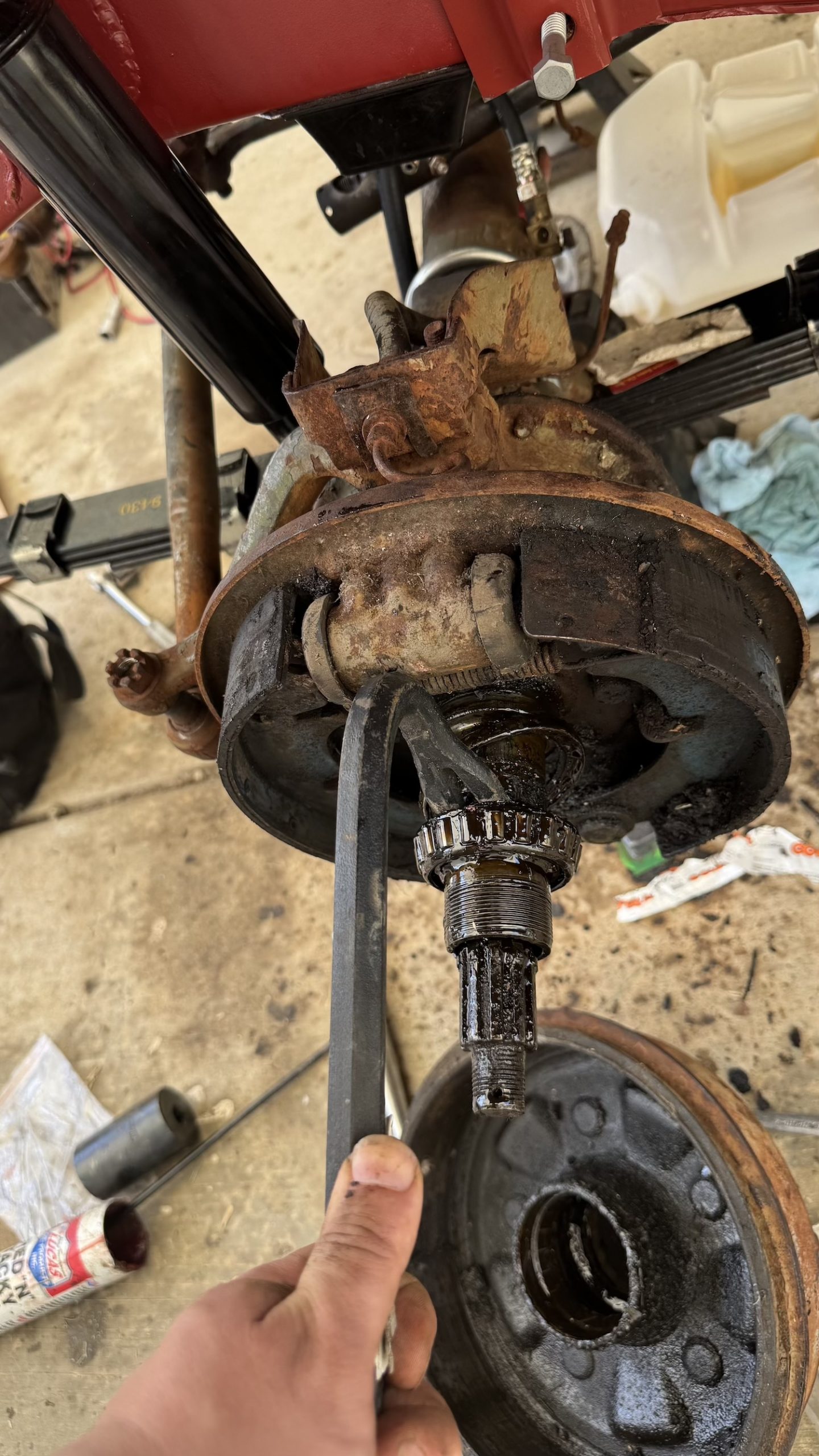
Once the drums were off, I had to remove an occasional seized bearing like the one above, and then I unbolted the entire drum brake system by just taking the whole brake backing plate off, revealing so much rust and grease and oil that I would have to spend hours trying to remove rusty eccentric bolts from the brake backing plates and cleaning everything.
And I don’t just mean “spraying it down with brake cleaner.” No, the grime in and around these brakes was caked on.
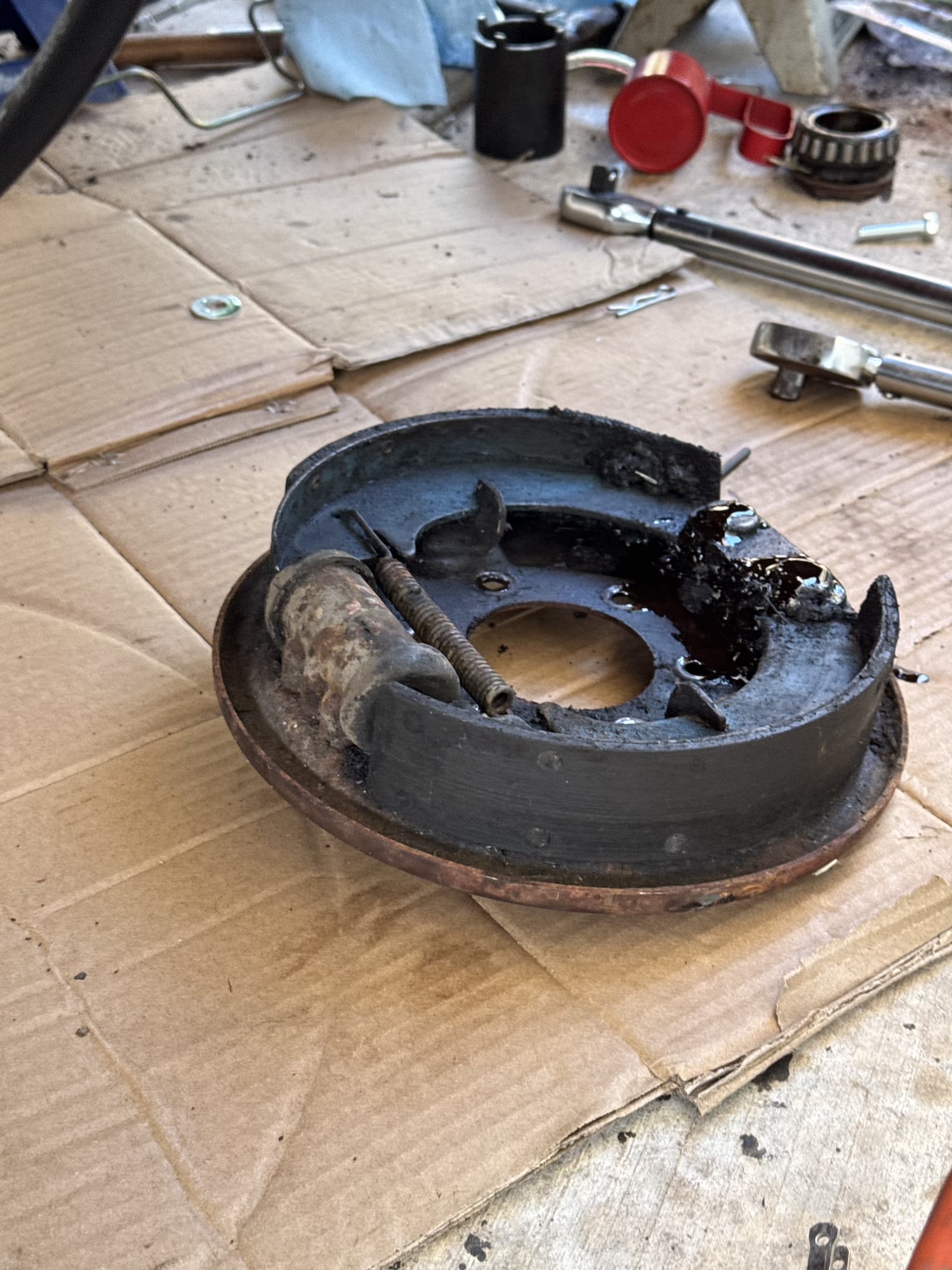
As you can see here, the brake backing plates were encrusted with a combination of oil and dirt, creating a concoction whose technical name is, I think, “grime”:

This is the type of stuff that you can just scrape off with a razor; it must be chiseled with a screwdriver and hammer: 
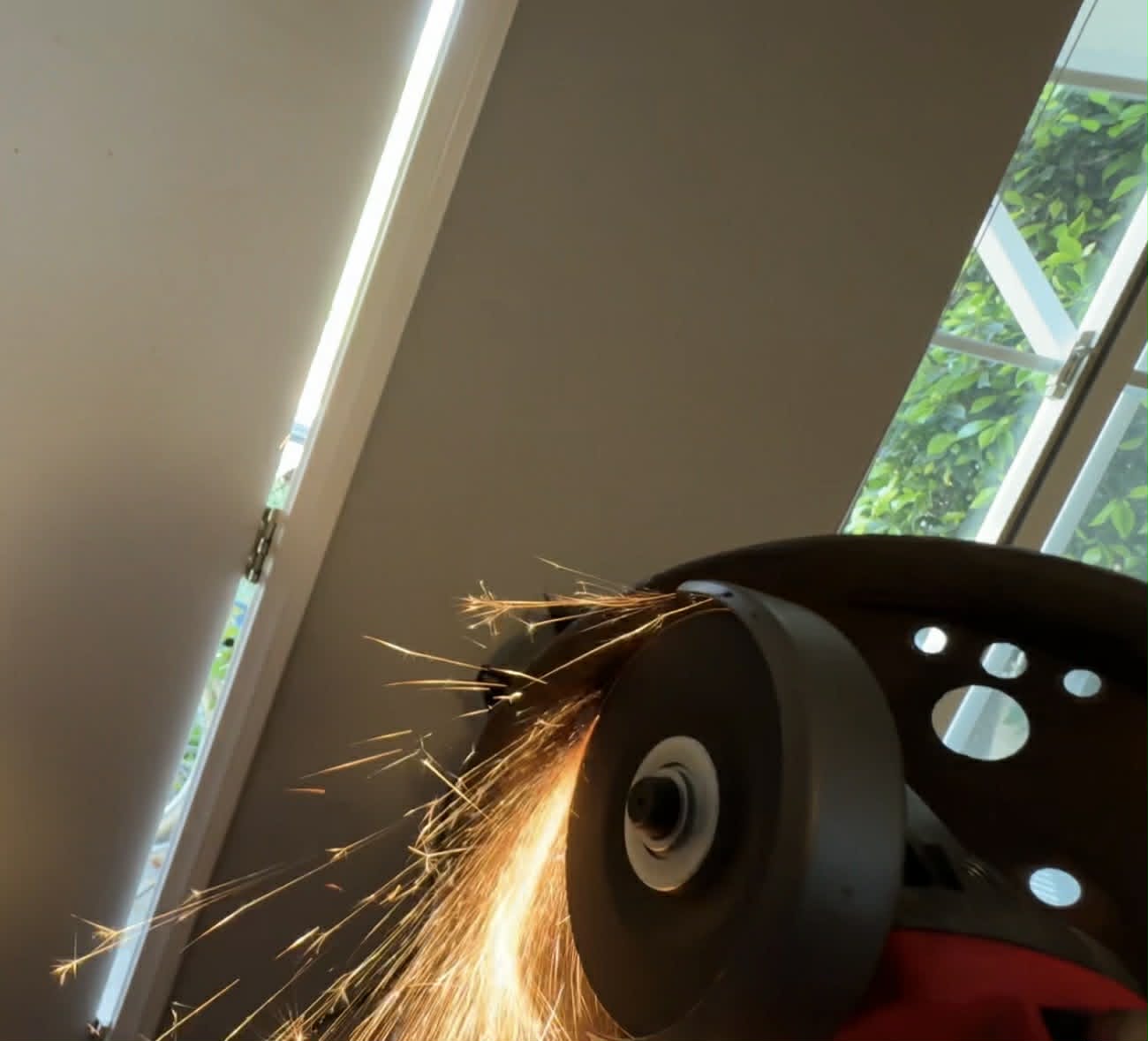
Of course, once that crud was off those adjuster screws, getting those out of the backing plate became a problem; since they had been exposed to so much dirt and moisture, they were seized. So out came the safety goggles and angle grinder:
After I had all the adjusters cut off the backing plate, I hit the part with some degreaser and a brusher:

Then I finished it off with a pressure washer:

From there, I assembled the drum brake on the backing plate, but not before first having to file out the brake shoes to fit the “eccentric” cam that allows the adjuster screws to push the shoes out against the drum:

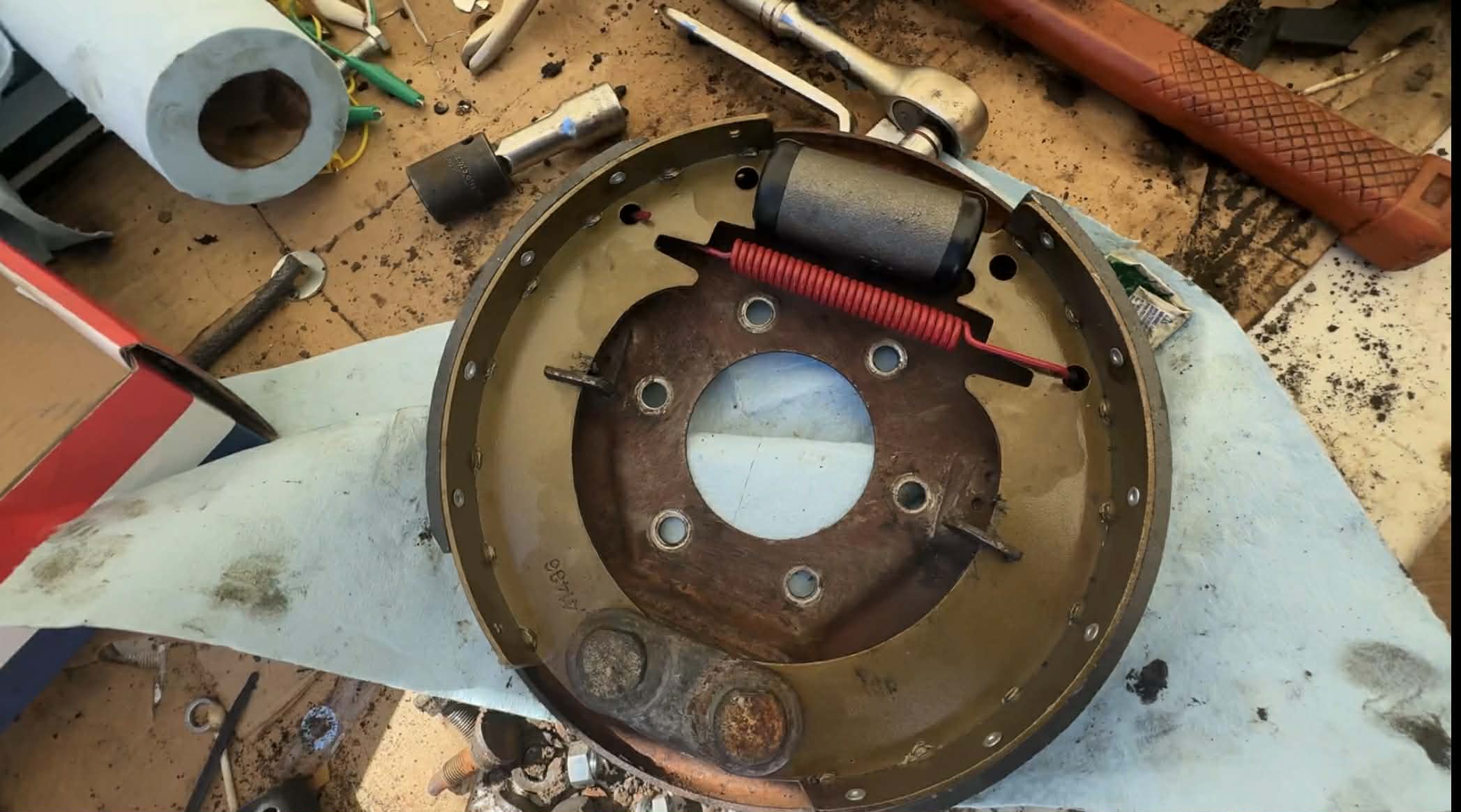
Only then — after all the cutting and scraping and power washing and degreasing and brushing and filing — could I put the drum brake together:
The rear axle was relatively easy to tackle compared to the front. I did have to remove the differential cover and replace the axle seals — something I did not enjoy in part because I installed the seals in backwards my first time around and in part because I destroyed so many seals during installation that I found myself in a situation where I had to install all four seals in the two axles perfectly or I’d have to wait for new parts (talk about pressure!):

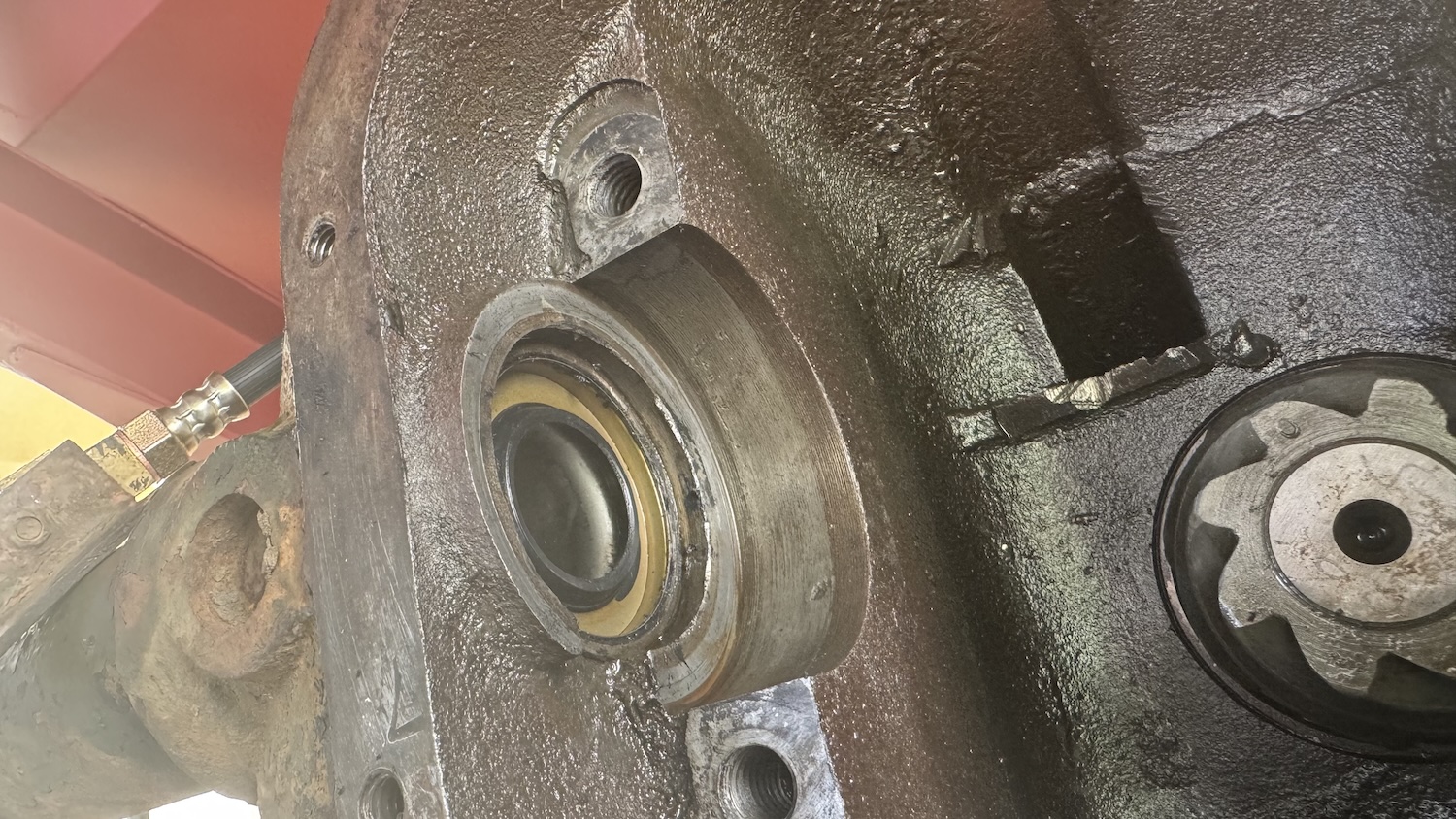

By the way, when I was re-installing the rear axle’s bearing caps, I noticed that the previous person who had removed them had installed them completely wrong. This is a big deal, as the bearing caps are line-bored, meaning that specific bearing cap must go on that side of the axle tube to ensure a perfectly round bore for the carrier bearings.
On many Jeeps, the way to avoid making this mistake is to pay close attention to the stampings on the axle housing and on the bearing caps. There’s a number — in this case, the number 7 — in a certain orientation. The bearing cap’s “7” must be oriented in the same direction as the axle tube’s “7.” You can see what I mean in the image below (the right bearing cap “7” is a little hard to read, but it’s clear on the left):

The previous mechanic had also installed the drum brake shoes backwards.

On these Jeeps, the big shoe goes towards the front, so I made sure to get that right:

With new axle seals and correctly-oriented carrier bearing caps, I bolted the differential cover back up and then took care of the pinion seal on the differential. That job involved using a seal puller and then hammering a new seal on very carefully.

The way I wrote that just now makes it seem easy, but that pinion seal probably took an hour. It required scraping the crud off the nut so I could get a socket on it. Then loosening the nut, spending far too long trying to pull the yoke off the pinion, then removing the seal with a puller, then trying to use a socket but ultimately settling on two hammers to install the new seal with some RTV, then putting the yoke back on and torquing it to spec.
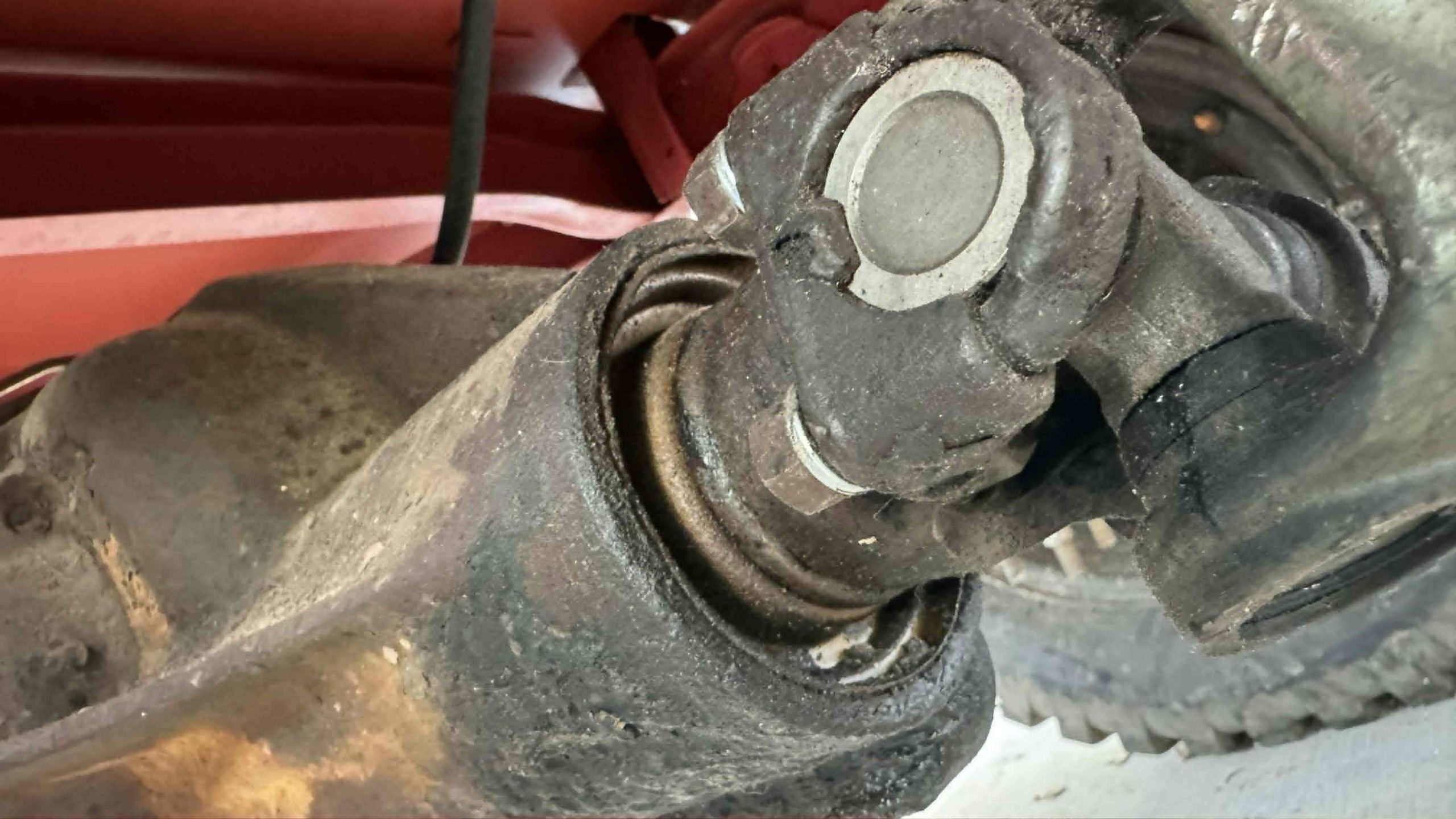
Every small job like this took an hour, minimum. And the brakes overall? Those took multiple days. Even buttoning up those rears could have been easier. Here’s a look at the drum brakes that go over the previously-shown brake shoes:

You can see a seal there and a bearing just below it. Here’s the bearing:

And at the front of the drum there is normally a second bearing in the center bore.

Each of those five studs you see in the image above had to be “thread chased” as they were so rusty the lug nuts meant to hold on the wheels would no longer thread on. Then I had to punch out all the wheel bearing races and hammer in new ones like the one shown below:
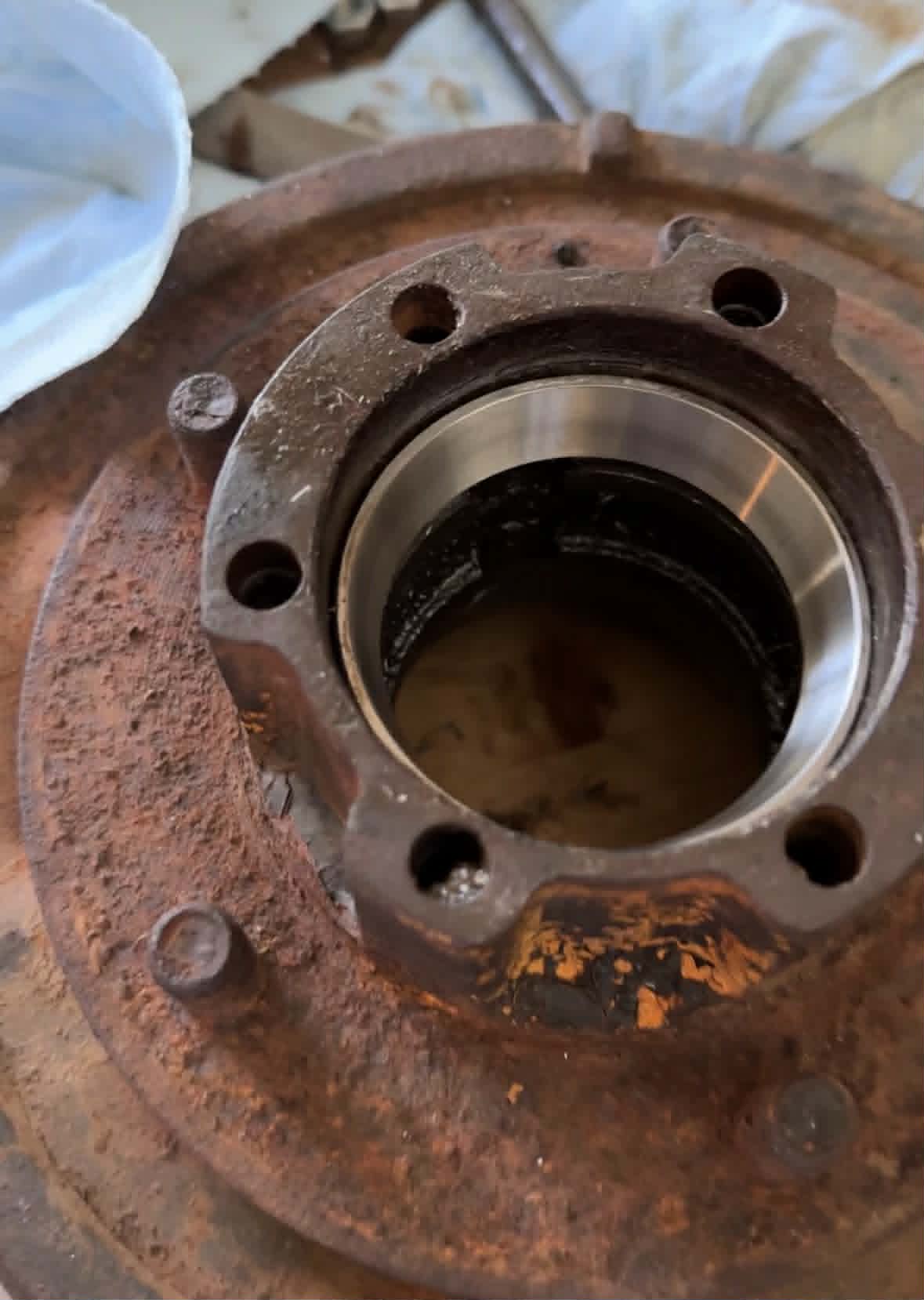
I won’t tell you the nightmare that was involved with pressing the bearing races into the drums, but it was bad. I hammered them in crooked, they created a groove, and then I realized the issue was that I had bought the cheapest bearings on earth and they were just too large, so I bought better ones, and those pressed in nicely.
Once the races were in, the tapered roller bearings had to be installed, but not before I packed them with grease using my bearing packing tool (basically two plastic cones that squish the bearing, and a grease fitting in the middle so you can pump grease into the middle and force the grease out of the bearing):

Here’s one of the wheel bearings sitting atop its bearing race:

And then on top of that I pressed in a wheel bearing seal using a hammer and a bearing installer tool I’d rented:


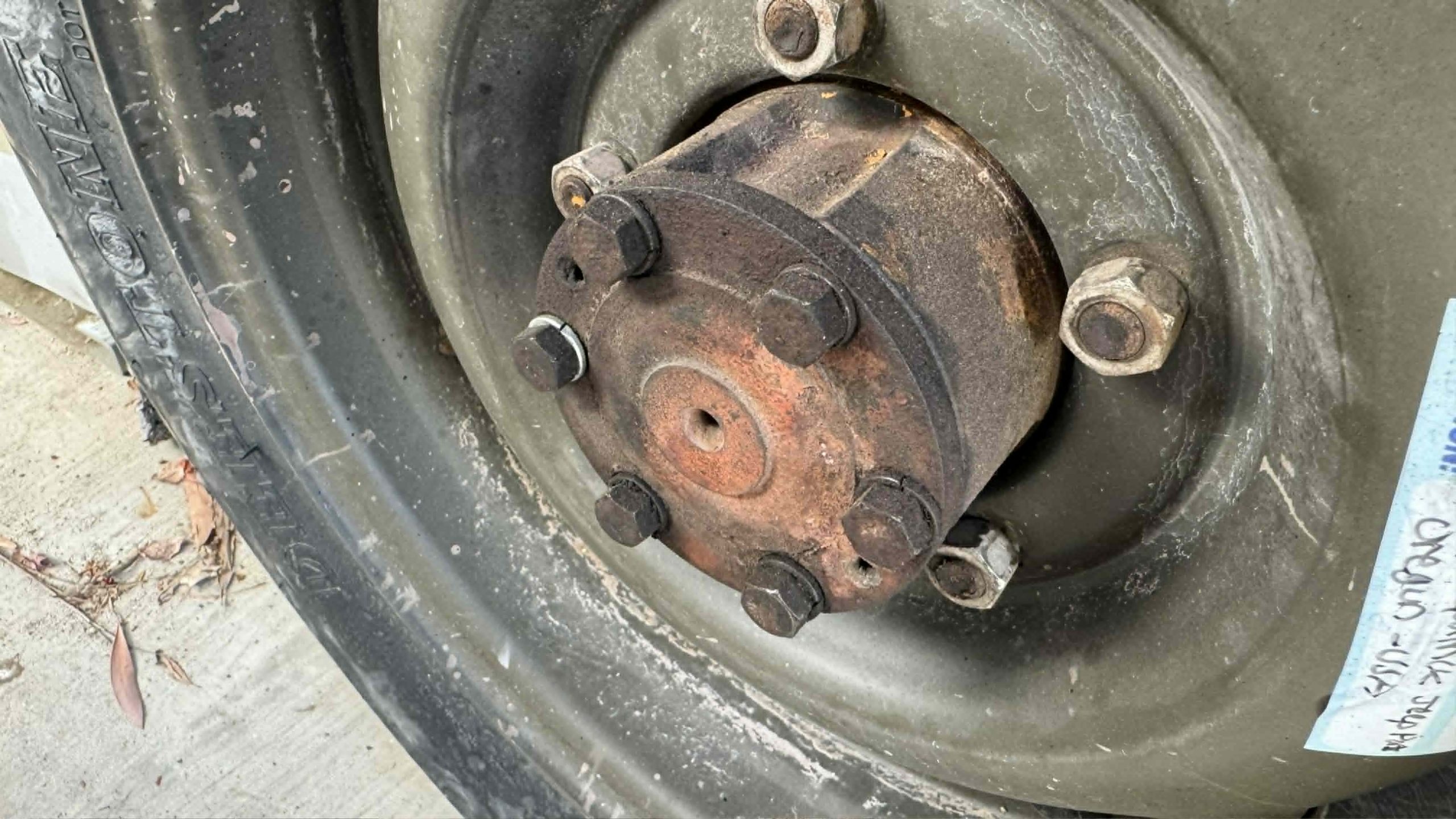
Each brake drum has two wheel bearings, meaning I had to press out two old bearing races and press in two new ones. I had to then pack two tapered rolling bearings, and install two seals. This is, of course, after thoroughly cleaning out the old grease with degreaser, a rag, and brake cleaner. Then once the rear drums were on, I had to fasten them to the axle via a bunch of nuts and washers; after that I installed the rear axle shafts right into the center of the drum, bolting them into place via six bolts:
The whole thing was a job. But even that didn’t hold a candle to the front axle.
The Front Axle Kicked My Butt

I’ll start with the easy part of the front axle job: replacing the axle seals in the differential:
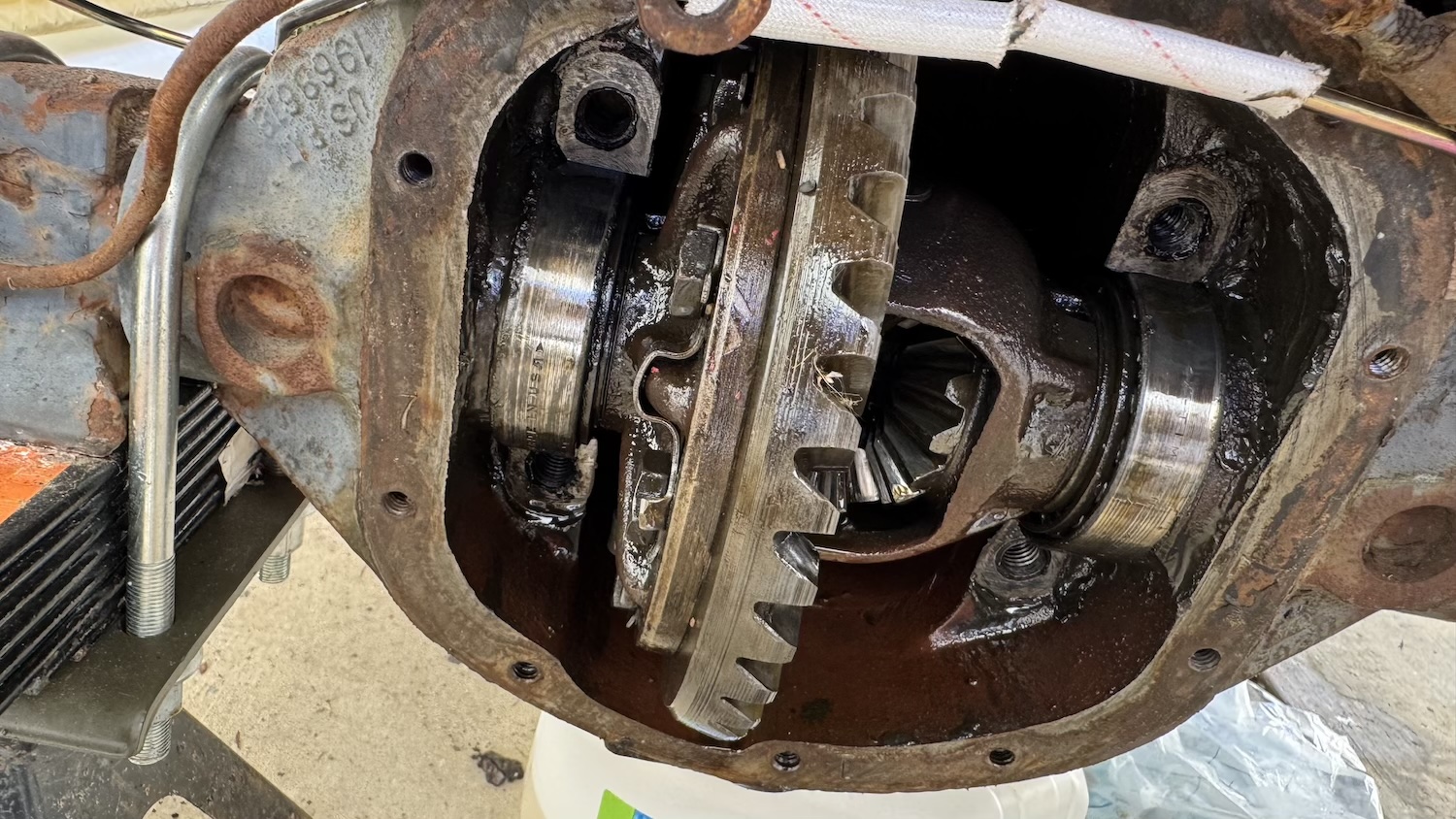
That went about the same as the rear, except I didn’t install the seals backwards and I found my carrier bearing caps to be on correctly. Unfortunately, what I also found was that all of the nuts holding my ring gear to the differential case were totally loose.
Back when I was preparing a 1948 Willys CJ-2A Jeep for a trip to Moab from Michigan, I had noticed that these bolts had completely loosened to the point where they actually hit the axle housing and bent the whole differential case to the point where I had to shove little shims (copper crush washers, if I’m honest) between the diff case and the ring gear to get the ring gear to mesh right with the pinion. Anyway, I’m glad I checked this on this eBay Jeep, but it meant I had to remove the eight bolts and re-install them with loctite:
Moving outboard, the front brakes were extremely grimy:

Undoing the six bolts holding both the backing plate and the spindle onto the axle housing left me with this in my hand:

And this was left on the axle:

What you see there is called a closed knuckle, and while many off-roaders like this for its strength and serviceability, the reality is: It’s an absolute mess.
A typical modern vehicle will utilize what are called ball joints to allow the knuckle (and thus the wheels) to turn when you move the steering wheel, and axle shafts with enclosed CV joints (these joints are necessary to allow the axle send torque to the wheels when in 4wd while also being able to pivot when steering):

See how those ball joints are enclosed (and feature rubber boots to keep grease in)? And see how those CV joints are also enclosed, with those big rubber boots that also keep grease in?
Well, a closed-knuckle design takes that whole space between the knuckle and the axle housing, closes it up, and fills it with the nastiest goop you’ve ever seen — goop whose job is to lubricate the axle shaft’s CV joint and the kingpin bearings (which take place of ball joints).
You can see the axle shaft CV joint (in my case it’s called a “Tracta joint” — the rarest of the three joints offered on WWII Jeep front axle shafts) in the photo two above. And here you can see some of the nasty goop in that closed knuckle:

To get that knuckle off, I had to remove a felt/rubber seal on the back of the knuckle that keeps the grease in. This seal rubs up against the spherical outer section of the axle tube: 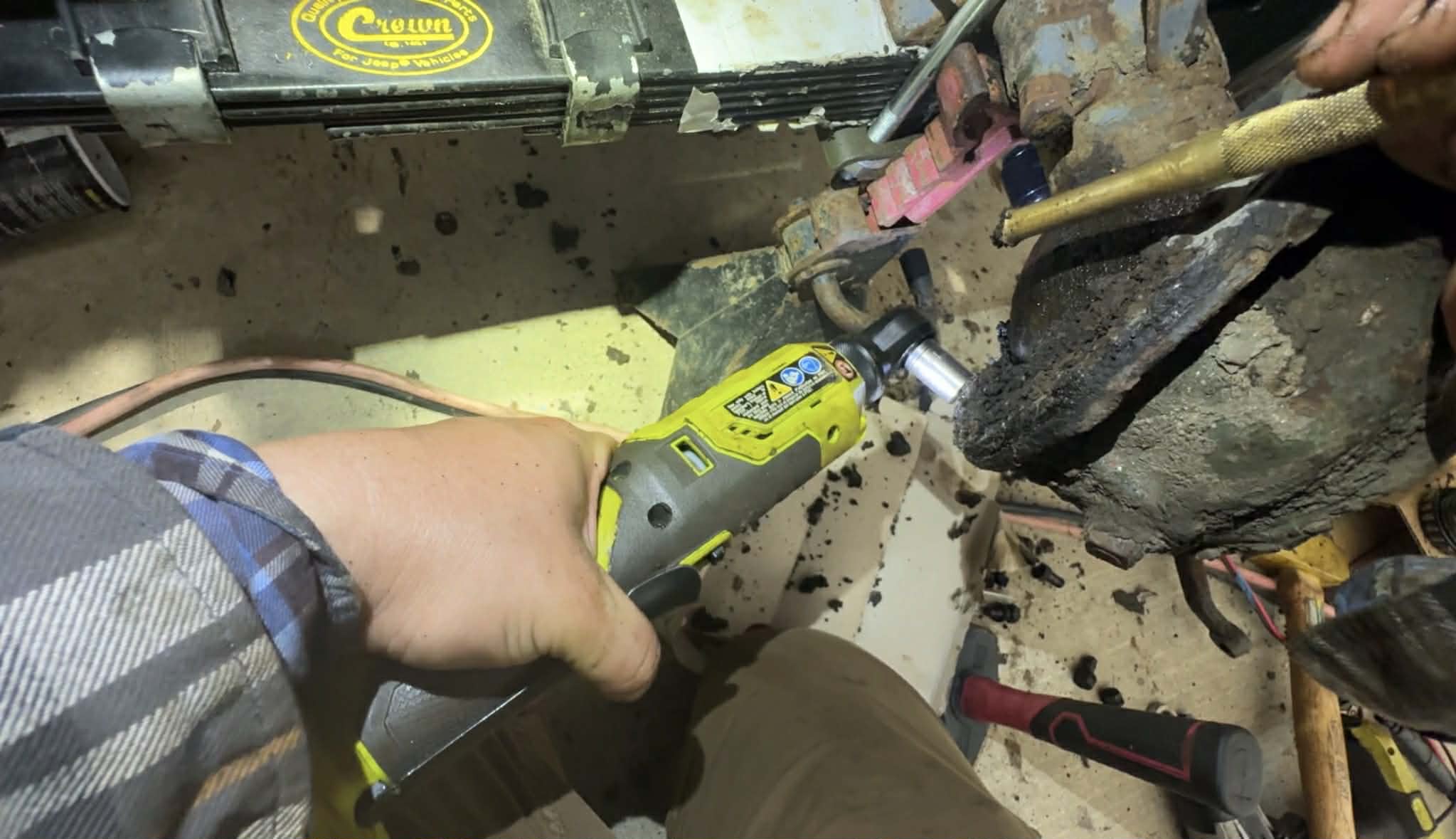
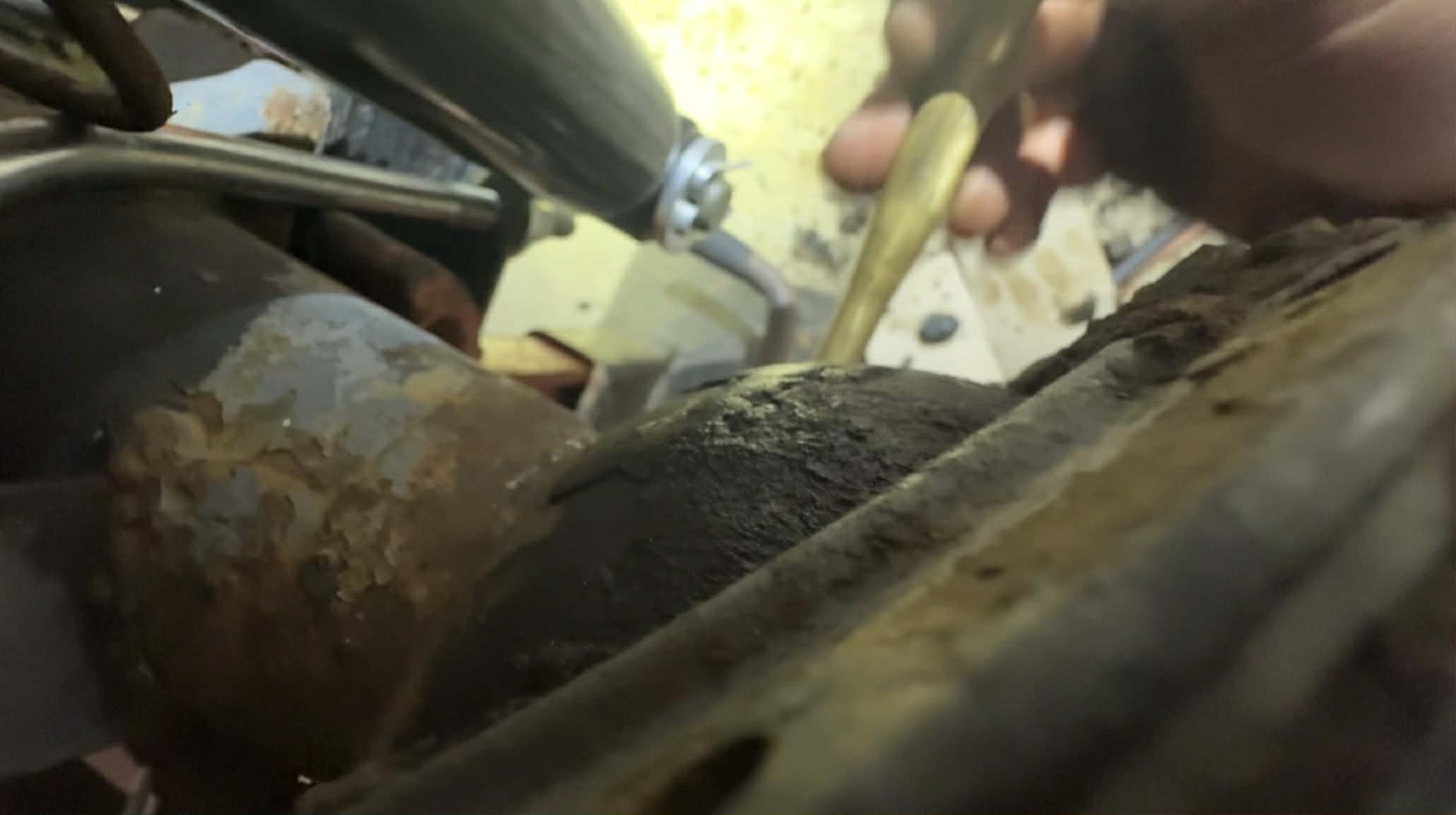
With the seal off, I could now remove the knuckle, revealing some true filth:
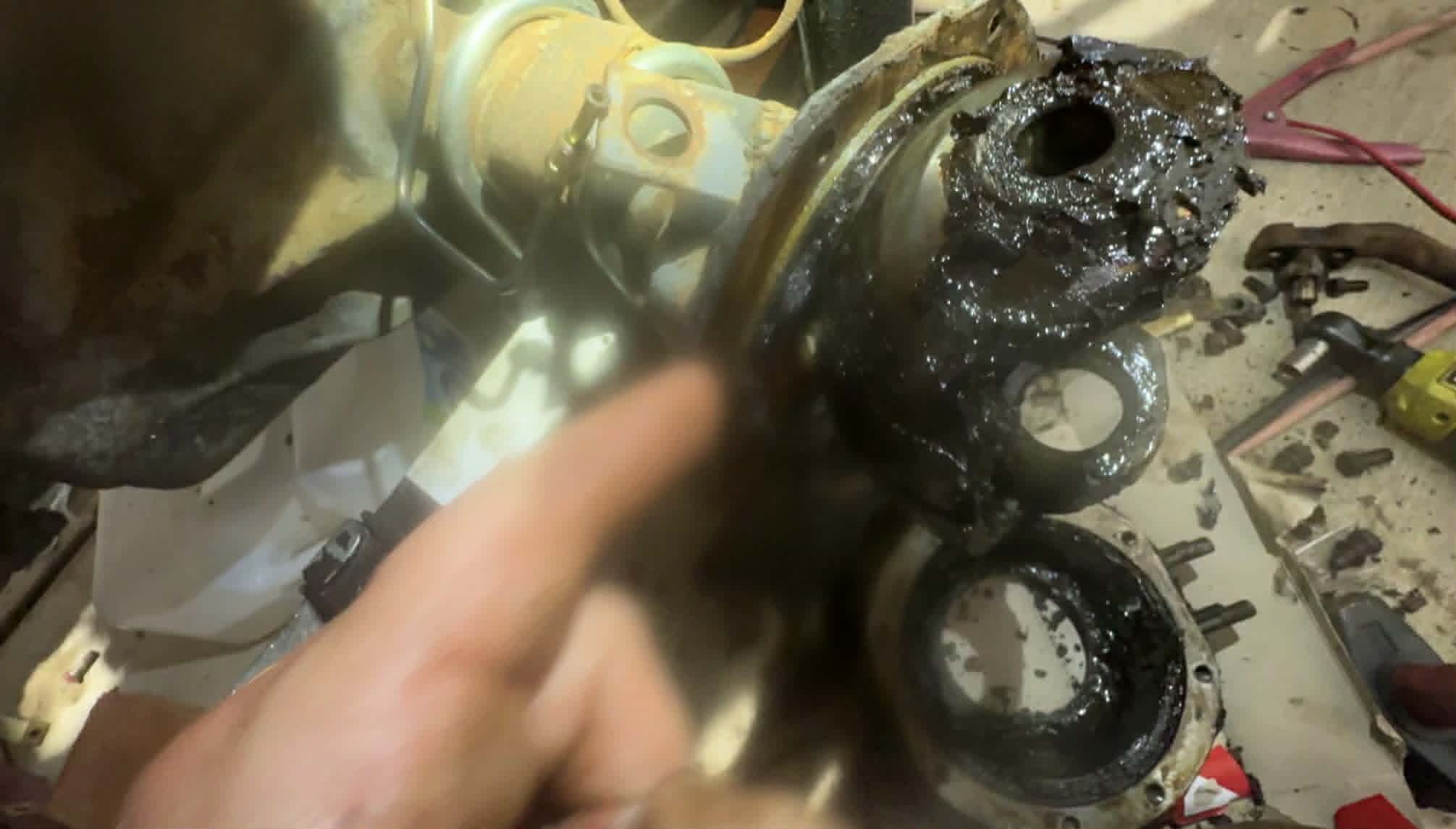
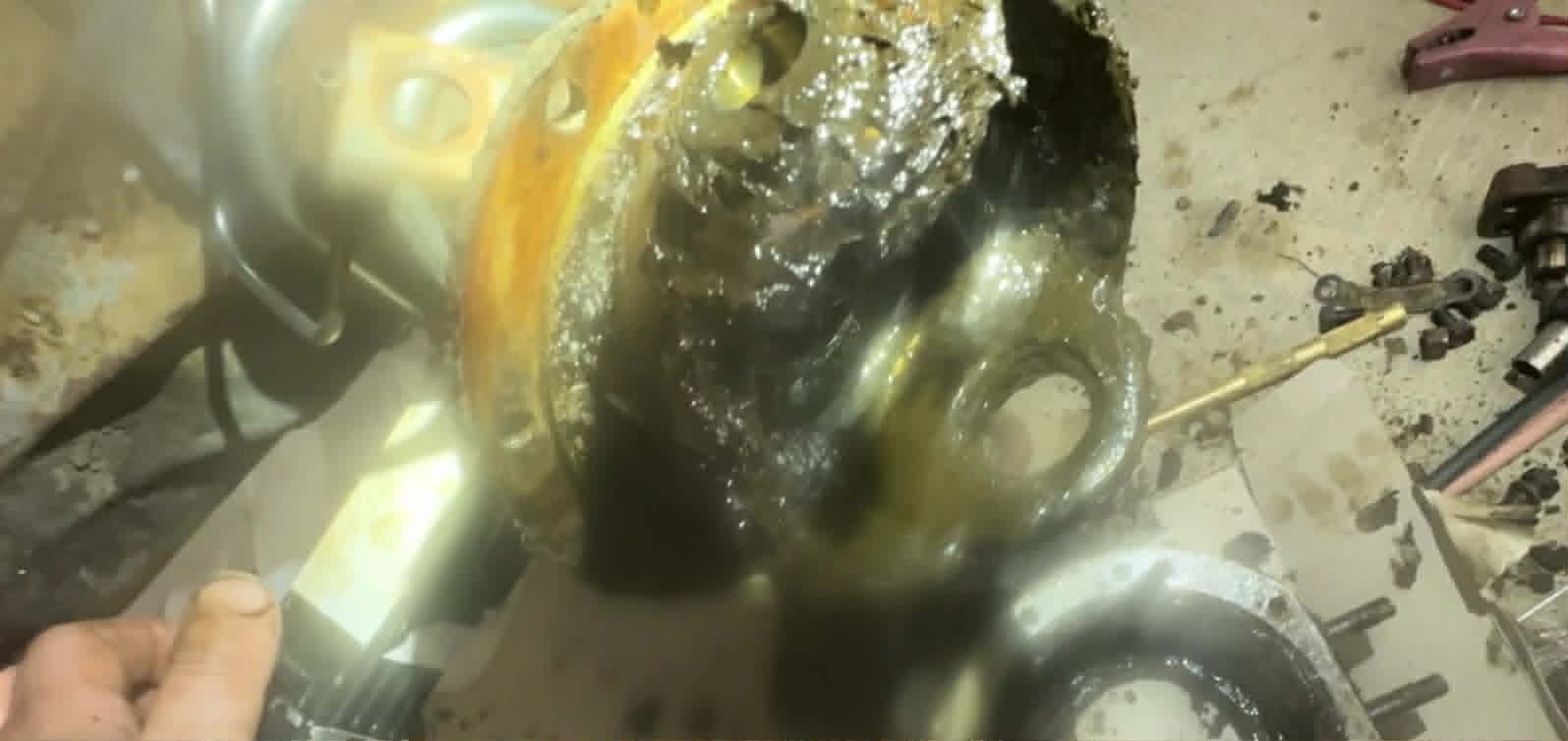
Cleaning each knuckle took what felt like an eternity — chiseling, spraying, brushing, power-washing, scrubbing. It was far from glamorous:

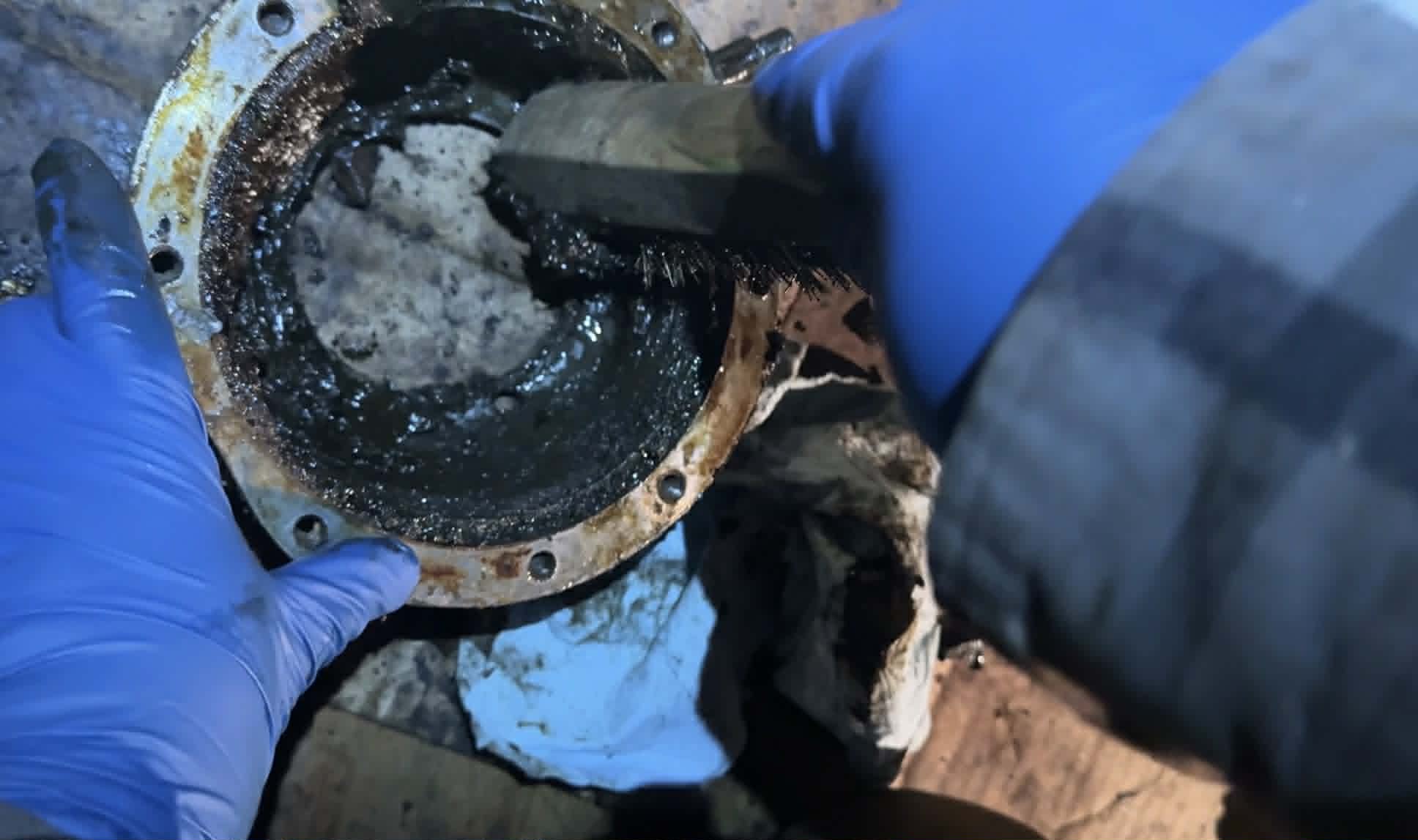
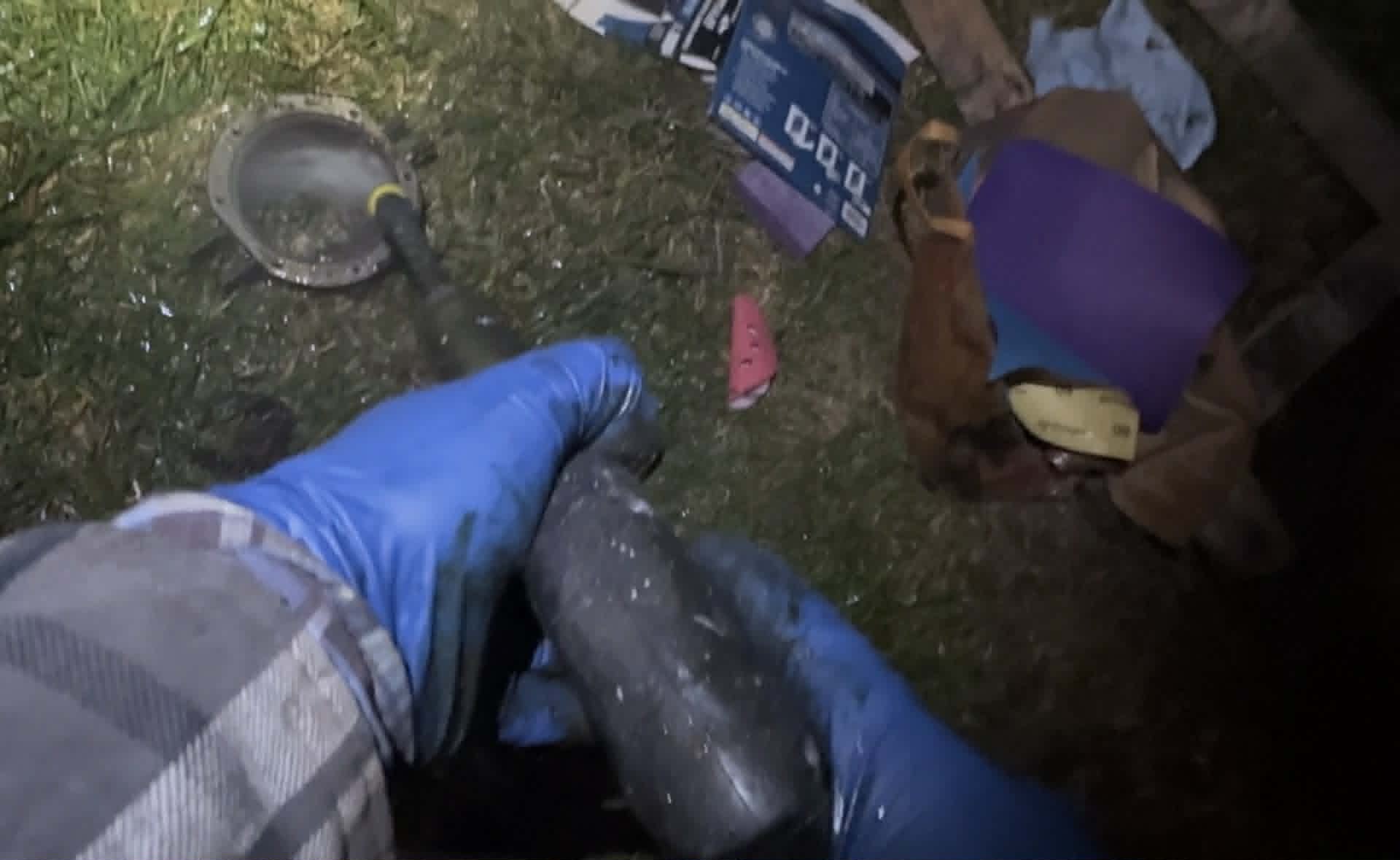
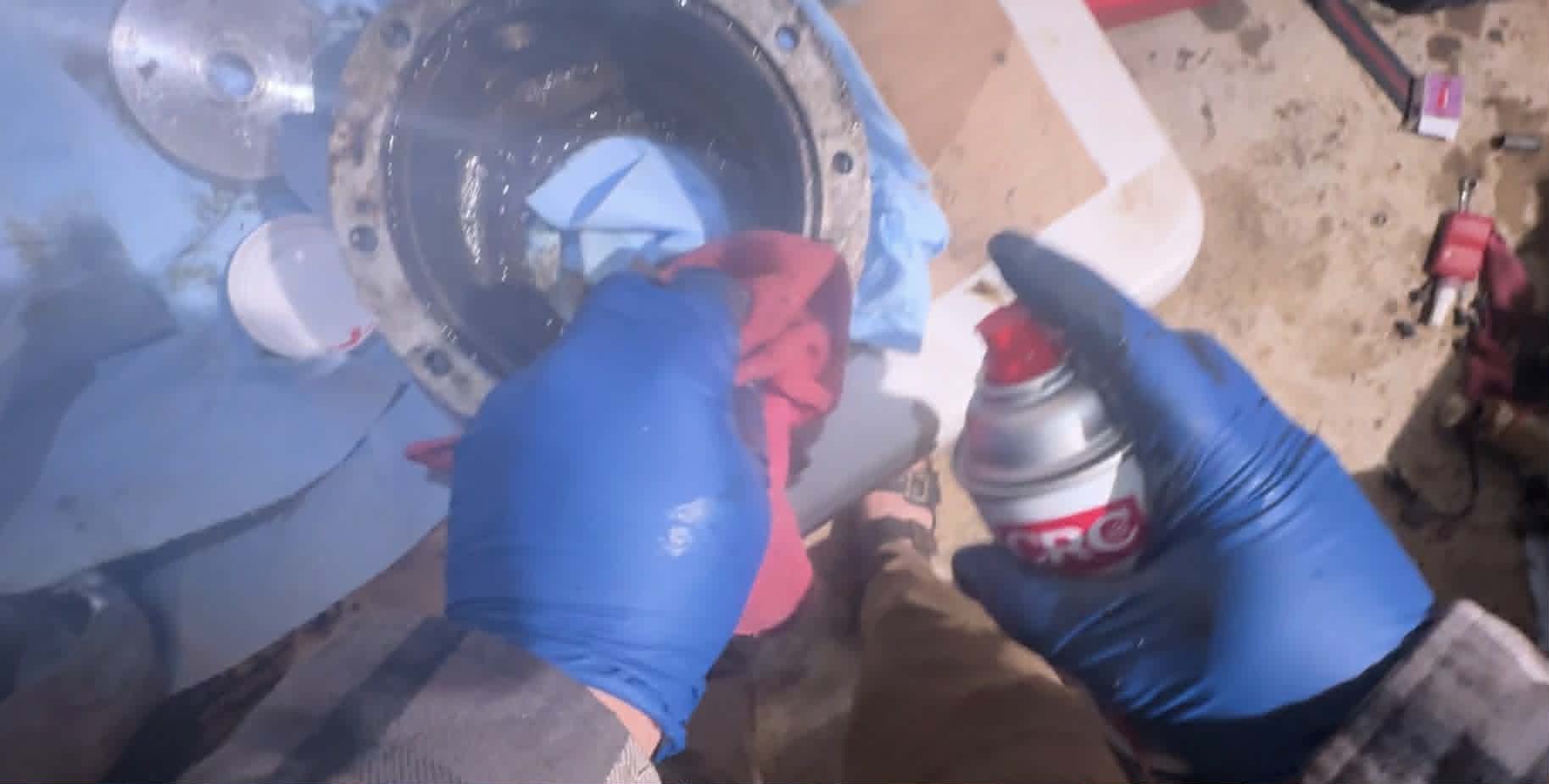
Ultimately, I got the knuckles looking nice enough, but I still had issues to resolve, namely that studs going into the knuckle had spun out since the nuts were seized in place:
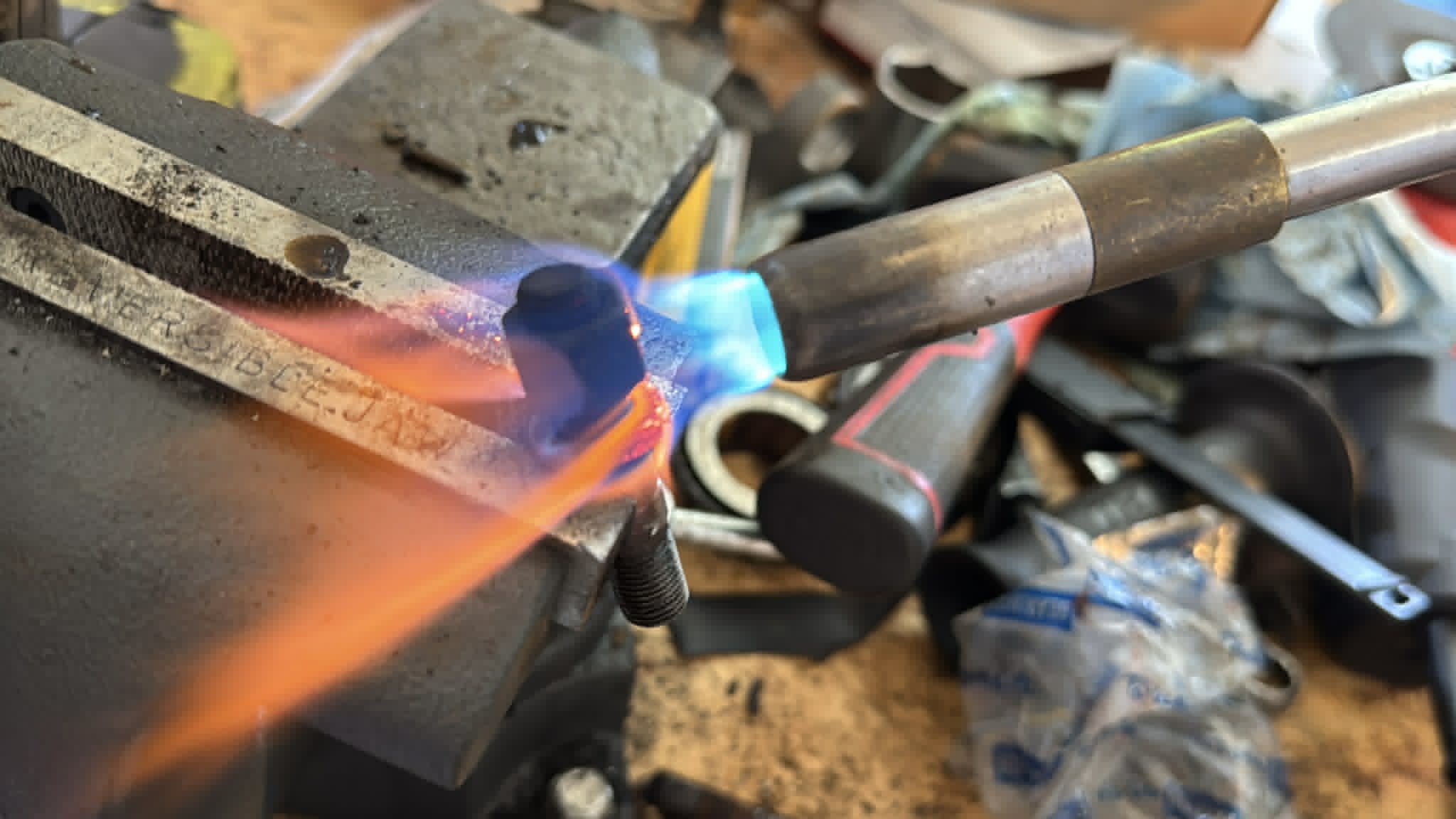
I had to heat up the nuts and remove them, and then I had to thread-chase all the studs since they were rusty and grimy:
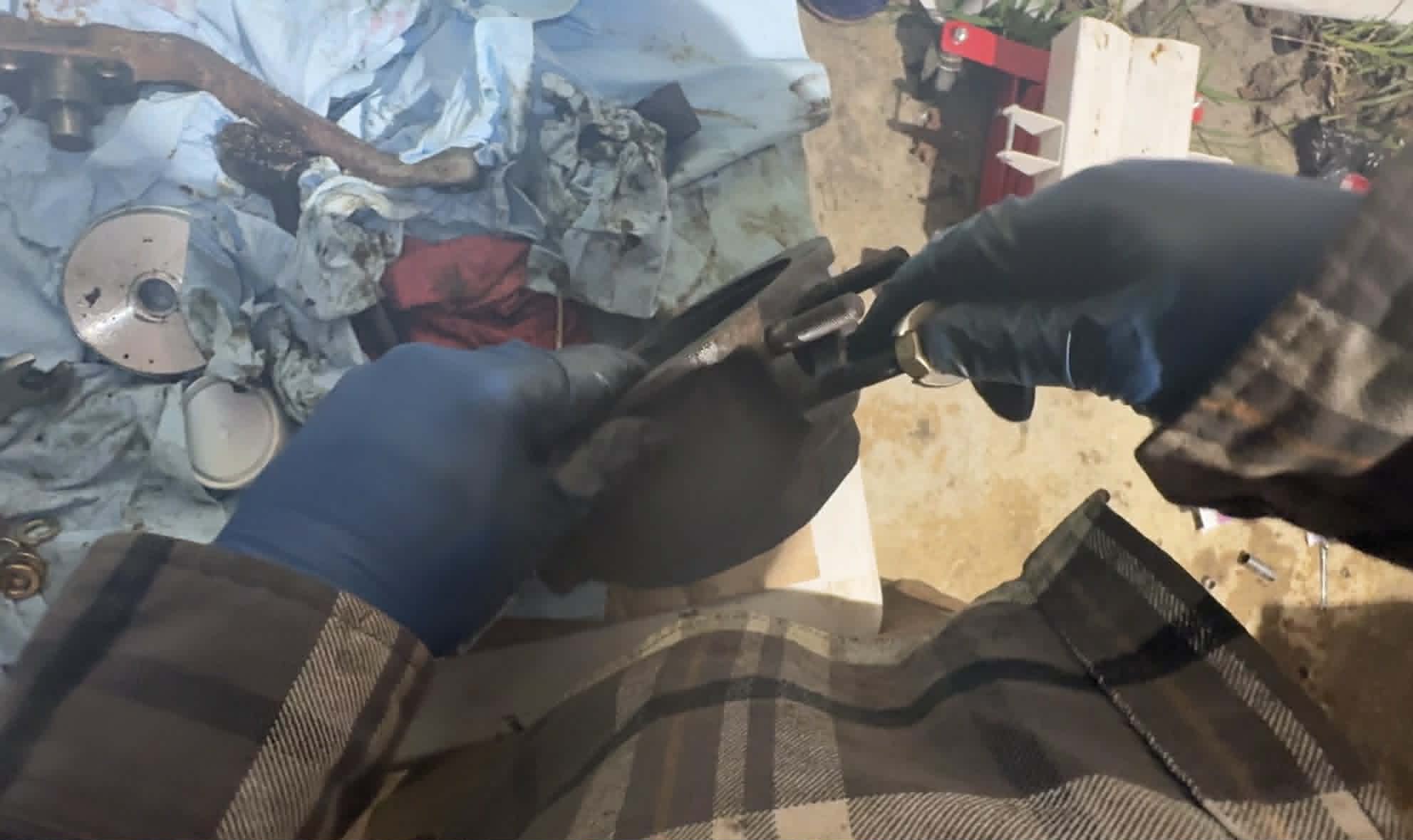
Cleaning the nasty axle tube was easier since it’s a smooth bearing surface, but I still had to break out the brush:

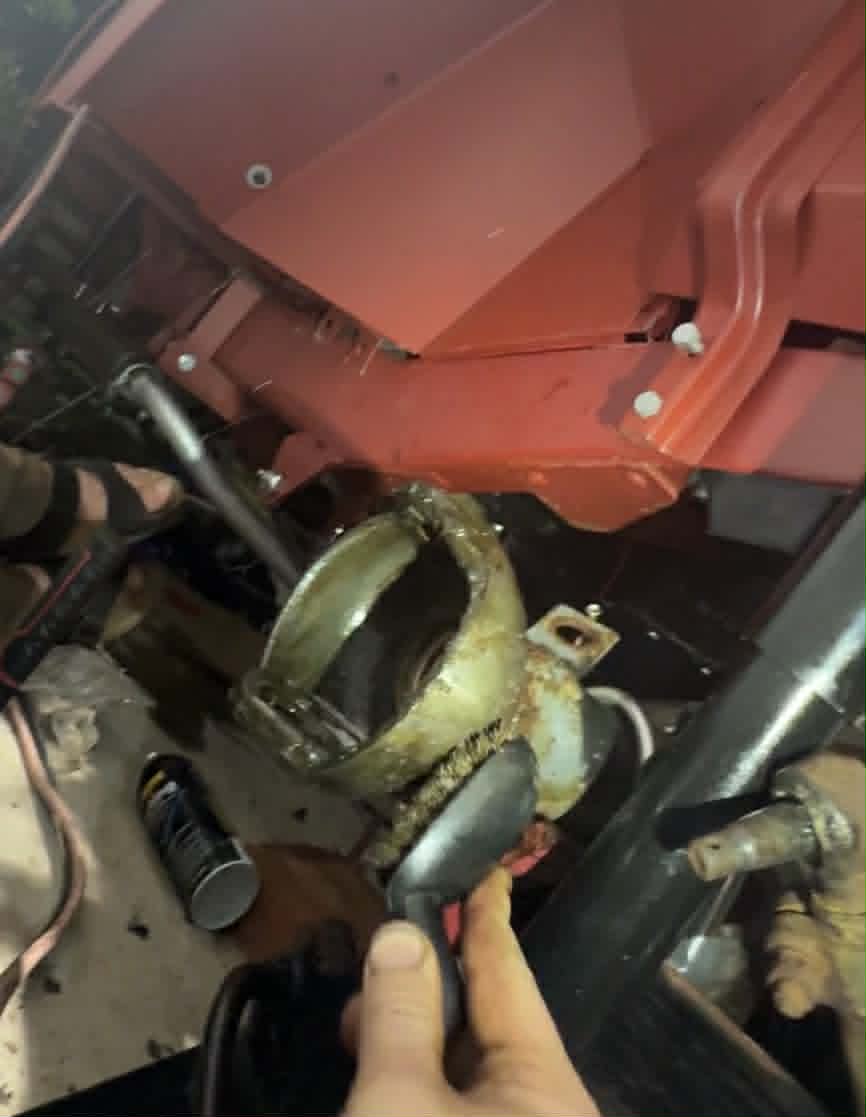
Once the axle tube was cleaned off, I punched out the upper and lower kingpin bearing races (the kingpins are the bearings about which the wheels tires turn when you move the steering wheel).
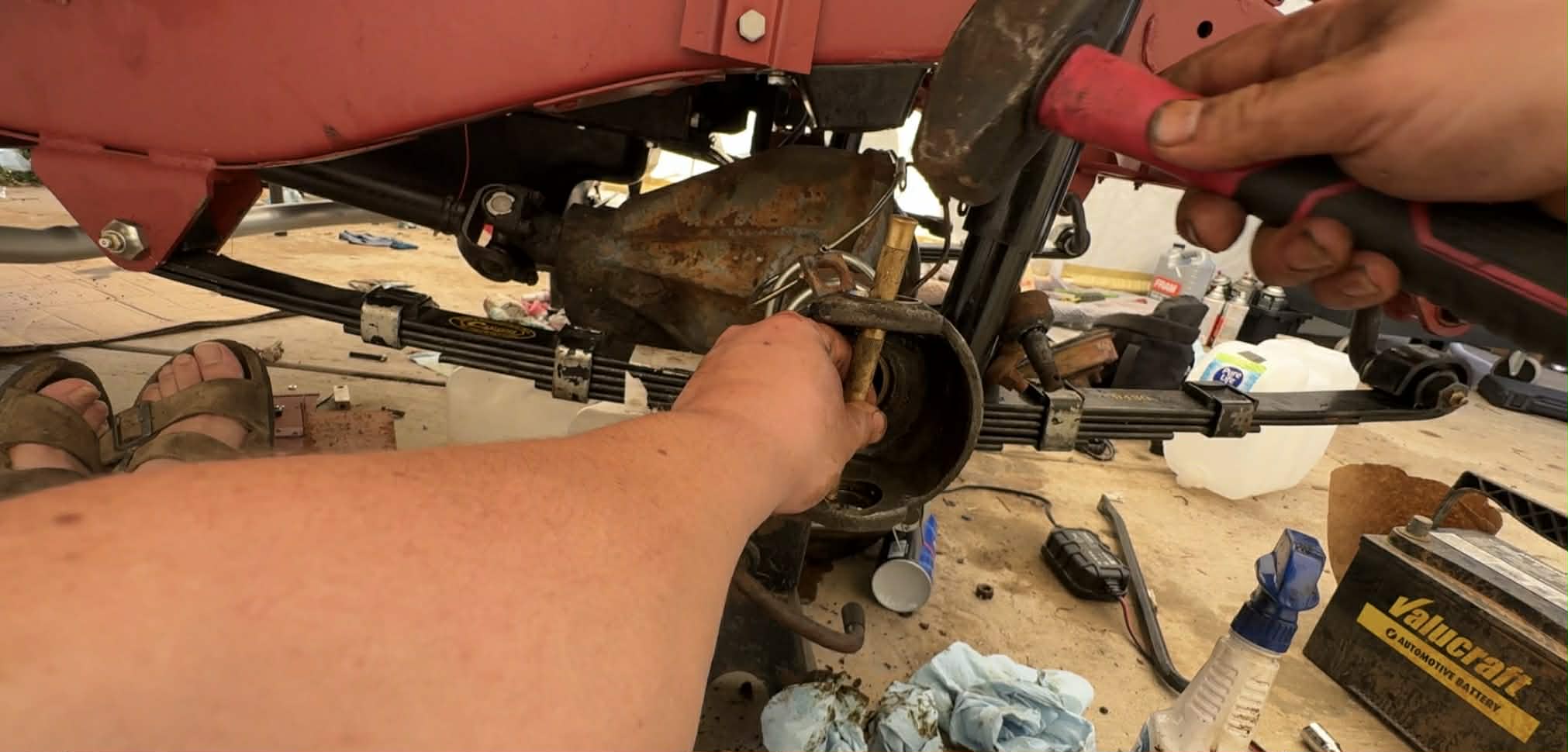
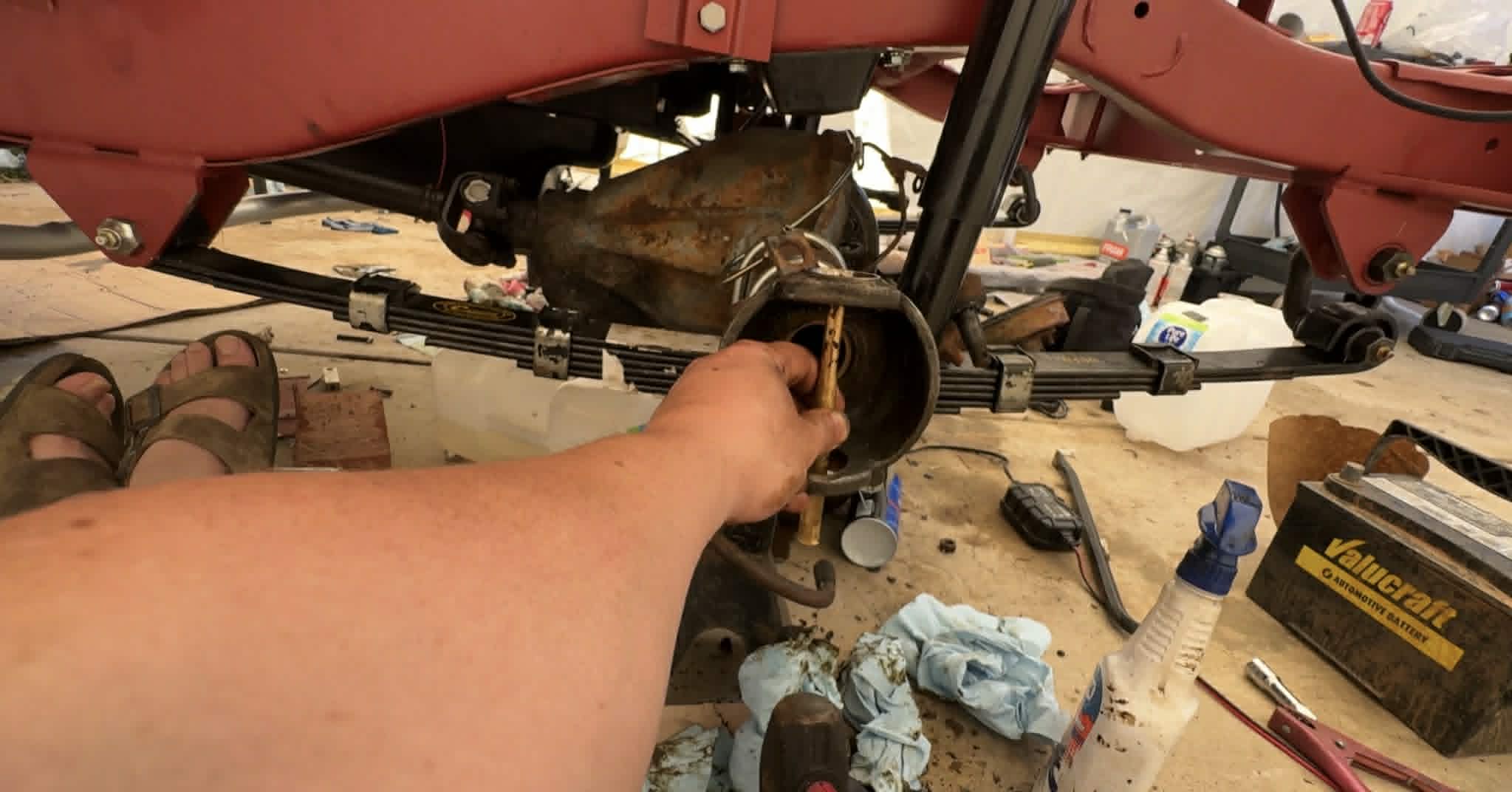
I then hammered in new kingpin bearing races:
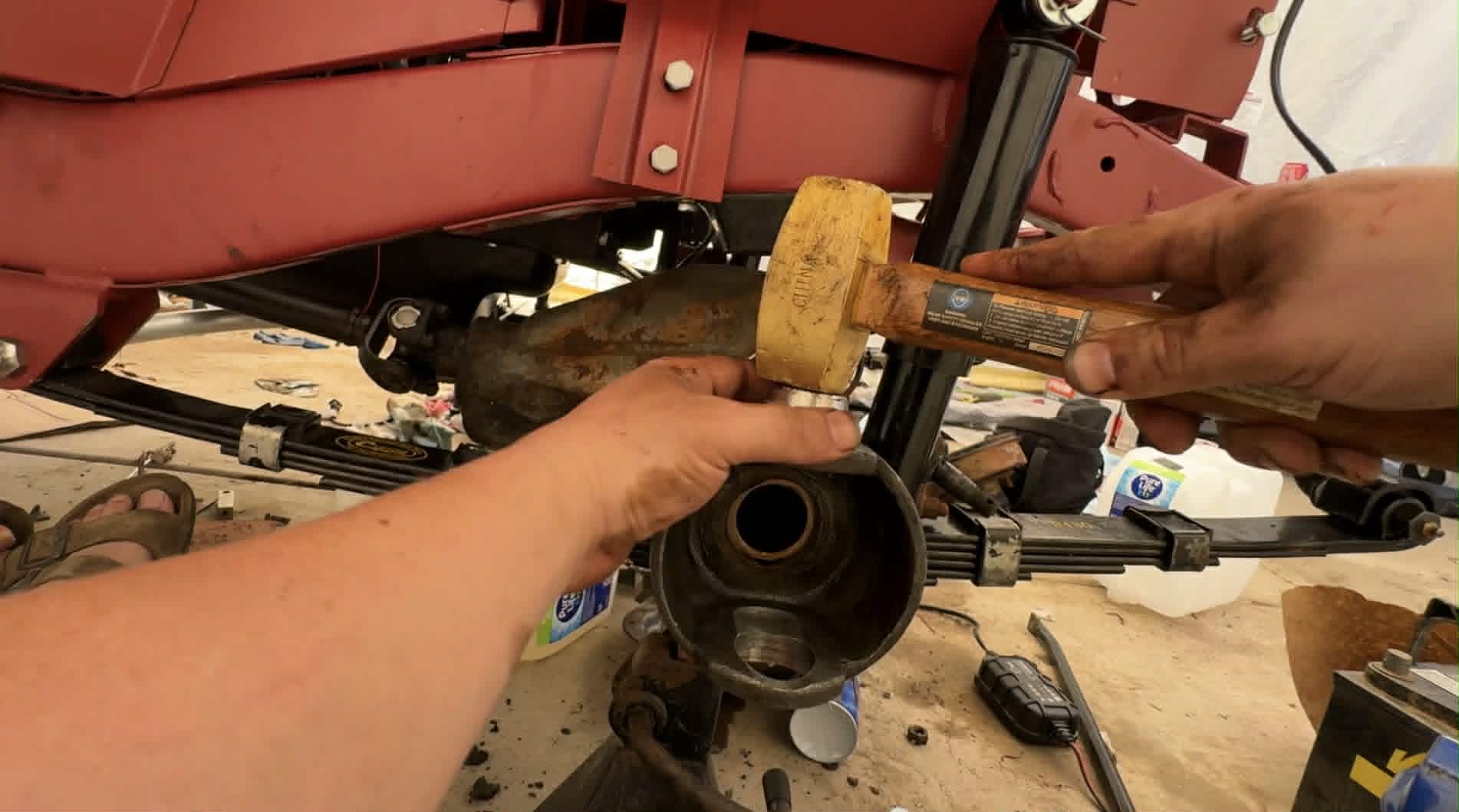

Then I packed grease into my new kingpin tapered roller bearings. Here’s a look at what the tapered roller bearing/race set looks like:

And here’s me packing grease into a tapered roller bearing:
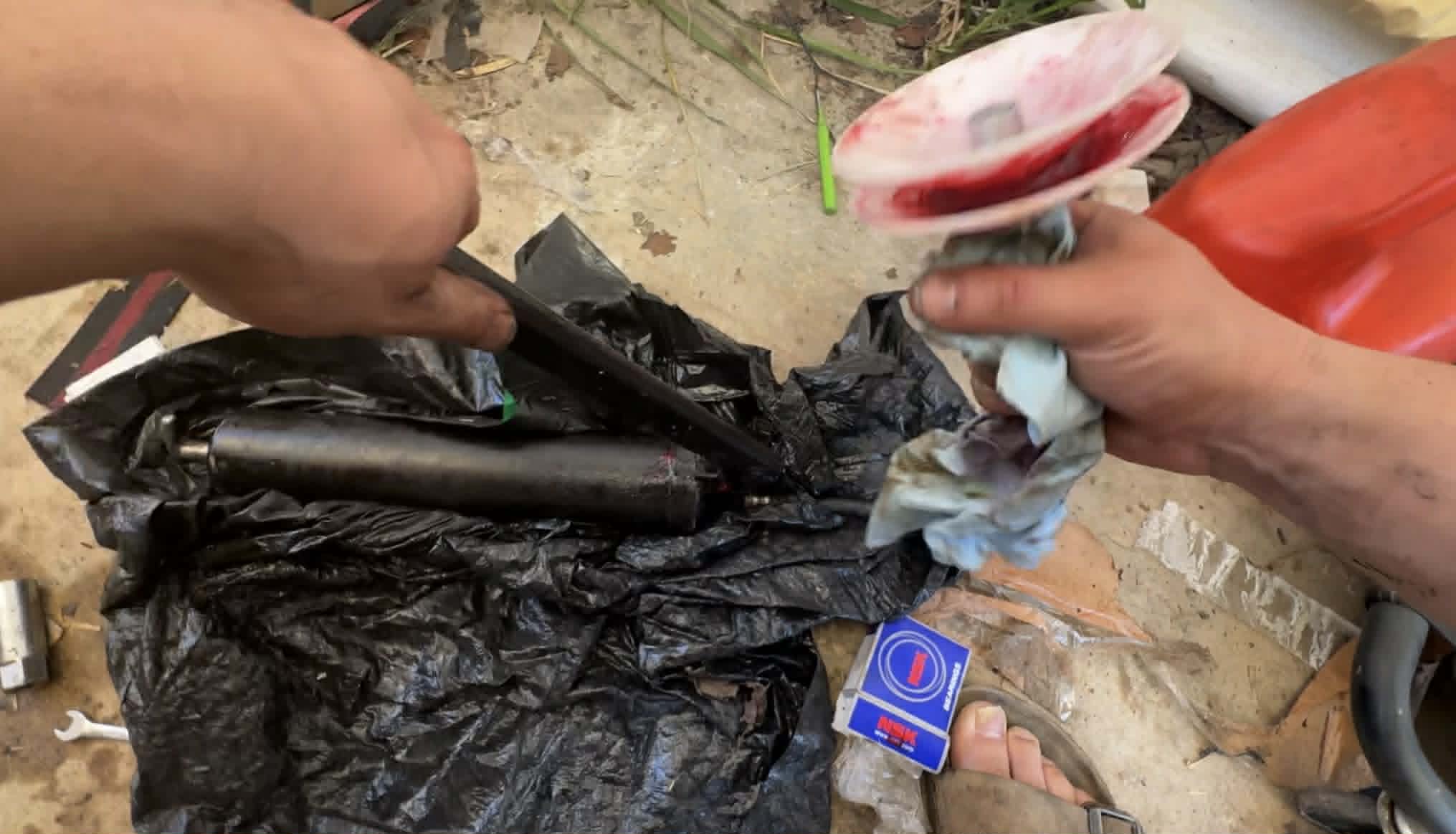
The photo below shows me having shoved a grease-packed bearing into the race that I’d pressed into the top of the axle. I have the lower bearing in my hand:
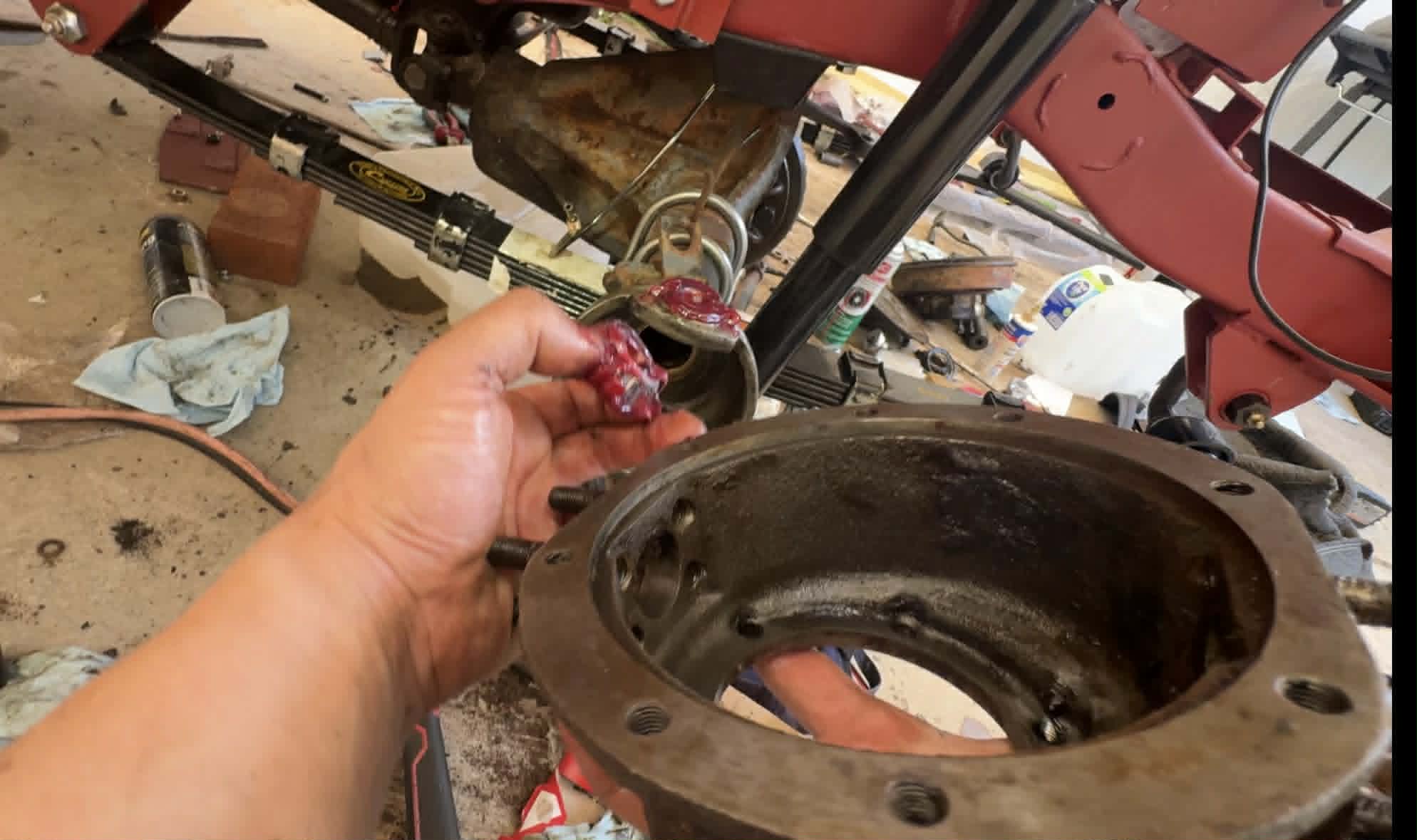
With the knuckle on, the bearing caps slide into the center of the bearings and push against the inner race, then they are fastened to the knuckle:
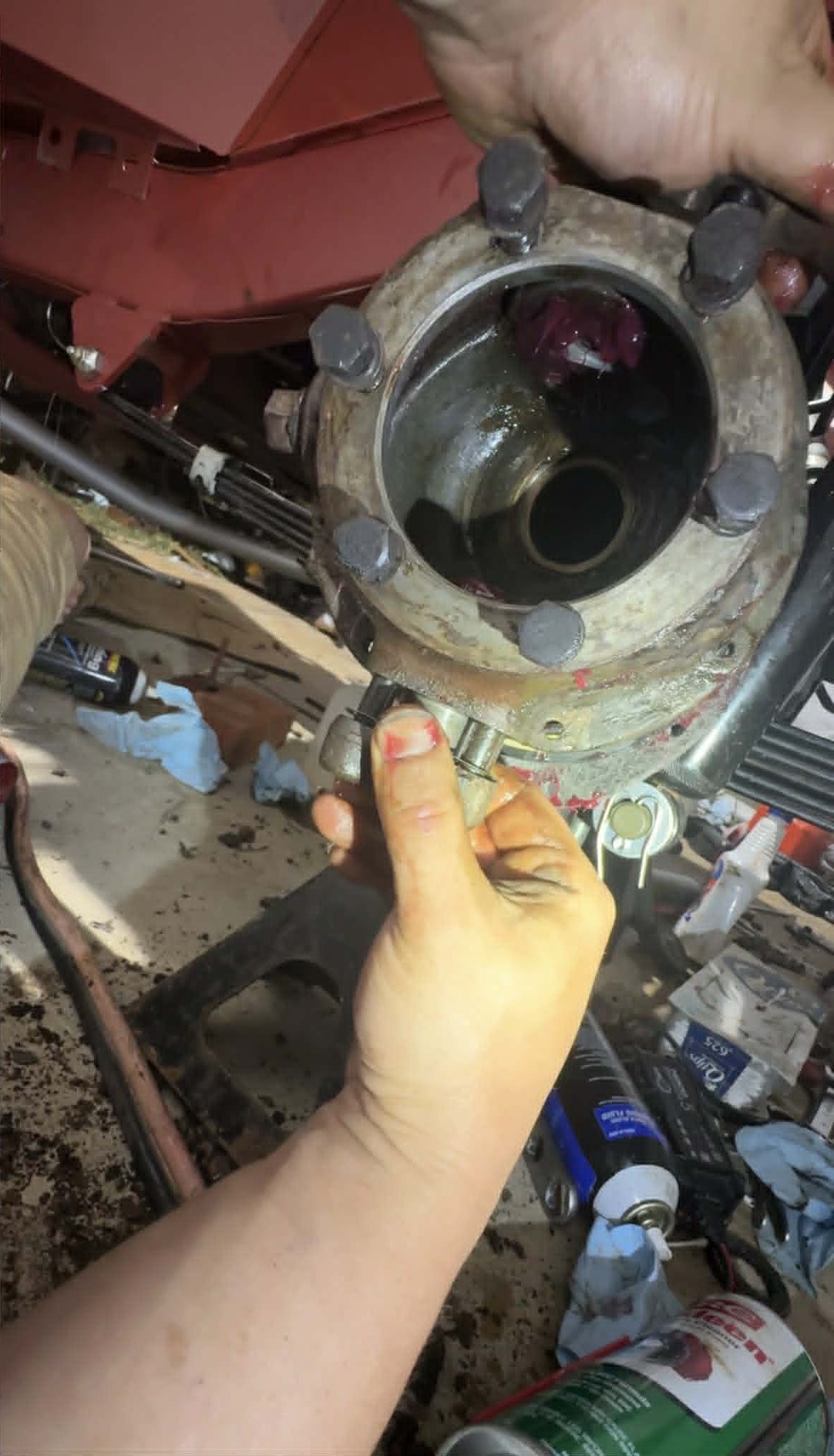
You may notice on that bottom bearing cap there’s a thin steel “shim” spacer. Those are these, which I had to buy from the UK since all of North America seems to be sold out:

These shims offset the bearing caps, which means they change how much those caps are squeezing the inside of the tapered roller bearing against the conical race pressed into the axle tub. Adjusting the shim stack changes how tight and loose the steering bearings feel — a process called setting the “preload.” Too tight or too loose, and the bearings will fail prematurely.
Setting kingpin bearing preload is an iterative process, and involves putting a stack of shims between the bearing caps and the knuckle, then tightening the kingpin bearing caps to spec using a torque wrench:

Then you use a “pull scale” on the knuckle’s steering arm to see how much drag is created when you try to steer the knuckle. Roughly 12 pounds is the spec, so once you hit that, you know you have the right shim stack.

Once I had my steering kingpin bearing caps tightened just right, I had to take the knuckle back off so I could install the seal on the back of the back. The seal comes in four pieces — two metal halves, a thick rubber circle with a break in it and then a giant round felt seal: 
Getting that seal onto the back of that knuckle was not fun. I had to gradually install the bolts from the bottom towards the top, first loose, then ever tighter. The goal was to try to get the ends of the rubber seal to mate and not leave a gap. This was quick on the driver’s side, but took me an hour on the passenger’s side:

Once I had tightened all the kingpin nuts on the knuckle, I then put on the spindle:

Then I bolted up the brake backing plate:

From there, I could slide on the brake drum:

And finally, since I’d thread-chased the lug studs, I could install the wheels by easily threading on the lug nuts:

The Brake Lines Were Relatively Easy, By Which I Mean They Only Took 6 Hours

There was so much more involved with buttoning up these axles, but I don’t want to bore you with all the details. The brake lines I’d purchased from eBay were pre-bent and flared, and they fit remarkably well. That’s not to say installation was quick, because I had to reuse my old junction blocks, which required lots of cleaning.
Bending these lines to get them just right was tricky, and then hooking them to the brake master cylinder and trying to get the master cylinder (shown below) connected to the frame with the heat shield required trimming of the shield.
Nothing was easy. Nothing.
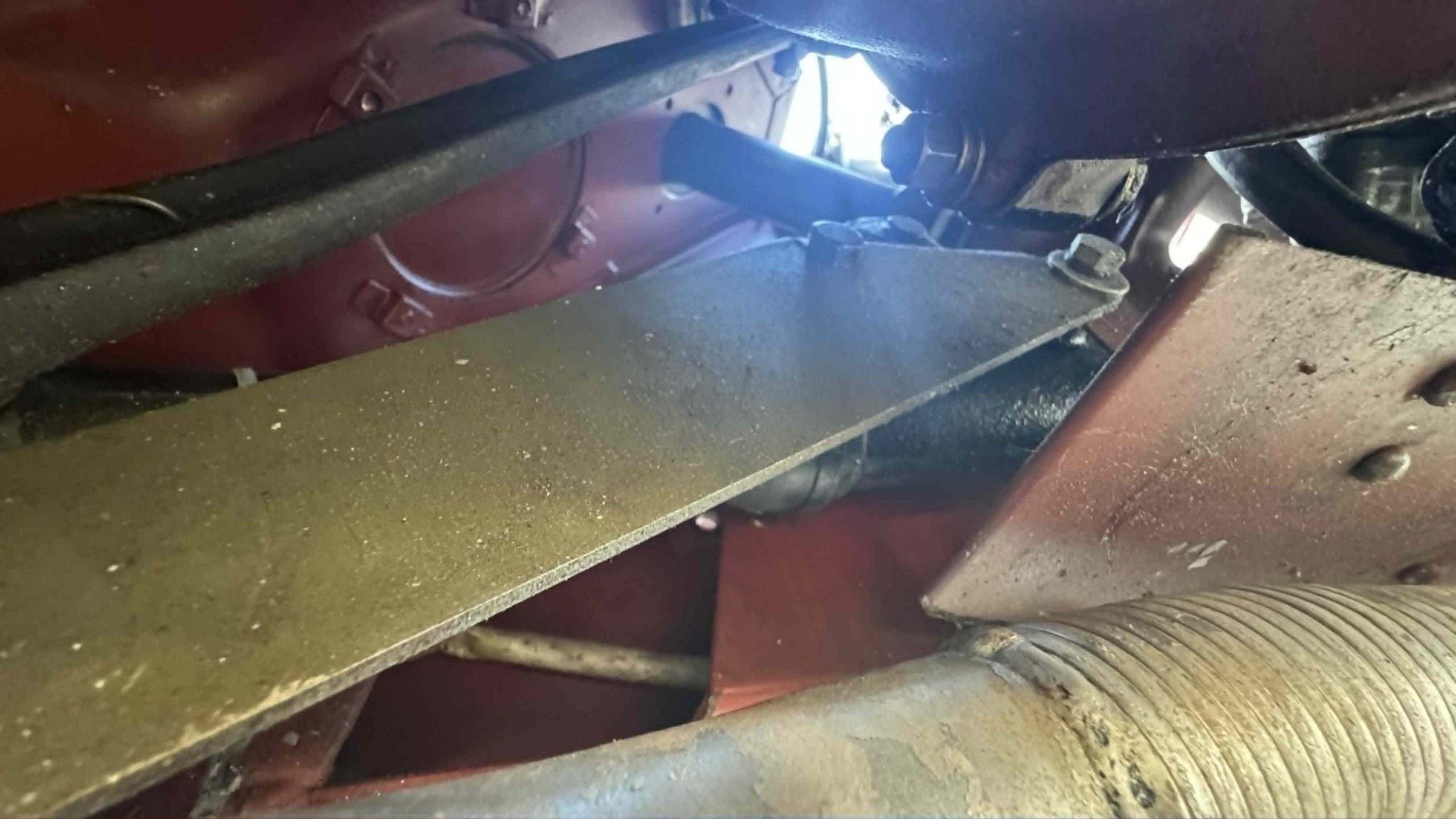
Bleeding the brakes could have been worse. There were a few leaks at some of the fittings, but snugging those down solved the issues.
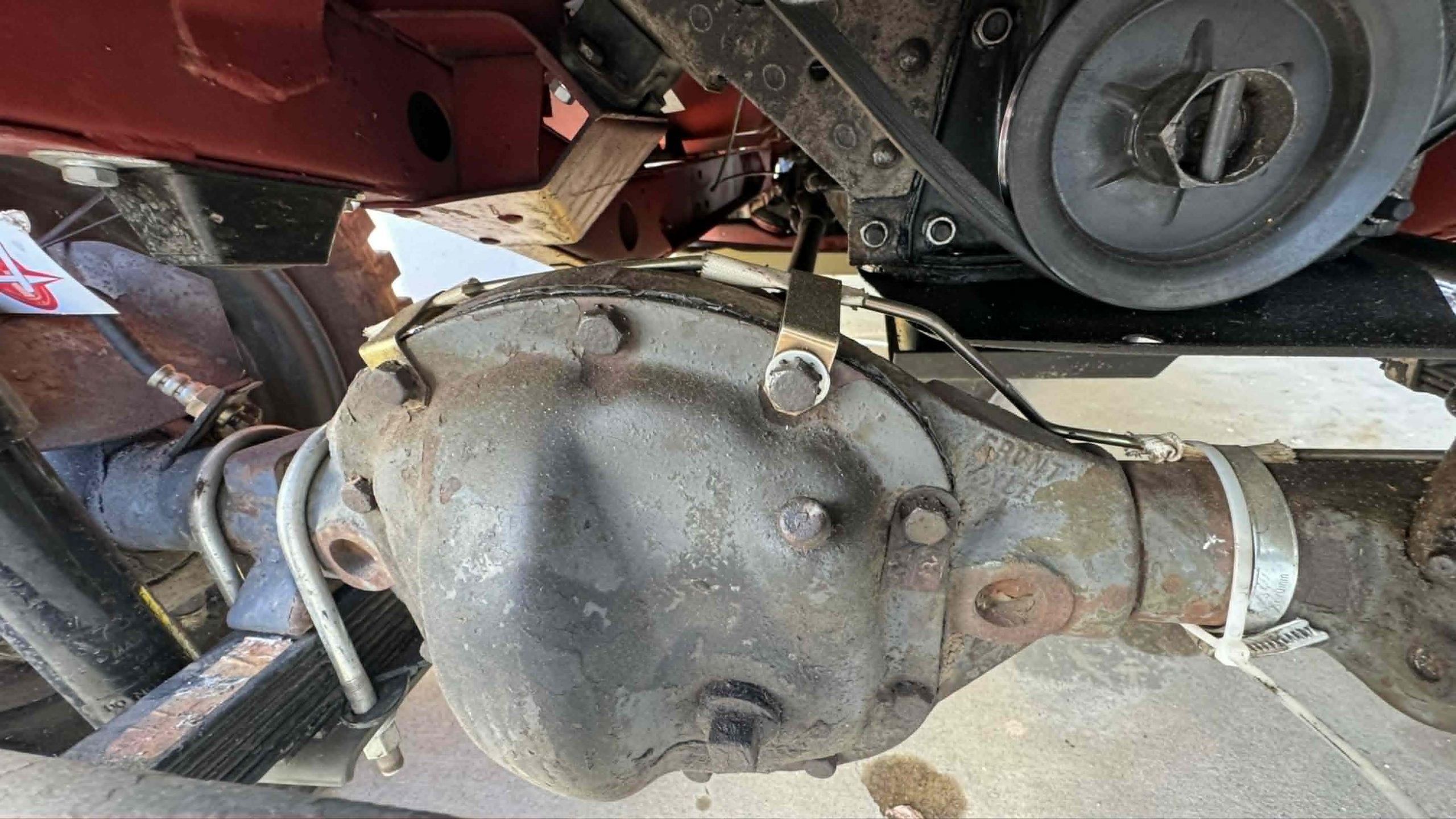
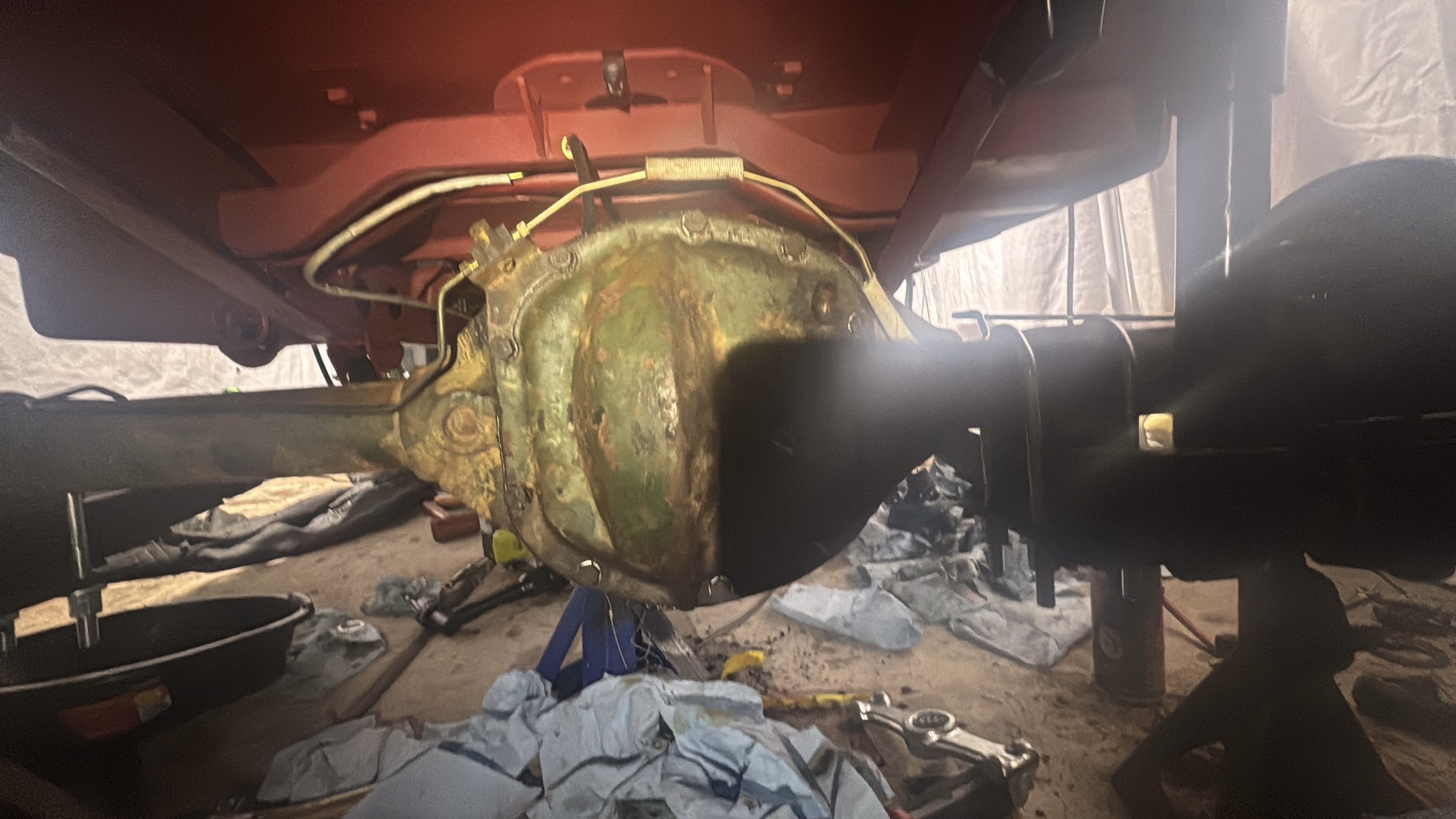
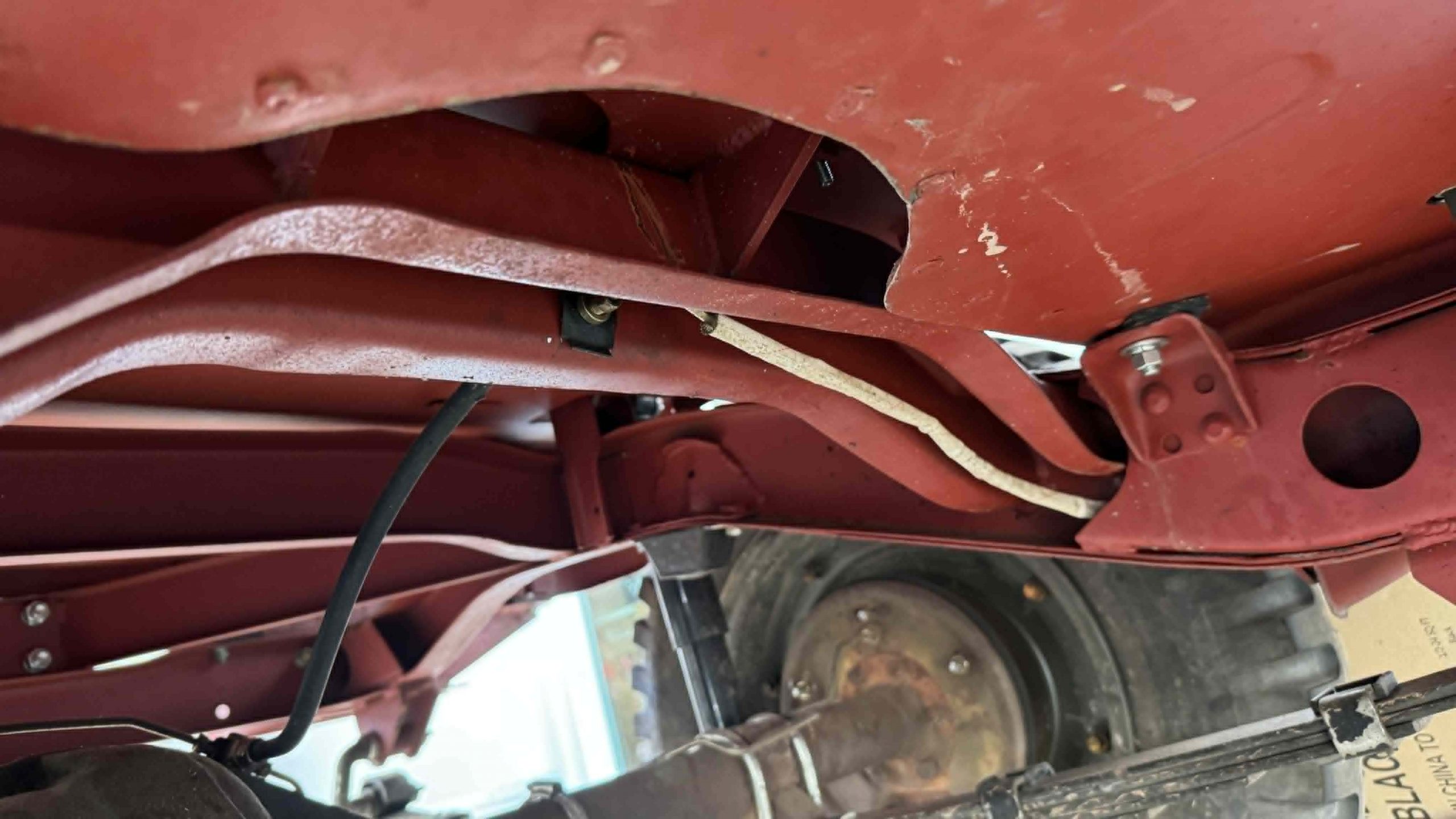
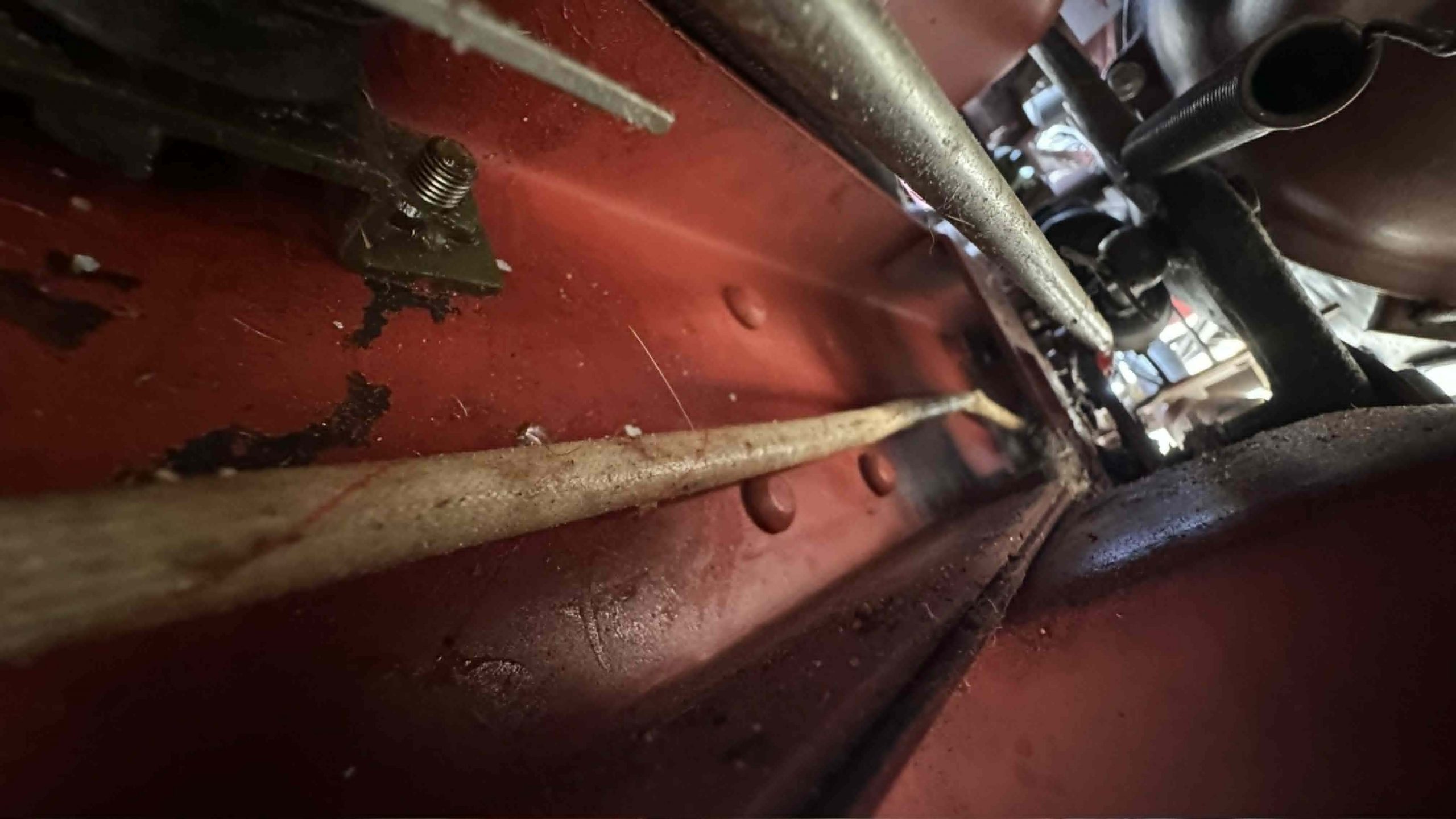
Above you can see these brake lines and rubber hoses all nicely installed.
This Whole Job Was Brutal

Tick…tock. Tick…tock.
I had less than 30 days to turn this Jeep into something that could drive 900 miles. I hadn’t driven it an inch, and while I’d heard it run, it wasn’t idling. While I had rebuilt the transmission and transfer case and looked inside the differentials, I didn’t know how well they all worked, and there was always a chance I had screwed something up.
I had some hope, though, because part of the reason why the axles I described in this article took so long to complete is that I was doing everything exactly by the book and with only the best parts. If there’s one thing I understood about this eBay WWII Jeep build it was that there are thousands of moving parts associated with assembling a car from scratch, and so many potential failure modes. I had to make sure that every single step of the way I worked with precision and took no short cuts; only then could I fire up this engine, put the transmission into gear, and have any prayer of driving 900 miles without incident.
I had one pitch to swing at, and I was going to be prepared for it.

Did the kingpin bearings that I removed look OK? Sure. Were some of the wheel bearings OK? Sure. Could that transmission that I’d purchased have shifted just fine without a rebuild? Maybe. But with so much at stake and so little time, I decided the right answer, given all the potential failure modes, was to break out the feeler gauges and dial indicators and calipers, replace every bearing, and follow the repair manuals to the tee. If I wanted any chance of getting this Jeep to Moab, Utah by the Easter Jeep Safari, I had to be 100% focused at all times. I had to do my best work.
And I did. As I sat covered in grease, night after night, all by myself, it was hard not to get demoralized. There was so much work, and it all took so much time and focus. It was brutal, but you readers, our partner eBay Motors, and my company was relying on me, and I had no contingency plan.
I had to pull this off. I just had to.


Nothing wrong with drums in the rear on small/light cars.
Never had to replace 1 part of it in my 96 Mégane in 18,5 years of ownership driven from +- 80000-290000 km.
Cleaning them every 2/3 years 60000 km kept them working great (had separate power adjuster for the rear)
Renault 19 and Clio with adjuster in the cilinder the cilinders would wear out and have to be replaced.
For cars of friends,family and customers were we did have to replace the shoes/cilinders Renault had very good kits were all was included and pre installed.
Biggest problem was getting the line loose from the cilinder, rest was plug and play and for adjusting drive slowly and play with handbrake.
From +-2012 Clio IV and Captur the kit also included drum itself, installing it was only disconnecting the line and take it of the backplate and put back on.
All things mechanic/ wrenching start and end with Cleaning. Not my strongest point but it is very true.
Pro drum in the rear:
Cheap to install and maintain
They power themselves
With a good adjuster or ABS , you never no they’re there
Front does +-80% off all braking
How millennial, instead of the potential of losing the shop, there is the potential of losing the website! LOVE IT.
Just did this on my M35. Be glad you only have 2 axles.
This project makes me think of a friend who did one of those house ‘renovations’ where the only thing original left was two walls and part of the foundation.
I briefly considered doing a similar project on my house.
Even with the help of hiring contractors for most of the work, it took him a year and a half and the house he has now is really nice.
But the cost of doing that, the time, the frustration and the stress he went through has convinced me that there is No Fucking Way that I’m gonna tackle that same job myself… at least not while I also have a full time job.
And like my buddy, David you convinced me that there is No Fucking Way that I want to tackle a car building project like this while also having to work full time.
Hell, even if I was retired, the only way I’d do it is if I was like Jay Leno and had my own staff to do all the hard stuff for me.
I am definitely not wise to the chemistry of all of the stuffs involved here, but in hindsight, does there exist some substance in which things could’ve been soaked in advance without damaging the parts that would’ve reducing the amount of chiseling/cleaning required? Or were other things happening with enough of these parts that there was no passive way to get them closer to clean while working on something else? Or does no such helpful substance exist?
I know none of that helps if you don’t realize how much cleaning is needed until you’re about to do it, but just wondering big picture-wise, if that would’ve been possible if noticed in advance.
Live steam works wonders on removing old grease, scale, goop and general detritus from surfaces. The downside is you need a steam jenny (high pressure steam generator), and they are not cheap to purchase. A better option may be a rental which can cost about $300+ per day. The boiler may fired by Diesel or Kerosene; electric units are available but the power requirements are typically more than most household utilities can provide.
Good to know it takes volume. I once bought a used Harbor Freight steam buggy to clean off motorcycle engines but it didn’t do squat so I gave it to a luthier friend.
I kept wondering about using an old fashioned solvent parts washer.
Solvent parts washer would work well if large enough to accommodate the parts. Issue is the solvents themselves, which may be toxic, flammable or carcinogenic, unless you use a water based wash (but even then, the additives present may be toxic or carcinogenic). I’d take my chances with live steam, which you can control by pointing the end of the hose, unlike the open surface area of a parts washer and the direction in which the wind is blowing. Cost is a consideration here; in my world (except for my car), cheap used is always best.
A long time ago (~35 years), I was refurb’ing some industrial pumps for my landlord. He supplied me with some stuff called CitriKleen, a biodegradable citrus-based water-soluble degreaser. That stuff was AMAZING. It would degrease things so thoroughly that after removing parts from the washtub, You’d have to hit them with WD40 to keep them from immediately rusting. If you put your hands in it, it would leach the oils from your skin, leaving them dry and powdery. Fortunately, it was non-toxic.
So far as I know, the company is still around.
I forgot about Citri Clean. Great alternative to both live steam and solvent based fluid for a parts washer. I used to use that 50 years back to clean pharmaceutical processing equipment gummed up with petrolatum (basically vaseline) prior to a final wash down. Didn’t need to be concerned with rust as all equipment was stainless steel. I see it is still available on EBay. Thanks for the reminder.
There are water based degreasers out there that work ok. As a chemist, methylene chloride works wonders on old grease and paint, but it has been regulated out of use due to carcinogenicity. My last employer had a 40 ton toluene tank and I would use that. Of course, it was pretty flammable so you would want to be careful. The good stuff all has drawbacks.
Somehow, I no longer want to build a Jeep from parts. All the cruddy, slow, annoying car projects I’ve tackled in the past dwindle into insignificance. I don’t know if this tale of woe is an inspiration or a warning!
As not-a-mechanic-or-engineer, I wonder if those who are/were a mechanic or engineer are reading this will interest and sympathy, or simply avoided reading because it’d be too traumatic to relive such painful experiences. Plus, how much extra time was required to have clean hands to take so many process photos?!
What extremely limited work I’ve performed decades ago on my simple 1966 car and with limited worked with tools on other projects in recent years, I will admit that I scrolled down to maybe the middle of the article as it was too painful even for me to start at the beginning. Sigh…
I knew it’d eventually have a successful ending, having seen the Jeep photos at Moab.
Kudos to you, David, for persevering. (And sending gratitude to your wife for her patience.) I do wonder if you’re going to take a long break from wrenching, as the Jeep build maybe scarred and exhausted you. Or if you’re already planning the next repair or upgrade.
Thanks for the article as I cringed then celebrated with you.
Never underestimate David “I learned nothing from my last Jeep debacle” Tracy’s love of rust and punishing wrenching. I’m sure the next thing will somehow be worse
Scary thought!
This project broke me.
This reminds me that I should check the on set of drum brakes in the house on the Honda CM250C. The other motorcycle and the cars have disk brakes. Our tandem bicycle had a,drum brake in the rear to control speed on hills plus the V brakes. Modern tandems seem to get by with F and R disk brakes with 203mm rotors.
I’m also staying well away from my son’s 79 Corolla project that’s currently getting its drum brakes refreshed
I was so happy when I bought my first car that had discs all round. Even just a simple set of new shoes takes hours and much swearing.
I’m surprised the closed knuckle is lubricated with grease. I had assumed all along that these were just bathed in the axle oil.
It’s a special, thin grease. I just pump mine full of CV axle grease, which flows a bit more than a typical Red ‘n Tacky. (There are various grease designations that I don’t know off the top of my head).
Broke brake mountain! Your dedication to the cause is admirable. I’ve done enough brakes over the years to tip my beer in salute. Of course from a safe distance so as to avoid becoming involved.