

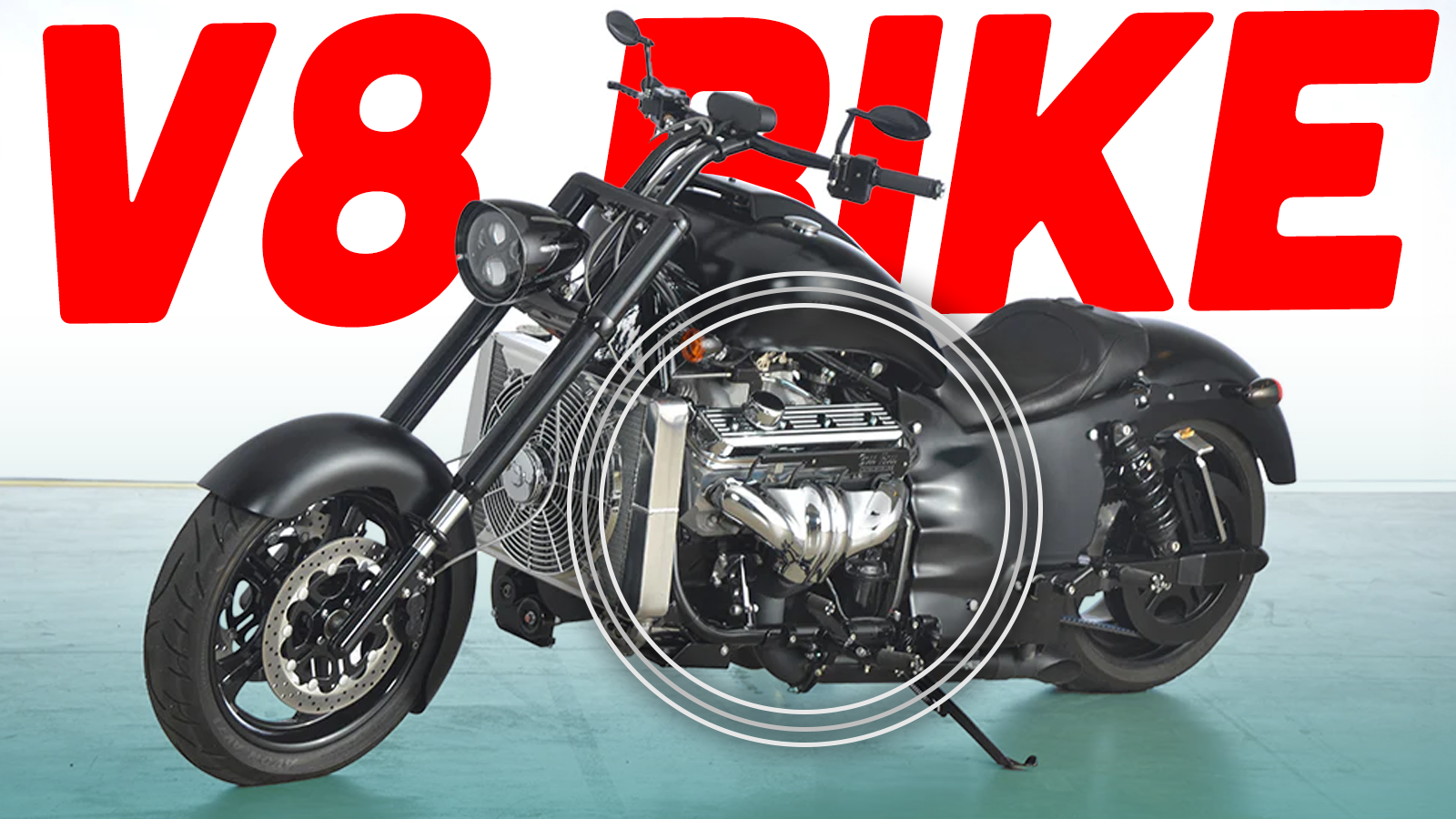
Most modern motorcycles tend to have relatively compact, high-revving engines. Even the bikes that do have large powerplants put out less displacement than many crossovers do. But there’s one American company that throws all convention and logic out of the window. That’s Boss Hoss, and for the price of a nice new pickup truck, this firm is willing to sell you a crazy machine with a big block V8, 600 horsepower, and handling that would make a Smart Fortwo seem like a sports car.
Boss Hoss recently popped up in my newsfeed after the bike nerds across the Atlantic at VisorDown realized that the company exists. It hit me that, of all of the motorcycles I’ve written about, I’ve made only passing mentions of Boss Hoss. I’ve even ridden two of them in the years before I started writing professionally. So, it’s time I rectify that.


I recently wrote about the Millyard Viper V10, a functional motorcycle that’s adorned with a 500 HP and 8-liter lump of American muscle from a Dodge Viper. Sadly, or thankfully, depending on your desire to harness so much power on only two wheels, the Millyard Viper V10 was a one-off.

On the mass-market side of things is the Triumph Rocket 3 (above). Its 2,458cc inline-three is comical in size and its 180 HP output is hilarious. Technically, the Rocket 3 has the largest engine of any mass-market bike. I own the 3’s predecessor, the Triumph Rocket III, which has a mere 2,294cc engine and 140 HP on tap. That motorcycle is frankly stupid, in a great way.
Boss Hoss doesn’t mass-produce its bikes, but if you plop down enough cash, you can ride away on a motorcycle or trike that’s locked and loaded with anything from a 383 stroker to a 496 big block. The weirdest part? In my experience, a Boss Hoss both rides exactly as you think it would, but is also far easier to ride than it looks.
From Planes To Bikes
Like many boutique outfits, Boss Hoss Cycles started with one man’s really specific quest for a kind of bike that wasn’t produced by any mainstream manufacturer. In this case, it was a commercial pilot and Aviation Airframe and Powerplant technician who had an unquenchable thirst for power. From Boss Hoss, emphasis mine:
In 1990, Monte Warne, a man living in the USA, was looking for a bike that provided 3 to 4 times more horsepower than any other bike available on the market. But there was no such thing. So he came up with the idea to build his own bike. For this, he removed the V8 Chevy engine from a StockCar. He packed this central unit into a frame he designed himself. His goal was that his new motorcycle, as a Crusier, had to be comfortable to ride. With this homemade bike he went to the Daytona Bike Week and received a lot of praise. Everyone wanted to know where exactly this bike was available. From this point on it was clear for Monte: He had to build more of these machines…

In the last 30 years, Monte Warne’s small shop has developed into a large manufacturing facility. In Dyersburg, in the state of Tennessee, these monster bikes are now produced in series [in an 8,288 square foot shop]. Here, the frames are designed and manufactured. After welding, all frames are powder coated. Apart from the engine, the company’s own turning and milling shop produces all parts for the motorcycles itself.
The engines are supplied by Chevrolet and modified at the factory by the Boss Hoss specialists. There are almost no limits to this: engines with a capacity of up to 10 liters and more are available, if desired by the customer. On a large production line, mechanics assemble the motorcycles by hand. After final assembly, each bike is thoroughly tested on a test bench and after this on the road.
Early Boss Hoss bikes utilized a single-speed right-angle drive transmission, which not only kept the overall length of the bikes down, but allowed the engines to be mounted longitudinally. These early bikes had a hand-operated, vacuum-assisted clutch, but later models have torque converters.

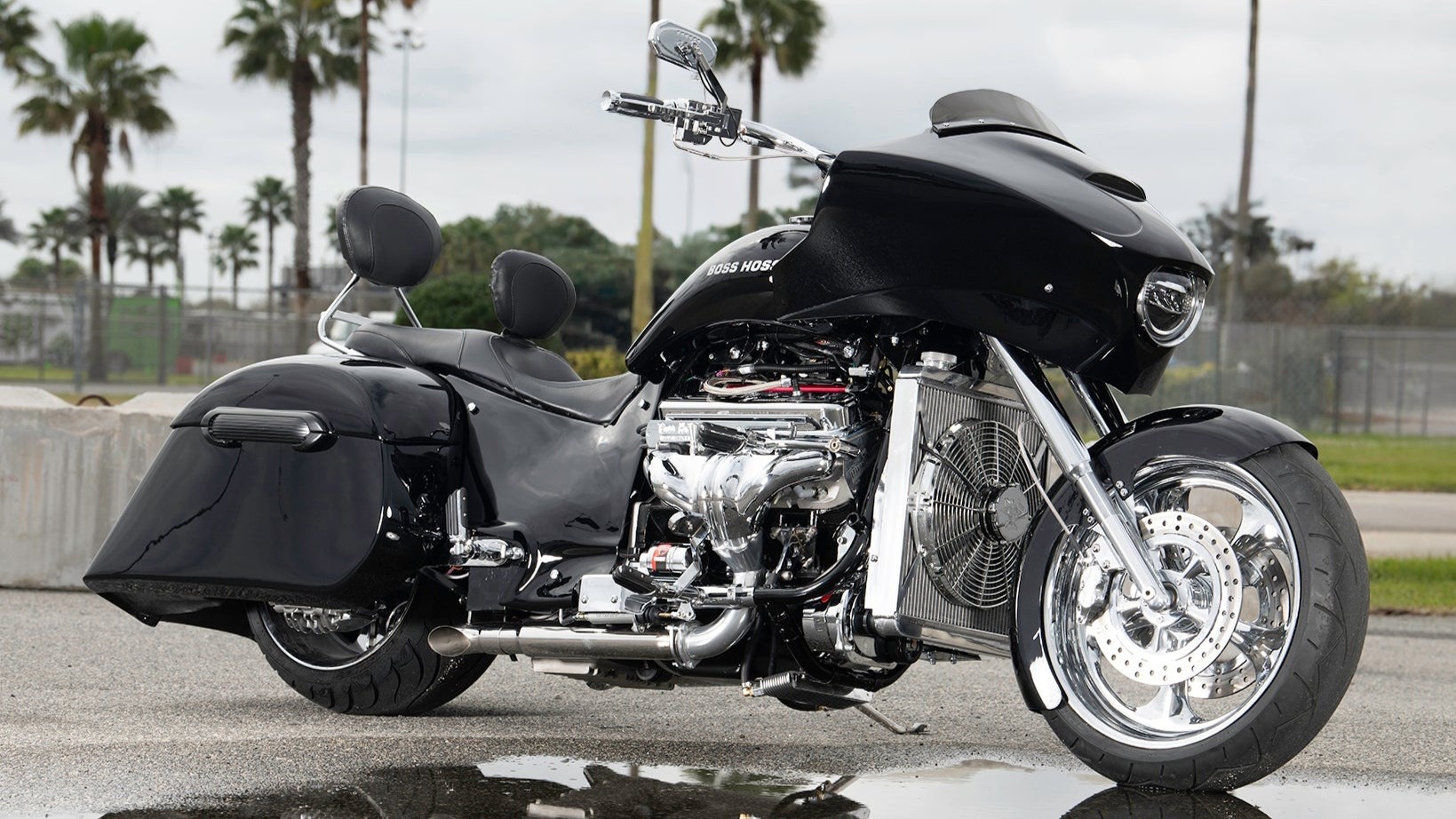
The first Boss Hoss motorcycles left the factory in 1996, and by 1998, the company was churning out some 300 bikes a year. Back in the late 1990s, the bike that you’d get had a 5.7-liter Chevrolet small-block V8. The standard version had 200 HP on tap, but for a cool $2,500 ($5,407 in 2026) on top of the $27,500 base price ($59,479 in 2026), the ZZ4 package upped output to 355 horsepower and 400 lb-ft of torque. The big Hoss weighed at least 1,200 pounds wet and required a meaty P225/70R-15 Firestone rear car tire to have a fighting chance of keeping the shiny side up.
In getting a ZZ4, your engine was hopped up with alloy heads, an alloy manifold, ceramic-coated headers, an Edelbrock four-barrel carburetor, electronic ignition, a forged crank, forged high-compression pistons, and roller cams. Power reached the rear wheel through a 44mm belt.

If you really wanted to give death the middle finger, there was also an 8,227cc version with a violent 502 HP and 567 lb-ft on deck. If you cared about fuel economy for some reason, a V6 was also available in the 1990s. Allegedly, depending on your exact configuration and your skill in keeping the rear tire hooked, a ’90s Hoss dispatched the quarter mile in 10.5 seconds at over 140 mph. Theoretical top speed was 180 mph, but nobody was brave enough to try.
In the late 2000s, the Boss Hoss team built its own interpretation of the Viper V10-powered motorcycle. Why yes, that is a bottle of NOS!

They’re Just As Ridiculous To Ride As They Look
I had the pleasure of riding one of these early bikes in 2019. Back then, I was at a motorcycle show when a kind gentleman let me take it for a spin. I was first surprised by how easy the Boss Hoss was to hold up. I’ve ridden Harleys that are harder to hold up. Honestly, it was so weirdly easy that it freaked me out.
Then, I started it. I took a video of another Boss Hoss starting up at a nighttime bike show, and this clip sums it up well:
The Boss Hoss was pure chaos the moment I started it up. If I didn’t have both feet on the ground – which was pretty easy thanks to the low 28-inch seat height – the bike was liable to tip over to the right from the engine’s torque. Once I survived the startup, I absolutely had to keep my feet firmly planted because, with each rev, the bike actively wanted to throw itself down. This is all freaky. The Boss Hoss shakes and twists like a muscle car when you rev it, only all of that horsepower is inches from your genitalia instead of well ahead of your feet, and supported by only two wheels instead of the usual four.
Oh, and the soundtrack, what music. If you’re into V8s, I’m not sure there’s anything that sounds better than a Boss Hoss. There’s no hood, car body, or lengthy pipes in your way. Your ears are only a couple of feet from the action. Honestly, who needs a Magic Wand when you have a rumbling eight-cylinder symphony to make you feel all warm inside?

The craziest part was how easy that bike was to ride. Flick the switch, and it was ready to go. The transmission delivered power much like an old slushbox automatic. That is to say that even when I cranked the throttle, the power came on surprisingly gradually. I’m sure I could have broken the back tire and killed myself if I cranked the throttle right away, but I found taking off on the Boss Hoss to be no different than getting going on a scooter. Honestly, my Triumph Rocket III reacts with far more brutality than that Boss Hoss did.
Once moving, the Boss Hoss rode sort of like any other cruiser, only with a gigantic 11-gallon fuel tank in front of my face and, of course, small block ASMR right below my helmet. When on the road, acceleration does become rather hard and fast. I also found it possible to do full throttle without breaking traction. Honestly, it felt like any Harley, just scaled up times two. Well, that’s not entirely true. If I twist the grip on a ’90s Harley, there’s a lot of noise and only some acceleration. A Boss Hoss goes from 40 mph to 80 in darn near a blink of an eye. Seriously, if I twisted the throttle and looked away for a second, I was going reckless driving speeds by the time I looked down again.

Turning was a strange affair, too. At slow speeds, that Hoss and the one I rode after it was vaguely as easy to maneuver as a big V-twin cruiser or a Suzuki Burgman 650, only with a turning radius like an oil tanker. At high speed, cornering was, at least in my view, sort of a mess. The rear car tire can be convinced to turn, but it didn’t want to and tried to straighten back out. But once forced over, it’s not too hard to keep it in a lean. I found myself having a lot of fun right until I hit the 28-degree lean angle limit, and I was rewarded by the sound of a lot of metal dragging. It was one of those sounds you feel in your soul, like you can sense the dollars evaporating from your purse.
Honestly, while the Hoss can corner, I found it best to treat it like a pickup truck and be easy in the turns rather than trying to keep up with bikes with a fifth of the wet weight. Apparently, some of the craziest Boss Hoss owners do wicked burnouts, and some have managed to wrangle the 78-inch wheelbase into the sky for a wheelie – though I’ve been told that Boss Hoss bikes can get pretty tweaked upon landing.
In both of my Boss Hoss test rides, I’d pull into a parking lot, shut the engine down, and have to stop the bike from tipping over to the left. These were just the ’90s Boss Hoss bikes, and they were an absolute circus legitimately from the start to hitting the kill switch. It was an experience that didn’t make any sense.
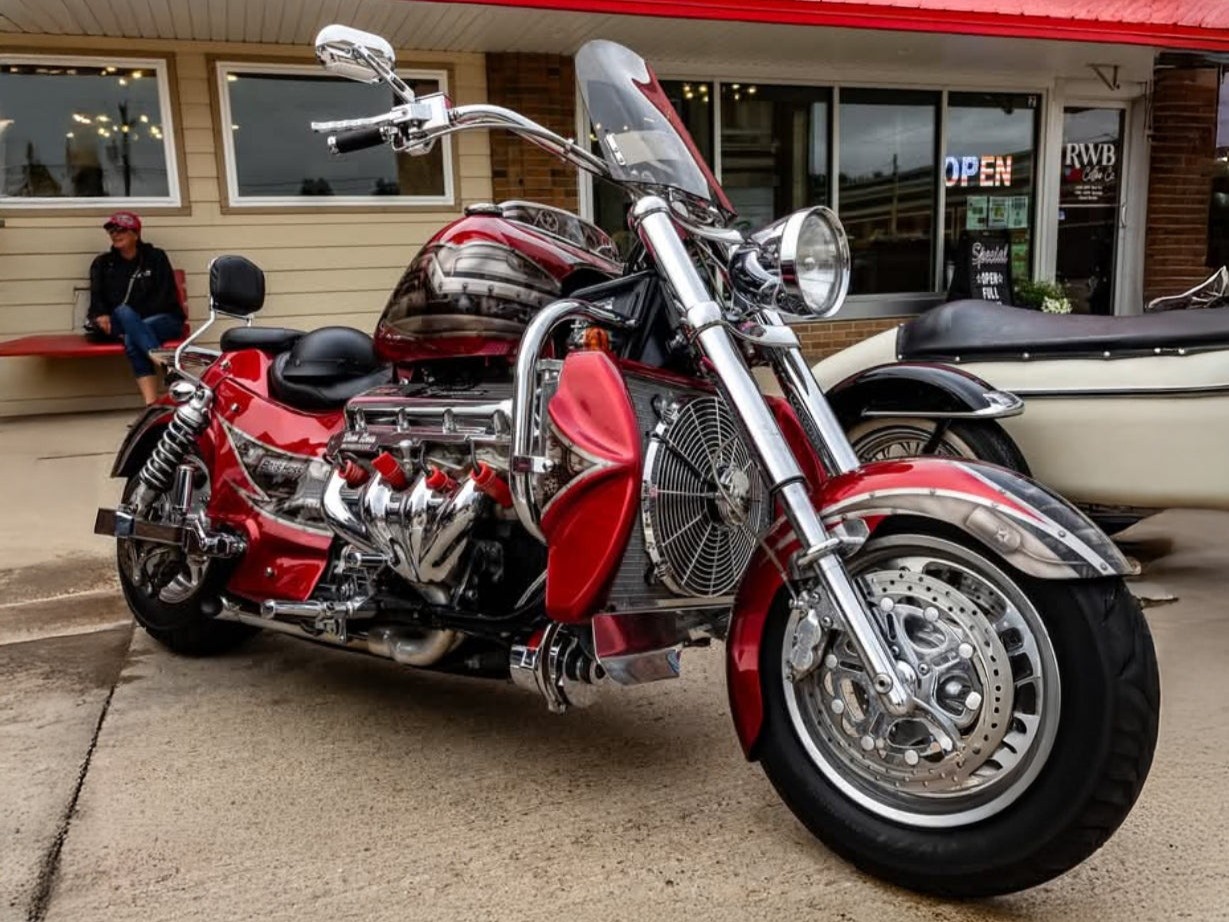
What do I mean by that? With the right rider, a Triumph Rocket III can race down the quarter mile just as fast as one of those older Boss Hoss bikes, despite having a much smaller engine and less than half the power. The motorcycle buff mags figured out similarly, in that a proper sport motorcycle could beat a Boss Hoss in a stoplight drag. But none of those bikes had the drama of the big Hoss. Also, while the Boss Hoss motos might have been slow to launch and hook, once they get traction and get into the power band, they pull hard. Remember, the trap speed of these things has been measured to be about 140 mph. So the sportbike gets to the quarter first, but then would get passed by the Hoss.
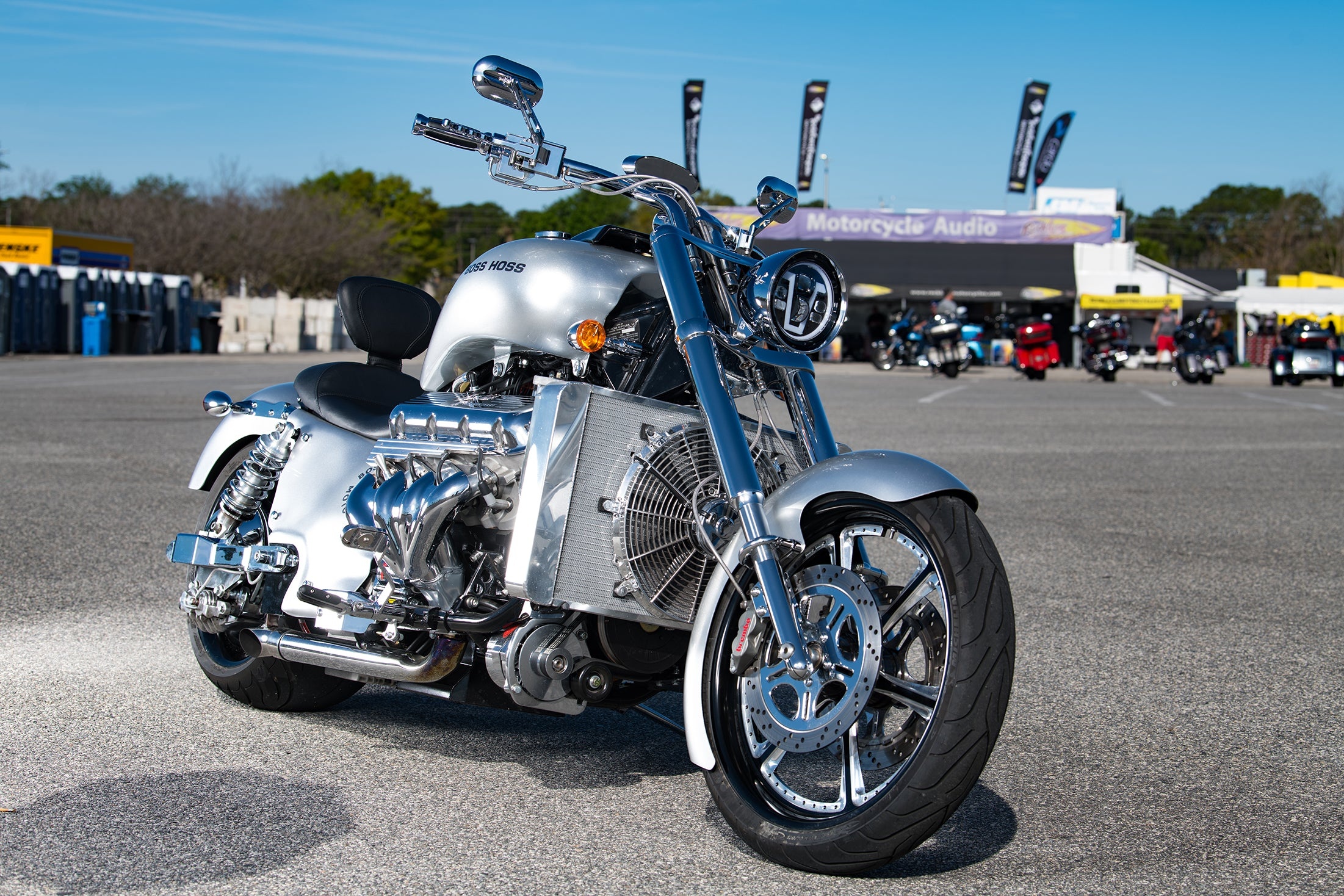
Sadly, since I wasn’t an auto writer back then, I never bothered to take any pictures of my ride, just of the other Boss Hoss at night. Or if I did, I no longer have those files. But I’ll never forget how fun it was.
Anyway, over time, Boss Hoss has been able to upgrade its bikes through its own in-house engineering and through help from contractors. Today, you can get your Boss Hoss with a two-speed transmission with reverse, inverted forks, cast structural frame components, and more. The company has also had a trike line for a long time. You can get a Boss Hoss trike with a butt that looks like a Silverado SS, a butt like an old Willys, a ’57 Chevy, a dragon, or an old custom coupe. Here’s the Silverado SS trike:

As of publishing, Boss Hoss sells its stock bikes with 383 cubic inch strokers, 376 cubic inch GM LS3s, 454 cubic inch GM small blocks, and a hefty 496 cubic inch big block. Offered outputs are 430 HP, 445 HP, 563 HP, and 600 HP, respectively. The torque spread is 450 lb-ft to 568 lb-ft of twist. These engines are fueled by Holly Sniper or Terminator EFI systems. If, for whatever reason, these power numbers are not high enough, Boss Hoss can strap all sorts of turbos and superchargers to these engines or up their displacement. They are GM V8s, after all.
Apparently, the newer two-speed Boss Hoss motorcycles can do a quarter mile in under 10 seconds if you’re mad enough. Boss Hoss hasn’t announced any new products lately, but the company seems to be getting some attention as people are discovering it exists at all.
Costs More Than Some Pickup Trucks
As for price? Oh my. Well, the cheapest two-wheel model from Boss Hoss is the bagger for $69,995. That’s the starting price, with bigger engines and customizations cranking the price up even higher. Weirdly, the trikes are cheaper, and start at $56,995 for the Dragon trike. If you go with one of the trikes, you also get a run-of-the-mill 4L70E four-speed automatic as your transmission rather than the two-speed semi-automatic that the two-wheel Boss Hoss bikes get.

That is very expensive for a motorcycle, of course. A base model Boss Hoss is more expensive than a base model diesel pickup truck! But I’m not at all surprised. Boutique motorcycle builders don’t really have economies of scale on their side, and they attract rich clients, anyway. If you’re not flush with cash, examples from the early 2000s can be had for around the mid-teens. If that’s still rich, just do what I did and get a Triumph Rocket III.
I think what I find the coolest about these bikes is that people don’t just buy them to shuffle away into some private collection to never see the light of day again. Boss Hoss riders claim to have 100,000 miles, 200,000 miles, and even more than 300,000 miles on their bikes. These machines apparently get in some serious road trips. I can’t say I’m surprised about that, either, given the reliable GM powerplant and cushy ride.
I do think the Boss Hoss is not the craziest bike built in America. That distinction goes to the MTT Turbine Motorcycle, and I doubt any V8 or V10 creation can unseat it for pure, unfiltered insanity. But I remain impressed with what an aviation mechanic managed to achieve here. If you had asked me if I could balance a V8 stuffed into a motorcycle, I would have told you no. But, somehow, Boss Hoss makes riding a V8 so alarmingly easy. Now, where’s my Duramax motorcycle?
Top graphic image: Boss Hoss


Damn, that 1996 Boss Hoss is so beautiful…wow, these bikes are so awesome w/ the big ol V8’s and even a V10 Viper. I’m glad they just went for it and that they were made…so cool!
That’s more power than any car I’ve ever owned, twice as many cylinders, and probably heavier than any car I’ve owned.
But only half the wheels.
That ’57 Chevy Trike is about 90 percent awful and 10 percent awesome.
Then there’s the “Stallion”, a trike with a 4 cyl Ford motor and a steering wheel and A/C!
Or you can just buy a Diavel and have something that handles and stops really well.
0-60 in 2.4s
180 mph top speed
https://www.motorcyclenews.com/bike-reviews/ducati/diavel-v4-rs/2026/
Was very disappointed to look up the dragon trike and see that the back end does not resemble a mythical dragon.
Saw one of these in person once. None of it makes a lick of sense. Still, I understand.
to be fair the og K bikes, the flying bricks used a Peugeot motor
I think that was only the prototype/mule..
i saw the LS 454. Talk about Motus the motorcycle with half a LS motor
Genitalia, Magic Wand, ASMR. Someone’s feeling a little frisky this morning.
My daily ride is the polar opposite of the Boss Hoss, and that is exactly the way I like it. These things are silly and hard to take serious. Like a super jacked truck with rubber band tires.
They should come with actual peacock feathers sticking out of the back. For obvious reasons.
Eww. Small dick energy 🙁
Seriously..
Meh, call me back when one with a Ford GAA is available.
I worked at a Honda dealership in 1996, and the guy who bought the first Honda Valkyrie (the Goldwing flat-6 in a cruiser chassis) had one of these. He rode it in when he took delivery of the new Honda and let the service manager take it out for a ride. Unfortunately he didn’t offer to let 21 year old me ride it.
There’s no point to this motorcycle, but I want one! Preferably the 600hp one, and it HAS to shoot flames out the exhaust.
They should hybridize these bikes, so you can go short distances without waking up all of Northeast Cleveland.
Observationally: the vast majority of these Boss Hoss & car-engined-bikes end up being ridden by people who can barely balance themselves standing up. And then they install a car tire on the rear because they feel it improves balance to the bike – leading it to handle worse than the Exxon Valdez.
They’re in a demographic that overlaps heavily with Harley open pipes.
These are pretty wild. I’ve seen a few in the flesh over the years.
It doesn’t really surprise me that the trike is cheaper. It has a standard transmission going into a shortened rear axle. That custom 2-speed going into a right angle drive has to be $$$$ at such low volumes.
I was gonna say the same. Honestly, it’s a lot more appealing as a trike, though I’d want one with a li’l pickup bed.
That would be fun with a pickup bed! And I agree about the trike being less unappealing. Trikes ride completely different than two-wheelers and I’d rather just drive a car than a trike. But in this case, it’s not like the two-wheeled version of this handles well. Is the one with the Viper engine at full lock? There are roads around here with corners tighter than it looks like that thing could make it around.
3.0 powerstroke bike wen
This pretty much sums up the entirety of this company’s existence. As a longtime motorcycle enthusiast, these things have always seemed like an atrocity, owned and ridden by a very specific demographic. I’ll leave it at that.
There’s a vast ocean of difference between someone who rides a Triumph Rocket3 and someone on a BossHoss.
Agreed.
In this case, the Rocket III/3 owner (love how Triumph has done both) owns five Smart Fortwos. lolol
Men will literally do anything except seek therapy.
I was peripherally aware these existed. Thanks for the great write up Mercedes. While not my cup of tea as far as bikes go, it is an interesting solution to some mad persons dream.