


Remember a few days ago when I wrote about how Chevy sort of made the Porsche 911 before Porsche did? Kind of, in a very specific and not particularly accurate way? Sure you do. It was a big day for all of us. Well, now, in a bit of healthy, decades-out-of-date parity, it seems that Porsche had a hand at making some cars that we could call quite Corvair-like, if we wanted to.
And, I assure you, we want to. Just because it’s fun.


These cars were design studies for a possible Porsche four-door sedan of some type, designed and built by Carrozzeria Ghia, who had been doing design consultation for Porsche at various times, and, of course, for Porsche’s sibling company, Volkswagen, where they most famously designed the lovely Karmann-Ghia.
Want to watch an old video I did about the Karmann-Ghia? Sure you do:
Okay, back to these Porsche sedans; Porsche had been toying with the idea of a less-sporting car for some time, and had even partnered with Studebaker to experiment with some compact four-door, rear-engined sedans in the mid 1950s, part of a project Porsche called Type 542:

These cars featured rear-mounted V6 engines, with air, water, and a combination air-water cooling systems. The V6 was something of a departure for Porsche, as was the larger four-door bodystyle. These were very technically interesting and I think nice looking sedans, but Studebaker wasn’t in the best financial shape and the project never really went anywhere.
A few years later, in 1960, Porsche seemed to return to exploring the idea of a four-door sedan of some type, and Ghia came up with some clean – perhaps even a little too clean? – designs. Here’s the first one, a fairly straightforward three-box sedan design:

I actually think it’s quite handsome in an understated way. I like the split bumpers and the way there was no compulsion to try to make a fake dumb grille; also note how the front trunk lid cutline goes down to the bumper, for easy loading of stuff or getting small animals to jump in there.
The Corvair came out in 1959, so this is a pretty close contemporary. These used 356 engines and drivetrains, and the styling was under the leadership of Ghia’s Sergio Sartorelli.
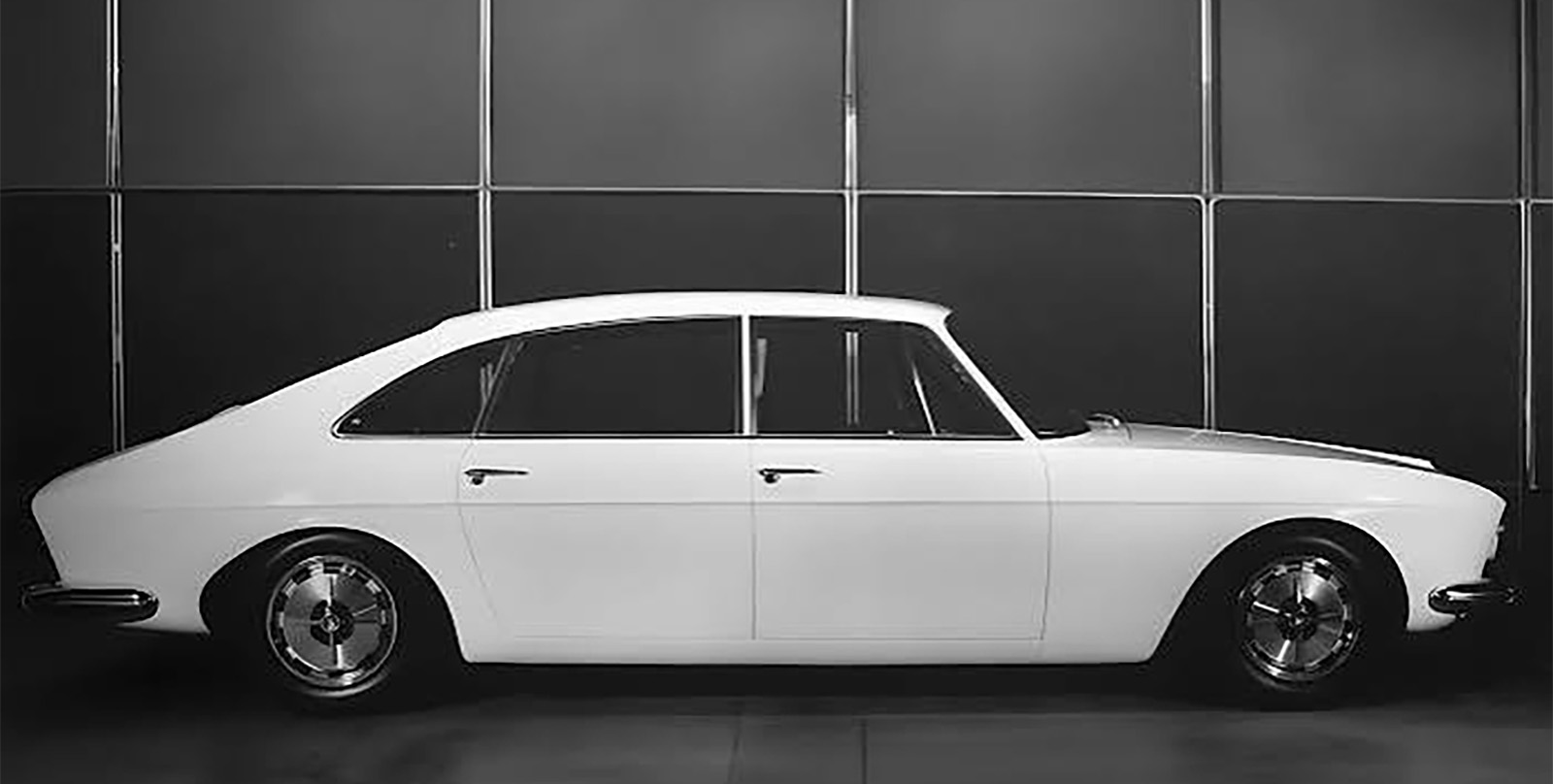
A second version, from 1962, was this striking fastback design. It almost has a Tatra 613/700 feeling to it, with that long roof and dramatically-sloping rear.
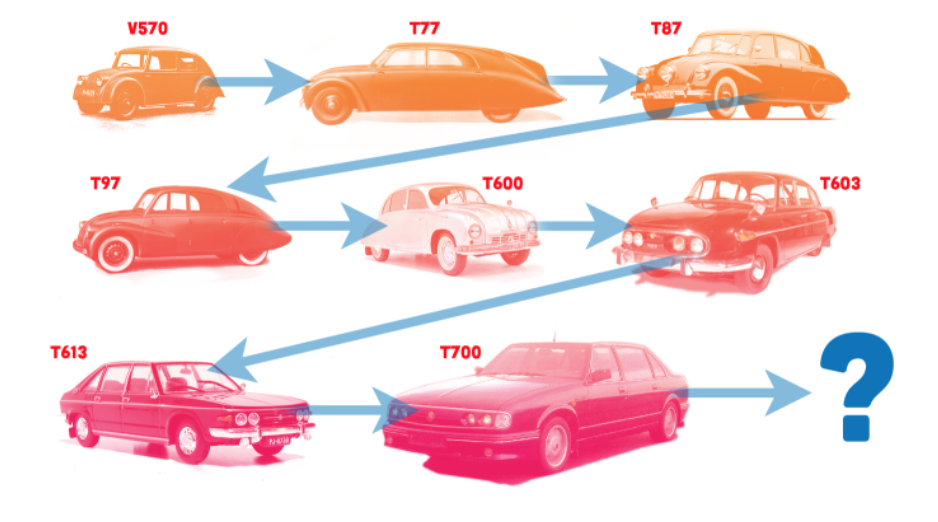
It’s a little lower and sleeker than the Tatra designs, though, and the Tatra 613 didn’t come out until 12 years later, so I hardly think that was an influence.

The rear is interesting, with lots of chrome-decorated air intakes, and quad exhausts exiting through the bumper, a novel touch that Porsche was also using on the 356.

The front end here, with its quad round headlamps surrounded by chrome cartouches, is somewhat reminiscent of the Corvair, but maybe a little closer to the Corvair’s second generation, which was released in 1965.
The fastback version looks to be pretty large for a Porsche of the era, and seems roughly mid-sized by American standards. That trunk up front looks like it would have been quite roomy, and the interior feels very American:

Bench front seats! Has there ever been another Porsche with a front bench seat?
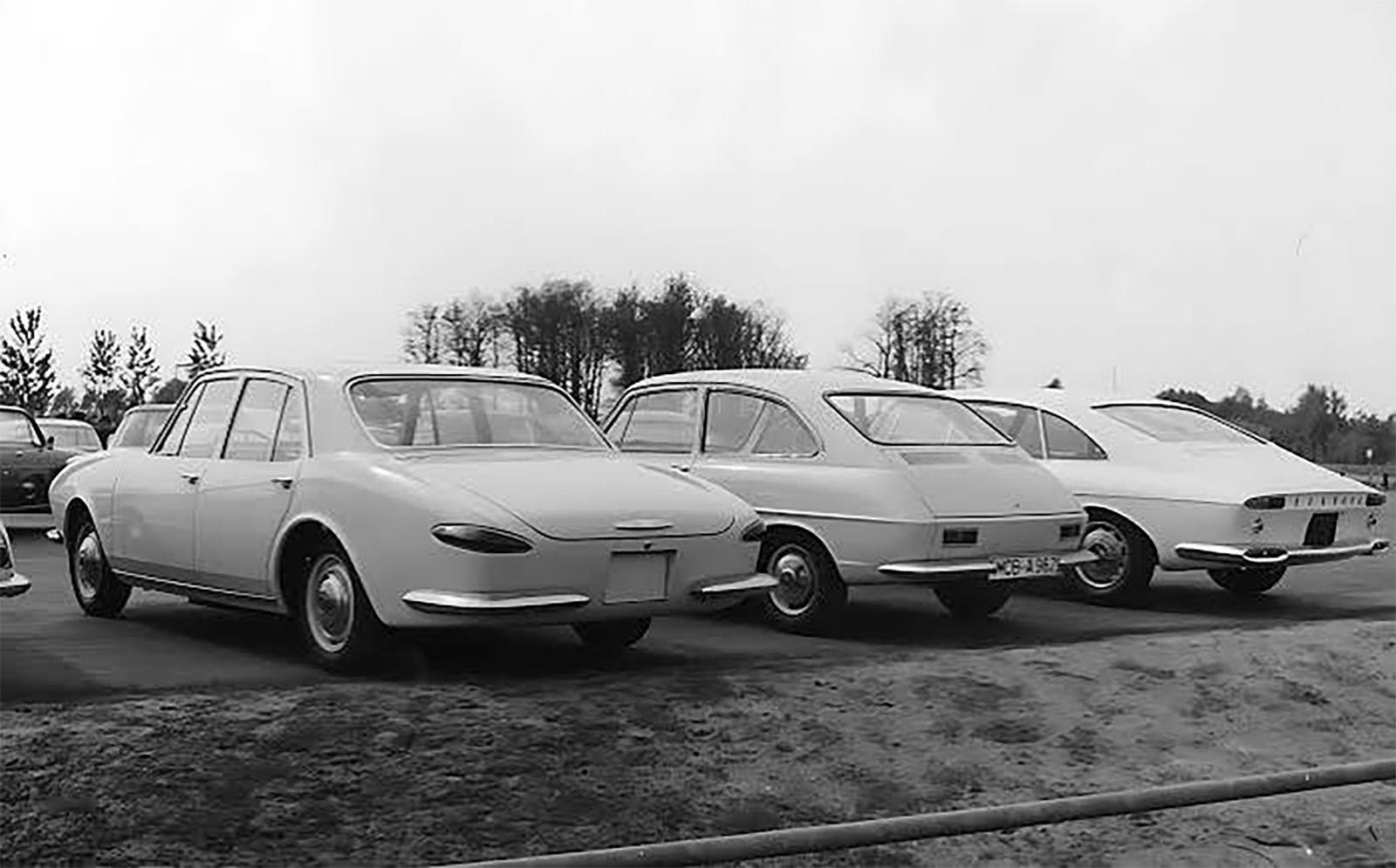
In 1966, Volkswagen exhibited both design concepts to the press (with another prototype between them, one that would evolve into the Type 4), as part of a big display showing how much they have been exploring successors to the legendary Beetle. Would these concepts have been considered to be VW-branded as well? It’s not clear.
Porsche wouldn’t have a four-door sedan or fastback until the 2009 Panamera, and even then those were front-engined, not rear. It’s odd to think about Porsche having a family car-type offering, but certainly not unwelcome. I love the idea of these cars, and a reality where large rear-engined family cars were a thing is a reality I think I could have a pretty good time in.


These are great, and maybe had Porsche partnered with AMC instead of Studebaker, that first one might have actually gone somewhere.
I know it’s much later, but don’t forget the Porsche 989 concept, what the Panamera should have been.
Frankly, the current 911 is big enough that they could probably do a rear engine small four door; it might even help amortize the cost of the 911 like sharing most of the front end of the Boxster did for the 996/997.
I had no idea these were ever a thing. They went pretty hard at this sedan idea, odd that they completely pulled the plug.
Perhaps, the EA128 prototype, four-door Volkswagen with 2-litre Porsche flat-six engine in the rear, is another “that could be Porsche four-door car”. Oh, those odd turn signal indicators on the side could be excellent Jason-esque journey into the madness…
I might have overlooked it and it was an one-off, but for completeness, thr four door 911: https://monochrome-watches.com/the-troutman-barnes-4-door-911-the-original-panamera-petrolhead-corner/
It’s most impressive for the way it has the same awkward proportions as the Panamera 😉
Do I long to bring a Studebaker to a Porsche meet? Yes, yes I do.
Damn, that 1962 version is gorgeous. I know I’m probably in the minority here, but I would love to drive around on that car. Hope one day we can just order those models to be 3d printed on our local dealer and mounted on a skateboard chassis.
I live in Utopia and I still have to deal with those schmucks at the dealership?
Fair point. I only bought second hand from individuals so far, so I forget how hellish they can be 🙂
Imagine an alternate reality where Studebaker-Packard formally shacked up with Porsche and eventually became the American arm of VAG. The performance-oriented Panamera and Cayenne would have luxury-oriented Packard siblings. Škodas would be rebadged as Studebakers for the American market.
They certainly could have started the kit car craze early by fitting a pane and 1600 motor under an avanti body.
My Dad had both. Karman-Ghia and a Corvair (and a Crossley), and waxed poetic about all 3. Wish I had asked him more about then before he passed.
One thing I do recall is him describing removing the transmission (from one of them) by himself because it was so small. Not sure I recall which one though.
My dad still waxes poetic about his Corvair, but not in a complimentary way.
Of this Corvair
I do not care
As I see it sit,
I think ‘It’s a piece of shit’
He would love that.
Almost certainly the Crossly, they are tiny. The rear trans axle is not as easy for sure, but a VW flat four is I think 4 bolts and some linkage and it is removable by a single person.
Crossley
Yeah, I loosely recall it being the Crossley.
The unprobable lovechild of a 1st-gen Valiant and a VW Brasilia. A fascinating detour our of normalcy. Thanks Jason!
A Jason standard deviation.
Does that mean he’s a standard deviate??
Deviate, yes. Standard? Probably not.
Unless you refer to the no-frills Beetle, of course.
Unless you change deviate to deviant and then it fits. Lol
Nope, I assert that Jason views the world 10.741 JSD from the SD of the majority of the population. It gives him his unique perspective on the world which he shares with we normies here on TheAutopian .
I think the scientists doing the cloning spliced some SP2 DNA as well. And, once the lineage escaped the lab, it also gave birth to the Brazilian Variant II.
BTW, if those scientists ever wondered, yes, they absolutely should have done it!
Yes, I see a genetic pathway to the Variant II too.
I feel like if Porsche hadn’t gained a Ferrari-like aura and image in racing, they might’ve gone ahead with this. They always did come up with weirdly pedestrian concepts for a company best known for outright performance. I appreciate that.
Looks a bit like an early version of the Monica. Which itself looks like an early version of the Panamera 😉
The poor sad Monica. Much prettier car IMO. A tale of woe and missed opportunity. I always felt that the company attracted grifters who drained as much money as possible from the project.
Monica is a great name for a car. Mercedes, Giulia, pretty female names really work. People do it with boats…
Apparently it was named after his wife.
Mercedes was named for one of the daughters in one of those families, too. Don’t know the history of the Giulia, but it’s such a pretty name.
This was a great read Torch! Early 356’s had a bench seat, with a little cutout for the shifter.
That top shot makes me think of “Repo Man.” Intentional?
Plate of shrimp!
I’m surprised they never considered the obvious, a Porsche engine and chassis tuning in an uptrimmed Beetle or Type 3 body. Like a German Lotus Cortina but upwards of a decade before (if it were Beetle based).
A Beetle is probably a stretch, but a Type 3 wouldn’t have been a terrible base. Or, they could have done something based on the Type 34 Karmann Ghia
Thank you for remembering the Type 34.
Aren’t Porsches and Beetles pretty much the same thing. I know a 914 Porsche has a Beetle engine.
I know I’ve seen Beetles done up with Porsche 356 bits, but it’s not exactly cost effective when you can get similar power from larger displacement Beetle engines.
That said, with Beetle prices rising, it’s not as crazy a thought as it used to be.
This sent me down a vicious spiral of looking up photos of the Tatra 603A which is what the front of that Ghia model reminded me of.
https://www.tatra-club.com/graphics/gallery/full/125_zk.603-a.jpg
And a picture of it being tuft tested:
https://www.tatra-club.com/graphics/gallery/full/128_prototyp-t603a.jpg
Something quite striking about that Porsche/Ghia model is the proportions, especially the dash to axle gap, unusual for a rear-engined car.
Speaking of big swoopy sedans it also put me in mind of the stillborn Renault Project H V8 efforts. Though front engined, i feel it’s way too cool and close of a shape not to mention.
https://preview.redd.it/renault-projet-h-1968-v0-0dfd6u4q2xfd1.jpeg?auto=webp&s=22125b59f69d22ac29f54e90ab4c6905fd0199df
https://i0.wp.com/lenouvelautomobiliste.fr/wp-content/uploads/2020/02/Retromobile-2020-Renault-Prototype-H-LNA-FM-103.jpg?ssl=1
Oh my.
I was thinking my ’70 Volvo 1800E didn’t have any seams either, so I was glad to hear you mention that.
I’m surprised to hear that Porsche were in bed w/ Studebaker for early development – particularly since Studebaker later joined forces with Mercedes-Benz in 1957.
I wonder if one had something to do with the other?
My guess is probably not; I don’t think Porsche and Mercedes (as industry competitors) collaborated much, especially at that time.
On the other hand, Studebaker needed something to differentiate it from both the Big 3 and from the other smaller independents, so associating with European automakers for R&D was likely a way to both generate some income and give them some additional marketing cachet. Studebaker was a bit ahead of the curve with incorporating more European flair and design concepts in their cars — they needed something to set them apart from other domestic automakers.
The European-influenced Hawk, the more compact, practical Lark and of course the too-late-to-save the-company Avanti all pointed in the direction that eventually all the US automakers had to turn in bringing more international/global elements into car design. But it took the depths of the Malaise era and the imports eating their collective lunch to get the Big 3 to realize it and change course.
Perhaps in an alternate universe (with better funding…), the innovative thinking and willingness to step outside the mold demonstrated by Studebaker and AMC could have been more successful and given them both an advantage and real profitability when the gas crisis and new emissions requirements came into play.
Studebaker was simply in complete shambles because their break even point was some ridiculous volume.
Packard should have shacked up with AMC; Studebaker was toast.
Packard would have either dragged AMC down like a boat anchor in such a case as well, or would have been jettisoned as quickly as they did with the Hudson marque. (Alternatively, had AMC kept Hudson around, it could have been a deadly financial drain on them as well.)
Despite Packard’s finances being better at the time of the merger with Studebaker, their business model was becoming less and less compatible and in the mass-market focused auto industry. No matter where Packard went, if they were intending to stay in the mainstream market, they were going to be forced to go downscale and risk losing their intrinsic brand equity. As a smaller independent, that could be death in the shadow of the Big Three. Whoever they went to in a merger would inevitably bear the brunt of taking on a brand that was foundering in the modern auto market.
AMC was formed at the same time out of Nash-Kelvinator and Hudson, and, interestingly, Studebaker-Packard made the Packard automatic transmission and newest V8 engine available to AMC. The sales of those components wasn’t enough to make a significant improvement in Studebaker-Packard’s finances. And AMC is credited with keeping afloat by leaving Hudson and Nash behind and focusing on economy in the introduction of the Rambler. In short order, they didn’t need Packard-sourced components.
Studebaker had the right idea with the Lark, but really the acquisition of Packard hadn’t done their already-strained finances any favors. They were slower to de-emphasize their larger car models until it was obvious that the Lark could outstrip their sales — but by then they’d already overspent on continuing with their larger cars. In retrospect, Studebaker tried to keep Packard (and their own larger cars) alive for too long and paid the price. AMC absorbed Packard competitor Hudson, but very quickly killed it (along with the Nash brand) to focus completely on building smaller, more efficient cars.