


Before they were a tentacle in modern Volkswagen’s mighty kraken, Spain’s biggest automaker, SEAT (Sociedad Española de Automóviles de Turismo) was a builder, primarily, of Fiats built under license. After Spain’s devastating civil war, the country desperately needed to rebuild its economy, and SEAT was a major player there, with the Fiat 600-based SEAT 600 becoming a sort of symbol of that economic resurrection known as the Spanish Miracle.
And sure, that’s a big deal, but what I want to note specifically is how much SEAT liked to take tiny Italian city car designs and stretch them into four-door family cars, making versions that were unique to their market. You’d think this would have happened more often with high-volume people’s cars like these – like, for example, why didn’t anyone other than a low-volume taxi company ever make four-door Volkswagen Beetles?


I’ve written about the first time SEAT did this before, with their stretched and extra-door’d version of the Fiat 600, which they called the SEAT 800:

This is what a non-stretched Fiat 600 looked like, for reference:

SEAT had, I think, a real knack for making four-door variants of these tiny cars. The next one they did was Fiat’s successor to the 600, the 850, which I think was a handsome little car on its own:
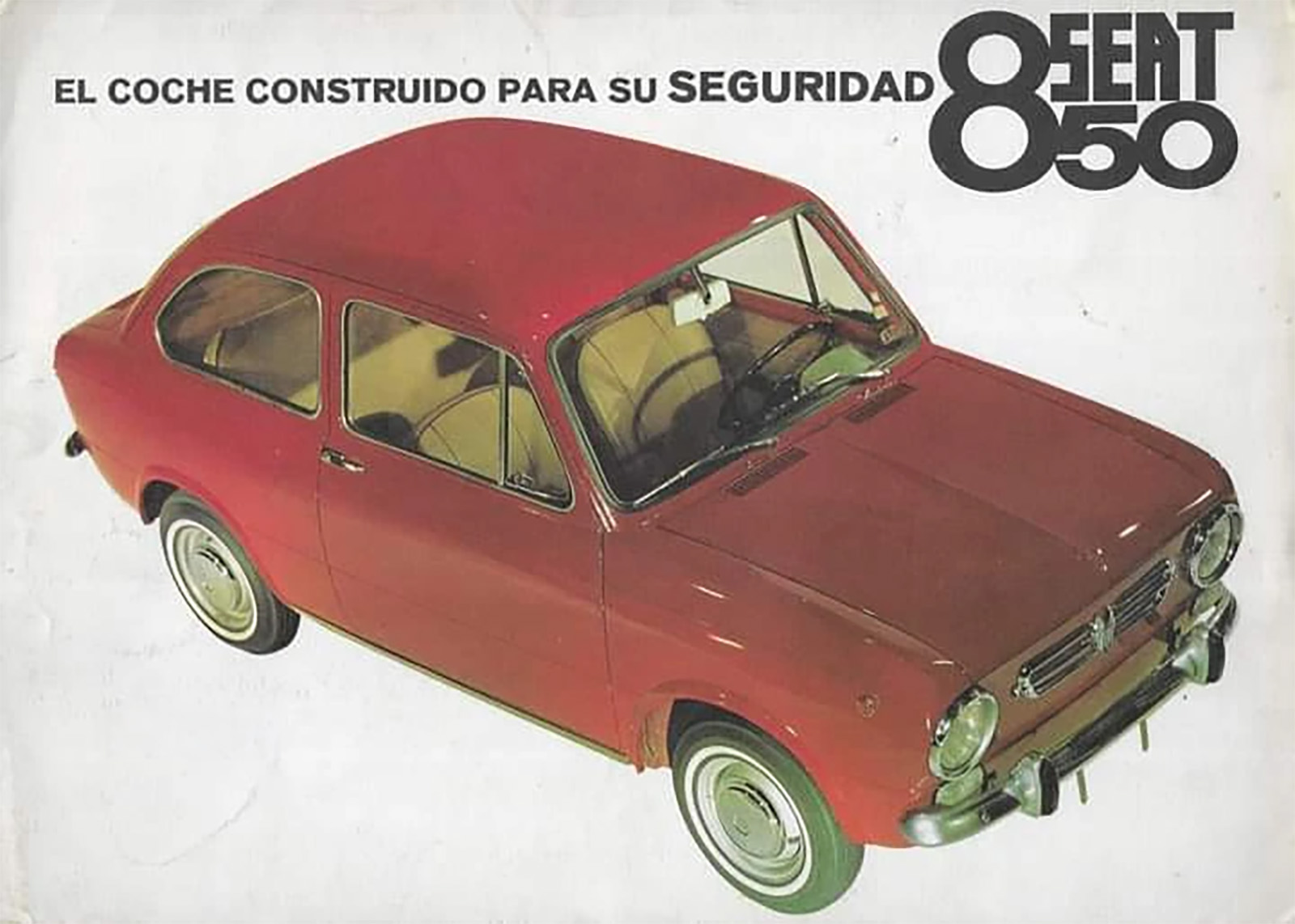
I always thought these were very friendly-looking and appealing little cars. SEAT actually had two versions of their double-door’d variant, a short wheelbase one, which is incredibly rare, and a longer one, which is the one that actually sold in real numbers:

It’s handsome! And it doesn’t even look especially stretched at all! The smaller SEAT 800 does look a bit mutated compared to the original Fiat 600, but I think with the 850, SEAT really managed to make the proportions work, creating a more notchback-like rear profile instead of the more fastback roof design of the two-door 850.

I’m kind of amazed how natural this four-door sedan version works, given the diminutive size of the original. SEAT’s designers really did have a gift for this very specific thing.
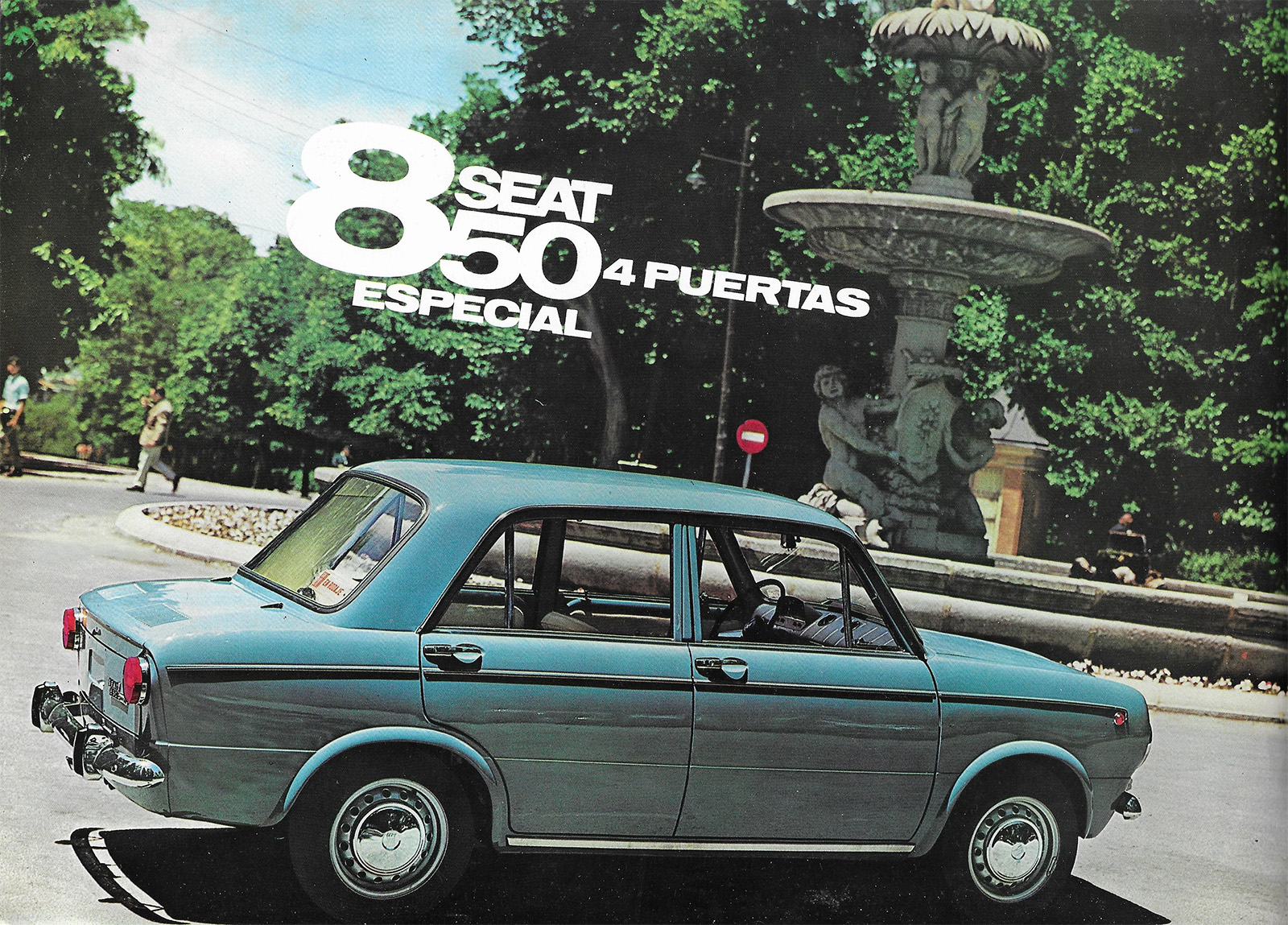
The design of the 850 is quite simple and straightforward, but it has a certain appeal that I can’t exactly put my finger on. The proportions are slightly chonky in a cute way, but not overly so, not cloying. It gives a sense of sturdy pluckiness, somehow.

The interior space looks pretty roomy for a small car, too. It’s not a limo, but that back seat doesn’t seem like a torture instrument, either. And the Spanish have some history with those; anyone who lived through the Inquisition can tell you all about that.

I’m impressed with the packaging of this little car, basic as it seems.

The rear, of course, was all engine, all 850ccs of it, a longitudinally-mounted inline-four with the radiator set off to the side there. I’m always surprised how much airflow these were able to get this way, but they managed.
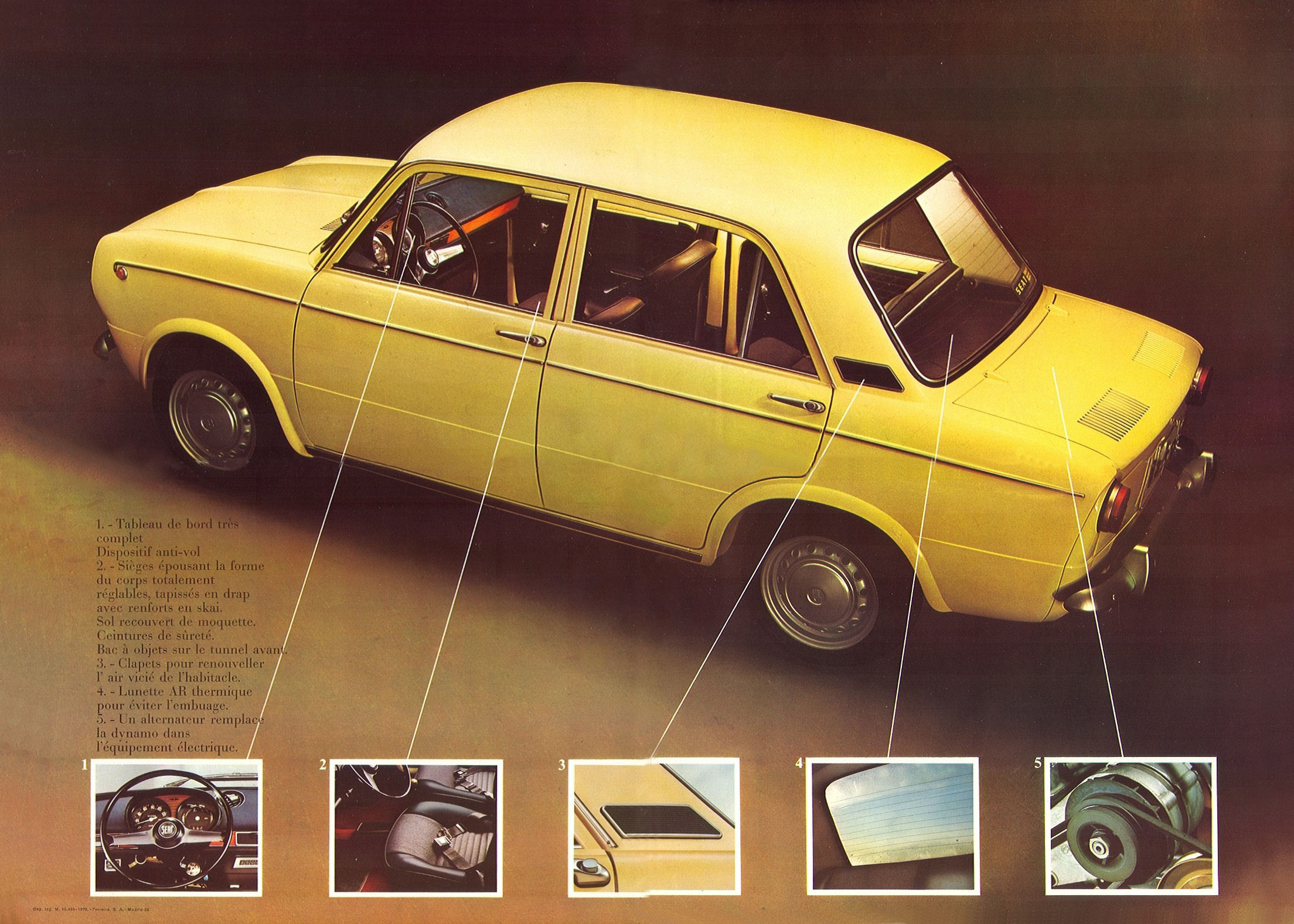
I appreciate how proud they were of switching from a generator to an alternator; that even gets its own callout in the brochure.
Luggage accommodation was mostly in the front trunk, aside from a shallow well under the rear window, but it looks like with some skills, that trunk could be really well tetrised into holding a lot:

Look how proud they are! I’d be proud, too. I’d show everybody my well-crammed trunk. I might even invite them to tug on those bags, see how snugly I jammed them in there.
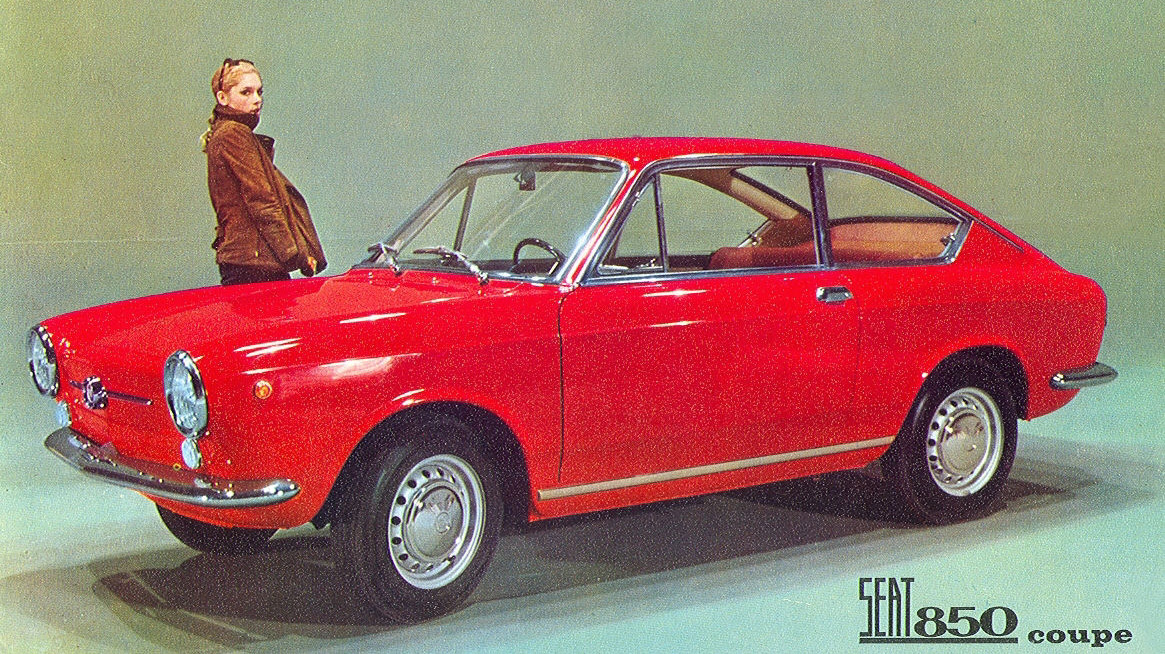
That trunk pic is actually from a brochure about the 850 Coupé, which I think is also a lovely little machine, in a different way, but one that shows how oddly adaptable the basic Fiat 850 styling was.
Such charming little cars! I can’t remember the last time I saw one, either in Fiat or SEAT guise. I don’t think I’ve ever seen the four-door one outside of SEAT’s museum outside of Barcelona; but I count myself lucky I got to see one at all.





“The rear, of course, was all engine, all 850ccs of it, a longitudinally-mounted inline-four with the radiator set off to the side there. I’m always surprised how much airflow these were able to get this way, but they managed.”
The airflow path for cooling drew air in through the slots in the engine cover, which was blown forwards through the radiator by the fan, which was mounted on the water pump which itself was part of a big cast alloy stalk protruding from the side of the engine. The fan was driven by a belt from the alternator, which itself was driven by a belt from the oil filter (the crank pulley did double duty as a centrifugal filter!)
The air that came out of the front of the radiator into the narrow space in front travelled down and was directed backwards by a curved panel, with airflow under the car helping to ‘draw’ it out. The final part of the puzzle was the sheetmetal panels that enclosed the bottom of the engine bay and even sealed around the sump with rubber stripping. These stopped the hot air from reentering the engine compartment, but seem to commonly go missing after they are removed for access to something or because the owner thinks that will aid airflow.
Luckily, when I had my 850 Sport Coupe, although the panels were missing, I was able to make a replacement for the right side as it is essentially flat, and I found a left side panel brand new at a Fiat specialist workshop where it had been hanging in the rafters for over 30 years, still with the original parts sticker intact!
I’d have to agree that their 4-door versions look very natural. Had you not told me they were stretched coupes, I’d have no idea. All of them quite handsome too! 🙂
The initial, shorter four-door design for the 850 was developed by Francis Lombardi. This was then used as the basis for the “proper” four-door, which was developed by Spain’s own Carrocerías Costa.
Next, you should do the Renault Siete!
The SEAT 600 was what helped Spain adapt to automotive transportation. The cars were affordable and they were everywhere. In Spanish, there’s a joke in similar vein to Fix It Again Tony. Siempre Españoles Apretando Tornillos. The literal translation is Spaniards Constantly Tightening Screws.
Factory custom luggage sets are something I pine for in car ownership, much like OEM floor mats. I always wished there was a set when I had my NC (although I love playing the mental game of ‘Will it fit?’ while packing) but all of the options are one solid case, not a mini lego set. Mazda should partner Away and have a 2/3-piece soft set that fits around an Away carry-on for the Miata.
Anytime I pack my luggage like that, the trip home is always a shitshow of “how the fuck is all this going to fit in that? What was I thinking?!?”
Note that the Spanish Inquisition canonically didn’t have a car. Python showed them racing across town by bus.
You would think a decent car manufacturer could buy early 2000s Toyota Camry or Corolla manufacturers equipment and just stamp out old Toyotas that don’t meet codes in the over regulated market
The story of the SEAT 850 has its coda in the shape of the idiosyncratic SEAT 133 that looked like a slightly oversized 126 and was built well into the 1980s:
https://en.wikipedia.org/wiki/SEAT_133
And then there was the only convertible sold by SEAT to this day:
https://www.seatcocheshistoricos.es/SEATHistoricos/en/1960/850sport.php
What an unexpected reference. 😉
BRB, registering WellCrammedTrunk on OnlyFans.
The SEAT branded ones were indeed unique to the Spanish market, but I think some of these 4-door models based on 2-door FIATs were exported to other markets rebadged as FIAT (including to Italy). But hey, don’t quote me on that because I didn’t really double check.
I believe some of the standard 2-door ones were exported to places like Argentina badged as Fiats.
Not quite. We had our own Fiat 770 and 800 with slightly different designs, supposedly by Vignale.
https://www.testdelayer.com.ar/pruebas/fiat-800-coupe.htm
Apparently both are true 🙂
“In November 1965, SEAT entered the export business, shipping 150 SEAT 600s to Colombia, followed by exports to Argentina, Belgium, Chile, Finland, Poland, and Portugal. In Finland itself, the SEAT 600 D was the best-selling car in 1971–1973. When Fiat stopped manufacturing its Fiat 600 in 1969, it met demand for the model with units produced by SEAT labeled as Fiat construzione SEAT. SEAT exported nearly 80,000 units in total, almost ten percent of total production.”
That would baffle me, since the Fiat 600 was built in Caseros, Buenos Aires, since 1960 (albeit the stamping came from Italy) and in Palomar since 1963 where they began stamping the bodies as well. Perhaps they imported a batch to cover an increase in demand? In such case, the cars were most certainly rebranded, since I’ve never heard about Seat 600 in Argentina.
Also, I’ve never seen Seat -or Fiat- 800s down here (but I did in Uruguay and Chile).
I can’t speak for Argentina’s Fiat 600, but here in Portugal we built Renault 4s for decades and still had to import some every now and then from France, Spain, and later in the production run, Yugoslavia, just to keep up with the demand (local production ended in 89, so after that year only Yugoslav-built Quatrelles were sold here). I can see how similar things may have happened with other cars in other countries.
There is some confusion regarding the SEAT 127 four-door – I was always under the impression that any four-door Fiat 127s were Spanish-built rebadges, but cannot find any supporting evidence for either case. I bought a 1980 issue of Quattroruote to verify but due to Alzheimers in the White House it is currently stuck in Germany.
Pretty sure European 4-door Fiat 127s were all rebadged SEATs, yeah. No idea if they were all fully assembled imports from Spain or if CKDs were assembled elsewhere, but they definitely weren’t built from scratch in Fiat assembly lines in Europe.
What I’m not sure about is South American production of 4-door 127s; the Brazilian 147 (derived from the 127 and later built in other South American countries) had a 4-door version that was definitely built locally because of the proteccionist laws and heavy taxation of imports at the time. The regular 2-door and later 3-door 127 was also built in Brazil, but I can’t find a single picture of a 4-door that I can say for sure is Brazilian.
In any case, it wouldn’t make sense to import and rebadge SEATs for that purpose, due to the same regulatory constraints that characterised the highly-insulated Brazilian auto industry. I’m leaning towards the 4-door 127 never having been sold there, but if it was, it was definitely built locally.
That was my feeling. The idea of panels being sent from Spain to be assembled in Italy is intriguing and quite possible.
The 147 picture, however, is a photoshop from https://irmaododecio.blogspot.com/ – no four-door 127s or 147s of any kind were built in Latin America. I actually own the book Clássicos do Brasil: Fiat 147 by de Simone and Ferraresi… Brazilians inherited the Germans’ peculiar hatred of cars with rear doors; this was bolstered by the fact that the secret police favored four-door Chevrolet Opalas to kidnap and disappear people. No one wanted to look like a torturer.
Found the original photo:
https://scontent-lga3-3.cdninstagram.com/v/t51.82787-15/655724569_18306922198277697_1830556986150498787_n.webp?_nc_cat=104&ig_cache_key=MzUwNTc0NDk4MzI2NzU1NjgyNQ%3D%3D.3-ccb7-5&ccb=7-5&_nc_sid=58cdad&efg=eyJ2ZW5jb2RlX3RhZyI6IkNBUk9VU0VMX0lURU0ueHBpZHMuNTE2LnNkci5yZWd1bGFyX3Bob3RvLkMzIn0%3D&_nc_ohc=0Ngwm6LkORIQ7kNvwFNgJS9&_nc_oc=AdrXExNVoXeLK_Cdn4-QkmPh7Me1SK9ONUJDL0B0U4xk7La5DtTnB5q2WZ6gL7YcO54&_nc_ad=z-m&_nc_cid=0&_nc_zt=23&_nc_ht=scontent-lga3-3.cdninstagram.com&_nc_gid=-uPG45CYzGeu25W1m507KQ&_nc_ss=7a22e&oh=00_Af5rRCpaAezXJPnlfjg8CPicfgSbXr83UwfEVXcNXT3F8A&oe=6A1F50CF
oh wow you are absolutely correct! I knew a few other images that I jus! realised are also photoshop or 4-door 127s incorrectly mentioned as 147s! Thanks for correcting me on this one!
Can we take a moment to appreciate those timeless steelies? They work equally well on a modern-day Maverick and on these little Spanish people’s cars from last century.
The basic 850 design was possibly the one of the most adaptable cars ever. Four door saloon, two door saloon, coupe (Bertone and Michelotti made variants), spider (s), beach cars, eight seat minibus, van, camper, and race cars, hillclimb cars and rally cars.
Also the Siata MGF clone, a wheelchair accessible taxi with a sliding door and the ones I have forgotten about.
I actually got to sit in a Moretti 850 Sportiva S2 yesterday; so add one more coupé to that list. Italian coachbuilt economy cars is one of the most bonkers things to have happened.
That frunk shot looks like my partner packing for a weekend trip as I search for a place for my gym bag and shave kit.
As I have told my husband more than once – Theres always space for your stuff in the back seat.
“That’s what she said.”
Sorry, it was just there and I couldn’t resist.
Amazing the space you have when doors and door cards are not a foot thick. Likely 3″ of door and vinyl covered hard board. Zero tumblehome. Crash protection – nil.
More crash protection than a motorbike, so definitely not zero. Also helps greatly that the most likely thing to hit you was another tiny car, not a Canyonero.
¡Ay que cocheto lindo!, or something like that.
There are a few on Facebook Marketplace, this one looks especially nice.
https://www.facebook.com/marketplace/item/916563170829560/?ref=search&referral_code=null&referral_story_type=post&tracking=browse_serp%3Ae8f00394-736e-4600-9a3d-bc36bdd4b1b8
“Cochecito”. Also us Spaniards would more like say “bonito” rather than “lindo”. 🙂
I studied for 5 years when I was a teenager. It’s a wonder I can still order a beer!
My daughter took Spanish in high school. I was amazed at how quickly a lot of it came back to me after decades of non-use. I also had 5 years as a teen.I still can’t listen to it and comprehend though. I did have the ability in Italy to at least understand some signage and communicate at a basic level with non English speakers.
It’s certainly in there somewhere – I spent a couple of months in Spain a few years back and I don’t think I insulted anyone’s mother while I was there.
Maybe you weren’t trying hard enough?
The school I attended in California’s Central Valley taught Castilian Spanish of all things. Pretty counter productive trying to have a conversation with all the Mexican kids, so I switched to Latin, which was actually sort of useful.
Tenga un me gusta para usted, señor.
Same with my Pennsylvania high school in the ’90s. Granted, we do not have a large Latin American community here, but still…
It flips my brain because “lindo” is “handsome” in Brazilian Portuguese. I was told to be very conscious of my usage of “lindo” and “linda”.
When I visited my friend, she told me the only phrase I needed to know was “Você é muito linda, me dê um beijo.”
You know what? She was right.
Local dialects are key.
Four-door Beetles under license? Forget it. Volkswagen absolute hated the idea. The mentioned taxi conversion outfit was put on a blacklist, and they had to source cars from the used-car marked and wreckers to get cars and parts.
Nobody expects the Spanish Seat Position!
COTD
Oh, look, a Frunk.
Why don’t the people look impressed?
My local manufacturer!
Also this kind of contraptions were common in pre-democratic Spain, such as the Renault Siete.
https://espirituracer.com/archivos/2017/01/renault-siete-tl-2.jpg
I was expecting that. Odd, but interesting nevertheless.