


If you’ve ever traveled down an American interstate, you’ve almost certainly mingled with a semi-tractor. The most common configuration on the road involves three axles on the tractor and two more on the trailer for an iconic 18-wheels. Maybe you’ll see a two-axle truck or three axles on the trailer, but nothing too crazy. Yet, if you head into some states like Michigan, you might find a whole different world of trucking. Semi-trucks in Michigan have as many as 11 axles, dozens of wheels, and can carry twice as much weight as the typical semi. The reason comes down to how Michigan reads the weight of trucks and trailers versus how the federal government does.
The early days of trucking in America were a sort of Wild West. Prior to 1956, federal rulemaking on transportation was largely limited to economic regulations. This left state governments to figure out what vehicles were allowed to drive on their roads and the exact configurations that the vehicles needed to be in to remain legal.


Some of the first state trucking regulations were established in the 1910s, and they focused on gross weight. Back in those days, trucks had solid iron and rubber wheels that quite literally pounded the rudimentary earthen roads found in many states. So, states established gross weight limits as low as 18,000 pounds to reduce damage to their roads by the burgeoning trucking industry.

It wasn’t long before states figured out that they wanted to set standards on the dimensions of trucks, too. By 1929, most states had established rules on the dimensions of trucks and trailers. By 1933, all states had rules in place limiting a tractor-trailer’s size and weight.
While these states were well-meaning most of the time in establishing their regulations, it led to a national patchwork of trucking regulations that could have varied wildly between two neighboring states. Illinois, for example, infamously limited the lengths of trucks rolling on its roads to a short 35 feet. Each state set its own rules based on what it thought would be safe, would support the correct interests, and maybe even what it thought other states should adopt.

Michigan has long been an outlier. The State of Michigan says that, currently, a whole two-thirds of all freight tonnage that moves through the state does so aboard a truck. The remaining third is picked up by majestic Great Lakes freighters and rail. The domination of trucking in the state is not a recent phenomenon, either. In decades past, trucks still carried half of the cargo flowing through Michigan. Trains and ships carried a quarter of the freight with other sources like aviation picking up the other quarter.
Because trucking has been such a critical component to keeping Michigan’s economy alive, the state has established unique rules that allow truckers in Michigan to carry bigger and heavier loads than they could in other states. Yet, it doesn’t come at the expense of the state’s roads.
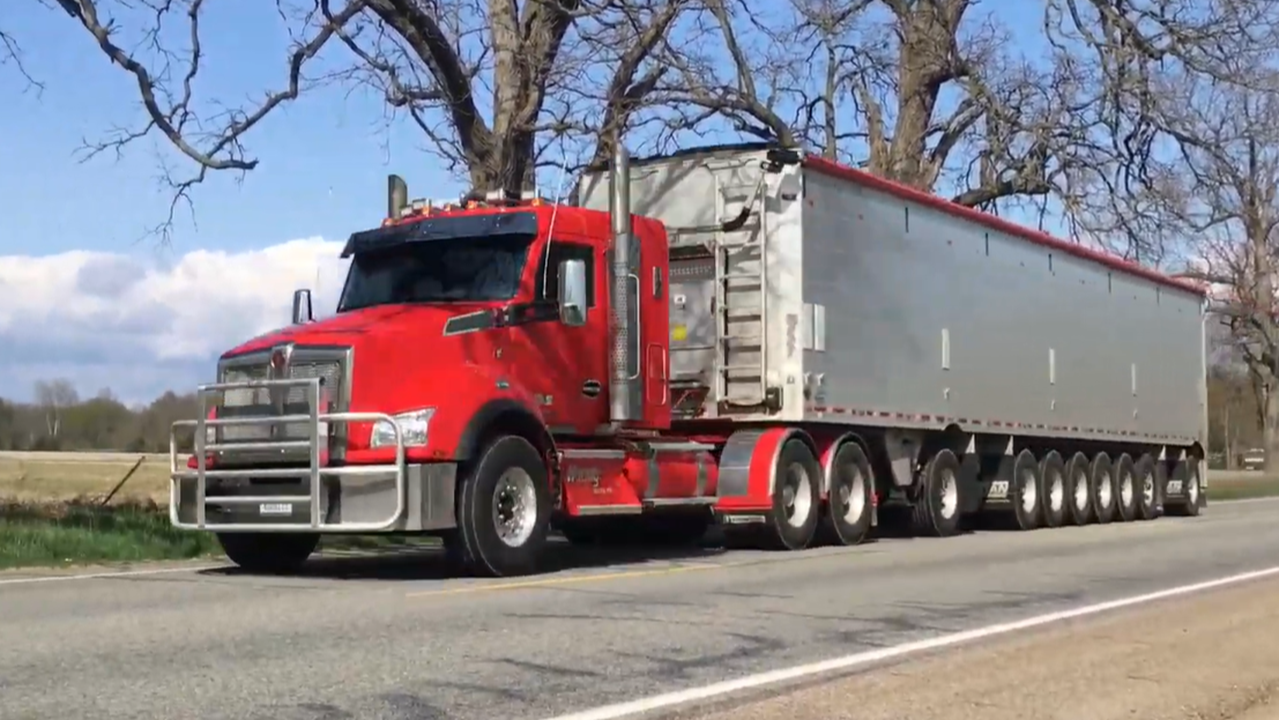
Michigan Has Long Welcomed Weird Trucks
Before World War II, Michigan did not set a limit on the number of axles that a truck could have. According to the Michigan State Highway Department, in early 1942, a tractor-trailer could have as many axles as its builder wanted, so long as the total rig was no longer than 50 feet long. This was because the state of Michigan counted truck weight through axle weight rather than the gross weight of the total rig.
Axle limits for trucks with pneumatic tires ranged from 9,000 pounds to 18,000 pounds, depending on how far apart the axles were spaced. The closer the axles were together, the less weight they could carry. However, there was no limit to the number of axles. According to the state, it was theoretically possible for a 50-foot truck to have 15 axles, spread 3’6″ apart, that could carry 13,000 pounds each. If each axle had four wheels, including the steer axle, that meant 60 tires!

When the United States entered World War II, the federal government discovered one of the unintended consequences (link opens document) of having the states set their own truck dimensions and weight limits. When materials needed to be transported across the country to support the war effort, shipments were delayed either because the trucks that would carry those materials were too small or couldn’t carry enough weight.
In 1942, the U. S. Department of Commerce sponsored a federal-state conference to set temporary wartime standards on truck size and weight. These standards called for trucks measuring up to 45 feet long, weighing up to 40,000 pounds, standing 12.5 feet tall, and spreading out 96 inches across the road.
That same year, the American Association of State Highway Officials recommended standards that all states should follow. Those proposed standards called for trucks no longer than 60 feet and with axles carrying no greater than 18,000 pounds each.
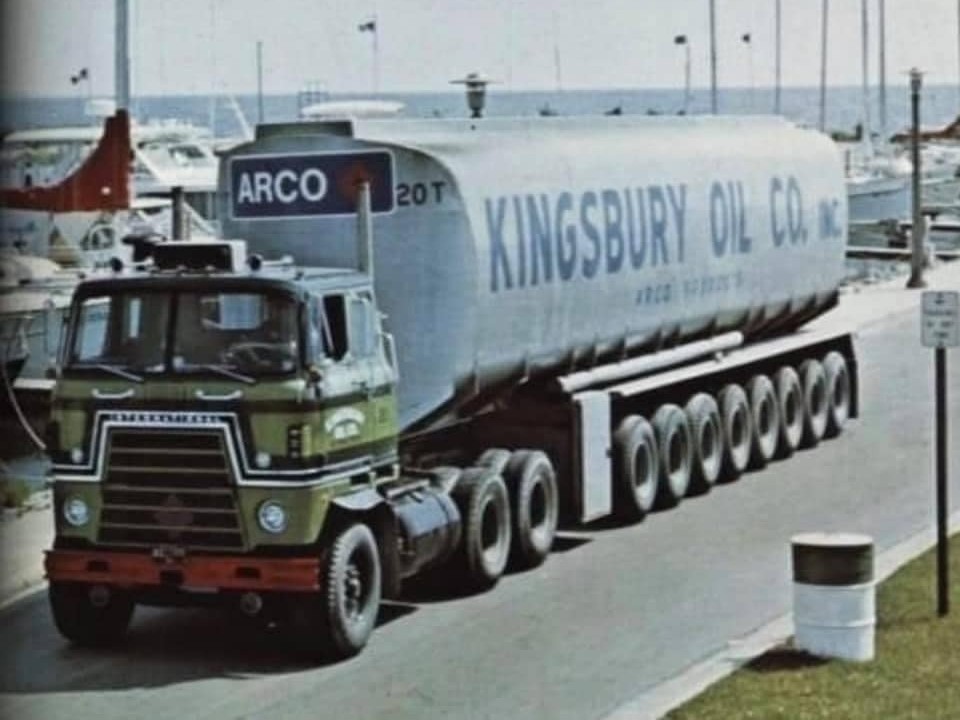
Still in 1942, Michigan decided (link opens document) to further refine its regulations. Now, a standard five-axle tractor-trailer was allotted 55 feet of length and 76,000 pounds of gross weight. That 76,000-pound limit was already a bit weird at the time, as many states limited their trucks to weights within the 50,000-pound and 60,000-pound ranges. Even Indiana, which is famous for its long trucks today, set its limit to 72,000 pounds.
Another quirk about Michigan is that it also allowed trucks of increasing length and weight, so long as the truck had lots of wheels. Under the new rule, trucks were allowed to have no more than 13 axles and were limited to a gross weight of 169,000 pounds. This was still plenty wild, because a truck with 13 axles in Michigan sometimes had 50 wheels or more. These trucks would earn the nickname “Michigan Centipede” over time for their looks.
The Michigan Weight-Law Today
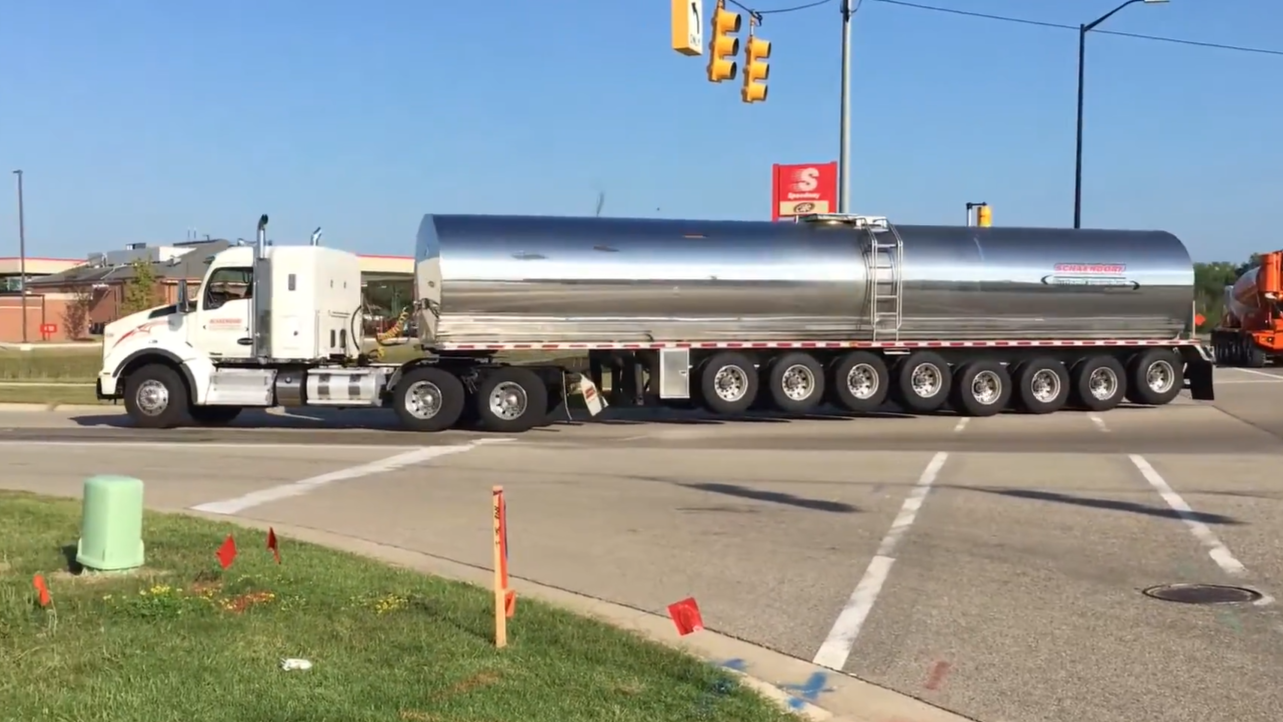
In 1967, these regulations were revised one more time, backing the axle limit down to 11 axles with total weight capped at 164,000 pounds. That’s still 42 wheels under a configuration with two steer tires or 44 wheels under a configuration with four steers. The Michigan law has remained unchanged since 1967, even as the rest of the trucking industry has evolved around the state.
The Surface Transportation Assistance Act of 1982 (STAA) largely put an end to the patchwork of state-based truck length and weight restrictions. Per the federal government, all states must allow trucks weighing 80,000 pounds to traverse the Interstate Highway System as well as other designated highways, in addition to the roads that these trucks will need to travel to reach their final destinations. The federal regulations also set standards for tractor-trailer dimensions.
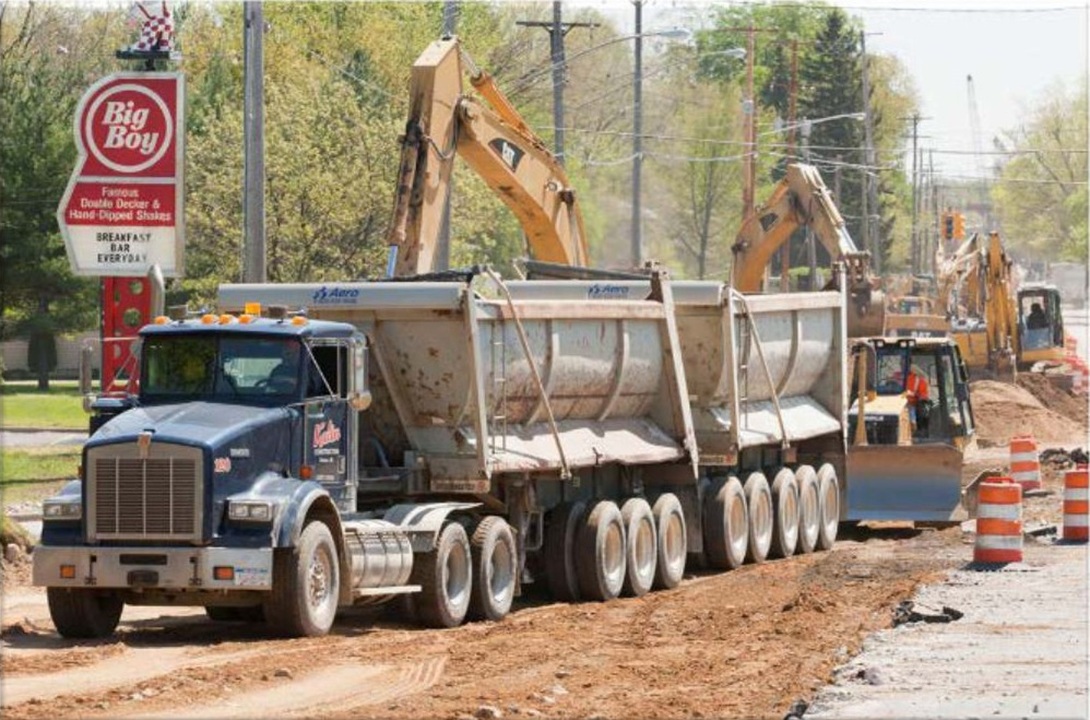
As the state of Michigan points out, however, it as well as several other states had unique truck weight limits above 80,000 pounds before STAA. The federal government grandfathered in the higher weight limits of these states, but with the caveat that if these state limits are ever repealed, they could not be re-enacted.
Since then, there have been challengers to the so-called Michigan Truck-Weight Law, but the state has remained steadfast on its benefits. These trucks are also known as high-capacity long combination vehicles (LCVs). But why does Michigan allow such high weights? Why is Michigan okay with so many axles?
Why Michigan Loves So Many Axles
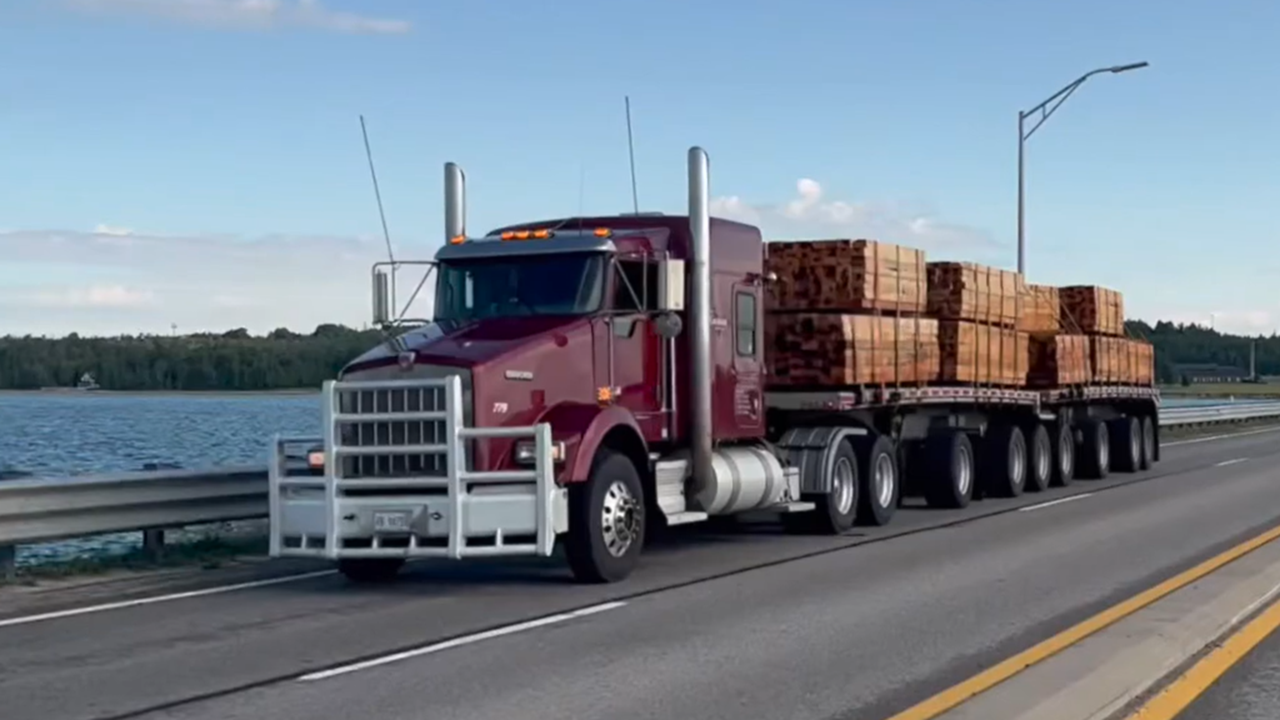
The state of Michigan explains that it comes down to the fact that it, unlike the federal government and most other states, has devised its regulations around the axle weights of a truck rather than the gross weights. From Michigan:
Gross vehicle weight includes the weights of the truck, cargo, fuel, and driver; axle loading is the weight on a single axle. Maximum allowable axle loadings are the same for a standard truck in all states, but Michigan allows use of more axles in combination with lower axle loadings, for a greater gross vehicle weight than other states.
The state says that it didn’t just come to this conclusion out of nowhere. Instead, Michigan says, research conducted by the American Association of State Highway and Transportation Officials, the Michigan Department of Transportation, and other organizations found that pavement damage from heavy trucks is attributed more to axle weights, not gross vehicle weight.
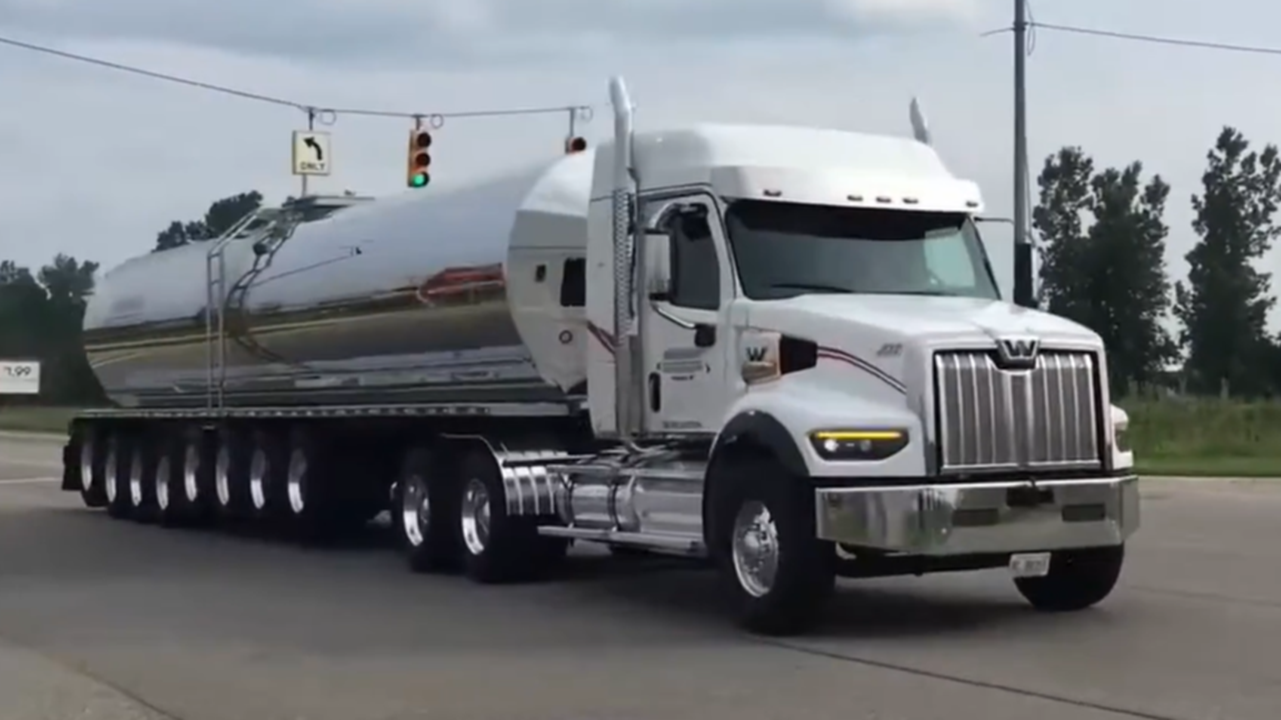
To illustrate what it means, Michigan explains that a typical five-axle, 80,000-pound semi that’s compliant with federal regulations is limited to 17,000 pounds on four of its axles and 12,000 pounds on its steer axle. However, a “Michigan Weight-Law” truck weighs more than twice as much at 164,000 pounds, yet each axle carries no more than 13,000 pounds.
Michigan even gives a practical example. Say you need to haul 160,000 pounds of bulk material. You can load that into a single Michigan Weight-Law truck that will carry that weight over 11 axles, or you could load it into two five-axle federal weight limit trucks that will carry that weight over a total of 10 axles.
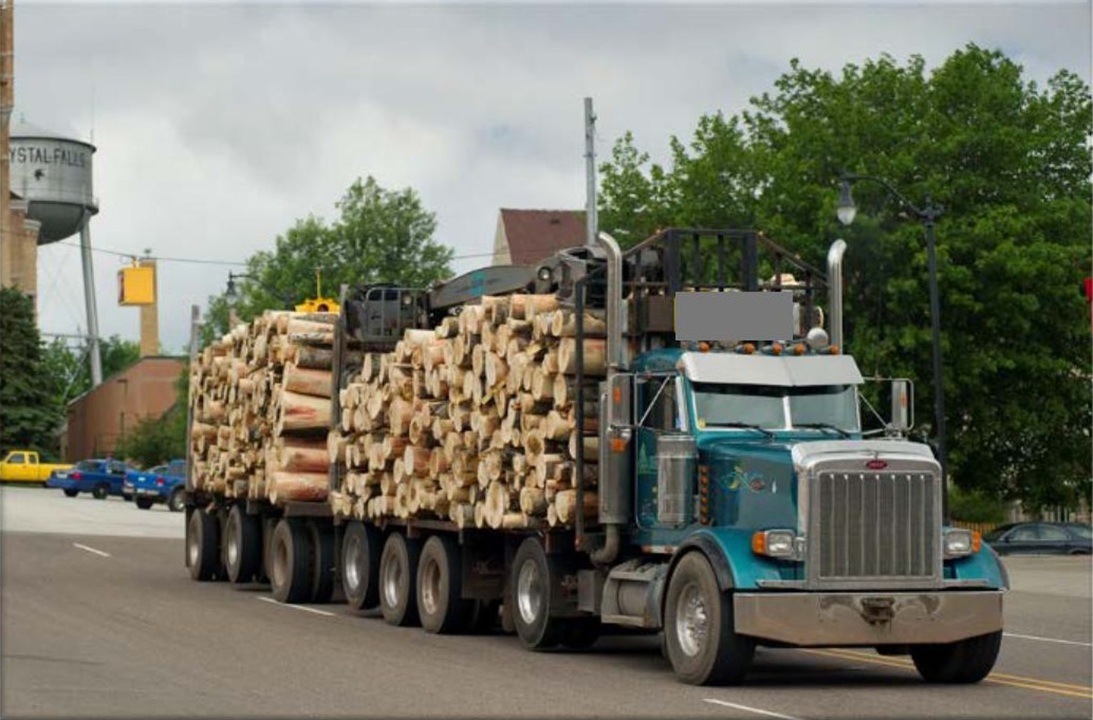
Michigan continues, from Heavy Duty Trucking magazine:
“The maximum gross vehicle weight allowed on a ‘federal-weight-law truck’ is 80,000 pounds, with four of its five axles carrying 17,000 pounds each. The calculated maximum allowable gross vehicle weight on the heaviest ‘Michigan weight-law truck’ is 164,000 pounds, which can only be achieved with the use of 11 properly spaced axles. Most of these axles carry only 13,000 pounds each.
“It would take two and a quarter 80,000-pound trucks to carry the same cargo as a single 164,000-pound Michigan truck. Pavement research has shown that these two smaller trucks actually cause about 60% more pavement damage than does the single heavier truck, because of their higher axle loadings and the extra weight of additional tractors at about 10 tons each.”
[…]
“If Michigan were to reduce its truck weight laws to 80,000 pounds, more damage to the [highway] system may occur because of the need to put more trucks on the road,” it says. “More trucks on the road raise serious questions concerning safety and traffic congestion. Several other states are currently looking at Michigan’s axle weight laws and are considering adopting similar laws.”
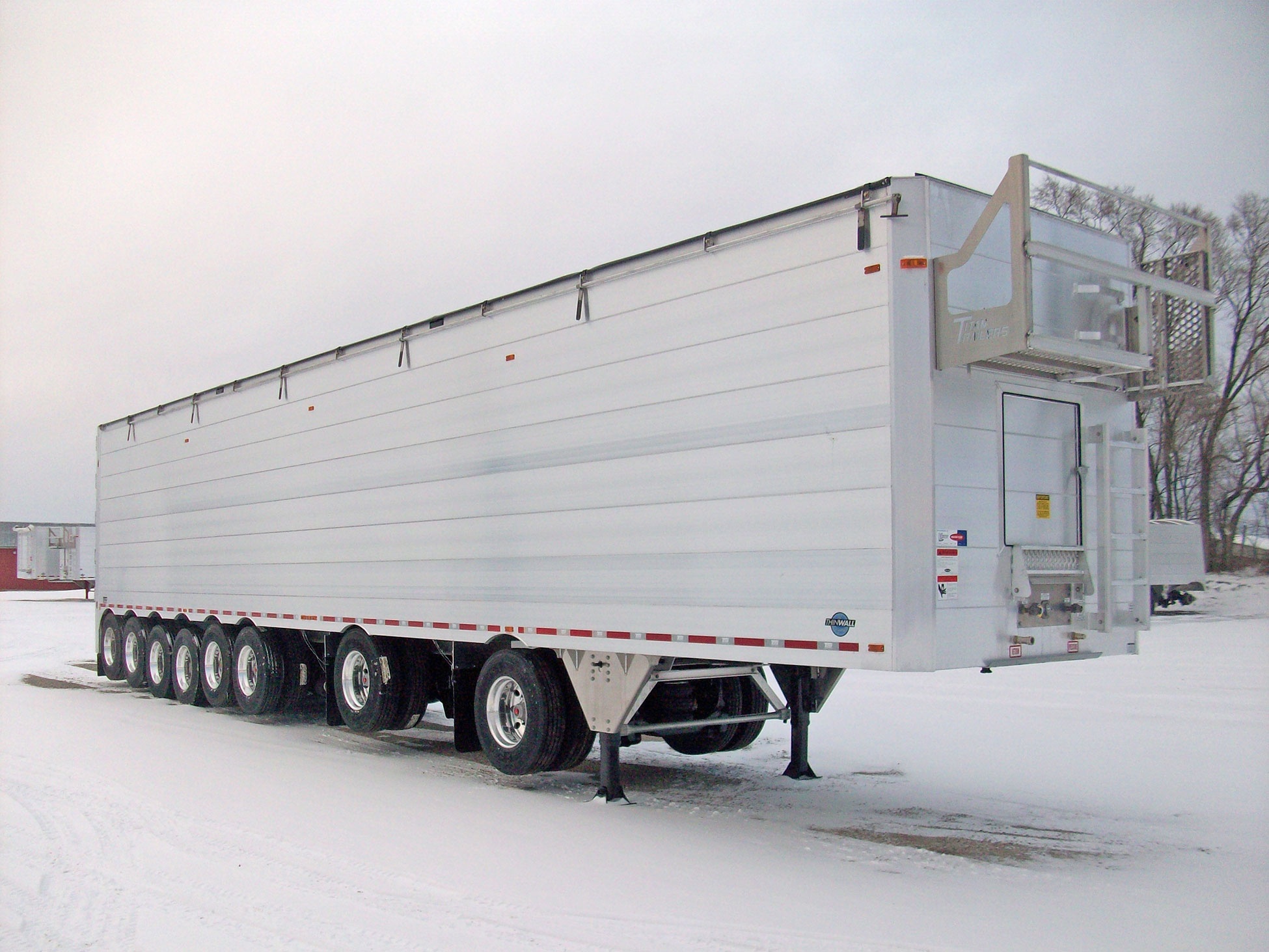
In another document (link opens document), Michigan says:
In December, 2012, there were 79,865 trucks registered by weight in Michigan, according to the Secretary of State; and 31,575 Michigan-based power units under the International Registration Plan (IRP). (These numbers do not include farm and log trucks; see below.) Of the non-IRP plates, 6,385 were registered to carry over 80,000 pounds, and 2,649 were registered to carry over 145,000 pounds. Only 6% of trucks registered in Michigan actually can be heavier than Interstate-standard “eighteen wheelers.” The majority of trucks in interstate trade can be assumed to operate at no more than 80,000 pounds. As a result, it is estimated that under 5% of all trucks using Michigan roads carry more than 80,000 pounds when actually operated.
LCVs aren’t limited to Michigan, either, as they’re also allowed in Connecticut, Florida, Indiana, New York, and Ohio. However, Michigan’s LCVs are unique in how closely their axles are spaced from each other. As Heavy Duty Trucking magazine writes, LCVs have proven themselves to be largely safe, too. Their operators require additional training than the typical trucker, having dozens of wheels usually makes the rigs stable, and since those extra axles have brakes, LCVs usually have lots of braking power per ton.
Sadly, there was a time when LCVs were a bit sketchier. Until the 1980s, Michigan used to allow tall, short trailers to be a part of a double-trailer combination. As Heavy Duty Trucking notes, these trailers were notorious for being unstable, and in one case, a trucker swerved, causing one of these trailers to topple. One of the two trailers, which was a tanker, rolled over, ruptured, and caught fire, killing a pedestrian in the aftermath.
Thankfully, immediately following the crash, Michigan would ban short trailer combinations. Since then, LCVs are reportedly safe despite their imposing appearance and the tons of weight involved.
What’s In A ‘Michigan Centipede’
Your next big question is probably about how a Michigan Weight-Law tractor-trailer is built. Are these just normal trucks with lots of wheels? Well, not exactly.
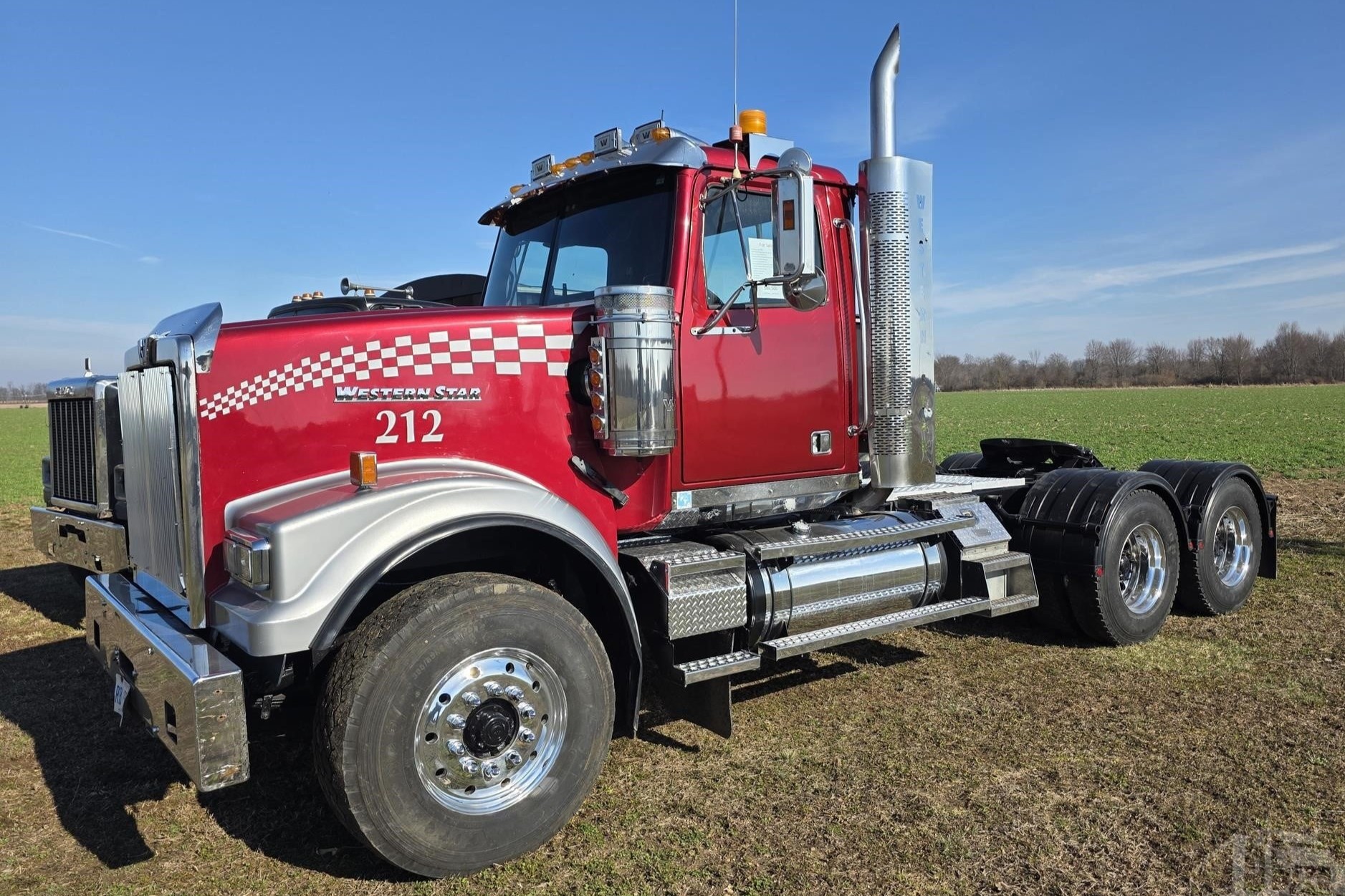
A truck built to Michigan standards will often look like other big rigs, but have upgrades that you might not notice with the naked eye. These trucks often have reinforced frames to handle the extra load, an 18,000-pound or higher steering axle, a doubled-up steering gear, and often fixed tandem axles. Or, you might find them with two fixed tandem axles and one lift axle. Under the hood, a modern Michigan-spec tractor will often have an engine pumping out well above 500 horses.
Trailers built for the Michigan law are similarly beefy. But they’re also clever. These trailers don’t just have up to eight axles, but these axles can have some tricks up their sleeves. These axles may lift when they aren’t needed or to help make negotiating corners easier. Likewise, you might also find steerable axles on a Michigan Centipede.
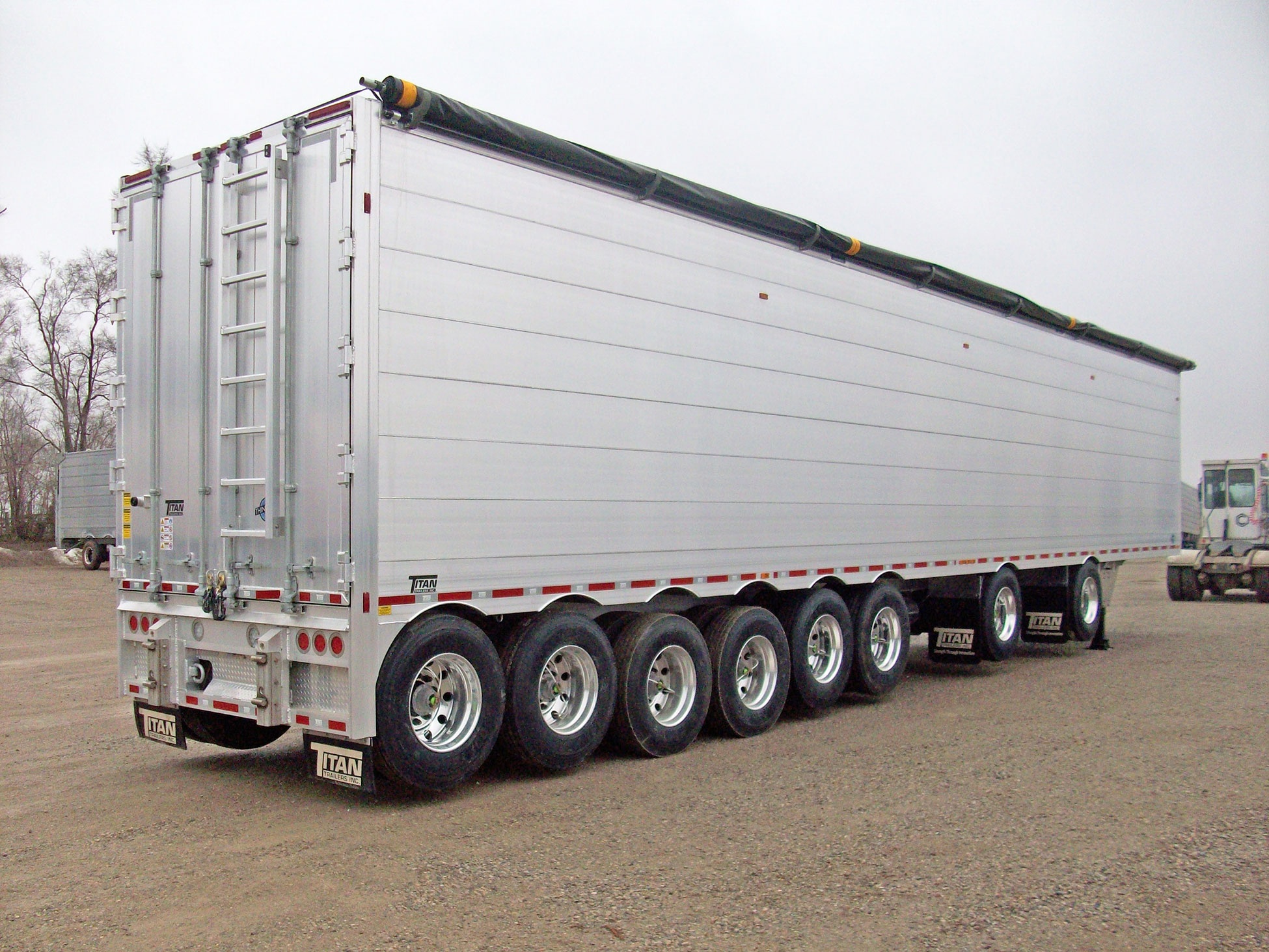
Of course, since we’re talking about both a beefed-up semi-tractor and trailer, Michigan Specials weigh more empty than your typical highway rig, too. A semi-tractor built for Michigan’s law can be found coming in at nearly 30,000 pounds, if not more. Similarly, you will find trailers that weigh well above 20,000 pounds when empty. For comparison, a typical highway tractor with a sleeper might weigh on the low end of 20,000 pounds, with trailers weighing in the 10,000-range.
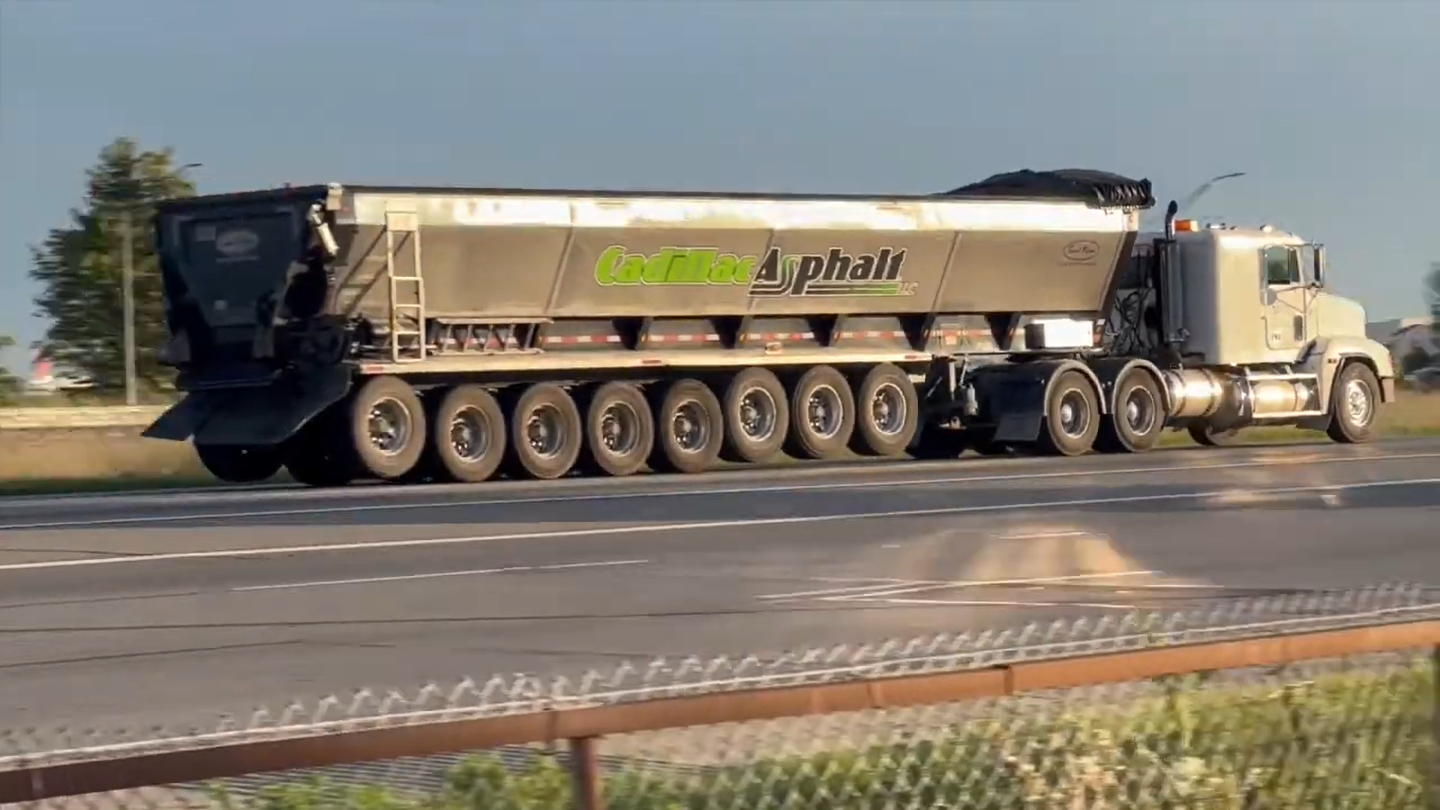
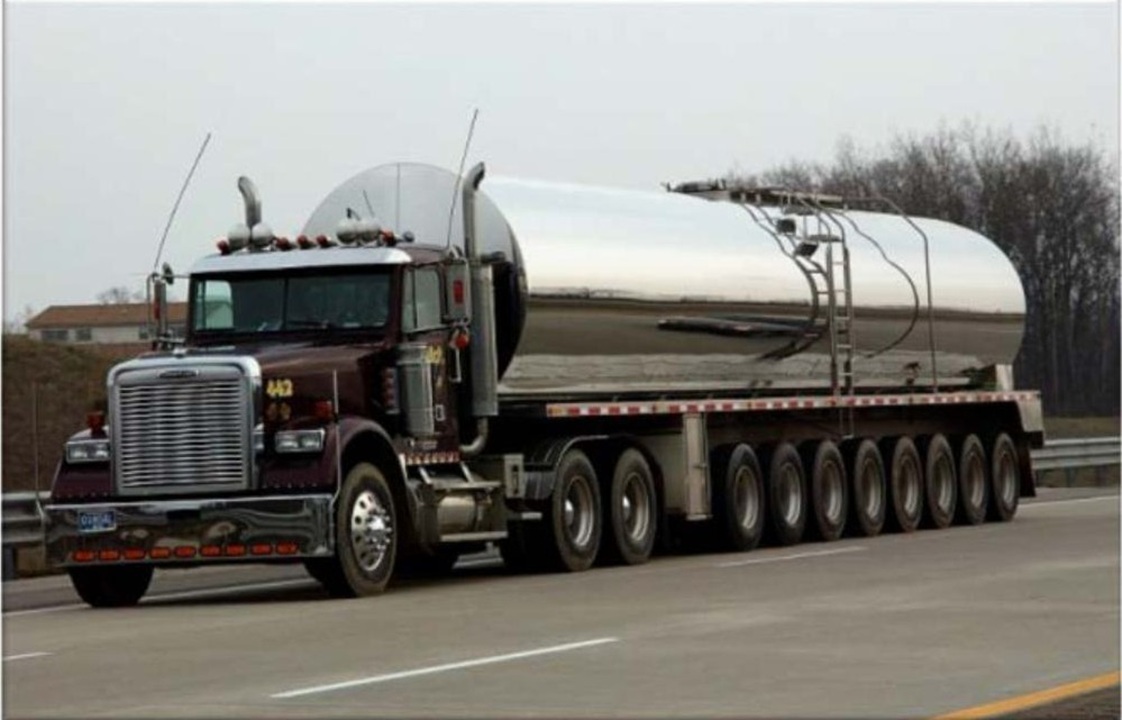
As for what these rigs carry, they haul just about anything big and heavy. A Michigan Centipede could be found carrying gravel, sand, asphalt, logs, steel, grain, or other agricultural products. Those are just the trucks that carry solid materials. You could find a tanker with room for 13,000 gallons of milk, fuel, or other liquids.
Lots Of Axles Are Here To Stay
The Michigan Department of Transportation says that, aside from pounding the road not as hard as typical trucks, a Michigan Weight-Law rig is also more competitive than five-axle combinations in other states. Further, the state says, because of Michigan’s unique weight laws, freight rates are lower. There are also fewer trucks, drivers, and trips that are required to carry heavy loads. Michigan also says that driving one 164,000-pound truck burns less fuel than driving two 80,000-pound trucks while also cutting down on traffic congestion, too.
Michigan’s special trucks are things of beauty, almost as much as the state itself is. Michigan’s trucks are allowed a silly number of axles and more than twice the weight of the typical semi, but it all makes sense because each of those axles puts down less weight than the axles of a typical semi. Of course, if you’re a Michigander, you might not have noticed a benefit as the state’s roads remain pretty terrible, anyway.
So, the next time you find yourself in Michigan, now you know why Michigan’s trucks have so many wheels. These are special rigs carrying loads most truckers could only dream of carrying. Like most things dealing with big rigs, the Michigan Centipede exists for a reason!
Do you drive one of these rigs? If so, email me at mercedes@theautopian.com. I’d love to know what the experience is like!
Topshot graphic image: Screenshot: The Grumpy Pete/YouTube


The gravel trains here in Michigan are an absolute menace. Mindbendingly slow, they pulverize what’s left of our roads, and every little rock that falls out of them will be kicked up by one of the million wheels and be put into (or in one memorable case for me, through) your windshield, no matter how far back you trail behind them. They are sometimes driven with alarming carelessness (another memorable case: two of us four-wheelers playing Embankment Or Death while trying desperately to sound horns and panic brake to get out of the way of a gravel driver who was not going to miss his turn) and they are often sooty as hell and/or straight piped.
And of course whenever the absurd weight limit comes up in state government, it’s the aggregate haulers who cry the loudest and shed the most tears. The both-hands-one-job situation there is *not* lost on us residents: it’s their piece of shit trucks tearing up the roads while hauling far too much gravel around to fix the roads.
Fascinating article, as always, Mercedes! It’s very interesting to read the many Michigander comments about how the roads are in terrible shape in the state, despite the theory that more axles = less road damage. There’s an old axiom in the field of scientific research: In theory, practice and theory are the same. In practice, they are not.
I thought we had massive payloads because the automakers wanted to save on their freight costs and – as an added benefit – cars fall apart on broken roads. I live on 13 mile. The nearby parallel highway (696) has been closed for a year. The truck traffic is almost constant. The road has fallen apart. When the trucks hit the broken road they bounce and it sends a shockwave that shakes my house – 100 feet from the road. I think my road is paved, but you would not be entirely certain because the chunks of pavement that do remain are nearing the same size as dirt particles. Sections of lanes are sinking. It’s a patchwork of disappointment. Our water table is not far below the surface. The ground heaves as we go through the freeze/thaw cycle. Nearly new roads have ‘ramps’ in them within a year. The heavy trucks bounce on these and start the process of disintegration. Then plows come by and catch edges of potholes like a pimple on the surface, throwing them into my yard. Once the pavement is broken, if one of those massive trucks has to slam on the brakes the thin, fractured road surface is supposed to resist that force? It further destroys the road. Michigan roads are better than they used to be – but 13 mile by my house can kiss my ass. I hate Michigan roads and I hate massively overloaded trucks – I don’t care how many axles they have.
I lived in Michigan when the roads were at their worst point, my coworker a life long michigander blamed these big rigs with all the axles for tearing up the road and not taxing them properly
I really hope TPS sensors are installed and legal to use on these things. I can’t imagine having to do a pre-trip daily where there are dozens of tires to check.
I do not get the impression as a fellow road user that the operators of these vehicles are super particular about their pretrips.
“Why Michigan Loves So Many Axles”
Because they make axles in Michigan.
Great writing as always Mercedes! That said, I call complete BS on these “heavier truck not damaging the roads” that the State claims.
I have lived Michigan for many many years and its the only place I know if that at many of the intersections, the road is aggressively sunken into the ground. Not a coincidence to notice that the length of these sunken sections are about the length of these trucks when they are stopped at a red light. Its a serious hazard as its creates not only large ruts but large bumps at intersections that can, and do, make it harder to stop and cause cars to lose traction when going through the intersections. I have had to explain the heavy truck situation to many people that visit from other states when they wonder why we have these big sunken sections. You see them more at intersections around industrial areas, but they are very common. I won’t get into the massive amount of trucks all running these high weights (even spread across more axles, its still more overall weight in a similar footprint and more tires on rolling on the road) that tear up the roads.
Now I do agree that the state also just doesn’t do a good job of fixing the roads and building them properly, or the fact that the state has a large amount of very old road infrastructure that is difficult to maintain and improve since it was the center of automobiles. These things do play a part in the general terrible roads we have here, but its just fuel on the fire to allow these heavier trucks. Fun facts, Michigan is credited with the first full mile of continuously paved road in the world ( I believe it was Woodward in downtown Detroit, starting from the Detroit river) and the first true “express way” (Davidson expressway).
I find that it is the braking action of the vehicle that causes the ruts. That’s why you see them on the approach to the intersection and not on the mainline.
In the Toronto Area, they’ve taken to using concrete at the intersections for the lanes that the trucks are using.
Same reason many cities have concrete for bus stops on an otherwise asphalt road.
Huh, fascinating. And I’ve lived in Indiana most of my life and didn’t realize we were famous for our long trucks?
We run triples up north by i90 and i94, mostly ups and fed ex now, but used to be overnight express, roadway, yellow, and consolidated freightway.
We also iirc allow turnpike doubles, 2 53′ trailers, but i cant say ive ever seen one here.
Ah, I live all the way south so makes sense I missed those, haha.
Ive been to florida, georgia, and bama, cant say ive ever seen anything beyond regular semis.
Have you written about Oregon and how they allow double trailers?
Just wait until you learn some states allow triple shorts, and then full length doubles called “turnpike doubles” in others.
And Rocky mountain doubles too
common on the Mass Pike. Along with giant lots where they can put these things together and take them apart. Seems like a logistical headache but clearly it works.
Oregon allows triples.
Ever driven the interstates in Michigan? I vehemently beg to differ.
That’s due to water infiltration and freezing. Whether it’s put on 2 trucks or 1 with extra axles, that freight and those tires are going to roll on those same roads. As Mercedes explains very well, there’s no more weight per axle allowed. The centipedes just make it more efficient.
The whole upper Midwest has the same weather. I can’t come to grips with the idea that 11 axles all a few feet apart from each other don’t have a materially worse impact on the roads. An axle with two other axles 3 feet from it in both directions are going to all interact together. It’s not like each axle passes over an inch of pavement and doesn’t impact the pavement all around it. Like most others that live here, I call BS on the state’s assertion, sorry.
I’ve had a ride in one of these beasts. One of my clients in “da UP” is a nickel mine/ore processing plant combo. Last time I was up there, I needed to take a part from the plant to the mine, so I hitched a ride on an empty up to the mine, and on a loaded truck coming back. ~60 mile round trip. They just loop between the two sites all day long. They are loud, incredibly slow, and don’t ride very well (especially empty), lol. Stopping power really is impressive – better than the highway coaches I once drove I would say. The air ride seats are bouncy but pretty comfy. It was a fun experience to do once.
This was probably more pronounced back when the US was a prime materials producer for vehicles. All the various manufacturing with hauling all the steel around from raw materials, to steel production, to making the vehicles. My spouse remembers such vehicle in Indiana when a kid in the Gary area.
What are the acceleration numbers for one of these monsters?
0-60 is “eventually” on the level (get out your sundial), never up a hill of any kind, and WAAAY faster than you would ever want to downhill. Jake Brakes are your best friend, though with all those axles they actually stop REALLY well for that much tonnage on the march, at least once anyway. Speed management is a serious business on them though, with that much weight only having Jakes on two axles can only do so much.
Michigan is a bit unusual in that it is composed of 2 peninsulas. Aside from trucks going to/from Canada, no driver is passing through Michigan on their way to someplace else. There are only 3 2-digit interstate highways in the state, one of which isn’t an actual interstate because it never leaves the state.
4 two-digit interstates, of which three leave the state (I-69, I-75, I-94).
Oops, ya got me there.
No worries. Everyone forgets about I-69 since it doesn’t go through Detroit 😀
I once drove through Michigan on my way from Colorado to New York, so almost no driver is passing through to get somewhere else.
Were you taking the shortcut through Canada?
Actually I think it was an extra hour if I hadn’t stopped, but it gave me a nice opportunity to visit Niagara Falls.
We were headed to Watkins Glen for the 6 hour IMSA race.
Interesting, even as a lifetime Michigan resident I never realized the peninsulas make it kind of difficult to “pass through” Michigan the way you would a more central state, never thought about that. The upper peninsula is kind of difficult to navigate since most of the roads are 55mph 2 lanes and much of the peninsula is still pretty remote forest
As a resident, I have to wonder if this leads to a substantial increase in tire debris across the state. I can’t find any studies or statistics, so I wonder if MDOT has looked into an increased prevalence of gators on Michigan roads because of it.
I was also very curious about tire wear – is it increased due to sheer stresses when cornering, reduced due to weight limits per axle? Same with brake wear, too. Relevant to us here in WA who are working hard to minimize tire and brake pollution impacts on salmon populations (which, truthfully, the only answer is widespread public rail and heavy investment into engineered stormwater ecosystems, but…).
There’s always some big lobbying organization behind rules like this, and clearly this is just because of the influence of Big Tire. If you doubt the influence of Big Tire here in Michigan, then you haven’t driven I94 between Detroit and Metro Airport.
https://www.google.com/maps/place/The+Uniroyal+Tire/@42.2709771,-83.209051,3a,75y,188.61h,88.14t/data=!3m7!1e1!3m5!1sugYJEjurJ8EQjAd-MVB1og!2e0!6shttps:%2F%2Fstreetviewpixels-pa.googleapis.com%2Fv1%2Fthumbnail%3Fcb_client%3Dmaps_sv.tactile%26w%3D900%26h%3D600%26pitch%3D1.8565710754354114%26panoid%3DugYJEjurJ8EQjAd-MVB1og%26yaw%3D188.6146790245338!7i16384!8i8192!4m6!3m5!1s0x883b367fc0171cad:0x7326ca6f26318d71!8m2!3d42.2705206!4d-83.2090241!16s%2Fm%2F0g9y9c4?entry=ttu&g_ep=EgoyMDI2MDMzMC4wIKXMDSoASAFQAw%3D%3D
I drive past it every day. It was formerly a Ferris Wheel for those that don’t know about it.
I used to live 5 minutes from there when I worked for Ford. Pretty dumpy area, but I always loved seeing that cool wheel and tire.
Actually, it’s our “USMax” 36 metric ton 16 meter long trailers that are the oddballs of trucking that should be questioned. Across the border in Canada they can run at 63.5 tons on 8 axles and double 16 meter trailers are legal on most 4 lane or more highways. Europe allows at minimum 40 tons on 4 axles with the nordic countries allowing 60 tons and more and double 13.6 meter trailers on many highways. Mexico allows double trailers and even heavier axle weights, New Zealand and South Africa allow weights similar to Canada of over 60 tons, and Australian truckers are the true kings and queens of the road with 75 tons legal most everywhere and over 200 tons in the outback.
No wonder the US can’t compete!
And clearly the only solution is to automate truck driving instead of increasing the limits so the existing drivers can be more productive.
If true, then Michigan’s roads should be as smooth as glass.
Well, that sort of requires Michigan to actually take care of its roads. Driving the CrossCab through Michigan is like off-roading on pavement!
You can see how the Detroit3 have naturally pivoted to SUVs and trucks. Hard to consider anything else as a daily-driver when you look out the window to see those roads.
I’ve always thought that city council members should be forced to drive Chevy Aveo’s while in office so that roads that work comfortably for ALL vehicles would magically be prioritized.
I mean the temp is below freezing for a large part of the year so you’re not exactly wrong.
“Why is Michigan okay with so many axles?”
Because Detroit Axle.
Hell yeah! Don’t cut them off in traffic.
I love Mercedes’ articles on commercial vehicles, but this one is missing any reference to the bridge formula – a real pain when you’re hauling containers out of a port. Those that load the trailer in Asia or wherever care not for American weight laws.
Maine will allow 50 tons gross with a twin screw tractor, but you cannot take such a load on the interstates because it won’t bridge without making the trailer longer than the statutory maximum.
https://ops.fhwa.dot.gov/freight/publications/brdg_frm_wghts/
True. These “centipedes” might be fine on a road but they put massive amounts of stress on a bridge.
Maybe Mercedes’ next article can be the trucks out west with multiple trailers that have about 30 foot tongues and dump and cement trucks with a drop axle in the rear that extends out 10ish feet.
https://www.motorbiscuit.com/why-do-some-dump-trucks-have-wheels-up-top/
Not too long ago, out west, triples were allowed (with shorter trailers) and “turnpike doubles”, with two 40′ trailers. https://www.fhwa.dot.gov/policy/otps/truck/wusr/chap02.cfm
Triples are still allowed here in Oregon. I see FedEx pulling them all the time behind a regular cab.
“Rocky Mountain” doubles are pretty common too with a 20 ft trailer behind a regular one. (Generally pulling containers)
I came here to say the same thing. The do need to keep under 96′ total length which is why they pulled exclusively by single axle day cabs.
Florida allows double 53’s on it’s Turnpike system. They also allow “Super B” tandems for container drayage from the ports.
Is that a recent change? Never saw that in 25 years of Florida living, but noticed it immediately in Orgeon.
We can run LCVs (long combination vehicles) on the 401 here in Ontario. Two 53′ trailers.
They have to separate them within 5km of leaving the highway and are limited to 90km/h (56mph)
There’s a lot of other rules, which you can find here
I know. I used to haul oil into Hamilton from a Pennsylvania refinery. I’m surprised we even got that business, it was very hard to compete and still be legal between PA and Buffalo.
Ah, now that’s fascinating. Michigan’s official explanation for its “Centipedes” makes no mention of bridges at all!
Meanwhile, Michigan roads are among the country’s absolute worst. And I’m not being hyperbolic.
The sheer relief of finally entering Ohio when you’ve been on 75 South for the last 2 hours.
Yeaaah.. but then you have to ready yourself for being a major contributor to Ohio’s local budgets through their extensive traffic stops & tickets.
You’d get where you’re going quicker by just going around Ohio.
There’s definitely cops everywhere here, but IMO it’s really not that hard to not get stopped. Up North at least it’s so flat you can see them from a mile away.
Tickets are 100% voluntary. Growing up in Michigan it was well known that once crossing the border you set the cruise control because those blue Michigan plates were a target.
I think it’s also the stark contrast between MI cops not being too bothered with anyone speeding around vs Ohio’s Gestapo stopping you over for going 5 over.
but then you couldn’t stop at Skyline.
The roads might be better, but you are still in Ohio.
You can always tell which roads these trucks regularly use by the deep ruts they leave in the pavement, like the fucking Oregon Trail.
Michigan and Maine used to be in a class by themselves, but more and more states are joining them.
Hey now, I only had to replace two tires and one rim this winter due to potholes on these fucked up roads.
I replaced my wheels after breaking one a few weeks ago because I already had another that was slowly losing the ability to hold air from a previous pothole. I kept the remaining stock wheels as spares.
How did I pick the new wheels? Available today + lowest price first.
I was chuckling at that thought when writing this. Michigan says all of these axles save the roads, but Michigan’s roads are still infamously terrible, anyway.
Just imagine how bad they’d be without LCVs!
As we say about Quebec roads:
“In the UK, they drive on the left side of the road. In Quebec, we drive on what’s left of the road.”
Montreal’s construction corruption.
Lol, that’s a good one. I’m going to start using that.
Truck pulls into Discount Tire.
“OK boys, looks like this one’s going to be an all nighter.”
“Call my wife! That trip to Cancun just got paid for!”
I remember my mentor telling me two decades ago that Michigan was “Home of the Centipedes!”
I’m glad to see that’s common nomenclature.
I’m just glad I was never a fleet tech in Michigan. That’s more brakes and tires on a given vehicle than I ever want to deal with.
I’m curious what the damage is when turning. Those tires are going to be scrubbing as they go around a sharp corner, and at even a large bend, they can’t all find the ideal path.
Many, many lift axles.
This is true. These are a very common sight in Toledo and they always have most of the wheels up off the ground when turning.
I’ve heard that truckers will raise all those axles when going through a toll booth to save on per-axle tolls. And as a result, there are microphones at the entrance of the toll lane to listen for the air sound.
I know truckers that would lift the axles and drive through the “empty” lane of scales.
Did it make you say “Holy Toledo, that’s a lot of axles!” ?
So aren’t you just damaging, or at least dramatically increasing wear on the road by temporarily exceeding per-axle weight limits while turning?
That’s a good question that Michigan had no answer to, and I couldn’t really find a good answer to, either.
That’s one weak point in Michigan’s law- You can (and some dummies do) build and operate an 8 axle trailer with no steering axles that will tear up the roads and its tires. Most of the Canadian Provinces, Australia on the main roads, New Zealand, etc. won’t allow more than 3 unsteered axles on a vehicle. Some states like Minnesota solve this axle dragging sideways problem with a requirement that lift axle controls not be accessible from inside the truck cab.
Have you covered the very long, very heavy rigs with multiple cantilevers and joints?
I saw one once with 38 to 45 axles and a rear steering cab with a very short bed.
My guess is that it carried a submarine.
It was parked outside a massive building that used to build nuclear reactors. Empty for years, it suddenly had tier 1 security.
Not too difficult to guess what it would be used for.
Later they went public, to an extent.
Water flow research facility.
Don’t let perfect be the enemy of good. Would you rather re-do 300ft of corner, or 50 miles of highway?
I’d rather see a requirement for steer axles.
A lot of them already do. But you can only make so many axles steerable.
Quebec actually has a legal requirement that any lift axle be steerable. If you wanna run a truck or trailer with a non steering lift axle, you have to remove the wheels from the axle and chain it up.
Then you’re weight limited to whatever the remaining axles are rated to carry.
So, we are still damaging the road, just in corners now, because lift axles, means more weight on remaining axles down, which was against the whole idea of ,”we are saving the road by reducing weight per axle.”
“We are saving 95% of the road and only having to re-pave corners more often” is more like it.
It’s Michigan, there’s no re-paving.
Ah, the Quebec of the States when it comes to roads.
Which I guess points back to the original question. Is the damage to the corners more or less expensive than the damage than the straights? You’re implication is that obviously worth it. But if it was so obvious, why is only Michigan doing this?
Mercedes covers why Michigan does this. But road laying isn’t magically more expensive around corners. It’s material cost and crew hours that cost.
Not to mention the impacts on traffic flow.
You’re assuming damage is 1:1 (corner:straight) and that they’d be fixed at the same point of damage. I’d assume corners get repaired earlier on than straights, given you know, it’s a corner. I’d also assume that X amount of weight causes more damage in a corner than it does in a straight.
And no, Mercedes doesn’t fully cover this…
Then I guess my answer is:
Put it on the long list of wildly different laws between states.
Except you can’t legally lift those axles while fully loaded on a public road.
So do they allow the axle weight to be briefly exceeded in such situations? If so, seems like there would be a lot of wear on turns where trucks frequent.