

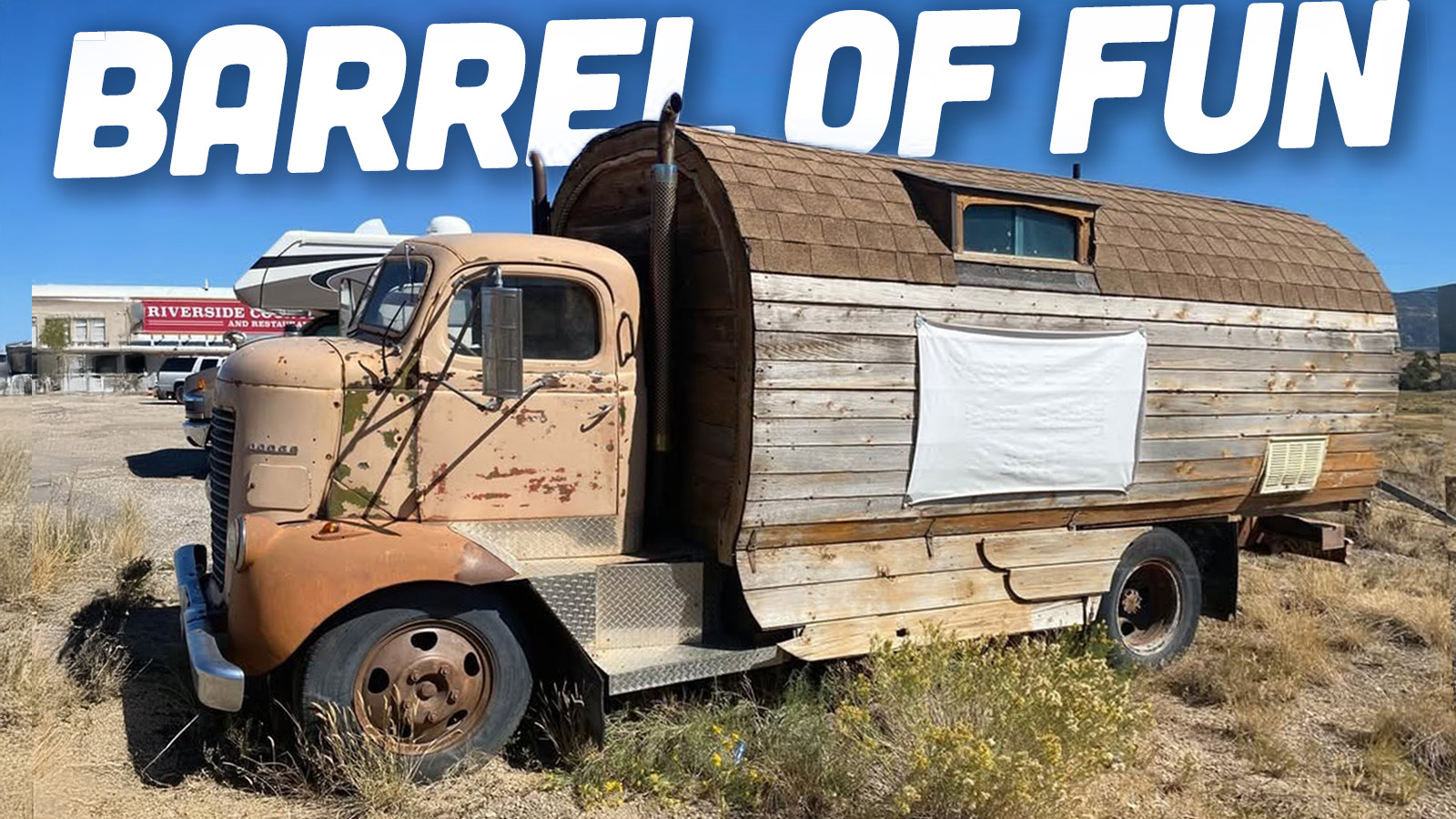
The world of custom motorhomes is something magical. Most RVs are large, boring boxes where most of the visual thrills come from decals or the location of the toilet. That’s where a custom RV like this 1947 Dodge COE comes in. Every square inch of this thing looks exciting, from the stubby vintage and operational cab-over-engine (C-O-E) truck up front to the motorhome body on back, which is both fully-featured and looks like a giant whiskey barrel. I’m told it even has parts from a crashed ship and an old cabin. This rig was once road art, but now it needs a new home!
This wonderful creation comes to us from the denizens of Opposite-Lock, a fantastic car enthusiast forum. If you’ve driven through or around southwest Utah at any point in the past two decades, if not longer, there’s a mighty good chance you’ve seen this motorhome parked on the side of the road. In fact, it sat for so long at a spot in Hatch, Utah, that there are countless photos on the Internet of it that were taken at different times. You can even buy stock images of this rig parked in Hatch.


But now, this Dodge truck’s life as road art is hopefully coming to an end. The current owner of the beast, the Eagle Nest Ranch of Kanab, Utah, has taken it away from Hatch and gotten it running. Now, after more than a year of ownership, the Eagle Nest Ranch is passing it on to someone that they hope can keep the story of this truck going. The fact that it looks like a barrel on wheels isn’t even the weirdest part!

Dodge ‘Job-Rated’ Trucks
The base of this build is a 1947 Dodge COE, a cabover truck, and it’s a historic vehicle in its own right.
Cabover trucks have been a part of American truck lore since 1899, but they really came into their own in the 1930s. Cabover trucks would come to dominate the world of trucking for decades, as cabovers were small enough to maximize cargo loads within the heavy length restrictions of most of the 20th century. But cabovers were also popular in work trucks for their form factor and maneuverability.
This truck comes from the line of highly configurable and customizable trucks that Dodge marketed as “Job-Rated” trucks. From Hemmings:
Dodge rolled out a striking new design for 1939, featuring an all-steel cab with a two-piece windshield that could be opened for increased airflow at the turn of a crank. There was also a center cowl vent for increased ventilation, though vent windows in the doors wouldn’t appear until 1946. The 1939 truck had a unique front-end/grille treatment that was changed in 1940. In 1940, Dodge trucks began using sealed-beam headlamps and were equipped with marker lights mounted on the headlamp housing. For the most part, after 1940, year-to-year appearance changes were very minimal.
Dodge’s 1939-’47 light trucks were offered in 1/2-, 3/4-, and one-ton varieties, but the nomenclature changed a little from year to year. The Job Rated trucks had stronger frames than previous trucks because they used steel with a higher tensile strength, the rails extended further forward past the engine than earlier trucks, and the trucks used beefy channel-type bumpers that helped to tie the frame rails together. A variety of wheelbases gave buyers greater options to suit their needs. The 1/2-ton rode on a 116-inch wheelbase, 3/4-tons on a 120-inch wheelbase, and one-tons were available with a 120- or 133-inch wheelbase. In 1940, Dodge 1/2-ton trucks adopted the safety-oriented system of using left- and right-hand thread lug nuts on opposite sides of the truck. Mechanically, the trucks are all very similar, with leaf springs at all four corners and solid axles front and rear.
After WWII, there were some changes made to production truck chassis parts due to reliability issues that cropped up during military service. For instance, the 1946-’47 trucks were equipped with housing vents on live axles–a spring-loaded valve in the vent could automatically reduce pressure when it built up inside the axle. This helped reduce seal leakage and failure. Stronger differentials and larger axle shafts were also used in post-war trucks, and steering boxes were beefed up and made heavier.
If you have 28 minutes to spare, you should watch the promotional film that I embedded above. It’s delightfully weird. Click here if you cannot see it.
Inspired By Navy Boats

Post-war Dodge trucks were advertised as having 248 different chassis configurations, from wood panel station wagons and conventional trucks to cabovers and school buses. It’s unclear what the exact model this truck started life as, but the Eagle Nest Ranch did give me a story.

He told me the truck was built by Walter Koziba, an elderly gentleman living in Utah. According to the story that the Eagle Nest Ranch was given, the motorhome’s design was inspired by blueprints of a United States Navy patrol torpedo boat from World War II. Apparently, Walter went the extra mile to make this motorhome special, going as far as to source the cedar that makes up the interior from Alaska.
The story gets even wilder from here. The Eagle Nest Ranch tells me that the porthole on the entry door is one of the portholes from the SS Catalina, which was also known as the Great White Steamer.
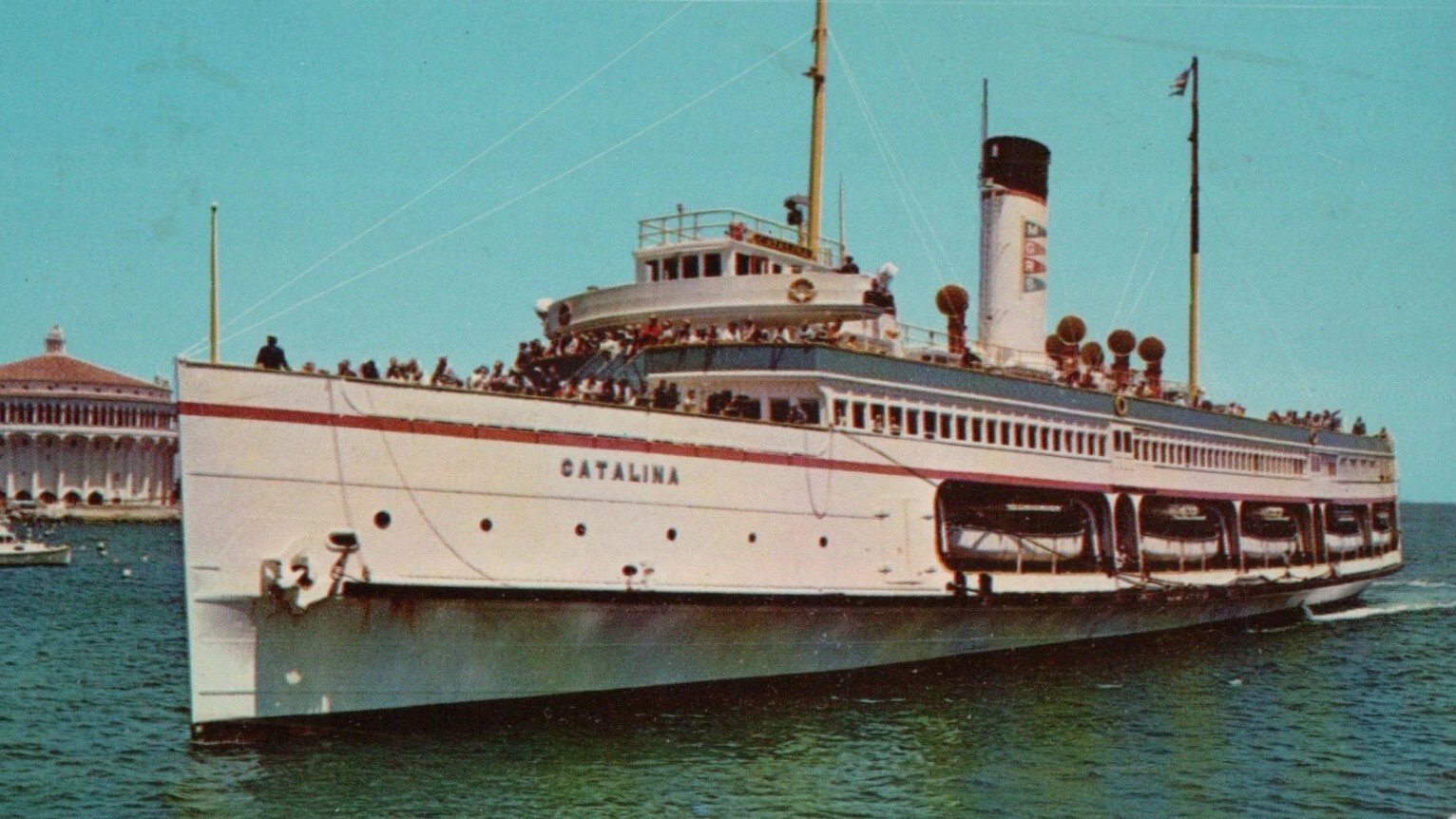
The SS Catalina was built in 1924 and was used on a 26-mile route between Los Angeles and Santa Catalina Island from 1924 to 1975. The ship was retired and ended up in private hands, where it would unsuccessfully serve as a floating discothèque, a bar, and a restaurant. The ship would partially sink in Ensenada, Baja California in 1997, and then sit, neglected, for years. The SS Catalina was scrapped in 2009 or 2010.

I’m also told that the hinges on this entry door came from the Jack London cabin in California. Jack London was a famous American author from the late 1800s and early 1900s. London’s cabin was built in 1897, right before the Gold Rush of 1898, on the North Fork of Henderson Creek, south of Dawson City. He stayed in the cabin during the winter of 1897 while Jack searched for gold.
The cabin was later abandoned and then rediscovered. It was torn down in 1965, and then replica cabins were built that used the original logs.

Of course, it’s hard to verify any of this, but it’s a fantastic story. What I can tell you is that the motorhome conversion is several decades old by this point. The coach is fully featured, with a full kitchen, full bathroom, and bedroom. Walter built this to be self-sufficient, and as a result, it holds 60 gallons of water and 60 gallons of propane for cooking and heating.
This wasn’t even Walter’s first motorhome build! Another one of his builds is below.

The Eagle Nest Ranch told me that the ranch has been trying to buy the rig for a decade, and the previous owner of the motorhome, who had it parked on the side of the road, finally let it go.
The engine under the cab is a 318 cubic-inch Chrysler industrial V8 engine. This engine is believed to have around 3,000 miles, but, of course, it’s been sitting for a while. The engine has been revived, and it is said to run well. However, there’s a lot of work that still needs to be done, as the truck needs wiring work and hydraulic system work before it can move under its own power again. Of course, you’ll also probably want to check over the wood structure of the motorhome portion and modernize the interior.
A Barrel Of Fun
The Eagle Nest Ranch is hoping to get $15,000 or the best offer for the rig. I think what’s most amazing about this build is that it clearly has sat outside for a very long time now. There are photos showing this just sitting around Utah for at least two decades now. Yet, the interior doesn’t look that bad. Yes, there’s some wear and decay showing, but I have seen much worse from motorhomes that haven’t sat for nearly as long.

It’s also hard to make a call about the price. Sure, you can buy an old running and driving motorhome for $15,000. However, nothing that you can buy right now looks as cool as this thing does. At the same time, the buyer for this RV isn’t really going to be your weekend camper, but some sort of avid DIYer, I think. This is one of those situations where the price, or whatever offer the seller ends up taking, will probably be right for the person who comes around.
I hope that whoever buys this motorhome gives it a makeover, but keeps the wild theme. It’s not often that you see a ’40s Dodge truck as it is, let alone one that looks like a giant barrel of whiskey. It’s yet another example of the kind of creativity you don’t really find with a factory-built motorhome, and that’s awesome.
Top graphic image: Eagle Nest Ranch


<crocodile_dundee_voice>Thats not a wooden rv, THIS is a wooden rv!</crocodile_dundee_voice>
Reminds me of this awesome vehicle, aptly named the “travel log”.
Here is an article with better pics,
If you are ever in the Northern California area, you can check it out in person at the Humboldt Redwoods visitor center, and if you are so inclined, grab yourself a brownie just down the street at the Peg House, deeeelicous!
Reminded of this RV which was actually made from a *single* log from a fallen redwood tree and a Nash Quad (four-wheel-drive!) truck in 1917: https://www.treehugger.com/nature-singer-drove-a-camper-made-from-a-redwood-4866980
It’s now in the museum at Humboldt Redwoods State Park. My kids & I visited the museum nearly 25 years ago but the RV was not on display at the time, alas. Given to understand they were in the process of fixing it up; glad to see it’s now on display. When we were there they did at least have a small exhibit with pictures and related artifacts; the gift shop had postcards, some of which were reproductions of period postcards, which I of course bought 🙂
Oh, and Nash Motors actually acquired the Thomas B. Jeffery company in 1916-’17; prior to that the four-wheel-drive trucks produced by that company were known as Jeffery Quads.
So given that Charles Kellogg built his log RV in 1917 he might have used an older truck, that is, a Jeffery Quad. As seeing how the redwood log was tube-shaped one could call that particular vehicle a…Jeffery Tube.
It’s a motorized Bow Top/Barrel Top Vargo.
Vargos are the traditional Romani Wagons. You can’t watch a British Cozy Murder Mystery series without some “Travelers” coming to town in horse draw carts where they are ornate and at least one is shaped like a barrel.
Here’s an image of a classic one from Wikipedia
Gypsy Caravan – Flickr – mick – Lumix – Vardo (Romani wagon) – Wikipedia
It might be an example of parallel evolution, but I wouldn’t be surprised if whoever built this thing had some connection with the Romani.
PS, the Romani is generally better known under a term that is considered offensive to them, which I have avoided. They are known to wander from almost all of Europe and generally live in transient communities. There is a long history of them not being trusted by the cultures that they travel in and out of, with laws about controlling them dating back 500+ years.
Put a guy on the top with a flame-throwing guitar and I’m sold
Check out the book, Rolling Homes, by Jane Lidz, from 1979 – https://archive.org/details/rollinghomeshand0000lidz
A traveling circus, or carnival, could buy it and have a Barrel of Monkeys kept in it!
My immediate and terrible idea.
Just add a steam generator for instant sauna in all parts of your RV.
The first thing I would check for is termites. 😉
And carpenter ants… which, if one thinks about it until it hurts (not that long, either) is an oxymoronic name for a wood-destroying insect.
Decarpenter Ants! 😉
ANTi-carpenter Ant
Perfect!!!!