

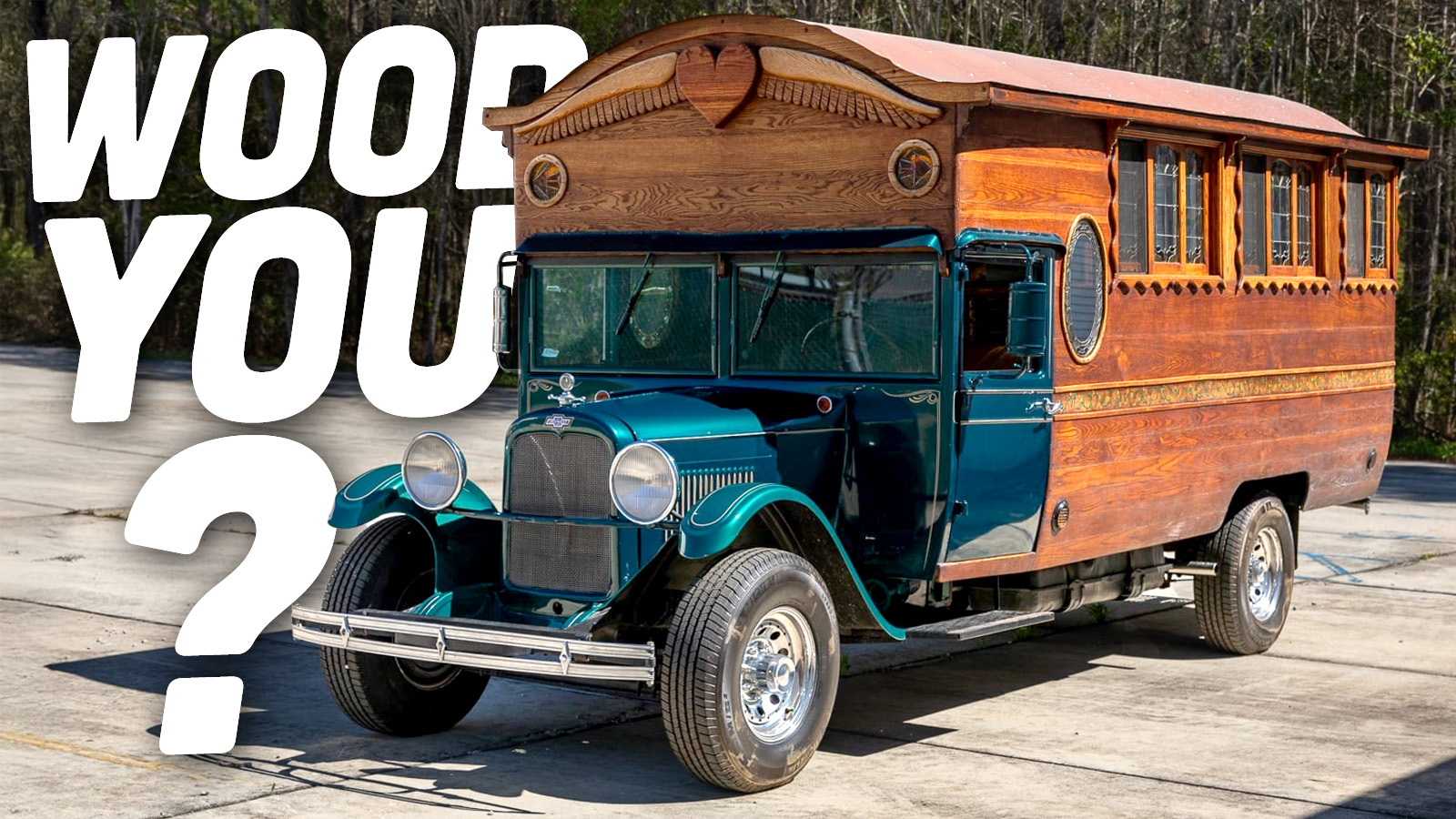
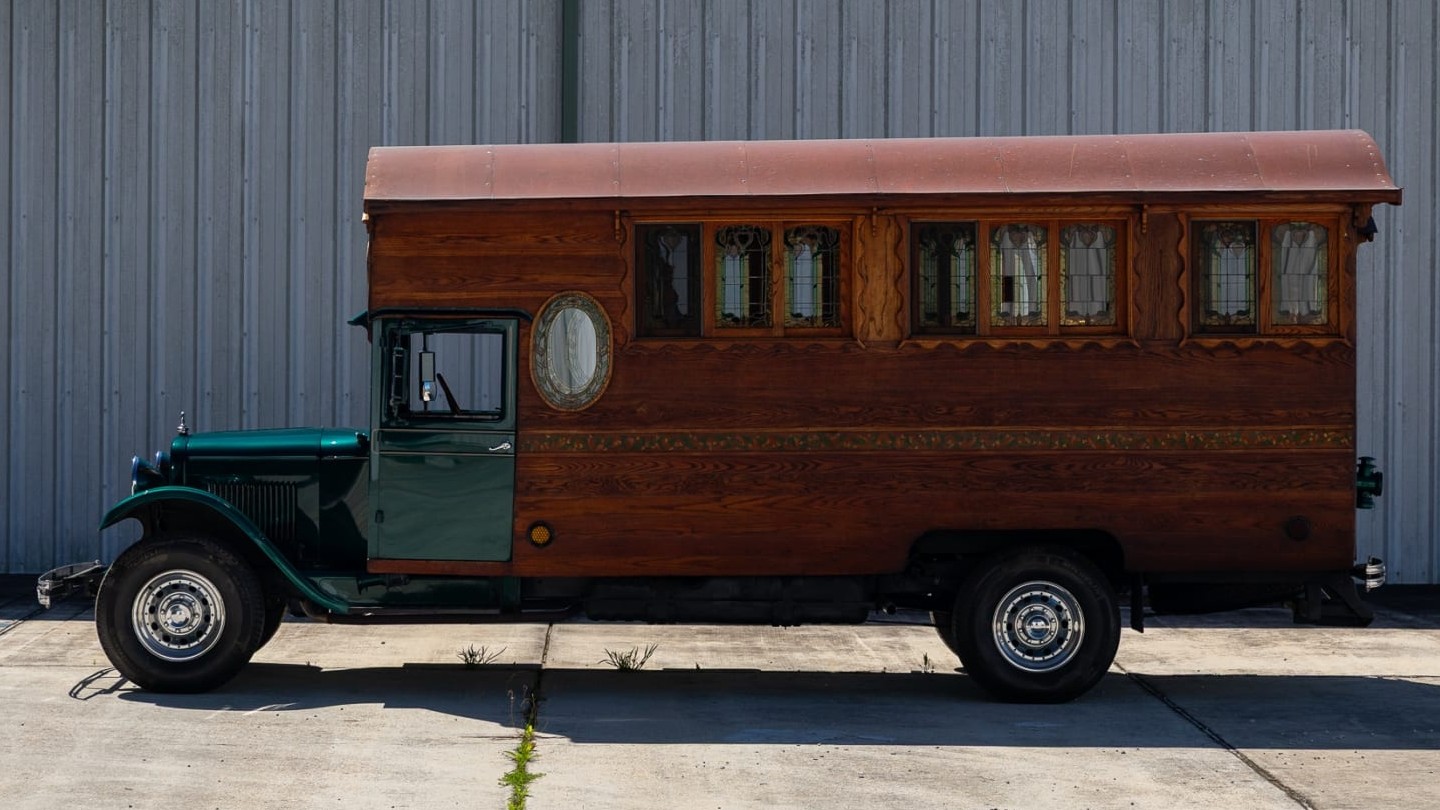
I have long said that the world of custom motorhomes is full of far more creativity than can be generated by any RV company. The limit to custom RVs is the builder’s imagination, skill, and finances. I think I found what might be one of the greatest examples of what someone can do with their own two hands. At some point in this 1928 Chevrolet LM one-ton truck’s life, it was restomodded into something that could handle modern traffic. On its back sits a totally custom wooden motorhome meant to look like something Romani people might have lived in back in the day. The more you look at it, the better it gets.
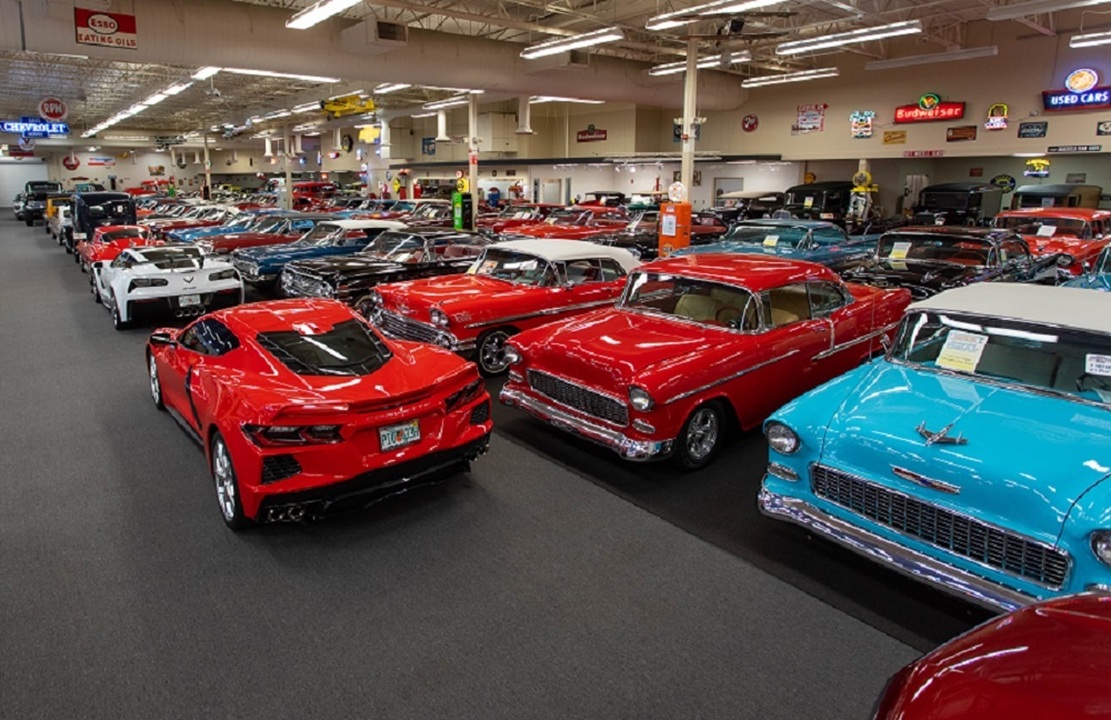
This custom coach was once a member of Rick Treworgy’s Muscle Car City in Punta Gorda, Florida. If you haven’t heard of Treworgy before, he was known for having amassed hundreds of classic cars that he put on display in an old Walmart converted into a museum. The purchases of these vehicles were made possible because of Treworgy’s ownership of several successful companies and land holdings in Florida.


As Hagerty writes, opening a car museum to show off his impressive collection was always Treworgy’s dream. He then got to live that dream. However, by 2021, Treworgy was 72 years old, and he didn’t like the idea of coming to his office at 5:30 am every day in his advancing age. Treworgy wanted to travel and enjoy other parts of life outside of cars. So, he made the decision to close the museum down and send the vast majority of his collection to live with other people.
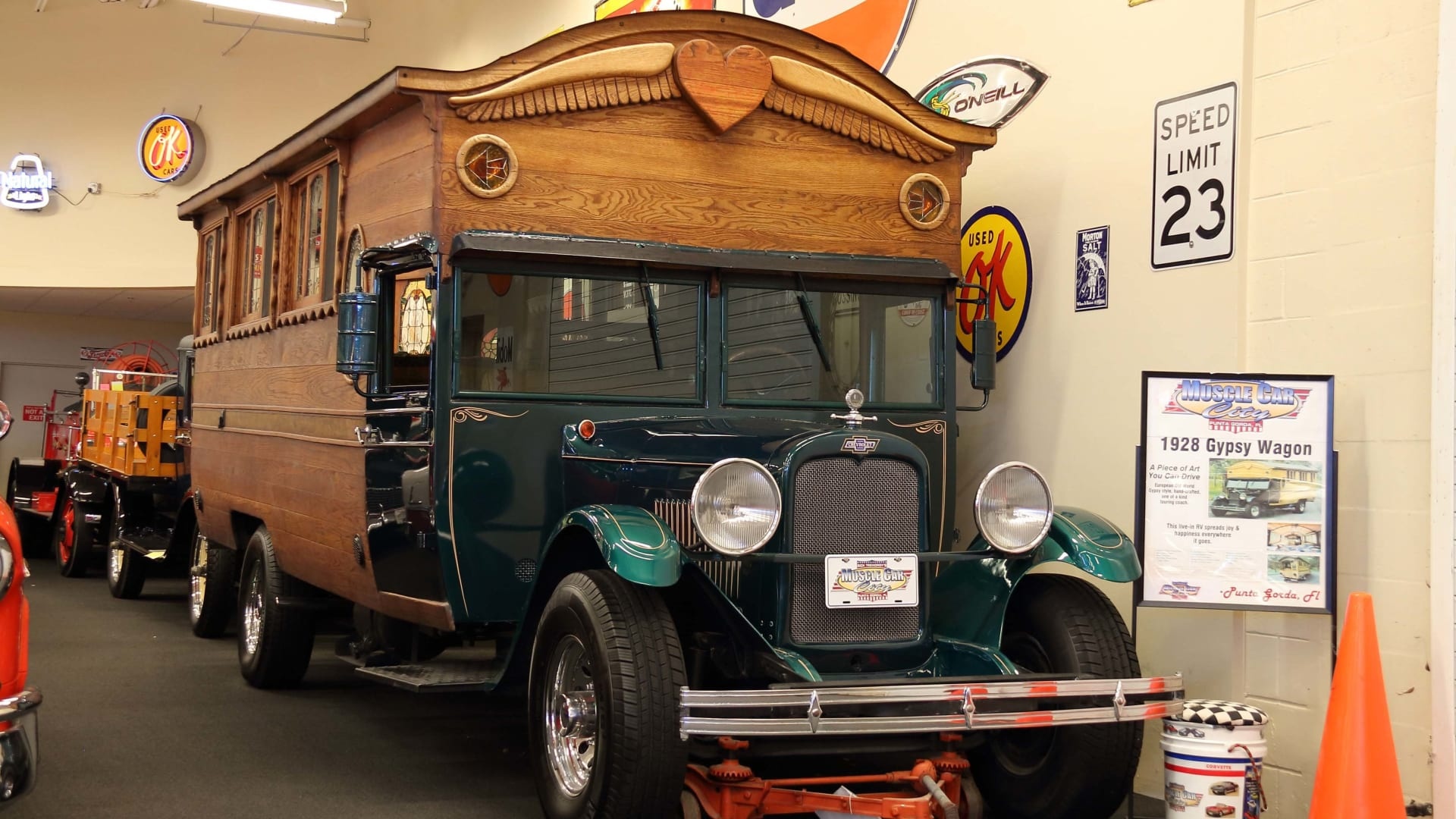
Included in that original 2021 auction was this 1928 Chevrolet LM one-ton truck, which Treworgy had advertised in the museum as the “Gypsy Wagon.” This coach was not actually a vehicle used by traveling Romani people. Instead, it’s a custom motorhome conversion that was made to look the part.
Now, it’s up for sale again, and it’s easily one of the coolest custom rigs you’ll see in a while.
From The Early Years Of Chevy Trucks
Chevrolet got into the business of building trucks early in its history.
In 1918, seven years after Chevrolet’s founding, William C. Durant’s General Motors purchased Chevrolet. Durant wanted to build a truck to compete with the Ford Model TT, resulting in Chevy’s first trucks. The Model T was available as a half-ton or as a one-ton truck, and it was a purely utilitarian affair. Chevrolet sold it as a drivetrain and a chassis, leaving the body and cargo box up to the buyer and builder. Power came from a 224-cubic-inch inline-four good for 36 HP gross.
Also available was the Model Four-Ninety Light Delivery, which was a car that became available as a light-duty truck in 1918. The Model 490 was sold as a “cowl” truck, where a builder configured their own cargo area. Power came from a 171 cubic-inch four with 24 horses in its stable.
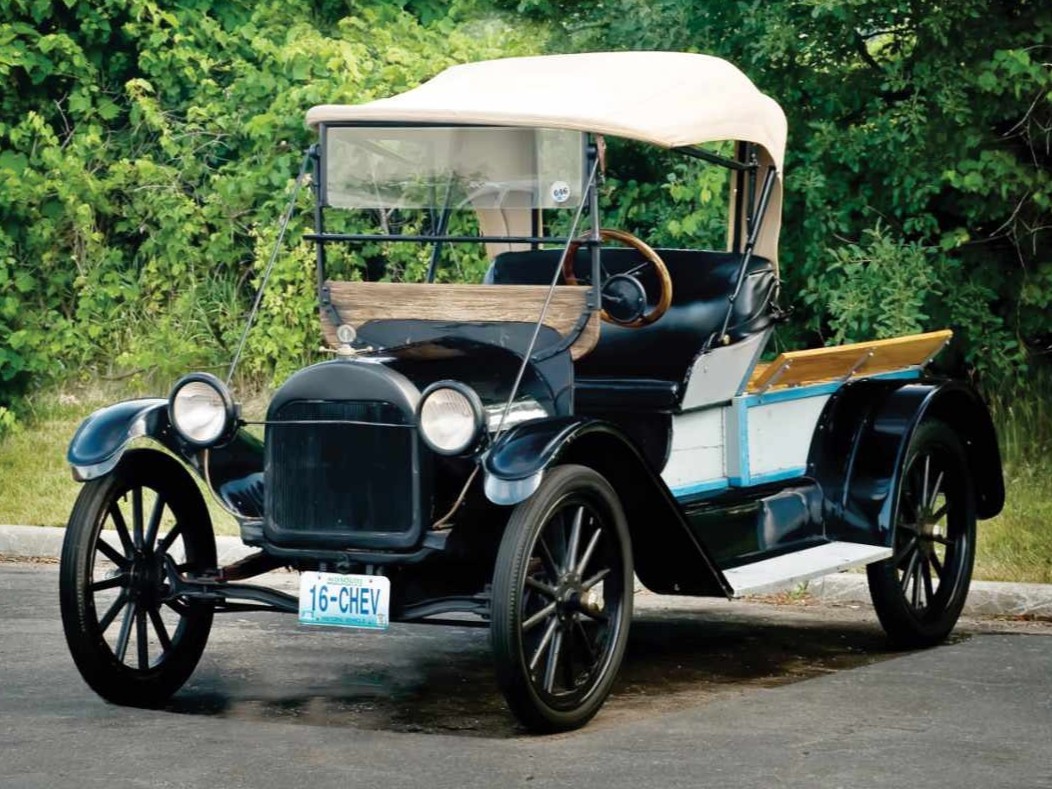
Establishing a line of trucks meant that American truck buyers of the 1910s could get the cheaper light-duty Model 490 truck for $490. If they needed more capacity, the Chevy Model T carried 2,000 pounds for $495.
This truck came from a revolutionary period in GM history. In the 1920s, automotive historian David Gartman writes, Alfred P. Sloan Jr. was on a mission to unseat Ford as America’s top car manufacturer. General Motors could not beat Ford on price, so it would instead try to win on quality and variety. To the infamous Charles F. Kettering, who led GM’s engineering at that time, “quality” translated to advanced technology. Kettering invented Cadillac’s electric starter, an electric motor for cash registers, an automotive electrical system, a rudimentary guided bomb, and he even had a heavy hand in leaded gasoline.
Kettering’s fascination with air-cooled engines led to the development of the innovative, but flawed Copper-Cooled Chevrolet, which tried to cut costs by eliminating a liquid-based cooling system. The Copper-Cooled Chevy was so slow and so unreliable that Chevy recalled all of them just to destroy most examples.
GM would end up implementing far more successful ideas in the 1920s. Sloan would learn that GM didn’t necessarily need the latest technology so long as its cars looked fresh. Innovation was risky, took time, and cost money. Slapping a new face on a nine-year-old vehicle costs only a little money in comparison. GM would also experiment with bold paint colors to draw the public away from Ford’s black cars.
That’s not to say that GM completely abandoned innovation. It was in the 1920s when GM also introduced parts sharing with the A-body platform and its B, C, and D derivatives. While GM’s brands had their own engineering teams, identities, and semi-autonomy, by having them share core platforms, GM was able to increase its economies of scale.
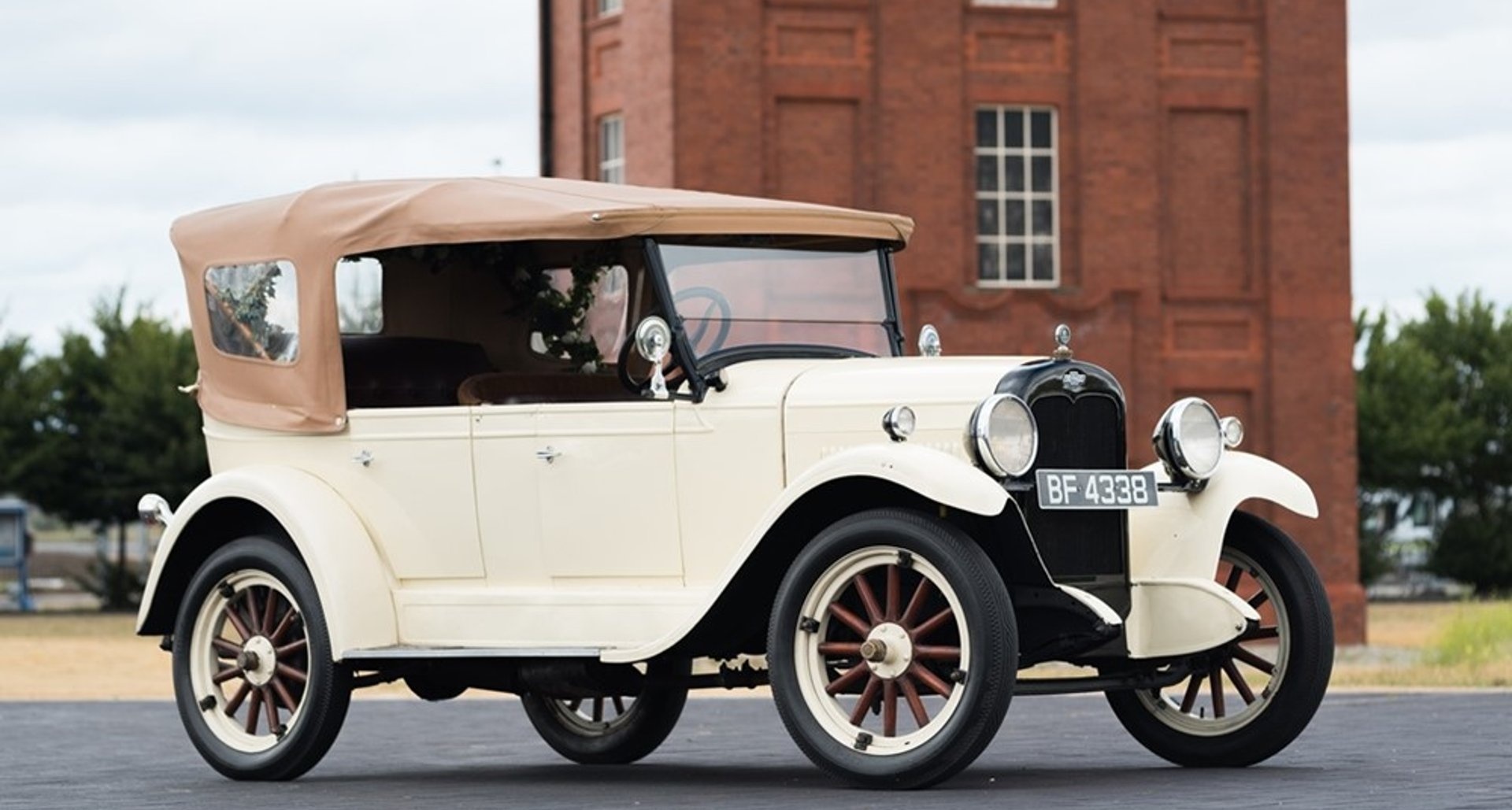
By 1927, GM rocketed past Ford in sales, and Ford, as well as other automakers, took some ideas from GM to keep up. Also, that year, Chevrolet launched the Series AA Capitol, which was the brainchild of William S. Knudsen. Produced alongside these new cars was the Capitol LM truck. LMs were sold in a few varieties. You could buy your LM as a chassis with a drivetrain, fenders, running boards, and a hood, a cowl unit, or as a cab chassis with an enclosed cab. Chevrolet also advertised complete panel trucks and stake bed trucks using cabs from Fisher Body. One-ton LM varieties rode on a 124-inch wheelbase and utilized Chevy’s four-cylinder engine, which was rated for 26 HP in 1927.
In 1927, a Chevy 1-ton with just the chassis, drivetrain, and hood cost you $395. A complete panel truck was $755. Many truck buyers of the late 1920s opted to get the bare chassis and then took their trucks to builders like Hercules, J.W. Henney, Martin Parry, or Mifflinburg to have their rigs turned into anything from an ambulance or coal truck to a delivery truck or ice truck.
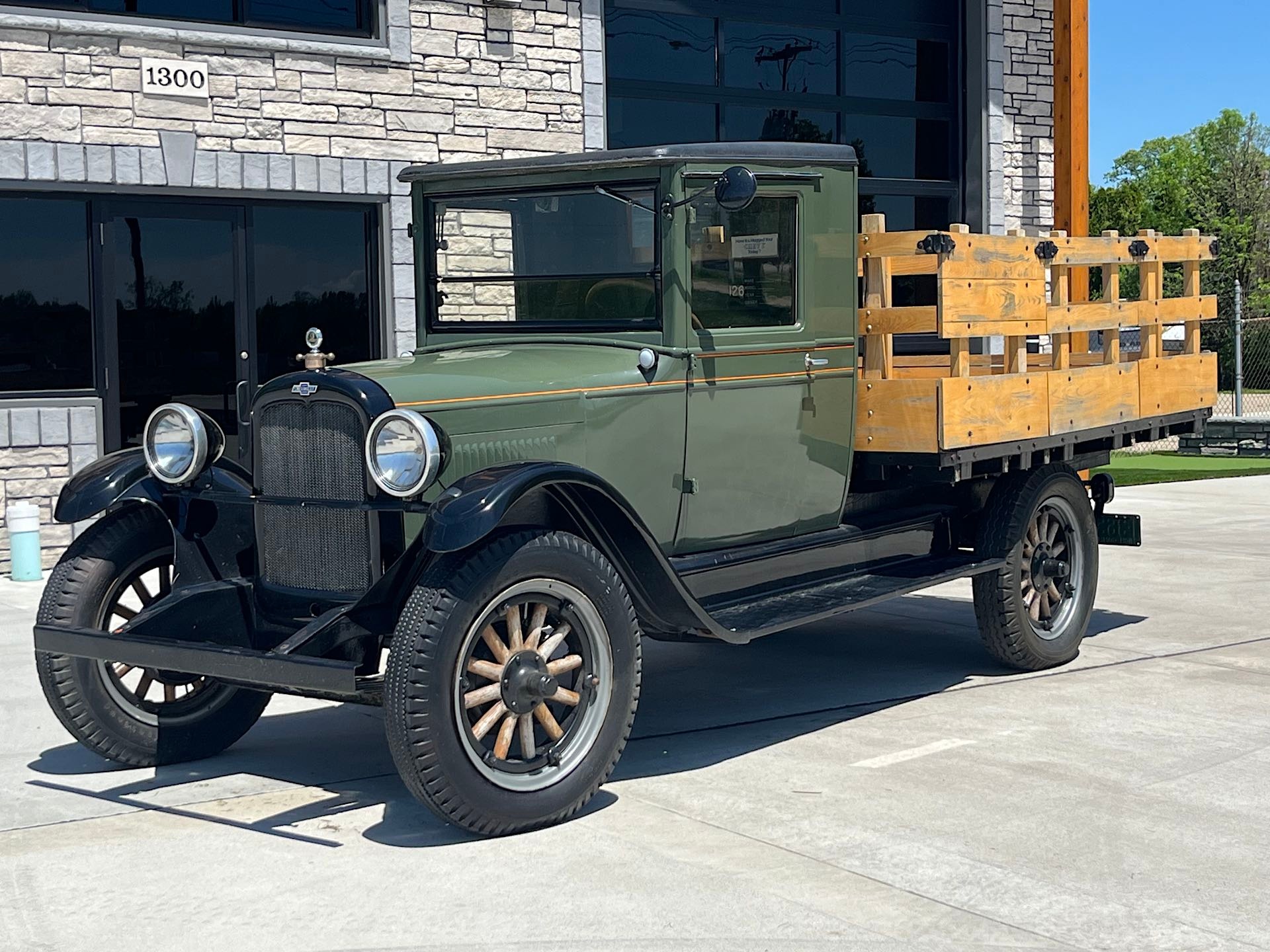
In 1928, Chevy’s trucks would be companions for the National Series AB cars. GM’s one-ton truck series included the LM, LO, and LP. In a mid-year update, the LP introduced a standard four-speed manual transmission with a power take-off, and in a first for GM work trucks, front brakes. Yep, GM’s early trucks relied on a single set of rear drums for stopping power.
The inline-four made a return for one last year in 1928. It rocked a Carter single-barrel carburetor, solid valve lifters, larger valves, and aluminum pistons. All of those changes added up to 35 HP. The Stovebolt straight-six engine would make its first appearance in 1929.
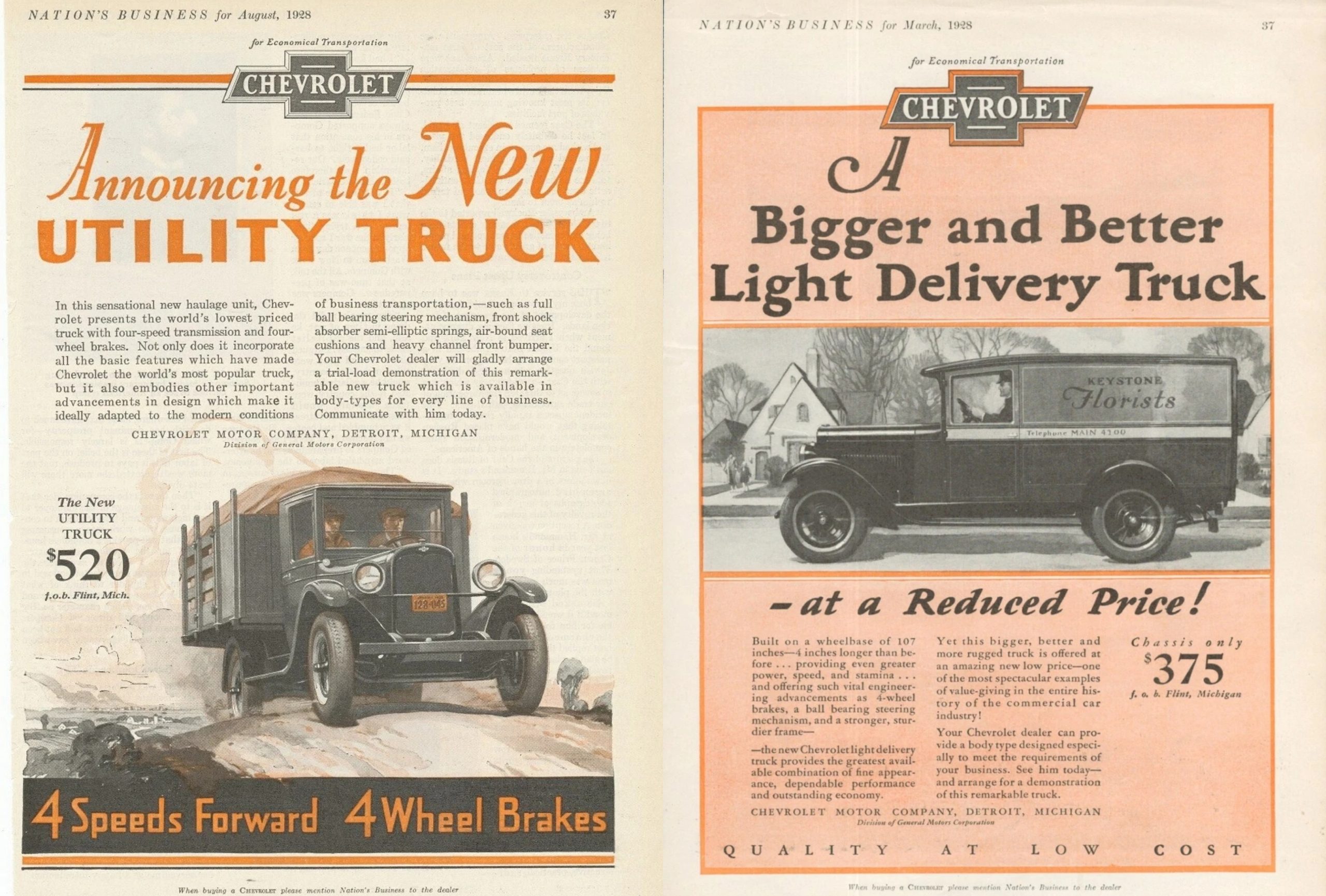
In 1928, a Capitol LM one-ton truck cost $520 for a bare 2,060-pound chassis. In comparison, a light-duty delivery truck was $375 for a chassis only.
This Wooden Motorhome
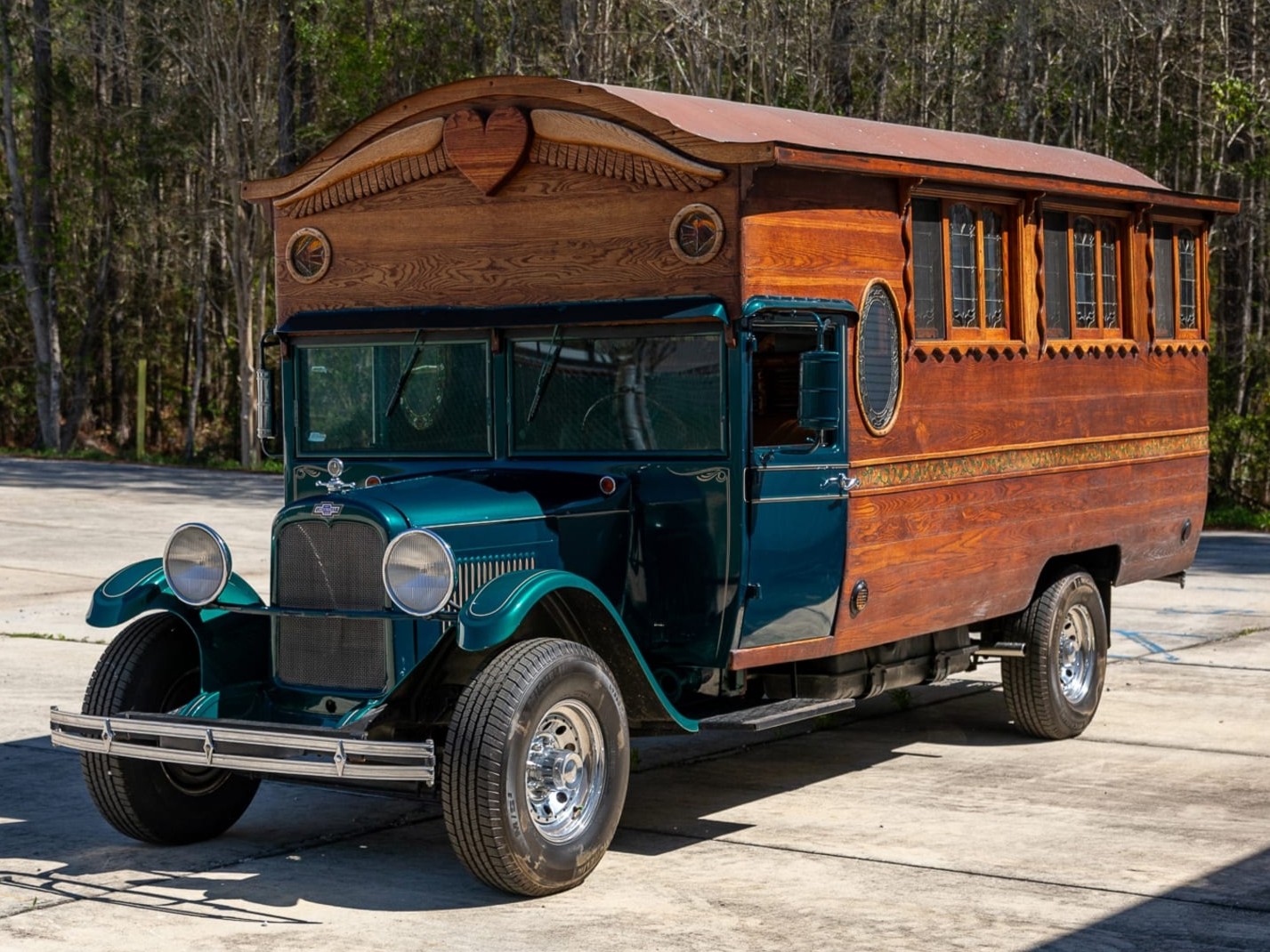
While this motorhome before us today is technically 98 years old, thankfully, it’s not running 98-year-old technology.
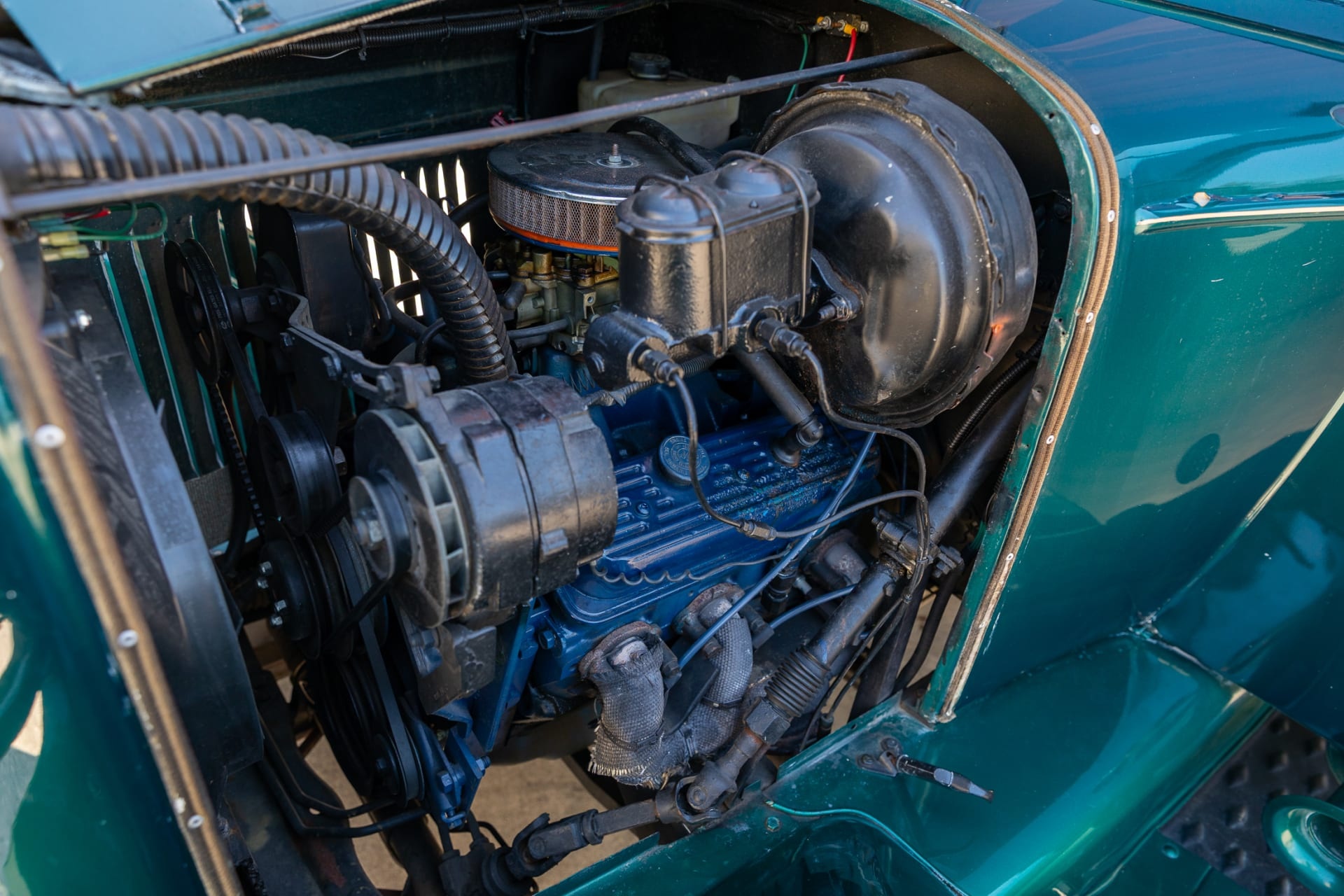
At some point in this truck’s life — sadly, the timing isn’t indicated — it underwent a restomodding and seemingly a bit of a widening. The biggest change that a driver will notice is that the old four was removed and, in its place, sits a GM 4.3-liter carbureted V6 of unknown date or origin. The truck’s semi-floating rear axle comes from a Ford F-250, and the front axle is a three-quarter-ton unit from Chevrolet. Rack and pinion steering keeps you on track, and power brakes provide the stopping. All of this is backed by a four-speed automatic. Mecum doesn’t say where any of these parts came from or how old they are.
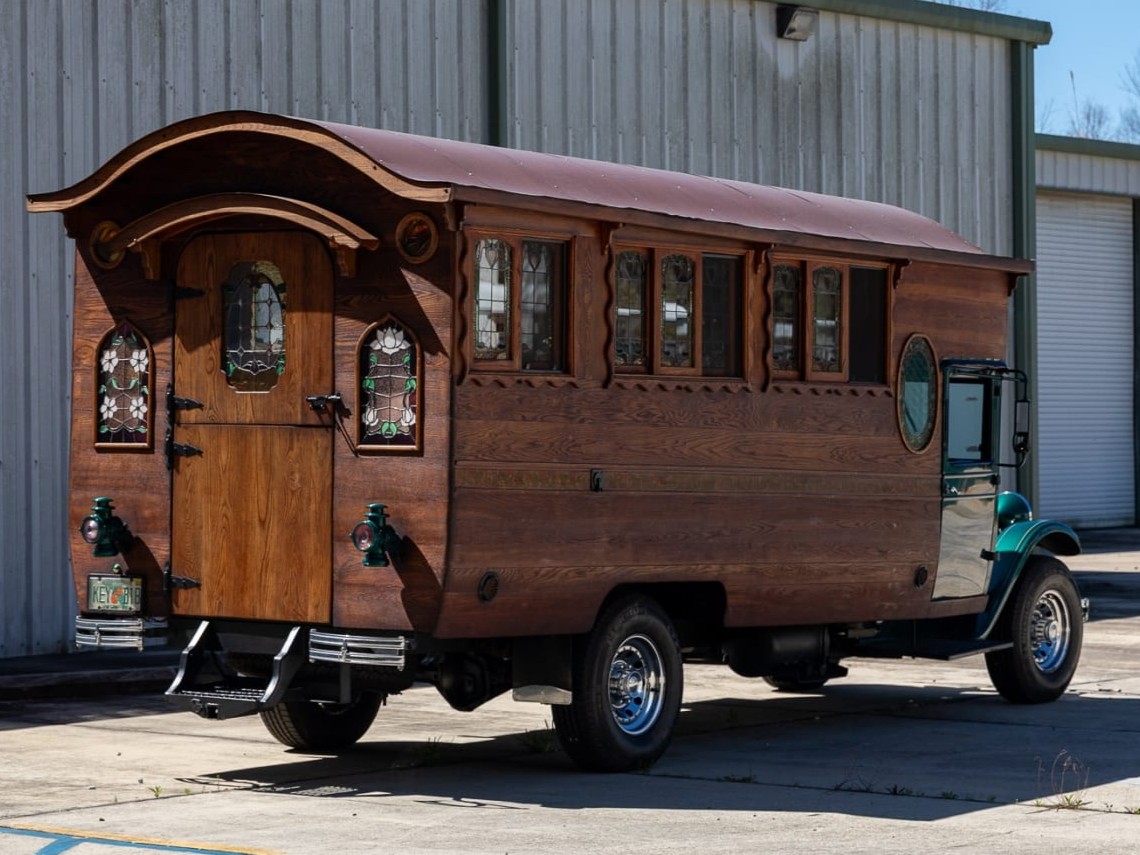
Normally, I love it when trucks remain period-correct, but I get the mods this time around. A 35 HP truck with a gigantic motorhome box on its back would be more or less totally useless. I’m not sure a 4.3-liter V6 is the best motivation for all of this heavy wood, but at least it stands a better chance. Sadly, there isn’t really room under the hood for a V8, so V6 power makes sense.
Speaking of heavy wood, Mecum says that the coach body was built out of solid red oak. The body is rather elaborate, featuring 21 stained glass windows, a Dutch door, a copper roof, buggy lanterns, and stained glass turn signals. The detail work in the wood is beautifully intricate, and you have to get close to see all of the details.
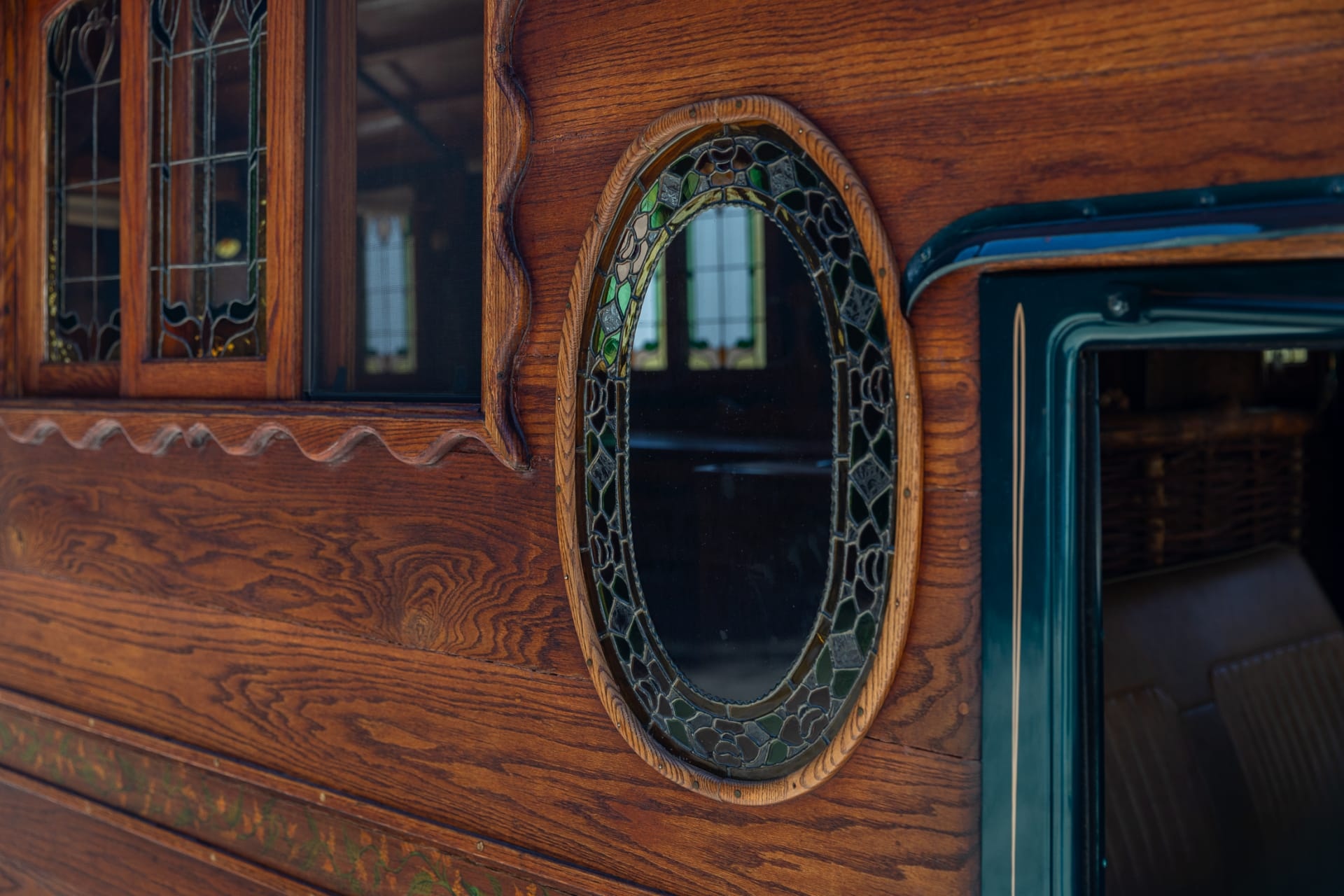
The interior is filled with even more red oak, from the floor to the cabinetry. The dashboard of the motorhome is said to be walnut, and there’s so much wood in there that even the sink is made out of wood. Red oak weighs something like 45 pounds per cubic foot, so it’s safe to assume this is a girthy unit. There does appear to be metal framing behind the wood, too, so that’s even more weight.
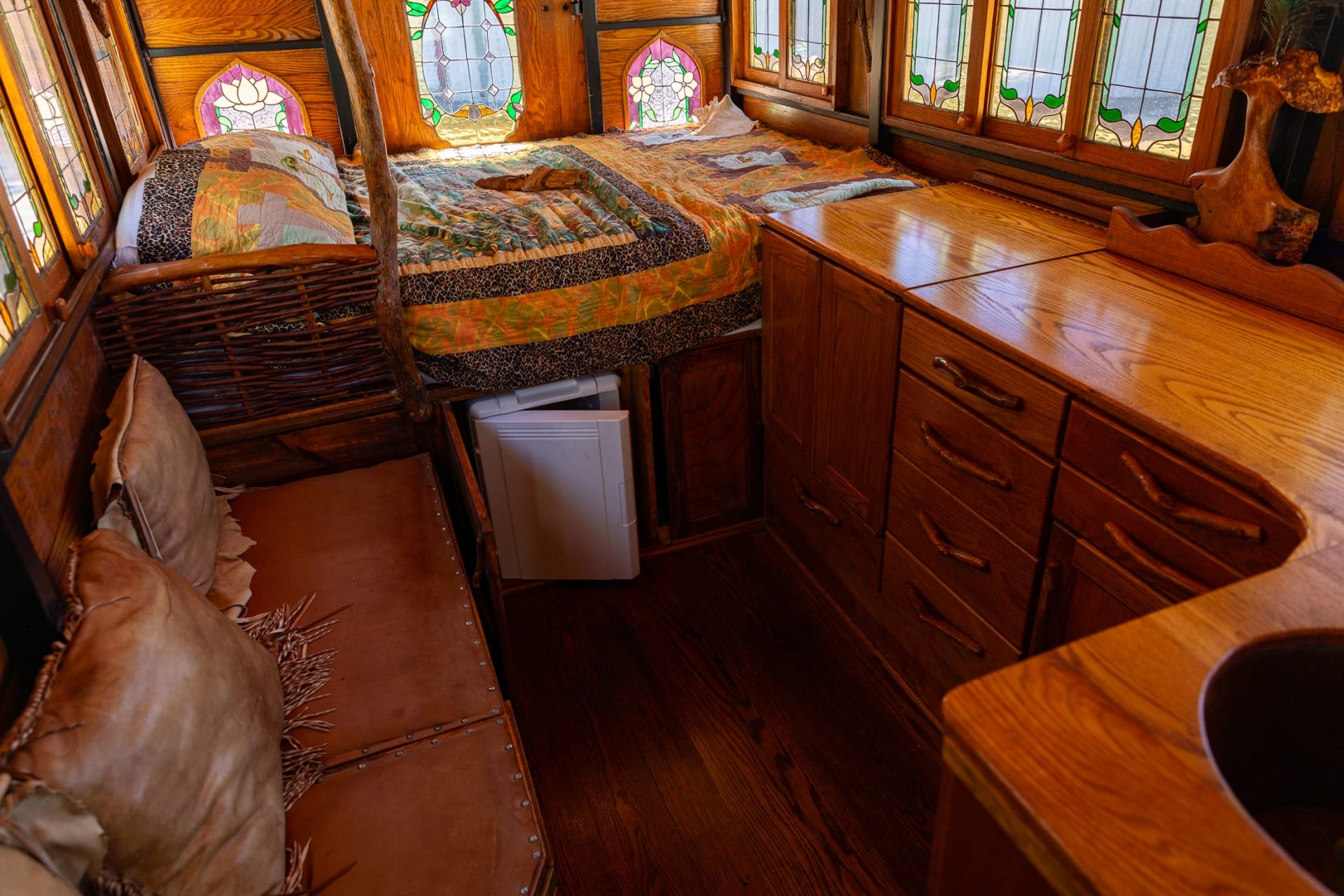
The stove and oven have a matching wood cover, and the refrigerator hides in a little alcove under the bed. The interior looks as functional as it is beautiful. Even the sofa seems perfectly themed to the motorhome.
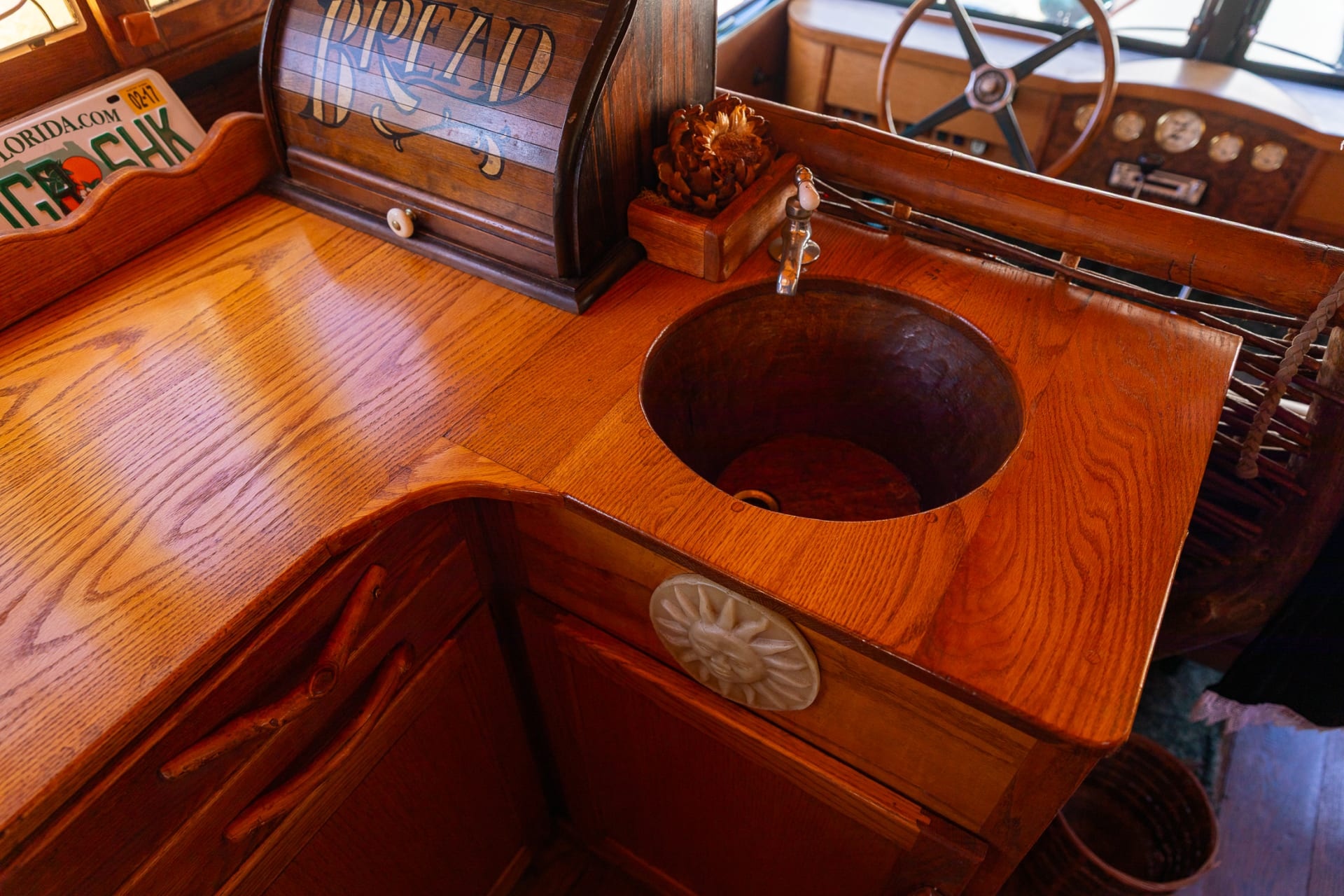
While the motorhome looks vintage, it’s actually fairly modern. Here’s the list of interior features:
Dual batteries.
AC/DC 12-volt lights.
AC/DC refrigerator.
Propane stove/oven.
30 gallon water supply.
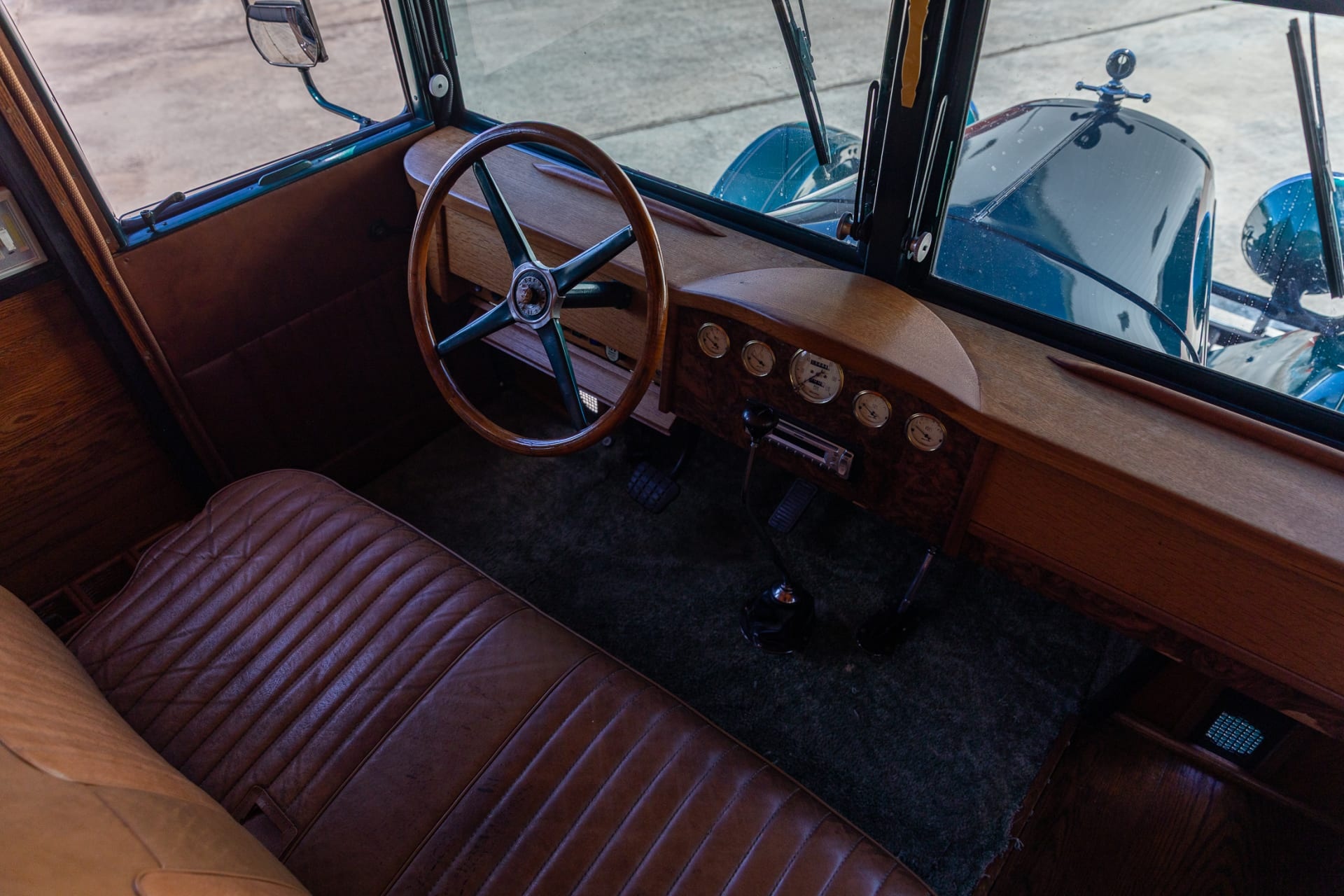
My eyes also spot 12V sockets, a modern car stereo, and modern pedals. It’s unclear what, if any, HVAC system is installed. A bathroom does not appear to be present, either, but that’s fine.
This is the kind of motorhome that you’d take to a car show, a vintage camper rally, or to a state park. When it was on display at Muscle Car City, a sign indicated that the vehicle was either built by or owned by Bill Eckhoff of Punta Gorda.
Sadly, no other history about this coach has been shared in either the Mecum auction or in any other place this motorhome has been shared. Someone built this, and it’s wild that the story is not getting told!
Such A Wonderful Build
Regardless, even without the history of how the coach was built or who did it, this is an awesome motorhome. Sure, it’s missing plenty of creature comforts, won’t be particularly quick, and I cannot imagine that keeping the wood in good shape would be anywhere close to easy. Yet, at the same time, this is an RV that could easily be considered art.
This motorhome sold for $51,700 when it rolled across the block in 2021. The new owner didn’t even put more than 100 miles on it. The odometer displayed 11,345 miles back then, and it shows 11,444 miles now. It’s going to be rolling across the Mecum block on April 10, and who knows what it’ll sell for. Hopefully, the new owner will have some real fun with it and maybe tell the coach’s story.
I fully admit that this kind of motorhome definitely isn’t for everyone. I know I’d want an air-conditioner when driving around hot and steamy Florida. Some folks aren’t into this style, either, which is totally okay! But it’s hard to deny that there was some incredible creativity put into this motorhome. You will never see something with this much character roll out of Indiana, and that’s why custom RVs remain some of the coolest RVs on the planet.
Top graphic image: Mecum


There’s an original of this type of conversion built in the 20’s and based on a 1924 Model T at Autoworld Brussels. Has a chimney for the white gas stove and the cutest little back porch with built in folding seats.
https://drive.google.com/file/d/1XPWUz3vCDhwca6tIVvqe9Jh3tYILCsAv/view?usp=sharing
https://drive.google.com/file/d/1NOmzSfxcvailnNj3nBXbmdAd4iid6XeA/view?usp=sharing
https://drive.google.com/file/d/1K6omBGO5fukhwAQYOmXxwvqLjQmI9e6f/view?usp=sharing
https://drive.google.com/file/d/14h07cknYHitzHOxQP0qoKT0w2o7y-coU/view?usp=sharing
The cash register was invented by brothers James and John Ritty in 1879.
Source: Duck Duck Go.
Yep, I made an error. Kettering invented an electric motor-operated cash register. Thank you for pointing it out! I issued a fix. 🙂