


If you’re thinking an RC Cybertruck is old news, you’re right – if we’re talking about the Hot Wheels-branded models for on-road use that were announced in 2020, or any of the toy-grade models that have appeared since. But we’re not talking about those.
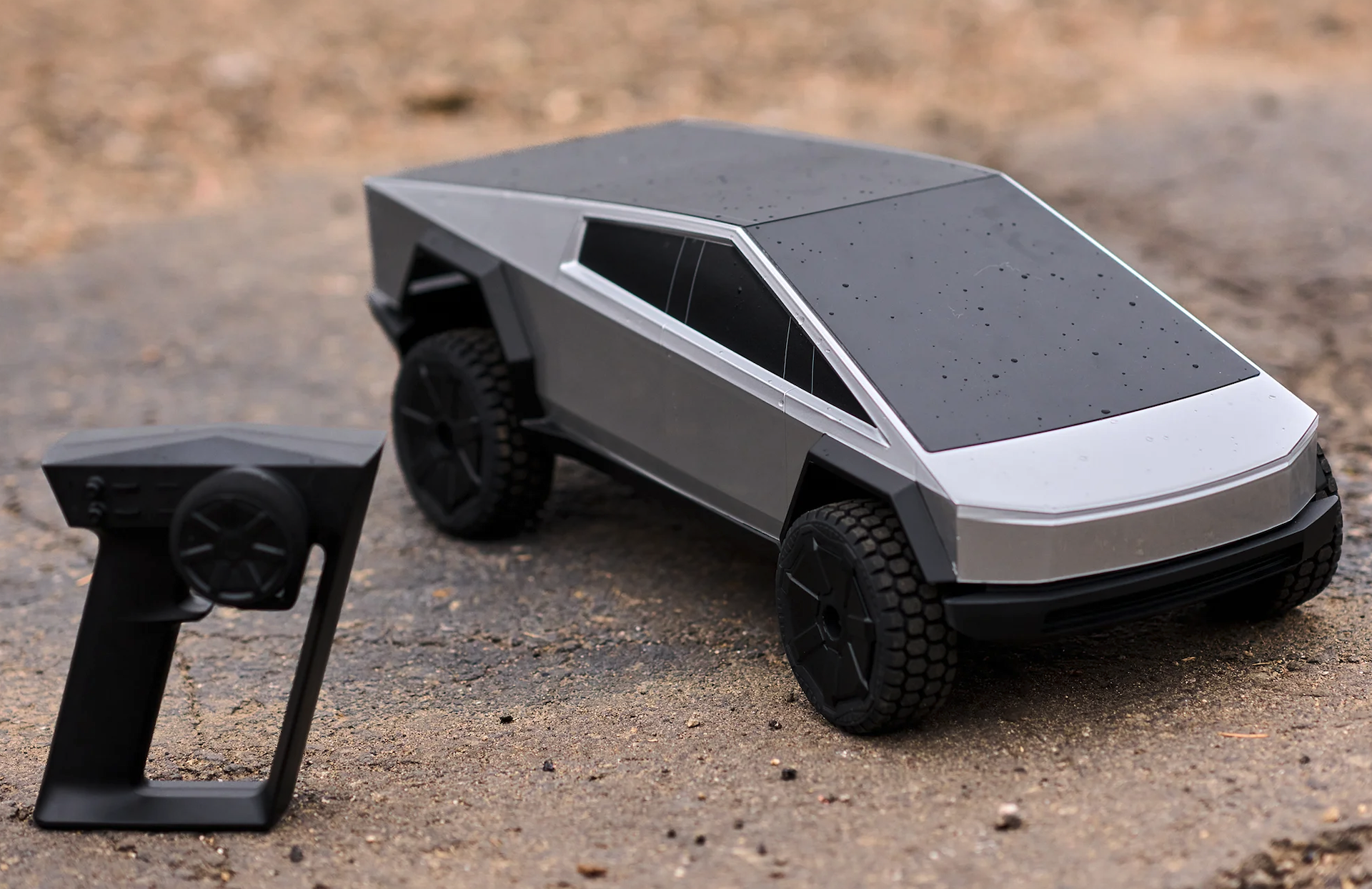
No, today we’re talking about Tesla’s all-new Cybertruck RC Racer that, while awkwardly timed given the latest full-size Cybertruck news, is perfectly timed for the holiday season. It’s not cheap at $350, but considering how well it’s spec’d and how complete the ready-to-run package is, it’s actually a good value. A great value, even, as it will almost certainly sell for more on the secondary market as a collectible.


But if one of these new Cybertrucks were to land in my hands, I wouldn’t shelve it for some future eBay sale; I’d charge it up and hit the dirt, because by all indications it’s a genuine high-performance off-road machine. Tesla doesn’t provide much in the way of photography for the technical details, but everything we need to know is revealed in the manual. As an RC car enthusiast for over 30 years and the former editor of RC Car Action magazine, I have a pretty good handle on this stuff – but do keep in mind that I don’t have the actual Cybertruck model in my hands to examine.
Now let’s take a closer look.
It’s hobby quality
The Cybertruck is a true hobby-quality model. If you’re into RC cars, you’ll recognize plenty of familiar features employed by many other brands, but the Cybertruck also has a unique feature I haven’t seen before. We’ll get to it, but first let’s look at what makes this a “serious” RC car and not merely a Cyber-styled toy.
Let’s start with the power system, which features a brushless motor, 60-amp speed control, and a 3-cell, 3400mAh Lithium-polymer battery. Tesla doesn’t list the motor’s KV rating (how many RPM the motor turns per volt of supplied power), but does claim a 37mph top speed for the model. It’s an entirely reasonable figure that many other models achieve with similar power systems.

For radio gear, the truck includes a pistol-grip 2.4GHz transmitter with “low-poly” styling to match the Cybertruck’s faceted look, and the receiver features a piezoelectric gyro and circuitry that automatically countersteers when a slide is detected to help prevent the truck from spinning out. The degree of help the gyro provides can be adjusted on the fly via the transmitter. No specs are listed for the steering servo other than six kilogram-centimeters of torque, which works out to 83 ounce-inches – not super powerful, but sufficient. I expect the servo also has metal gears, but Tesla doesn’t specify.

If I have one gripe about the electronics package, it’s the transmitter’s trigger design. Pulling the trigger toward the grip applies forward throttle, pushing the trigger away from the grip applies the brake. Return the trigger to neutral and apply up-trigger again, and reverse is engaged. This is all standard RC stuff, but the trigger’s trapezoidal shape doesn’t appear to hug both sides of your finger, so you have to really extend your finger and possibly adjust your grip for braking and reversing – you can see this in the quick-start video.

Proven drivetrain design
With its body removed, the RC Cybertruck is built like other models in the four-wheel-drive short-course truck category. Like most other brands, the chassis is configured with the battery on the left and the motor and speed control offsetting its weight on the right.
In addition to spreading the weight of these components relatively evenly, this setup allows plenty of room for the chassis-spanning center driveshaft that links the front and rear differentials.

The image above shows a Traxxas Slash 4X4 because Tesla does not provide a similar view of the Cybertruck, but the drivetrain layout is the same. Only three gear meshes are required to get power to the wheels: the pinion and spur gear mesh, and the mesh between the crown and ring gears for each differential.

The differential internals are likely greased from the factory, but the manual shows o-ring seals on the output shafts, and a gasket between the ring gear and the diff housing. This allows the differentials to hold silicone oil, which can be purchased in different viscosities at hobby stores to tune how freely the diff operates. I doubt any RC Cybertruck buyers will exploit this feature, but it does show this is a “serious” RC model. Assuming it’s built like every other 4WD short-course truck I’ve seen, the ring gears and internal gears are metal.

The RC Cybertruck is also equipped with a slipper clutch as seen above. The metal pressure plates in blue are keyed to the shaft, and the hexagonal friction pads are keyed to the spur gear. The spur gear spins freely on the shaft via a ball bearing. Tightening the assembly compresses the spur gear between the pressure plates to transfer gear rotation to the shaft. When properly set, the gear will only slip when the drivetrain is overloaded – for example, when landing a jump onto a high-traction surface under power, or driving through rough terrain where the tires are constantly loading and unloading.

Another premium feature is the use of universal-joint front driveshafts and ball bearings for all the rotating parts. Cheaper models skip ball bearings in favor of nylon or oilite plain bearings, which RC hobbyists refer to as “bushings.”
Rugged suspension
The illustration above also shows the front suspension, which is a “pivot ball” design. Let’s take a look at a more typical front suspension first to better understand the benefits of a pivot-ball design:

Most RC cars use a design like above, where a hinge pin runs through the suspension arm and hub carrier (“C-hub” in RC parlance, colored blue here) to allow suspension movement, and a kingpin runs through the C-hub and steering knuckle (in red) for steering movement. An upper link connects the C-hub to the chassis to set camber.

A pivot ball design replaces the pins with a pair of pivots embedded in a single knuckle that allows both suspension and steering movement. The balls’ shanks pass through the knuckle and thread into the upper and lower suspension arms. Plastic pads are placed over the balls and captured by threaded plugs. The plugs are tightened just enough to eliminate play but not restrict free movement. Camber is adjusted by threading the lower pivot further into the suspension arm and threading the top pivot further out, or vice-versa depending on whether you’re increasing or reducing camber.

The advantage of this setup is greater durability. C-hubs and steering knuckles are common break points for a front suspension, while the chunky molding of the pivot-ball design has a lot more material to ward off impact damage. Another plus is the ability to adjust caster angle by sliding the upper arm forward or rearward on its hinge pin.
Next, let’s look at the shocks.

The RC Cybetruck’s shocks are very “standard RC” in design and appear to have plastic bodies with aluminum top caps. The shocks are oil-damped and each uses a pair of o-rings to keep oil from leaking past the shafts. What looks like a spacer between the oil bottle and the shock eyelet in the illustration above should be a volume-compensation bladder. As the shock is compressed and the shaft is pushed into the body, the bladder flexes to accommodate the volume of oil displaced by the shaft. When the shaft extends again, the bladder returns to shape.

What Tesla does differently
All of this is pretty standard stuff for a model of the RC Cybertruck’s class, and I call out these features to illustrate that this is a hobby-quality model, not to suggest Tesla is doing exciting new things in radio control. And if all Tesla did was put familiar short-course RC truck tech under the CT’s signature low-poly look, I’d still be impressed that Tesla bothered to make such a nicely equipped model. But there is some actual innovation going on here as well, and it’s in how the battery is charged.

The RC Cybertruck’s lithium-polymer battery’s “main plug” is an XT60, which is a common design supported by nearly all hobby LiPo battery chargers, and the “balance plug” is a JST type, which is the standard for RC batteries.
Most RC cars have you remove the battery for charging via a freestanding charger. The charger supplies sufficient amperage for fast charging via the “main plug,” and once the charger detects the correct total voltage to indicate a full charge, the charger shuts off. If the balance plug is connected to the charger, it can monitor the voltage of each cell individually. The charger will top off or discharge the individual cells via the balance plug until all the cells are the same voltage or “balanced,” which is best for achieving a full charge and for extending the battery’s life.

For the RC Cybertruck, Tesla installs the balancing circuitry onto the chassis to charge the battery without removing it from the vehicle. All you need to do is plug the battery’s balance plug into the charging board and plug the charging board into the supplied 30-watt AC adapter via a USB-C port. Since charging is done exclusively through the balance plug, every charge is a “balanced” charge.
The downside of Tesla’s charging solution is its inability to fast-charge the battery. Charging exclusively through the balance plug requires up to three hours for about 20 minutes of run time, according to Tesla. Fast-charging should only takes about 45 minutes, less if you’re comfortable charging at a higher amp rate. But hey, at least you don’t need to buy a charger before you can play with your new Cybertruck, and you can always upgrade to an aftermarket fast charger. There’s nothing proprietary about the RC Cybertruck’s LiPo battery, so charger options are plentiful. And if you’re already an RC enthusiast, you no doubt already have a fast charger.

Would I buy one?
Would I buy an RC Cybertruck? Unless I absolutely need an RC car that looks like a Cybertruck, probably not. Not that I don’t think it would be fun and durable, but because when I need parts, they won’t be found in hobby stores. I’d prefer to stick with models like the Arrma Senton, Team Associated Pro4 SC10, or Traxxas Slash 4X4 which have established track records and plenty of factory and aftermarket support, as well as parts on the wall at the shop where you purchased them.

But if I were a huge Cyber-fan and just had to have an RC Cybertruck? I’d absolutely go for it. “The Cybertruck RC Racer Spare Parts page is coming soon,” says Tesla, so you’ll should only need to wait a couple of days if you need parts once the store is up (which is just the norm for RC hobbyists without a hobby store near by, no matter what brands they drive). Though only briefly seen in action in the Quick Start video, the truck can clearly perform, and it appears well built.

I think anyone who unwraps an RC Cybertruck over the holidays will be very happy with the model and impressed by its performance, especially off-road where it can roost and slide and you can see the suspension pumping. On-road, it’s still plenty of fun just to rip up and down the street (a quiet street, of course). The Cybertruck’s 37mph top speed isn’t exceptional by hobby-RC-enthusiast standards, but no driver will feel it’s slow – especially a first-time driver, to whom it will feel crazy-fast. I’d be thrilled to see one of these whizzing up and down my street in the hands of a happy kid – or adult.
Top graphic images: Tesla


It does indeed look like a lot of fun. And $350 for a licensed 1/12 model in RTR form is a bit high but not crazytown pricing. People will figure out who actually makes it and what spares will fit. I bet 50 mph isn’t out of the question with a larger motor, different gears and a 4S pack.
No, no I am not charging a LiPo battery in the chassis. It’s going into my fireproof charging box like the rest, and being monitored closely as it is. Also that Cybertruck body’s getting tossed for something else: barely anything I drove on the regular had a stock body on it anyway.