

Over the past seven years, two things have happened in the car world: Hybrids have exploded in popularity, and Nissan hasn’t offered a single normal hybrid in America. Mind you, it’s not like many people noticed the last Nissan Rogue Hybrid. Not only was it sold for just two model years, most of America couldn’t buy it at all. Nissan only offered this 176-horsepower electrified crossover in select states, making it a relatively niche proposition. However, the 2027 model year brings with it the new Nissan Rogue ePower that’s shaking off the continuously variable transmission once and for all.
Let’s start with the big news: The Nissan Rogue ePower, on sale later this year, uses a series hybrid setup that Nissan calls ePower. It’s been on sale around the globe for years now, and the premise is simple: the engine simply acts as a generator and an electric motor on each axle drives the wheels. Like any other normal non-plug-in hybrid, there’s a small battery pack to store energy generated by either the engine or regenerative braking, but that’s about it for extra components. No clutch to connect the engine to the wheels, no planetary gears, no transmission at all. It sounds like one smooth way to ditch the Xtronic CVT’s reputation for flimsiness, although key specifications like power, engine size, battery capacity, and fuel economy haven’t been released yet.


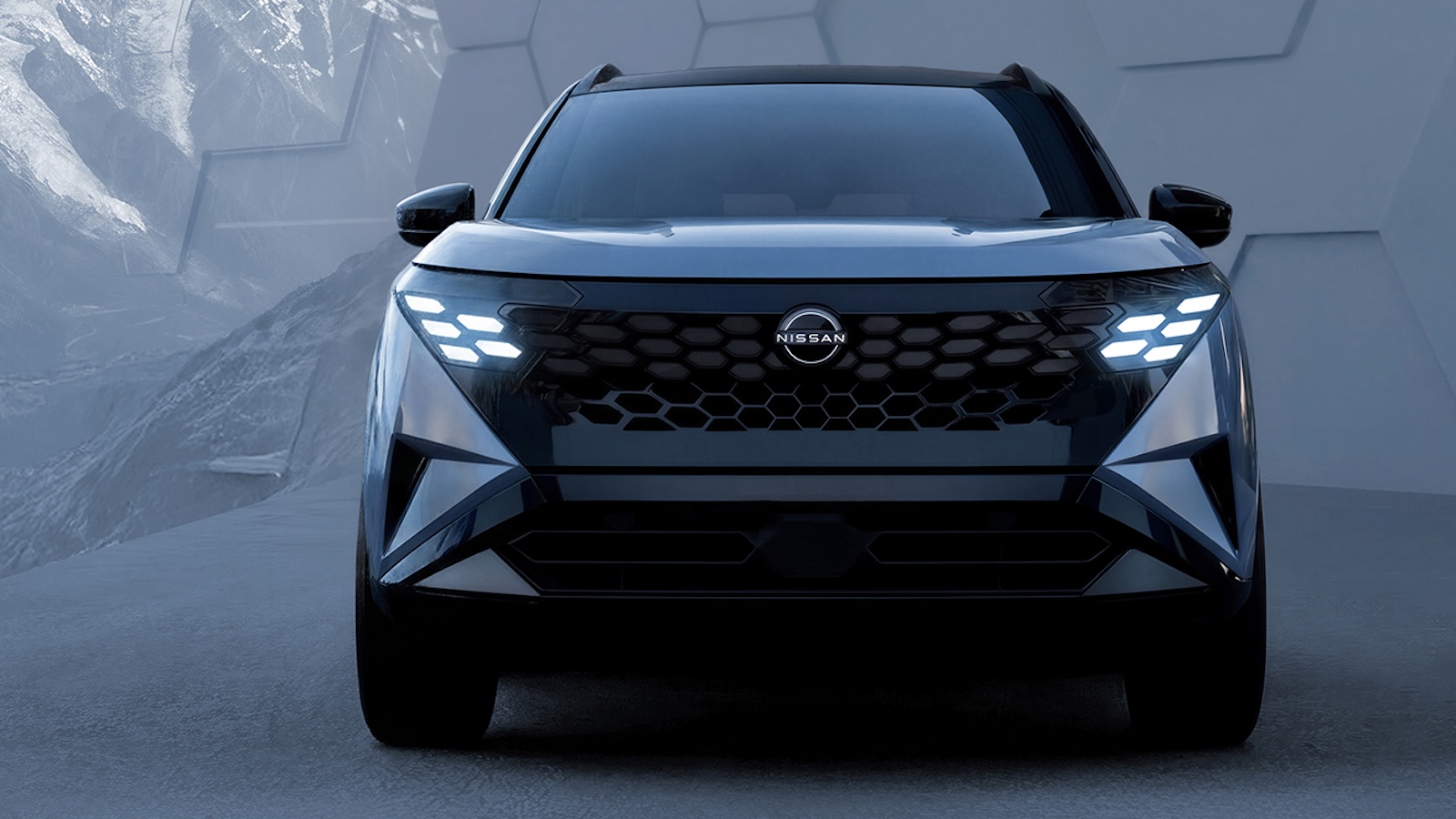
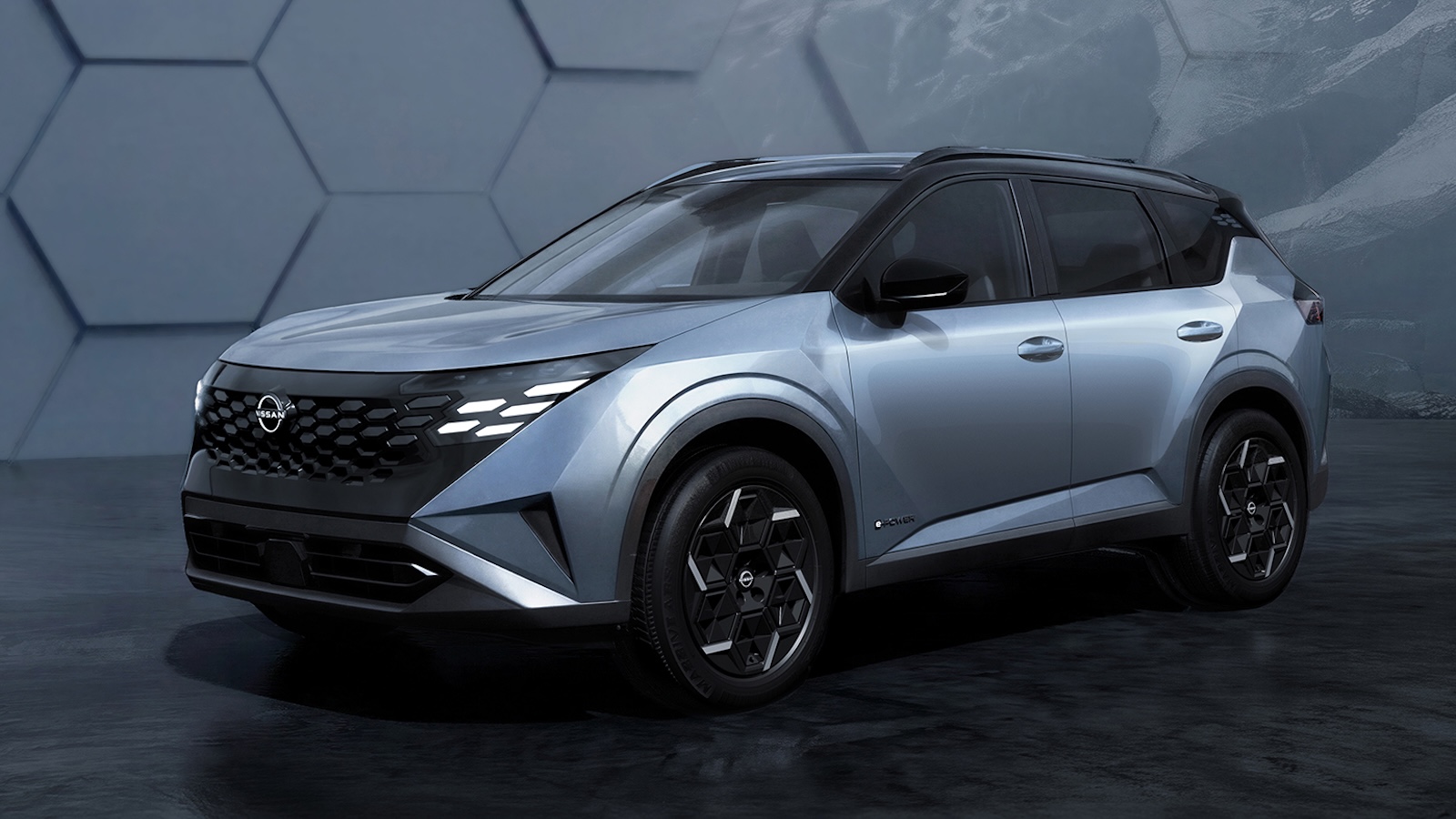
While the outgoing Nissan Rogue was basically the second C-segment crossover to adopt a split headlamp treatment, this fourth-generation model is over it. Instead, it gets chevron-shaped clusters either side of a glossy black grille. Admittedly, there is a whiff of supersized Lexus Darth Vader-face to the grille’s general graphic, and some Kia Sportage who-stole-my-face? to the sheer size of it, but the various hexagonal inner elements help deflect from that.
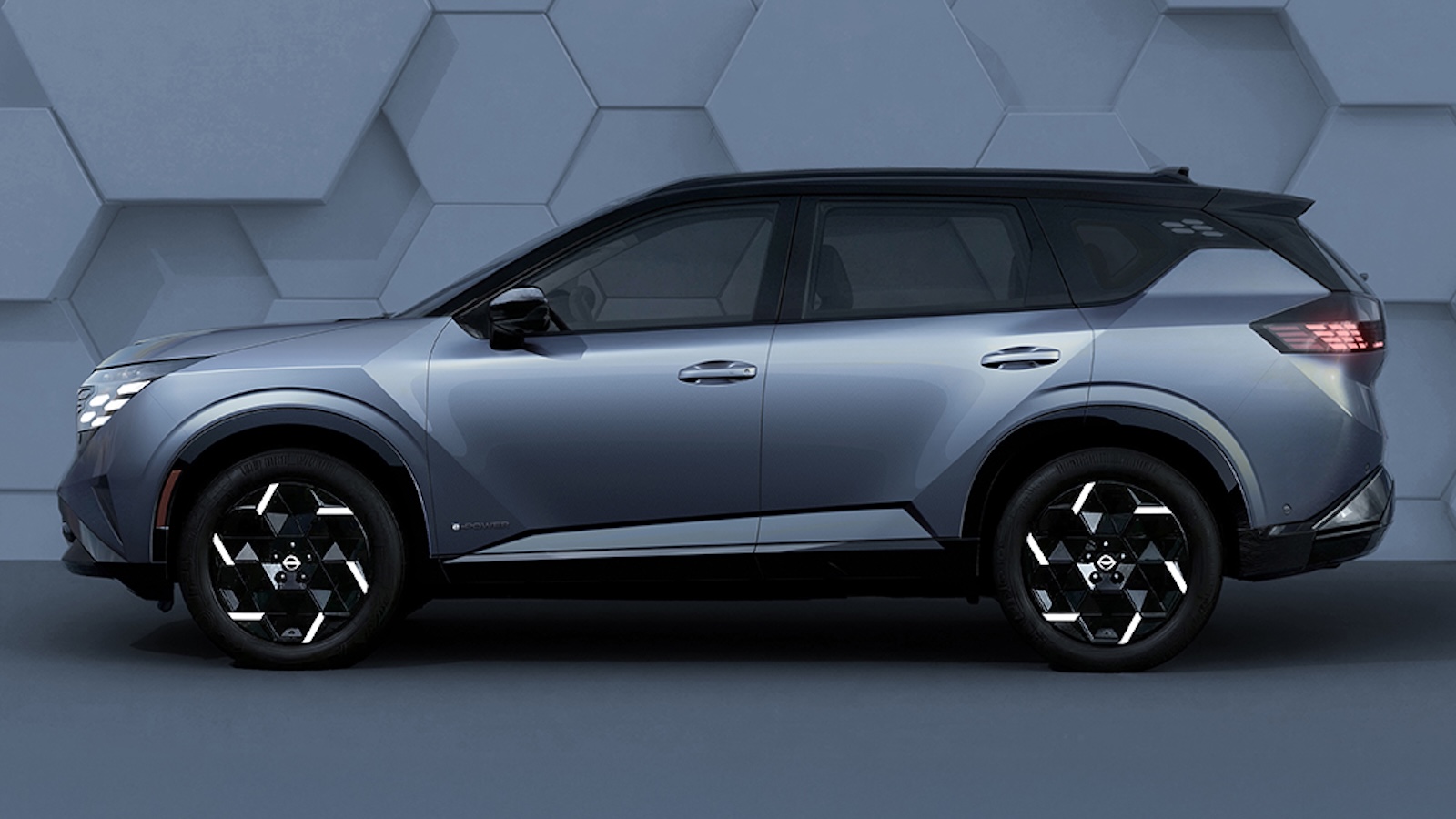
Around the side, the next Nissan Rogue continues to shake off the image of old with some rather daring surfacing. That harsh diagonal line down the quarter panel and door almost make this crossover look like it’s molting, with similar angularity to the front fenders attempting to balance things. Love it or hate it, this thing won’t be confused for its predecessor in a parking lot.
Actually, context might be the most fascinating thing about the new Nissan Rogue because the outgoing model was something of a weather vane. While competitors’ next-generation design freezes were likely in place when Nissan’s third-generation compact crossover went on sale in 2020, it was one of the first compact crossovers to get markedly more blocky. From Chevrolet to Toyota, almost everyone else seemed to follow. The big break from this trend? The chrome-faced, geometrically-surfaced Hyundai Tucson. Come to think of it, maybe the weather vane’s changed.
There’s still a lot we don’t know about the new Nissan Rogue ePower. What the interior’s like, how powerful it is, what sort of fuel economy is expected, and how much it will cost. However, by ditching the CVT and going hybrid, Nissan will finally have a rival for the new Toyota RAV4, the Honda CR-V Hybrid, the Hyundai Tucson Hybrid, and the Kia Sportage Hybrid. This thing might be late to the party, but it’s still exactly what Nissan needed.
[Editor’s Note: Apologies for the brain flatulence. This system is, of course, a series hybrid, not a parallel hybrid, as the engine does not drive the wheels directly. Sorry about that, and thanks for pointing it out.]
Top graphic image: Nissan




I actually like how it looks and I hate most new cars. That diagonal line at the rear wheel well looks awesome, in profile anyway. I also like the line above the front wheel and how it splits into 2 diagonals.
Wild west of hybrid strategies going on from Japan automakers and HK. This operates differently from Toyota’s 3 (?!) which is different still from Honda’s. And HK’s is like which one? I can’t keep track anymore.
This looks like a Hyundai design from 5 years ago
Genuinely brilliant in powertrain, especially for Nissan. Not only does it fix their biggest Achilles heel, it removes a whole maintenance component period. As batteries get more energy dense, all they need to do is add a plug and suddenly it’s an EREV making this platform more futureproof than their competitors. Absolutely brilliant
A plug and a much bigger battery of course. But yeah, same motors and potentially same ICE.
I like Nissan is always pushing new things or technology that differs from the competition but their quality is not there, similar to Stellantis great ideas but results are not good. First was CVT across the board, air cooled batteries for their mainstream EV, then the variable compression engines, now the series hybrid when everyone follows Toyota formula.
I wish them good in this new chapter, they had great product ideas in the past that worked good, they just need to do more long term testing to assure their product is ready. Bring back the Nissan Quest and Maxima you cowards lol
Cool! So if they add a bigger battery and a plug do they have an EREV?
Yup!
I can’t help but feel like this is kneecapping an EREV’s best features. Which is efficiency gains at scale.
Small econoboxes are already strung-out for efficiency on their ICE engines. So while this system pays dividends in city traffic, you’re not gaining much in steady state cruising.
Now, if you take a large SUV or full size truck, which is using a hulking V8 to cruise around so that towing power is always on tap, and you downsize the generator, then you’ve got gains.
The numbers I’m really keen to see are the Ramcharger EREV platform when it launches. I wanna see it stacked against the Hemi and Hurricane in a towing test. Not just in the mountains, but on the flat lands where you need a lot less oomph to cruise.
This is why I also hold on to hopes of one day sliding an Edison Motors series hybrid chassis under my Excursion. 60kWh pack with a 2.8L diesel generator? Perfection.
You’re looking at it in the wrong direction. This is a platform that runs on EREV principles but acts like a standard HEV for the consumer. As the consumer gets used to plugging in, they can add more battery to this platform but not have to change a lot of packaging or hardware to turn it into a PHEV or full EREV, especially as battery technology allows them to get denser batteries. This platform and design is Nissan future proofing themselves
I think you’re right that most of the gains are in city = which is where a lot of people spend their driving miles. E.g. 48 mpg city / 52 highway / 50 combined is a significant improvement over 30/48/39.
The rest though is a different use case than this vehicle, about towing rigs. Very horse/courses.
That’s my whole argument, though. This use case isn’t where this tech shines the best.
OK, I see that. Maybe it will shine enough, though.
I can’t help but think you are going to be disappointed in EREV (or series hybrid) performance in highway and especially highway towing comparisons with conventional ICE powertrains, or even parallel hybrid powertrains. Any kind of hybrid or EV powertrain is going to have the most advantages when there are frequent opportunities for regen braking. Even though an EREV or series hybrid can always run the ICE at peak efficiency, you still have to use it to turn a generator to make electricity to then use that electricity to power the actual traction motor, or even worse charge the battery and then use the battery later to power the traction motor. Lots of opportunities for conversion losses versus powering the wheels directly from the ICE with only transmission losses which both ICE powertrains and parallel hybrid powertrains can do. With modern bajillion gear auto transmissions, even conventional ICE powertrains can run at close to peak efficiency most of the time on the highway. EREV and series hybrids are mainly a way to have an EV without the range anxiety on road trips. They are unlikely to save you money on your road trip though. (Which is very similar to EVs on a road trip given the relatively high fast charging costs)
Oh, the savings on the highway are always going to be marginal compared to in-town. Hell, the fuel savings of doing an average commute on electrons alone could offset the cost of running a larger engine on a gas truck with lower payments.
But you still gain the efficiency of running a SIGNIFICANTLY downsized generator, instead of trying to make a big cube engine efficient. The electric motors have all the power you need, and appropriate programming to always leave enough in the pack for occasional high demand pulls like hills.
I sure hope that particular efficiency gain pans out in practice. I see your point, though I remain skeptical on the practical execution front.
If it has 250hp, gets 325 miles range and has AWD for less than $40k, I think they might have a winner on their hands.
The range is irrelevant, it’s not a plug-in. Just put gas in it.
That’s a different type of vehicle. That’s more EV, this is more very efficient hybrid ICE.
By the description, it sounds like this thing isn’t a parallel hybrid at all, but a series hybrid. If there’s no physical connection from the engine to the wheels at any time, that’s series.
Like a train.
I worked at a company that made bus bars for trains, to carry those huge electrical loads from generators to motors. You’re talking, IIRC, three-phase stacks of FR4-copper-FR4-etc, with the copper being quarter to half inch thick by six inches wide by at least twelve feet long.
There was one reeeeeally long heated press to laminate those.
This seems totally acceptable to me. If they somehow offer a powertrain that competes well with the RAV4, and make it more available and undercut it slightly, they should sell a ton of these.
I will say, the current Rogue, while certainly not super appealing, doesn’t totally suck. The Ghosn one that came before it (like basically everything Nissan did in the 10’s) was a POS.
Overall, the Nissan lineup is almost pretty decent now? Never thought I’d say that again.
The current Rogue is a genuinely nice car other than the transmission. I had a base one as a rental not that long ago and the interior quality punched way above its weight, the turbo 3 cylinder had enough punch down low that it felt peppy (it promptly runs out of steam but if you’re living between 20-45 mph or so like most people are it feels fairly quick), it has plenty of space, and no matter how hard I flogged it (since it was a Nissan I felt obligated to, you know?) it never got lower than 28 MPG.
It’s far from a penalty box, but the longevity concerns with the CVT are real. This does away with those, ups the efficiency, and probably ups the acceleration. If the interior is as buttoned down and spacious as the current one this is going to be a genuinely good car.
I had a Nissan Rogue rental not too long ago and came to almost the same conclusion as you. I wasn’t expecting much at all and what struck me was that the interior was quite nice and the ride was almost shockingly well composed with a really good blend of comfort and body control. The turbo three, while a little crude, was competent and offered a perfect amount of grunt for everyday driving.
When I had to return the car I remember thinking that everything I disliked about the car would be solved if it was an EV. The ePower gets us awfully close to that, now that the engine is effectively decoupled from the power train. Generally I rank transmissions MT > None > (most) ATs so I consider the lack of transmission a massive upside. As long as Nissan doesn’t botch pricing I think they have a hit. Rooting for them.
I’m still unclear whether or not the Jatco Xtronic CVT (do I have to say it 3 times for him to appear, like Beetlejuice?) sucks still, or if it really was a matter of everyone being mislead (to be fair, by Nissan themselves) that transmission fluid changes weren’t necessary. But I’m sure other like myself would prefer to not find out for themselves.
Nissan getting their groove back slowly but surely, is good for all of us. At the minimum, we need the leverage when walking into the Toyota dealer.
Our local airport Enterprise had a ton of Versas – I guess being an economy car but a decent size let them cover a few segments with a single vehicle.
In any case, I had a few over a couple of years traveling for work (over 100 miles I had to rent a car instead of taking my own and collecting mileage). The first was a 2017 or 18. I made it an hour before my butt was sore and my lower back hurt.
The next couple, though, were brand new cars in 2021-2022. Completely different experience – surprisingly comfortable and a perfectly acceptable car.
Yeah it’s similar. The Versa of 10 years ago was punishment. The last generation (RIP) was a decent little commuter.
Perfectly cromulent. I’m sure I’ll see one being antisocial in traffic soon enough.
The target customer for this doesn’t care at all about the details of the hybrid system. What’s important is the fuel economy numbers when they come out. If they’re somehow able to get decent highway mileage out of this it will be very impressive.
I think this is likely to be very comfortable and quiet which will translate to sales
Are you kidding me
Sorry for your trouble. Thoughts and prayers.
Yay! Jatco is back!
Not gonna lie as soon as I saw that in the article I raced to the comments to check for them, and I’m so relieved they’re here.
Just like Jatco: better late than never. Or early. Actually, you know, they’ll find the right gear in time.
Maybe.
EAT IT JATCO YOU HAD YOUR CHANCE
I’m sure you can commiserate with Ford Powershift; they get it.
Username: Series Hybrid fka Jatco-X-CVT
“The transmission formerly known as Jatco Xtronic CVT”
This is exactly what the 4th gen Rogue needed to be. Nissan already said they’re projecting over 40 mpg which if they achieve will be very impressive, especially from a series hybrid system. I’d say appearance-wise it’s about on par with the CR-V. Restrained and maybe a little plain but boxy and handsome enough to not feel dated in 5 years (looking at you Hyundai/Kia). This will definitely help Nissan continue to sell 200,000+ units a year.
Now show us more of that Xterra, Nissan!!
Give me some knobs and buttons instead of just a big, fat touchscreen and I might actually walk into a Nissan dealership to take a look.
You need look no further than the interior of the new Leaf to imagine where the interior design of this Rogue is heading.
Woof!
Seems dumb. Just license the best hybrid tech from Toyota/Ford and do it properly. Ford’s barely even using it at the moment. Be interesting to see what this gets for fuel economy in the real world vs. the performance on offer. My bet it it’s either notably worse, notably slower, or both.
I’m sure I will get stuck with one as a rental eventually. Yeah.
Ward’s likes the tech, and bested the current drivetrains economy in mixed driving
https://www.wardsauto.com/news/nissan-e-power-review-hybrid-power-set-to-amp-up-2027-rogue/814010/
38 mpg in city driving isn’t competitive when the RAV4 is certified at 47 mpg city.
Mixed driving with a highway burn vs a specific city route.
A. 38 mph average speed.
B. In other markets the Nissan X-Trail e-Power is certified at 6.1 L/100km while the RAV4 hybrid is 4.6 L/100 km
A. The average speed in my Sorento shows 68km/h, despite half my commute being being on a highway at 120.
B: The Qashqai e-Power managed under 4L/100km crossing the UK on one tank , so there’s pretty clearly some wiggle room in the drivetrain efficiency.
It seems weird that you have this setup where you have a battery but it can only charge from the engine, there is no option to plug it in at all. I get that not everyone can or wants to charge a car at home, but this eliminates the car as an option for people who do. They don’t even list the battery size on the spec sheet, just that epower option is a bunch heavier than the regular one.
Buy this petrol powered EV that you can’t charge from your solar panels. Simply go to a petrol station and.. oh. Oh no.
I feel you’re getting hung up on the series hybrid nature of this car. The current ePower system in the rest of the world has a roughly 2 kWh battery back. No reason to assume this next generation ePower will deviate much from this. Too small to make it worth it to add a plug. No one is asking to plug in their RAV4 or CR-V hybrids.
The RAV4 is one of the most popular PHEVs.
But the RAV4 hybrid (non-PHEV) sells in way higher numbers than the PHEV and it doesn’t have a plug. This Rogue could very well get a plug-in version down the road, but it’s clear that based on the current situation in the US it makes more sense for Nissan to launch this as a standard hybrid even though it’s possible to make a PHEV with it.
Toyota has been really stingy with their PHEV production numbers, I can only assume to keep transaction prices high. Also, I believe all the PHEV models are manufactured in Japan (Prius and RAV4) so Trump’s tariffs don’t help matters.
More likely they are constrained by battery supply.
We shall see if they’re just holding back on battery capacity for initial introductions, based on description of the setup: a larger battery would make sense to offer with a plug-in option.
It seems unimaginable that they couldn’t fit in a 10 kWh battery to get a lot of people’s commutes gas-free.
Knowing production lines of other automakers, I’m guessing that they feel the regular hybrid will be the volume production so get it released first and get it in front of people.
And I’m certain there’re some technical or commercial issues they need to sort out with the larger battery (hopefully it’s just final testing)
They could but then it would be priced higher. The RAV4 Hybrid starts at $31,900 and the PHEV at $41,500. Even in my situation where gas is normally $3.50 and I can charge at 9 cents / kwh I can image that math works to pay almost $10K upfront so save
Even at $4 a gallon the entire fuel cost for a RAV4 hybrid is only $1,400 a year.
It’s cost plus the thing expressed by ¿Toyota as 90:10:1 (or numbers like that).
The 90:10:1 ratio only matters if there was a limitation in battery supply. Right now there is an oversupply.
It indeed applies to what vehicles can be produced when availability of batteries are limited. But even in the event of easy availability, it applies to the cost of the vehicle. Others here have pointed out $10k price differences between HEV and PHEV versions of the same car. Even if $2k of that is attributable to a forced trim level step up, it is still a lot of money.
Also, it is 10x or 90x times the amount of lithium that is used, and that lithium is a card in global politics.
No doubt more batteries cost more money but Toyota’s 90:10:1 ratio is bogus as a supply chain limitation.
It’s not really weird, as that is the case for a normal hybrid vehicle. Small battery whose main function is storing regenerated energy from hills or traffic, not big externally filled storage. The difference here from a normal hybrid is that it is a series hybrid rather than parallel, so in heavier load/speed conditions when a normal hybrid would be applying the power mechanically to the wheels, here it is still being driven electrically, and the battery may be there but mostly the ICE runs the generator/alternator (whichever) which powers the motors, like in a diesel train.
The difference is why it’s kinda weird though, they’ve gone to all this work to make basically an EREV but then take out one of the main selling points of it. I get that it’s cheaper to sell this way and they could maybe change it for a future model, but it just kind stuck out to me.
The series hybrid system is unlikely to be more efficient than Toyota or Honda’s hybrids at highway speeds, but maybe it’s an acceptable compromise to effectively not have a transmission at all and thus not have it be a source or unreliability.
If the Rogue beats the RAV4 hybrid in real world highway MPGs, it’ll likely be due to the latest RAV4’s notably worse aerodynamics than the previous gen rather than the Rogue’s powertrain.
The current X-Trail (Rogue) e-power gets worse economy than the RAV4 – not having an option to directly drive the wheels from the ICE at highway speed, where an ICE is most efficient, would be a cause. Nissan’s hybrid system’s main selling point is having an EV-like driving experience. If you don’t have access to charging points where you live, this could be a compromise.
In other markets the Nissan X-Trail e-Power is certified at 6.1 L/100km while the RAV4 hybrid is 4.6 L/100 km
Other markets fuel economy ratings are far more fantasy-land than ours. I will believe it when I see it in the real world. Every time I have had a rented Toyota hybrid, I have gotten at least what it says on the tin, and often a bit better. YMMV.
And even if it’s better – it’s still a Nissan. No thanks.
Yes, YMMV but certifications are an apples to apples comparison between vehicles.
EPA has adjusted the fuel economy formulas so much that I find it is easy to beat EPA in pretty much anything I drive.
EPA at this is reasonably indicative of what most people will get in the real world.
I find that particularly for the Euro testing, it tends to exaggerate differences and automakers absolutely “teach to the test” in thier drivetrain tuning. There are tons of cars that do very well on the test and not so great in the real world. I expect this will be one of them.
Not terrible at all. I rented a current model base Rogue over the holidays and it was perfectly inoffensive and actually quite nice to drive and be in. Nothing exciting but that wasn’t what I was looking for either. If it makes good mpgs and doesn’t have the (what seems to be improving anyway) stigma of its past CVT issues then that’s all the better. Without Hyundai/Kia’s dealership baggage and Toyota’s take it or leave it approach this could be a very big success amongst those who just want a reasonably priced, efficient vehicle to get through the daily grind.
Typo:
“Let’s start with the big news: The Nissan Rogue ePower, on sale later this year, uses a parallel hybrid setup that Nissan calls ePower.”
It should say series hybrid, not parallel.
I guess this is what passes for attractive nowadays, but I don’t think it’s almost interesting. I’d like to see Nissan succeed and this isn’t a bad sign.
Will this replace the Mitsubishi Outlander-based Nissan Rogue Plug-in Hybrid? 2026 deserves to be that car’s only model year.
It’s okay, I guess. It’s no XTERRA LIKE YOU KINDA HINTED IT WOULD BE AND NOW I HAVE TO GO SCREAM INTO A PILLOW FOR AN HOUR, but I suppose it’s fine GODAMMIT I WANTED A NEW XTERRA AAARGH WHY CAN’T WE HAVE NICE THINGS I KNEW NOTHING GOOD COULD HAPPEN ON THE 13TH for its intended audience XTERRA! I WANTED AN XTERRA! who will appreciate the efficiency and distinctive styling of this perfectly cromulent hybrid crossover-y thing.
So what are your true feelings about the XTerra? Sounds like you might not be a fan.
Maybe next time DialXforXTerra.
They actually released teaser pics of a new XTerra and said it’d have an all-new V6 and V6 hybrid as engine options.
Be glad it’s not an XTronic XTerra.
I….kind of like it?
Not bad.
Not bad at all.