


You’ve already seen the new global look of the 2027 Hyundai Tucson, which was revealed earlier this year. Like most new Hyundai models, the design is bold without being shouty, unique without being offensive, and premium-looking without making you worry that Patrick Bateman is about to chop you up under the cheery tones of Huey Lewis and the News.
The Tucson has to find a way to stand out against the Honda CR-V and Toyota RAV-4, which are the perennial favorites in this class. Japanese automakers have found success by rounding off the edges, growing a little bit bigger, and offering enough trim levels to make Malcom Gladwell blush. Hyundai is mostly following the playbook, albeit with a less toned-down visual presence.


To me, the hybrid is the model to get, and with a predicted 42 MPG in the FWD layout, it’s a little more competitive with the class leaders.
It Looks Butch To The Max

The Tucson is launching with a bevy of trims, each with their own moderate distinguishments. I’m focusing on the hybrid because I liked the previous model when I drove it, and all roads lead to hybrids these days.
While all models have those big, deep fenders as part of the “art of steel” design language guiding Hyundai’s aesthetic choices these days. The company’s press release calls it “The Boldest SUV” and it’s certainly bolder than the outgoing model. It’s also 60 mm longer, 40 mm wider, and 20 mm taller.

The most obvious difference between models comes at the front, where the space between the ‘H-Edge’ lighting signature is either filled below the hood line (as on the hybrid), open as on the non-hybrid, or offset with a shaper nose as on the XRT Pro.
By the time you’re reading this I’ll have been transported by boat to the reveal, so I can append my thoughts on the visuals with non-studio shots. It looks good.
The Interior Also Delivers
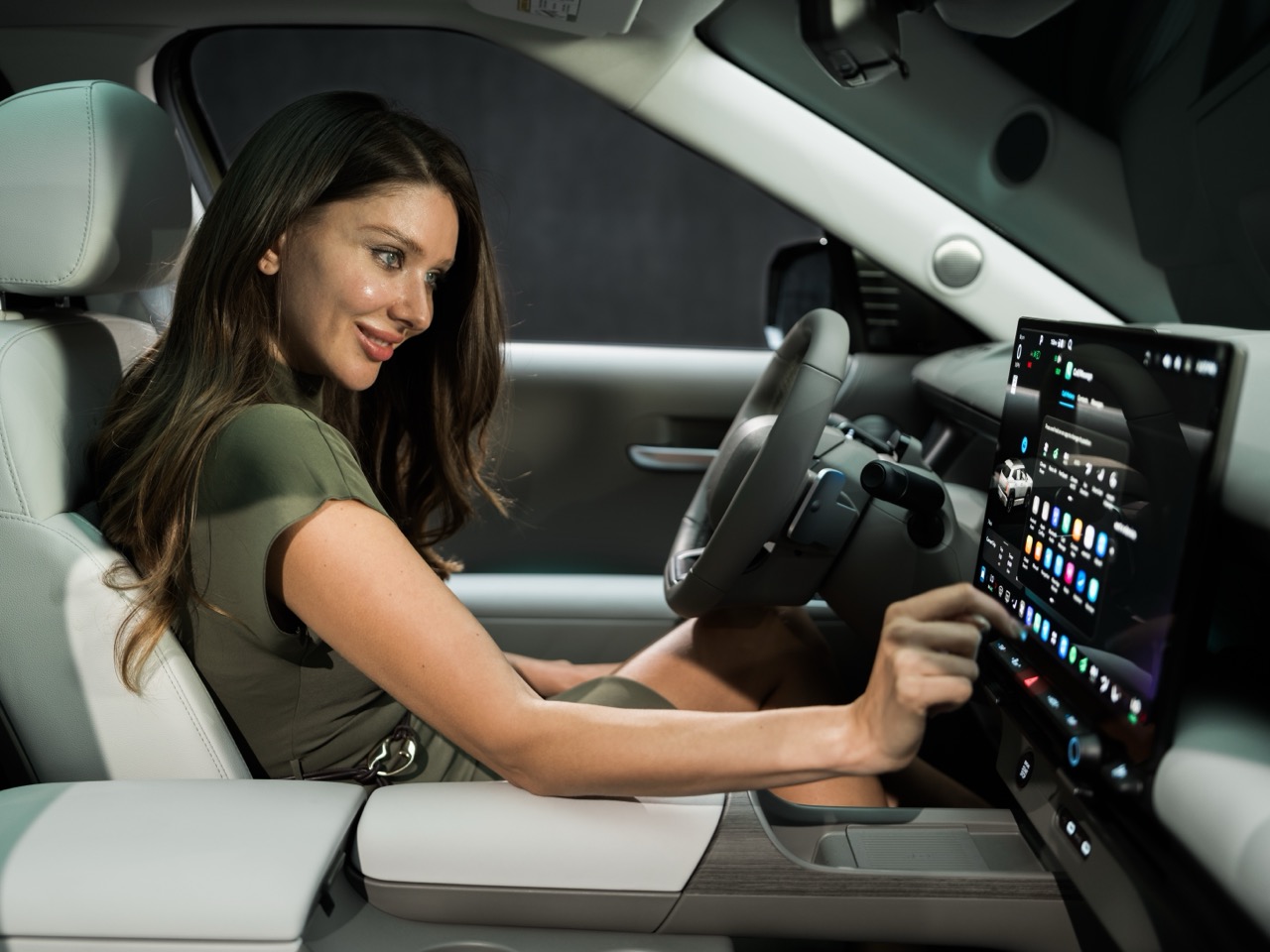
Look at how happy this woman looks! There are buttons. Actual buttons. Yeah, there’s a huge center stack screen and a smaller one for the driver. Buttons. The press release even goes out of way to say there are buttons and knobs:
The Double D-Cut steering wheel pairs with a 9.9- inch slim display above the steering column to keep the driver’s visual field uncluttered. Below the center stack display, tactile buttons for frequent-use features including HVAC and audio settings provide intuitive control without the need for distracting screen-tapping while driving.
Hyundai bolded the buttons thing, not me. They believe in buttons.
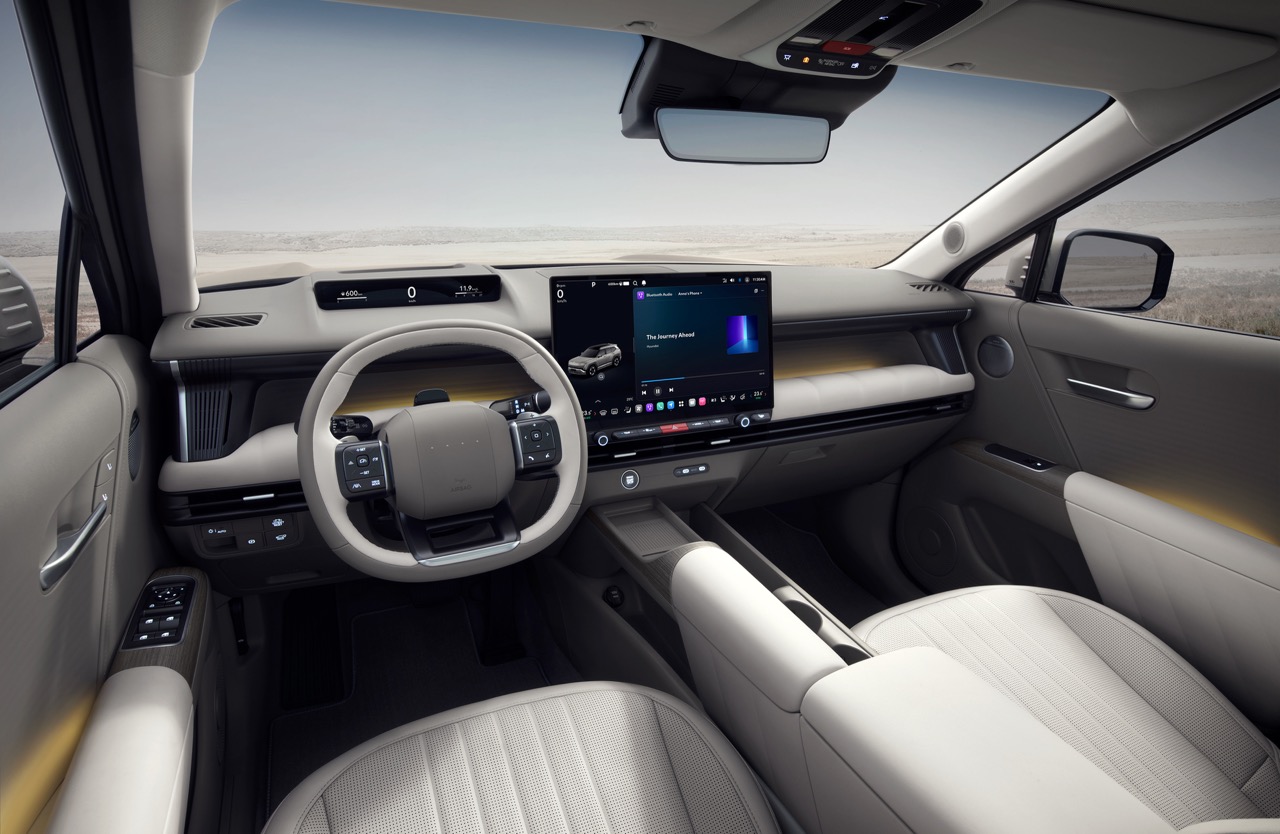
I don’t mind the little screen high on the dash. More automakers are going this direction, and you shouldn’t be staring at a gauge cluster. The limited amount of information in that screen is probably all anyone is ever going to need.
Here’s another woman excited about buttons:
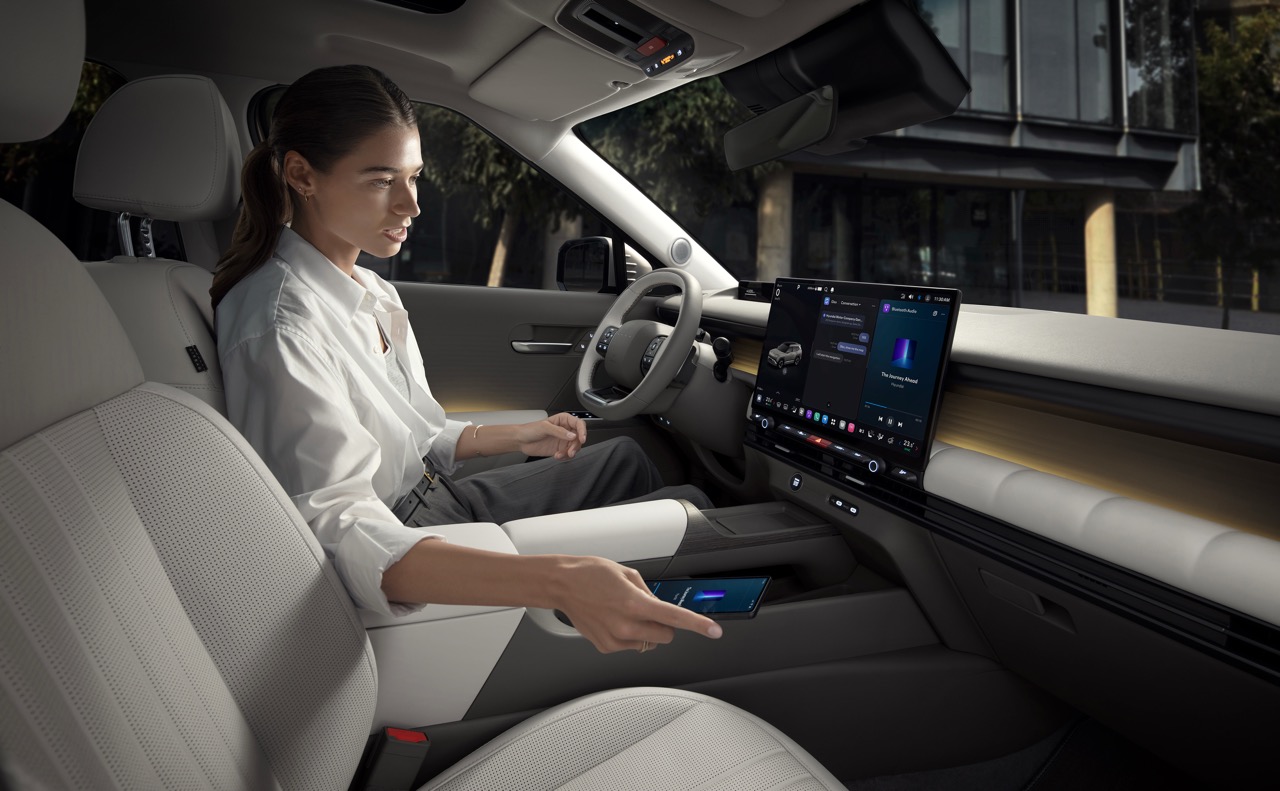
Maybe she’s more excited about pairing her phone. I’m not sure. I’m going to assume it’s the buttons.
What Hyundai has done here is create an interior that doesn’t have too much going on, nor too little. The shaping on the dash pad feels exaggerated here, so I’ll have to update you on how it feels.
The Hybrid System Is Improved

The hybrid-only RAV4 gets 43 MPG combined in hybrid form. The FWD Honda CR-V gets 40 MPG combined. Hyundai only says that it’s targeting 42 MPG out of its FWD version with 17-inch wheels, though it’s not clear if that’s combined or city. Either way, it’s going to be an improvement over the outgoing Tucson, which doesn’t crack the mid 30s.
Here’s what the press release says:
Targeting up to 42 mpg12 and 0–60 mph acceleration in 8.5 seconds, this hybrid powertrain proves that leading efficiency no longer requires compromising performance or refined everyday drivability. The E-Traction system, applied exclusively to HEV models, further enhances handling performance by intelligently optimizing driving torque to reduce wheel slip during cornering. By increasing innertire grip, the system improves vehicle stability and control at the handling limit, contributing to a more precise, confident and refined driving experience. The class-leading HEV Stay Mode enables drivers to run features including air conditioning, heating, audio and device charging while the engine is turned off, creating an EV-like in-cabin experience that enhances quietness and comfort during breaks, outdoor activities or waiting periods.
If you’re looking to plug-in, the PHEV version returns with an estimated 81 km (or 50 miles) of range, which is about the minimum these days to feel like a competitive PHEV.
Say Hello To… Gleo?
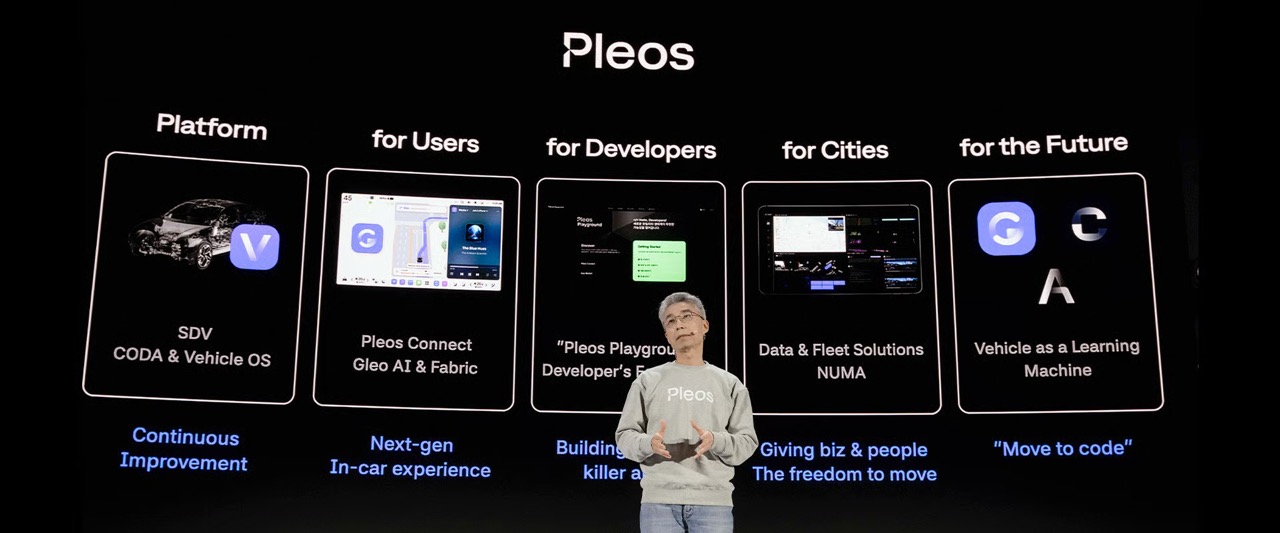
If I ever say “Hey, Gleo” to a car, just know that I am doing it ironically. It is a bit. It is not sincere. How do I even begin to explain why there’s a whole press release devoted to Gleo and Pleos? The short version of this is that what Chinese automakers, Tesla, and Rivian all exposed was that letting a bunch of disparate suppliers provide the brains for your car probably is a bad idea. That, in the future, cars would be “Software Defined Vehicles” or SDVs, and the way a car performs becomes less important than how you interact with it.
Maybe! That seems to be happening in China to some degree, where consumers like talking to their cars and having AI agents. Most automakers seem to think that’s the future in the US, and I’m open to the possibility.
For Hyundai, this means Pleos Connect, which is the overarching name for the SDV platform. This Android-based system will do a bunch of sensible things, like harmonize communication within the vehicle, and some flashy but maybe ultimately unnecessary things like having you talk to your car, oh, and your car is named Gleo.
Gleo AI can assist with navigation, compatible vehicle controls and information requests while providing context-aware responses and a more natural conversational experience. The system is designed to understand conversational history, helping customers complete tasks and access vehicle functions through everyday dialogue. U.S. customers can activate the assistant using either “Hey Gleo” or “Hey Hyundai” wake phrases. Regular software updates will help Gleo AI to continue to evolve and improve. Gleo AI availability may vary by model and trim level.
Even Hyundai can’t fully commit, and the version of this in the Tucson will also allow you to just say “Hey Hyundai” as a “wake phrase.” Some firm or agency was probably paid more money than you will ever see to come up with the name Gleo, which is a thing to remember when it’s probably discontinued in a few years.
The Important Stuff
When is the car going to launch in North America? Uh, next year. I don’t know more than that. What will it cost? I also can’t answer that, but probably more than the current one by a small but not-too-small amount. I will be offered cocktails and a ride on a ferry in a few minutes, so just know that in between the cocktails and the boat ride I will maybe ask these questions/
Top photo: Hyundai


Is it? I’d rather have a car (or frankly life) with no AI whatsoever and this thing is so damn overstyled it borders on nauseating. There’s also something very cringe to me about cars that look like off-roaders but don’t have any capability. Anyway, I liked Hyundai and Kia’s styling a lot more 5-7 years ago when their designs were quirky but not over the top. The OG Kona, the Veloster with its odd layout, the Stinger, etc.
I remember being very confused when I saw a Kona for the first time in the 20-teens, being like “huh I kinda want that” and realizing it was a Hyundai. Same with the Stinger. Anyway, their current “too much too much” cyberpunk deal is just not for me. I’ve been trying to convince the wife to consider a Palisade or Telluride hybrid and every time we see one she’s like “I don’t want to be seen in that”.
And you know what? I got nothing. Design for the sake of design never seems to work out well. Clarkson’s description of the FL5 CTR as the “the car they wouldn’t stop designing” is evergreen and fits this perfectly….
The Korean automakers have really been styling their cars Koreanly lately after mostly refraining from doing so for a decade or two.
Yeah, well, my brain says it looks ridiculous and is full of AI crap. No amount of mpgs will change that.
Did they really name that steering wheel “double d cut”
I’m waiting for the exterior graphics to finish rendering
It looks like the old one that they tried to graft a frunk onto.
It looks weird on the outside.
Too much screen on the inside. Is it a vehicle or a home theater?
It’s a Hyundai.
Three strikes.
“consumers like talking to their cars and having AI agents. Most automakers seem to think that’s the future in the US”
I can’t believe that this is going to be true. People hate talking to robots, and I certainly don’t want one riding in my car.
Free cocktails and a boat ride….sign me up.
Soooo the lady in the first picture appears to have her legs crossed. I have never tried that, but imagine it would be…
You can only pull off that party trick if a) you’re under 4’10, and b) you have the BMI of a doctor’s office display skeleton. Otherwise it is officially discouraged.
“Hey Gleo”
– Professor Frink
Is Hyundai/Kia still using a DCT in their hybrids? It’s not a cost savings when I have to do a DCT clutch job of my hybrid