


555 Horsepower. 1230 lb-ft of torque. 8.3 liters of turbodiesel glory. The new Chevrolet Silverado HD may share its body with the 2026 truck, but this mid-cycle update is a big deal: It brings with it the Mongoose, the biggest diesel engine ever offered in a heavy duty pickup, and one that can tow an outrageous 38,000 pounds. Here’s what it was like to drive.
If there’s one thing that heavy duty pickup truck brands enjoy, it’s oneupmanship. If you look at the last 15 years of torque figures, it’s really been Ford and Ram duking it out. In 2011, the Ford Super Duty’s 6.7-liter Power Stroke was the first HD truck to hit 800 lb-ft of torque — a monumental figure at the time. Ram caught up in 2013 with its 6.7-liter Cummins, while Chevy’s 6.6-liter “LML” Duramax hung out at 765 lb-ft all the way until 2017.


Chevy released the 910 lb-ft L5P Duramax in response, though by then, Ram’s Cummins had jumped to 850 lb-ft, 865 lb-ft, and then 900 lb-ft — just 10 lb-ft short of Chevy. Ford had countered Ram’s 850 lb-ft with a new 860 rating, and then when the Ram jumped to 900 lb-ft and Chevy jumped to 910 lb-ft, Ford went up to 925 lb-ft. So in 2017, Chevy was now no longer dead last; it was second.

But that didn’t last long, because the following year the Ram’s Cummins’ output elevated to 930 lb-ft. That same year, Ford’s Powerstroke’s output went to 935 lb-ft. In 2019 the Ram made 1000 lb-ft; in 2020, Ford’s truck made 1050 lb-ft; and then in 2021, the Ram started making 1,075. All the while, Chevy stayed at 910 lb-ft.
The Bowtie’s L5P got an update in 2024 to bring torque up to 975 lb-ft, but that was still short of Ram’s 1,075, and it was in this year that Ford’s figure jumped all the way up to 1,200 lb-ft.
This is all to say that Chevy has been in third place in torque every year for the past 15 years, except 2017. Which is why 2027 is such a huge deal: Chevy decided to go nuclear.
[Full Disclosure: Chevy flew me to Tucson, Arizona, and fed me lots of steak. It is the diesel of human food, and afterwards I could feel the torque coursing through my veins; I snapped a 1/2-inch bolt using only my fingers. -DT].
A Close Look At The 8.3-Liter Mongoose V8 Diesel
I’m feeling sick tonight, so this won’t be one of my patented 4,000 word deep-dive reviews, but let’s see what I can get cranked out before I pass out.
As I mentioned earlier, the current L5P has been around since 2017, receiving an update in 2024. In reality, that engine’s architecture can be traced all the way back 2001. “We’d stretched that architecture as far as it could go,” Rob Moran, the Assistant Chief Engineer for the heavy duty diesel, told me at the press event in Arizona. It was about four of five years ago that Chevy began planning to bring out the biggest diesel engine ever offered in the heavy duty segment.

Though the engine shares some basic traits with the outgoing V8 — it’s a 90-degree V8, it has aluminum cylinder heads, those heads contain four valves per cylinder, there’s a variable geometry turbo in the valley, etc. — there’s quite a bit new here. For one, the block, Chevy says, is made of a new compacted graphite iron versus the outgoing gray iron. Per Moran, gray iron is the entry point for strength, nodular iron is the strongest (but harder to machine), and compacted graphite iron offers 40-50 percent more strength than gray iron and is more machinable than nodular iron.
I dug into this a bit, learning the following from the Michigan-based Metal Casting Institute, a website that “provides casting information, educational material, training outlines and linkage to technical resources.” From MCI:
Gray cast iron is the simplest, most common and lowest cost form of cast iron in the world. The iron microstructure is characterized by the “Flake Graphite” qualities in the forms of: a.) Type, b.) Size and c.) Martrix.
Gray cast iron has excellent castability and machinability qualities, making it a high value for parts that can be heavy. In addition, gray iron has superior damping and thermal heat transfer, making it excellent for automotive brake systems. While it is strong, it is also brittle.
Compacted Graphite Iron (CGI)is a recent addition to the family of cast irons. As shown by the image to the right, the graphite is characterized as a “vermicular” or worm-like structure. This graphite structure produces an iron with most of the properties being in-between the Gray Iron and Ductile Iron families of properties. Simply stated, CGI has nearly the same castability and wear resistance characteristics as gray iron, but with improved strength. Being able to use CGI for engine cylinder blocks allows thinner wall sections and lighter weight.
MCI goes into detail, discussing the significant advantages MCI has over gray iron, particular in engine applications:
While not quite as strong as ductile iron [which is the same as nodular iron], compared to gray iron properties, CGI is 75 percent stronger and up to 75 percent stiffer. It is also twice as resistant to metal fatigue as gray iron. However, significantly important for use in engine cylinder blocks, the graphite morphology of CGI was [determined] to have similar friction and wear resistance characteristics as found in gray iron.
Engine Applications
With all of the material properties taken into consideration, engine designers found CGI ideally suited for engine cylinder block manufacturing, where lighter and stronger materials are needed which can absorb more power and have similar resistance to bore wear when compared to gray iron. An assembled automotive engine can be made nine percent lighter with CGI. The engine block weight alone can be reduced by 22 percent. This corresponds to a 15 percent reduction in length and a five percent reduction in height and width.This weight savings is made possible by decreasing wall sections less than 4.5 mm thick, where the higher strength and slightly higher stiffness of CGI can be taken advantage of. Similarly, the bore walls and bearing block supports can be reduced in mass without losing the characteristics of gray iron as related to machinability, piston ring wear or noise damping.
Moran told me exactly the same thing: CGI allowed Chevrolet to reduce the block’s wall thickness without compromising strength, resulting in a block about the same weight as the outgoing one despite the new unit being 20 percent larger.
As for the engine’s size, Moran told me the displacement was an intentional way to reduce the specific output (horsepower per liter). This, he told me, lowers exhaust temperatures and pressures, yielding a less-stressed, more durable motor — a quality aided by the fact that the engine makes over 1,200 lb-ft between 1,400 and 2,000 RPM, meaning it can operate at low RPMs almost all the time.

Let’s talk about the new pistons. The outgoing ones were aluminum and the new ones are actually two-pieces of steel laser-welded together under the ring lands (this was done to accommodate a piston cooling gallery). Moran says the new pistons are “appropriately heavier,” though he notes that they’re thinner gauge than the aluminum ones in the outgoing L5P.

“We can run the steel pistons hotter than the aluminum pistons,” he told me. “That gives us improvements from a combustion perspective; it allows us to produce very clean combustion.”
Another change to the new L6P over the the L5P is that there’s now a variable oil pump that can strategically produce oil pressure based on demand, with Moran telling: “It allows us to dial in oil pressure to exactly what the engine needs. We also have electronically controlled piston cooling jets that allows me to cool pistons as needed…When the piston doesn’t need to be cooled, that’s heat that we’re not rejecting to the cooling system that has to go through the oil cooler, etc.”

That oil cooler, by the way, is a giant plate/stack-style heat exchanger now mounted to the side of the motor. The outgoing oil cooler was integrated into the oil filter like this:

Moran says the new heat exchanger has more plates and more cooling capacity than the outgoing one and was “specifically designed for towing 38,000 pounds.”

Moving to the cylinder heads — they’re similar to the outgoing ones in their basic design; they’re aluminum (great for heat dissipation) and they’ve got four valves per cylinder. But the L6P’s heads have integrated intake manifolds.

The outgoing 6.6-liter L5P’s intake manifolds were bolt-ons. Here you can see the intake ports:

And here you can see what the bolt-on manifold looks like (this is a top-view; the intake manifold is at the bottom, and would sit in the vee of the engine with the turbo, just like the current engine):
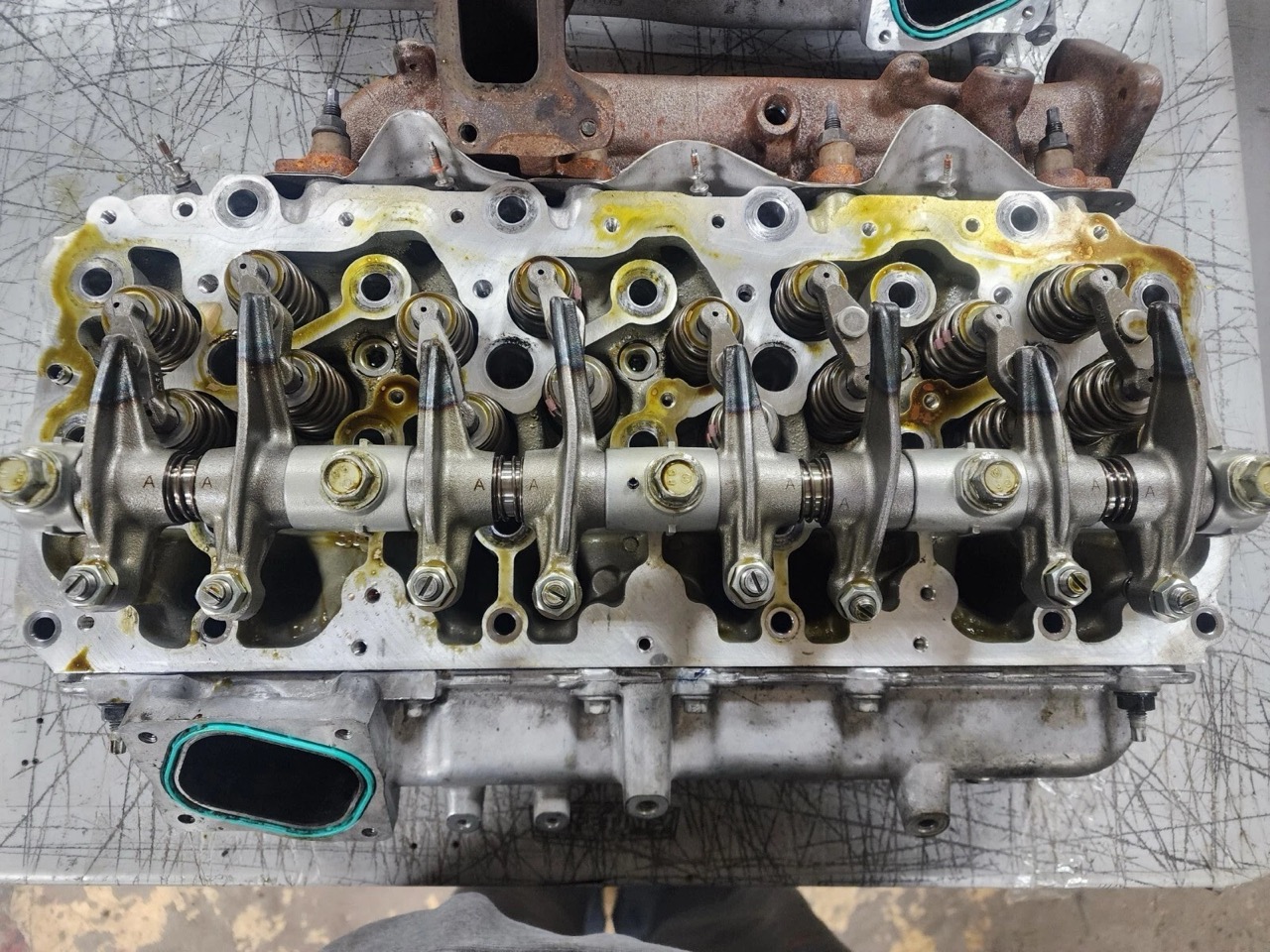
Moran didn’t get into the advantages of the integrated intake manifold, but I’d guess there are complexity, weight, and potentially thermal management/airflow advantages. Bolted to that intake, in the vee, is a huge turbo.

That larger turbo is spun up by the exhaust exiting the engine on the outside of the vee via two cast iron exhaust manifolds. After spinning up the turbo, some of the exhaust goes to an oxidation catalyst before continuing on to the rest of the exhaust aftertreatment system and some of the turbo’s turbine gases go into the EGR cooler.

The clean air that enters through the engine’s airbox is compressed by the turbo and then sent through two coolers — one liquid-to-air “knock down” cooler and one conventional liquid-to-air charge-air cooler.

If you’re curious what the inside of that knockdown cooler looks like, here you can see a bunch of tubes that the intake air travels through and that are surrounded by cold engine coolant. This is a called a “shell-and-tube” cooler, and in this case is made of stainless steel:

Once through the aluminum charge-air cooler, the air enters the intake ports, but not before being mixed with the appropriate amount of EGR to help reduce emissions.

As for the front of the engine, the alternator, engine fan (not shown), and ac compressor appear to be belt-driven. Otherwise, much of the accessory drive is gear-driven — including the oil pump, water pump, and fuel pump:

Here’s a look at the fuel pump, in case you’re interested:

The injectors are shown here on the right:

There’s a lot more to the engine, but I’m getting sicker at this review goes on, so I’ll leave you with Gale Bank’s look at the motor while I move on to the cooling system and exhaust:
There’s A Huge Cooling Module, And An Impressive Exhaust Aftertreatment

Before I get into the chassis, I’ll finish up talking about the engine ancillaries. The cooling module up front, for example, consists of a transmission oil cooler way at the nose, a condenser next in the stack, then the low-temperature radiator for the charge air cooler (and other things), and then there’s the high-temperature radiator for the engine and whatever else is plumbed into that system (I suspect the EGR cooler).

So that’s what’s in front of the engine. Let’s talk about what’s behind it: a sophisticated aftertreatment system. It begins with the oxidation catalyst I mentioned before. “That really cleans up any unburned fuel/any hydrocarbon coming out of the engine,” Moran told me, pointing to the blue and red wires going to a temperature and NOX sensor.

“Based on the data we get there, we come to our first [diesel exhaust fluid] injector,” he continued. “We dose the DEF here, it goes into the downpipe, mixes with the exhaust flow before we come to the first [selective catalytic reduction] brick.”

“The first SCR takes that DEF, combines it with the exhaust system, reacts to clean up the NOx,” he said, mentioning the larger DEF tank on the new truck compared to the outgoing diesel HD (up from 7 gallons to 9 gallons).
“Once we come out of the SCR, we double check the NOx where we are (he pointed to a blue wire) based on what we cleaned up in the first [SCR brick], before we go into the DPF.”
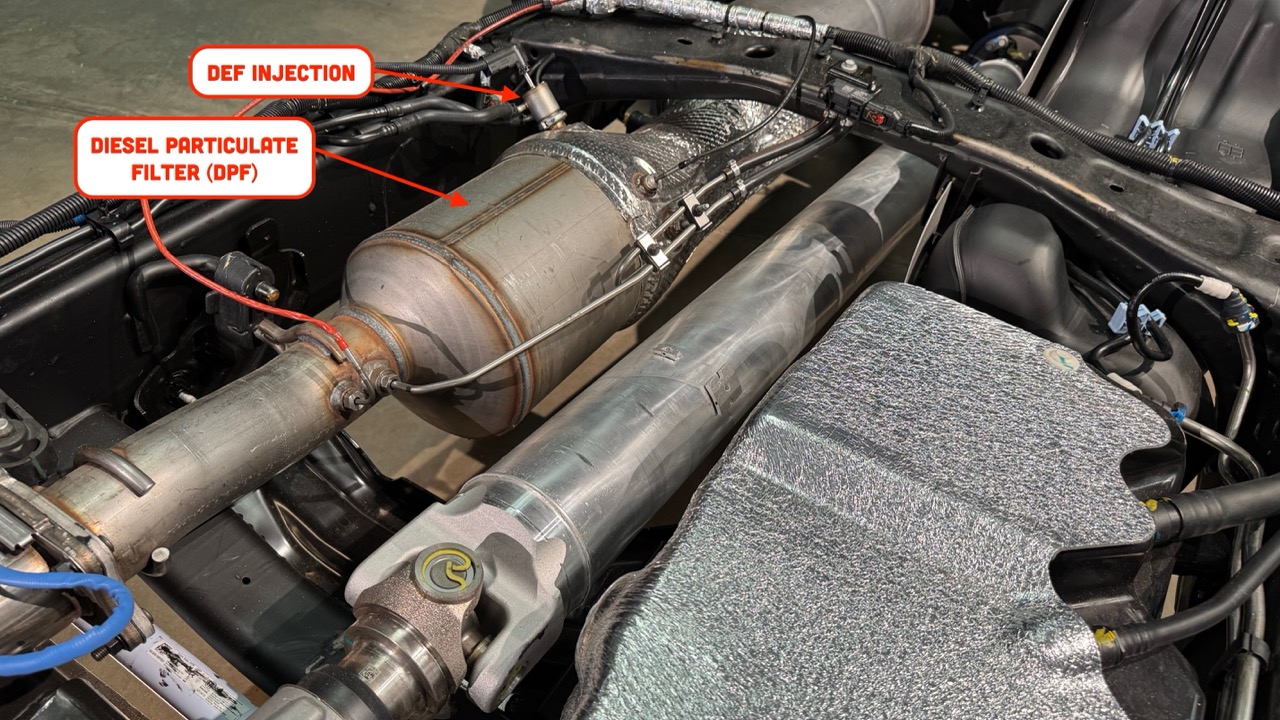
“[The DPF] is the particulate filter that cleans up the soot emissions in the engine…we measure the delta pressure across the DPF and… we regen the system when needed,” Moran, mentioning that the new Silverado HD now lets the driver regen at idle or manually without requiring a dealer to handle it.
“Based on what we see out of the DPF, we then dose the second DEF injector. That will then mix with the exhaust before we go into the second Selective Catalytic Reduction — there are two bricks in there that clean everything up before [the exhaust] goes to the tailpipe.”

The tailpipe, by the way, is quite cool. I’ve seen this on other diesel trucks but never thought too much of it; it turns out those holes in the tailpipe are there to reduce exhaust tip temperatures. The nozzle visible through the holes is acting as a venturi.
“The hot gas going through the center draws in fresh air from underneath the vehicle to control exhaust tip temperature,” Moran told me.

Big Updates To Brakes And Steering, Suspension Remains Largely The Same
On heavy-duty pickup trucks and really anything with a solid front axle, the way steering works is the intermediate shaft that’s spun by the steering column goes into a steering box. That box’s output is a pitman arm that swings in an arc, pulling and pushing a drag link and tie rod that are attached to the front steering knuckles. It’s a simple, but rather imprecise system, in part because these steering gearboxes have so much slop in them.

The new Silverado is the only HD pickup to use independent suspension — a design that is usually joined by a rack and pinion steering system. Chevrolet kept the old-school system going, presumably for durability reasons, but now for 2027 the brand says rack and pinions are ready for primetime in an HD application.
That makes the Silverado the first heavy-duty pickup in the U.S. to use a rack-and-pinion design like what you see in most passenger cars. There’s no gearbox; there’s simply a rack that’s attached to tie rods (which bolt to the steering knuckles), and there’s a pinion that’s attached to the steering intermediate shaft. You turn the wheel, this turns a small pinion gear, this moves a rack back and forth, and this pushes and pulls the steering knuckles to turn the front tires.
In addition to it being more precise than a steering box, a steering rack can more easily incorporate electric assist, which the new Silverado HD has. This assist could enable more ADAS driver-assist features, since the vehicle’s computer can now theoretically steer the truck using the electric motor in the rack. From Chevy:
Our first-in-class advanced, electrically assisted rack-and-pinion steering system helps give Silverado HD a confident, modern steering foundation, designed for reduced maintenance. Nimbly maneuver turns on switchbacks, squeeze through tight fits at the construction site and back into parking spaces with ease.
Tuned for precise and responsive steering
Quiet operation with no hydraulic noise
Reduces steering kickback off-road

Another major change for the new Silverado HD is the brake system. The rotors are bigger — now 14.6 inches — and they’re squeezed by new four-piston fixed calipers.
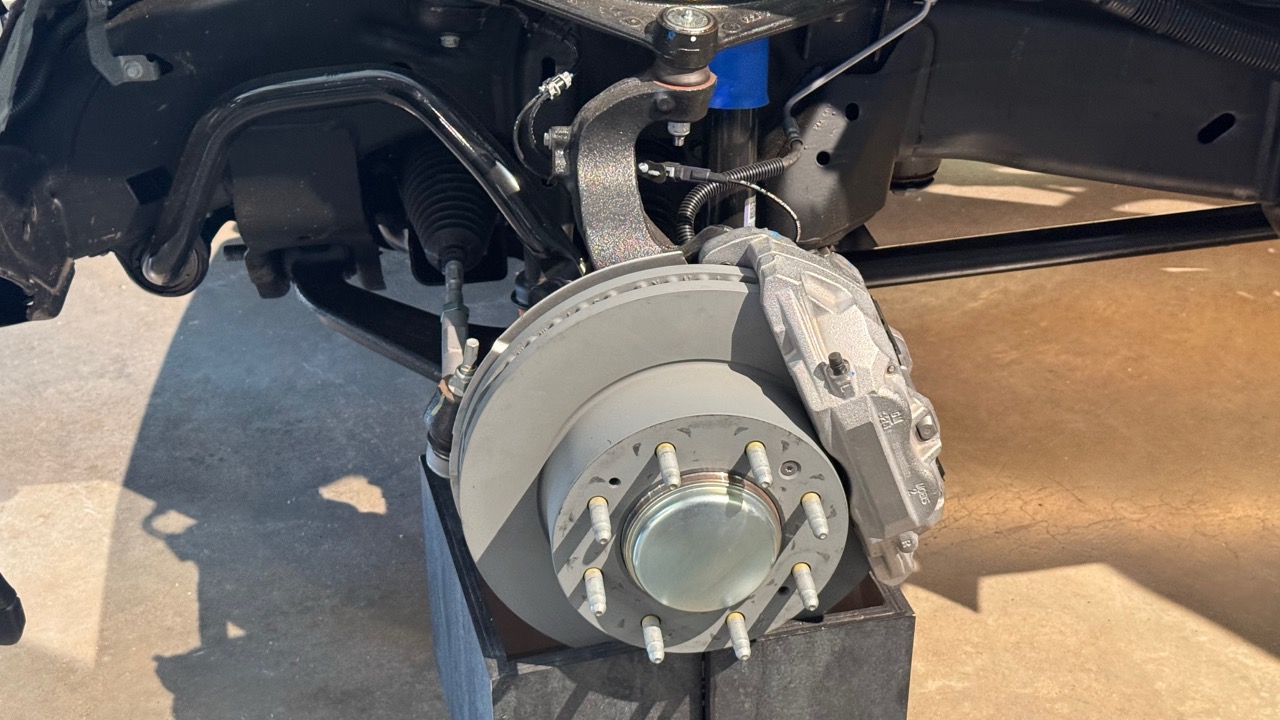
Perhaps even more important than the bigger brake hardware is the new eBoost electronic brake boost system. This replaces a hydroboost system that ran off the power steering pump on the old truck’s accessory drive.
The new electronic brake assist (shown below), Chevy says, is meant to offer “responsive and smooth heavy-duty stopping power, helping to give you added confidence when braking under load, especially on long downhill grades or when making repeated stops while towing.” The brand notes that drivers should notice a “More predictable brake feel; smoother, faster brake response; and improved braking power, cooling and consistency.”

As for the rest of the truck, the basic hardware is similar to the outgoing pickup. Out back is a leaf-sprung solid axle:

And up front is an independent front suspension:

Chevy reckons it’s dialed in leaf springs to the point where a move to coils or airbags doesn’t seem worth it. The brand is also happy with its torsion bar front springs that it’s been rocking or many years:


To see how much of a difference that new electronic brake booster and electronic power steering made on everyday drivability, I hit the road — but not before towing an absurd amount of weight with an absolutely epic truck.
Towing 37,000 Pounds In One Of The Most Impressive Trucks I’ve Ever Driven

What you’re looking at may be one of the greatest trucks I’ve ever driven. Why? Because it’s a nice combination of old and new; this red Silverado 3500 is a regular cab dually with a bench seat, column shifter, and vinyl floors. The screen is small, the dashboard plastics are rock hard (just as many workers prefer), and overall it just feels like a real work truck:

The truck is basic, and yet, it’s also equipped with a huge, modern 8.3-liter monster diesel making 1,230 lb-ft of torque.


Using that truck to tow 37,000 pounds down a drag strip was amazing. The jump off the line was a bit slow, but eventually that turbo spooled, the engine built a few revs, and I was on my way accelerating with a colossal load hooked up to the truck’s gooseneck.

The shifts were a bit firm, as one might expect when towing so much weight (it’s possible there was a little slop in the trailer hookup). But otherwise, that Allison 10-speed did a fine job helping the truck accelerate all the way to 60 mph, confidently.

Obviously, I’d prefer a 4×4, but this two-wheel drive “max tow” truck — with its basic interior and regular cab configuration — charmed me. And so did that surprisingly refined 8.3-liter, which — thanks to that turbo and the sheer amount of air passing through the motor — sounded almost like a jet engine as it stormed along that dragstrip.
Climbing A Mountain At 1,500 RPM
Chevrolet had journalists meet in a parking lot outside the hotel at 8 AM. There, a bunch of Silverados were lined up, and I was assigned the black 8.3-liter Duramax you see in the middle here:

Hopping into the truck, my first impressions were solid. The truck I had used to tow 37,000 pounds was basic, but this black truck was nicer — but not too nice.
The thing I like most about this Silverado HD in comparison to its sibling, the 1500 that I also drove during this press trip, is that there are more physical buttons and there is a truly substantial column shifter.


Seriously, the shifter feels satisfyingly mechanical, and does a lot to give the Silverado HD a “truckish” feel.

Obviously, it’s that tall Duramax diesel that I was most excited to try out on the street, and again I’ll say: It’s felt remarkably refined. Like I noticed at the drag strip, the sound it makes isn’t violent — it’s a loud whooosh that sounds like all the air the engine is sucking in and shooting out the back. The noise isn’t what I noticed when you drive this truck, though; what I noticed was just how low the engine’s revs stayed all the time.
Here I am accelerating quickly as I pull onto a main road; you’ll notice the RPMs are at 1500:

It makes sense. The torque curve for this behemoth engine is total madness — it makes the outgoing engine look downright pedestrian all across the rev range:

But it’s the bottom of the rev range that blows my mind. At only 1,400 RPM, the engine makes 1,230 lb-ft of torque. This means that, if you’re spinning just 1,400 RPM and you’re mashing the pedal, you can make 328 horsepower. That’s a lot of power at an engine speed that would fall into the “cold idle bump” range of a typical gas engine (i.e. that’s what some gas engines idle at when cold in order to warm up).
Experiencing acceleration from a thoroughly relaxed engine on a flat surface is cool enough, but to experience that on a grade is even more impressive. I literally climbed a steep mountain without the engine ever cresting 2,000 revs. I wish I could tell you more about how the Allison transmission behaves, but it did so little shifting that I’m just going to say it was good:

Throw a load on the back, and the 8.3 is in a league of its own when compared to anything else I drove out there — any of the Silverado 1500 half-ton trucks and the Silverado HD equipped with the 6.6-liter gas motor. That motor is more than competent, but the 8.3 shrugs off whatever you hook up to it, and quickly climbs whatever grade needs to be climbed without even the slightest complaint.

Coming down, the exhaust brake, the transmission braking, and the big discs at all corners mean the vehicle slows down as confidently as it speeds up. The brakes are solid; the pedal travel is a bit shorter than I’m used to, but it felt nice, though at idle, I did feel like the truck required a bit more brake pedal effort to stay still (I’ll have more on that later).
The steering, while a rack and pinion setup, doesn’t exactly feel that precise. There’s plenty of play on center, but I don’t mind that on an HD truck; if this thing were as tight as, say, a Cadillac ATS-V steering rack, that would feel out of place. What’s more, the truck’s size and suspension setup means it won’t change directions very fast no matter what you do.

But I’m not criticizing the truck’s handling; it actually slithered through the Arizona mountain roads better than I expected for a large truck. The ride was a little firm, the steering felt very light, and the brakes felt mostly normal. The 2027 Chevy Silverado HD is a shockingly daily-drivable heavy-duty truck that just so happens to have an earth-shattering, torquey 8.3-liter turbodiesel V8.
Off-Roading The Beast
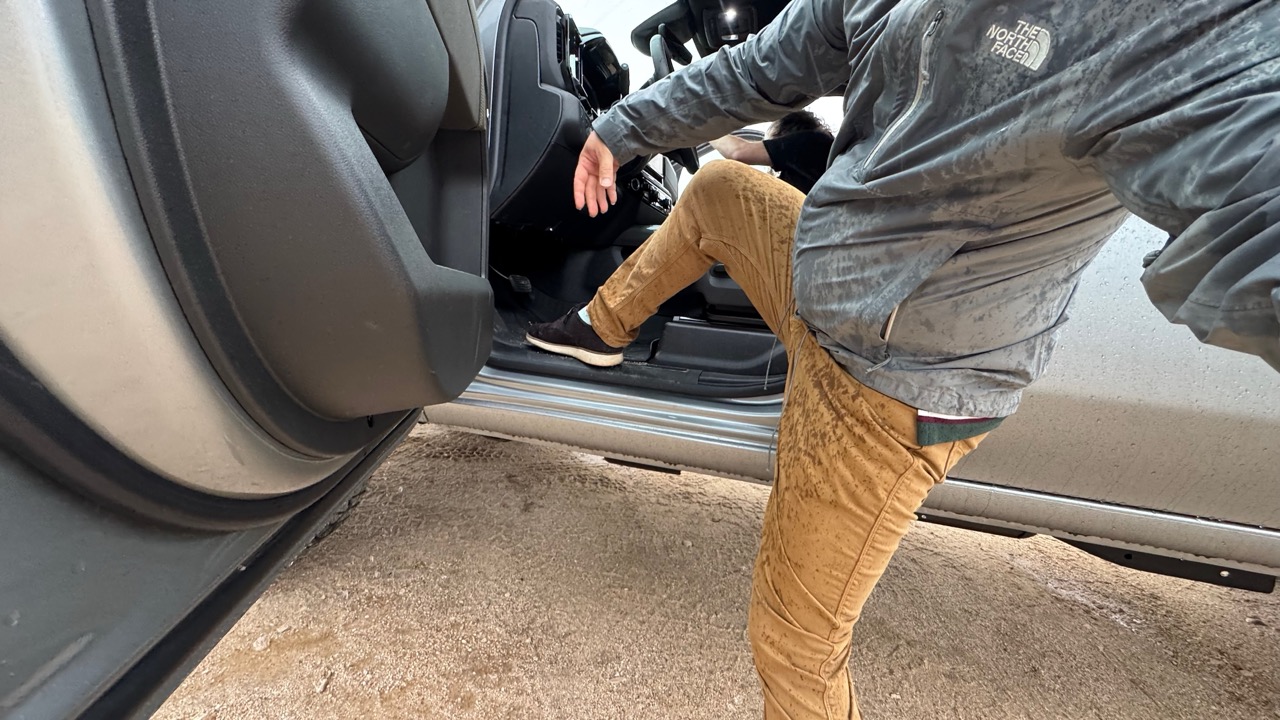
Jumping into the Silverado HD ZR2 almost required a ladder; seriously, the floor height is absolutely bonkers, though I applaud Chevy for putting grab handles on the A-pillars. Every truck should have those.

The Silverado HD gets the job done off-road. It’s got aggressive Goodyear Wrangler tires, a rear locking differential, and skidplates where you need them (though I’d like to have seen protection under the engine and transmission pans, even if I recognize those are tucked up high).


A truck this big isn’t ever going to be a sensational off-roader due to geometry constraints, but the suspension articulated well enough, the tires gripped well (especially with lockers), and I was able to take this thing down a rock trail and have a lot of fun.
Low-end torque offroad is a big deal, as it allows a driver to maintain control over technical obstacles without revving the engine and potentially having to spin up the tires. The Silverado HD idles over rock ledges, and in low range, does require quite a bit of pedal effort to keep stationary. (Not an egregious amount, but more than I’m used to — it’s a lot of torque trying to get the truck moving!).

I’m not feeling great; I’m definitely going to be out of commission tomorrow, so let me wrap this thing up.
If You Like Trucks, The 2027 Chevrolet Silverado HD Is Epic

I’m a huge truck fan, and I love big, brawny engines. In that context, this new Silverado HD seems, to me, like it has the potential to become one of the great trucks of all time. Yes, the competition will eventually catch up, and that’s great. But until then, Ram and Ford are not only down on power and torque, but their engines are 1.6 liters smaller.
The cheapest Duramax Silverado HD will cost you $62,000 (that’s the base price of about $47,000 plus the $11,400 premium for the diesel). That’s not cheap for a Work Truck, but some might find it worth it in order to own the biggest, baddest pickup truck on American roads today. Then again, you could argue that the biggest, baddest pickup out there is the 1,025 horsepower, 1,198 lb-ft Rivian R1T, which would outperform the Silverado HD in many, many ways. But these are two very different machines, and in the category of ICE trucks, we may have to crown a new king.
Crap, I did end up writing 4,000 words. I’m off to bed.
Top Image: David Tracy


555 Horsepower. 1230 lb-ft of torque. 8.3 liters of turbodiesel glory. Just the thing for the 5 mile drive to the officemall.
Yep, Hauling nothing bigger than a hockey bag in the bed and tailgating everyone the whole 5 miles.
This thing is a bad joke and an assault on both good taste and common sense. Might just as well buy a truck tractor. I shudder to think of the idiots who are going to be driving this thing at 80 mph in the left lane with a full load
I’m not a buyer, but this is really cool. The larger engine allows for less stress, so why not?
I hope it will be a reliable beast
Fuel costs and parking this monstrosity come to mind.
I think we’ve found by now that smaller engines when worked hard consume more than larger engines.
Turbo engines under load are consumption hogs.
I think a more obvious finding is that very, very, very few people ever actually need anywhere near 555 Horsepower, 1230 lb-ft of torque, 8.3 liters of 38,000 lb hauling, pedestrian crushing, parking space hogging turbodiesel glory.
Regardless of engine all modern 3/4 & 1 ton trucks fit the description of pedestrian crushing, parking space hogging, view blocking, fuel wasting, and so on.
In fact, I would go further and say the same of late model 1/2 ton trucks and their SUV versions.
Where we go from there, I don’t know.
Where we go from there?
Kei.
Touché
I am not sure why they code named this engine the Mongoose? Mongoose are quick, lithe little animals that can fight snakes. This seems like they should have named it the Water Buffalo or something like that.
Ox, mule, plenty of strength evoking names being left on the table.
Hippopotamus.
Mon-geese eat Scorpions (the name for the Ford Powerstroke).
Ah. There’s the answer. I assumed there had to be some industry code name joke in there.
So do chickens. They should have called it “The Chicken”. And sell it as a Pontiac.
“They should have called it “The Chicken”.”
Either that or “The Turkey”
Because to me, this engine is one giant turkey of overkill.
Thanks. Now I’m hungry.
I have some chicken and salad…
I think I have a can of Manwich around here somewhere.
I mean, a flaming chicken on the hood would improve the looks. Make it black and gold for extra effect.
Hey GM! We have a suggestion!
Mongooses? Monsgoose? Mongi? Mongae?
Hmmmm… some further thought is required.
https://youtu.be/_I2AKUSnU0s
How is it a driving solo to the grocery store where you are for sure going to bring your dog in with you.
These things (trucks) disgust me.
Yeah but how are they with a DPF delete, giant 6 inch exhaust tip and a coal roll tune? Does it handle 26s? How many Monster cans can be stowed in the cabin? Thats what real truck owners want to know.
DPF regen on these things is no joke. The radiator fans sound like a jet engine while you’re doing it.
This full engine deep dive is the content I love paying for! This article tickled my neuro-spiciness something fierce!
Great content David!
Most of us would drown in David’s shallowest dives.
Was about to come here to state the same. So many reviewers look at the emissions stuff like a pig staring at a wristwatch. Lots of innovation on this engine and having the the photos annotated like David does really sets this review apart.
A CDL should be a requirement when towing over 7,000 pounds with this truck.
Genuinely insane take.
It should require something.
The idea that a K-turn and parallel parking in what could be a Corolla, somehow demonstrates you can safely tow some pretty extreme weight, isn’t right.
Some sort of tiered licensing would be nice.
All that being said, what are the actual injuries/deaths per year as a result of someone legally towing a large load and just not being skilled enough? I’d wager pretty small numbers. I’d assume more of it is unsafe vehicles, overloading, poor trailer maintenance…
This is the key point.
A CDL does make sense in the upper ranges of this vehicle’s towing capacity. 7,000 lb is a car trailer or camper. Those people aren’t out causing accidents, and another layer of pointless licensing for them isn’t going to make the roads any safer.
While the overall number of accidents are probably pretty low, I’d imagine if you’re looking at the accident rate of people trailering something, it’s probably significantly higher than the rest of the population. I’d agree, a CDL is probably too extreme at 7k pounds, but I do think we need at least some additional qualification and testing if you want to tow period. Spending any amount of time at a campground or boat ramp and you quickly realize a significant portion of people towing have no idea what they are doing.
I’m not opposed to a CDL limit, but 7K ain’t it.
“I’m not opposed to a CDL limit, but 7K ain’t it.”
You’re right. It should be set to 5000lbs.
:-p
We can argue about target weights and tow lengths and such, but as a guy who did extra training to pull around 10k and 30 foot plus loads…yeah, we need more appropriately weighted certification system for the big stuff on the highways.
Ford’s new DECAliter MegaStroke 10 liter 1500 lb ft torqe diesel will annihilate GM!
The exhaust system concerns me. My MIL owned an almost unicorn of a car, a 2017 Chevy Cruz Hatchback diesel with 6 speed manual. I drove it once. Amazing. But the car wound up being problematic and a lot of it had to do with the DEF and exhaust system. The intake clogged with carbon and soot deposits. And there were issues with the exhaust system itself.
I’m also curious about the huge aluminum heads on these things. If they have been doing that since 2017 then maybe they’ve figured out how to get dissimilar metals to play nice but that seems like a huge no-no from other such combinations of the past.
I think the main problem is diesels burn off soot in the exhaust on longer trips where the diesel particulate filter heats up appropriately, but not if it’s mostly short trips around town. I have only seen my exhaust DPF light come one twice on my Golf Sportwagen diesel in 11 years.
Yeah, short trips and idling are good ways to kill modern diesel emission systems.
I just rolled over 93k miles on my Colorado 2.8l duramax, and have yet to see a ‘keep driving – regen in progress’ notice pop up. But I average ~40 miles a day for work and take plenty of road trips.
Agree with this. I’m closing in on 1/2 million miles on modern diesel emissions and the worst I ever had was a plugged DEF injector on my Touareg at 150,000 miles. It took me all of 30 minutes to remove it, soak it in hot water, and put it back.
Short trips, people that idle their vehicles all day long, and people that install aftermarket tunes are what kills the emsisions equipment.
The dissimilar metals are separated by gasket(s). The surfaces that aren’t, not sure galvanic corrosion is really an issue, but maybe.
Duramax has had aluminum heads since forever. I remember doing some benchmarking as an intern in the mid-2000s and they had aluminum heads then.
I’ve always liked the idea of larger motors under less stress. But oddly enough, if I ever bought a Silverado, it would probably be a regular-cab 2WD W/T with the turbo-4.
Hope you feel better soon.
Thirty-eight thousand pounds.
That’s 19 tons.
We’re talking CDL territory here…or at least we should be. Instead, we’ll let anyone with a legal license get behind the wheel of one of these things and drive without any proper training 19 tons of whatever your dad needs you to haul into town for auction.
And don’t tell me it doesn’t happen, I grew up in a rural community doing questionable things at my dad’s behest because we just had to get it done.
Reminds me of how we let octogenarians drive huge Class A diesel pushers with the same license they need to drive their Avalon.
Oh that’s CDL territory all right. That doesn’t mean you can use one to commute back and forth to the cubicle farm.
Perfect for that application, especially the ZR2.
Winter is coming.
I’ve always loved the original Duramax (had a dually flatbed work truck with one).
I think that the new engine itself is impressive. But the amount of new thermal and/or emissions componentry that has been added is getting a bit much, even compared to the last gen Duramax.
I wish that GM, Ford, or Cummins would start adopting variable cam tech on their diesels to help reduce the amount of emissions equipment needed. Heavier class trucks are starting to do that, so I think it’s time for the big three to do it as well.
VVT doesn’t do much when your speed range is 500-3000 rpm. One setting covers the range well. Is there some very small improvement available? Sure, but it’s not worth the complexity.
You do see VVT on some smaller diesels that rev to ~5000 RPM.
VVT enables jake brakes, VVT can reduce (or eliminate) the need for external EGR, VVT can mimic miller cycle (in certain situations, if beneficial), and has the potential to reduce regens and reduce the amount of exhaust emissions componentry, and there are probably other benefits I’m not thinking of right now.
These are the reasons why its starting to get implemented on Class 6-8 trucks, even here in the U.S.
I’d say that VVT is less complex, less failure prone, can provide power/efficiency benefits, and more proven than adding more and more exhaust componentry.
Examples:
International (Traton/VW) using it on their 2027 compliant S13 engines
https://www.international.com/products/trucks/features/engines-and-powertrains/s13-integrated.
Sure there have been VVT issues with certain OEMs (i.e. Ford 2018-2022 3.5’s) but that wasn’t inherit to vvt being bad as a concept, because there are massively more VVT successes vs failures across internal combustion engines.
All good points.
I think they have tried to use VGT, intake and EGR throttles to accomplish similar emissions benefits but with compromise (external EGR, more electronics and controls, potentially more failure points).
VGT can also generate Jake brake-esque engine braking without the noise. Not the same amplitude as Jake and has other tradeoffs for engine + turbo reliability.
OHV architecture has long been a challenge for VVT implementation but this has been solved and implemented by some.
I’ve read about the S13 but couldn’t find enough supporting document to objectively prove its performance. Thanks for the link. I look forward to seeing the direction they go over the next decade or so.
So here we have a yet to be proven engine mated to a 10-speed transmission that has been problematic along with all the complexity/reliability of modern diesel emissions systems.
What could possibly go wrong
GM usually gets the engineering 92% right on the first try. It’s that 8% that worries me.
“I’m feeling sick tonight, so this won’t be one of my patented 4,000 word deep-dive reviews, but let’s see what I can get cranked out before I pass out.”
You didn’t eat spaghetti in the shower again, did you?
Hope you feel better!
Ope, and he’s got trench foot again.
He’s in California now. It’s rust withdrawl.
Sounds like someone put diesel in DT’s gas tank.
Great, the diesel gets a proper Allison transmission, but the gas variants still have that joint Ford 10-speed.
Correct me if I am wrong, but it still has the Ford 10 speed that has been “validated by Allison”
No, this is correct and I was typing the same thing. Both diesel and gas HD trucks have a version of the GM-built 10L1000 (which shares some basis with the lighter-duty Ford design, but was primarily engineered by GM).
Wow this is very interesting. GM straight-up calls it an Allison, though this distinction is worth making.
There is a lot of misinfo out there about 10 speeds and I’m hardly an expert on the subject, but I do know the “Allison” name has been merely marketing for years now.
GM and Ford have shared designs (mostly) on the 10R60/10L60 and the 10R80/10L90. That’s as far as the joint development went. Ford created their own 10R140 from the 10R80 and GM created their own 10L1000 based on the 10L80. There are gas and diesel versions of the 10L1000.
GM used to use Allison transmissions when they owned Allison. They continued for awhile after the sale but in 2020 started selling their own transmission and licensed the Allison name.
These are the transmissions made by Allison
https://www.allisontransmission.com/applications–products/products
This is the most comprehensive article I found about the transmission in this pick-up. So, no more Allison designed and built transmissions at all for GM. I find it interesting that Allison does’t ‘approve’ the design for the Ford 10R140 unit but does for the GM version.
https://www.alligatorperformance.com/blogs/news/allison-10l1000-transmission-a-technical-deep-dive-and-overview
I thought GM couldn’t even use the Allison Badging as of June of 2026, even though they hadn’t even been Allison transmissions for years?
They worked things out with Allison to resume using the name again.
Oops. Missed that!
Impressive stuff. This can pull your house off of it’s foundation. It’s amazing our fathers got by with so much less than this torque arms race and did so in trucks without power windows. Were they made of grit and stronger stuff and all the other things? I don’t know, but it’s fascinating.
“I’m feeling sick tonight, so this won’t be one of my patented 4,000 word deep-dive reviews,”
Proceeds to do a DEEEEP dive.
“Chevy flew me to Tucson, Arizona, and fed me lots of steak.”
S’matter, DT? Got the meat sweats?
As I like to say: Being a vegetarian would be a huge missed steak.
Get out.
Do you have beef with his comment?
Not another pun thread! We really need to mooooove on from these.
Hey, you know what they say, “you mess with the bull, you get the horns.”
I’m not too chicken to ham it up.
Best BroDozer Ever!
Impressive GM engineering as usual, I wonder what will go wrong and cause headaches in a year because of the usual GM shortsighted cost cutting.
This was my first thought when reading. They’ll cheap out on the head bolts somehow to save 12 cents per unit, and then need to spend $500 million on a recall.
Interesting deep dive into this engine. A nice reminder of how much accumulated knowledge and expertise is required to engineer and manufacture something like this. We take it for granted.
Help a stupid person out–what’s the advantage of using diesel here? Would an 8.3-liter turbocharged gasoline engine not produce similar massive low-end power without needing as complex and expensive emissions equipment? Operating temperatures? A very large delta in fuel economy when worked hard?
A large gasoline engine will produce torque, but not at these levels with any sense of emissions standards. Adding a turbocharger and trying to keep reliability with high exhaust temperatures and usage towing 35klbs would be extremely difficult too.
The fuel economy delta at that high of a tow rating would be enough to justify the costs and emissions complexity. It’s for a very specific use case, but that use case exists enough to justify the development.
1) No, a gasser 8.3 Turbo would not produce the same low end power and torque. Diesels are normally much torquier at lower RPMs due to the differences in combustion process (gasoline is much lower compression where diesel is a much higher compression.) It also comes down in the volatility of fuels. Diesel is much harder to ignite, so it needs heat and a lot of compression to light off. Gasoline is a lot more volatile, so compression often needs to be a lot lower.
2) If you chug a gasoline turbo at low RPM, it will create a lot of heat and potentially explode, versus a diesel that does not like high RPMs.
3) yes, diesels will get much better fuel economy when worked hard, as the power and torque are at low rpm. In a gasser, to get maximum power and torque, you need to rev it out plus be in boost. There is a reason there aren’t many (or any) gas big rigs anymore.
As others have stated, gas by itself is poorly suited for this kind of work, but my hope is that a well-designed hybrid system can fill in that low-end torque void and get diesel out of consumer grade vehicles once and for all.
Mazda’s Skyactiv-X was a pretty good shot at it, but no one cared, which is sad.
I think the problem with a hybrid is if you need 1200 ft-lbs of torque, then you’re going to need a fairly substantial electric motor and battery to go with your fairly substantial gas engine, and you really start running into packaging issues. Going full EV like the Silverado EV gets you sort of there, but even that thing is 20k lbs down in the max config compared to this beast.
I won’t be the guy who says “no one needs 1200 lb-ft” but I bet someone will.
I’m intrigued by the concept of scaling up the F150 hybrid, which has a 3.5TT and a mere 44 hp motor with 1.5 kWh battery to make 570 lb-ft. It seems like there would be room to go quite a bit bigger with that electric side before running out of room, especially if paired with a compact pushrod V8 rather than a twin turbo DOHC six.
The problem with the F150 hybrid setup is the battery is nowhere near big enough for extended towing, especially up a grade. Rough back of the envelope math suggests if you were to tow this same 37k lbs up a 1 mile elevation gain with the ~35% thermal efficiency of the F150 hybrid drivetrain, assuming the electric motor is doing half of the total work you would need a 100 kWh pack which you would completely drain. Obviously that’s real approximate, but it gives you a sense of the size of battery you need for towing heavy loads. The problem is the hybrid can’t match pure EV for efficiency nor torque, so you have to skew harder and harder to the electric motors, and it becomes a question of why bother with the ICE at all? Maybe as a range extender?
But if you’re max towing up a grade, low end torque doesn’t matter as much since you’re flat out or close to it.
This diesel makes 555 hp; the 6.6 gasser makes 412 hp. So you don’t need the electric motors to provide half the power; it’s more like a quarter or less.
The appeal of the electric motor is to get the load moving off idle, when the gasser is making very little power compared to a turbodiesel, but once you get up in the revs a bit, the real power difference to the ground is much less.
Yeah, but that would still be a 50 kWh pack drained completely by one pass. I’m not saying it’s impossible, but I think the packaging challenges put it outside the realm of what you can actually sell to consumers, especially when Big Ass Diesel is a product you can move.
Thank you gentlemen. Informative.
Mongoose, eh? This Diesel’s a Weasel.
Ford’s name for the current 6.7 Powerstroke is “Scorpion”.
What eats Scorpions? Moongeese. Mongooses. Whatever plural for Mongoose is. English is hard.
I mean, sure, it just invites rewrites of “pop goes the weasel” whenever one of these eventually breaks.
Also what’s the over/under on the next Ford being named “Snake?” And how mad is Chrysler/Hot Wheels going to be about it?
Also chickens.
Mongooses, since it’s not a Germanic root word (thank you 12th grade English).
Not to be confused with octopuses, which is the accepted standard English Germanic root-plural despite the root word being Greek, but coming to English from Latin, meaning octopuses, octopi, and octopodes are all grammatically correct (octopodes is the most correct).
Cummins had a development program called “Hedgehog” because they eat Caterpillars.
That 4 stack of radiators just looks hilarious, like someone just kept adding them in with CAD one after the other and said “Hey it fits!”
Waiting to see what the aftermarket does with this engine, I’m willing to bet we see over 1,600ftlbs on a stock block.
The packaging on the engine and all the auxiliary components is impressive.
On the other hand, I really don’t think I’d enjoy having to get in there to work on it.
Yo dawg, I heard you like radiators…
Man, these numbers would be acceptable in a semi truck. Literally. If you’re not doing heavy haul, this engine would be enough to power an 18 wheeler.
I’m torn between “that’s awesome” and “uh, we should really require a CDL for that”.
It might work in a big rig, but it would be more stressed out than a 10-16 liter straight-6 turbo diesel that is the norm.
555 HP with 1230 lb-ft of torque is still a little unbalanced for the big rigs. They’ll achieve that level of torque with lower horsepower figures, for an engine that’s stressed less to produce that much torque. If you dip into the high-horsepower big diesels running 550 to 600 horsepower and beyond, you’re also getting torque output close to or over 2000 lb-feet.
But the use cases are different here — this engine isn’t intended to be a million-mile, day-in-day-out hauler with loads exceeding 40,000 pounds. This comes close, but it’s probably not going to be hauling 37,000 pounds every single day, either.
This truck, and engine, will however wind up being popular with the non-CDL “hotshot” haulers — the ones doing contract hauling for the RV industry, contract auto transporters with the relatively small, often enclosed trailers, and whatever else they can load up on a gooseneck trailer and come in just under DOT limits for CDL drivers… and then they’ll run for hours longer than CDL regs to run as many jobs as possible anywhere for as long as possible out on the road to make money, until the truck depreciates and wears out in a few years.
Any driver driving a vehicle over 10,001 lbs and during commercial work is required to keep a logbook for hours and keep to the same driving limits as CDL drivers. There are exceptions for those that operate within a 150 mile radius and drivers that stay exclusively within a state.
However, if you are hauling freight over state lines there is no legal advantage to driving a pickup instead of a commercial truck when it comes to operating hours. There is the advantage of not having to go get a CDL.
Do lots of drivers cheat? Yes.
Sure, I agree with that. It would be far more stressed and as a result it wouldn’t last long in that application.
I couldn’t agree more on the CDL requirements…
I mean, does it not? CDL limit is defined by gross weight rating (anything over 26k), and if you are hauling a trailer rated for 37k gross it seems like legally you need more than the standard driver’s license.
Not that I expect anyone to abide by the limit, but if/when lawsuits happen as a result of a crash it seems like something a savvy lawyer would bring up.
It is actually more stringent than that. Any gross combined weight rating over 26k requires a CDL. So if that dually has a GVWR of 14,000 lbs, you could not tow a trailer rated for more than 12,000 lbs without a CDL. Some states allow one to exceed the CDL limit if used for personal use. Farm exceptions and maybe RV exceptions are also out there.
One of the reasons I have an older truck with a GVWR of under 12,000 lbs is so I can tow 14,000 lbs without a CDL, even though a modern truck with bigger brakes would ironically be safer.
In my neck of the woods, there are weigh stations in every direction and random portable scale stations as well. I would not want to cross one of those over the CDL limit without a CDL.
Yeah, that’s what I thought- this truck is mostly for people who have (or should have) CDLs. Sadly, it will probably be bought by those who cosplay as truckers instead.
Displacement alone is putting it in the Class 6/7 range, which tends to get like 7L-9L engines.