

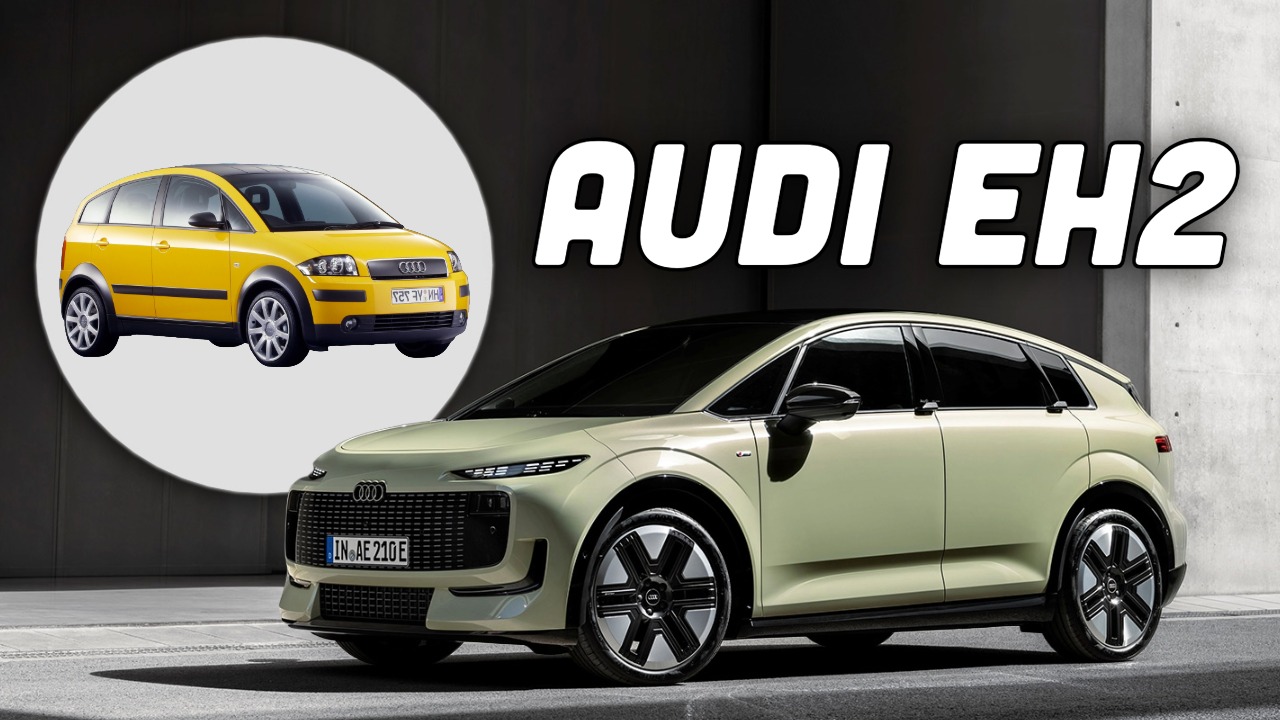
Way back in February, we wrote about the upcoming Audi A2 e-tron hatchback. And seven months on, here we are! Audi pulled the wraps off the production A2 e-tron today in Paris, and key information about the small fancy Audi is out, as well as unmasked photographs. In these shots we see a Pistachio Green launch-spec A2 e-tron: time will tell if it’s a hard nut to crack.
If you don’t know the original Audi A2, it was a city car or a commuter car produced in the 2000s, offering seating for four and a cool design with five doors but an engine cover that was nailed shut. Up front was a service panel, from which the owner could check and top up fluids, and anything beyond that would be done at a service bay which would undo the hood.


The original aluminum-bodied A2 was engineered to be super-frugal at any price, which meant it cost Audi a lot to produce, but it also used as little as 3-4 liters of diesel per 100 kilometers. Several decades on, the A2 has now been reborn as a small and tall electric hatchback, bearing the e-tron name.

The design is unmistakably today’s or tomorrow’s Audi, and it’s certainly an A2, no doubt about it. It isn’t quite as minimalistic as the early-2000s one, but then again, few things are. The exterior wears a design that’s less overtly a hat-tip to the original than about packaging a modern EV into a small footprint, with a front end that hides headlights in the edges of a full width grille. The wheels are also significantly larger than in hatchbacks of yesteryear, even if the wheel design at least in these launch-spec photos pays homage to the 2000s car. The wheel selection ranges from 18 inches to 20 inches in size, and they’re not pizza cutters like in the BMW i3, as tire width is 235 mm at its widest.
The design and engineering of the wheelarches has been optimized for airflow, door handles are tiny little items, and the underbody is completely flat. This means a drag coefficient of 0.24, compared to 0.25 of the original.
It’s Rear Wheel Drive

The new A2 e-tron comes with three battery sizes and four power levels. The smallest battery is a 52kWh LFP unit, and the cheapest A2 produces 125 kW of power, or 170 horsepower; the biggest battery is an 84kWh NMC one that is offered in two versions that produce either 170kW (230hp) or 240kW (326hp). That means a 0-62 mph figure of 8,8 seconds for the slowest A2 e-tron and 5,7 seconds for the fastest one. The original A2 never had a performance version (3L stood for 3 liters per 100km, not 3 liters of displacement), but perhaps Audi is eager to bring in customers used to the Volvo EX30 and its power levels.
Unlike the EX30, the A2 e-tron will only be available in a rear-wheel-drive configuration. Yes! It’s a RWD Audi, something only the R8 could claim to be before Audi brought rear-drive EVs to the market. The A2 e-tron shares its MEB platform with the VW ID.3, which explains the setup. It’s built at the Ingolstadt Audi plant in Germany, not at a VW factory.
The most efficient version is the one not yet mentioned above: the 140kW (190hp) one with a 61kWh LFP battery. As its combined consumption is said to be just 12.8 kWh/100km (WLTP) or 4.85 miles per kWh, it’s now called the most efficient Audi ever. Compare that to the turbodiesel original, which managed 78.4 mpg, and you’re still getting ahead while spending just pennies, especially if you live in a country with expensive diesel ($11/gal where I’m sitting) and cheap electricity. In comparison, the diesel’s fuel consumption represents around two miles per kWh in energy consumption, if a liter of diesel contains 10kWh of energy.
As Much As 401 Miles Of Range

But if you want range that equals diesels in any way, the big-battery version is said to be able to reach 401 miles in 190hp guise. It also produces 401 lb-ft of torque, or 545Nm, and the large-battery models can DC charge at 183kW maximum. The smaller-battery versions can manage around 100kW at best, which isn’t a spectacular figure in 2026. That said, all of the versions are quoted a 10% to 80% charging time under half an hour. As well as charging, the cars can deliver power, as they support V2L (powering laptops and appliances) as well as V2H (powering homes).
Audi is pitching the A2 e-tron as an efficient car, lengthening the range by means of efficiency and low consumption. Still, offering the car with a large 84-kWh battery and not the small 37kWh battery available in some of the smaller VW-Audi-Seat-Skoda EVs speaks volumes of the car’s positioning and how holy a long range is when it comes to Audi premium branding. The A2 e-tron also replaces the A1 hatchback and the Q2 crossover models from the lower end of Audi’s model portfolio.

A2 e-tron prices start at 38,200 euros in Germany. That’s a touch above $44k, but since it’s unlikely to be sold in the States, pricing might perhaps be a moot point. For comparison, the Volvo EX30 is currently priced a little cheaper in Germany, as prices start from 34,900 euros for the Essential and almost exactly the same for the Core, which costs 38,200. The cheapest Volvo does only have the 150-horsepower P3 drivetrain, while the more expensive Core model has the 200kW/272hp P5 setup which used to be the cheapest.
As for cheaper VW-Audi EVs, the new front-engine, front-wheel-drive ID.Polo is priced at 25,000 euros for the dinky 37kWh / 115 horsepower version, and the 52kWh / 155kW / 207-horsepower version costs a little under 34,000 Euros, already a good jump towards the Audi’s starter price. And since the Audi is based on the same bones as the bigger ID.3, it should offer more space.
Just like the Volvo EX30, the Audi also includes recycled materials in the interior, and the vertical fresh air vents have a similar design. The optional finish for the dashboard and doorcards in the above shot is called Softwrap in Audi’s press materials.
More Space Than An ID.Polo

Audi says the A2 e-tron offers “generous space” and an ambiance “previously associated primarily with models above the compact segment”. That is an advantage of packaging the powertrain neatly near the rear axle, as it leaves more space for the passenger cabin.
That said, the EX30 also relies on the same skate-boardy layout, and the rear seat on those is definitely tight for a six-foot adult – think first-generation Hyundai Kona. Space is the ultimate luxury, and if a fancy small car can offer a spacious rear seat, that’s already a mark in its favor. The EX30 is 166.7 inches long and has a 104.3-inch wheelbase: comparable figures for the A2 e-tron are a 170-inch length and a 109-inch wheelbase. The Audi is 70.5 inches wide, which is actually a couple inches narrower than the Volvo.

The 2000s Audi A2 was 150 inches long, with a 95-inch wheelbase. The trunk size is nearly the same between the new and old Audis at around 390 liters.
Note, that the original, aluminum-bodied A2 also weighed less than 2,000 lbs at its lightest. All of the A2 e-tron versions weigh over 4,000 lbs, which is perhaps the biggest deviation from the 2000s original, along with the upscaled power output and angrier front end design. There isn’t much variety in the way the different versions tip the scales, as the lightest, starter model weighs 4,056 lbs and the heaviest 4,255 lbs.
The original A2 is already a classic, or at least a “youngtimer,” as funky 1990s-2000s cars are sometimes called. Since the new one wears the same name, and sits in the same market position, I hope it will be in time considered at least half as cool as the original. But for Audi’s sake, I hope it will be more profitable to produce.
(Images: Audi)


Love to see a long range compact EV. Too bad it’s more forbidden fruit.
I like the 3/4 view from the rear. The rest? Meh. The exterior door handles look terrible and fragile. The Cheshire Cat grill is interesting. I think I like it better than the Ken Doll genital region the Tesla 3 always reminds of. It also looks like it will be a pain to keep clean.
This makes me want to get my gf the original A2, it looks awesome! And this new one makes me feel like the fall of VW group is well deserved.
The Dodge Caliber done right
That profile photo in the pistachio sure does remind me of Walter White’s Pontiac Aztec.