

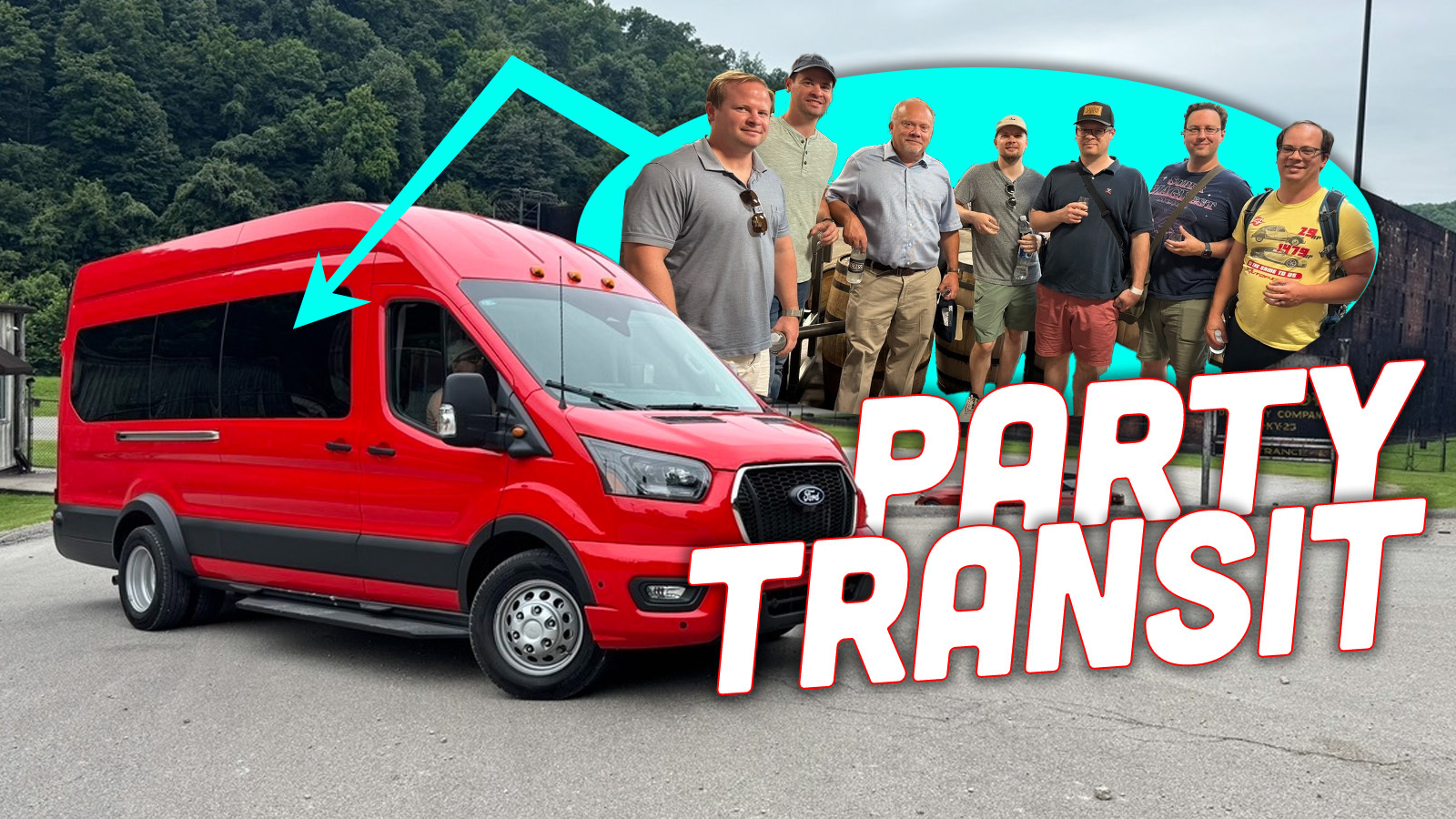
My oldest brother is getting married soon, and as he’s a bit of an alcohol-brewing nerd (he recently won two silver medals for the mead that he brews) his best man (my youngest brother) planned a bachelor party along Kentucky’s Bourbon Trail. With my future sister-in-law’s brother joining five of my six brothers, my dad, and me, we had a crew of seven all flying into Kentucky from all over the globe. Everyone was relying on me to hook the crew up with transport between various distilleries in rural Kentucky, and boy did I.
I’ve driven plenty of minivans in my day, but a full-on commercial van? Never. I’ve always been curious, as I love the idea of a vehicle with a very specific purpose: To fit a bunch of junk. Or, in the case of my Ford Transit 350 dually 18-seat passenger van, to fit a bunch of butts.


I got my first glimpse of the beast at the airport, where Ford had dropped it off:
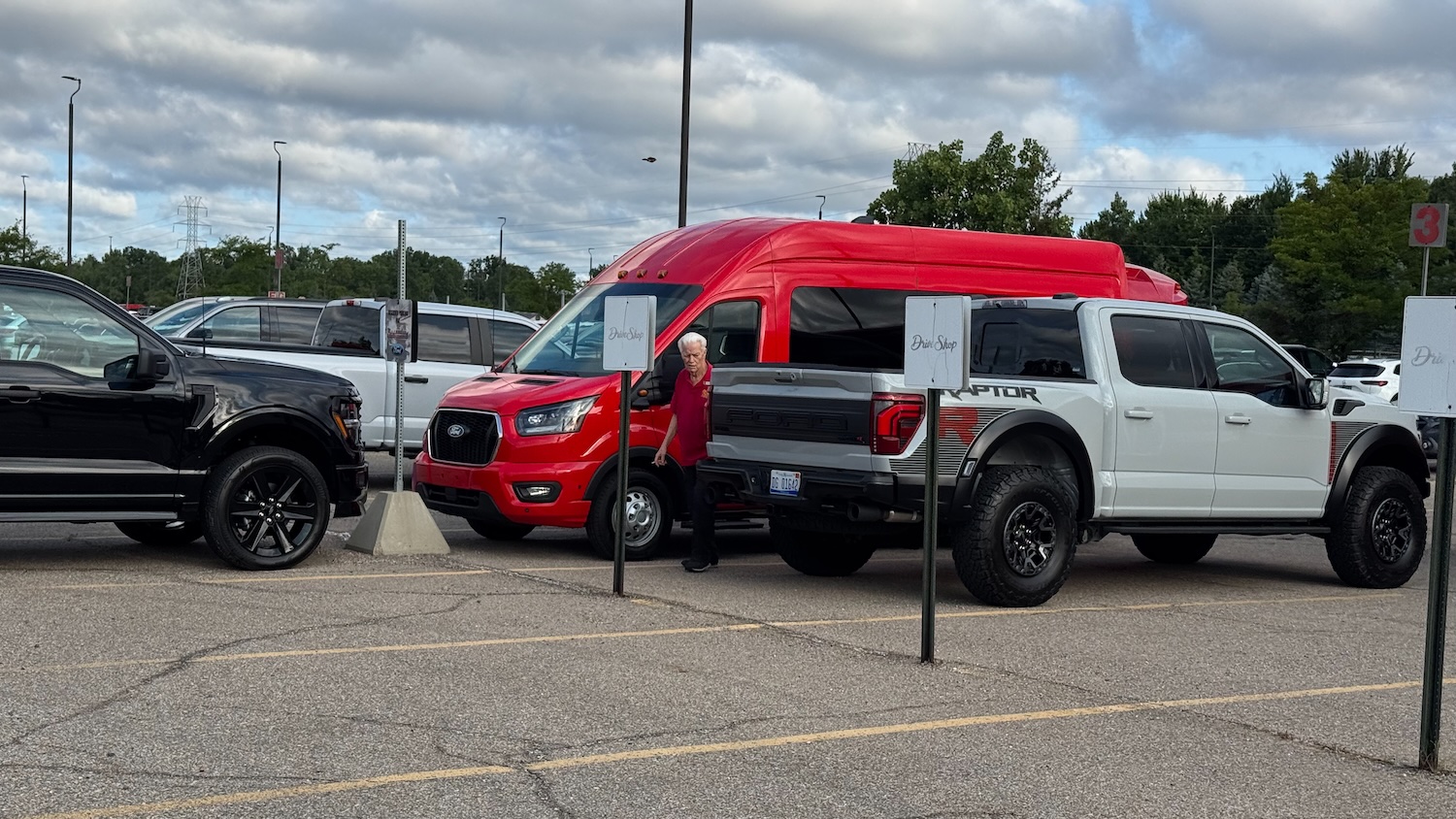
Ford offers two different Transit Van styles (cargo and passenger van) with three heights — Low Roof (~83″), Medium Roof (~100″), and High Roof (~110″). There are two wheelbase options, 130″ and 148″ for the cargo van (that one also gets three different overall length options), while the passenger van always gets the longer 148″ wheelbase and can be had with the standard 236″ length or an extended 264″ length. Both cargo and passenger Transits can be optioned with single or dual rear wheels.

Not only was my $78,105 Race Red van the tall boy, but it was also the long boy and the wide boy. It was the heaviest duty Ford Transit passenger van money can buy — the Ford Transit 350 HD with dual rear-wheels. A total beast.
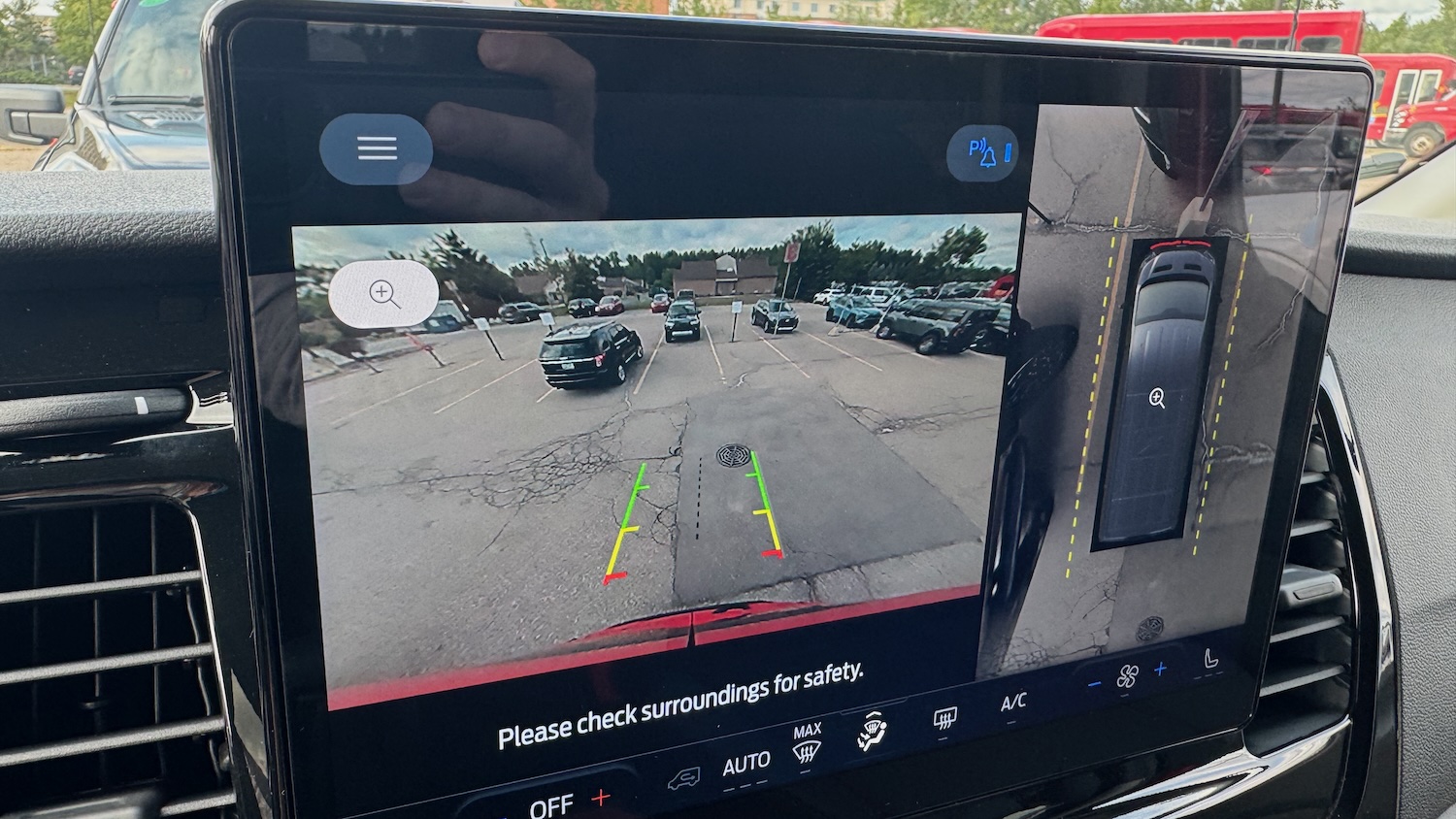
And at first, I’m not sure this was ideal for my use case, as — after backing out of the parking spot (and noticing how ridiculously high-up the backup camera is mounted, see above) — I hit the freeway and noticed a less than optimal ride.
Detroit Has Transformed In 3 Years, But Some Things Never Change
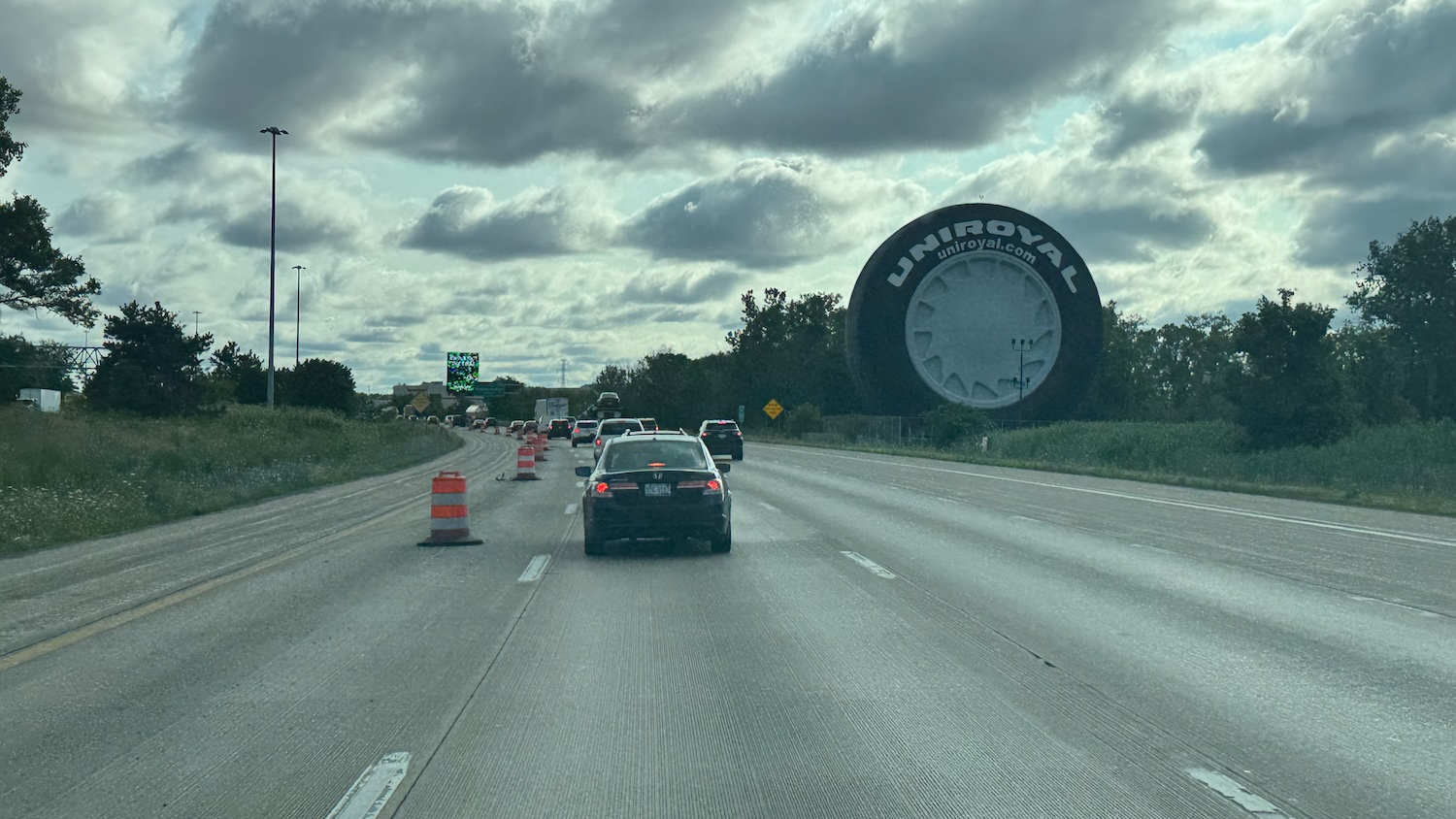
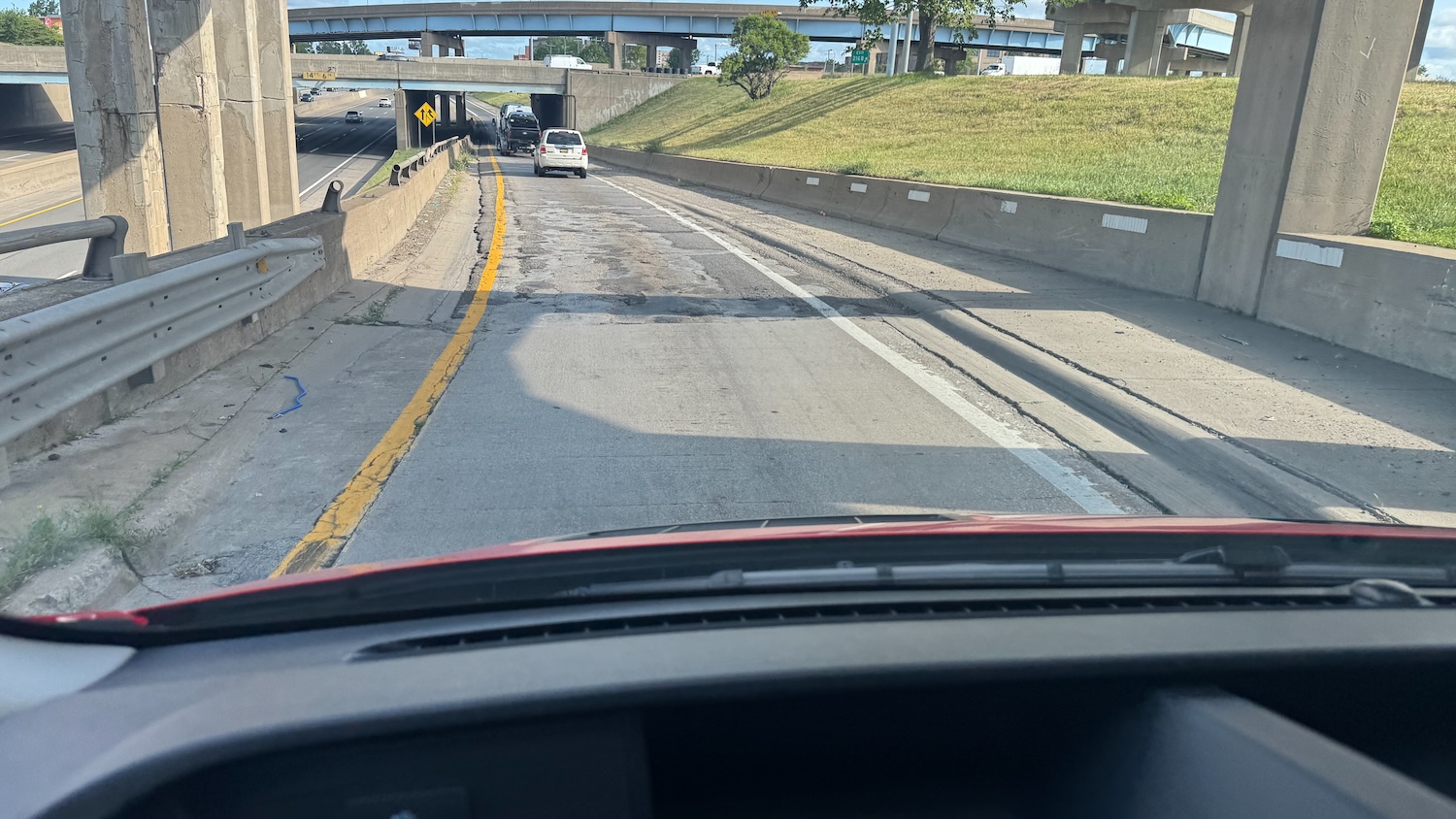
Some of that was just the reality of Michigan’s roads, which appear as terrible as they were when I left the state three years ago:
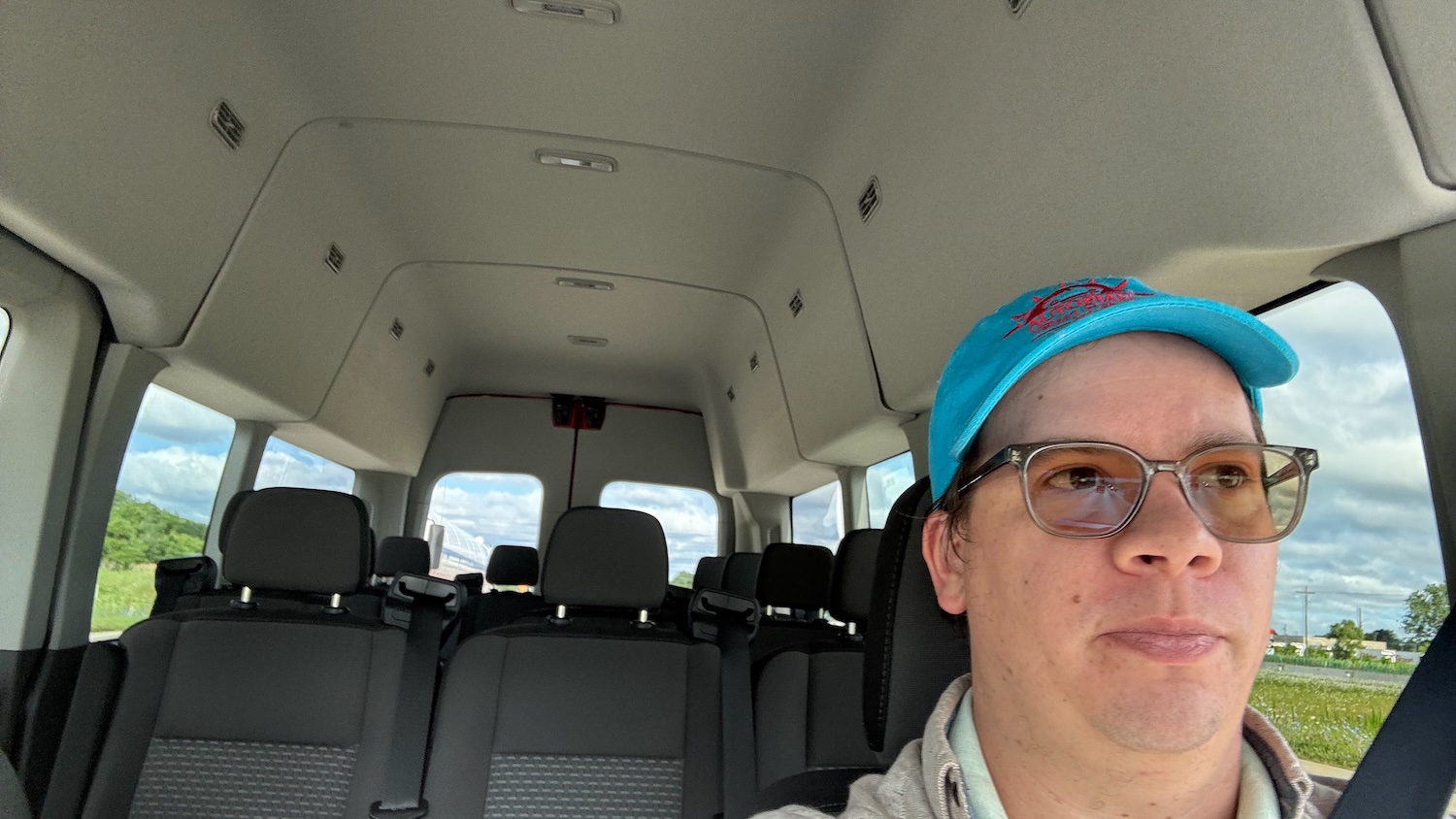
But some of that was also the simple fact that this 10,360 lb GVW van had only me onboard, along with a couple of carry-on bags; look at all this empty space:
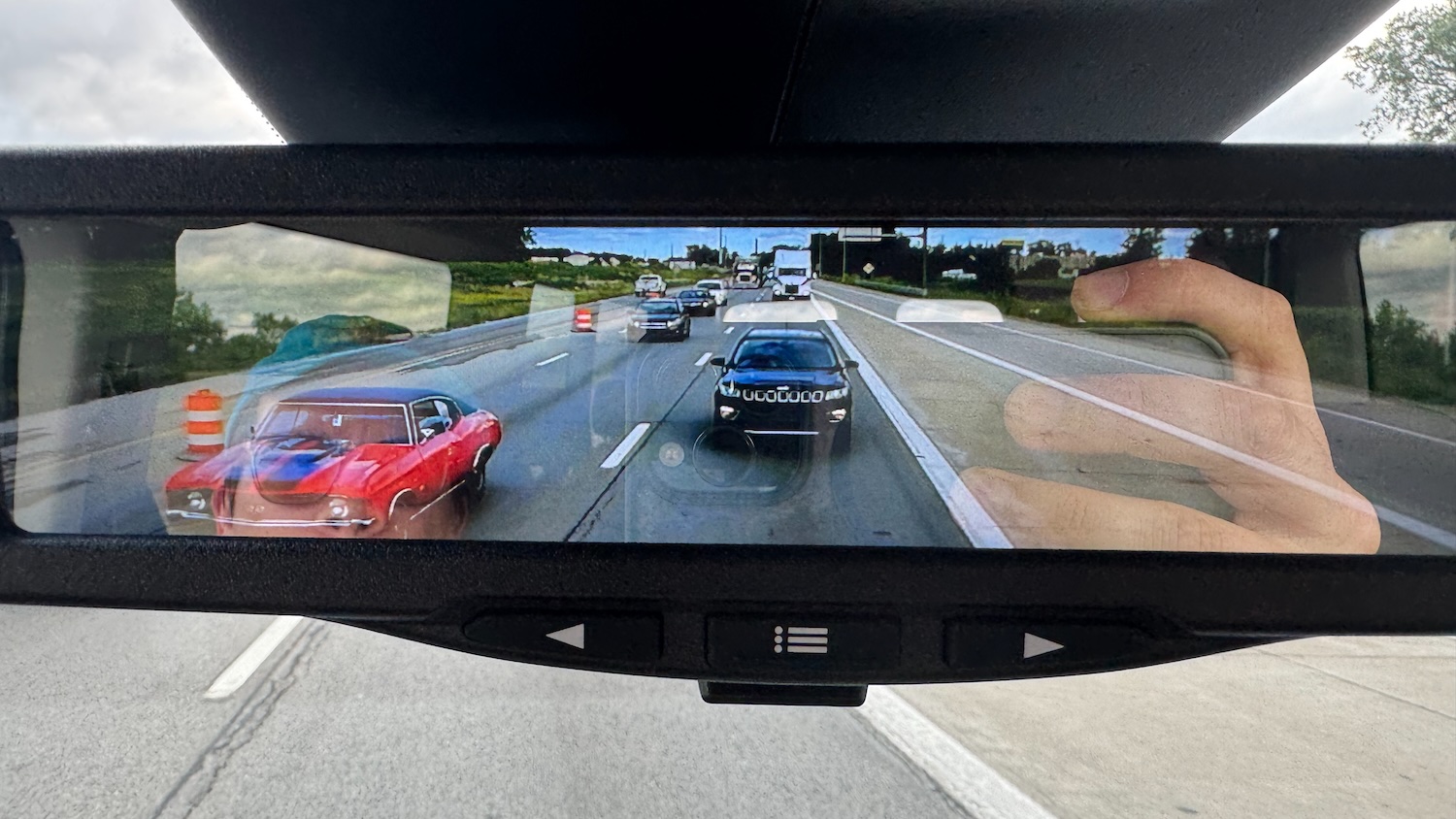
I checked out the rearview camera and, fittingly for Detroit, saw a crystal clear red Chevelle with black racing stripes. I’m generally not a huge fan of rearview cameras, but a huge van like this definitely benefits from one given that the back glass is in another zip code.
Driving east down I-94, I began to realize something: Detroit has changed a ton since I left in February of 2023. First, where did this huge DETROIT sign come from, just off the freeway?

Where the heck did this hotel come from on the I-75/Rochester Rd. exit I used to take to get to my old house?

Speaking of my old house, it appears to be condemned, doomed to be flattened and turned into condos like much of the rest of Southeast Michigan.

Seriously, the condo-ification of this area has gotten wild. Across the way from me used to be a house and a nice field:

Now it’s just a bunch of these:

What was most shocking, though, was just around the corner from me, on a road I used to run/drive almost daily. Here’s the before:

And here’s the after:

A different angle now. The before:

The after:

This is all now condos.
Perhaps the strangest change that happened during my three year absence is the replacement of my favorite burger joint, Hunter House, with…a burger joint that looks exactly like it. I nearly dined at “Better Burgers,” only to google it and find that there is a massive legal battle between my go-to burger business, Hunter House, who had been in that building for over seven decades before getting the boot from the landlord, and the new burger spot in the same…spot — Better Burgers. 
Needless to say, I grabbed my Transit Van’s lovely dash-mounted shifter (I’d have preferred a column-shift, but it’s fine), popped it into reverse, got out of the Better Burgers’ parking lot, and headed down the fabled Woodward Avenue until I saw a white tent where Hunter House was quickly building its new facility but still serving delicious burgers. 
It was here in this parking lot, where I was wolfing down delicious greasy, cheesy beef sandwiches that I noticed two things. First, because the longest version of the Transit keeps the medium length Transit’s wheelbase, the thing has a giant butt:

Second, I notice that the doors really don’t open very far:

It appears that the mirrors — which, oddly, you cannot fold electronically unless the vehicle is on — would prevent the door from opening further, anyway:

This wasn’t an issue, since I hadn’t eaten that many Hunter House burgers yet, but if I were a fatter guy, maybe that door opening would be suboptimal. Maybe.
One thing I was thrilled to see had not changed much was my go-to junkyard, U.S. Auto in Sterling Heights. This is the junkyard where I cut my teeth as a young car journalist.
View this post on Instagram
Still some great vintage iron out there, mixed in with plenty of modern stuff. That same description applied to the Autopian meetup that took place at the Walmart parking lot. I am shocked at how many people showed up to pose behind that van on a random weekday (thank you all!):

There were some amazing machines at the meetup:

But readers were legitimately interested in the van, with some pointing out features I hadn’t even looked at yet. For example, I hadn’t yet popped the hood to reveal the 3.5-liter EcoBoost offering 310 horsepower and 400 lb-ft of torque. Hooked to this thing is a 10-speed automatic and an all-wheel drive system with a limited slip differential in the rear 3.73 differential.
The Van Ain’t Slow

We decided to put this motor to the test, filling the van with 15 readers and taking the thing for a jaunt up and down Maple Rd. The thing is legitimately quick!
View this post on Instagram
Zero to 60 mph in 12-ish seconds is amazing for a big van with probably over 2,500 pounds of human onboard, and Matt later tried again and told me he got closer to 10. Three factors are at play, here; first, the motor is powerful; second, the 10-speed automatic makes the best of what power is available; and third, this thing isn’t as heavy as you might think.

It’s about 7,200 pounds, or about the same weight as a Rivian R1T or F-350, which to me seems reasonable for basically a building-on-wheels. Part of the reason it’s not heavier, and part of the reason why — when laden with 15 passengers – it rides quite nicely (despite its leaf-sprung solid rear axle) is that the Transit Van is actually not a body-on-frame vehicle. Here’s a look at the chassis-cab version of the van:

You’ll notice that the U-shaped unibody rails are capped in the rear so that they’re fully boxed. This appears to be exactly the same setup as my 1992 Jeep Comanche, a famously-unibody and surprisingly lightweight and nicely-riding pickup truck.
Anyway, I’m assuming readers were drawn to this van because it’s fun (bright red!), it has a singular purpose that it’s actually good at, and it’s a very humble and kinda dorky design, and we all love dorky. We also love disconnecting those rear doors so they can flop forward against the bump-stops on the side of the van; look at how far these open! (Allison, below, showed me how to do it):


Anyway, let’s get to this bachelor party.
Off To The Bachelor Party In Kentucky

The bachelor party was to be held in Kentucky, meaning I had a six hour drive ahead of me through some of the finest parts of America’s midwest.

On the way out, I saw the last abandoned building I used to explore that hasn’t yet been torn down: the iconic Fischer Body plant right off I-375 in Detroit. I know blight is considered a bad thing, but abandoned automotive buildings were some of the coolest elements of the city of Detroit, and most are now gone. It’s a good thing, but I can’t help but say Detroit lost a bit of soul in the process.


After ogling at the surprisingly decent 14 MPG indicated by the computer, I stopped to fill up and noticed that you can’t close the filler unless the door is open. This isn’t a big deal, as you typically open your door to move your vehicle after filling it, and what’s more, it’s actually a brilliant way to lock your gas cap without having to pay for a unique lock — you just use the door as the lock!

I drove through Ohio and towards Kentucky, where Chevy builds its Corvettes in Bowling Green. Look at all those C8s wrapped in plastic in the photo above.

One thing I learned quickly during my trek is that, when you drive a high-top van like this Transit, the view you have out of your windshield — and all of your muscle memory from every car you’ve ever driven — doesn’t prepare you for the reality that there’s a huge shed just behind you.
This is all to say that, while dipping into a Burger King to snag a Whopper Jr. with cheese, upon being asked to pull forward after telling my order I noticed that the van wasn’t rolling forward when I let off the brake. “Hmm, this is odd,” I thought. I tapped the accelerator. I still wasn’t moving forward. “Weird!” I gave it a bit more gas, only to hear: SCREEEEECHHH!
Oh crap. I hopped out of the van, looked up, and saw that the van’s roof was hitting the clearance sign, which was 9 feet tall. My van? 9 feet 2 inches. Not ideal:
 d
d
I texted Ford’s team immediately, and they were nice enough to forgive me for my transgression. I hit the road, following maps on Apple Carplay, cruising 70 mph very comfortably. The van is huge, and the seating position is quite high up, but the van doesn’t feel giant from the driver’s seat, and the forward visibility, power, and decent-if-a-bit-firm ride made the whole journey fairly chill.

I took a break at one point to hop into the back row of seats for a nap. The lower cushions are a bit short, but the width of the van was enough for me at 5’8″.
d 
After deciding I needed to be awake for the next day, since I was driving my whole crew around, I found a cheap motel, and — in order to prevent the van’s butt from sticking out — I found a parking spot with a level grassy area behind it, and backed in. This would be my strategy for the weekend:

The next morning I hit the freeway again for a few hours and picked up my dad and brothers from the Louisville airport:

One by one, they all trickled in, and one by one they all said the same thing: “Dude! You went all-out!”

I think everyone was expecting all seven of us to cram into a minivan, which would have worked fine, but this was a bachelor party. Squeezing everyone in tight to go from distillery to distillery just wasn’t going to be as fun as everyone having tons of room to sprawl out. Look at how huge this 15-passenger van is inside:

And the space for cargo behind the fourth row was prodigious.

The phone-charging situation was good, though I had to tell everyone ahead of time to reach back into their cable drawers and snag a USB-A cable, as the van only has one USB-C port up on the dash.

The cupholster situation was amazing. In the back, there were cupholders all along the beltline trim, but up front is where things got impressive. Not only was there room in the door pockets, there were six cupholders built into the dashboard — two at the base of the center stack, two outboard in the middle of the dash, and two outboard at the lower part of the dash:
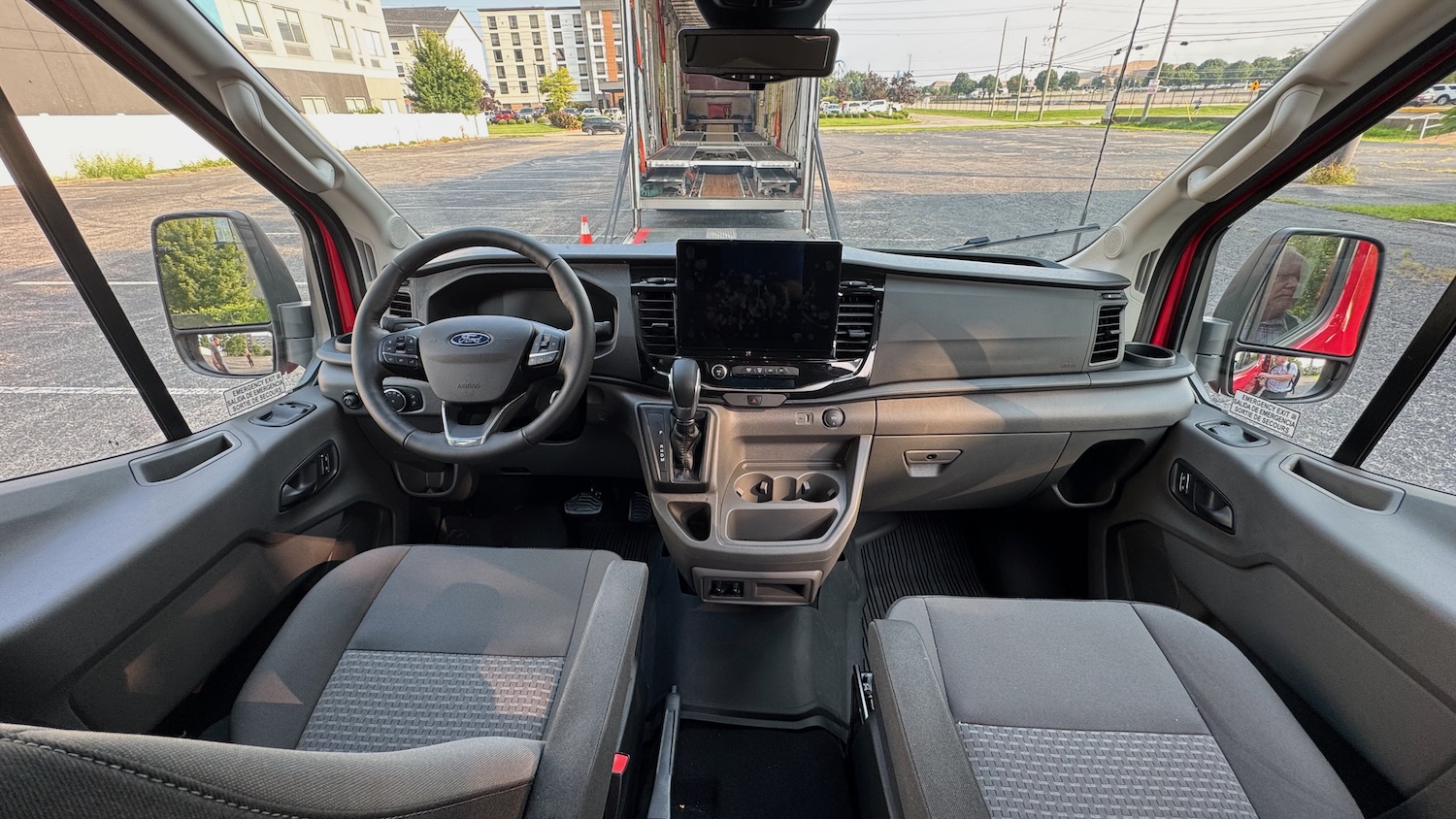

Speaking of the dashboard, it had quite a bit of storage ahead of the driver and passenger. You can see the upper dashboard cubbies in the photo below, which also shows the rooftop storage area just aft of the driver and passenger seats:

The first thing I did when I got to Louisville was fill this area with beef jerky, chips, and cookies so my dad, brothers, future brother’s brother-in-law and I would never be even slightly hungry during this bachelor party. This would be important if folks were going to be drinking:

Comfort was the whole point of this van. We had tons of space, we had tons of snacks (and a cooler in the back), and the interior was always at the perfect temperature thanks to a separate rear HVAC:
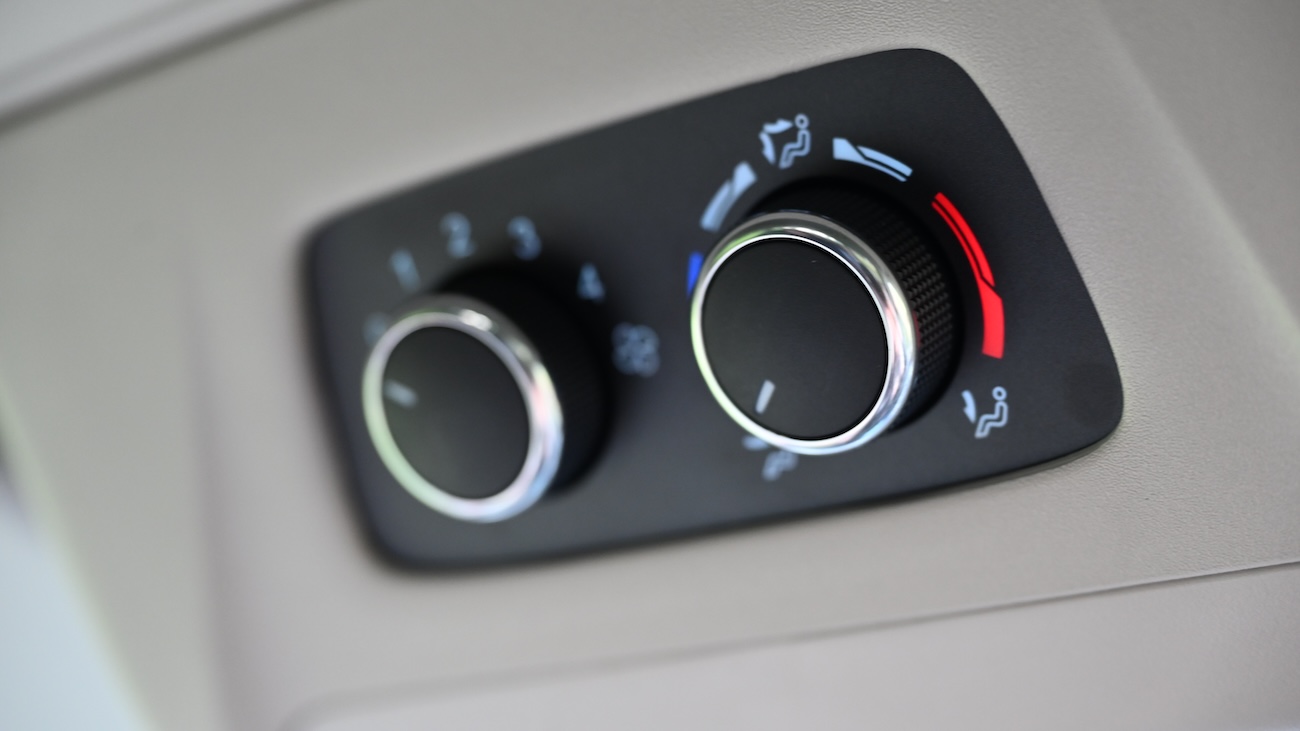
The thing blows ice cubes.
On The Bourbon Trail, Our Ford Transit May As Well Have Been A Lamborghini

Our first stop along the Bourbon Trail was a small distillery called Peerless. Started by the stud on the wall in the photo below back in the late 19th century, the distillery went belly-up around 1920 because of WWI and Prohibition.

Almost a century later in 2009 the handsome founder Henry Kraver’s grandson, Corky Taylor, sold his financial services company and then in 2015 reopened Peerless, managing to somehow get the original Distilled Spirits Plan number (DSP number) of 50, whereas a new distillery would normally have the number 20,000+. Needless to say, Peerless advertises this number heavily:

I’m telling you all this history because I can’t tell you anything about taste. I don’t like the taste of any alcoholic beverage, so I found all the bourbon I drank during this weekend (which wasn’t much; I was the designated driver) to taste the same (i.e. not good).
Still, it was cool looking at the history and especially the science behind it all, especially Peerless’s six giant fermentation tanks and the 2,500 gallon cooker:


The most impressive piece of hardware is the 26-foot, 14-inch diameter, 18-plate continuous copper still:


As I understand it (and I’m no expert), a still is basically just a giant heat exchanger. The corn/rye/barley and local limestone water that makes up various batches of “mash” gets cooked in the cooker, sent to the tanks for fermentation, and then all that goes into a huge 3,800 gallon “beer well,” which ultimately sends that beer into this still at the middle/top. At the bottom of the still is boiling water.
The beer fed into the top passes through a series of cold plates (condensers) that have holes in them; the holes allow both the beer to fall through and the vapor from below to rise. As the water vapor and beer interact, it vaporizes parts of the beer into alcohol, which rises, hits a cold plate, becomes a liquid, gets vaporized into alcohol again by steam, hits a cold plate, becomes a liquid, and on and on until the vapor can get through each plate and to the top of the still.

It’s fascinating stuff, even if, at the tasting at the end of the tour, I didn’t drink much:

After everyone but me had a nice buzz going, we walked to the Louisville Slugger Museum, a company dedicated to the now-fifth-generation, family-owned baseball bat company Hillerich & Bradsby Co. Here’s my brother Ian swinging Hank Aaron’s actual, game-used bat:

Here’s my brother Ben picking up the wood billets that will be used to make bats for LA Dodger catcher Will Smith:

Here we’re watching those billets — either white ash, maple, or birch (which come from Hillerich & Bradsby’s own forests in Pennsylvania) — get machined into bats in a lathe:

The sign below shows the baseball players for whom the company was machining bats that day:

Before we left, my brother Ian, my brother’s future brother-in-law Matthew, and I hit the batting cages and reminisced on Little League and how quickly our years have clearly flown by:

After the museum, I drove us all to our Air BnB and we basically played video games all night, as adults do:


But it was really day 2, while at Woodford Reserve conducting my backwards parking operation to keep my van from hanging out too far into the lane, that I noticed something: Our van was getting a lot of looks.


That’s when I realized: There were Transit vans everywhere:


Every single distillery we visited for the remainder of the weekend had its parking lot filled with Transits, whose drivers were wondering who the heck I was, and whether there was new competition in town.

I had a chat with Jason from Kentucky Bourbon Boys, and I asked him what he thought of the vans. He said he was a fan, and that — aside from a recent emissions issue on one of the vans — his company found them to be reliable and practical, and they valued the fact that they were American.

Over the next two days, I drove our crew of seven from distillery to distillery along the Bourbon Trail, learning about how wood gives Whisky its flavor and color, and the difference in flavor profile created by a barrel that is charred or toasted:


I also learned about black whisky fungus found around Rickouses that store bourbon barrels. Apparently this black fungus, which is found everywhere in the region, used to be a giveaway if someone was illegally making whisky during prohibition. Look at how covered this Chevy K1500 is after parking near a Rickhouse!:

While participating in all these tours, I learned lots of local “lingo,” including:
- Angel’s Share: Whiskey that evaporates through the barrel’s wood pores
- Kentucky Hug: The warm sensation when drinking whiskey
- Kentucky Chew: A special way to taste whiskey
- Whiskey Thief: A long tube used to pull whiskey from a barrel
It was all very touristy, but a good time nonetheless. Here’s the future married man getting serenaded at a Mexican restaurant and then getting a pie to the face:


And here’s our crew just drinking whiskey and playing corn hole at Whiskey Thief Brewing Company. This was a great day:


It was here at Whiskey Thief that I had trouble finding a parking spot, in part because there were so many Transit tour-vans:


So I decided to park on an incline — something that made quite a few passers-by rather uncomfortable, as they kept trying to flag me down and warn me that I was about to tip:

From where I sat in the driver’s seat, everything felt under control. That leaf-sprung solid rear axle flexed well and kept all six tires on the ground:

Well, maybe only five full tires were touching:

Aiming the nose up the hill to get the entire van off the road caused my rear tires to spin out. This actuated the front axle, which pulled the van up and out of the way.

For a vehicle this large, I’m not sure I’d leave the all-wheel drive option box unticked, as 7,000 pounds stuck in grass just because you want to park off the side of the road sounds like a nightmare.

As we departed our final brewery, it became clear that I was driving the supercar of the Bourbon Trail.
Nobody wants to drive their own cars to these breweries, as the whole point was to drink the product, so tour vans abounded, and of all the tour vans out there, I was driving the Top Dog: a fully-decked out, all-wheel drive, Transit 350 HD. The heavy-duty, dual-rear-wheel, EcoBoost-powered beast, a vehicle perfectly suited for this job, and it’s not just me saying that, it’s pretty much every tour company in the area saying that with their purchases.
An Unforgettable Bachelor Party Thanks, In Part, To The Perfect Transportation

I won’t pretend the Transit was flawless. The sliding door was fine when opening the door from the outside, as many tour companies do for their clients, but when my dad and brothers tried opening the long, heavy door from inside, there just wasn’t enough arm-space to swing that door open comfortably. This thing deserves a power door; the fact that it’s not even an option seems unacceptable to me, and I can’t imagine Ford has customer data that says otherwise.
I also found the infotainment system to be very useful, but given the distances at play, I feel the screen should be angled towards the driver a bit to make it more useful.

In addition, I wish the steering wheel telescoped a bit. And again, the USB-As feel a bit dated, the ride can be a little stiff when unladen, the power mirrors should fold when the van is off, but otherwise, the van crushed this assignment.
The bachelor party ended with a tour of a Rickhouse, a building built especially to age bourbon.

Interestingly, the inner structure is all made of wood, and barrels are laid on that wood. Only after that is the outer part of the building laid over top:

Here we are getting a taste via a Whisky Thief:

And this should give you an idea of the scale of one of these buildings — just multiply it by ~7 floors:


We also stopped by a replica of Abraham Lincoln’s birth-home:


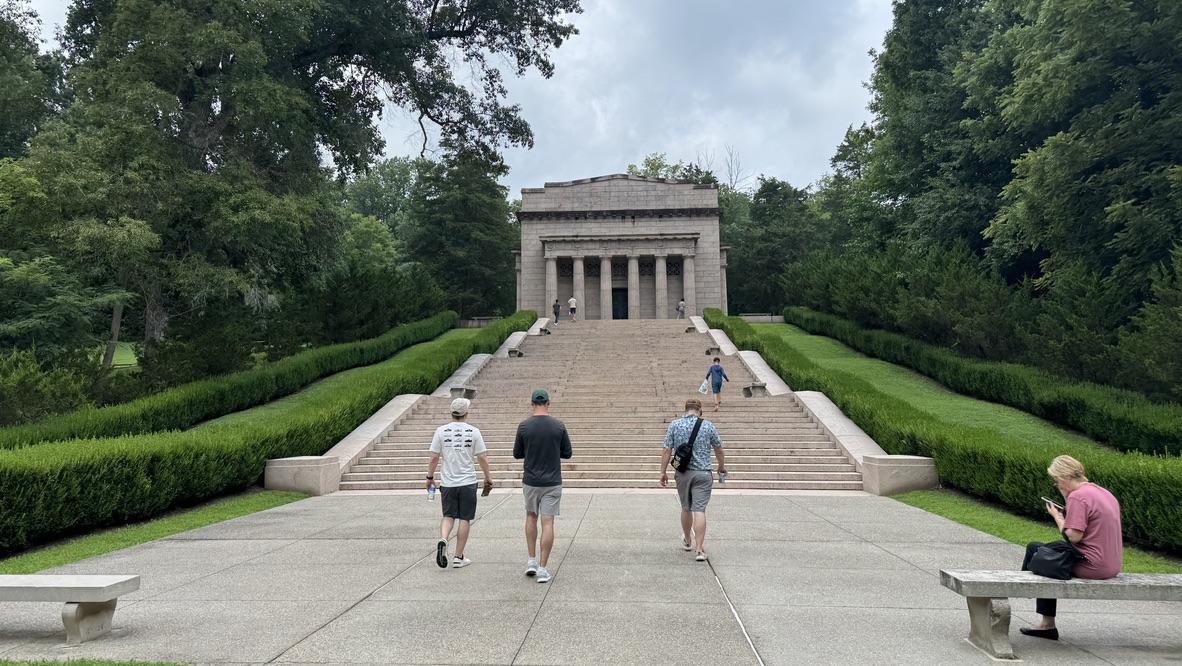
And finished our weekend with a walk through the biggest cave in the world (by length — 426 miles at least): Mammoth Cave.


It was a truly epic weekend, and I’m glad I had the ultimate Bourbon Trail Supercar to help make it all happen.


The first part of your article reminded me of the Pretenders classic “My City Was Gone.”
Ay, oh, way to go,
OhioMichigan.Damn has it really been 3 years since you left Michigan already? I feel like it was just last week that you were showing us all the cars getting stuck in your backyard. I guess they were just playing the long game and waiting for you to leave until they upgraded the place!
But to the vehicle at hand, I used to have a Transit Connect as my work car and it was surprisingly comfortable. And that upper shelf was glorious for storing whatever the hell it was you wanted. Made use of what could have been a lot of wasted space.
For the last several years, I have rented a couple of 12 passenger 2500 versions off this van for a 12 person relay race. We remove the 4th (back) row of seats and have a tremendous amount of room for 6 people and gear. Unfortunately, the cost of the rental is now greater than the entry fee for the race. We can’t afford $1,600 for two vans for two days. I guess I will go back to borrowing old Suburbans from friends.
I may have done a few deep dives on the Ford Transit forums before I bought mine (a Crew version!) in 2020, right before the market went ass over teakettle. IIRC the passenger versions did have a power sliding door option back in the day. But then the COVID supply chain nonsense ended up taking victim of the hardware for the power sliding doors. Van orders were delayed by years because of those power sliding doors. I’m assuming Ford eventually gave up and told everyone that COVID ruined it all and now nobody gets power sliding doors.
When i got hired by Ford in 2015 they took everyone on an orientation drive around Dearborn, which included the test track. Picture a 15 passenger van full of young new hires doing 90+ on the high banking around the track, then up and down the steep inclines.
I’ve been looking at these for a while, as it is the only van sold in the US today with an optional turbocharged engine and optional AWD, both of which are needed as I live high enough up in elevation that an NA engine loses 25% of its horsepower, and AWD is necessitated by it snowing basically 9 months out of the year.
However I wish I could get a medium or low roof version of the Dually, as soon as you option the dual rear wheels it forces you to a high roof version.
Which where I am the highways are very often shut down to “high clearance” vehicles, which is defined by whatever the highway patrolman says, but do to the real concern of blowovers due to the high winds.
Couple thoughts:
Since the dawn of the Van Epoch, passenger variants have always been the “developmentally disabled stepchild” of the line. It makes sense, as the vast bulk of sales come from the cargo versions. Some companies are better at finishing the interior panels and installing seats than others, but in the end, they’re all cargo vans with some interior panels and seats thrown in.
Also, ever since Ford and Chrysler began building high-roof 12+ passenger vans in the European style, they’ve caused a vast decline to the business that made scads of money converting cutaway cab Econolines into shuttle buses. Yes, you still see some of those airport and hotel shuttles with the bespoke fiberglass bodies, but scads of them have been replaced by the much cheaper 15-passenger Transit Vans.
Been to Woodford before, such a cool distillery. I really learned to appreciate Bourbon there, but I wasn’t driving.
As someone who loves beer, whiskey and vans this is a great read.
Question about the clearance signs though, in the US are they precise?
In the UK clearance signs are normally posted 3-6″ under the real height. Though also realise it was a private sign not one by a local/road authority.
That looked like a lot of fun. That’s a massive van, geez! The Transit Connect is a smaller version of these vans, closer to a Mazda5 in size but taller. I just got a 2020 and have been moving bikes, people, and cargo (separately usually.) I don’t think they share drivetrain parts, but the design elements are similar. You can get cargo or passenger versions, long wheel base or short wheel base, and barn doors or a massive liftgate.
Only if you buy a used one. They were discontinued in the US after 2023.
“ For a vehicle this large, I’m not sure I’d leave the all-wheel drive option box unticked, as 7,000 pounds stuck in grass just because you want to park off the side of the road sounds like a nightmare.”
This article brings back many memories for me.
When I was in high school, I spent an evening parking cars for a family friend’s wedding they were hosting at their house. For people that were staying in local hotels, they had a van (probably a Chevy Express) running a shuttle service back and forth. It was raining the entire evening, and at one point the driver decided to park on the freshly laid sod. He buried the wheels up to the axle and we had to call a tow truck.
I also used to take an actual trip with a bunch of my cousins to the mammoth caves. We also visited a few distilleries, the Corvette museum, and I have a very similar picture from a Mexican restaurant in the same area since it was around my birthday typically. We rented a minivan one year, and a full size van another. The year we had the van, a blizzard rolled through Kentucky and Southern IL. Part of the way through the trip, the driver broke the drivers side windshield wiper blade off banging ice off of it. This resulted in my cousin and I standing on the front bumper on the side of the highway in stop and go traffic coming up with a way to get it back on.
I did not expect a story about a full size van to prompt so many memories.
It was great meeting and chatting with you on the Bardstown tour. Looks like you had a great time.
What a cool bachelor party!
I might be wrong, but I thought Transits were designed and built by Ford’s European arm.
This generation is sold globally, with specific engines for the different regions. The US sold Transits are also build in the US. My guess is that the design is a joint effort of ford-europe and ford-US.
Americanized by putting in red turn signals 🙁
rears should always be amber. period.
At least the cargo version needs to be as they’re subject to the “chicken tax” that keeps foreign trucks out of our market.
IIrc that’s also why the focus-based Transit connect isn’t sold here anymore as Ford was caught importing all of them as passenger vans and tossing the rear seats after leaving the port.
IIRC they shipped the seats back to Spain or wherever they were made, and they got installed in new vans and sent back again!
Better than the VW diesel scandal, but still a bit shady.
I believe the full size Transit is built in Kansas City (KCAP), the Transit Connect was built in Valencia and imported.
Looks like a great weekend – kudos for being the DD and arranging the transportation, I’m sure that was well appreciated. And Peerless was a great way to start the tour, yum.
I grew up just a few miles from Whiskey Thief and love their stuff – plus like you said, it’s a lot of fun there. Many people I spoke to there and at other distilleries found it to be their favorite place. Hopefully you got to meet the distillery cat…and that you took the turn onto the road there slowly.
Looks like that fungus-ridden GMT400 was at Glenns Creek (they put out some great products as well), I’m glad they were able to breathe new life into that little area along with Castle & Key. I still need to check them out in person.
Speaking of how things used to look…this is what the latter two looked like in 2007, when I stopped by to visit with a friend.
Old Taylor & Old Crow – Yarnallton Pike
They did WHAT to my beloved Hunter House? This is what happens when I don’t visit Detroit at least once a year.
Birmingham is gonna Birmingham, and not really Detroit at all.
They are just down the street now, but it’s a crap deal that they were dealt with the landlord situation. Or try some of the other excellent slider places, like The Telway.