


Since 1971, Amtrak has served as America’s quasi-public national railroad. If you need to get between cities or across the country and don’t want to do it by bus, car, or plane, the train remains an option. I have finally taken an Amtrak train for the first time in my entire life, and it’s left me conflicted. On one hand, the train was magical and far more comfortable than a plane. On the other, this train ride also made me sad.
Before 1971, America’s passenger rail system was operated by a patchwork of private railroads. These operations, which often hauled freight in addition to passengers, were countless, and spread from sea to shining sea. Often, more than one railroad served a single region, competing for the same market. This system worked in the 19th century, when trains were the only real way to travel great distances across land in anything resembling alacrity.


Times began to change in the opening decades of the 20th century. Emerging technologies like the automobile and the airplane began snagging headlines. But the trains weren’t threatened, at least not at first. By 1916, 98 percent of intercity passenger traffic was handled by trains, and 77 percent of intercity freight traffic was on the rails, too. In a distant second place was inland waterways, with a meager two percent market share. Over the decades, cars, buses, and planes each chipped away at passenger rail market share.

By 1968, trains carried only 1.2 percent of all passenger traffic in America. Americans felt that trains looked antiquated compared to other forms of transport and offered limited freedom. Making matters worse for the railroads was the fact that the United States Post Office Department began diverting mail from passenger trains onto airplanes, freight trains, and trucks. Eventually, some of America’s largest railroads were on the brink of collapse.
The formation of the National Railroad Passenger Corporation, or Amtrak, allowed the railroads to wash their hands of passenger operations to chase just lucrative freight. Amtrak would handle intercity and long-distance rail, allowing the freight railroads to chase their bread and butter. Meanwhile, regional agencies — like the Regional Transportation Authority here in Chicago — handled commuter rail in cities and suburbs.
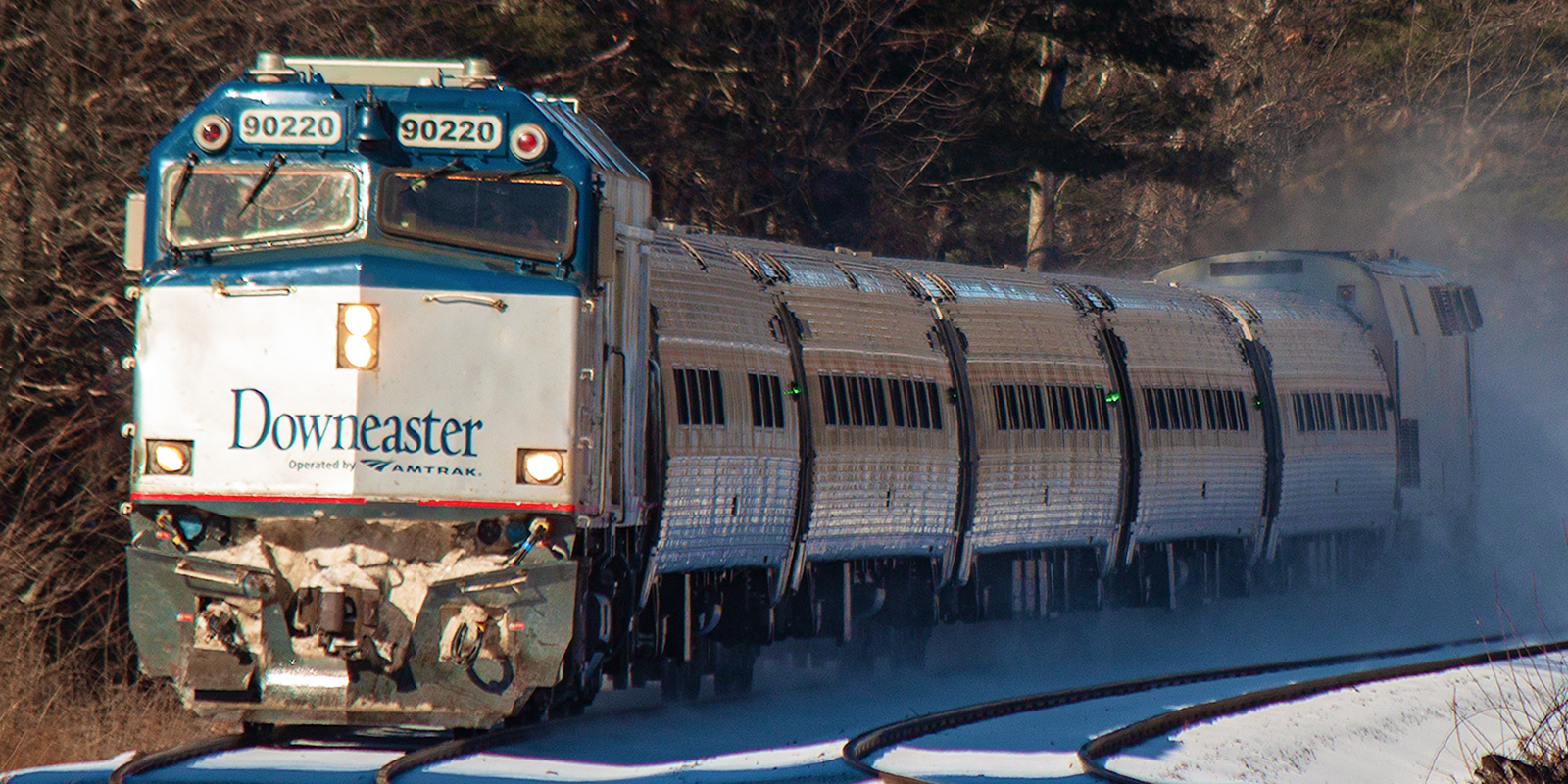
Since then, Amtrak — which is funded by the federal government, but run like a for-profit corporation — has clawed back ridership. In the Northeast Corridor, for example, Amtrak has an 83 percent share of the air-rail market on the route between Washington, D.C. and New York. The Northeast Corridor in itself has a lead over the airlines.
Amtrak’s passenger numbers are barely a footnote on long-distance routes compared to planes and cars, and as the United Rail Passenger Alliance claims, some routes have as low as a one percent market share. This is all to say that America doesn’t really take the train like it used to. That includes myself. I am an avid train geek, and yet, I rarely ever ride a train that’s actually in service. I have never even stepped foot in Amtrak equipment that wasn’t retired and sitting in a museum somewhere. Last week, I finally changed that by riding the Amtrak California Pacific Surfliner.
The Train On The Coast
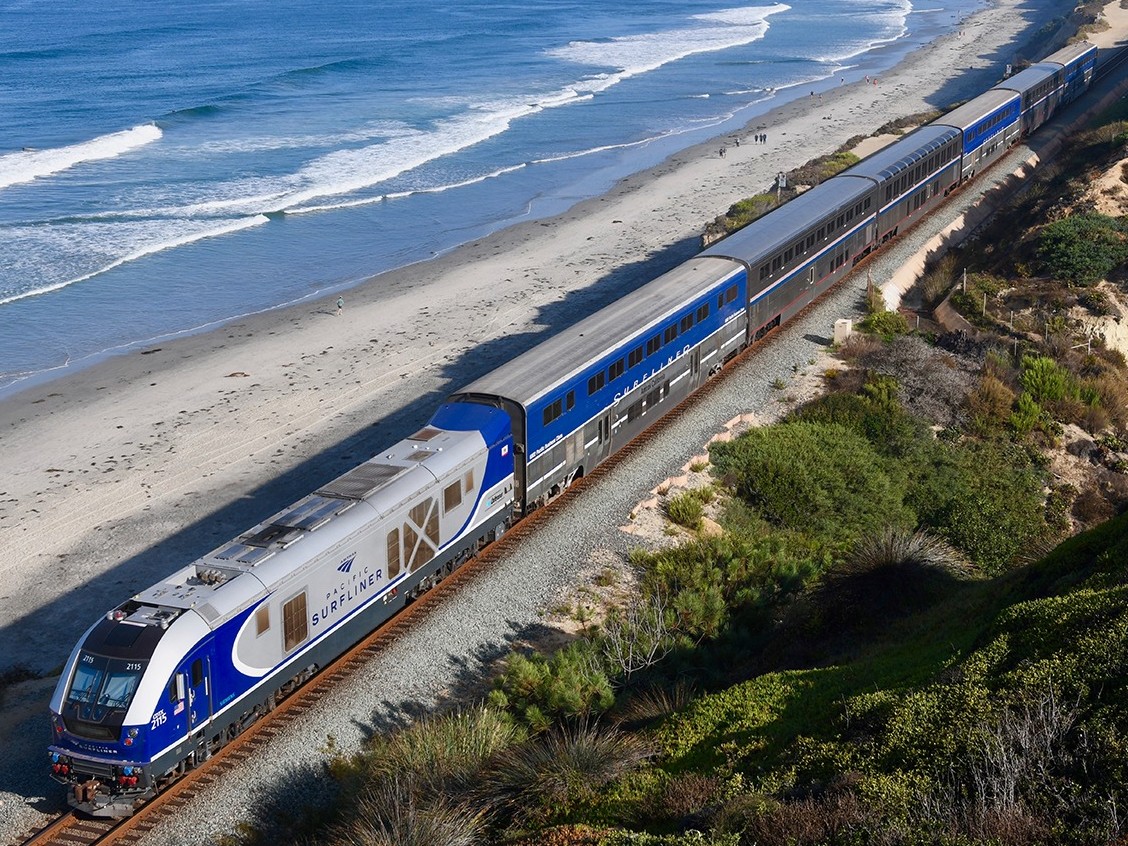
The Pacific Surfliner is the successor to the Atchison, Topeka and Santa Fe Railway San Diegan, which was originally a 126-mile route between Los Angeles and San Diego that entered service in 1938. After Amtrak assumed control of the route in 1971, service would stretch as far north as San Luis Obispo. Amtrak named the now-351-mile route the Pacific Surfliner in 2000, and today it’s considered Amtrak’s third-busiest route, behind the Acela and the Northeast Regional.
Many Californians use the Pacific Surfliner as a way to commute to Los Angeles from the north, or to get to San Diego from Los Angeles without dealing with airports or traffic. The highlight of the route is the fact that it spends considerable mileage right at beach level, giving riders some incredible views of the Pacific Ocean during their ride.

The Pacific Surfliner is run by the Los Angeles–San Diego-San Luis Obispo Rail Corridor Agency (LOSSAN), which is a joint authority formed by the local transit agencies along the route. It’s also a part of Amtrak California, which is a partnership between Amtrak and Caltrans that also runs the Capitol Corridor in Northern California and the Gold Runner in the San Joaquin Valley. These trains can help passengers connect to other Amtrak routes like the Coast Starlight to Seattle or the California Zephyr to Chicago.
I rode the Pacific Surfliner as a typical Californian would, and used it to get me from a press event in Santa Barbara to Van Nuys, where the Autopian’s headquarters resides. It was a ride of only 84 miles, and was estimated to take roughly two hours and 14 minutes to complete. Not a bad choice for only $27.

My train was due to depart Santa Barbara at 6:53 a.m., and since I hadn’t ever ridden an Amtrak train before, I obeyed Amtrak’s advice and got there 30 minutes early. It was still dark outside, and only a few people milled around the station. I’m not quite sure why Amtrak recommends getting to a station so early when there’s nothing going on, but it was beautifully peaceful.
Eventually, a bus arrived, which dumped a bunch of college students off at the station before disappearing into the darkness. Before long, there was a small crowd of tired travelers at the station. They, like me, probably woke up way too early for this.

The train arrived at 6:53, and I was pleasantly surprised by what I saw. Earlier this year, I wrote about the cab cars that allow commuter trains to easily run in a push-pull configuration. Apparently, the Pacific Surfliner does not have a way to turn around at either end of the line, so a cab car is placed on each train.
Leading this train was No. 6907 Point Mugu, a combination bi-level coach, baggage, and cab car. It was built by Alstom in 2001, and it feels a lot like a coach bus, but scaled up. The lower level of the coach was reserved for bicycles and people who weren’t able to climb the stairs. The upper level featured seating for everyone else.

What I immediately found glorious about the train was the lack of assigned seats and no security. I just dragged my bag onto the train, found a seat I liked, slid my bag into the luggage compartment, and plopped myself down.
The seats themselves had pretty decent padding, incredible legroom, and a table large enough to use a big laptop in relative comfort. I also enjoyed the huge windows, even though they were a bit old and not as clear as they used to be. Unlike most planes I’ve been on, the power outlet was also easy to access, as it was right there on the wall next to my seat. I was rather impressed with what I got for my $27.

But then, I got the “stereotypical” Amtrak experience almost immediately. Relatively powerful storms had passed through Santa Barbara the night before, which led to some localized flooding and some downed trees. One of those trees blocked the tracks. The engineer behind the controls of the cab car assured us that the delay would be only a few minutes. Unfortunately, it wasn’t that easy, and the delay stretched into the tens of minutes.
This gave me plenty of time to explore the train. Typical Pacific Surfliner trains are six-car consists with a cab car, two coach cars, a coach car with a lower-level café, an Amtrak Superliner car, and a business class car. Finally, a locomotive sits at the end, or the front, depending on travel direction.

That locomotive was No. 2118, a 2018 Siemens SC-44 Charger diesel-electric locomotive (below). The Siemens Charger family entered production in 2016, and it’s supposed to be a versatile passenger workhorse.
Transit authorities can get them in diesel-electric, overhead wire electric, third rail electric, and battery-electric configurations. This one was a diesel-electric. The prime mover is a 95.3-liter Cummins QSK95 V16 with 4,400 HP on deck. The four Siemens three-phase AC electric motors have 978 HP each, and are good for 62,000 pounds of continuous tractive effort at 16 mph. In other words, the Pacific Surfliner has some healthy power! The Cummins is surprisingly quiet, too.

The Surfliner cars were all built between 2000 and 2002, and they show their age a bit with interiors bearing some scratches, some fading, some cloudy-ish windows, and some dings here and there. But it’s really no worse than when you ride in an older Boeing 737 that’s still in revenue service. If anything, it’s much better. In addition to the great legroom, Surfliner seats also recline almost as far back as the seats in a car do. Since the train runs light before Los Angeles, there’s no shame in maxing out the recline, either.

I made it to about the halfway point in the train. The center car has the café on the lower level. I had high hopes for the café, but it was actually pretty depressing.
Half the menu items were entirely unavailable, and what was there looked like it came from the frozen section at a Dollar General. The menu also didn’t make much sense. There was a vegetarian breakfast burrito, but the menu made no effort to say what was in it, and there was no way to add any breakfast meat to it. So, had the burrito even been in stock, which it wasn’t, I had no idea what was even in it.

Ultimately, I decided to go without breakfast and walked back to my seat. As I waited, I spotted this parking area here, where someone abandoned a Mercedes-Benz (below) next to a motorhome that looks like it has the Mercedes-Benz’s hubcaps. Neat.

Finally, after a 50-minute delay, the train departed.
The Most Scenic Commute
The Pacific Surfliner is a gentle train. The cab car I was in slowly bobbed up and down on the tracks, and the whole train quietly marched along the beaches. The journey was quiet enough and smooth enough that I considered going to sleep and catching another hour of sleep. It was a beautiful contrast to the ocean, which was still somewhat violent that morning after the storms.

But I was too excited to sleep, and watched the train scoot down the coast.
The Pacific Surfliner’s tracks generally follow California’s coastline. These tracks were originally laid during the 19th century, when railroad builders still had limited methods to deal with steep grades and high terrain. The tracks are right at the edge of the water, where the ground is flatter. This is great for the passenger, as it means seeing views like this:

It can also be a nightmare for Amtrak on any day that isn’t perfect. Rising sea levels have resulted in scenarios where high waves crash onto the sides of passing trains, while also drenching signal equipment with saltwater until they short out. This was the case on the day I rode the Surfliner. High waves shorted out signal equipment, leading to red signals when there should have been green ones. As a result, the train had to run at slower speeds than usual.

The train rarely exceeded 54 mph. The highest speed I observed with GPS was 74 mph, and that was only for a brief period. Still, I didn’t care because this might have been the most visually spectacular train I’ve ever been on. The only one that comes close to it was the excursion train I took to the Grand Canyon. But this was no excursion train. People were riding this thing to get to work, school, doctor appointments, and to the airport!

Eventually, however, the train would turn away from the ocean and would go through a series of tunnels before getting into the Los Angeles metro area. As the ride went on, the time between stops reduced from over twenty minutes to ten minutes, then below ten minutes between each stop. By the time I was hurtling toward Van Nuys, the train felt a lot like the Metra commuter trains I have here at home, but with better seats.

Finally, at 10:18, or an hour and 11 minutes later than I was supposed to arrive, I stepped off the train at Van Nuys. Then, I watched as the Charger quietly pushed the train off into the horizon.

I left my ride feeling both pumped and a bit sad. I was thrilled because this train was as comfortable as the last first-class flight I took, but at a rock-bottom price that couldn’t be beaten by any other way to get from Santa Barbara to Los Angeles. I adored the huge windows, the quiet ride, and the room I had to totally stretch out. Trains are legitimately awesome ways to get between two cities. Forget sitting in traffic in a car when you could legitimately kick back on Amtrak.
It’s Hard Not To Think About How Much Cooler America’s Trains Could Still Be
But then, I felt sad. It wasn’t really about the delay. Amtrak’s on-time performance is about 71.1 percent, or no worse than your average airline. Besides, when your train gets stuck at the station, you can just get off it and walk away. You can’t do that when your plane is delayed on the tarmac.

What really brought me down was being reminded that the Pacific Surfliner is one of the best rail experiences America has to offer, in that it’s awesome by American standards, but behind much of the rest of the world. True high-speed rail remains a pipe dream in America. Likewise, unless you’re in a part of America where there is robust train service like the Northeast, Florida, Chicago, or Southern California, taking a train probably won’t make sense a lot of the time. If you take an Amtrak train on a long enough distance, you’ll probably even witness your train stopping to let freight traffic by. In other words, I wish America invested more in passenger rail.
I love to imagine a future where, if I want to, I can park my car, then be whisked away to a different city without worrying about the TSA, getting to a terminal two hours early, or being crammed into a tiny seat. Trains offer a taste of that potential! Such is already a reality in places like China or Europe. But that dream remains elusive here.
Still, I highly recommend trying out an Amtrak train, and especially the Pacific Surfliner, at least once in your life. Sure, depending on the route, it might be slower than a plane, and the train will probably stop a bunch of times for all sorts of reasons, just like a plane gets delayed for all sorts of reasons. But it’ll be a fun, unique experience you can’t get anywhere else, and certainly not in row 30 of a Boeing 737.
Top graphic images: Mercedes Streeter


I’ve only ever taken the Surfliner and Coastal Starlight for US rail. Surfliner is great for when you don’t have compressed time needs or can leave a day early, etc. You will run into the “we’re an hour late” thing from time to time… but, as anyone who’s used the 405 to get to San Diego knows, traffic can occasionally do that too…. It’s a beautiful chill trip, and you can’t beat the price.
My one Amtrak experience was miserable. It took 11-1/2 hours to go from Fayetteville, NC to Washington DC. We arrived to DC so late, the Metro had shut down for the night. Never again!
I’m surprised you’ve never taken the Hiawatha between Chicago and Milwaukee, it’s cheap, comfortable, and fast, the best way to travel between the cities.
@mercedes. We need to get you out to Italy to experience their train systems as well as give you a chance to see all the Smart cars, plus Smart sized competitors…along with all the scooters. It seems like the perfect trifecta for you, and I just spent 2 weeks there. I definitely thought that Rome was a great car spotting area.
EDIT: Sitting on their train as it went close to 200 mph was such a beautiful experience. That north south Trenitalia system is perfect for either coast here, besides our lack of infrastructure.
Riding trains in Europe was fun and I wish we had something equivalent. Somehow 1/2 the country thinks trains are a commie plot to steal their freedom dollars.
I wanted to do a cross country trip for a vacation. It was just too expensive. I guess the only places that get good prices are highly populated areas. I still wish they would have put a train between Phoenix and Tucson like they talked about for decades
I swore off Amtrak after spending 16 hours in a freezing coach-class seat from Chicago to Utica, NY. Aside from a few happy retirees with nothing else to do, most of the passengers gave me a distinct vibe that they were en route between various sad family and/or legal situations. Also, this was before Zyn pouches were invented, so the hourly deboard-for-a-cigarette times were palpably tense.
This brings me back to when I was in college and taking the Pacific Surfliner between campus and home. I miss it, weirdly enough. I never tried the food on the train — I never had a reason to, I was usually taking it shortly after breakfast or after lunch, so I could get away with just getting a snack at the Trimania at Union Station — but I loved riding the train.
The views are beautiful, but the rails are in danger of collapsing into the ocean because of climate change and high surf destroying the banks that protect the track. I suspect that at some point in the near future, they’ll make the decision to move the tracks further inland in order to continue having service between Los Angeles and San Diego. And that makes me sad, because the scenic view is a large part of what I miss.
I know that it’s not as good as rail elsewhere. I’ve been on the high-speed rail between Guangzhou and Shenzhen, so I know what it could have been. But it’s just the bit of nostalgia that makes me love it, even though I know it’s not the best it could be.
For sure I’d much rather take a train than an airplane these days. But I bet there are interesting fellow passenger experiences sometimes.
All their hot food, is just frozen stuff chucked in a microwave, f the Wolverine is anything to go by. So yeah, no fresh meat or anything available.
I sued to take the Wolverine to Chicago from Metro Detroit once or twice a year. My last ride was stopped on the tracks for 12 hours, as we hit a person lying on the tracks. What was supposed to be a free afternoon in Chicago before a week of corporate training, turned into most of a day stuck in a train in the middle of nowhere West Michigan.
I won’t say never again, but I’m not as sold on train service as I used to be. I know travel can go bad in Planes, Busses and Automobiles (ask me about a group of Detroiters renting a bus to get home from Philly) but yeah walking through downtown Chicago at 3AM to get to my hotel because even the taxi drivers had gone to bed sucked.
Oof, that’s brutal…
I’ve always thought it interesting commentary on America that unless you have specific reasoning against doing so you’re basically always better off taking a domestic flight if you are going somewhere far and don’t want to just drive; both of which are faster and cheaper.
Every year I take a trip 750 miles each way from Chicago to SC to visit family and it’s much cheaper to fly even with prices being about 150% higher than normal. Tickets would be $432 for the flight I’d pick right now (though I could do $346 if I hate myself and sleep). Alternatively I’d spend $375 in just fuel, $25 worth of an oil change, $120 worth of tire life, 16 extra hours of time, and any additional wear and tear to my car. Going the Amtrak route would cost me $504 and take an extra 49 hours of time.
My Amtrak experience pretty much lines up. I used to go from MKE to Winona on the Empire Builder quite often in college and when it was good, it was great. Lots of room…quiet…comfortable enough chairs…But when a herd of Buffalo got onto the track in Wyoming a day prior (an actual excuse given by the ticket person IIRC) the train was delayed 8hrs and I was stuck in Winona trying to get back on a Sunday before school the next morning. I started calling ahead from then on and the problems weren’t usually that bad but there was 2-3 times I ended up getting my parents to drive me instead of waiting the equivalent amount of time it took to get there for the late train.
The Wolverine line is pretty nice, I’ll be taking it to Chicago next week.
Sorry to hear the cafe car was a bust. If you happen to get on the Cascades line, grab a set of branded playing cards. As far as I know it is the only line currently doing the playing card thing, but I gather it used to be more popular. They should bring that back. I’ll gladly pay $5 for a deck of cards with trains on it, but no chance if it is just a regular deck I can get at the grocery store.
18 years ago we took the Amtrak Coast Starlight from LA to Oakland, an 11 – 12 hour trip. Our son was only 18 months old so we got a sleeper car to have a hideout if he got cranky. He did.
The only disappointment on that trip was the food, as Mercedes mentions. The views were fantastic and the restored glasstop lounge car (I believe a Pullman?) was a great place to have a beer and watch the scenery.
I recently took an Amtrak round trip from Minneapolis to Chicago. Weird experience. Great when it is great, the unexplained thirty minute stops to let another train by, and the bathrooms SUCK. Still a fun experience.
Amtrak — which is funded by the federal government, but run like a for-profit corporation
BIG mistake. That combination has always been a recipe for disaster. Anyone still believing that the trains run on time in Germany is in for a nasty surprise. Deutsche Bahn going private has only had negative effects except for the executives, whose salaries have exploded. The idea of going public one day is dead in the water after they sold their only profitable business to DSV under dubious circumstances.
After Margaret Thatcher and her lackeys had ruined the infrastructure in the UK by privatizing whatever they could, the government seems to come to its senses now. Whatever happens, the result will be a huge burden for the taxpayer.
Ah, so that’s why DB more recently has kind of sucked compared to what I remember almost 20 years ago.
Yes, that was about the time things started going downhill. 🙁