

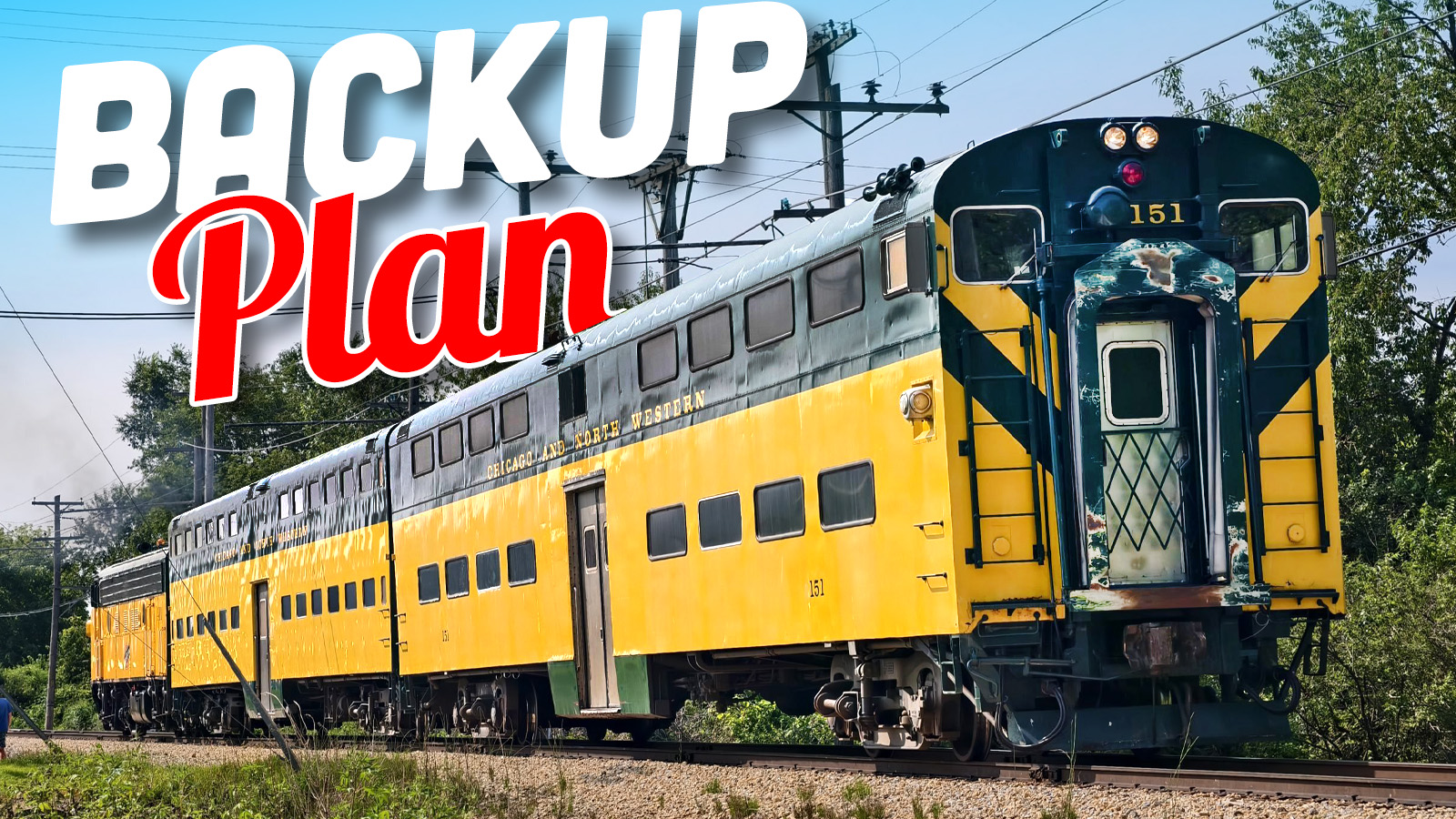
If you’ve ever ridden a passenger train in America, you have probably witnessed an old invention that’s still hard at work. The “cab car” has allowed America’s passenger trains to easily switch directions after reaching the end of a line. Instead of turning the whole train around, the operator just has to sit in a cab in the last car, then make the locomotive push the train. It seems so simple today, but when the Chicago & North Western Railway was the first to introduce cab cars in the 1960s, it would change how American passenger railroads operate. Yet, it’s probably something you never think about today.
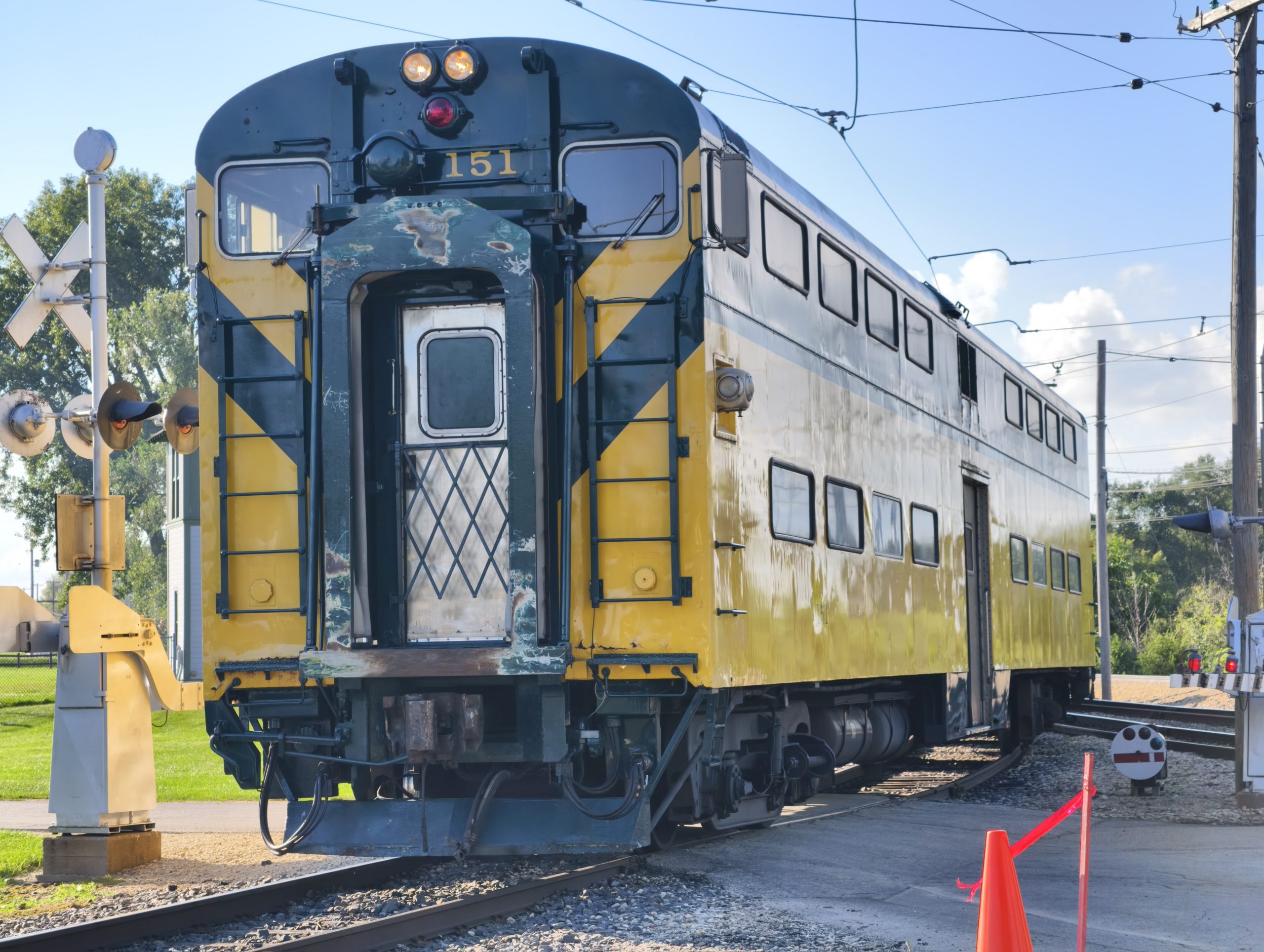
For the past 28 years, the Illinois Railway Museum – America’s largest train museum – has had an incredible piece of American commuter rail history. Throughout the museum’s season each year, you can get a chance to take a ride in Chicago & North Western No. 151, a cab car that will usually be a part of a train pulled and pushed by Chicago & North Western No. 411, a 1949 General Motors Electro-Motive Division F7A diesel-electric locomotive.


Upon first glance, this gleaming green-and-yellow beauty just seems to be a predecessor to today’s commuter trains. Indeed, if you sit in the C&NW No. 151 cab car or its companion bi-level gallery cars, you’ll feel just like you’re riding a modern Metra train or an equivalent in just about any major American city. But it’s so much more than that. C&NW No. 151 was the first of its kind. Found inside the upper level of C&NW No. 151 is a small cabin for an engineer to drive the train from the last car. It seems like such a simple thing, yet when this train car was finished around 1960, it was only the first of a concept that would change American passenger rail.
The Chicago & North Western Railway
To understand why C&NW No. 151 is such a big deal, let’s go back to what American passenger rail was like before the cab car’s incarnation. The Cornell University Library gives a great primer on how the Chicago & North Western Railway came to be:
The Chicago and North Western Transportation Company [CNW] was a Class I railroad in the Midwestern United States, often called the North Western. The CNW also called itself the “Pioneer Railroad,” because one of its predecessor lines, the Galena and Chicago Union Railroad, was the first railroad to run out of Chicago. The railroad operated more than 12,000 miles of track in seven states (Wisconsin, Iowa, Nebraska, South Dakota, Illinois, Missouri, and Michigan) before retrenchment in the late 1970s. At the height of the railroad era, the CNW was one of the most profitable of the Midwestern railroads and one of the longest railroads in the United States because of mergers with other railroads, such as the Chicago Great Western Railway, Minneapolis and St. Louis Railway and others.

The CNW’s earliest predecessor, the Galena and Chicago Union Railroad [GCU], was chartered in 1836. In 1848, it operated the first steam locomotive out of Chicago. Despite this early success, the GCU had many problems, including an inability to build tracks to Galena, Illinois, one of its supposed terminals, and instead had to rely on an interchange built by the Illinois Central to reach the city. These problems led to it being purchased by William Butler Ogden. Ogden was the first mayor of Chicago and a railroad investor. Ogden had already taken over the Madison and Beloit Railroad in Wisconsin and extended its lines. After the financial trouble of 1857, Ogden founded and incorporated the CNW. The CNW was chartered on June 7, 1859, by the legislatures of Illinois and Wisconsin. Five days previously, it had purchased the bankrupt Chicago, St. Paul and Fond du Lac Railroad. Ogden now controlled numerous roads in the Midwest; by 1865, they were merged into one system, the CNW, with over 850 miles of track. Ogden left the company in 1868 and became president of the Union Pacific. This was after one of CNW’s predecessor lines, the Cedar Rapids and Missouri River Rail Road, had reached Council Bluffs, Iowa, in 1867, establishing a direct interchange with the Union Pacific, the first transcontinental railroad. By the end of the 19th Century, the CNW operated on over 7,000 miles of track, connecting such cities as Chicago, Omaha, Milwaukee, Duluth, Rapid City and the Twin Cities.

The CNW opened its Proviso Yards in Chicago in 1929. This facility was the largest of its kind when it was built, containing 224 miles of tracks and a huge diesel shop. The CNW was a “granger” railroad, primarily serving agricultural businesses. Potatoes were ones of its main crops, and the Potato Sheds in its Wood Street Yards were the largest in the world. It also did extensive business in transporting sugar beets, corn and wheat. The CNW also operated extensive passenger lines, including serving as one of the main commuter lines for Chicago. The CNW was unique among American railroads in that it ran on a left-hand main, which meant that traffic was routed to the left instead of to the right. This was common among railroads built by British companies, but not among American ones.

If you were born before C&NW’s dissolution in 1995, you probably knew it best as a freight railroad that served the Midwestern and Great Plains farms that fed America. Other folks might remember the C&NW for the most extensive commuter service in Chicagoland until the formation of the Regional Transportation Authority in 1974, which led to the creation of Metra. The C&NW was also the home of the Twin Cities 400, the route that connected Chicago to Minneapolis in only 400 minutes. The C&NW would apply the “400” name to most of its intercity trains, and the railway would market itself as the “Route Of The 400.”
The Bi-Level Commuter Car
As the Illinois Railway Museum’s Rail & Wire magazine wrote in January 1998, in the mid-1920s, commuter railroads saw a need to carry more passengers without actually increasing the footprints of their trains.
At the time, America’s passenger lines had only recently upgraded to steel cars, and these cars were good to carry 80 to 90 people in a standard 72-foot length configuration. In 1928, inventor Albert Hutt patented what we know today as the bi-level car. Built for the Pennsylvania Railroad in 1932, Hutt’s MP70 increased passenger capacity to 120 people without increasing the footprint of the car. Hutt’s design stacked a second level of seats on top of the existing level.
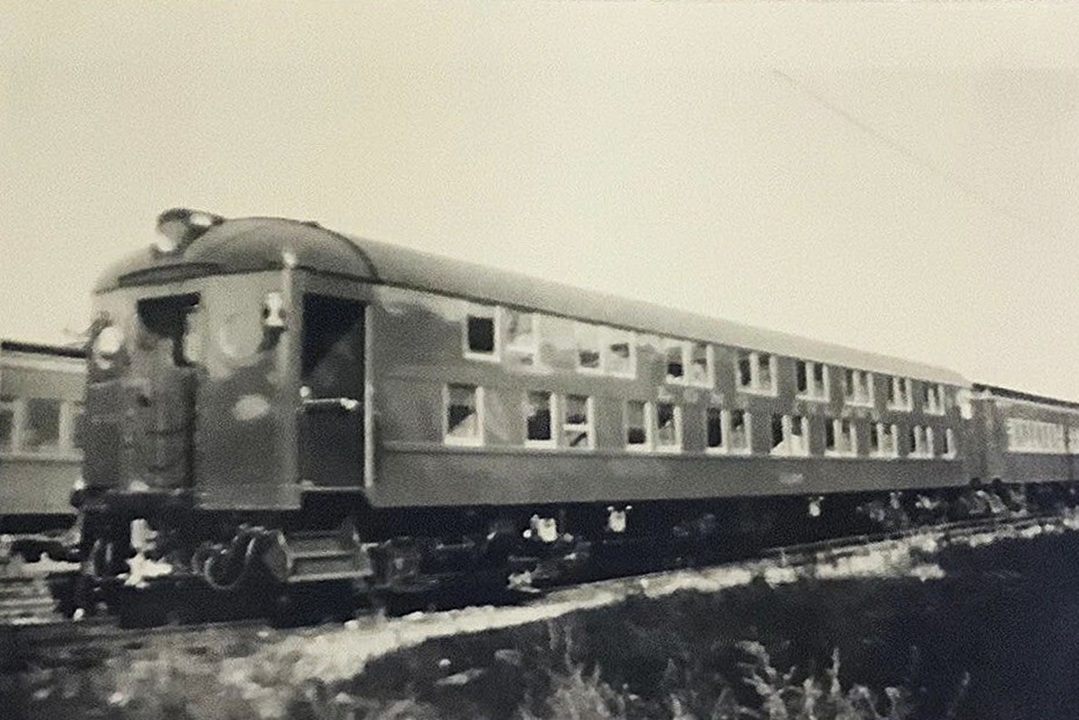
Hutt’s original design was innovative, but flawed, as the roof of these cars wasn’t very high, making for a rather cramped interior.
The idea of the bi-level coach never really died. As Rail & Wire writes, Chicago Union Station assessed “user charges” to railroads by the passenger car. If a railroad wanted to add passengers to a train by tacking more cars onto a train, they would be charged more by the train station. But a loophole would be if the railroads were able to fit more passengers into the same number of carriages as before.
In 1950, the Budd Company launched its first of a new generation of bi-level cars for the Chicago, Burlington & Quincy railroad.
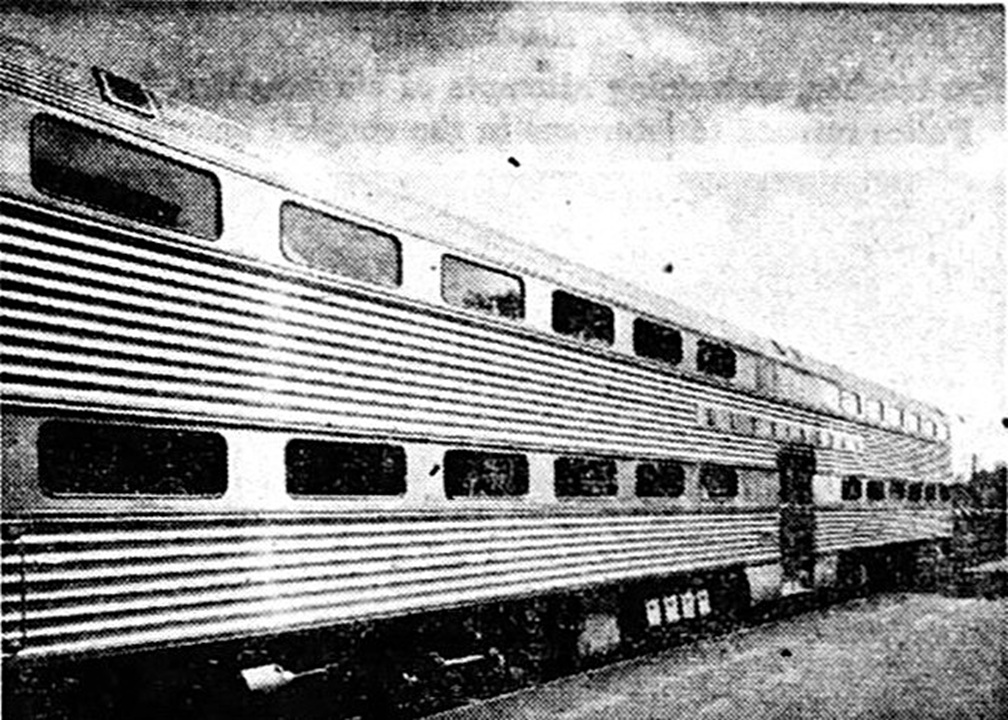
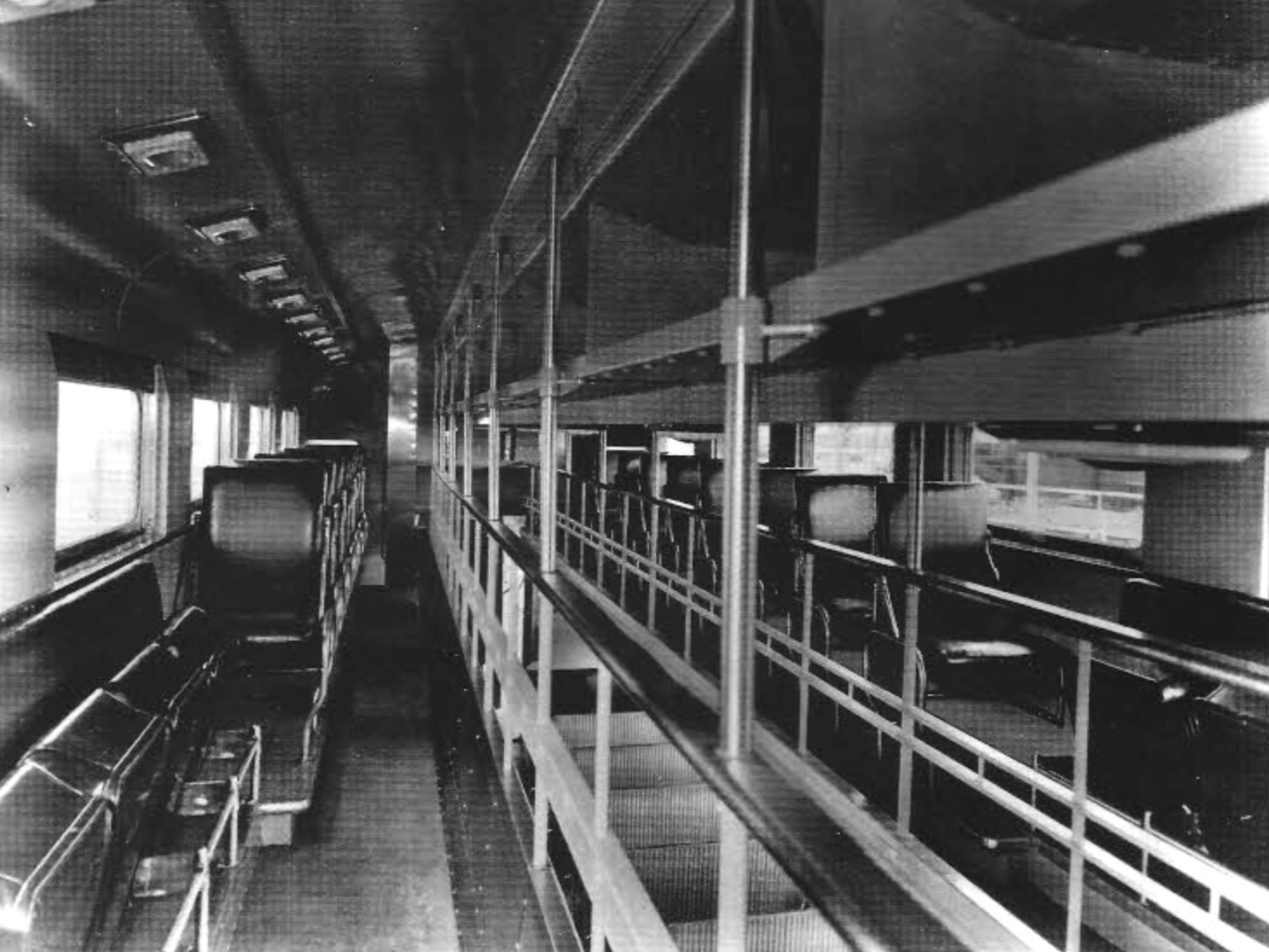
At its core, Budd’s “Gallery Car” was similar to Hutt’s invention, but improved on the idea in key ways. A true double-decker passenger car would have increased passenger volume the most, but was found to be unworkable. One reason was that the conductors’ workloads would either have to be doubled or the number of conductors would have to be doubled. However, by placing an open-air gap in the middle of the car, a single conductor can punch tickets for upper-floor and lower-floor passengers at the same time.
The design of the gallery car improved the passenger experience. A central vestibule made it easier and faster for passengers to disembark or board the train. Four spiral staircases directly next to the vestibules made access to the upper level easier. Since the vestibule was also only on the lower level, the car’s HVAC equipment could live in the space above the vestibule.
Once the Burlington Gallery Car experiment had proven to be a smashing success, other Chicago railroads decided to upgrade their own aging equipment with gallery cars.
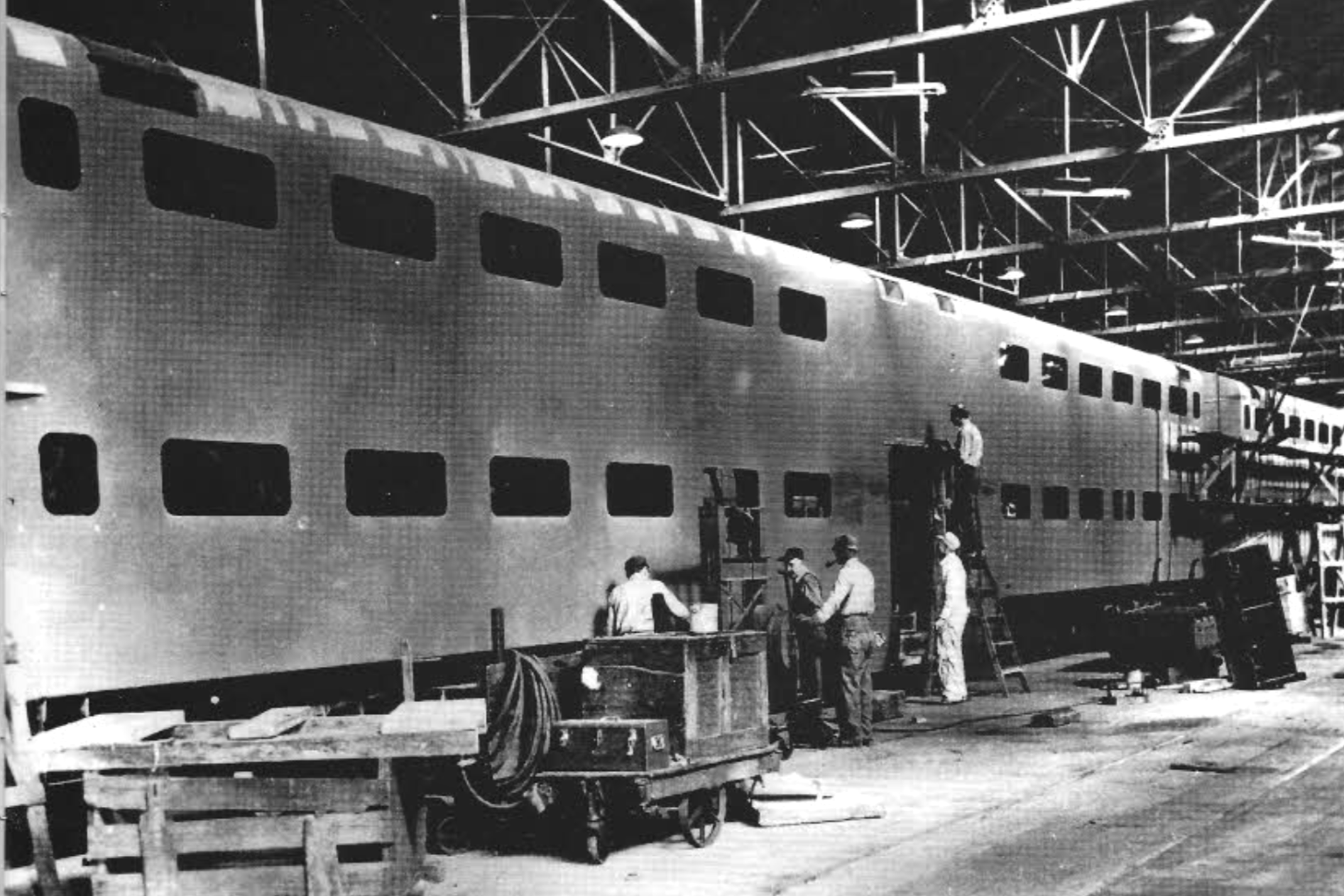
The C&NW’s 40-year-old coaches were in dire need of replacement. At the same time, the road believed that if it could carry more passengers without making trains longer, it could make more money. The C&NW started getting its own gallery cars beginning in 1955 after placing a 16-car order from the St. Louis Car Company for $2,240,000. The St. Louis Car Company produced coaches that measured 85 feet long, stood 15’10” tall, and seated 169 people in reversible seats.

The C&NW was still using steam locomotives during this time, so the road’s early gallery cars utilized steam for heating. When the railroad transitioned to diesels, those locomotives had steam generators behind their prime movers. Later, C&NW locomotives would transition to head-end power that utilized diesel generators to produce electricity to power heating and cooling in the cars.
If you’ve ever ridden in a gallery car of any kind in America, chances are it can trace its lineage back to these early experiments. These gallery cars were also an important part of the next great advancement in American commuter rail, the cab car.
Controlling A Train From A Passenger Car

When a train reaches the end of the line, there comes a need for the train to switch directions. There are several ways to do this, with some methods being more popular than others.
The entire train or just the locomotive could switch directions by rolling into a wye, a Y-shaped junction that allows a train to do the rail equivalent of a three-point turn. The train could park at a station, detach the locomotive, and have the locomotive switch onto a run-around loop to scoot to the other side of the train to couple back up. The locomotive could also detach from the rest of the train, spin around on a turntable, run around the passenger cars, and then hook back up.

This takes a ton of time and requires that infrastructure either already exist or be built for this purpose. The time lost moving a whole train or locomotive around could be spent carrying passengers and thus making the railroad money while getting people to their destinations on time.
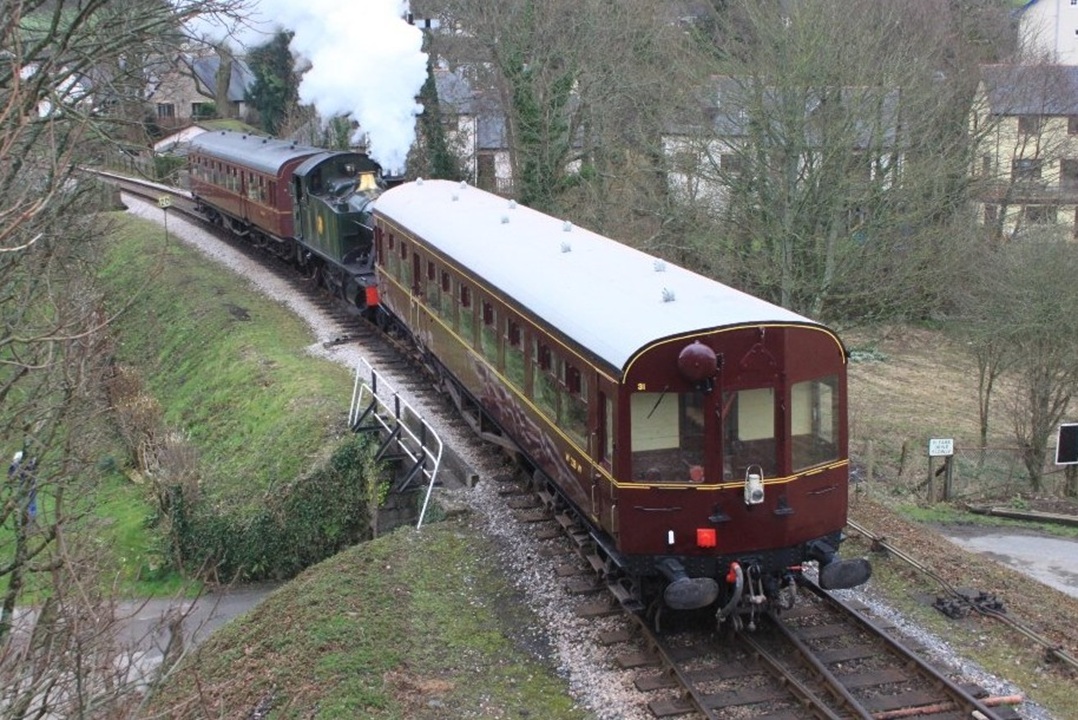
Alternatively, the train could be run in a push-pull configuration. Sometimes, this means having a locomotive at both ends of the train, and sometimes, it means having a locomotive in the middle of the train. Electric trains often run with a locomotive on both ends. There were even somewhat rudimentary steam trains that featured an unpowered carriage at one end with controls for the engineer and a signaling system to tell the fireman in the locomotive what controls to adjust.
Here’s an example of a push-pull configuration with a steam locomotive placed right in the middle:
For decades, Chicago’s rail authorities did things the old-school way, and physically turned their trains around. Rail & Wire‘s September 1999 issue describes the problem further:
The idea leading the development of the control cab car is to allow a train to be operated from a cab at the opposite end of the train from the locomotive. The basic concept is identical to the concept of Multiple Unit (MU) control, developed first for Chicago’s South Side Elevated in 1897 and rapidly adopted by transit agencies and electric railroads around the world. MU Control allows several electric cars to be operated by a single motorman or engineer. Electrical and/or pneumatic lines connect all the cars or locomotives with a control stand in any one of the cars, so all of the motors on all of the cars work together, providing power to propel the train. Beside reducing the number of engineers required to run the train, the design also provides a great deal of flexibility in the daily operations of these systems by allowing trains to reverse direction easily at the end of the line and to add or remove cars from the train based on service requirements. Almost all of today’s light rail systems throughout the world use this control car system in their operations.

Railroads were quick to adopt the MU concept for electric locomotives, so that they could reduce the number of engine crews involved. But the mechanical nature of steam locomotive control made MU control impractical and each steam locomotive continued to require its own engineer. So while electric commuter operations enjoyed the benefits of the control cab design, the steam railroads continued to be saddled with the inflexibility of their conventional equipment. One of the most time-consuming aspects of the commuter operation was the need to turn the trains at the end of their runs in order to get the locomotive in front for the return trip. In most cases, the locomotive had to be turned on a wye or turntable and then run around the train to proceed back. In stub end stations, such as C&NW;’s Chicago Passenger Terminal, the entire train had to be backed out of the depot to have it proceed to the turnaround facility just to return to the station for its departure. On some railroads, such as the C&NW;, many of the steam locomotives assigned to suburban service were equipped with headlights and pilots mounted on the tender so that they could be operated facing in either direction, but they still had to be placed at the head end of the train. These, along with other operational problems, made their suburban operations very labor intensive and raised related expenses considerably.
Very quickly in the development of diesel locomotives, MU control was introduced between locomotives or “units” as they are referred to. The ability of diesel units to MU was a major advantage over the steam locomotives they replaced, but the railroads were slow to take full advantage of the ability to operate diesels remotely. With the arrival of the St. Louis bi-level cars in 1955, the C&NW; began to reap the benefits of the gallery car design, but continued to experience the operational problems brought about by conventional locomotive-hauled suburban equipment and operations.

The C&NW and Pullman Standard joined forces to come up with a solution. The companies decided to outfit the last car of every commuter train with an engineer compartment which featured the same controls as the locomotive itself.
To facilitate this, Pullman built a control cab into the structure of the existing gallery car design. A set of large electrical cables ran the length of each passenger car, eventually connecting to the locomotive. When the engineer hit a control in the cab, an electrical signal was sent to the locomotive, commanding the corresponding function. Air lines also ran the length of the train, allowing the engineer to have full brake control as well. In practice, it meant that the engineer was able to effectively control the train from the rear car as if they were sitting in the locomotive. Sadly, I couldn’t find any images of the controls of No. 151, but here is a video:
This was a revolutionary step forward. The C&NW no longer had to turn the trains around at the end of the line. Instead, all the engineers had to do was walk to the other side of the train.
The cab car also allowed trains to park at a station with the locomotive pointing away from the direction of departing passengers. When you ride a commuter train to one of Chicago’s great stations, you head into the station cab car first. When you disembark the train, you don’t have to walk past the smelly, smoky locomotive.

Another benefit of the cab car was its flexibility. The railway could add or remove cars as it pleased because they all had the components to make the cab car work. It was also possible – and remains so today – to stack cab cars up in the middle of the train and just use them as regular passenger coaches.
Now, I will note that there’s a reason why I’ve been mentioning American commuter rail all this time, and it’s that Europe has had cab cars since about the 1920s. Out there, they’re called control trailers, driving trailers, or something similar.
C&NW No. 151

Most railroad historians point to C&NW No. 151, which was built in 1960, as the first American cab car. From Rail & Wire:
This control-cab bi-level car is very similar to the earlier gallery cars represented at IRM by Cars 1 and 6, but with several evolutionary changes. The car is 85 feet in length, 15 feet, 10 inches high, weighs 127,900 pounds and rides on GSC single-drop equalizer trucks. It is equipped for head-end power (HEP). 480-volt three-phase AC generators located in the locomotive provide electricity to power the lighting, heat, and air-conditioning systems on each car. This eliminated the need for much of the under-floor equipment found on the earlier cars which had self-contained power equipment. This also resulted in these cars being about 10 tons lighter than the previous orders of bi-levels. The interior color of the car was the same as was found in the St. Louis cars, but with featured interior surfaces of vinyl-coated steel, stainless steel or aluminum. These surfaces required no painting. The seats featured an improved design, but retained the terra cotta-colored Naugahyde covering. These cars were the first C&NW; commuter equipment delivered with four larger passenger windows in each section of the car, instead of the six windows found on previous orders.

The most noticeable difference between the 151 and the earlier bi-levels is the control cab itself. It is located on the upper, gallery level of the car and incorporates all of the features found on a locomotive cab, including a Pyle-National headlight and an electric bell installed above the end door. When originally delivered, a downward facing Westinghouse AA 2 chime air horn was located just outside the engineer’s front window. Subsequently, the horn was moved to its current location on the roof above the engineer’s side window. Because this car contains a control cab, the seating capacity of this car was reduced to 155. When delivered to the C&NW;, the car was painted in their traditional passenger scheme, with green and yellow sides with CHICAGO AND NORTH WESTERN spelled out in yellow above the door. This car featured the simplified paint scheme that removed the black separator stripes that had been found on the original order of the St. Louis Cars. The cab end of the car was painted yellow and green, with a green diagonal stripe added to improve the visibility of the rear of the train. The pilot plow was painted green. The non-cab end was painted solid green.
The 151 was the first of 64 cab cars in the C&NW; suburban fleet, which ultimately totaled 275 bi-level cars. Along with most of the suburban equipment, the car was sold to the public Regional Transportation Authority in 1978. At that time, the familiar C&NW; paint scheme was replaced with Metra’s silver mist with an orange stripe through the top windows and brown stripe through the bottom windows. The cab end of the car had reflective Scotchlite applied as an additional safety measure. At that time, Car 151 was renumbered to 8700. In 1983, ownership of the car (along with the rest of the suburban equipment) was transferred to Metra, RTA’s operating commuter railroad. No changes were made to the exterior paint scheme or car number at that time. The car remained in service until early 1998, when the early C&NW; cab cars as well as almost all of the early Pullman Standard and St. Louis non-cab bi-levels were finally retired from service. The remaining C&NW; cab cars not retired were withdrawn from cab car service, with all of the ATC/ATS equipment being removed and placed in the new Amerail cab cars then being placed into service on the former C&NW; lines. These remaining cab cars were then placed in service as regular coaches.

C&NW 151 arrived at the Illinois Railway Museum in 1998, and according to a museum volunteer, it’s one of six bi-levels of this era that IRM has. Usually, IRM runs two coaches and No. 151 with its C&NW No. 411 EMD F7A locomotive. However, after the air-conditioner failed in one of the two coach cars, IRM has been running its C&NW bi-level train with one coach and No. 151.
A Concept In Use Today

The Illinois Railway Museum says that C&NW No. 151 is the distant ancestor of the cab cars that remain in use today.
If you’ve ridden in a commuter train anywhere in America that is capable of running in “reverse” without actually turning around, chances are, it has a cab car that descended from the design established by No. 151. The cab car is so useful that some railroads have even sometimes converted old locomotives into cab cars.

Early on in this piece, I said that the cab car is an invention that is ignored today. To a small extent, I was even talking about myself here. I’ve known about IRM’s C&NW cab car for longer than three years. I have taken so many rides in it. I adore how the train is six decades old, yet has the same familiar ride as any Metra train today. It’s quiet, comfortable, and relaxing. When it gets too hot outside at the museum, I can always trust the green and yellow train to cool me down.

Yet, until recently, I never really thought about the actual historical significance of No. 151. For the most part, this cab car has always been a time machine back to Chicago commuter rail in the 1960s. I didn’t think of it as the reason why modern commuter rail works the way it does in America. I’m willing to bet that most riders of today’s Metra don’t think about it, either. They just see someone sitting in the cab car’s engineer position, ready to whisk them away to Chicago for a day of work or fun.
So, the next time you board a train that has a cab car, take a minute to stop and appreciate just how brilliant it is. When faced with the challenge of having to turn trains around at the end of the line, a railroad and a railcar builder figured out a solution so good that it remains in use today. Yet, the solution is something that so easily fades into the background. I love helpful engineering that’s in plain sight like that.
Top graphic image: Author


Actually in the UK they started playing with that idea at the dawn of the 20th century around 1900… while in France we waited for the late 1920s to do things like that…
In both cases it was with a steam locomotive at one end of the train controlled (through various means) from the cab sitting at the other end of the train.
Nowadays most of our passenger trains have cabs at both end.
“…[C&NW’s] Proviso Yards in Chicago in 1929…containing 224 miles of tracks and a huge diesel shop”
Henghg, probably not a diesel shop in 1929, unless they were really more forward looking than most railroads.
I spent many an hour riding in the CB&Q’s double-decker passenger cars on the Union-Station-to-Aurora commuter line. In those days the motive power was EMD E-class diesels. I don’t recall them running “backwards,” but they might have.
Budd warrants a whole article for their contributions starting with the “lightweight” passenger car, then the RDC and their auto industry role making wheels and bodies.
The RDC (Rail Diesel Car) was the first widely used diesel multiple unit in North America and was an alternative to push-pull.
In my former back yard of Beaverton the WES has both a control car on one of the modern rail cars and a refurbished RDC set, plus,light rail with electric multiple units
I was raised in central Illinois along the Illinois river. I had a good friend that operated the lift draw bridge that crossed the river and the track belonging to the CNW. Many a night I traversed up to the control “shack” atop the bridge. Powered by a 50hp electric motor with A LOT of counter balancing material. Back up was a 4 cylinder Ford tractor engine with a dry clutch. BTW, the river ALWAYS has Right of Way. The trains had to stop. I was always fastinated by trains and enjoy Mercedes articles. Sure wish I had photos of that old train bridge. My friends name was John McCurdy, loyal CNW employee…
I came into Chicago yesterday on the “City of New Orleans”. Boy was the last 30 minutes weird. They had to turn the train around in Chicago before arriving. https://en.wikipedia.org/wiki/St._Charles_Air_Line
Nowadays light rail commutes are all done with essentially this design as the blueprint. All my morning commutes are in trains that use this same blueprint.
It’s mentioned briefly in this piece, but the fact that the seats in the gallery car are reversible is also highly significant, as it allows the appearance to the passengers that the train has reversed even though it has not. This feature allows you to ride always facing the direction of travel, rather than riding one of the directions “backward”. If you ride the Chicago Metra one of the things you see the conductors doing at the end of the lines is reversing the seats. It’s an incredibly simple but clever design that even allows 2 rows to face each other on demand if 4 friends are riding together. The fact that these cars have been operating for decades and these seat mechanisms flip back and forth, back and forth dozens of times a day and still work are a testament to the durability of the engineering.
I remember seeing conductors in Grand Central flipping the seats on Penn Central EMU cars. Then they switched to the M1 and M2 which had fixed seats, half facing each way.
“Electric trains often run with a locomotive on both ends.”
If the train is electric would it be more efficient overall to just have each car self powered? Such a train would be shorter and lighter since there’d be no locomotives and carry just enough motor weight as needed.
I could see the argument that locomotives were used because they were cheaper or that coordination was too difficult for the electronics of the day but would that still be true now?
Even if every car has it’s own motors, most train lines still insist on a driver being present, so you need somewhere for them to sit and control the train, which means you either add a cab to every car, or have a specialised one at each end.
Even driverless trains (like the DLR) have a front/back car with a (slightly) more aerodynamic shape.
BART, out local commuter rail does that:
(edited for brevity)
The rolling stock of the Bay Area Rapid Transit (BART) system consists of 782 self-propelled electric multiple units serving the main BART system.
….
The A cars were designed as leading or trailing cars only, with an aerodynamic fiberglass operator’s cab housing train control equipment and BART’s two-way communication system, and extending 5 feet (1.52 m) longer than the B-cars. A and B cars can seat 60 passengers comfortably, and under crush load, carry over 200 passengers.[2] B cars have no operator’s cab and are used in the middle of trains to carry passengers only. However, since each car is self-propelled, the B cars do have hostler controls allowing manual control as single units at low speeds inside a yard.
…..
BART’s solution to (the shortcomings of A and B cars) was a new design, the C car. A C car has an operator’s cab like an A car but can also be used as an intermediate car like a B car. When placed in the middle of a train consist, the operator’s cab is closed off and a door in the nose opens, allowing passengers to pass through to the next car (always another C car). This allowed BART to make one long train that could quickly break into two trains outside of a yard. Crews could also do the reverse and make one long train from two shorter consists. To add the operator’s cab while maintaining the same length as a B car, the C cars could only seat 56 passengers (a loss of four seats).
https://en.wikipedia.org/wiki/Bay_Area_Rapid_Transit_rolling_stock
It’s a win-some/lose-some. Yes, multiple-unit trains with the power distributed to all of the cars ARE lighter and potentially more efficient. But that also means that EVERY powered car is a “locomotive”. Which means it costs more and has tougher inspection requirements than if it is simply a passenger car. It’s generally cheaper to use a locomotive and if it’s an out and back service, a cab car at the other end. Or a locomotive/power car at each end ala Acela. Typically multiple-unit trains run in fixed sets, so much harder to add and remove cars to suit demand too, so you lose flexibility. Very much an “it depends” situation.
Japan’s Shinkansen was designed from the get-go as an EMU, to avoid using heavy locomotives à la TGV. At the time, it was an unusual choice for express trunk-line trains.
The main reasons were to minimize noise and vibration through urban areas, and because most Shinkansen track, outside tunnels, is elevated, so more even weight distribution puts less stress on the track infrastructure.
The weight distribution decreasing track wear is an interesting angle.
This kind of thinking would never fly with airlines who’ll maximise every nook and cranny that they can find.
Well, there’s also the fact that it’s really hard to fly a plane backwards.
I hope Mercedes does a piece on the self propelled Budd cars of my youth outside of NYC. By the time we were riding them they were old and tired – you knew Metro North was having a bad day when, waiting for the always tardy train in Wingdale, you see the passengers appearing out of the gloom on foot. I saw that happen once, we had a van so we went back and picked up the people who couldn’t make the walk across town from the resting place of the single car train.
In the 2000’s, I commuted on Virginia Railway Express, which is a commuter rail based in Northern Virginia. They also don’t turn anything around. The trains go into the city going backward and leave the city going forward.
At the time it was a small and relatively new company and I think the cars and locomotives that made up the trains were basically whatever they could get. Some had the same double decker cars from this article. Some were single deck. Some were a mix of the two. Some had a cab car. One had a locomotive on both ends.
It was an easy and fun way to commute. Not super reliable, though, as freight trains had priority on the tracks.
Ah, yes, the GWR Autocoach. Remote control of a steam locomotive via rods and linkages. Sure the fireman was a bit lonely but it did eliminate the need to run the engine around the train.
I imagine diesels with MU connections were slightly easier to accommodate in a push-pull configuration.
The British did some interesting things back in the day. My favorite being “slip coaches” on the fast expresses to serve intermediate stations without stopping the train. Detach the last coach or two at speed and let them coast into the station with a trainman operating the brakes while the rest of the train carries right on!
Taking this idea to a extreme with self propelled cars you could split the train on the fly and, with enough distance between the segments, quickly shunt the stopping coaches onto a spur line, then have the rear segment catch up to and reattach to the leading segment. Coaches could be added simply by catching up to and hooking up to the end of the already moving train.
But then you have a bunch of “locomotives” to deal with, and worse, expensive engineers for each of them.
Though in theory, with a fully automated system it could work. The University of West Virginia in Morgantown has a wacky people mover thing that kinda-sorta can work the way you propose, though I don’t think they ever actually did it in practice, rather using them mostly as summoned pods.
“But then you have a bunch of “locomotives” to deal with, and worse, expensive engineers for each of them”
Maybe, maybe not. Definitely not a technical hurdle and I can see the argument that it’d be a lot safer overall than much of the autonomy we already have on the roads today.
Between the regulatory burden and the unions, this is an absolute non-starter regardess of whether it is technically feasible.
Maybe not in more enlightened countries.
Point me to a country that does anything like what you are suggesting.
If you mean not let regulatory issues and unions get in the way of progress then I’ll say China.
There is a shining example to use…
You DID ask.
(Hey at least it wasn’t North Korea.)
China is not running individual EMU/DMUs then joining them up into weird trains on the fly.
I didn’t say they were. Note I prefaced my answer with “If you mean not let regulatory issues and unions get in the way of progress”
I was looking for a piece about foward control steam locomotives but I found this, which is even geekier. Atc in1905! see also slip coach and Auto tanks. Slip coaches are so brilliant and very scarey!
https://www.youtube.com/watch?v=sXq9fs9xbAU
Slip coaches have always fascinated me. I have a friend with an 0-gauge British outline layout who modeled one with a flywheel mechanism in a passenger car. Today with modern digital control it would be a lot easier to do.
My 00 gauge railway has one, I wish I had thought of a flywheel, mine works with magnets and luck! Turning the whole thing to DCC would be a very long job.
Nowadays battery and wifi/bluetooth control is possibly easier. If I didn’t have a huge investment in DCC and were starting from scratch I might go that route.
Interesting how japanese Shinkansen trains have turning seats so passengers are always facing the road (which is great at that speed)