

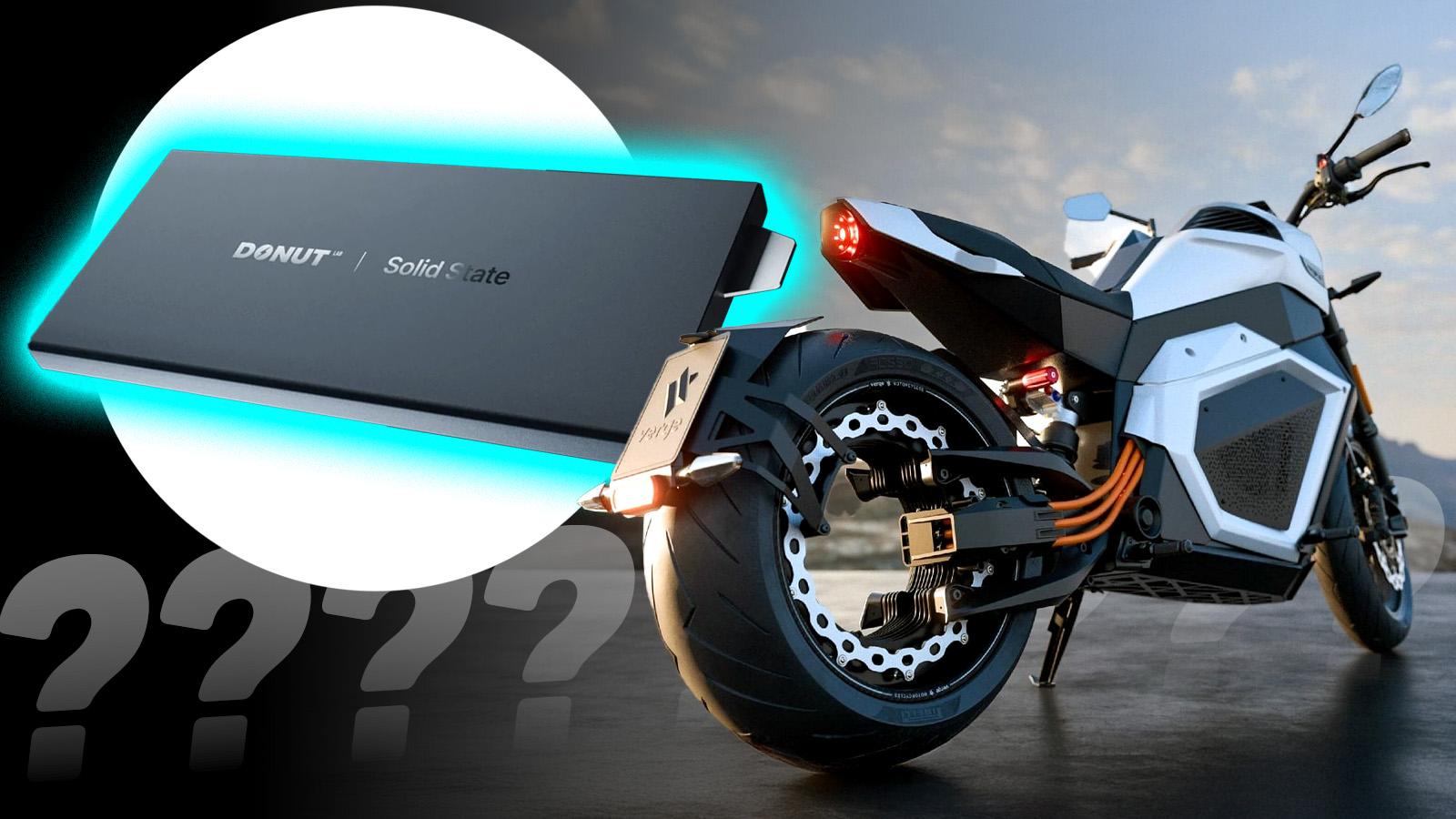
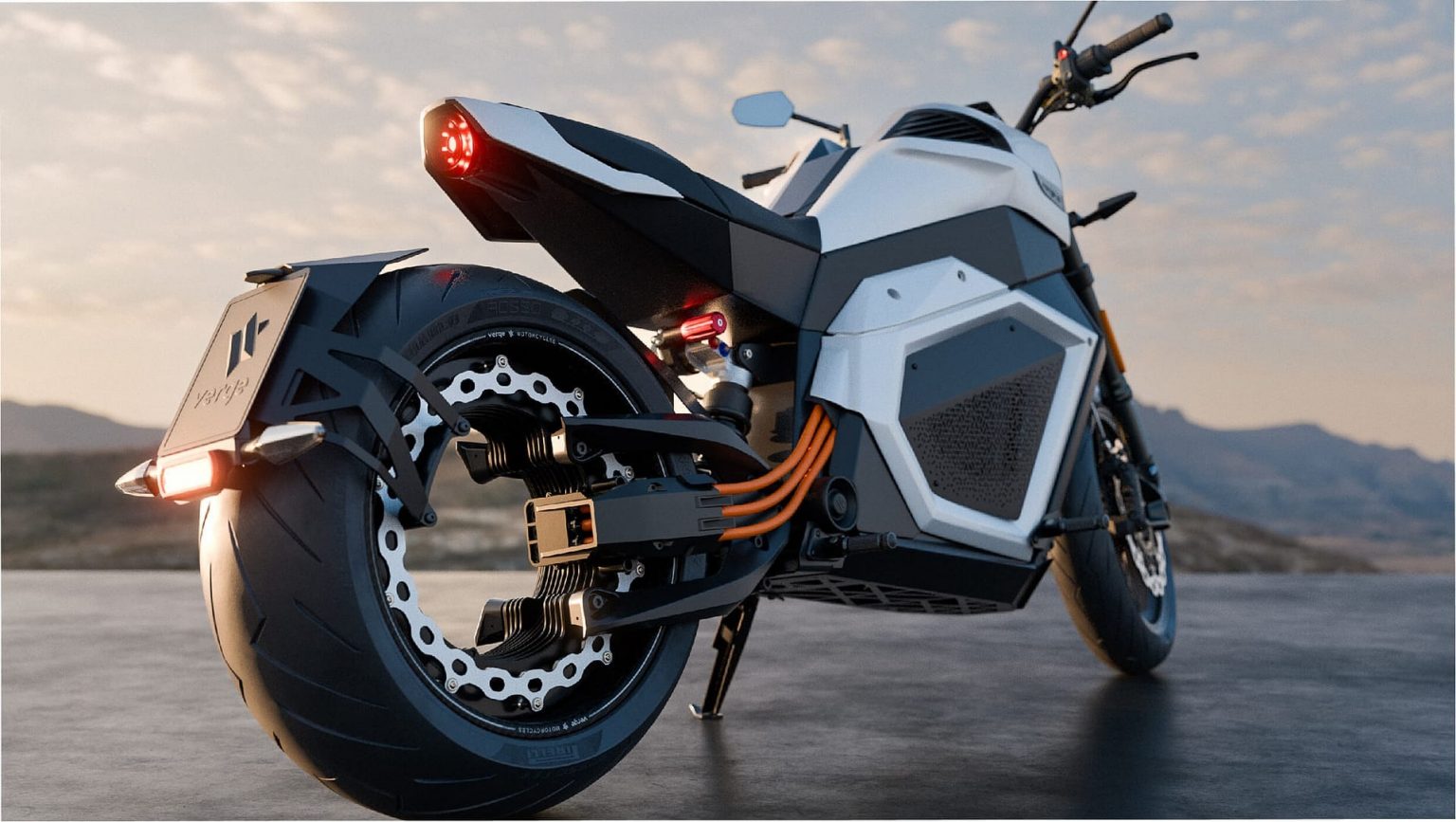
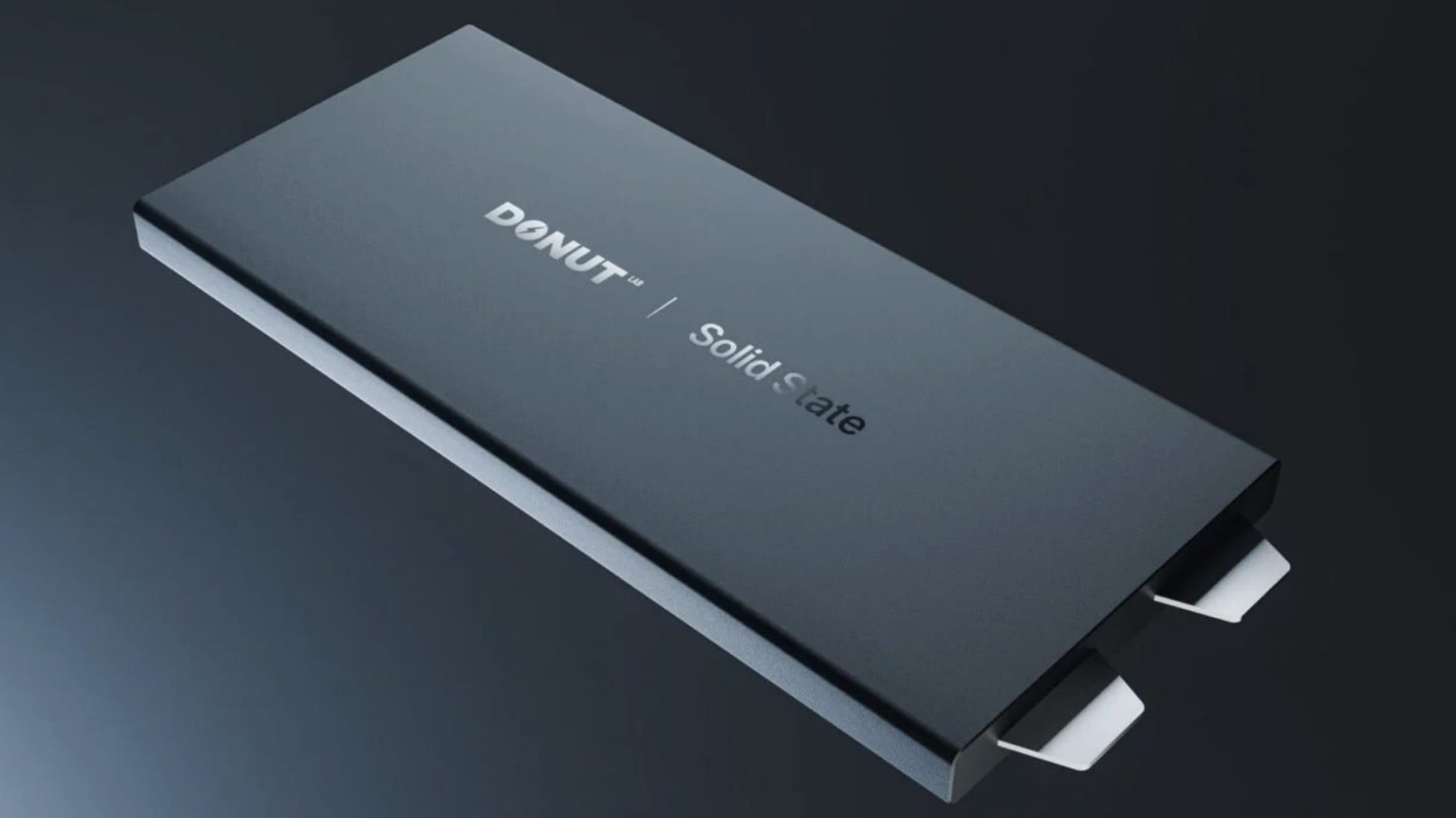
Back in January, Donut Lab and Verge Motorcycles stunned the electric vehicle world by announcing what they called the “World’s first production vehicle with an all-solid-state battery.” The Donut Lab battery that powers this motorcycle is considered the “holy grail” of batteries. The battery gives the motorcycle 370 miles of range, can be charged in only five minutes, delivers 400 Wh/kg, is cheaper to make than lithium-ion batteries, and is made out of 100 percent green materials. All of these claims were made without any testing, causing experts to raise a red flag. Now, Donut Lab’s battery has had an independent test, and somehow, it raises more questions than it answers.
I was a mix of both excited and skeptical when I wrote about the new solid-state version of the Verge TS Pro in January. I’ve been a huge fan of Verge’s weird hubless rear wheel. I’ve also championed the company because, unlike so many startups, it advanced past shiny renders and breathless press releases to actually put motorcycles into production.


The lithium batteries inside production electric vehicles today have some known limitations. They charge only so fast, and their energy is only so dense. If you’re an EV owner, you’re probably used to waiting at a fast charger for around 30 minutes or so before continuing on a journey. Today’s battery density also means that, in order to get a good range out of an EV that’s doing towing or hauling, tons of batteries have to be piled into the vehicle, weighing it down and making it more expensive. Thermal runaway events in today’s batteries can sometimes be a problem, as can degradation over a very long time.

The limitations of today’s battery technology are most apparent on electric motorcycles sold in America and Europe. Manufacturers have to be careful with how they deploy batteries in electric motorcycles. Too many batteries and the bike will have good range, but it’ll also cost a small fortune and attract few buyers. Too few batteries and the bike will be cheaper, but might not have an attractive range for some riders for the price.
Solid-state batteries have been seen as the ultimate kind of power source. The promise of the solid-state battery is charging that can happen as nearly fast as you’d fill a gas tank, better energy density, lighter packs, more stable chemistry, and degradation so minimal that the battery should last the life of the vehicle.
Solid-state experiments have been going on for a long time, with huge names like Toyota, CATL, Volkswagen, BYD, Nissan, and Honda all hard at work developing a workable battery. For example, Toyota has been working on the tech for nearly two decades and is still at least a year or two out from producing its first production battery. Volkswagen and its brands have been cooking up solid-state technology since 2012. In September 2025, Volkswagen, QuantumScape, PowerCo, and Ducati unveiled a functional prototype electric motorcycle that had a real and working solid-state battery.
So, these batteries do exist, and they are out there. But nobody has made that impressive first step to put a solid-state battery into a production vehicle. That was until last month when Verge Motorcycles and Donut Lab made their announcement. The Verge TS Pro with a solid-state battery is on sale right now. Deliveries for existing orders are supposed to begin this quarter, with future orders expected to deliver in the fourth quarter. This motorcycle is something you can throw money at right now.
There Have Been Skeptics
Both companies sort of shocked the EV sphere with their announcement. Verge Motorcycles has been around since 2018, while Donut Lab was founded in 2024 and announced in 2025. Understandably, folks wondered how these little Finnish startups managed to leapfrog industry titans to launch the world’s first solid-state battery production vehicle.
The skeptics had good reason to question Donut Lab’s press copy. The company more or less claimed it had achieved the holy grail, but offered no proof. Donut Lab and Verge Motorcycles had no patent disclosures, no demonstrations of the tech, and not even any research papers. It didn’t even have any internal testing to offer anyone. The press releases just claimed the achievement, and that’s it.
According to Electrek, one of the biggest voices questioning Donut Lab was Yang Hongxin, chairman of China’s Svolt Energy. Hongxin minced no words, via Car News China:
“That battery doesn’t even exist in the world; all the parameters are contradictory… Any person with even a basic understanding of the technology would think it’s a scam.” Yang said. Yang also pointed out that it is “too early for the industrialization of all-solid-state batteries,” and criticized the excessive hype in the industry and capital markets.
Woof. Svolt is another player in this battery space. The company originally started as the battery development group within Great Wall Motor. In 2018, it was spun off into Svolt Energy Technology Co., Ltd. and has been working on its own solid-state battery project. Svolt says it finished development of its first-generation solid-state battery in November 2025, and it’s due to go into production sometime this year. The battery is expected to have an energy density of 270 Wh/kg.
According to Electrek, Donut Lab CEO Marko Lehtimäki didn’t take what Hongxin said too kindly, and noted that he’s putting not just his own reputation on the line, but the reputations of Verge Motorcycles and Donut Lab. Indeed, if this battery were all smoke and mirrors, I cannot imagine the fallout would be particularly good for anyone involved.
Donut Lab Gets Its Battery Independently Tested
In response to the critics, Donut Lab launched a website and video series called “I Donut Believe.” Donut Lab’s website doesn’t even hide that people have accused the company of being scammers.
Each week, Donut Lab seeks to prove each of its claims with a video. To make sure the skeptics are satisfied, Donut didn’t test the battery itself. Instead, the battery went to the state-run VTT Technical Research Centre of Finland for third-party verification. Now, before we continue, here’s what I wrote about this battery in January:
Lehtimäki claims his team has made a battery that can charge in only five minutes, will last more than 100,000 cycles with almost no degradation, is cheaper to make than lithium-ion batteries, delivers 400 Wh/kg, and is made out of 100 percent green materials. Simply put, Verge and Donut Lab claimed to have built the holy grail of batteries.
[…]
Donut Lab claims that this battery is better than any other in that it retains 99 percent capacity in minus 30 Celsius and also when it’s above 100 Celsius, unlike lithium chemistry. Donut Lab also says you can run the battery to zero or charge it to 100 percent as many times as you want without hurting it. As for lifespan, Donut Lab says it’ll last the entire life of the vehicle, making the threat of having to replace a worn battery a thing of the past. The company then talks about these cells not having thermal runaway problems, weighing less than lithium batteries, and, somehow, even costing less to make than lithium batteries.
As if all that wasn’t unbelievable enough, Donut Lab then claims, “In fact, we found ourselves designing a slower charging speed so riders can plug in and actually have time to drink a latte and enjoy it instead of downing an espresso and rushing back to their bike.” Weirdly, Verge also says that its version of the Donut Battery will last for 10,000 cycles rather than 100,000.
Here is Donut’s first “I Donut Believe” video:
The first VTT report (VTT-CR-00092-26) has been released, and it covers charging performance. You can read it by clicking here. Otherwise, here is the test summary:
The aim of the project was to conduct independent charging performance tests on the energy storage devices supplied by the customer, which the customer identified as solid-state battery cells. Based on the results of the initial capacity test within the recommended voltage range, the nominal capacity was determined to be 26 Ah.
The cell was charged at a 5C rate, that is 130 A, until the maximum charging voltage of 4.3 V was reached, followed by a constant-voltage charge at 4.3 V until a charge capacity of 26 Ah was achieved. The cell was charged also at an 11C rate, that is 286 A, under the same procedure: constant‑current charging until 4.3 V, followed by constant‑voltage charging until reaching 26 Ah.
The test was carried out using one-sided and two-sided heat sinks to simulate different levels of thermal management comparable to real-life applications. Before and after each charge, the cell was discharged at a rate of 1C until the voltage reached 2.7 V to measure the capacity and ensure a consistent initial condition.

The battery was subjected to seven tests, which put the pack through seven cycles. Five of those cycles were fast-charging, and three of the fast-charging cycles were done at 11C current. The tests also involved either the use of one or two heat sinks. Here’s VTT’s summary of the 11C tests:
During the test #3 (the first 11C charge test), the cell was placed between two heat sinks. The initial surface temperature of the cell was 26.5 °C, and the highest recorded temperature during the test was 63 °C. This test followed the 5C fast-charge test, which ended with a standard discharge.
During the test #6 (the second 11C charge test), the cell was placed on top of a single heat sink. The first attempt was interrupted when the surface temperature reached the safety limit of 90 °C. After a four-minute cooling period, the test was resumed. Following this run, the cell was strapped to the heat sink to improve thermal contact, and consequently, heat transfer. The test was repeated once the cell had both discharged and cooled sufficiently.
During the test #7 (the third 11C charge test), the cell was placed on top of a single heat sink. The initial surface temperature of the cell was 27 °C and the highest recorded temperature during the test was 89 °C. This test was conducted after the previous run, which ended with a standard
discharge.

This 11C current charging test was genuinely impressive as the pack charged from completely dead to 100 percent in just 7.5 minutes at the longest. The time to charge from dead to 80 percent is equally great at only 4.5 minutes. That’s awesome, and confirms that Donut Lab made a battery that charges seriously fast.
The other interesting portion of the 11C test is just how hot the battery got. Donut Lab says its battery does not need active cooling, unlike lithium batteries. However, as the VTT test shows, the battery does get hot during charging, but it looks like there is a sufficient amount of passive cooling that can be used to keep the battery in safe margins. Here’s what Donut Lab told The Verge after the test:
“Unlike other solid state batteries requiring high compressive pressures and undergoing volume changes of up to 15-20% during recharging cycles, the Donut Battery does not require special compression or more extensive cooling,“ Donut Lab CTO Ville Piippo said in a statement. “This greatly simplifies the structure of battery packs and enables solutions that are cost-efficient, powerful, and better than traditional lithium-ion batteries in terms of energy and power density.”
So, to Donut Lab’s credit, I think it sufficiently proved that its solid-state battery can charge fast. But the test answers no other question. Somehow, there are still more questions than answers.
More Questions

The 400 Wh/kg energy density hasn’t been confirmed, and neither has the claim of 100,000 cycles with minimal degradation. We’re also no closer to finding the chemistry of the battery, its extreme temperature performance, or how much the battery costs to make. Further, we don’t even know how many times the battery can be charged at 11C levels. The Verge notes that the reveals thus far also don’t tell us how Donut deals with the so-called “dendrite issue,” a condition where microscopic stalagmites grow from anode to cathode, causing a short over time.
There’s also a rumor out there that this isn’t a true solid-state battery, but a supercapacitor. Donut Lab has denied that it is rebranding a supercapacitor from Nordic Nano, but it also won’t tell anyone about the chemistry of the battery.
Then there’s this “I Donut Believe” video series. Publishing a video a week is sort of weird. It’s unclear why Donut is doing a video a week, but I think it would have been a better move to publish the results all at once rather than drip-feeding them a week at a time like a season of Fallout. But I guess doing a video a week means that Donut and Verge will stay in the news for multiple weeks.
Well, Donut Lab has my attention. This whole thing is honestly wild because, really, there are only two outcomes from this. Either Donut Lab is vindicated and is proven to have leapfrogged the rest of the world, or the whole thing falls apart, and maybe we’ll get a new documentary to watch on Netflix one day. If Donut Lab pulls this off, it could be a game-changer for all EVs. Imagine if you could charge an EV as fast as you could fill a gas tank, that EV could go several hundred miles on a charge, and those batteries cost less than lithium.
So, you bet I’ll be watching “I Donut Believe” every week because I’m honestly on the edge of my seat. This could be the breakthrough the industry has been waiting for. Or it could be a disaster. I sincerely hope it’s the former.
Top graphic mages: Verge Motorcycles; Donut Lab


“If we got caught lying, it’d be bad for us” is not the ironclad argument they think.
Fast charging a battery is well understood. In theory you can charge any battery at the same rate that it can discharge. So by beefing up the internal connections you can recharge, at least between 20% and 80% state of charge, very fast. This is true of lithium, NiCad, lead acid and other types of batteries. By itself this means nothing, although for a motorcycle it would make sense to build faster-charge capable batteries as at a commercial charger you really could get to 80+% SOC very quickly. Otherwise everything else about this battery sounds like a scam.
To keep the company in the news cycle I guess.
The testing pictures looks like they’re employing a couple of Kraft Singles
I think our civilization moved way beyond battery pack power or electric storage, I mean make a electric motor with a builtin or external 2 stage generator that captures air, ect, to spin & generate full electric power and make the battery smaller, the electric motor gives off things that can turn into electric such as the magnetic field generated, and thermal, that can recirculate back into electric for electric motor or 2 stage generator,
I think you haven’t studied physics
Talked to a Finnish coworker of mine about it, and apparently Donut has been cold calling people looking for investors.
Definitely a scam
I have zero trust in any company that claims they have some groundbreaking tech, yet primarily communicate about it via social media or a video service.
If I was a company from Finland and a company from China was calling BS there is a 0% chance I would explain it to them. Buy one and try to reverse engineer it because I am sure as hell not giving away my IP.
Those look an awful lot like power-cell battery charging curves, down to how the 1 heat sink curve voltage initially rises during charging, then falls to a local minima, then continues rising which indicates a fairly strong dependence of the cell impedance on temperature (the cell internal resistance, which dictates the voltage rise over open circuit voltage when charging and droop below OCV when discharging), which is typical for electrochemical batteries where ions need to travel through some type of media between electrodes, be it liquid electrolyte soaked separators or solid separators. It looks like the impedance is about 2.5 mOhms at room temperature, which is also in line with expectations for a roughly 25 to 30 A-hr cell. 90C operating temperature limit is quite impressive, most BEV cells start to see significant degradation over 60C.
The big questions, as many have already pointed out, are can it really do this for 1000+ cycles, how much does it cost, and how much does it weigh
I’m showing my ignorance, I know. But what if it is a superconductor? If it works, it works I would think.
It’s definitely not a superconductor.
90 degrees C sounds pretty toasty. One wonders if they’re going to have heatsinks on the motorcycles. Nice big chunks of finned aluminum, hard black anodized, is what I’m picturing (not unlike the picture in the article). But then an ICE motorcycle could easily have exhaust pipes that get much hotter than that. Maybe they’re figuring motorcyclists have already learned not to touch the hot bits during or soon after riding? Also, probably easier to get plenty of airflow over any heatsinks.
Anyhow, it will be very interesting to see if this turns out to be real or just smoke and mirrors.
FYI Toyota does have a production variant of their Solid State battery currently on sale – in the optional dash-mounted JBL boombox one can get on the Tacoma. I’d wager they’re using this implementation to gather real world engineering data before releasing it as an EV battery.
“The 400 Wh/kg energy density hasn’t been confirmed”
Well, we do have some data to think about:
They did test a capacity of 26Ah. The min/max voltage was 2.7/4.3V, so if we assume a linear drop in voltage with discharge, that’s 3.5V average. So that’s about 91Wh out of the battery. (26Ah * 3.5V)
[And then I read the VTT report, where they reported 88-92Wh discharge energy, depending on the cycle!]
(As an aside, can I complain about the unit Watt-hour? I understand it’s been standardized now, but it was clearly invented by people who didn’t realize that a Watt is not a fundamental unit. It should just be Joules. 1 Wh = 3600 Joules)
So, IF the battery actually had 400Wh/kg, then the tested battery, at 91Wh, should weigh about 228 grams (0.5 lbs). If more than 228g, then the energy density is less than 400Wh/kg.
There are no size scale in the pictures to give any estimate of size/weight.
It’s really too bad that out of that entire report, they never describe the size/weight of the battery!
Yea, I was surprised that they didn’t include the cell weight too… It’s a much easier measurement than the electrical cycling
Just be glad W.h is not HP.day or something.
That would be worse!
BTW,
I guess I should also complain that A.h is also just one Coulomb.
Or we could use calories or Calories for maximum confusion.
Nevermind. I forgot that an Ampere is actually the fundamental unit. A Coulomb is 1 A/s.
One of the original definitions of ‘horse-power’ was “the amount of work a horse can do averaged over an entire day“, because it was for measuring the output of a steam engine, which was intended to replace a horse in a treadmill. It also explains how horses can output more than 1HP
There are so many holes in these claims…
What we really need? To bring back Joe Isuzu, yeah he can give us the real scoop!
I really hope this is true. I’d love an electric dirt bike with a hundred miles of range.
LTO chemistry can achieve those charge/discharge numbers pretty easily (10C with 40A / 2.5v cells); I run these as starter batteries (and they do get sold as supercapacitors sometimes), because 400A x 12V gets me about 3x what I need to run my starters, and I don’t have to care about running the battery down. It can also withstand the number of charge/discharge cycles discussed here.
But – the only manufacturers are Toshiba (who has sold them to Panasonic and Honda) under their SCIB label and Yinlong in China. It has nowhere near the energy density described in this article, at about 1/5 to 1/4 of what the article describes. As in, 10kg for 1kwh, or about 100 pounds to send a vehicle 10-15 miles.
I don’t buy that the described battery is impossible due to funding and sources – we live in a world where the premier maker of chip manufacturing technologies is located in the Netherlands and where things like “the television” began life as underfunded skunkworks projects, after all – but I’m really intrigued to see the rest of the VTT results. The unrealistic part of this for me is that nobody’s seeing movement on staging any kind of manufacturing anywhere for something that is going to be in gigantically high demand
You seem knowledgeable, so I’ll ask you rather than risk shouting into the void: I am assuming the C used as a unit throughout is Coulombs? Pardon my ignorance, but how is that being measured as a ‘rate’? I thought current was the measurement of coulumb flow rate.
Disclosure: Do not possess an EE, or anything close to it. I’m just a backyard engineer with a few battery technologies around.
C as used in battery tech is a function of amp-hours discharged or charged relative to the amp-hour capacity. The C number multiplied by amp-hour of the battery is the actual current discharged at whatever the nominal voltage is.
Coulombs are also a unit (of stored capacity), designated in C, related to but not synonymous with the C used in battery tech (per wikipedia, 1ah = 3600C(oulomb), as the SI definition uses seconds, not hours).
I hate units, sometimes. So, in the battery tech version of the unit (https://www.power-sonic.com/what-is-a-battery-c-rating/), a 40amp-hour battery discharging at 10C is giving me 400 amps of current. In the C(oulomb) version of the unit, I have 3600C stored in a 1-amp battery; so battery tech C multiplied by Coulombs divided by 3600 is the rate of discharge (in amps).
Units are fun. And I might have gotten that wrong, so would encourage you to ask the credentialed professional near you
This really strikes me as one of these scenarios: https://xkcd.com/927/
Why they can’t just stick with established SI units is beyond me.
C is relative to the battery’s capacity. If you charge any size battery “at 1 C” you can fully charge it in 1 hour. If you charge it at 2C, it’ll take 30 minutes, etc.
Thanks, Mercedes for the breakdown. I saw the press release start getting reported on and I literally thought “I don’t need to read any of these articles because Mercedes will break it down for me and it’ll make more sense then”
Keep up the great work!
And these EVs will presumably extinguish all fires in a 100 meter radius when they crash, and even drive themselves autonomously! Wow!
I don’t know what’s so damn special about filling a gas tank. It means standing, waiting, supervising, and watching a price counter tick up. There might be ads on it.
The ads might even repeatedly urge you to leave the gas pump unattended and go into the store to redeem a deal for an energy drink or something. My car does not have a big gas tank and it felt like an eternity (at least based on how many times the “LEAVE THE GAS PUMP OR MISS THIS SPECIAL DEAL” ad played).
The “charging time” of an EV is also “waiting”, but at a length of time (and lack of danger/responsibility) where you can comfortably do something else. Check your phone, read a book. Or, if you charge at home, it’s effectively negative time compared to needing to actually travel to a gas station.
On range…you can already get an EV that goes several hundred miles on a charge. Especially if you don’t care about how heavy or expensive it is. If batteries charge so much faster, why would you even want so much extra range? If anything, we’d expect less. Then the vehicle could be dramatically lighter and cheaper.
I don’t see a lot of ads, but I remember a somewhat-recent one for a Subaru or something, and it was a hybrid SUV. And the ad was like, “it has 900 miles of range!”
WHY? I think the ad even just featured people driving along a completely empty, featureless road in awkward silence. Not even having infinite adventures without ever stopping their vehicle for some reason. And of course, you can recharge that car as fast as you can fill a tank of gas.
I feel like BEVs have settled around 300 miles as an acceptable range for consumers. I’d rather have a lighter, cheaper EV with 300 miles of range than a 4500 pound one that covers 600 miles in a charge.
Unless I’m trying for a Cannonball record while hurling trucker bombs out the window, I am going to be stopping every 200-300 miles anyway. If not for the 30% range loss that current batteries see in winter, I’d even be comfortable with a range closer to 200 miles.
My vague judgment on range target is more at 250, but I agree on reliability in conditions like winter. If people weren’t mentally “shrinking” the range to compensate for unreliable range, it would be much easier to sell less range.
I recall the 2000 or so VW Passat tdi at the Chicago auto show. Huge leg space in the rear seats even with 6’2” me in the drivers. Calculated the range at 700 to 800 miles cause it had a real gas tank and thought I could get to DC on a tank of gas. Sadly my kids were already angry with me for only stopping when gas was needed for them to pee etc. so that dream was dead on arrival. But it seemed like a nice car.
I saw the drama and checked out. It didn’t pass the smell test to begin with. What I do find funny if 20 years ago you had said a Chinese expert was claiming a European company is lying about a product and it couldn’t exist today people would have thought twice. But if a Chinese battery expert says it can’t be done yet now I think you have to believe it. Quite the reversal. Though there are some US labs doing stuff with batteries the Chinese quite haven’t figured out but they haven’t figured production for them either.
Let’s fast forward to a few weeks from now and speculate… The tech is faulty, but now they’re a YouTube channel with 10M subscribers. =D
“Act now… Buy my new bitcoin…
Limited time offer…”
I also have heatsinks 5 times larger than my batterypack everywhere I go…
If not true solid state they’re at least Level 2++.
Common misconception, it’s actually only a solid state battery if it’s produced in the solid state region of France.
The lab is called Donut Lab, the battery is Donut Lab’s Monster.
Appellation d’Origine Contrôlée Donut.
This test actually proves their claim that active cooling is unneeded is false, because a single passive cooler is barely enough to keep a single 0.094kWh cell cool, let alone a pack 9.4kWh pack with 100 of these cells; at 3.6V each, that 100 cell pack seems like the config they’re going for since they add up to 360V, perfect for 400V-class power electronics and charging.
Other stats in the report show that it lost energy at an average rate of 27-35W during 0-100% 5C charging and 87-95W during the 0-100% 11C charging tests, assuming 0 energy losses during the 1 hour rest period and discharge cycle were identical to the 1C reference test. For reference, CPUs nowadays use 65-200W at full blast, albeit on a much smaller surface area and thus harder to cool. These numbers I calculated can’t be taken at face value because the sample size was only 2 cycles each for 5C and 11C, and the variance is too wide.
It actually isn’t particularly impressive that they got a cell to charge at 11C a couple times without exploding, as with less than 10 cycles total this doesn’t prove much more than those research breakthroughs you hear about in the news. Your cell charging at 11C is worthless if it can’t survive hundreds of cycles at that rate, I bet there’s several cars that you can buy today that already have cells capable of doing 2x11C + 2x5C charge cycles without exploding, but there’s a good reason why they’re limited to 3C (10-80% in ~20 mins).
I’m sure they’re hoping that this test is enough proof for (uneducated) investors to light some money on fire towards them.
It will be fine. The bikes will combust, there will be bad yield in the production line, temperature issues, etc. But handful of bikes will be sold at collectors for gazillion €/piece and they get their name in the history books. And generate lots of buzz like starupts should (altought this is Finnish company and this sort of drama is very american).
But I hope solid state battery tech in general will be ironed out in few years. Wasnt there some chinese company that is supposed to start shipping cars this summer with solid state batteries?
There’s always someone claiming they’ll ship something really soon, but all the reputable Chinese players have all collectively said that SSBs will be limited to demonstrators and ultra high end models until 2030. They also said it’d be limited to luxury models for at least the first half of the ’30s if not the entire decade. However several of those reputable suppliers have aggressive roadmaps for semi-SSBs starting production this year with progressively more energy dense cells slated for next year and the year after. They’re probably targeting the many eVTOL startups which need energy density ASAP at any cost, but they could make their way into higher end EVs too.
There’s actually already a fairly cheap semi-SSB EV on the market right now, the MG4 Anxin Edition. However, it has really average energy density and uses the semi-solid state electrolyte to improve low temperature performance and utilize a (cheaper?) Lithium-Manganese-oxide cathode. Nio also has had a semi-SSB since 2024, but it’s only available as a rental from a battery swap station and isn’t available to buy since they said it costs as much as an entire one of their luxury cars (which hadn’t succumbed to the price war at the time).
Were surely almost guaranteed to see at least 400Wh/kg semi-solid-state batteries in EVs within the next 10 years, and hopefully that’s a conservative statement.
Not really. You said it yourself:
This continues to feel more like a reality tv show than an actual product launch. I’ll be very interested to see what the eventual outcome is, because solid state batteries are one of those technologies that seems like it is perpetually two years from commercial viability, and not because people aren’t trying.