

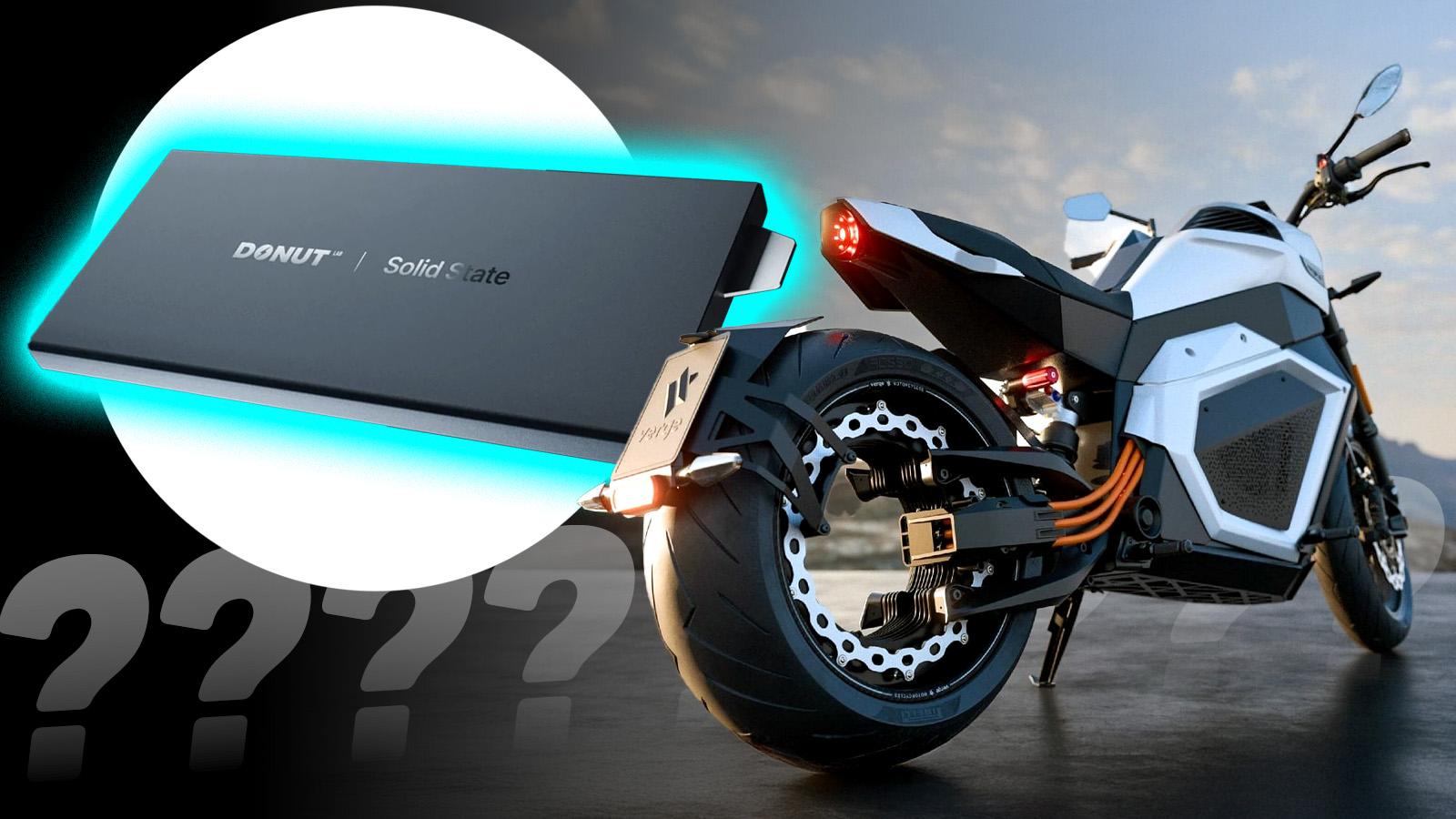
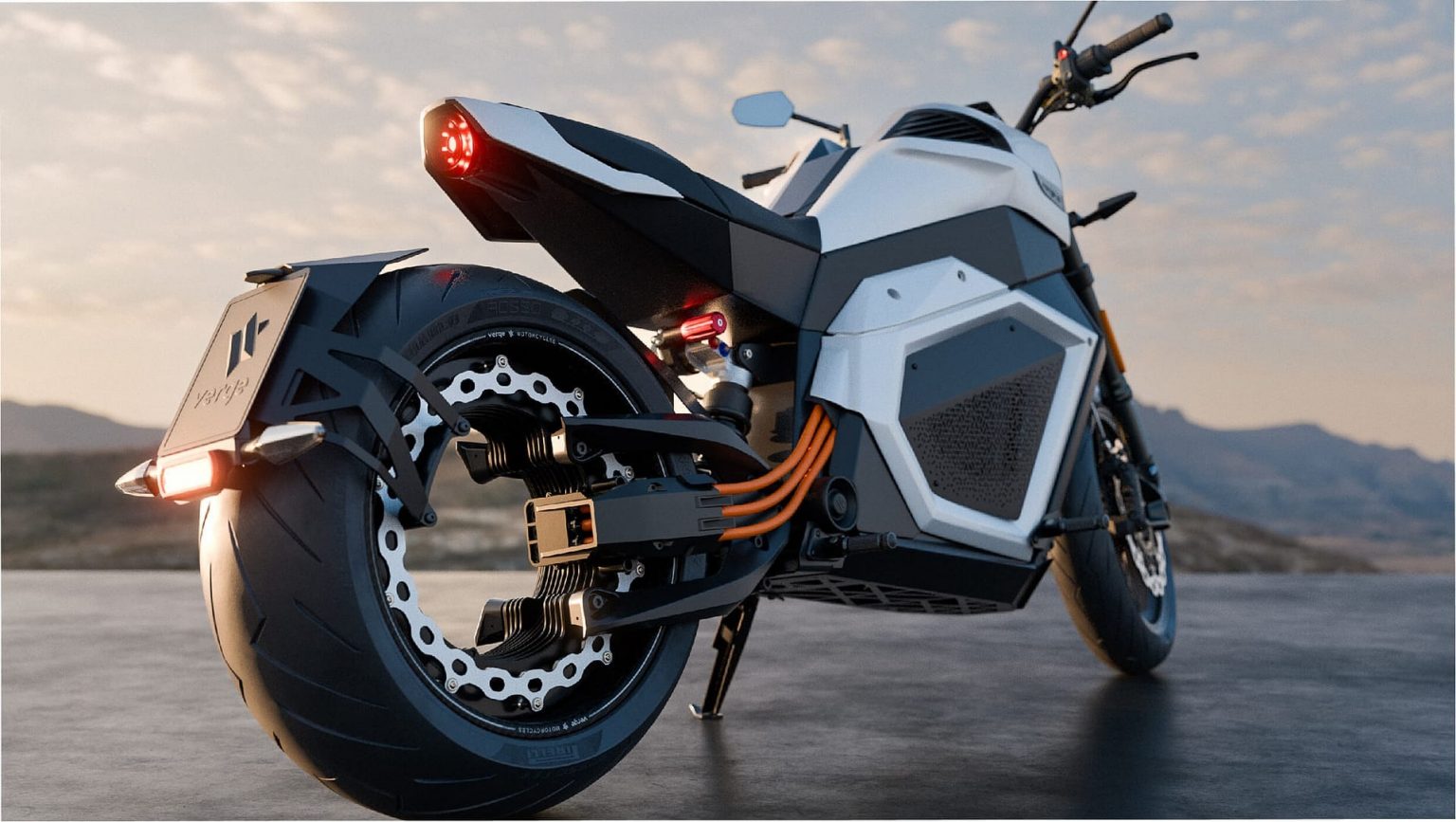
Back in January, Donut Lab and Verge Motorcycles stunned the electric vehicle world by announcing what they called the “World’s first production vehicle with an all-solid-state battery.” The Donut Lab battery that powers this motorcycle is considered the “holy grail” of batteries. The battery gives the motorcycle 370 miles of range, can be charged in only five minutes, delivers 400 Wh/kg, is cheaper to make than lithium-ion batteries, and is made out of 100 percent green materials. All of these claims were made without any testing, causing experts to raise a red flag. Now, Donut Lab’s battery has had an independent test, and somehow, it raises more questions than it answers.
I was a mix of both excited and skeptical when I wrote about the new solid-state version of the Verge TS Pro in January. I’ve been a huge fan of Verge’s weird hubless rear wheel. I’ve also championed the company because, unlike so many startups, it advanced past shiny renders and breathless press releases to actually put motorcycles into production.


The lithium batteries inside production electric vehicles today have some known limitations. They charge only so fast, and their energy is only so dense. If you’re an EV owner, you’re probably used to waiting at a fast charger for around 30 minutes or so before continuing on a journey. Today’s battery density also means that, in order to get a good range out of an EV that’s doing towing or hauling, tons of batteries have to be piled into the vehicle, weighing it down and making it more expensive. Thermal runaway events in today’s batteries can sometimes be a problem, as can degradation over a very long time.

The limitations of today’s battery technology are most apparent on electric motorcycles sold in America and Europe. Manufacturers have to be careful with how they deploy batteries in electric motorcycles. Too many batteries and the bike will have good range, but it’ll also cost a small fortune and attract few buyers. Too few batteries and the bike will be cheaper, but might not have an attractive range for some riders for the price.
Solid-state batteries have been seen as the ultimate kind of power source. The promise of the solid-state battery is charging that can happen as nearly fast as you’d fill a gas tank, better energy density, lighter packs, more stable chemistry, and degradation so minimal that the battery should last the life of the vehicle.
Solid-state experiments have been going on for a long time, with huge names like Toyota, CATL, Volkswagen, BYD, Nissan, and Honda all hard at work developing a workable battery. For example, Toyota has been working on the tech for nearly two decades and is still at least a year or two out from producing its first production battery. Volkswagen and its brands have been cooking up solid-state technology since 2012. In September 2025, Volkswagen, QuantumScape, PowerCo, and Ducati unveiled a functional prototype electric motorcycle that had a real and working solid-state battery.
So, these batteries do exist, and they are out there. But nobody has made that impressive first step to put a solid-state battery into a production vehicle. That was until last month when Verge Motorcycles and Donut Lab made their announcement. The Verge TS Pro with a solid-state battery is on sale right now. Deliveries for existing orders are supposed to begin this quarter, with future orders expected to deliver in the fourth quarter. This motorcycle is something you can throw money at right now.
There Have Been Skeptics
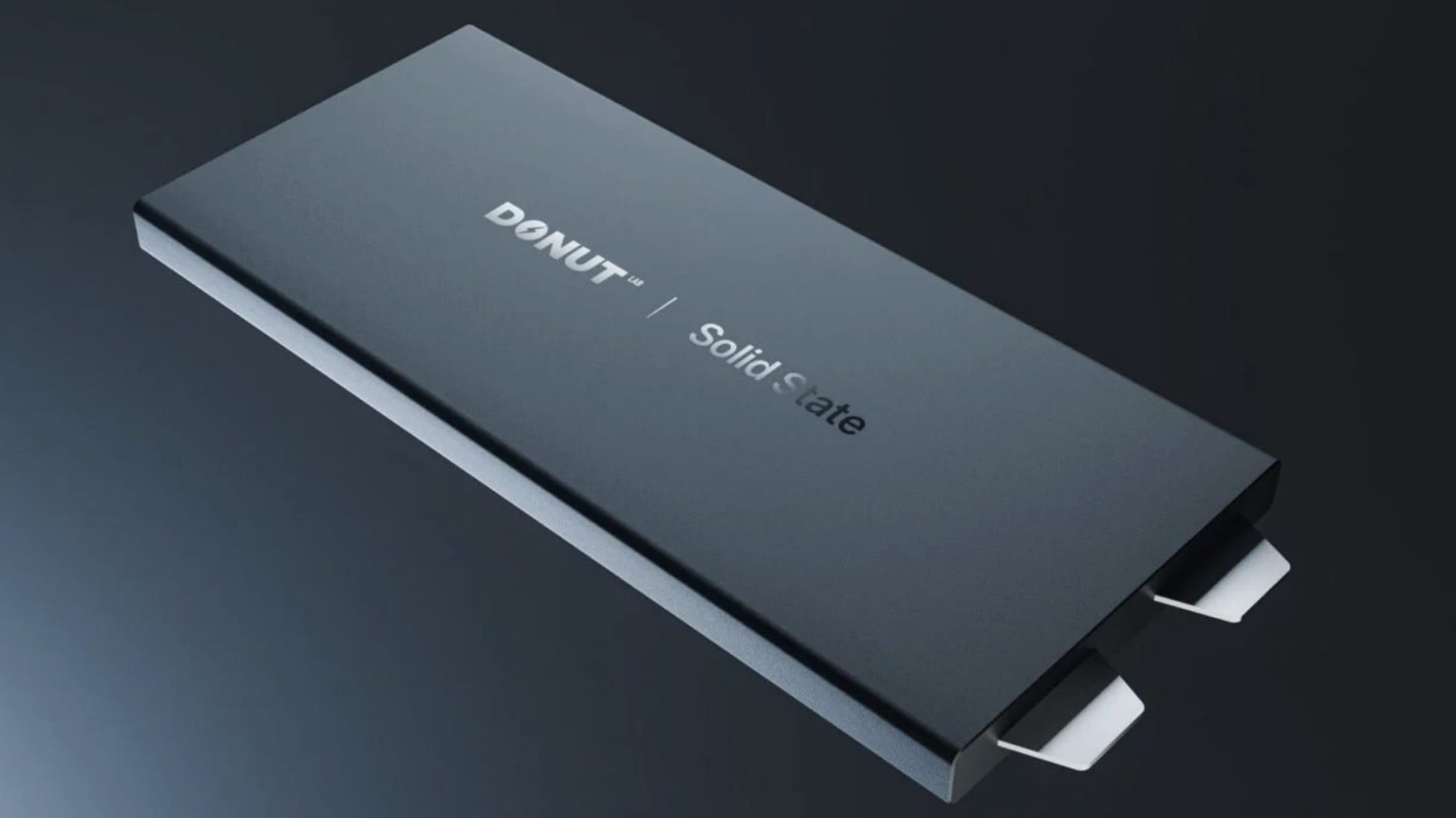
Both companies sort of shocked the EV sphere with their announcement. Verge Motorcycles has been around since 2018, while Donut Lab was founded in 2024 and announced in 2025. Understandably, folks wondered how these little Finnish startups managed to leapfrog industry titans to launch the world’s first solid-state battery production vehicle.
The skeptics had good reason to question Donut Lab’s press copy. The company more or less claimed it had achieved the holy grail, but offered no proof. Donut Lab and Verge Motorcycles had no patent disclosures, no demonstrations of the tech, and not even any research papers. It didn’t even have any internal testing to offer anyone. The press releases just claimed the achievement, and that’s it.
According to Electrek, one of the biggest voices questioning Donut Lab was Yang Hongxin, chairman of China’s Svolt Energy. Hongxin minced no words, via Car News China:
“That battery doesn’t even exist in the world; all the parameters are contradictory… Any person with even a basic understanding of the technology would think it’s a scam.” Yang said. Yang also pointed out that it is “too early for the industrialization of all-solid-state batteries,” and criticized the excessive hype in the industry and capital markets.
Woof. Svolt is another player in this battery space. The company originally started as the battery development group within Great Wall Motor. In 2018, it was spun off into Svolt Energy Technology Co., Ltd. and has been working on its own solid-state battery project. Svolt says it finished development of its first-generation solid-state battery in November 2025, and it’s due to go into production sometime this year. The battery is expected to have an energy density of 270 Wh/kg.
According to Electrek, Donut Lab CEO Marko Lehtimäki didn’t take what Hongxin said too kindly, and noted that he’s putting not just his own reputation on the line, but the reputations of Verge Motorcycles and Donut Lab. Indeed, if this battery were all smoke and mirrors, I cannot imagine the fallout would be particularly good for anyone involved.
Donut Lab Gets Its Battery Independently Tested
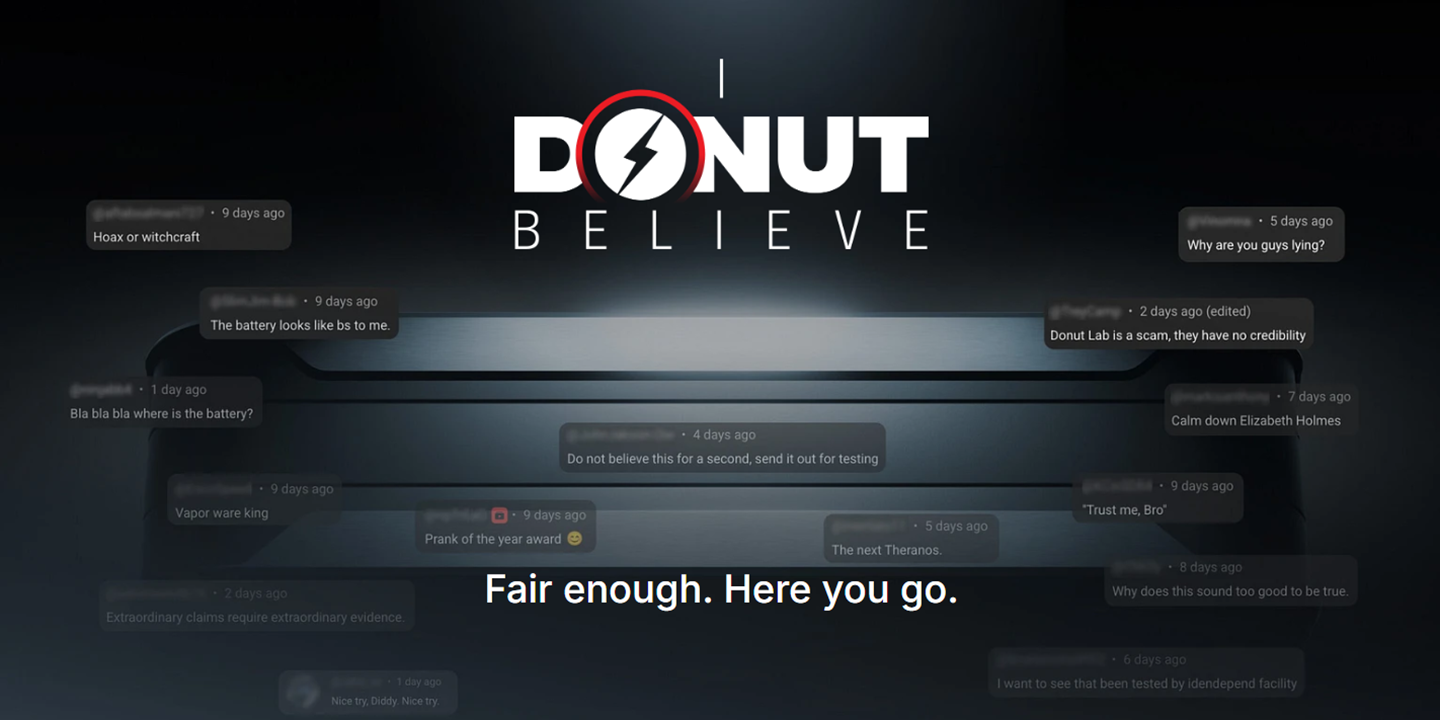
In response to the critics, Donut Lab launched a website and video series called “I Donut Believe.” Donut Lab’s website doesn’t even hide that people have accused the company of being scammers.
Each week, Donut Lab seeks to prove each of its claims with a video. To make sure the skeptics are satisfied, Donut didn’t test the battery itself. Instead, the battery went to the state-run VTT Technical Research Centre of Finland for third-party verification. Now, before we continue, here’s what I wrote about this battery in January:
Lehtimäki claims his team has made a battery that can charge in only five minutes, will last more than 100,000 cycles with almost no degradation, is cheaper to make than lithium-ion batteries, delivers 400 Wh/kg, and is made out of 100 percent green materials. Simply put, Verge and Donut Lab claimed to have built the holy grail of batteries.
[…]
Donut Lab claims that this battery is better than any other in that it retains 99 percent capacity in minus 30 Celsius and also when it’s above 100 Celsius, unlike lithium chemistry. Donut Lab also says you can run the battery to zero or charge it to 100 percent as many times as you want without hurting it. As for lifespan, Donut Lab says it’ll last the entire life of the vehicle, making the threat of having to replace a worn battery a thing of the past. The company then talks about these cells not having thermal runaway problems, weighing less than lithium batteries, and, somehow, even costing less to make than lithium batteries.
As if all that wasn’t unbelievable enough, Donut Lab then claims, “In fact, we found ourselves designing a slower charging speed so riders can plug in and actually have time to drink a latte and enjoy it instead of downing an espresso and rushing back to their bike.” Weirdly, Verge also says that its version of the Donut Battery will last for 10,000 cycles rather than 100,000.
Here is Donut’s first “I Donut Believe” video:
The first VTT report (VTT-CR-00092-26) has been released, and it covers charging performance. You can read it by clicking here. Otherwise, here is the test summary:
The aim of the project was to conduct independent charging performance tests on the energy storage devices supplied by the customer, which the customer identified as solid-state battery cells. Based on the results of the initial capacity test within the recommended voltage range, the nominal capacity was determined to be 26 Ah.
The cell was charged at a 5C rate, that is 130 A, until the maximum charging voltage of 4.3 V was reached, followed by a constant-voltage charge at 4.3 V until a charge capacity of 26 Ah was achieved. The cell was charged also at an 11C rate, that is 286 A, under the same procedure: constant‑current charging until 4.3 V, followed by constant‑voltage charging until reaching 26 Ah.
The test was carried out using one-sided and two-sided heat sinks to simulate different levels of thermal management comparable to real-life applications. Before and after each charge, the cell was discharged at a rate of 1C until the voltage reached 2.7 V to measure the capacity and ensure a consistent initial condition.

The battery was subjected to seven tests, which put the pack through seven cycles. Five of those cycles were fast-charging, and three of the fast-charging cycles were done at 11C current. The tests also involved either the use of one or two heat sinks. Here’s VTT’s summary of the 11C tests:
During the test #3 (the first 11C charge test), the cell was placed between two heat sinks. The initial surface temperature of the cell was 26.5 °C, and the highest recorded temperature during the test was 63 °C. This test followed the 5C fast-charge test, which ended with a standard discharge.
During the test #6 (the second 11C charge test), the cell was placed on top of a single heat sink. The first attempt was interrupted when the surface temperature reached the safety limit of 90 °C. After a four-minute cooling period, the test was resumed. Following this run, the cell was strapped to the heat sink to improve thermal contact, and consequently, heat transfer. The test was repeated once the cell had both discharged and cooled sufficiently.
During the test #7 (the third 11C charge test), the cell was placed on top of a single heat sink. The initial surface temperature of the cell was 27 °C and the highest recorded temperature during the test was 89 °C. This test was conducted after the previous run, which ended with a standard
discharge.

This 11C current charging test was genuinely impressive as the pack charged from completely dead to 100 percent in just 7.5 minutes at the longest. The time to charge from dead to 80 percent is equally great at only 4.5 minutes. That’s awesome, and confirms that Donut Lab made a battery that charges seriously fast.
The other interesting portion of the 11C test is just how hot the battery got. Donut Lab says its battery does not need active cooling, unlike lithium batteries. However, as the VTT test shows, the battery does get hot during charging, but it looks like there is a sufficient amount of passive cooling that can be used to keep the battery in safe margins. Here’s what Donut Lab told The Verge after the test:
“Unlike other solid state batteries requiring high compressive pressures and undergoing volume changes of up to 15-20% during recharging cycles, the Donut Battery does not require special compression or more extensive cooling,“ Donut Lab CTO Ville Piippo said in a statement. “This greatly simplifies the structure of battery packs and enables solutions that are cost-efficient, powerful, and better than traditional lithium-ion batteries in terms of energy and power density.”
So, to Donut Lab’s credit, I think it sufficiently proved that its solid-state battery can charge fast. But the test answers no other question. Somehow, there are still more questions than answers.
More Questions

The 400 Wh/kg energy density hasn’t been confirmed, and neither has the claim of 100,000 cycles with minimal degradation. We’re also no closer to finding the chemistry of the battery, its extreme temperature performance, or how much the battery costs to make. Further, we don’t even know how many times the battery can be charged at 11C levels. The Verge notes that the reveals thus far also don’t tell us how Donut deals with the so-called “dendrite issue,” a condition where microscopic stalagmites grow from anode to cathode, causing a short over time.
There’s also a rumor out there that this isn’t a true solid-state battery, but a supercapacitor. Donut Lab has denied that it is rebranding a supercapacitor from Nordic Nano, but it also won’t tell anyone about the chemistry of the battery.
Then there’s this “I Donut Believe” video series. Publishing a video a week is sort of weird. It’s unclear why Donut is doing a video a week, but I think it would have been a better move to publish the results all at once rather than drip-feeding them a week at a time like a season of Fallout. But I guess doing a video a week means that Donut and Verge will stay in the news for multiple weeks.
Well, Donut Lab has my attention. This whole thing is honestly wild because, really, there are only two outcomes from this. Either Donut Lab is vindicated and is proven to have leapfrogged the rest of the world, or the whole thing falls apart, and maybe we’ll get a new documentary to watch on Netflix one day. If Donut Lab pulls this off, it could be a game-changer for all EVs. Imagine if you could charge an EV as fast as you could fill a gas tank, that EV could go several hundred miles on a charge, and those batteries cost less than lithium.
So, you bet I’ll be watching “I Donut Believe” every week because I’m honestly on the edge of my seat. This could be the breakthrough the industry has been waiting for. Or it could be a disaster. I sincerely hope it’s the former.
Top graphic mages: Verge Motorcycles; Donut Lab


I can understand them playing their cards very close to their chest because we all know that once the Chinese figure out the chemistry or other details, they will steal any designs regardless of patents.
However, at some point, they will simply have to release more information. If they are getting enough investment money flowing in now, then they can string this along until products actually ship, but the longer this drags out with no production the longer people will continue to claim its all a hoax.
I think everyone is rooting for them, but we are all so leery of over-hyped products that turn into useless nonsense.
Has the press been able to take any preproduction/release candidate bikes out?
Nope! The lithium Verge bikes do exist and are available to the media (only in California, ugh) but the solid state ones are not.
I’m going to apply Occam’s Razor to this. I’m betting dollars to donuts we’re getting a Netflix doc on this one.
I trust you. Username checks out
I’m having trouble reading this because every time I see Donut, my brain goes all Homer Simpson and I start drooling on myself.
I keep thinking of the idiots over at Donut Media.
It didn’t really raise any new questions, just answered very few of the already existing ones.
The weekly drip is potentially a good marketing move, but the things will have to be for real. Otherwise it’s a train wreck.
I’d like to know
The mass energy density of a bare cell is not nearly as useful, I would think.
11C is really fast charging. Could be marketing speak saying no heatsinks necessary, but that’s at lower charge rates.
I haven’t been this excited about a new technology since Steorn 😉
I suspect it’ll really depend on what method of cooling they end up employing (air or liquid), and how fast they elect to actually let the end user charge.
The Donut person points out that
and yet, the testing required compression of the the heat sink to the battery when fast charging, just in order to keep the the test from shutting down at 90 C (=194 °F). That’s pretty toasty.
So, said person is making a claim about no clamping needed for charging at some unspecified rate, while the battery requires clamping at the fast rate they claim as a feature.
While I agree this seems like a scam…
Reading Mercedes article here I took the 90 C limit to be a VTT testing limit. i.e. the independent testing company as a safety precaution would not allow the battery temp to exceed 90 C.
IF Donut Labs claims really Are true, (a Very Big ‘IF’), upon recharge the battery temps could have exceeded 90 C without risk. If I’m the independent testing lab… Im certainly looking to impose certain safety precautions.
True – so then a question becomes relevant: did the testing lab a) pull “90 C is the safe limit” out of its butt, b) know based on prior experience that 90 C is the safe limit, c) were they told by DonutCo that 90 C is the safe limit, or d) did they know from having been informed of the battery chemistry that 90 C is the safe limit?
It it’s c or d, then I think the scamishness to the company’s statement stands.
100 percent agree
Quick.search for VTT max temperature battery testing, turned up a not terribly helpful 1 pager with the only max temp reference included at the pack level consisting of the following:
“PACK LEVEL
AVL E-STORAGE
Voltage: 10 V up to 1000 V
Current: 600 A
Power: 320 kW
Container: Battery pack is placed inside a climate container, which has
a temperature range from −32 °C up to +50 °C. It also
includes a liquid cooling circuit with 10 kW cooling/heating
power and temperature range of −10 °C up to +45 °C.
Mode: Can be used as a battery cycler or a battery emulator
Link: Integrated to the heavy-duty chassis dynamometer
infrastructure, can be used to emulate a battery pack”
Searching within VTT’s site I didn’t find any better / more satisfactory answer….
If I assume positive intent, I would guess due to regular battery charge segregation for lithium batteries above 75 C, likely for insurance reasons did not want to push more than 15% above this temp…
That said I dont like guessing and in the name of transparency VTT should clarify
Hook this ZPM to the nearest Stargate and off we go!
I was a reading a bit about that a while a go and it sounds pretty slick if it’s true. I have my doubts (as with all press releases) but I’ll stay positive.
It would be pretty slick if it can be back-ported to older EVs to keep them on the road and possibly even improve them. The 4.3v at full charge puts it in the realm of the current NCM and NCA cells floating around in the older platforms. Dealing with the current BMSs would be a pain w/o OEM support, though.
Just make sure Teal’c is around when the shit hits the fan
Patent applications filed in the US publish 18 months after filing (unless they request non-publication, which is not very common), so we may get some insight soon into the chemistry, etc. if they filed any applications to the tech within the last year or so.
Something odd about the names, Verge and Donut. I guess it gets name recognition just shy of infringing copyright. Perhaps RezVilla will be next. Anyway, should someone wish to make a rebuttal site – not that I’m advocating stirring pots, heaven forbid – the domain donutbelieve dot com is available and for just a penny as the algos that determine pricing have not recognized any value in it yet
“GoddamnitDonut.com” is probably already taken by a Dungeon Crawler Carl fan site.
I’m so glad I understand that reference.
This is so bizarre, I’m thinking if it’s real the only reason they don’t just divulge the chemistry/construction is it’s not patentable and could be easily duplicated. But then once they start shipping the bikes then anybody can reverse engineer from that.
I also think, if it’s real, that it’s not scalable for someone like BYD or CATL, like a small manufacturer can make them profitably but it could be a slow process to make them. Like if they have a small shop with minimal staff cranking out like 5 a day, and they only need a few hundred a year for limited run motorcycles, (Verge is only going to sell 350 bikes this year), then sure no problem. For a company like Svolt energy though that won’t work, they need to produce thousands/millions of batteries for their customers, so whatever process Donut is using they probably disregarded years ago as not practical.
This wouldn’t shock me. Solid state batteries have existed for a while now, but they weren’t commercially viable. If this company is just stretching the definition of “commercially viable” they might be able to pull it off.
Exactly, people have already made solid state batteries, that’s part of how we know they’re so good, but mainly just a few for testing from a lab. Scaling them up cheaply is the main stumbling block, but if Donut is just making them a handful in a lab and calling it production then that’s not what everyone’s been waiting for.
I think I read a NYTimes article maybe a year ago describing just how hard it was to manufacture these solid state batteries – though once you did, they were good. There was a firm out of Cambridge doing it, and Mercedes Benz had bought their tech, even producing an E class I think, which they were testing when the article came out. I guess development takes time.
Usually in new technology 1st question is scientific “is this possible” which for SSB has been answered.
The 2nd question is of course an engineering challenge “how to scale production”
With the time it takes between scientific discovery until sales production called the ‘valley of death’ and the gap is often at least 10 years
As someone write just above IF Donut Labs claims are true I suspect they may have figured out how to produce just enough sub to satisfy a very small ev motorcycle production demands, so no where close to the demands of even laptop demand let alone automotive mainstream production demands
They can’t blind you with science, so they’re hoping to baffle you with bullshit. In a past role I used to review test results like these. This is a superficial, frivolous test, with results you could get out of any cell you bought from a reputable manufacturer if you brute forced enough current into it. Making a cell that will survive what they did once is nothing new.
If this was real, they would have already sold it to Samsung for 3 Ford Motor Companies.
Yeah as much as I like this battery to be as good as they claim, it just doesn’t seem to be like that.
A test between heatsinks in a lab is not the same as just charging the motorcycle with the installed battery. I doubt the owner likes his bike to get near 90C hot. That’s boiling water temperatures (90% of it, to be exact) in case you didn’t think of that.
Even if the battery and the bike (frame/seat) could handle it, can all the cables handle it? Can the electronics around the battery handle it, a 100 times, a 1000 times? Electronics degrade fast with high temperatures.
I understand they want to keep ‘their secret’ but a good patent should be enough. I am worried it is a show.
Some RC enthusiasts might chime in with their own experiments done with LiPo batteries at 5C-10C charge speeds, in controlled environments and with proper cooling. I wouldn’t be surprised you can push good quality LiPos to 8C if you can keep them cool (and compressed/clamped down) WITH very accurate temperature/voltage/current control.
Yep. The biggest red flag to me is the wrapper around the tech. Why a motorcycle? Even if they made the best motorcycle in the world, the potential audience is so limited. If the tech is truly as great as they say, then the goal should be to get it into as many hands as possible.
Another comment suggested that perhaps the production isn’t scalable, making it “commercially viable” for a low-volume luxury product.
Of course, that’s assuming it isn’t entirely nonsense, and I don’t want to imply I have that kind of faith in them.
Spite’s corner (that guy that publicly got fired by Yammie Noob) made a whole video about this. Unfortunately because of past controversies I thought he was just being brand safe. He does a lot of work with Livewire and did a lot for Energica.
I have a really hard time separating Donut Labs and Donut Media in my mind, which makes it neigh impossible for me to take this seriously.
With the endless grandiose claims from every battery start up, I believe nothing until everything has been tested and peer reviewed.
I vaguely remember something about chemical energy scaling non-linearly with volume and mass.
It was a story about a half stick of dynamite not quite doing the job, and a full stick blowing the job into the next week.
Anyway, the thermal issues in a battery the size of a tv dinner are probably different than a battery the size of a Golden Corral buffet.
Actually, if they have a super capacitor with that capacity I would be really excited. How fast can it discharge? If it can discharge as fast as it charges I can think of all sorts of uses.
Finally starting that Railgun project, eh?
hey its about time the armaments industry started going green.
You jest, but I’ve speculated for a while that militarized rail/coilguns have been slept on. Like EVs, I think they tend to be judged on their weaknesses rather than their strengths.
While “going green” may sound silly for the arms industry, reducing exposure to shockwaves and toxic propellant smoke might have benefits for the health of soldiers (though there is the argument that, of course, less-than-effective weapons also very immediately threaten the health of soldiers).
Well, a 13kwh battery that could discharge in 10 minutes would give you a bit more than 1000 horsepower, enough torque to break things fast, and Bugatti Veyron performance.
I’d settle for a 6kwh battery and 5 minutes discharge, that would be all sorts of fun. At the stated 400 Wh/kg, that would be 15kg.
Axial flux motors are less than 13kg for 1000hp
Yikes, is my math right?
Is their math right? That’s basically gas engine power density taking thermal efficiency into account.
Anyway, this is exciting if true.
A 700mm-class RC helicopter doing hard acrobatics can discharge a 44.4V-5Ah pack in two minutes. That’s 30C average discharge rate at 6.7kW. Peak discharge can easily exceed 60C.
12C discharge is nothing to write home about. Even granny flyers like me do it routinely.
I remember going down the rabbit hole on those RC power packs, and encountering killer rabbits, undoubtedly the spawn of the Monte python strain and that one that attacked Jimmy Carter.
Something made them terribly unsuitable to scale to a full size car. What was it?
As far as I know current supercapacitors hardly reach 20 Wh/kg. Every increase by 10% would be pretty big news. These guys claim a factor 20 (!) more capacity per kilogram. I doubt that is a supercapacitor. It would be worth a nobel prize.
I think that Styropyro needs to look into it then. He recently built a battery bank from 400 lead-acid vehicle batteries to drive a circuit with massive current. His power switch consisted of two modified log splitters. And he achieved the goal he set out to by Z-pinching a hollow pipe. Z-pinching comes from extreme magnetic fields generated by ridiculously high current.
If you’re still not sold, then I’ll just say that he makes good use of his “science machete”.
His experiments definitely support Adam Savage’s assertion that the only difference between science and screwing around, is documenting the results.
He’s literally a mad scientist with the appropriate hairstyle.
A co-worker showed me him the other day, trying to make a massive (6000A?) fuse fail.
Best way to test if it is a supercap is to monitor its natural discharge rate (ie. the rate at which it discharges on its own, disconnected from a circuit after having been charged). Supercaps can only store a charge for a fraction of the time that a battery will hold its charge when not in use.
Well it’s amazing how long a capacitor can hold a charge, and even more amazing when they mysteriously charge themselves.
My experience is with a 5000 joule strobe pack in a photo studio.
A million watts for 1/200 of a second can be really exciting,
That’s about 2,000 amps at the peak.
Anyway, you would completely discharge the thing and a day later it would have a enough charge to destroy a connector.
I object to the use of heat sinks; I prefer my doughnuts hot.
If Verge actually starts delivering motorcycles next month (the last month in the 1st quarter), it shouldn’t be long before more is known about the batteries. You can bet that every other company that’s working on solid state batteries has a bike (and its batteries) on order.
They could be on the Verge of greatness.
BOOM tsssssssss
This would be a Cruller joke if it’s fake but I know a lot of OEMs will be Jelly if it’s real. Maybe this weird marketing drip is to have the public Glaze over some of the shortcomings or the marketing team is trying to Fritter away some free advertising.
Call me Old Fashioned, but while I’m glad to see these issues Raised, playing fast and loose with the truth is just the Devil’s Food.
I suspect this battery may be powered by some sort of Rich Energy.
There still seems to be some holes in this Donut story.
I would love to hear from an electrical engineer on the reality of this.
Well, it’s all perfectly possible. Solid state batteries aren’t like cold fusion or anything. It just seems less believable to come from an unknown tiny company in Finland, when larger, more established players have spent billions(? I think likely) on attempting to achieve a viable product
I do not care if it is a supercapicator, battery, or a damn Galvani frog wired up in the box if it does all of what it claims, I will be very happy…BUT…
Things that sound to good to be true usually are.
Yeah, as long as it’s not a pocket-sized universe of creatures running on treadmills in there (ala Rick and Morty), I don’t care about the pedantics of capacitors vs. batteries if it does what they claim.
Exactly and, Yes being on here, one needs to learn to ignore the pedantics.
Thanks for the update. Looks like the test was only for one cell, not a completed battery pack on a vehicle. Methinks we’re still at least 2-3 years away from seeing this in an automotive application. I hope it’s not a scam for their sake, but it looks like the race is on!
Keep the updates coming, Mercedes! This is going to be revolutionary or a disaster, and I’m here for it either way.