

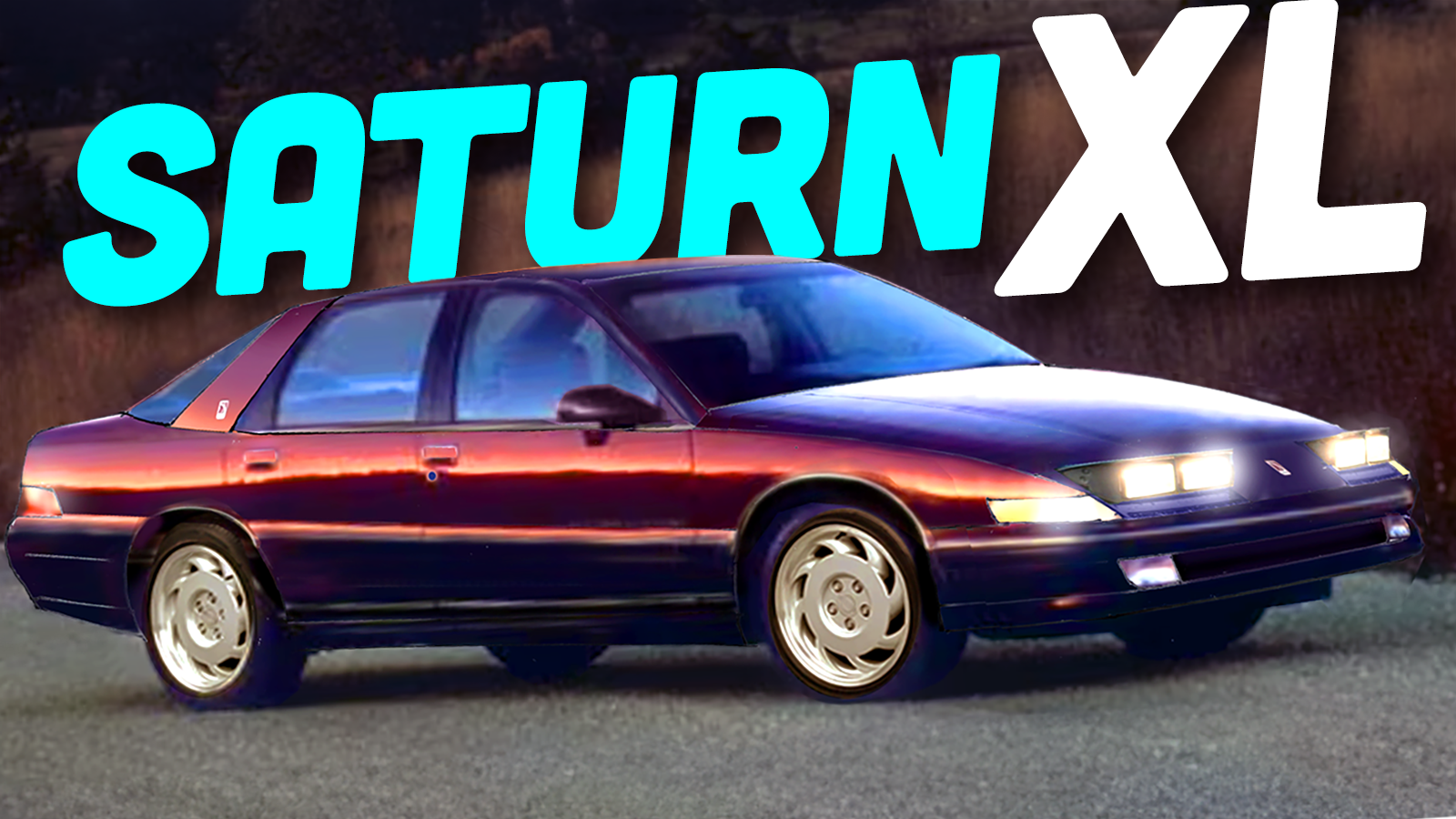
I’ve only owned two American cars in my life, and they were both comically big body-on-frame barges. Why? Well, they made sense for the Midwest, where absurd comfort, easy maintenance, and hearty durability outweigh canyon carving and corner-exiting power since the nearest canyon is a few days’ drive away. And though I preferred the equivalent import offering to anything domestic, there really wasn’t anything similar to a GM B-Body or Ford Panther available from Europe or Japan.
That’s not to say I didn’t want more out of these things. It sounds like at least one of our readers feels the same way, since they asked me to envision what a big General Motors “downsized” B-body sedan might look like if it were sold under the banner of GM’s most import-like division: Saturn. That’s a challenge I’ll gladly take on.


But For God’s Sake, Don’t Get The Diesel
As Autopians, most of us really dig European and Japanese cars that appear to be total oddballs in the land of Baconaters. Still, as much fun as puttering around town in a Citroen 2CV or Kei vans on a decent spring day might be, even the most ardent supporters (except Jason and Mercedes Streeter) would likely agree that they never made any sense as the only car a family owned in most of America. Transporting five or six corn-fed adults in freezing temps for a few months and then searing heat for a few more is what we do here, and a typical road trip is a full day or more at highway speeds. Poor handling? Who cares? In this country, we used dynamite on natural terrain to make roads smooth, straight, and flat. Fuel economy? At thirty cents a gallon, nobody seemed to mind.
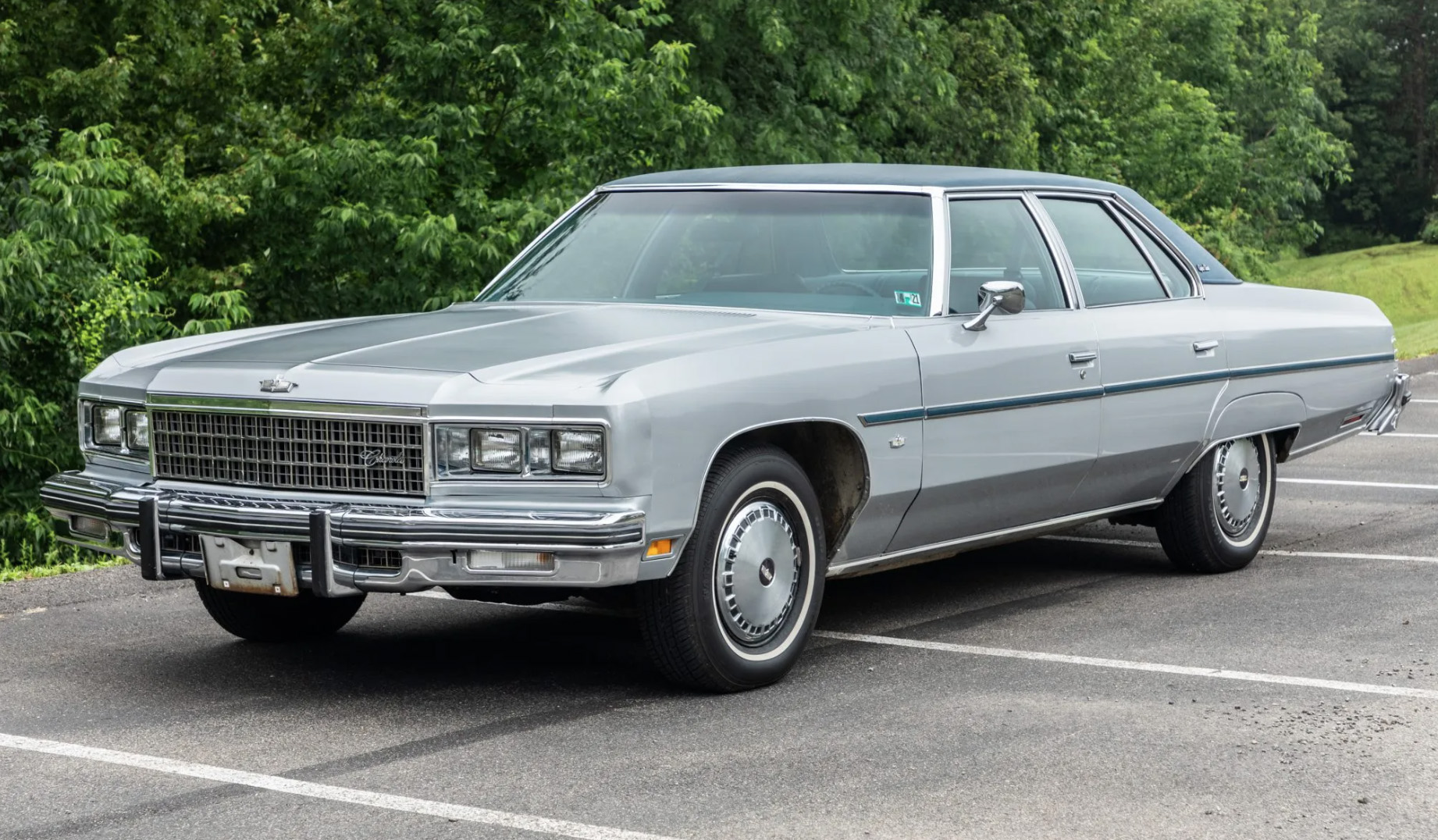
Well, that is, until they did. The fuel crisis of 1973 killed the sales of single-digit MPG land yachts like that 1976 Caprice above, and the little imports cutting up the roads made driving an aircraft carrier seem like a chore. General Motors bit the bullet with a major $600 million program called Project 77 to lose decades’ worth of added-on weight and overhang from their mainstream B-body cars. They even came up with a new word to make the type of work they were doing palatable by the average buyer: downsizing. It sure sounds a lot better than “shrinking.” This wasn’t completely marketing mumbo jumbo, though. Despite shedding around a foot in length and over 600 pounds of weight (nearly 900 in the wagons over the “clamshell” tailgate predecessors), the new 1977 big Chevys and their GM brothers and sisters actually gained interior space, all while getting far better fuel economy.
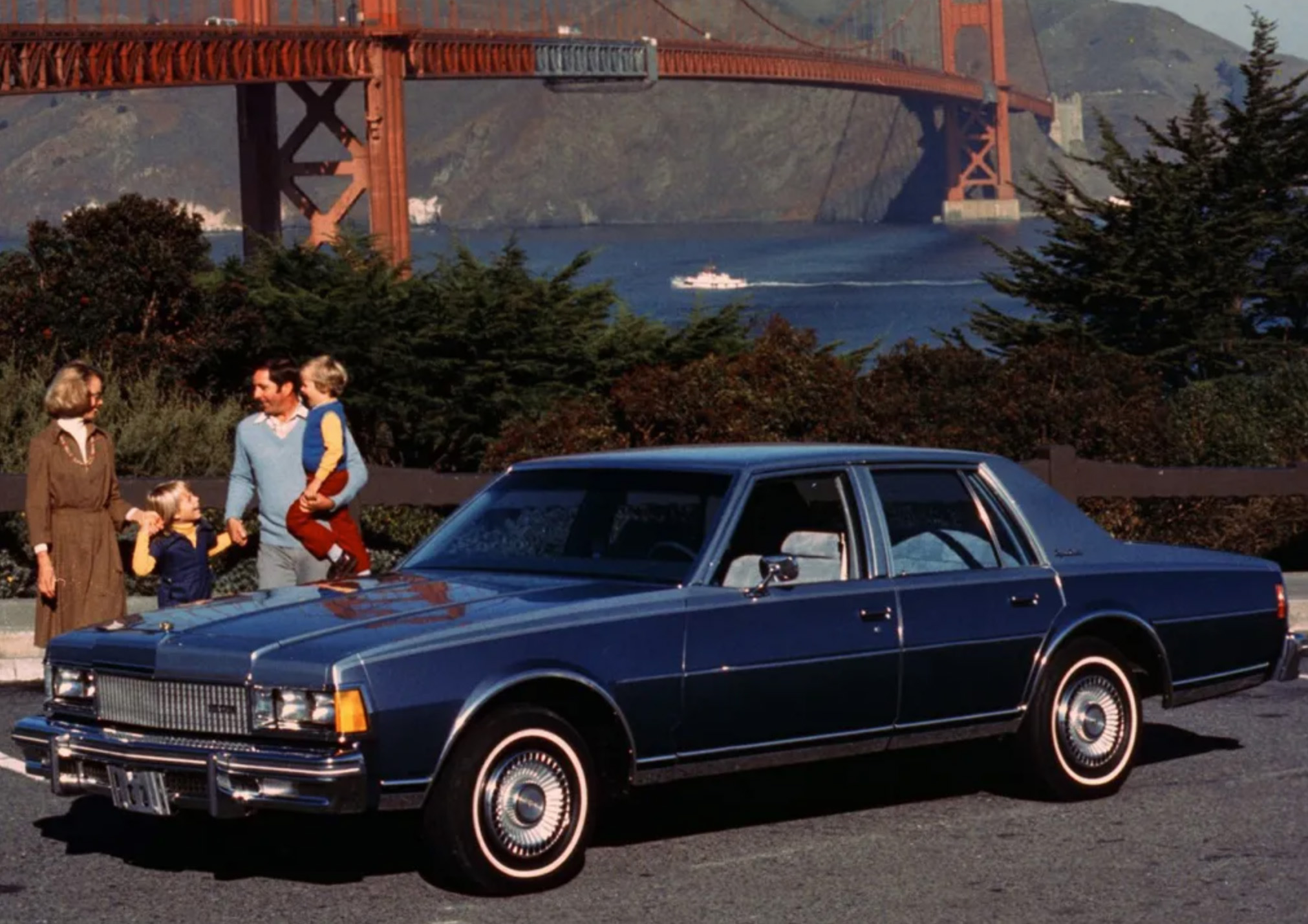
That weight reduction also allowed them to drive far better than the 1976 models. In their review of the redesigned 1977 full-sized Chevrolet Caprice and lower-model Impala, Car and Driver famously wrote that the F41 suspension upgrades “will make you think your Chevy came from the Black Forest instead of Detroit.” Hyperbole? Maybe, but those words were written by legendary journalist David E. Davis, a man who didn’t lie much in print and got fired more than once for speaking the unfortunate truth. That optional suspension package didn’t even hurt the ride significantly, all while pulling similar skidpad figures to a Porsche 911 (and unlike that car, it wouldn’t kill you if you took your foot off the gas mid-turn).
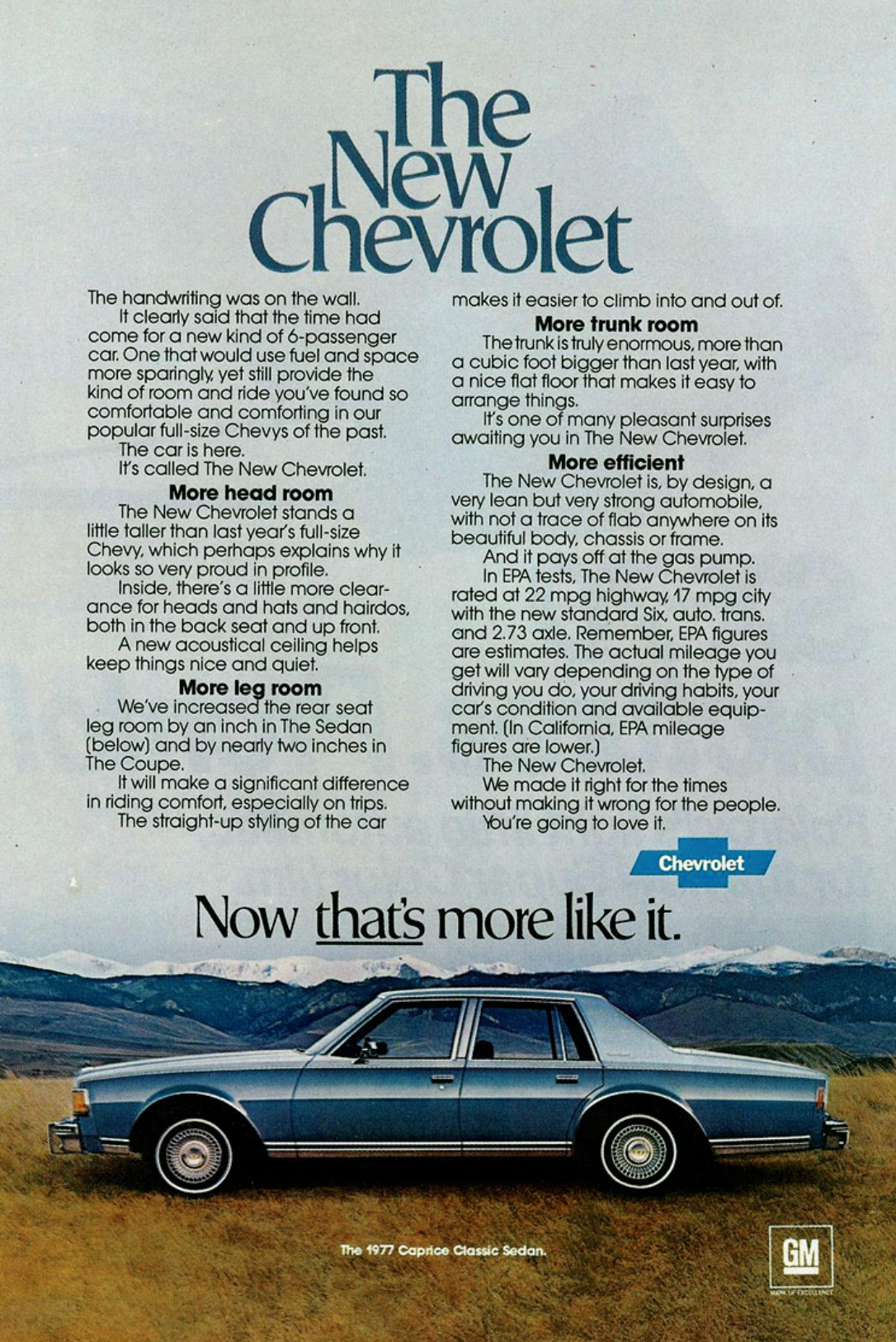
Now, fuel economy even with the standard “Stovebolt” six wasn’t great by today’s standards, but still far better than the low teens you’d get from the earlier cars.
It’s just a magnificent car that honestly doesn’t seem as large as it once did against current giant SUVs. You can compare for yourself, since if you take an hour’s drive almost anywhere in the US, you will still likely see one or two plying the streets as a testament to their great build quality. As the eighties dawned, GM continued to refine the big sedans, resulting in better aerodynamics and fuel economy.
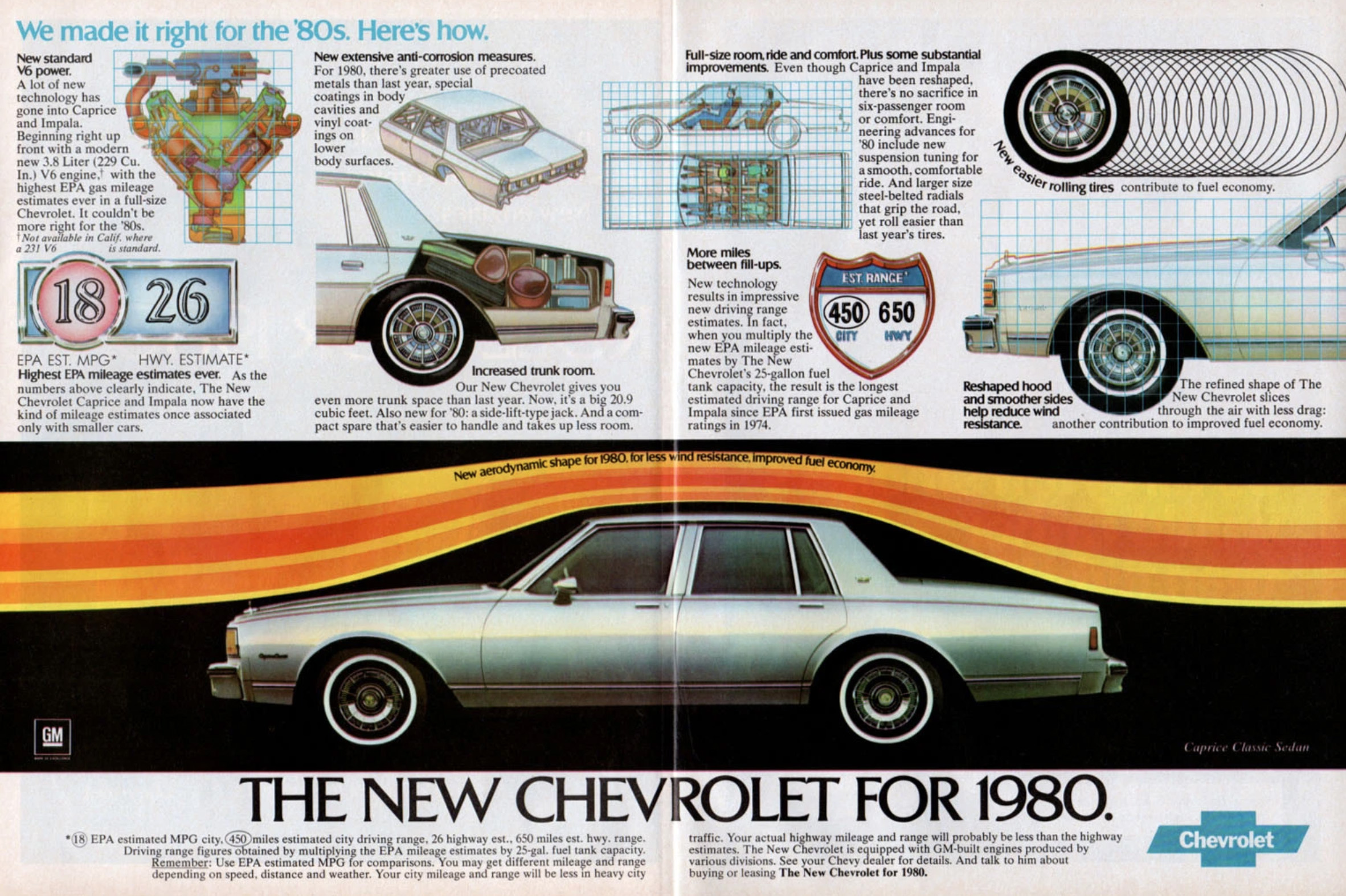
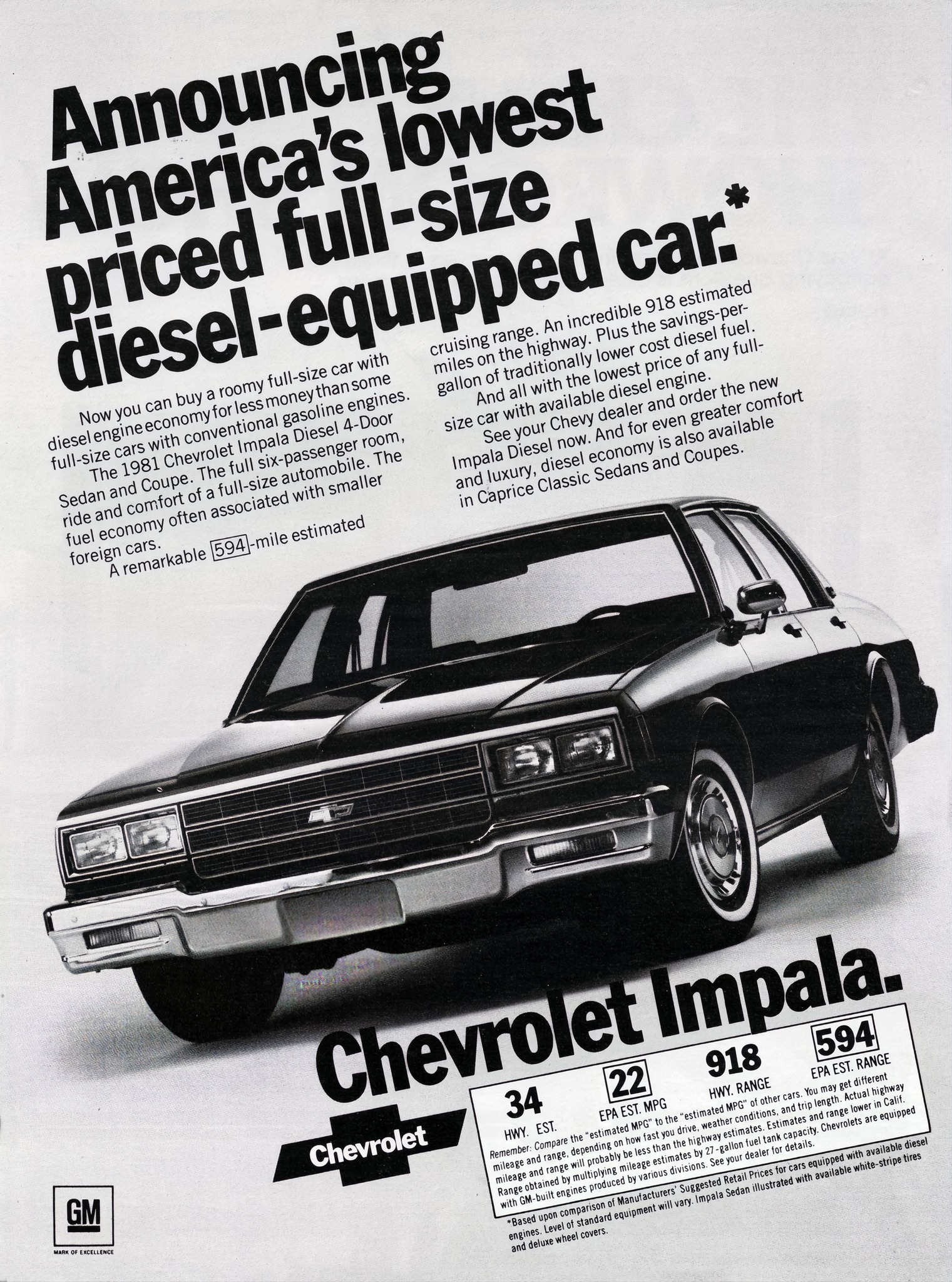
You could even get one with an EPA estimate of 34 MPG on the highway if you chose the di … well, on second thought, do not choose that. Admittedly, that later diesel was a far better motor than its notorious predecessor, but we’re still talking a half-minute zero to sixty time. Cue the Michael Scott “No, dear God no!” meme. Look at that bladder-busting range, though.
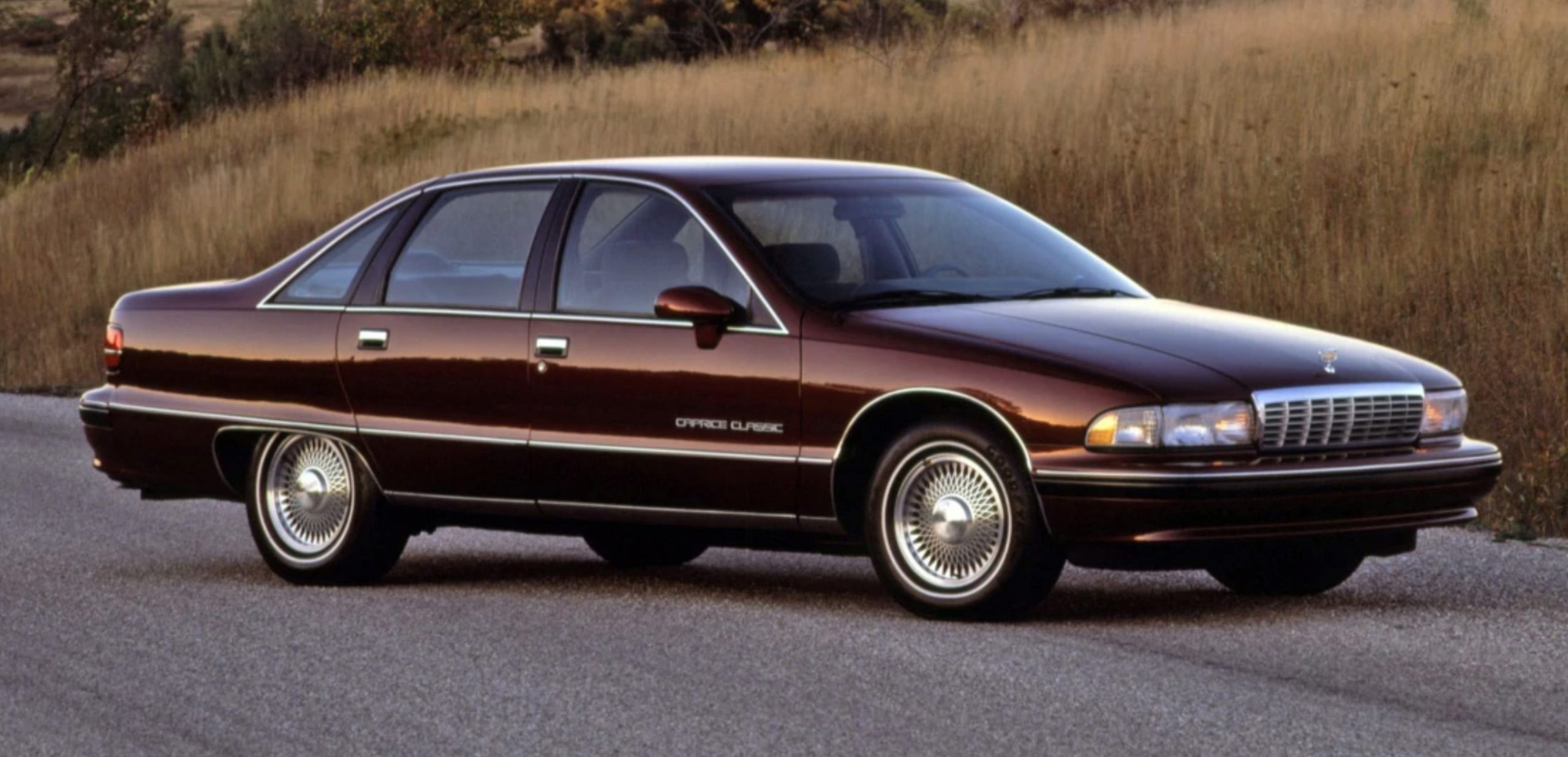
A decade and a half later, Chevy gave us a rebodied B-body Caprice for 1991. Gone was the boxy shape, replaced by Shamu-The-Whale-looking “aero” sheet metal that appeared to combine the Ford Taurus with a Motorama show car.
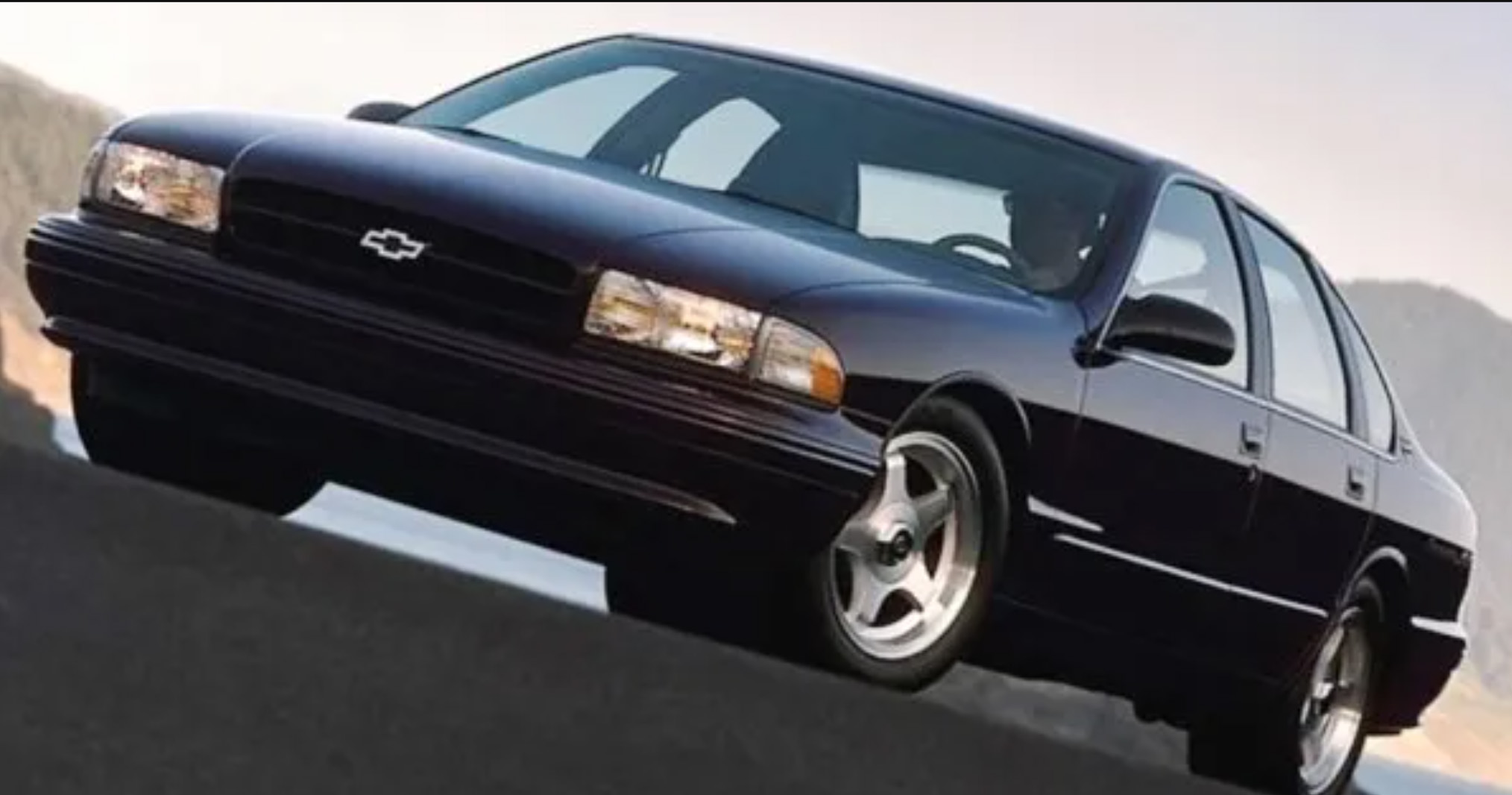
Sales were not nearly as strong as before outside of massive fleet purchases, but at least GM gave us one last hurrah with the blacked-out Impala SS:
The B-body’s new lease on life was short-lived, ending in 1996 to make way for more SUV production. It’s a shame that it never got an opportunity to explore its full potential and give an ill-fated GM brand a truly cool flagship. It seems reader Nick Hernandez feels the same way:

Sure, Nick, let’s make that happen.
Don’t Forget The Winona Judd Concert, Too
General Motors’ work in collaboration with NASA on the Lunar Rover was impressive, but it was nothing next to the moonshot that they tried in the early eighties. Sure, they had kept their head in the sand during the seventies, but by the 1980s it was undeniable that the Japanese onslaught was not going to end unless they put 200 percent tariffs on the cars like, well, they do now with China. The General realized that they had to make a sea change, and the best place to start was with an almost-skunkworks kind of new brand. The first concept was seen in 1984, but it took seven years and five billion dollars for cars to reach showrooms.

Those showrooms, as I’ve indicated in the famous ad before, presented a totally new experience for buyers with no haggling (except on your trade-in) and treating buyers such as young Julie like a princess and not some bottom-feeder loser:
In fact, almost all of the commercials for Saturn showed things like happy workers building the car or owners enjoying barbecues:
You know what was missing in these ads? For the most part, the cars. You barely see them on screen, as it wasn’t deemed important to show them to buyers in a category that generally didn’t care about cars. The whole Saturn buying and ownership experience, in some ways, outweighed the value of the product itself. It’s not that they were horrible products; the styling was nice in a shrunken-Olds kind of way, and they were absolutely better built than the average Cavalier.

However, like I said earlier about products in a certain category, if given the choice between a Saturn SL and a smoother-revving Honda Civic, ultra-high-quality Toyota Corolla, or a deceptively athletic Nissan Sentra, it’s likely that GM’s product would fall to the bottom of the list. There were too many other better selections.

Do you know what you couldn’t get from those imports? An easy-to-maintain, V8-powered sport luxury touring sedan with big tires, brakes, and independent suspension all around for under $40,000 1991 dollars. Now I see where that reader was coming from; I think I’m gonna like the Saturn XL.
A Different Kind Of Caprice
I’m well aware that if the B-Body chassis were a person, it would have been old enough for its driver’s license in 1991. Still, I think we could do some serious work on the chassis to make a rather serious car. General Motors did that themselves with a one-off “Corvette chaser” wagon they built up to keep up with Stingrays on test runs.

I’ve explored this idea before with my Euro-spec turbocharged Caprice idea a few years back:

Inside, bucket seats with a console and extra gauges would have given the ’77 Euro Caprice a more “international” feel.

I’d employ this thinking and a number of the mechanical tricks for the B-Body Saturn XL that I proposed for that concept here as well. The B-Body was great for oozing down the city street or cruising down straight interstates, but cornering and stopping were never strong suits. Brakes would fade into oblivion after one good stop, and just like the Ford Panther, there would be that exit ramp where the live axle would hit that one bump and shift the rear end alarmingly a foot or two sideways. Among those changes would be enormous (for the time at least) Corvette-style tires and wheels, as well as big diameter vented disc brakes on all corners. The biggest modification, of course, would be a bolt-in independent rear setup to replace the four-link live rear axle. I had suggested a C3-style rear suspension for my original Caprice, but I’m sure we could do something updated for 1991.

Combined with tweaks to the front suspension, we’d have a much better ride and handling combination, and a limited-slip differential would help, but down power from the Corvette LT-1. I’d like to pump up the power a bit from the 260 in the Impala SS; closer to 300 with the standard automatic could get the zero to sixty time down to the magical sub-7 second range. At least that’s what you could get with the Saturn XL Red Line model.
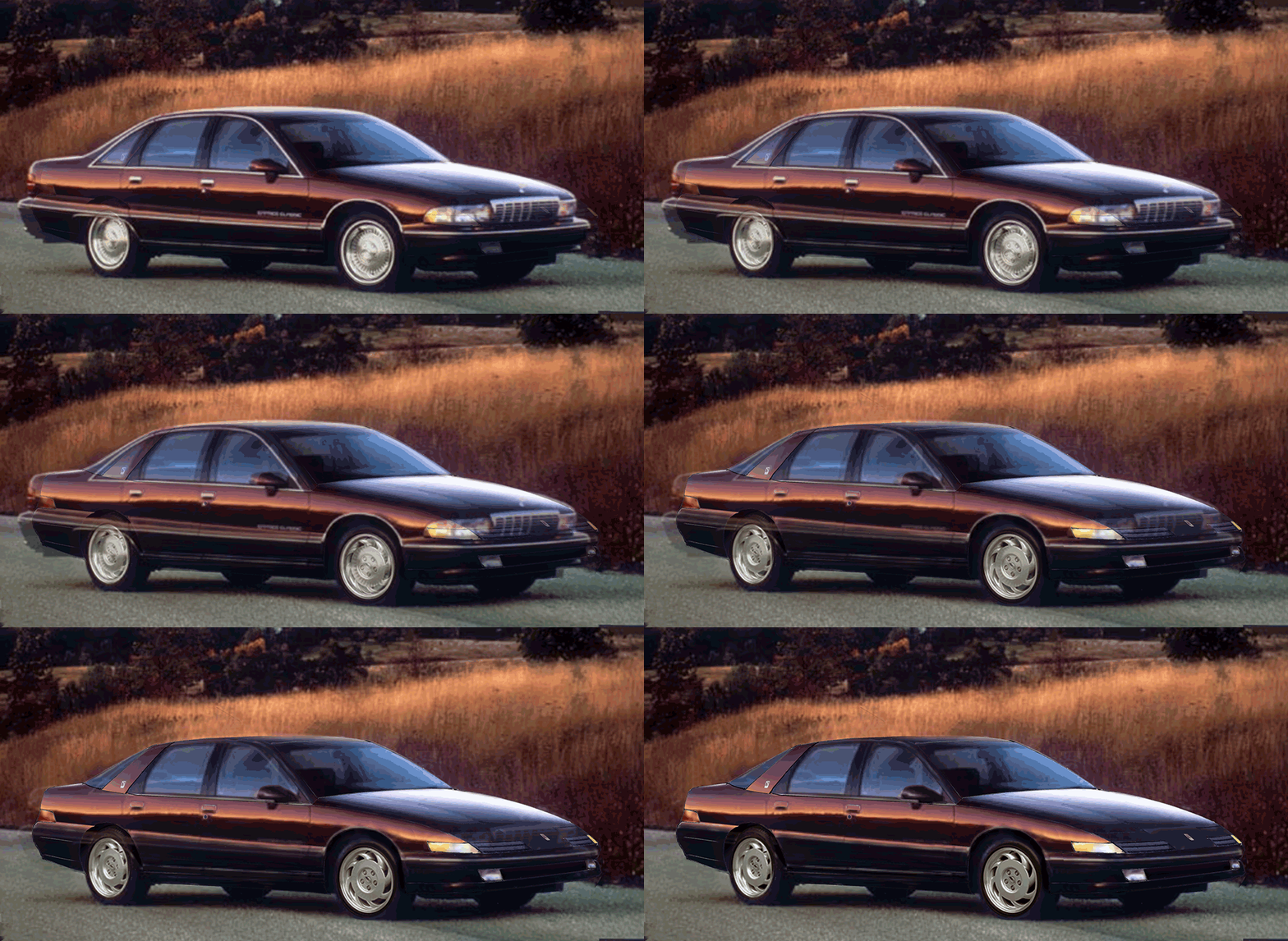
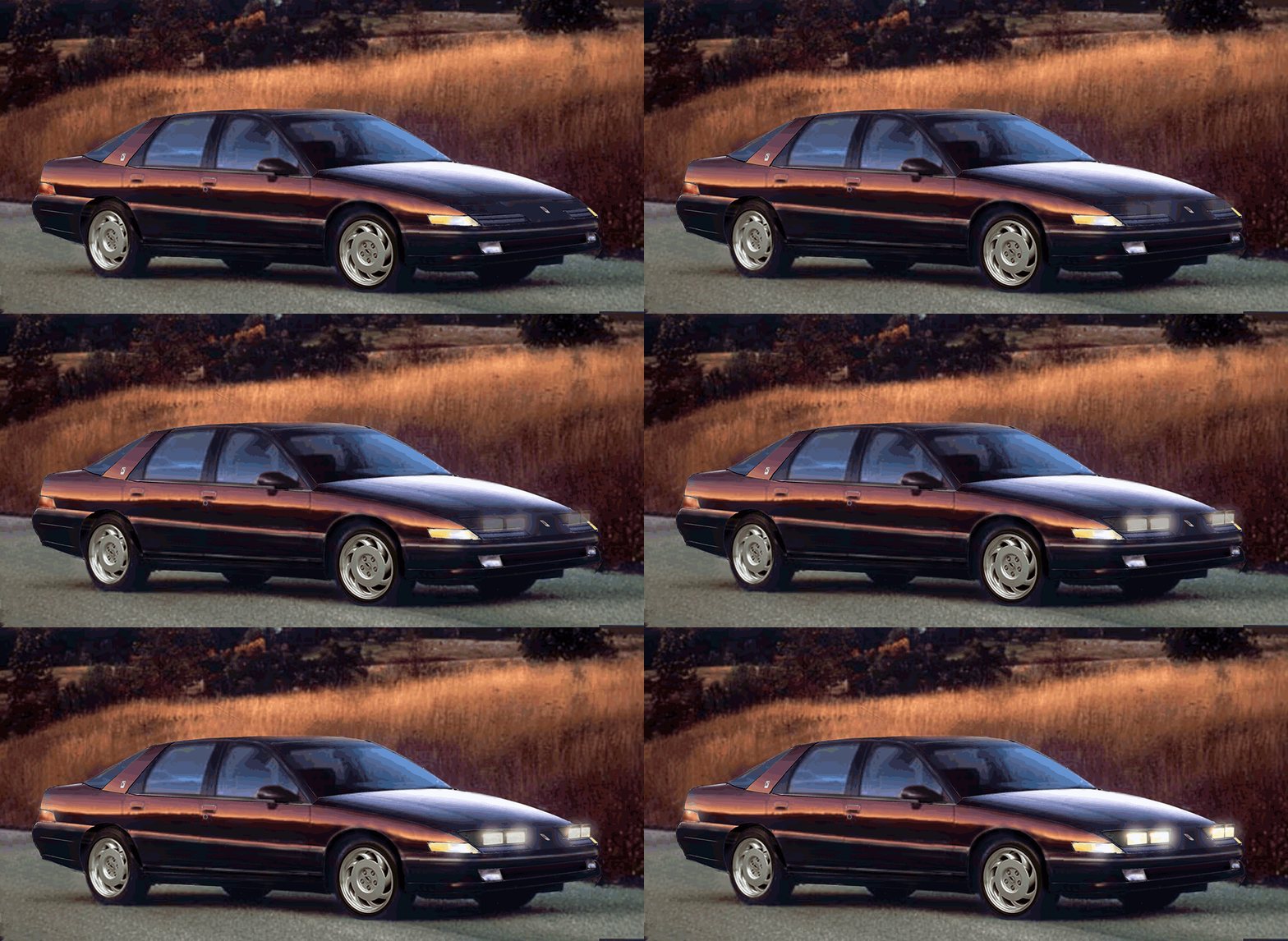
For the styling, I kept the windshield and doors of the Caprice essentially the same (just slightly different skins). The nose needed to be extended somewhat to clear the hard points of the radiator and such to give it an SC coupe-style face with retractable headlamps. The filled-in C pillars sit ahead of a very Saturn-looking rear backlight; I’m envisioning a black-painted roof but a body-colored hoop that connects the C pillars. Naturally, I’ve opened up the skirted rear wheel opening, simplified the side trim, and blacked out the chrome.

Here’s an animation between the Caprice and the Saturn XL. You can also see that I reduced rear overhang at the expense of trunk space, but the trade-off would be worth it.
Remember that the flagship SC2 coupe had pop-up headlights? The XL will as well, but since it has twice the number of cylinders, it will naturally have twice as many sealed beam lights.
The rear features low taillights with amber signals since that was a Saturn trademark; prominent quad exhaust tips would be standard on the Red Line and possibly across the board, with the backup lights finishing off the recesses for the pipes. It ended up being kind of a combination of Saturn S- and L-series with some Seville STS in the mix.

Again, you can see how the greenhouse (window area) is pretty much the same, but lopping off some of the rear overhang changes the whole look.

You just know I’m going wild on the inside of this thing. The radio sits in a pod on top of the dash and can be turned to face the driver, the center, or maybe even the passenger (though I would personally NEVER let that happen and would want to have a hidden lockout on the driver’s side). Digital climate controls sit above a typical GM overblown compass and diagnostic display that can pivot up to reveal a hidden storage space underneath.

Yes, we’ve got more pods, people! In 1991, that would have been the last appearance of such things in cars, and the Saturn XL would use them like they were going out of style. I’ve made them sort of “waterfall” into the buttons on the spokes of the steering wheel.

Before you ask, I did try a station wagon version of the XL, but it just didn’t look right. It also looked too much like the Caprice or Roadmaster wagon that it really was and seemed unbefitting of the market position that Saturn would be looking for with the XL. Sure be fun, though.
Forget Memphis, We’re Making A Run To Munich
Like almost everything that I do here at The Autopian, this exercise was done rather tongue-in-cheek with entertainment in mind. Still, the question remains: would anybody have actually wanted what amounted to essentially a thinking person’s Impala SS? The answer is almost certainly not; GM’s experiments with things like turning the Trailblazer into a more highbrow Saab SUV didn’t exactly rush off the showroom floor. Still, the Saturn XL doesn’t look like a Caprice or a Roadmaster, and I can guarantee that with the totally revamped chassis and heated-up motor, it would have been as unrecognizable as the 1976 Seville was to the Nova chassis beneath it, and that sold like hotcakes.
Let’s face it; the big GM B-Bodies and Ford Panthers unarguably have a legacy as some of the greatest American cars ever built. They died out as taxis and cop cars when they should have at least been given just that one chance to get dressed up for the ball to meet up with big S-Class sedans and Rolls-Royce Silver Spirits before the clock struck midnight. Best of all, you wouldn’t even have to haggle at all when buying it.
Top graphic base image: General Motors


Nice work! Viewed from in front and to the right, I get a lot of first gen Chrysler LH platform cars–think Eagle Vision or Dodge Intrepid. And I do like the transformation at the rear with the truncated trunk.
I also like the pivoting audio stack but wonder how rattle-prone it would become over time.
Oh well. It’s all academic.
Love the interior and driver-focused controls ideas — that’s so straight out of 80’s and 90’s GM interior designs!
I’m not sure the GM bean counters in the 90s would have approved so much unique interior switchgear but I like the overall package of this.
Great, now I need a Corvette Chaser in my life.
Neat car and I especially love the interior mock-ups. Well done, as usual, and these posts are a huge part of what makes this site so fantastic.
thank you! Glad you like it.
I can kind of see it from the side of Saturn being the American car brand of that era that was actually willing to do things a bit outside the box (see the no-negation pricing, etc.)
Nice! I love the Corvette wheels on your creation!
You wrote, “I’ve only owned two American cars in my life, and they were both comically big body-on-frame barges.”
I’m in my mid 50s and the closest I’ve come to owning anything ‘foreign’ was my Suzuki-based 1991 Geo Metro and 2003 Chevy Tracker, and our Korean-built 2024 Chevy Trax.
I guess I must live in the land of the Baconator. I’ve never known anybody who owned a Nissan or a Honda, one person who owned a Volkswagen, and I’ve only known four people who owned Toyotas, and they were all coworkers across two different jobs and 30 years.
If I were bored and decided to look out my front window at the cars going past my house on the busy state highway for an hour, 80-90% of them would either be Chevy, F*rd, GMC, Dodge/RAM, Buick, Cadillac, Lincoln, Harley-Davidson or older Pontiacs and Oldsmobiles. The other 10-20% combined would be the German, Korean, and Japanese brands combined.
Within a 25 mile radius of where I live there are two Chevy/GMC dealerships, two F*rd dealerships, one RAM/Chrysler/Dodge dealership and one Toyota dealership. If you want something else, you’re driving 100+ miles.
Oh fuck that shit, just put it on a W body with a sideways 5.7TPI or 3800S/C motor and a 4T65E and call it a day.
that shortened rear overhang really makes a difference to the presence of the car. Wish that they had done that with what came out on the market then. Look a lot better proportioned to my eye.
This car misses the point of what Saturn was about.
It’s insane but in a good way. I have no idea how it would sell in the same showroom as a Saturn SL with unpainted plastic bumpers, or how much blackmail it would take to get it approved but a hot rod Caprice with pop up headlights would make the world more interesting
It’s a fun thought that the 1977-1997 Caprices ARE actually downsized from even larger ones: To me it has always been a big bunkin’ barge and the most American thing ever.
Nice work on this one, makes me miss the Saturn brand a bit more..
Chevy had stopped making the Stovebolt 6 by the 80’s and replaced it with the Turbo-Thrift (which was not turbocharged).
Beat Porsche to it by like 40 years.
Yeah the Stovebolt finished up in 62. The 62 and up inline six (like I have in my 67 Camaro) has many parts in common with the small block V8 and seven main bearings vs four in the Stovebolt. This engine was in production through 2001.
Saturn would be the least appropriate GM brand for this, which makes it all the more fun! And that’s a great job matching the Saturn style to the b-body size.
I’d buy one! Used. For $4,000. I almost ended up with a Saturn LW200 but luckily it was sold the day I looked at it. Don’t think I missed out there, but I still have a softspot for the brand.
I mean yeah, I’d probably buy that.
The new, full-sized Saturn? Now THAT’S more like it!
Man I love this thing!
If Ferrari and/or Mercedes would just consult The Bishop on new car design the world would be a much nicer place.
Thank you!
First project: “fix” the Luce, but where to even begin?
There is still the fragile engineering to be addressed.