

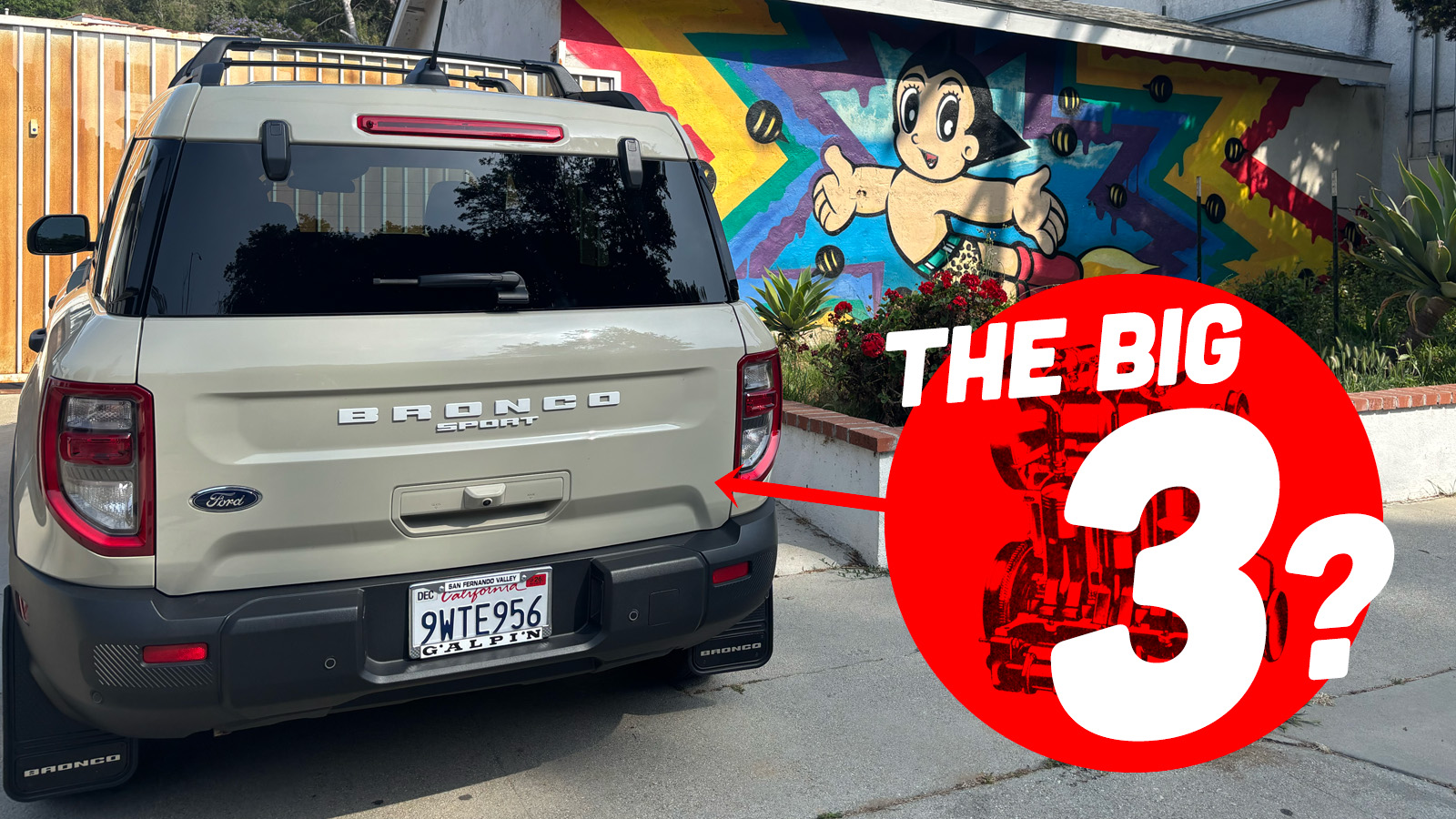
I bet you’ve found yourself in this position: you’re sitting at an outdoor cafe, a hoagie in one hand and a sock puppet in the other, because you hate eating alone. As you’re happily feeding your puppet friend finger-bites of hoagie, a man frantically approaches you, knocking over chairs and children and climbing onto your table. He seizes your face in both his hands, brings his face nose-to-nose with yours, and demands, loudly, “Tell me what the biggest three-cylinder car is!”
Now, usually when this happens, most of us will mutter something like “a Wartburg?” and then pepper-spray ourselves to freedom, taking off running in the opposite direction of the three-cylinder weirdo before he can recover to ask you again.


I may take issue with the methods, but the three-cylinder questioning vigilante brings up a good, and, let’s be honest, important question: what is the largest passenger car ever to rock a three-banger?

I wasn’t really kidding about the Wartburg guess there; the Wartburg 353 Tourist wasn’t exactly a small car, especially by the standards of three-cylinder cars. I think by far the most common three-cylinder engine type used in passenger cars – there are likely some large, weird diesel three-cylinder engines, so I’m not counting those – were two-stroke threes, the kind pioneered by DKW.

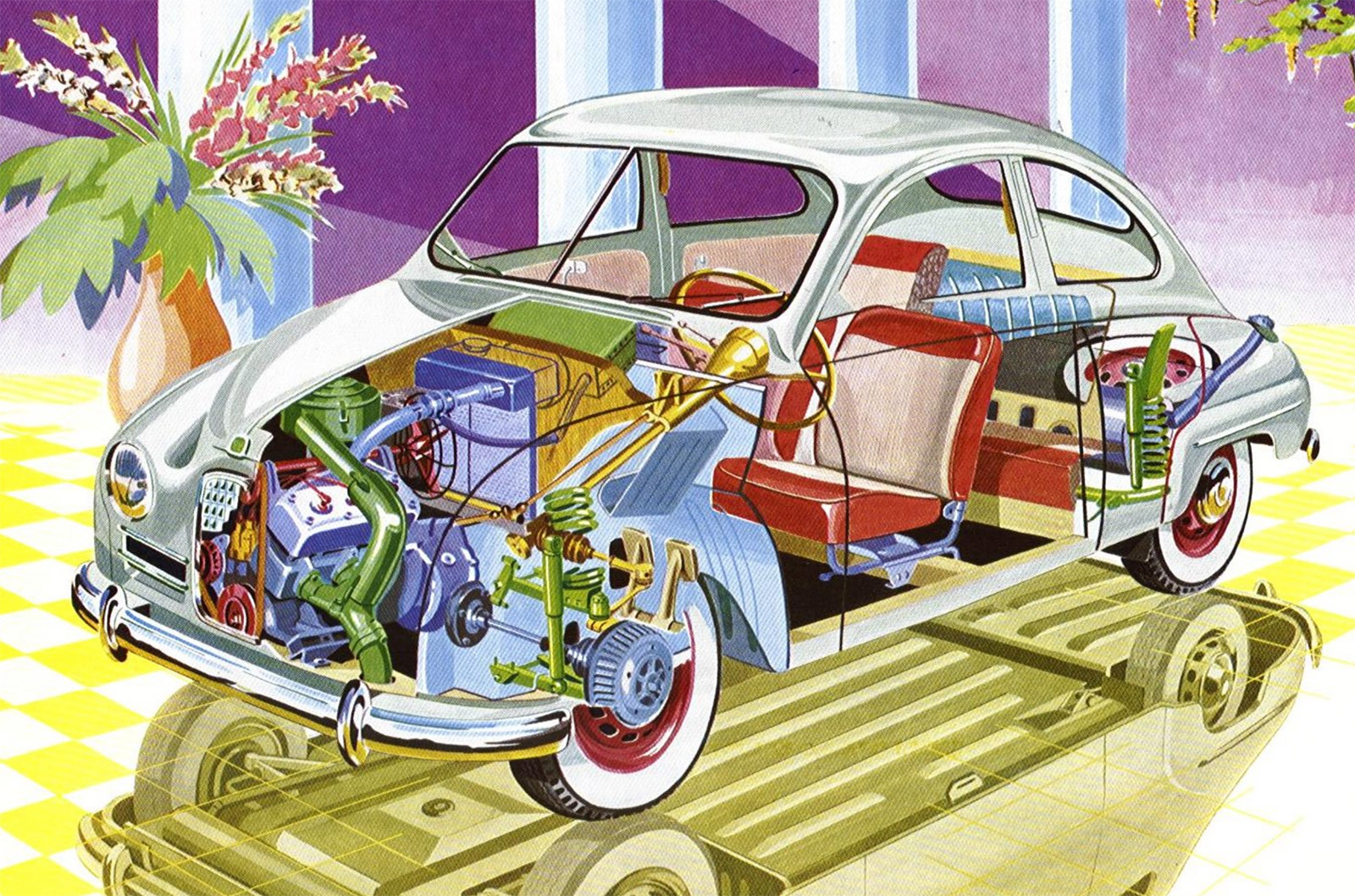
DKW’s two-stroke three was a very clever engine design, with minimal moving parts and good fuel economy, with the added plus of being smoky enough to give everywhere you idle a certain moody, noir-film-like feel. A number of other cars adopted this engine design, like the aforementioned East German Wartburgs, and companies like Saab, which adapted the design for most of their early cars.
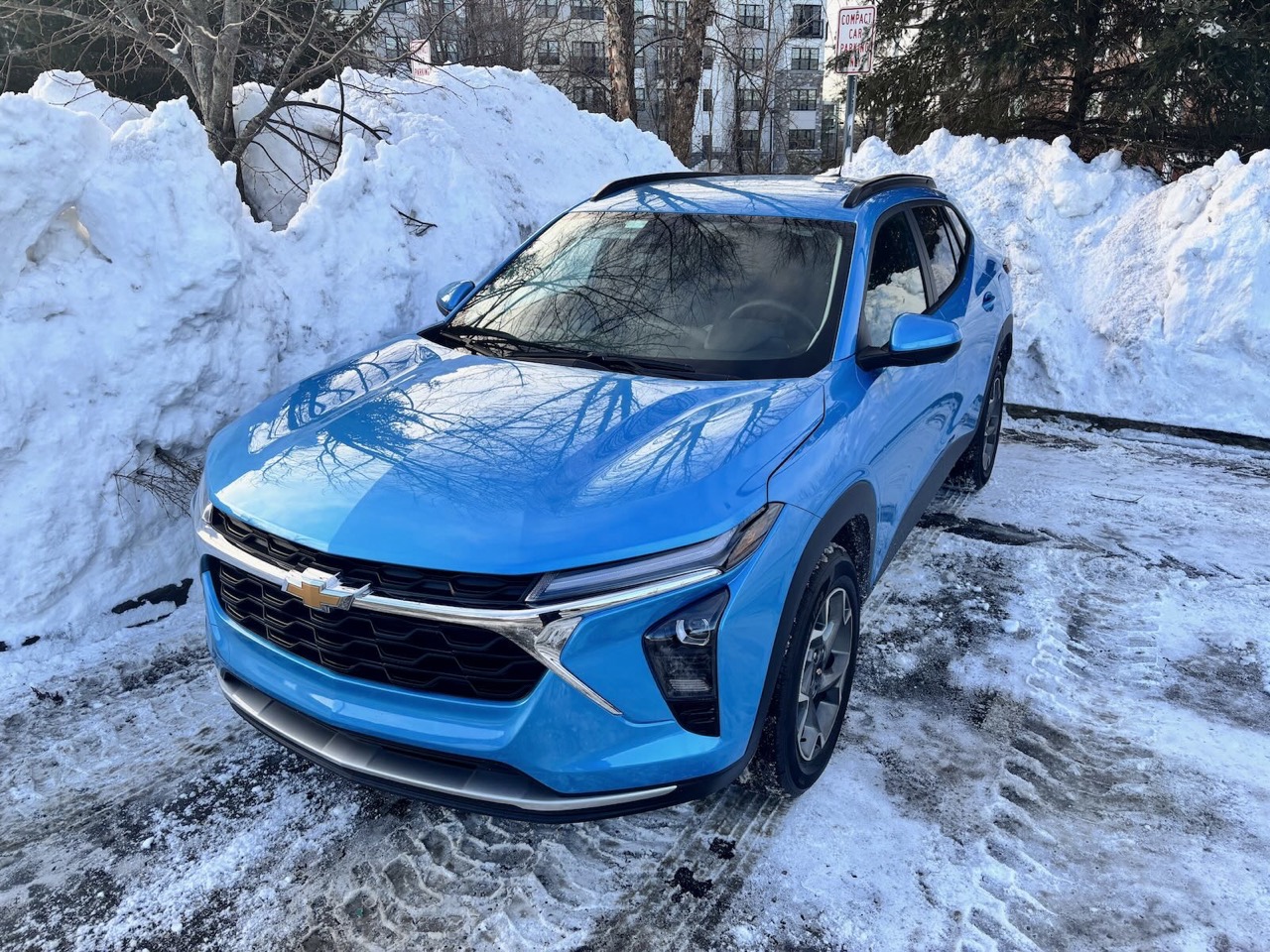
But none of these cars was especially large. It wasn’t until the advent of the modern re-emergence of three-cylinder engines that we actually saw some larger vehicles using them. I think the two best candidates for Largest Three-Cylinder Gasoline-Powered Passenger Car are the Chevy Trax and the Ford Bronco Sport.
Here’s a Trax:
…and here’s a Bronco Sport:

Between the two, the Bronco Sport is a good bit larger: about 3 inches wider, nine inches taller, 500 pounds heavier, all that. And it’s still definitely a three-cylinder engine under the hood! I counted, even:
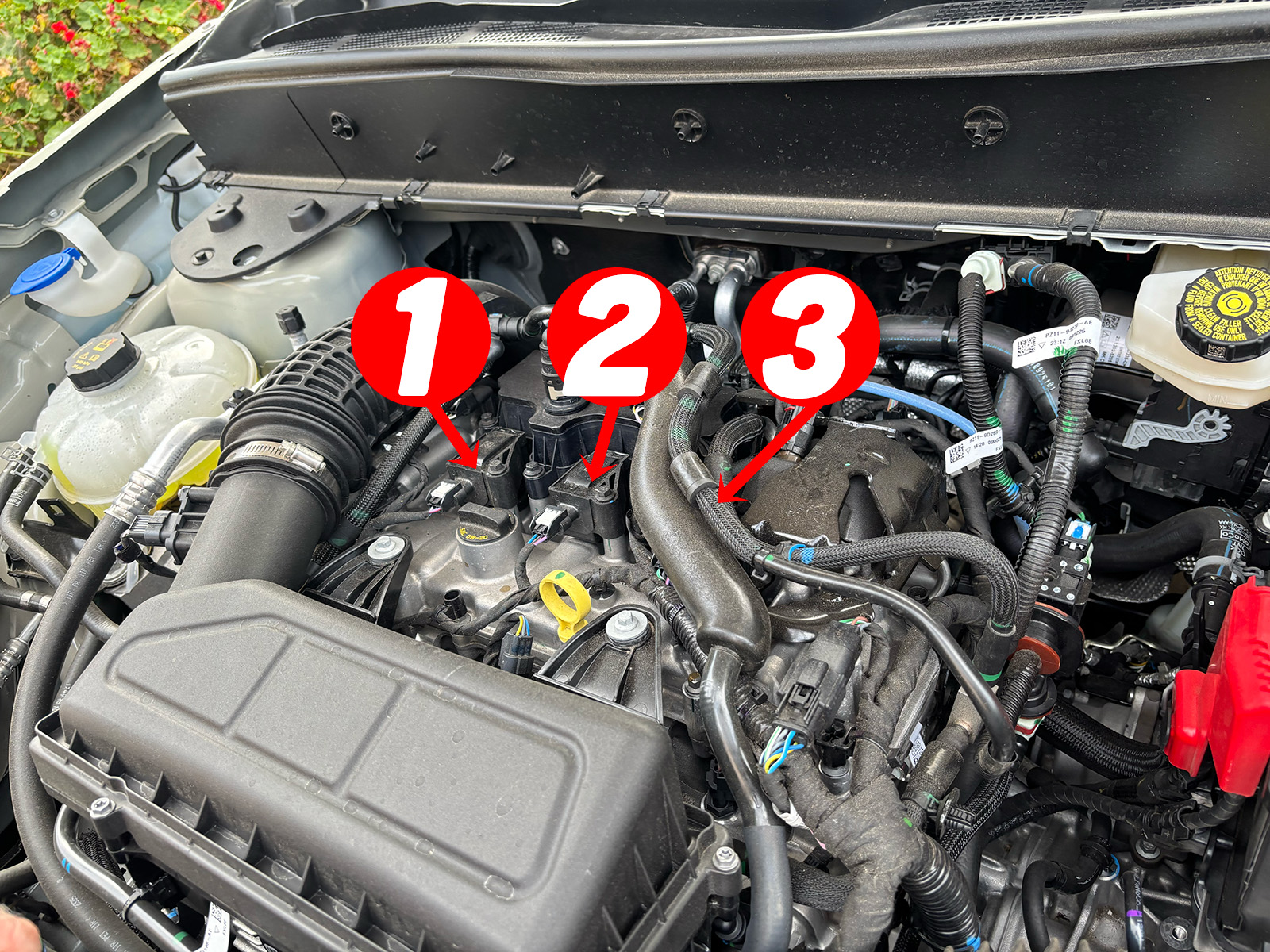
I’m pretty sure the Bronco Sport has to be the largest mass-produced passenger vehicle ever to rock a gas-powered three-pot engine. Everything else is Suzuki Swifts or Festivas or Mirages or whatever, all small city cars.

But I could be wrong. The BMW i8, for example, has a three-cylinder engine as part of its hybrid drivetrain; it’s smaller than the Bronco Sport, but by some metrics, just barely. The Bronco Sport weighs 3,458 pounds, while the i8 is 3,455 pounds – only 3 pounds lighter! I’ve made sandwiches bigger than that!
So maybe there is some other unit of a three-banger I’m forgetting? Or does the Bronco Sport deserve the prize here? Please, help me think this through in the comments so I can finally get some sleep!
Top graphic image: Jason Torchinsky


Technically, my Honda V6 is sometimes a three-cylinder car with VCM doing its thing. Does that count?
While certainly not a large vehicle, I used to own a 3 cylinder Skoda Fabia. Loved that car, all 58 hp.
Commer 3 cylinder opposed piston diesel truck?
Couldn’t you get a Ford fusion with a 3 cylinder turbo for a while too?
The current gen Nissan Rogue has a turbo 3 cylinder. its longer then a bronco but shorter and narrower.
My old VW van running on 3 cylinders?
Whole bunch of French SUVs like the Peugeot 3008 with 1.2 litre three cylinder turbo motors, making 130hp.
Pretty sure it was an option in the larger 5008 too.
At the opposite end the little 108, and the equivalent Citroen and Toyota, made in the same factory were fun — had a stick shift and you could get that 3 cylinder rasp
Why didn’t I know that the BS was three cylinders? I seem to recall that the hybrid BS used the four cylinder engine from the Maverick, so I guess I assumed that a non-hybrid BS would use a NA four. Dunno why I thought that. I’ve never been super-interested in the Bronco Sport, so I guess I never bothered to learn more about it.
Thanks for the edumacation.
I’m sure it’s evolved since then, but isn’t Ford’s rep for three cylinder engines (Fiesta) considerably less than stellar?
The Bronco Sport doesn’t have a hybrid variant, only the Maverick, Escape and Corsair had them with the Escape and Corsair available as a PHEV as well. The Bronco Sport is either a 1.5L I3 turbo or a 2.0L I4 turbo only
Ah! Forgive my premature senility. Of course I was thinking of the Escape, not the Bronco Sport. My mistake. Thanks!
Cars of all sizes have GM 1.5T 3-cylinder engines in China.
Why is it the underhood of Ford products always just looks like a spaghetti mess of hoses, and ribbed black plastic? It’s always just SO UGLY.
And I’m not a fan of engine covers… but god damn every time I see a terrible engine bay it’s a Ford.
I had a C-Max that had an air filter integrated into the engine cover. Said engine cover couldn’t be removed easily from the car – you had to disconnect the hose to it, and remove a portion of the windshield wiper cowling. I greatly prefer that my Escape has no engine cover.
Standard engine 2.0 ecoboost is the answer for Bronco Sport.
My first 3-cyl driving experience was this past fall’s rental of a Peugeot 2008. I have some issues with the car, but the engine (w/6pd man) wasn’t one of them. Good power, nice growl, great economy in a comfy cruiser compact car. Conceptually I’m not against them at all and was left impressed.
I’ve rented a few 1.0L I3s in Europe, both NA (Kia Picanto and Seat Ibiza) and turbocharged (Skoda Fabia and Renault Clio). All were perfectly adequate for getting around, with the Kia and Skoda being the favorites.
The Renault was a nice car and I appreciated the sixth gear, but it had a pretty annoying drivetrain whine at cruising RPMs.
I’ve heard the Skoda (Karoq?) is nice. I found the Pug’s interior ergonomics really bad- too many things exclusively controlled via the screen, not intuitive at all and I had to google how to figure out how to change the language. The TomTom navigation frequently showed me in fields adjacent to the road, not on the road, and turn instructions (visual and audible) would happen after I’d already passed the intersection. It was all so distracting, and the dash design forces you to view the gauges over the (tiny! low) steering wheel instead of through it. Otherwise it had a very comfortable quite ride on roads throughout Austria. Easy to drive all day.
We owned a 23 BS. 180hp from the 3 pot. Impressive drivability for a such a small engine.
In Europe, BMW utilizes a 1.5-liter, 3-cylinder turbocharged engine (B38) in specific, entry-level 3 Series models, notably the 318
I believe they also used in the X1/X2. The X1 is likely a similar size to something like Bronco Sport.
In the U.S. we only got the B38 in various Minis (and BMW i8), but surprisingly it was used in the Countryman for a while.
The Mitsubishi Mirage has once again entered the room. Worldwide sales and large being a relative term especially to us American fatties, the Mirage is the most likely to reach 200K miles compared to the Trax and Ford abominations that have the lovely wet-belt oil pumps…
Big in terms of what? Length? Width? Height? Weight?
Bigness. Maybe largeness, if you’re so inclined.
It doesn’t quite fit the parameters, but I spent some time on a J/40 sailboat. 40 feet long, 12 feet wide, and 18,000 lbs with a Yanmar 3 cylinder.
I was thinking sail boat too. Or tractor most sailboat engines are basically marinized tractor engines anyway
Modern Chinese EREVs use some funky ICE engines – largest might be the Radar RD6 with Geely’s corporate turbo I3. ~3600 lbs, approximately the same size as a Tacoma
The sixth-generation Nissan Serena is 187in long https://en.wikipedia.org/wiki/Nissan_Serena