

It would probably be incorrect for me to say that I don’t like racing. You couldn’t pay me to sit and watch, say, an entire Formula 1 race, but in many ways the track action is only part of “racing.” The fact is that many if not most races are won off of the track well before the pace lap.
No, it’s pure preparation and development that’s ultimately the key to getting the checkered flag, as well as finding any competitive advantage within the rules. That, my friends, is the racing that I’m totally here for. In 1970, Ford tried to unfair-advantage their way to Trans-Am racing series wins with an incredibly innovative carburetor that still fit the requirements of the race series – until it didn’t. Here’s a brief history of the “Cross Boss.”


Rules Are Made To Be …
Reading between the lines of the racing rulebooks is a common thing; there’s only so many regulations that can be written for without trying to imagine every crazy possible outlier. For example, do the rules say you can’t have a race car with six wheels? No, they don’t! And so:

Was there any regulation that stated a race car couldn’t have a snowmobile engine stuck on back that sucked air out from below the car and stuck it to the tarmac so well it could theoretically drive upside down? By all means, Chapparal, go ahead and make a “sucker car!”
Eventually, manufacturers either realized these ideas were not worth the effort, or more often, the rule books quickly added a few pages. Like when Smokey Yunick installed absurdly long fuel lines to increase fuel capacity without modding the tank? Yeah, that changed quickly when they saw his car drive some distance despite having left its fuel tank behind.
Still, that didn’t stop (and still doesn’t stop) race car builders from pushing the rules; Ford did just that in an effort to keep their Pony Car in the winner’s circle.
So There Was This Pontiac Trans-Am Trans Am …
The old mantra of “race on Sunday, sell on Monday” was never stronger than in the fifties and sixties, and while stock cars put brands head-to-head on the big ovals, the real battles to watch were on the road circuits of the Sports Car Club of America’s Trans-American (Trans-Am) series. It was called the “sedan” championship, but that’s a bit of a misnomer; there were no Impalas and Galaxies here. Nope, this was a battle of the latest batch of Pony Cars, which famously included the legendary “Boss” Mustang.

The year 1970 was arguably the greatest ever for choices among the Big Three and The One Independent. Combined with some outstanding drivers, it was possibly one of the greatest seasons of motorsports ever. The vaunted Parnelli Jones-driven Mustang originator went wheel-to-wheel with the likes of Chevy Camaros, Pontiac Firebirds, Mopar’s Challengers and ‘Cudas as well as red, white, and blue AMC Javelins driven by enigmatic Ivy League engineer Mark Donohue on a team led by Roger Penske himself.
These “sedans” were in the so-called “over two liter” class. In this group of cars, the maximum displacement allowed was 305 cubic inches, and for 1970 the complex dual-four-barrel carburetors of the previous season were banned to help lower costs for privateer entrants. That was a problem, but at least the regulations applied to everyone and allowed for parity between competitors. It wasn’t like anyone was going to be able to gain a power advantage here, right? Don’t tell the guys in Dearborn that.
The Regulation Said Four Barrels, Right?
As virtually any gearhead knows, the words “four-barrel carburetor” almost always refer to something like below: two columns and two rows of two barrels each. They’re basically always arranged that way.

Ford engineers determined that putting a carburetor like that right in the center of an intake manifold like the one below forces air and fuel to make sharp bends to reach the outer cylinders (primarily cylinders #1, 4, 5, and 8). Uneven fuel distribution and turbulence are the enemies of engine breathing and high-revving power.

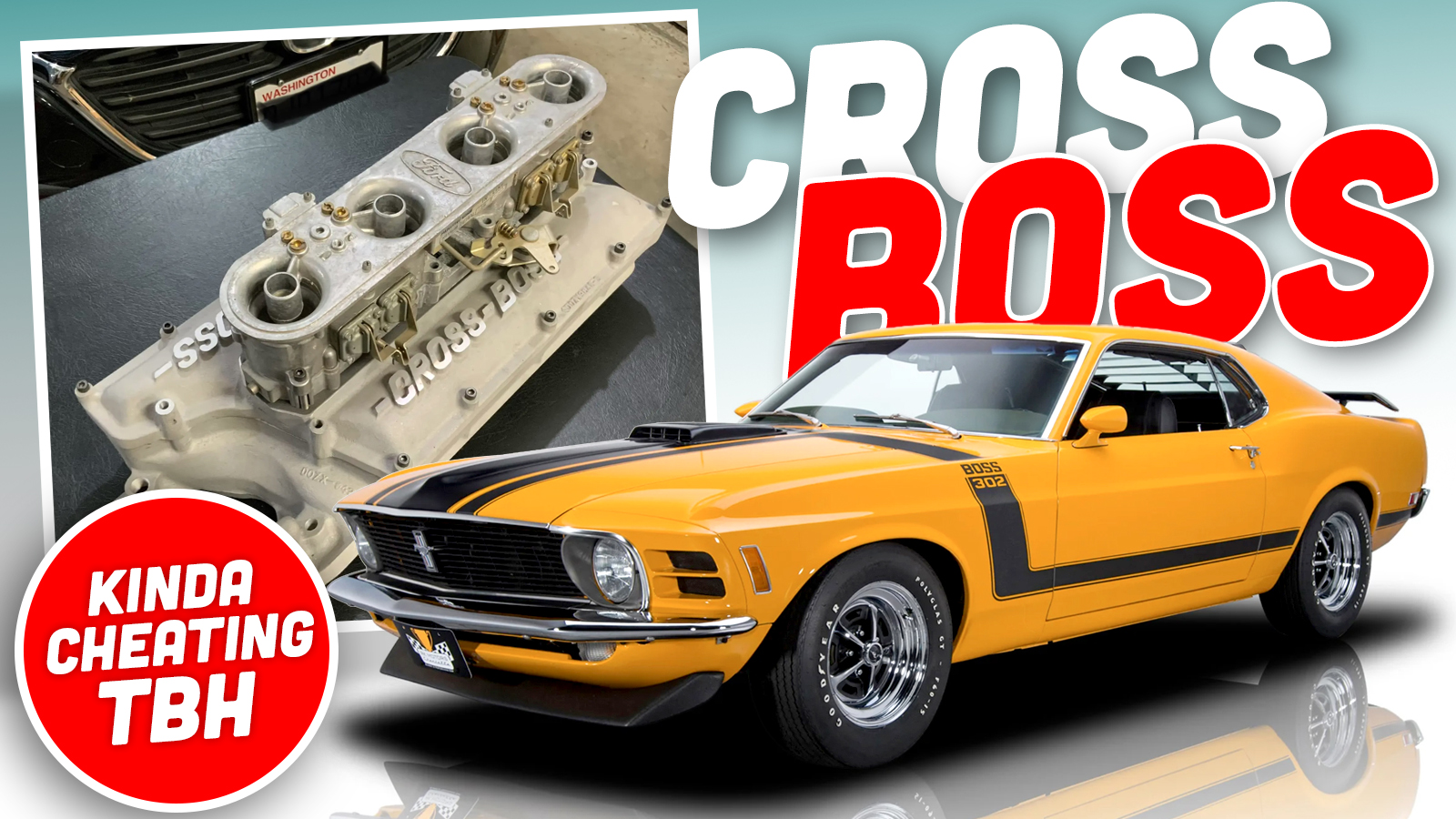
Ford’s answer to this issue was a new cast-aluminum intake and a special carburetor to match. According to a number of sources including Stangnet.com, here’s what they did: instead of the four conjoined barrels, they lined up all four venturis in a single straight row, sitting evenly spaced for each row of cylinders over a two-piece aluminum intake with straight, equal-length runners.

Unlike the standard production V8 setup, here each cylinder essentially got a “straight shot” of air and fuel, which mimicked the advantages of individual carburetors like dual four-barrel carbs or three two-barrel “six packs.” In fact, it really gave much of the same feel as a not-even-close-to-legal multi-port fuel injection system. Technically, it was still a “four-barrel ” carburetor, but in a bit of nudge-nudge-wink-wink way; “It’s just a really, really long and skinny four-barrel carburetor, what’s the problem?”

The Cross Boss turned a 302 into a totally different animal. Unlike a typical Ford V8, this thing traded low-end grunt for frenetic, high-revving power. When dialed in, it came alive above 5000RPM with the volumetric efficiency of the free-flowing setup. A 7000RPM top end? Try 8000 or even 9000 and more in a race-prepared Cross Boss; unheard-of figures for big American iron. These could produce well over 450 horsepower, but the increase over the standard carb setup was not nearly as significant as the crisp throttle response that they reportedly delivered. Keep it on the boil and was an ideal racing powerplant.

Another cool feature of this sand-cast aluminum manifold was a removable top plenum cover. This made it much easier for race teams to port and polish the interior for maximum velocity as well as allowing the cutting-edge concept of removable venturi sleeves to allow racers to quickly swap them out to change airflow calibrations. There were actually two different versions of the Cross Boss; one was rated at 850 or 875 CFM for Trans-Am and NASCAR, while a 1,400 CFM version was for drag racing and “unlimited” classes (I love that “unlimited” term, implying like 630 miles an hour).
What did the competition from GM, Mopar, and AMC say about the Cross Boss? I don’t know, but even if we did, we probably couldn’t print the expletives that surely came out of their mouths, as they were not happy. Together, they were able to convince the SCCA that the inline-four carb and intake might have “four barrels,” but it blatantly violated the spirit of competition. And thus, the Cross Boss was promptly banned from competition. It never ran in a car that competed in any Trans-Am race, ending its chances before it started. Ultimately, it didn’t matter for Ford, who went on to win the 1970 Championship with a traditionally aspirated Mustang anyway.

Better To Look At Than Drive
Ford reportedly built around 500 to 700 of the “in-line four” Autolite carbs and a mere 100 of the intake manifolds, with the intent of making nearly 2000 to meet SCCA’s homologation rules before the sanctioning body lowered the boom.

They’re still out there, and they sell for what seems like absurd money for a carburetor and intake. This one pictured above sold for over $5,000; others have gone for similar sums. Look at the coin this incomplete set of two units took in a while back.

If you buy one, should you throw it on your own ’70 Boss ‘Stang? Well, if you’re vintage racing, the answer might be a tentative “yes,” but for street use? According to a number of sources I found, forget it. The Cross Boss-equipped engine idles at a frantic 1500 to 2000 RPM, and the lack of low-end power means that it would be a pain to drive on public roads as you keep the revs up. Worse than that, reportedly the Cross Boss was a nightmare to keep properly tuned in a manner similar to the multi-carb setups like the six two-pot Webers on a Ferrari V-12. Early ones had no idle circuit, and mechanics supposedly had to manipulate the throttle linkage manually to keep it running. Almost certainly there was a lot of development yet to do on this thing that never happened when the whole thing got banned.

This was a pure race car carb and never, ever found its way onto a production street Ford, and never would have even if it didn’t get banned. With gas so cheap, if you wanted more power, you just got a 429!
Still, the Cross Boss would look great on a coffee table; a striking reminder of a time when rules weren’t necessarily made to be broken, but you could sure bend the living crap out of them.
Top graphic images: Bring A Trailer


Sweet stuff.
This is really cool stuff, in a very cool-written article. Many thanks!
This one is new to me, and, frankly, fucking awesome!
First rule of racing; if you aren’t cheating, you aren’t trying.
Great story for a Friday afternoon! Thank you Bishop!
Reminds me of Ford’s NASCAR SOHC V8 from the same time period…a wild flight into what could have been but never was. Love to see a deep dive on that someday…or did we already do one?
Only the coolest looking carburator ever. I’m biased as a Ford fan. About 20 years ago Barry Grant Carburetors was about to release a modern take on this inine 4 barrel carb idea. But the company hit some financial troubles and Holley ended up buying them. The inline carb never materialized.
I was wondering how the hell this made sense with the Ford 302 firing order and the weird runners it would need. Then I scroll back and see that it’s a plenum.
Still can’t wrap my head around that firing order.
13726548? It has been used in Boss 302 and 335 series Fords along with the Modular series. Also Porsche V8s use it.
The early SBF, and some other Ford engine families, share the exact same firing pattern as the classic SBC. Ford just “starts” where the Chevy “ends”.
The Ford engines have the passenger side rods at the front of the crank journal while on Chevy they are on the back. That makes Ford #1 on the passenger side with 2, 3, and 4, while the driver’s side is 5-8.
If you renumber a Ford with the Chevy numbering system the resulting firing order would be 2 1 8 4 3 6 5 7.
The Chevy LS and Ford modular (along with some other Ford engines) also share the same firing pattern.
You are correct. What i meant was the Pattern, not the numbering conventions of the manufacturers.
Of course, when designing the engine, the balance and vibration are the primary concerns, not the gas flow.
Surprised Ford didn’t at least try to develop it more for production and lean in to the banned from racing angle like Mopar did with the hemi.
Pure unobtainium, I remember seeing these in those “How to build a performance Ford V8” books.
Also don’t give out my file names in the article! How rude!
While I do enjoy watching racing, I too love the behind the scenes stuff like this. As an engineer I enjoy reading about the creative solutions folks came up with decades ago to get an advantage in a race series, and sort of lament that racing has evolved to the point today that the ingenious fixes have all been discovered and it is all now down to fine tuning and circumstantial luck.
Racing is a team sport. That’s what makes it interesting.
And why, though it always seems weird to non-fans, winning drivers spend much of their post-victory interview thanking their mechanics and crew.
If nobody is talking about it, that just means the mechanics are really good at their job.