

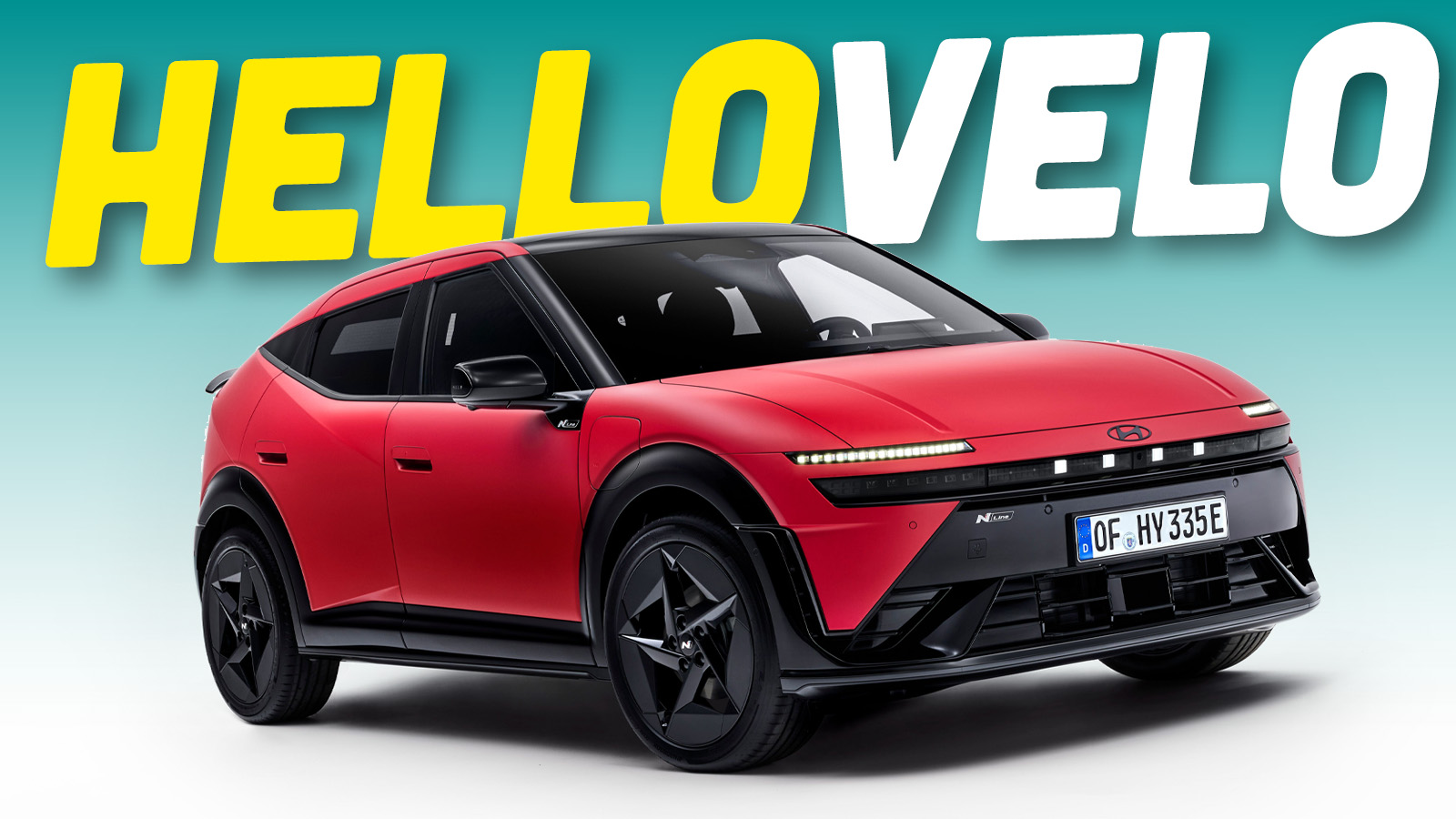
Over the past 30 years, it feels like the world has forgotten that economy cars can look sweet. There used to be a whole segment of rakish hatchbacks pairing sporty looks with ordinary mechanicals, and now that’s all fallen by the wayside. Thankfully, it’s not dead yet. This is the Hyundai Ioniq 3, an electric hatchback that won’t set any performance records but seems aspirational in a way most current cheap cars don’t because it just looks so cool.
The first thing you need to know about the Hyundai Ioniq 3 is that it’s actually, genuinely small. We’re talking 164.2 inches stem to stern, roughly eight inches shorter than the already compact Toyota Corolla Hatchback. However, it packs a whole lot of attitude into 13.68 feet thanks to an edgy kammtail silhouette. It’s an impressive thing to pull off, given how short the rear overhang is and how the roofline doesn’t start to dip until it’s above the rear axle, but it makes this hatch look rakish and contributes to its drag coefficient of 0.263.


Hyundai’s only shown off the Ioniq 3 in sporty N-Line form so far, but as far as factory body kits go, this one goes hard. Wide grille mesh, flics to hide the air curtains, a big spoiler, and a chunky faux-diffuser write some big checks. Obviously, since this isn’t a hot hatch, don’t expect the test track figures to scare a GTI, but it’s a sporty commuter car in the vein of the Toyota Paseo, Honda CR-X, and Mazda MX-3.
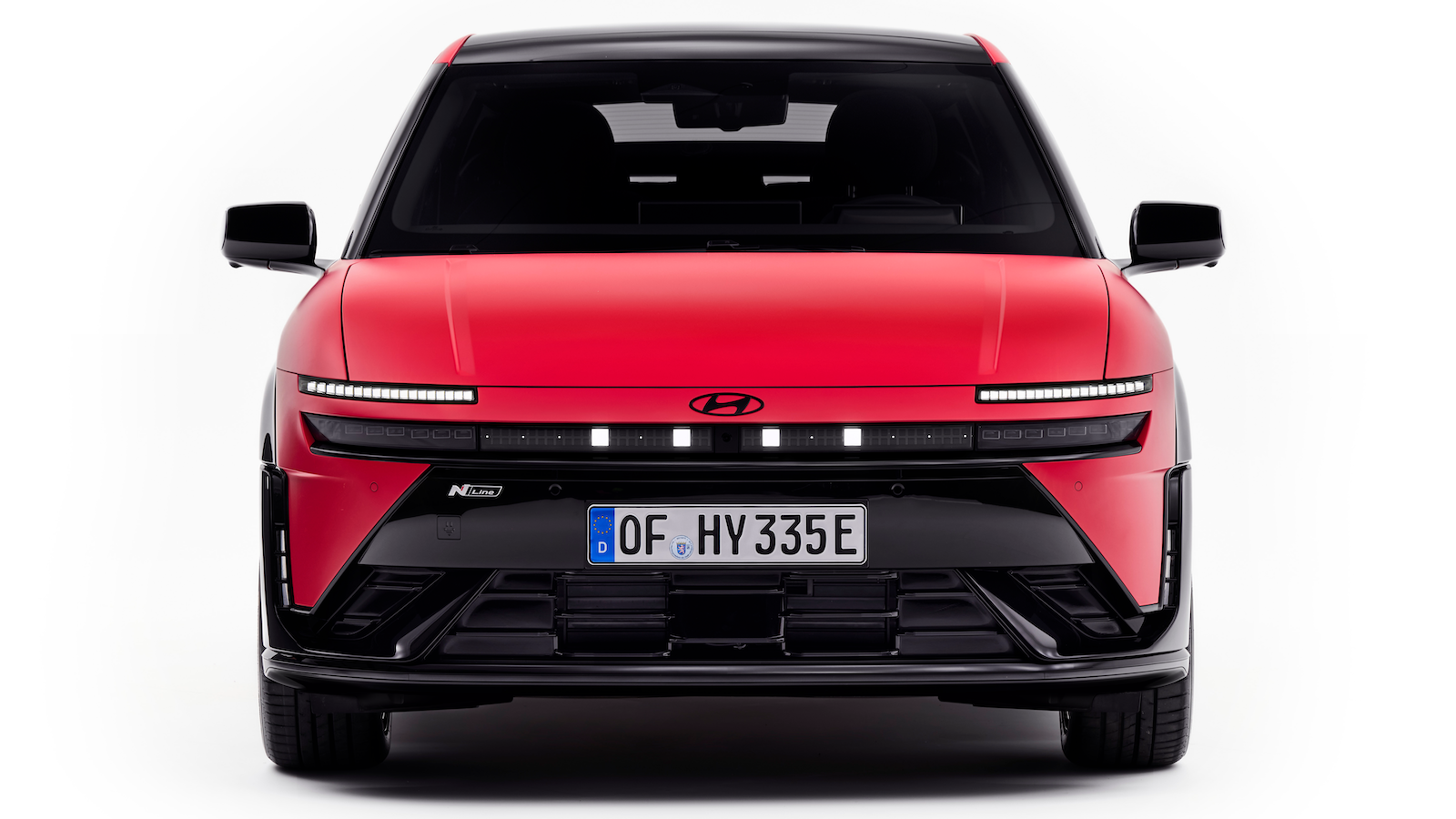
It’s also worth talking about the lighting situation on this electric compact. Because the headlight beams are actually beneath the daytime running lights, the Ioniq 3 technically has eyebrows that line up with the main headlights perfectly. Also, those four square lights on the front are rather distinctive. It’s a bold strategy, but you definitely can’t accuse it of being boring.
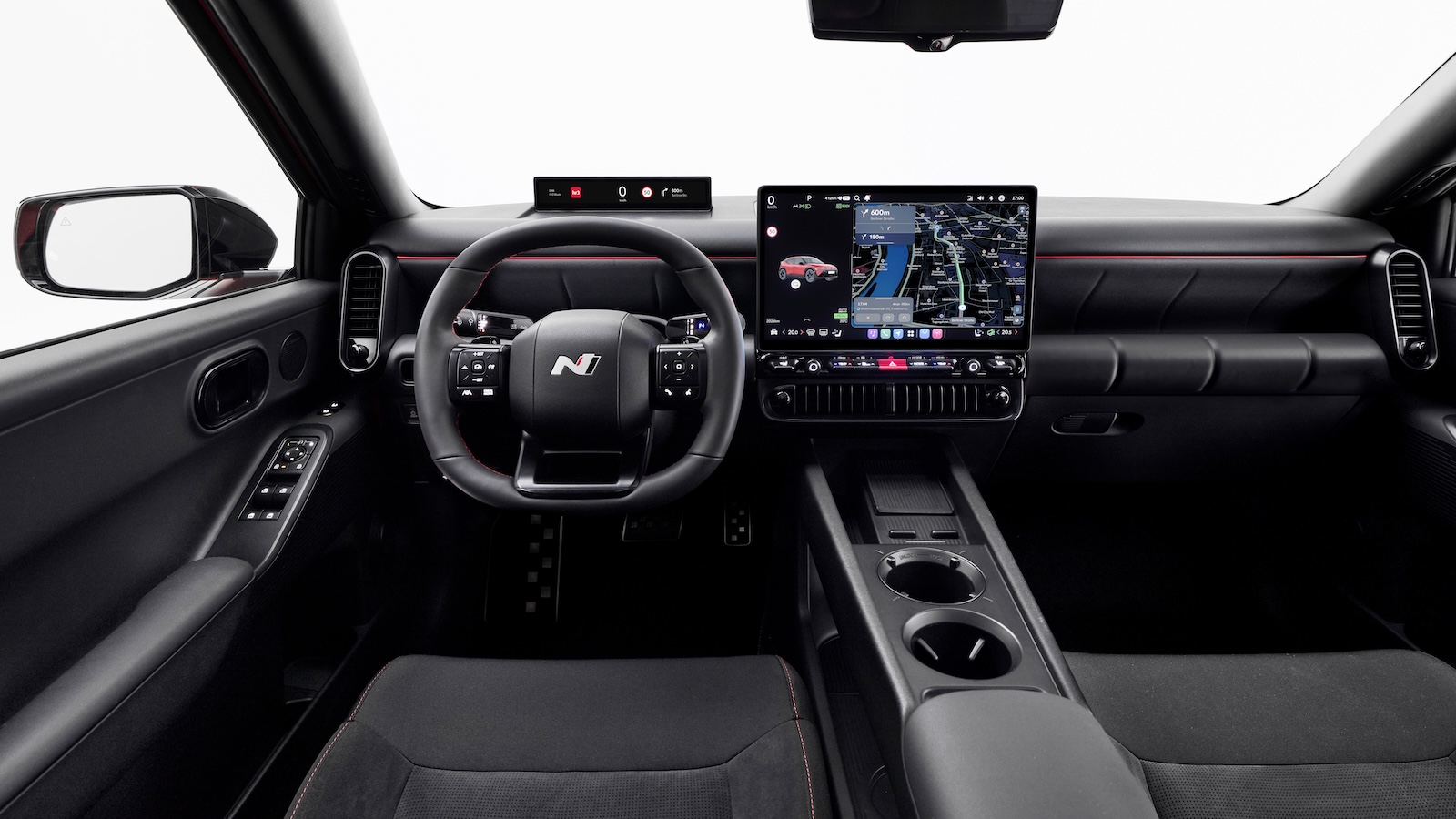
The inside of the Ioniq 3 is just as interesting as the outside. It’s the first car to get Hyundai’s new Pleos infotainment system, an Android Automotive-based setup with a choice of 12.9-inch or gargantuan 14.6-inch screens. With an app dock at the bottom and vehicle info on the driver’s side of the screen, it’s a lot to take in. Thankfully, Hyundai is still sticking with buttons and knobs for important stuff. The heated seats, climate temperature, fan speed, and climate mode are all on rocker switches, while volume and tuning knobs are on proud display. Also, the presence of two speedometers is unusual. One in the infotainment, one in a thin digital cluster mounted high on the dashboard. I kinda dig it.
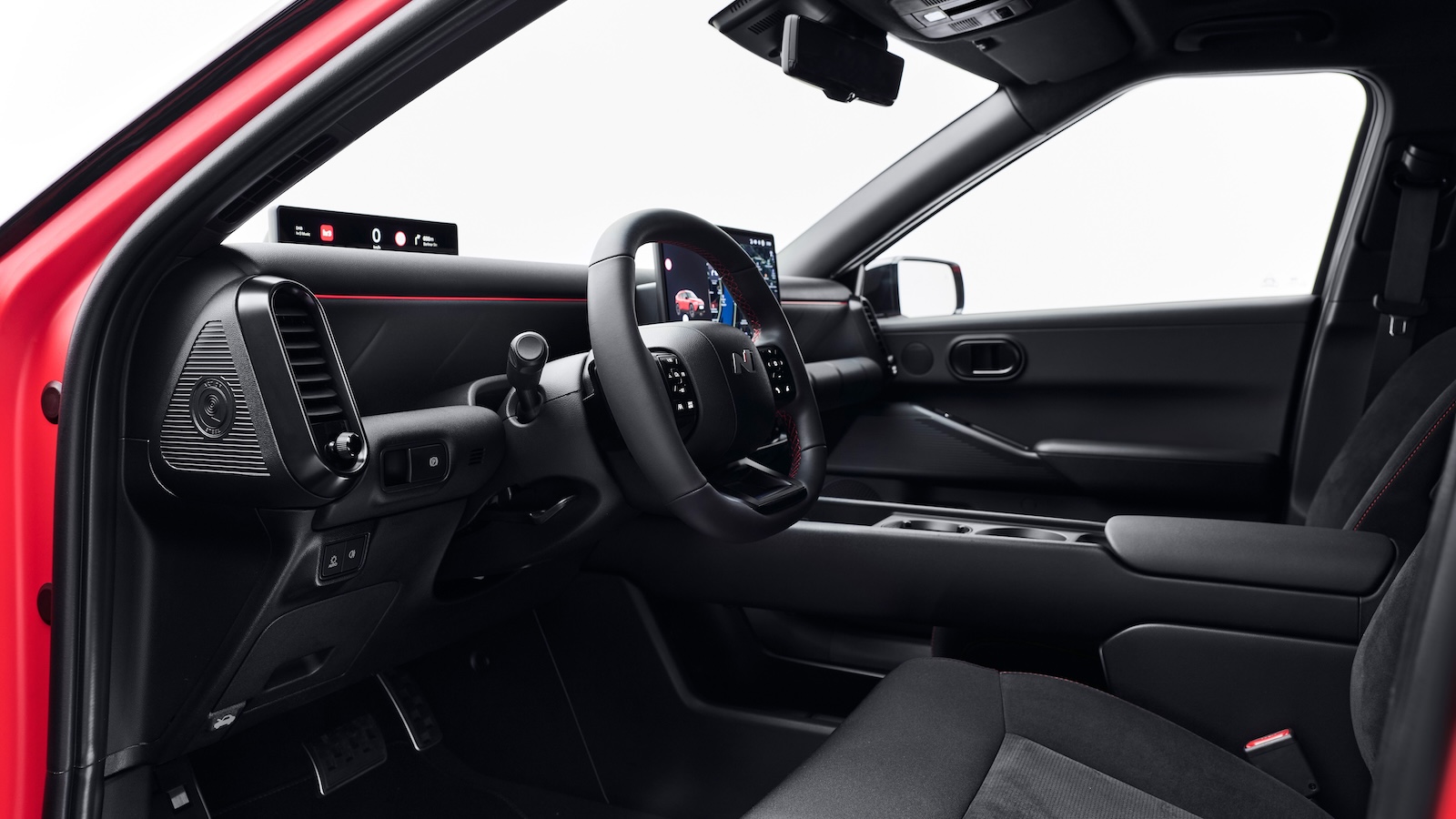
Beyond the tech, the cabin of the Ioniq 3 features a bunch of neat textures and finishes, from the ribbing on the ends of the outer air vents to the pleated textile on the dashboard. A two-tiered center console with loads of storage cubbies should swallow up tote bags and parking passes easily, and the overall look in here feels pretty architectural for what is essentially a mass-market hatchback.
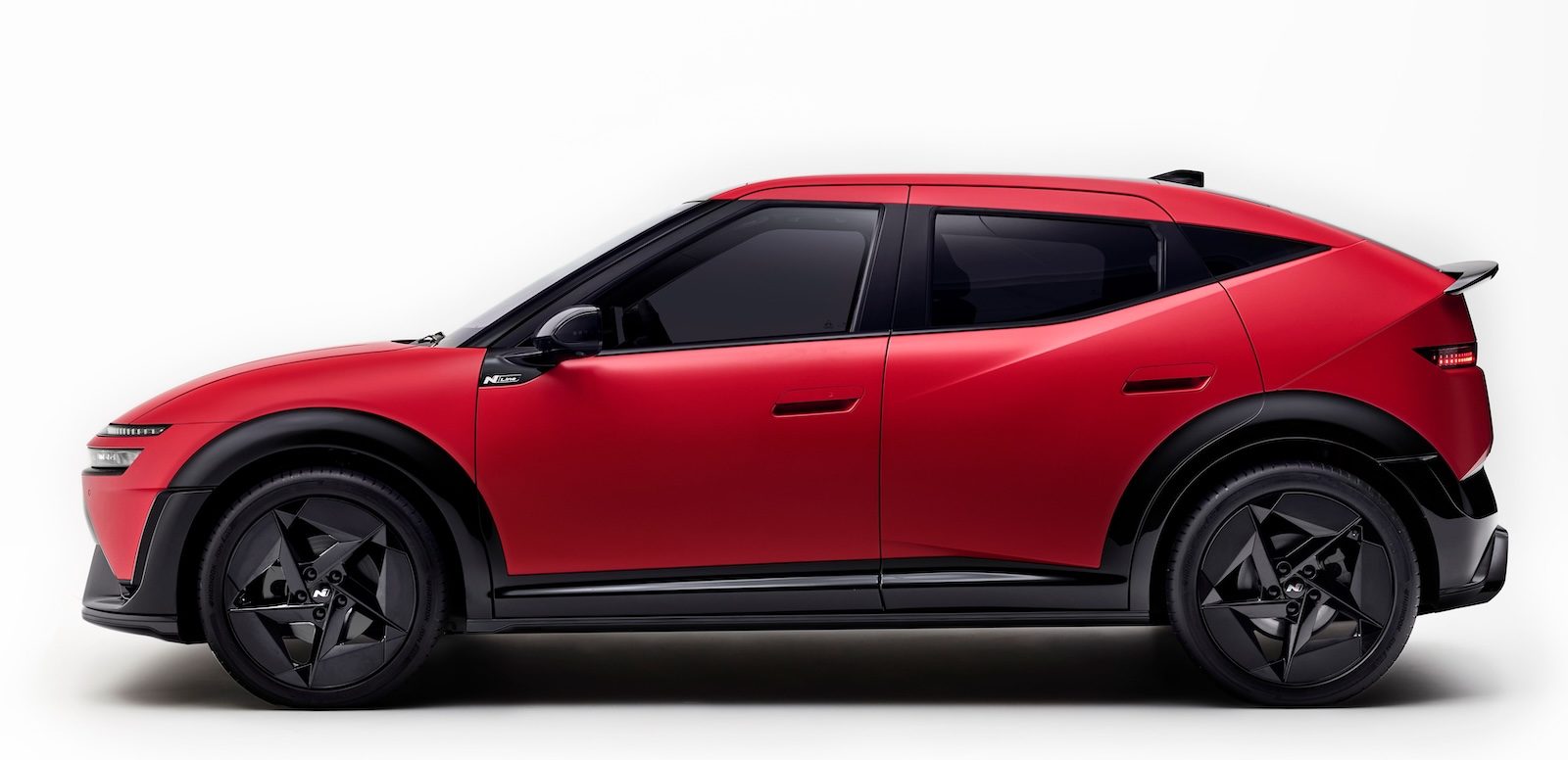
Under the skin of the Ioniq 3, you’ll find the 400-volt variant of Hyundai’s E-GMP electric platform with a choice of 42.2 kWh or 61 kWh battery packs. The former’s good for a modest 213 miles of WLTP range, while the latter ratchets things up to 308 miles of WLTP range. The tradeoff, other than cost, is straight-line acceleration. While the standard-range model pumps out 145 horsepower, the long-range model sees that figure sink to 133 horsepower. As such, models with the small battery pack will saunter from zero to 62 mph in nine seconds, and models with the long-range pack stretch that figure out to 9.6 seconds. This isn’t a hot hatch, it’s just a hatch. A rather striking hatch.
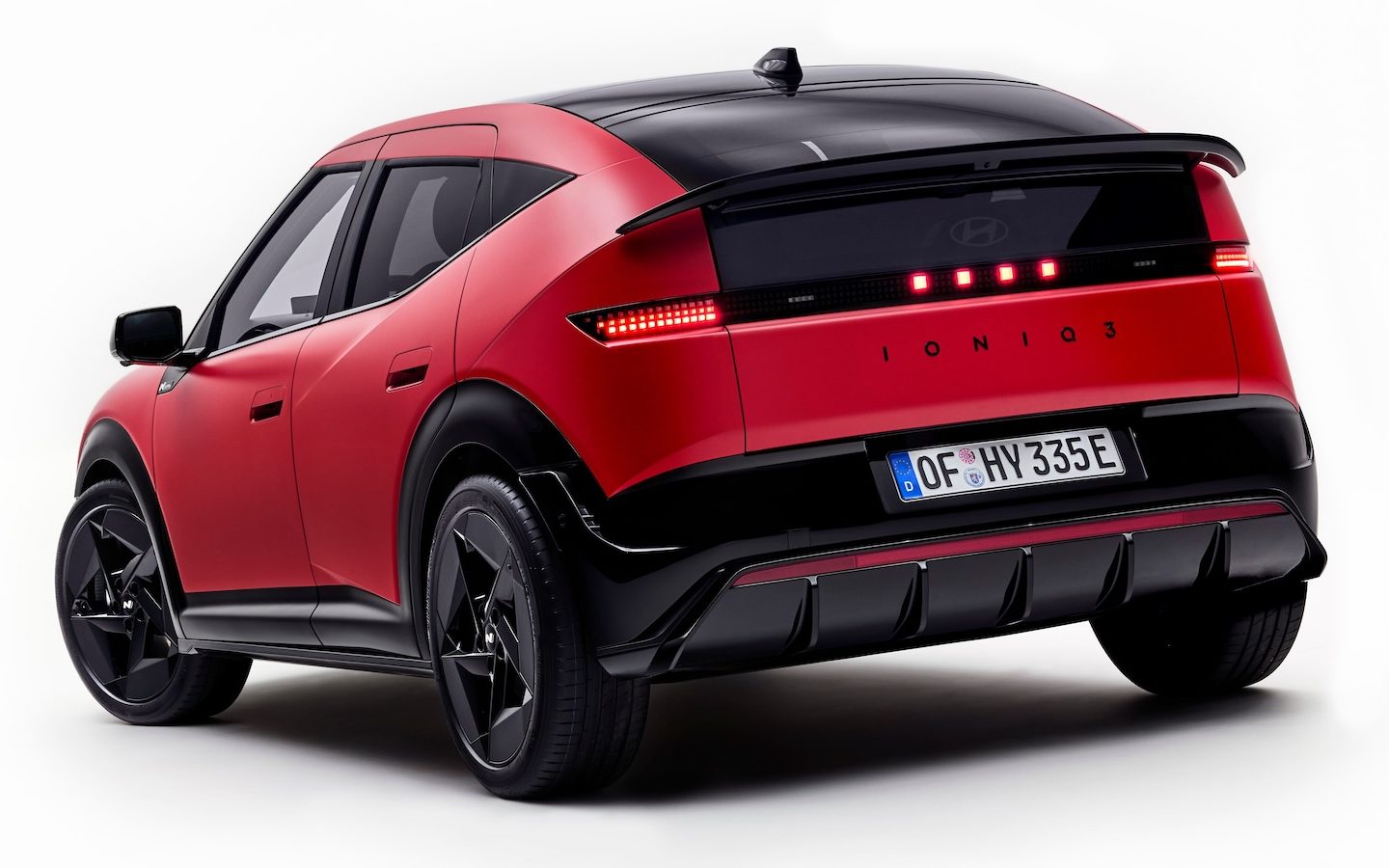
So, kammtail hatchback form factor, great looks, economy car performance. Aside from an additional door, the Ioniq 3 really feels like the spiritual successor to the quirky Hyundai Veloster. It’s always great to see a manufacturer having fun with its economy cars, and while it’s not currently expected to come to America, wouldn’t it be great if the next Elantra looked a little more like this?
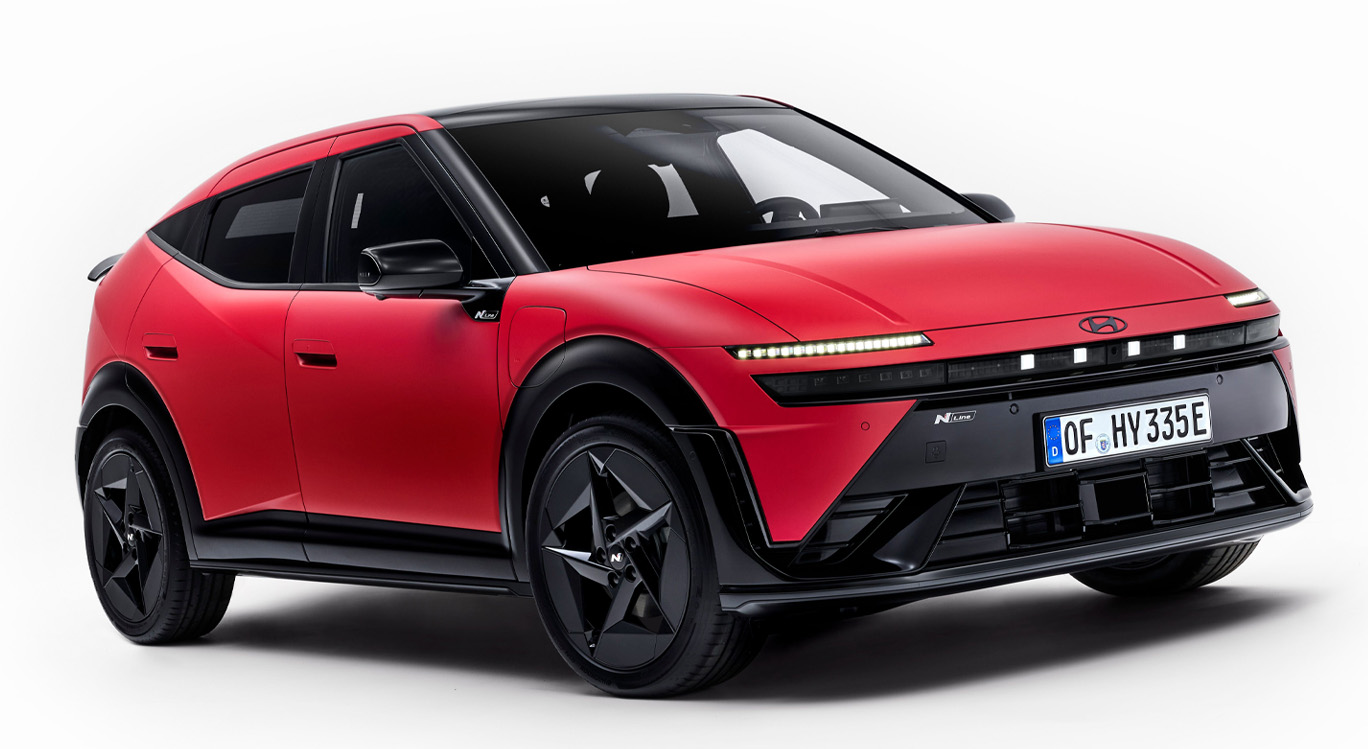
Top graphic image: Hyundai


I like it! And I really like the little high mount info display. With no need for a tach that just makes more sense for any EV, and as a rather tall person I’m constantly frustrated by difficulty getting a steering wheel to a comfortable driving position and still seeing the gauges.
I would be obsessed, if I wasn’t strongly opposed to so many elements of it like the tech and…I thought it had flush/motorized door handles, but it appears to just be using the shadow of an actual handle cavity to imitate them in negative space, which is definitely good.
IIRC it’s front-drive, which just seems like a needless restriction on an EV.
Speaking of, does it really gain anything by being slow? I think the 0-60 is worse than the original Veloster, which wasn’t even electric (instant torque etc.). If it can be significantly cheaper (doubt) or lighter (doubt – probably why it’s slower) as a result, maybe that’s worth it, but I’m unimpressed with the EV specs and that’s unusual.
I’m absolutely not a relevant market opinion, and techier is better for this. Young people with money, buying a new EV? They’re very comfortable working around lots of AI.
Actually, on that reflection, I could imagine it having a decent niche in the market, but it wouldn’t be enough to justify setting aside domestic production lines for it…non-domestic production ain’t happening, tariffs and all.
Ultimately, I am glad that this car even exists.
The choice about ‘slow’ is made to maximise power efficiency and therefore range. It’s a much more common choice in EVs than you might imagine given the dearth of EV diversity in North America.
In this case, the small size of the vehicle (it’s smaller than a Kona) limits battery size but it also identifies it as an urban car and it was designed primarily for Europe (it will be made only in Turkiye) so it’s not likely to frequently be used on roads with speed limits above 60 mph in any case.
However…this vehicle is also likely to form the basis of a replacement for the i30N. So an N version (as opposed to the N-line trim package shown here) is inevitable.
Looks like a 4/5 scale GV60
I was just lamenting to myself about the demise of the (hot) hatchback segment. Less than a decade ago we had so many options:
YarisElantra GTVelosterGolf/GTI/RFocusFiestaFitRioVersa NoteLeaf(CUV’d)CruizeSonicSparkMirageI’m not going to pretend to be sad that those Chevrolets went away…they weren’t great. But most of the hatchbacks crossed off this list were genuinely pretty good to excellent when in production.
What you’re also missing is that the few survivors were further butchered
Civic hatch is no longer available as a 6MT (except CTR)
Corolla hatch is no longer available as 6MT (except GR)
K4 hatch is not available as 6MT
Fiat500, no further words
WRX no longer available as a hatch
And, the Mazda3, is down to just one trim as 6MT.
The butchering continued with the VW and BMW (Mini) options losing MTs. Interestingly, you can get more hot sedans with MTs… Elantra N, Jetta GLI, Civic Si, WRX.
It’s cool, I like it. Much like with the rest of Hyundai/Kia’s recent designs, it’s not for me personally, but I can appreciate the boldness and trying new things.
Probably the right decision to not bring it to America, unfortunately. 9 seconds to 60 isn’t acceptable for an EV where performance is so easily gained. And we all know nobody is getting 300+ miles out 61kwh – WLTP is wildly optimistic as always.
Can someone explain the bolded phrase?
At that level of screen ‘integration,’ why not let the owner put their phone or tablet there?
again we can’t have nice things. GRRR
Why don’t other Americans buy the kind of cars that I like?? (I want this.)
Looks like a great city car
“As such, models with the small battery pack will saunter from zero to 62 mph in nine seconds, and models with the long-range pack stretch that figure out to 9.6 seconds”
Which is about as quick as my old manual 2008 Honda Fit was. And it’s quicker that the manual 2007 Ford Focus Wagon or Ford Escort Wagon I had.
So for a daily driver, that 0-60 time is perfectly fine.
This vehicle is right up my alley.
I hope they make a base model that ditches the heated seats, the spoiler, glass roof, oversized wheels and other unnecessary features.
I will say I’m a fan of how tight the front seating area looks. I’m a fairly small person so that might actually be pretty large irl and would have the opposite effect, but I like feeling like packed in tight in a vehicle and a tall full length center console to separate the passenger and driver.
I think it would look better without those squares in the center. I also find the way the painted roof gets thicker as it moves toward the rear unappealing. I’ll also be glad when the black wheel fad and all CUV’s must have chunky black plastic molding dies.
I agree on all points. I’m not a fan (styling wise) of the square dot lights they are doing, it feels extremely try hardy in a low effort way. The roof section just looks low effort in a low effort way.
I like it a lot.
While I’m not a fan of the giant screen, I assume this is the larger option and the smaller one looks more reasonable.
Interestingly, I like the look of this little HUD style screen. It’s better than the normal Hyundai thing where they stick a big screen there with no hood, and it makes more sense than putting huge skeuomorphic gauges on a screen or just shuffling critical info like speed into the center display.
I’m no biblical scholar. But, I do wish that the original 11th commandment had fit on the tablets. If the car must have screens then let them be hooded. Glare is abomination.
Looks very nice.
I like it.
I wish it was more hot-hatch, but it’s in the right direction.
Just wait for the inevitable N- version.
“Hyundai’s only shown off the Ioniq 3 in sporty N-Line form so far…”
This is the N version, isn’t it?
Edit: The N badge is on the front bumper.
I was confused as well.
It took me far too long to realize “N-Line” which is their code for sport styled. It’s not the “N” model variant.
Like VW with R-Line, or Toyota GR-Sport – which is just an aesthetic trim.
Well that’s confusing as hell.
You say that, but so many manufacturers do it. BMW, Audi, VW, Hyundai, Kia, Toyota, Mercedes, Lexus, and probably others I’m forgetting. Must make sense to someone.
That is, honestly, the point.
Masquerading as the top trim.
I missed that this was an N-line spec, but as you stated, that’s only a trim. 9+ sec 0-60 would not be very impressive for a full-fledged N.
Don’t forget the S-Line for Audi.
I’ll take the grill on this over the new C-Class Mercedes’ any and every day.
It’s like Veloster meets gm China / geely. I wish they had hid the handles the pillar like the original Veloster did. It made it sort of like a quad and not a 4 door.
If this comes in at a truly good price, this could be a big seller.
Looks cool, and I’m all for designs like this or the Trax/Envista that bring us closer to actual cars again.
And while nobody gives it much credit, the 4th gen Ford Escape was a real pioneer in bridging the gap between truck-like SUVs and crossovers and cars as we knew (and in my case, loved) them. Its carlike front end was pretty unusual in its class at the time.
I keep thinking about getting a Model Y and rebadging it as an Escape.
Neat little design. Not all angles are perfect, but overall it’s a nice package. I don’t think buyers in this category will care much about speed. I can’t speak to reliability though.
Can we please stop referring to crossovers as hatches? The automotive industry is trying to convince people that this is what cars are now, so it’s up to us to combat it.
100%. Those black wheel arches are trying really hard to make you think this is not as tall as it is. If this is a hatch, so is a Macan (narrator: it isn’t).
It’s hard for me to tell if this thing is more crossover proportioned, or hatchback proportioned. They haven’t provided anything for us to scale it. It may in fact be a hatchback?
Here you go – I feel like Thomas should have gotten Jason to do this (and much better!)
https://i.imgur.com/8kOxsVo.png
To be fair, the Veloster is kind of low even for a traditional hatchback. But yeah, the Ioniq 3 definitely has taller proportions than you’d expect from a Fiesta or Golf competitor.
I don’t know. The Veloster, like Clueless mentioned below, has coupe proportions. And I do feel like proportions aren’t the end all be all in this argument. I drove an SX4 for a long time. I don’t think anyone seriously considered that to be a crossover, despite being tall. The Fit, maybe the king of all hatches, is certainly pretty tall as well.
I do appreciate the image though.
The Honda Fit is 5′ tall. The Suzuki SX4? 5′-1″. If this is in that ballpark, I think it’s still a hatch. Even if it’s trying to act like it isn’t.
Edit: Scrolled down to find this argument has already been made.
According to the press release info it is 59 inches high, or about 1 inch more than a Golf.
That’s two inches taller than the Veloster. It’s a CUV.
Can’t wait until we have solid state batteries so designers no longer have the excuse of “we have to make EVs taller to accommodate the batteries” anymore.
If it was a CUV, they’d have added way more than 2 inches. The Veloster really is a low car.
One inch less than a Honda Fit or Toyota Yaris from the 2010s.
I was gonna say, it’s shorter (height) and longer than my ’07 Fit was, and no one was calling that a CUV. Proportionally and in absolute terms it’s a tallish hatchback.
Ha, and I made a reply above without scrolling down. This is all we needed to know.
Also a reminder to all, we have pictures in front of us, from a company trying to sell a hatchback that they want consumers to believe is a crossover. When we see this thing in the flesh (we won’t, if you’re from the US and aren’t doing much traveling anyway) it’s probably going to look pretty small, and nothing like your typical subcompact crossover.
This is the same problem I have with the Ioniq5. Shrink the entire thing by 15-20% and you can call it a hatchback. Otherwise, it’s a crossover.
That’s the way I feel about the Euro market Ford Puma. It’s within squinting distance of being a hatchback car, but not quite.
The Puma is clearly not a hatchback car, that was the Fiesta.
There are countless examples of this, Arona, Captur, 2008, Mokka, etc. No matter how you look at them they are not hatchback cars.
The Ioniq 5 IS a hatchback that is marketed as a CUV.
Most CUVs are hatchbacks. But the ones that aren’t are wagons.
You can’t, because the battery pack sits under the floor. It raises everything up by the total thickness of the pack.
For EVs, that aren’t track-focused, we’ll have to accept that they’ll look chunkier and sit slightly higher than we’re accustomed.
Honestly, I’m sort of shocked it’s as short as it is considering the battery pack.
CUVs generally ARE hatchbacks.
They HAVE rear hatches, but they aren’t hatchbacks in and of themselves. That’s like someone saying the Miata and the Mustang are the same kind of vehicle because they both have 2 doors and RWD.
“ but they aren’t hatchbacks in and of themselves”
If the back has a hatch, then it’s a hatchback.
“That’s like someone saying the Miata and the Mustang are the same kind of vehicle because they both have 2 doors and RWD.”
Nah… the Miata is a 2 seater while the Mustang is a 4 seater. Thus, according to Consumer Reports, they are in different classes.
But if I was looking for a 2 door convertible, I absolutely WOULD be cross-shopping them.
Hatchback has connotations and associated meaning beyond the most literal definition. You’re playing with words.
Whatever other connotations and associations people have with the word ‘hatchback’ does not change the literal meaning… that it’s a body style with a hatch-style door opening in the back as opposed to some other style of opening.
In this case, I think it is a hatchback, just a slightly chunky one. I get the sense that it looks bigger than it is in a way contrary to how the Ioniq 5 looks smaller than it is?
The Bolt and Leaf, those are openly crossovers that call themselves crossovers (or “crossover coupes”) while wearing the name tags of dead hatchbacks. With this, I think they’re just overcompensating for the height of the BEV platform and the wheels being normal-sized (they’d look “small” without the massive black arches).
9 second 0-60? Making the upcoming Slate look spritely with it’s estimated 8 seconds.
I do like the look of this though.
A slight hint of Aztek at that rear end
Interesting to see how much was changed from the first 3d Design models I got to see. They adapter the front and rear lamp design to the styling of new Ioniq 6. In the beginning especially the front was more like the old Ioniq 6 lights.
Anyways. Nice CRX vibes.
Anyone know if these use the same ICCU that seems to be hugely problematic for the Ioniq 5/9?
Yeah, I was wondering the same thing. Hyundai’s look good and drive well but man do they have issues
I think that’s all new model cars, regardless of brand. Unless you get something that is largely a heavily reworked facelift masquerading as a new model, the true all new stuff has teething. It gets worked out over time.
Regarding current Ioniqs, 2022 with 50k on the clock and no issues.
Wondering the same thing. They are tempting cars, but the ICCU failure rate (supposedly ~1%) and then near indefinite down time due to hard to get replacement parts, and then those replacement parts having the same potential issue is a joke.
And their engines have similar problems!
Most speculation has iconic 3 sharing components with ev3 and those are having the same iccu issues.
oh, well there you go, then – dang!
Looks like it is on the same e-GMP platform, but its running 400V instead of the 800V that the bigger ones use. No idea if that will have an impact on ICCU longevity.