

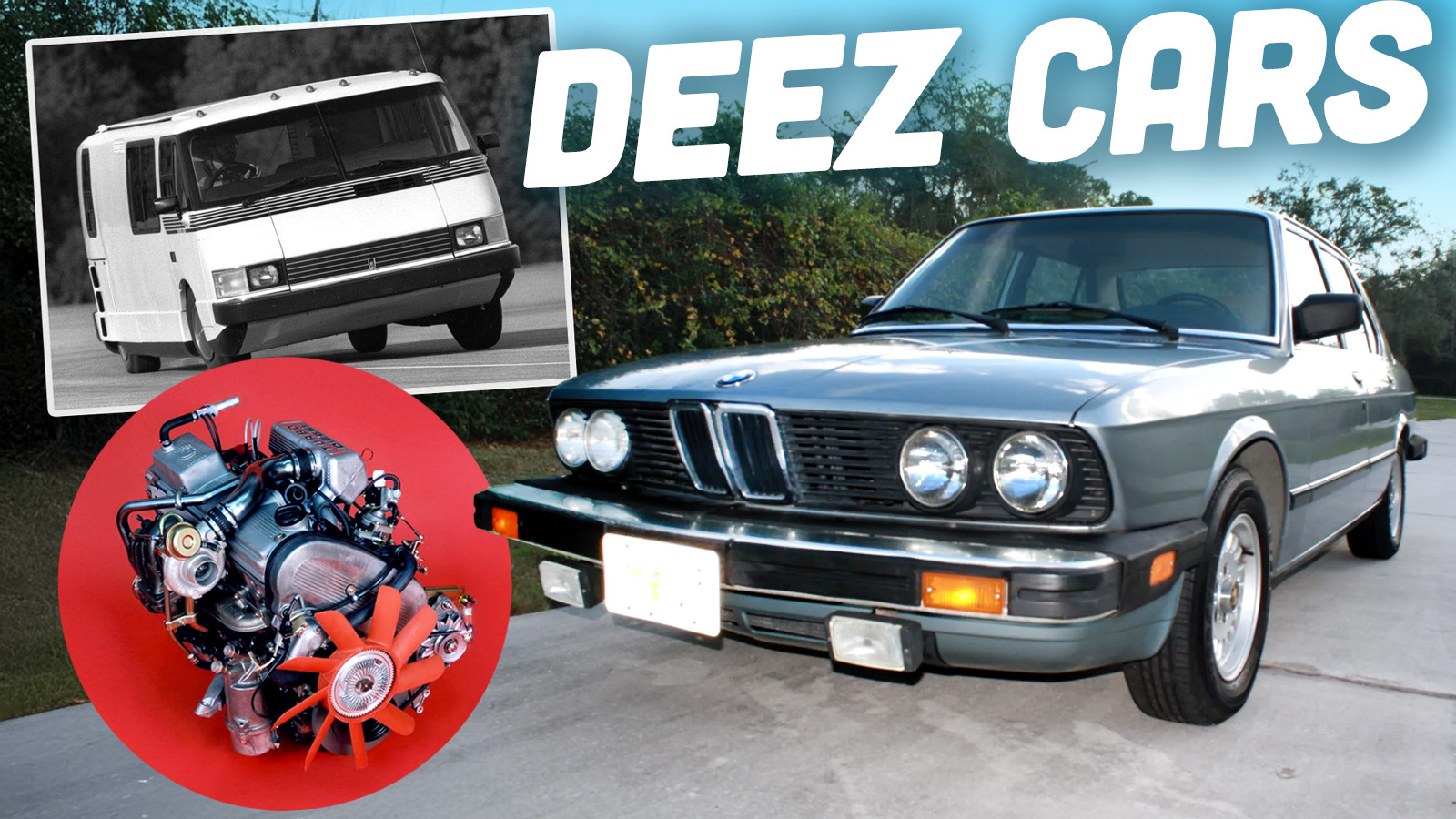
After the oil crisis of the 1970s and more stringent emissions standards that followed, manufacturers across the globe began to turn to more economical options to power their vehicles. In America, smaller, more efficient engines from Japanese manufacturers made strong headwinds early on, but that wasn’t the only method automakers tried out. There was also diesel.
The most famous example of a carmaker attempting to turn to diesel following the oil crisis was General Motors, which tried with its Oldsmobile V8. But poor design choices turned it into an unmitigated disaster for the brand. Of course, GM wasn’t the only carmaker to start selling diesels in the United States to keep up with the law and fuel prices.


BMW did something very similar to GM, turning one of its gas-powered engines into a diesel powerplant to diversify its portfolio, and even sold its first diesel-powered car, the 524td, in America. Instead of flopping due to mechanical issues, the diesel-powered 5-Series was actually a great success. In fact, the straight-six engine was so good that it made its way into two obscure Lincolns and one of the weirdest motorhomes ever made.
The Design Came From Gas-Powered Engines, But Everything Was New
The engine, codenamed the M21, was based on BMW’s line of newly developed M20 engines, designed in collaboration with Steyr-Daimler-Puch AG. The engines were made popular with their use in the first two generations of the 3-Series, the E21 and the E30. Though it used the same basic block design as the 2.0-liter variant, most of the M21’s parts were new or modified, including the iron block itself. From BMW Blog:
[I]t required very few changes to be dieselized, mainly being cast from a superior grade of iron with a higher chrome content. From this modified 2 liter petrol block, the 2443 cc M21 was developed, the extra capacity drawn from a new forged steel crankshaft with a stroke of 81 mm.
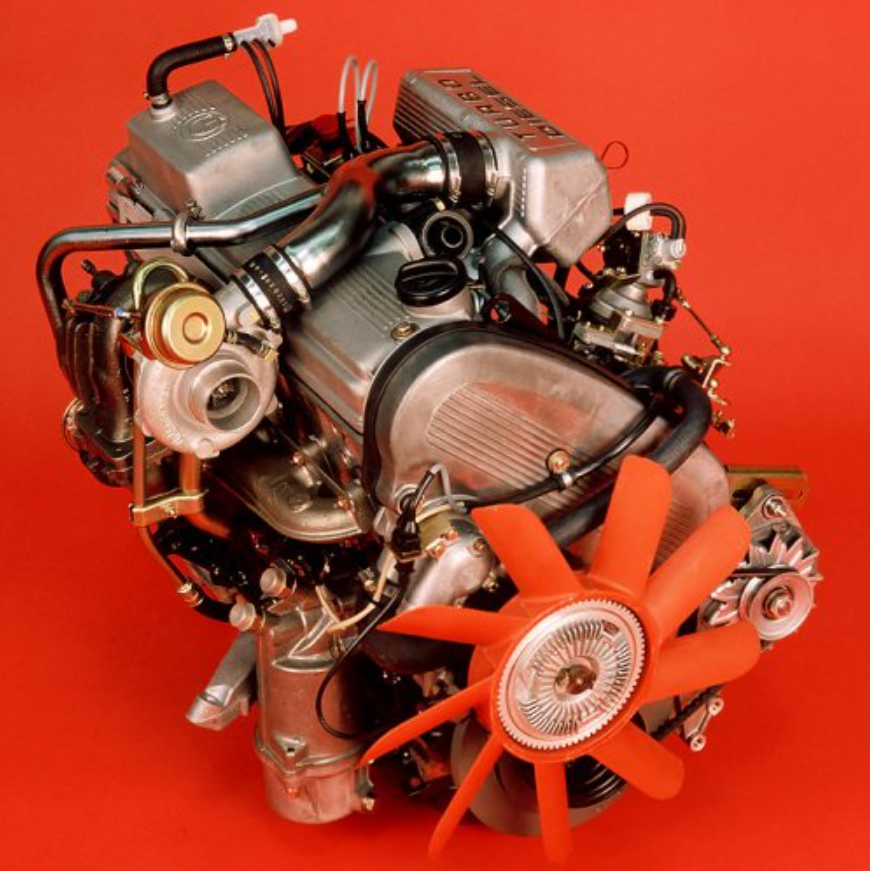
Stronger steel connecting rods, diesel specific pistons with deep chambers, a higher volume oil pump and a bigger sump were joined by a new SOHC cylinder head with no combustion chambers and a thick cast alloy cam cover was used to damp out both valve train noise as well as diesel combustion sound.

Like most diesels of the time, the M21 relied on indirect injection, where the fuel is delivered in a pre-chamber or a swirl chamber, where the combustion actually starts before traveling to the main combustion chamber. Paired with a Garrett T3 turbocharger, it produced 114 horsepower and 154 pound-feet of torque, all while getting an EPA-rated 24 mpg combined—4 mpg better than any other version of the 5-Series at the time.
The Diesel Outsold The Sportiest 5-Series Trims
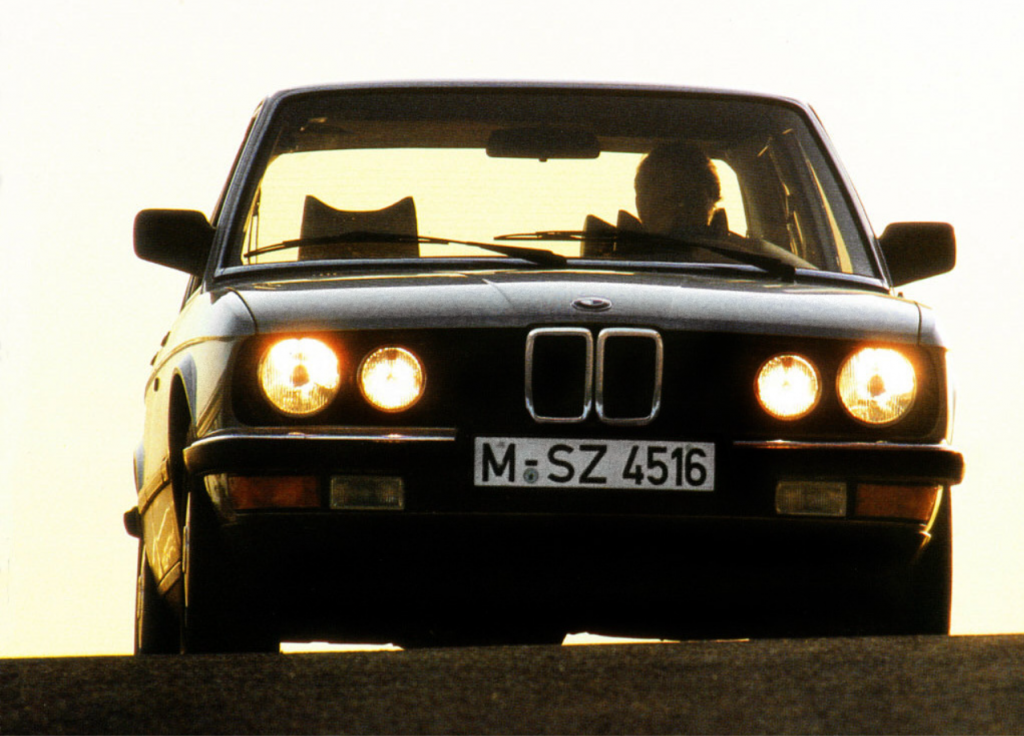
The M21D24 made its debut in 1983 in Europe under the hood of the E28-generation 524td, which immediately claimed the title of fastest diesel-powered production car in the world, with a top speed of 112 mph, according to BMW (Car and Driver only got to 107 mph in testing). It wasn’t until 1985, though, that BMW started selling the diesel 5er in America. It was only sold here until the end of 1986, and only came with a four-speed automatic transmission.

Official sales data is tough to come by, but an E28 forum thread suggests that, despite the above constraints, the diesel-powered 5-Series managed to outsell the two sportiest cars in the lineup over the lifetime of the E28 in North America. Specifically, the data claims BMW sold 3,635 524tds, but only sold 1,236 M5s. Hilariously, BMW sold 3,634 manual-equipped 535is cars, meaning that, if this data is accurate, the diesel-powered 5-Series outsold that model by precisely one car.
An in-period test from C/D of the 524td drummed up mild praise, both for the car and the engine itself:
General driving feel and coordination are quite good, and the car is a sweetheart on the highway, but skidpad laps and brake testing from 70 to 0 mph reveal a modest 0.72-g cornering limit and 219-foot stops, figures in the range BMWs turned in ten years ago.
Except for that, the 524td is easily a 90th-percentile car, full of power-assisted luxuries, deluxe comforts, and good manners. The work lavished on the turbo-diesel engine qualifies it as a worthy power source for a sports sedan.

After 1986, the 524td disappeared from BMW’s U.S. lineup, and it would be more than 20 years until a diesel-powered BMW of any kind would return to America. But the M21 had a life outside of BMW that was arguably more interesting than its original objectives.
When Ford Tried To Do Diesel

Around the same time that BMW was selling the 524td in America, Ford’s subbrand Lincoln was also attempting to dabble in diesel. But instead of designing the engine in-house, it turned to BMW instead. In 1984, it introduced diesel powertrain options to two Foxbody-based cars: The Continental sedan and the Mark VII coupe, both powered by BMW straight-sixes.

The turbocharged M21 found in the Lincolns was identical in spec to the engine found in the 5-Series, making the same 114 horsepower and 154 pound-feet of torque. Lincoln described the engine as “designed specifically for passenger-car use,” and as a powertrain that could “provide the power of a gasoline engine with the fuel economy of a diesel.”

That was sort of true. Yes, the BMW-powered Mark VII and Continental were more efficient than their V8-powered counterparts, with the diesels achieving 24 mpg combined, according to the EPA, versus just 16 mpg for the gas cars. But the 5.0-liter V8s also had 16 more horsepower and could get 60 mph in 11 seconds. That sounds slow until you learn it took the diesel Lincolns “nearly 14 seconds” to reach the same speed, according to Hemmings.
Reviews of the cars were mixed, according to Hemmings, which spoke to two people who drove the cars when they were new:
Hemmings contributor Jim Donnelly sampled a Mark VII LSC diesel press car in 1985. It “wasn’t bad,” he recalls, adding that it offered “acceptably good acceleration” and “excellent fuel economy.” In sum, “The diesel wasn’t as incongruous to the car as I thought it might be,” he says. Auto-industry insider Richard Vaughan is less charitable: “I’ve driven both [the] Mark VII and Continental with the BMW 2.4-liter diesel: slow, noisy, and unremarkable,” he opines. Richard adds, “The engine itself was excellent in the BMW, for the time, but the Lincoln weighed 500 pounds more than the 524td.”

It’s not like the diesel was any cheaper, either. It was actually $1,500 more expensive than the V8. On a car that costs around $23,000, paying an extra 6% just to have a car that’s slower and noisier wasn’t exactly appealing to most Americans, even if it meant less time and money at the pump.
Lincoln sold between 2,000 and 3,000 diesel-powered Mark VIIs and Continentals before the diesel option was scrapped after the 1985 model year. They remain the only diesel-powered Lincolns to ever enter production. But the M21’s story doesn’t end there, either.
An Engine Destined For Greater (Weirder?) Things

Easily the weirdest application of BMW’s M21 turbodiesel engine was the Vixen 21. Conceived by engineer Bill Collins, whose resume includes development of the Pontiac GTO and the DeLorean DMC-12, the Vixen motorhome was supposed to be the sports car of RVs, with a smaller, lighter footprint that delivered more comfort and even behind-the-wheel thrills.
Much has been written about the Vixen on this very website by my colleague Mercedes, so if you want a full retrospective on what makes this RV so cool, I highly encourage you to read her full retrospective.

One of the biggest selling points of the Vixen 21, besides its fascinating design and packaging, was its efficiency. Thanks to its unique frontal shape and flat floor, it had an astounding 0.295 coefficient of drag, which rivals some modern passenger cars and puts the vast majority of other RVs to shame. BMW’s M21 was mounted in the rear under the floor, paired to a Renault five-speed manual gearbox, and made the same 114 hp and 155 lb-ft. All of that working together meant the Vixen could achieve a claimed 33 mpg when cruising at 55 mph (it got just 21 mpg in Car and Driver testing, which was still incredible for the period).

At a time when most RVs could barely crack double-digit mpg numbers with their thirsty V8s, the Vixen 21 was a revelation. Sadly, the RV-buying public of the mid-1980s didn’t seem to agree. Vixen sold just 417 units of its motorhomes powered by the BMW straight-six, and another 172 with the optional GM supercharged V6 and automatic transmission (which Mercedes has also written about extensively).
The M21 finally faded away from the U.S. market at the end of the ’80s, but lived on in cars like the 3-Series, 5-Series, and the weirdo Bertone Freeclimber SUV before finally exiting production in 1991. As far as variety, I’d say BMW’s first diesel had a very impressive run.
Top graphic images: Viven; BMW; Bring a Trailer




The “M” stands for “motoren”!
Whats their price per flight?
I learned about the diesel Mark VIIs when I pulled the dash of my gas-powered ’85 Mark VII LSC apart when I was a teenager and saw the “Wait to start” and “Water in fuel” lights on the dash bezel. Since then I’ve seen a couple of diesel Mark VIIs in the wild.