

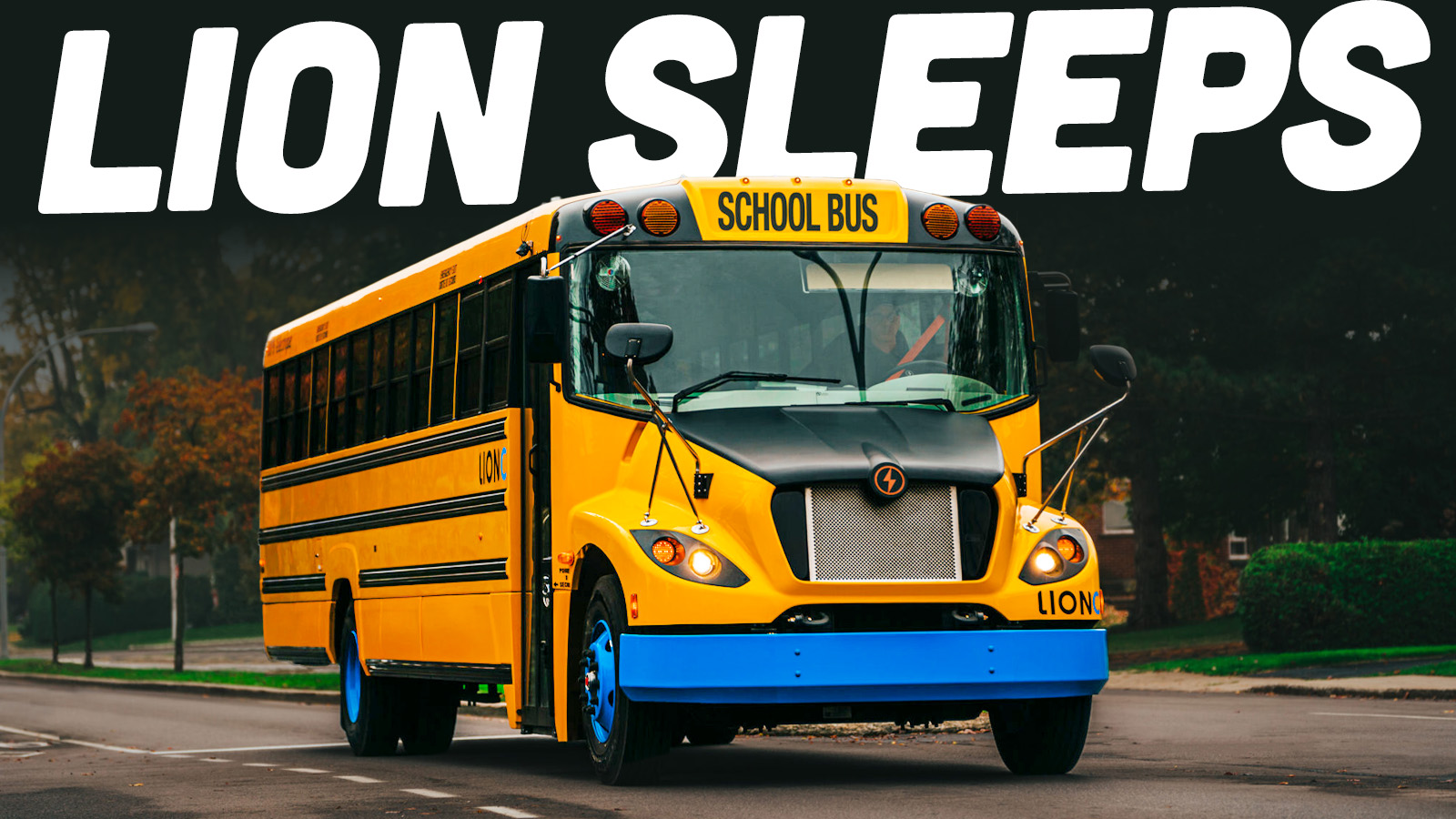
Back in 2021, Congress passed the Infrastructure Investment and Jobs Act, and with it, granted the Environmental Protection Agency (EPA) $5 billion over the course of five years to help school districts across the country switch from inefficient diesel buses to all-electric models.
Called the Clean School Bus (CSB) program, it’s unlocked significant progress in the world of electric school busing since funds were first made available in 2022. According to the World Resources Institute, the number of electric school buses on the road in the United States has gone from a measly 415 vehicles in 2020 to over 5,100 buses in 2025, a 12x increase. The research firm estimates that more than 265,000 kids ride electric buses to school each day, up from just 21,000 five years ago.


On the whole, electric school buses are a pivot that makes sense. As my colleague Mercedes Streeter pointed out back in 2022, electric buses provide more than enough range for the average 31.73 miles they have to drive each shift, while delivering a quieter ride and spewing harmful emissions that could impact the health of the children riding aboard.
Now, in the final year of the CSB program’s funding, the EPA has announced plans to “revamp” its approach to “ensure the best use of taxpayer dollars.” Specifically, the agency is looking for public feedback as to whether buses powered by other types of fuel, such as compressed natural gas, liquified natural gas, and hydrogen, might be better suited for some school districts’ needs.
Things Didn’t Go Well For One Brand
In its announcement, the EPA made a point to call out one specific manufacturer as the driving force behind this decision.
Since 2021, the Biden-era program has forced unsafe and unreliable electric buses onto American schools. There are multiple well-documented examples of one particular bus manufacturer failing to deliver buses altogether despite preemptively receiving tens of millions of tax dollars from the CSB program. To fix these issues, the Trump EPA will seek public input on the availability, cost, and performance of alternative school bus fuels and technologies. This feedback will help reform the program to bring consumer choice back to schools and deliver results for American families, while still fulfilling congressional intent.
“As was the case with so many of the Biden-era programs, the Clean School Bus program has been a disaster of poor management and wasteful spending of taxpayer dollars. At the Trump EPA, we have zero tolerance for reckless spending. Today, EPA takes the next step to set the program straight,” said EPA Administrator Zeldin. “Americans can rest assured that moving forward, the program will be safe, effective, and use reliable forms of American energy.”

The “one particular bus manufacturer” the EPA is talking about here is Lion Electric, a Canada-based company that sold roughly 3,400 battery-powered buses in the United States, including an estimated 1,600 school buses, before going bankrupt last year, according to Politico. According to CleanTrucking.com, many of these school buses were purchased using the CSB’s funding. The EPA says Lion received a total of $160 million from the program.
A 2025 letter published by Deloitte, the accounting firm responsible for handling Lion’s bankruptcy proceedings, said that as a result of the bankruptcy, “all warranties and purchase orders that you could have with the Lion Group are therefore not being legally assumed by the company post transaction.” In layman’s terms, that means all warranties for the buses already sold were declared null and void, save for those operating in Lion’s home province of Quebec.
Each of these school buses costs around $325,000, according to CleanTrucking.com. The publication spoke with two school districts back in June to inquire about the status of the buses, and found them having to idle their Lion buses due to technical problems that couldn’t be solved due to a lack of adequate support from the brand:
“All four Lion buses that we own are currently parked and not being used,” explained Coleen Souza, assistant to the superintendent and interim transportation director of Winthrop Public Schools in Winthrop, Maine.
“Two of them are in need of repairs which would cost us money which we are not willing to invest in because the buses do not run for more than a month before needing more repairs.”
The district is reinstating some of its older diesel buses to take the place of the Lion EVs.
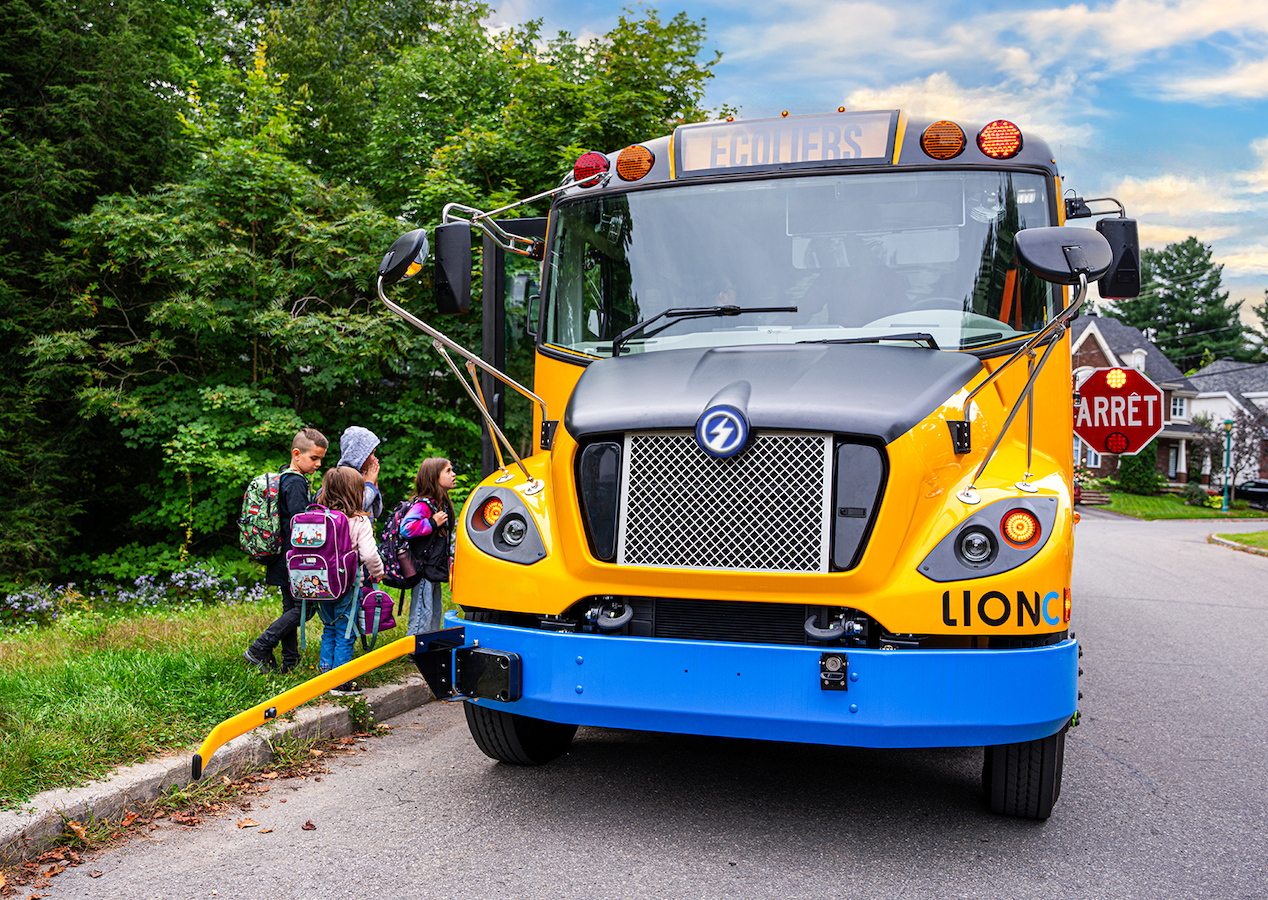
It wasn’t just technical problems that had administrators stressed. A superintendent of a Midwest school district who wanted to remain anonymous brought up numerous safety issues, too:
This district did not experience any charging issues but “There were random error codes that came up. The usual fix was to stop the bus, get out, and reset the bus from the outside by flipping a switch. It was basically like rebooting a computer. But the problem is actually having to exit the bus.”
That’s a clear safety concern when the bus is packed with students. Furthermore, the buses lost power while driving on the highway, leading to a loss of steering and braking ability.
“We had to manhandle them to the side of the road. There was little clue from Lion about what was going on. The only input we got was ‘it might be user error.’ We thought we were an isolated case. We’re not. Other districts have experienced the same problems.”
When a normal car loses power steering and braking, it’s an incredibly scary, dangerous situation. Trust me, I’ve experienced it myself. And if you have, too, you’ll know just how little control you actually have at highway speeds. If it happens to a school bus full of children, that’s definitely way worse.
To me, this feels like one of those situations where one faltering brand is spoiling the tech’s reputation. Electric buses may be expensive, but they address several real issues related to emissions, noise pollution, and maintenance costs. Nonetheless, the EPA believes incidents like those mentioned above are serious enough to warrant a revamp of its funding, giving school districts a choice in the type of power their buses use, rather than being forced into battery propulsion.
If Not Electric, Then What?
Should funding from the EPA open up school districts to spend funds elsewhere, buses powered by stuff like natural gas, biofuels, and hydrogen could start showing up to pick up your kid from the bus stop in the near future. Chances are, if you’ve ridden a bus after 2020, it was more likely powered by something that wasn’t diesel fuel.
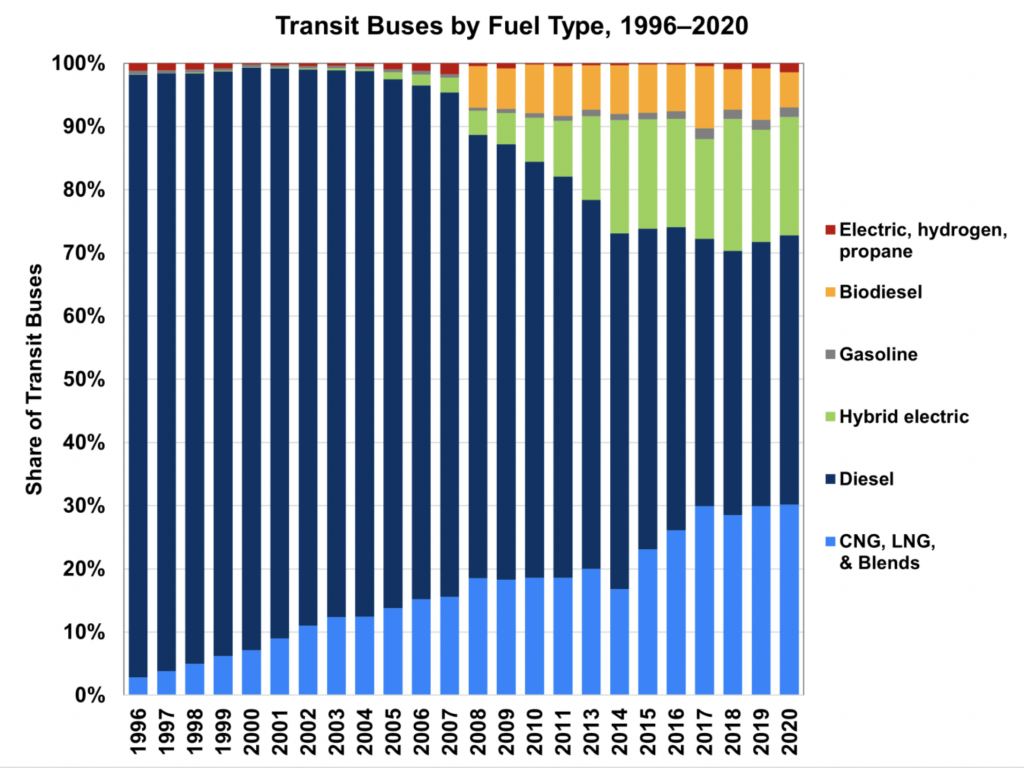
The chart published above comes from the Department of Energy and shows the share of transit buses powered by diesel, natural gas, biofuels, conventional gasoline, electric, hydrogen, propane, and hybrid electric. From 1996 to 2020, diesel steadily lost ground in the segment, going from 95.4% of the market share to just 42.7%. That space was taken by natural gas and hybrid buses instead, with those power sources making up 30.2% and 18.8% of the market as of 2020, respectively.
While the demand for buses with power sources like biofuels, hybrid setups, and conventional gasoline has remained steady over the last seven years of that chart, buses that use natural gas, whether in its compressed gaseous state or in its liquid state, have proven increasingly popular for fleets in the U.S. due to their lower cost and emissions compared to diesel.
Against electric buses, those powered by natural gas also deliver a far lower up-front cost, being priced $25,000 to $50,000 more than a diesel bus on average, according to the Department of Energy (versus electric buses, which are two or three times more expensive than diesel buses, and hybrid buses, which lie somewhere in the middle between diesels and EVs). 25 grand might still sound like a significant chunk of change, until you realize natural gas can net fuel savings of $200,000 over the 12-year life of a transit bus compared to diesel, according to the Greater Cleveland Regional Transit Authority.
And while natural gas produces emissions, it produces fewer emissions than an equivalent diesel bus. The net benefit of an engine powered by natural gas is 13% to 18% less CO2 compared to an engine running on diesel fuel, according to the North American Council for Freight Efficiency.
The likely result of all of this is that natural gas will continue its march to slowly take over the transit bus segment in America, albeit at a slightly quicker rate than if the EPA hadn’t stepped in to change its funding policies. As for electric buses, it feels like they’ll probably go on the same path as the passenger car EV segment right now, in that sales will mostly remain flat for the next few years, until a new administration takes office and changes things again.
Top graphic image: Lion Electric


Lion appears to me to have been a fraudulent company set up purely to take advantage of government subsidies. The article doesn’t give a cost for a standard diesel bus, but $325,000 for a BEV bus is insane.
As far as reliability of an electric bus, our municipal transit system has a number of electric busses, and based on how often I see them on their routes, it appears that they are fairly reliable. They are also putting on a lot more miles than a school bus.
As far as government subsidies for anything, it is insane to me that they are not clearly tied to performance requirements with penalties for not meeting them. Not doing so is a guarantee that someone will commit fraud to take advantage of the money.
Totally agree on the carrot and stick approach on the contracts. And I am somewhat annoyed that so much money went to a non-US based entity. I don’t naturally lean protectionist, but that was a lot of taxpayer money to send outside the country.
It would not surprise me in the least if it turned out the founder of Lion is a part of the current administration. Fraud and corruption are what they do best!
If we hadn’t fired all the people who investigate things like this, maybe the people involved could at least have been held accountable, but based on our reaction to the Epstein files (especially relative to most other country’s), I’d say accountability is a thing that no longer exists here.
You say one faltering brand is spoiling the reputation of EV busses but that brand sold 1600 of the 4700 new EV busses. That’s over a third of all busses were junk. I’m sorry that’s just unacceptable especially at the cost of $160,000,000 of our money.
I have no issue against EV busses or cars but holy hell is this a bad way to run a country. A 100k dollars per bus subsidy? That money could have been put to way better use in a classroom.
Makes me glad I’m in a walking district.
I agree with some others here that electric for school buses just makes a ton of sense for a ton of reasons. A few failures during the development phase of this technology shouldn’t result in a butthurt reversal of policy (Zeldin is a gigantic b-hole says this NY resident). And let’s get real, these sorts of decisions are being made not for what’s best, but just to protect the fossil fuel industry. You know, our best buds! And based on how violently the natural gas industry has bent me over this winter, I’m not exactly excited to give those leeches another dime.
In reality, much of the country is in a hold pattern because policy like this is unlikely to remain.
Natural gas is expensive in New York because the jacobins have outlawed the simple pipeline. You see, there is a lot of gas in pennsylvania. This FORCES the rest of new england to use heating oil because the natural gas halted from crossing NY thru pipelines. They think this is funny.
2-3 times more expensive is an absolute non-starter. That money would be much better spent in the classroom. Let the private sector figure out cheaper batteries for cars, revisit school buses in a few years.
Please no more fossil fuel busses for things like this.
This is genuinely great use-case for electric. Fixed routes, lots of downtime, and eliminates a massive tailpipe at kindergarten-head-height
Even if natural gas burns 18% cleaner, it’s still not even remotely close to fresh air
Yeah, this is a “shitty company” problem, not a BEV problem.
This feels somewhat like when GM divested from “old-GM”.
Mismanagement with bad QA – yeah, not surprised here.
The Lion might be electric, but looks like something from the 1950ies. Why do the kids have climb 3 feet in the air to sit upon a tall ladder frame chassis?
Just use regular low floor city busses. The (probably Chinese) electric ones we have here (CPH) are already yellow…
Long standing safety laws that kids need to be above collision impact height.
It’s ok, though, the Detroit-3 have been working hard to readjust bumper heights of pickup trucks to be able to catch those kids.
I live in a rural town with lots of pickups. Can confirm: Pickups are increasing in height on a yearly basis. I’m 5’11 and there was a GMC HD pickup whose hood was the same height as my forehead. It’s fun to watch people load stuff into the bed at the hardware store. Forget putting stuff in from the sides, you need a ladder just to get up onto the tailgate.
Look at the price difference of a school bus and a city bus, regardless of fuel source.
School buses are made to federal standards that call out every little detail.
It feels like a global, generational mistake that we tried to rush straight to all-electric just when hybrids were coming into their own. (My beloved Chevy Volt got ~80 mpg!) I’d have rather seen a mass conversion to hybrids, providing a nice stepping stone so that a decade down the line, the tech would have matured and all-electric would have happened naturally.
I agree with you on the mistake of jumping straight to BEV’s and trying to stip hybrids, even though they are had potential to replace 100% of traditional internal combustion engines with almost zero drawbacks to the user. That said, I find this case particularly maddening because school busses are such an ideal use case for BEV’s and one shitty company had to set the whole idea back.
There’s one massive drawback of EV buses: they’re fucking expensive.
Read it again, the mention of zero drawbacks didn’t apply to BEV buses.
Besides, I wouldn’t base the market cost for a segment of vehicle entirely on one obviously shady company’s pricing…
We did hybrids for 15-20 years before EVs started getting any market share. I wouldn’t call it a rush to EVs – especially when we are talking about transitioning over 30 years.
That said – 25 years in – every ICE vehicle should be hybrid today. It is proven tech that quickly pays back in upfront cost.
I always thought my school-busses were powered by the crushed souls of the children.
Natural gas, for the love of god no stop with the natural gas I hate natural gas so much make it stop
Why? It’s alot cleaner than diesel (in pollutants and CO2) its widly distributed so no more trucking diesel into the bus storage facility.
If a district replaces a diesel bus with anything else that is a win environmentally.
Natural gas could cure cancer at this point and I would oppose it, it’s been promoted so aggressively (and deceptively) by the energy industry. I hate it and everyone involved with it on a personal level now.
It’s still generally an “easy way out” scam for clean energy.
Oh OK, makes sense that companies and governments tried to present NG as the “perfect solution”.
What are your thoughts on nuclear?
I believe nuclear power is excellent (though I’m alarmed by recent moves to strip regulations from the construction of new nuclear power plants. If the rigor and paperwork is incorrect, it should be proven with rigor and paperwork, rather than a unilateral political order).
I assume by context that you’re setting up for a “comeback” or “gotcha”.
I’ve done some research on the SMR reactors and they seem intriguing, dare I say about as safe as a nuclear reactor can be.
I’m more on the side of using them as a stopgap while development and deployment of true sustainables to 100% replace our needs. I could go into specifices, but this video does a much better job: https://youtu.be/Zgxb8I1nk2I?si=-n8yZhYOTCPonQLo
(Sorry for jumping in, wanted to give you a “yes, and” reply)
I haven’t personally done the research on new reactors. I’m skeptical of the hype, though, as they’re now being used to justify/hype AI investments…tech billionaires aren’t known for their accountability, our regulatory agencies have been significantly weakened, etc.
One of the worst things is that any stupid, irresponsible, and preventable errors will promote future radiophobia and anti-nuclear rhetoric.
(Jumping in is fine!)
No comeback or gotcha. I just like to see what kind of energy mix other people prefer. And its hard to ask people in real life, most people would be confused or have no idea about energy in the first place.
Thanks for the conversation.
Ah. Fair enough, then.
Hey! Glad to see this article; I work for the World Resources Institute (there’s a typo in our name up there, Brian) and have been involved with the Electric School Bus Initiative since its start. I’ve heard nothing but good things about the non-Lion EV buses currently on the market, so I’m mad that this zombie EPA is gutting the whole thing based on Lion’s implosion.
thank you for all the hard work you put in to gather this data!
Thanks Brian! I’m not directly responsible for any of it (I’m on the main Comms team) but I’m passing this article on to the ESBI folks.
Former Lion employee here.
Lion’s failure was mostly due to very poor management. We tried to make too many new models too quickly, some with a dubious market potential. Then the IPO happened, a sudden influx of cash and a building spree and other spending. Very Sillycon Valley mindset set in and the money evaporated.
There were at least 4 clean sheet designs going on in parallel when the end came.
A true shame, because it was a fun place to work and the potential was there for a massive company, if a reasonable road map and plan was put in place.
They haven’t mentioned if they saw what happened with us, but Chace from Edison Motors growth plans seem to have a lot of lessons learned from a failure like ours.
On a positive note, the new owners that picked up the scraps after bankruptcy restarted production of the Lion C (the bus shown in the pictures in the article) recently.
Edit: The Lion D is listed on their website now. That’s a classic flat nose schoolbus.
Woah, thank you for this insight! Perhaps one day they can turn it around and start selling buses here in America again
You think the new owners could take over maintenance contracts? The one thing that pisses me off here is the school districts that have to sit their buses down.
As for the people running the EPA right now, they are like everyone in the Trump admin the worst internet poster you know and make policy mostly based on that, so I will take everything they said with… I’ll just won’t take it.
No idea, I left about a year before the implosion.
I suppose this isn’t as bad as it possibly could be. My local school district’s large buses are propane powered. Lots of upsides for propane over diesel. It burns much cleaner so there’s much less need for exhaust cleaning tech. The engines are also cleaner internally. It doesn’t gel in cold weather. It’s much harder to spill/leak. They won’t need to remediate the ground around the tanks when they need to be replaced.
They are still mandated to replace them with electric by 2030. Holding out until 2029 is the wise course currently.
Taste the meat, not the heat.
They have the absolute most hilarious exhaust notes too. Triton V10 or the Godzilla V8, they both make me giggle when I hear the bus driver take off.
On the one hand, just like cars, every year the offerings are going to be visibly better.
On the other hand if everyone waits until 2029 it’s going to be a crapfest to get buses then.
This is one of those things where there are no winners. Anytime there is a large pool of money like that the fraud happens. It probably did spur some manufacturers to put a product out. It’s worth noting international with their max force and Mercedes with some of their engines that ended up in buses bankrupted many schools systems.
I’m not sure lng or cng is the answer either. Outside of Oklahoma and maybe a few other states there is very little infrastructure for cng or lng. Many gas utilities that were big into cng have gotten out removing stations just keeping a few around their facilities for their vehicles and some municipal fleets that bought in. Building those out again doesn’t make a ton of sense and hydrogen really never works out in the end.
Electric probably does make the most sense for many systems if they can get charging infrastructure and have the grid capacity or could add some kind generation capacity. It just goes back to the bigger problem of decades of outsourcing then trying to throw money at a single area and expecting perfect results and no fraud. Especially with deadlines on funds and limited capacity. It’s just going to make an expensive bad product and people at the top be temped to make bad decisions that have ripple effects.
Warranty is huge in school buses it’s how international was able to get such a market share because they produced the entire product with one warranty. VW owning them could possibly do something along those lines. Although with the sciana engine designs they are bringing in might be a good solution for many schools systems. At least until there is a known reliable platform for ev buses.
The problem is that platform is Chinese. Unless we want to reinvent the wheel the obvious answer would be to do a JV or license the tech. But that wouldn’t do politically here in the US.
Traton aka vw trucks has some relevent ip and tech in their portfolio with MAN and possibly some other brands. They have shown transfer to international with the sciana engines and some other tech so I dont think it’s outside the realm of possibly. The separation between vag might be an issue for American supply chain but they could probably set up something to buy components from one or the other at a preferred rate or something.
Though the Chinese defiantly dominate that area. A company like horizon could appear in a similar method for busses with Chinese power train and batteries. So many of the transit busses manufacturers are owned by Chinese they could possibly go into school buses that might bring up political issues especially in the current mind set.
The new Charlotte buses are mostly propane, but there are some electric ones too. I think propane is a lot easier to retrofit onto a gasoline engine than natural gas (don’t they use diesel engines? And still use some diesel fuel?). Also, propane is not difficult to find. Certainly not as cheap as natural gas…but if they’re properly billing, it shouldn’t be too bad.
I’ve always been told propane and cng is like nitro to diesel engines. Still need to run diesel for a multitude of reasons including lubrication but the propane can be used alongside. I believe most propane engines are gasoline engines though. But maybe some fuel agnostic. With cng and lng they are normal gas engines typically too. You have to do things to timing and sometimes spark. It can be very drying too. In the energy industry lots of big engines that are basically gasoline engines used for compressors and generators some of that is going to things like capstone turbines and a little to fuel cells.
There’s conversions that don’t need the diesel part, but they’re a lot more extensive than a gasoline conversion to propane or NG or a diesel conversion to mixed diesel and propane or NG. Modifying the block for spark plugs, replacing some internals, that sort of thing.
There are industrial engines where they have a ng and diesel line based on the same block like cat d and g series. Alot of times they use hemispherical combustion chambers so they can get away with the same block. But different heads pistons maybe some different internals especially if they are chasing efficiency. Cummins has the x15n like that. Fpt had the n67ng like that. It’s not really a conversion they come from factory like that. They are either a natural gas or diesel. Maybe with the big industrial engines some have been some converted. Where it would cost more to swap them out then converting. Especially on a ship or something or some kind of onsite generator or cogen system where the structure they are in is built around them.
The propane ones just use Roush propane injection kits on normally gasoline Ford Godzilla V8s and formerly V10s. No gasoline needed. Propane exhaust is definitely cleaner than gasoline or diesel, and likely natural gas/diesel converts too. Not sure if they even have catalytic converters, tbh.
Their have been tons of cng and propane kits for gas engines. Alot of trucks in Oklahoma are fitted with a cng tank and have a switch that adjust timing and switch the fuel. I think some have a different injectors set too. Lots of gm trucks with ls with systems . Along with Ford stuff. Propane used to be extremely commonly because its so easy to get working. They had a hard time getting cng right in the early to mid 90s. 5.9 ram vans were converted alot. Honda really got it working well in a civic fleet. Lots of old square bodies were running around with propane tanks in the bed and a switch to turn off off the gas and feed the propane.
I’ve seen a lot of the 6.2 fitted with different systems. Ford had some factory cng stuff at one point too. Propane is just easier to run. You can even run directly in to a carb on small engines they will typically run decently not super efficient though. I don’t think propane would be cleaner then lng but probably very similar. Unless it’s just they have the burn figured out better because it’s easier to work with being higher BTU. Alot of peak shavings facilities store propane because it has a higher BTU then mix it with atmosphereic air and send it in their systems.
Gotcha. I was only thinking the engines converted from gas to propane, would likely have cleaner emissions than the diesel+lng converts. I may be wrong though!
I can tell that propane stove burners definitely reek more (they smell like a chemical in Marlboro light cigarettes that is not present in Camel light cigarettes – I can smell when a propane pilot light is on in a home within mere minutes of walking in, without even seeing it – getting a migraine from a mere whiff) than natural gas cooktops which don’t smell as bad (natural gas stoves smell like a sweetly scented chemical in Virginia Slims that’s not in Marlboro or Camels, so less smelly than the propane – I can at least walk through a house with a natural gas pilot light on and usually not smell it, I gotta go outside when someone’s cooking if they don’t have a very strong hood vent). So yes, I can see how a gas engine converted to LNG would be cleaner than an LPG bus.
Both Natural gas (methane) and propane doesn’t have a smell they add some mercaptan to the system so people know there is a leak. Propane has Ethyl Mercaptan added for the same reason. But propane will pool to the ground as it’s heavier then atmospheric air when methane will float up. They both have similar flammability ranges. Around 2 -10 %. It’s alot easier to vent methane especially outside. There different types of both depending on where the well is. Sometimes there are additional pollution from whatever is in it naturally. There was a kid from Utah that did a study but utah has a lot of extra stuff in their gas. There is a whole bunch of natural gas in western Colorado that is radioactive because they decided to test using a a low yield nuclear bomb to essentially frack it. It’s not used but just in the ground. There is some naturally occuring in other areas too but it’s low enough its safe.
Most the buses I’ve seen are running pure propane or ng. It’s when you get into the trucks they keep the gasoline systems and add on switches. Party because they are aftermarket. I believe there were some trials to do cng with diesels class 8 trucks but I dont believe anyone is doing them anymore. But because of the infrastructure and reduced ranges it’s mainly trash trucks and busses with the bigger industrial engines that are designed to run ng with different heads from the factory. Might be some short hall day trucks with basically the same engines as the buses and trash trucks. Some utilities had some medium duty trucks that had cats in them running ng.
I’m not a smoker but remember about 15 years ago when they added the chemicals to them to allegedly stop people from burning their houses down. I knew some people that tested it and starting rolling their own because they would relight. Fascinating stuff and I believe only the us uses those chemicals.
If a district is big enough they could make their own CNG facility, there is a bus distribution lot near me has well over 100 busses, would be put to good use if they switched to cng.
They often did with the help of the local gas utility. I know of several in the DC area that were sort of a joint venture. But then systems age out and if one party doesn’t want to deal with the cost of updating it just gets pulled out or shut down. If you look at a map of the public or semi public stations they are normally near gas wells or large gas basins. They have compressor stations anyway it’s just another product and the compressing is just using some of the product.
There are a lot of spots near transmission lines where you could have the suppliers doing most of the compressing. I’m not sure anyone is really doing that on a utility system but definitely on their own systems. Transmission and delivery is where most of the money gets eaten up in natural gas.
https://americancng.com/pages/find-a-cng-station#/find/nearest?fuel=CNG
Woah you might be onto something, I checked maps and the bus facility was less than a half mile from a NG power plant I wonder if they were thinking of that when they built it.
The diesel school busses smell terrible compared to the city NG busses so personally I’d love them to switch.
Unfortunately our district has a 50million budget shortfall next year so no new busses for sure.
The transmission lines like what feeds a ng power plant make things easier. Just an issue of supply but with transmission lines normally not a huge issue but when there is a cold snap sometimes they get sucked a little dry. But that’s why you have peak shavings in and around many metros.
T Boone Pickens was always trying to buy abandoned stations and systems to keep them running. But many utilities didn’t want to sell to him. They would rather just rip them out.
Might want to run this through an editor. This sentence could use another word or two.
I’m conflicted about this.
On one hand, a school bus route seems like the ideal use case for electrification.
On the other hand, a school bus is one of the applications where you absolutely cannot have a sudden violent battery fire, under any circumstances.
And the issues mentioned in the article just don’t give me much confidence these buses are really safe. 3 of these already burned out in Canada.
I think safety here overrides environmental gains and it would be best if these buses remained diesel.
Yes, diesel buses can and do also burn out but much less suddenly and violently.
Many types of batteries don’t have the violent fires of lithium ion. Lithium Iron Phosphate being one common example.
Unfortunately LFP batteries don’t really handle below freezing temps all that well. Lion EV school buses also use a different chemistry, probably for this reason.
It’s about the right mix for the application. LFP is just one example that doesn’t self-fuel, but can be used in the winter if warmed up for charging.
LFP aren’t really that much different from NMC as far as cold temperatures go. The charge rate drops a bit faster with temperatures, but both pretty much have to be above freezing to charge. So your cold-weather charge will take longer, but if it’s overnight anyways that doesn’t matter much.
That article posted recently about a turbine being used on an IH farmall makes me think that we should bring that back for the school buses. They can run on virtually any fuel, so that seems quite reasonable as the schools are able to procure whatever cheapest fuel they can get their hands on.
I would become a school bus driver just to experience the turbine. 😀
Come on Mercedes, you would love to drive any bus and the electric should be really fast off the line right?
Turbines have proven themselves as the best for large airplanes and helicopters. To get reasonable fuel economy they need to operate at high combustion temperatures which requires very expensive materials.
The turbine engine in the Abrams tank is about a million dollars compared to a diesel of similar horsepower (1500) at about 30-40% of that price.
like the left over grease from school lunches?
Willie’s retirement grease!
Let’s see here…
Yep, perfect propulsion system for chronically underfunded organizations that need to collect and drop off children!
Some school districts are selecting the V2G (vehicle to grid) option for their buses. They charge during off peak hours and sell back to the grid during peak hours. During school days, that doesn’t mean much energy sold but these buses have 200 kWh+ to sell at a profit when school isn’t in session. That is helping some school districts pay for the added up front costs. There are times where the districts could sell at $2/kWh while buying during off peak times at much lower rates.
There is almost no more perfect vehicle to be electrified than the school bus. It drives a set route, with a set time line, and typically many hours of free time in between shifts to allow for charging (if that is even needed). They already weigh so much, that a battery pack would barely matter. And they travel slow speeds, so aerodynamics is mostly meaningless. And there is untold room on them to hold batteries because they are so big already.
FFS
Republicans used to screw things up because of their willful ignorance and incompetence, but these days, it goes beyond that. They add spite to that toxic recipe.
To use another metaphor… when you go to vote in an election, think of your ballot as an automatic transmission. Do you want D for Drive, or R for Reverse?
COTD
Its far worse than just going in reverse. Its going in reverse, while salting the earth so nothing ever grows behind you. The scummiest of the scum.
It’s a nice theory, but has not been our reality with our electric class D units.
The range is usually around 89-92 miles, barely enough for three runs a day. Four routes a day would be ideal.
Using the HVAC, and our temps require it most months, will cut that by 15-25 miles.
They have to be on the charger at all times, so they cannot be left waiting at school sites.
They have zero under seat shortage which renders them useless for field trips. Of course the limited range also negates field trip use.
The driver needs training on how to get the best range and must continually practice that training. Sub drivers often lack this and we have little ability to train the sub pool of independent contractors. A bad driver can reduce range by half.
They are subject to continual tech glitches; won’t start, won’t charge, HVAC failures, limp modes while running routes. Though I will say this is getting to be less of a problem this past year with better software updates.
Software updates require in person techs and down time.
Due to the limited range they can’t transport kids from site to site for sports.
The electrics are not ready for prime time. Oh and they cost $400k plus.
Meanwhile it’s not all roses in diesel land.
Emission controls have drastically reduced the reliability of the diesel fleet.
One example is the bus we’ve had out of service for months waiting on a single, and simple, emission part. The bus runs fine and could be doing its routes, but legally can’t.
And you can’t install a nearly identical part without the CARB sticker that is available for less money. CHP will catch that on inspection and fine you and order it’s R&R.
The repair will cost a bit over 10k.
This happens regularly.
It’s not Crown bus reliability, and diesel is now a poor choice.
CNG is an excellent option and those buses are great workhorses. Blue Bird quit making CNG due to component availability.
The CNG buses are like gold and districts cling to them. Wish we had more.
Pollution from the emissions of the diesels is a real and valid problem that needed to be solved. From my seat CNG delivered the most realistic option at this time. Electric is nice, but honestly not ready for the real world work of moving kids daily through the various activities of modern schooling.
Almost every one of those of those problems is a planning issue, not one inherent with the technology. If you don’t specific a reasonable range (including a buffer) then of course you’ll always be on a charger instead of once at night.
Similar deal with no under seat storage – I assume that’s because the batteries are there. But they have no business being there to begin with – should be under the bus between the frame rails. The interior should be nearly identical to a regular bus.
This sounds like the type of 1/2 ass EVs that traditional car makers would release once every few years to pretend like they were innovative. Before Tesla showed them to be full of shit. I hate to give Tesla credit, but they legitimately proved most of the EV excuses are exactly that – excuses, typically perpetuated by people or companies who really don’t want to innovate and are instead stuck in their ways.
This. Exactly this.
A great example is looking at transit buses: King County Metro in the Seattle area purchased buses from two companies and charging stations also from two (different) companies. All had to place nice with each other before the major contract was signed. The buses (and chargers) are working great.
Other metros sole sourced, ending up with anecdotes similar to above.
The range specified and purchased on our class D units is always the maximum the manufacturer makes available.
It’s never enough. And it’s NEVER as much as the manufacturer claims it will be. Usually we see a full quarter less range than quoted when first started in the morning for route 1.
The batteries are both between the frame rails and also where the underneath storage compartments go on diesel and CNG units. This is a packaging problem that needs to be solved if electric school buses will ever be truly useful and able to replace diesel and CNG units.
Commuter cars are the low hanging fruit of EVs, and frankly Tesla did nothing remarkable that hadn’t been done before by the GM EV1. Tesla’s only impact was the excellent charging network and making EVs rocket ship fast to overcome the golf cart stigma.
School buses, construction equipment, and tractor-trailer rigs are not an easy application for EV. Heavy loads, hauling requirements, indifferent and rotating drivers, and non stop hard commercial use are magnitudes of difficulty harder to resolve than a personal commuter car in light duty use.
I fully agree that the current EV solutions offered in these fields are half baked, even Tesla’s semi, and are mainly prestige items to greenwash.
EV solutions are promising, and we may get there for these applications before I shuffle off and die.
I hope.
What you are describing is exactly what I wrote above – this is an incompetent supplier who instead of embracing a new power source mandate is begrudgingly selling a 1/2 baked product. No one in industry would sign contracts stating their purchase will do X and accept just 75% of that without lawsuits.
You are simply not giving Tesla the credit it deserves. It PAINS ME to give them that credit what with Musk’s true colors finally showing through, but they absolutely turned the car industry on its head. They systematically addressed all the issues that people had with EVs and not just addressed them, but in many ways flipped them around as positives. Range, 0-60 speed, charge times, the simple fact that they aren’t a laughable golf cart that barely can get out of its way. He turned EVs into something to strive to own – sexy bodywork and kitted out with tech no other car out there could even touch. And all that for a fairly attainable price. I admit all this without owning an EV or even particularly wanting one for myself, but they absolutely changed the landscape.
So the issue is not that these buses are electric, but rather that the specific ones that won the contract are simply poorly engineered, perhaps “not production ready” is the better term. Observe, the lowest bidder.
Why not just pivot suppliers? EV Buses make so much sense…short runs, lots of stop and go, ability to charge overnight or between shifts. I hate to recommend it, but I’d imagine adapting Tesla’s truck R&D to this use case would be doable. The Tesla Semi is in production/use already. LPG would be an easy conversion for existing diesel buses too.
Yep, it’s the same problem the poor folks in Vermont have to deal with. There are electric buses that work, but not all electric buses are created equal.
Sorry, LPG is not an easy conversion, and not allowed in most cases under CARB.
LPG is fine under CARB. You just have to use a CARB approved system. No different than any other engine modification.
https://ww2.arb.ca.gov/alternative-fuel-retrofit-systems-aftermarket
you’re assuming that the end result here was ‘electric school busses’. the real goal was likely “money in the hands of the people we want to have it” and the busses were just a way to do that. if you disagree you hate the environment or children. or both.
https://encrypted-tbn0.gstatic.com/images?q=tbn:ANd9GcRTFhuhX2m_ktio2In4jMzvTCD-2uSPMPlhaA&s
I picture coal power https://encrypted-tbn0.gstatic.com/images?q=tbn:ANd9GcRTFhuhX2m_ktio2In4jMzvTCD-2uSPMPlhaA&s
The error codes on the bus go flash flash flash
Flash flash flash
There goes my cash
The error codes on the bus go flash flash flash
All through the town
The switch on the bus goes off and on.
Off and on. Off and on
Crap the code’s not gone
The switch on the bus goes off and on
All through the town
Looking forward to the EPA suggesting coal-powered buses arriving at an elementary school near you soon.
Make anthracite great again! (Snark, just so we’re clear. I’m team EV.)
CLEAN BEAUTIFUL BUSES.
Do natural gas, hybrid if it makes economic sense but either way design the bus to be able to harness all possible waste heat as cabin heat for winter use. Done right the diesel heater will never be needed.
Bonus points using the expansion and/or gasification of that natural gas as a source of HVAC cold for hot weather use.
A CNG bus will usually use an ICE, so I imagine they can just take the coolant and circulate it through heater cores like has been done for decades. No need to reinvent a wheel. Heavy-duty alternators can be used if electric heat would be more practical.
Yup, CNG is merely a fuel change. Only there are little to no emissions control equipment to foul and fail.
Fuel and tank. The tanks are the tricky bit.
… and expensive bit with a mandatory DOT expiration date.
Testing and recertifing a tank shouldn’t be that expensive. I dunno about those newfangled 10k psi H2 tanks though.
DOE website on CNG vehicles says that CNG tanks on vehicles over 10,000 lbs must be inspected and tested every years and cannot be used past the manufacturer’s expiration date which is generally 15 to 20 years.
Well there you have it.
Any word on those 10k H2 tanks? They should be a LOT more durable.
Same for H2 tanks – which means they will be an even harder sell than CNG or LNG.
Hmm. The new ones Toyota uses are carbon fiber. Carbon fiber may be an absolutely terrible material for submarines but it’s really good for pressure tanks. In fact its so good these tanks can take a hit from a standard .50 caliber round without breaching. It took .50 armor piercing rounds to penetrate and even then the tank only vented rather than exploding. Same even when the tank was hit with a RPG. Try THAT with a standard metal tank:
https://h2xglobal.com/2024/05/17/tank-tales-hydrogens-better-than-bullet-proof-safety-shield/
I dunno how that toughness would translate to an actual usable lifetime but clearly these new tanks are very different beasts than the old metal tanks.
Regulations are slow to update to technological change.
The Toyota Mirai H2 tanks have a 15 year expiration date from manufacture. Inspection is every 3 years but I doubt anyone driving a light duty H2 vehicle follows that rule.
Exactly but in this case have enough core area do dump ALL the ICE heat inside rather than outside. Or figure out how to duct the radiator heat inside.
If any of these school boards (and companies) had any sense, they’d simply wait out the idiot in office and wait until better minds are in control.
That’s what my local school district is doing.
Hybrid natural gas?
Is there a reason that isn’t possible? Has anyone tried that?
Just more cost. Same way they avoided hybrid diesel 10-20 years ago. You’re stacking up front investments.
Sure its possible, regen braking to recharge a battery like a mild hybrid.