

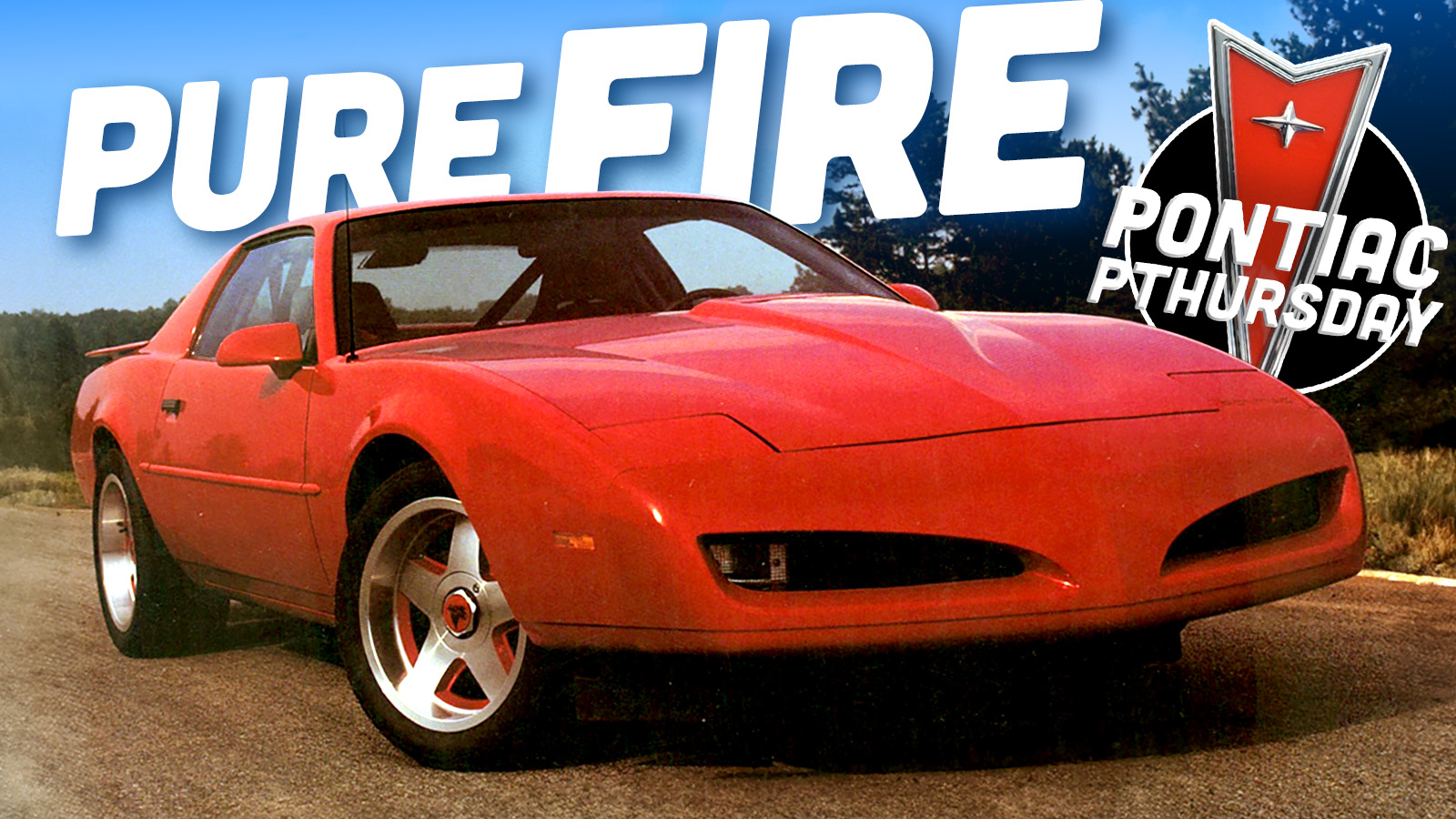
There are several cars made by famous names in the world of tuners: people like Roush, Saleen, and even Shelby, who created some famous editions of well-loved Pony cars. Also, there were plenty of modified coupes like Mustangs and GM F-Bodies that combined race-level prowess with the ability to offer at least reasonable comfort and tractability on the street.
The 1992 Firebird Formula Firehawk was neither of these two things. Street Legal Performance was hardly a household name, and this hot Pontiac F-Body was barely usable on public roads. Its mission was simple and clear: go fast. If nothing else, on that mission, it delivered.


Was that really enough? Let’s find out.
A Firebird With Real Fire
I’ve heard it said that you can get almost anything you’d ever want in life if you’re willing to sacrifice essentially everything else. That’s certainly the case with the modified Firebird that Street Legal Performance- or SLP for short- decided to offer to the public in late 1991.
The goal of SLP’s Ed Hamburger was to create a car faster than most exotic cars of the day, including the Ferrari 348, Lotus Esprit, Acura NSX, and even GM’s own Corvette ZR1. To do this, Ed began with a product that would undercut the price of these high-dollar machines but still be able to handle the immense power needed to accomplish the task.
Ed settled on the Firebird Formula, the rather stripped-down all-business performance version of GM’s third-generation F-Body. Now in its tenth and final season as Pontiac’s fastest Pony Car, the Firebird was getting long in the tooth, but John Schinella’s masterpiece still looked stunning; it’s personally my favorite F-body of all. The Formula version kept things simple with none of the scoops, spoilers, ground effects, or even smoked-out “grid” taillights of the flashier Trans Am.
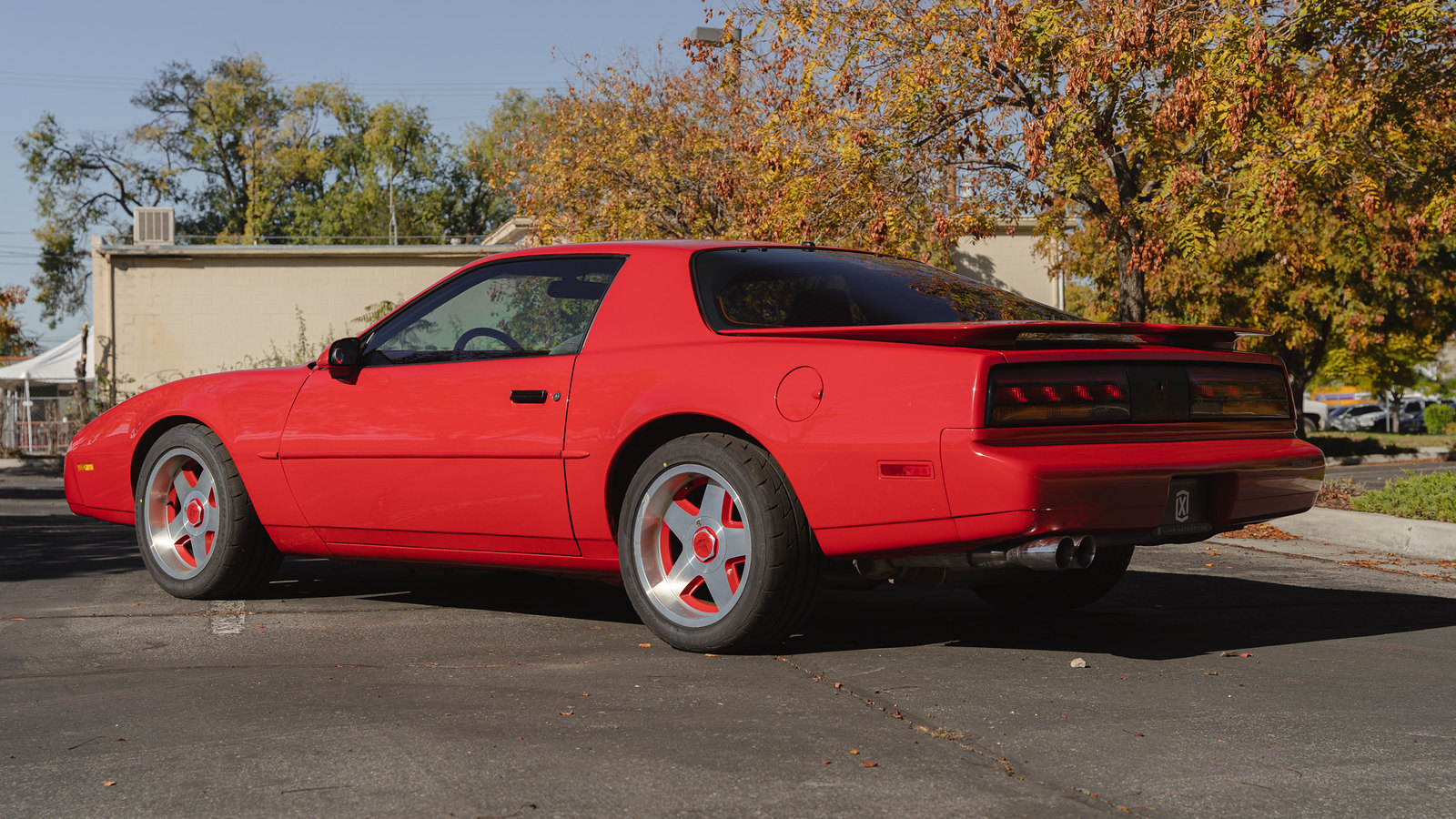
On these late third-gen examples, the ovoid-shaped grille openings that presaged the coming fourth-generation nose always looked at odds with the crisp, angular visual language of the rest of the car, but that’s a minor quip.
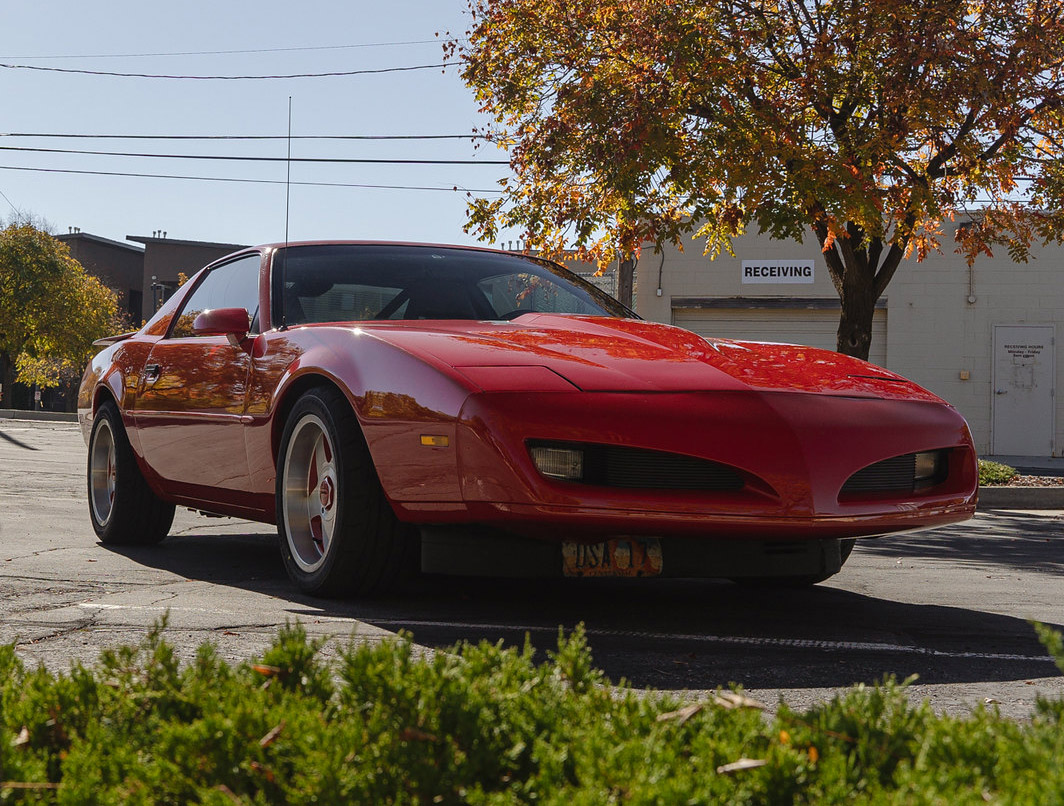
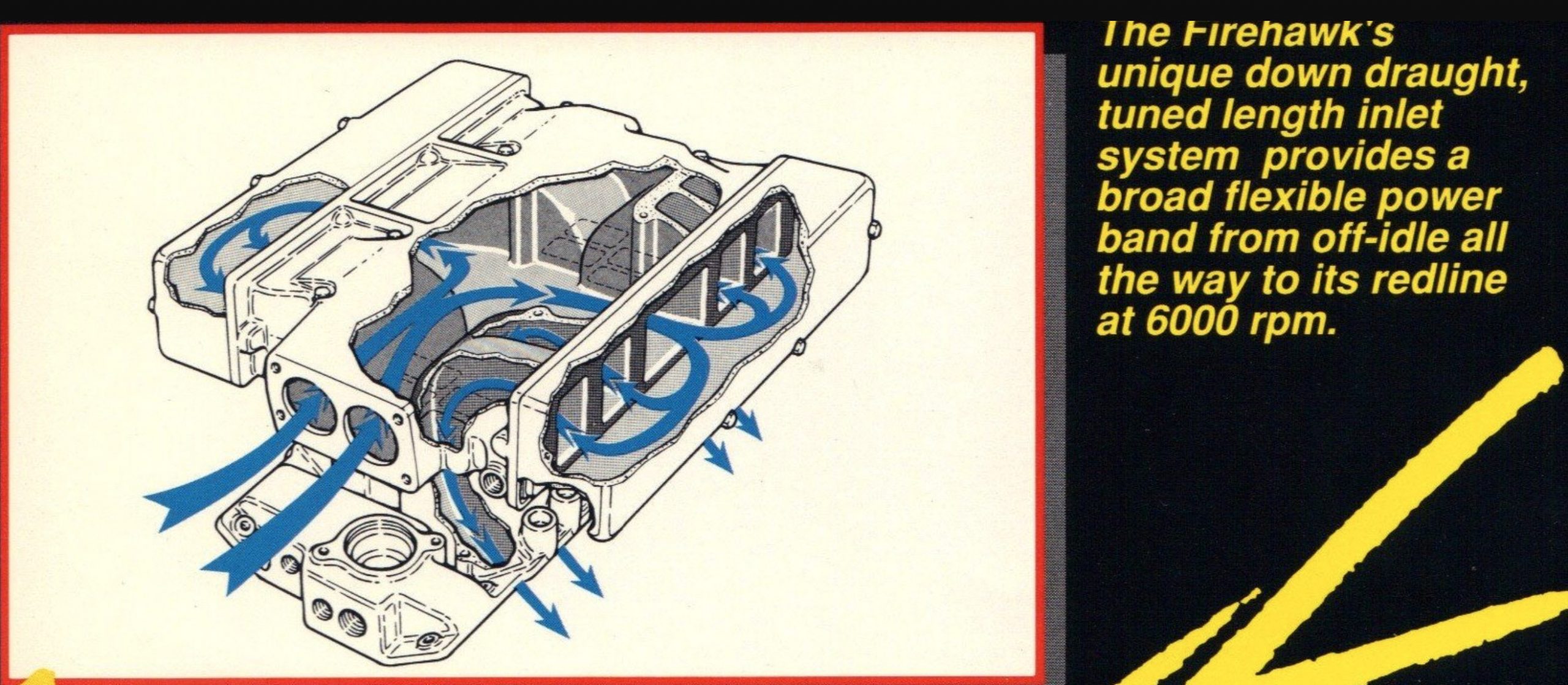
Despite the intent to make an inexpensive speed machine, SLP didn’t skimp on any of the details. Under the hood, the 1LE 350 was anything but a run-of-the-mill Firebird motor. Mods included a forged crank, forged rods, and lightweight pistons, as well as special cylinder heads. SLP also installed a special intake and exhaust, bringing the Firehawk to 350 hp and 390 lb-ft of torque. The bespoke “down draught, tuned length inlet system” supposedly created a flexible power band up the engine’s 6000RPM redline.
Stainless steel headers and dual catalytic converters replaced the stock Firebird exhaust; SLP was obviously committed to the cause without compromise.
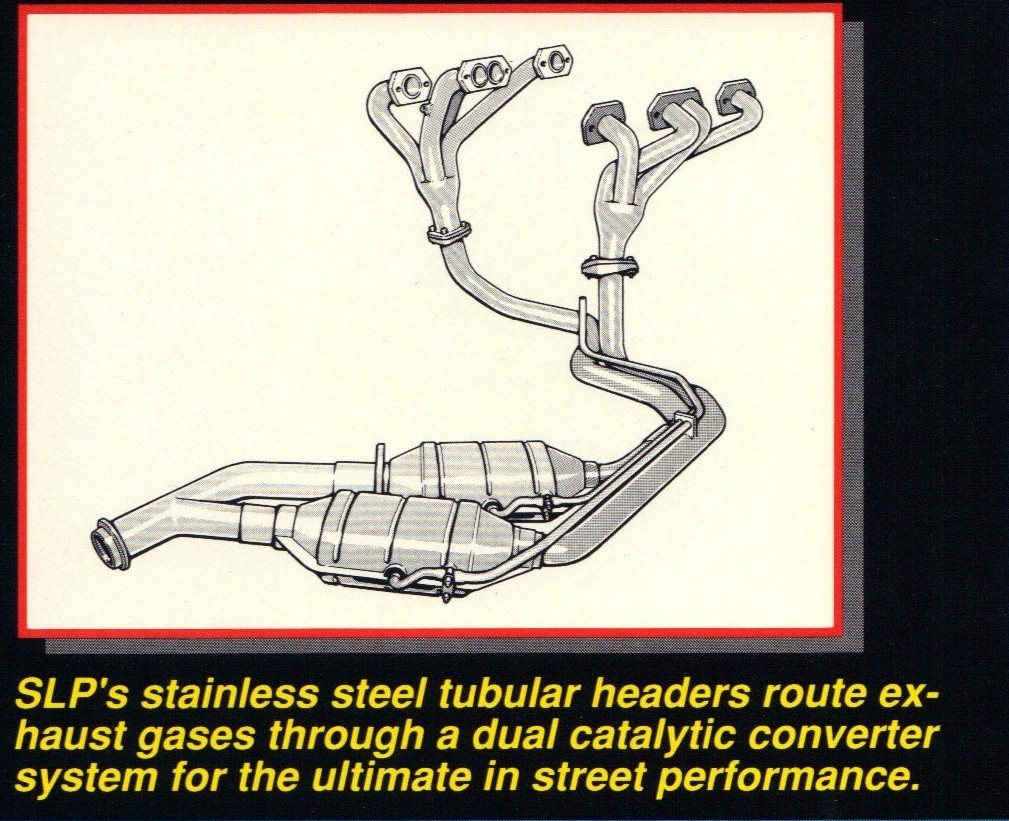
The result was 350 horsepower, mated to the same six-speed as the Corvette:

That horsepower is an uninspiring figure today, but at the time, it was capable of propelling the rather lightweight Firebird to sixty in a shocking 4.6 seconds. That’s a time on par with the costlier Corvette ZR1 and faster than the even higher-priced exotics. Still, at $39,995, it was hardly cheap.
Some Turning And Stopping With Your Go
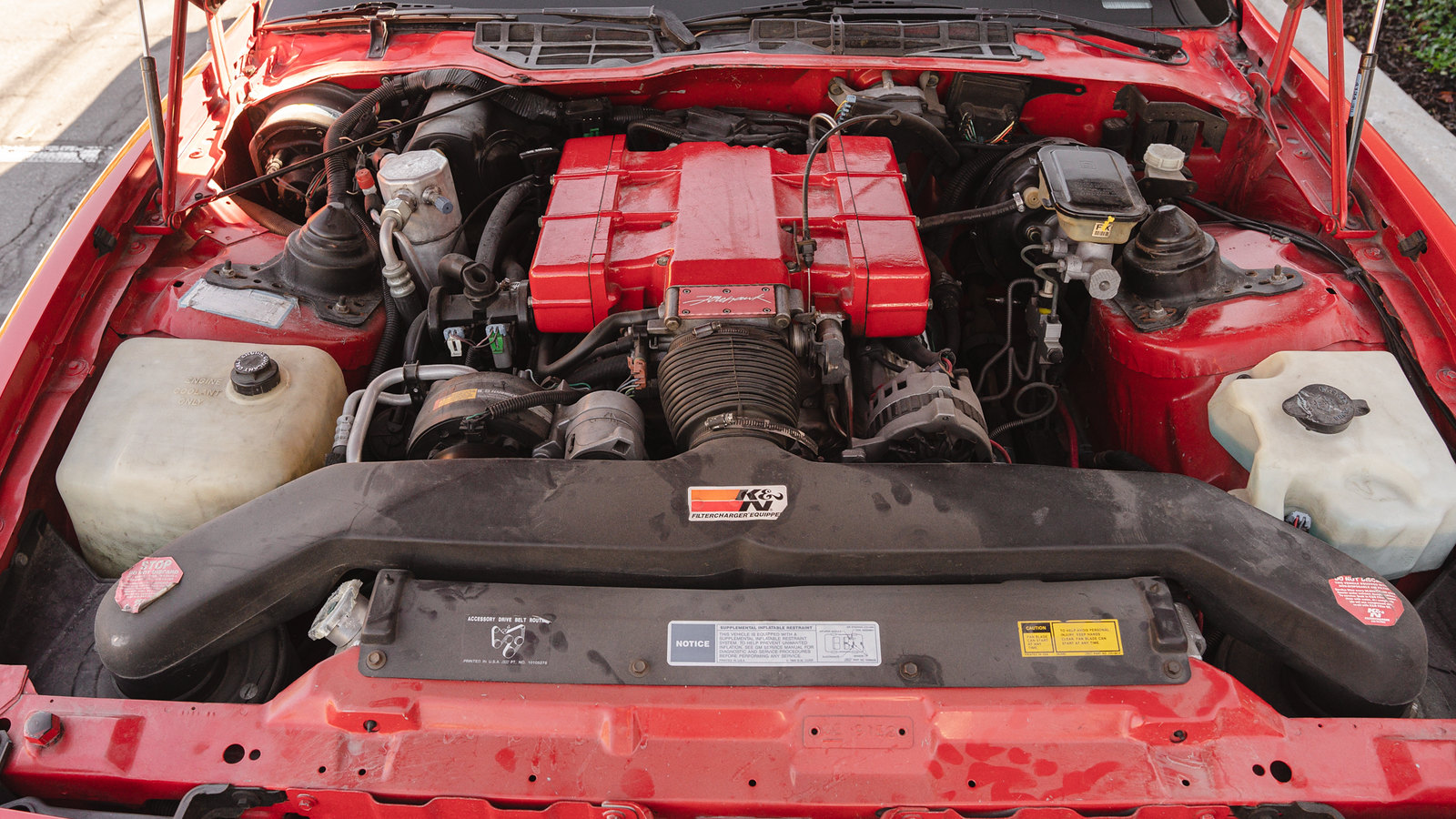
Straight line performance is one thing, but the Firehawk was no mere dragstrip machine. Seventeen-inch wheels on the Firehawk were inconceivably huge for the time, shod with Firestone 275/40ZR17 tires that shared the Firehawk name; tenacious grip was there as long as the road was smooth. Accents on the alloys matched the red finish of the Firehawk, the only color that SLP was to offer for their custom Firebird. Beyond that, though, inside and out, the Firehawk really didn’t have anything that screamed “killer performance car”, unless you opened the hood. Even then, it looked pretty damn OEM:
With such power and wide rubber, you’d be smart to consider taking things to the next level, particularly with the Firehawk’s ability to stop and even hold you in place. For those willing to pony up another ten grand, SLP offered the “competition option” package:
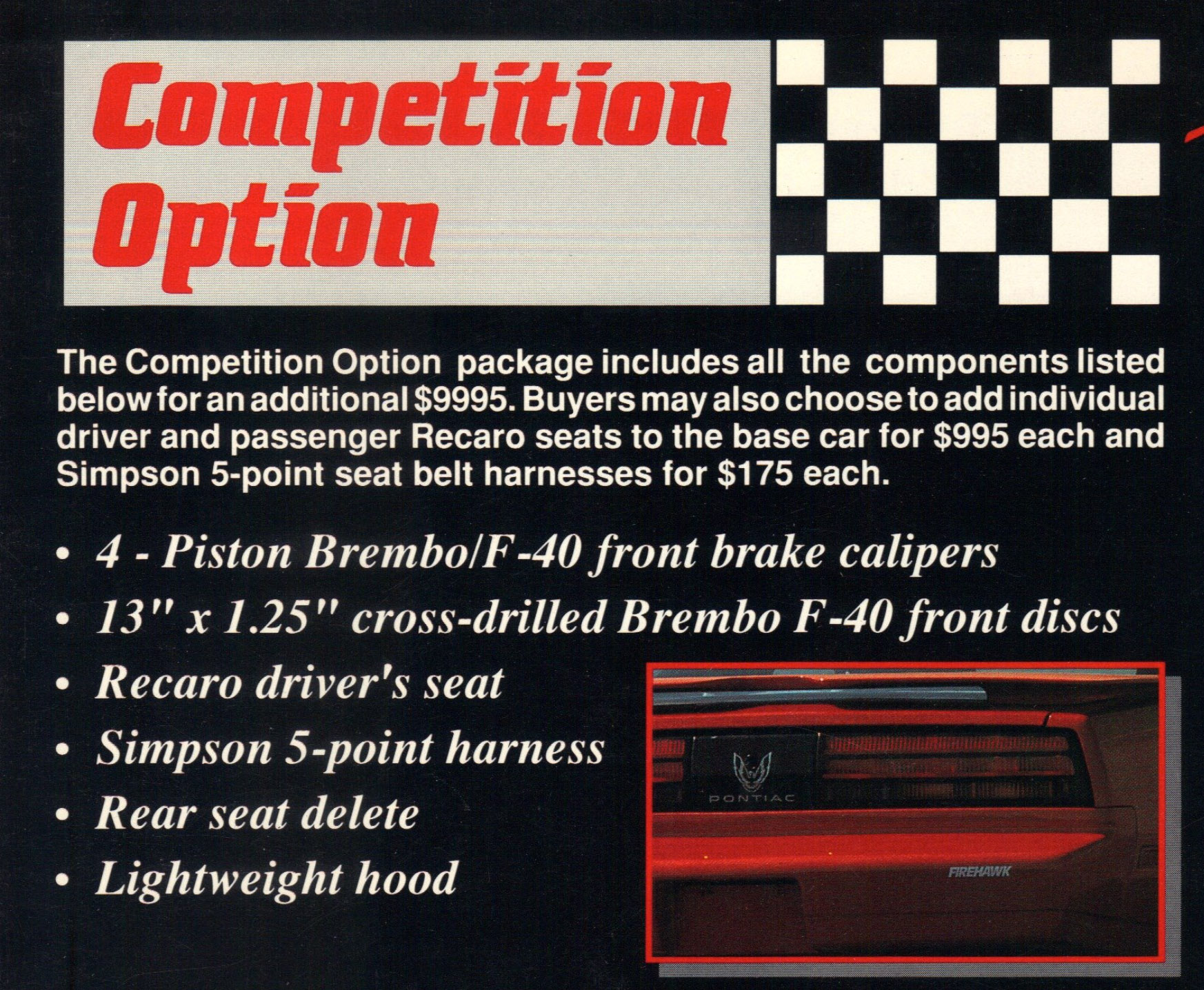
As the brochure excerpt above states, this included a bunch of goodies, but most notably what they claimed were the same four-piston Brembo front brakes as on a Ferrari F40. At 13 inches in diameter, some car mags pointed out that they were the same size as the actual wheels on a Civic, and they did the expected great job in arresting the Firehawk’s prodigious speed.

A lightweight hood and racing driver’s seat came with the package, and a few more bucks got you a matching passenger’s chair and five-point belts (but the rest of the cabin was very much bare-bones Firebird).
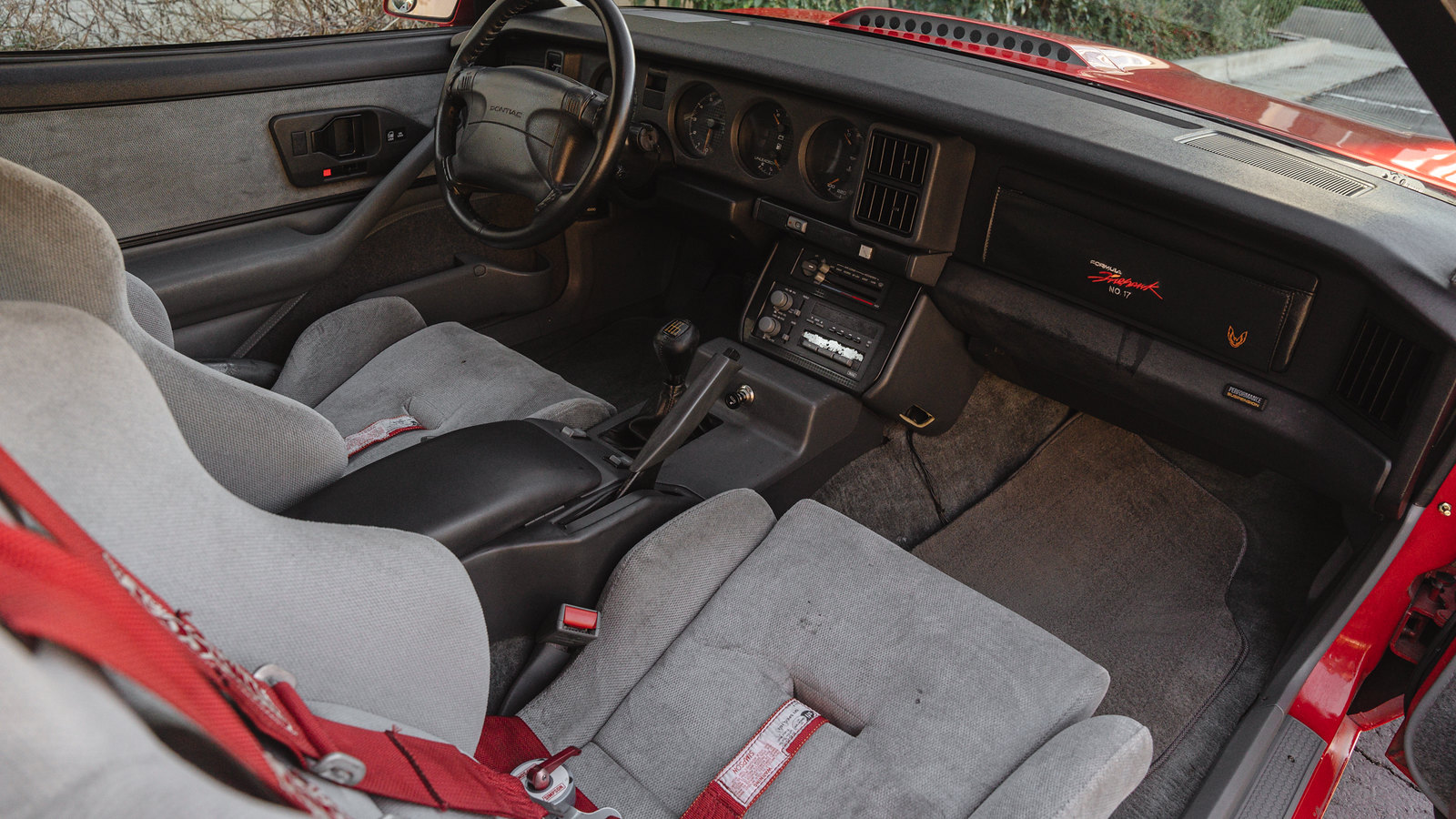
A rear seat delete to accommodate a roll bar was also part of the package.

Equipped with the “competition option” and the other racing-style extras, the Firehawk was very much a track car, despite it being ineligible for the “Firehawk” series that it shared a name with.
The best part about the Firehawk might have been that obtaining one didn’t require endless correspondence with some small tuner; all you had to do was select “Regular Production Option B4U” and take delivery of your new fast Firebird right at your Pontiac dealer. It sounded like a decent deal on paper for a hand-built hot rod, but remember what I said about sacrifices?
More Like Street Legal Punishment
Lots of things like garbage trucks, street sweepers, and mail Jeeps can be legally driven on the street. That doesn’t necessarily mean that you’d want to. That’s a bit of the case with the 1992 Firehawk. The ride was reportedly punishing; such jarring didn’t do wonders for the creaky old F-body structure. Firebirds were never designed to have tires that wide, so on the street, a Firehawk might “tramline” and hunt for grooves and imperfections you won’t find on a racetrack. A rumbling idle and ample cabin noise meant the Firehawk was one of those cars that was a laughter-inducing thrill to drive on public roads, but you’d be begging to get into something like a Camry after an hour or so.
The promotional VHS video from SLP embraces this and happily quotes the review that calls it “scary”.
https://www.facebook.com/watch/?v=1632445543447020
Ultimately, being fastest for the least cash wasn’t as popular a proposal as SLP had imagined. At over $50,000 with the Competition Option, the Firehawk might have been less than a ZR1 or the European and Japanese exotics, but it was almost twice the price of a slower but better-equipped Firebird Trans Am or GTA. For that money, you could have bought some almost-as-fast rides with far more refinement, better build quality, and finer accoutrements as daily drivers.
Plans to make 250 Firehawks soon evaporated; only 25 were converted by SLP before the third-generation Firebird ceased production. Also, despite SLP’s Henry Ford-style single color plan for the Firehawk, they ended up making some examples in other shades, including one white, one blue, one in a very-1992 teal, and the best-of-the-lot in a striking dark green with tan seats that you can see by clicking here.
Yes, you ask, but what does John Davis think? I knew you’d ask:
With a production run that numbers not much more than the total sum of vehicles that our Mercedes Streeter currently owns (ouch!), you’ll struggle to find one for sale today, but they do occasionally appear. Despite the rarity, historical significance, and outright title as one of the fastest Pontiacs ever, don’t expect to see million-dollar sales figures. The few that have come up for sale typically go for less than their price new, at around $30,000 to $40,000.
SLP persisted in making highly modified Pontiacs in the ensuing years with later Firebirds and even the Australian-built Holden that was sold here as the G8 in the brand’s very last years.
Most of these products succeeded in providing more street tractability than their first 1992 attempt provided, but that’s not to say there isn’t an appeal to the visceral take-no-prisoners approach of their first Firehawk. If you’re willing to make the needed sacrifices, there’s a reward to be had.
Pontiac Points: 86/100
Verdict: You Want Comfort? Forget It. You Want The Ultimate Third Gen Firebird? Here’s Your Car
Top graphic image: SLP, Pontiac


A few years ago here in upstate NY a used car dealer had a teal Firehawk for sale, until this article I never knew it was 1 of 1.
After thinking about this a bit, I’d love a deeper dive into SLP and their work in the 90s (and 2000s) on various Camaros and Firebirds. They made some cool stuff.
I’ll always say that the 91-92 Firebirds were the best looking of the 3rd gens. I also remember 15 years ago, when I had a 91 GTA, SLP still sold new parts for the 3rd gens. There was a point where I was tempted to buy some Firehawk parts for mine, but did not have the funds at the time.
I will forever miss that GTA too….. *salutes*
I miss ‘ol ’95 Firehawk #523. The 4th gens were milder than the original and much more plentiful with just a few trivial bolt-ons over the regular Formula: intake/hood, the best sounding 4th gen exhaust, Hurst shifter, Torsen LSD and suspension bits (I didn’t get the optional springs/dampers). Probably not worth the cost compared to do-it-yourself mods, but I liked it. The Comp T/A was cool, but I’ve always preferred the Formula over the Trans Am. I don’t miss replacing the plastic headlight gears every year. Heads/headers/cam would have pushed it beyond ’92 power territory and an aftermarket cross-brace would have helped the floppy chassis. Sadly, it was totalled when someone rear-ended me, but the 928 S4 that replaced it had more power, a vastly better interior and the IRS was much more controlled on real streets.
Wait, the Firehawk was a solid rear axle? Like my pickup? I was more a motorcycle guy then and forget how stuff was.
I was drooling over these when I got my license as a muscle car obsessed kid in the mid aughts, but they were rare and still out of my meager price range even then near the bottom of the depreciation curve.
350hp is ‘uninspiring’? That’s a crazy amount of power for a car like this.
I had a 96 Trans Am WS6 with a six speed, which was a hoot to drive, then a 2000 Camaro SS 6 speed, which was somehow less fun than the TA, even if was a bit faster. I always wanted a Firehawk, but the cards didn’t line up.
I’m still mad at GM for killing the Firebird and then shuttering Pontiac.
“Ed Hamburger” sounds like a name Jeremy Clarkson would’ve made up as part of disparaging the Firehawk for a review.
Richard Manlove
I bought one of the brand new zexel torsen differentials SLP listed on eBay for $88 in the early 2000s. They were swapping factory parts with something better. I put it in my S10 4-cylinder by carefully aligning it with the rear bearings in the axle without measuring anything and kicking it as hard as I could with hiking boots until it went in. It was running strong 80k miles later when I sold the truck. Thanks again for the great deal SLP!!
Brings back memories of my red 1991 Formula WS6 I had. Was a fun car for what it was. The 4th gen Fbody was far superior in about every way but it didn’t have the style of the 3rd gens.
I do recall these in fact, one of the church members at the Methodist Church I went to was a gm exec and he was driving one. Took me for a spin in it, up and down square lake road and I75 (metro Detroit) it ripped and rode like a buckboard and had terrible rattles. I was about 14 at the time so I could not drive it, I just thought it was some tuner package, had no idea so few were produced. In today’s money that $40,000 at the time in 1992 is about $93,000 in today’s cash. That’s c8 money, or way more than late Zl1 1LE money, or even approaching Mustang Darkhorse SC money,offff… Cool article!
That is the best prettiest gen Firebird,and I like the 17s on it. Also that intake is really neat.
The original TPI intake has pretty small runners, it requires an aftermarket intake to get any power.
If you think 350/390 are uninspiring numbers, try the 225/330 my ’88 trans am left the factory with, which was only available with a 4 speed auto. It really is true about how weak the body structure was on these, driving over a humped rail road crossing and you could see the door move in relationship to the body.
Or going anything above like 65 and the whole car starts to rattle haha
Ah, the old “vibeshaft” TSB. It was more like 80 mph with the 6-speed and 3.40 axle. Got hollow steel driveshaft replaced gratis with the solid aluminum 1LE driveshaft.
ha, honestly I don’t remember mine doing that but also sold it in 2008 so my memory may be dim, but always thought it was surprisingly good freeway cruiser for an ’80s car I bought in 2002 with 100K on the clock. Of course I was 18 at the time…
The t-top versions you could also see the windshield frame shimmy as well. Never-mid the convertibles which were as rigid as a week old salad…
Lol yeh the t-tops were also prone to leaking, I was lucky my car was a hardtop, which was part of why I bought it over a cleaner camaro z28 I also looked at.
In 2009 you could get both a Pontiac Vibe and the SLP G8. Perhaps the only two Pontiacs I have liked since the turn of the century.
Having owned two 84 Camaros back in the day, I loved the idea of the Firebird Formula. Almost bought a Formula 350 in 1991 right before Desert Storm, but luckily the salesguy was a total douche and I walked. I still think about it occasionally.
Now I’m wondering where this SLP fits in SCCA autocross classes.
we have a local tune shop that specializes in GM performance. started out in the dudes neighborhood out of his house called hawks third gen. he’s since transitioned into a full on building and goes by hawks motorsports now. i feel like they are our local version of SLP. dude had several nice rides in GM high performance back in the day. his ’01 Sunset orange metallic catfish camaro was a poster car for me when i was in college.
Hey I know hawks and have ordered from them from when they were hawks third gen and to the current form. That is actually where I got my t56 magnum from they were really helpful getting all the parts I would need.
I’m pretty sure Stellantis would be happy with those numbers.
I remember reading about these about 20-25 years ago in an issue of High Performance Pontiac Magazine. They featured one just like this one (could have been this exact car, actually) and it was fully kitted out with the Competition package. Being able to buy something like this at the dealer was absolutely bonkers back in the early 90’s! I mean, I remember when the 4th Gen cars debuted and had a 275hp LT1, and that was a complete coup! These were more powerful and handled better, and on a 3rd Gen chassis. Of course, they were more expensive, but they are such cool cars, and ultra rare.
Cars today need stupid horsepower because they all weigh as much as small moons. To go only marginally faster.
I always thought the Camaro was better looking back in the day, not that I had any interest in either one.
I ran SLP Loudmouth exhaust on my 03 Mustang GT. They were a great little tuning firm.
For that price I’d probably be happier just building my own spec version. I’d want to start with a GTA and give it a modern suspension refresh and replace the 305 TPI with something in the 400 HP power range and a modern ECU from Haltech or Link.
I’d probably lean into my nerd skills and add a digital dash and lots of fancy electronic goodies.
A mild LS1 would be plenty to make this thing perform as it should without wadding up the soft tortilla unibody these were known for.
An acquaintance back in the day had a black T-Top from early in the run that we called the general, because neither door opened. The chassis had sagged enough to crimp the doors shut. Man we drove some complete death traps back then.
That is where I am with mine 406 with a t56 magnum, Ford 9in, and a holley HP ECU. I have had the suspension all redone at this point and the frame has been stiffened (giggity) up. Though I have kept all the interior stock as I like the look much more then anything aftermarket. Haven’t had it on a dyno yet but assuming around 400 horse or so.
I think if the engine ever goes I am going to go with an LS better fuel economy and probably cheaper to get power out of it.
Sounds like a solid fun to drive build.
Yeah still has a bunch of minor things I need to work on headliner, paint, dents and the clutch master cylinder moves when pressing the pedal down since the car was originally a auto and one of the fitting on said cylinder rubs a little bit so not a smooth clutch push right now.
The last 10% of the project takes 90% of the time 🙂 My 03 Civic has a ton of little things to be done to it as well, but I might just pull the engine and trans out this spring which escalates things substantially.
The new LS6/409 at 535hp/520tq they just intro’d would make a sweet crate motor if you ever need one
I have stated here before I really wish my bird was a 91-92 (thought I prefer the trans am/gta from those years with the ground effects over the formula) also I remember years back when I bought my Firebird seeing a few firehawks for sale same with turbo trans ams they were much cheaper then the prices they are going for today sucks I was a poor college kid back then and could afford either one haha.
Minor quibble, the Firehawk tires were Firestones, not Goodyear. This was just before they trashed their reputation with the Explorer fiasco.
I like that intake manifold!
I have a TPI 305 from an IROC Camaro in my El Camino, but it just has the regular Tuned Port Injection intake.
Here’s some Pontiac Pthursday extra-credit for you today…
https://www.hagerty.com/media/member-stories/passed-down-across-four-generations-these-pontiacs-are-staying-in-the-family/
🙂
They did that because the Camaro one wouldn’t fit under the Firebird’s much lower hood
Hah that reminds me when I had to cut a brace off my original hood when I installed my after market holley intake.
That’s called a “lightweight hood” and would have cost an extra $9995 new.
Was the original TPI really all that much taller?
https://en.wheelz.me/wp-content/uploads/2025/11/0740572715161125.webp
I admittedly misread “intake manifold” as “intake”