

Remember when driving at night used to be fun? The warm glow of halogen lights, summer breeze in your hair as you set about reenacting Volkswagen’s Pink Moon commercial with whatever you had in your driveway. Unfortunately, as the brightness wars have raged on, headlight glare has really got in the way of night drive enjoyment. It’s a problem large enough to have spawned its own anti-LED-headlight subreddit, and now the government’s looking to do something about it.
Meanwhile, Porsche just teased what sure seems like a new mid-engined halo car, but there’s also a report going around that proposed gasoline-powered variants of the next Boxster and Cayman are dead. We have great news for Lotus, perhaps, but not great news for the rest of us who’ve worked reasonably hard the normal way, definitely can’t stretch to supercar money, but still want choice in the reasonably small mid-engined arena. Oh, and Honda is reportedly changing up production plans again, with the next-generation Civic sedan set to leave Indiana production in the past.


Welcome back to The Morning Dump, where we carve up the morning’s car news stories into bite-sized pieces and serve them to you hors d’oeuvres-style. Don’t worry, they’re less slimy than Vienna sausages straight out of the can. Let’s get cracking.
The Feds Want To Do Something About LED Headlight Glare
The potency of modern LED headlights is astounding if you regularly drive in rural areas with plenty of large wildlife, but if you drive a relatively low-slung car, you’re probably familiar with having your eyeballs seared by brutal glare reflected by your side-view mirrors. After years of arguments from both sides of the headlight wars, the feds finally want to do something about it beyond letting matrix headlight assemblies be matrix headlight assemblies and use their arrays to bend high-beams around oncoming cars. NHTSA has opened up public comment for an overhaul of America’s lighting standards covering more than just glare, and now’s your opportunity to chime in.
“Today’s standards do not allow automakers to deploy the latest safety-improving lighting technologies, so we are bringing key experts and stakeholders together to modernize our standards and address potential causes of glare,” said NHTSA Administrator Jonathan Morrison. “This collaborative approach will allow us to update outdated regulations, foster innovation, and keep everyone on our roads safer.”
So what’s NHTSA going after here? While LEDs are one component, this looks to be a holistic approach. New rules around automatic high-beams are on the table as those can be blinding at times. Evaluation of headlight height and aim is being pursued, and NHTSA is looking more closely at dusk sensors. Canada already implemented new headlight legislation aimed at preventing “ghost cars” driving at night with no taillights illuminated; America might be looking to do the same.
In addition to addressing glare, NHTSA seeks to revamp rules around lighting technology with an additional goal of “Harmonizing U.S. vehicle lighting regulations with international safety standards.” While adopting UNECE lighting standards seems like a long shot, never say never. Should you wish to submit comment, the deadline is Nov. 9, and you can make your voice heard at www.regulations.gov under Docket No. NHTSA-2026-1981.
Is This A New Porsche Supercar?

Shortly after midnight, Porsche teased something new. Something that very much isn’t an SUV. Something low-slung, curvy, almost certainly mid-engined, and possibly not a new Cayman. It’s called the Mission S, it’s debuting on Oct. 15, and Porsche claims it’s “our tribute to the sports car. And to the vision of Ferry Porsche.” So what exactly are we looking at here?
It’s no secret that Porsche isn’t in the strongest position it’s ever seen. A slump in profits has made the marque get aggressive, and one of the ideas floating around is a supercar sitting above the 911 in the range. Something high-margin, low-volume, and assuredly exclusive. If Porsche does it right, there’d certainly be some clients interested in a 296 GTB-sized, slightly-more-than-a-top-dog-911-priced manual mid-engined supercar, but it would be launching at a rather strange time from a sentiment perspective.
See, for years, pricing of the Porsche 911 largely kept track with inflation. Adjusted for that economic spectre, a 2001 911 Carrera was only about $3,000 more than a 2018 model when new. That’s since changed. A 2018 Porsche 911 Carrera in today’s money would carry an MSRP of $121,528. That’s more than $14,000 cheaper than what a new 911 Carrera starts at. Further up the range, things have gone even crazier. A 2018 911 GT3 had an MSRP of $143,600, or about $191,565 adjusted for inflation. A 2027 Porsche 911 GT3 stickers for $235,800 before any options. That’s an adjusted difference of $44,235. As a result, there’s a prevailing sentiment going around the Porsche community: Long-time serial owners are starting to balk.
After experiencing sticker shock pricing out a 992.2 GT3 Touring, will these owners bite on a halo supercar that sits above the 911 and presumably isn’t a hypercar? Furthermore, is this a real conquest proposition? It’s tough to say, but someone in Stuttgart has crunched the numbers and found value in them. For now, we’ll just have to sit back and wait for the debut to arrive. Mission S. How different.
Say It Ain’t So
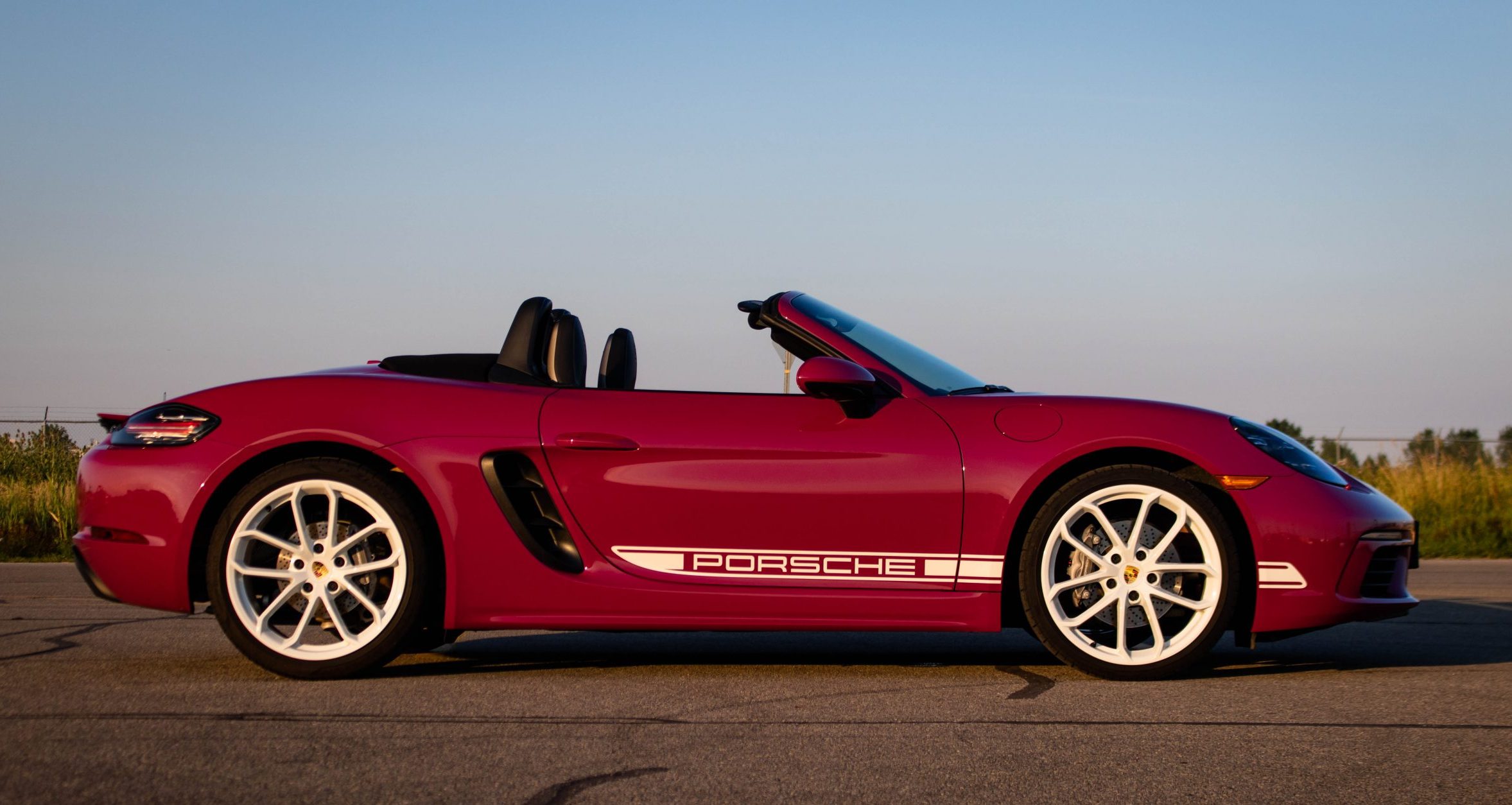
Speaking of Porsche, a report came out today that’s a bit of a head-scratcher. See, years ago, the marque announced that the next 718 Cayman and Boxster would go all-electric. This has proven to be a controversial move, especially since there are sports car traits most electric cars still aren’t ready to embody. Most amateur motorsports venues for stuff like autocross and trackdays don’t have DC fast charging on site, and part of the whole point of a sports car is relative lightness. Batteries are heavy, even though they’ve grown more power-dense as modern EV development’s gone on. Last September, Porsche snuck a slight reversal of course into a presentation, claiming that actually, top variants of the next 718 will be available with gasoline power. Now it seems that’s all gone out the window.
According to Autocar, the next 718 Boxster and Cayman “will now be launched purely as electric models, with Porsche abandoning plans to rework the new architecture developed for them to accept combustion engines.” On paper, this makes sense, as such redevelopment would be expensive. Still, I can’t help but feel a bit sad.
The outgoing 982 Cayman and Boxster rode on the same MMB platform as the current 911 meaning that it’s theoretically possible to update the architecture to be compatible with the European Union’s GSR2 regulations. Plus, they were just so lovely to drive, magnificent road cars in all variants, and they were notably less expensive than equivalent 911s. By seemingly not going ahead with a next-gen combustion-powered 718, Porsche would be enforcing the K-shaped car market in a brutal way: Classic fun is now for people with double-barrelled names and private equity morals, not people who simply worked hard in life.
Honda Shuffles Production Again

If there’s one word that encompasses the new car market in America right now, it’s “volatility.” Shifting tariff rates and consumer demand makes long-term forecasting difficult, and Honda’s reportedly shuffling the deck yet again. Last year, the news broke that Honda was reversing course on sending next-generation Civic sedan production from Indiana to Mexico over tariff concerns. At the time, this seemed like a relatively sensible play as the current Civic is made in Indiana, but there’s been a further development. According to Automotive News, the next-generation Civic sedan is getting the boot from the Hoosier state.
Honda has delayed production of the next-generation CR-V by three months and canceled plans to build the next Civic sedan in Indiana, a supply chain source told Automotive News.
Start of production for the redesigned CR-V has been pushed to April 2027, said the person, who asked not to be identified because the information has not been made public. Honda also has reduced first-year volume planned for the crossover by 6.7 percent, to 41,315 units.
The CR-V is an American favorite, by far and away the marque’s best-selling model stateside. Through the end of September, Honda sold 336,844 CR-Vs in America versus 195,135 examples of its next-most-popular model, the Civic. Despite increasing appetite for small cars, CR-V sales are ripping harder than Civic sales, and the model’s higher transaction prices look good on a balance sheet. Reportedly kicking the Civic out of Indiana could free up additional production capacity for the CR-V, and it’s not like there isn’t a North American plant capable of picking up the slack. Plans still seem to be afoot to build Civic sedans in Honda’s Canadian plant, and Mexico may remain an option.
As for the three-month production delay and reduced first-year forecast for the new CR-V, it’s possible Honda is looking across the aisle at Toyota and adjusting its own forecast based on the way production ramp-up of the new RAV4 is going. For months, Kentucky production was a little slow to get online, resulting in used RAV4 hybrids being worth more than equivalent new RAV4s due to supply being just that tight. Either way, expect a new CR-V to debut sometime in the next few months.
What I’m Listening To While Writing TMD
I’ve always wondered why Attack In Black wasn’t absolutely massive. The Welland, Ontario-based indie rock band only released three studio albums, but right from the get-go, there was something irresistible about their sound. Polished, but not clinical, abstract but not obtuse. “Hunger of the Young” off their debut album “Marriage” is still in my rotation, and it still holds up.
The Big Question
What do you want the government to do about headlights?
Top graphic image: DepositPhotos.com


Regarding headlights, for starters just because the hood of your truck/SUV is 5 feet high that doesn’t mean the headlights need to be. Do what semi trucks do and mount them at a normal height.
This, I’m sick of feeling like Clark Griswold’s yuppie neighbors whenever some guy in a RAM decides 10 over the speed limit just isn’t fast enough on a narrow, winding, pitch black country road in a heavy deer crossing area
So much this… anymore I invariably end up with a 3/4 ton truck pushing me at night; all lights blazing, on the 8 miles or so of back roads between the 4 lane and my house. And most nights I count at least a half dozen deer grazing in yards/fields/etc…
Buyers won’t go for it, because they won’t like the look. The answer will be faux headlights up on top and actual, tiny projector lights mounted in the bumper.
The Sierra EV and Hummer EV do this to great effect, imo. Their main beams basically look like fog lights.
Even the abomination that is the cybertruck uses smaller LEDs way below the giant light bar and more on the bumper for the actual headlights. Looks pretty goofy when they are on.
Turn headlights on when the wipers are on, and when it gets dark. That’s it.
How about like motorcycles, and just have headlights (and taillights) always on? Make them be actively turned off.
I hate DRLs and such for this very reason. Us motorcyclists used to be the only ones with 24/7 headlights, so we were at least a little easier to spot. Now every modern car has LED DRLs and bikes stand out even less.
The real downside of DRLs is that so many of them are bright enough that some drivers think they have their headlights on. Dummies.
Oh yeah, I’ve seen plenty of that too. Which to me is odd, because you’d think that the DRLs being on means that headlights are set to Auto, so they would come on as well? At least any modern rental car I’ve gotten seems to be that way.
Older and cheaper cars don’t have auto headlights. It was an option. These are the cars that become ghosts at twilight.
My Toyota’s have – OFF/Running/DRL/Auto/ON functions on the stalk. I leave mine in Auto, but often override to ON as the light sensor is not sensitive enough in my opinion. I’ll often flip to ON at dusk before the sensor, not to mention rain. OFF is nice for dark events like drive-in movies (a few still exist)
Ah, more options than I thought. I got a Buick rental recently and the stupid headlight controls are on the touchscreen, but they’re at least a permanent icon on the screen close to the driver, and the screen response time was really good. SO going on base at 0dark30 in the morning you’re not blinding the guards.
In my experience, DRLs turn themselves off when it gets dark.
Only if the Auto function exists and is enabled.
That’s crazy talk! I want the car to do it for me so I don’t have to think.
Here’s my proposal: Regardless of vehicle height, headlights shall be no more than 24 inches above the ground.
That would be a good standard. If you want to lift your truck figure out how to lower your headlights to 24″ or less.
24″ would be a horrible standard. 24″ is low, like really really low. Current regs say they can’t be lower than 22″. Making the maximum height just above today’s current minimum seems like equally bad regulation as allowing them to be so tall. A modern 911 doesn’t even meet that. Just going off wheel size, I’d guesstimate a modern 911 has headlights over 27″ because they sit above their 26.8″ tall tire.
I’d generally agree the current max needs to be lower, but it just seems insane to make the new max well below even low slung sports cars.
Point remains, whatever the number.
I’d say it should in that ballpark, though. Definitely less than 30″.
As an example, the projector lenses on my C6 Z06 are 24″ above the ground. Those are HIDs and they are one of the best low beams I’ve ever driven (the halogen highs are not great). One of the big pluses is that with a reasonable cut-off they can still light up a lot of road without throwing glare at anyone.
Since I had the tape measure out, my daily driver sedan lights (LED, not matrix) are at 26″ which is in the neighborhood. They are not as good as the C6 on low but still decent and not many reports of glare that I’ve seen.
22″-30″ seems like a reasonable window to me, I just don’t see why a headlight would ever need to be above 30″. And if the designer wants a “headlight” higher up for styling reason just make that a DRL and put the real headlights in the regulated window, with LEDs the actual headlight really doesn’t need to be that big.
The federal standard is about twice as high.
Adaptive headlights that have been legal in other countries for years but not here. I know some are finally starting to show up but I know with my Polestar 2 they didn’t get the approval to enable it so I would have to program it myself to get it working.
I once saw a thread on a VW forum with instructions on how to enable the Dynamic Light Assist headlights in order to take full advantage of the already-installed, but disabled adaptive headlights. I’m just a little reluctant since the interface is in all German.
It’s so disappointing that today’s headlights seem inferior to my 2013 Tiguan’s adaptive system. Those aimed the xenon projector lamps up to 15 degrees around curves, and auto-dimmed the left headlight for oncoming traffic. When there was no oncoming traffic and it was dark, they gave a bright, wide and circular beam extending way down the road like a cone of light.
Reduce LED color temperature to something more yellow. Some brake lights are now getting too bright, too.
Lots of LED tail lights and even turn signals are getting blindly bright now. I love the look of lots of modern LED tail lights and turn signals, they just don’t need to flashbang your eyes when activated.
Weirdly, the aftermarket for LED taillights (whole housing) they are bizarrely dim. Often there is no discernable brightness difference between the tails and brakes.
I always associate aftermarket ones with going for ONE MILLION LUMENS! so this has been a distracting observation on my part.
Just mandate 70’s sealed beam headlights and all will be good again.
Unfortunately the eye-melting modern headlights are wonderful on the pitch black, winding, no shoulder, tree lined, deer-and-moose-ridden roads in my area
Not going to argue you there.
I think a lot of the LED hate comes from misperception due to the nature of the light. Yes, they appear brighter, but I rarely experience ongoing visual effects from them. (The array that Tesla was using is the exception here. From certain angles they are terrible.)
Contrast this with 10-15 year old cars with terribly fogged headlights driving around with their high beams on. Even with the reduced light output, *that* glare is painful and leaves spots in my vision. And that is my concern about active arrays – what happens when the cars they are on become cheap used cars? They will be running with blazingly bright lights with a failed shutter system.
As for automated high beams, I’ve not had a good experience with them. In our Outback, if you have the lights set to “auto” on the stalk, it means that when you turn on high beams, they are in auto mode. Only when you turn the lights on manually do you get full control of the high beams. This is an issue for me because I find myself in many conditions where high beams are warranted, but they won’t come on in auto mode because the system thinks it sees something that isn’t an issue. But at least I have the option to override and go fully manual, which is something I’m not sure all cars have, and a regulation that may prevent manual control would be annoying.
I’ve been driving my wife’s car with these new led headlights. The problem seems to be the sharp cut off pattern which actually works fine on a smooth road kind of like how I’m sure the wiper washers work fine in a traffic jam but are useless for cleaning bugs off windshield at rural road speeds. It s like car companies are only designing for urban or suburban stroads now.
I can watch the light stay below other sedan drivers sightlines and out of their rear view mirrors. But on a bumpy windy hill country road it must look like I’m manically flashing my high beams constantly all the time. I’ll hit a dip in the road and see other drivers swerve or brake and try to pull over.
Euro H4 sealed beam replacement headlights had this sharp pattern for decades but US lights had to have a diffuse gradient that would illuminate our unlighted highway signs. And allowed for a less aggressive rise in illumination as the car hit bumps.
I hate watching what it’s doing to other drivers but I’ll admit the lighting pattern gives me confidence driving in rural deer season.
TBQ: I’m not sure the government needs to do anything beyond enforcing existing laws.
Based on what I have seen, it seems like modern headlights aren’t blinding if aimed correctly. It appears they cause bigger problems with misaligned than older style headlights, though. I also presume misaligned headlights are illegal, but I have literally never heard of someone being pulled over for that.
It would help if mechanics/service departments routinely checked headlight aim when vehicles are brought in. Further, I have asked service departments to check the aim on my vehicle’s headlights on two occasions and was told they were unable to do that. That seems highly improbable – I presume they just didn’t want to disrupt their workflow.
It is possible I take my vehicles to lousy service departments, but it seems more likely that no one is paying attention to this. Since many drivers aren’t even aware headlight aim is something that can incorrect, it wouldn’t surprise me if a lot of vehicles with blinding headlights have appropriately bright headlights that are aimed wrong.
I think most the issues are with as you said headlights that are leveled correctly (or aftermarket ones on cars not designed for LEDs or lifted bro dozers). I cannot recall anyone flashing their brights at me in the Polestar as they are leveled really well not not pointed up at peoples mirrors while the ex’s Tourx I had some people flash their brights at me.
The problem is that carmakers are doing with headlights sort of what VW did in Dieselgate: they are required to control glare as measured at specific spots. And they do, but they shine much stronger light everywhere else. More here.
What do I want the government to do about headlights?
Stand out in the middle of a highway one night in fast, oncoming traffic.
What about LED brake lights? There are some cars that leave me seeing spots. They need more ‘diffusion’.
It’s the opposite for turn signals. Some newer cars such as Explorers, the turn signals are not very obvious at all on a bright day.
Auto dimming headlights make sense. Blinding on coming traffic especially with streetlights doesn’t make things safer or pas ms any logic tests. Toyota brought that up almost 2 decades ago. But they didn’t listen. Auto dimming high beams is an absolute necessity as people don’t understand they have them on or where or when to use them or how to turn them off. They just think it’s an octopus on the dash and keep them on always. It’s a regional idiot issue that escaped containment. They should require the manufacturers enable it on all models that support it.
Let’s get Elon to work on dimming.
He’s dim enough, already.
His cars do appear to be part of the problem. Must be trying to find those “grey kitties”.
It’s a personal responsibility problem and the fact most people no longer have any. It is absolutely amazing how many people are running around with their high beams on permanently.
Someone on here posted in a comment some months ago that they believe the real issue is all the screens inside cars are obliterating people’s night vision and so they crank on the high beams so they can see; F everyone else.
I turned off automatic high beams in my car. I drive in the city pretty much exclusively and never have an opportunity to use them without blinding someone else.
My take on this is slightly different. I think the LEDs are so damn bright on newer cars, most people, including myself, think they have their brights on. So everyone who DOESN’T have those hyper bright LED headlights thinks FINE and leaves their brights on to combat it. A can’t beat em, join em approach.
I think that’s part of it. But people have adjusted. 4 or 5 years ago I used to get people flashing their high beams at when driving a car with led headlights and high beams off. I would flash back and they got the idea. It’s been years since that happened. And I think most people can tell high beams from just led lights now. But I’ve noticed some older cars driving around with high beams more. I suspect it’s the region idiot issue that have escaped containment. But wouldn’t be surprised if others are just screw it I’ll drive with brights on too.
I’ve argued with people who drive with the high beams on all the time who claim it doesn’t bother anyone else despite their lack of perspective because they apparently haven’t been followed to their destination and shot (yet). I’m, like, no, you’re blinding people and don’t care because you’re a dick, now have the balls to own it.
They probably have been all but shot but don’t realize it. But the people that tend to do that road raging are the ones with the high beams on so maybe it’s a wash.
It requires them to have some empathy and “be a good neighbor” as well as some intelligence. They are lacking in all that and can’t do it. Most cars that still have a stalk for headlights still can be pushed in for high beams with auto dimming. Then pulled back for off and pulled again for flash. I don’t know why we are allowing manufacturers to get away from that. Allegly on the cars with yoke buttons it’s possible to assign those too.
I always turn the screen off when driving at night. It’s cary to think that other drivers don’t. Don’t the screens revert to a back background at night?
I used to live in a well lit urban environment and could go a whole year without using high beams. I would even sometimes catch myself driving with the lights off because everywhere I went roads were so well lit. Then I moved to a semi rural with few or no streetlights and now I use high beams every single day…manually selected.
Start with banning any vehicles lifted off the ground from the location they were designed, crash tested and certified for use on public highways.
And those goddamn off-road light bars these brain doners use on public roads. Sometimes I wish I was in a James Bond car where I can dump a load of tire shredders behind me.
Would this ban then also affect lowered cars? What about a car with a worn suspension but new parts bring it up a little higher then stock because tolerances are different for parts for a vehicle from 30+ years ago? Which has happened to both my Firebird and my D250. Kind of a slippery slope for vehicles if you are saying they shouldn’t be modified from stock.
Those instances are fine. That is a big difference from someone with a 4 inch lift.
Understandable but they have stock lifted trucks like the raptor/rebel/TRD’s etc that sit 4+ inches higher then stock. I offroad my FJ which is lifted ~3inches and had a K5 jimmy lifted ~6 inches before that was also off-roaded so to me banning suspension lifts is just a no go. And like I said this is a slippery slope because this can lead to banning any exhaust modification, performance boost and so on.
IMO those things are bullshit and shouldn’t even be a thing. When you offroad, you should actually use it. The issue is 90 percent of people with lifted trucks never use the lift.
Or more, completely destroying any active safety capability the vehicle had. The engineers really did know what they were doing, not the shade tree rednecks.
There’s a huge difference between half an inch or drooped springs and the idiots raising their vehicles 8, 12 or more inches off the ground. I don’t know if you’re old enough to remember, but well over a decade back, Ford made an announcement that they were going to see to it that all of their vehicles manufactured matched bumper height, in the event of impacts. That would’ve effectively lowered any of their heightened vehicles and automatically brought the headlights down to a safer level.
After playing a very, very small part in harmonizing US and European electrical standards for hazardous locations (1996 NEC article 505) I realized the only way it gets done is having an economic plus for the parties involved.
My favorite segment of the industry is lightning, and yes oncoming headlights can be a problem and has been since candles have a tendency to extinguish while driving.
Find the money and can be harmonized.
Now I know what it feels like when I send YouTube videos to a Canadian friend and they can’t view it.
Don’t they, already, make Civics (and CRVs) in Canada (
and CRVs in MXedit: HRV in MX)?What am I missing here?
Is this the US equivalent to this article you wrote on the Canadian government survey?
That’s weird stuff from Porsche. New supercar? Fine, whatever, I’m sure it will be beautiful and brilliant. Cayman and Boxter as EV only? What? Everything I’ve ever heard about the Taycan is that it’s amazing but they have trouble selling them. Why would these models be different?
I don’t get worked up about drivers having their brights on. I assume they need them and forgot to turn them off. I can look to the white line for a few seconds. What I don’t like is the blue glare I get on my glasses from LEDs. Porsches are especially annoying with their matrix lights causing 8 blue dots to dance around my vision.
Tesla LED headlamps, a few Honda models, and nearly all jacked pickup trucks – even without highbeams on – are notoriously bad to me.
My otherwise beloved Mazda is a keen offender in this space. Low beams like blue lasers.
I’m just a Wallflower in this discussion, but we can drive it home on One Headlight. Who needs them fancy LEDs? Me and Cinderella, we’ll put it all together for ya.
There’s got to be something better.
I dunno man, I turn the engine, but the engine doesn’t turn. Damn this beat-up truck!
At this point, I’m shocked to learn that *any* government agency is doing *anything* that represents the will of the people.
There’s not much left as far as government agencies capable of any policing of any kind. But that was the point of destroying the government.
I expect tomorrow we’ll see the “Make Headlights Twice as Bright Haha Fuck You Idiot Act” signed via Executive Order
At this point, the only thing “Of the people, for the people, by the people” is Soylent Green.
Laws need to be made and enforced not just for new manufactured vehicles but vehicles currently on the road.
We have 10 years worth of vehicles on the road with these things, which means at least another 10 years of dealing with them even if regulations changed tomorrow.
There are so many models that support auto high beams and dimming but have its disabled because NHTSA thinks its 1982. They really need to get the manufacturers to enable those system. Most VCI can already. It’s a 5 minute process.
VCI?
Vehicle Communication Interface, bi directional scan tool. J2534
Indeed, our state outlawed the “Carolina Squat” but a year later it’s back as much as ever.
> It’s a problem large enough to have spawned its own anti-LED-headlight subreddit
Isn’t exactly the damning evidence of proliferation you might think it is, but it’s still definitely a problem. I can’t tell you how many times in the last week alone I’ve had to flash my high beams at someone to get them to turn theirs off, or how many times I’ve had to ride completely blind through my own lane until we cross each other because even their low beams completely wash out my field of view and leave me with afterimages to boot.
Automatic high beams are the worst. The dim headlights of my 28 year old BMW don’t trigger them to switch off until the oncoming car is right in front of me. I almost can’t drive at night anymore and I avoid it whenever possible.
TBF maybe it’s time to fight back
That’s a setting. You can turn that feature off. And if BMW doesn’t allow it like other brands, that’s a design fault.
Bob has no control over the automatic high beam settings of oncoming vehicles.
I turned my auto dimmer off because I do a far better job.
I’m torn on the headlight issue, living in rural Western PA LED and HID bulbs are game changers – particularly as I age. At the same time the blue/white color spectrum is very harsh, particularly in rain/snow/fog. The glare from all the lifted trucks is maddening.
I would like to see the regulations go big and get a twofer: regulate the height that lights can be it. Solve the problem of headlights being right at eye height for everyone not in a lifted 1 ton truck and make it so if manufacturers want to have a cohesive design, they have to put hoods back down to reasonable heights. The ensuing decline in pedestrians deaths will be an unintended side effect, of course.
Please god make the auto headlights mandatory, in time for another winter in the PNW. Cars with no lights on in the rain at night are a huge pet peeve of mine.
The lowest common denominators among us dont even notice when it is just their running lights on. It should be the easiest ticket in the world too, but I never seem to see them get pulled over
In Kentucky it’s the law to have your headlights on in the rain, however the large majority of offenders to this law are the cops. Just the worst at putting their damn headlights on
It’s the same in Virginia, but the gray area of drizzle, leading to intermittent wipers being used means a lot of folks don’t.
Blame the instrument panels always being lit. In the old days not being able to read the dash was a clue to turn the lights on.
Yeah, that’s part of the Canadian requirement.
Dashboards stay dark until the actual headlights are turned on
https://www.caranddriver.com/news/a37490555/canada-automatic-headlight-rules/
Huh, my Toyota basically auto dims but is always lit. I find myself relying on the headlamp idiot light or manually cycling the switch regularly.
I notice Toyotas seem to be a big offender of this. Often times it’ll be rainy/foggy/or dark and when I pass the vehicle with no taillights, it’s a Toyota.
Especially Rav 4
Yup. Back in the day when I looked down and couldn’t read my gauges, it was definitely time to turn on the lights.
my 10 VW darkens the dash if the light gets dim with no headlights
I drive to work around 0530 every morning. Pretty much every day, no matter what the weather, time of year, etc., there are people driving around with their DRLs or no headlights. And there’s no way to get them to notice. I’ve tried flashing my lights off and on, flashing brights…no one ever notices these as indicators their lights are off.
In my wife’s truck with auto headlights, they won’t turn on if it’s raining during daylight, even though it is the law. My old truck had lights that were always on. I never saw what the problem was with that.
Yeah, there has to be some simple logic to it.
Wipers running for ~30 sec override the light sensor, or something to that effect.
That’s actually how my last few cars have worked. If the wipers swipe at least three times it turns on the headlights.
Also, if I put it into reverse, that it’ll do a courtesy swipe of the rear window if the wipers are on.
I was just going to comment this same thing. I don’t think a week goes by that I don’t see at least one nearly invisible vehicle running in the dark or inclement weather because their DRL’s illuminate enough for them to not thing to turn on the actual lights.
For some reason it’s often a Toyota late model Toyotas. I can think of multiple times when the only reason I noticed these cars was that they blocked out the lights of other cars.
And, they’re often gray or silver, so they blend in with the cloudy/rainy surroundings.
Always!!
Which is why it should be illegal to finish vehicles in those colors. The return of real colors isn’t just about aesthetics; safety is a factor as well.