

Remember when driving at night used to be fun? The warm glow of halogen lights, summer breeze in your hair as you set about reenacting Volkswagen’s Pink Moon commercial with whatever you had in your driveway. Unfortunately, as the brightness wars have raged on, headlight glare has really got in the way of night drive enjoyment. It’s a problem large enough to have spawned its own anti-LED-headlight subreddit, and now the government’s looking to do something about it.
Meanwhile, Porsche just teased what sure seems like a new mid-engined halo car, but there’s also a report going around that proposed gasoline-powered variants of the next Boxster and Cayman are dead. We have great news for Lotus, perhaps, but not great news for the rest of us who’ve worked reasonably hard the normal way, definitely can’t stretch to supercar money, but still want choice in the reasonably small mid-engined arena. Oh, and Honda is reportedly changing up production plans again, with the next-generation Civic sedan set to leave Indiana production in the past.


Welcome back to The Morning Dump, where we carve up the morning’s car news stories into bite-sized pieces and serve them to you hors d’oeuvres-style. Don’t worry, they’re less slimy than Vienna sausages straight out of the can. Let’s get cracking.
The Feds Want To Do Something About LED Headlight Glare
The potency of modern LED headlights is astounding if you regularly drive in rural areas with plenty of large wildlife, but if you drive a relatively low-slung car, you’re probably familiar with having your eyeballs seared by brutal glare reflected by your side-view mirrors. After years of arguments from both sides of the headlight wars, the feds finally want to do something about it beyond letting matrix headlight assemblies be matrix headlight assemblies and use their arrays to bend high-beams around oncoming cars. NHTSA has opened up public comment for an overhaul of America’s lighting standards covering more than just glare, and now’s your opportunity to chime in.
“Today’s standards do not allow automakers to deploy the latest safety-improving lighting technologies, so we are bringing key experts and stakeholders together to modernize our standards and address potential causes of glare,” said NHTSA Administrator Jonathan Morrison. “This collaborative approach will allow us to update outdated regulations, foster innovation, and keep everyone on our roads safer.”
So what’s NHTSA going after here? While LEDs are one component, this looks to be a holistic approach. New rules around automatic high-beams are on the table as those can be blinding at times. Evaluation of headlight height and aim is being pursued, and NHTSA is looking more closely at dusk sensors. Canada already implemented new headlight legislation aimed at preventing “ghost cars” driving at night with no taillights illuminated; America might be looking to do the same.
In addition to addressing glare, NHTSA seeks to revamp rules around lighting technology with an additional goal of “Harmonizing U.S. vehicle lighting regulations with international safety standards.” While adopting UNECE lighting standards seems like a long shot, never say never. Should you wish to submit comment, the deadline is Nov. 9, and you can make your voice heard at www.regulations.gov under Docket No. NHTSA-2026-1981.
Is This A New Porsche Supercar?

Shortly after midnight, Porsche teased something new. Something that very much isn’t an SUV. Something low-slung, curvy, almost certainly mid-engined, and possibly not a new Cayman. It’s called the Mission S, it’s debuting on Oct. 15, and Porsche claims it’s “our tribute to the sports car. And to the vision of Ferry Porsche.” So what exactly are we looking at here?
It’s no secret that Porsche isn’t in the strongest position it’s ever seen. A slump in profits has made the marque get aggressive, and one of the ideas floating around is a supercar sitting above the 911 in the range. Something high-margin, low-volume, and assuredly exclusive. If Porsche does it right, there’d certainly be some clients interested in a 296 GTB-sized, slightly-more-than-a-top-dog-911-priced manual mid-engined supercar, but it would be launching at a rather strange time from a sentiment perspective.
See, for years, pricing of the Porsche 911 largely kept track with inflation. Adjusted for that economic spectre, a 2001 911 Carrera was only about $3,000 more than a 2018 model when new. That’s since changed. A 2018 Porsche 911 Carrera in today’s money would carry an MSRP of $121,528. That’s more than $14,000 cheaper than what a new 911 Carrera starts at. Further up the range, things have gone even crazier. A 2018 911 GT3 had an MSRP of $143,600, or about $191,565 adjusted for inflation. A 2027 Porsche 911 GT3 stickers for $235,800 before any options. That’s an adjusted difference of $44,235. As a result, there’s a prevailing sentiment going around the Porsche community: Long-time serial owners are starting to balk.
After experiencing sticker shock pricing out a 992.2 GT3 Touring, will these owners bite on a halo supercar that sits above the 911 and presumably isn’t a hypercar? Furthermore, is this a real conquest proposition? It’s tough to say, but someone in Stuttgart has crunched the numbers and found value in them. For now, we’ll just have to sit back and wait for the debut to arrive. Mission S. How different.
Say It Ain’t So
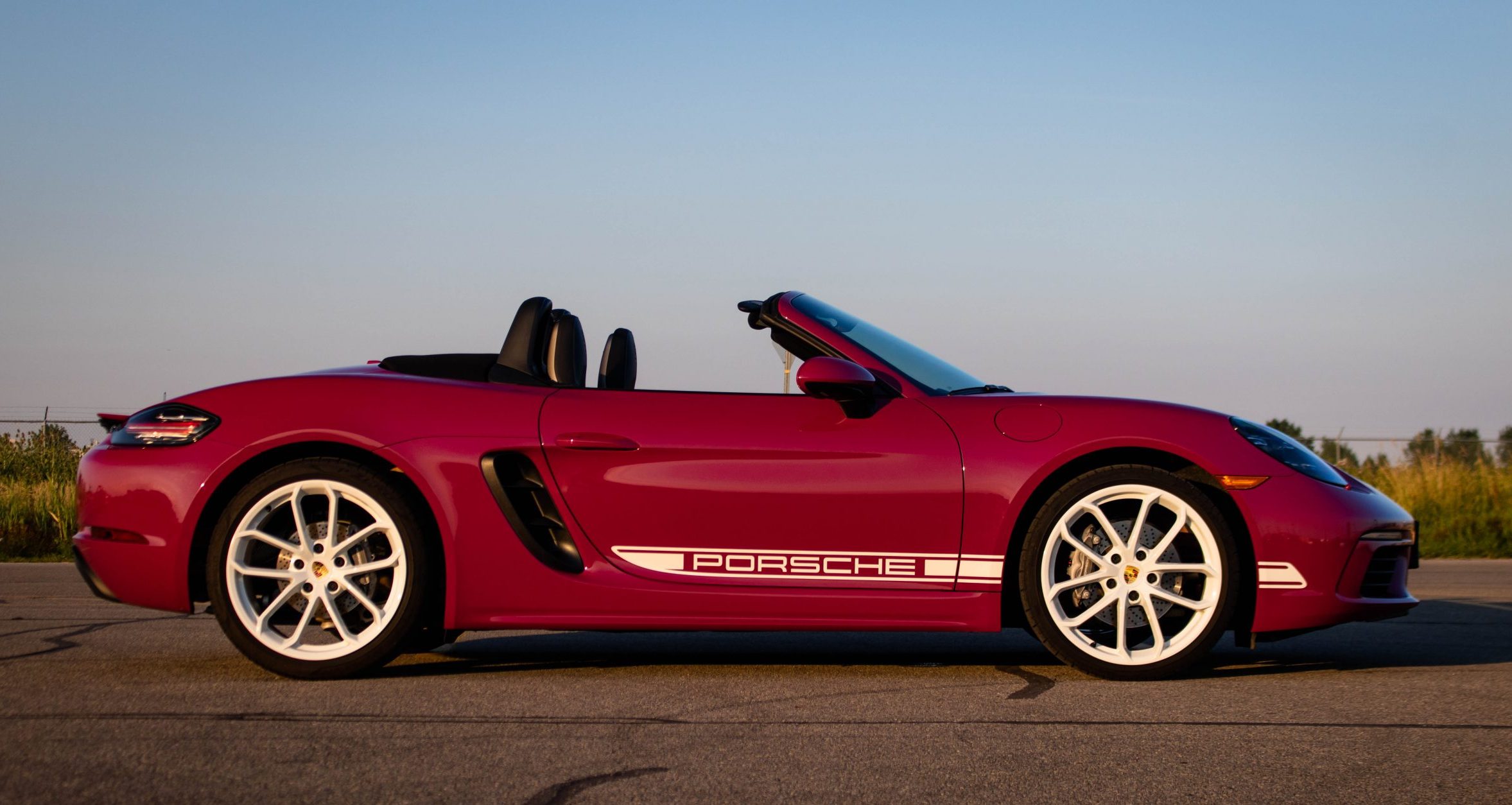
Speaking of Porsche, a report came out today that’s a bit of a head-scratcher. See, years ago, the marque announced that the next 718 Cayman and Boxster would go all-electric. This has proven to be a controversial move, especially since there are sports car traits most electric cars still aren’t ready to embody. Most amateur motorsports venues for stuff like autocross and trackdays don’t have DC fast charging on site, and part of the whole point of a sports car is relative lightness. Batteries are heavy, even though they’ve grown more power-dense as modern EV development’s gone on. Last September, Porsche snuck a slight reversal of course into a presentation, claiming that actually, top variants of the next 718 will be available with gasoline power. Now it seems that’s all gone out the window.
According to Autocar, the next 718 Boxster and Cayman “will now be launched purely as electric models, with Porsche abandoning plans to rework the new architecture developed for them to accept combustion engines.” On paper, this makes sense, as such redevelopment would be expensive. Still, I can’t help but feel a bit sad.
The outgoing 982 Cayman and Boxster rode on the same MMB platform as the current 911 meaning that it’s theoretically possible to update the architecture to be compatible with the European Union’s GSR2 regulations. Plus, they were just so lovely to drive, magnificent road cars in all variants, and they were notably less expensive than equivalent 911s. By seemingly not going ahead with a next-gen combustion-powered 718, Porsche would be enforcing the K-shaped car market in a brutal way: Classic fun is now for people with double-barrelled names and private equity morals, not people who simply worked hard in life.
Honda Shuffles Production Again

If there’s one word that encompasses the new car market in America right now, it’s “volatility.” Shifting tariff rates and consumer demand makes long-term forecasting difficult, and Honda’s reportedly shuffling the deck yet again. Last year, the news broke that Honda was reversing course on sending next-generation Civic sedan production from Indiana to Mexico over tariff concerns. At the time, this seemed like a relatively sensible play as the current Civic is made in Indiana, but there’s been a further development. According to Automotive News, the next-generation Civic sedan is getting the boot from the Hoosier state.
Honda has delayed production of the next-generation CR-V by three months and canceled plans to build the next Civic sedan in Indiana, a supply chain source told Automotive News.
Start of production for the redesigned CR-V has been pushed to April 2027, said the person, who asked not to be identified because the information has not been made public. Honda also has reduced first-year volume planned for the crossover by 6.7 percent, to 41,315 units.
The CR-V is an American favorite, by far and away the marque’s best-selling model stateside. Through the end of September, Honda sold 336,844 CR-Vs in America versus 195,135 examples of its next-most-popular model, the Civic. Despite increasing appetite for small cars, CR-V sales are ripping harder than Civic sales, and the model’s higher transaction prices look good on a balance sheet. Reportedly kicking the Civic out of Indiana could free up additional production capacity for the CR-V, and it’s not like there isn’t a North American plant capable of picking up the slack. Plans still seem to be afoot to build Civic sedans in Honda’s Canadian plant, and Mexico may remain an option.
As for the three-month production delay and reduced first-year forecast for the new CR-V, it’s possible Honda is looking across the aisle at Toyota and adjusting its own forecast based on the way production ramp-up of the new RAV4 is going. For months, Kentucky production was a little slow to get online, resulting in used RAV4 hybrids being worth more than equivalent new RAV4s due to supply being just that tight. Either way, expect a new CR-V to debut sometime in the next few months.
What I’m Listening To While Writing TMD
I’ve always wondered why Attack In Black wasn’t absolutely massive. The Welland, Ontario-based indie rock band only released three studio albums, but right from the get-go, there was something irresistible about their sound. Polished, but not clinical, abstract but not obtuse. “Hunger of the Young” off their debut album “Marriage” is still in my rotation, and it still holds up.
The Big Question
What do you want the government to do about headlights?
Top graphic image: DepositPhotos.com


I drive a hatchback in F150 and Silverado country. I finally gave up and bought nighttime driving glasses (turn everything yellow-amber ish). no more problems, even with 1/2 the trucks being lifted with fog lamps….
How about having actual headlight height requirements so all the stupid jacked up things don’t have thier headlights at my eye level? Pickups and big SUVs are by FAR the worst offenders.
RE: light sensors, it’s about d*mn time. In the semi-perpetual dusk of the PNW winter there is an absolute scourge of people driving around with with either no lights or front DRLs these days. Not sure how much the sensors are to blame vs operator error vs touch screens giving no clear affordance of whether lights are on, but it’s maddening-add in that every new car is now the same steely gray as our streets in winter and it’s rough out there.
Having the dash dim too quickly based on changing light conditions is a problem, but figuring out this piece of conditional logic aside I just can’t see what argument there is in favor of not erring on the side of turning on the lights more often. Like there is no unsafe condition created by someone accidentally having their lights on in a slightly overcast afternoon (or even a sunny one).
This is certainly welcome, but there is an important piece of history that should not be overlooked.
In 1996, Congress directed NHTSA to develop a plan for harmonizing U.S. and European side-impact standards. NHTSA submitted its Report to Congress: NHTSA Plan for Achieving Harmonization of the U.S. and European Side Impact Standards in April 1997.
That was 29 years ago.
NHTSA has had decades to study the differences between U.S. and international safety requirements and develop methods for determining functional equivalence. Yet we are still discussing how to begin harmonizing U.S. vehicle regulations with international standards.
There is a broader pattern here.
When Congress wanted improved rear visibility, it had to mandate the rulemaking through the 2007 Cameron Gulbransen Kids Transportation Safety Act. Congress gave DOT a deadline, but the rule was repeatedly delayed. Safety advocates and parents eventually sued the Department of Transportation in 2013 for failing to issue the mandated rule. NHTSA finally issued the rear-visibility rule in 2014. (Consumer Reports)
Power-window safety provides another example. Congress specifically directed NHTSA to upgrade FMVSS 118 and required a final rule on pull-to-close switches by April 2007. NHTSA ultimately implemented that Congressional mandate in its 2006 rulemaking. (regulations.justia.com)
And Adaptive Driving Beam is an even more recent example. ADB technology had been available internationally for years, but it took a Congressional mandate in the Bipartisan Infrastructure Law to require NHTSA to address the issue. NHTSA finally amended FMVSS 108 in February 2022 to permit ADB systems. (NHTSA)
These examples point to the same problem: Congress keeps having to intervene to make NHTSA act on safety technologies or regulatory changes that the agency’s normal process has allowed to languish.
That is why I would not simply ask Congress to tell NHTSA to “move faster.”
Congress should establish a statutory deadline for NHTSA to conduct a comprehensive review of the FMVSS against UNECE regulations and to adopt international requirements wherever they provide equivalent or greater safety.
Genuine U.S.-specific differences could remain, but NHTSA should be required to provide a documented safety justification for retaining them.
That would preserve U.S. authority over vehicle safety while eliminating unnecessary regulatory divergence.
The objective should not be to replace American safety standards with European standards. It should be to stop maintaining two different regulatory systems when they are solving the same safety problem.
NHTSA has already had 29 years to study harmonization.
Perhaps it is time for Congress to give the agency a deadline to finish the job.
Regulatory activity is not necessarily synonymous with regulatory progress.
When harmonizing international standards don’t happen, I wonder who the beneficiaries are for the non-action…
And, I’ve heard, though don’t know and don’t have a source, that Canada is reviewing auto safety (maybe others) standards to align with European standards, to more easily allow importation of EU cars.
The beneficiaries of non-action is mostly the manufacturers (domestic and international). They can control what vehicles to be officially sold in the US and aboard.
Mercedes-Benz was a massive beneficiary of 1988 federal law that ended the “lawless” grey importation for good. Restricting what Americans can choose to buy maximised profit margin for Mercedes-Benz USA and protected their control over what to sell in the US. Same for other German manufacturers.
If the Europeans choose to import the new vehicles from the US and register them for public road, they must accept that the manufacturer warranty and liability are null-and-void once the vehicles cross the pond to the east. If the American-built vehicle has not been type approved in Europe, the owner must bear the cost of costly type approval himself.
Interesting… Thanks for the followup.
Lights and visibility have been an issue in America for as long as I can remember (I’m 78), and I don’t see that changing any time soon. I am driving a 2026 VW Golf R at the moment, an engineering & electronic tour de force. My car has LED lighting that points to where you are pointing the car. Due to my age I avoid driving at night when that is an option. Matrix lights would be welcome. But I think that’s only part of the problem. Lights from other vehicles don’t bother me much; I’ve become used to that and compensate as best I can. Those little reflectors along the lines help. On well-marked, maintained roads things are fine; unfortunately, that is not the norm. During the day in daylight, no real issues. Add darkness, worn or nonexistent road markings, lines & signs, and some rain for good measure and it becomes a whole new game. I used to curse those who drove with their brights; now I’ve become more understanding. After all, what would you do if you suddenly couldn’t see? Cars today have generally ample lighting; do we really need different “modes” to further complicate things? I think the next problem is going to be lights that don’t work, broken or burned out. There were enough of them when lights were incandescent, along with those who didn’t check and cared less. I think that these long-lasting LEDs are going to further aggravate that problem. Fewer will be inclined or remember to check, and then there is the expense of replacement to further irritate. Years ago (60s-70s) GM had, I believe, a fiberoptic system where you could see that, at least, your front & rear lights were working right from the driver’s seat. A good idea, lost to time and efficiency. More “Ghost Cars.” Are there enough people at the NATSA, and do they drive or like/know cars & trucks? Do they act or react? On the local level there’s poor signage often obscured by foliage or bent and barely visible, worn, almost gone lines along with inadequate road maintenance. Car instrumentation: most today have some sort of touch screen controlling ever-increasing vital functions (tire air pressure, checking oil); no two remotely are the same, even within the same manufacturer. How about some uniformity between all vehicles? You know, “Lights,” with a submenu showing everything you can do with all lighting, or “Mechanical” with oil & tire pressure. You shouldn’t have to relearn these things just to drive another vehicle. What’s going to happen with used vehicles, complicated and not new? Yes, lighting & vision are important, but I don’t see anything but a dark road ahead. Where will we be with those who haven’t mastered the simple turn signal yet? How often and thoroughly are people tested when renewing their license to drive, i.e., people of advanced age like me? Likely at my age, I’ll be gone, hopefully not from a car accident. To those remaining, good luck and watch out; the life you save may be your own!
Cheers for a good comment.
Some of us are old, you know.
Bring back carbide lamps!
OSRAM developed the LED bulb retrofit kits for the “Youngtimer” market in Germany called NIGHTBREAKER VINTAGE. They cast warm glow similar to the halogen bulbs. I do like them very much, and they look “period correct” on the older vehicles with halogen headlamps.
The only caveat is that the vehicles must be approved by Kraftfahrt-Bundesamt (KBA) before the owners can install them in their vintage or classical vehicles.
My ’17 Accord and ’18 MDX really got a lot of things right about the logic behind their lighting. In Auto, the lights come on when they should, including in daylight when it’s raining. But it’s possible to go to running lights only or even fully off except for DRLs when approaching a security gate at a military base or board a ferry at night. Where they messed up is that if you switch to running lights, or off, the instrument panel and screens are still fully illuminated. My visiting son got pulled over when he borrowed my car to visit friends in Houston because he accidentally turned them to off. Fortunately, he hadn’t been drinking and was let off with a non-paper warning.
Unfortunately, the MDX had pretty fussy automatic high beams that I hated when left to their own devices, but I don’t know whether they went back to default (on) mode with every restart or it was the fact that my wife and I both drove it and perhaps her preference was for them to do their own thing. Regardless, I preferred my Accord’s full manual control of them. But the MDX also had the best low beams I’ve ever driven with. They’re bright but have an incredibly sharp and low cutoff that even oncoming Miatas wouldn’t mind. Driving at night on rural Texas two-lanes was just awful in either car. So many tall F-250s with quad lights that always use all four fixtures so you couldn’t tell whether they had their high beams on. It seemed like they did. Learning to just look at the fog line, if it existed, until getting past them was really about the only thing you could do to preserve any semblance of night vision.
Eliminating the Ghost Car problem is the lowest-hanging of safety fruits, if you will. All you need to do is require headlights that automatically come on at night. Right now we have two uncoordinated Federal regulations that create this problem: Daytime Running Lights must go off at dusk, and dashboard instrument illumination automatically comes on in the dark. With gauges illuminated, the drivers think their headlights are on when they’re not.
This is not at all true.
Most of the ghost cars I see on the road have their headlights on, but the rear of the car remains dark. This combination is the result of faulty rear body control modules that do not illuminate the rear of the vehicle when the headlights come on.
Fixing this will require a rethinking of the way modern cars are wired, and may result in mandatory additional circuits to the rear of the vehicle to ensure that headlights and taillights function as a cooperating unit even if a body control module fails.
just reporting what I see. No headlights, and no taillights. I see this every evening.
Yes, though somehow I still seem to see an awful lot of cars with front lights illuminated and no tails, my hunch is that at least living up North is that the auto headlight sensors that many new cars have is not sensitive enough. I can say with certainty I think the auto headlights on my wife’s Subaru should come on in brighter light than they do (and I dug in the settings and set them to “more sensitive”)
The germans have been doing this since the ’80s in the form of warning you when you have a light out, not sure why this is so hard and frankly having owned a couple german cars and come back to a Japanese car it’s insane to me that we didn’t mandate this years ago (as I assume the Germans did)
I see this most in Stellantis vehicles, although I’ve seen many Mercedes and a few Land Rover, Ford and GM products this way.
The only Japanese products I recall ghost driving at night (headlights fully on, taillights fully off) were a recent Toyota Highlander (maybe Grand Highlander) and a Subaru of some sort.
First, enforce a height limit on passenger vehicles. The height of trucks and SUVs has gotten insane to the point they can’t see children they are going to mow over.
Second, enforce that headlights need to be leveled and pass a requirement they do not shine in to drivers eyes.
Third, no one needs automatic brights and while they might “work” against oncoming vehicles, they do not work for people who are out during the night and lights up people’s house as people drive through a neighborhood.
Fourth, set and enforce a lumens limit on headlights.
If you break any of these, I get to smash your headlights.
Can they go back in time and fix headlight regulations 20 years ago? Cause if not whatever they do isn’t going to make much of a difference for another 15-20 years. But some progress is better than none I guess…
Could they require dealers / repair shops to check the aim of the lights before putting the car back on the road?
Many are not up to the task. I’ve been told “we might make it worse.”
NHTSA was ordered by the Congress to start harmonising its FMVSS with UNECE in 1997. Yes, 1997! NHTSA admitted that ECE lighting regulations were much better and more realistic in 2004, but the ageny keeps gazing at its navel to this day…
I tried the automatic high beams on my vehicle once and will never do it again because all it does is reflect the harsh white light from my headlights off nearby road signs and reflective lane markings back into my eyes. I’d advocate for a universal recall applicable to all models to cover existing headlight assemblies with a film to cast a warmer temperature light at slightly lower intensity.
LED bulbs can be calibrated to cast the warmer glow, but the market departments say nope.
OSRAM has NIGHTBREAKER VINTAGE bulbs that are LED H4 bulbs. They cast out the warmer colour temperature for the vintage or classical vehicles for the “period correct” appearance.
Okay, I’ve got this theory about the Volkswagen Pink Moon commercial. If you listen to the lyrics it’s not in your face but it’s about death. And there’s some older cultural references to the pink moon being a sign of death or rebirth.
So here’s the theory, all those kids are out having a great time cruising around enjoying the pink moon, and they get to the big party, but none of them go in. Because they can’t. Because THEY’RE ALL DEAD! They all died in a car crash on the way there, and now they’ll continue their journey to the Great beyond.
US vs UNECE headlight regulations.
UNECE: Why not just adopt our standards and then you can have all these fancy matrix headlights etc
US: That sounds communist. We are going to have our own standards, with blackjack, and hookers!
NHTSA was ordered by the Congress to start harmonising its FMVSS with ECE regulations in 1997. NHTSA admitted in 2004 that ECE lighting regulations are much better and should start harmonising.
Yet, NHTSA kept studying and studying while gazing at its navel for the last twenty-nine years. The court rulings and act of Congress forced NHTSA to adopt the rear-view camera and power window regulations as well as Automatic Driving Beam respectively.
TBQ: All I want is matrix LEDs to be legal, and mandating rear lights to be on whenever any lighting is on up front, including DRLs.
I wouldn’t go as far as mandating auto headlights to be on at all times, but honestly I’d probably want that for most people. It just seems a bit “much” to ask.
I don’t actually have a problem with glare as much. And I’ll take the tradeoff of modern lighting. I can’t believe what we used to drive with. That’s where matrix comes in, best of both worlds.
This sounds incredibly reasonable, I hope they do this.
My take on auto high-beams is that they are awful and overly annoying to other drivers. I had to immediately disable them on our newest car (only one in the fleet with it). The constant on and off when I can see that more traffic is coming, the confusion of turning off from the light on a building or house up ahead, etc.
Also, when taking road trips, I enjoy driving through the night. This year, the prevalence of auto high-beams ruined the night drive on the rural interstates with little traffic. Seemed nearly every car coming at me in the opposite lanes would have the high beams on and off, and on and off. Even with a median in between, it can be blinding at times. I wish this setting came disabled from the factory and was something you have to turn on deep in the screen settings, which would stop the lazies from activating it.
I’m really torn on some aspects of the headlight stuff.
I’ve never had automatic high beams (let alone matrix type) so I can’t really weigh in there. Would manual operation only be better (if not matrix, at least)?
I’m also curious if mandating warm white LEDs would help. Apparently that makes them mildly more difficult to produce, but backup cameras (among many other things) have shown us that the manufacturers will obey. Regardless, that still leaves it an open question as to whether the color temperature alone is the problem, or if it’s other qualities than that.
I also don’t like automatic headlights, personally. Aside from people driving with only DRLs at night, there’s also edge cases, like around observatories that explicitly say to turn OFF your headlights. So I’m very much opposed to any kind of “always-on” minimum.
And I don’t know what else to think aside from just…manual control. Off, DRL, low beams—you turn them on yourself every time, and the car drains its battery if you leave them on after you turn the car off. So that you can’t leave it in a specific position (like DRL).
In Pennsylvania (and probably other states), the law says headlights should be on in construction zones, and there’s also signs telling you to turn them on by the Lehigh Tunnel on the turnpike. I rarely see people obey these.
The only thing I can possibly think of that could actually address the problem would if your car prevented itself from being moved unless you answered a prompt of “Is your headlight setting appropriate for the given conditions?” with every time you shift to drive…but that would both 1–infuriate absolutely everyone (including me) and 2–quickly lose effectiveness as pushing “yes” falls into muscle memory, regardless of whether you actually check your headlights.
Shit sucks, and I hope people much smarter than most of us are actually looking into this with more knowledge and experience at hand. Edge cases are hard.
Warm light temperature is an interesting issue. Some argue that it is less intrusive to wildlife and I think they are right. However, one might argue “irritate the wild life so it stays away from the road” others might raise that it also confuses them and might cause more erratic behaviour. This would need to be studied properly. Lower K lights would be kinder to the rest of us, so I would argue for it and they are not really more expensive to produce.
As for the ‘lights on interlock’ idea, it kind of brings back memories of the mouse seat belt dystopia of the 80’s
Agreed. Take away the auto setting and make people use the switch on a regular basis. People set the switch to auto the first time they use the car, and never touch it again. Out of sight, out of mind.
I’ve never used the auto setting in any car I’ve ever owned, and I turn my lights on when it rains, dense fog, driving away from the sun at dusk or dawn (so light-blinded people coming at me can see me better), all the situations where no one else bothers.
No, automatic-on headlights are great! I just don’t see a downside. They come on in brief dark conditions such as tunnels. They’re always on at dusk, so you’re not a Ghost Car. I don’t want to be manipulating my light controls on a daily basis. My 2017 Ford has a knob for that, but it’s got about five settings and they’re cryptically labeled with tiny icons.
“Not on a daily basis?” The act of driving requires much more, more often.
The downside is they are only triggered by an ambient light sensor. So, during low visibility conditions that happen during the daytime (heavy rain/road spray, dense fog, heavy snow, etc.), the lights do not turn on. In my experience, very few bother to manually turn their lights on in these conditions. They are likely the same people who just leave the switch on auto and never think about the switch ever again.
Conversely, I’d argue that the auto setting is also responsible for some of the ghost cars out there. A good portion of ghost cars I come across are rental cars (can tell by fleet license plate and/or sticker in the window). Again, likely driven by people who never touch the switch in their own car and expect the lights to just come on by themselves.
I don’t quite understand why a lot of domestic and euro automakers are still putting a knob or switch somewhere off to the side on the dash for lights. I’m probably biased, but I much prefer the stalk mounted switch that most Japanese automakers have been using forever. Barely have to take your hand off the wheel to operate and don’t have to contort to look for a switch mounted at waist level then try to read what setting is what. They all use the stalk for high-beam and turn signal function so putting the rest of the light controls there is intuitive. Also space saving, likely cost saving, etc.
Personally, I do prefer the dashboard mounted type, just to minimize the chance of me bumping high beams or turn signals on. Regardless, that brings me to a quasi-related rant that I think wiper and turn signal stalks should be illuminated like the rest of the controls…
I mean, how do you deal with exceptions like my observatory example? Drive-in movies would be another example.
Not many of us commute to observatories or go to drive-ins, but I see your point. There should be a manual override to douse the headlights, but the default should be ON.
I’ve noticed “headlights on in construction zone,” but only in Pennsylvania. I’ve wondered how the “self driving” cars cope with that; auto headlights obviously don’t.
The issue with full manual control is some people can get by on yellow old incandescents while others need a full searchlight in front of them for them to be able to see, and the chances of anyone thinking of what blinds someone else in traffic vs what they want is slim.