

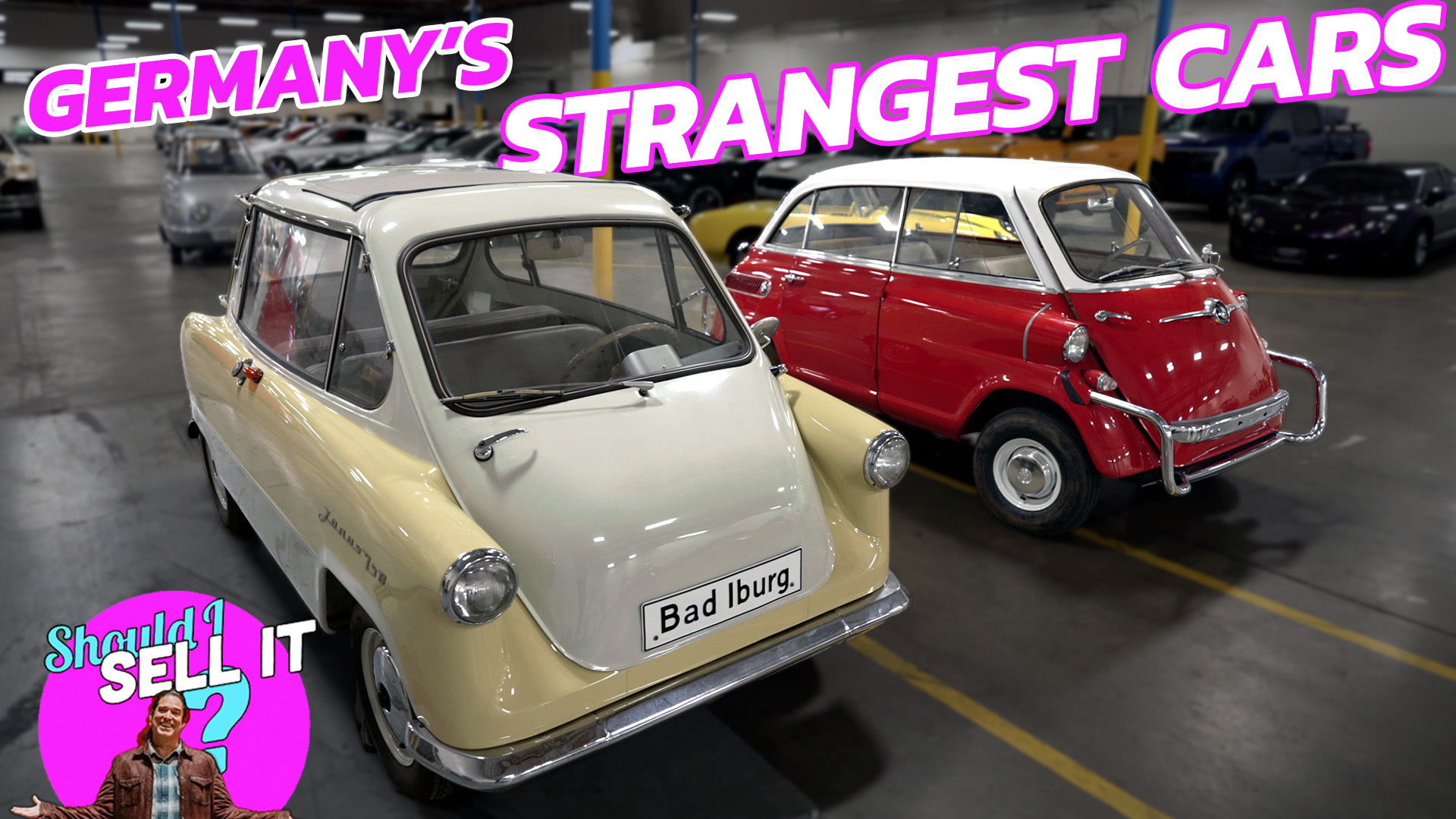
There’s never just one right way to do things. I know this is something that most of us have long understood, but sometimes it’s easy to forget, as we can tend to fall into ruts of doing things one particular way. The way we think of cars can be like this. There’s certain establish solutions to the problems cars aim to solve, and once we find solutions that work, we tend to repeat those solutions, over and over. But what happens when circumstances force you to think in new ways? That’s when interesting things happen.
The cars I want to talk about today absolutely found other ways to solve their problems. In the case of these cars, the problem was how to be a family car. Now, by “family car” I mean something pretty specific: how to seat four people in a vehicle with a bit of room for luggage, and allow for each group of two – usually divided between parents and children – to have their own door.


I know there have been plenty of cars that were used as family cars that didn’t exactly meet these requirements – the Volkswagen Beetle, for example, was used as a family car by millions (my own family included), but if you wanted to let the kids out of the back seat, someone up front had to get out and flip the seat forward. The two cars I’m discussing now – the BMW 600 and the Zündapp Janus – did not have this restriction, and they were even smaller than the Beetle.
Before I get too deep into these microcar weeds, I should remind you that I’m talking about these cars because our Autopian co-Founder Beau has them, and is considering selling one or both of them. That’s right! It’s an other episode of Should I Sell It?
Both of these cars are from postwar Germany, right at about the time when the economy was just starting to pick up again in the later 1950s, but definitely not prosperous, at least not yet. There was still a demand for simple, cheap transportation, especially cars that could hold a family of four, at prices below even that of the ubiquitous Beetle.
The constraints of the economy pushed carmakers to try novel design approaches, ones that didn’t even really feel like cars, as they are generally understood. BMW, for example, found itself after the war with a lineup of luxurious vehicles that precisely nobody was buying. They needed something dirt cheap to make and sell, used as little fuel as possible, yet was still somehow usable. They found their answer in an Italian company that used to make refrigerators: Iso.
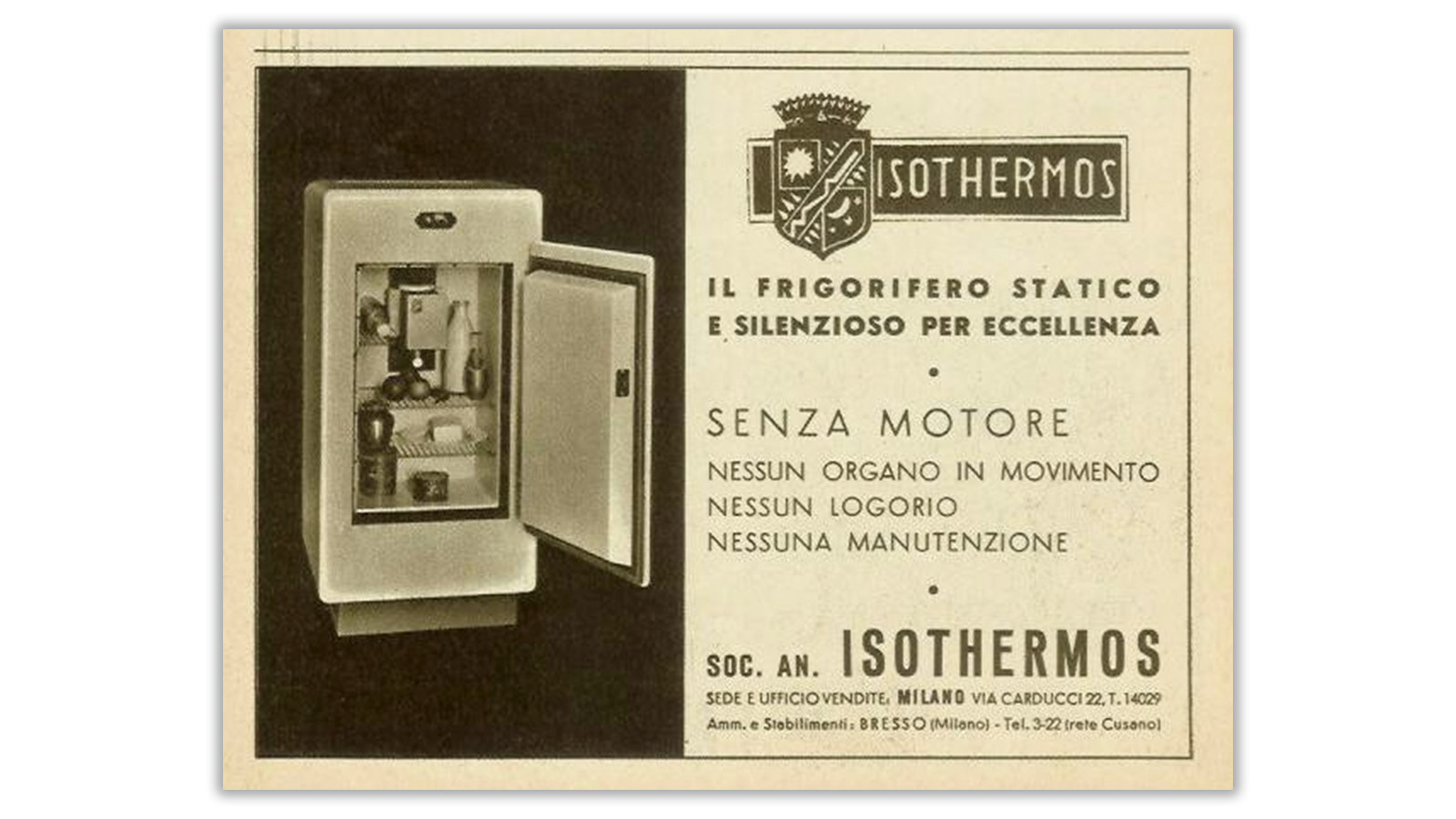
Iso was once Isothermos, the maker of fridges, and the car the company came up with to meet Italy’s postwar trasport demand seemed like a fridge itself, with one big front-opening door. The fridge wasn’t the actual inspiration for this design – it just made sense from an economic standpoint, as it was one door that exposed both seats instead of requiring two – but it was a funny coincidence.
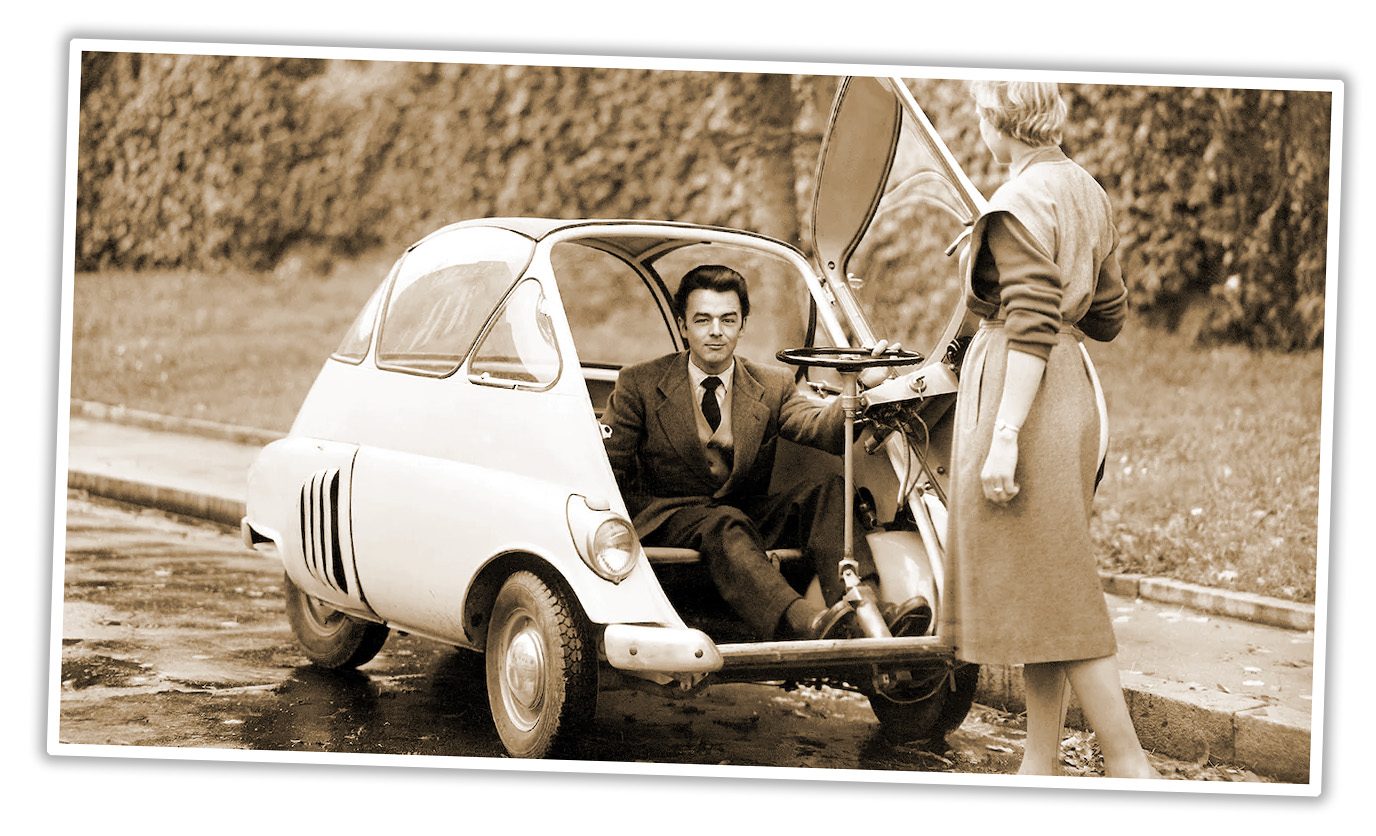
The resulting car was unlike anything really seen before: an egg with a front door, enclosing a bench ahead of a small engine, all propped on four wheels, the rear ones set quite close together. The odd layout worked, and BMW took notice of the car, and the company ended up licensing the body design from Iso, buying the tooling, and then made their own modifications, including adapting one of BMW’s more powerful motorcycle engines for the car.

The resulting BMW Isetta proved to be a hit, and was just what the company needed: a car they could actually sell. Eventually, BMW refined the design into a bigger, somewhat up-market family car, the 600, which now featured two rows of seats, and a door for each row:

The BMW 600 was a packaging marvel, and in many ways can be considered the ideal minimal expression of a four-seater car. It’s smaller than a BMC Mini, but easier for the four passengers to get in and out of, and surprisingly roomy inside.

The rear-mounted flat-twin BMW motorcycle engine made about 20 hp, pretty good for the scale of the car and the era, and while the 600 was a very clever, if quirky design, the market in Germany was tending to want less quirkiness, as the slow recovery after the war was allowing for more traditionally-designed sorts of cars.
But that’s boring! And not every carmaker got pressured out of making weird cars. Some leaned into it, hard, like motorcycle maker Zündapp.
Zündapp never built cars before – and never would again – but the Janus was worth making an exception for. In 1954, Zündapp decided they needed to branch out into more weather-protected vehicles, which meant a car instead of a motorcycle. Zündapp reached out to aircraft maker Dornier, who had built a prototype car called the Delta, a strange little trapezoid of a car that featured upward-opening hatches at both ends.

The Delta was a genuinely novel design: engine in the middle, seats at either end, facing in opposite directions. It was unexpected, but really sort of brilliant, offering a surprising amount of room for people in a remarkably minimal envelope. Zündapp took the concept and refined it a bit, making the side doors side-opening and making the styling a bit less alien-shed-looking:

The odd layout remained the same: an engine in the very middle (a 245cc one-cylinder two-stroke making 14 hp and unique to the car) driving the rear wheels, some luggage space in the middle above and beside the engine (and fuel tank) and two bench seats, one facing forward, one aft.

The Janus was really like two Isettas mounted back-to-back and while it did look sort of strange, I think Zündapp’s designers did a good job of keeping it from looking that strange.
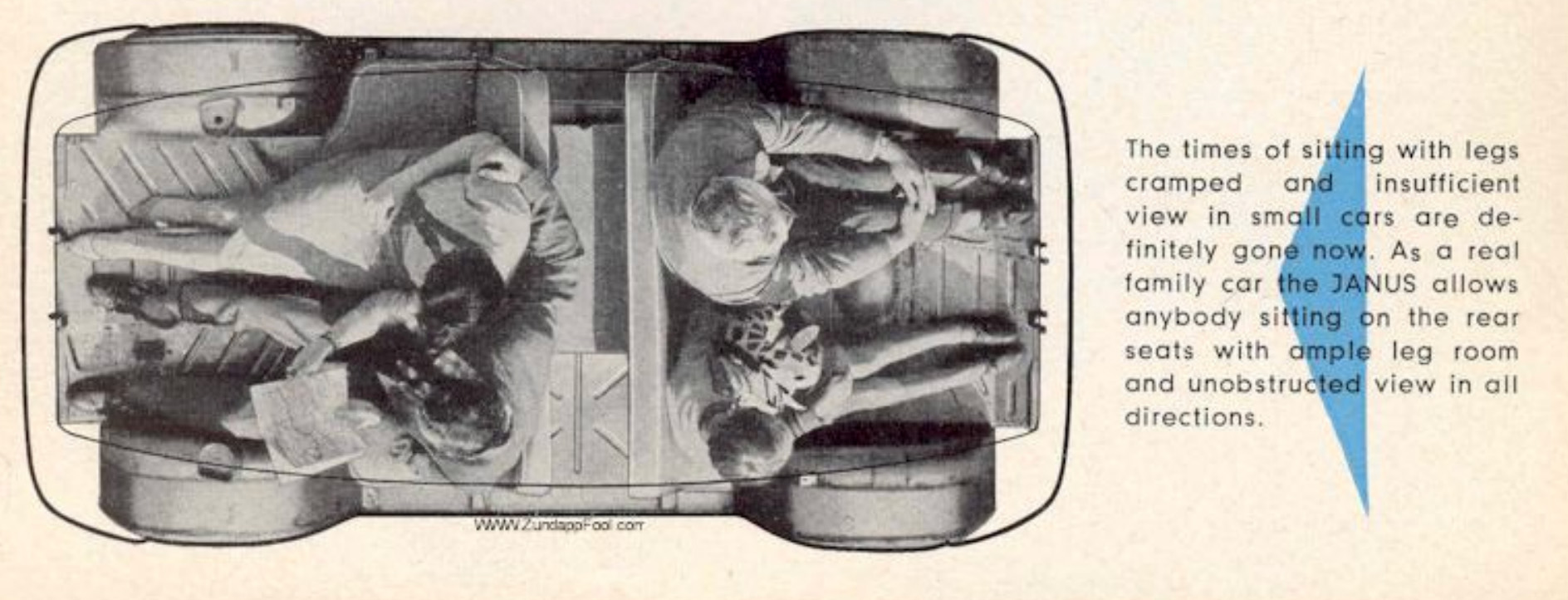
The amazing thing about the Janus is just how roomy it is inside; look at that diagram up there and you can see that there’s a surprising amount of legroom. It feels open and roomy inside, car more so than its exterior dimensions would suggest.
It’s a really clever out-of-the-box solution to the four-seat/a door for everyone family car problem, and in some ways I think it’s a shame the layout never caught on. I guess people like an easier way to talk to one another in different rows? You’d think that separation could be a plus.

Interestingly, when Dick Teague was first designing the AMC Pacer, one of his first ideas was to make something a lot like a ’70s-era Janus. Early sketches, like that one above, show a mid-mounted Wankel rotary engine and seats facing front and rear! The Pacer is already delightfully odd, but this would have been next-level. Some customizer really should make this sketch a reality.
These are both remarkable and clever cars, brilliant and offbeat solutions to the family car problem. I wish Beau could keep both, but I know how reality can be a jerk sometimes. So, what should he do? Sell both? Keep both? Keep one or the other? Let’s hear what you think!




I’m kinda curious how that fridge worked without a motor or moving parts.
No kidding!
Just guessing here. Maybe it’s an icebox? A block of ice goes in a top compartment accessible from the outside and cold air sinks into the interior? Melted ice may drain into a container/catch pan.
Always wanted an Isetta Limo.
Zündapp never built cars before – and never would again
They almost did in 1932. Ferdinand Porsche designed and built a bug-shaped car for them long before a certain mass murderer with a ridiculous moustache claimed the idea for himself.
Steve Urkel had one of these on the Golden globe winning show “Family Matters”. Yes, he did do that.
I wonder what an Isetta with a modern BMW boxer engine would be like. An R1300 with 140 horsepower would be challenging to drive. A friend of mine had an Isetta with a Volkswagen engine and transaxle grafted onto the back of it and it was popping wheelies all the time. At least it had a wide rear track. 140 hp with a couple wheelbarrow wheels 6 inches apart would be interesting to say the least.
How could you possibly miss the opportunity to explain that Janus was the Roman god of doors, and oh yes, had two faces.
Also the month of January is named for Janus because of entering the new year and exiting the old, and janitors primarily took care of doors and keys.
What could possibly be cooler than a car named after a two-faced Roman god?
They said that in the video only.
They expect us to watch videos?
Are they going to be on the test?
I hadn’t even noticed that it wasn’t the slate lady one again.
We need – and I do mean need – to see the road trip in the Janus. That’ll be amazing.
At a minimum, the Janus should be the official Autopian car of Pebble Beach 2027.
I still have an original MT magazine from 1958 featuring micro cars. The Janis was nuts! There is an old episode of the price is right from 1958 on you tube floating around where an Isetta was a prize. The audience went nuts! Not sure out of ooohhs and aughhs or, what the hell is that thing, a refrigerator door for entrance?!
Honestly speaking, I don’t think the Isetta itself was such a “hit”. It was way too expensive back in its’ day, especially if you compared it to a VW Beetle.
Yes, the sales numbers were pretty good. But still BMW suffered a lot during this time and the main reason why this brand still exists is, that the “Neue Klasse” was build.
My dad owned large numbers of Isettas when he was young. When I was a kid, we had 2 of them left. One 250 and one 300 three wheeled version. The 3 wheel version was an Austrian one, as they had some strange regulations where these cars could be driven without paying taxes.
We went on a lot of shorter trips with this one. My dad enjoyed driving it, I enjoyed being the passenger.
Being allowed to drive it myself totally killed the Isetta for me. Such a piece of shit. Manual gearshifter left to you, H-pattern MIRRORED! So 1st gear bottom right, 4th gear upper left area. Unsynchonized.
Due to the only rear wheel not sitting exactly in the middle (due to construction of rear axle) this piece of shit never went a straight line. And no matter how hard you tried, you would always hit the potholes.
As much as I tried. I hated driving it. So easy one…when my dad passed, I sold all Isetta stuff. Sorry dad. I know these little things were your passion and I tried my best to like them…
Edit:
In 1983 my dad had 5 or 6 Isettas. Even 2 “Standard” ones with the larger windows, which are very rare today. He swapped 3 Isettas + 3000 Deutsche Mark for a BMW 1802 touring. From todays perspective totally crazy, as the prices for Isettas are extremely high nowadays. Even for a shitty one, you will pay roughly 8-10k Euros.
Well…the 1802 touring is still there and is my loved little fun car. Money-wise it is worth much less than 3 Isettas + the equal of 3000DM in Euros. Still, this car is more fun than 3 Isettas combined.
The Isetta saved BMW by buying time to develop the new class. The 507 was what nearly killed BMW. They expected to sell 5000 a year but sold less than 300 total. Max Hoffmann came up with the idea for the Mercedes-Benz Gullwing road car using the design of a racing car but with a limousine engine and for the Porsche Speedster that was designed be as cheap as possible but the 507 which was supposed to be in-between was a real dud. .
The Isetta didn’t make BMW much, if any, profit. But, it gave them something to build and sell (and sell it did) while they planned their future. It kept the factory open which was incredibly important, obviously. And it put a lot of Europeans on wheels at a time when normal cars, even VWs, were out of reach for most. I’ve always enjoyed driving Isettas. It’s not like driving a full-sized car, obviously, but they are fun once you get used to them. I’ve never driven a true 3-wheeler, though.
I owe my existence to one of those Isos (well a BMW licensed one anyway). My father’s family escaped from Budapest when the Soviets squashed the revolution in the 50s. For part of the journey they were all somehow smuggled inside one of those tiny things. They got as close as they could to the Austrian border and then had to make their way on foot through mines and patrolling soldiers. My Grandfather had no backup plan other than bringing a bottle of really expensive rum he was going to use to bribe any soldiers they encountered. They made it to the Red Cross across the border and he drank the entire thing with my grandmother.
I love the Zundapp although I’m pretty sure I’d never fit in the thing.
Well, people have been denigrating cars which feature minimal style, minimal handling, and minimal acceleration as “appliances” for decades.
So if the door fits…
C’mon no one was taller than 5 ft 8? Griffin should have been the mom as JT & DT are definitely the kids. I like the Zundapp put a roof rack on it for occasional luggage and the taxi privacy plexiglass and you got a limo.
I am definitely the wrong one to ask about decisions like these!!
Keep ’em, they’re both delightfully weird and tiny.
Can attest to being trapped in the back seat as a kid, as my dad used to drive Beetles as our family car (yes, it was my dad driving, no-one else) when I was a kid.
Wasn’t comfortable, but we lived to tell the tale.
My mother got a license some time in her forties but never actually used it. Too late now to start getting into it; she died over two years ago.
It looks like this BMW has the smaller headlights of the European-spec “600” version but the large “towel rack” bumper overriders of the US-spec “Isetta 600” version. I’m only distantly familiar with these but my impression was that the typical modification back in the day, at least in the US, was to keep the larger sealed beam headlights but to get rid of the overriders. I doubt anyone went to the trouble of adding front and rear overriders to a European-spec 600 so my guess is someone changed the headlight assemblies.
If it’s anything like Beetles at the time, the towel-rail bumpers were a separate factory option, also available as a dealer accessory, in Europe at the time.
Thy couldn’t have a normal front bumper on it because then the door wouldn’t open.
Because these unusual little cars are particularly close to my heart, I would like to point out two things:
The BMW 600 does not have an inline-twin engine, but rather a flat-twin (boxer) engine derived from BMW’s large-displacement motorcycle engines.
And the shape of the Janus is, of course, not a parallelogram, but a trapezoid.
Parallelograms are rarely found as a design element in automotive styling; the roofline of the Citroën Ami 6 comes to mind as an example 🙂
Almost got myself in trouble with my rotting math brain, and said that a trapezoid was a subset of a parallelogram. Both are subs of quadrilaterals, with rhombus, rectangles and squares being special parallelograms. Carry on.
The 600 was also not a modified Isetta, but an entirely new car designed and engineered by BMW from the ground up. It wasn’t a success, but provided the platform for the 700 which sold enough for BMW to fund development of the Neue Klasse cars.
So that’s where the Janus from the Weiner Microcar Museum went. I didn’t see that one coming. Or going:
http://microcarmuseum.com/tour/zundapp-janus.html
And, as the plate suggests, Bruce Weiner got it from the scooter and microcar museum in Bad Iburg when it closed in 1998. It’s even on the defunct museum’s Wikipedia page.
There‘s no „Good Iburg“, by the way 😎
Correct. Iburg was born to be Bad.
Bad Orb, OTOH, used to be a perfect sphere.
If it were up to me, I would never sell any car, ever. Even the ones I hate, they have something fascinating about them, some detail that bears respect and consideration.
Fun factoid about the Isetta: it is equipped with a dynastart. That is, after the motor has finished spinning the engine over, it changes roles and becomes the electrical generator for the car’s ignition and hotel loads.
When you have no room to spare, making a single part fulfill two roles that way is pretty smart.
The Janus is more rare, so keep it! I’m not saying that Isettas are a dime-a-dozen, but you can find those in other collections.
I’d say keep both because Beau doesn’t want to sell them and then one day find himself saying “ did I do that.”
I read about the Janus and figured it was built by my pal Hugh, since that’s his last name!
It’s been said that people would snap the “J” off of the badge as a prank…
I just love cars that are basically water resistant motorcycles.
The Zundapp looks like it gets 300 Hectares on a single tank of kerosene.
Made by a country that no longer exists.
Looking around me I can assure you Germany pretty much still exists 😀
I don’t think so, either. I pulled a screwdriver out of my tool bag yesterday that was stamped “MADE IN W GERMANY”. Show me on the map where the country of West Germany is located, please.
I‘m no expert on the legal details, but in contrast to the „GDR“, the „FRG“ still exists:
https://en.wikipedia.org/wiki/German_reunification
There are just some people
(waves hand at map of Europe) It’s most of this part except for this part, except for this part in the middle that wasn’t part of it.
Same place it always was. You ever study geography new names nothing changed
Well it was Germany than it split to east and west Germany now it’s Germany so yes still exists.
90’s Simpsons humor hasn’t apparently made itself known to you whippersnappers.
https://youtu.be/1HPVQ4FpVlY?si=XP_zjvCTOlmrg2SC
Two people can tell the same joke. One gets a laugh the other gets booed off stage. Matt Groenegg gets the laugh. Do you need me to tell you where you are in this?
Ah, I really didn’t think about that. Thanks for pointing it out (and for the „whippersnapper“, which, at my age, I consider a compliment) 🙂