

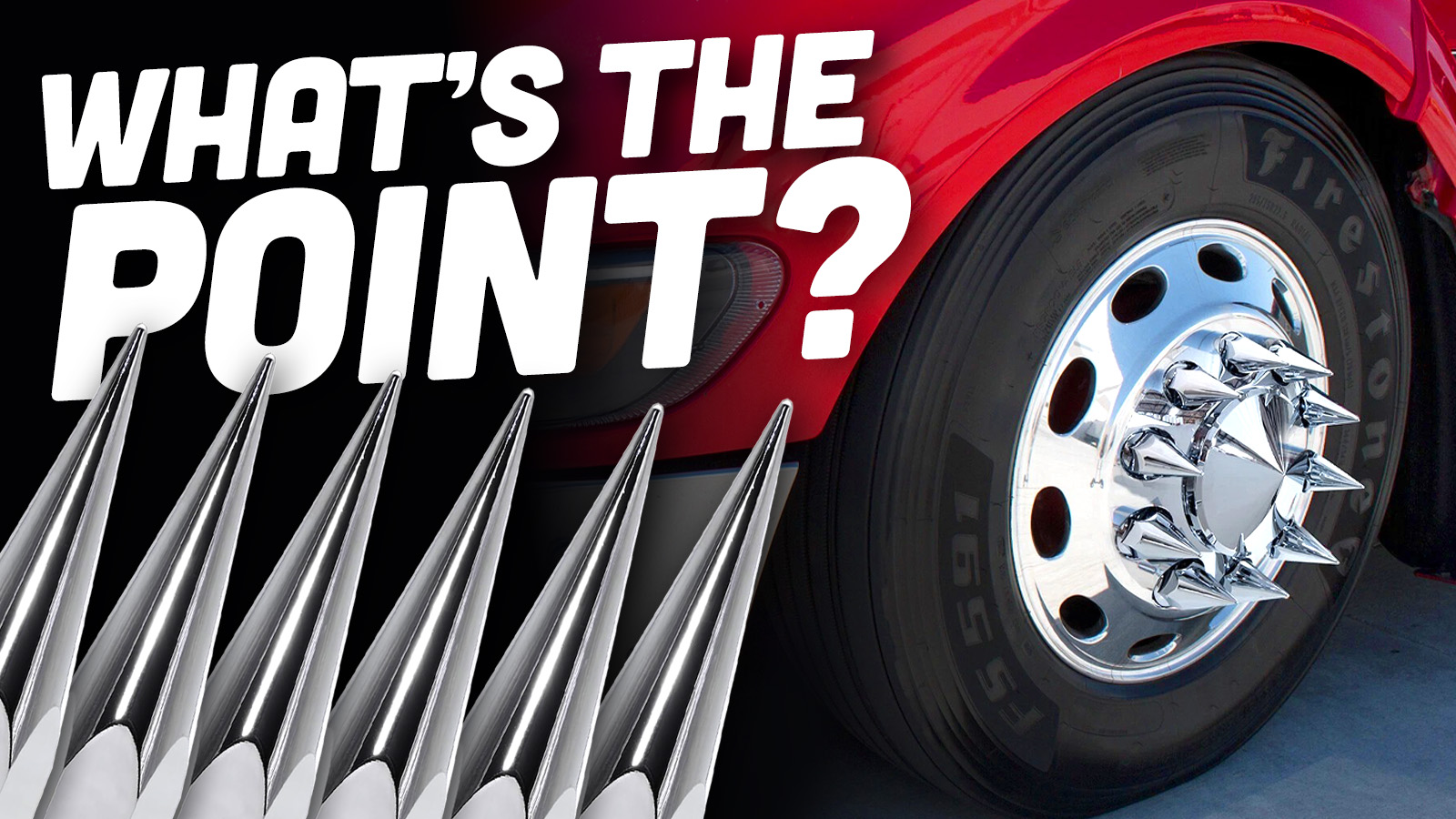
Roughly three million semi-tractors make up a significant portion of America’s logistics backbone. When you’re working, sleeping, or playing, truckers from sea to shining sea are driving to keep America moving. If you’ve ever found enough time to spare at one of these rigs in traffic, you’ve probably noticed some interesting modification choices. Many trucks are rolling around America with big chrome-plated spikes poking out of their wheels. Why do these exist? What would happen if your car contacted these spikes? Something like this? The answer is thankfully better than you’d probably expect.
The subject of trucks with spikes came up in a recent Autopian staff meeting, and I was somewhat surprised to learn that my car enthusiast colleagues didn’t know why trucks are running around with spikes, and my colleagues write about cars for a living. I can only imagine how many other drivers have wondered about this, too.


There are some myths and legends about truck spikes out there. If you take what you see on the internet at face value, you might think that these spikes would absolutely screw up any car they came into contact with. The good news is that these spikes don’t turn semis into death rigs, but they also are a little bit less useful than is sometimes claimed.

Nut Caps Have Been Around Forever
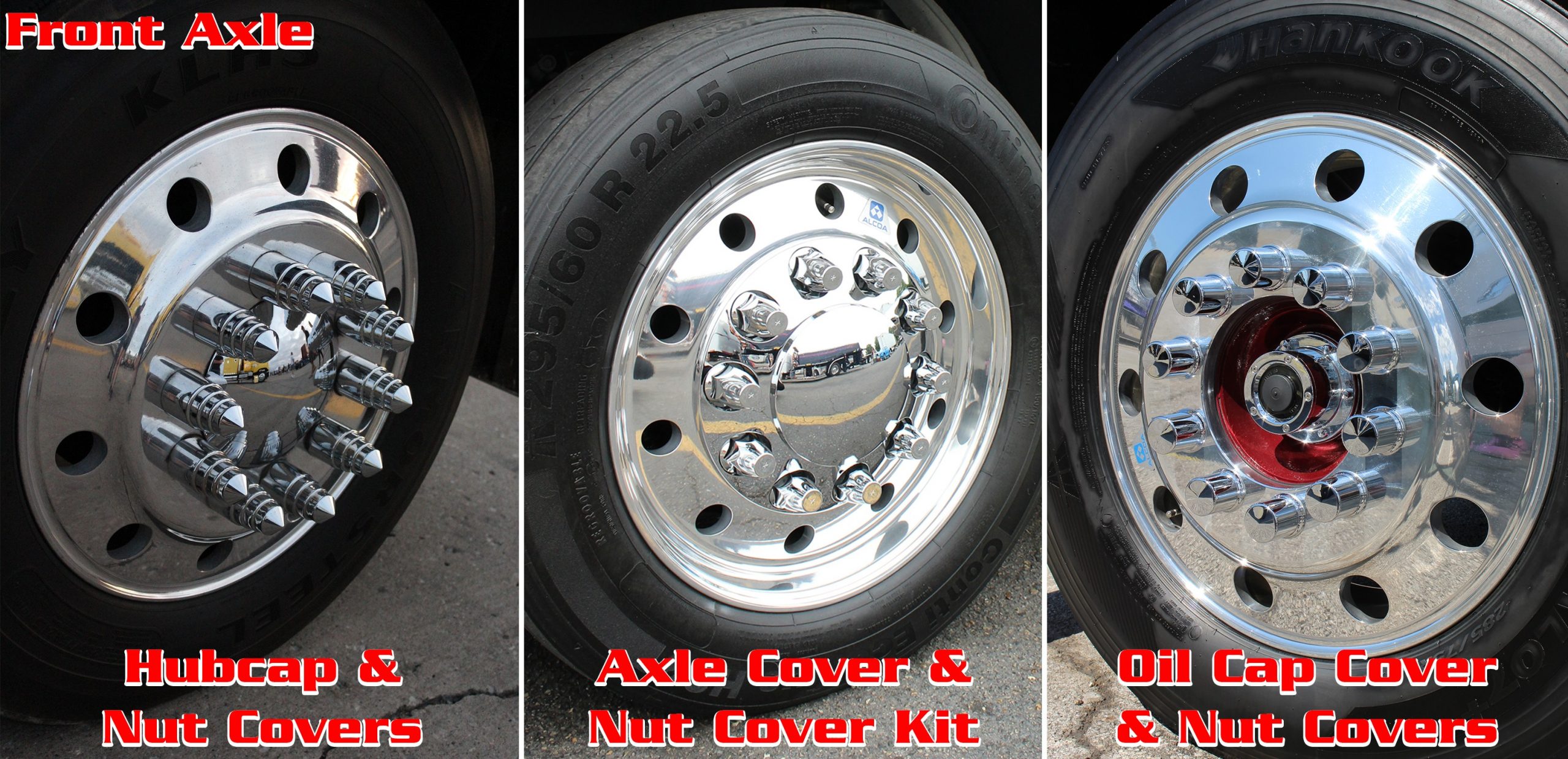
The spikes that you see hanging off truck wheels are not weird, super-long lug nuts. Instead, they’re just a variation of an old idea, the lug nut cover.
The earliest mention of a nut cover that I could find in patent literature was a 1902 design by inventor Frank Lambert. He notes that the exposure of nuts, bolts, and studs is a big deal because these parts can corrode. Lambert said that there was an existing solution to this problem in a single-piece “cap-nut,” also known today as an acorn nut, that mated a protective cover to a nut.

Lambert’s idea was to separate the cap from the nut for ease of manufacture and cost savings. From the patent:
When exposed to the atmosphere or water, bolts with cap-nuts are preferable to open nuts, as corrosion along the thread between the bolt and the nut is prevented. Open nuts are easily manufactured; but cap-nuts in one piece are more expensive, as they require more costly operations, and much material is wasted in their manufacture. Where bolt nuts are used in places exposed to the atmosphere or water, the effect is that the ‘few threads of the bolt that may project out beyond the nut soon become corroded, which renders the removal of the nut very difficult, if not impossible. Cap-nuts are more ornamental and permit of the machine being kept clean more easily. When open nuts are used and some of the threads of the bolt project out beyond the nut, these threads catch the dust and oil, which is difficultly removed. Another advantage of the use of cap-nuts is that the length of the bolt does not need to be so closely calculated-that is, to make the bolt end come flush with the nut since when a cap-nut is screwed down it hides the end of the bolt, and it does not make any difference whether the bolt is a couple of threads longer or shorter.
By my present invention I take a common open nut, form a groove in its top surrounding the opening, and insert in the groove an independent cap, thereby producing an efficient cap-nut at a low cost. While nuts are generally made of metal such as brass, steel, or iron-according to my invention the caps can be of different material than the nut, according to the use to which the nut is to be applied. For cheapness an iron cap can be used, and for fancy nuts, where appearance is a matter of concern, a cap (or covering for the cap) of brass, celluloid, hard rubber, or other material can be used equally as well.
This patent would suggest that the acorn nut has been around since the early 1900s at the very least. Sadly, I could not locate who invented them, though I did find a patent from 1852 that described a decorative cap that would go on top of wood screws. Really, it looks to me like people have been trying to cover up fasteners for at least two centuries, either for decorative or anti-corrosive reasons.

Now, in theory, Lambert’s invention could have been used on an early car. The earliest mention that I could find for lug nut caps is a patent application filed in 1962 and granted in 1964. That cap, which was invented by Leonard H Johnston Jr. and Vernor W. Strom, was designed to keep dirt and the outside environment away from nuts and threads, therefore keeping them free from corrosion.
Patent records show countless more lug nut cap variations after 1964. It would seem to me that if you have a car or truck that has caps covering its lug nuts or lug bolts, its lineage probably traces back to these early inventions. Sadly, I haven’t been able to ascertain when truckers started slapping them onto their lug nuts.
Very ‘Heavy Metal’ But Not Actually Heavy Metal
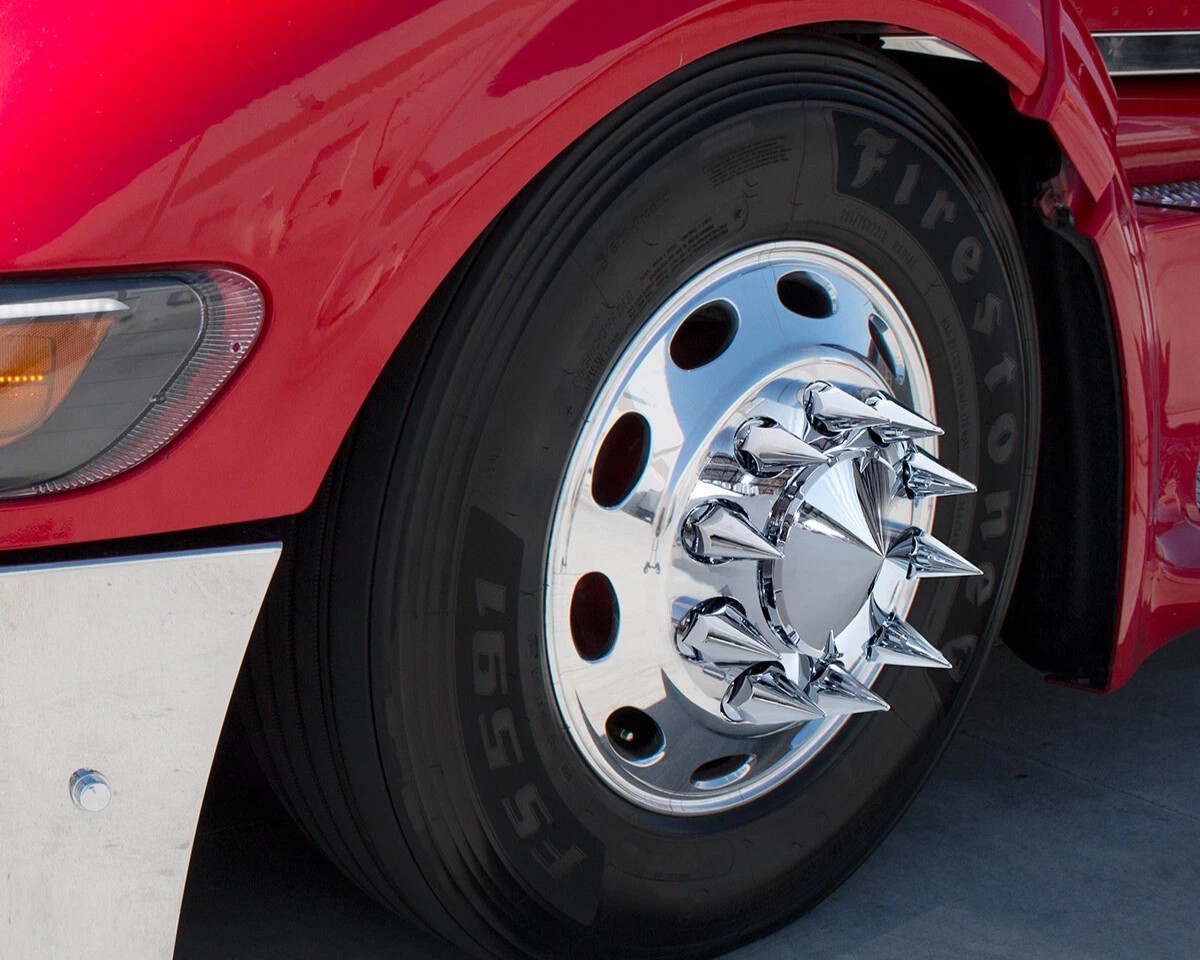
From what I’ve been able to find, it seems that wheel spikes became a large enough trend for people to start noticing back in the 2010s. As one might expect, many drivers were and are at a minimum curious and often downright concerned about what appear to be solid steel spikes doubling as lug nuts on semis. They also wondered, again, pretty reasonably, about what would happen if their cars made contact with those spikes.
Of course, the spikes are not solid, but merely covers for the actual lug nuts, and effectively no different than any other nut or bolt cover. They’re there for aesthetics and to keep gunk off the wheel’s fasteners. Technically, their official purpose is also to protect the fasteners from corrosion from being left in the elements.
Some news publications and law firms have claimed that the spikes are also there for visibility. The idea is that, if you somehow did not see the semi-truck and its trailer as you drove next to it, maybe you’d see the spinning spikes and know to keep away.

According to WFLA News, some trucking companies banned the use of wheel spikes for the opposite reason, saying that spikes are actually distracting to drivers, not a real safety benefit. So there’s a debate about how effective the spikes even are.
I haven’t found any solid research one way or another about the efficacy of spikes in getting drivers’ attention, but I do find the safety angle at least a little suspect. I would think that if a driver misses an entire 80,000-pound 18-wheeler, they probably won’t see the spikes until it’s too late, anyway. It’s not like trucks just sneak up on you.
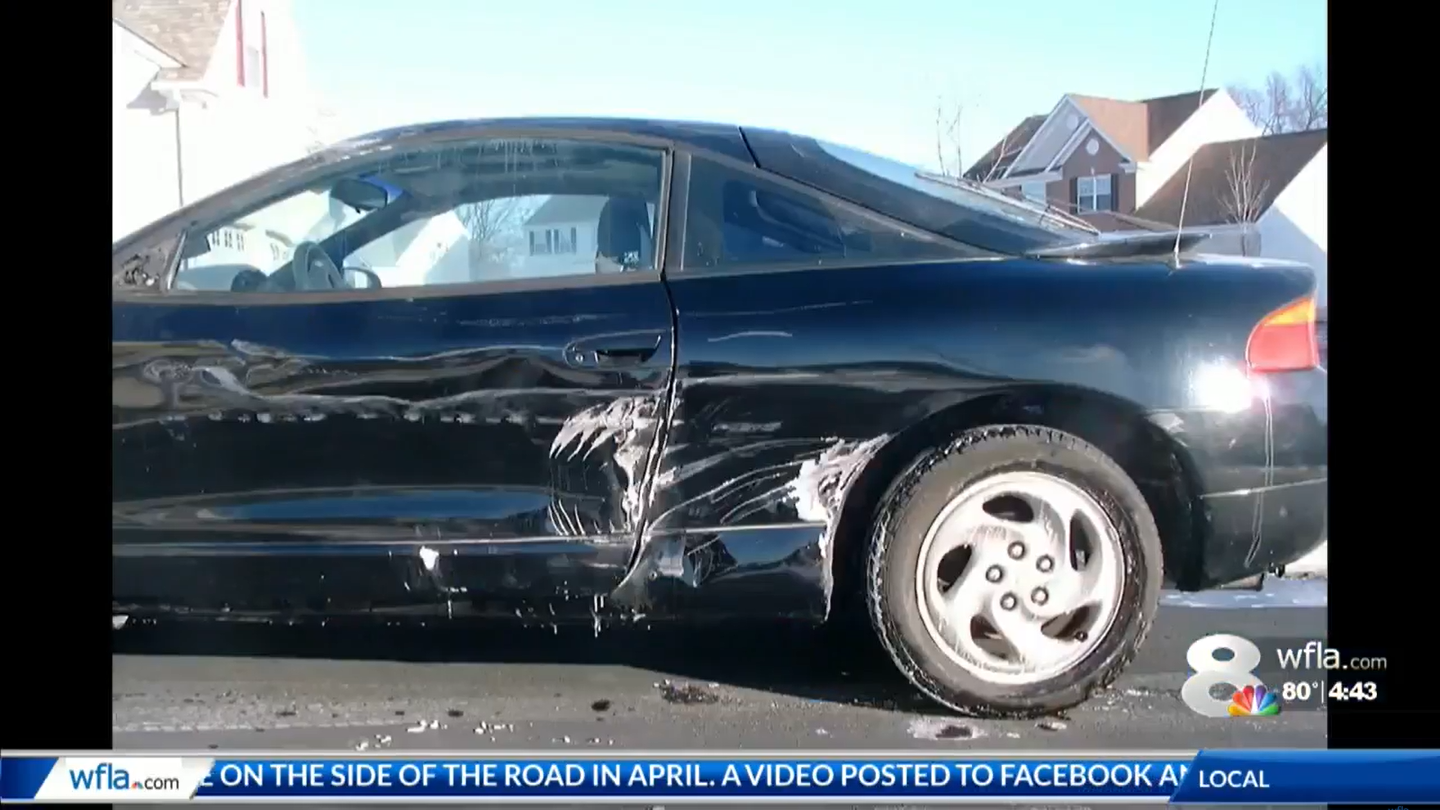
There have also been claims that these spikes have caused heavy damage to vehicles. You can see one of those vehicles in the WFLA News video (click the image, or here, for the video). You can also see claims and photos of purported wheel spike damage on Reddit and forums.
These spikes are generally made out of plastic, flexible rubber, or aluminum that’s barely thicker than a soda can, and then are painted to look like actual chrome. These spikes are held on entirely by friction. It’s unlikely that these spikes will gouge up a car as you see in some photos online. Instead, what’s more likely is that the spikes break and then fall off, then your car gets mauled by the wheel’s actual lug nuts and studs, which are a much harder metal. There’s a popular Reddit thread where a mechanic claims that a car was destroyed by wheel spikes, but in the comments, the vehicle’s actual owner chimed in to say that spikes weren’t even involved.
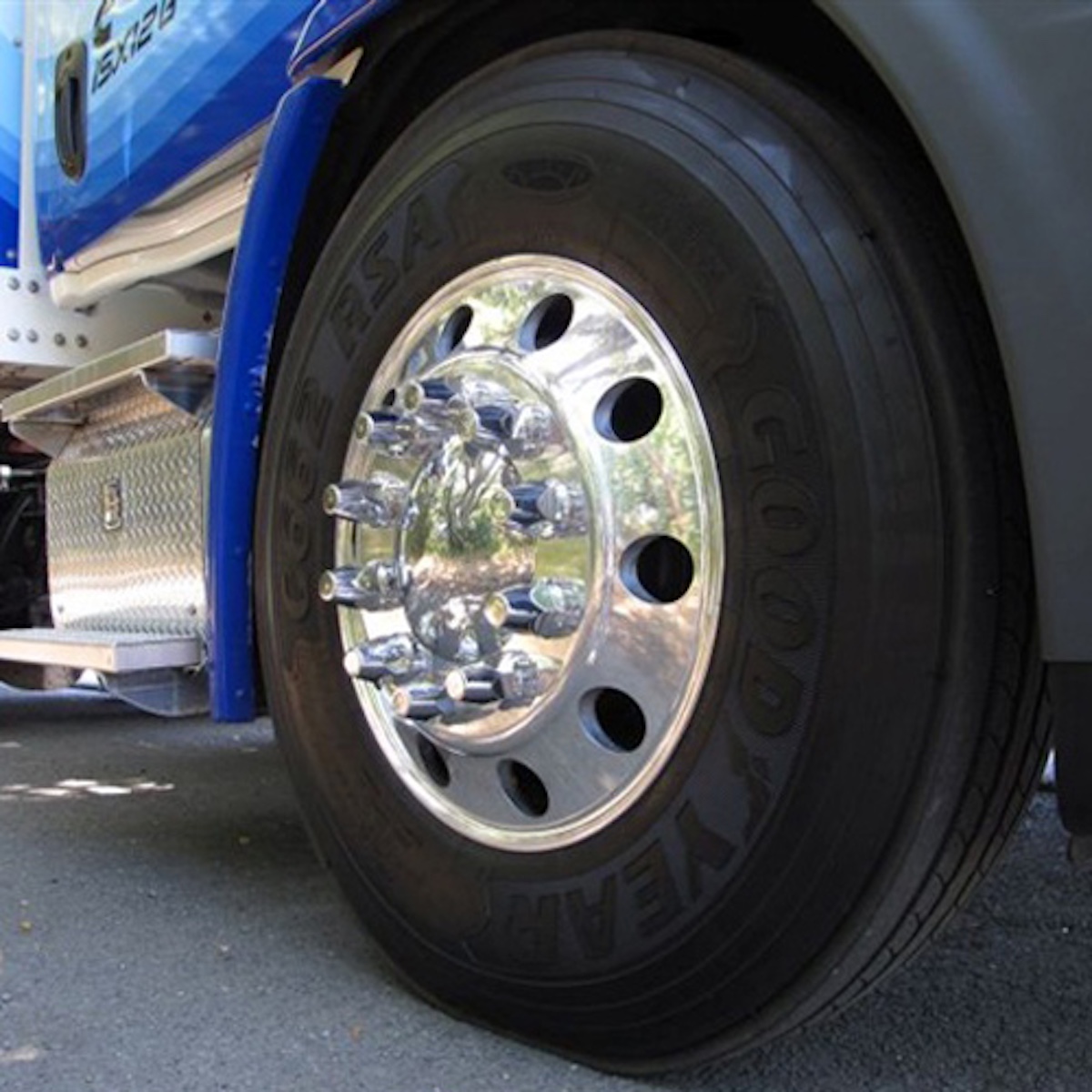
Granted, I’m sure there are exceptions to this, and I would be unsurprised to learn that someone has made these spikes out of heavy metal. But if your car finds itself interfacing with the wheel of a semi, it seems your greater concern will be the truck’s actual lug nuts and, well, the truck itself.
Are Spikes Legal?

Sadly, those spikes, even the plastic ones, do pose a real danger to bicyclists, motorcyclists, and pedestrians. According to the National Law Review, nearly half of the cyclists and about a quarter of the pedestrians killed by trucks are struck by the side of the truck first. In theory, this means if the truck has spikes, there’s a chance the person can get caught up in them.
The legality of these spikes varies. The state of Hawai’i bans spikes that stick out further than four inches. The state of Washington banned them more fully, stating in its statutes:
“No vehicle shall be equipped with wheel nuts, hub caps or wheel discs extending outside the body of the vehicle when viewed from directly above which: (a) incorporate winged projections; or (b) constitute a hazard to pedestrians and cyclists.”

Florida appears to allow spikes so long as they don’t make the vehicle’s overall width greater than 102 inches. Texas also appears to have a width-based restriction. Gadgets that protrude from wheels without being covered by a fender or other guard are illegal in Australia, and truckers have been fined for running them, Sgt. Jesse Grabow of the Minnesota State Patrol wrote in 2022 that Minnesota, like many states, doesn’t regulate these spikes, and neither does the federal government. However, several trucking companies do ban them.
Earlier, I called these spikes a little bit less useful than is sometimes claimed. There are wheel nut covers that you can buy that are nearly flush with the nut, or are rounded out and do not stick inches out. So, if a trucker is buying the spikes just for the protection angle, there are better options. Alcoa, a prominent aluminum wheel maker, also makes smaller nut covers! I also wonder about the effectiveness of these spikes if moisture does make it in.
But they do make a statement about style. It seems people either adore semi-truck spikes or hate them, not really any different than the feelings about wheel spikes on pickup trucks or the wild swangas wheels on big American sedans. The effects of these types of modifications on collisions involving pedestrians and cyclists are concerning, for sure. So, I see why trucking companies and some jurisdictions want to rein them in.
But now know why the truck you recently saw was sporting spikes. If you take anything away from this story, it’s that the plastic, rubber, or thin aluminum spikes on most of these trucks are unlikely to seriously screw up your car. But if you’re a motorcyclist, bicyclist, or pedestrian, keep your head on a swivel and watch out for drivers who might not be looking out for you. If you’re behind the wheel of any vehicle, look for and be friendly to cyclists and pedestrians! Everyone can benefit from safer travel.
Topshot graphic image: Raney’s Truck Parts




These lugnut caps are the truck nuts or handlebar tassels of the Trucker community.
As the young lady said – “Small dick energy” – the users of these things must be cosplaying Mad Max.
The entire point of the spikes is to look scary and aggressive. Everything – everything – after that is gilding a rotten lily.
I’ve had quite enough of people going out of their way to be scary and aggressive.
They’re really great for puncturing open the little seal on a bottle of windshield wiper fluid.
My suspicion that these are useless and purchased by man-children to project a crass image has been confirmed.
Right, it’s good to know they can’t actually get ya, but they say more about the driver than anything. I am not against them, as its a large warning sign to normal people to give the vehicle some space, or pass them asap and get around them.
I am against them. They are meant to be threatening, and my survival brain gets activated when I see them.
Ergo, Death Race 2000. Hilarious movie – everyone should watch it at least once.
One key thing that was missed here: in corrosive environments, lig nut covers by themselves often make corrosion worse. Truckers in the North will often fill them with grease before slipping them on, which helps seal it up and keep the nastiness out. Likely even that wouldn’t protect forever, but a well maintained truck should have the wheels off at least a couple times a year anyways.
That being said, the spiked ones are still dumb. Just regular chrome caps that are flat or rounded work just fine.
Here in the UK trucks tend to have these bright plastic rings with pointers on them on the wheel nuts, They are set to point to each other, I think the idea is to give you a quick visual warning of a loose nut.
I commonly see these on municipal busses and industrial equipment here in the States.
Here in the US, coal-rolling lifted pickups give us the exact same visual warning.
I didn’t know what these were until I learned about them on this site. Satan bless The Autopian.
Autopian branded lugnut covers and spikes coming to a JC Whitney catalog near you.
Under the “Autopain” brand, of course.
If Otto gets wind of these, we could end up with Ottopian-branded merch.
Saw them on a cambered Miata last week in Wisconsin when it was nice out. Thought it was weird but whatever. They’re lame but if a bicycle is that close, then Miata or semi- someone is f*cking up driving
As a trucker all spikes are good for is telling me you are a supertrucker steering wheel holder. All ego no skill. Current fashion is 3 inch cylinder lug nut covers.
I HAVE been wondering about this. Thank you, The Autopian!
Still, the answer is disappointing – they’re exactly what I thought 🙁
That’s nothing compared to a 4 inch diameter steel axle sticking an extra 24 inches on either side of a John Deere tractor. Those will totally rip the doors and fenders off a passing car.
The idiots that try to pass get so pissed about it too.
I always took these as the Tractor driving “I’m tough” accessory, and this here’s the Rubber Duck take is spot on. There are solutions that don’t make one think of Mad Max.
It’s already been said but I’m gonna add to it: the spikes are there to intimidate and possibly hurt people. There are myriad ways to protect lug nuts that don’t like high speed rotary weapons.
“the spikes are there to intimidate and possibly hurt people.”
+1
That’s what I think as well. All the other claimed reasons for them are weak assed bullshit.
Same deal with those ‘bull bars’ some truckers put on their trucks… particularly on trucks used in urban areas.
Hey! I want a bull bar for my semi! But then, I travel mostly theMidwest, aka deer country. One of those bastards can cause 50 grand in damage to a semi
I have seen quite a few Midwestern semis with a lot of blood covering a side of the bars but only a cracked fender or something as real damage. They seem to do the job!
***Bambi Basher
Yeah but I’m not referring to you. I’m talking about trucks in the Toronto area… which is NOT deer country.
But one thing to consider is where those trucks came from or where they are going. Just because they happen to be in or passing through Toronto now doesn’t mean they’ll be there in a couple hours or days.
Keep in mind though, I agree that installing those bull bars on local route trucks is just dumb.
They call ’em ‘roo bars deeyown oondah.
These are an indication of the character of the driver. Bigger spikes = more degenerate.
Exactly this. The spikes just indicate that the driver is an insecure dbag who’s trying to look tough, and failing.
Pretty much this exactly. I never assumed they were a true hazard… more like the chromed spike equivalent of rolling coal.
I would say truck nutz . . . as much as they target people with unhealthy thoughts about their vehicles, they’re at least not continually damaging to the environment.
As a trucker, I second this
This is one of those questions I’d been mentally asking myself while driving and then forgetting to actually ask when I got home.
Good to know that they have a purpose and aren’t necessarily as scary as they look (even if still not something I’d want to encounter up close, car or no car).
Thanks, Mercedes!
SIZE OF WHEEL SPIKES:
1. DIRECT PROPORTION TO HOOKERS HIRED/K^!!&D
2. INVERSE PROPORTION TO P#%!$ SIZE
“… what’s more likely is that the spikes fall off and your car gets mauled by the wheel’s actual lug nuts and studs…”
How would they fall off? When pressure is applied at the pointy end – there’s no where for it to go. And they’re not going to twist off – otherwise they’d be falling off just from driving along the road.
The “function” they serve is 100% intimidation. That is all.
A big rotating wheel should provide plenty of leverage to twist them off.
Can confirm. I have (non-spiky) plastic lug covers on one of my cars and it’s a delicate balance to tighten them enough to not fall off, but not so much that they crack or deform. I’ve lost a few when I undershot the torque “spec”.
“How could this fall off?” is the question asked by everyone who’s ever designed or produced an auto part, yet many parts do.
They are plastic. They break off.
“The idea is that, if you somehow did not see the semi-truck and its trailer as you drove next to it, maybe you’d see the spinning spikes and know to keep away.”
Ha. Its a stupid intimidating thing. If they arent solid, maybe i’ll swing a hammer at a parked truck to find out. Maybe not.
Look at the trucks they are on. Not corporate!
Yeah, I don’t know how an intelligent person could make that statement with a straight face.
How does it seem at all plausible that a person could miss the ENTIRE TRUCK, but see stupid little spikes?
Just because someone says something stupid, doesn’t mean that a journalist has to repeat it as if it was legitimate.
I’d always heard these were designed to subconsciously nudge other drivers toward the middle of their own lanes (“OMG spikes Karen…can’t risk the Chrysler!”) to promote (marginally) better visibility of them from the trucker’s pov. Appreciate the unpacking Mercedes!
The first time I saw a wheel attachment that nasty looking was in a movie about some guy who ends up in a chariot race.
I was hoping for a Ben Hur reference. I can now retire in peace.
Purpose? To take out Greased Lightning.
(Amending text now)
When I was in Germany on the Autobahn last year I noted that all large trucks have discs that are flush with the lug nut so the protruding part of the wheel is basically a flat surface with lug nut holes in it. I wondered why that isn’t a thing in the US and then immediately realized that in the land of spiked lug nut covers to look cool, likely nobody cares about the safety aspect here.
The land of image is being more important than function.
May as well add calvin pissing on X, stickers professing your love/hate for politicians, a stellantis-branded-logo, and some trucknuts.
I was going to say, I’m surprised we didn’t sell any of these to our trucker customers, who would put the STUPIDEST shit on their company owned trucks, but then I saw the bit about them being illegal in Washington.
See plenty of them and I don’t know how this stupid shit is still legal.
They have a purpose? I thought it was a spike dog collar type of thing for the bulldog mascott.
Except that spiked dog collars did have a purpose back when they were used in dog fights.
Dog fights are inhumane. I was thinking more of 80’s fashion.
I think the purpose before that was to protect herding dogs from wolves/coyotes.
Exactly…
The most paper thin purpose! Though I suppose you could also say they are damage multipliers in pedestrian incidents.
I wouldn’t mind seeing a person who received personal or property damage that was increased by the spikes using the presence of the spikes as evidence of intent in their lawsuit.
I agree.
Trying to be charitable here, I always thought that they were an effort to avoid scrubbing the rest of the rim in a tight situation as the wheel was turning. Basically, when doing a tight maneuver, the sound of the cones-o-deeth rubbing off would indicate that the much more expensive rim was about to take a hit.
I feel for large vehicle drivers, by and large they are super safe and put up with a lot of crap from people who don’t realize that large vehicles don’t stop as quickly and are using all the lane. It is rare that I see a large vehicle driven poorly.
Oh, how I wish that were still true. I feel like back in the 1980s and 90s you could reliably count on semi truck drivers being professional and good mannered. But now, so so many of them are nearly as bad as the 4-wheel drivers.
They’re better behaved on average than pickup truck commuters, but that isn’t saying much.
Mainly during orange season. 😉
I guess it depends on your definition of “poorly.” I consider it poor driving to enter the left lane forcing drivers to slow down substantially. This is usually done because the driver doesn’t want to have to wait for a sufficient open space. It usually coupled with the driver passing the truck that was in front of him at 1mph faster than that other truck’s speed. Go ahead and force traffic to brake rapidly and create traffic backlogs so that you don’t have to slow done the tiniest amount and can save up to 5 minutes on your 10-hour shift.
Not to defend the drivers who do this, but if the 5 minutes shaved off transit time are enough to get them to their destination inside of the limits proscribed by law, then it is worth it to the driver to do this and inconvenience the traffic stuck behind them during the overtake.