

Roughly three million semi-tractors make up a significant portion of America’s logistics backbone. When you’re working, sleeping, or playing, truckers from sea to shining sea are driving to keep America moving. If you’ve ever found enough time to spare at one of these rigs in traffic, you’ve probably noticed some interesting modification choices. Many trucks are rolling around America with big chrome-plated spikes poking out of their wheels. Why do these exist? What would happen if your car contacted these spikes? Something like this? The answer is thankfully better than you’d probably expect.
The subject of trucks with spikes came up in a recent Autopian staff meeting, and I was somewhat surprised to learn that my car enthusiast colleagues didn’t know why trucks are running around with spikes, and my colleagues write about cars for a living. I can only imagine how many other drivers have wondered about this, too.


There are some myths and legends about truck spikes out there. If you take what you see on the internet at face value, you might think that these spikes would absolutely screw up any car they came into contact with. The good news is that these spikes don’t turn semis into death rigs, but they also are a little bit less useful than is sometimes claimed.

Nut Caps Have Been Around Forever
The spikes that you see hanging off truck wheels are not weird, super-long lug nuts. Instead, they’re just a variation of an old idea, the lug nut cover.
The earliest mention of a nut cover that I could find in patent literature was a 1902 design by inventor Frank Lambert. He notes that the exposure of nuts, bolts, and studs is a big deal because these parts can corrode. Lambert said that there was an existing solution to this problem in a single-piece “cap-nut,” also known today as an acorn nut, that mated a protective cover to a nut.

Lambert’s idea was to separate the cap from the nut for ease of manufacture and cost savings. From the patent:
When exposed to the atmosphere or water, bolts with cap-nuts are preferable to open nuts, as corrosion along the thread between the bolt and the nut is prevented. Open nuts are easily manufactured; but cap-nuts in one piece are more expensive, as they require more costly operations, and much material is wasted in their manufacture. Where bolt nuts are used in places exposed to the atmosphere or water, the effect is that the ‘few threads of the bolt that may project out beyond the nut soon become corroded, which renders the removal of the nut very difficult, if not impossible. Cap-nuts are more ornamental and permit of the machine being kept clean more easily. When open nuts are used and some of the threads of the bolt project out beyond the nut, these threads catch the dust and oil, which is difficultly removed. Another advantage of the use of cap-nuts is that the length of the bolt does not need to be so closely calculated-that is, to make the bolt end come flush with the nut since when a cap-nut is screwed down it hides the end of the bolt, and it does not make any difference whether the bolt is a couple of threads longer or shorter.
By my present invention I take a common open nut, form a groove in its top surrounding the opening, and insert in the groove an independent cap, thereby producing an efficient cap-nut at a low cost. While nuts are generally made of metal such as brass, steel, or iron-according to my invention the caps can be of different material than the nut, according to the use to which the nut is to be applied. For cheapness an iron cap can be used, and for fancy nuts, where appearance is a matter of concern, a cap (or covering for the cap) of brass, celluloid, hard rubber, or other material can be used equally as well.
This patent would suggest that the acorn nut has been around since the early 1900s at the very least. Sadly, I could not locate who invented them, though I did find a patent from 1852 that described a decorative cap that would go on top of wood screws. Really, it looks to me like people have been trying to cover up fasteners for at least two centuries, either for decorative or anti-corrosive reasons.

Now, in theory, Lambert’s invention could have been used on an early car. The earliest mention that I could find for lug nut caps is a patent application filed in 1962 and granted in 1964. That cap, which was invented by Leonard H Johnston Jr. and Vernor W. Strom, was designed to keep dirt and the outside environment away from nuts and threads, therefore keeping them free from corrosion.
Patent records show countless more lug nut cap variations after 1964. It would seem to me that if you have a car or truck that has caps covering its lug nuts or lug bolts, its lineage probably traces back to these early inventions. Sadly, I haven’t been able to ascertain when truckers started slapping them onto their lug nuts.
Very ‘Heavy Metal’ But Not Actually Heavy Metal
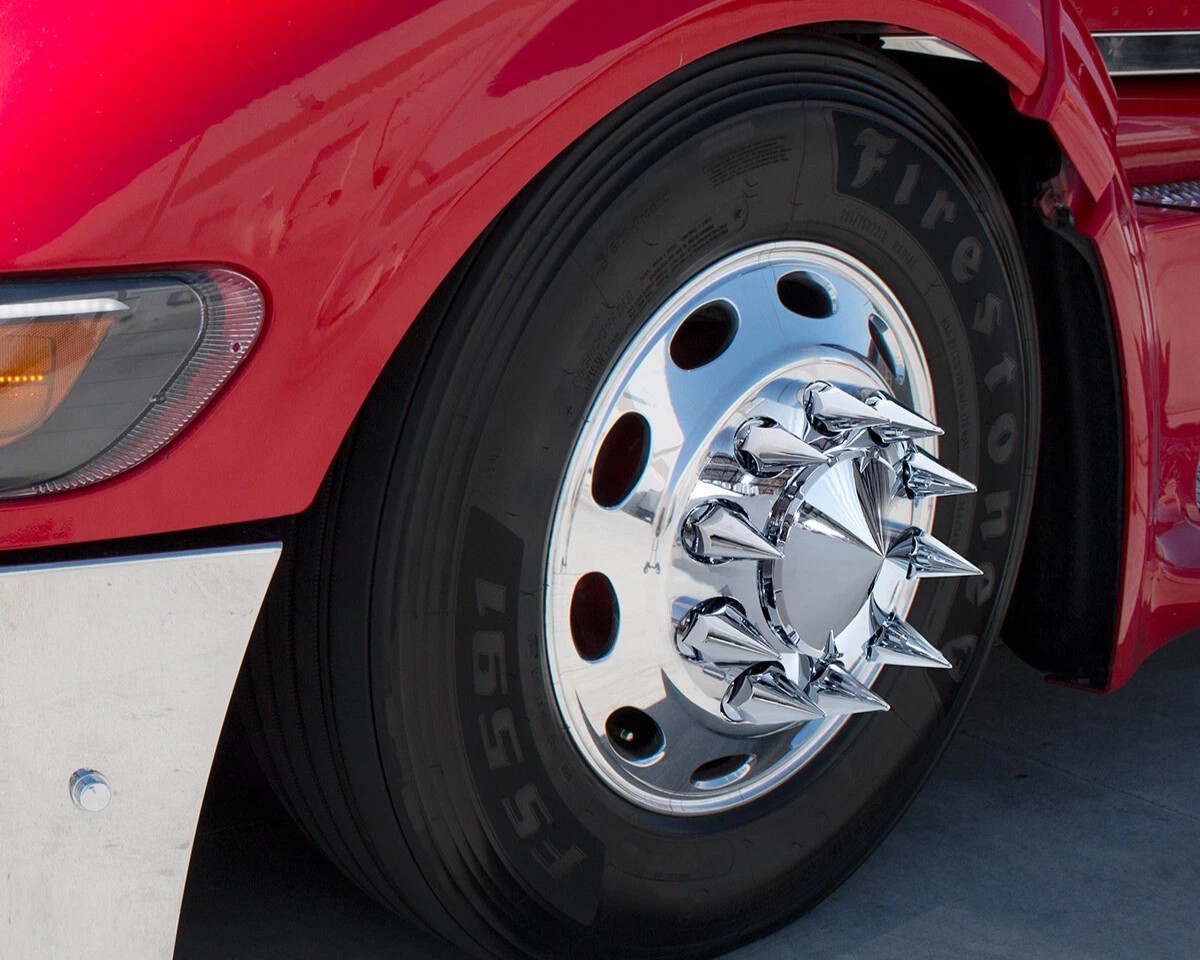
From what I’ve been able to find, it seems that wheel spikes became a large enough trend for people to start noticing back in the 2010s. As one might expect, many drivers were and are at a minimum curious and often downright concerned about what appear to be solid steel spikes doubling as lug nuts on semis. They also wondered, again, pretty reasonably, about what would happen if their cars made contact with those spikes.
Of course, the spikes are not solid, but merely covers for the actual lug nuts, and effectively no different than any other nut or bolt cover. They’re there for aesthetics and to keep gunk off the wheel’s fasteners. Technically, their official purpose is also to protect the fasteners from corrosion from being left in the elements.
Some news publications and law firms have claimed that the spikes are also there for visibility. The idea is that, if you somehow did not see the semi-truck and its trailer as you drove next to it, maybe you’d see the spinning spikes and know to keep away.

According to WFLA News, some trucking companies banned the use of wheel spikes for the opposite reason, saying that spikes are actually distracting to drivers, not a real safety benefit. So there’s a debate about how effective the spikes even are.
I haven’t found any solid research one way or another about the efficacy of spikes in getting drivers’ attention, but I do find the safety angle at least a little suspect. I would think that if a driver misses an entire 80,000-pound 18-wheeler, they probably won’t see the spikes until it’s too late, anyway. It’s not like trucks just sneak up on you.
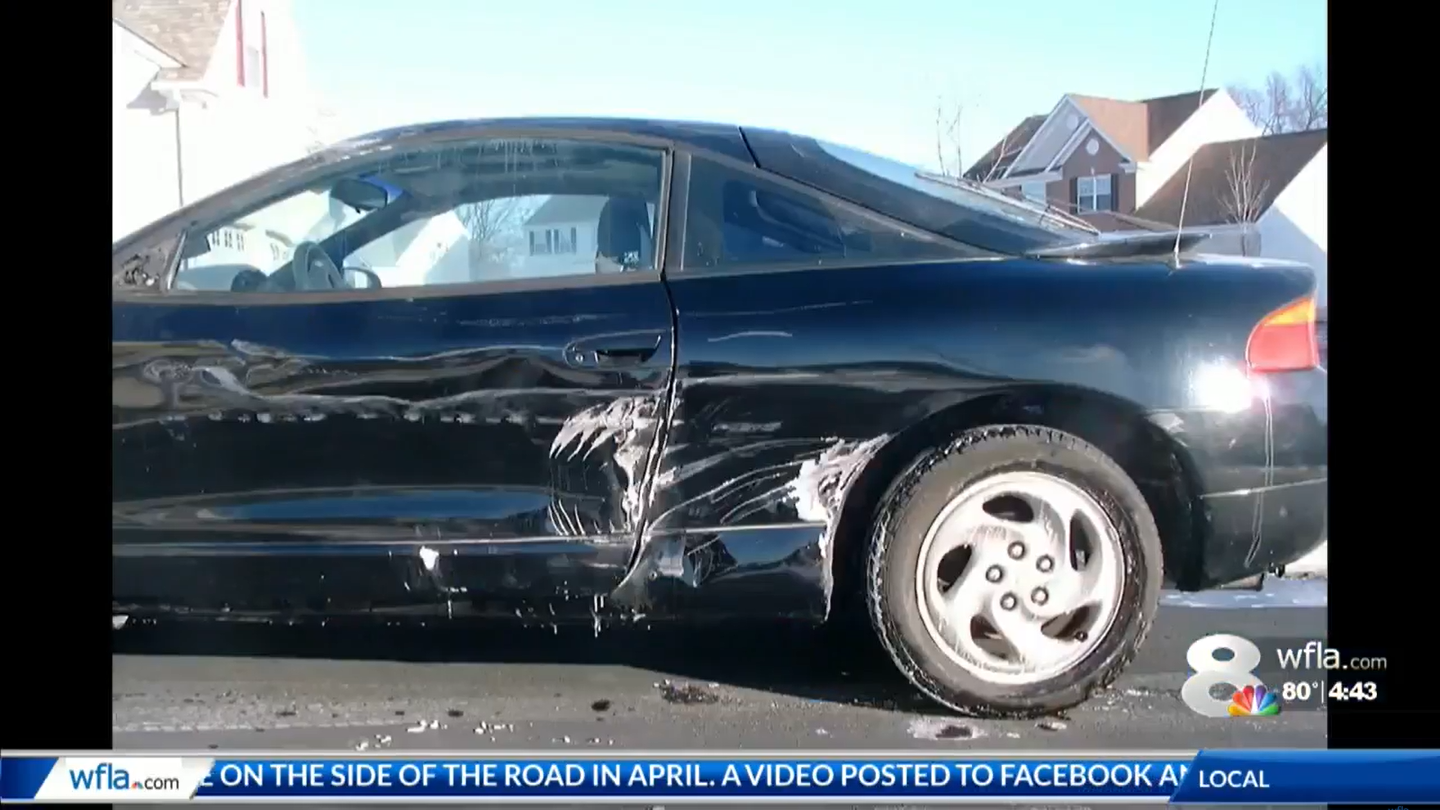
There have also been claims that these spikes have caused heavy damage to vehicles. You can see one of those vehicles in the WFLA News video (click the image, or here, for the video). You can also see claims and photos of purported wheel spike damage on Reddit and forums.
These spikes are generally made out of plastic, flexible rubber, or aluminum that’s barely thicker than a soda can, and then are painted to look like actual chrome. These spikes are held on entirely by friction. It’s unlikely that these spikes will gouge up a car as you see in some photos online. Instead, what’s more likely is that the spikes break and then fall off, then your car gets mauled by the wheel’s actual lug nuts and studs, which are a much harder metal. There’s a popular Reddit thread where a mechanic claims that a car was destroyed by wheel spikes, but in the comments, the vehicle’s actual owner chimed in to say that spikes weren’t even involved.
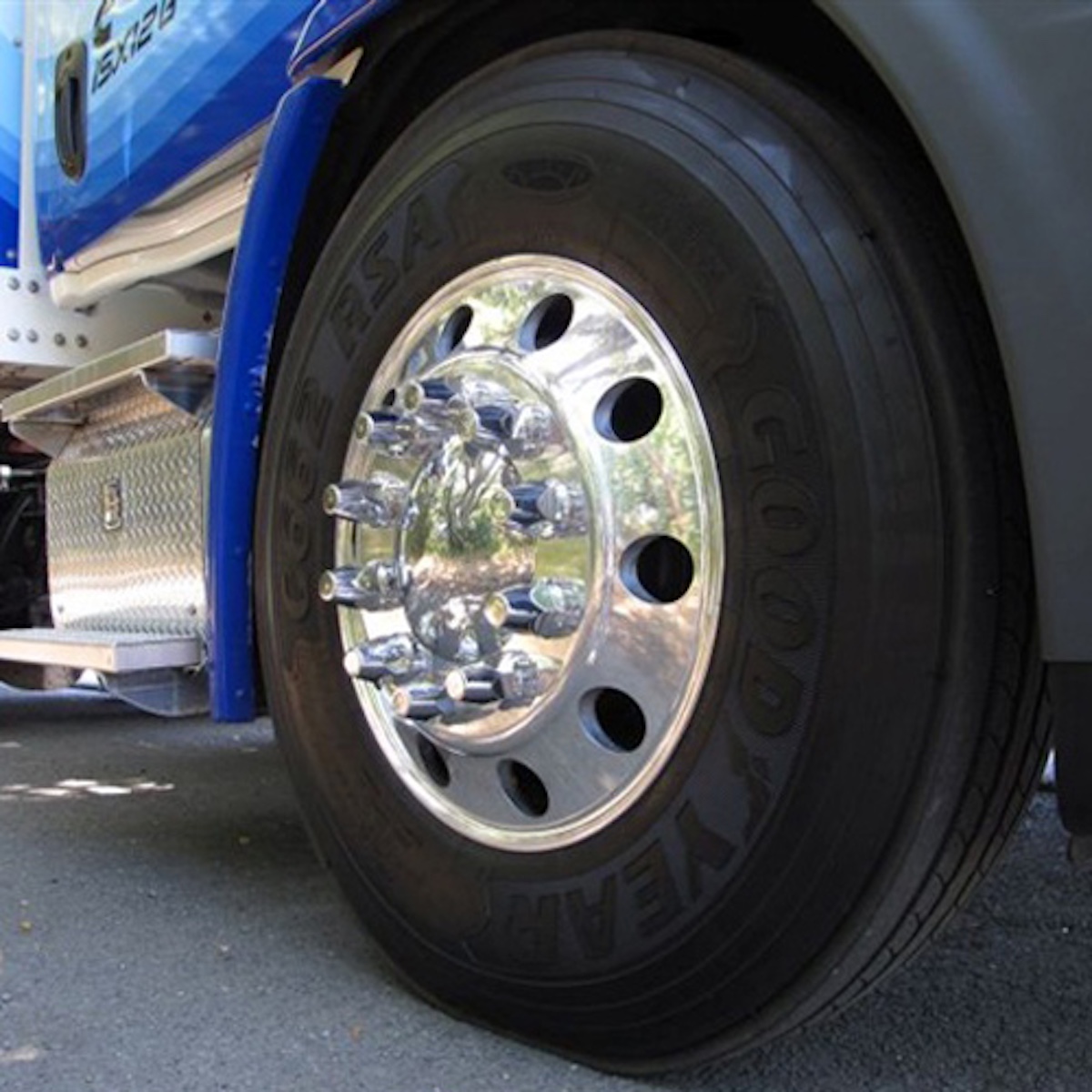
Granted, I’m sure there are exceptions to this, and I would be unsurprised to learn that someone has made these spikes out of heavy metal. But if your car finds itself interfacing with the wheel of a semi, it seems your greater concern will be the truck’s actual lug nuts and, well, the truck itself.
Are Spikes Legal?

Sadly, those spikes, even the plastic ones, do pose a real danger to bicyclists, motorcyclists, and pedestrians. According to the National Law Review, nearly half of the cyclists and about a quarter of the pedestrians killed by trucks are struck by the side of the truck first. In theory, this means if the truck has spikes, there’s a chance the person can get caught up in them.
The legality of these spikes varies. The state of Hawai’i bans spikes that stick out further than four inches. The state of Washington banned them more fully, stating in its statutes:
“No vehicle shall be equipped with wheel nuts, hub caps or wheel discs extending outside the body of the vehicle when viewed from directly above which: (a) incorporate winged projections; or (b) constitute a hazard to pedestrians and cyclists.”

Florida appears to allow spikes so long as they don’t make the vehicle’s overall width greater than 102 inches. Texas also appears to have a width-based restriction. Gadgets that protrude from wheels without being covered by a fender or other guard are illegal in Australia, and truckers have been fined for running them, Sgt. Jesse Grabow of the Minnesota State Patrol wrote in 2022 that Minnesota, like many states, doesn’t regulate these spikes, and neither does the federal government. However, several trucking companies do ban them.
Earlier, I called these spikes a little bit less useful than is sometimes claimed. There are wheel nut covers that you can buy that are nearly flush with the nut, or are rounded out and do not stick inches out. So, if a trucker is buying the spikes just for the protection angle, there are better options. Alcoa, a prominent aluminum wheel maker, also makes smaller nut covers! I also wonder about the effectiveness of these spikes if moisture does make it in.
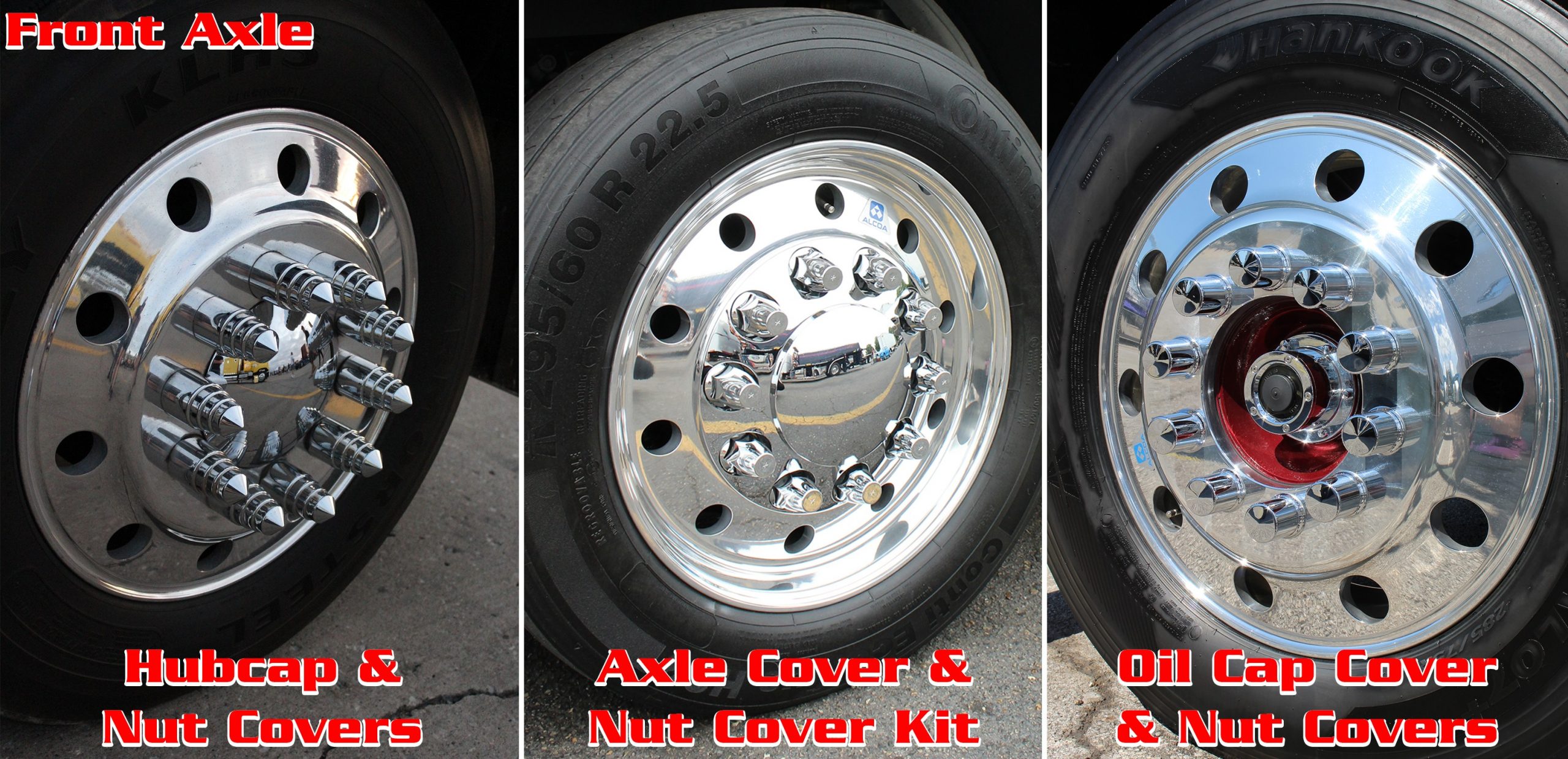
But they do make a statement about style. It seems people either adore semi-truck spikes or hate them, not really any different than the feelings about wheel spikes on pickup trucks or the wild swangas wheels on big American sedans. The effects of these types of modifications on collisions involving pedestrians and cyclists are concerning, for sure. So, I see why trucking companies and some jurisdictions want to rein them in.
But now know why the truck you recently saw was sporting spikes. If you take anything away from this story, it’s that the plastic, rubber, or thin aluminum spikes on most of these trucks are unlikely to seriously screw up your car. But if you’re a motorcyclist, bicyclist, or pedestrian, keep your head on a swivel and watch out for drivers who might not be looking out for you. If you’re behind the wheel of any vehicle, look for and be friendly to cyclists and pedestrians! Everyone can benefit from safer travel.
Topshot graphic image: Raney’s Truck Parts




Drivers who pay for their own fuel might be more likely to have aero wheel covers. Even a tiny mileage benefit adds up over several hundred thousand miles.
Anytime I see these sort of spikes, I just assume the driver/owner would happily call me a slur to my face.
Do something like this.
https://www.acitoinox.com/en/home/1265-front-wheel-cover-application-acitoinox.html
Ban this trash now. Zero benefits to the spike design, and the attempts by fans to “back into” engineering justification is laughable. Only meant to look Mad Max aggressive, and downright dangerous.
Go look up swangas and come back and tell me what’s more dangerous. And I need to remember to NEVER go to houston.
No Ben Hur reference?
These seem needlessly aggressive looking. I’ve noticed another lug nut accessory that makes more sense on some buses and trucks… High-viz arrows that point to the neighboring nut. If the but starts to loosen, the arrow head rotates and points elsewhere and makes it easy to spot a suspect nut at a glance. Given the impact wrenches available at truck stops and service facilities, the need for nut covers of any type seems dubious to me.
I have lived in five states, traveled through 44 of the 45 others and had never seen “swangaz” until I moved to Beaumont, TX which suffers from some influence from nearby Houston’s “slabs” culture. I thought to myself that surely, they couldn’t be legal. Turns out, they are unless the total width of the vehicle equipped with them exceeds 96 inches.
From lonestarlive.com, it appears some additional regulations are in place in Texas: “It appears that as long as slab rims, or any rims for that matter, don’t make the width of a passenger car more than 8 feet, and those rims don’t extend beyond 3 inches on the driver’s side of the car and 6 inches beyond the passenger side, they’re likely legal.”
I know I’ve seen some that extended more than six inches beyond the widest point on the sheet metal on the passenger side and usually they are of symmetrical size on the driver’s side.
Now I”m tempted to go poke at some with a finger just to see what they’re made of. But can’t come up with a way to safely do that.
Easy. Just pull up next to one at a truck stop, and politely ask the driver if you can touch them. Let them know you’ve always been curious about them. Most would probably oblige, as long as you’re not being obnoxious.
“Hi, excuse me, but would you mind if I touched your nuts? I’ve been thinking about them for a long time.”
“Well, since you put it that way…”
Yeah, phrasing matters.
Insane if a cyclist or pedestrian is close enough to the chintzy lug nut covers it isn’t them he needs to fear. It is being run over by the wheel of an 80,000 pound semi. Being an avid fan of the always perfect history of automobiles program called Top Gear I point out an episode in I believe season 12 where the automotive scientist Jeremy Clarkson is instructed to create an inexpensive cop car to stop crazy drive. He installed budasears, 12 inch metal spikes to his wheels, ala Ben hur, and attempted to stop the Stig. It didn’t go well the Stig got away, Clarkson got sidelinesd and the budasears fell off. CASE CLOSED
Hold on, what? This implies that, like the idiotic deer around here, you walked into the side of a truck hard enough to kill yourself? Except even when the deer do that they usually get up and run away. Or are there a lot of trucks Mustanging sideways into crowds?
I will also note that my parents had two Fords with the crappy two-piece lug nuts. They had to carry a socket a size too large in order to change a tire because water got trapped in the nuts and caused them to corrode so much that the “correct” lug wrench wouldn’t fit anymore.
What if the pedestrian were walking on the side of the road, parallel to the flow of traffic, and the truck moved laterally so as to “side swipe” the pedestrian? Would you believe that this sort of thing happens? I know a guy who was hit by a logging truck in that manner while he was riding his bicycle. Dude was in the hospital for a long time…
Pedestrians and trucks generally meet at intersections, where a truck would be changing direction.
Long vehicles have to make wide turns to avoid the side of the vehicle coming into contact with obstacles on the inside of the turn.
I’m just here for the nut cover discourse. It’s an important conversation.
Wait, so the entire conclusion is that they are entirely decorative and quite possibly dangerous to other travellers on the road? Is that not where this discussion started off in the first place??? Oh don’t worry – it’s not the actual lug nut that is also shaped like a spear. It’s just a spear shaped cover on top of a regular lug nut!
Ask owners of Fords that have 2 piece wheel nuts where the outer covering expands due to corrosion underneath it and makes it very difficult to remove the nuts how well an outer covering works to prevent corrosion.
Mine were starting to do this. Caught it while the lug wrench would still fit and replaced all of them with aftermarket.
How do you screw up a lugnut?
Well that’s easy, you put a non-sealed thin metal cover over it.
So simple, it might actually work!
In 1994, Chrysler was using 2 piece lug nuts. Annoying AF. The original lug wrench doesn’t fit and an oversized one (in SAE sizes) doesn’t fit closely. The car was undoubtedly taken to a tire store or service station for rotations and an impact gun used on the lug nuts. I use an impact socket on a breaker bar for my Ford pickup and they don’t seem to be as deformed as the Chrysler’s were. Of course, the Chrysler may have lived in a salt state before I bought it, whereas the Ford is a California car.
Yeah it isn’t fun when you suffer from swollen nuts
There is a kit you can buy to make them shoot at cars/pedestrians/cats. The propellant is the same engine used for model rockets. This probably isn’t true but if it were it would be sold out at the truck stop. Pardon me, I have some packaging to design.
I’m amazed Texas has a width based restriction when Swangers are a thing.
I THOUGHT Fed regulations require anything over 80″ to have chicken lights, I’m assuming that those stupid swangers may fit within 102″. But I’m too lazy to look it up. I’d love for them to start impounding Cadillac’s with swangas for not having their chicken lights on the roof.
That’s a big stretch. I think the real danger is, you know, being struck by a 40 ton missle.
Yeah, if you’re close enough to get struck by the spikes, you’re more than likely getting hit if the spikes are there or not.
Good lord, I can’t believe the comments here. What happened to the Autopian being pro-car? Vehicle mods are the taste of the owner. Truckers put the caps because they like them, not because they want to intimidate or hurt other drivers. If I don’t like someone’s car, it’s because we don’t like the same style. I don’t hate that person for doing something I wouldn’t do.
When your decisions start to affect the safety of others, it goes behind personal taste in to the territory of unnecessarily putting the public at risk due to your decisions.
In 2021, there were 631 non-occupant (not in a motor vehicle) fatalities in crashes of large trucks in the USA, which is 11% of the total of fatal large truck crashes. It’s not unreasonable to suggest that truck nut spikes almost certainly pose a risk to pedestrians, cyclists and other roadside users, and that it’s certainly possible that they have contributed to some of the fatalities.
https://crashstats.nhtsa.dot.gov/Api/Public/ViewPublication/813452.pdf
The same principle applies to other modifications (and behaviors for that matter) that increase public risk, including exhaust emissions system mods (diesel deletes in particular), lifted trucks (and donks), uncertified aftermarket headlights, tires that don’t fit (stanced cars with stretched tires and extreme camber), etc. – not to mention upkeep of vehicles.
Yep, not my style but more fun then some boring rust covered pos.
A lot of Truckers are older and remember when Ben Hur was basically required TV watching around Easter.
Every time I drive by one of those spiked wheels the only thing I can think of is the chariot race from Ben Hur!
Lot lizards like spiked wheels and truck nutz.
They do it for decoration, that’s it and that’s all
Bubb Rubb and Li’l Sis approve of this message.
Wooo woooo
These exists for one reason and one reason only:
Stainless Steel Sex Appeal
Billy Big Rig wants every piece of chrome and every set of chicken lights they can possibly get on their rig.
As someone who has spent over 2 decades wrenching on Class 8, the nut covers mean nothing for corrosion, they all come off with a 1″ impact.
Mechanics and Truckers are natural enemies.
Like Dispatchers and Truckers,
Or Customers and Truckers,
Or Truckers and Truckers.
Damn Truckers, they ruined Trucking!
I assume this is being sarcastic and as such it is hilarious
I mean, truckers/bus drivers keep me employed, but I’d like it if they stopped breaking my trucks/buses (I work fleet, so those are MY rigs, they’re just seat warmers)
I always assumed these spikes served two purposes:
1) Decorative
2) Easy visual cue to see if you’re missing a lug nut
I do not know enough about fluid dynamics and aerodynamics to guess at this question, so I’ll just ask. Aside from delusions of machismo, would the chaos of these spikes at all effect the drag coefficient of the truck? Would that change be positive or negative? And would the change in roll resistance negate any benefit?
Was wondering that myself, but I can’t imagine them having anything other than a negative effect. Increased frontal area, and cylindrical profiles aren’t very aerodynamic, plus disrupting airflow further down the vehicle. Also, increased rotating mass, though I’m sure that’s tiny in the scope of a truck drivetrain.
Not as much as a ping pong ball on an aerial but what demographic uses ping pong ball?
I’ve been around truckers all my life, and I can guess exactly what kind of person is driving a rig with these. Sadly, there are a lot of truckers who are exactly that sort of person.
Yea I just assumed the drivers with these were anti-social and should be avoided.