

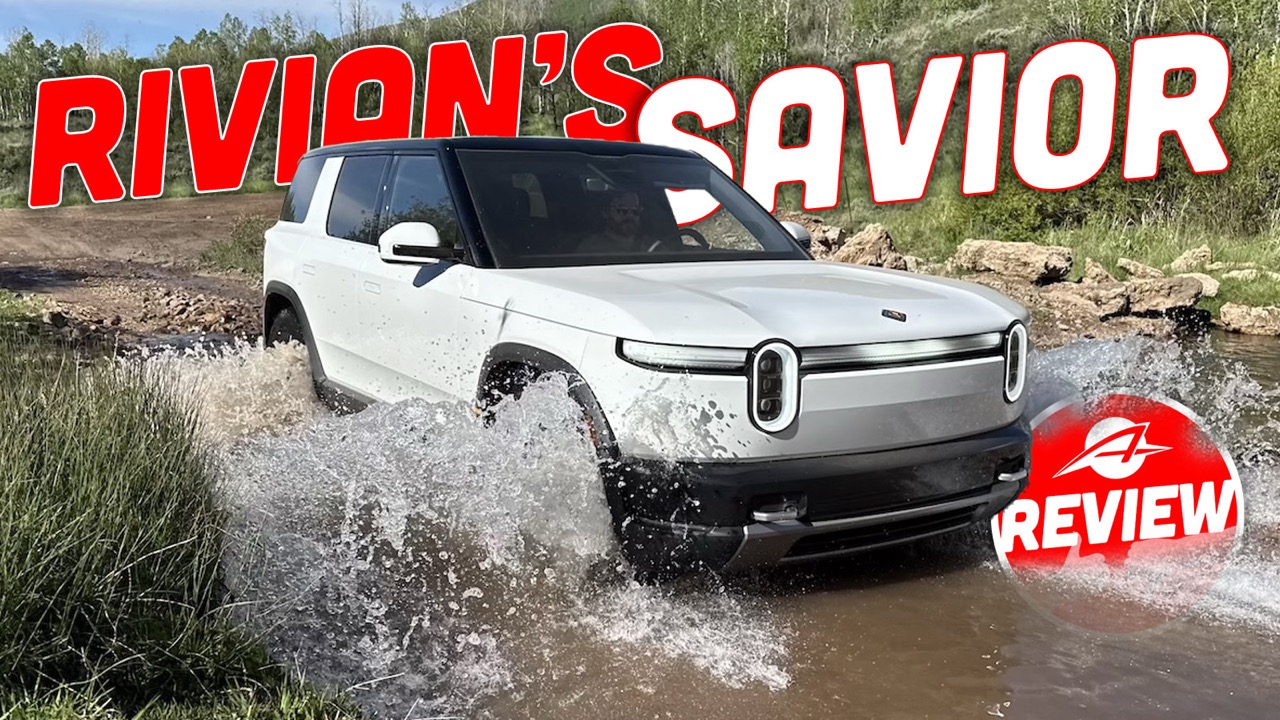
The Rivian R2 isn’t as luxurious as the Rivian R1S, it’s not as capable off-road, it may not ride as well, it’s not as quick, and its styling at launch is nowhere near as fresh. This might lead you to think the R2 is a bit boring — a derivative stuck riding its forebear’s coattails. And, in a way, you’d be right; but I recently drove the R2 and spoke with the company’s CEO and its engineers; what I learned is that, while driving the R2 may not be as exciting compared to driving the R1S, in many ways, the R2 is the more impressive machine.
Engineering is the art of making intelligent compromises. Strength vs weight. Styling vs efficiency. Ride vs handling. And on and on. In the world of engineering, one compromise always has and always will stand highest as the king of all compromises: Performance vs Price. To the customer, this is known as “value,” and it represents one of the strongest driving forces in the automotive marketplace.


When Rivian was developing the R1T and R1S, it, like pretty much every automaker, had to consider cost, but it wasn’t at the forefront of the program. What Rivian was trying to do with the R1 was build a world-beater — an SUV that could sprint from zero to 60 MPH in under 3 seconds, that could drive over 400 miles on a charge, that could use clever quad-motor torque vectoring and an intelligent multi-link suspension to handle corners in ways you wouldn’t believe, and that could use air suspension and traction control to crush off-road trails.
I remember asking a Rivian engineer back around 2021: “Why even bother with the Quad Motor?” A big SUV doesn’t need to handle like a sports car, and I wasn’t convinced that individual motors at each wheel was really helping the vehicle perform off-road, particularly on the rocks where I was noticing lots of wheel “flaring” as each tire saw different traction conditions. Wasn’t the quad motor system just adding unnecessary cost and complexity? The response I heard from Rivian was the right one: We’re a new brand, and we’re launching with the most insane, over-the-top vehicles to show the world what we can do.

And Rivian absolutely pulled that off. I know this because, after I recently told readers that I was about to drive the R2, my inbox exploded. I was a little confused at first, as I find the R3X to be much cooler than the shrunken R1S . Why was everyone so excited? It’s because the Rivian’s R1S and R1T have created an absolute powerhouse of a brand, and the R2 represents the first time many people can take part in that brand at a price approaching “reasonable.”
These emails and all this excitement motivated me to the point where, upon my arrival at the R2 media event in Utah, I took as many notes as humanly possible. Get ready for a long review, starting with discussion about design.
‘We Didn’t Like What We Saw’: Rivian Almost Pulled A Lucid On The R2’s Design
The media first-drive took place at the Waldorf Astoria in Park City, Utah (Full disclosure: Rivian paid for my travel and food), and on the lawn out back the company had set up a cool display that included a body-in-white, an exposed battery pack, front and rear subframes with drive units, various power electronics, and a few complete R2s.
I had seen the R2 from a distance at a Rivian event in Venice, California, and I have to say I’ve always found the design a bit… derivative.

Seeing the car up close didn’t change my mind on that; the car looks like a shrunken R1S, which Rivian debuted way back in 2018. Here’s a look at an R1S I drove a few years ago; the two are hard to distinguish from one another:

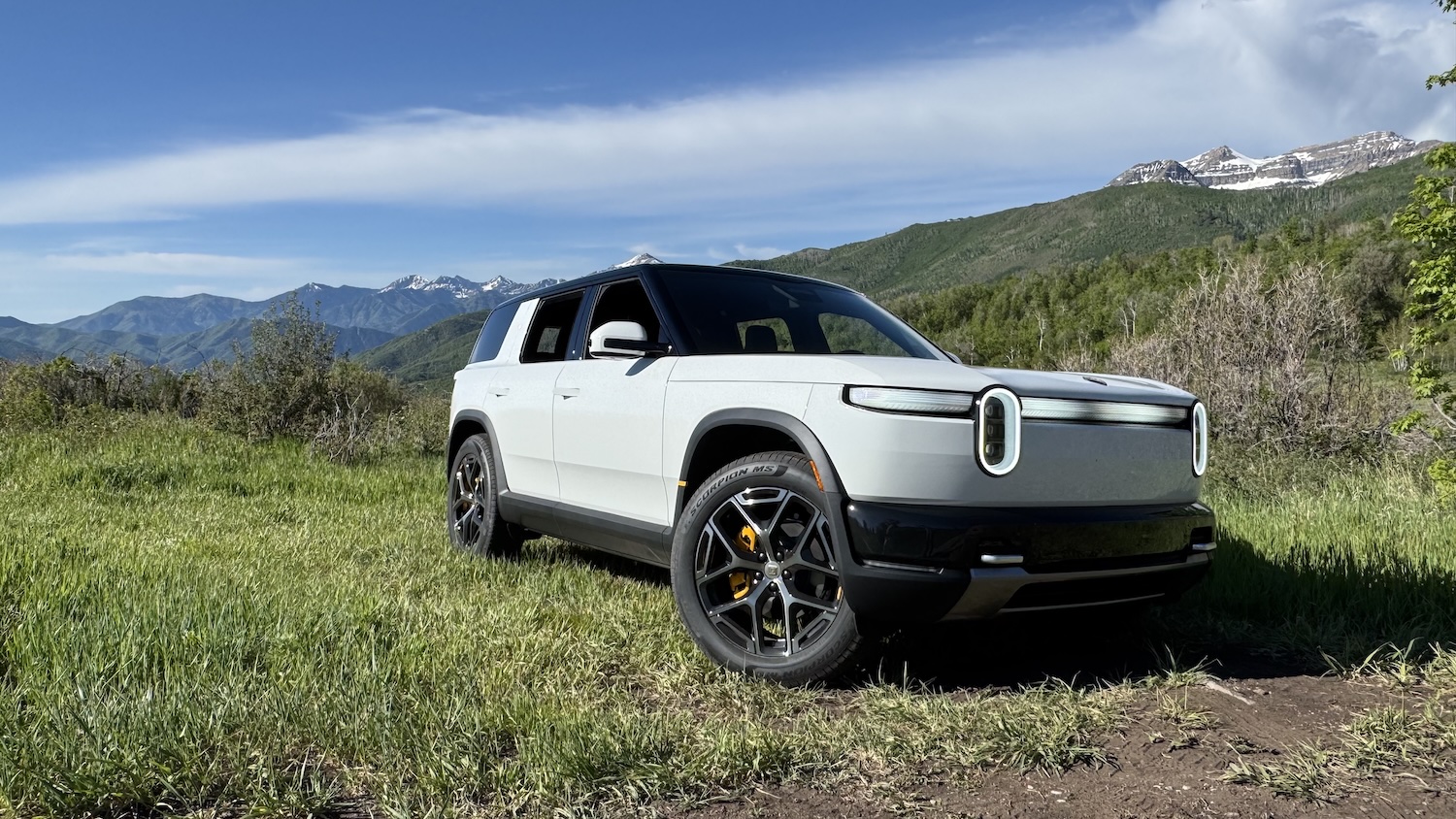
If you ask Rivian to point out obvious design differences, the company will mention that the R2’s outboard Daytime Running Light “brows” are a bit more aggressive (they have more of a “scowl,” per Rivian), the entire second-row window rolls up and down without the need for a divider bar, there’s a clever badge/side marker-combo at the rear of the front fenders, the edges of the taillights are a bit more rounded to give more of an “acceleration” vibe, and the headlights are a bit wider and shorter. The two most obvious differences, to me, are 1. the lack of a grille between the “face” and the “bumper” and 2. the hood, which is a clamshell-style in order to meet European pedestrian protection requirements, and whose horizontal edge continues into a character line that runs the entire length of the car.
Since attending this trip, I’ve come around to the R2’s design, especially given the path the car nearly took.

A year ago, I drove the Lucid Gravity, a vehicle that I consider the most impressive “SUV” in the world, on paper. The reason why I predicted the car would flop is that it seemed to me that the brilliant folks at Lucid were too nerdy to compromise aerodynamics in order to make the vehicle look cool (don’t get me wrong — I’m an engineer, so I love the Gravity, but I fear that, to the layperson, it’s a tough sell). The result is an extremely aerodynamic, efficiently-shaped SUV, but the thing looks like a minivan. An $80,000 minivan.
As I learned while chatting with Rivian CEO RJ Scaringe and head designer Jeff Hammoud, Rivian itself nearly traveled down a similar road.
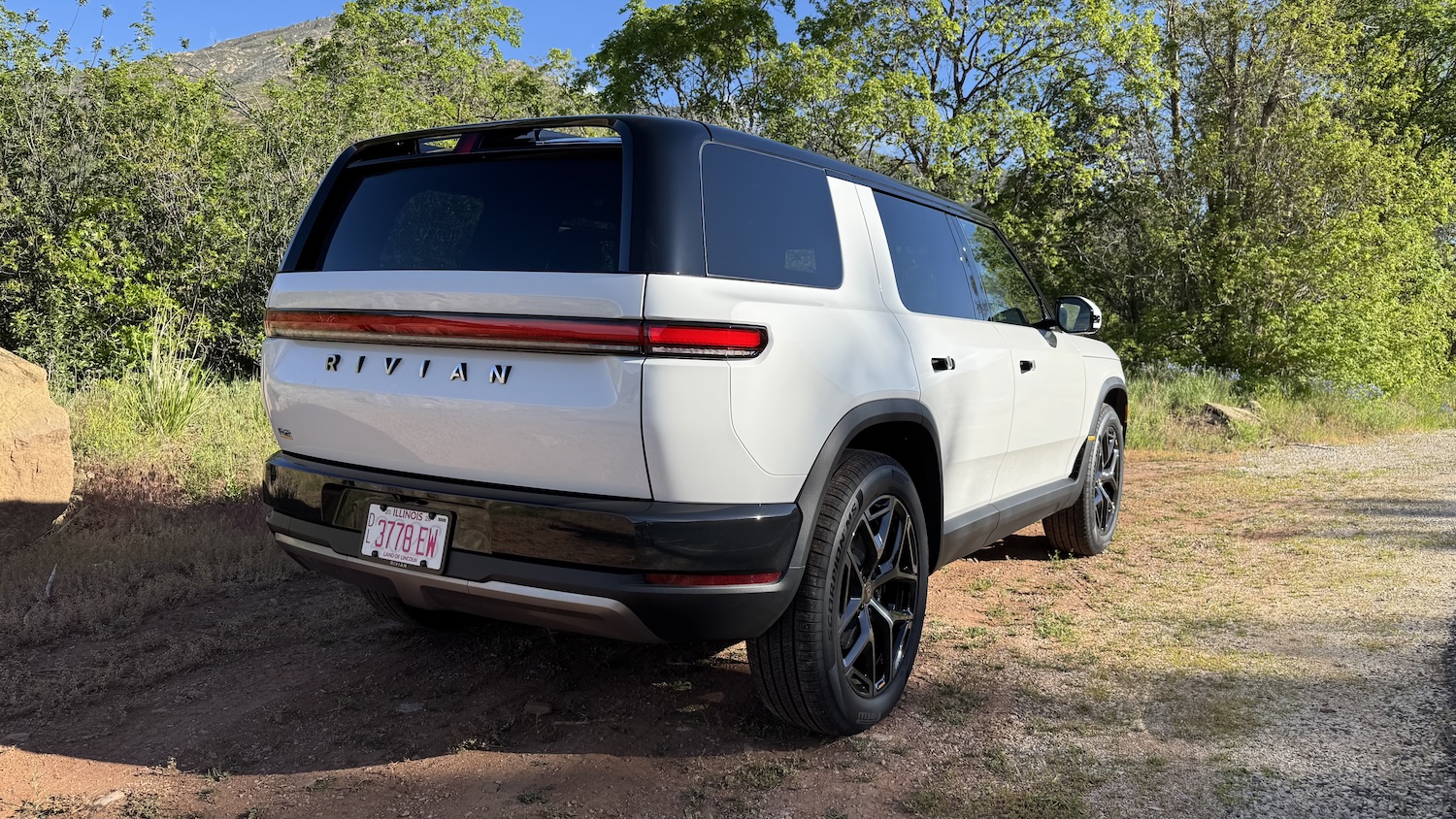
“There’s hundreds of decisions that have very large impacts on things like proportion, packaging, interior comfort — those sorts of things,” Scaringe said at a roundtable with journalists. “A lot of the different objectives when we set out to run the program have a lot of competition to push in completely different directions.”
Rivian’s CEO gave an example. “From an aerodynamic point of view, you want to create more of a taper [at the rear of the roof] — something that looks more like an egg — to move through the air as efficiently as possible…this is particularly important at high speeds.” He went on: “So there you have a tradeoff of making something that’s very aerodynamic but maybe looks proportionally a little bit goofy to something that proportionally looks right, also has a lot of functionality embedded in a two-box shape…We were flexing between a lot of these types of tradeoffs.”
“In each of [the hundreds of] tradeoffs we made decisions that ultimately compounded…[and] got to a place in the R2 program that we didn’t like what we saw. We said ‘Boy, the sum of this isn’t working.'”
Rivian had to shred its design.
[Writer’s aside: I noticed something similar when I was on the Jeep Wrangler JL engineering team. Each engineer was trying to optimize their own system/subsystem, and this was threatening to water down the overall product. At Chrysler, this became known as “death by a thousand cuts.” I remember watching in horror as a vehicle dynamics engineer who was unable to meet his handling targets recommended changing the Wrangler to independent front suspension. Luckily, Jim Repp, a Jeep old-timer who would later become my friend, shut that down. At Rivian, it’s the chief engineer Max Koff and the head designer Jeff Hammoud who collaborate on these big decisions, with CEO RJ often acting as the tie-breaker. -DT]
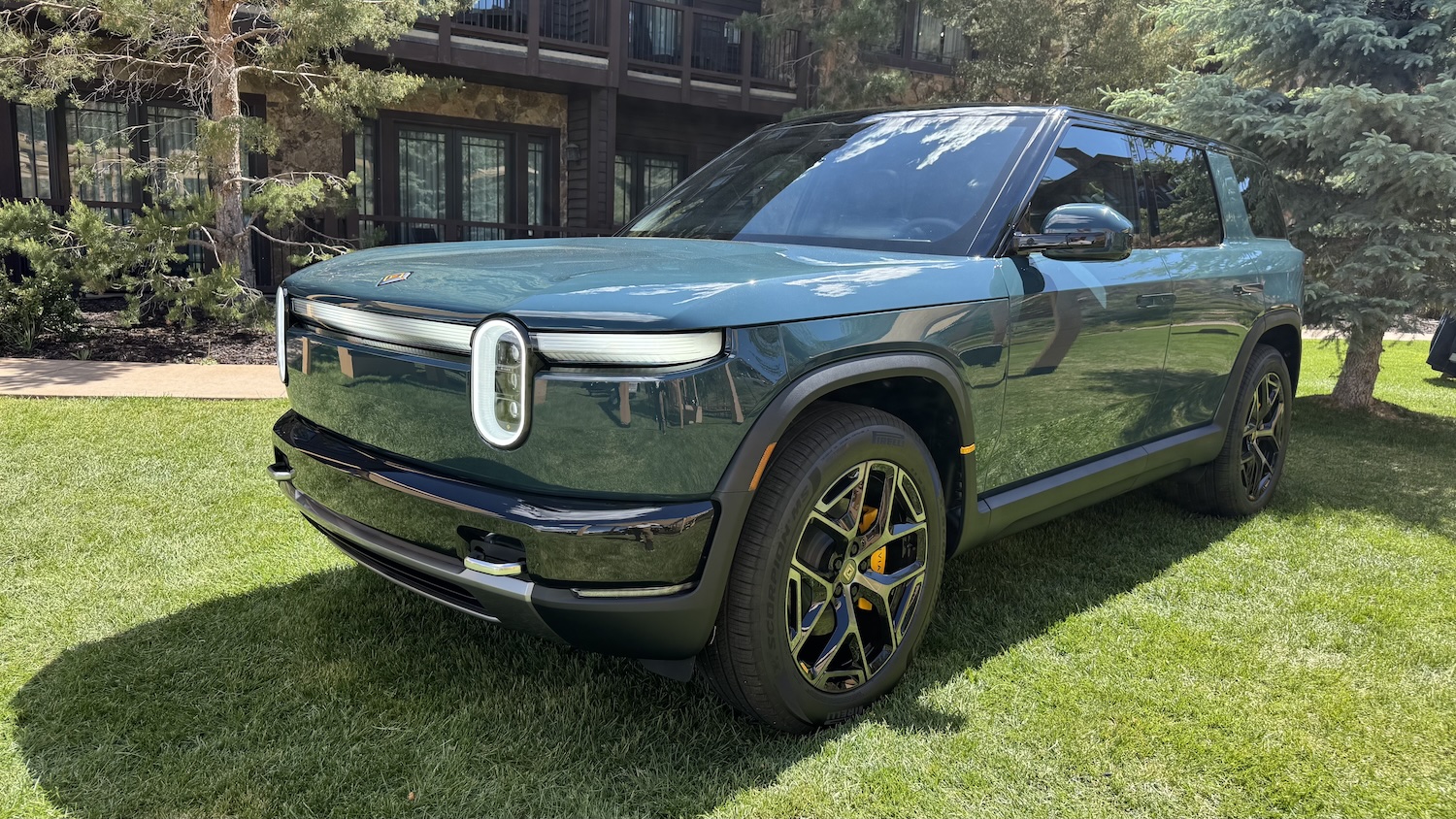
“We actually went through two pretty meaningful resets to the program in terms of vehicle packaging and the overall design approach..and arriving at this [realization that this isn’t working] actually is where we said we had to reject some of these tradeoffs and… try harder.”
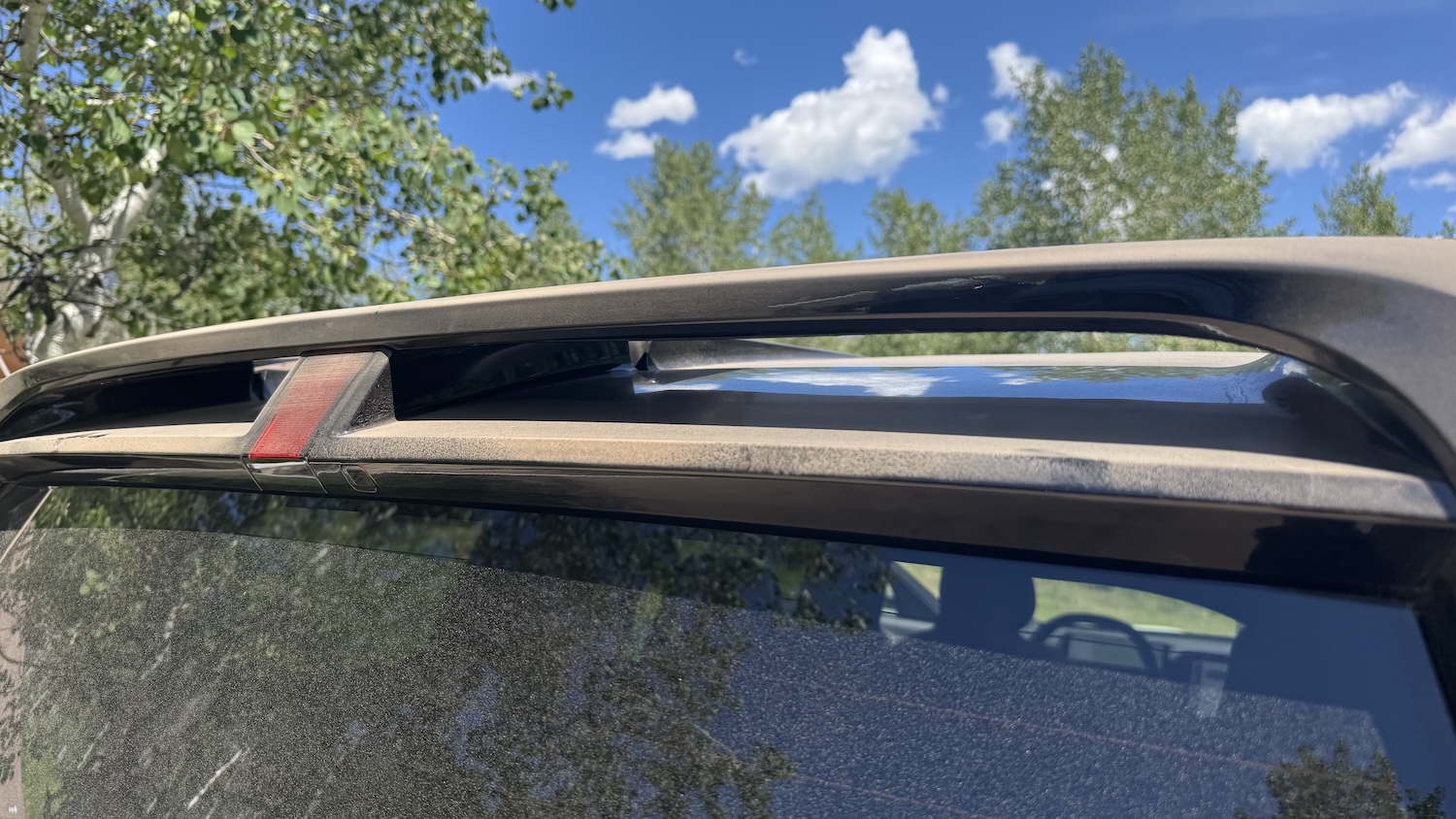
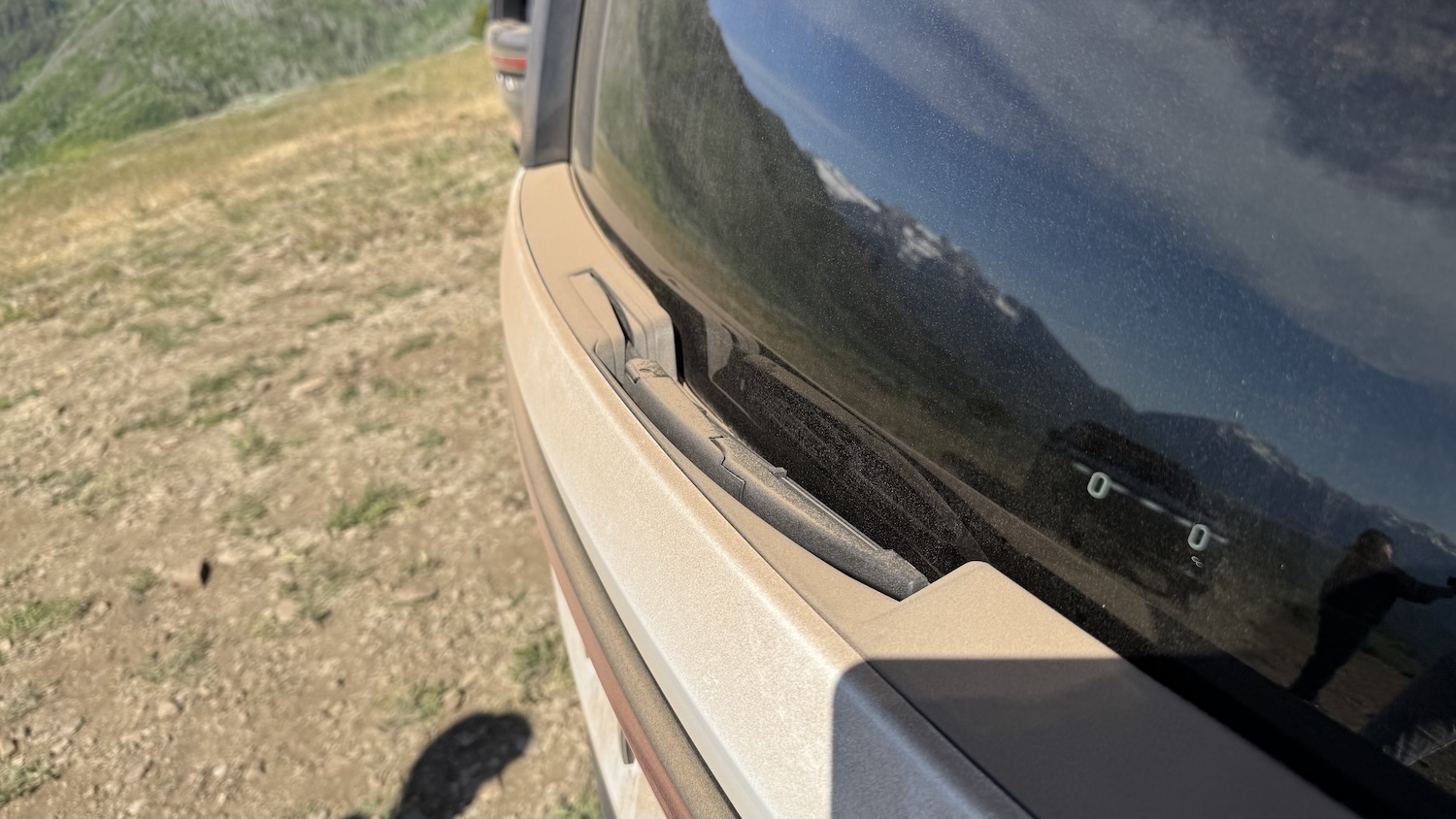
So the team decided what was important, and came to grips with the fact that it was going to have to sacrifice aerodynamic performance (I was told the sacrifice was roughly 8-ish miles of range). “We really wanna have this functionality that comes with a two-box, but we need to get to a certain level of aerodynamic performance,” Scaringe went on. “We’re not going to have the same performance of a pure, more egg-shaped vehicle, but that led to the innovation around that aero pass-through in the back. But then, suddenly, where do you put the wiper if you have a drop-glass?”
Here’s the rear aero pass-through:
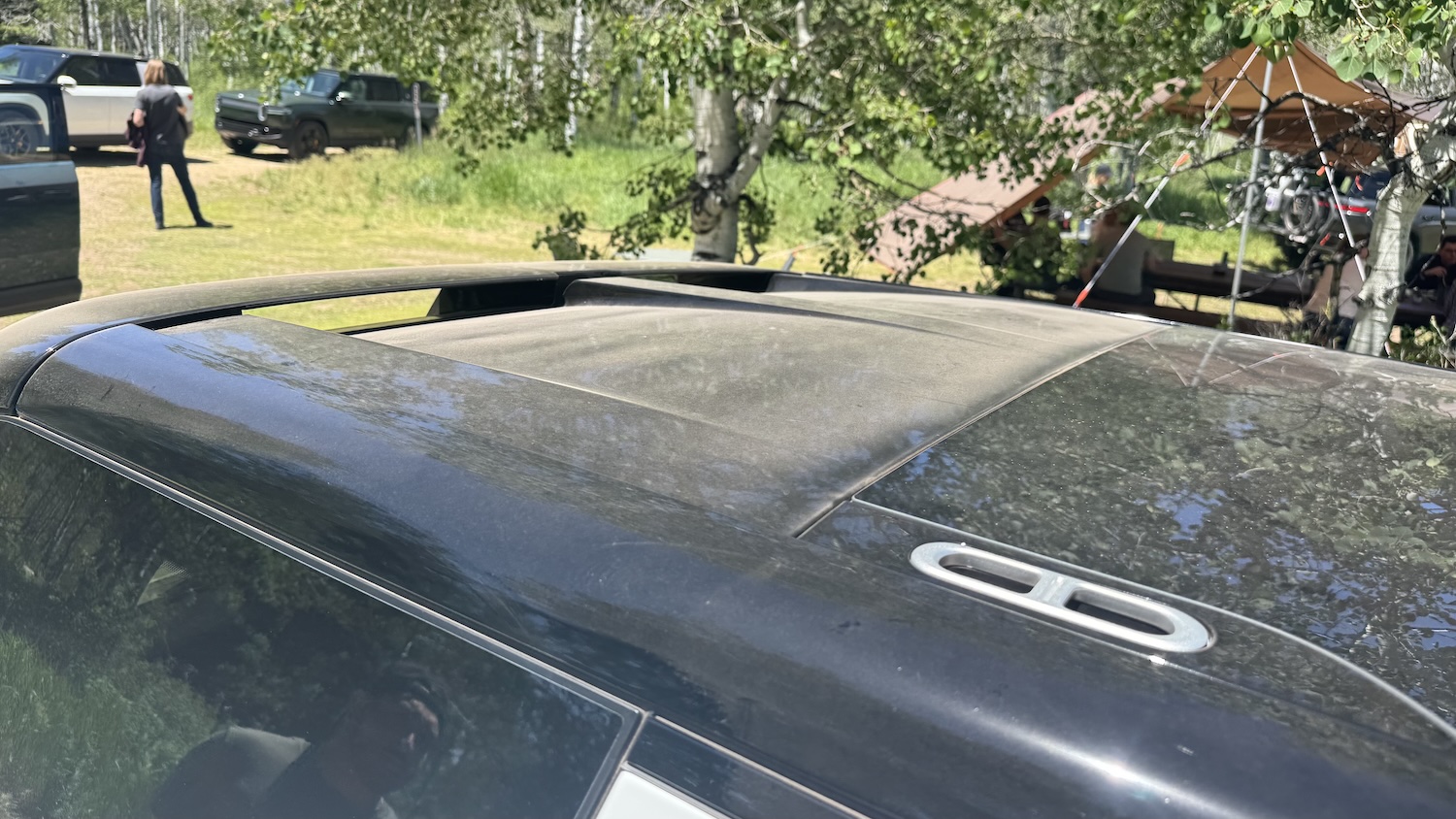
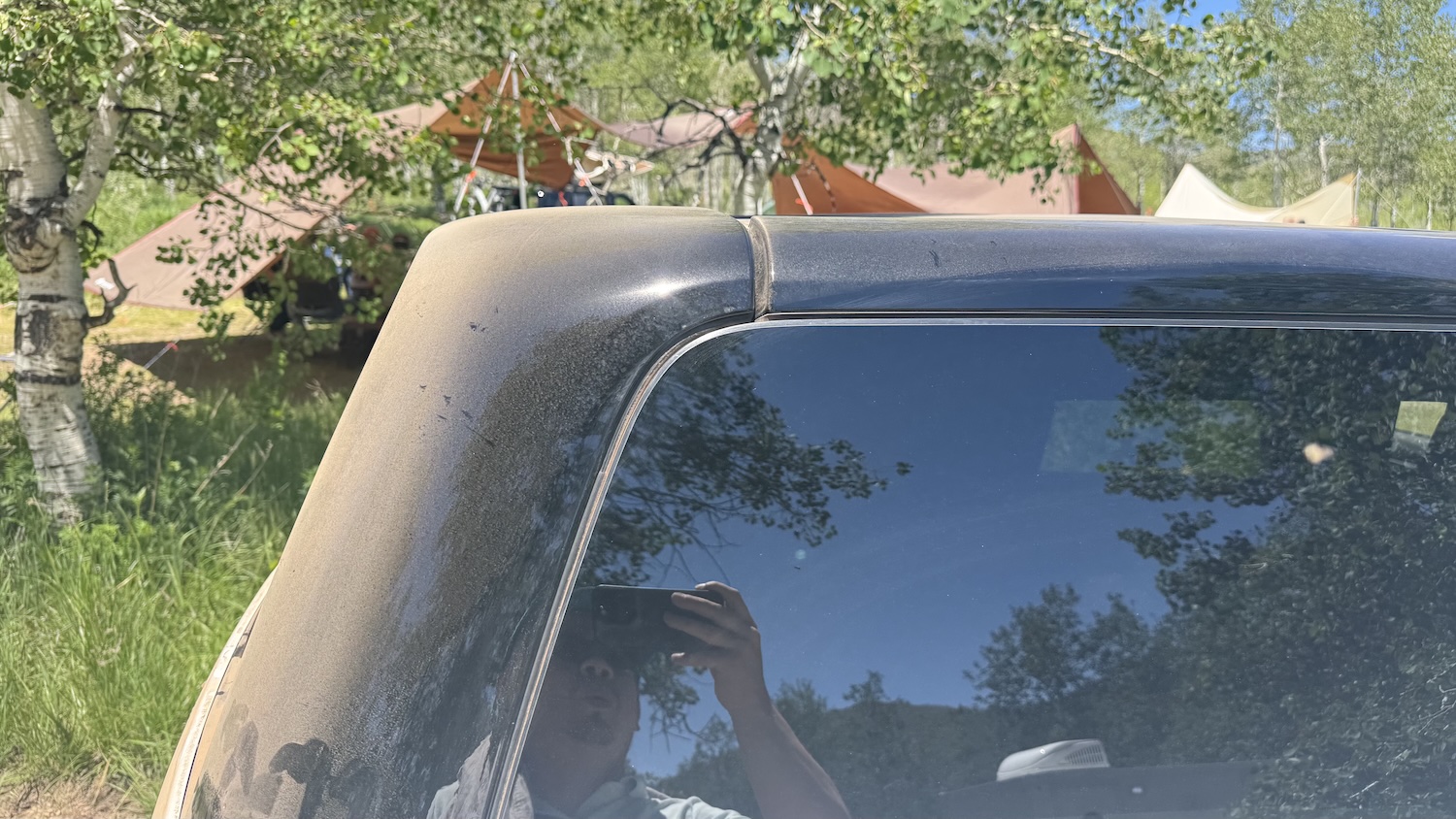
Here you can see that, from the side, the profile still looks nice and upright:
And here’s the wiper, which had to be relocated into the rear hatch:
“I’d say it was like the third iteration that allowed us to converge on making all of these tradeoffs in the most thoughtful way that led to what you see here….We went on a long, long journey with lots of iteration and landed in a place that has lots of DNA from R1, for sure.”
Rivian made it clear that it sees value in the similarities. “We thought it was appropriate, because there was a lot of positivity with R1,” Hammoud told journalists. “And R2, for a lot of people, is gonna be their first experience with a Rivian, so we wanted to build off of that…” He went on to say that the Rivian R3 was shown at the same time as the R2 in order to show that the Rivian team is capable of stretching the brand: “When we did R3, it was really showing that we can take the Rivian form-vocabulary and completely change it into a different segment, a different form-factor, but it still feels distinctly Rivian.”
Not As Capable As The Rivian R1S, But More Intelligently Engineered
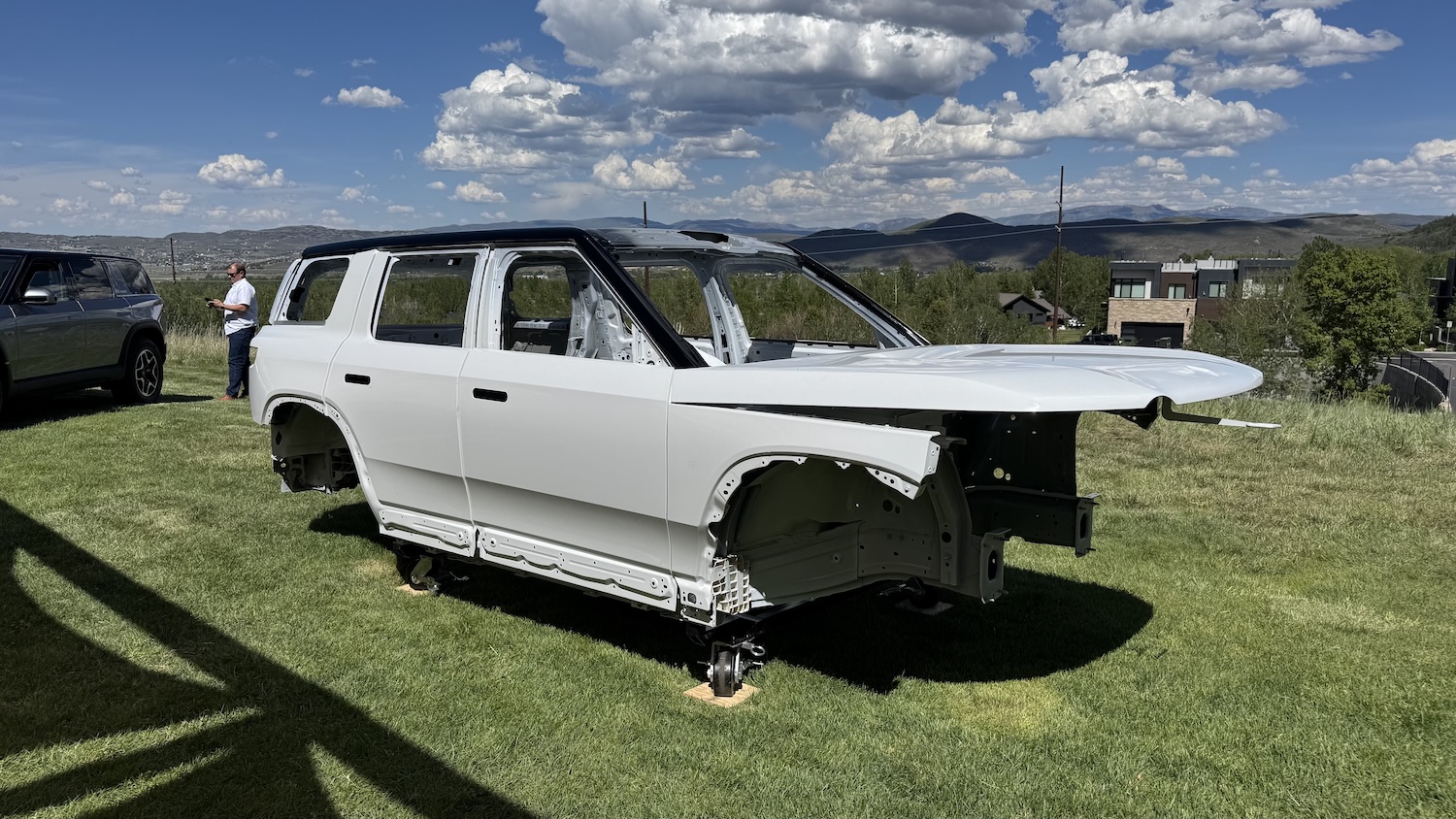
Even though the Rivian R2 looks a lot like the R1, and even though its performance figures like acceleration and range and off-road capability pale in comparison to its bigger sibling, when you look at the engineering behind the R2 it becomes clear that in some ways it’s the more impressive of the two machines.
The R1 was the company’s first vehicle — a “white space” car, as Rivian puts it. It was a halo product meant to “offer a massive spectrum of performance both on-road and on.” And while developing such a world beater was difficult, Rivian says developing the R2 was just as challenging. “How do we bring that Rivian experience to many more customers by making it more attainable?” was the brief.
With the R2, cost was at the forefront of design, with certain departments saying the goal was 50 percent Bill of Material costs when compared to the R1S. And a key to achieving such targets was clever engineering, particularly consolidating parts and bringing them in-house. Beyond that, the R2 had the luxury of being the brand’s “second album,” meaning it could take some of the learnings from the R1.
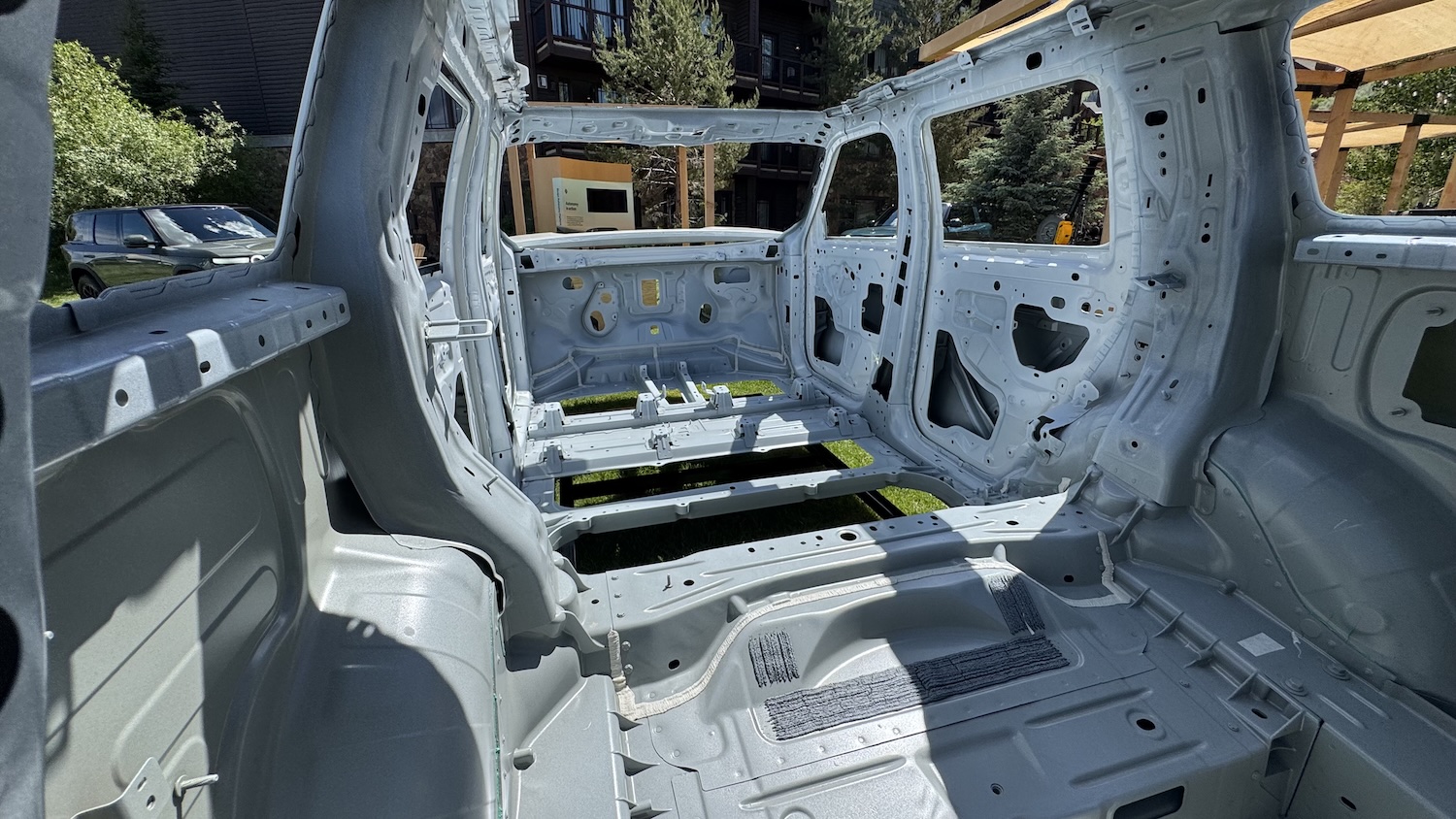
Take the body, for example. It’s roughly a ton lighter than the R1S’s, and while it’s obviously smaller, it’s also just more efficient. There are two reasons for this. First, the R1S had to be built to handle insane on and off-road loads, so it’s just downright overbuilt (Just check out this video from my friends at Munro & Associates. Rivian itself admitted to me that the R1 features lots of redundant body structure). Second, the R1 was the brand’s first iteration; naturally, the R2 is going to build on what the team learned from its own analysis and external critiques of the R1’s body structure.
While the R1 featured a beefy frame to which the battery and body were bolted, the R2 is built on a new unibody platform featuring “advanced structural castings that actually simplify the vehicle’s footprint,” per Rivian. The company continues in its press material, saying that it has “moved toward a much more modular architecture, significantly reducing the total part count compared to the R1. By simplifying the body structure and how the vehicle is assembled, we’ve made specific panels and components far more accessible.”
After a rather controversial situation in which a Rivian owner found themself on the hook for tens of thousands of dollars to repair a light tap to the rear of their truck, Rivian made it clear that the company cares about repair-ability, highlighting to the media: “This modularity is designed to make repairs more straightforward and efficient, ensuring that when service is needed, we can get the vehicle back to the customer as quickly as possible.”
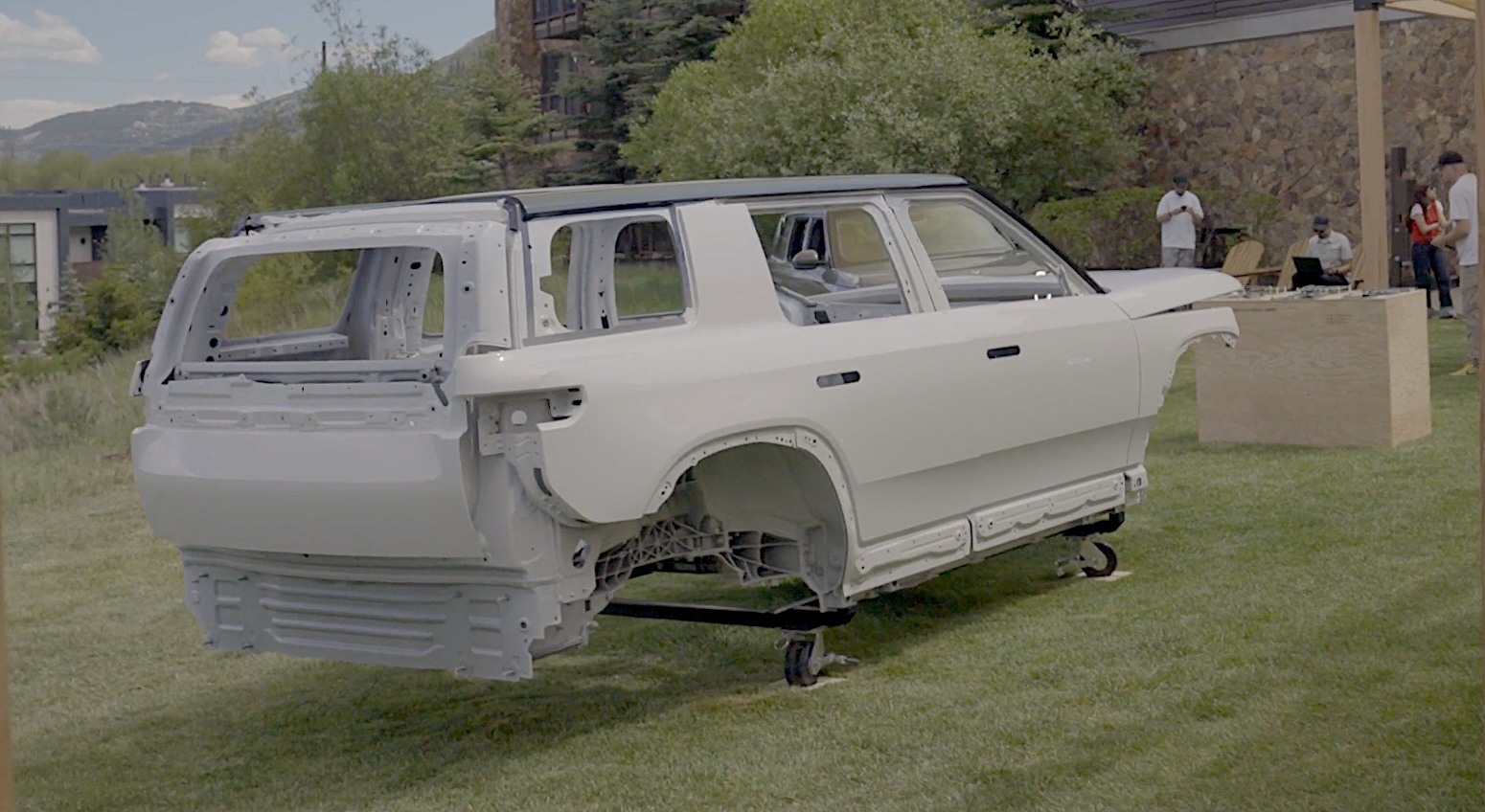
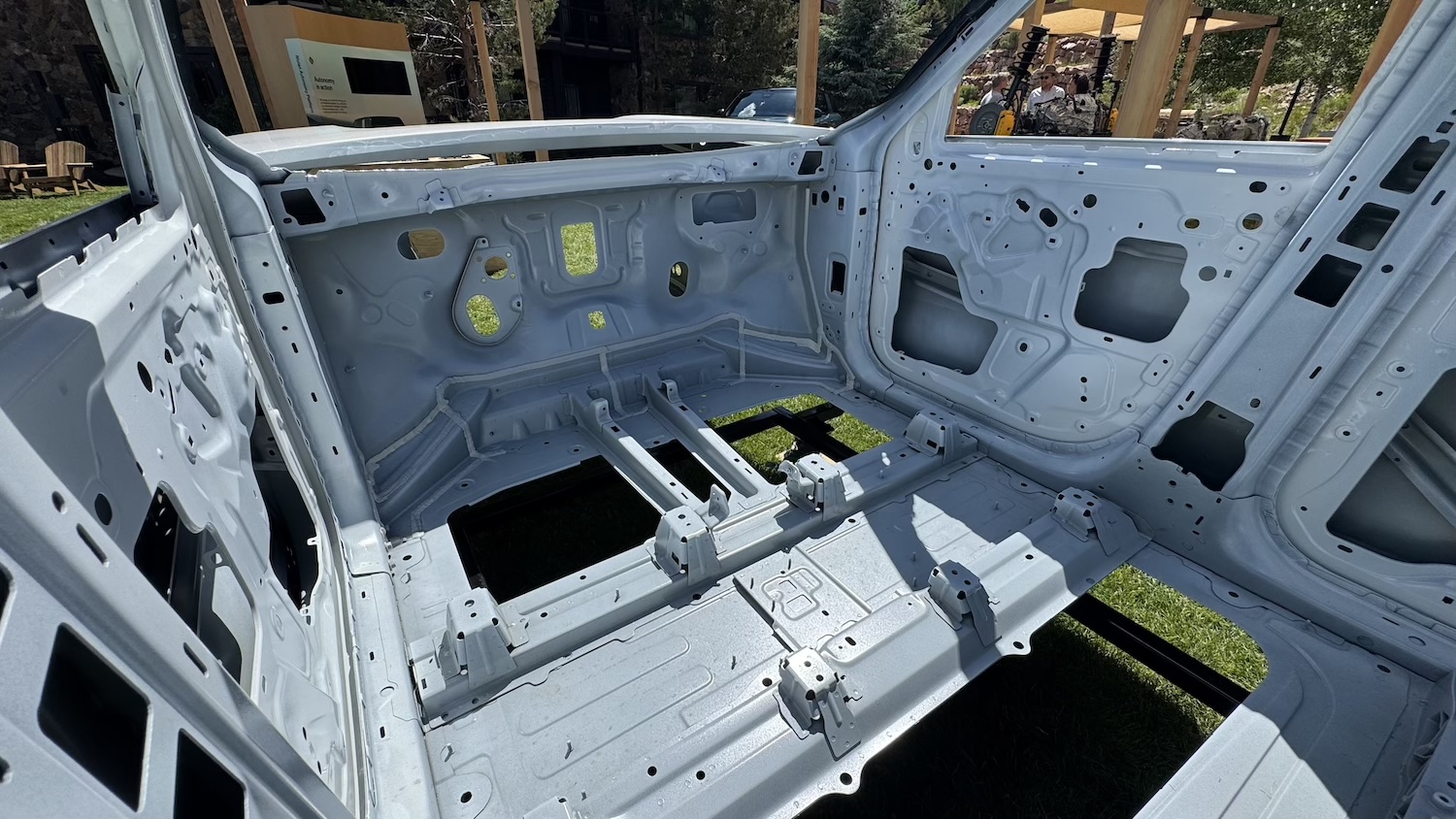
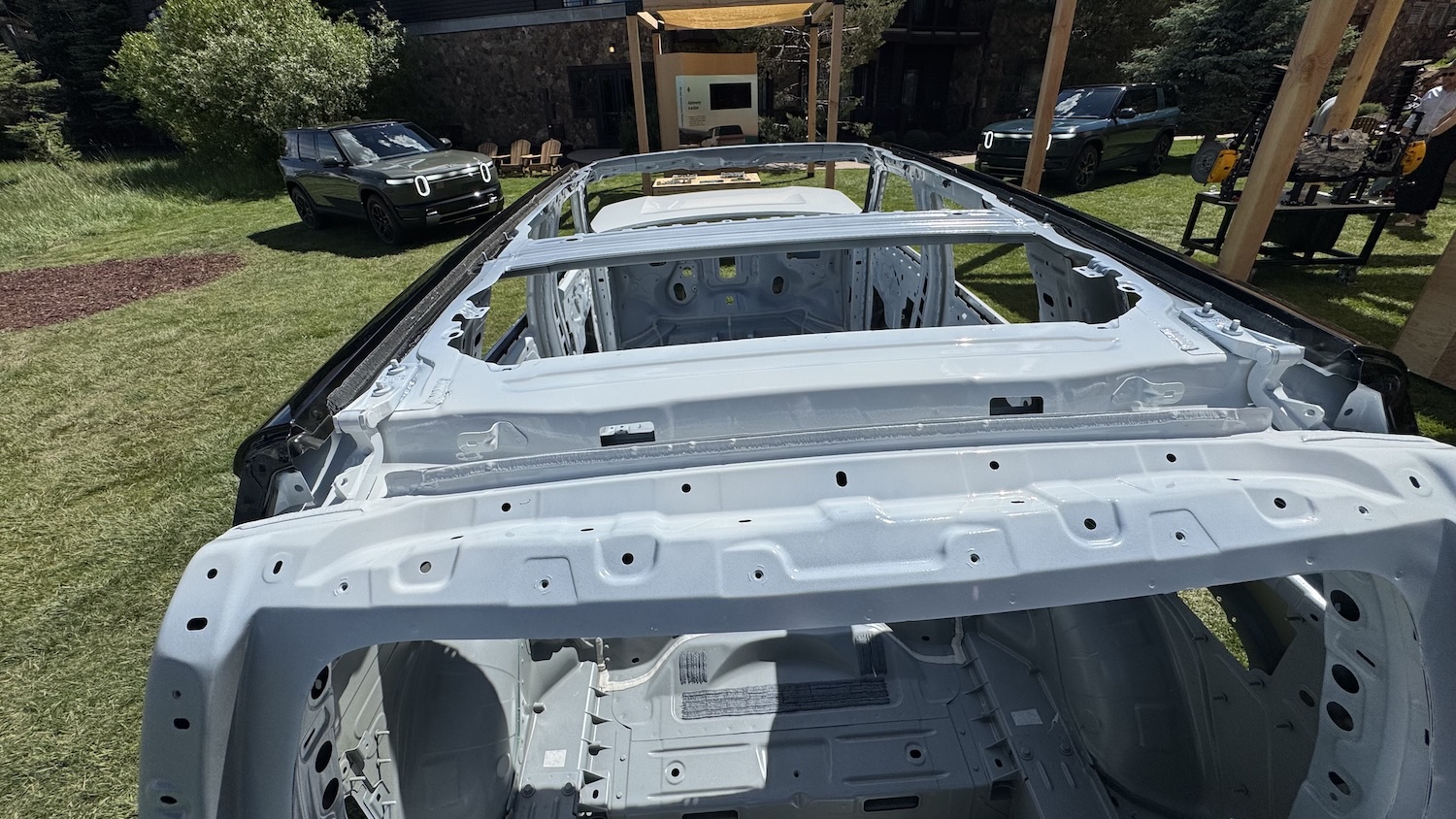
I wish I had more time to chat with Rivian’s body engineer at the event so I could give you more insights into this body-in-white, but for now I’ll just provide you some photos of the beautiful structure. Before I do that, let’s check out the Rivian R1S body structure; as I mentioned before, in addition to the battery, it consists of a humongous, beefy frame:
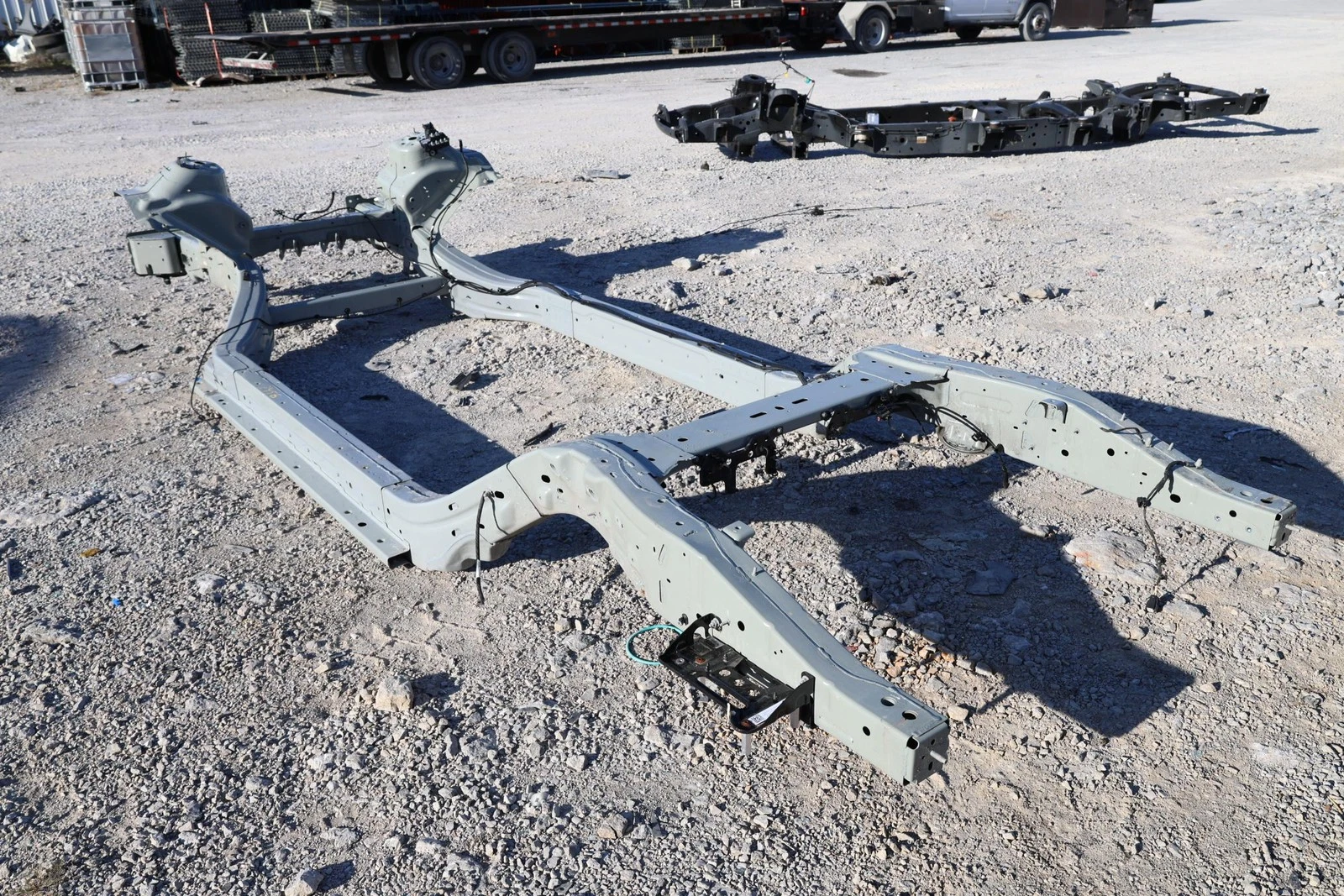
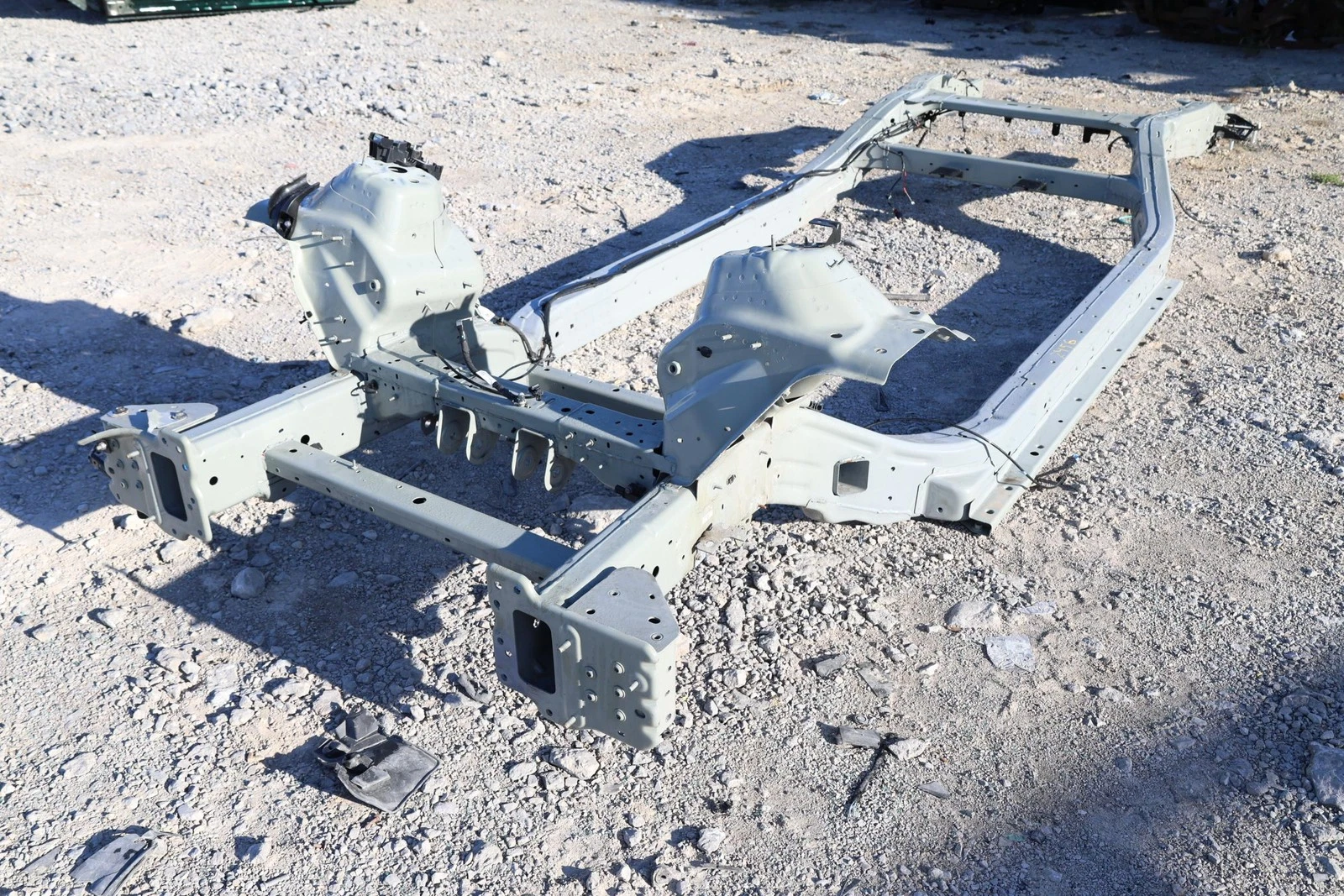
To that frame is attached a body:
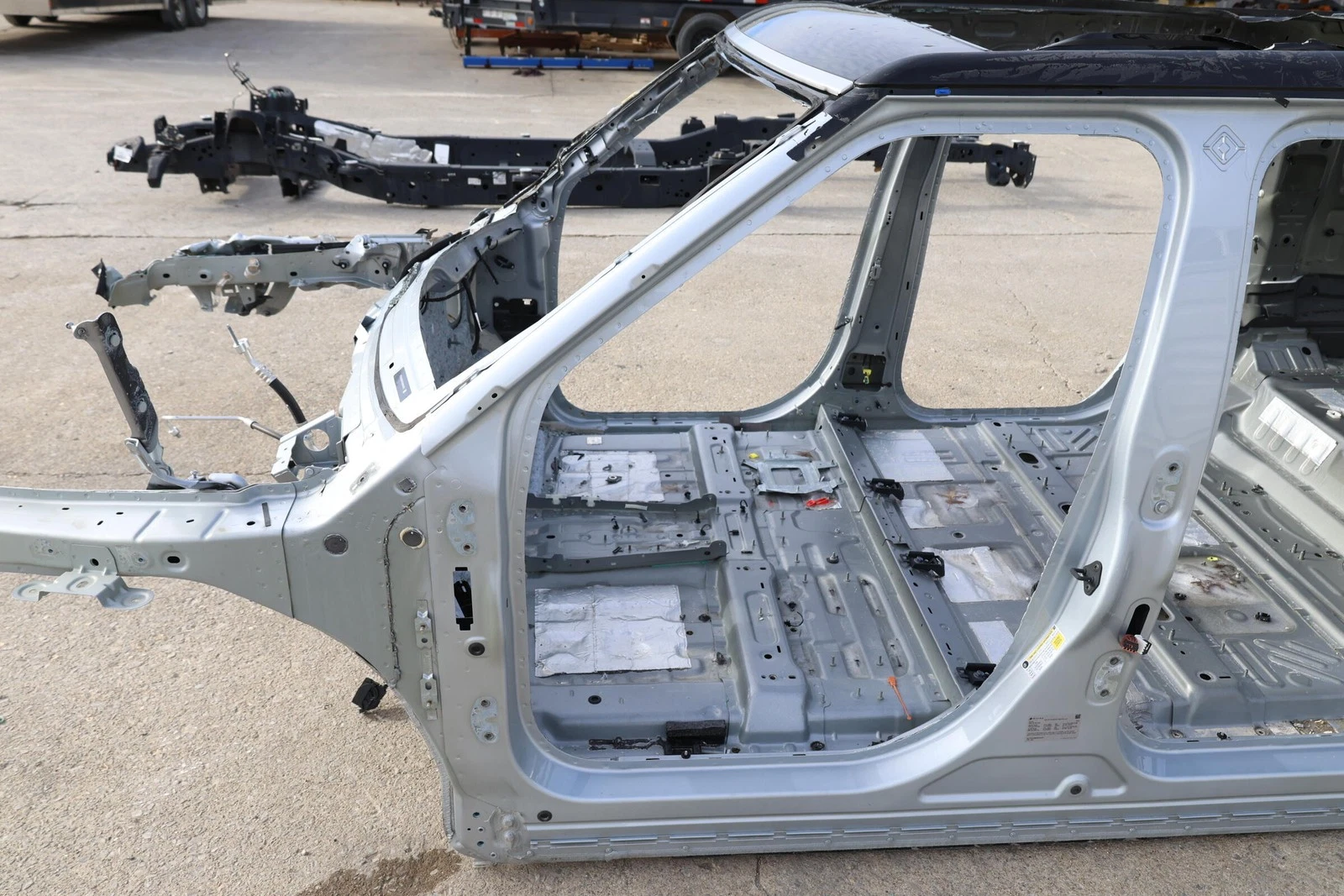
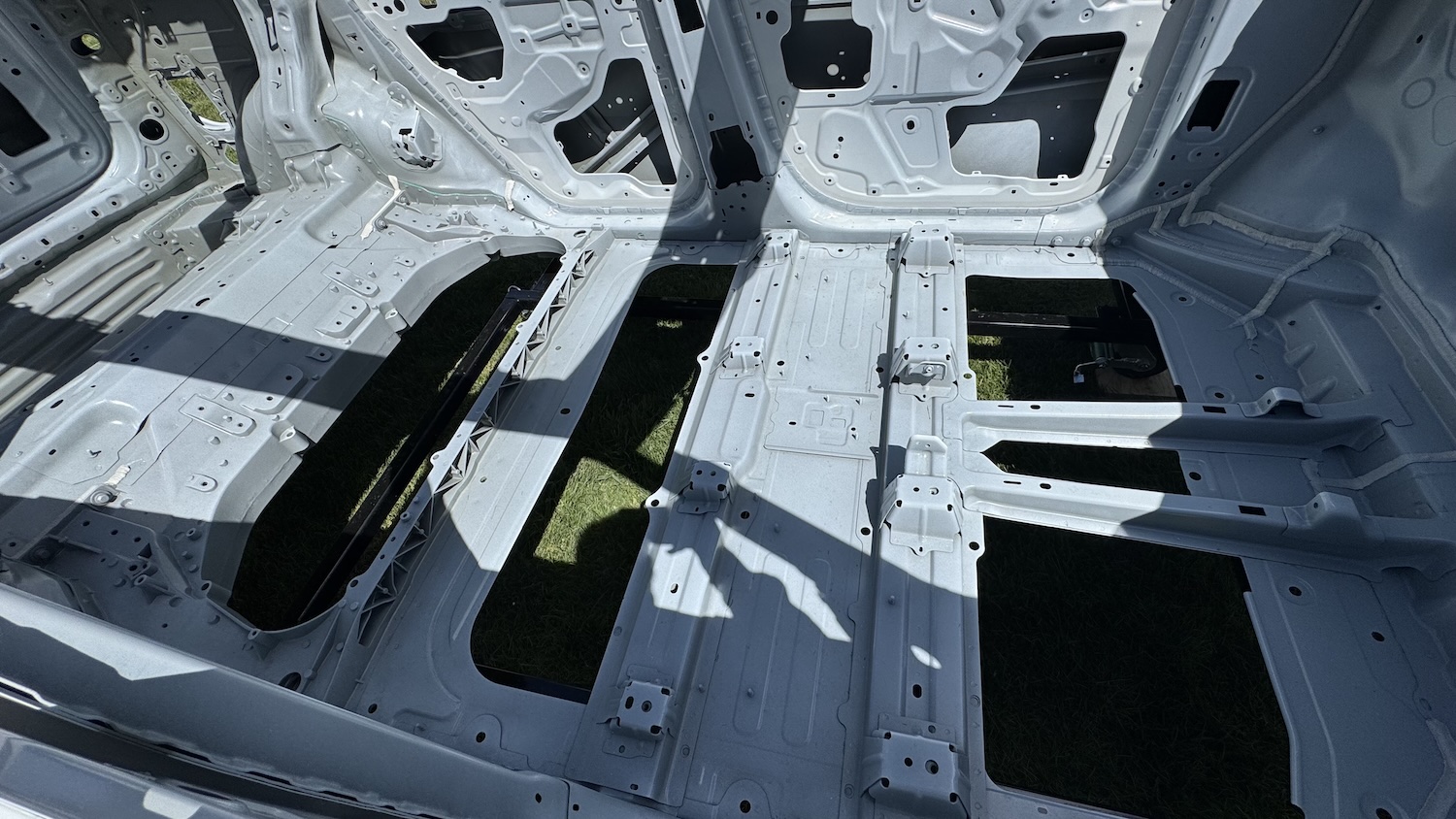
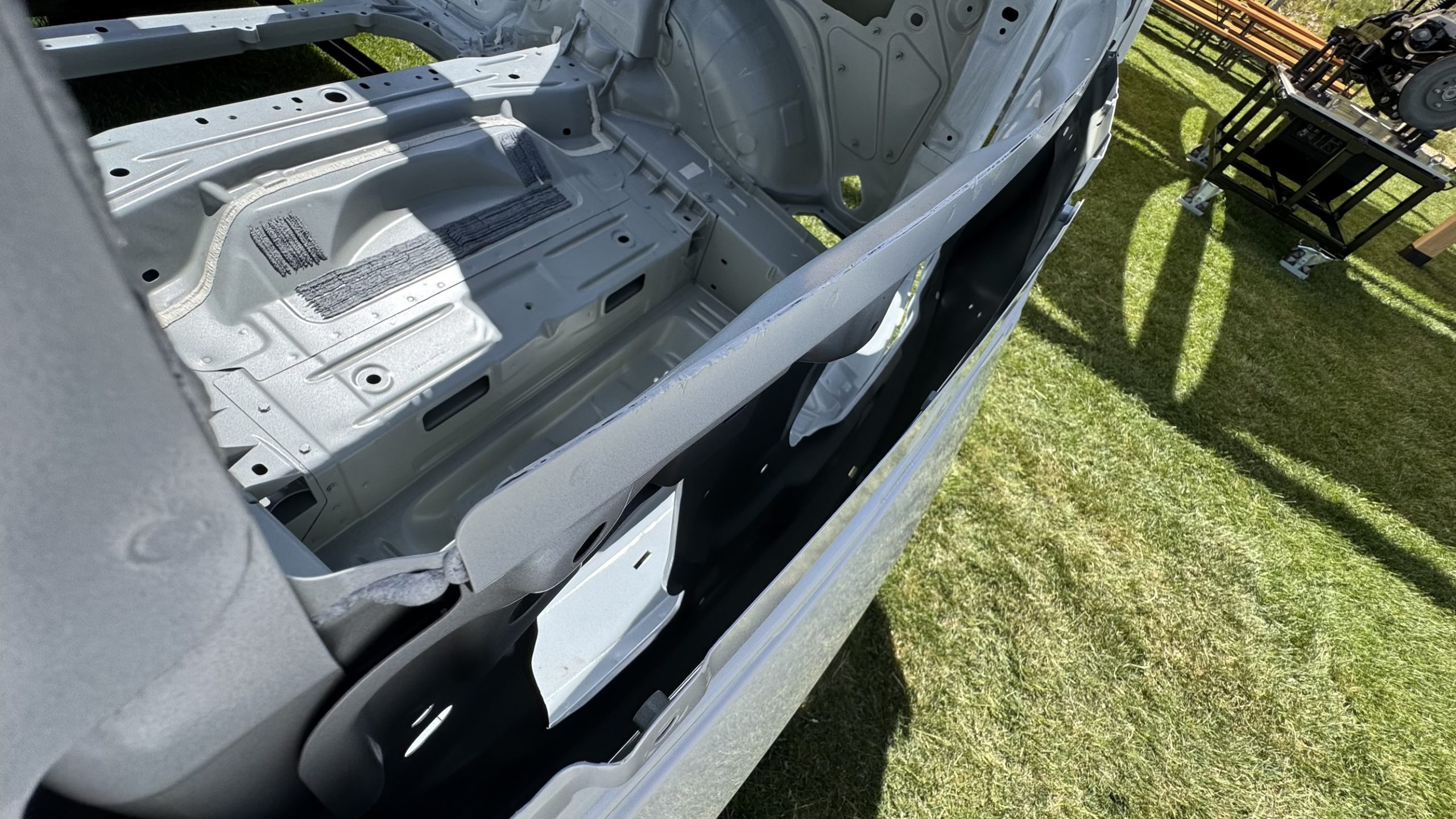
The R2, by contrast, does not feature its own dedicated frame. Its unibody is made primarily of stamped steel with cast aluminum structures throughout. The most obvious of the large aluminum castings is the rear floor; check this out:
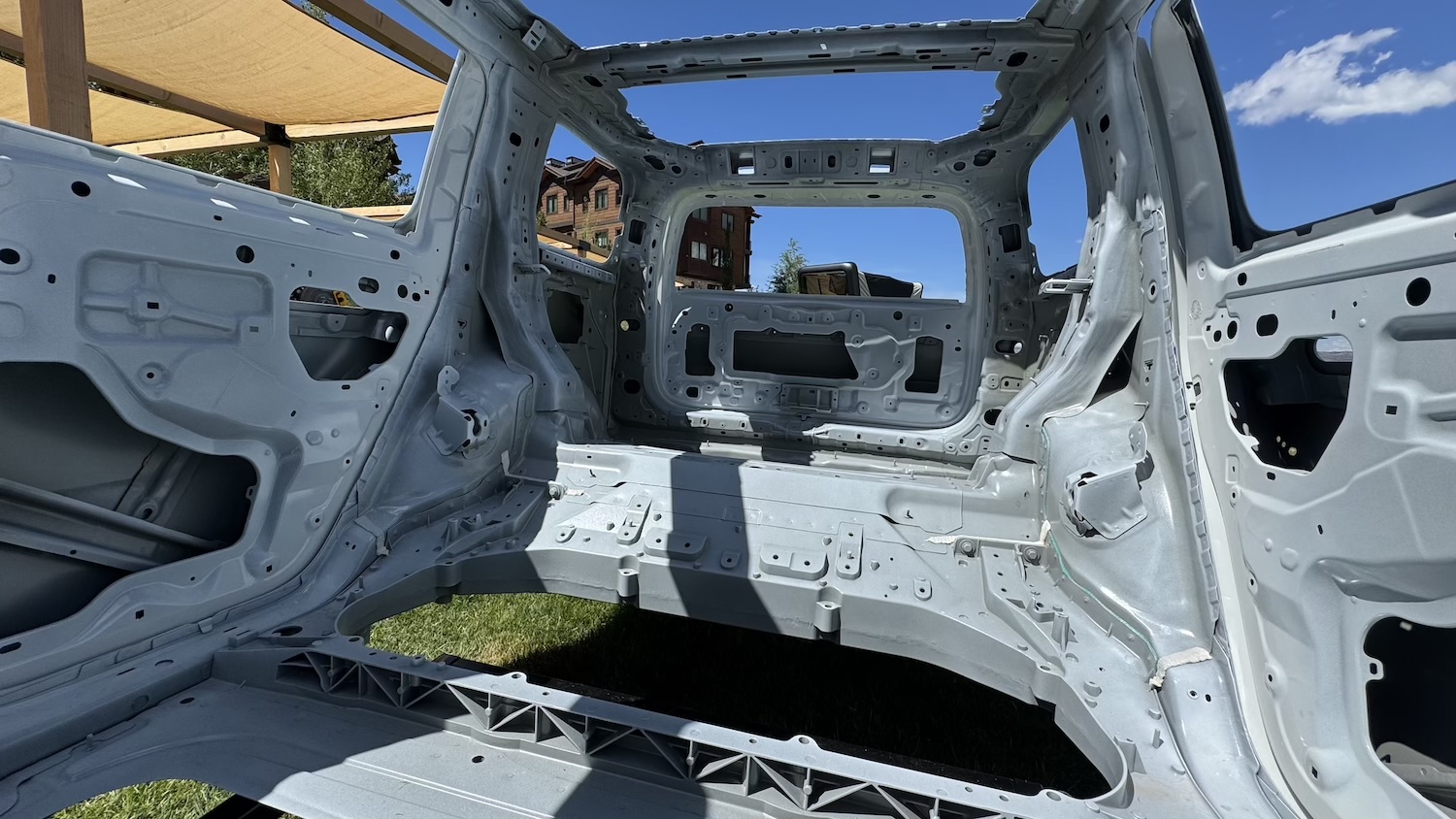
You can see some other castings on the outboard parts of the cargo area:
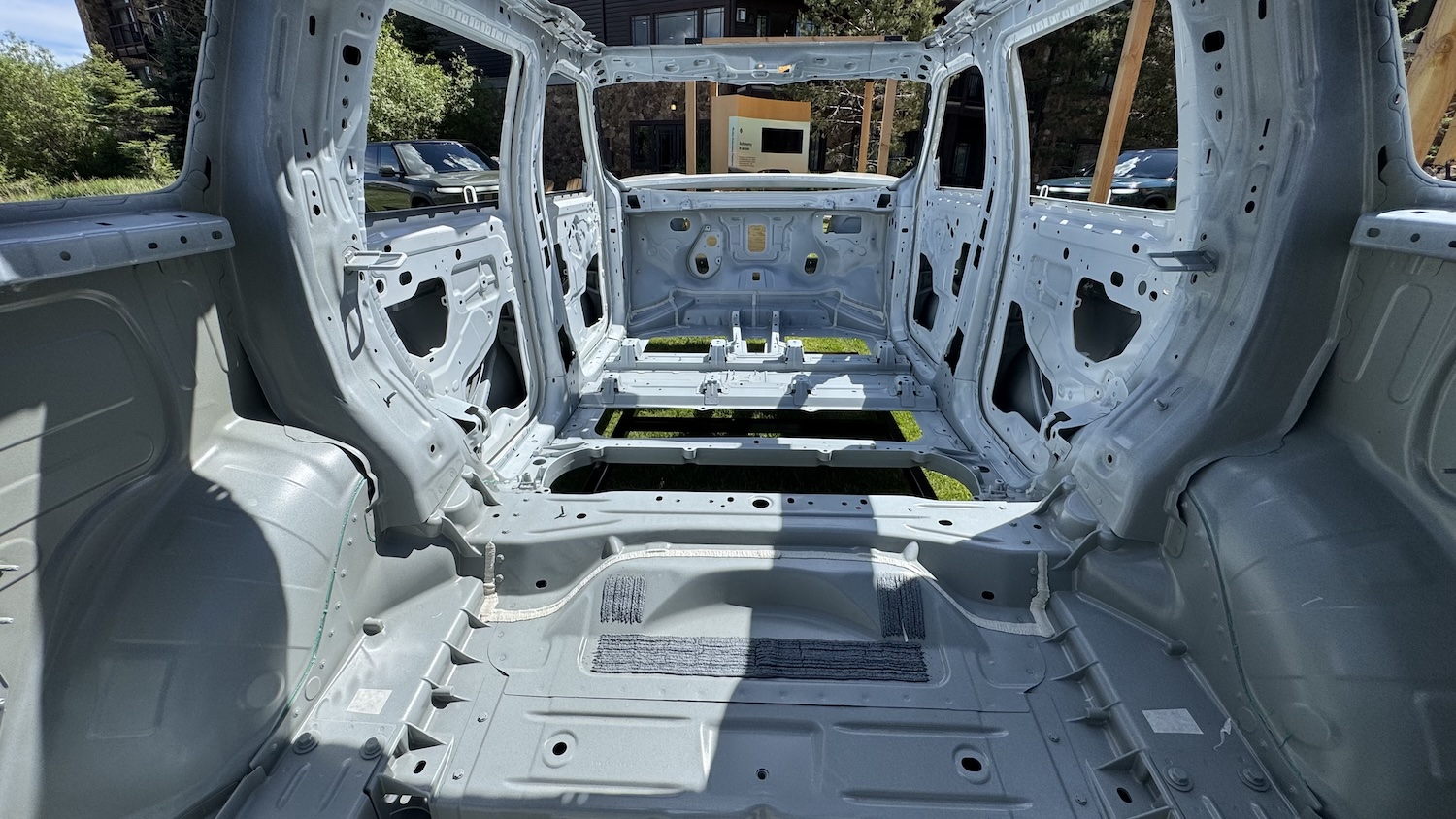
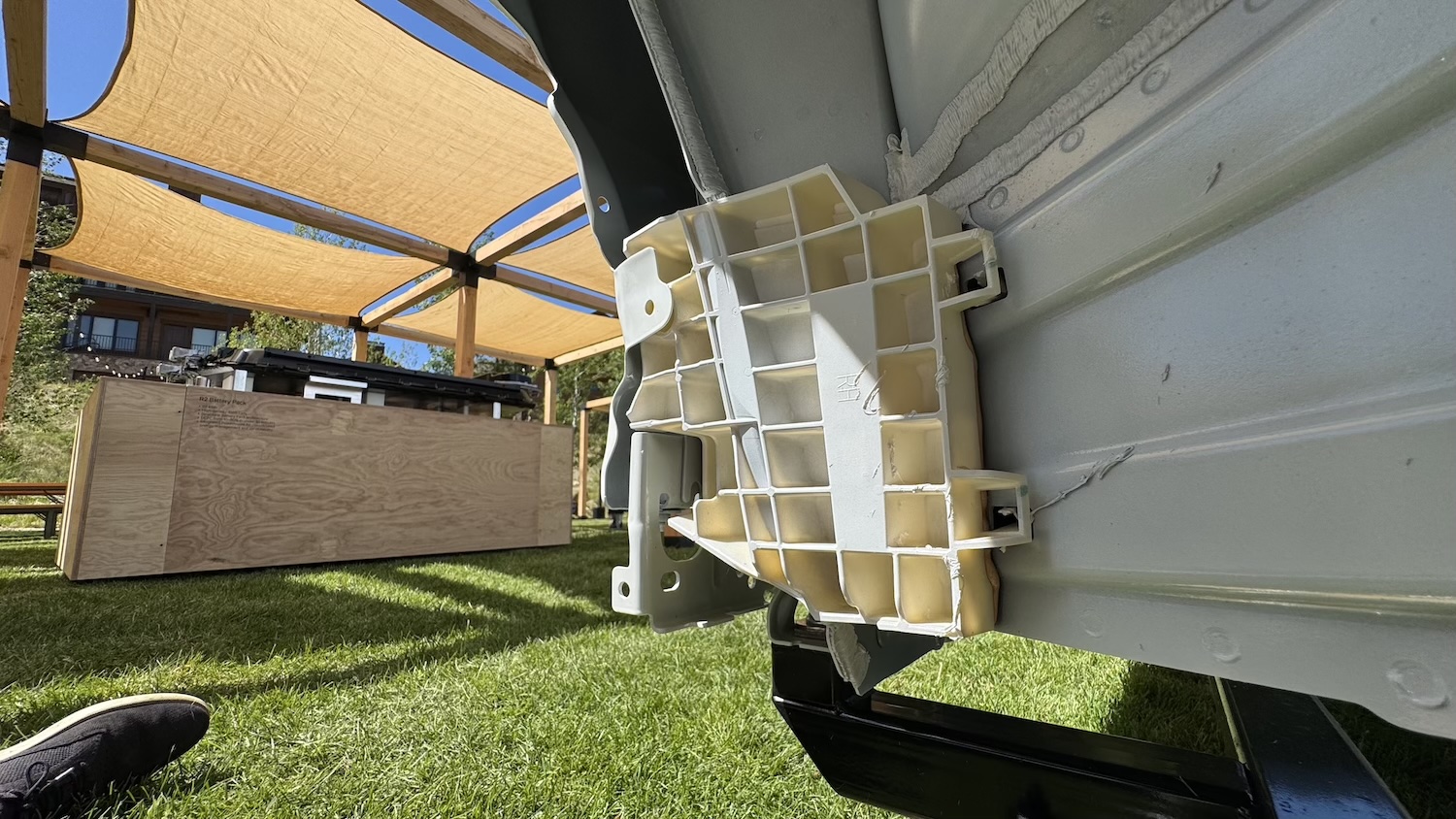
Check out all those welds and bolts and adhesives — a beautiful thing to behold. In the rear wheel wells you get a great look at the giant rear castings:
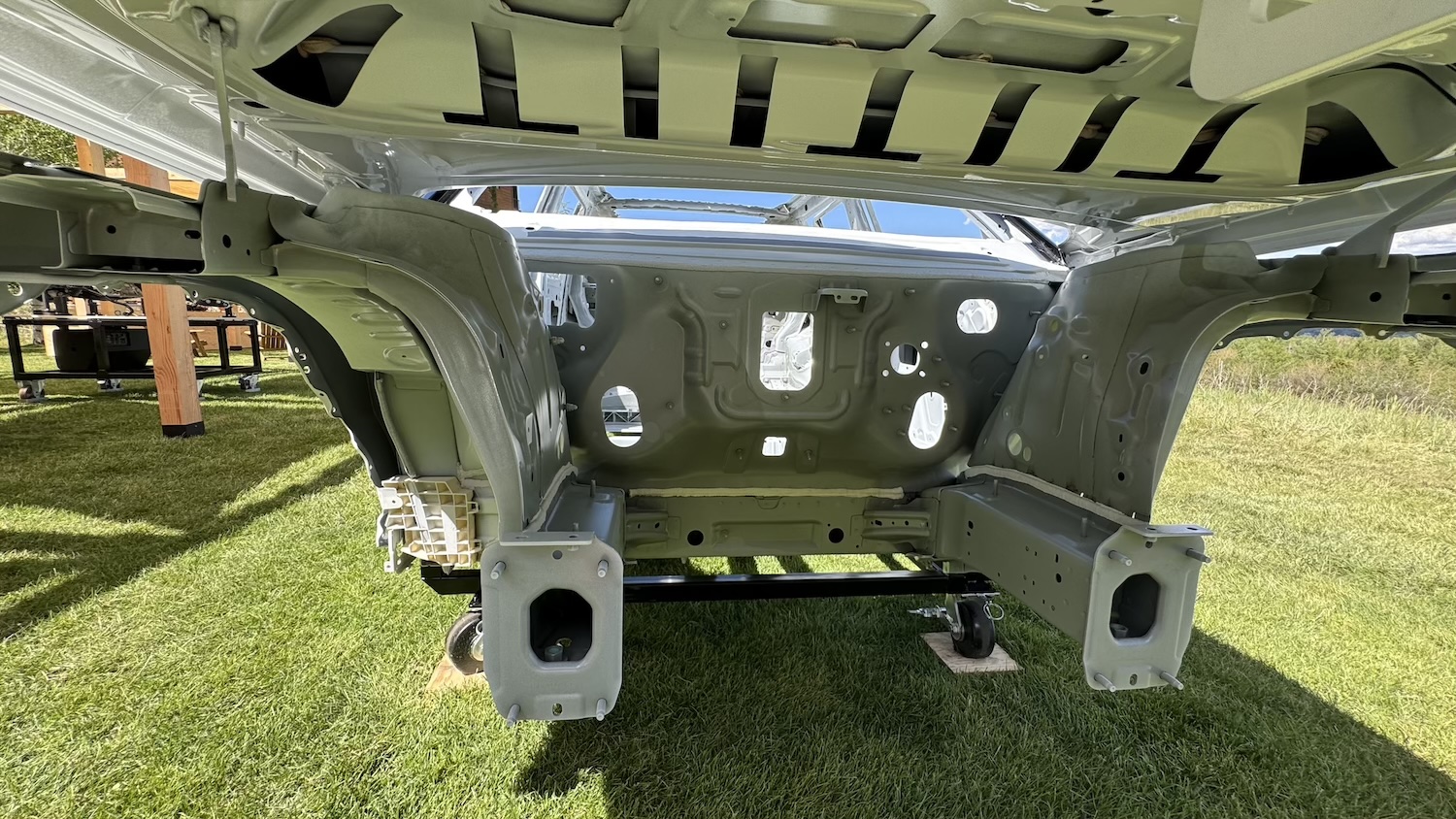
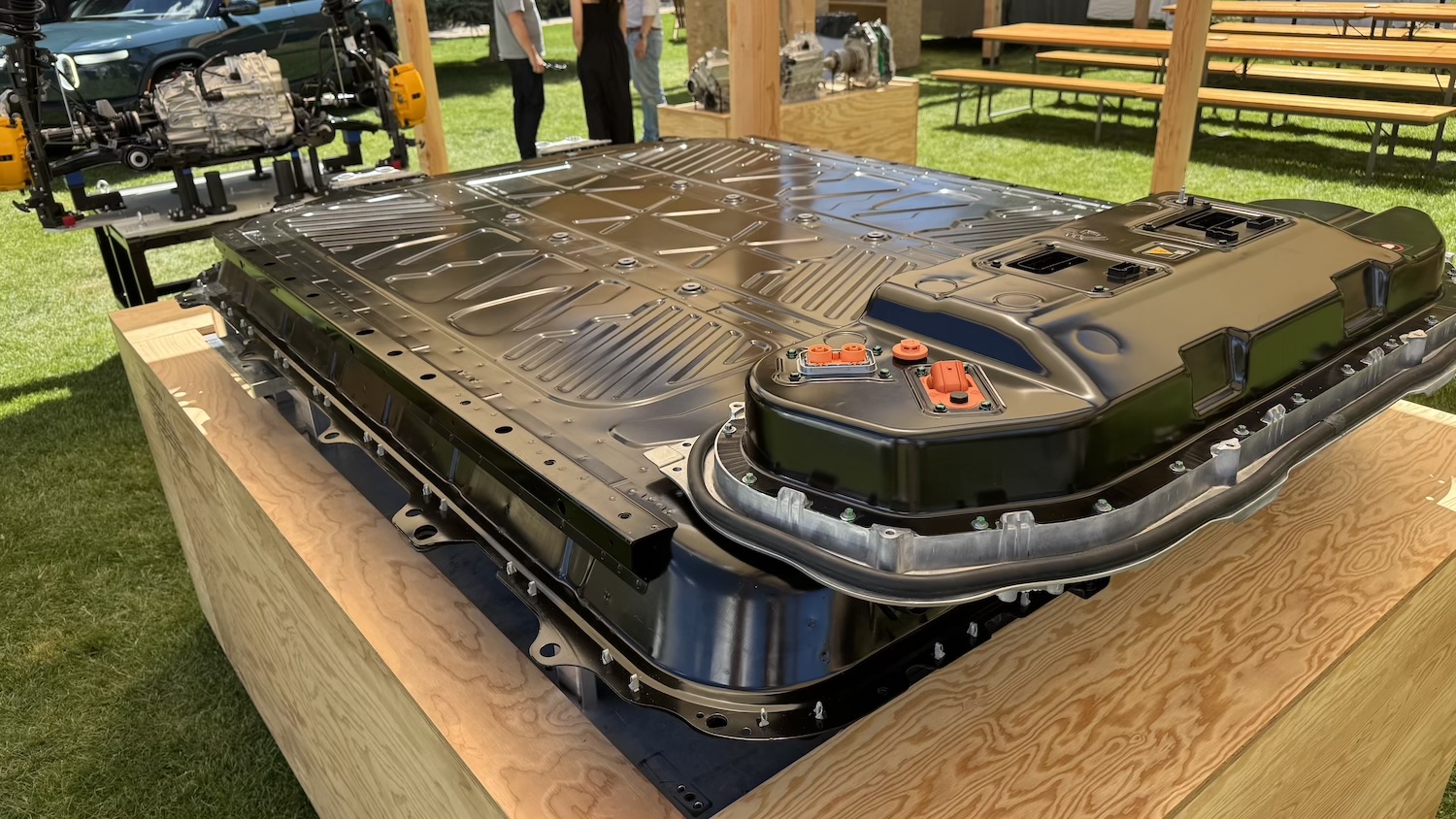
The diagram below shows how the structural battery pack mounts between the axles:

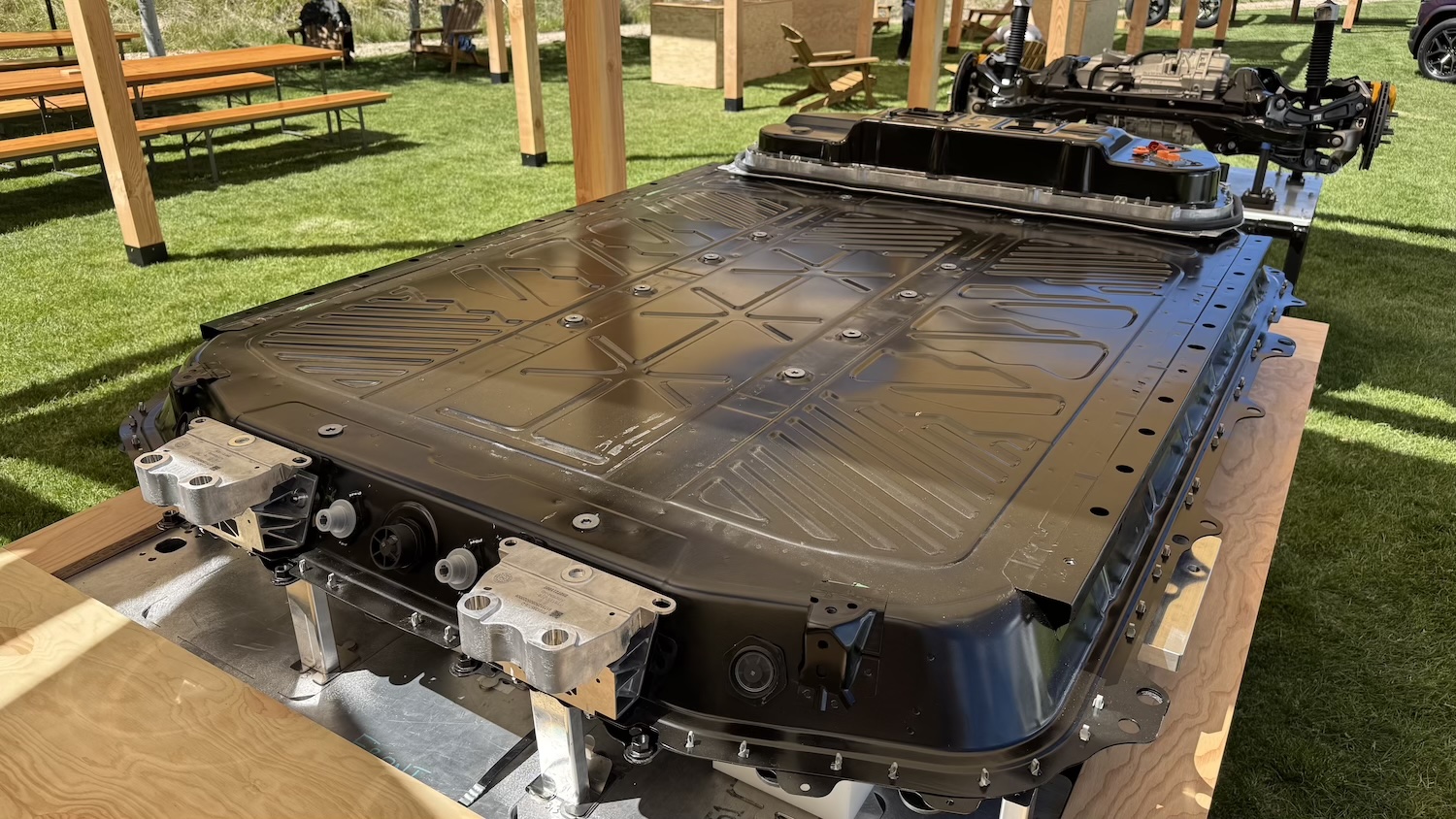
That 87.9kWh pack features a “Powerhouse” sitting on the rear. If you look at the body-in-white images above, you’ll see where the powerhouse mounts to that cast aluminum structure making up the rear floor:
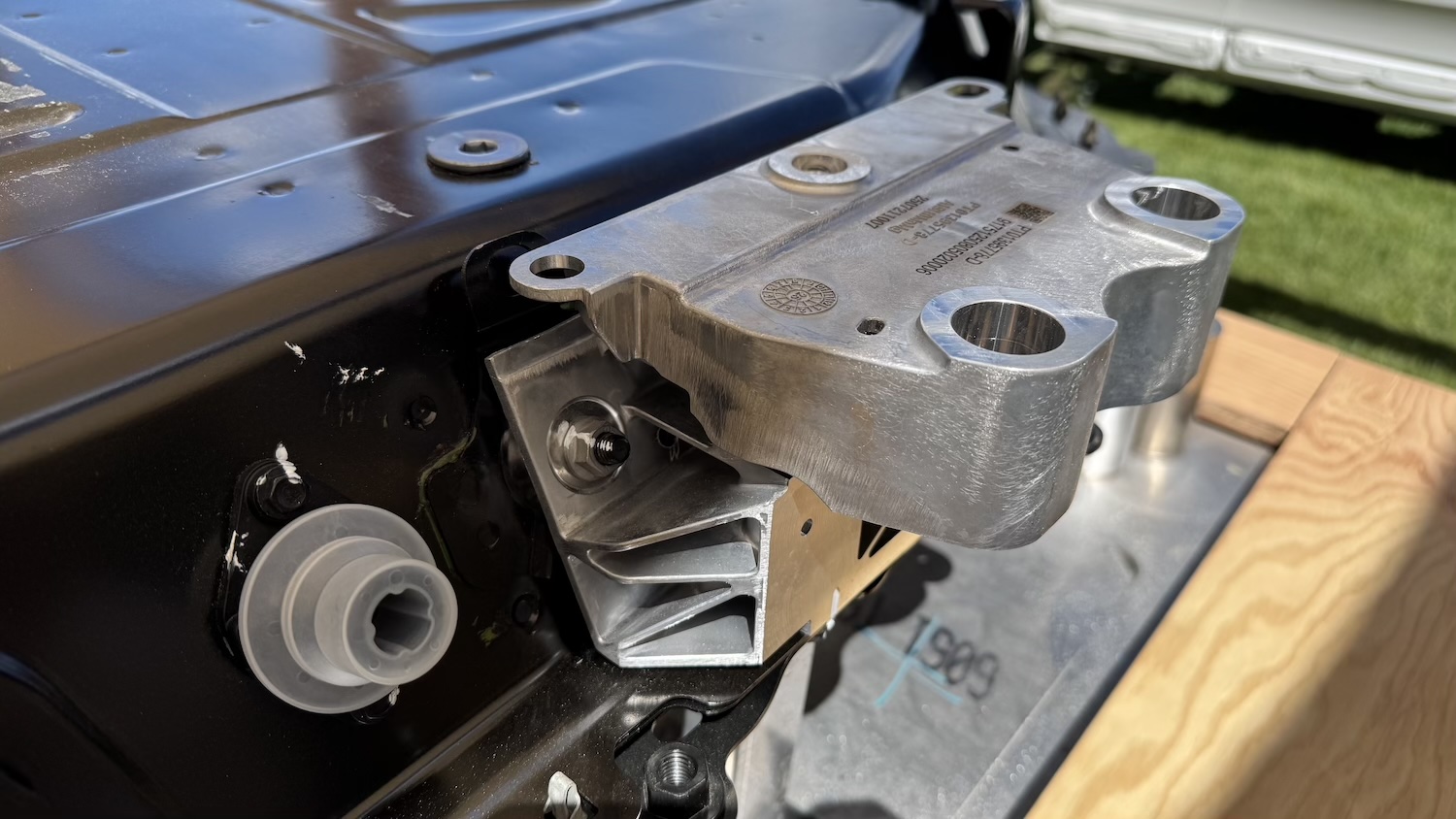
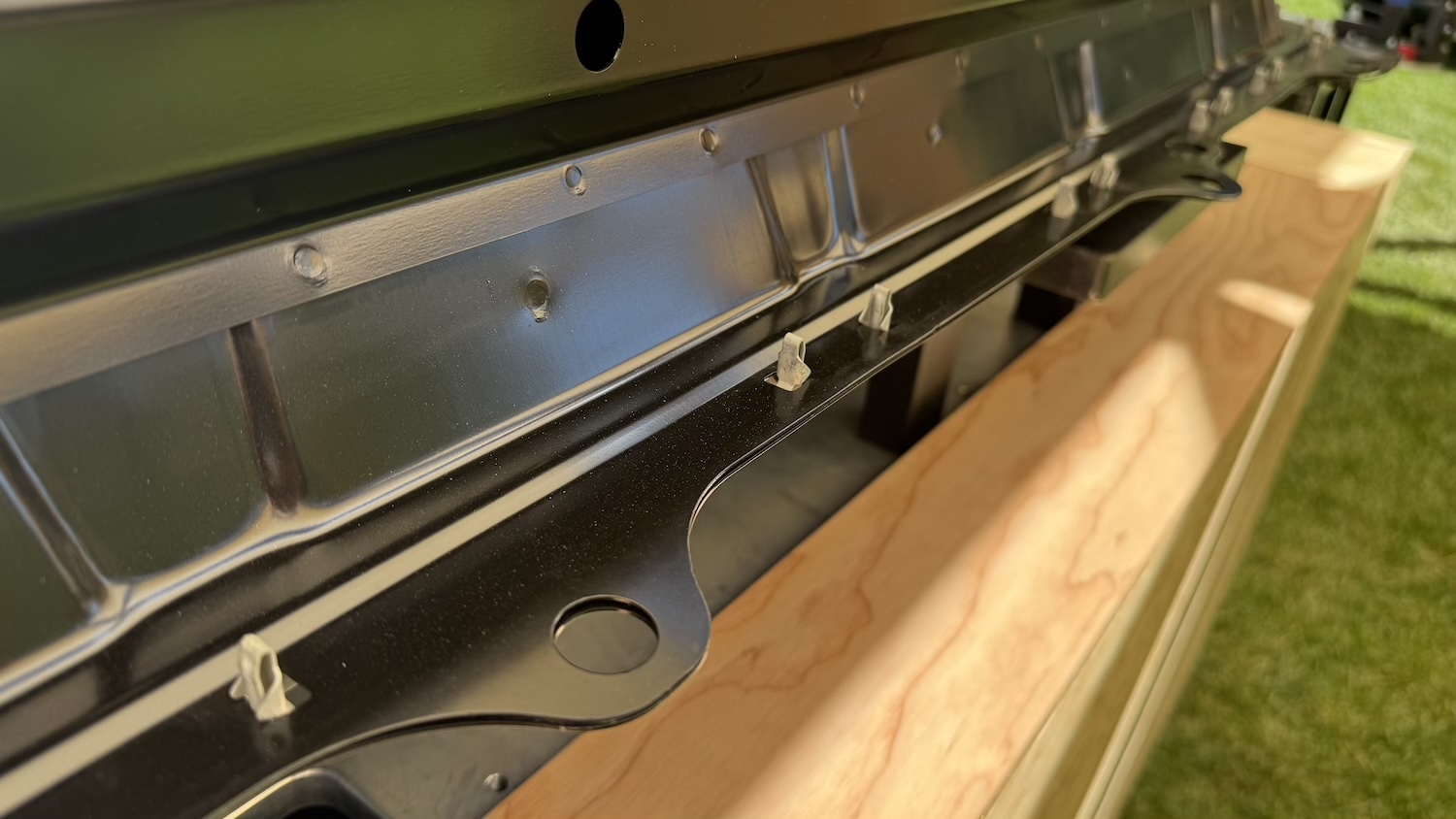
Here you can see some of the battery pack mounting provisions:
Rivian showed us the R2’s 4695 cylindrical cells (NCMA: Nickel Cobalt Manganese Aluminum), which are named for their 46mm diameter, 95mm height form-factor. The design of these cells, Rivian told us, allows for easier manufacture due to there being fewer cells than the 2170 packs in the Rivian R1S. What’s more, the cooling efficiency is increased due to the increased surface area, which is why the new cells are side-cooled.
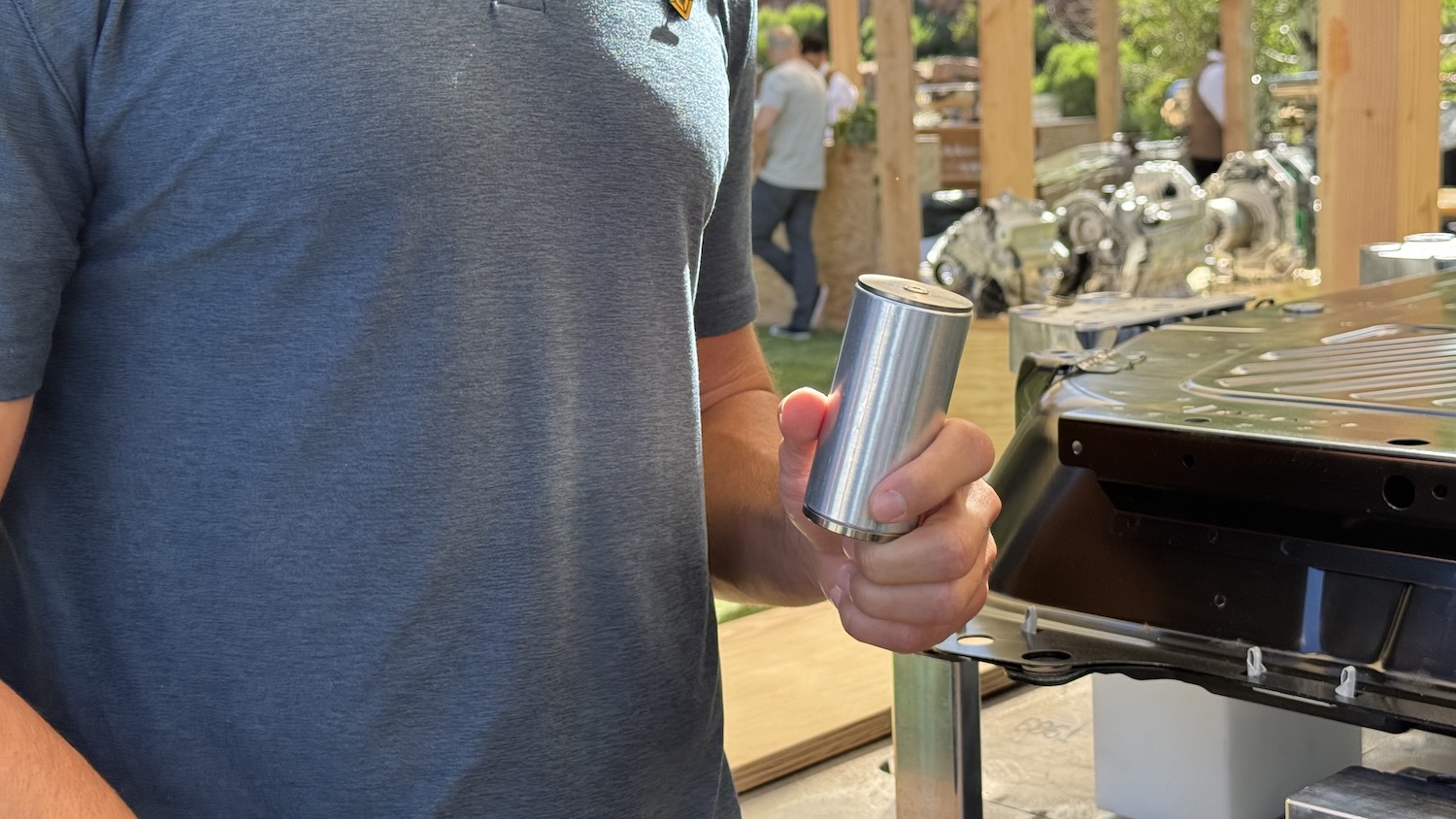
Here you can see the smaller, 2170-style cells in the R1S; they’re end-cooled via cooling plates, whereas the R2’s batteries feature channels that “weave” between the sides of the larger cells.

Here’s a look at the guts of that “Powerhouse” sitting atop the rear of the pack:

Rivian showed journalists that what would normally be five components — the south “zonal” (this is the controller for components at the rear of the vehicle), the Battery Management System, the DC-DC converter, the On-Board Charging Module, and the DC-to-AC inverter — has been converted to a single, elegant part.
Here’s a look at that single component located in the Powerhouse box:
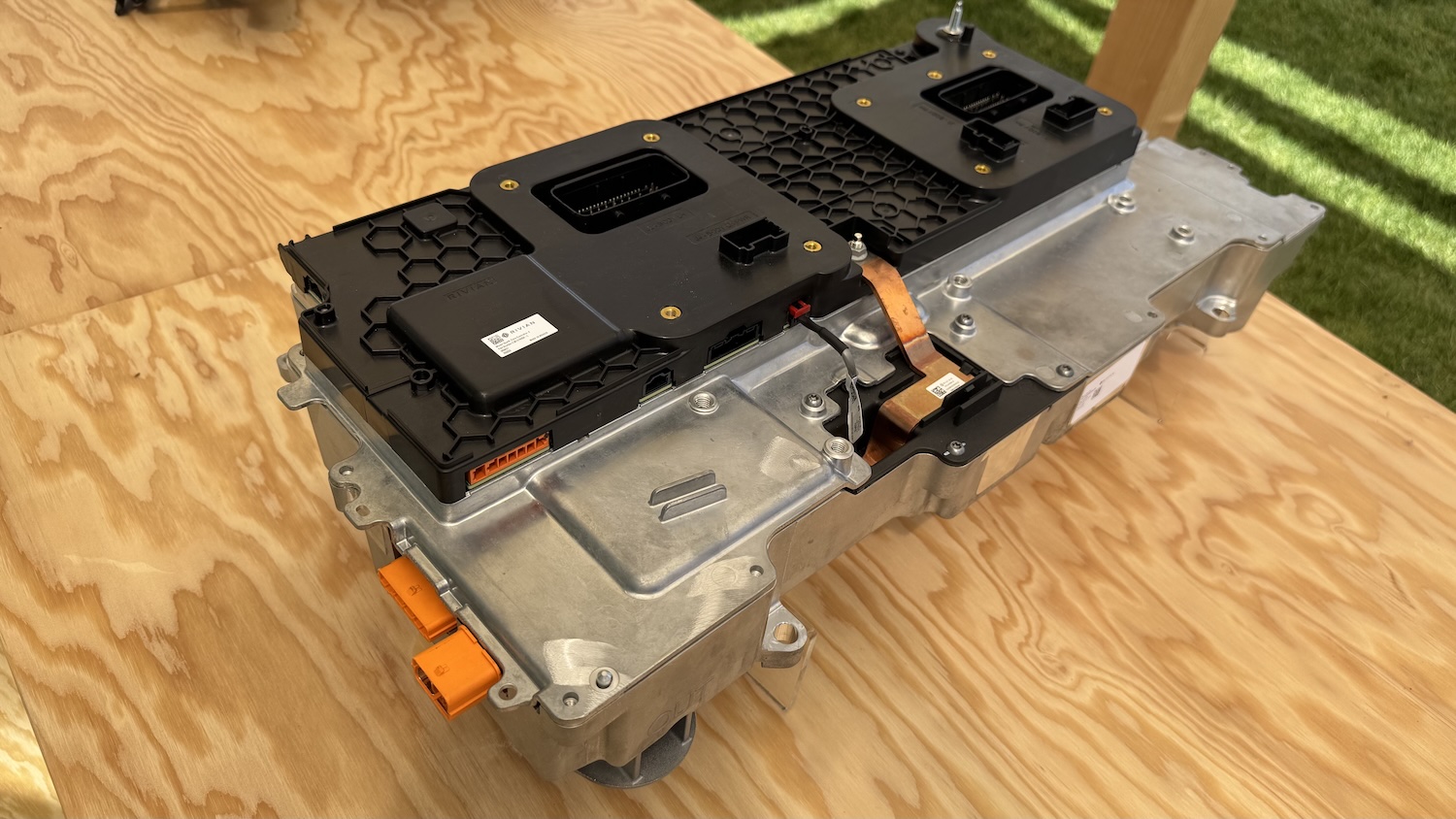
The components have all been brought in-house, Rivian says, and instead of features being removed, the R2 actually adds bi-directional charging, so you can actually use the vehicle as a battery to run auxiliary power tools, homes during power outages, etc.

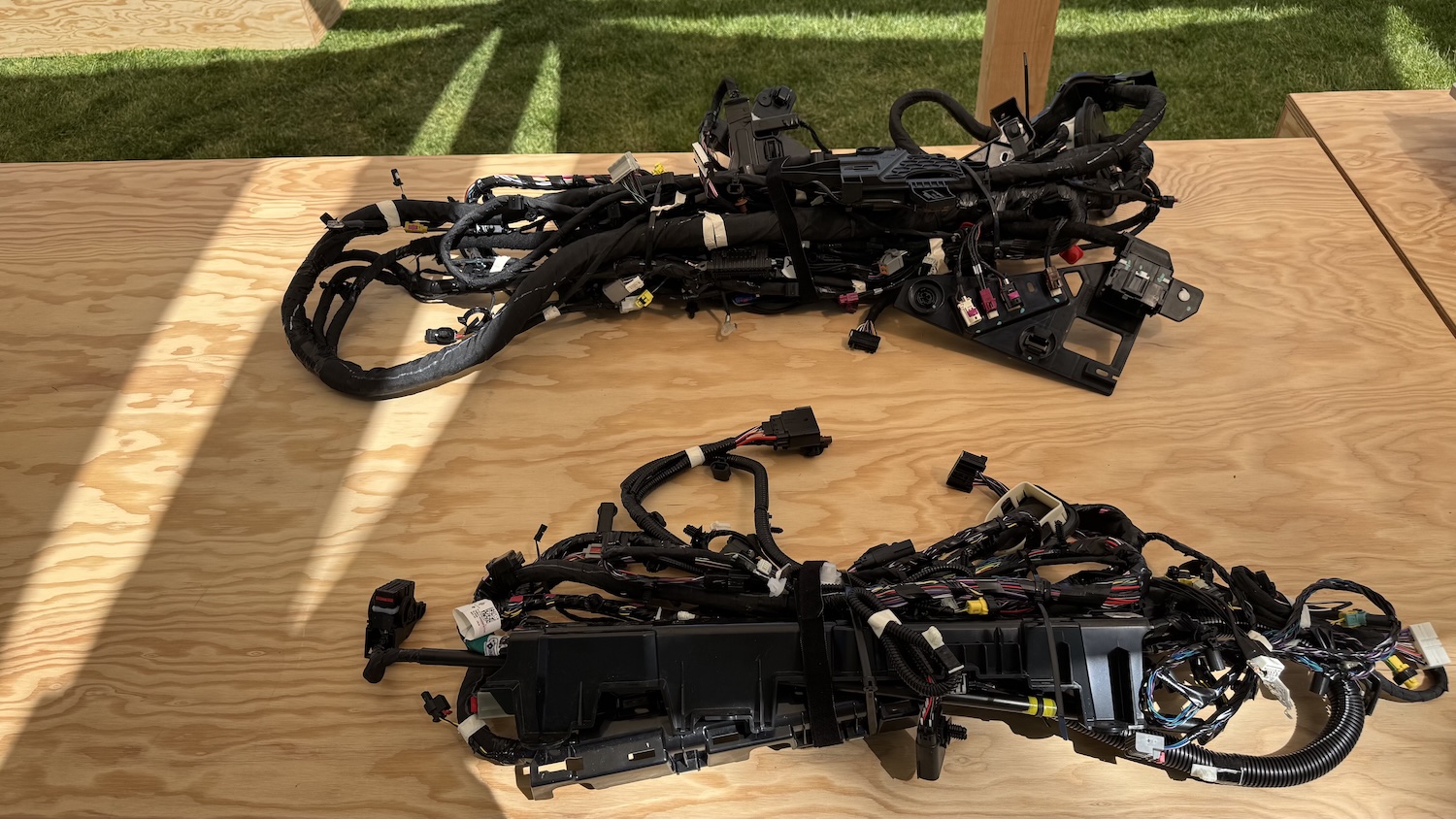
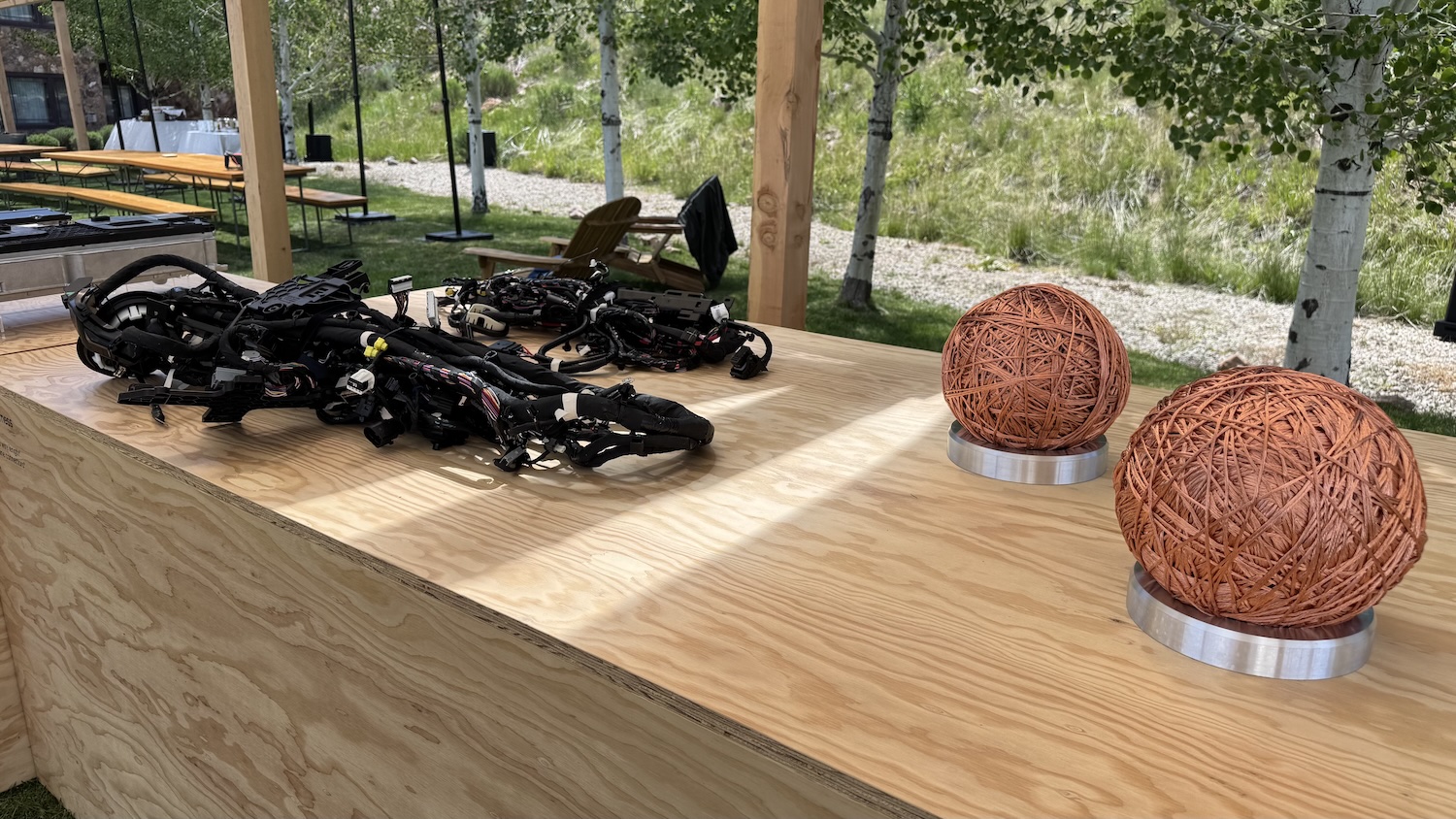
The company also showcased the R2’s wiring harness, which is 2.3 miles (when adding individual wires) shorter than that of the latest R1S.
2.3 miles weighs over 44 pounds, which is what one of the copper wire-balls below weighs. It was not easy to lift:
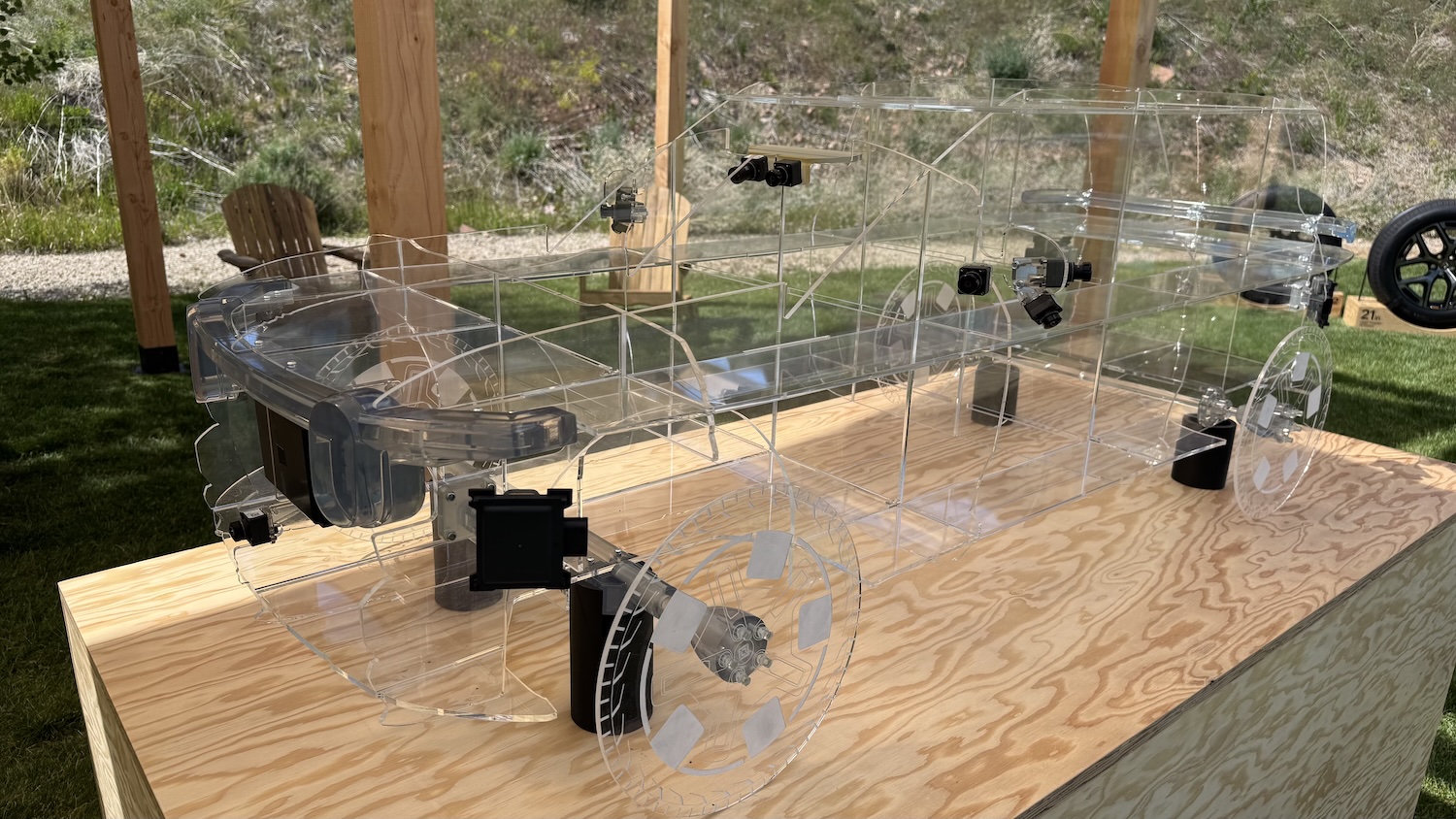
There’s a lot more that Rivian showed journalists. For example, the company showed the cameras (11 in total; 10 outside, one inside) and radar sensors (four corner radars and a long-range in the front) located around the vehicle:
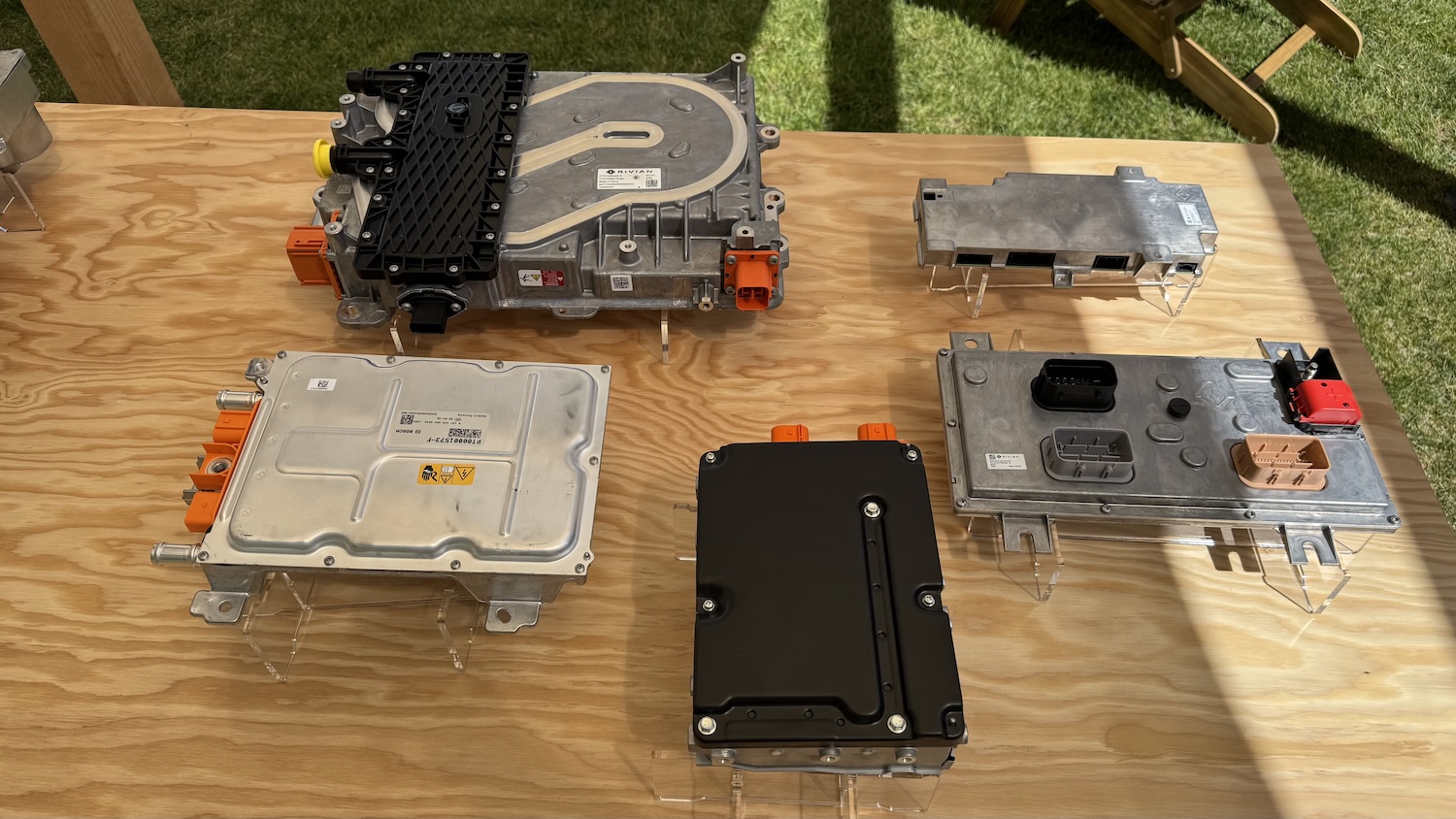
They also showed boards that they’ve made more compact compared to the R1S:
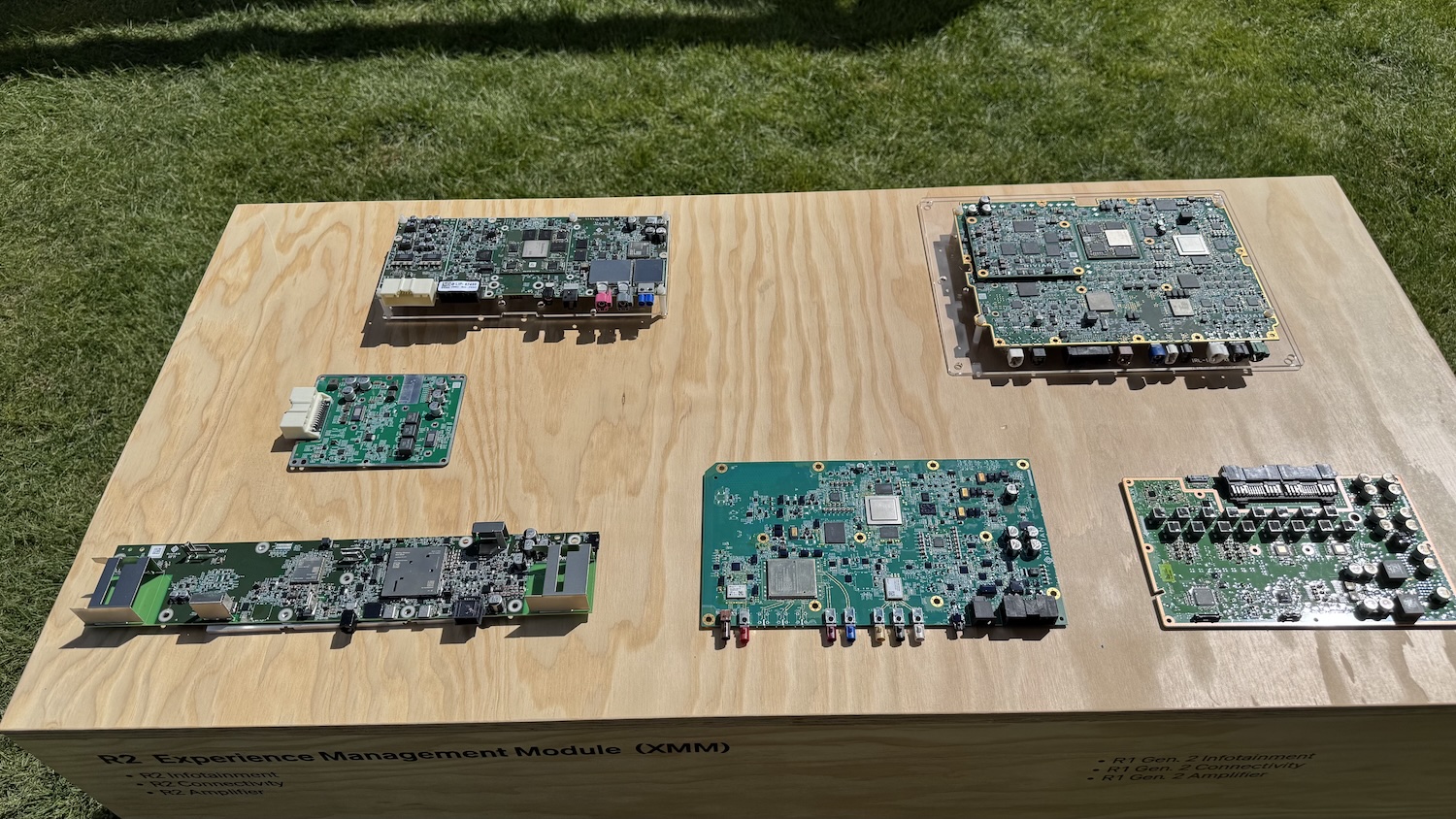
I know there are some electrical engineers furious that I’m glossing over the sensors and boards above (you can see by the text that the R1s are bigger overall) but this review is getting long, so I’ll finish this engineering section with the subframes, since as a mechanical engineer and there’s lots of good hardware on the subframes.
Up front you’ll see a fairly standard stamped steel subframe with a MacPherson strut suspension, a regular steel roll bar, and a fairly typical dual pinion steering rack:
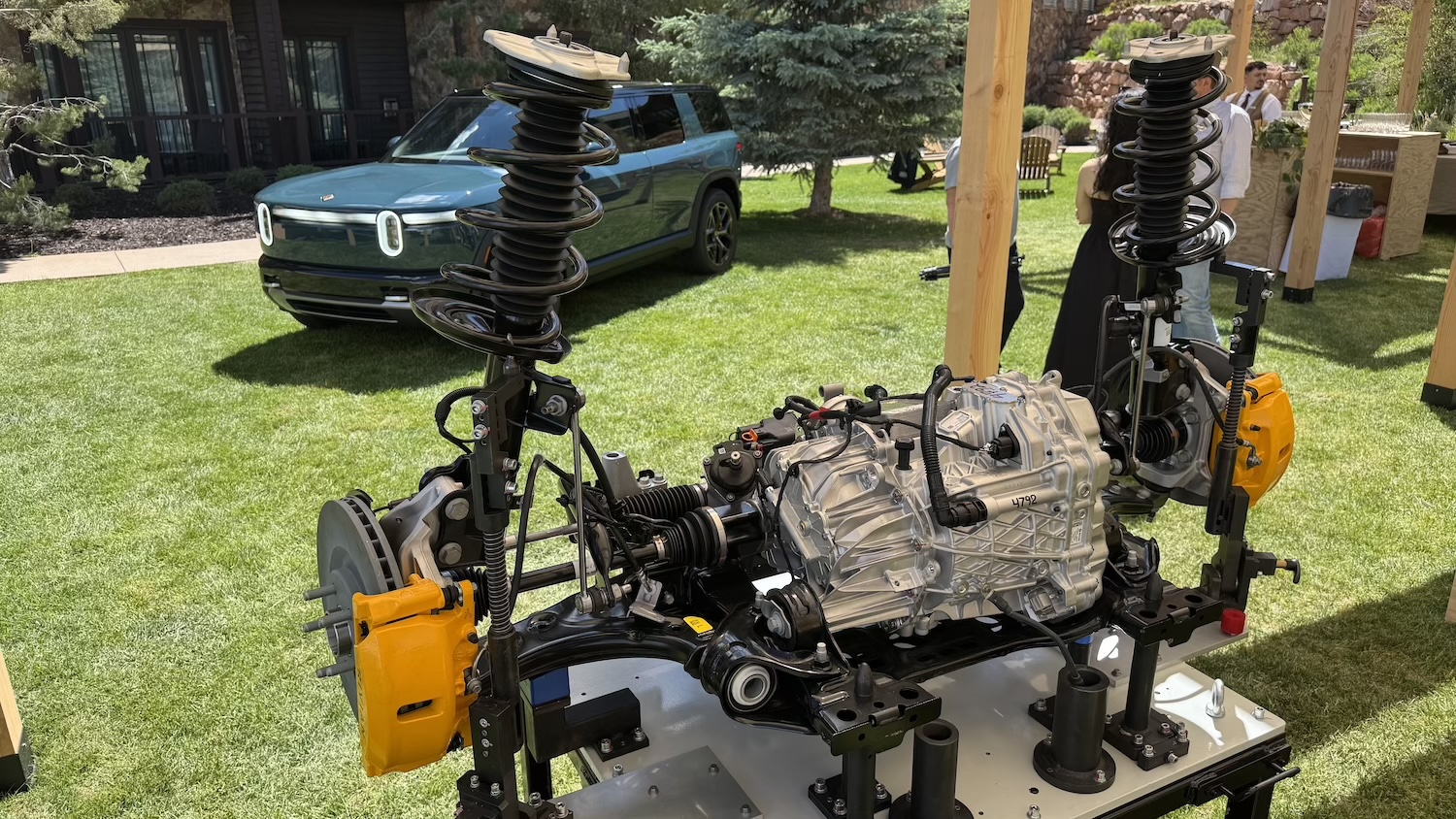
By contrast, the Rivian R1S features air suspension, a fancy hydraulic roll control system, a cast aluminum subframe, a double wishbone front suspension, and a ball screw-style steering system to handle the higher loads. Rivian mentioned that the R2’s braking system is also different than the R1s in that, while pushing the R1’s brake pedal always moves hydraulic fluid, the R2’s brake pedal does not normally move fluid but instead it sends a signal to provide brake pressure (you can press harder to “push through” in the event of a failure); this, Rivian says, allows for better regen performance/variability.
The dynamics engineer mentioned that the Rivian team made him fight for every last feature, and the one he refused to give up on was semi-active dampers, so those are present on the R2 (though simpler than the ones on the R1S) and allow for variable damping performance in different driving conditions (the driver can actually change damping rate via the screen).
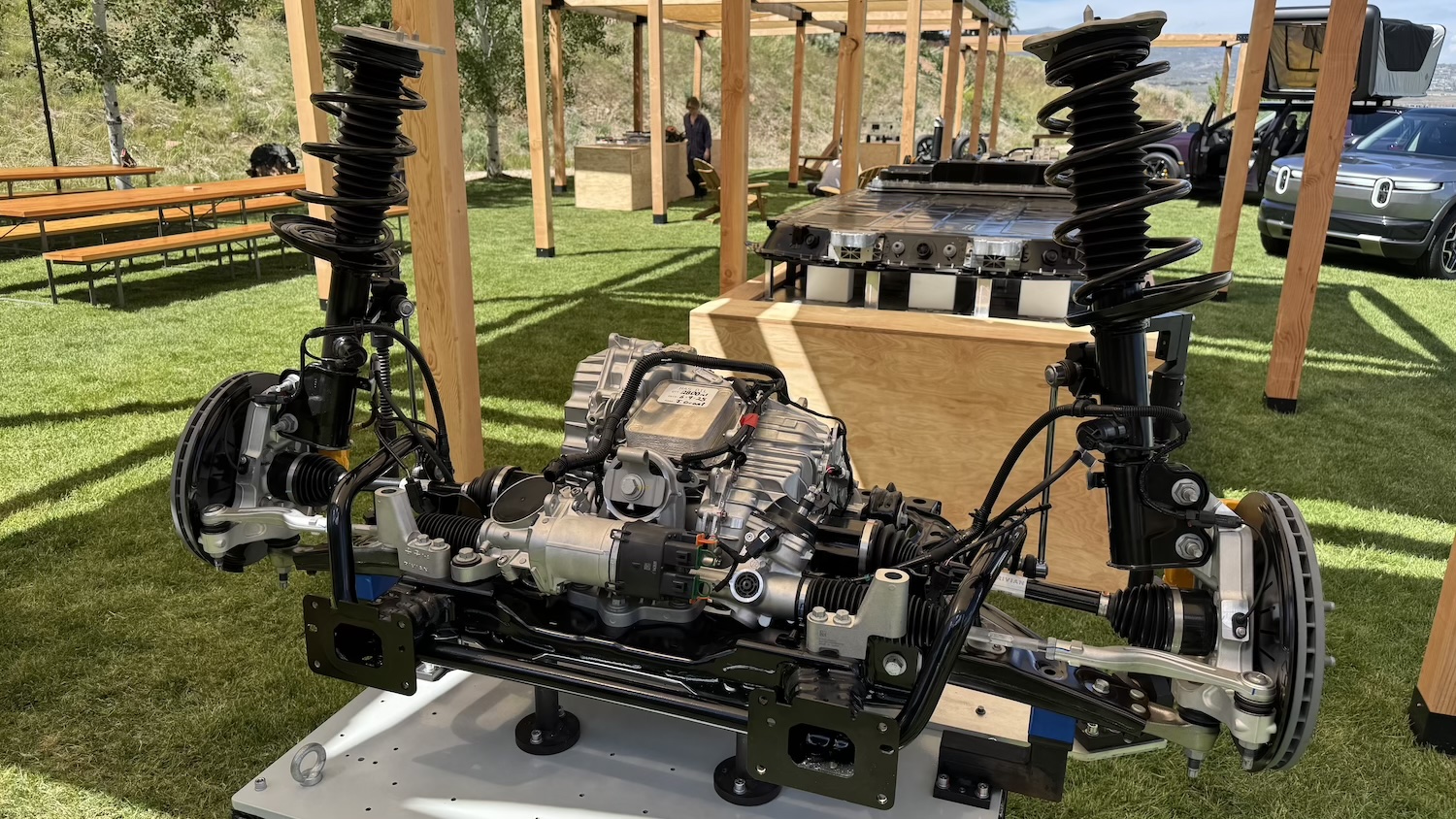
The drive unit is new, and called “Maximus.” A smaller unit than those found on the R1S and specifically designed for mid-size vehicles, it has been set up on the front and rear to offer a 40/60 front-rear torque split. Speaking of the rear, here’s that subframe, which is also stamped steel, which also features a standard steel sway bar, and which also features coil springs instead of air springs.
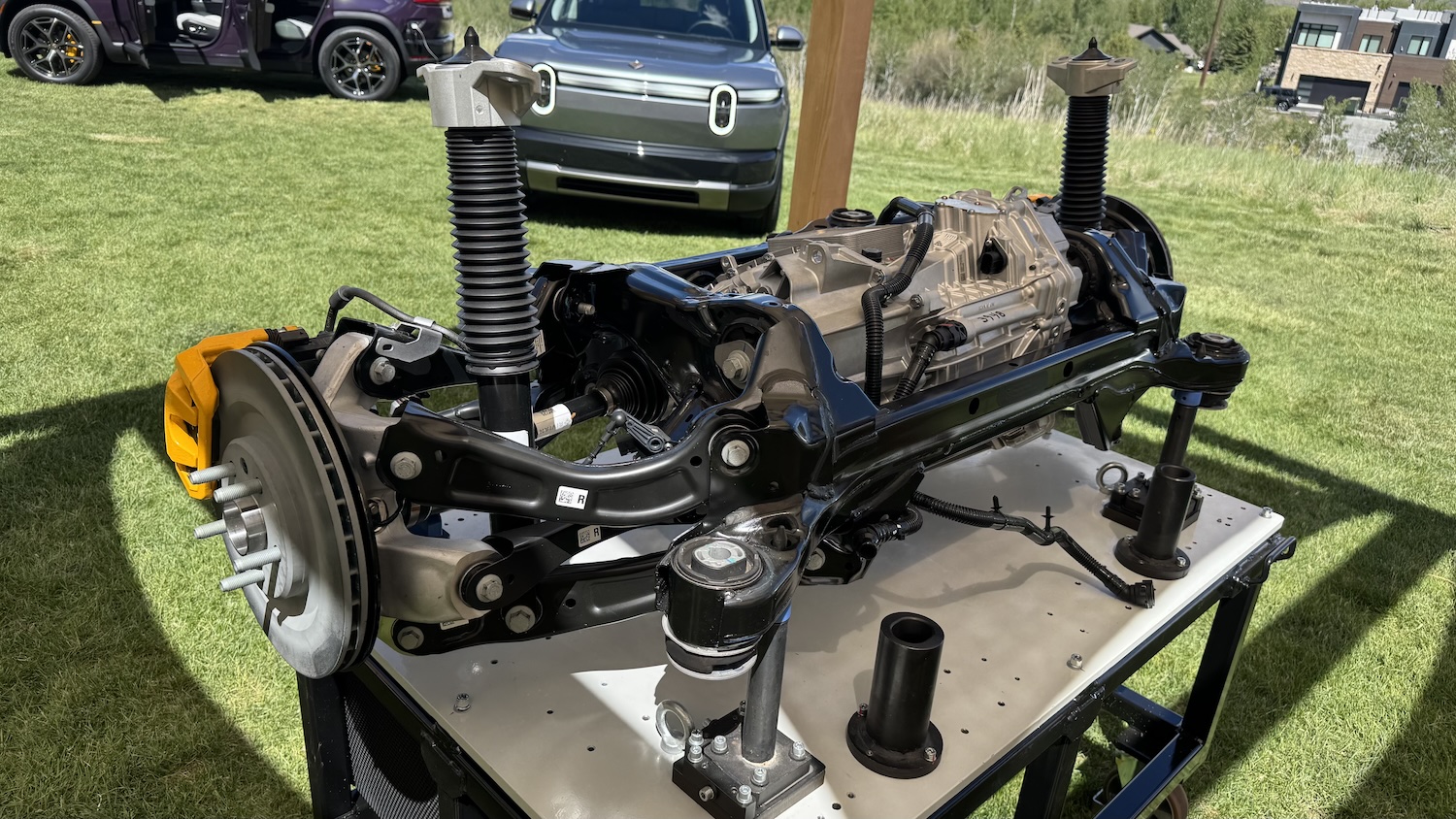
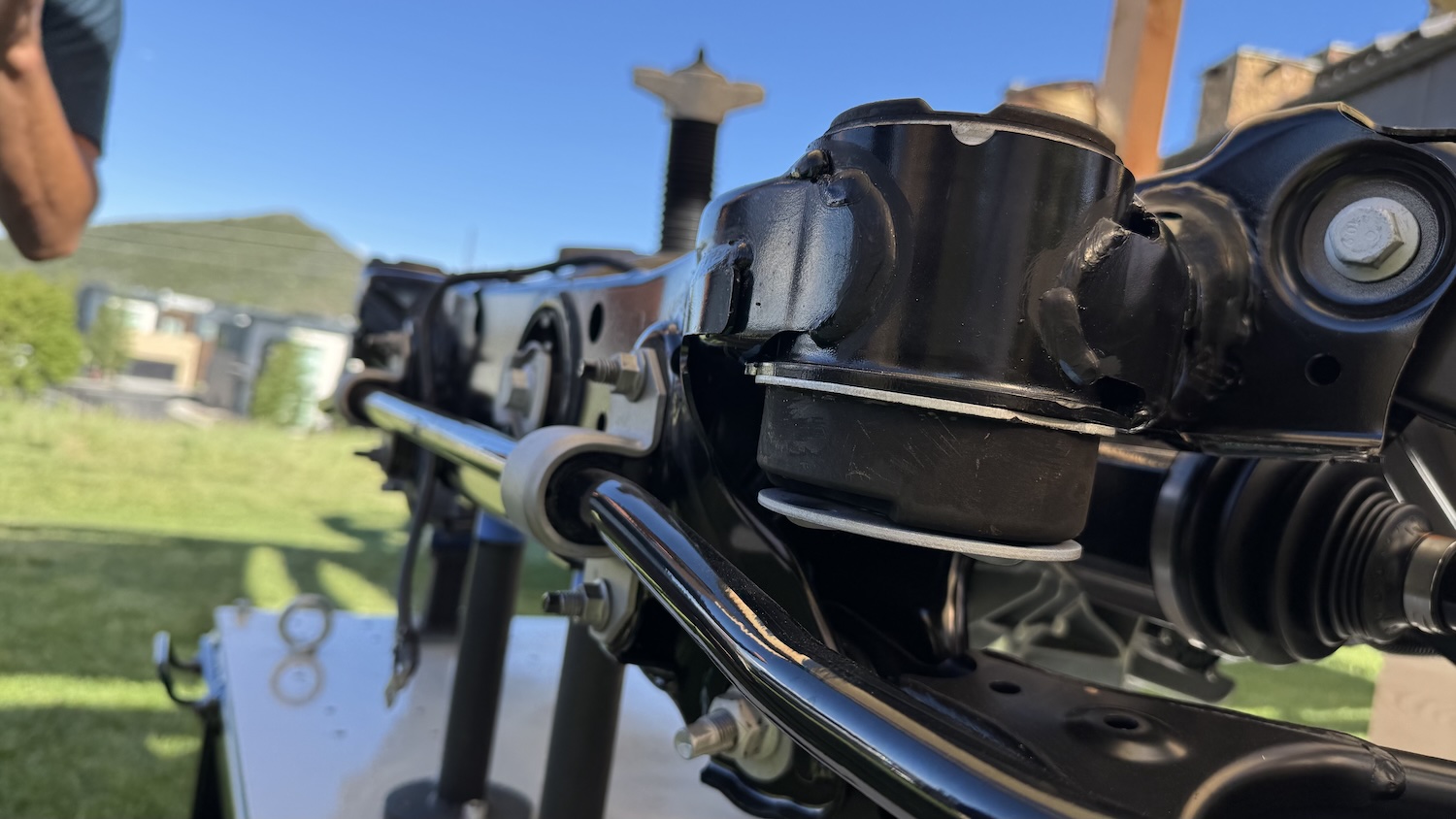
You can see that the suspension is a multi-link setup, and if you look closely, you’ll also notice that this subframe is actually isolated via rubber mounts:
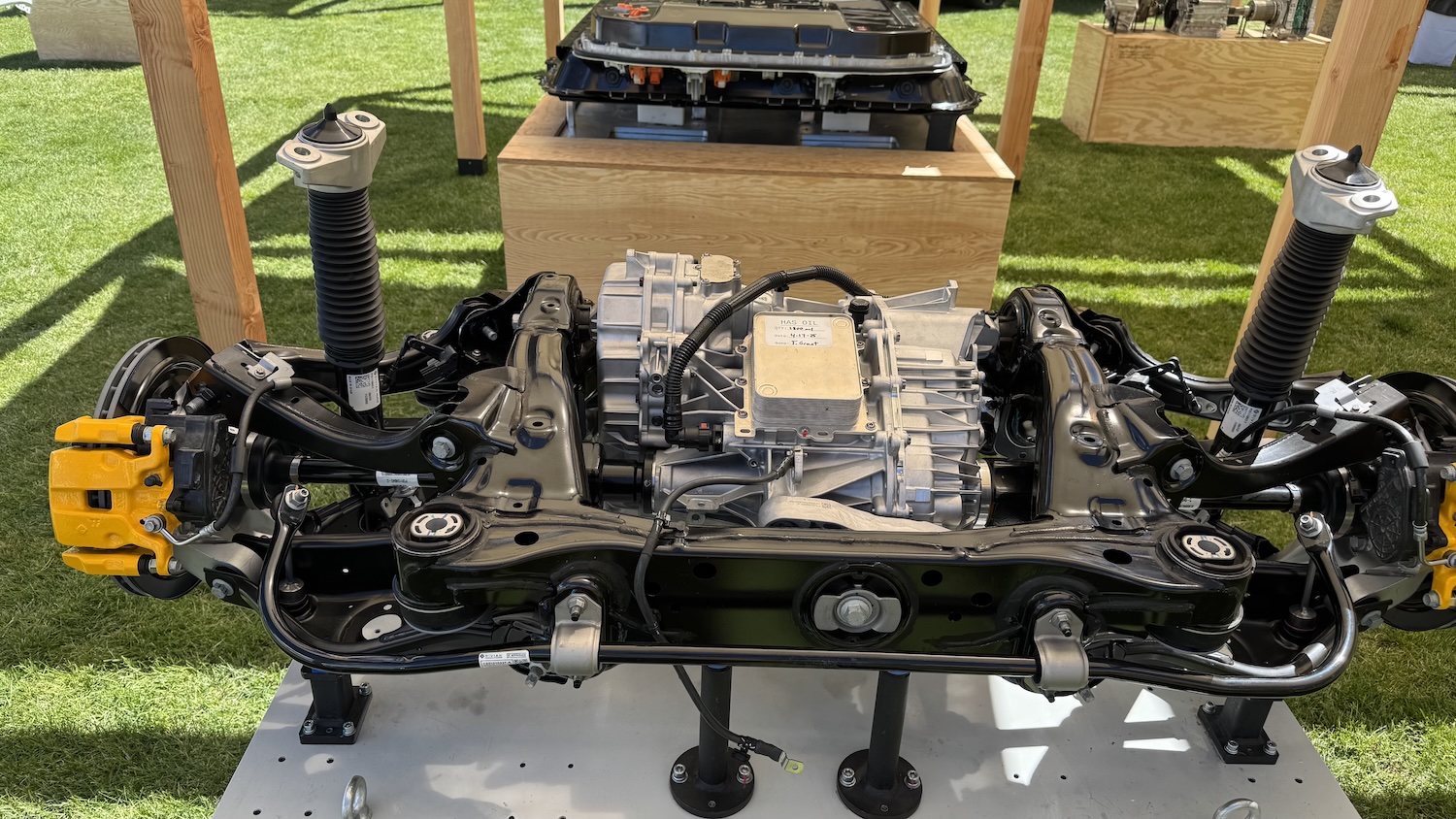
Here’s a closer look:
If you’re curious about the output of these motors, they come in three different combinations (this is also a chance to look at the pricing and range):

For reference, here’s the Rivian R1S’s front subframe:

And here’s the rear: 
You can see the subframes and control arms are cast aluminum, whereas on the R2 they’re stamped steel — a more economical, traditional setup meant for what is meant to be a more economical, traditional electric SUV.
The Interior Is Simple But Nice, And The Storage Is Phenomenal

With the design and engineering discussion out of the way, let’s talk about what it was like actually driving the thing, starting with my assessment of the cabin. The first thing I noticed is that the base car — which is shown above and starts at $44, 995 — is actually quite nice.
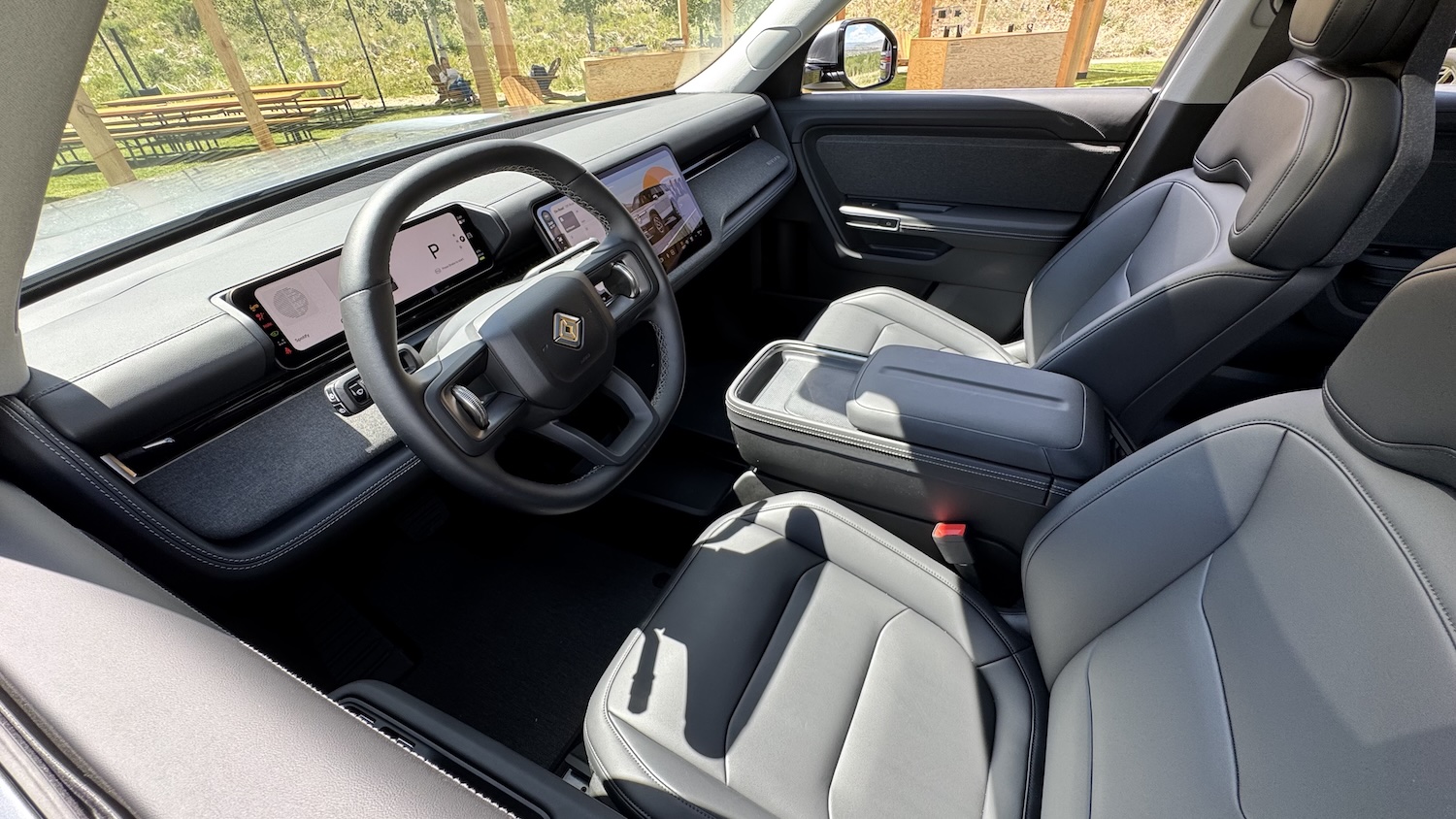
The design is elegant, the “Advantex” faux-leather feels nice and durable, and the whole cabin just feels light and airy and pleasant.
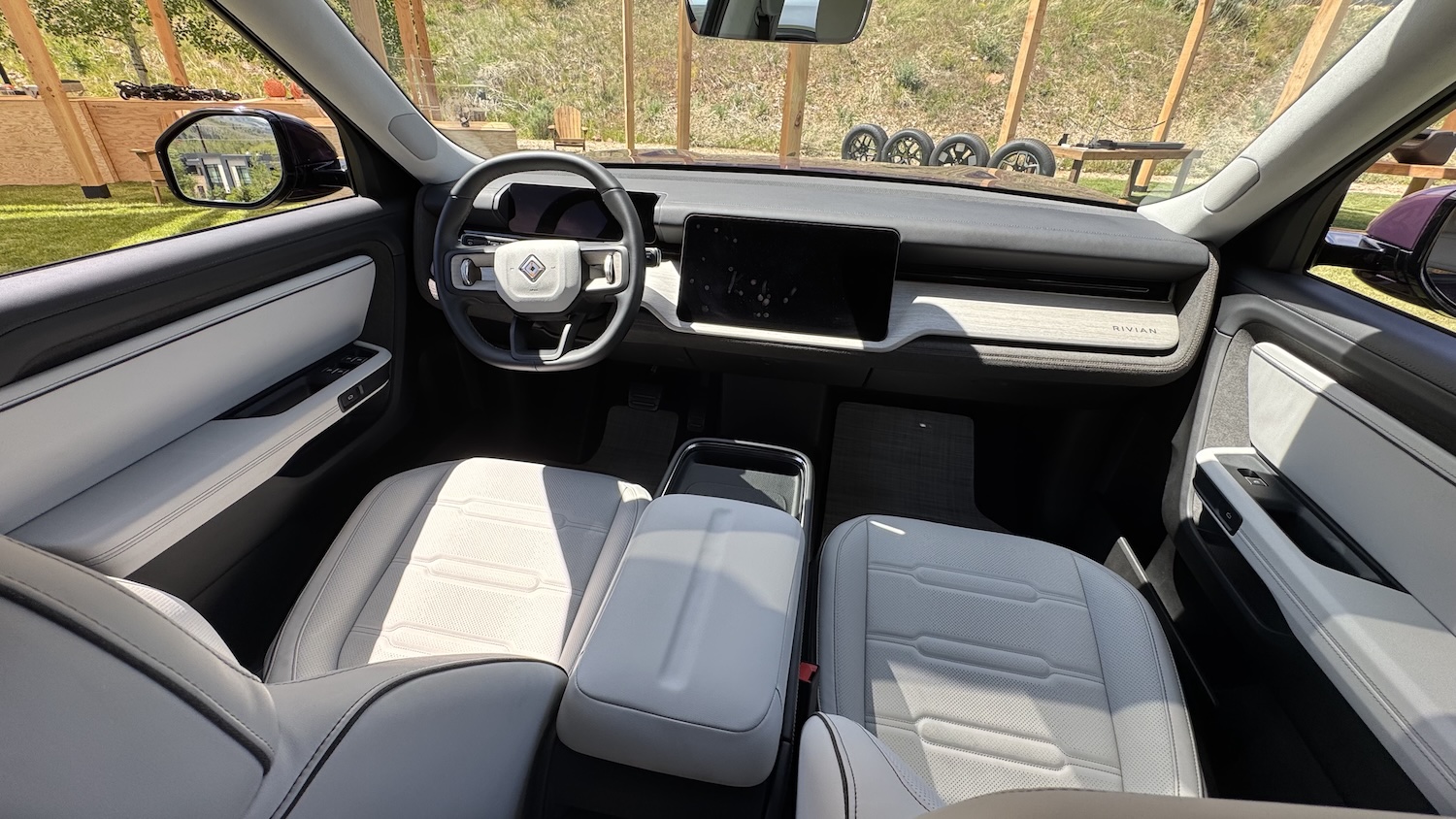
Whether you get the base car or a higher-end trim (like the one shown directly above), the interior is minimalistic and lacks physical controls. The result is that your screen will likely often look like this:
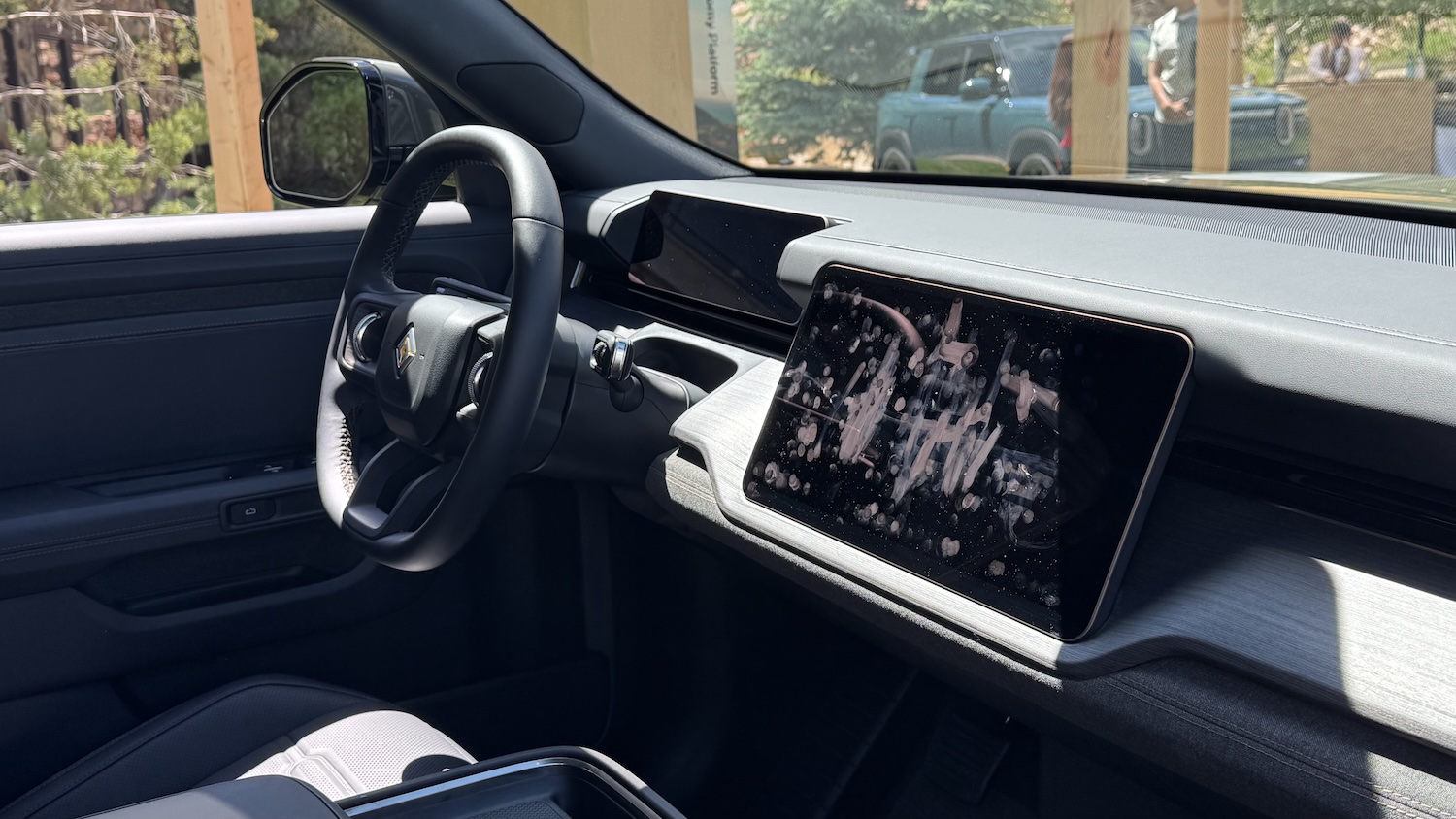
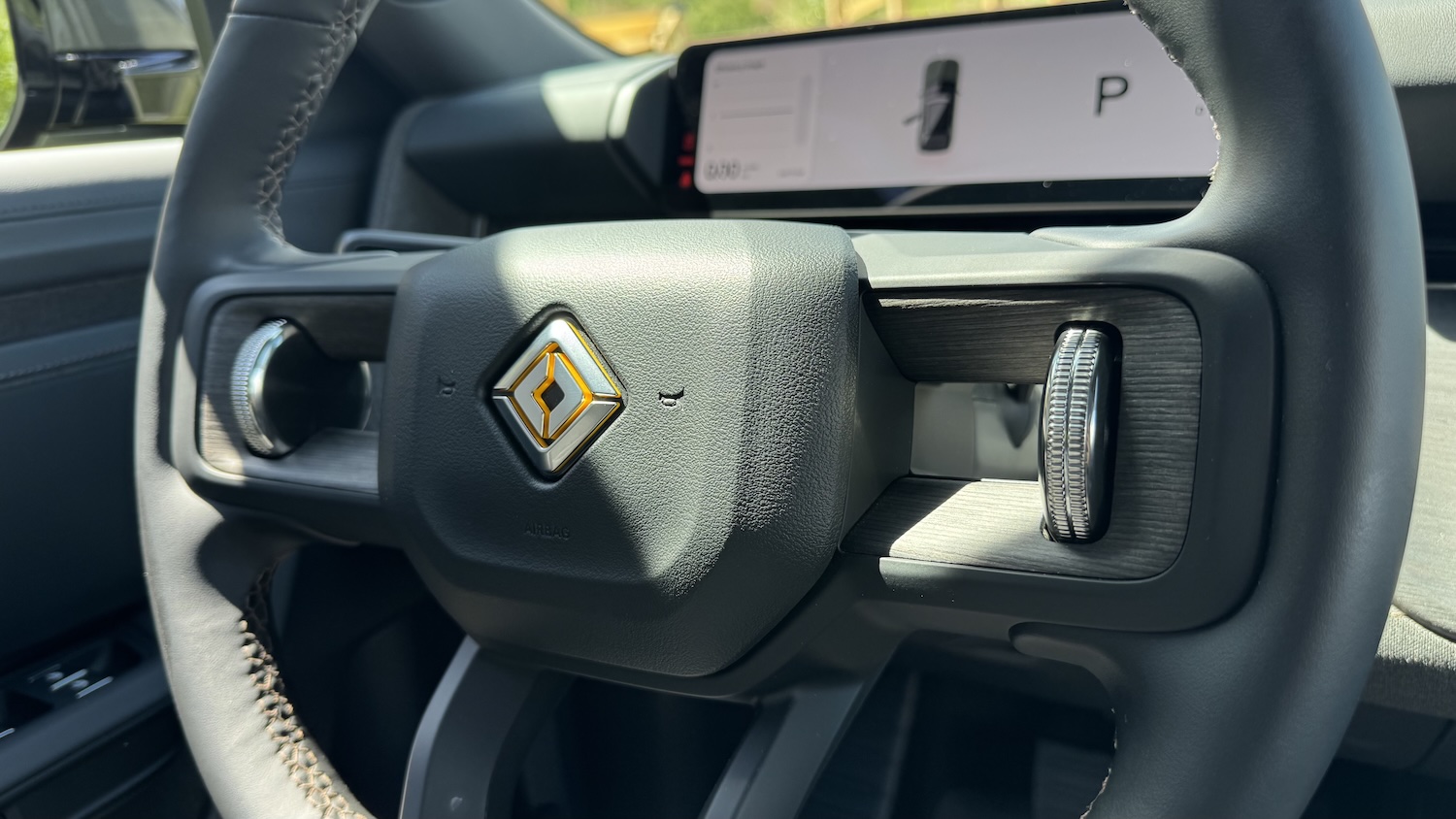
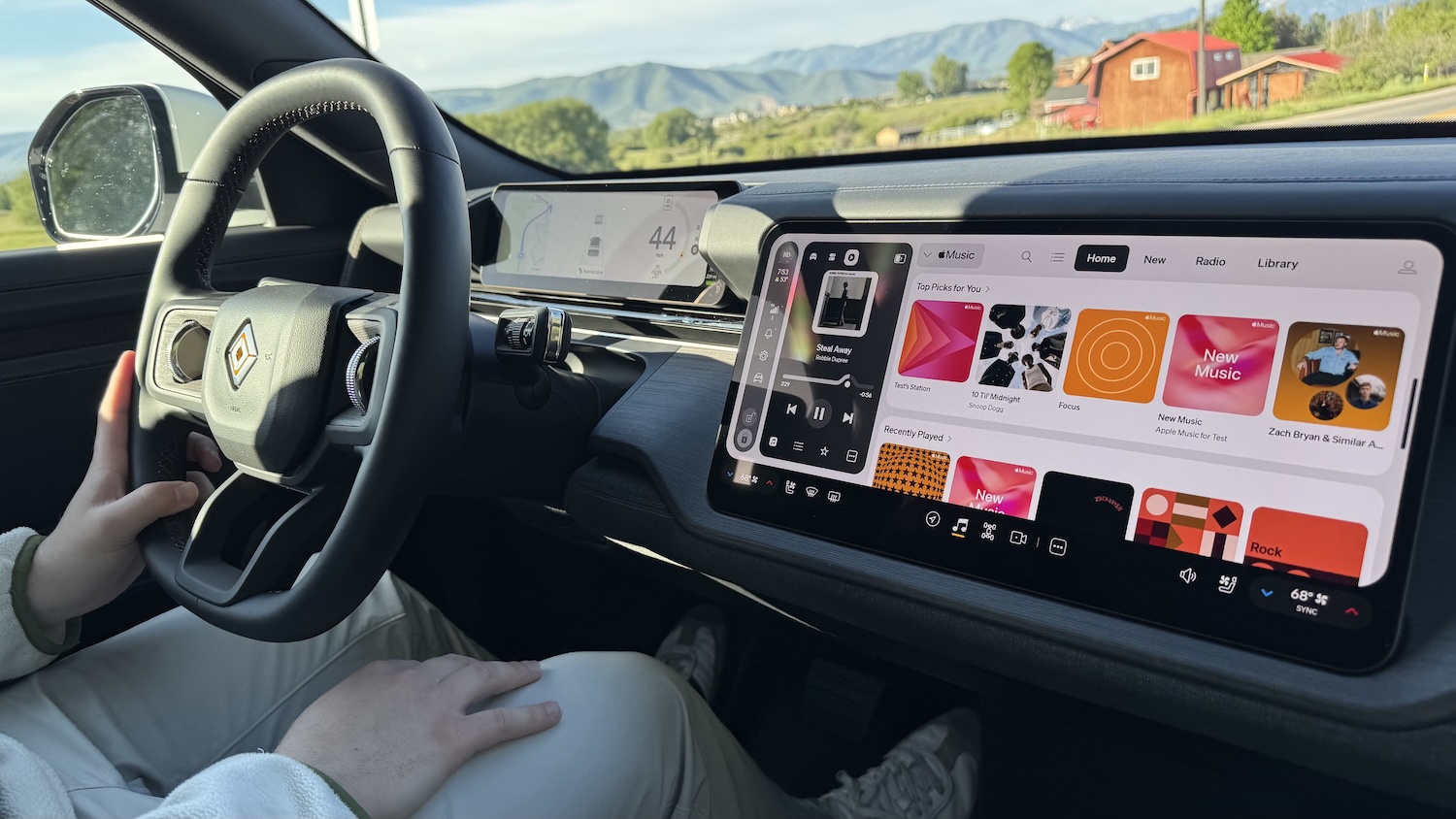
There are two “Haptic Halo Wheels” (see below) on the steering wheel, which can both scroll and press left/right, and there are the stalks, but the infotainment and most other controls must be accessed through the screen. That includes the HVAC vents — something that I find maddening. (Rivian, for its part, says screen-vent control is there to maintain the car’s house-like interior vibe. You don’t see piano black in homes and you don’t see vents in elegant homes, so you shouldn’t see them in a Rivian, design Chief Jeff Hammoud told me).
I’ll get back to the infotainment and the cabin in a second, but for now I want to applaud Rivian for making the R2 an absolute monster in the area of space utilization. The Rivian R2 is 185.9 inches long, 84.7 inches wide, and 66.9 inches tall. For reference, that’s shorter than the Tesla Model Y, it’s about an inch wider, and a couple of inches taller.
Upon sitting in the R2, it quickly became clear to me that, for a vehicle this size, the R2 is massive on the inside; it feels like the Sistine Chapel, not just because there’s tons of headroom (and there is), but because there’s tons of room everywhere. And the way Rivian set up the cargo system on the car is absolutely A+ work.
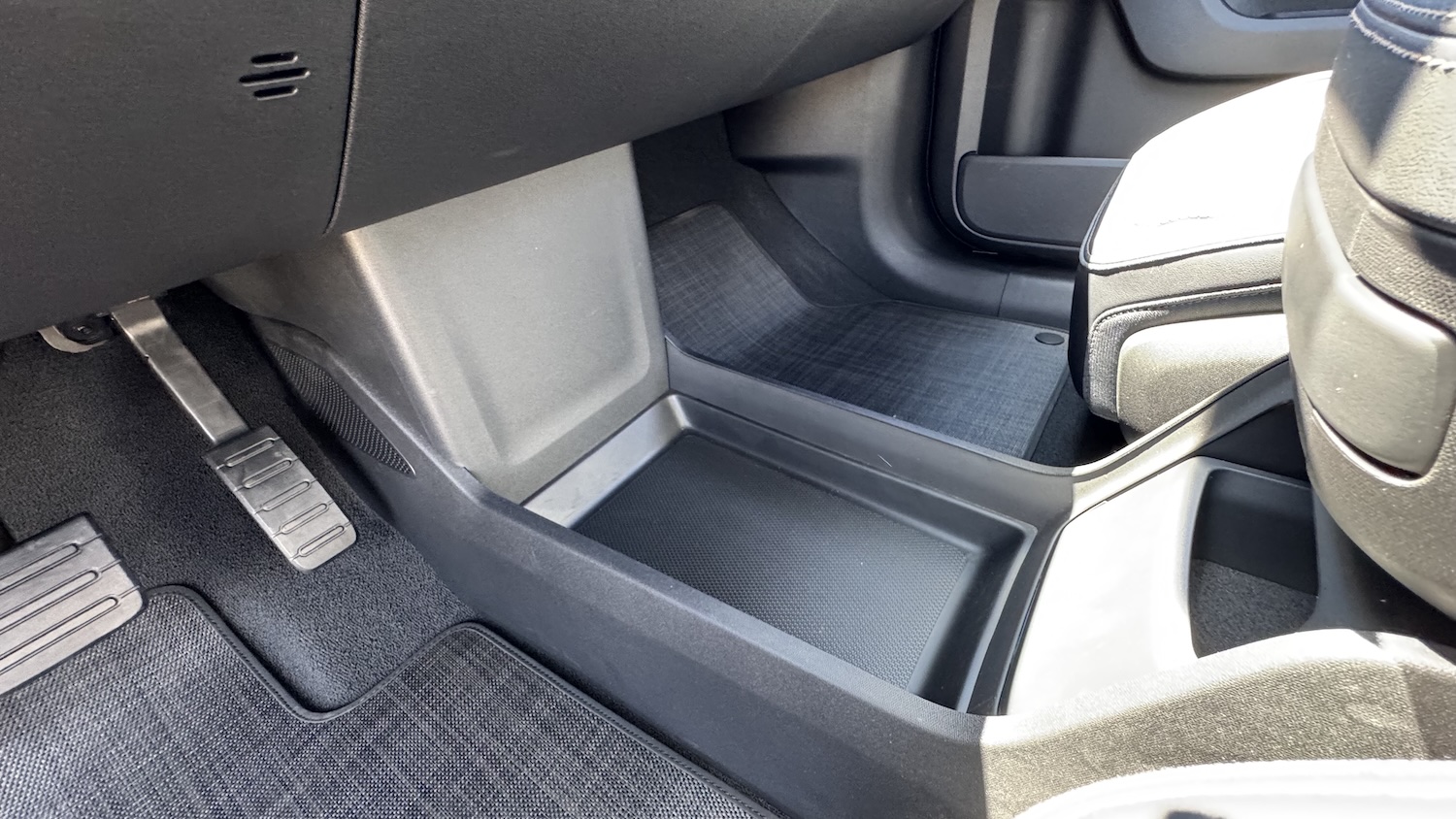
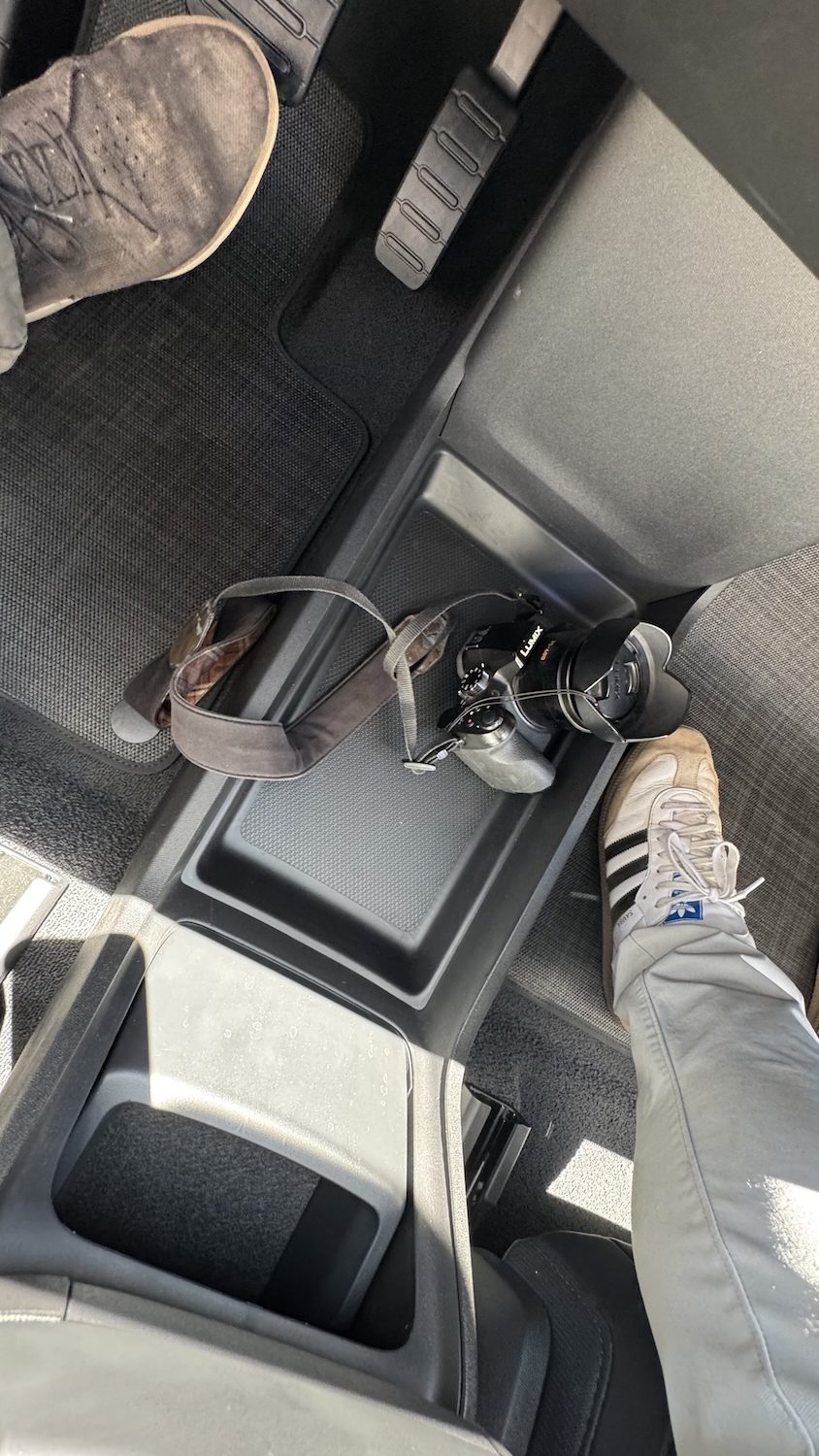
I think every electric car should have a shallow bin on the floor between the driver and passenger. It doesn’t have to be tall and it certainly shouldn’t be a huge center tunnel as is so common — it just needs to prevent stuff from sliding in turns. This space becomes so useful for big items like backpacks, purses, and in my case, a camera:
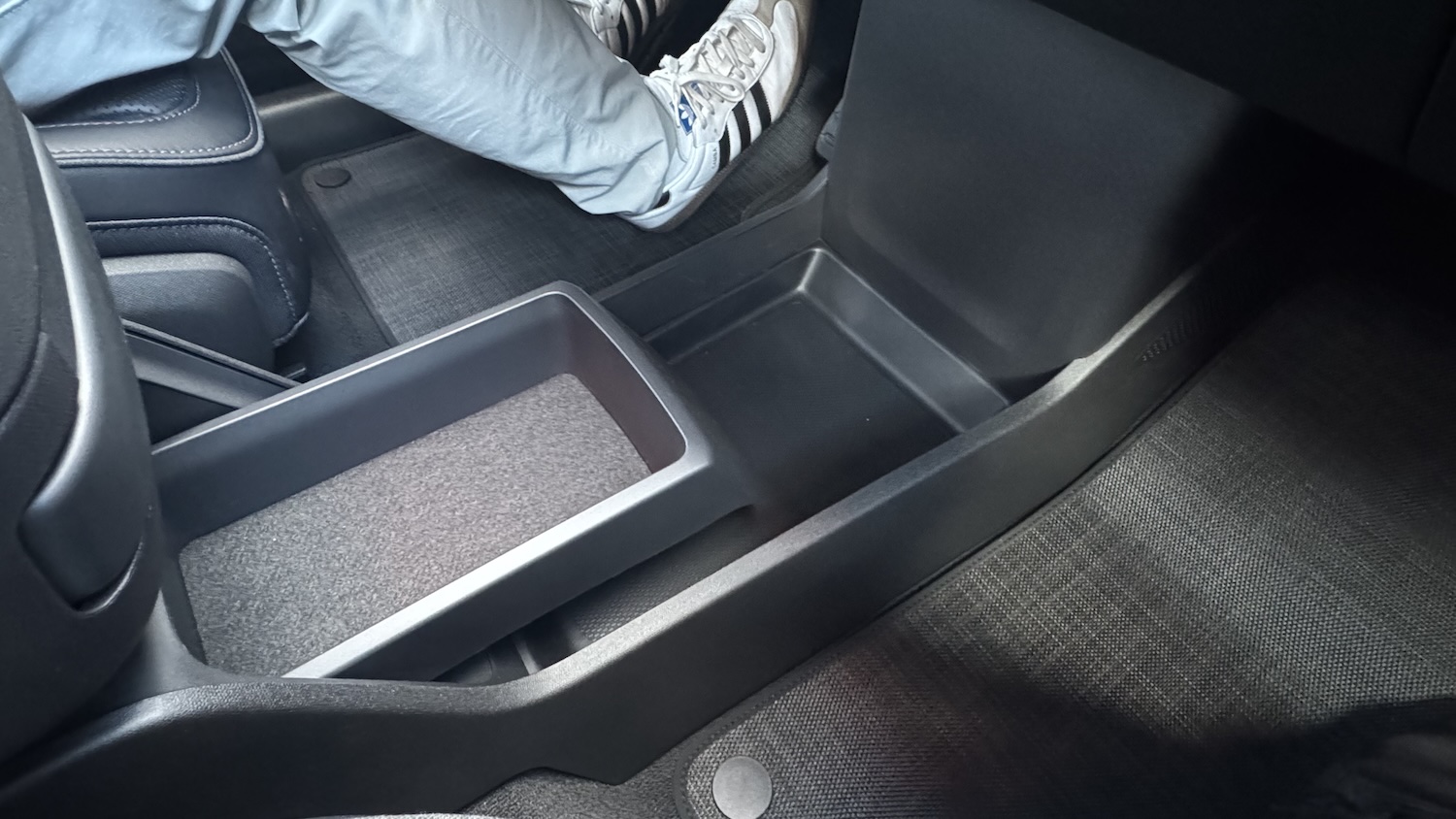
Rivian has a fore-aft sliding drawer in the center console that offers even more storage:
Speaking of the center console, up top it features a wireless charger at the front:

And towards the rear is a deep bin of which I only have this blurry screenshot:

Jutting from the front of the center console is a pair of cupholders:

And ahead of that, built into the dashboard, is the awesome pair of (manually-opened) gloveboxes:
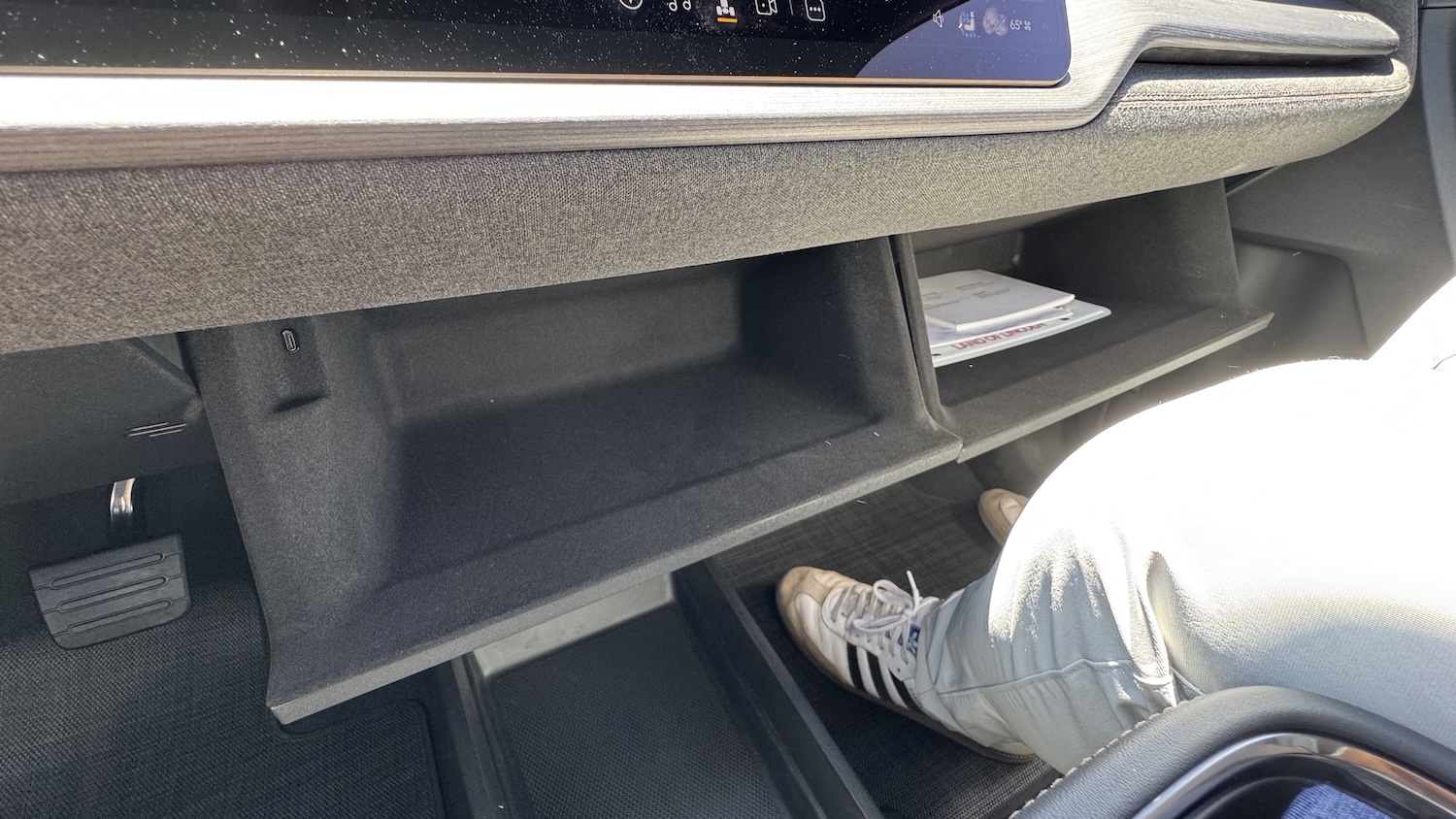
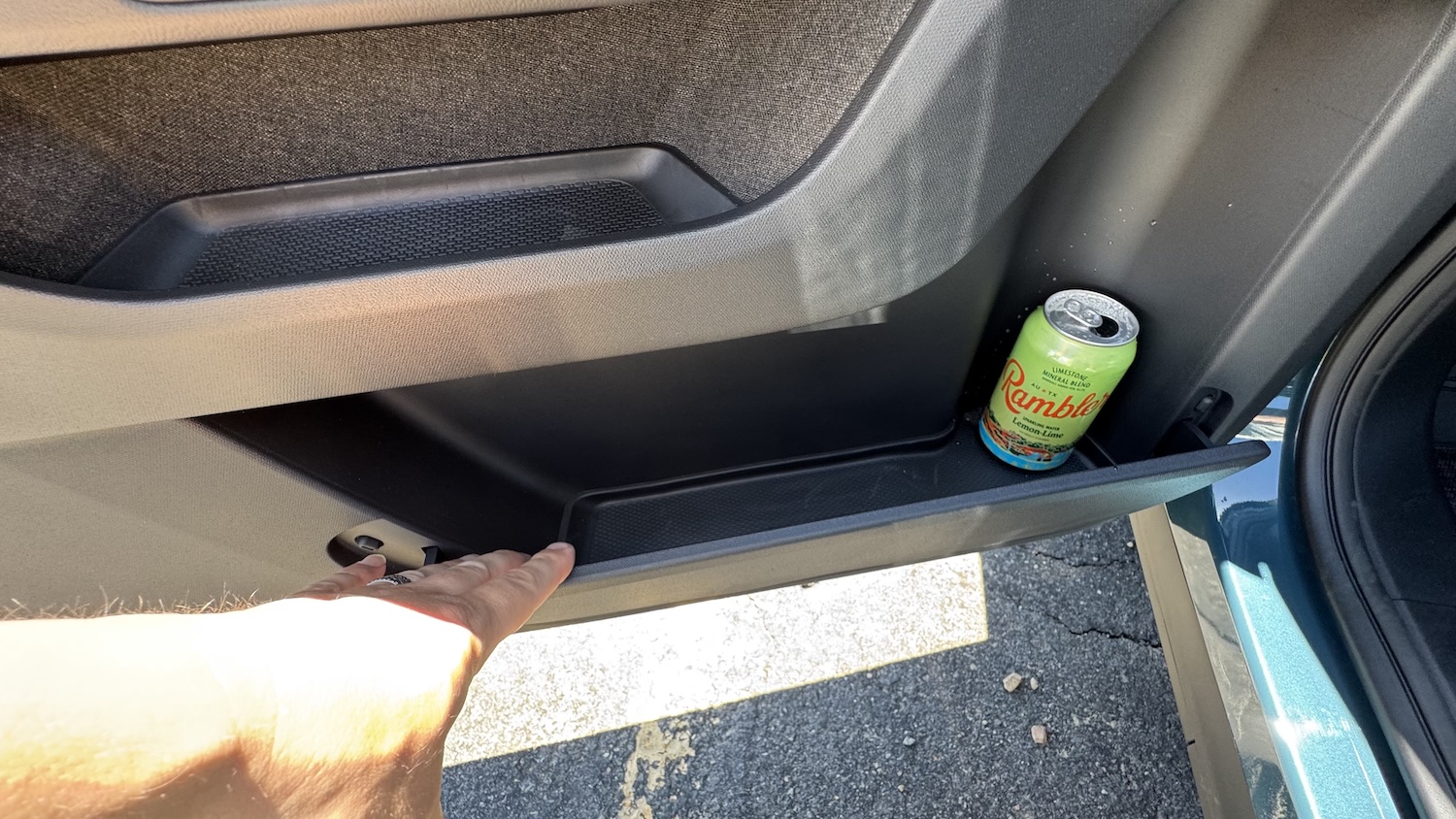
The doors up front have an upper storage area as well as an expandable lower storage area (I think all cars should have expandable door pockets; this is just great design). There’s lots of space there because the front speakers have been relocated to the base of the dash. These are back-to-back “force-balanced” speakers, so they don’t transmit significant vibrations into the structure holding them in place. (Overall, the sound system quality seemed good to me).
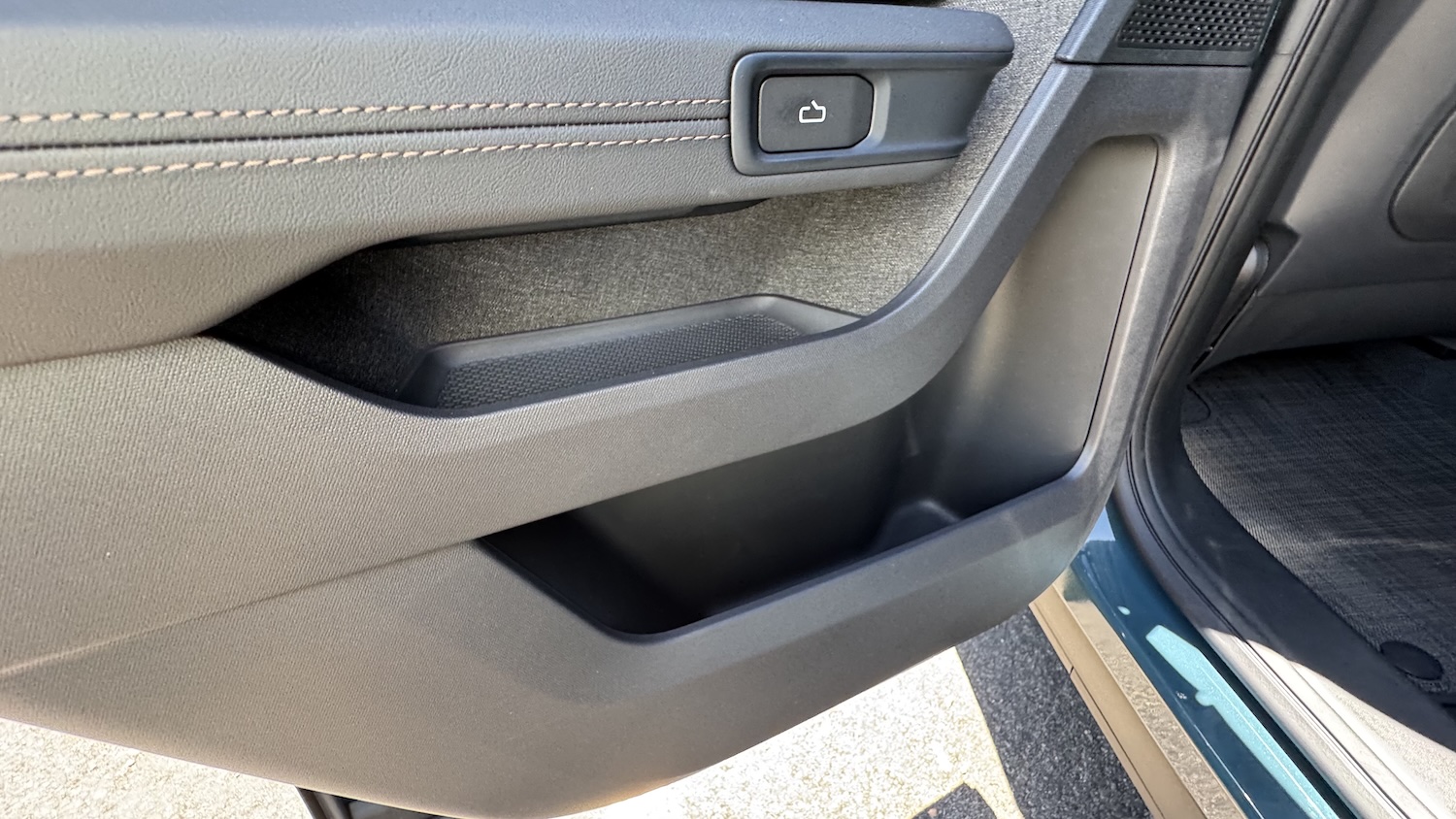
In the rear doors, there’s a smaller upper storage bin and a huge lower one with an area that should fit a tall water bottle:
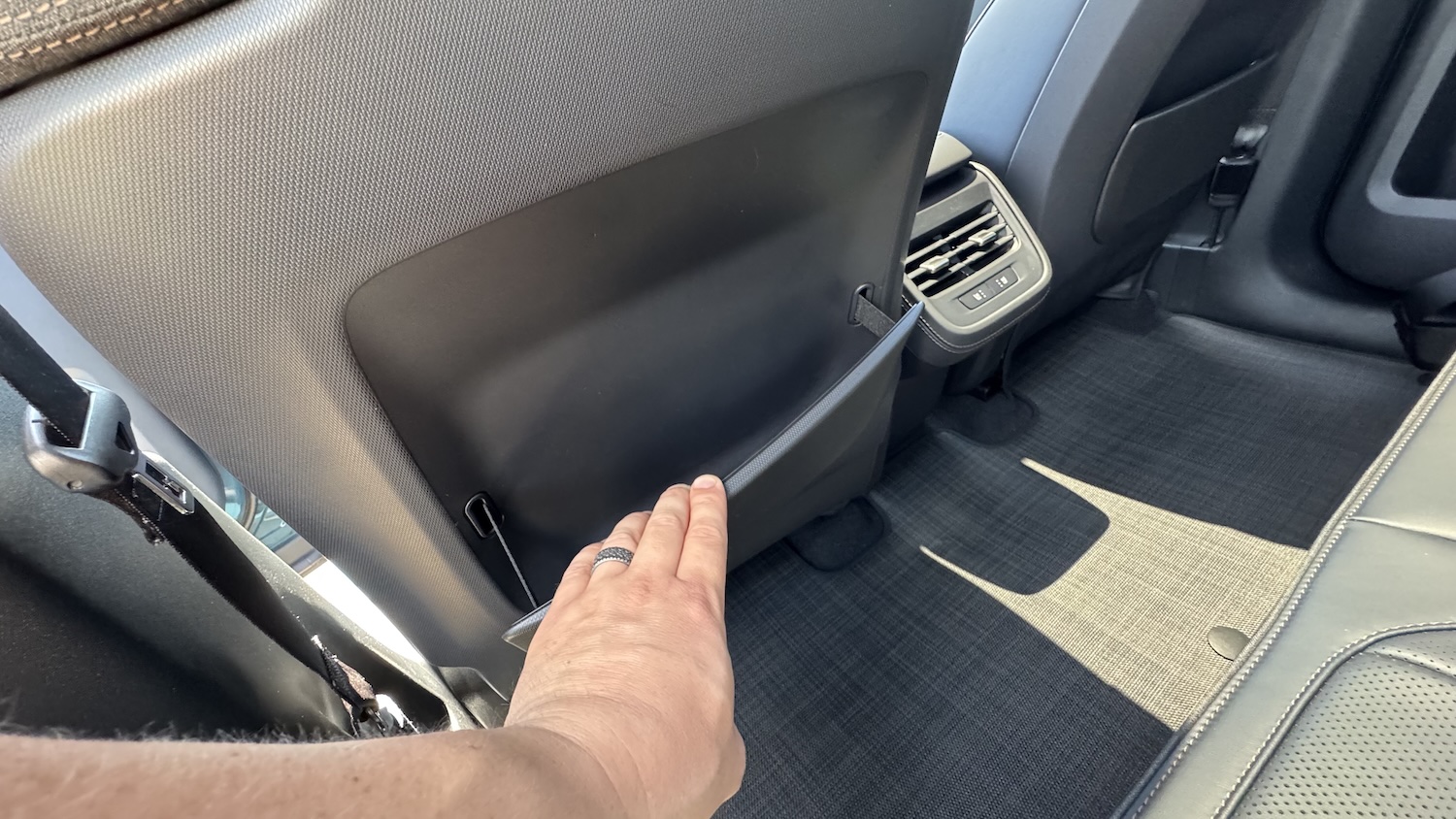
Behind the front seats are expandable storage pockets:
There are some cupholders and a little bin in the center of the rear bench upper cushion:

But most importantly, what’s back in that second row is space. Tons and tons of space. How could there possibly be this much space? Look at how much room there is ahead of my knees; it’s even more than the R1s!:

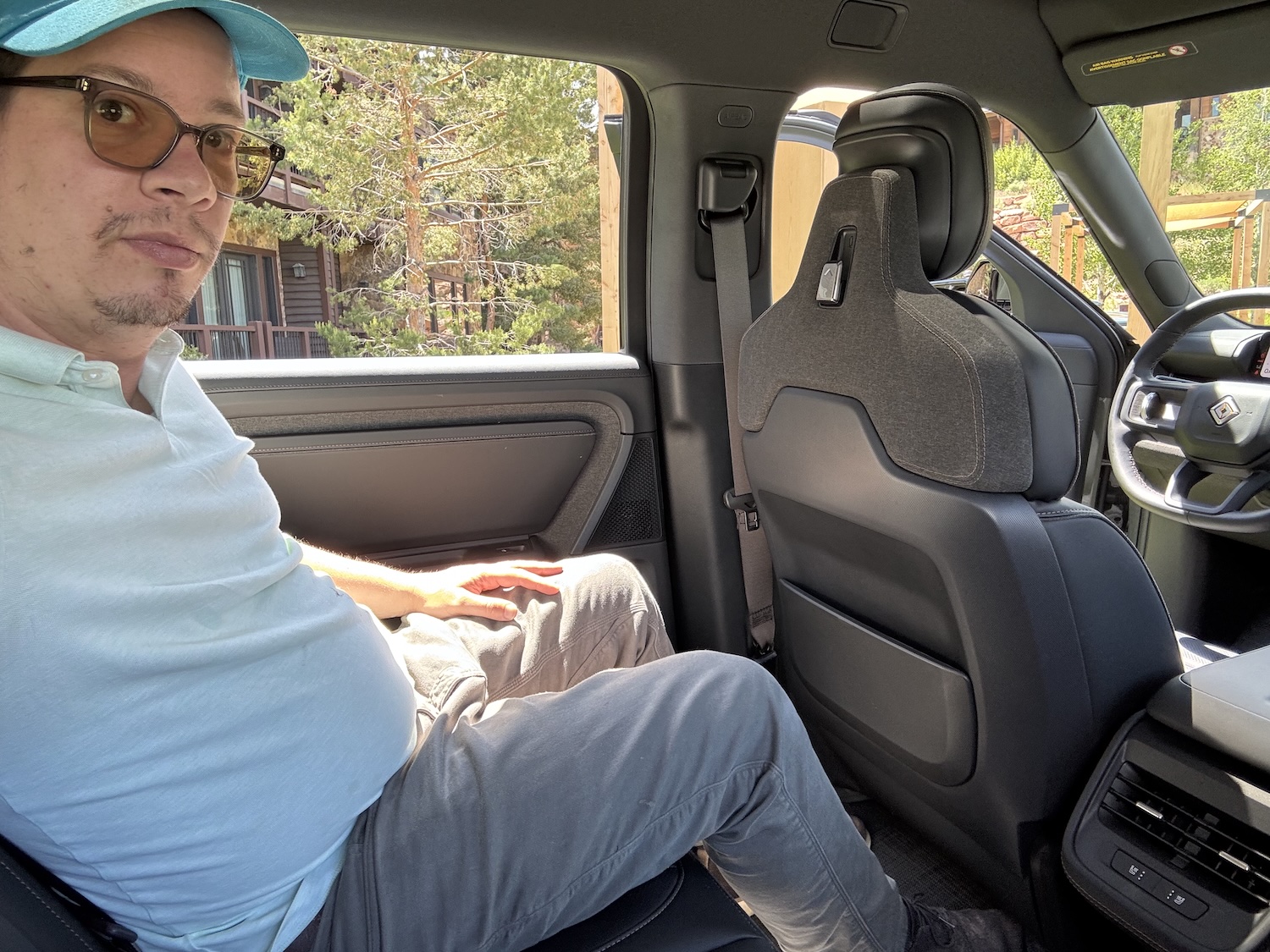
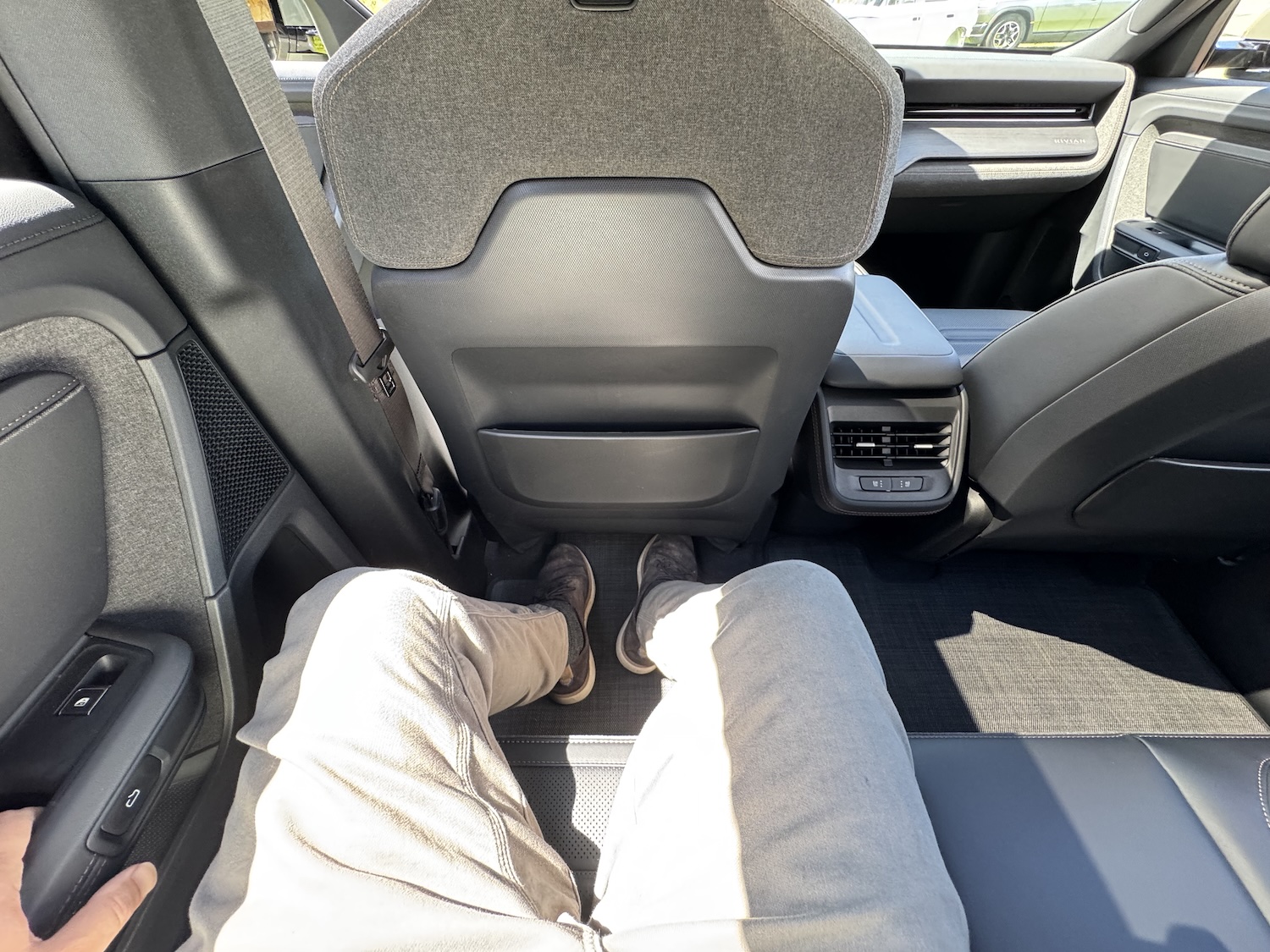
Surely all that legroom came at the price of rear cargo space, right? Not really; it’s huge back there, too:
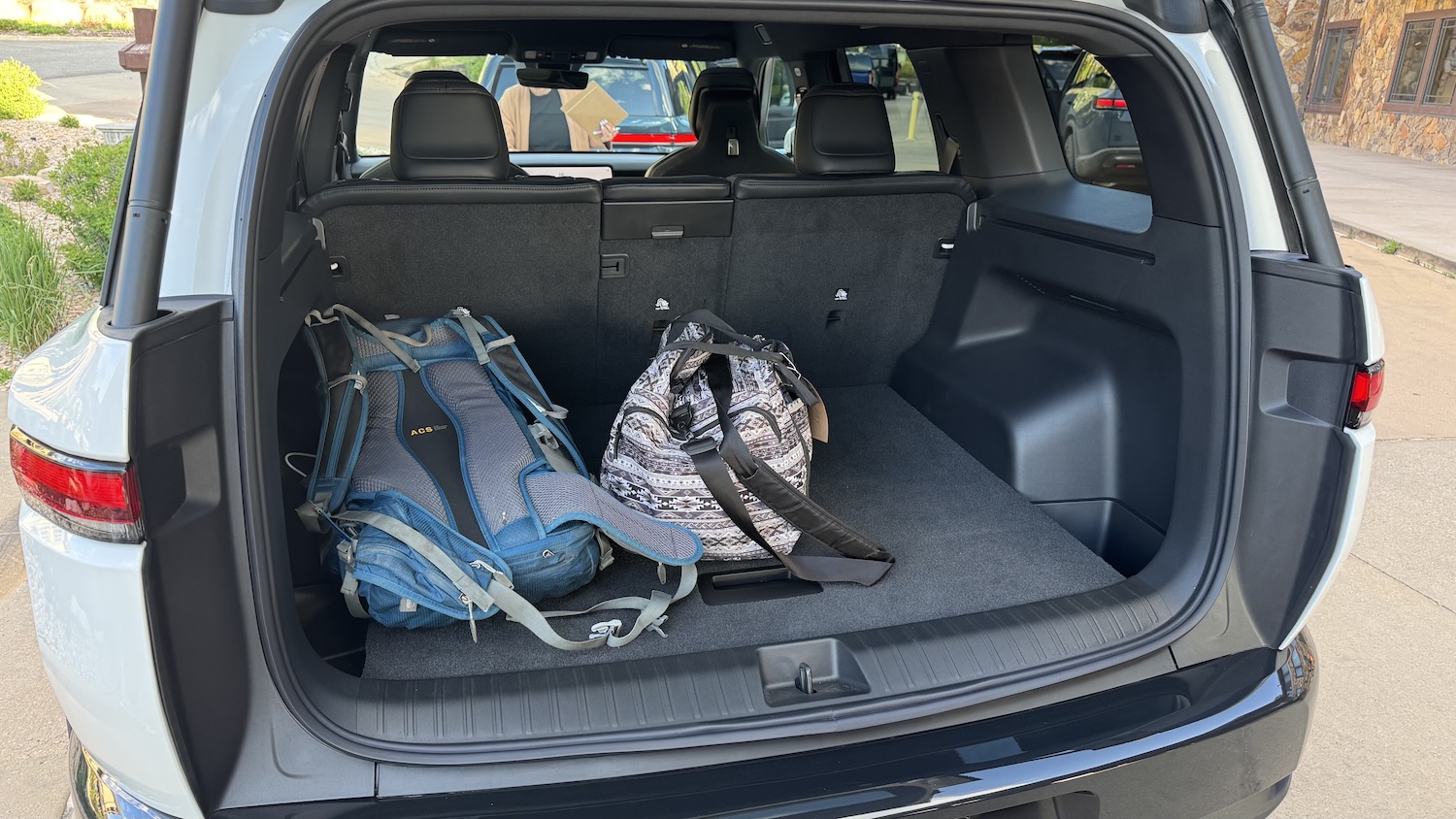
You can see the storage bins aft of the rear wheel housings:
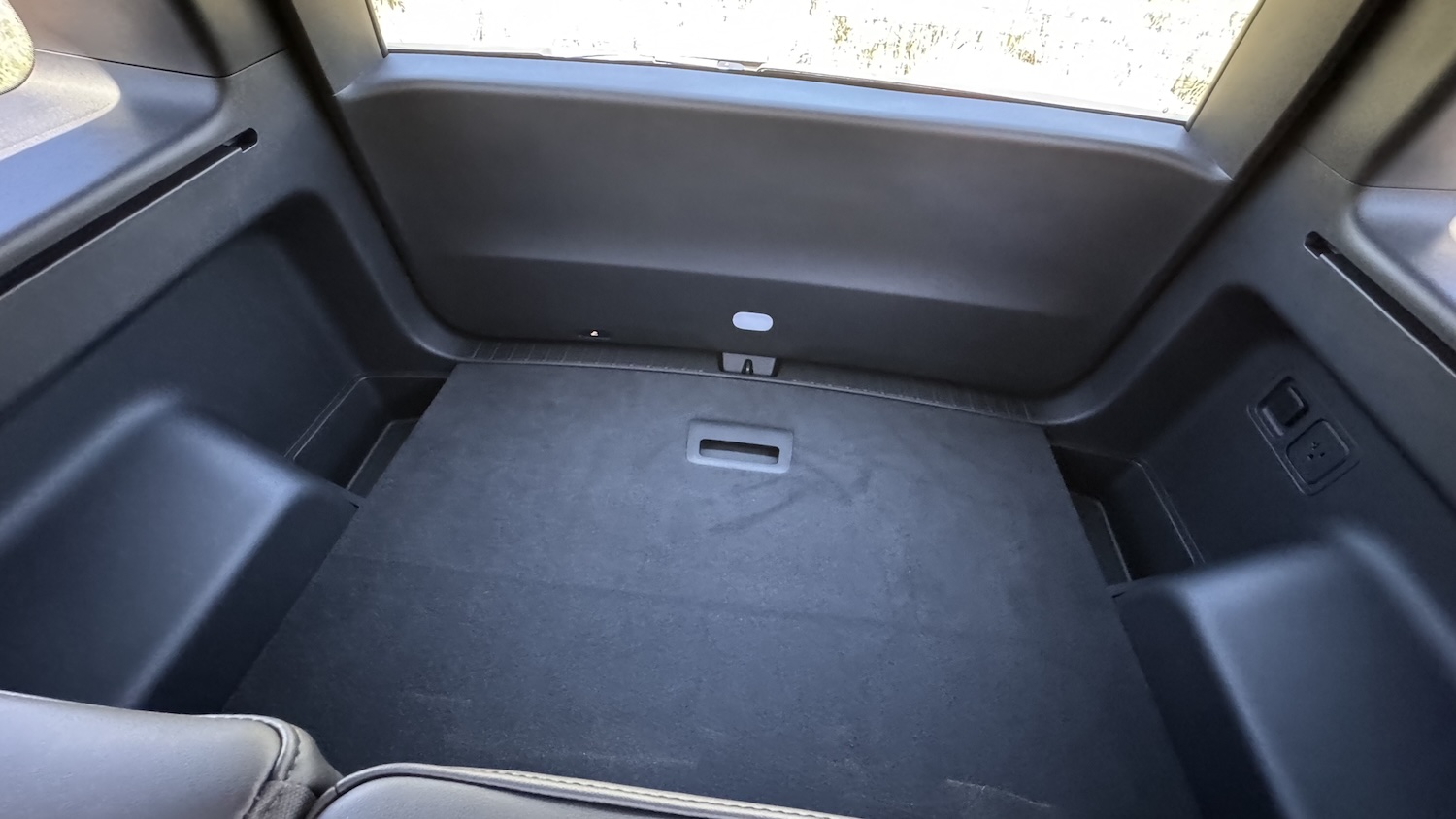
And below the floor is even more room if you forego the spare tire:

That’s really my takeaway on the Rivian R2’s interior. Do I think the quality of materials/overall design is that much better than, say, a $45,000 Blazer EV’s cabin?:

Or a Tesla Model Y’s cabin:

Or a $40,000 Kia EV6’s cabin:

Or a Mustang Mach-E’s interior?:

Maybe. The R2’s interior looks elegant, but its lack of physical switches really takes it down a notch, and I don’t think its simplistic design looks as nice as that of the Lexus RZ. Here’s the base R2 again:

And here’s the RZ, with its stunning standard Palomino and Macadamia NuLuxe fabrics surrounded by Charcoal trim:

But even if the RZ’s cabin looks a bit nicer and those other cars have buttons where the R2 does not, I think I’d still take the R2’s interior overall solely because of the combination of elite-level interior storage and an upright, airy, just downright pleasant atmosphere.
On-Road Capability
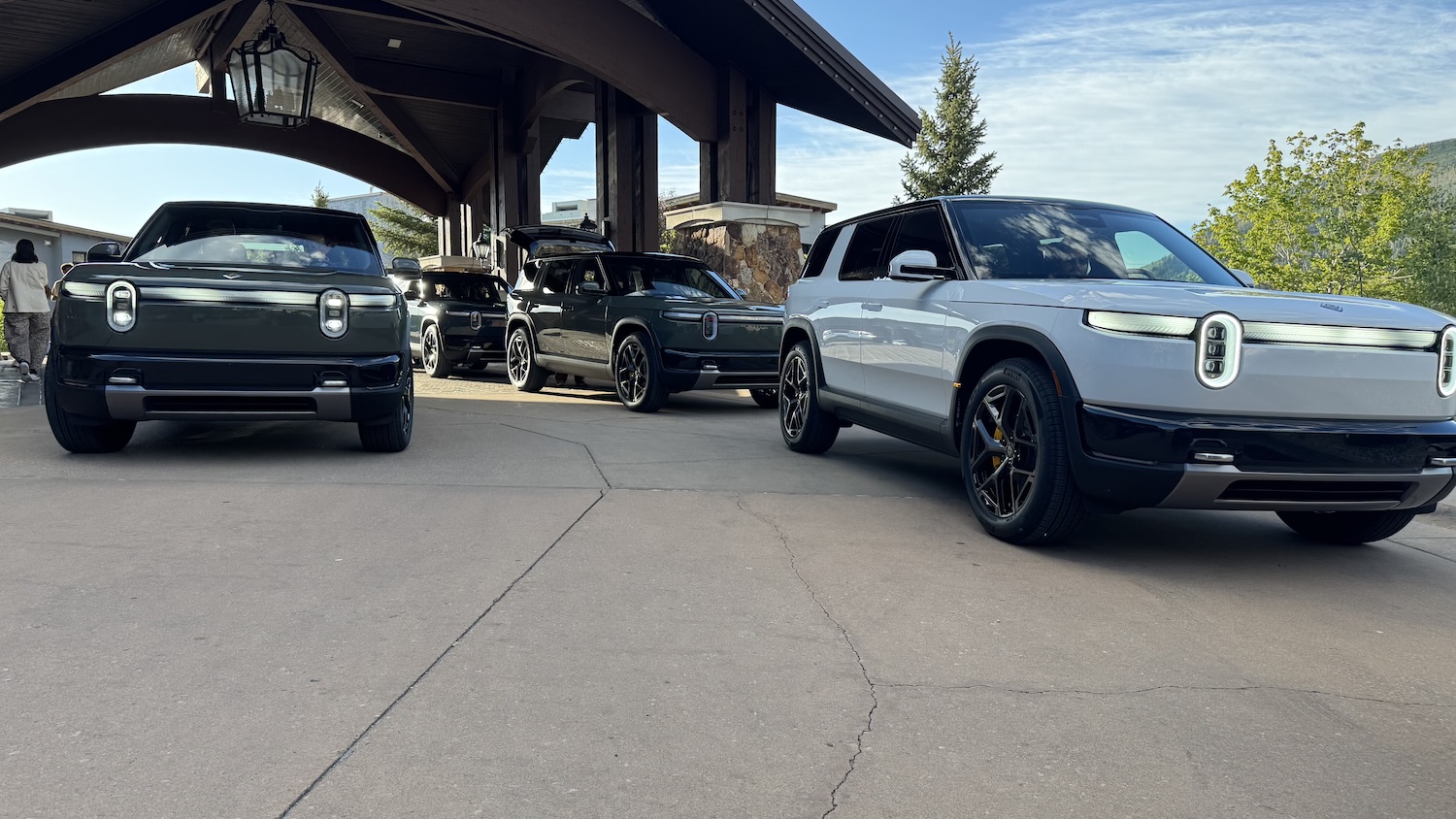
Unfortunately, Rivian didn’t have any base-model R2s for journalists to drive, so I hit the road in a white Performance Dual Motor R2. Right away, I noticed a vibrant screen that seemed to work fine for my needs despite its lack of Apple Carplay/Android Auto:
The cameras were crisp:
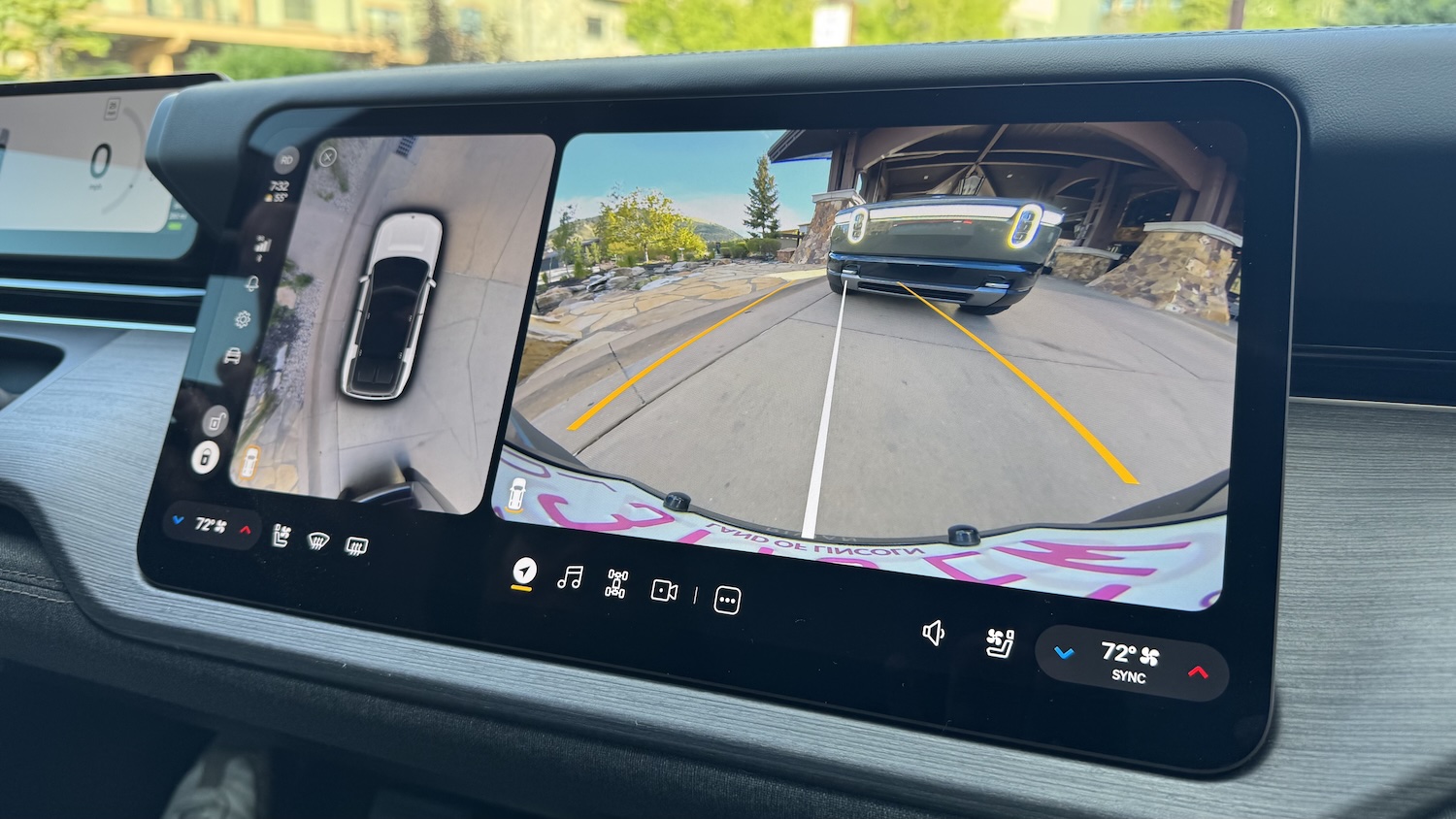
And the shifter — a column-mounted unit — is simply the best in the automotive industry. It’s out of the way and not taking up any storage space; pull it down, and you go into drive, engaging your front camera if you want it on; push it up and the reverse camera engages instantly. If you’re pulling out of a driveway in reverse, you can just let off the accelerator, tap the shifter, and hit the accelerator pedal; far too many cars require brake application and far too many cars have a lag in their cameras when shifting. Rivian understands that we all just want to put the car into drive while rolling backwards, and we all want those cameras right now.
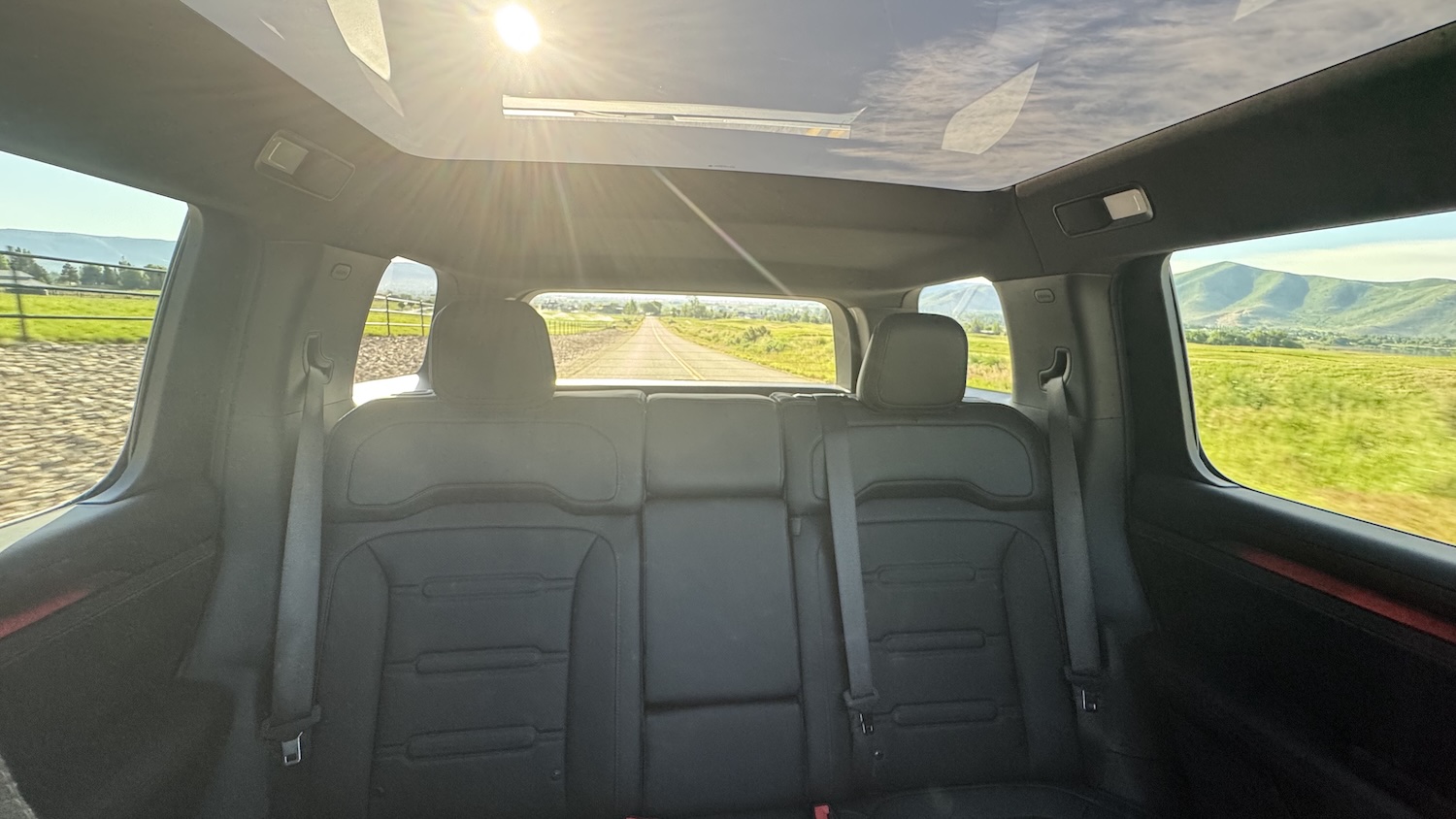
Once my drive partner and I pulled out of the hotel drive we found ourselves on beautiful mountain roads surrounded by Utah’s lush greenery. It was a beautiful, sunny day, and my partner and I could enjoy every bit of it through the R2’s lovely greenhouse. Visibility in the rear and out front is absolutely fantastic for a car made this decade.

On the wide-open valley roads just before the twisties Rivian was sending us to explore, I jotted down a few notes about the ride. First, there was seemingly no wind noise — like zero. This was astonishing. There was some road noise, but it was far from egregious. As for the ride, it was decent. Without instruments on hand, I can’t really quantify how it compared with the R1S, but, to me, it felt like the R2 was allowing more high-frequency imperfections to travel through the chassis and against my spine. Again, it wasn’t anything grievous, but I didn’t feel that it quite glided like a magic carpet, regardless of damper settings.
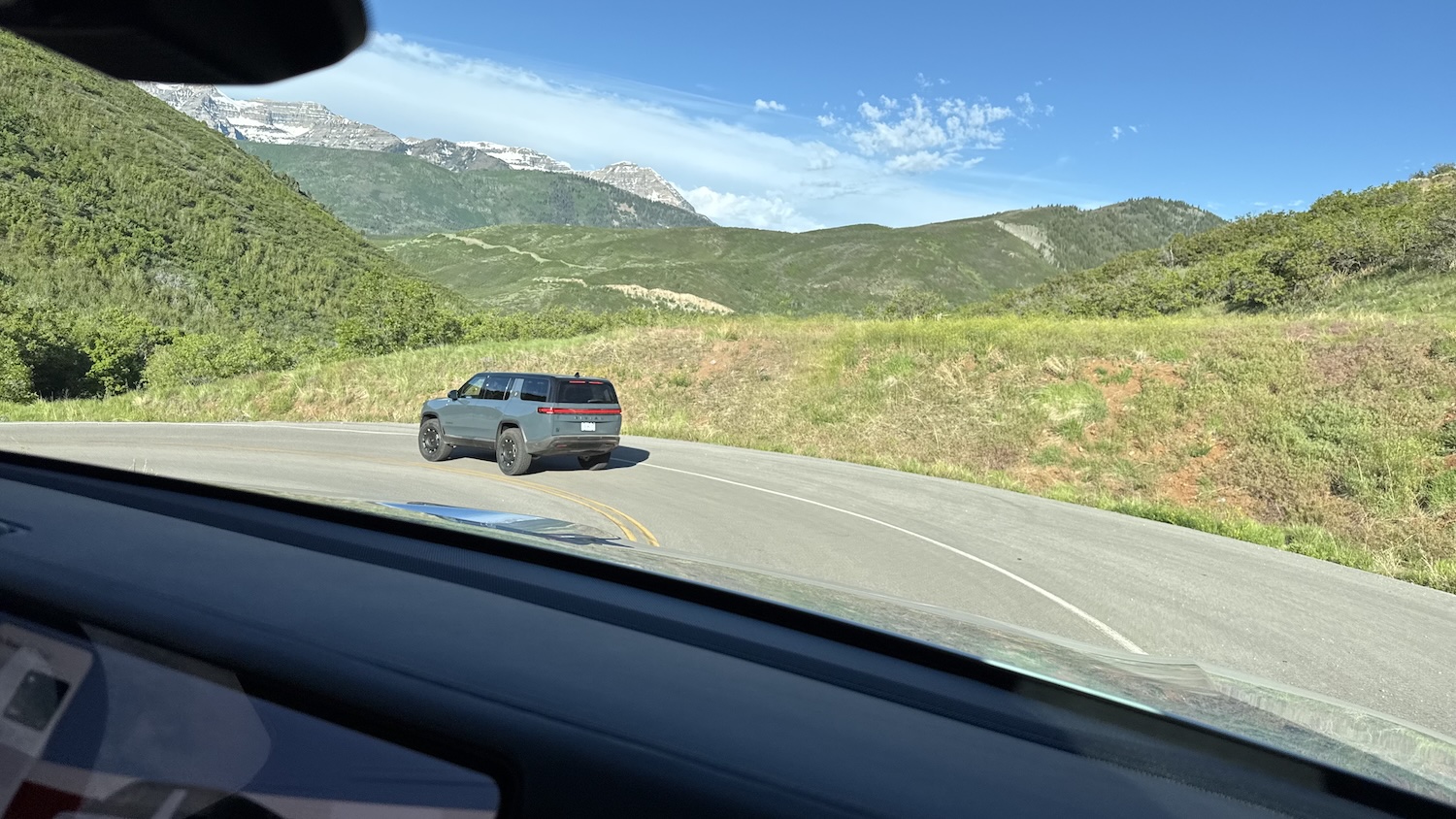
It wasn’t long before we were carving canyon roads and making those 255/55R21 Pirelli Scorpion MS all-seasons howl. If you want an extremely detailed description of the R2’s handling performance, that’s something for the Jason Cammisas of the world, as I’m far from a track driver, but suffice it to say that, with the big sidewalls on the R2 and the lack of a fancy sway bar system like in the R1, turning into a corner was followed by tire noise, a little bit of lean, and eventually understeer. Could you probably use the accelerator pedal to get the tail to swing out? I have no idea; I’m not trying that on public roads.
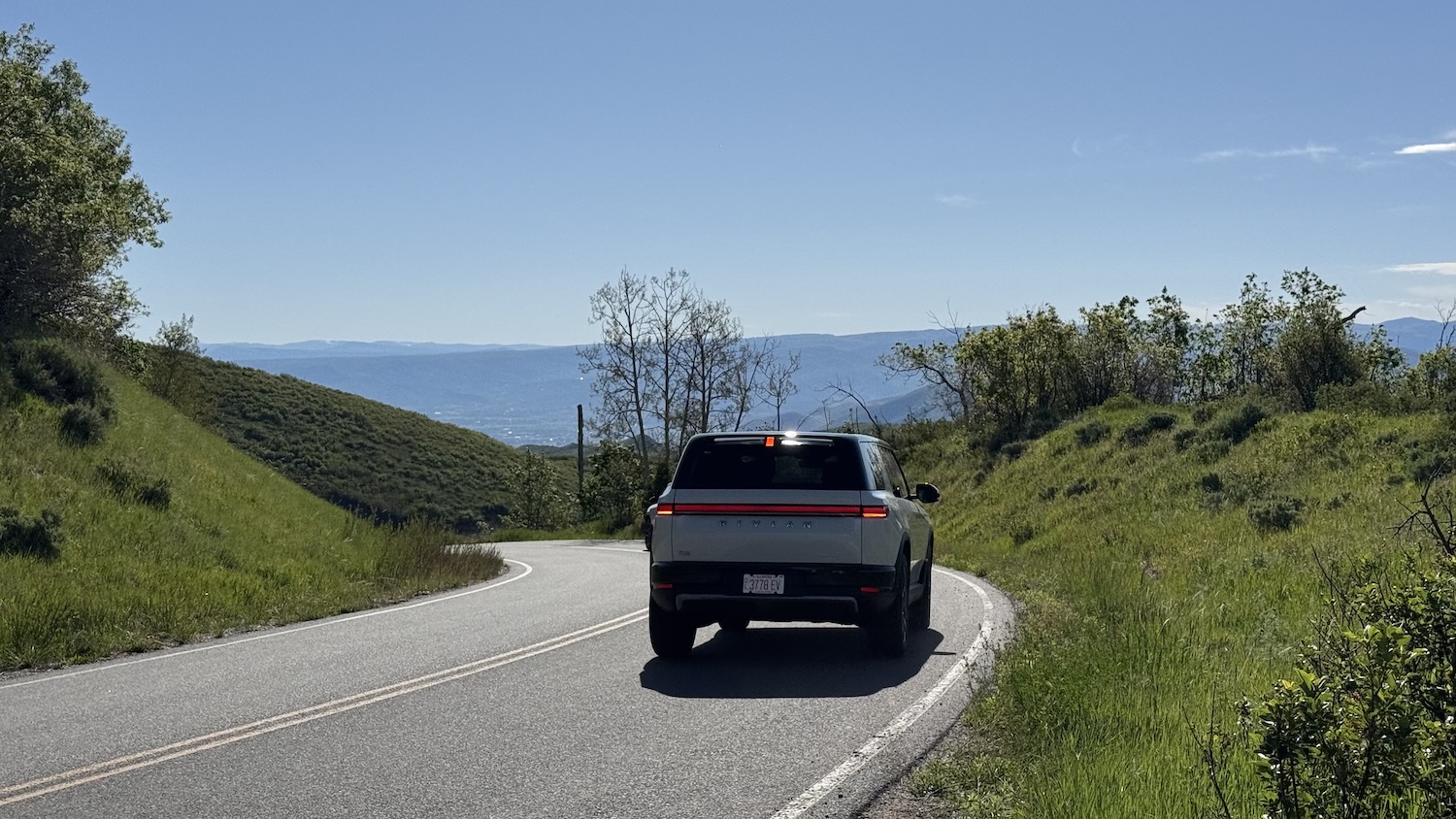
The R2 is lighter than the R1S, but that doesn’t mean it’s a sports car. 5,000 pounds, a MacPherson strut front suspension setup, good ground clearance and big sidewalls is hardly a formula for precision, but I still hustled the SUV through those winding roads and had a fun time. I’m sure the average person buying this thing will be pleased enough with the handling.
Ditto with the acceleration. A 656 horsepower powertrain offering a 0-60 MPH time of 3.6 seconds is still insanely quick, despite the fact that many EVs are quicker. Watch the video above, and you’ll see that the speedometer climbs hilariously quickly without that much indication that I’m accelerating that fast — it’s a drama-free hustle that only an electric vehicle can offer.

I tried Rivian’s Universal Hands Free system, not realizing that it does not stop at traffic lights/signs. Let’s just say: I put those bright yellow brake calipers to the test, and they passed. The system, at least as equipped on my R2, seemed fairly simple, offering the capability of an adaptive cruise control system coupled with a lane keeping system. Apparently the system also does lane changes, and automatic parking is on the docket, and there’s even more in the pipeline. Each Rivian R2 features a provision for a LIDAR unit in the frontmost roof crossmember.
The last two on-road driving notes I see in my book are 1. the steering radius is fantastic and 2. the HVAC very much is not.

The temperature was roughly 85 degrees outside, and my drive partner and I found ourselves sweating. I, generally, am not sensitive to heat, having driven far too many junkers without AC in my day. But it was clear that the R2 we were driving just wasn’t as comfortable as it should have been, so we adjusted the AC controls and turned everything to max cooling. The fan was up, the temperature was down, and yet my head continued to sweat:

Here I am reaching for the moonroof, curious if the solar load coming through that was the culprit:

I suspect that some ceramic coating on that roof might help, but the bigger issue is that the AC seemingly could not keep up with my cooling request. CEO RJ Scaringe told me the company is planning to increase front-passenger air volume through the vents, so it sounds like they’re aware of the issue.
Let’s get to the off-roading.
Off-Roading
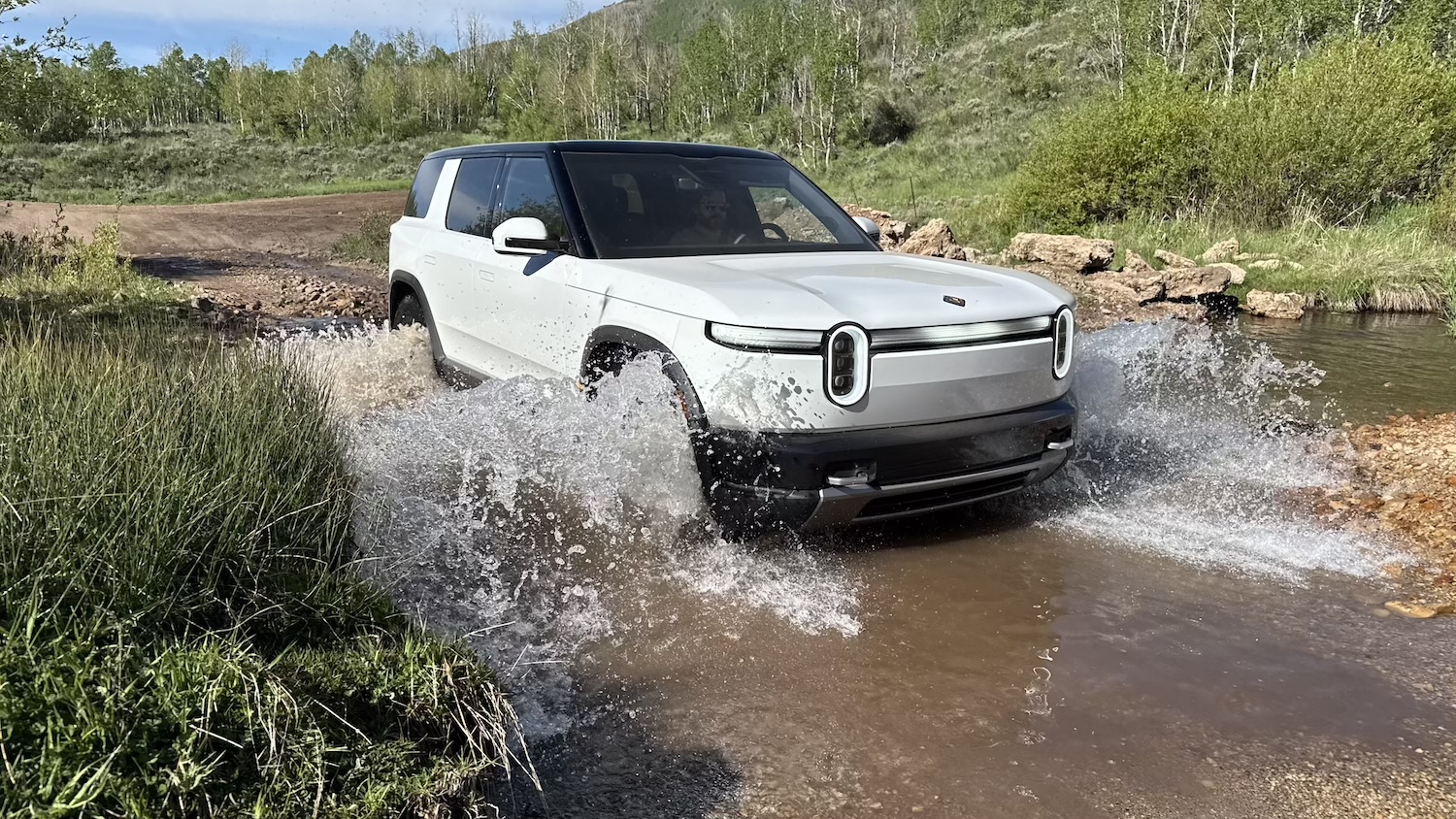
The Rivian R2 isn’t amazing off-road — let’s just get that right out of the way.
The most important attribute of a competent off-road vehicle is favorable geometry. That means good ground clearance to drive over obstacles, short overhangs so the front and rear tires can get up onto grades before the bumpers hit, and a small belly so the vehicle doesn’t get high-centered. And on the geometry front, the R2 is just OK. Its approach angle of 25 degrees is acceptable, as is a 26 degree departure angle and a 20.6 degree breakover angle caused by a rather large 115.6-inch wheelbase.

These are closer to Subaru numbers than they are to Jeep Wrangler/Ford Bronco figures (aside from the breakover numbers, which are bad on all of these four-door vehicles), and they’re certainly not Rivian R1S numbers. The larger Rivian, thanks largely to air suspension, has a roughly 35 degree approach angle, 30-ish degree departure angle, and 26-ish degree breakover angle. What’s more, the R1S has nearly 15 inches of ground clearance compared to the R2’s 9.6 (note that the location of the minimum ground clearance matters as much as the number itself).
The R2’s geometry wasn’t an issue on the rocky mountain trail Rivian sent us on, even if there were a few times that the nose got close to the terra firma:
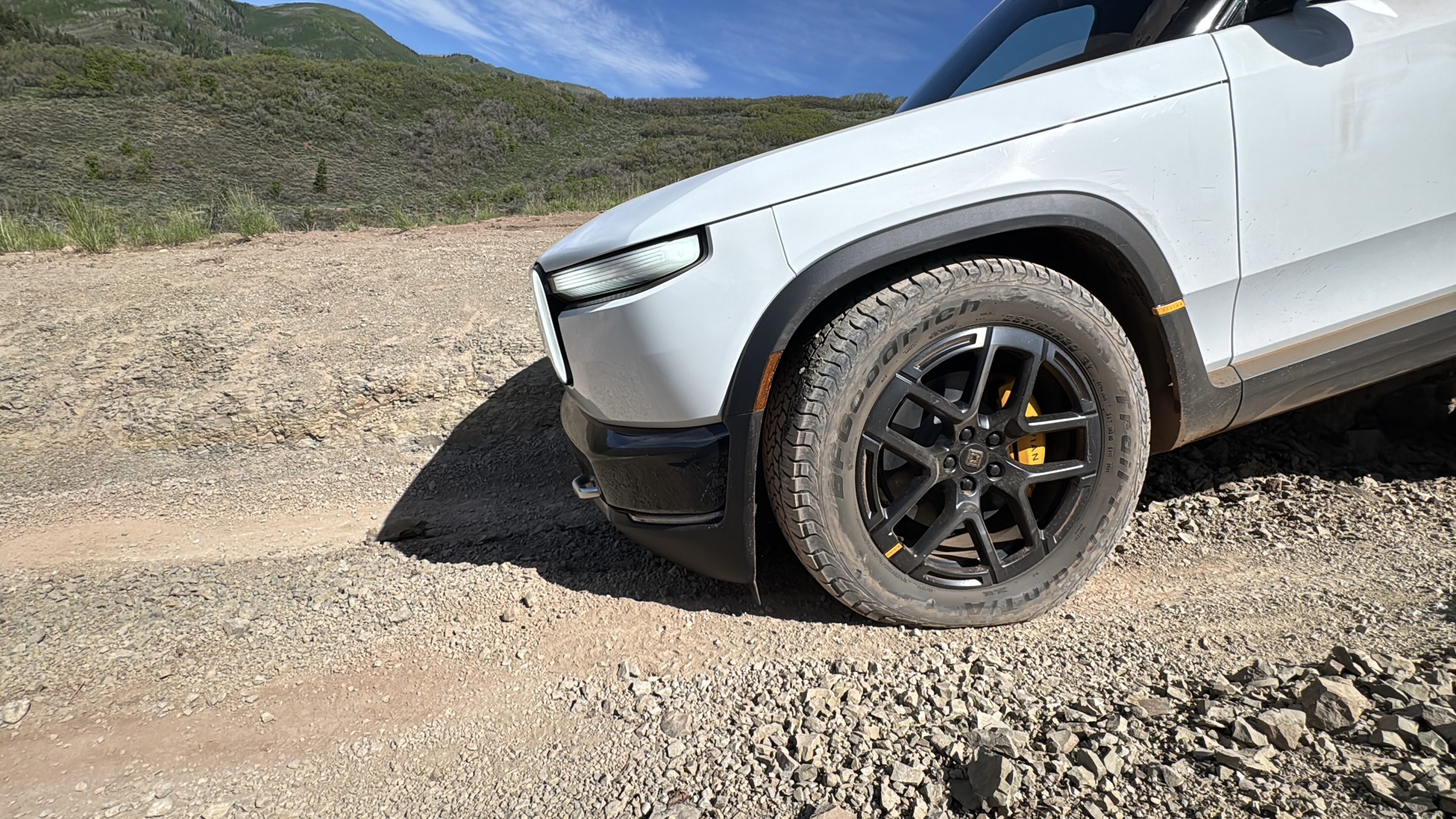
And the belly, too, sometimes managed to get down close to the dirt:

But it really wasn’t the geometry that was a problem on these mild trails. The only areas that seemed to be challenged by the terrain were the suspension and the four-wheel drive/traction control system.
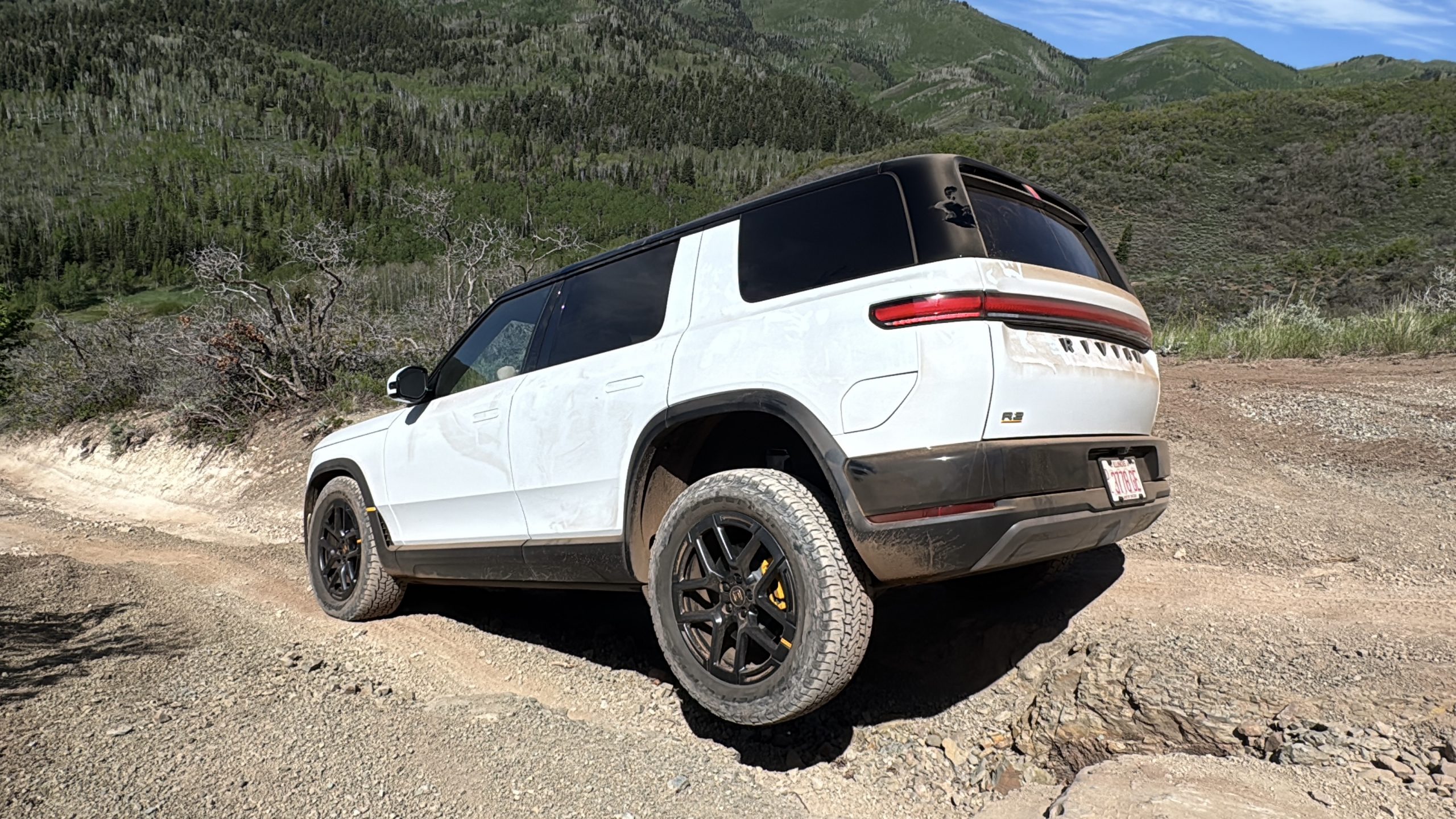
The Rivian R2’s fully independent suspension does not articulate well, and the result of this is that, all too often, those BF Goodrich Trail Terrain T/A tires found themselves trying to grip air instead of rock/dirt. This is a problem because a tire that’s not on the ground cannot assist with propulsion or braking — two things one generally wants to do while off-roading.
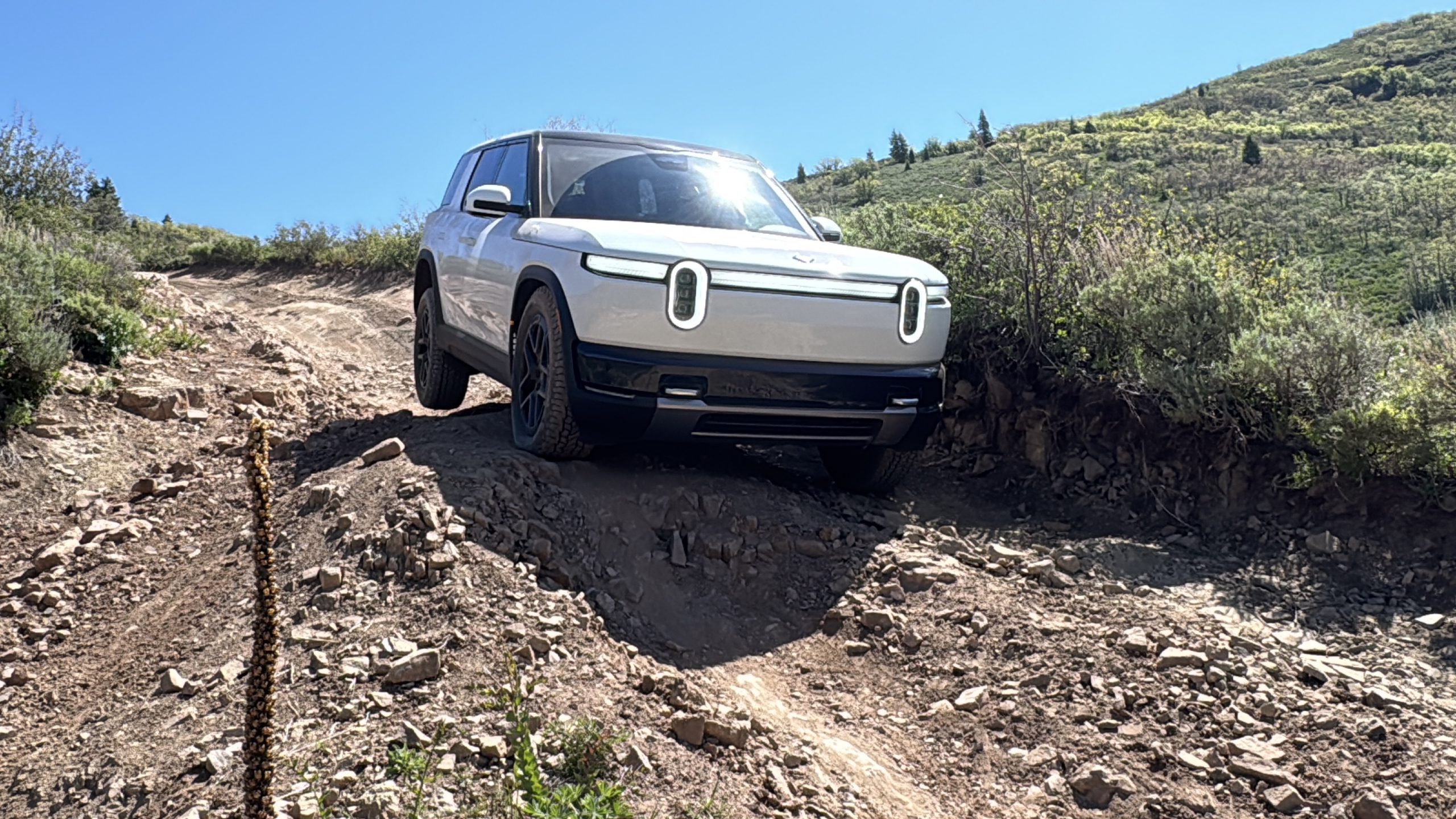
This lack of articulation did not pair particularly well with the R2’s traction control system, which makes do with open differentials front and rear, whereas the R1S can be had with three or four motors — setups that allow for lightning quick torque vectoring on the rear axle. The R2 utilizes what some call a “Brake Lock Differential,” which is basically just strategic application of the brakes to force torque to the wheel on the opposite side of the axle. It’s rudimentary, but usually it works well enough, and has been found on Jeep Wranglers since at least 2007.
The R2’s system isn’t perfect. I noticed something a bit odd when trying to mount the rock you see in the image below:
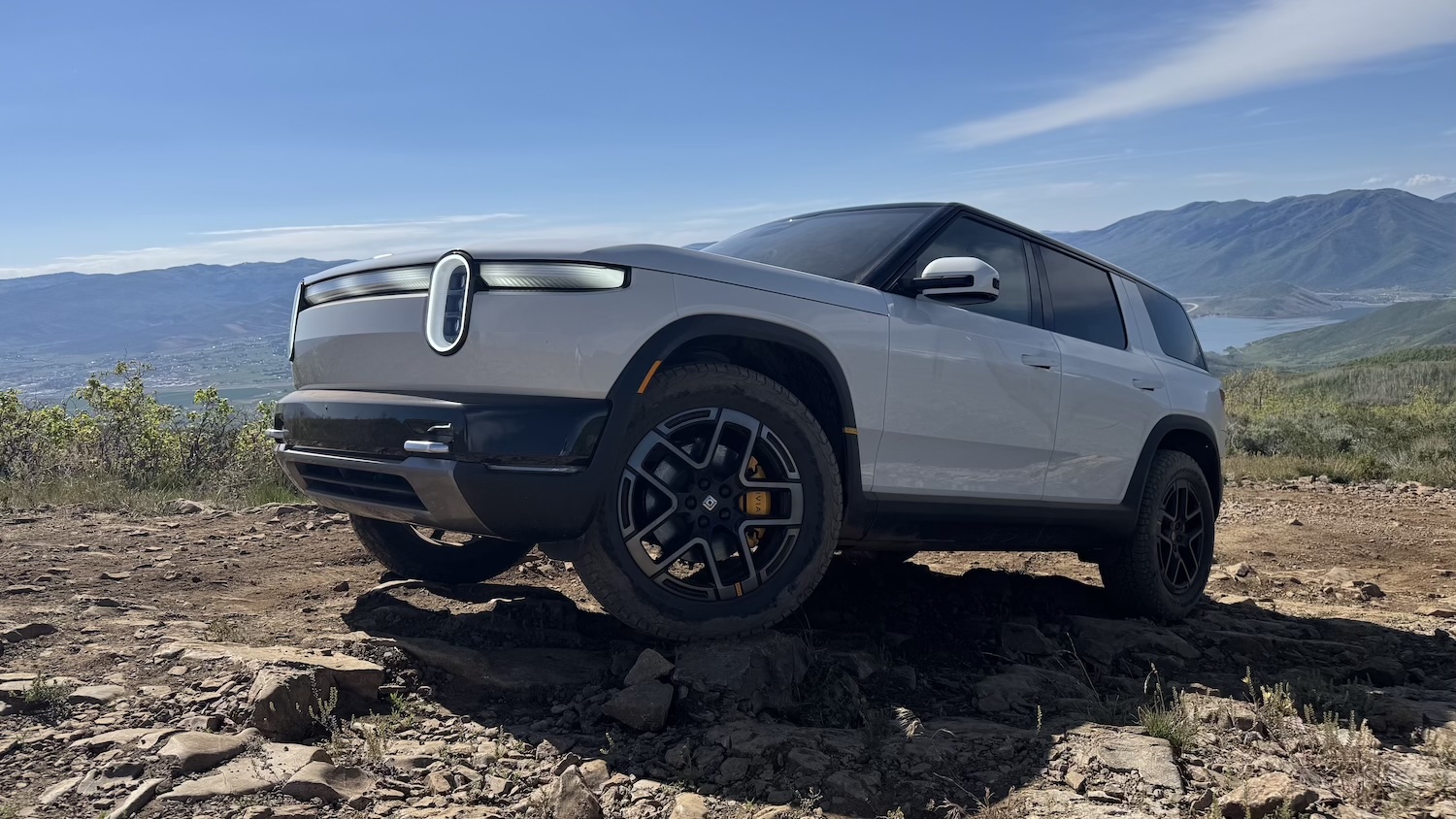
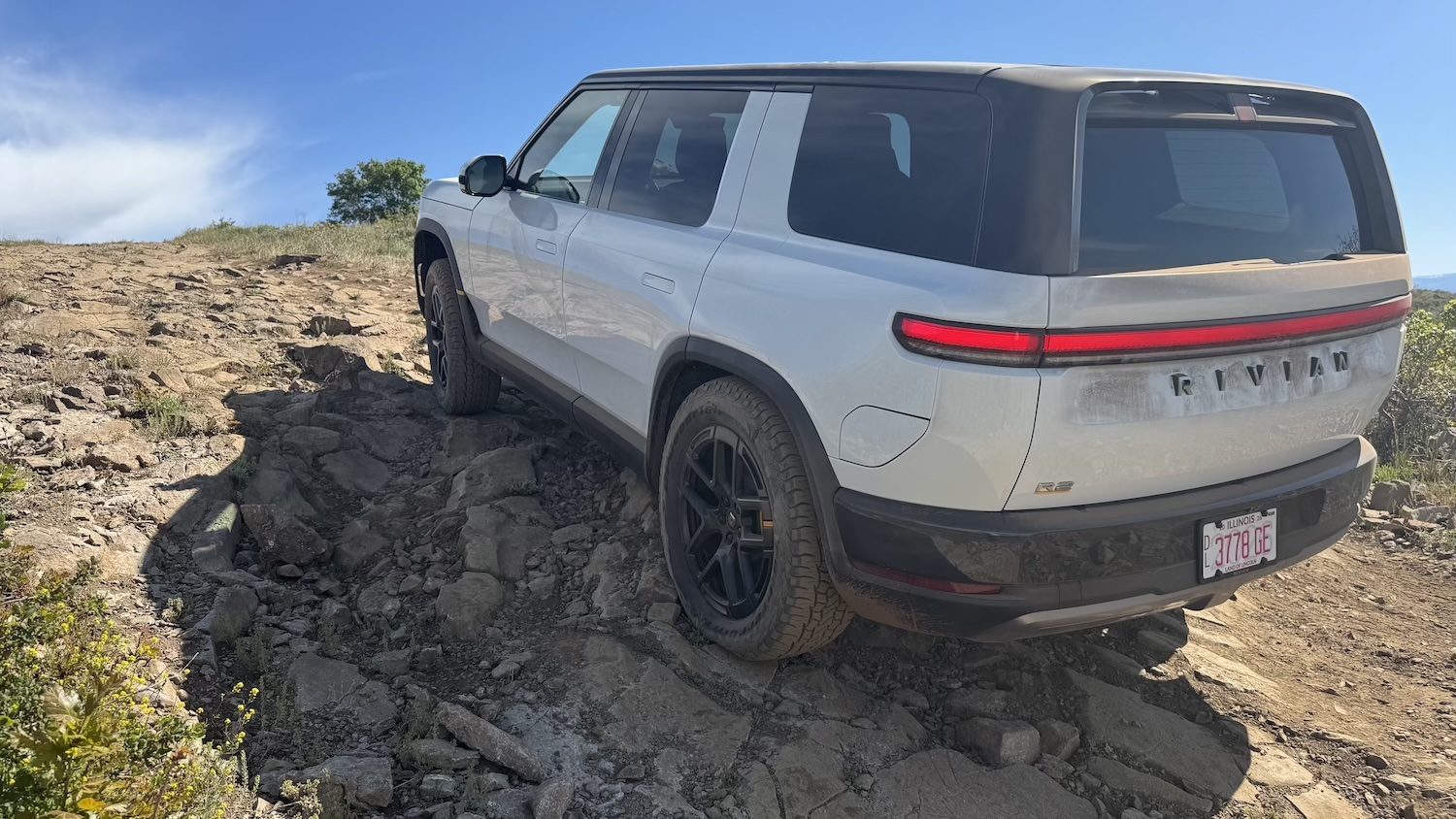
What happened is that, for reasons unknown, only that front left tire seemed to be spinning, while the others were stationary. But that tire was spinning quite slowly, so I pressed deeper on the pedal. I still wasn’t climbing the little rock, so I pressed harder, and harder, and eventually the tire got grip and tried launching the car up and over that rock.
I was able to get on the brake and prevent an overshoot, but the point is that I felt this little climb shouldn’t have been that challenging, especially given that the tires were aired down. That rear axle should have had plenty of grip, and it should have helped propel the vehicle up onto the rock with ease and control.
But this is a challenge with EVs. They’re heavy, they pretty much always feature fully independent suspensions that don’t flex particularly well, and because of the nature of having multiple completely separate drivetrains (two in this case; the R1s have four), you’re limited in how much of the overall system torque you can send to a given wheel, plus the drivetrains have to communicate with one another and with the driver understand vehicle linear speed, driver desire, and on and on. It’s a lot more challenging to develop than, say, a fully-locked drivetrain on an internal combustion engine vehicle.
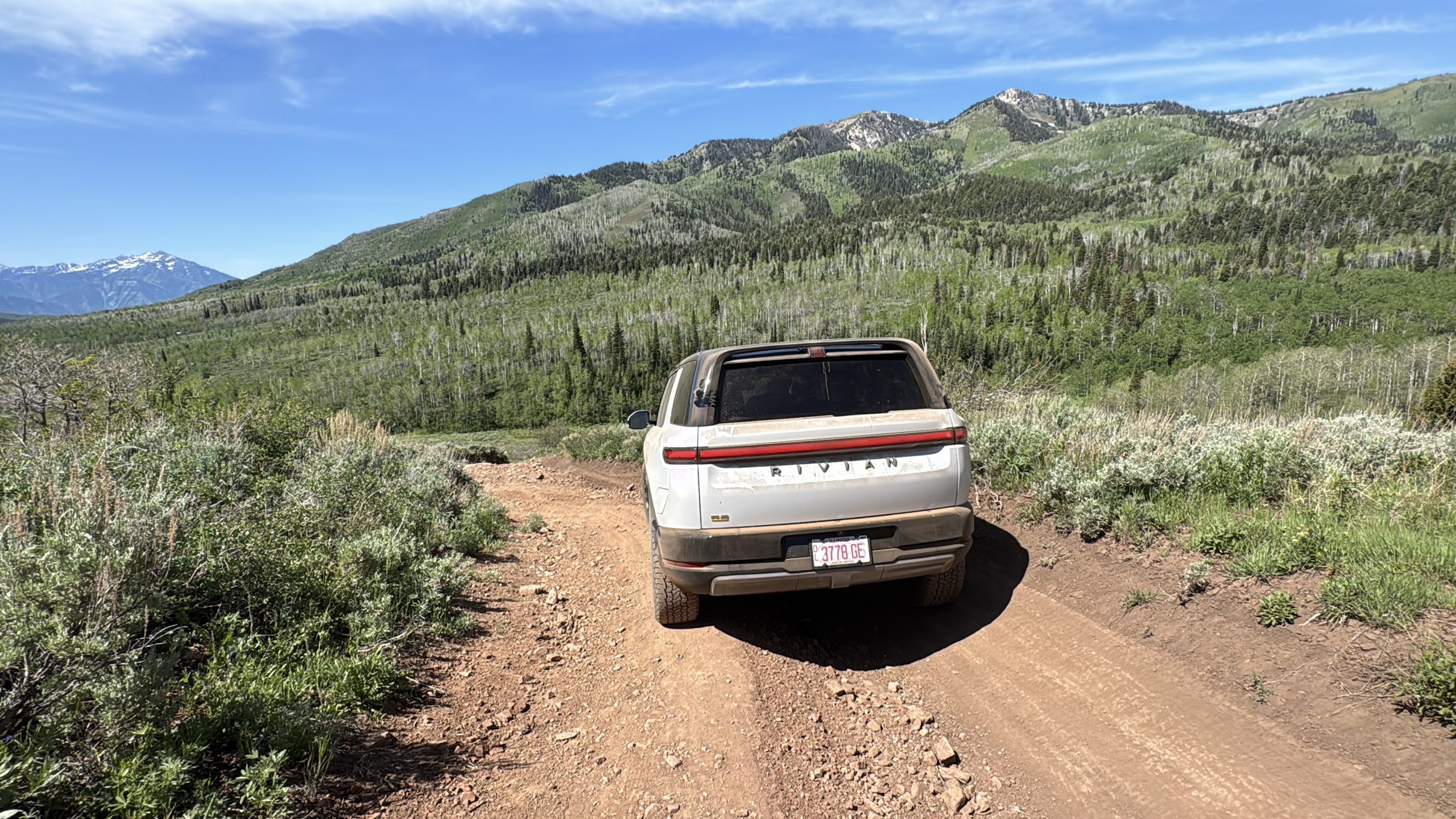
If you look at the video in this section, you’ll see that, climbing down fairly modest rocky trails, the tires would often lock up. This seemed a bit unusual, but it was a result of limited articulation and the driver trying to maintain a certain speed downhill. I have seen similar behavior when using hill descent control over a particularly bumpy, steep downhill grade, though this was a fairly modest trail and not that steep.
I also should mention that, while traveling down these loose grades, my drive partner and I attempted to park in order to switch positions, but we were unable to. We threw the shifter into park and went to open the door, only to notice the vehicle sliding down the grade!
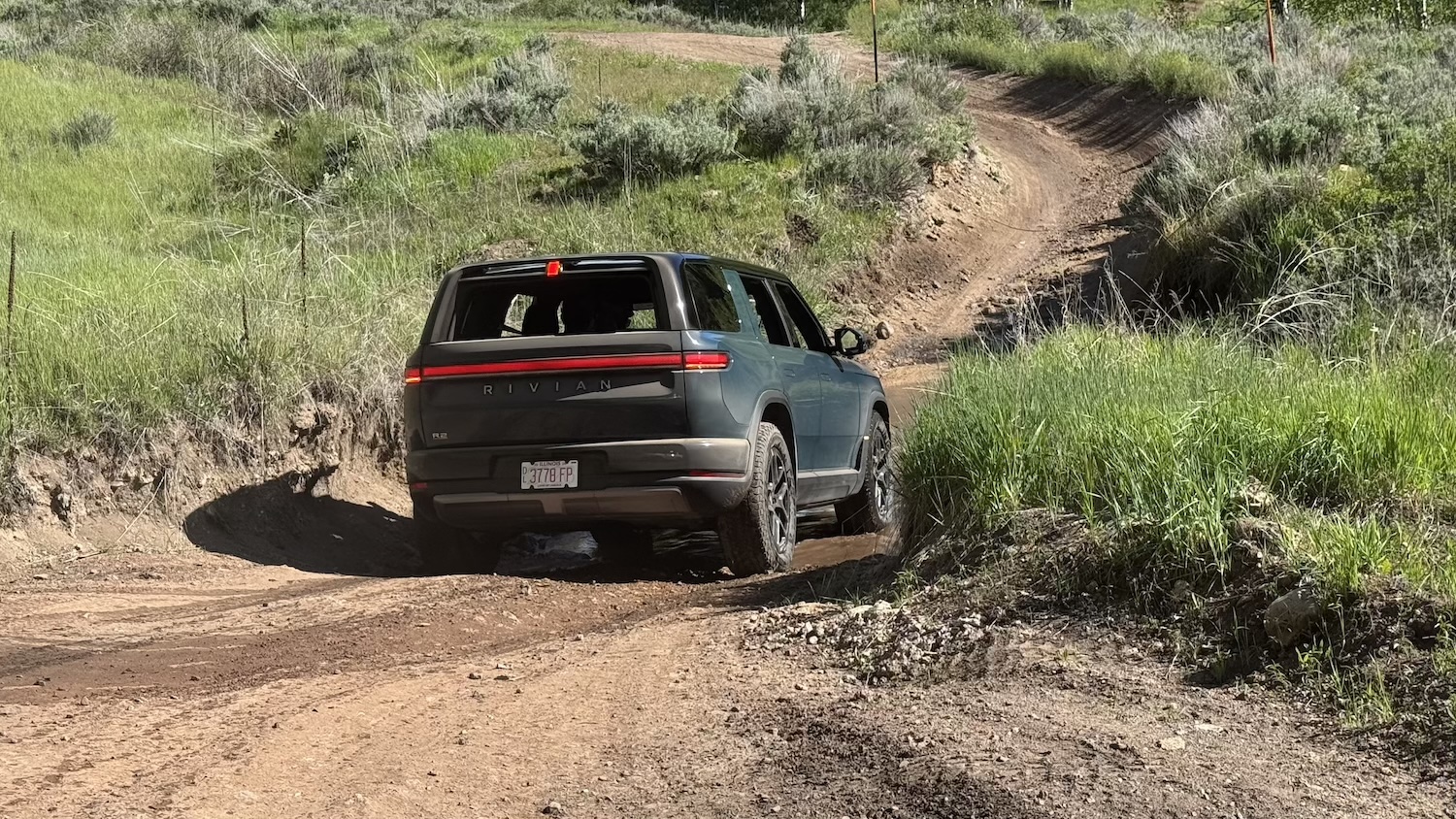
We actually had to drive to flatter parts of the trail in order to park the vehicle because the Rivian R2 (and I’m fairly sure the R1S as well?) only uses caliper-mounted motors to brake the rear wheels. As you can imagine, on a grade, that heavy battery pack tends to just pull those locked rear wheels, while the front wheels do little to encumber forward motion. The inability to park on such a modest grade was something I had never experienced with a four-wheel drive vehicle before.
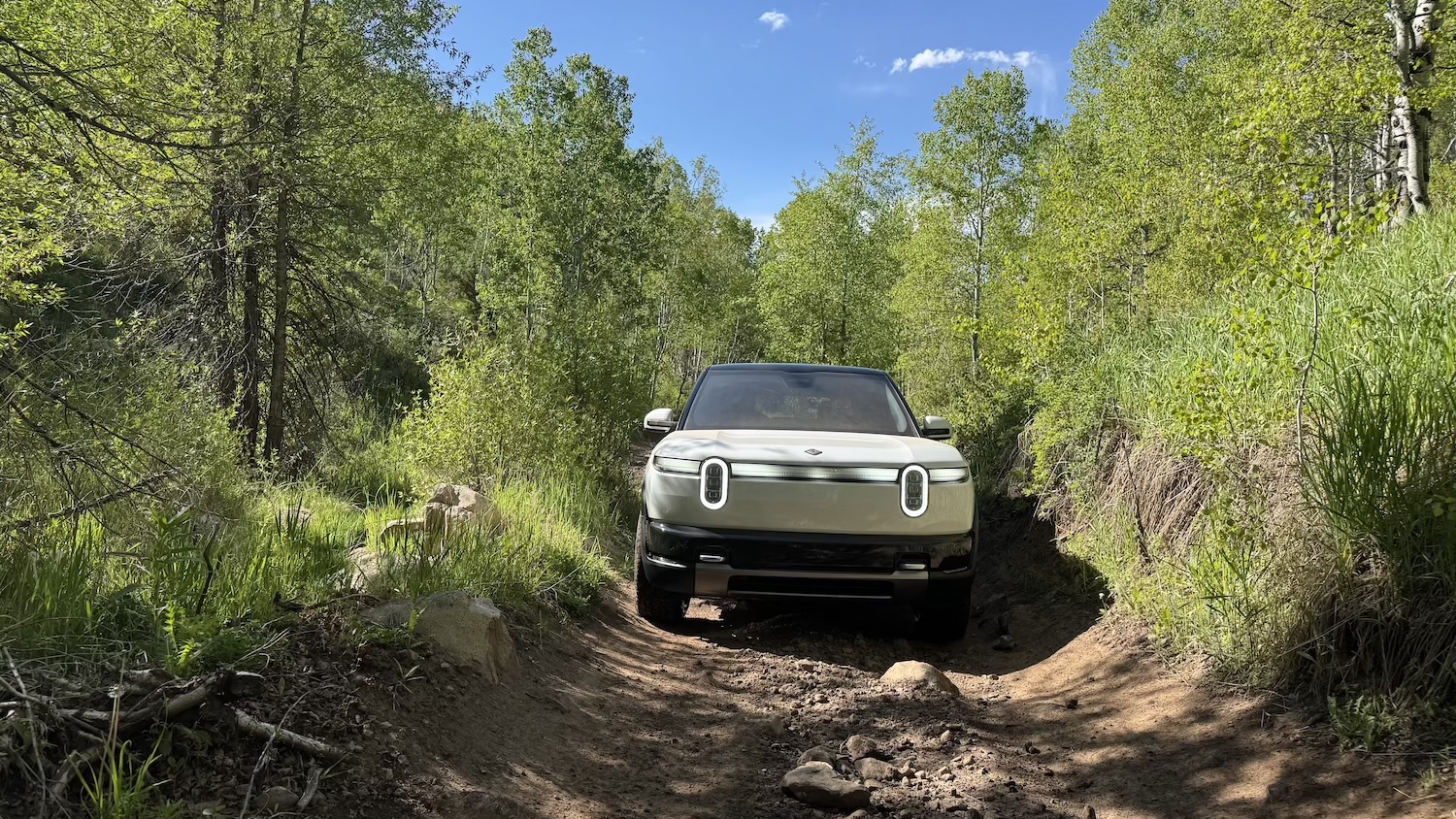
So the R2 has its off-road limitations, but it still got us to the top of our trail, and for most folks who want a vehicle with Subaru Wilderness/Jeep Cherokee-levels of capability, the Rivian definitely delivers, while also offering decent on-road range. It’s pretty much the only vehicle in the space that can do both.
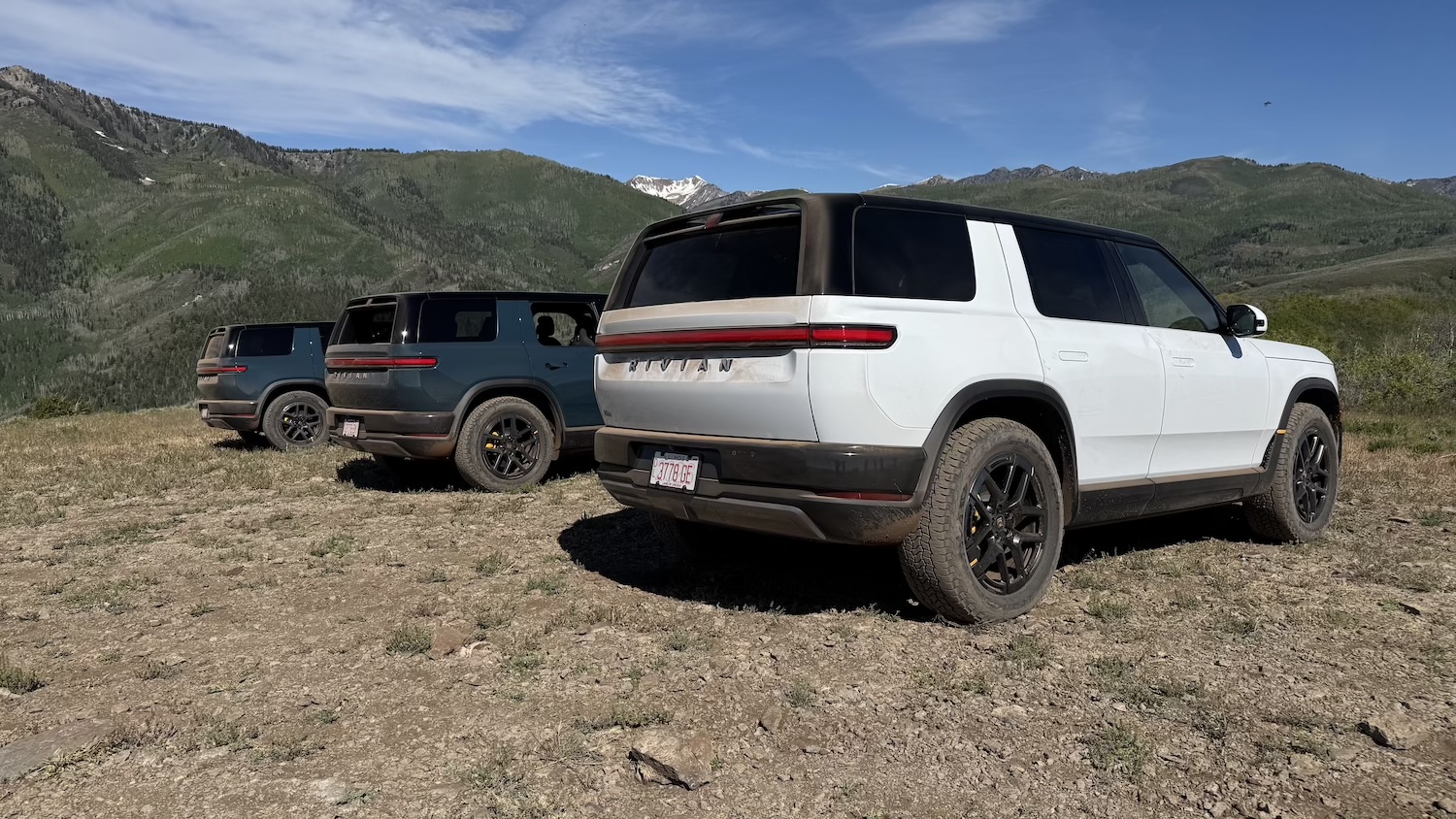
Before I conclude this off-road section, allow me to just say that I wish the R2 had any interior grab-handles whatsoever. It’s a small thing, but especially off-road as a passenger, it’s something you notice.
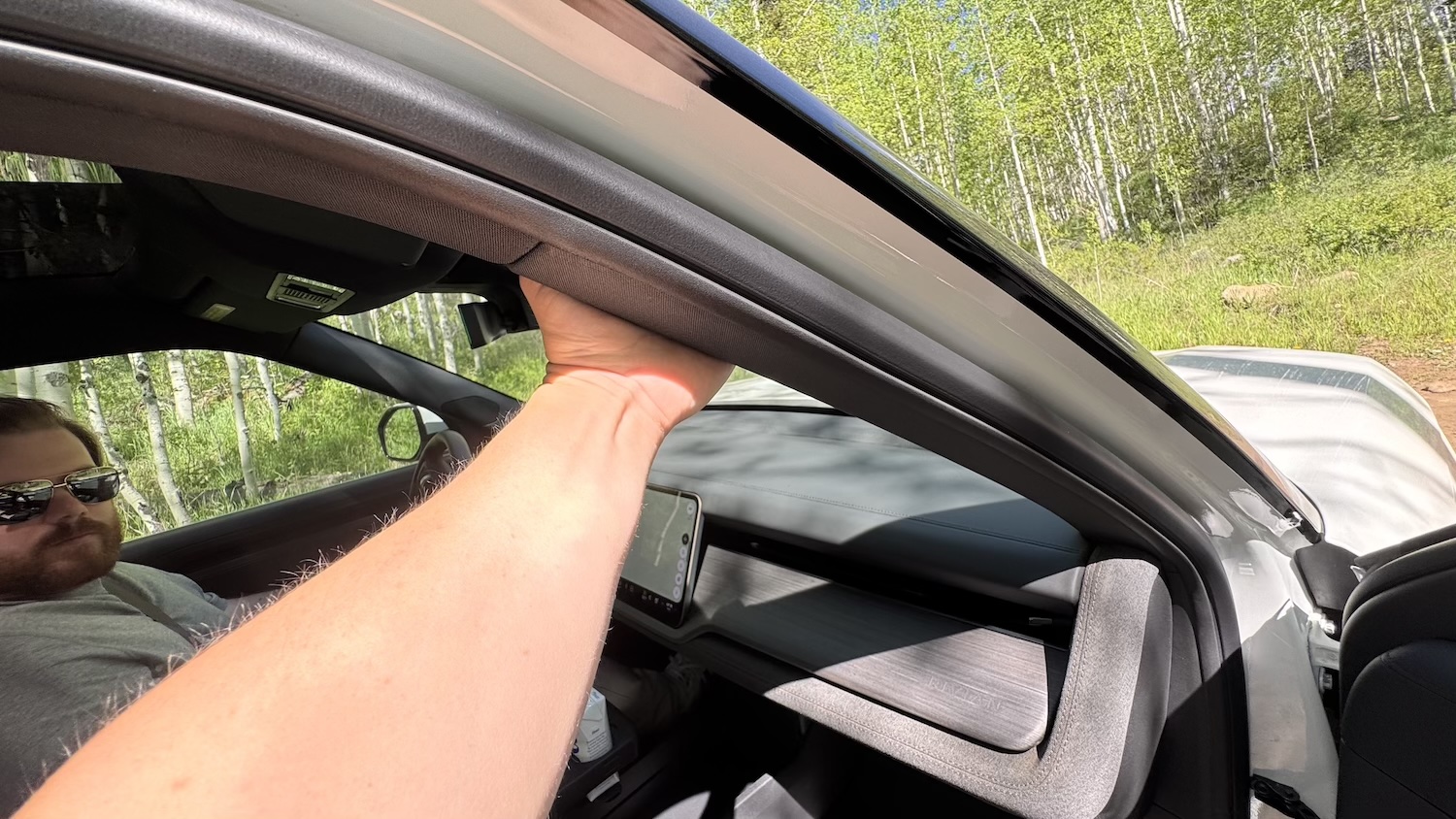
It’s not that I really need it to get into the vehicle, given how low the R2 is, but to stabilize my body as the vehicle bounces over obstacles, a grab-handle tends to be clutch.
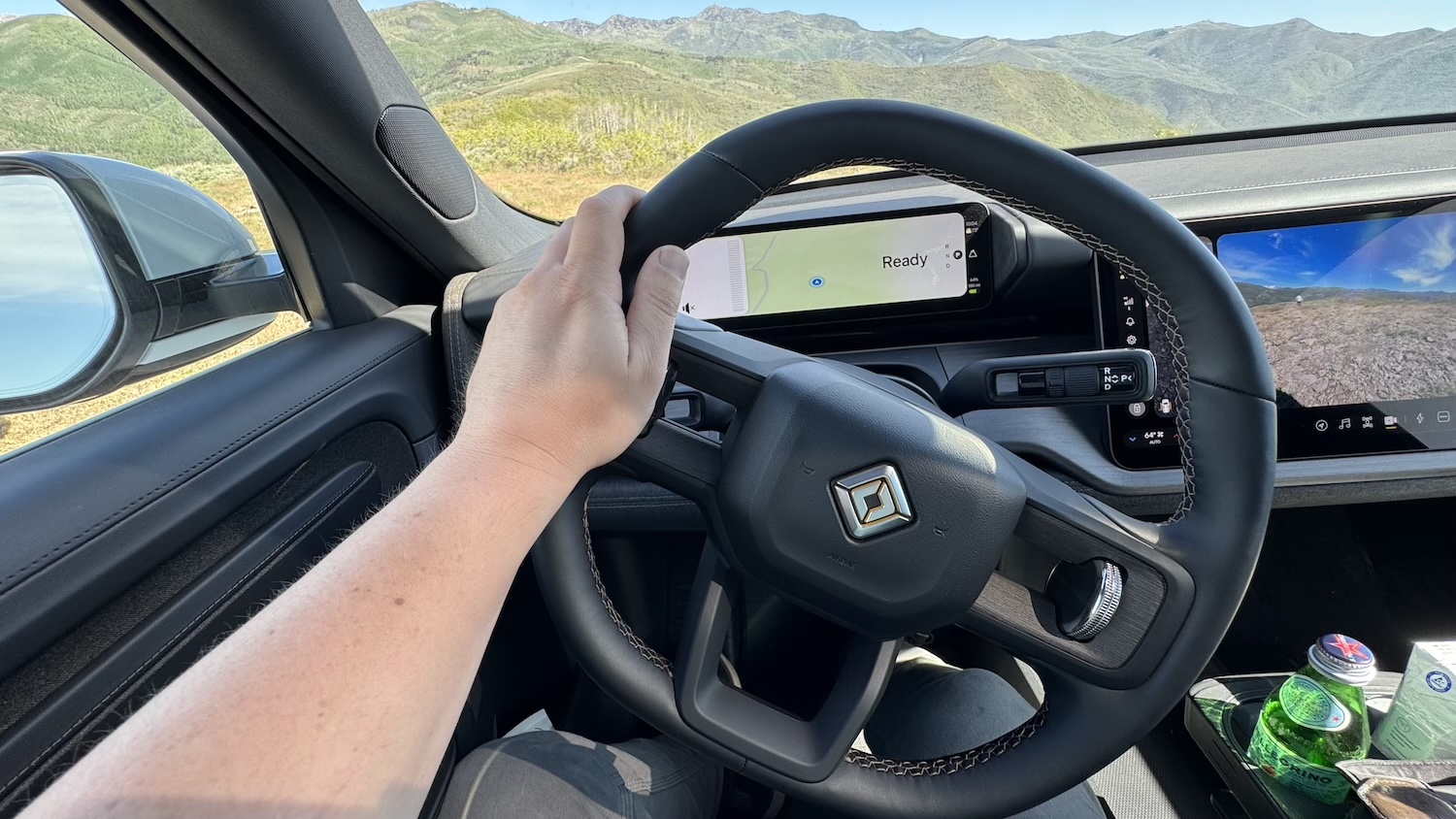
I also found myself accidentally activating those haptic halo wheels as I turned the steering wheel off-road. How big of an issue that is and if, as an owner, I’d change my behavior to avoid doing this, I don’t know.
Conclusion

Right about now, a bunch of media outlets have probably published that the Rivian R2 is a “game changer,” and I won’t lie: My initial headline was similar. But the truth is that I don’t know how to feel about the Rivian R2.
It doesn’t look that special inside or out (especially compared to R1), its range and acceleration figures aren’t mind-blowing for the segment, its off-road capability isn’t amazing, and its pricing isn’t exactly the cheapest in the midsize SUV segment. Is this vehicle really going to sell in volumes that Rivian needs for it to fulfill the role of company-savior? Is there really that much demand for midsize EV SUVs, and how much of R2 sales will be cannibalizing from the R1? (Scaringe thinks the additional visibility all the R2s on the road will give the Rivian brand will ultimately raise all ships, so to speak, and prevent a drop in R1 sales).
I spent a large chunk of my day yesterday contemplating all this, asking around and trying to understand what is drawing so many people in. Why is a modestly off-road capable, shrunken R1 going to be a game-changer for the industry when this segment has competitors with similar performance figures?
The answer really comes down to two things. First and foremost, the R2 benefits from the heavy lifting the R1T and R1S have done over the past decade or so. The R2 isn’t a Chevy, it’s not a Kia, and it’s not a Ford; this is a Rivian, and to understate that would be foolish. This is a luxury brand that, despite being ranked near the bottom of Consumer Reports’ predicted reliability scale, finds itself at the top of that very outlet’s customer satisfaction poll. This is called the Rivian Satisfaction Paradox, and it underscores the strength of the brand.

Rivian put its heart and soul into the R1S and R1T, and while all that development cost the company billions, it also accomplished the hardest and most valuable task one can complete as an automaker: It built a brand. A robust brand. Exactly how robust the brand is about to be put to the test with the R2. We’re also going to learn about how much appetite there is in the market for a cool EV SUV; Scaringe says EV demand is largely being held up by lack of choice; we’ll find out if he’s right.
I think he may be. I think the R2 may not be the cheapest vehicle in this segment, it may not offer the most range, and yes, its styling is derivative and its interior is simple. But it’s the combination of decent off-road capability with good range/efficiency, along with an unmatched cool-factor that will help it stand out in this segment.
I just wrote a 6,000 word review that contained plenty of criticism — the AC could be better, off-road performance isn’t mind-blowing, styling is similar to another car in the brand, the interior could use some switches, and on and on. And yet which car would I personally want to own in this segment? Would it be a Hyundai Ioniq 5? A Tesla Model Y? A Chevy Blazer EV? A Lexus RZ? Maybe a Polestar or a Volvo?
No, it would be the Rivian R2. Forget the spec sheet. The thing is just cool.
All photos David Tracy unless otherwise noted


Great review, DT! I’m glad it was you to do this, I really appreciated the technical details. I spent my whole lunch break reading this article and perusing the comments.
I love this thing – the styling is great; besides the goofy Rivian “face”, I like that they made it into a baby R1 – kind of like a Tahoe to a Suburban. I’m also glad they didn’t succumb to the temptation to turn it into an egg – the squared off styling is more suitable for this type of vehicle and also makes for better interior space. One of my favorite things about my old boxy 4Runner and P2 Volvo wagon was how useful the interior space was with a near vertical rear window.
I think the offroad capability is sufficient – being able to do forest roads and greens, maybe blues, is likely all that most buyers would expect to do with it.
But that curve in the back means some of that space is still lost.
True, I was a little disappointed when I saw that. I’d give up the 6 miles or whatever of range. At least the sides are still fairly vertical though, a lot of the egg-shaped vehicles also have pretty dramatically shaped side glass as well.
I’ve watched a few videos on it the past few days, I have to say I really like it.
I don’t give a hoot about off-road performance or getting to 100kph in 4 seconds or less. 300 hp for this vehicle is plenty. It’s a tranportation appliance; at least that’s how most people will use it. They hit that spec right on. What I don’t like is the way it looks from the outside, but I’m running into that feeling with many (most?) cars these days, and you don’t see it from the driver’s seat. That said, the interior looks nice enough, except for the lack of physical controls. I share my cars with my wife. She sets the A/C to Antarctica and aims the vents at the driver. I set it to Maine and prefer to diffuse the air around the cabin. Having to do this through a screen would be frustrating. Also, give me analog guages. They look better than a screen.
OTOH, it might well be much better – you do it once, and all the vents adjust to match your settings based on your key.
They may have implemented ‘driver profiles’ that are linked to the memory seat settings that could also set the HVAC settings and vent directions. I’d still vastly prefer manual vents, personally.
Yeah, that’s possible, but other than the radio and the A/C, my wife and I share the same settings and we generally share the same key fob. I’ll stick with manual vents too.
This looks really appealing in a number of ways. Good size, plenty of performance and range, well-packaged (40:20:40 rear seatback!) and a nice interior.
My only hangup is this: the ride height and handling are strongly dictated by an off-road focus that I couldn’t use to the extent that I’d want. A lot of western dirt roads begin far from a charger and if you’re going to be out there for a few days I wonder if it has enough range.
But that’s a niche concern and this is cool vehicle. Thanks for the comprehensive review.
I love that color-blocked exterior!!!
I know the interior is part of Rivian’s design language (much like the heckin’ cute headlights), but I think they’re getting ‘elegant’ and ‘minimalist’ confused. To be sure they have designers talented enough to come up with minimalist HVAC and vent controls.
Two gloveboxes??? In this economy???
Go design houses then. Maybe he forgot this is a car? You know I don’t see steering wheels in houses either, now that I think about it. Or pedals, gloveboxes, window switches, instrument clusters. Lets just get rid of everything!
I am happy to see a new American manufacturer doing well and I’m happy if they succeed, but they can absolutely miss me with their design intents. I guess I’m getting too old for this whizz-bang tech BS.
Or if it’s supposed to mirror a luxury house, give me in floor radiant heating instead, and an attic fan in those huge skylights.
We recently bought a home with an attic fan, and it’s absolutely marvelous. If I wasn’t planning on dying in this house I’d say it would be a requirement for any future homes. No in floor heat but we do have a massive woodstove with ductwork that heats the whole house despite it being a weird split level with five floors.
It’s BS anyway.
Contemporary interior design is positively riddled with fins, slats and louvres. Open-joint rain screen exterior cladding is all the rage, ceilings are covered in floating wooden strips with shadow reveals, and open stairwells are contained within slatted millwork.
Sure, nobody wants to look at a cheap floor register, but the visual language of well-designed airflow is actually very much in vogue, and never really goes out of style.
Pleasing, user friendly design is not about masking functionality- Its about considering that functionality in a concise, intentional, rational way. Good design telegraphs its functionality in intuitive ways that humans instinctively understand, without written labels.
I wonder to what degree the hidden vents are responsible for the lacklustre AC performance…
Now that I scroll, happy that I’m not the only one that noticed that.
I don’t want an automaker to tell me their interiors are inspired by architectural digest, or anything that’s not a set of functional requirement sourced from aggregated customer feedback.
Reality is it was likely marketing slop. Their design is really likely to be about cost avoidance.
Has he ever been in a house? If you want it climate controlled, there’s going to be vents. Underfloor heating exists, sure, but if you want AC you’re going to have to live with having vents, just like us normal people.
Excellent review!
Owning a pre-refresh Model Y, the “everything touchscreen” doesn’t bother me as long as it’s a fast touchscreen and my input is quickly translated into output. This was reported to be the same. Peachy keen!
The A/C being iffy is an absolute deal-breaker. On my Tesla, I rarely adjust the vents. The A/C blows ice cubes so the cabin is comfortable even in 95*F, full 12 PM sun conditions. With powerful air conditioning, keeping the air away is more important than it blowing onto someone. That also suggests the heat may not be up to snuff in the winter since this is a heat pump, IIRC.
I like everything else. Make the A/C better and this might be a contender for our next car.
I agree, excellent review. I own a pre refresh (’24) Y Performance as well. Not sure why you think using a heat pump would be bad. I think it was the earlier Rivians that didn’t use a heat pump and it absolutely murdered the range in the cold. That is exactly what Tesla uses and it is the standard, high efficiency way to quickly extract heat out of the air. As for AC, once the Y gets blowing, it can be good but even here in New England where we only get a few weeks of temps that consistently crack into the 90s, the AC is not a stand out. It takes a bit to get going, actually the same or possibly slower than any other gas car I have used in the past. Sure, pre-conditioning helps both heating and cooling but I only pre-condition for heat, mainly to warm the battery when plugged in for the morning commute in the colder months, otherwise efficiency would take a massive hit.
Anyway, back to the Rivian, they will sell every single one they can build. From the anti-Elon weirdos, to the folks who just don’t want to drive around in a smoothed over egg shaped EV, this thing will sell like crazy. I was hoping for more range so it is a bummer that the Premium AWD gets the same range as my Y Performance, I won’t be rushing out for it like I thought I would want to. I really hope they worked out all of the other bugs that current Rivian owners hate about the ownership experience. If they solve those bugs and things look stable a year or two into production, I will definitely give Rivan a chance for my next ride.
I’m not saying a heat pump itself is bad. I’m saying it’s looking undersized for the amount of cabin it needs to cool. Or they need to further optimize the condenser ducting or something. And being an air conditioner with reverse, if it’s undersized for cooling it’s probably undersized for heating.
Usually most heat pumps are undersized for heating. The heating demand tends to be larger than the cooling demand (in the majority of climates, far north and far south are different). Even accounting for the compressor heat adding ~25% to the output when in heating mode, heat pumps are either undersized for heating or oversized for cooling.
That can be overcome to some extent by using a variable speed compressor and variable speed blower fan. Which this is undoubtedly using. But it’s not a good look to be marginal on A/C on a routine day. A $25k econobox, maybe. A $53k car, definitely not.
TIL that inverter driven eCompressors for automobiles are available (Denso advertising them since 2003 so probably in the better-half’s Prius PHEV and a VW-corporate one in my BEV)… and with enhanced vapor injection like the “cold climate” heat pumps…
I thought it was only in the “building” style heat pumps (like Mitsubishi HyperHeat). My mind was still stuck in the belt/clutch constant speed compressors.
Thanks for the knowledge!
I like Rivians, but their interiors can go straight to hell. Now that even some of the cheapest cars on the market have digital instrument clusters and big screens, there is nothing exclusive or “luxurious” about these screen-only interiors. Give us high quality touch points and controls, putting everything on a screen is now the cheap way to do things.
I think ‘screenshot control everything’ has always about cost reduction for the manufacturer.
When the model S came out with its big tablet screen in the center, it was pretty novel amd therefore I think was considered interesting.
I stand like the vast majority of I think us here with nothing beats a well designed physical button at least for hvac controls + preferably basic ‘music’controls
The interior design and materials looks nice. The driver UI and lack of some physical controls, not so much. The lack of Android Auto, a deal breaker if a vehicle like this was ever a consideration for me.
Exterior styling: I actually like it when a brand has a consistent design language and styling.
I like the colorway R2 at the end there! But I would probably rather get a used R1
Looks cool, unfortunately screen based AC controls are a dealbreaker for me. Hopefully they fix that in the future.
Having just recently purchased a Kia EV6, the R2 is what I really wanted. However, the Rivian reliability is a very real concern, and the nearest Rivian service center is several hours away, while the nearest Kia dealer is ten minutes. If Rivian can expanded their dealer/service network to cover more areas outside of large city centers, I may be looking at a used R2 in a few years.
I really appreciate the very thorough review! Some of the off-road (and maybe A/C) issues should be fixable in software, but overall the Rivian take on a Jeep Patriot/Compass is good.
I just hope someone makes an aftermarket CANBus button panel for it.
I think that DT’s strength in this review is not really the engineering commentary as much as the understanding of the customer mindset. Might be a result of having Hardigree on board. Either way, thoughtful review
I’ve been writing such reviews for years, though that doesn’t mean Matt isn’t a genius, because he is.
I’m referring mostly to the conclusion section of this piece. I don’t see as much of that in the F-150 piece.
Whether or whether not Matt is a genius, his writing and analysis are very appreciated
Totally agree. He’s wonderful.
So close to being perfect. Why oh why can we not have physical hvac controls?
Also David, make sure to get those spots on your head checked out for cancer please my friend.
This might be just the upgrade from my Bolt EUV (love, love, love it) when the time comes, which I didn’t realize was “weird” for being able to shift R>D>R>D without braking. I have a LONG driveway, and I often will do a 7-point turnaround at the head rather than back all the way down and back into a street; I literally don’t even lift off the accelerator pedal, I just shift R>D>R>D>R>D and it just changes direction as I turn the wheel. We also have a Prologue which is a pile of shit I’d prefer to set fire to rather than drive.
Medium-rich styling and aesthetics must be stopped. Seeing vents is fine. Buttons are good, actually.
Millennial gray minimalism is soulless and boring just like Kim Kardashian’s all-white Christmas tree.
There are all kinds of youtube video bemoaning the everything is grey, white, or beige. Like you said it make homes, cars etc look, “rich”
my preferred design reference for a car interior isn’t a beige mcmansion, it’s a jet cockpit
So what kind of Saab do you own
None yet but I am absolutely tempted by the saabaru
Just here to say that Gen-X is responsible for all the gray, not millennials. It was their reaction to Boomers trying to turn every interior space into an Olive Garden around the turn of the century. Which was fair, but obviously, it’s gotten out of control.
My millennial cohort has bemoaned the very Gen-X practice of slapping gray vinyl onto every damn surface they encounter, for quite some time now.
I stopped reading at this point. I’m 100% their target market for this vehicle, too, but you can pry my buttons from my cold dead hands.
Rivian might luck out a little on the timing. Many, many dual-motor model Ys with “anti-Elon Tesla club” and “I bought this before he went crazy” bumper stickers are going to be retirement age in the next couple of years. This gives those buyers pretty much exactly what they want. Rivian will probably be able to sell as many as they can make.
You’ve made a case for that Kia’s interior to me, it looks so much more cohesive than all the rest.
Thank you David for the very insightful review. I’ve been slightly frustrated with many auto reviewers lately who basically publish puff pieces. This review does a great job of actually answering everyday usability questions.
As far as the vehicle itself. Poor AC in 2026 is completely unacceptable. AC has been a solved science for decades at this point, but now we need to turn every vehicle into an actual greenhouse with a massive glass roof, and we’re back at square one. I’ve made many drives across the American Southwest, and I don’t really ever plan to own a road trip vehicle, which I would use this for, that can’t keep the cabin at 68° on a 110° day.
I’m disappointed by its off-road ability, but perhaps I had too big expectations. I have been laboring under the impression that EVs were vastly better off-road, and this review seems to indicate this one is only on par with its ICE unibody softroader equivalents. Shouldn’t the: lack of an oil pan, low-end torque, and much more granular drivetrain control make this thing a much better off-roader?
Overall, I’m left more conflicted about this vehicle than I was before. On the one hand, Rivian is doing so many things that are just cool. Flashlights in the door, storage bins everywhere, really good styling, massive interior space. But on the other hand, they seem to unnecessarily compromise the vehicle. No physical HVAC controls, no physical AC vents, electronic door handles, no Apple Car Play, and a panoramic sunroof to the detriment of interior comfort.
I’m now firmly in the wait-and-see camp. I’d like to see the repairability aspect get tested, and I’d like to see their nonsensical agentic AI UI push get walked back.
EV’s are better for the points you mentioned but those aspects cannot overcome the limitations of the suspension, clearances, and approach/break over/departure angles.
Torque is no good if it’s not touching the ground.
Peak torque happens at stall speeds (0 RPM) in an electric motor, and peak torque = peak current. Current = heat. Obviously BLDC motors don’t suffer from the same burnout issues of a physically commutated motor, but this is achieved by digitally monitoring and limiting current under overload conditions.
Electric motors are effective over a much wider RPM range, but gearing still matters. Obviously the priority in a mainstream EV will a ratio that maximizes efficiency under normal driving conditions. They will have to balance off-roading and a decent top speed.
Rock crawling is tough because it can put the motor into a situation where it is essentially lifting the vehicle’s weight up an obstacle, at a stalled 0 RPM. This pulls a ton of current, which builds heat rapidly if you can’t get moving and let it ‘hang’. In the old days this would just melt the motor windings- Now the controller just limits output.
The ultimate solution for a true hardcore EV off-roader is probably a two-speed gearbox, or even a torque converter to allow just a tiny bit of slip at stall speeds. For something less hardcore, (but maybe not as luxury-focused as this Rivian) a slightly lower gearing ratio would suffice.
EV SUVs are still very porky (heavy) certainly still more so than ice alternatives which is bad offroad; though as this example shows the weight difference IS getting closer to ice suv weight
Also this having independent suspension all around allows it to do well on road and in general without the more fancy and expensive height adjustable air suspension of the R1 puts it at a disadvantage when crawling off road as well
For sure. This is definitely more of a soft roader / general purpose family SUV than a Jeep competitor.
I have no interest in a midsize SUV so I’m not looking to buy an R2 but I hope they sell a million of them because I have a ton of interest in the R3X and very much would like to buy one of those.
yep, for me the R2 is the R3X R&D fund car
The bit about the poor HVAC and lack of a roof shade is concerning; hopefully they remedy the cooling.
Corporate design language is fine IMO, and I think the Rivian design language is aging well. I think the overall package is impressive; I’m really interested in leasing one of these sometime in the next few months.
Nice review. In about 13 minutes I’ll be scooting by the Milpitas Rivian (center/location). I’m curious if I see one and can tell the difference.
Reason #458 why I love this site: The A/C deficiency would not have had the same impact without a photo of David’s head sweat. I felt like I was right there sweating with him.