

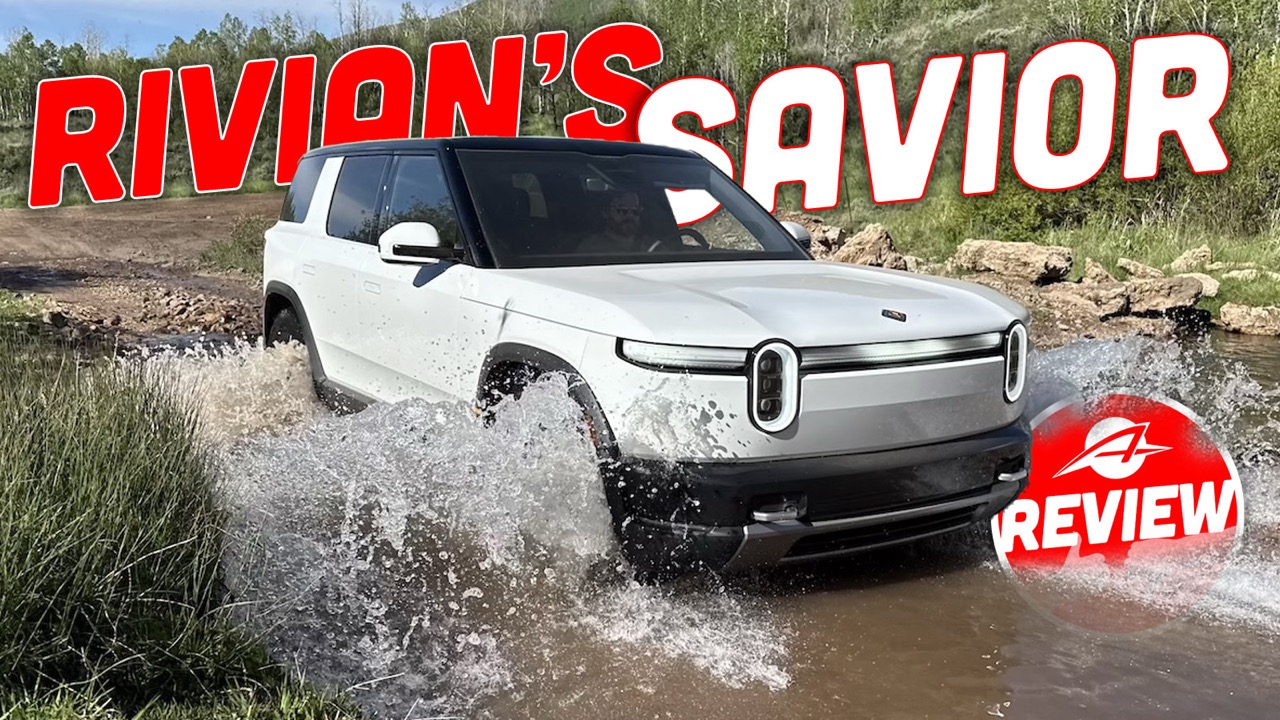
The Rivian R2 isn’t as luxurious as the Rivian R1S, it’s not as capable off-road, it may not ride as well, it’s not as quick, and its styling at launch is nowhere near as fresh. This might lead you to think the R2 is a bit boring — a derivative stuck riding its forebear’s coattails. And, in a way, you’d be right; but I recently drove the R2 and spoke with the company’s CEO and its engineers; what I learned is that, while driving the R2 may not be as exciting compared to driving the R1S, in many ways, the R2 is the more impressive machine.
Engineering is the art of making intelligent compromises. Strength vs weight. Styling vs efficiency. Ride vs handling. And on and on. In the world of engineering, one compromise always has and always will stand highest as the king of all compromises: Performance vs Price. To the customer, this is known as “value,” and it represents one of the strongest driving forces in the automotive marketplace.


When Rivian was developing the R1T and R1S, it, like pretty much every automaker, had to consider cost, but it wasn’t at the forefront of the program. What Rivian was trying to do with the R1 was build a world-beater — an SUV that could sprint from zero to 60 MPH in under 3 seconds, that could drive over 400 miles on a charge, that could use clever quad-motor torque vectoring and an intelligent multi-link suspension to handle corners in ways you wouldn’t believe, and that could use air suspension and traction control to crush off-road trails.
I remember asking a Rivian engineer back around 2021: “Why even bother with the Quad Motor?” A big SUV doesn’t need to handle like a sports car, and I wasn’t convinced that individual motors at each wheel was really helping the vehicle perform off-road, particularly on the rocks where I was noticing lots of wheel “flaring” as each tire saw different traction conditions. Wasn’t the quad motor system just adding unnecessary cost and complexity? The response I heard from Rivian was the right one: We’re a new brand, and we’re launching with the most insane, over-the-top vehicles to show the world what we can do.

And Rivian absolutely pulled that off. I know this because, after I recently told readers that I was about to drive the R2, my inbox exploded. I was a little confused at first, as I find the R3X to be much cooler than the shrunken R1S . Why was everyone so excited? It’s because the Rivian’s R1S and R1T have created an absolute powerhouse of a brand, and the R2 represents the first time many people can take part in that brand at a price approaching “reasonable.”
These emails and all this excitement motivated me to the point where, upon my arrival at the R2 media event in Utah, I took as many notes as humanly possible. Get ready for a long review, starting with discussion about design.
‘We Didn’t Like What We Saw’: Rivian Almost Pulled A Lucid On The R2’s Design
The media first-drive took place at the Waldorf Astoria in Park City, Utah (Full disclosure: Rivian paid for my travel and food), and on the lawn out back the company had set up a cool display that included a body-in-white, an exposed battery pack, front and rear subframes with drive units, various power electronics, and a few complete R2s.
I had seen the R2 from a distance at a Rivian event in Venice, California, and I have to say I’ve always found the design a bit… derivative.

Seeing the car up close didn’t change my mind on that; the car looks like a shrunken R1S, which Rivian debuted way back in 2018. Here’s a look at an R1S I drove a few years ago; the two are hard to distinguish from one another:

If you ask Rivian to point out obvious design differences, the company will mention that the R2’s outboard Daytime Running Light “brows” are a bit more aggressive (they have more of a “scowl,” per Rivian), the entire second-row window rolls up and down without the need for a divider bar, there’s a clever badge/side marker-combo at the rear of the front fenders, the edges of the taillights are a bit more rounded to give more of an “acceleration” vibe, and the headlights are a bit wider and shorter. The two most obvious differences, to me, are 1. the lack of a grille between the “face” and the “bumper” and 2. the hood, which is a clamshell-style in order to meet European pedestrian protection requirements, and whose horizontal edge continues into a character line that runs the entire length of the car.
Since attending this trip, I’ve come around to the R2’s design, especially given the path the car nearly took.

A year ago, I drove the Lucid Gravity, a vehicle that I consider the most impressive “SUV” in the world, on paper. The reason why I predicted the car would flop is that it seemed to me that the brilliant folks at Lucid were too nerdy to compromise aerodynamics in order to make the vehicle look cool (don’t get me wrong — I’m an engineer, so I love the Gravity, but I fear that, to the layperson, it’s a tough sell). The result is an extremely aerodynamic, efficiently-shaped SUV, but the thing looks like a minivan. An $80,000 minivan.
As I learned while chatting with Rivian CEO RJ Scaringe and head designer Jeff Hammoud, Rivian itself nearly traveled down a similar road.
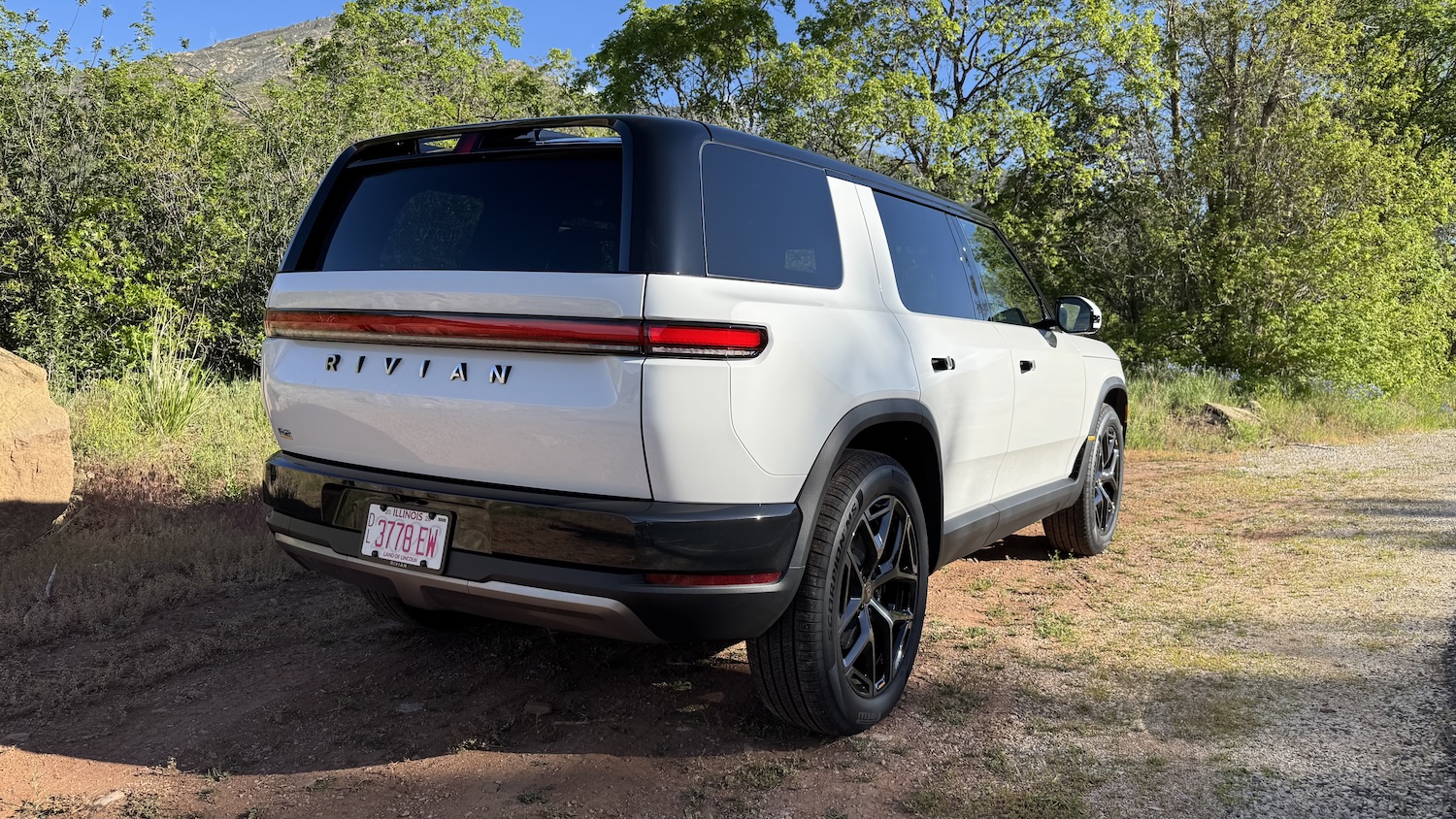
“There’s hundreds of decisions that have very large impacts on things like proportion, packaging, interior comfort — those sorts of things,” Scaringe said at a roundtable with journalists. “A lot of the different objectives when we set out to run the program have a lot of competition to push in completely different directions.”
Rivian’s CEO gave an example. “From an aerodynamic point of view, you want to create more of a taper [at the rear of the roof] — something that looks more like an egg — to move through the air as efficiently as possible…this is particularly important at high speeds.” He went on: “So there you have a tradeoff of making something that’s very aerodynamic but maybe looks proportionally a little bit goofy to something that proportionally looks right, also has a lot of functionality embedded in a two-box shape…We were flexing between a lot of these types of tradeoffs.”
“In each of [the hundreds of] tradeoffs we made decisions that ultimately compounded…[and] got to a place in the R2 program that we didn’t like what we saw. We said ‘Boy, the sum of this isn’t working.'”
Rivian had to shred its design.
[Writer’s aside: I noticed something similar when I was on the Jeep Wrangler JL engineering team. Each engineer was trying to optimize their own system/subsystem, and this was threatening to water down the overall product. At Chrysler, this became known as “death by a thousand cuts.” I remember watching in horror as a vehicle dynamics engineer who was unable to meet his handling targets recommended changing the Wrangler to independent front suspension. Luckily, Jim Repp, a Jeep old-timer who would later become my friend, shut that down. At Rivian, it’s the chief engineer Max Koff and the head designer Jeff Hammoud who collaborate on these big decisions, with CEO RJ often acting as the tie-breaker. -DT]
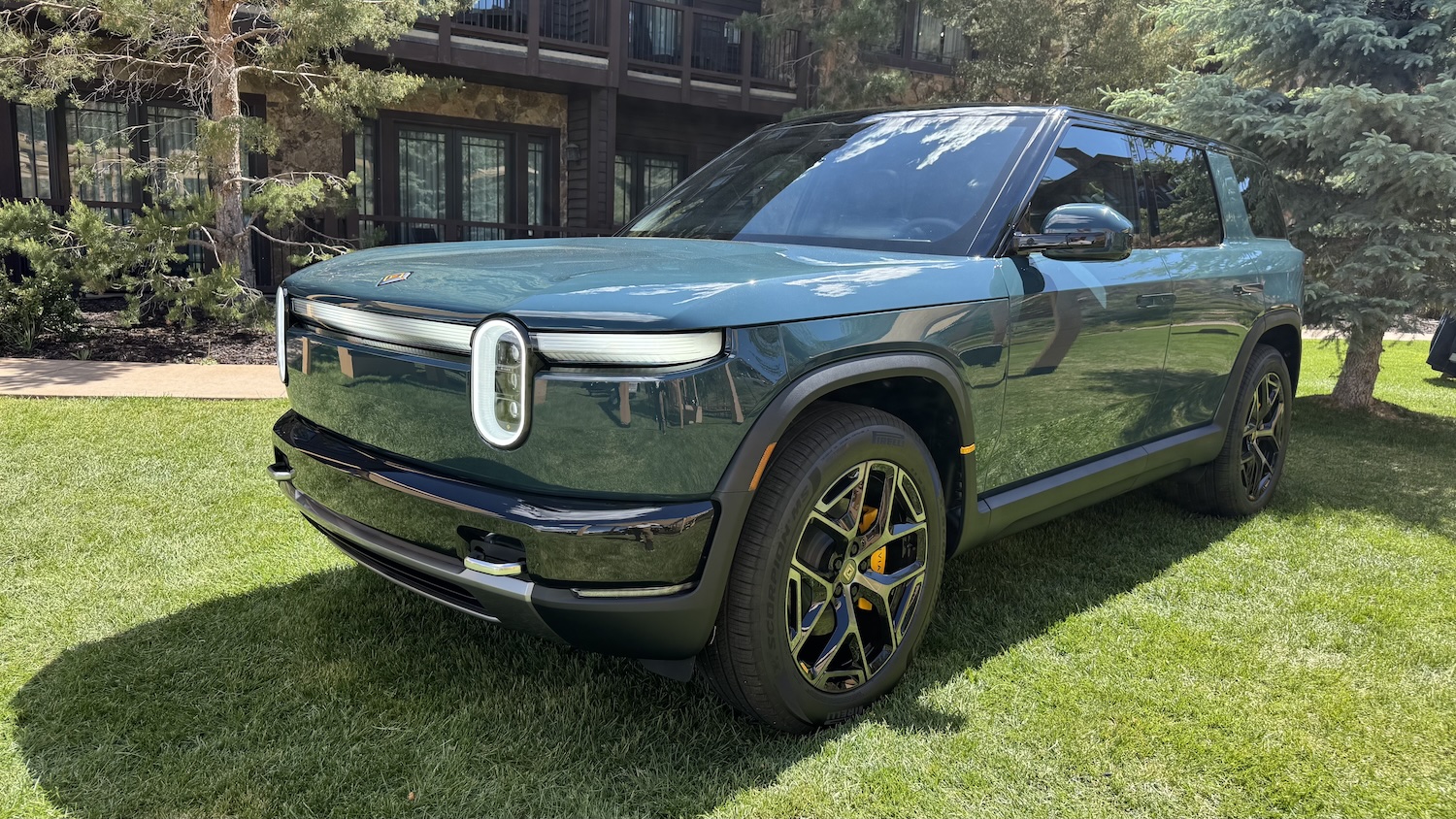
“We actually went through two pretty meaningful resets to the program in terms of vehicle packaging and the overall design approach..and arriving at this [realization that this isn’t working] actually is where we said we had to reject some of these tradeoffs and… try harder.”
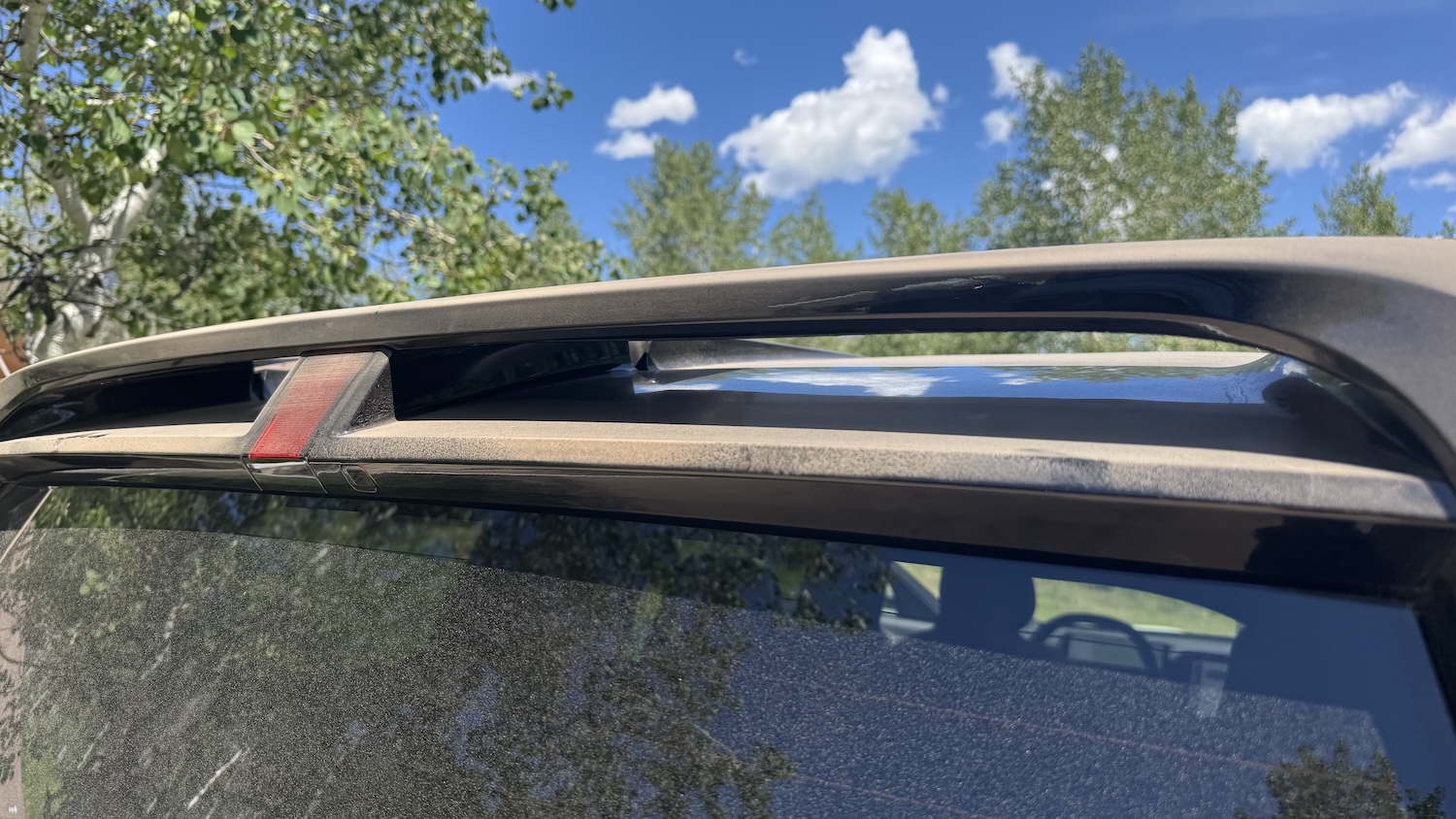
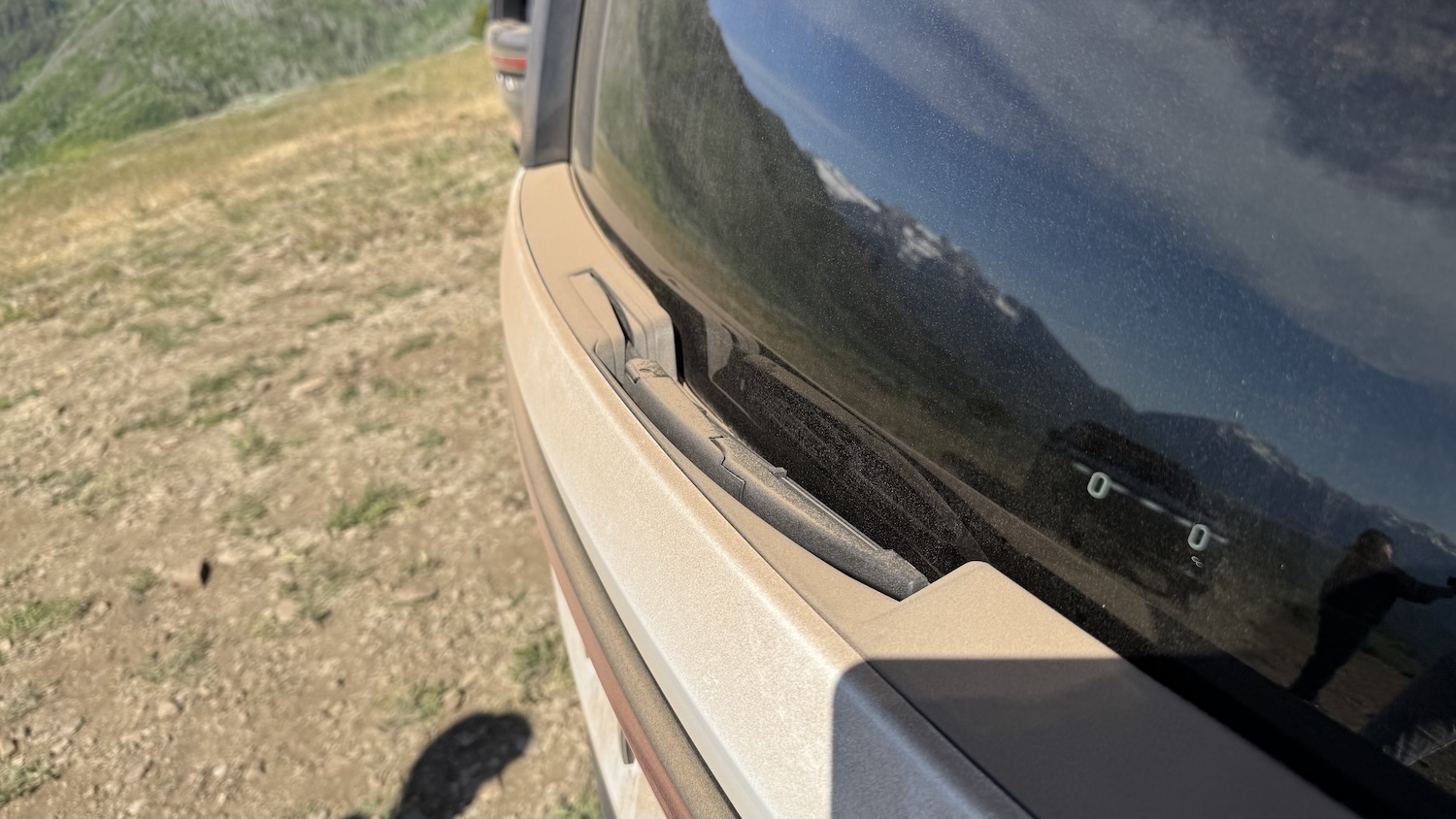
So the team decided what was important, and came to grips with the fact that it was going to have to sacrifice aerodynamic performance (I was told the sacrifice was roughly 8-ish miles of range). “We really wanna have this functionality that comes with a two-box, but we need to get to a certain level of aerodynamic performance,” Scaringe went on. “We’re not going to have the same performance of a pure, more egg-shaped vehicle, but that led to the innovation around that aero pass-through in the back. But then, suddenly, where do you put the wiper if you have a drop-glass?”
Here’s the rear aero pass-through:
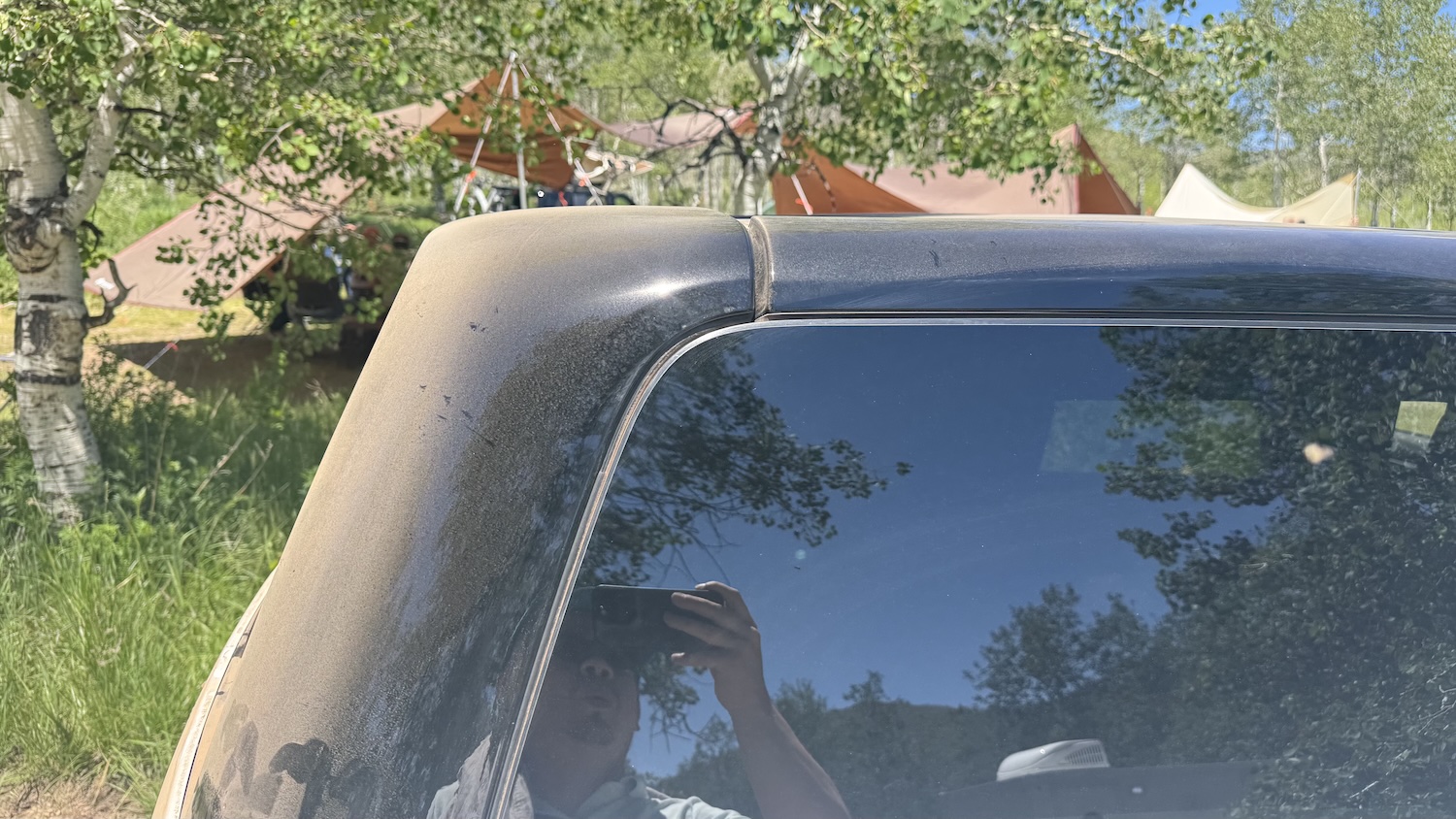
Here you can see that, from the side, the profile still looks nice and upright:
And here’s the wiper, which had to be relocated into the rear hatch:
“I’d say it was like the third iteration that allowed us to converge on making all of these tradeoffs in the most thoughtful way that led to what you see here….We went on a long, long journey with lots of iteration and landed in a place that has lots of DNA from R1, for sure.”
Rivian made it clear that it sees value in the similarities. “We thought it was appropriate, because there was a lot of positivity with R1,” Hammoud told journalists. “And R2, for a lot of people, is gonna be their first experience with a Rivian, so we wanted to build off of that…” He went on to say that the Rivian R3 was shown at the same time as the R2 in order to show that the Rivian team is capable of stretching the brand: “When we did R3, it was really showing that we can take the Rivian form-vocabulary and completely change it into a different segment, a different form-factor, but it still feels distinctly Rivian.”
Not As Capable As The Rivian R1S, But More Intelligently Engineered
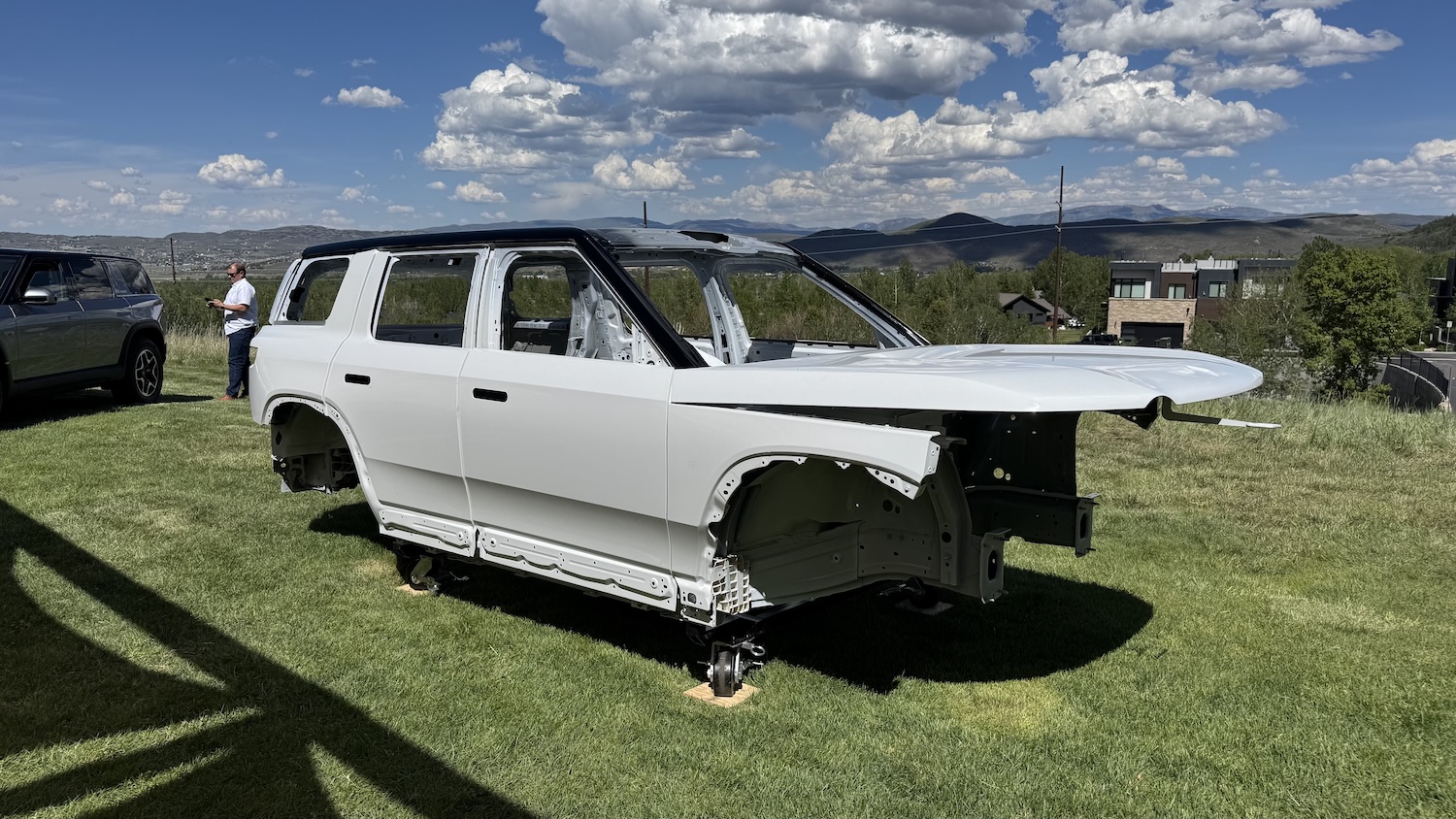
Even though the Rivian R2 looks a lot like the R1, and even though its performance figures like acceleration and range and off-road capability pale in comparison to its bigger sibling, when you look at the engineering behind the R2 it becomes clear that in some ways it’s the more impressive of the two machines.
The R1 was the company’s first vehicle — a “white space” car, as Rivian puts it. It was a halo product meant to “offer a massive spectrum of performance both on-road and on.” And while developing such a world beater was difficult, Rivian says developing the R2 was just as challenging. “How do we bring that Rivian experience to many more customers by making it more attainable?” was the brief.
With the R2, cost was at the forefront of design, with certain departments saying the goal was 50 percent Bill of Material costs when compared to the R1S. And a key to achieving such targets was clever engineering, particularly consolidating parts and bringing them in-house. Beyond that, the R2 had the luxury of being the brand’s “second album,” meaning it could take some of the learnings from the R1.
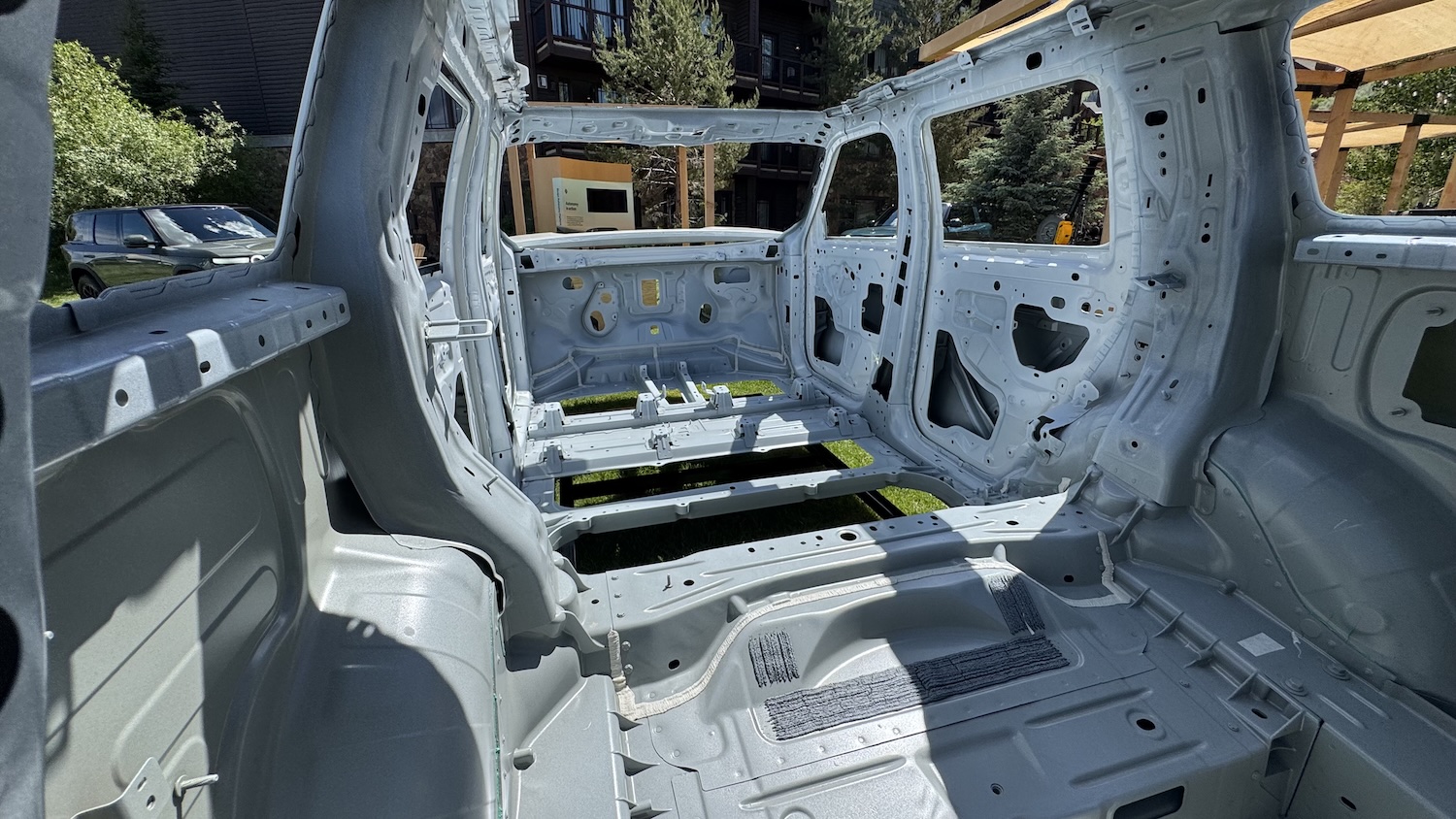
Take the body, for example. It’s roughly a ton lighter than the R1S’s, and while it’s obviously smaller, it’s also just more efficient. There are two reasons for this. First, the R1S had to be built to handle insane on and off-road loads, so it’s just downright overbuilt (Just check out this video from my friends at Munro & Associates. Rivian itself admitted to me that the R1 features lots of redundant body structure). Second, the R1 was the brand’s first iteration; naturally, the R2 is going to build on what the team learned from its own analysis and external critiques of the R1’s body structure.
While the R1 featured a beefy frame to which the battery and body were bolted, the R2 is built on a new unibody platform featuring “advanced structural castings that actually simplify the vehicle’s footprint,” per Rivian. The company continues in its press material, saying that it has “moved toward a much more modular architecture, significantly reducing the total part count compared to the R1. By simplifying the body structure and how the vehicle is assembled, we’ve made specific panels and components far more accessible.”
After a rather controversial situation in which a Rivian owner found themself on the hook for tens of thousands of dollars to repair a light tap to the rear of their truck, Rivian made it clear that the company cares about repair-ability, highlighting to the media: “This modularity is designed to make repairs more straightforward and efficient, ensuring that when service is needed, we can get the vehicle back to the customer as quickly as possible.”
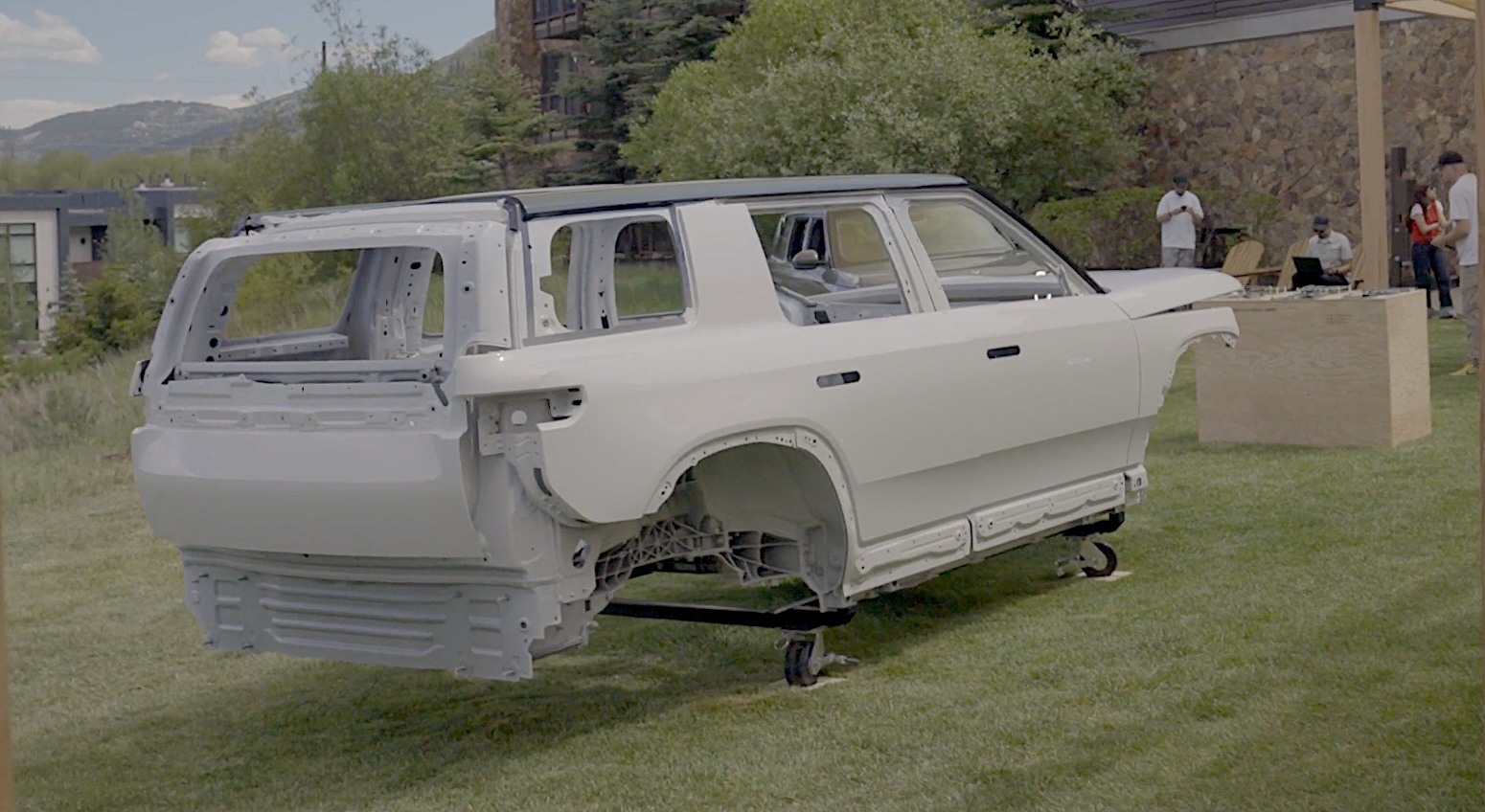
I wish I had more time to chat with Rivian’s body engineer at the event so I could give you more insights into this body-in-white, but for now I’ll just provide you some photos of the beautiful structure. Before I do that, let’s check out the Rivian R1S body structure; as I mentioned before, in addition to the battery, it consists of a humongous, beefy frame:
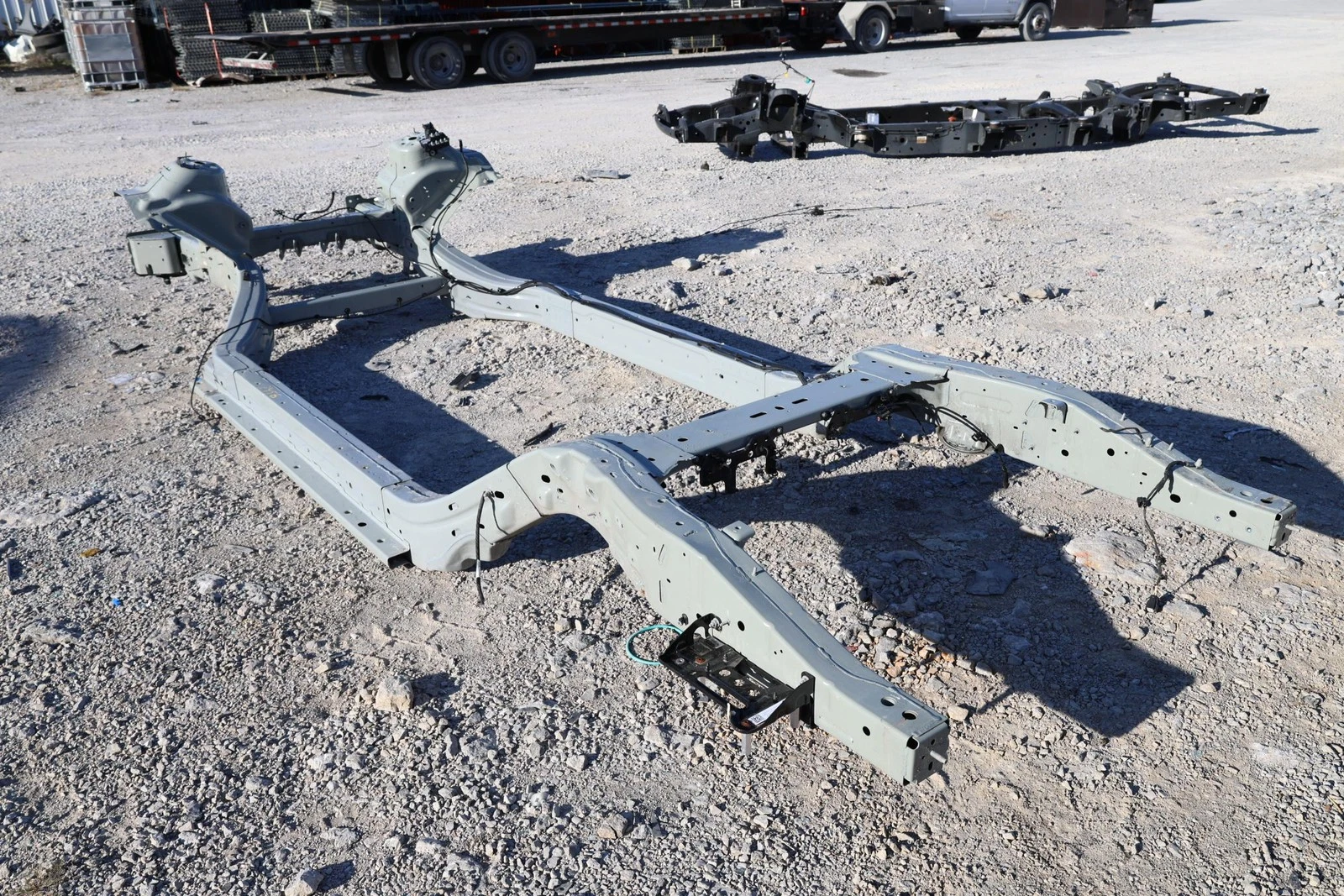
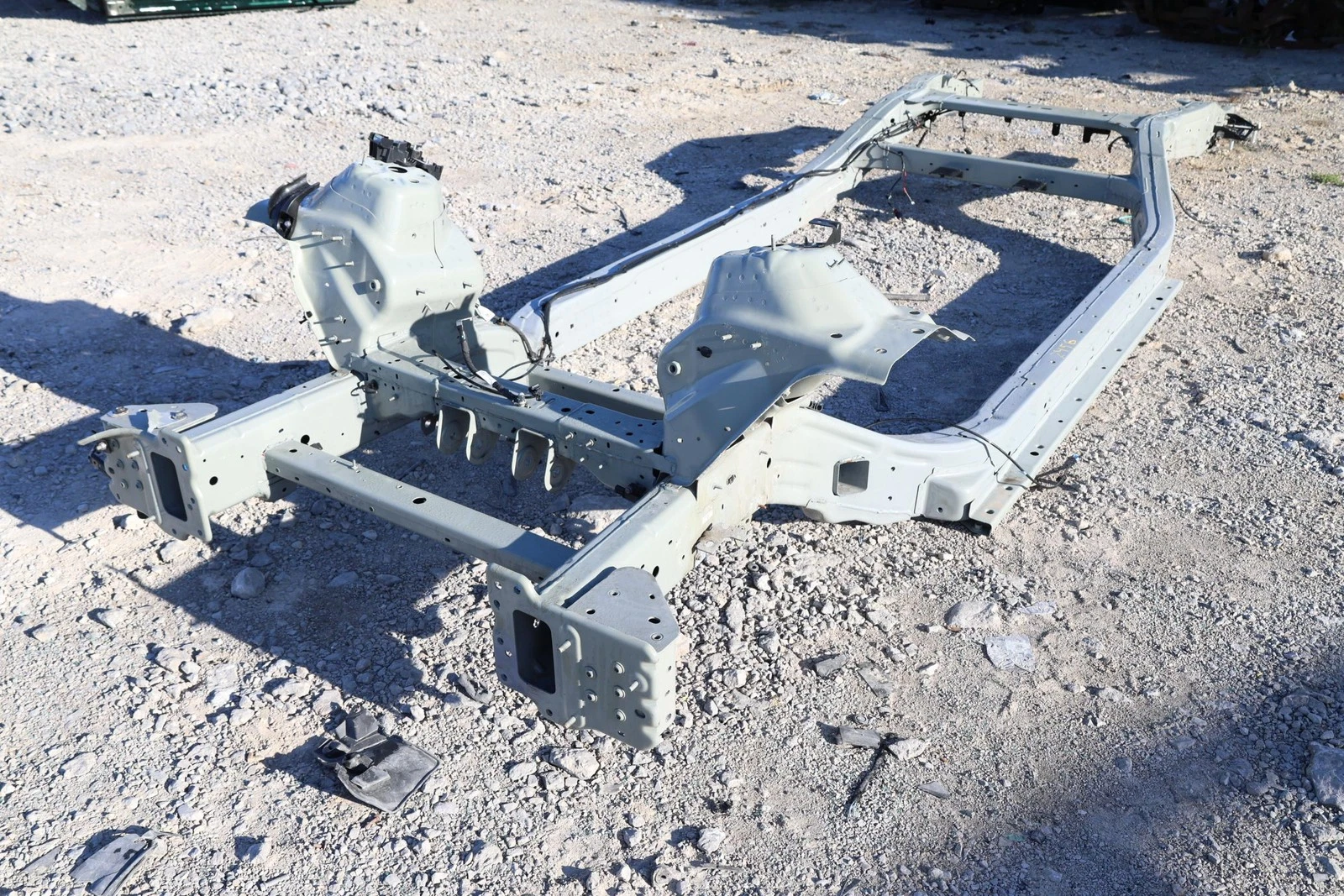
To that frame is attached a body:
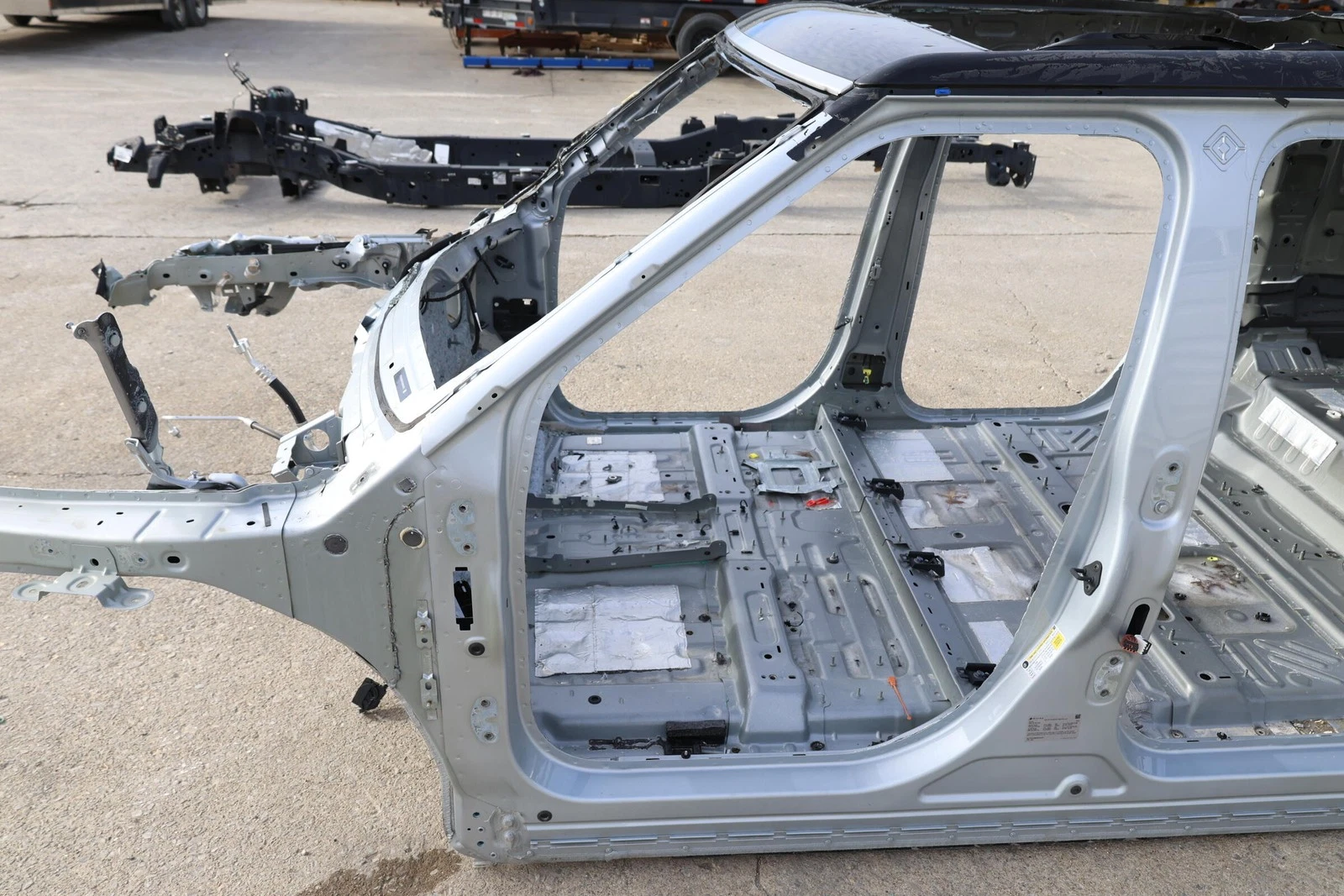
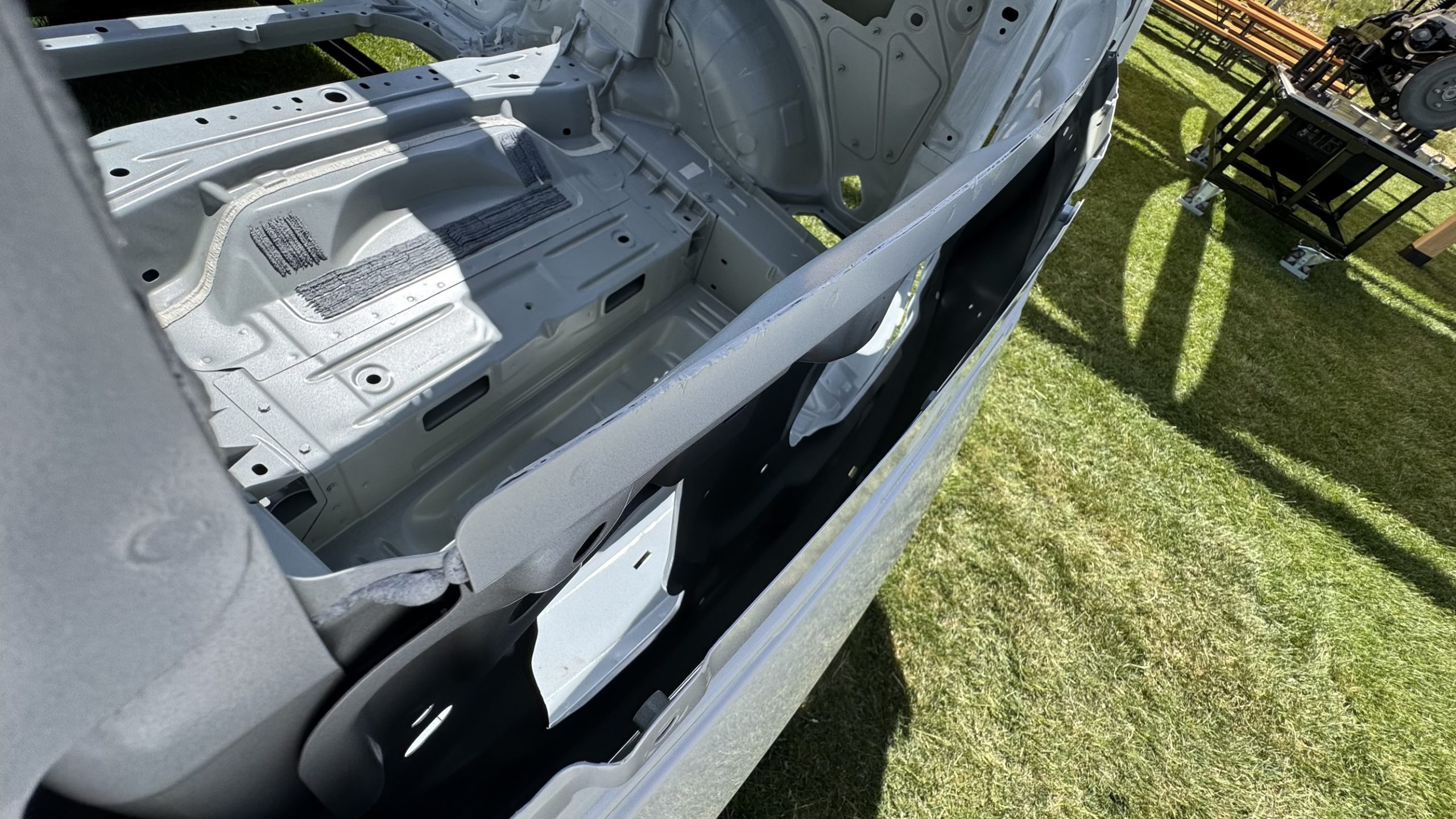
The R2, by contrast, does not feature its own dedicated frame. Its unibody is made primarily of stamped steel with cast aluminum structures throughout. The most obvious of the large aluminum castings is the rear floor; check this out:
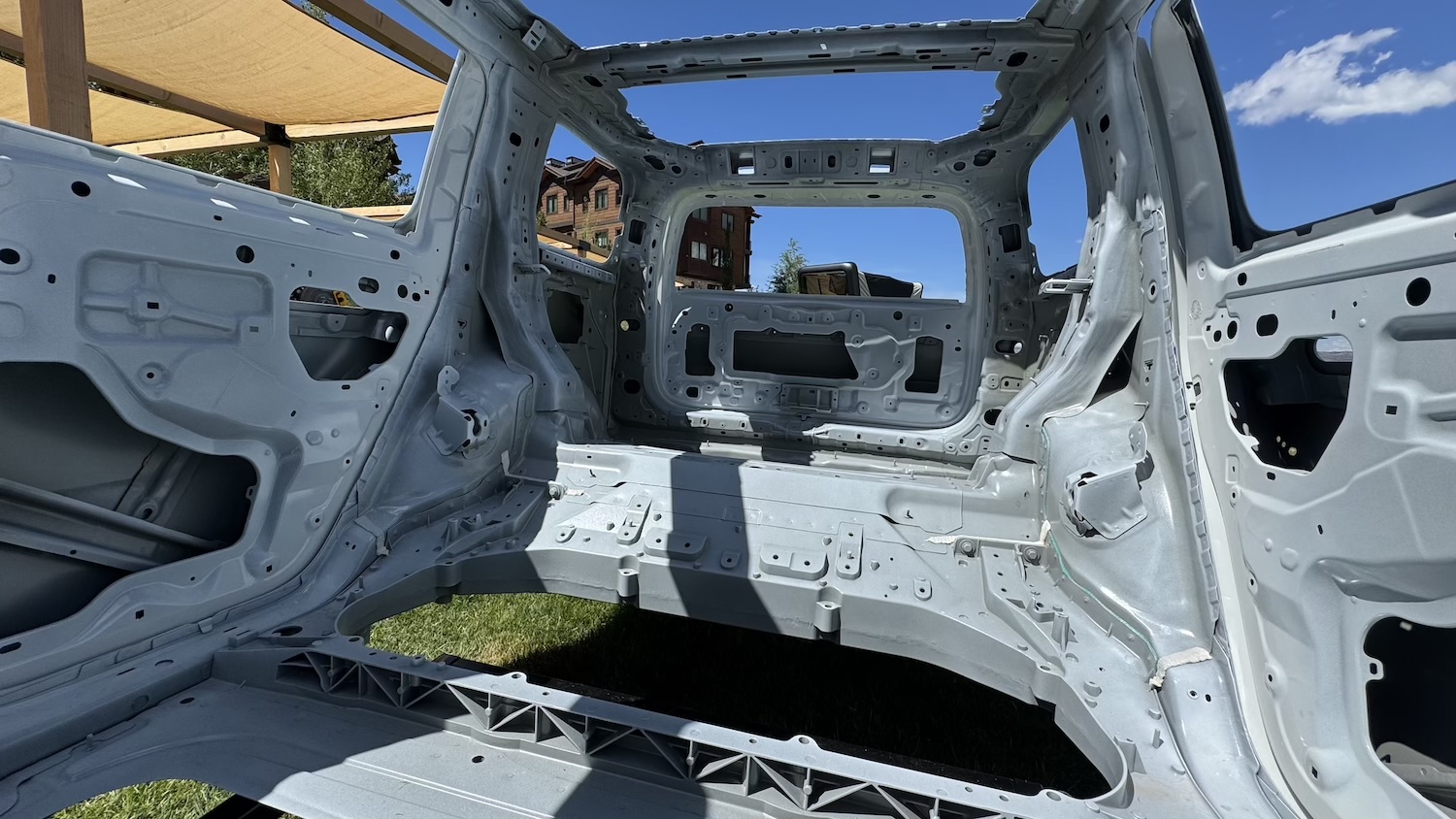
You can see some other castings on the outboard parts of the cargo area:
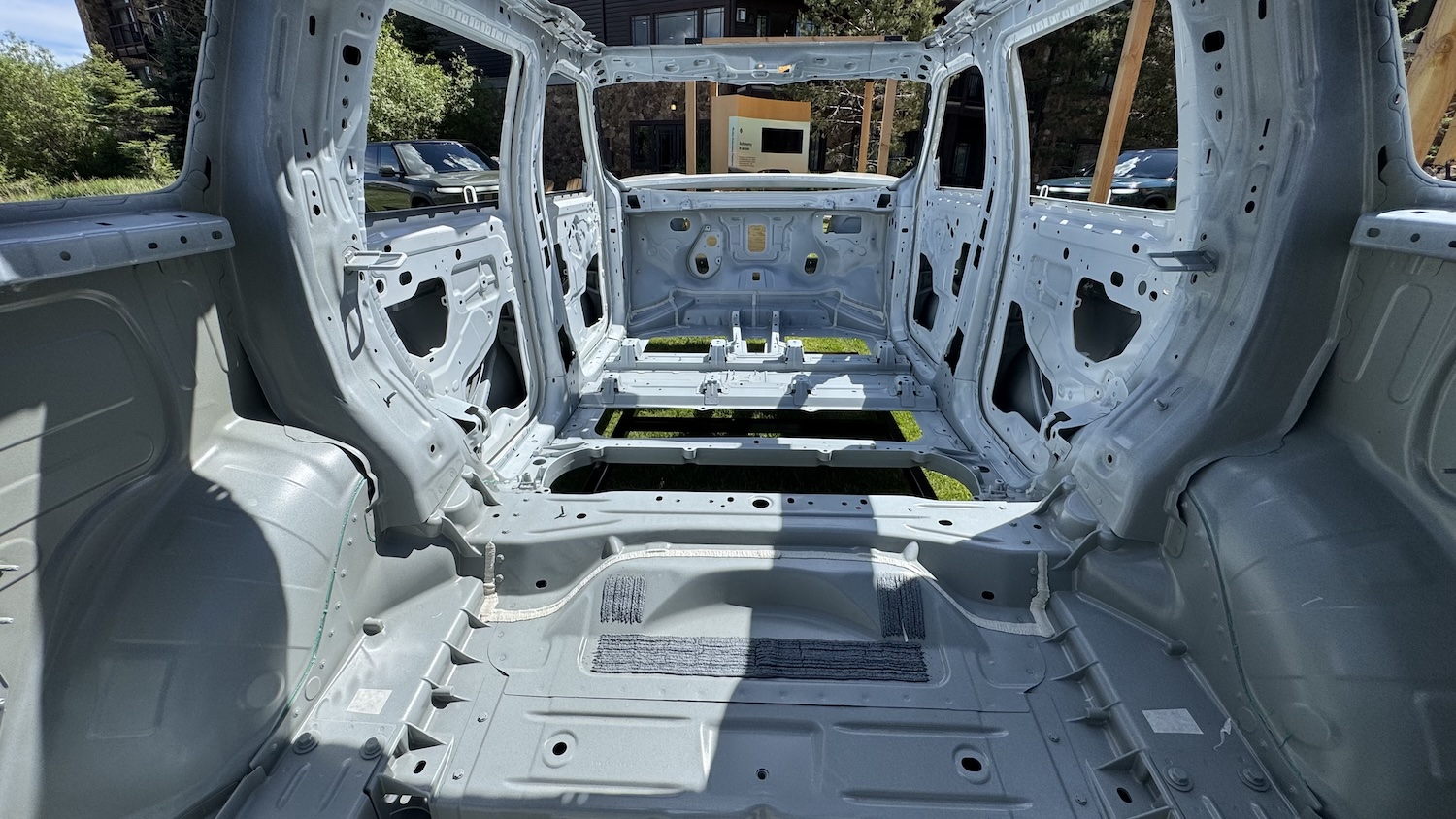
Check out all those welds and bolts and adhesives — a beautiful thing to behold. In the rear wheel wells you get a great look at the giant rear castings:
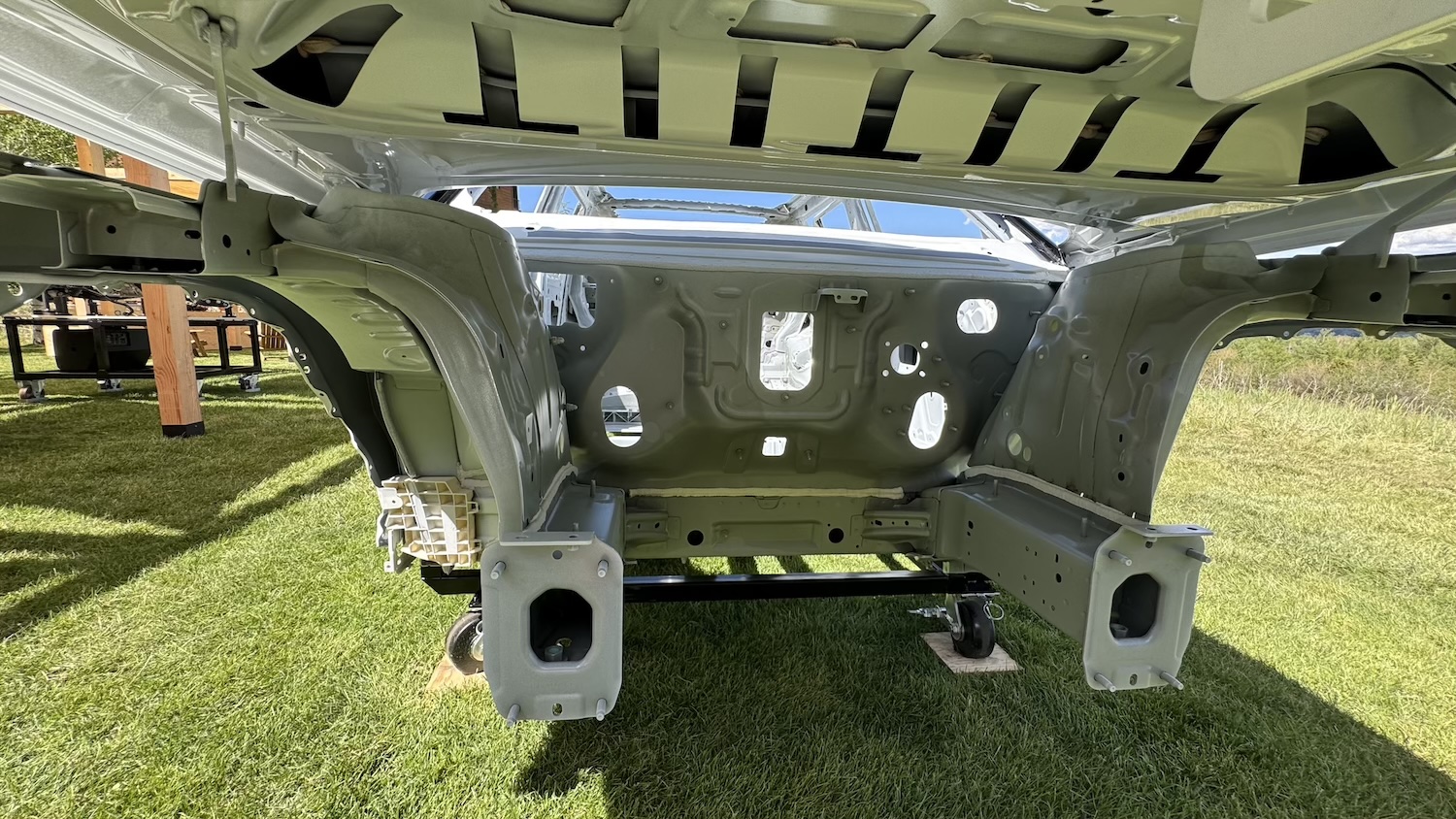
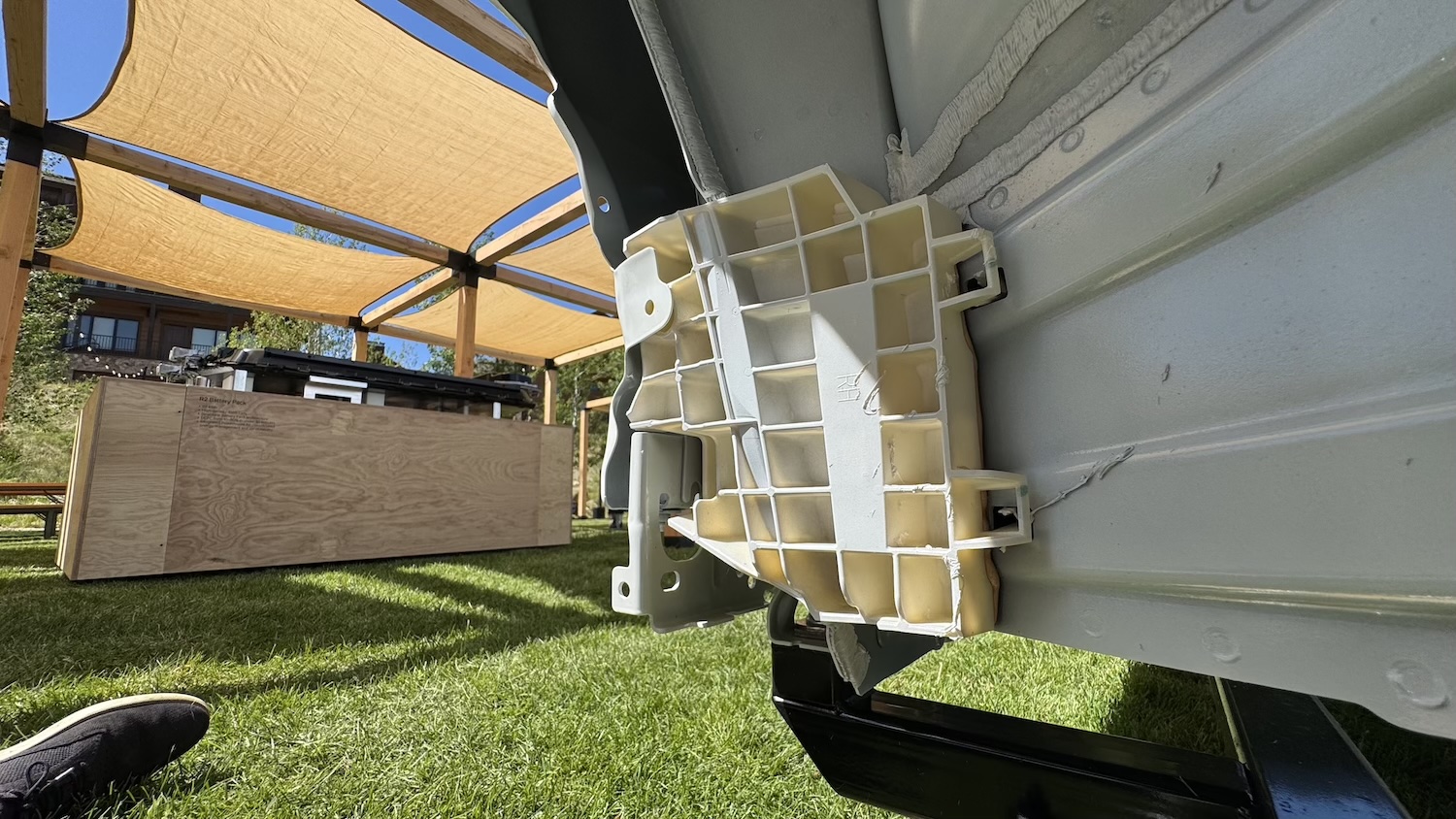
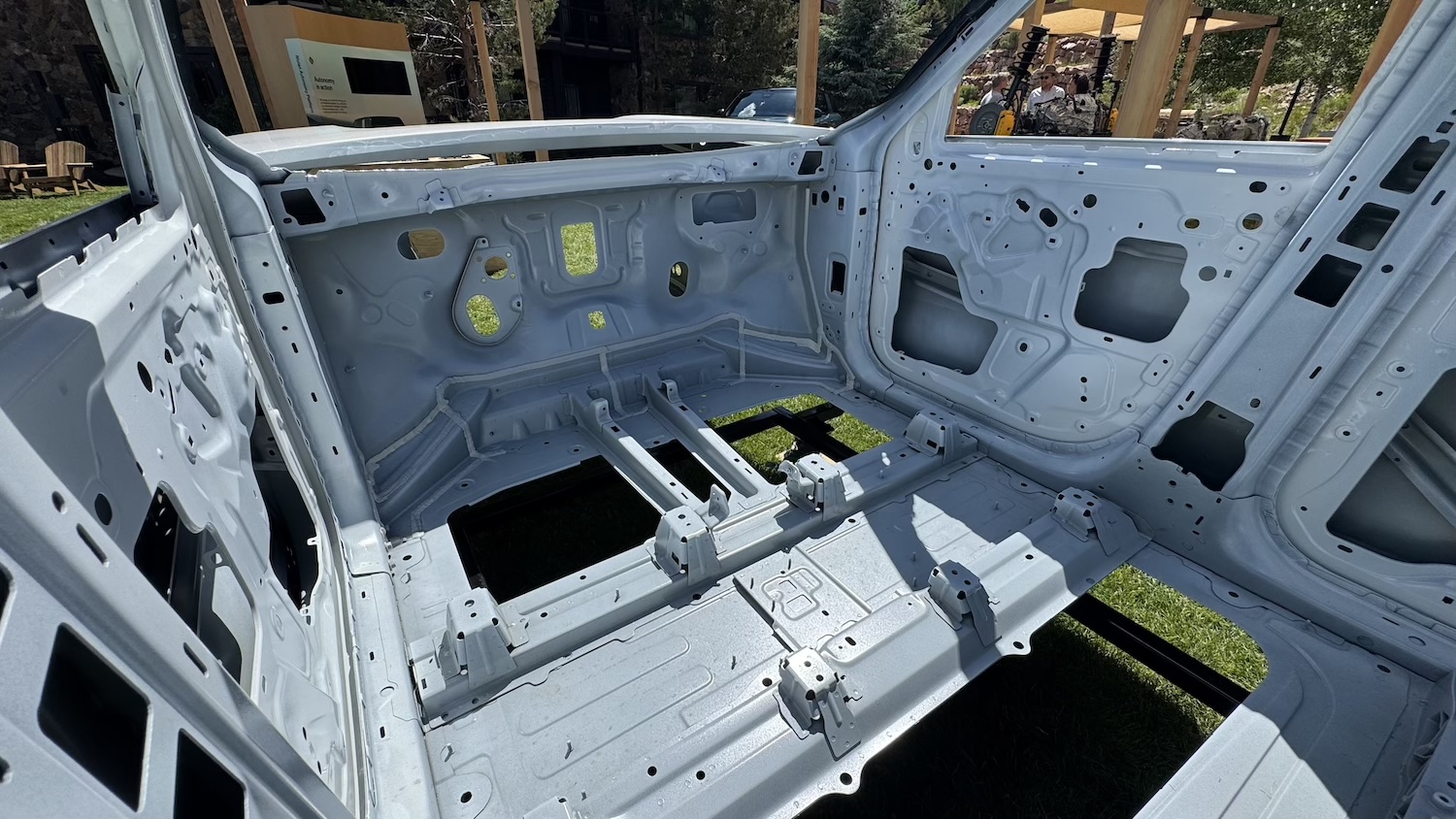
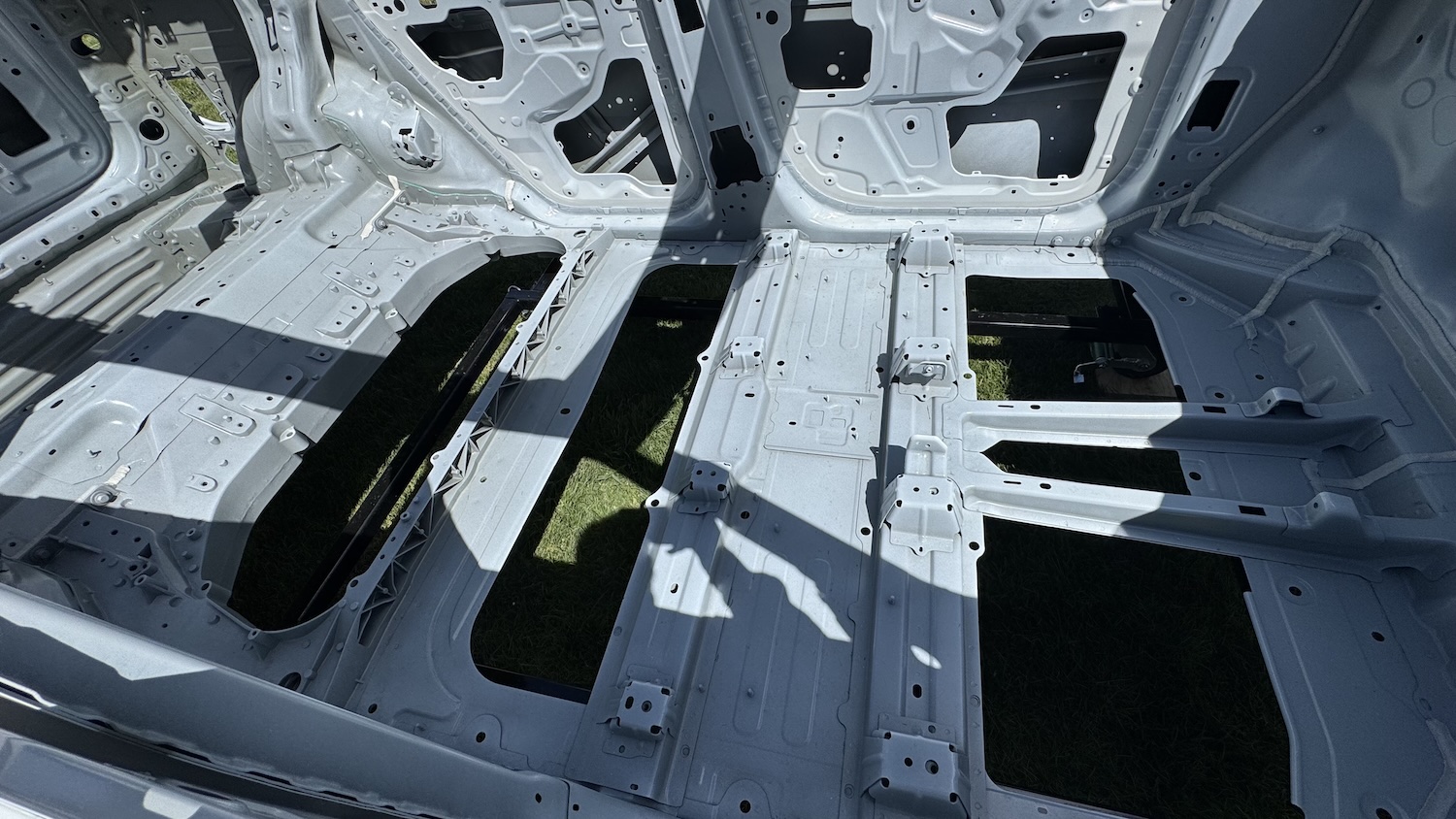
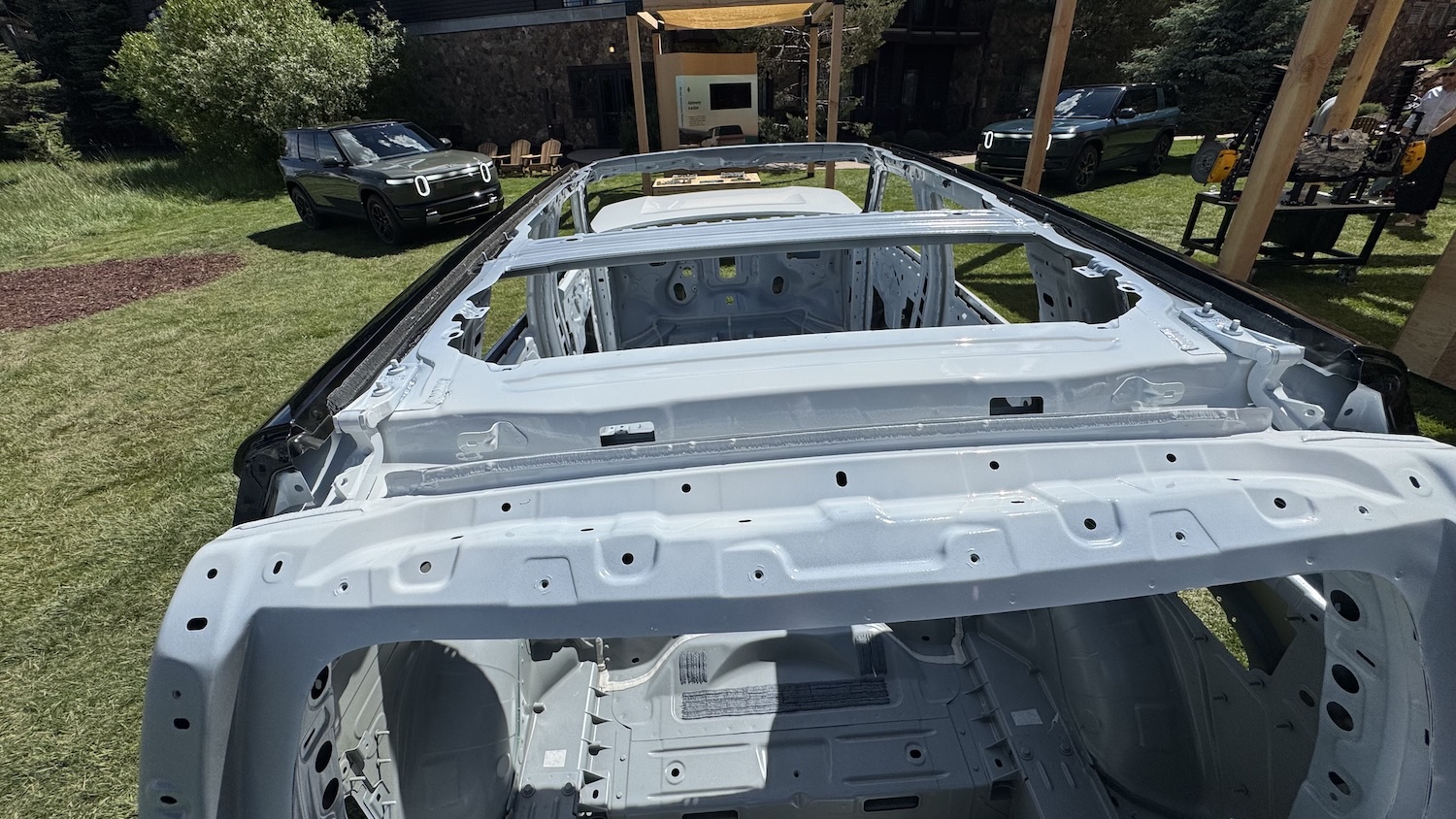
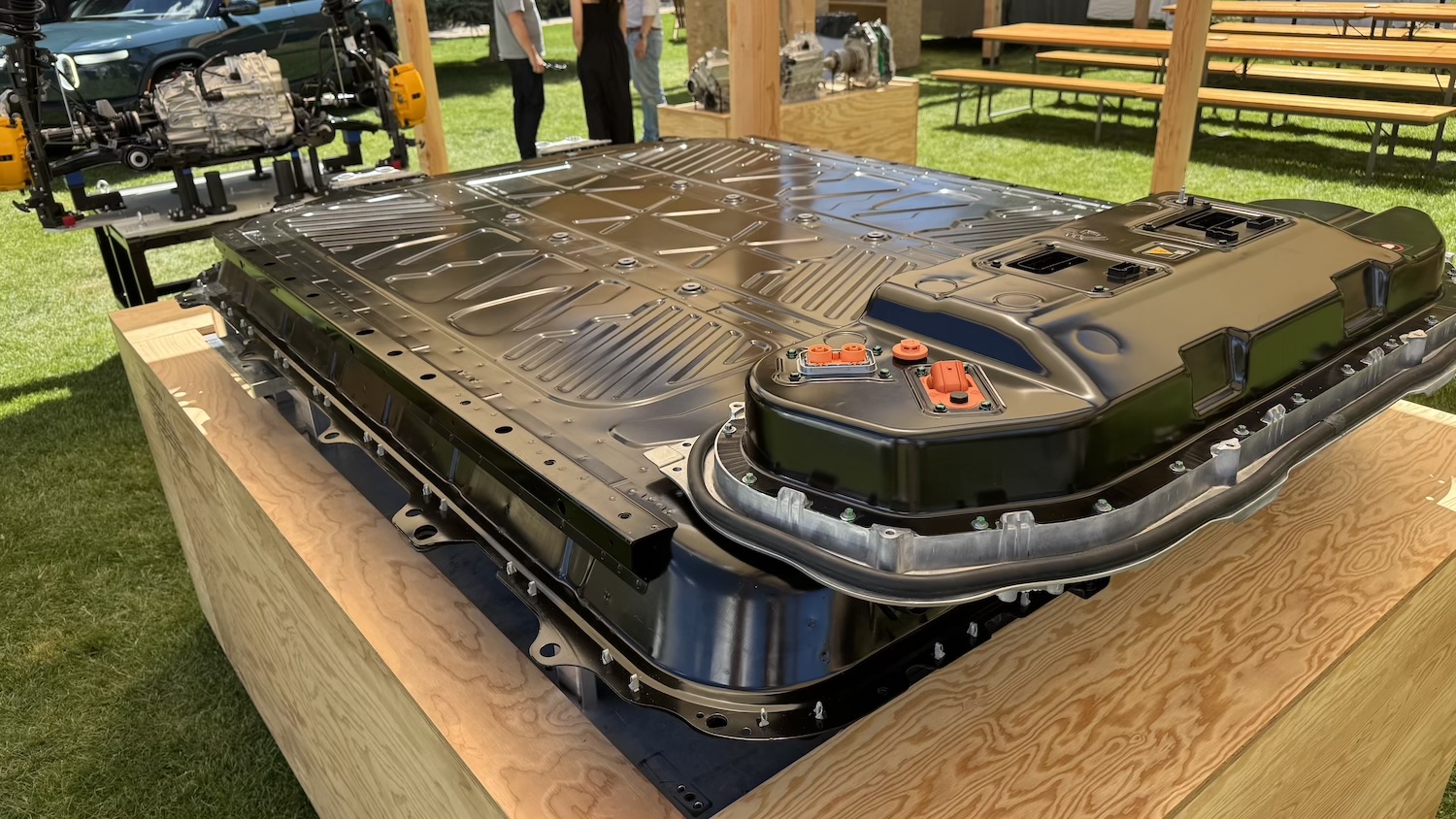
The diagram below shows how the structural battery pack mounts between the axles:

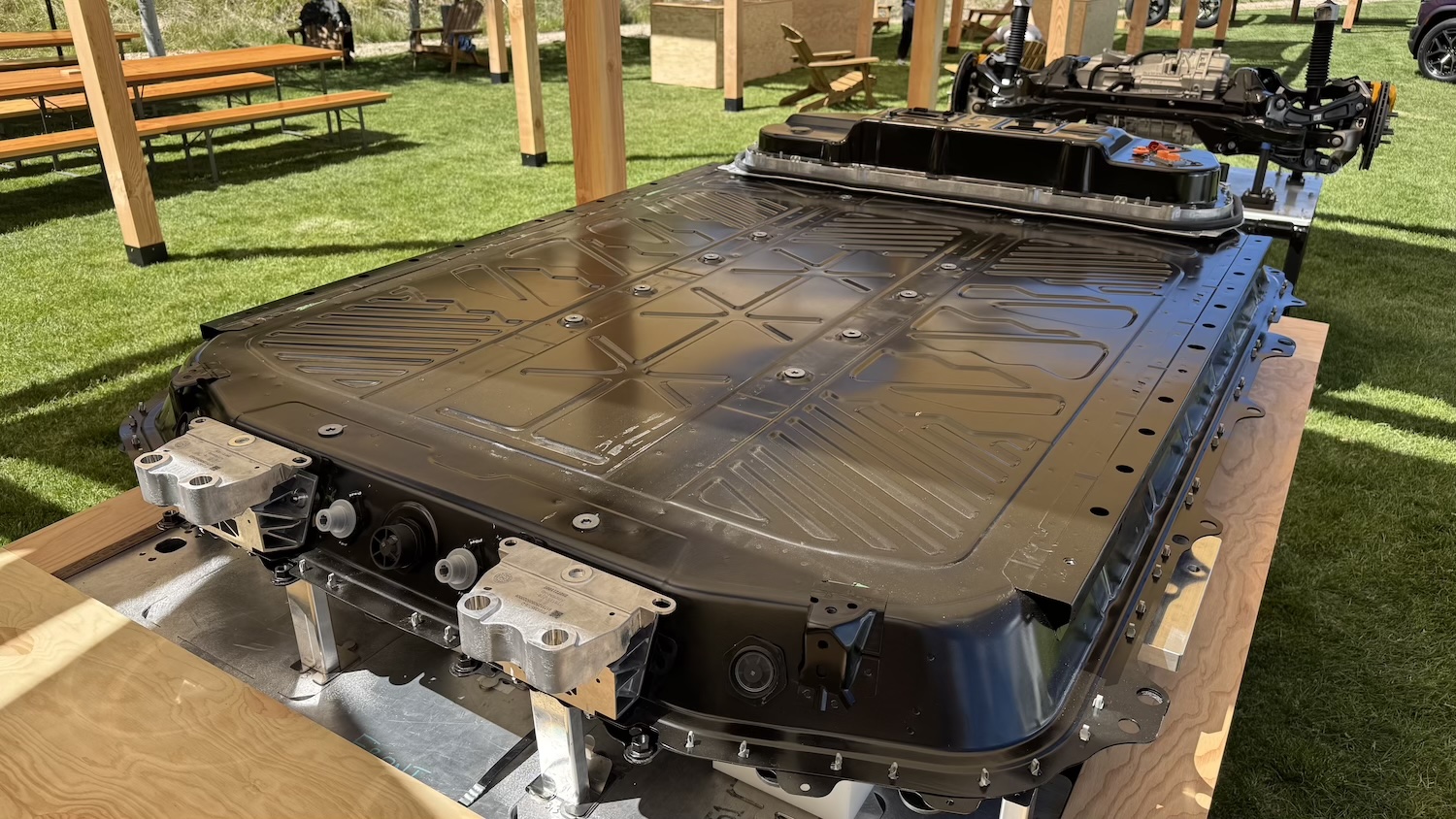
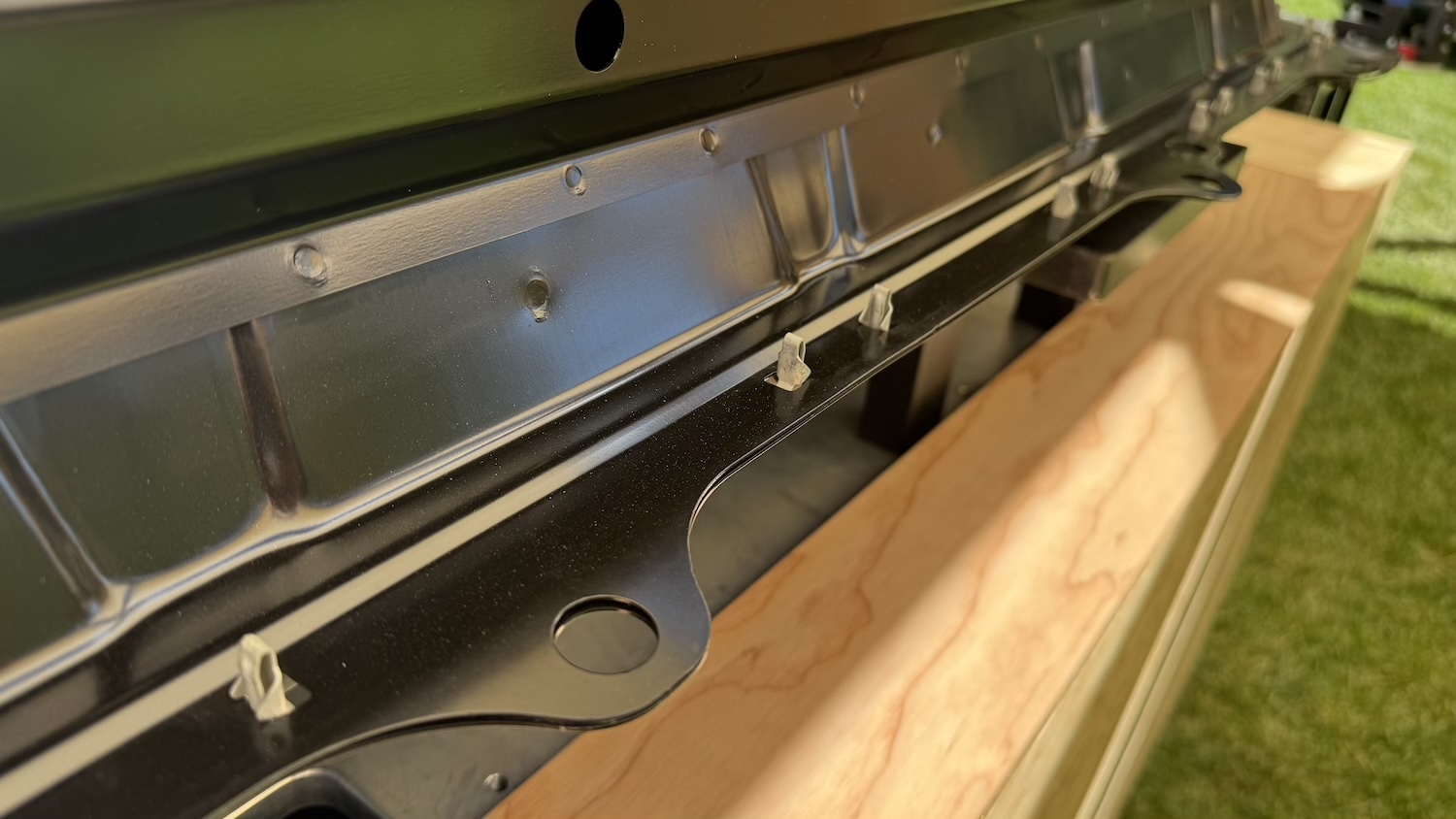
That 87.9kWh pack features a “Powerhouse” sitting on the rear. If you look at the body-in-white images above, you’ll see where the powerhouse mounts to that cast aluminum structure making up the rear floor:
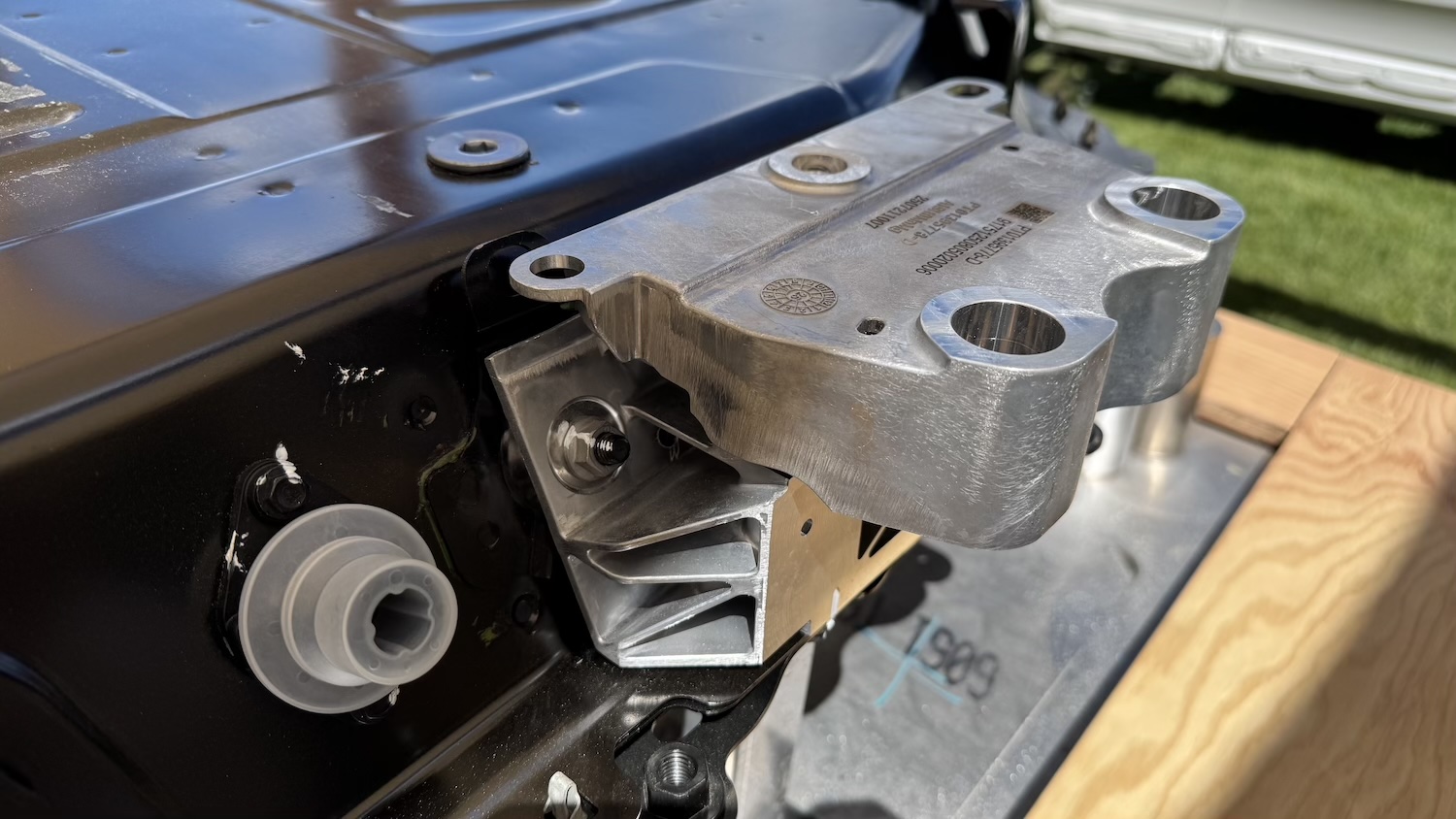
Here you can see some of the battery pack mounting provisions:
Rivian showed us the R2’s 4695 cylindrical cells (NCMA: Nickel Cobalt Manganese Aluminum), which are named for their 46mm diameter, 95mm height form-factor. The design of these cells, Rivian told us, allows for easier manufacture due to there being fewer cells than the 2170 packs in the Rivian R1S. What’s more, the cooling efficiency is increased due to the increased surface area, which is why the new cells are side-cooled.
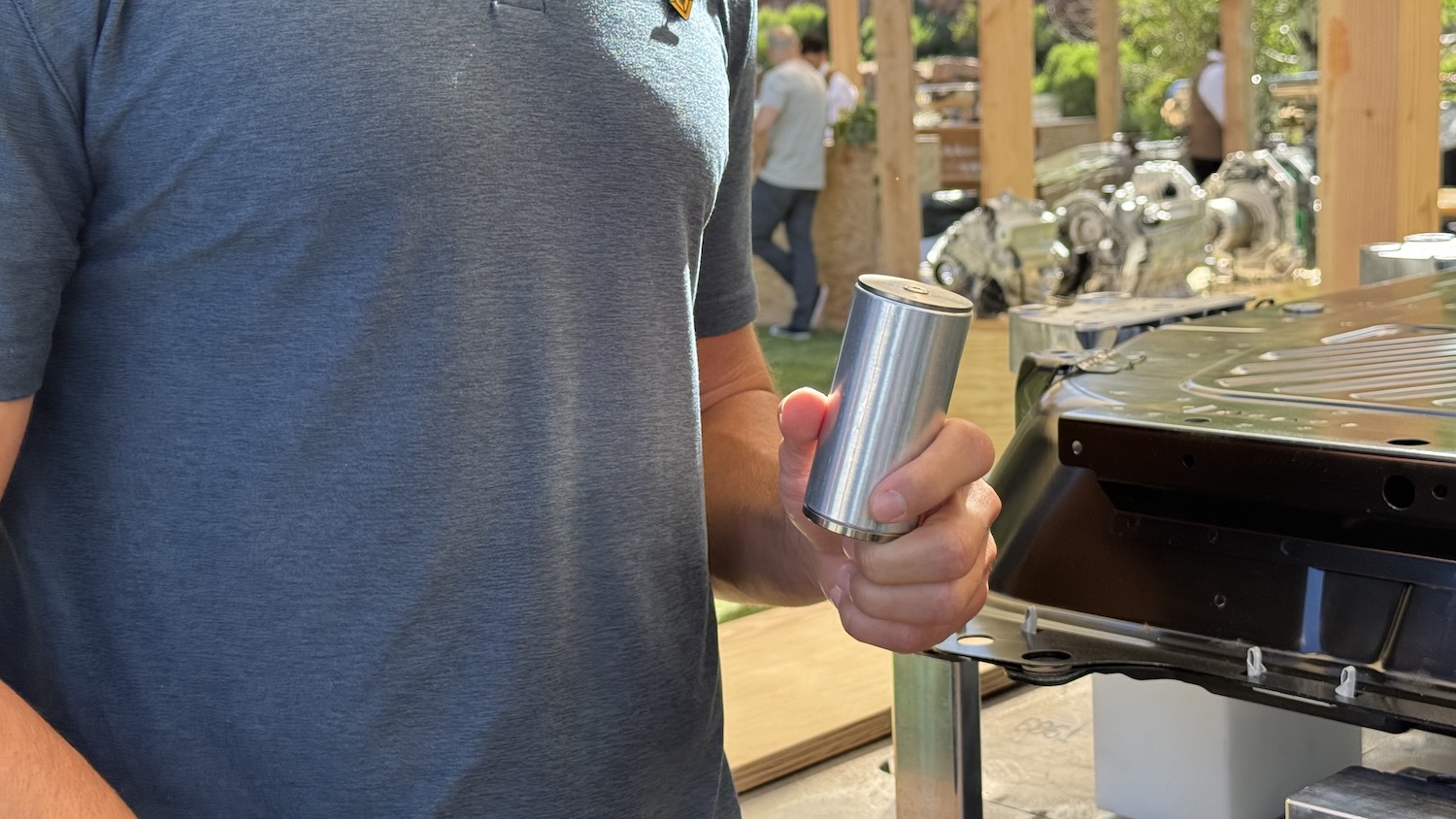
Here you can see the smaller, 2170-style cells in the R1S; they’re end-cooled via cooling plates, whereas the R2’s batteries feature channels that “weave” between the sides of the larger cells.

Here’s a look at the guts of that “Powerhouse” sitting atop the rear of the pack:

Rivian showed journalists that what would normally be five components — the south “zonal” (this is the controller for components at the rear of the vehicle), the Battery Management System, the DC-DC converter, the On-Board Charging Module, and the DC-to-AC inverter — has been converted to a single, elegant part.
Here’s a look at that single component located in the Powerhouse box:
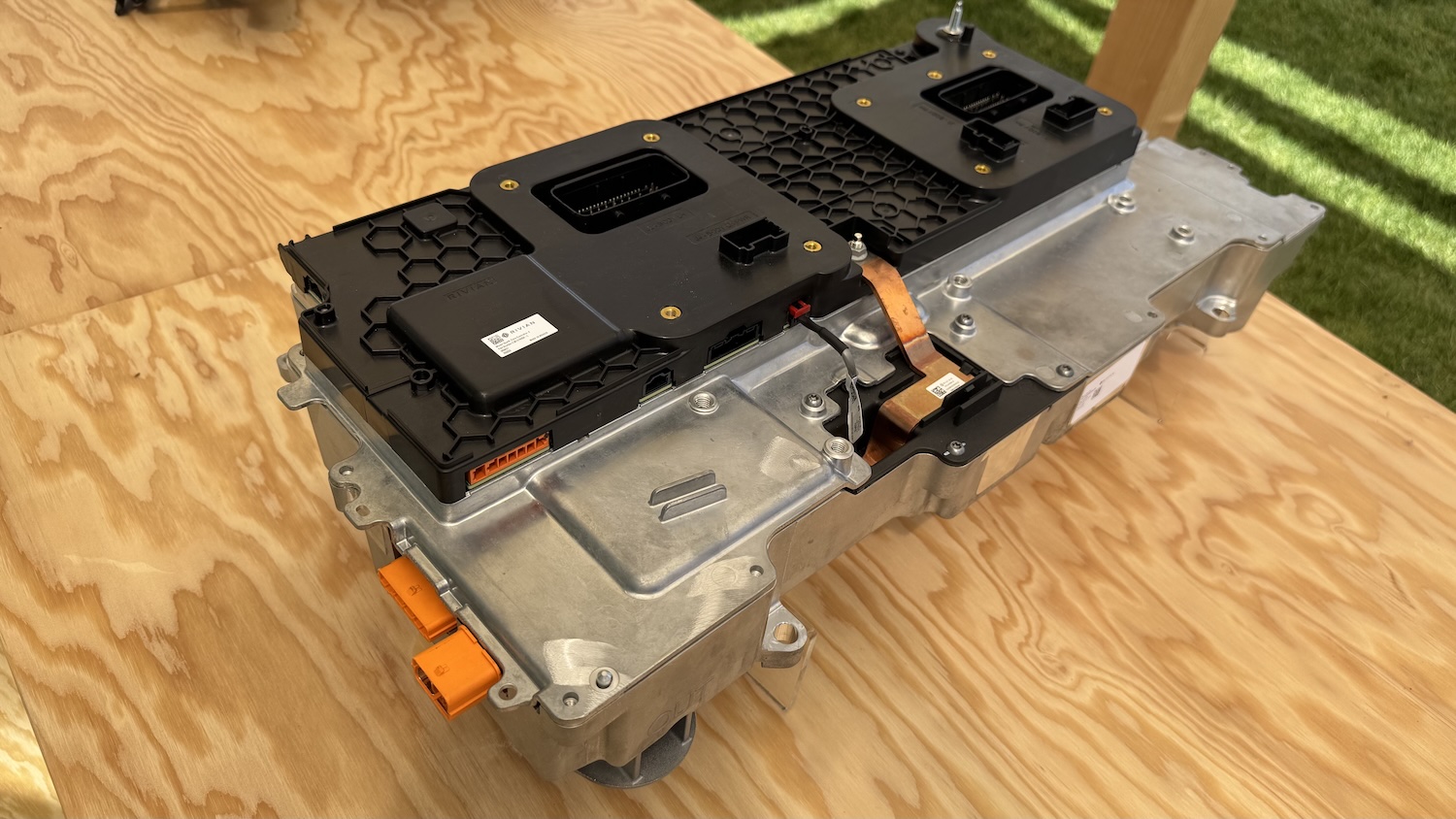
The components have all been brought in-house, Rivian says, and instead of features being removed, the R2 actually adds bi-directional charging, so you can actually use the vehicle as a battery to run auxiliary power tools, homes during power outages, etc.

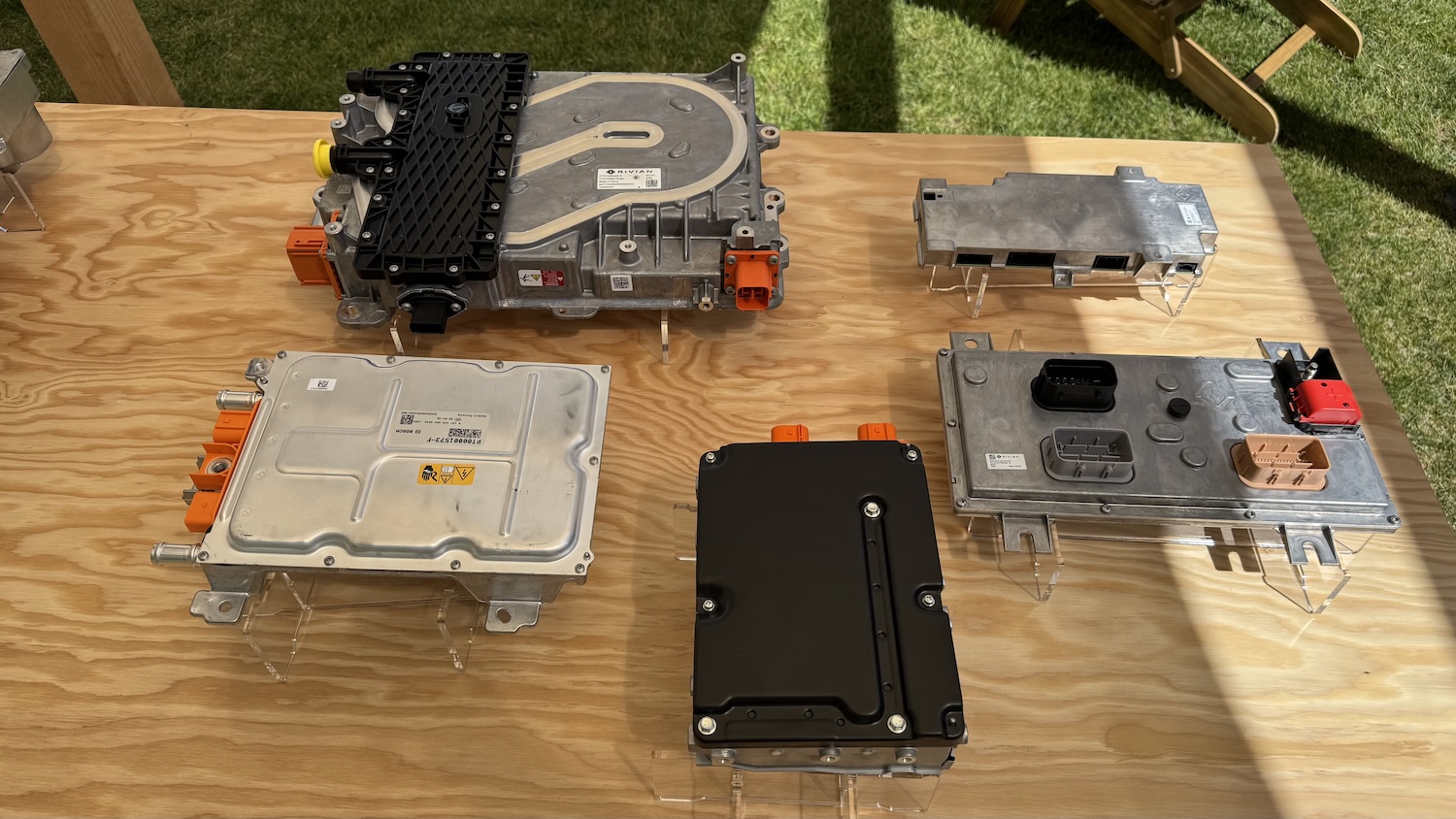
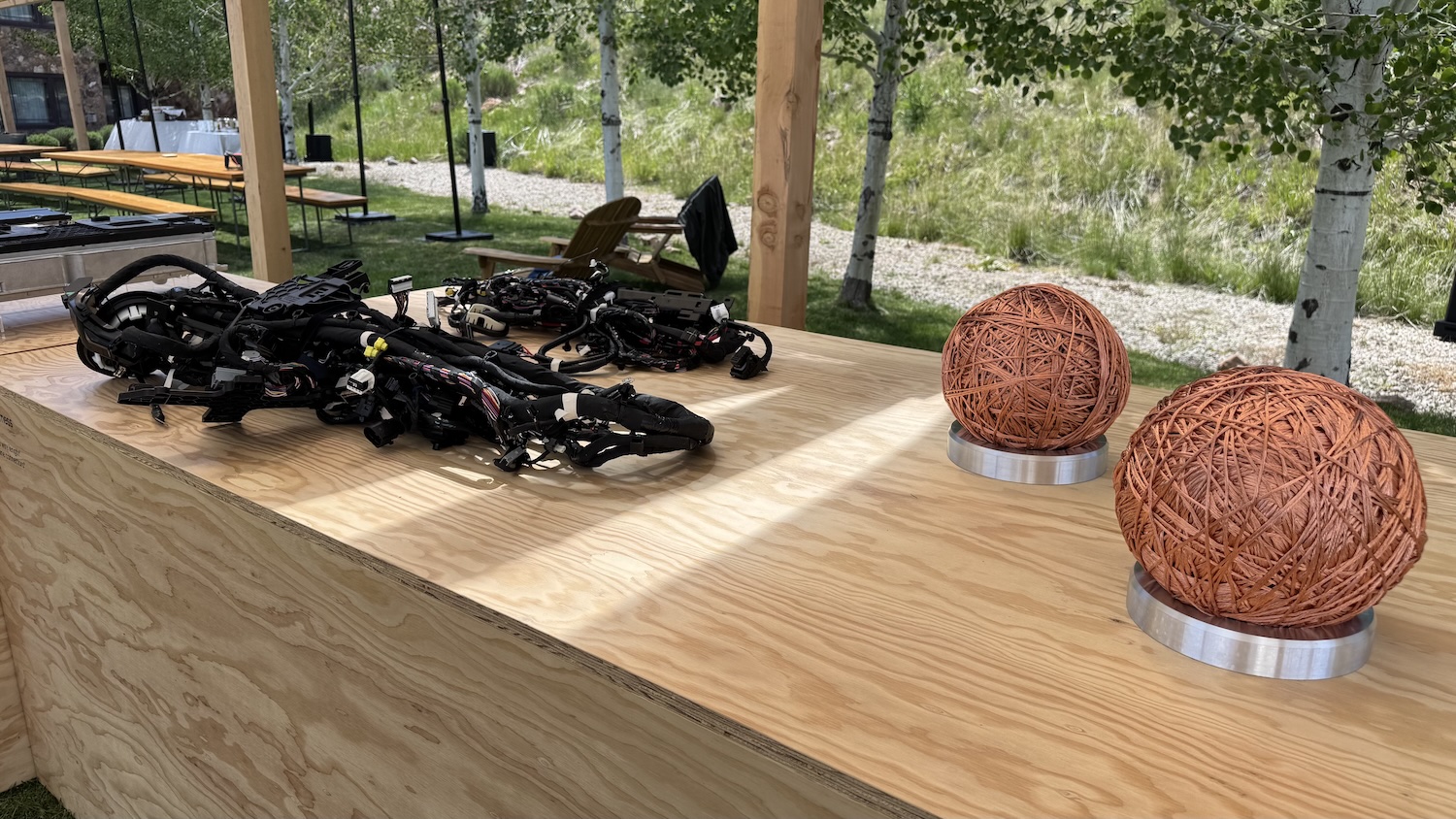
The company also showcased the R2’s wiring harness, which is 2.3 miles (when adding individual wires) shorter than that of the latest R1S.
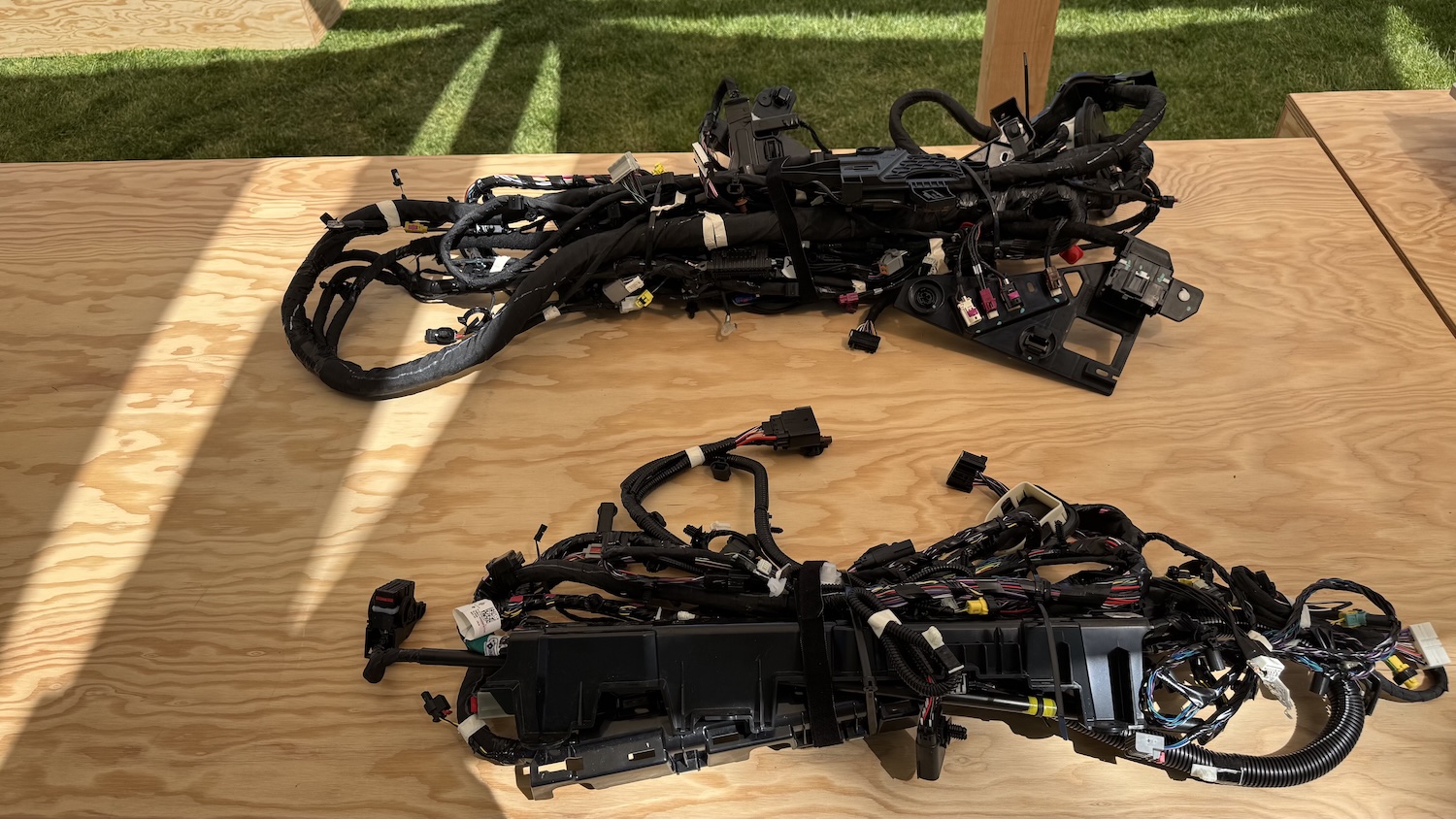
2.3 miles weighs over 44 pounds, which is what one of the copper wire-balls below weighs. It was not easy to lift:
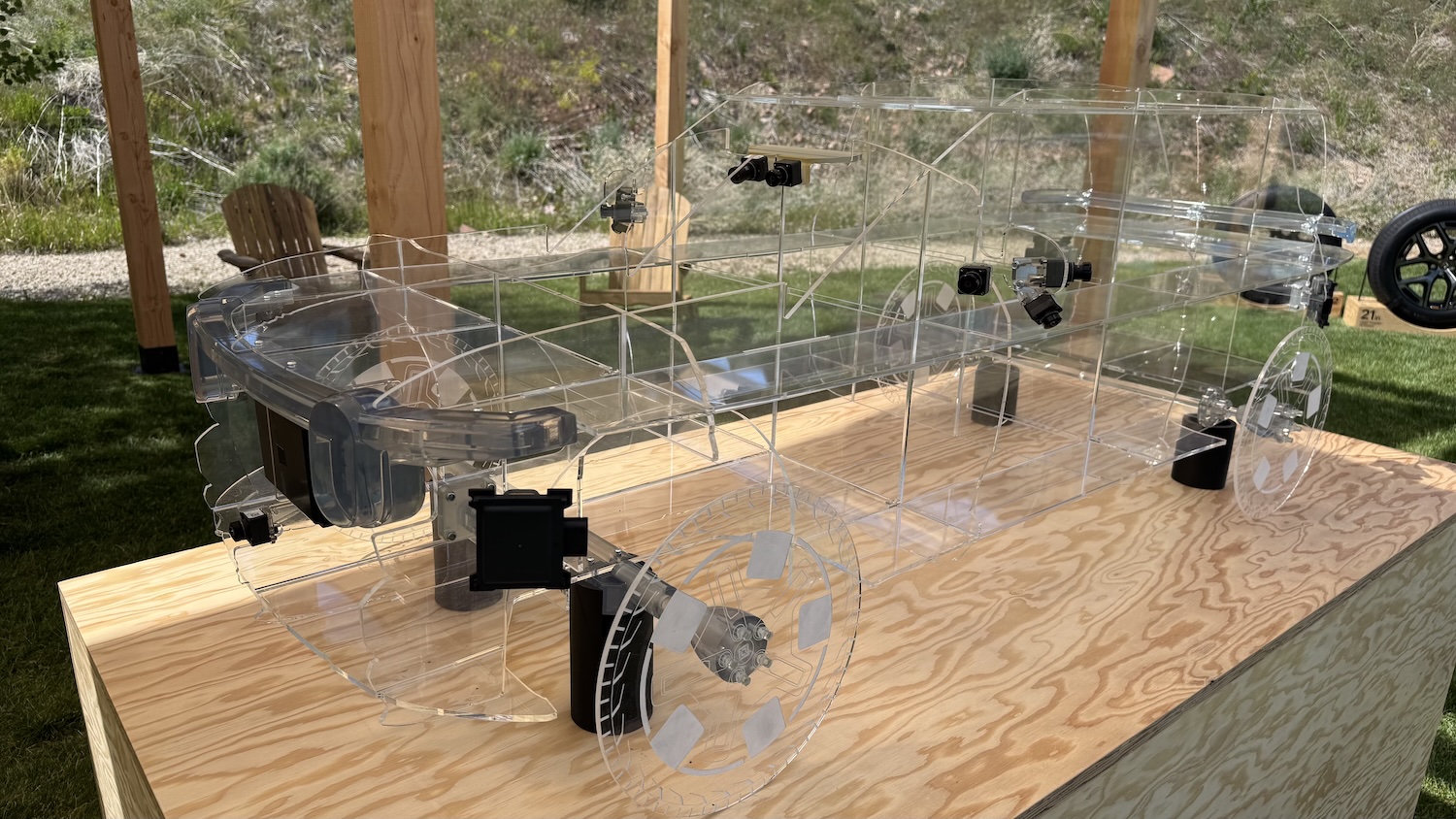
There’s a lot more that Rivian showed journalists. For example, the company showed the cameras (11 in total; 10 outside, one inside) and radar sensors (four corner radars and a long-range in the front) located around the vehicle:
They also showed boards that they’ve made more compact compared to the R1S:
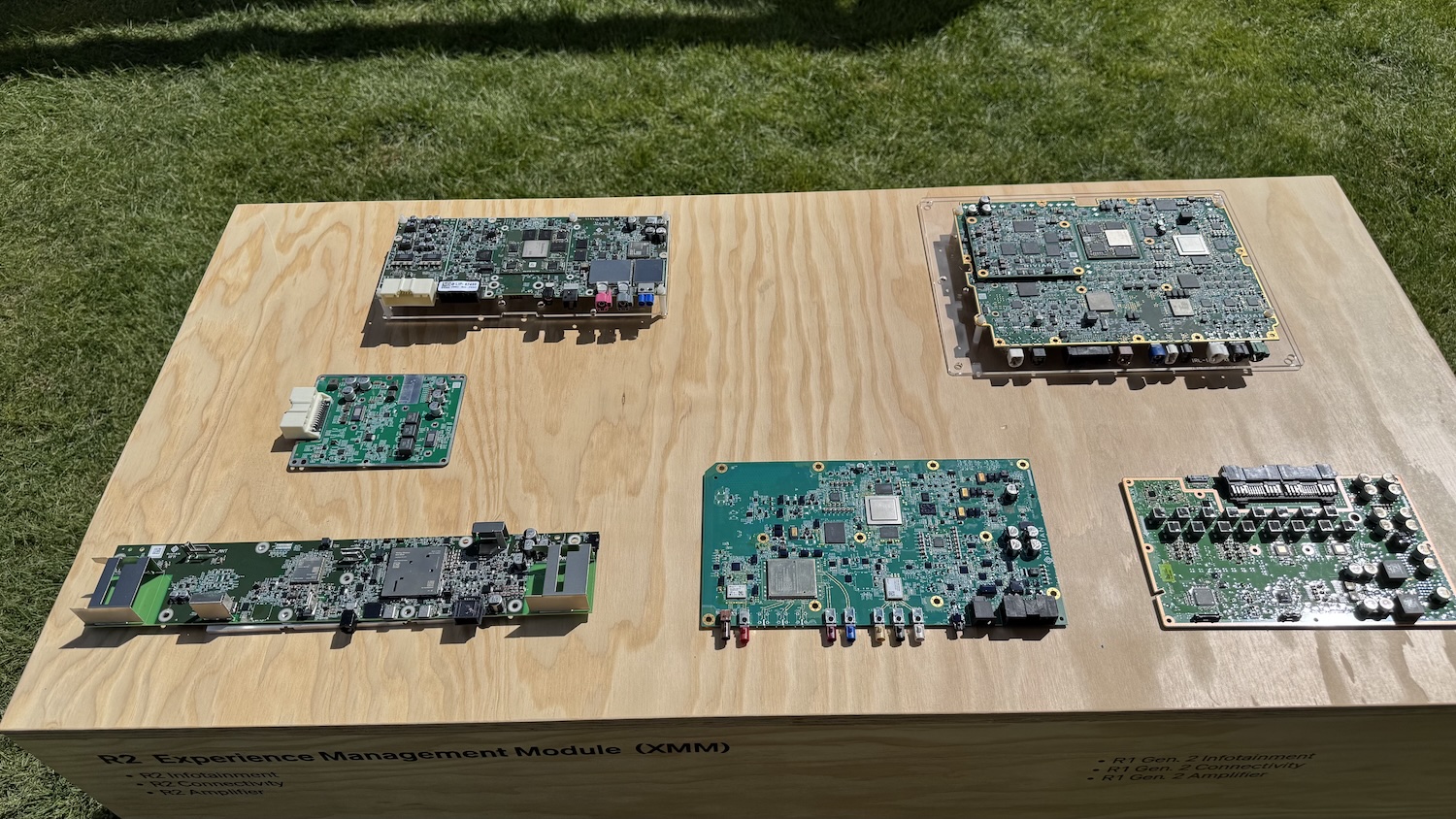
I know there are some electrical engineers furious that I’m glossing over the sensors and boards above (you can see by the text that the R1s are bigger overall) but this review is getting long, so I’ll finish this engineering section with the subframes, since as a mechanical engineer and there’s lots of good hardware on the subframes.
Up front you’ll see a fairly standard stamped steel subframe with a MacPherson strut suspension, a regular steel roll bar, and a fairly typical dual pinion steering rack:
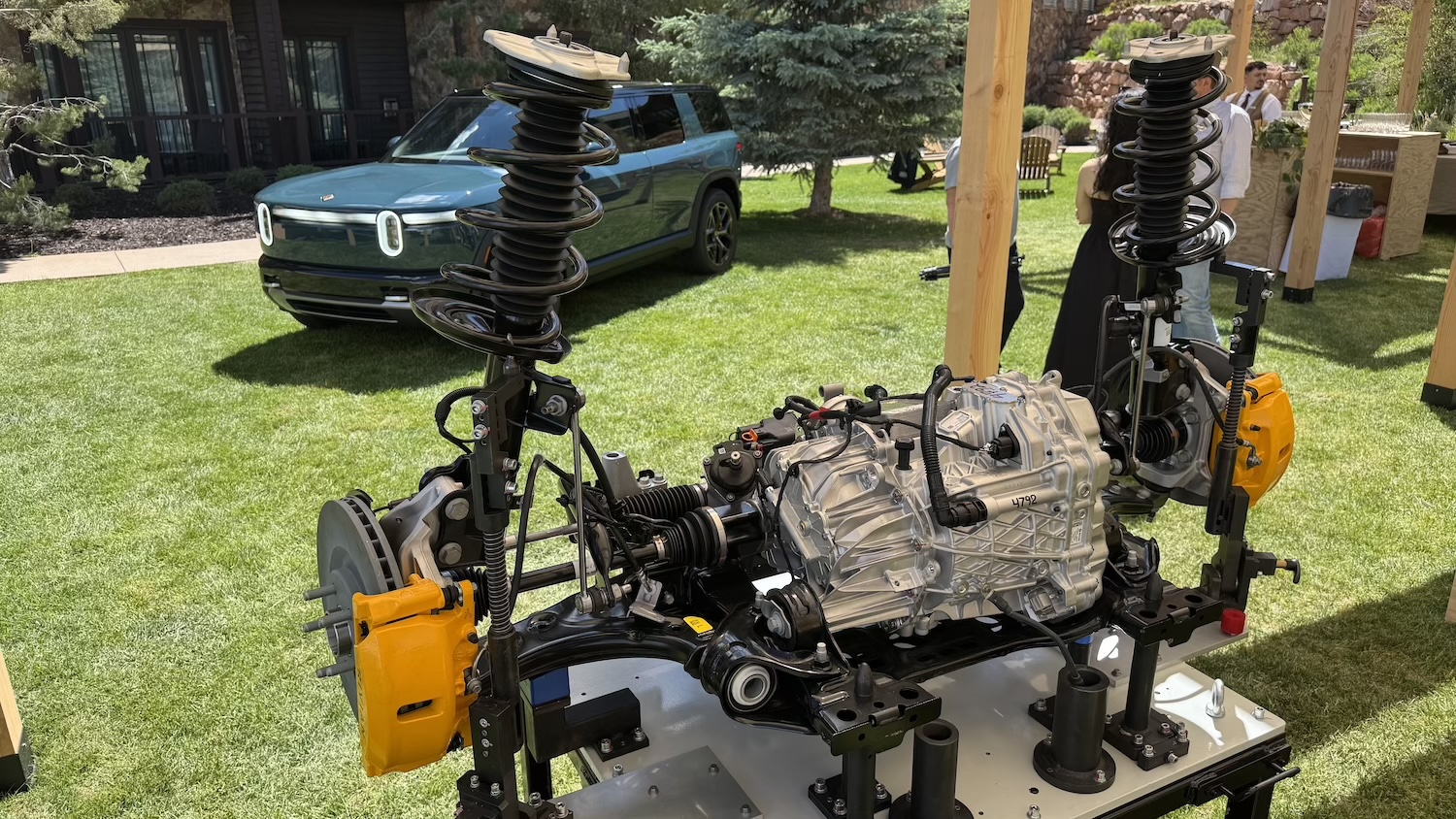
By contrast, the Rivian R1S features air suspension, a fancy hydraulic roll control system, a cast aluminum subframe, a double wishbone front suspension, and a ball screw-style steering system to handle the higher loads. Rivian mentioned that the R2’s braking system is also different than the R1s in that, while pushing the R1’s brake pedal always moves hydraulic fluid, the R2’s brake pedal does not normally move fluid but instead it sends a signal to provide brake pressure (you can press harder to “push through” in the event of a failure); this, Rivian says, allows for better regen performance/variability.
The dynamics engineer mentioned that the Rivian team made him fight for every last feature, and the one he refused to give up on was semi-active dampers, so those are present on the R2 (though simpler than the ones on the R1S) and allow for variable damping performance in different driving conditions (the driver can actually change damping rate via the screen).
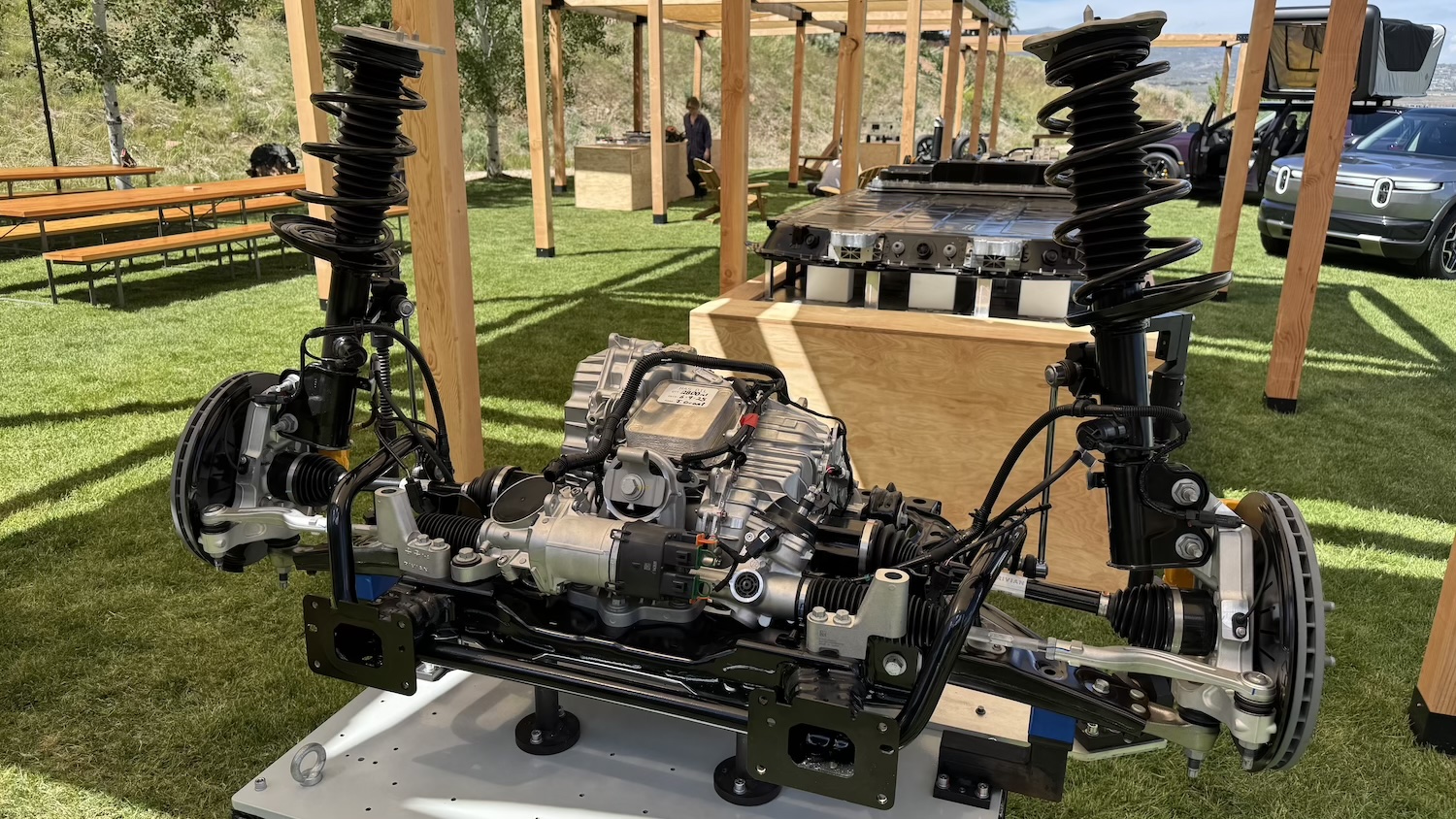
The drive unit is new, and called “Maximus.” A smaller unit than those found on the R1S and specifically designed for mid-size vehicles, it has been set up on the front and rear to offer a 40/60 front-rear torque split. Speaking of the rear, here’s that subframe, which is also stamped steel, which also features a standard steel sway bar, and which also features coil springs instead of air springs.
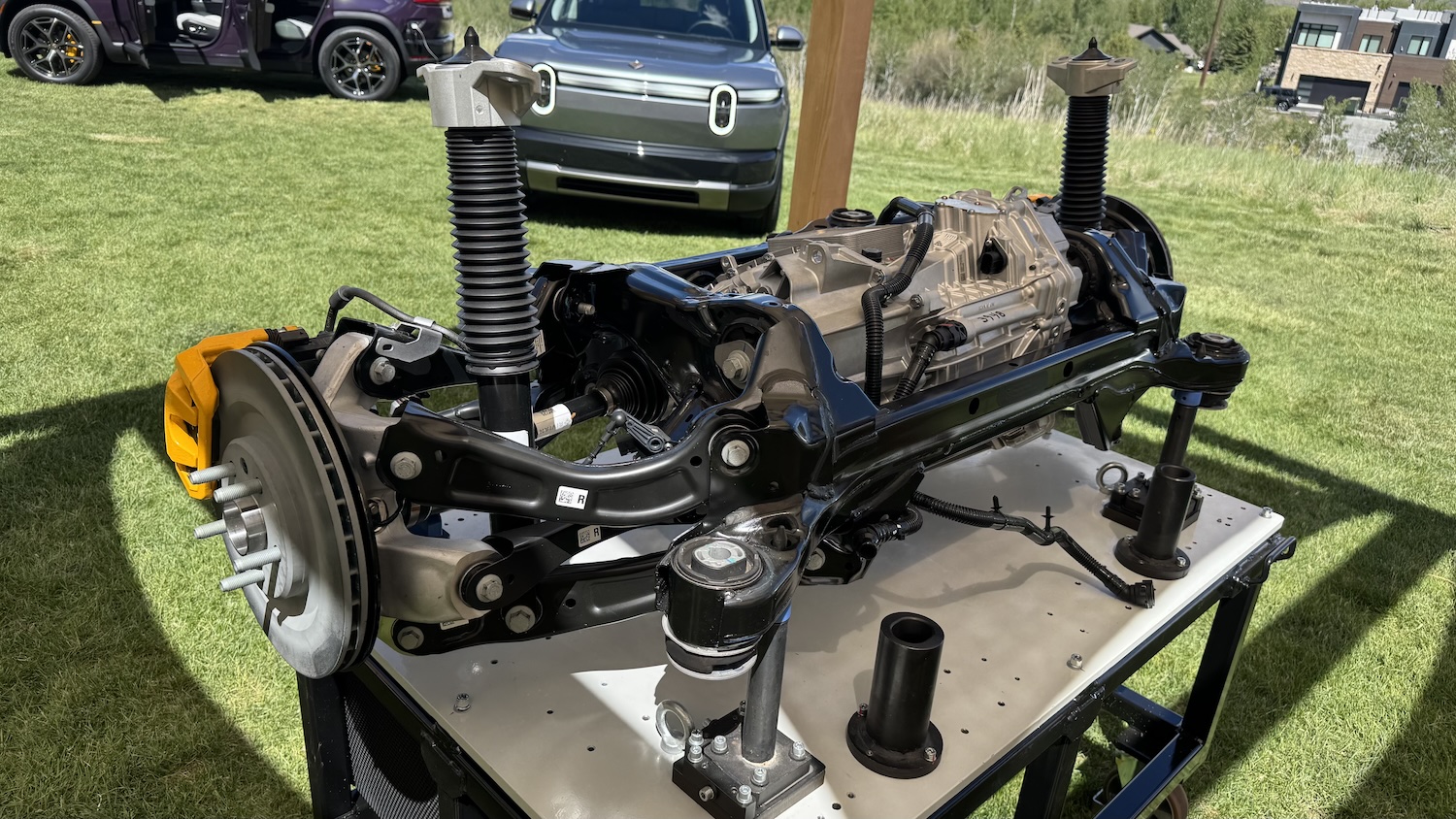
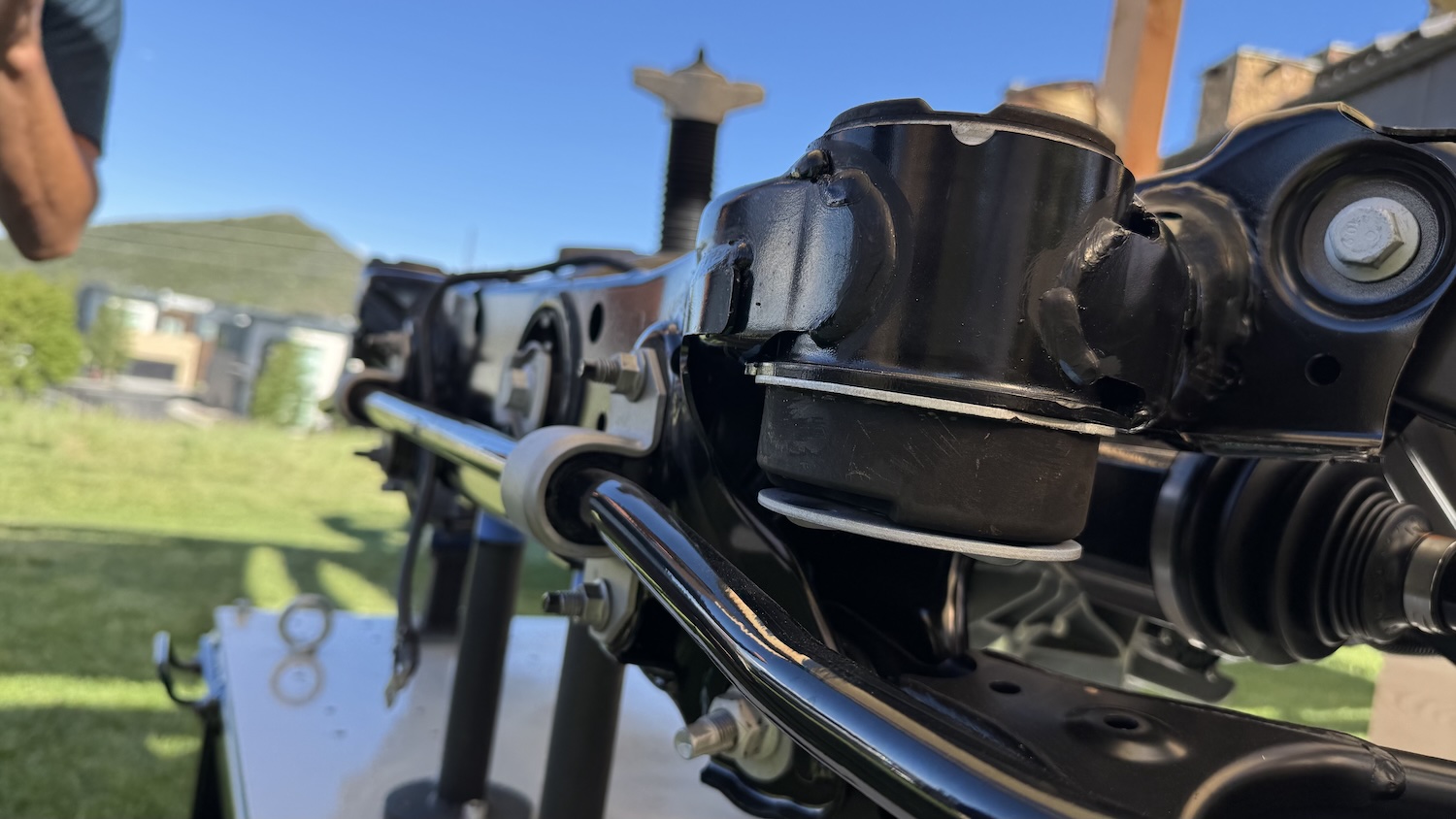
You can see that the suspension is a multi-link setup, and if you look closely, you’ll also notice that this subframe is actually isolated via rubber mounts:
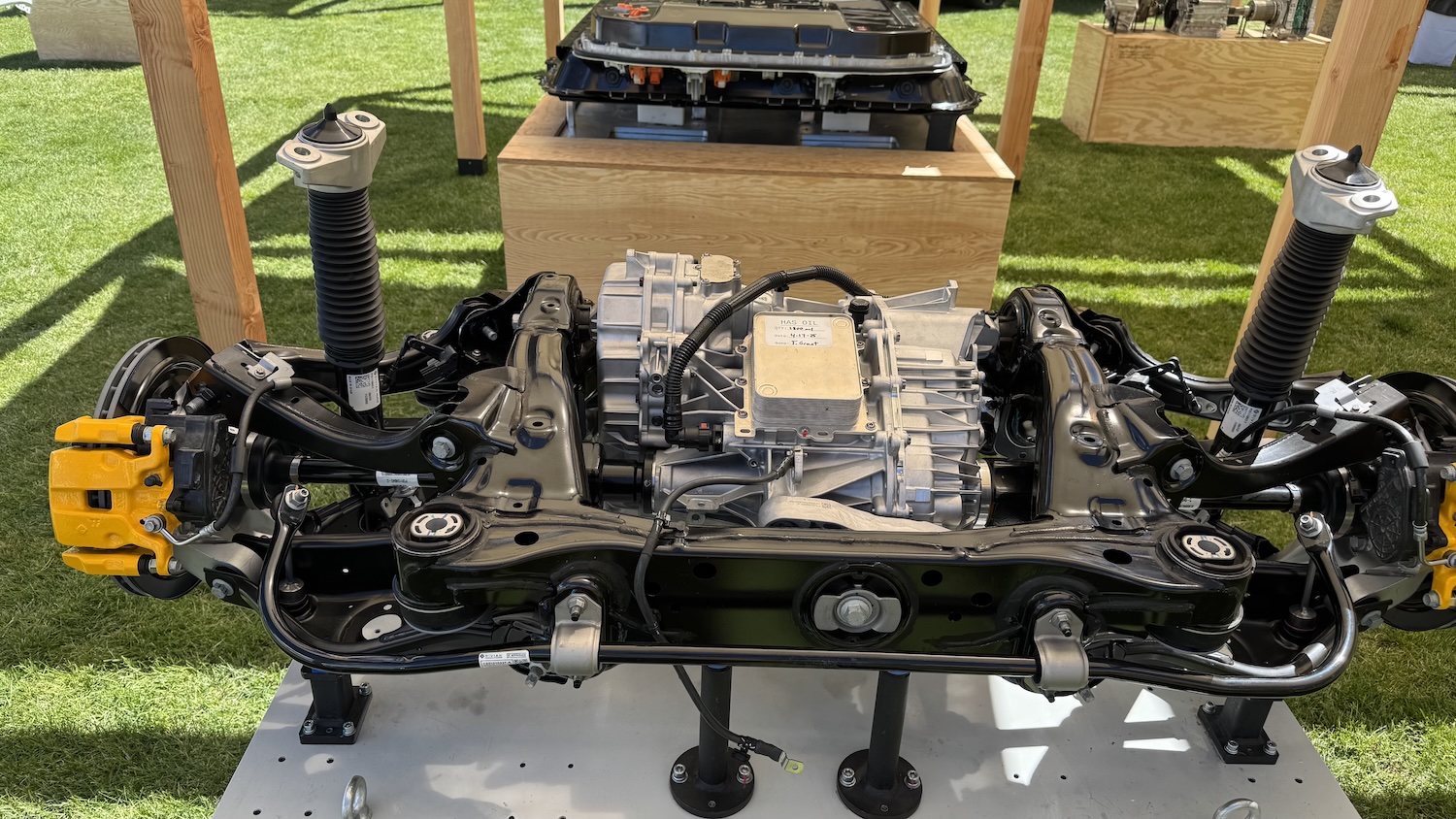
Here’s a closer look:
If you’re curious about the output of these motors, they come in three different combinations (this is also a chance to look at the pricing and range):

For reference, here’s the Rivian R1S’s front subframe:

And here’s the rear: 
You can see the subframes and control arms are cast aluminum, whereas on the R2 they’re stamped steel — a more economical, traditional setup meant for what is meant to be a more economical, traditional electric SUV.
The Interior Is Simple But Nice, And The Storage Is Phenomenal

With the design and engineering discussion out of the way, let’s talk about what it was like actually driving the thing, starting with my assessment of the cabin. The first thing I noticed is that the base car — which is shown above and starts at $44, 995 — is actually quite nice.
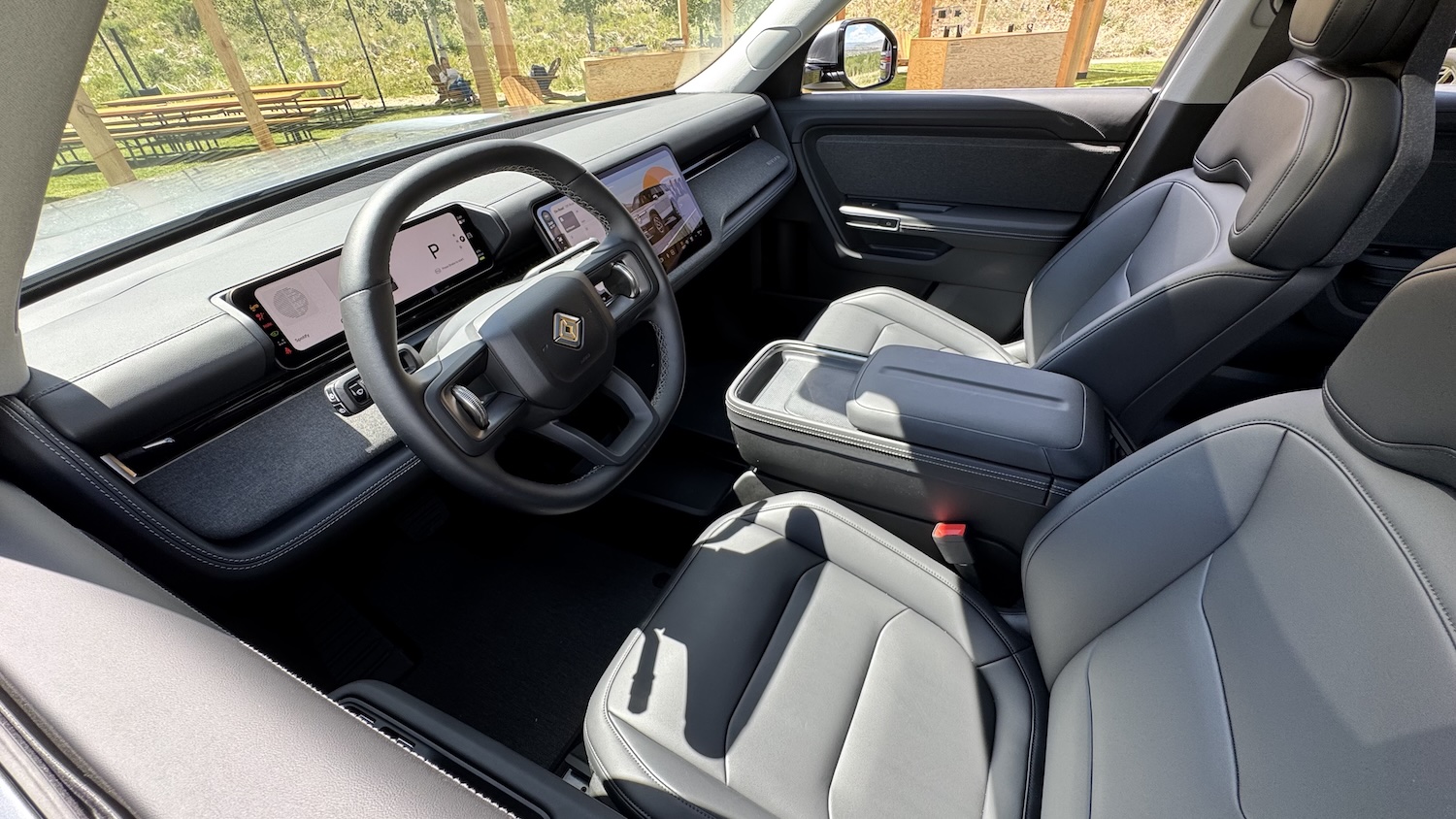
The design is elegant, the “Advantex” faux-leather feels nice and durable, and the whole cabin just feels light and airy and pleasant.
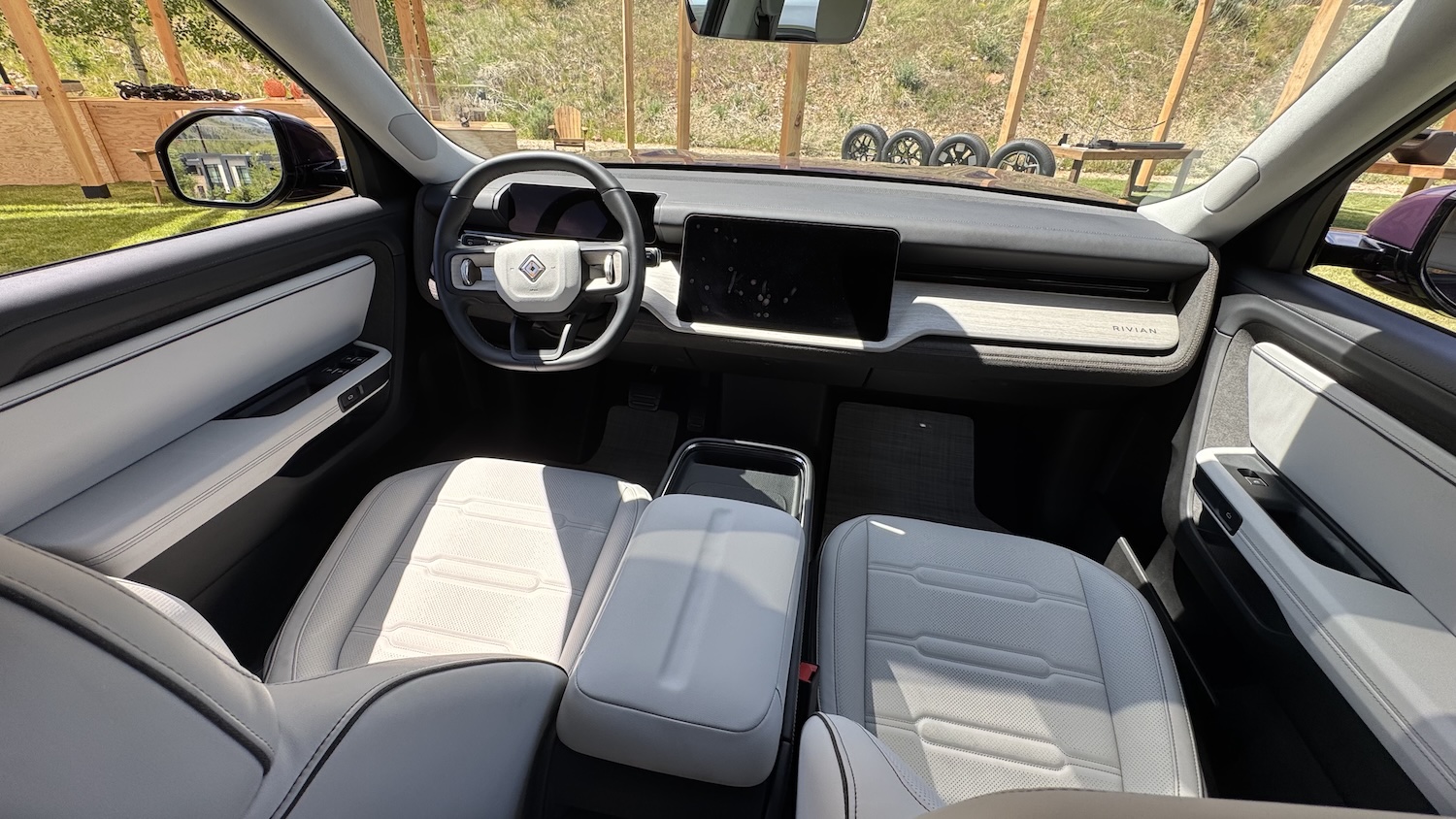
Whether you get the base car or a higher-end trim (like the one shown directly above), the interior is minimalistic and lacks physical controls. The result is that your screen will likely often look like this:
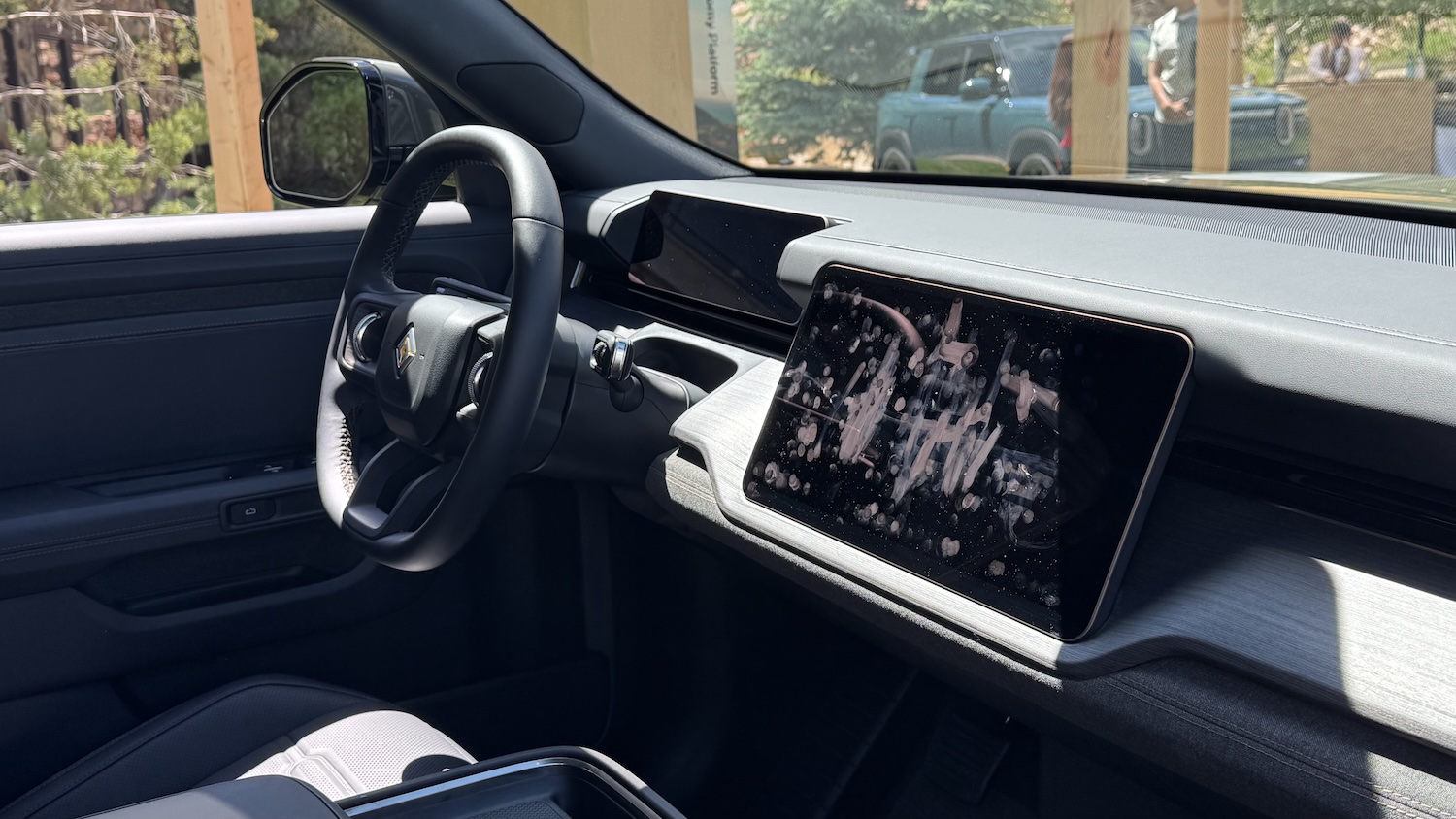
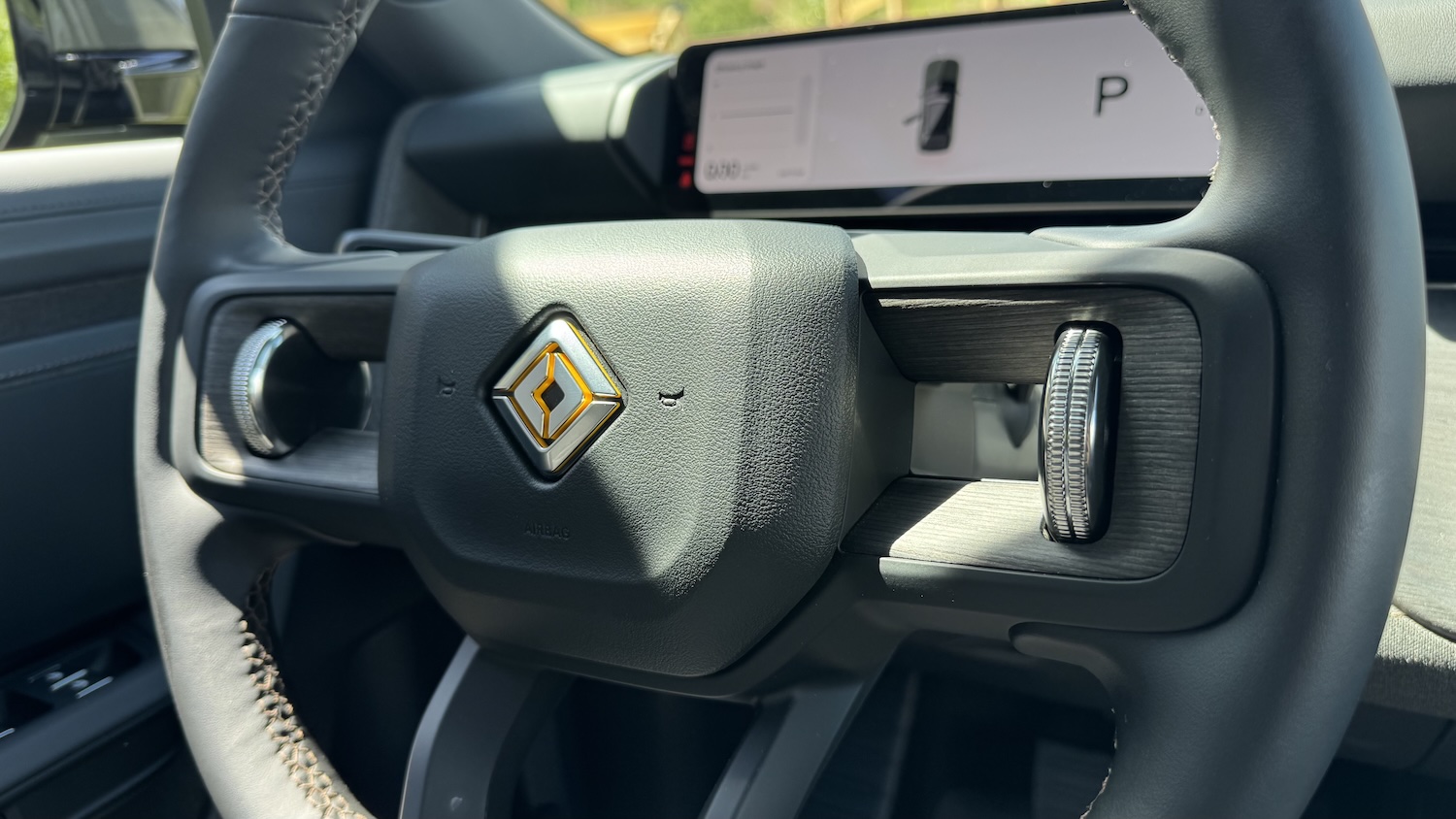
There are two “Haptic Halo Wheels” (see below) on the steering wheel, which can both scroll and press left/right, and there are the stalks, but the infotainment and most other controls must be accessed through the screen. That includes the HVAC vents — something that I find maddening. (Rivian, for its part, says screen-vent control is there to maintain the car’s house-like interior vibe. You don’t see piano black in homes and you don’t see vents in elegant homes, so you shouldn’t see them in a Rivian, design Chief Jeff Hammoud told me).
I’ll get back to the infotainment and the cabin in a second, but for now I want to applaud Rivian for making the R2 an absolute monster in the area of space utilization. The Rivian R2 is 185.9 inches long, 84.7 inches wide, and 66.9 inches tall. For reference, that’s shorter than the Tesla Model Y, it’s about an inch wider, and a couple of inches taller.
Upon sitting in the R2, it quickly became clear to me that, for a vehicle this size, the R2 is massive on the inside; it feels like the Sistine Chapel, not just because there’s tons of headroom (and there is), but because there’s tons of room everywhere. And the way Rivian set up the cargo system on the car is absolutely A+ work.
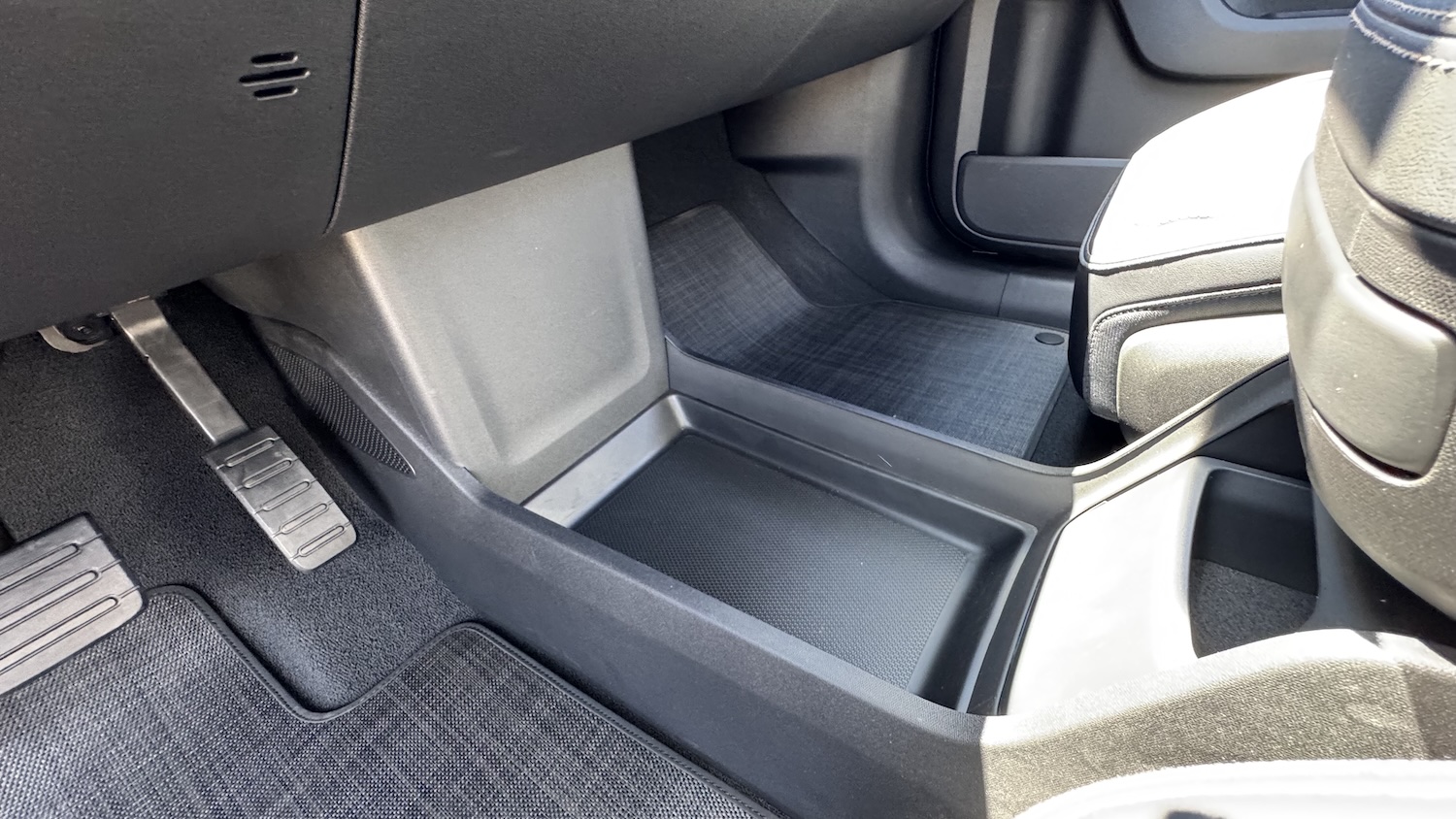
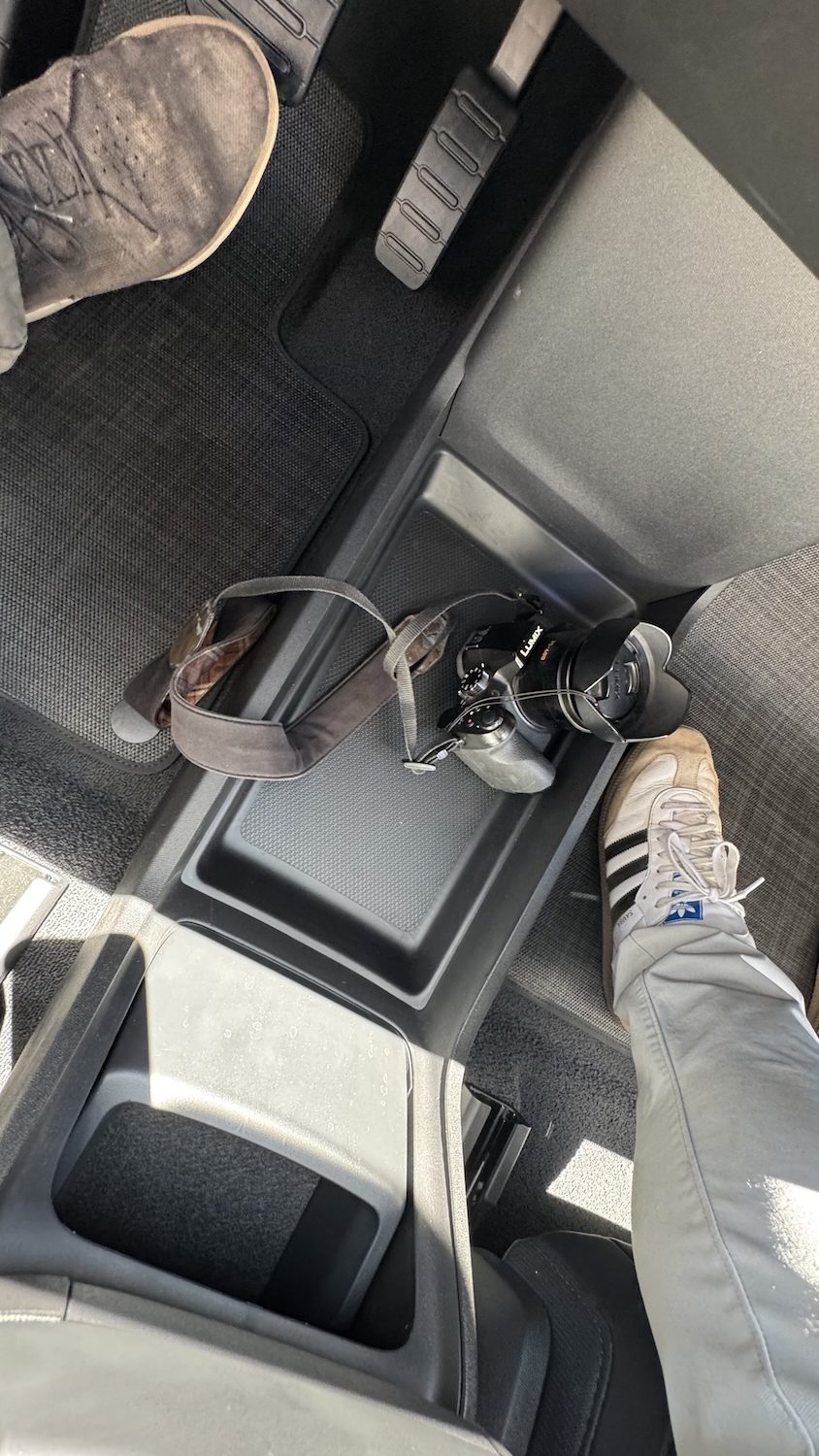
I think every electric car should have a shallow bin on the floor between the driver and passenger. It doesn’t have to be tall and it certainly shouldn’t be a huge center tunnel as is so common — it just needs to prevent stuff from sliding in turns. This space becomes so useful for big items like backpacks, purses, and in my case, a camera:
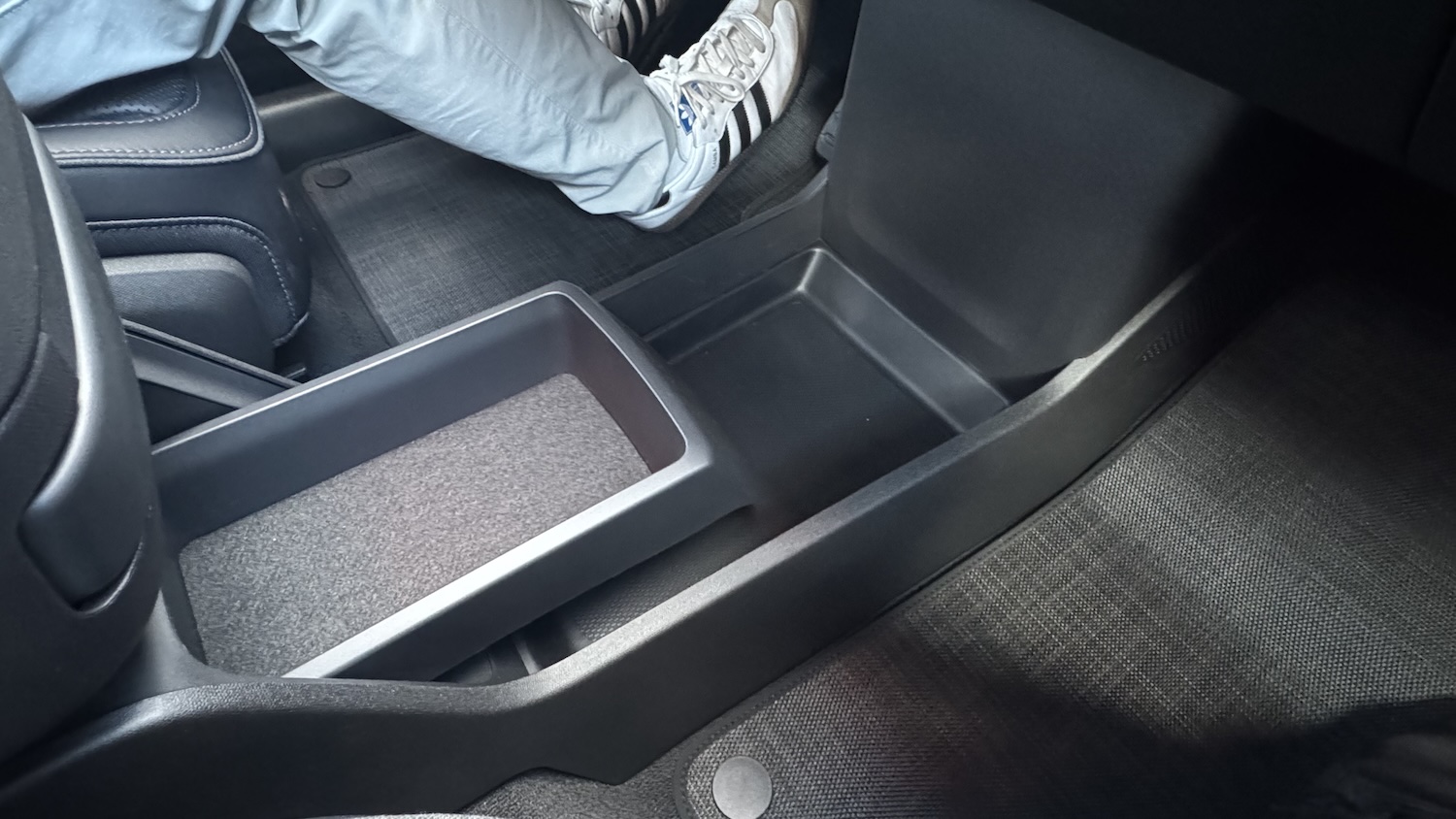
Rivian has a fore-aft sliding drawer in the center console that offers even more storage:
Speaking of the center console, up top it features a wireless charger at the front:

And towards the rear is a deep bin of which I only have this blurry screenshot:

Jutting from the front of the center console is a pair of cupholders:

And ahead of that, built into the dashboard, is the awesome pair of (manually-opened) gloveboxes:
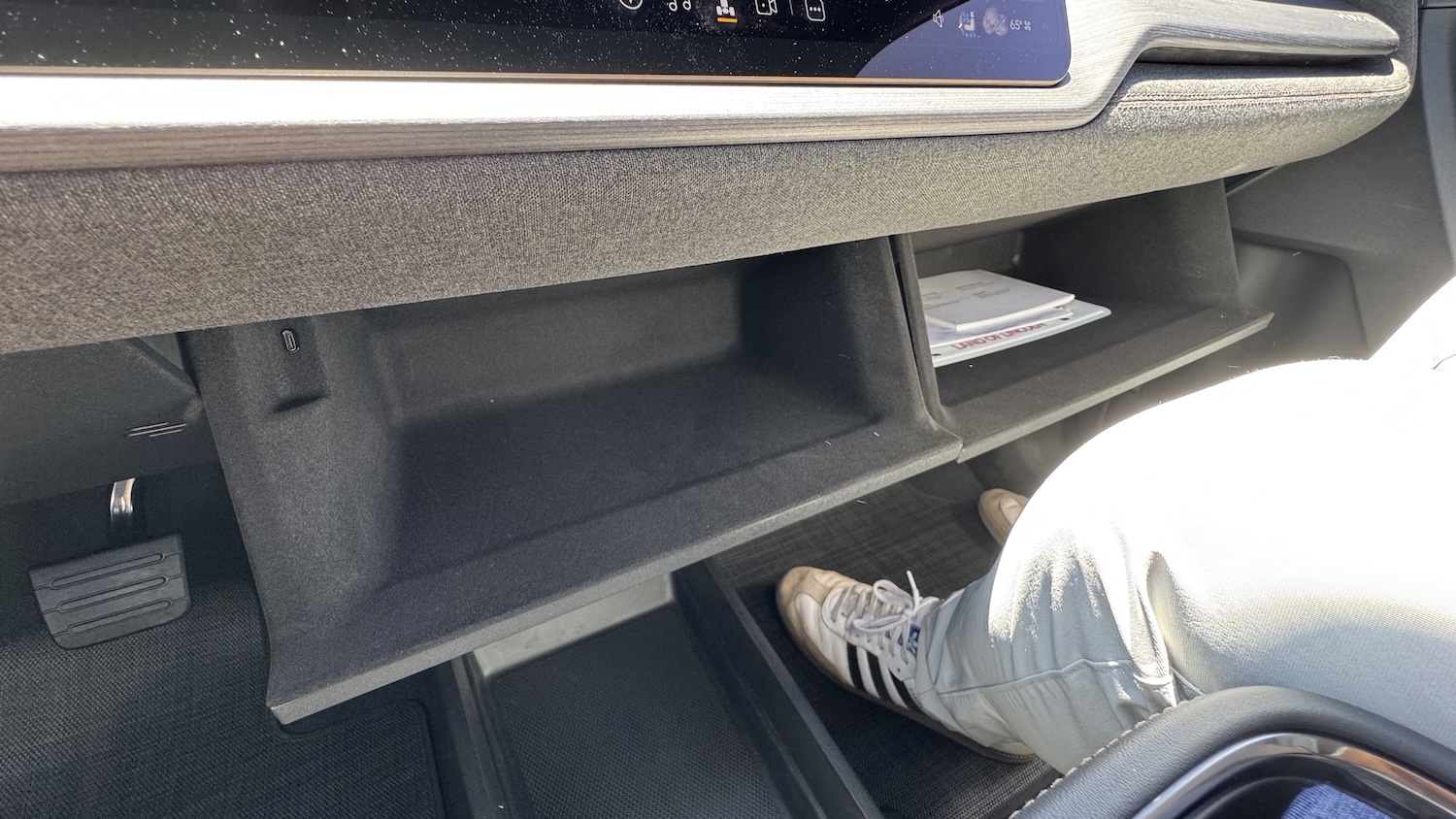
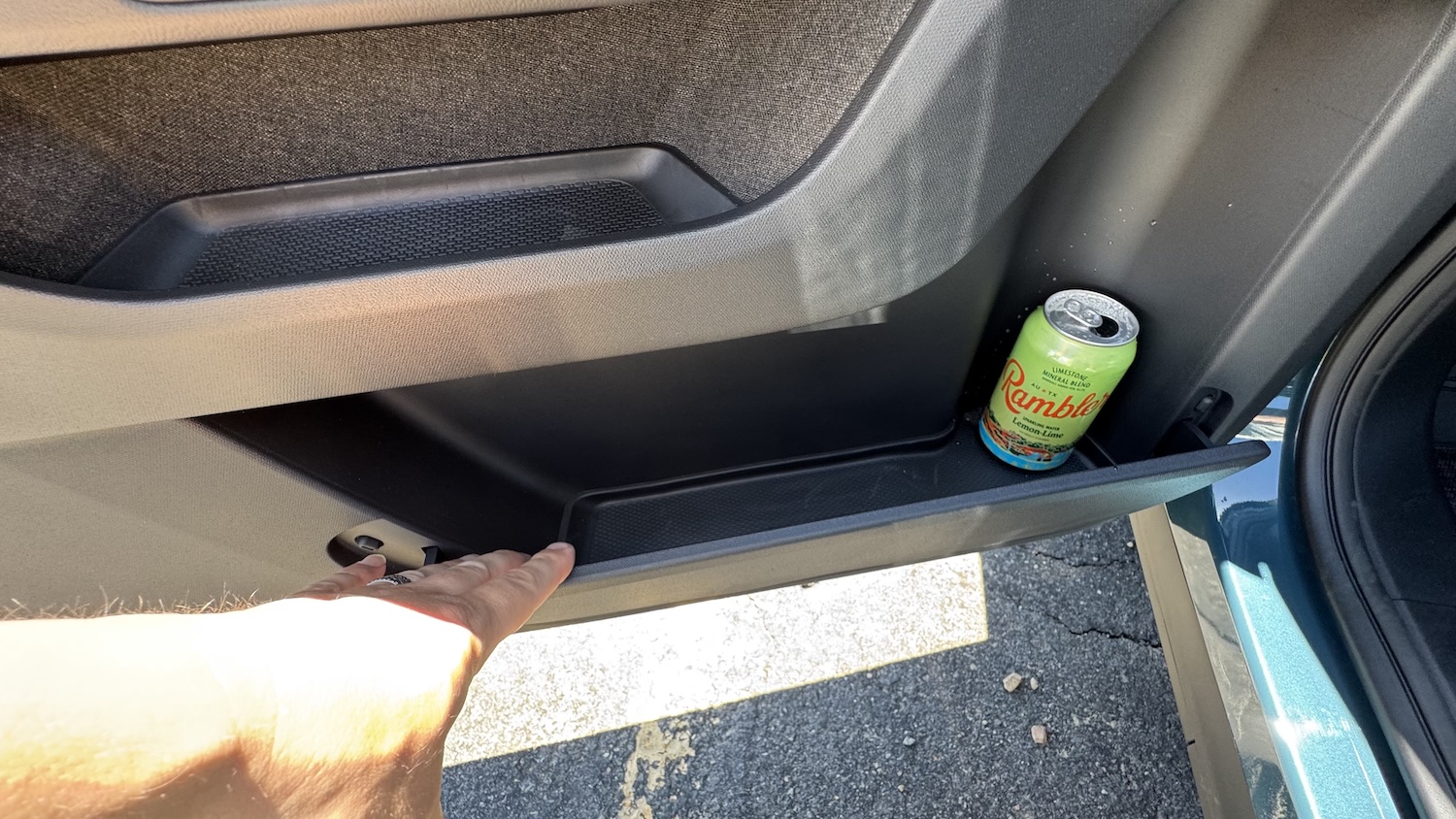
The doors up front have an upper storage area as well as an expandable lower storage area (I think all cars should have expandable door pockets; this is just great design). There’s lots of space there because the front speakers have been relocated to the base of the dash. These are back-to-back “force-balanced” speakers, so they don’t transmit significant vibrations into the structure holding them in place. (Overall, the sound system quality seemed good to me).
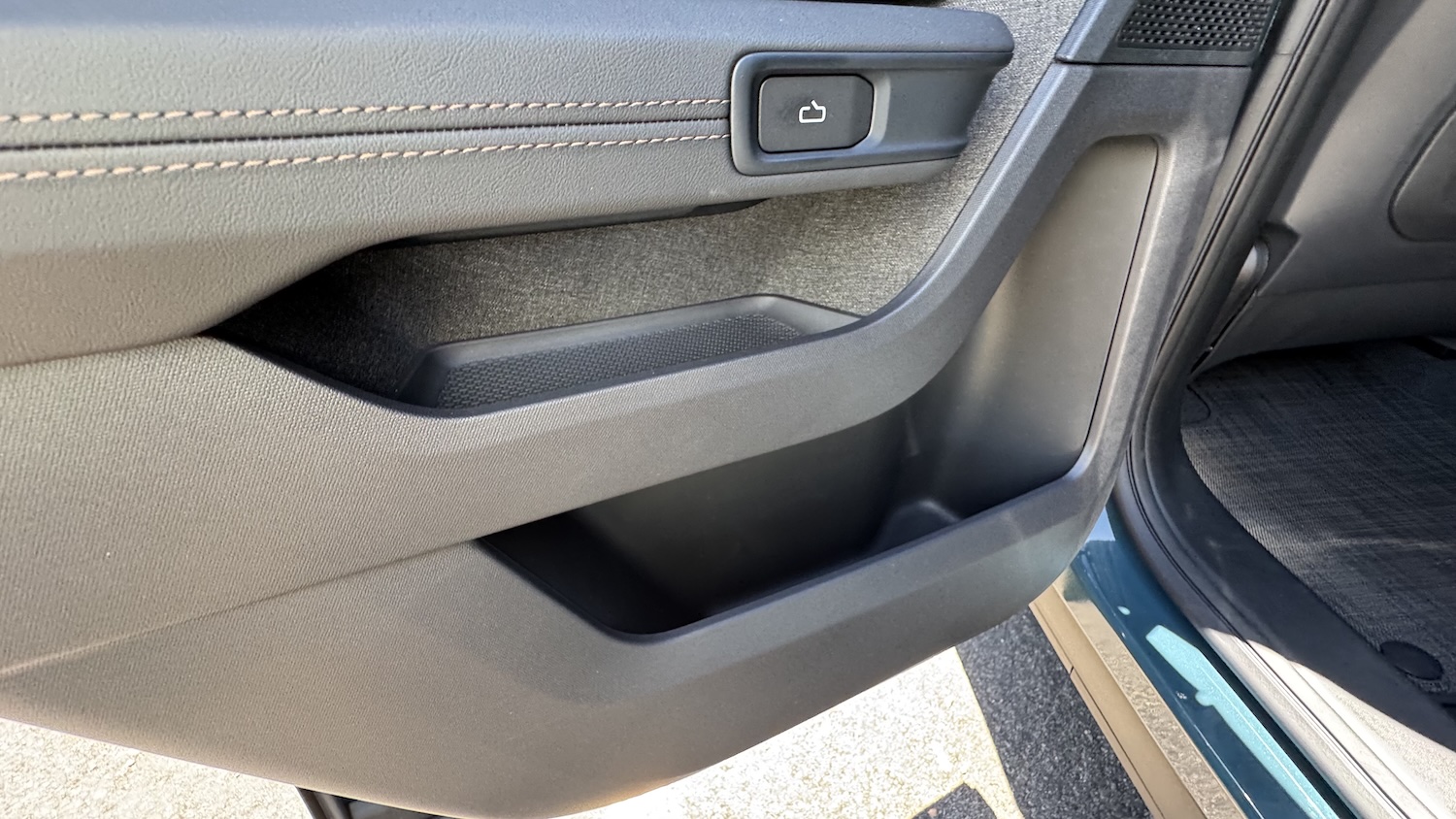
In the rear doors, there’s a smaller upper storage bin and a huge lower one with an area that should fit a tall water bottle:
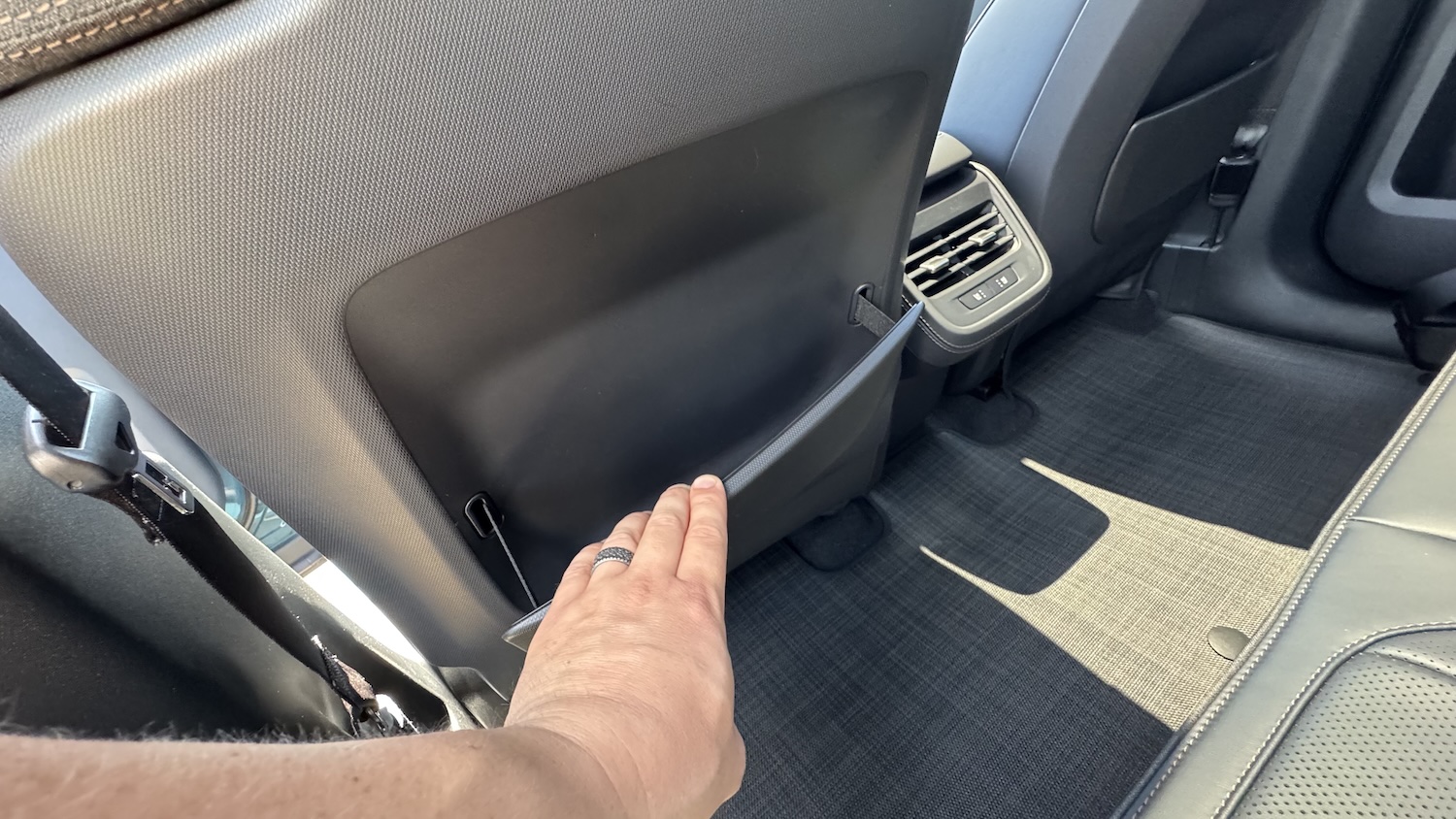
Behind the front seats are expandable storage pockets:
There are some cupholders and a little bin in the center of the rear bench upper cushion:

But most importantly, what’s back in that second row is space. Tons and tons of space. How could there possibly be this much space? Look at how much room there is ahead of my knees; it’s even more than the R1s!:

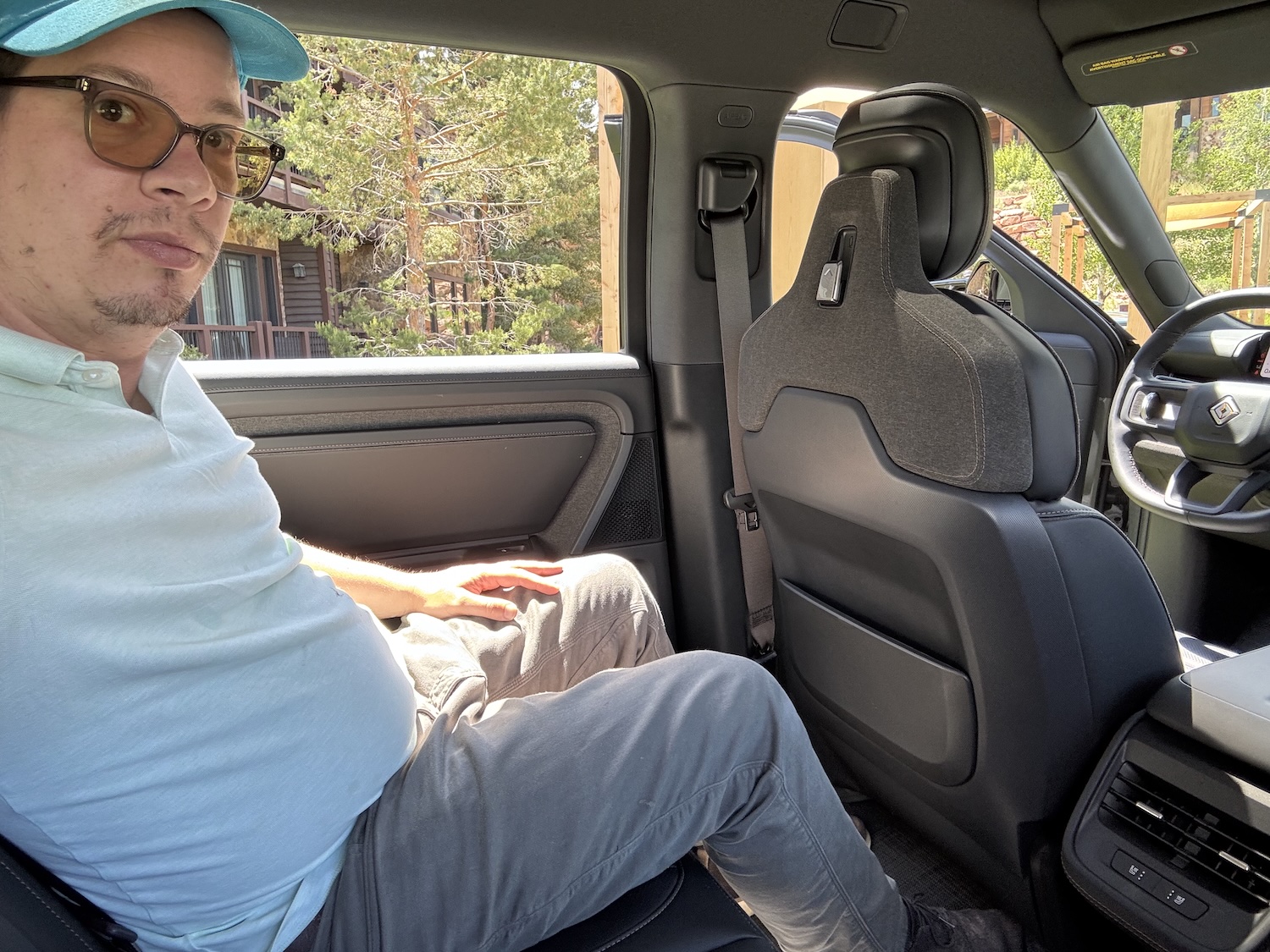
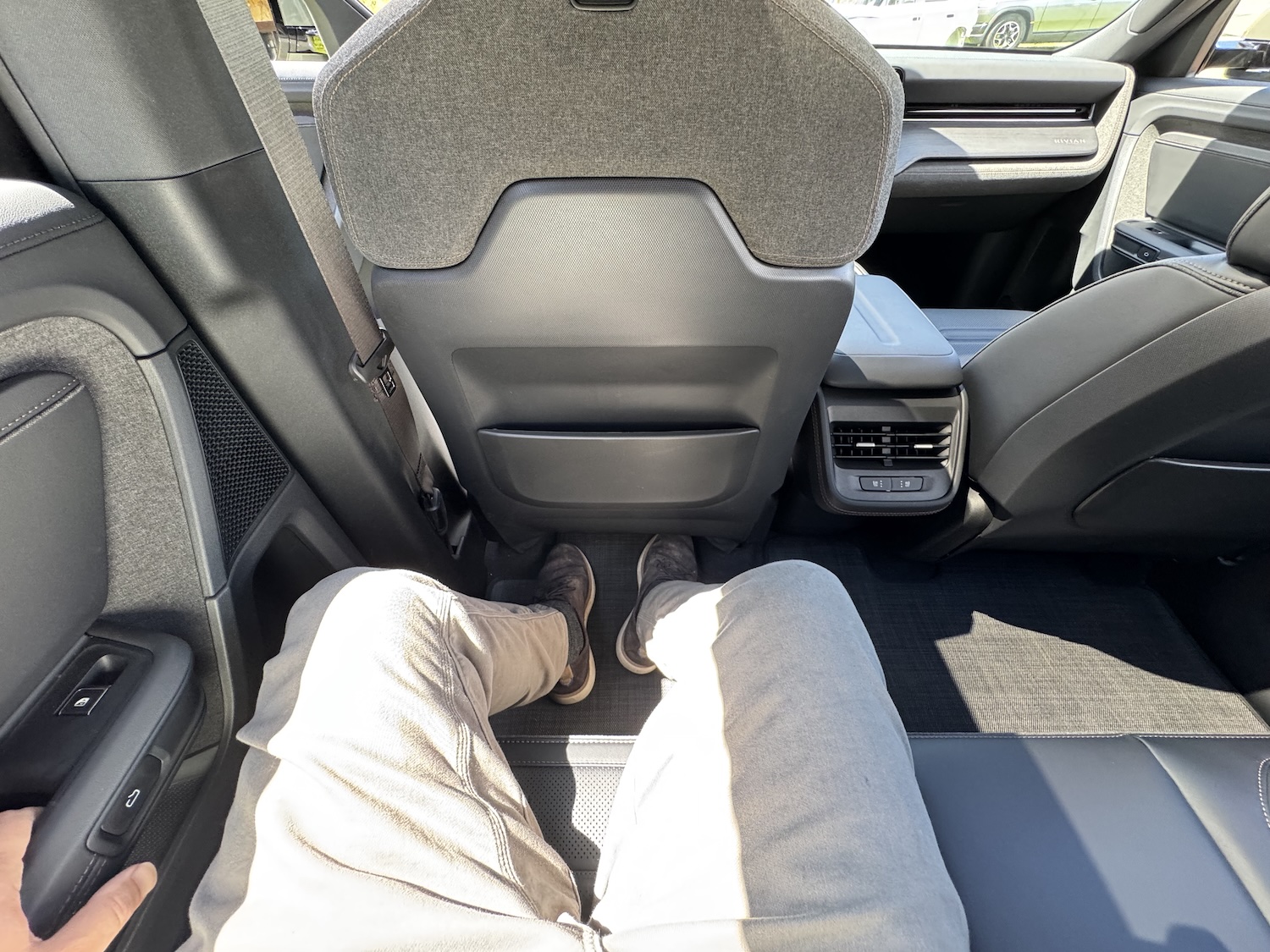
Surely all that legroom came at the price of rear cargo space, right? Not really; it’s huge back there, too:
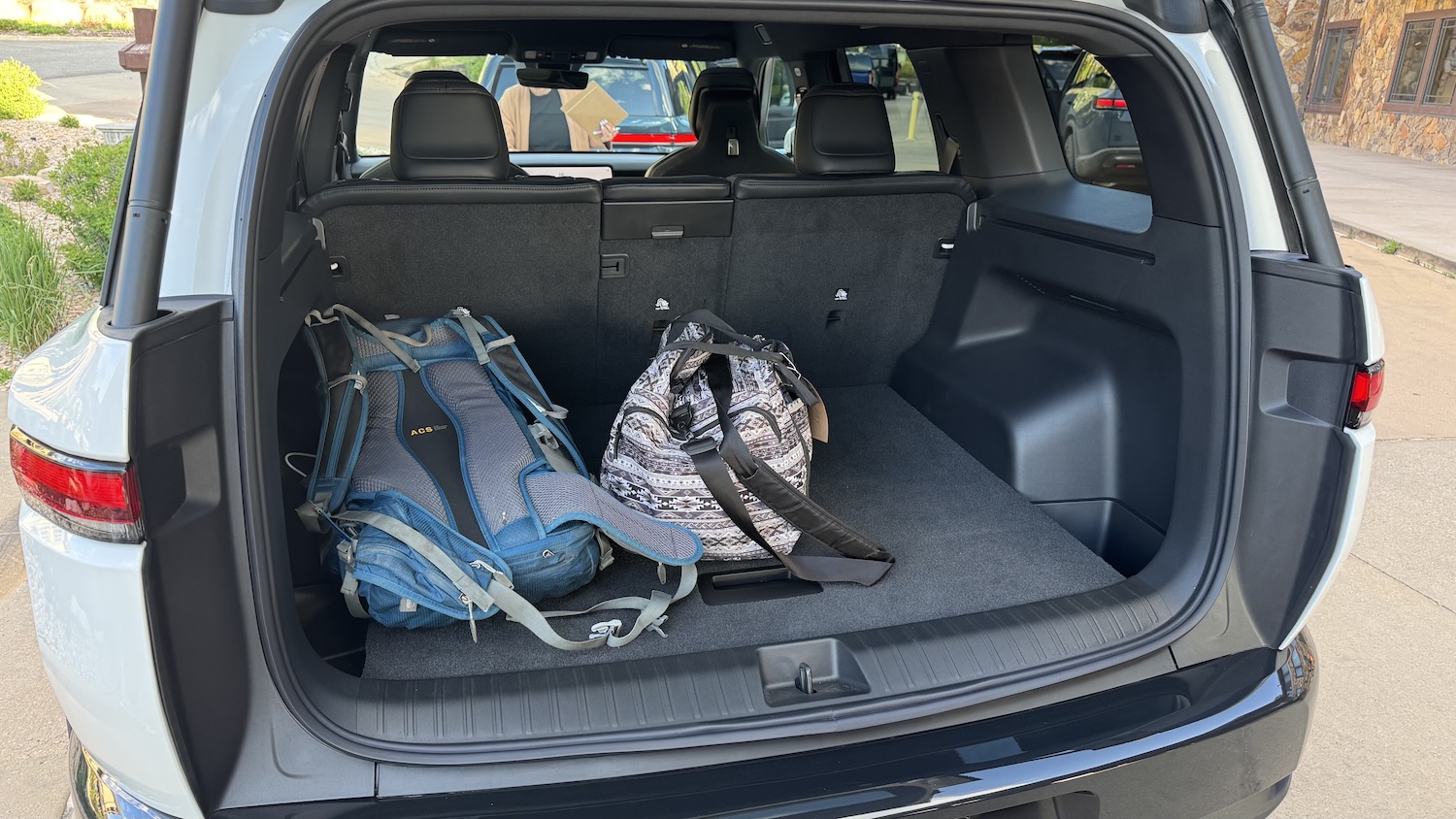
You can see the storage bins aft of the rear wheel housings:
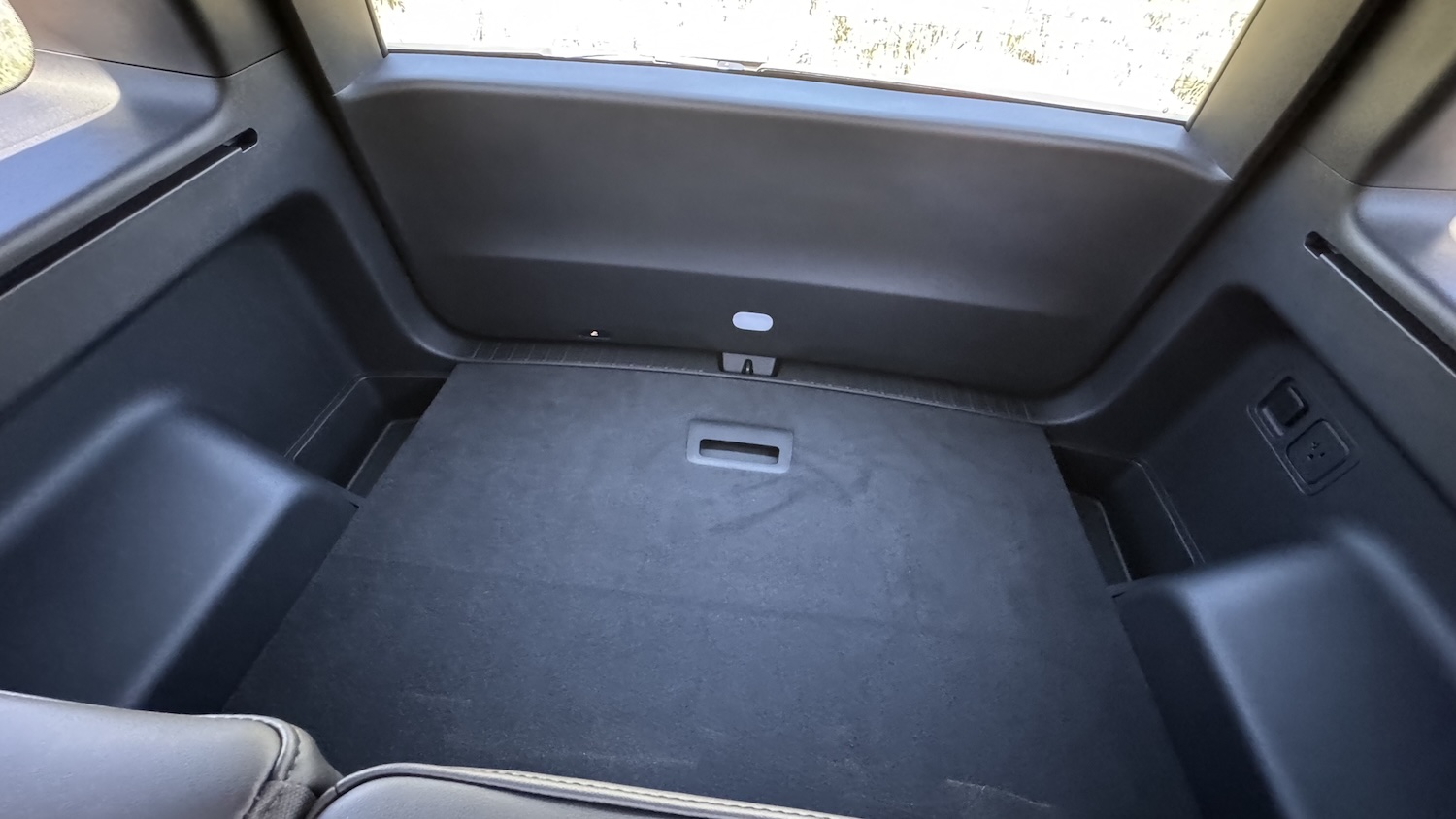
And below the floor is even more room if you forego the spare tire:

That’s really my takeaway on the Rivian R2’s interior. Do I think the quality of materials/overall design is that much better than, say, a $45,000 Blazer EV’s cabin?:

Or a Tesla Model Y’s cabin:

Or a $40,000 Kia EV6’s cabin:

Or a Mustang Mach-E’s interior?:

Maybe. The R2’s interior looks elegant, but its lack of physical switches really takes it down a notch, and I don’t think its simplistic design looks as nice as that of the Lexus RZ. Here’s the base R2 again:

And here’s the RZ, with its stunning standard Palomino and Macadamia NuLuxe fabrics surrounded by Charcoal trim:

But even if the RZ’s cabin looks a bit nicer and those other cars have buttons where the R2 does not, I think I’d still take the R2’s interior overall solely because of the combination of elite-level interior storage and an upright, airy, just downright pleasant atmosphere.
On-Road Capability
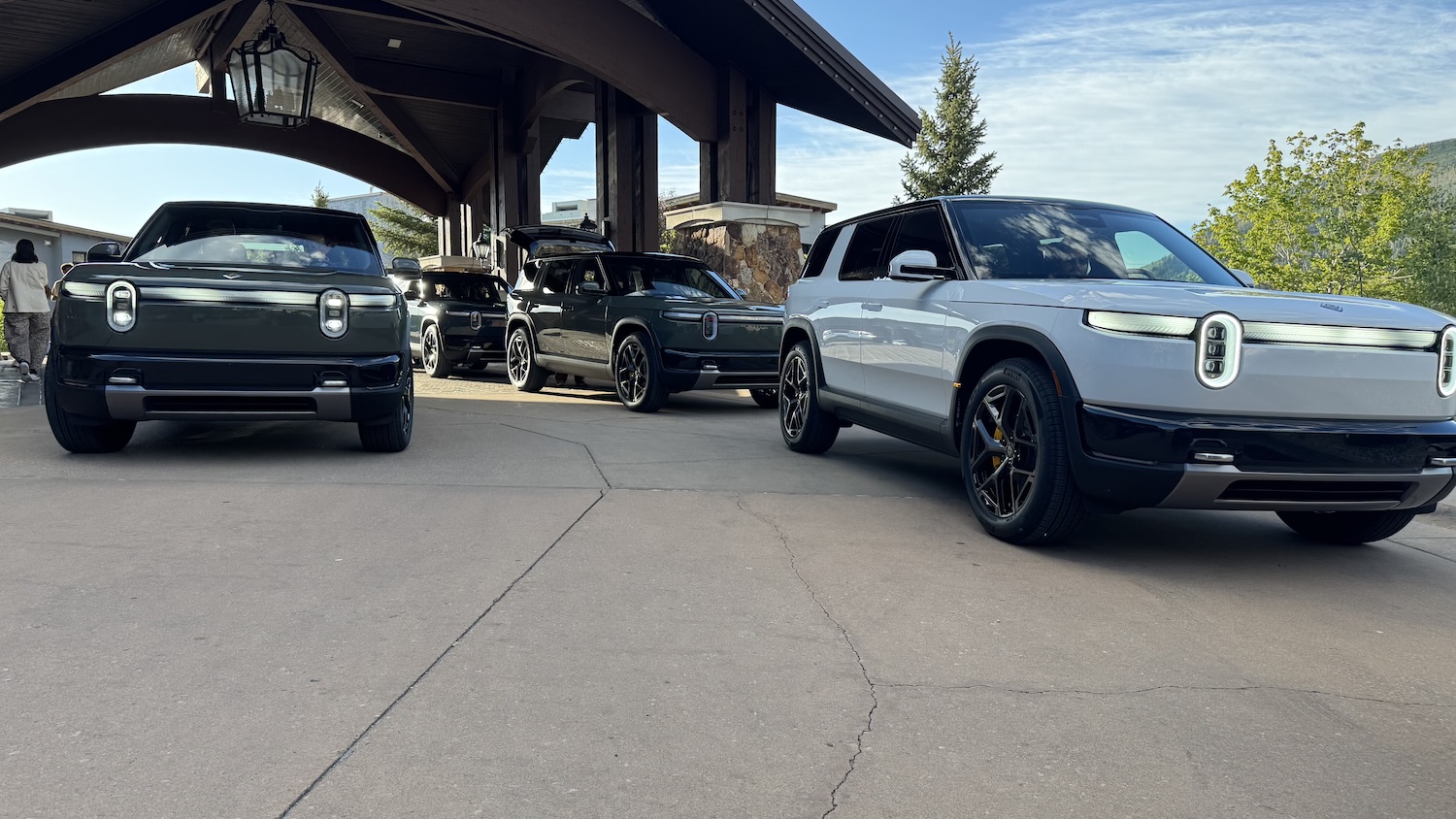
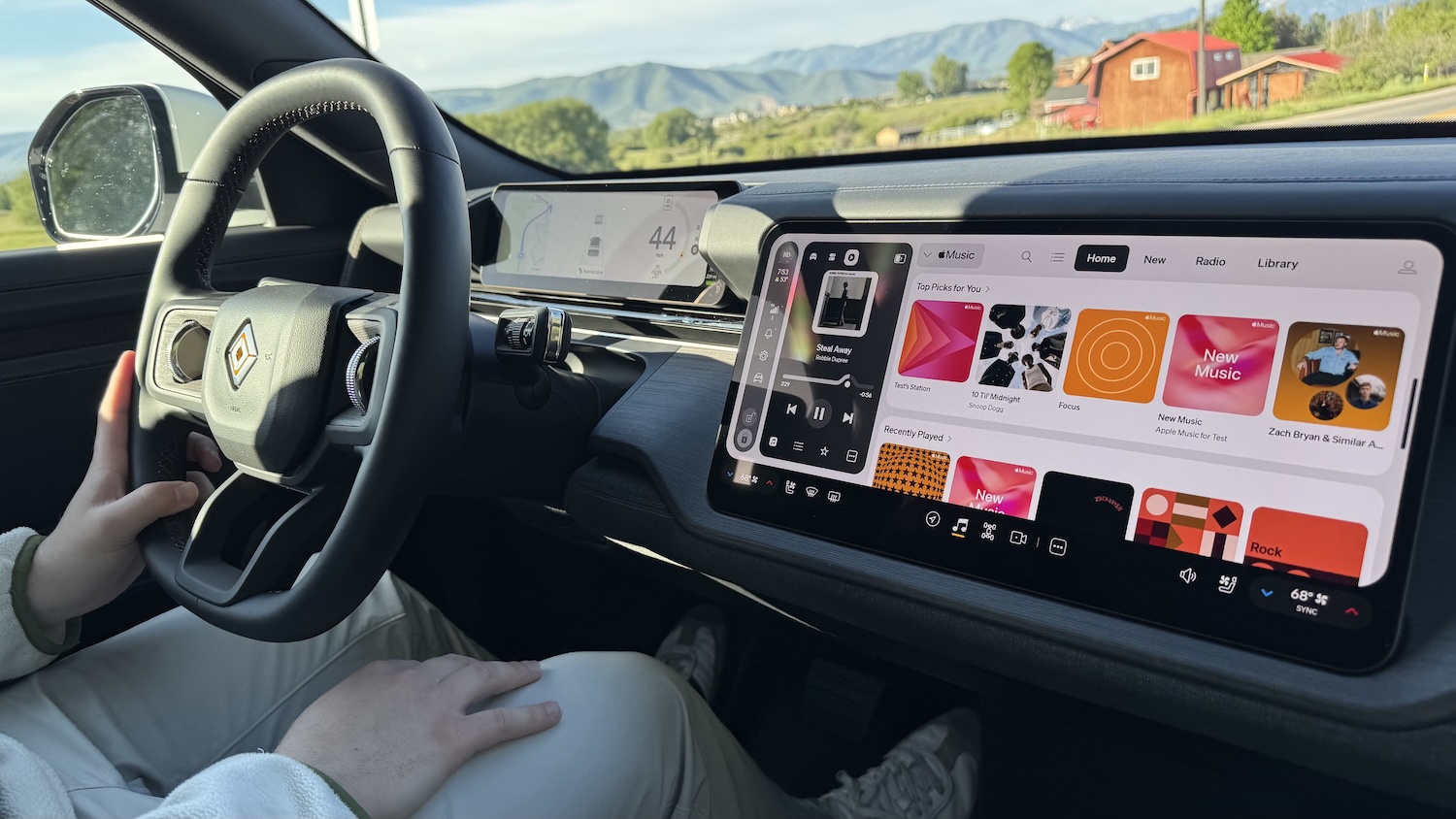
Unfortunately, Rivian didn’t have any base-model R2s for journalists to drive, so I hit the road in a white Performance Dual Motor R2. Right away, I noticed a vibrant screen that seemed to work fine for my needs despite its lack of Apple Carplay/Android Auto:
The cameras were crisp:
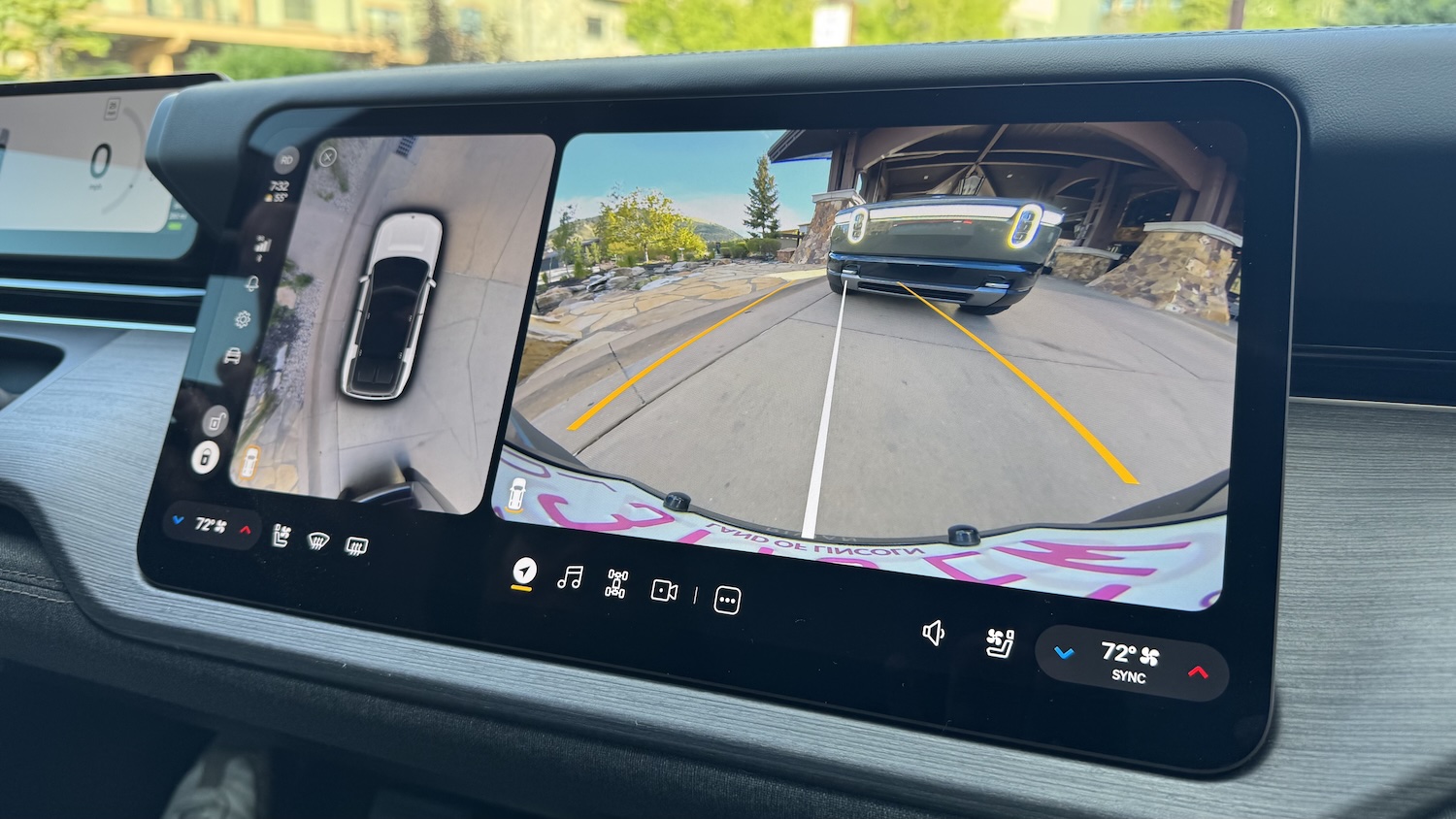
And the shifter — a column-mounted unit — is simply the best in the automotive industry. It’s out of the way and not taking up any storage space; pull it down, and you go into drive, engaging your front camera if you want it on; push it up and the reverse camera engages instantly. If you’re pulling out of a driveway in reverse, you can just let off the accelerator, tap the shifter, and hit the accelerator pedal; far too many cars require brake application and far too many cars have a lag in their cameras when shifting. Rivian understands that we all just want to put the car into drive while rolling backwards, and we all want those cameras right now.
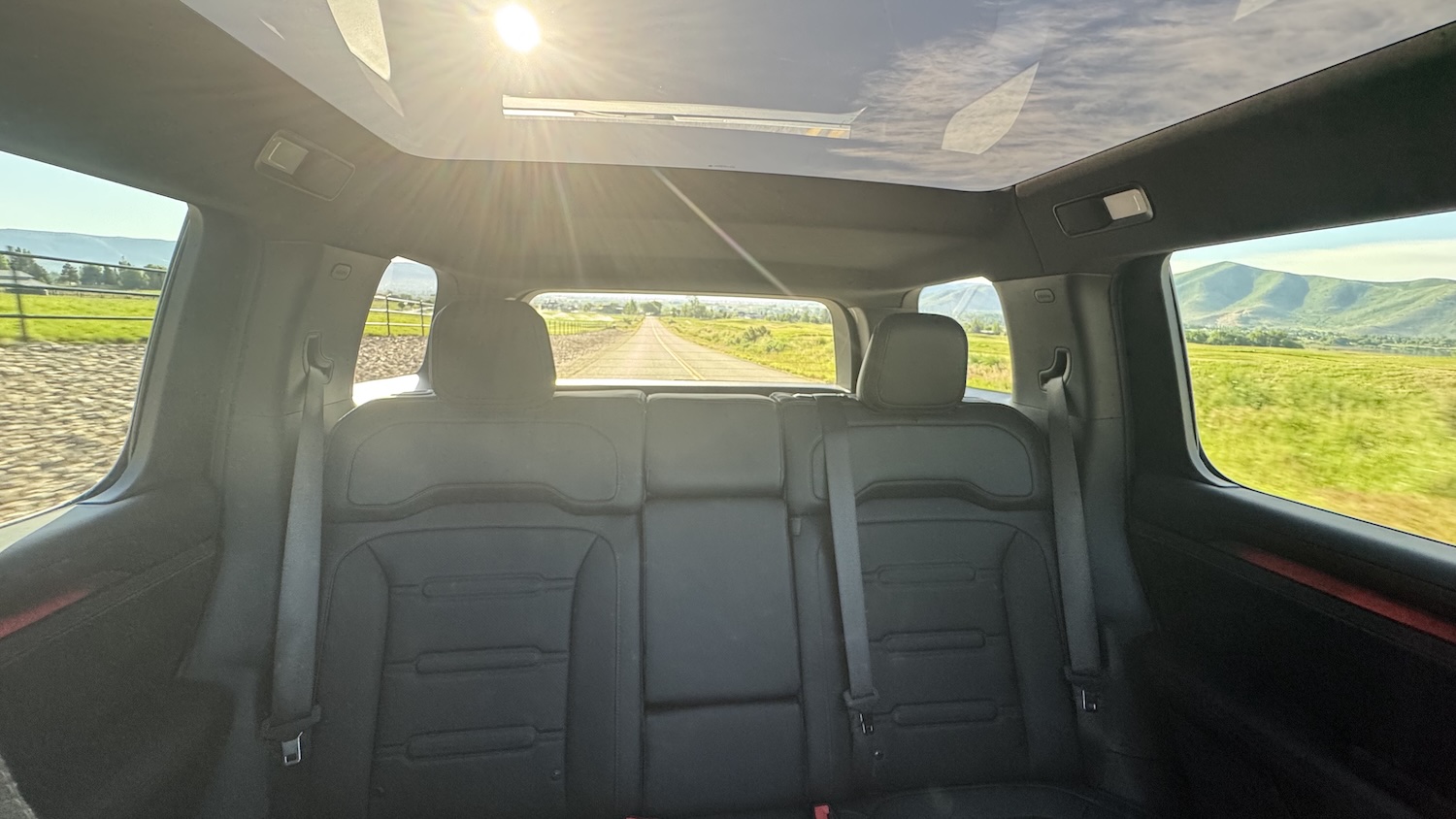
Once my drive partner and I pulled out of the hotel drive we found ourselves on beautiful mountain roads surrounded by Utah’s lush greenery. It was a beautiful, sunny day, and my partner and I could enjoy every bit of it through the R2’s lovely greenhouse. Visibility in the rear and out front is absolutely fantastic for a car made this decade.

On the wide-open valley roads just before the twisties Rivian was sending us to explore, I jotted down a few notes about the ride. First, there was seemingly no wind noise — like zero. This was astonishing. There was some road noise, but it was far from egregious. As for the ride, it was decent. Without instruments on hand, I can’t really quantify how it compared with the R1S, but, to me, it felt like the R2 was allowing more high-frequency imperfections to travel through the chassis and against my spine. Again, it wasn’t anything grievous, but I didn’t feel that it quite glided like a magic carpet, regardless of damper settings.
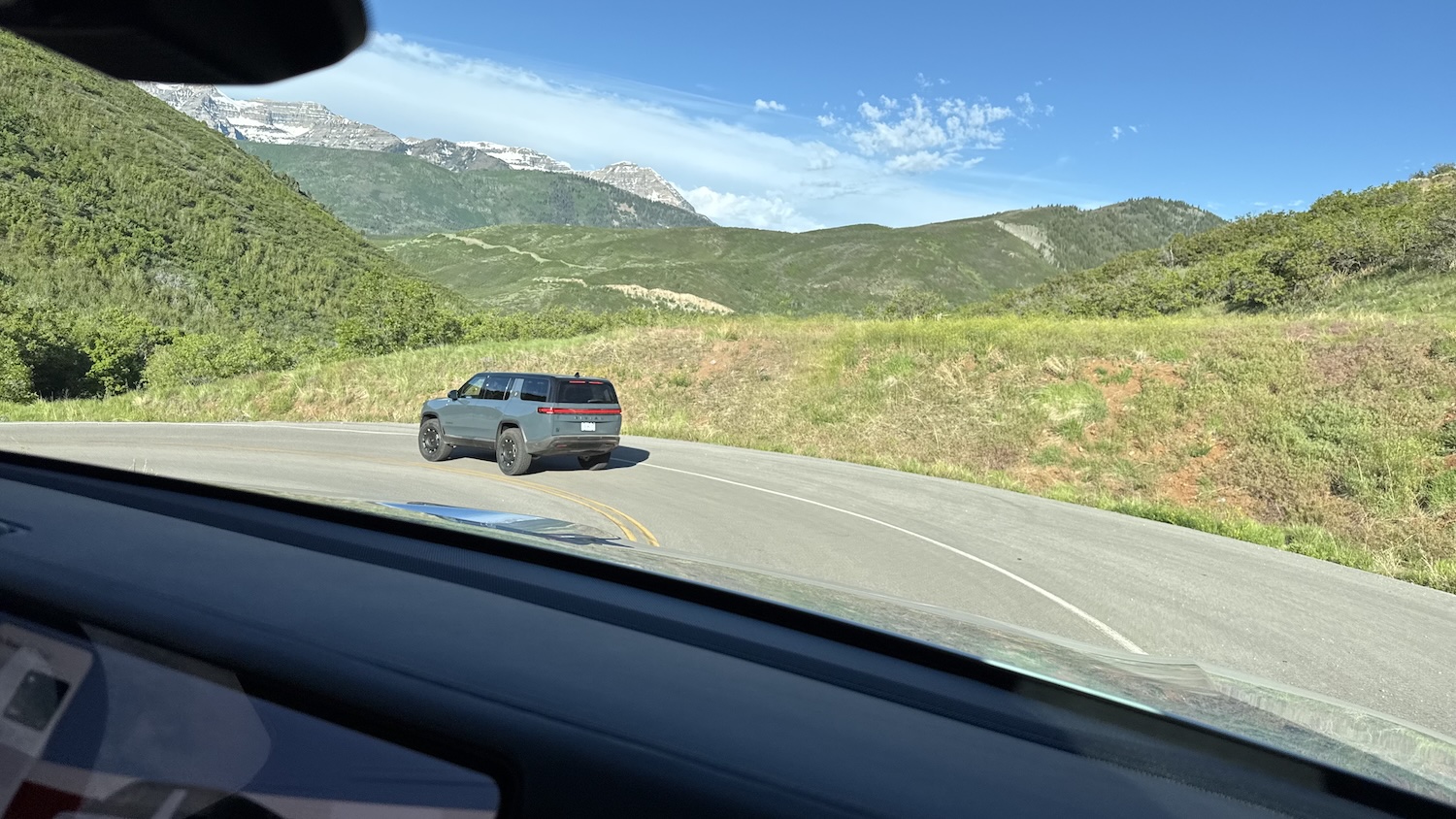
It wasn’t long before we were carving canyon roads and making those 255/55R21 Pirelli Scorpion MS all-seasons howl. If you want an extremely detailed description of the R2’s handling performance, that’s something for the Jason Cammisas of the world, as I’m far from a track driver, but suffice it to say that, with the big sidewalls on the R2 and the lack of a fancy sway bar system like in the R1, turning into a corner was followed by tire noise, a little bit of lean, and eventually understeer. Could you probably use the accelerator pedal to get the tail to swing out? I have no idea; I’m not trying that on public roads.
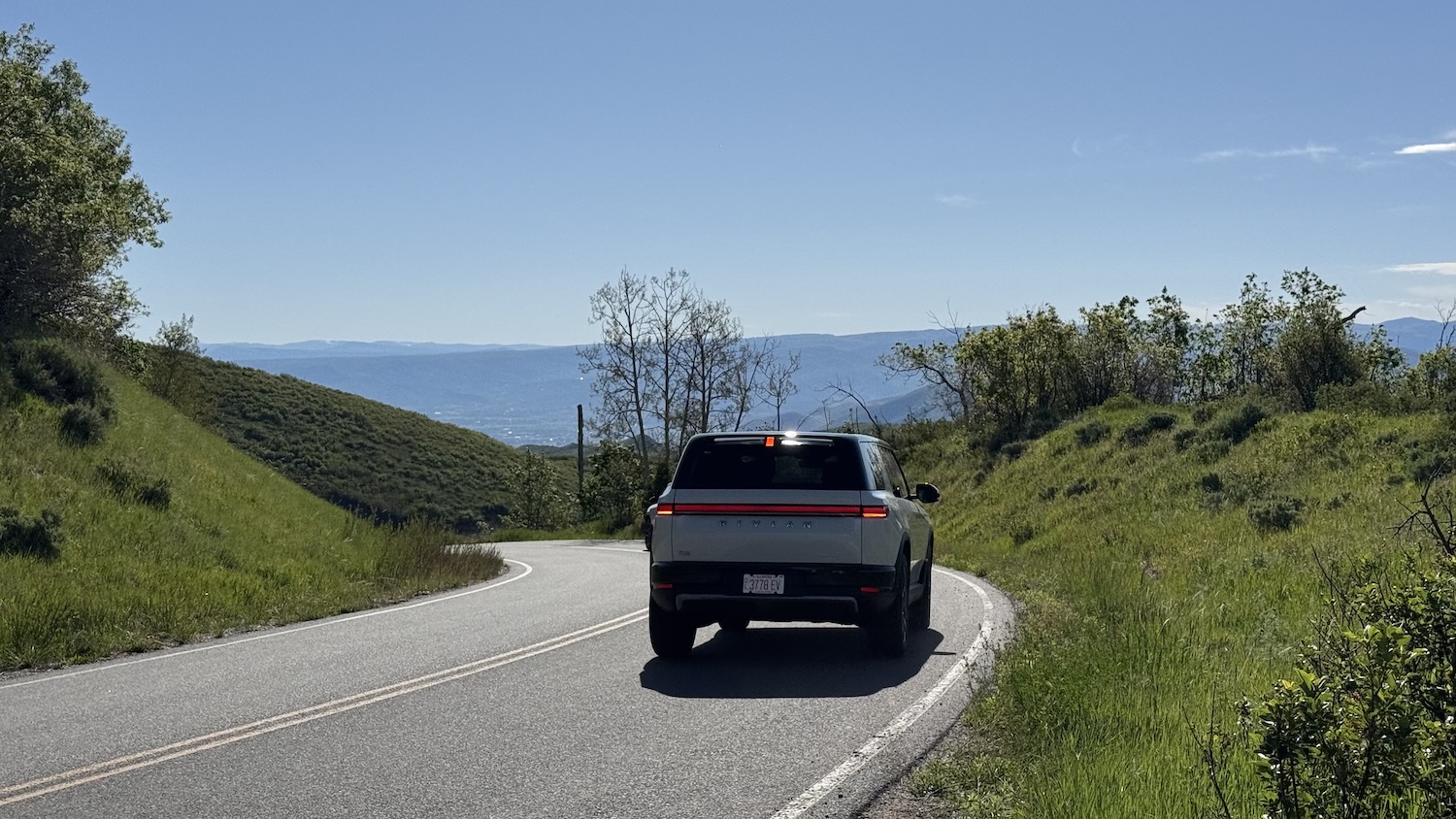
The R2 is lighter than the R1S, but that doesn’t mean it’s a sports car. 5,000 pounds, a MacPherson strut front suspension setup, good ground clearance and big sidewalls is hardly a formula for precision, but I still hustled the SUV through those winding roads and had a fun time. I’m sure the average person buying this thing will be pleased enough with the handling.
Ditto with the acceleration. A 656 horsepower powertrain offering a 0-60 MPH time of 3.6 seconds is still insanely quick, despite the fact that many EVs are quicker. Watch the video above, and you’ll see that the speedometer climbs hilariously quickly without that much indication that I’m accelerating that fast — it’s a drama-free hustle that only an electric vehicle can offer.

I tried Rivian’s Universal Hands Free system, not realizing that it does not stop at traffic lights/signs. Let’s just say: I put those bright yellow brake calipers to the test, and they passed. The system, at least as equipped on my R2, seemed fairly simple, offering the capability of an adaptive cruise control system coupled with a lane keeping system. Apparently the system also does lane changes, and automatic parking is on the docket, and there’s even more in the pipeline. Each Rivian R2 features a provision for a LIDAR unit in the frontmost roof crossmember.
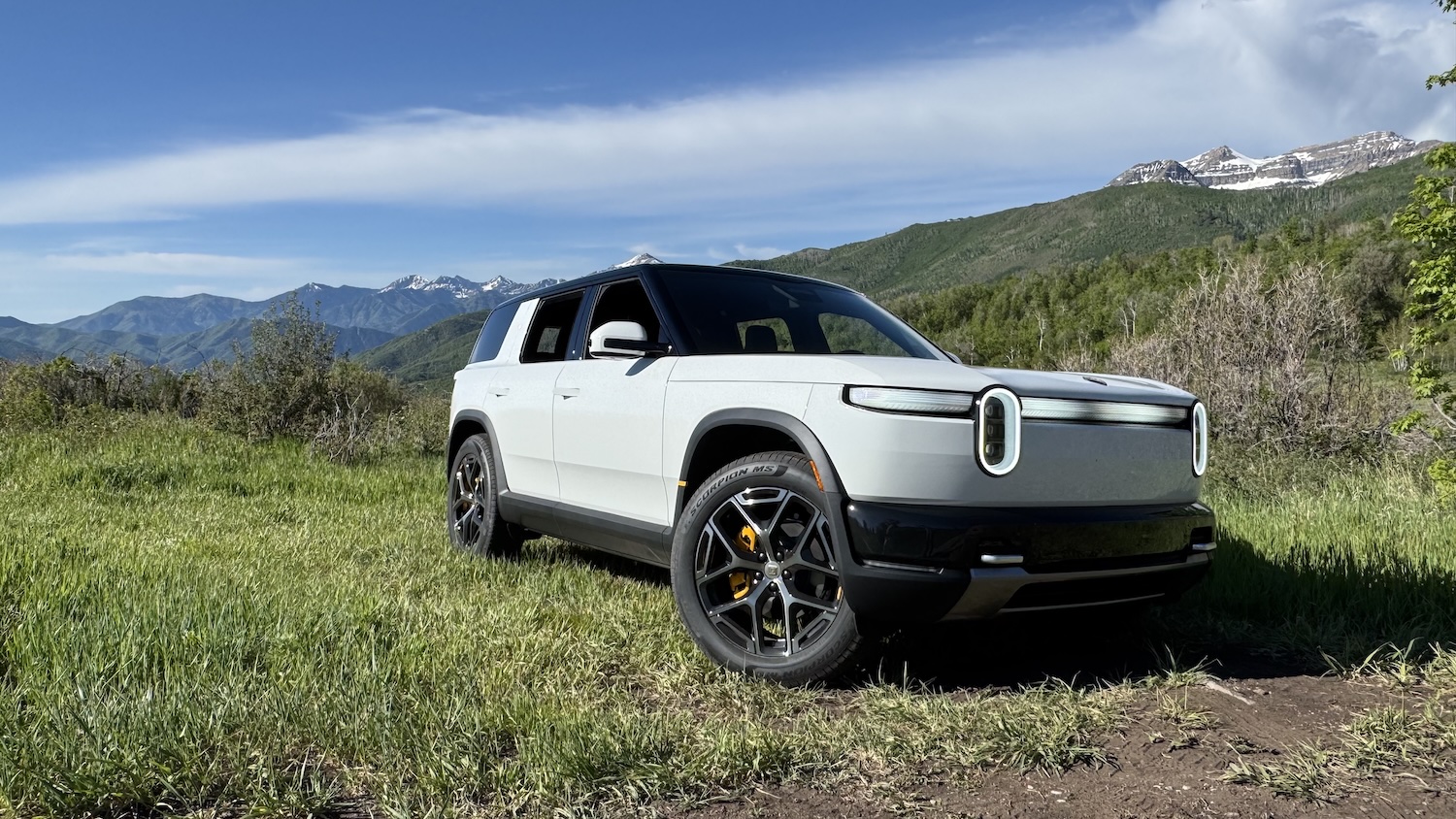
The last two on-road driving notes I see in my book are 1. the steering radius is fantastic and 2. the HVAC very much is not.

The temperature was roughly 85 degrees outside, and my drive partner and I found ourselves sweating. I, generally, am not sensitive to heat, having driven far too many junkers without AC in my day. But it was clear that the R2 we were driving just wasn’t as comfortable as it should have been, so we adjusted the AC controls and turned everything to max cooling. The fan was up, the temperature was down, and yet my head continued to sweat:

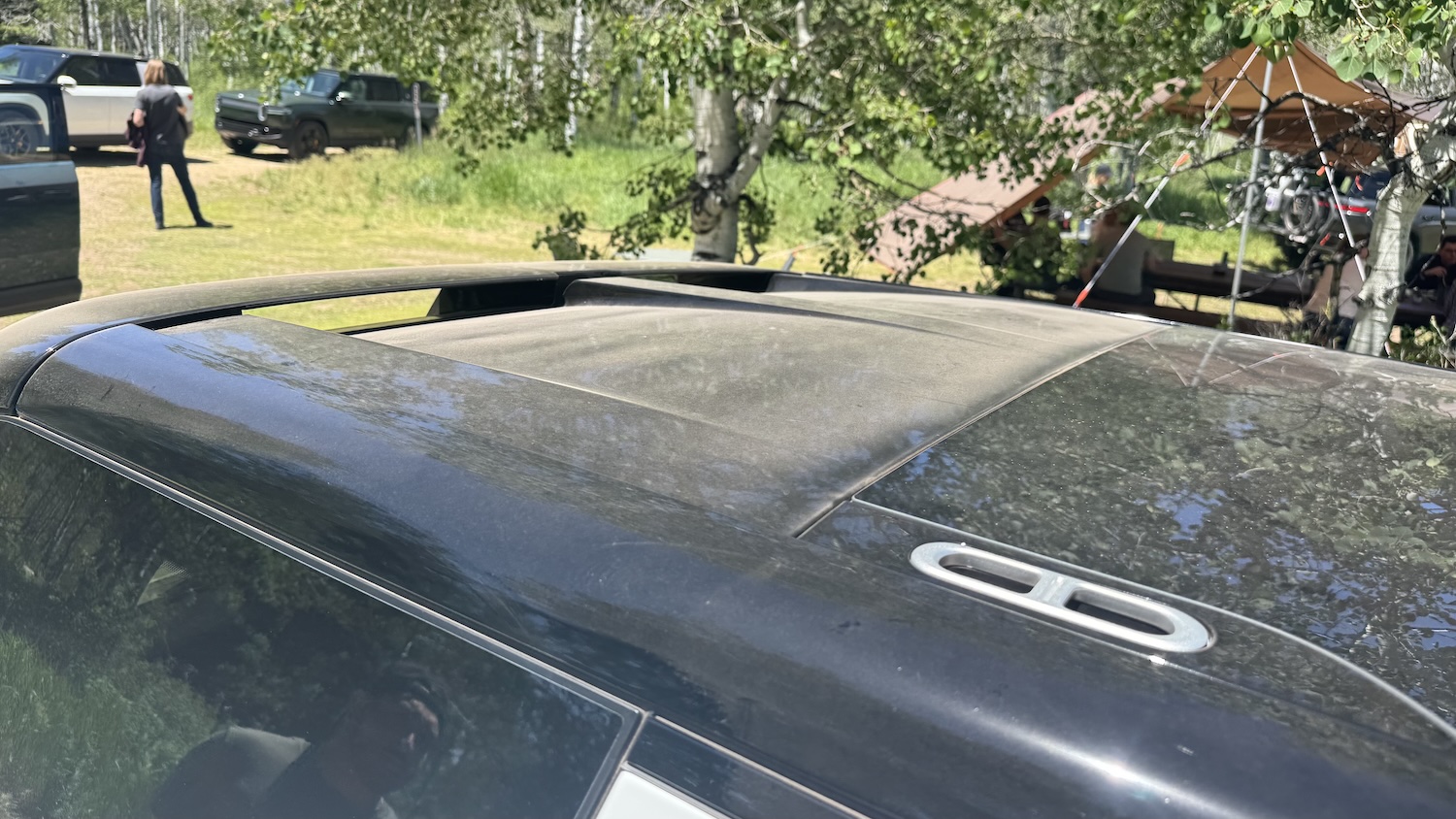
Here I am reaching for the moonroof, curious if the solar load coming through that was the culprit:

I suspect that some ceramic coating on that roof might help, but the bigger issue is that the AC seemingly could not keep up with my cooling request. CEO RJ Scaringe told me the company is planning to increase front-passenger air volume through the vents, so it sounds like they’re aware of the issue.
Let’s get to the off-roading.
Off-Roading
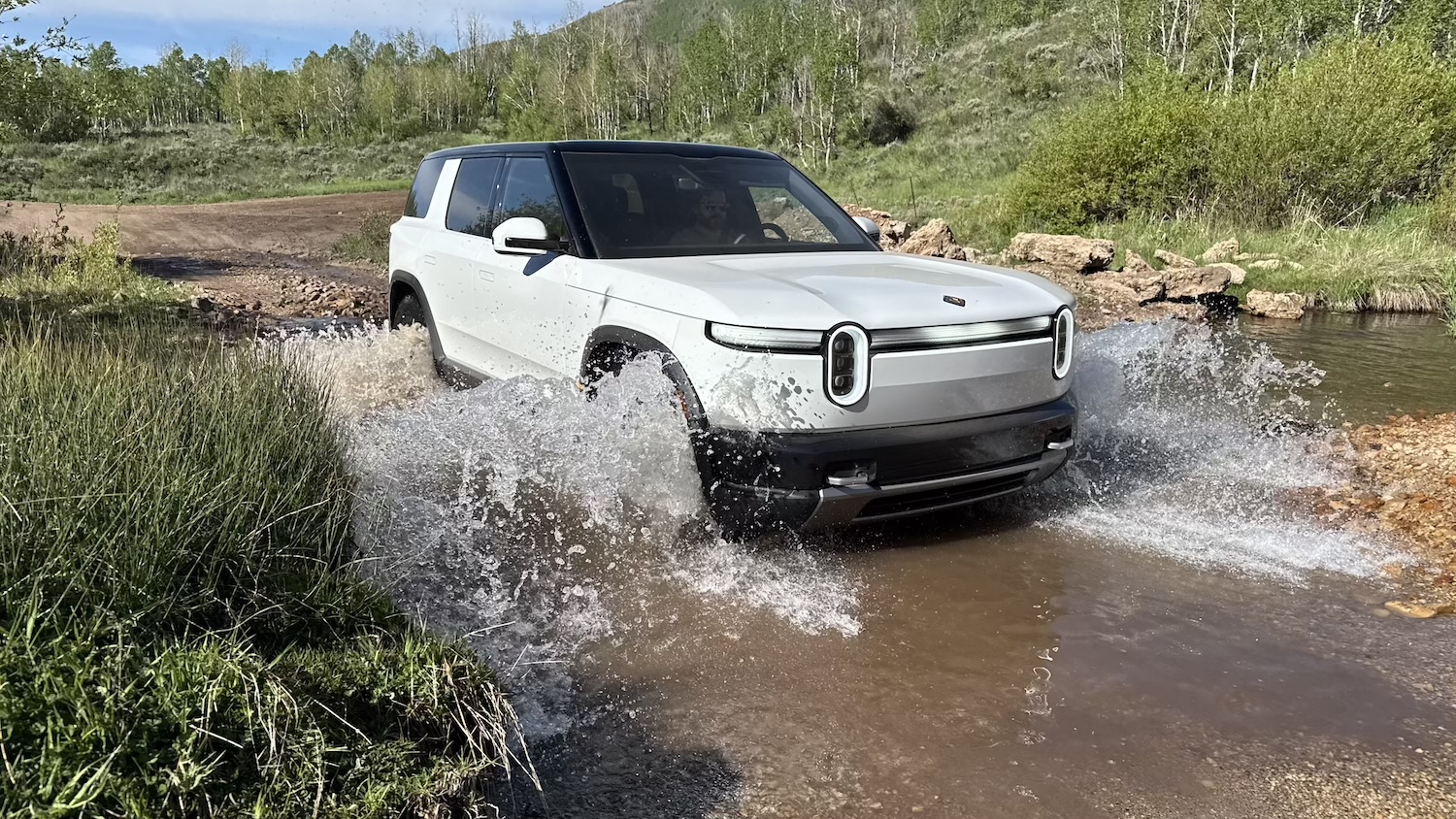
The Rivian R2 isn’t amazing off-road — let’s just get that right out of the way.
The most important attribute of a competent off-road vehicle is favorable geometry. That means good ground clearance to drive over obstacles, short overhangs so the front and rear tires can get up onto grades before the bumpers hit, and a small belly so the vehicle doesn’t get high-centered. And on the geometry front, the R2 is just OK. Its approach angle of 25 degrees is acceptable, as is a 26 degree departure angle and a 20.6 degree breakover angle caused by a rather large 115.6-inch wheelbase.

These are closer to Subaru numbers than they are to Jeep Wrangler/Ford Bronco figures (aside from the breakover numbers, which are bad on all of these four-door vehicles), and they’re certainly not Rivian R1S numbers. The larger Rivian, thanks largely to air suspension, has a roughly 35 degree approach angle, 30-ish degree departure angle, and 26-ish degree breakover angle. What’s more, the R1S has nearly 15 inches of ground clearance compared to the R2’s 9.6 (note that the location of the minimum ground clearance matters as much as the number itself).
The R2’s geometry wasn’t an issue on the rocky mountain trail Rivian sent us on, even if there were a few times that the nose got close to the terra firma:
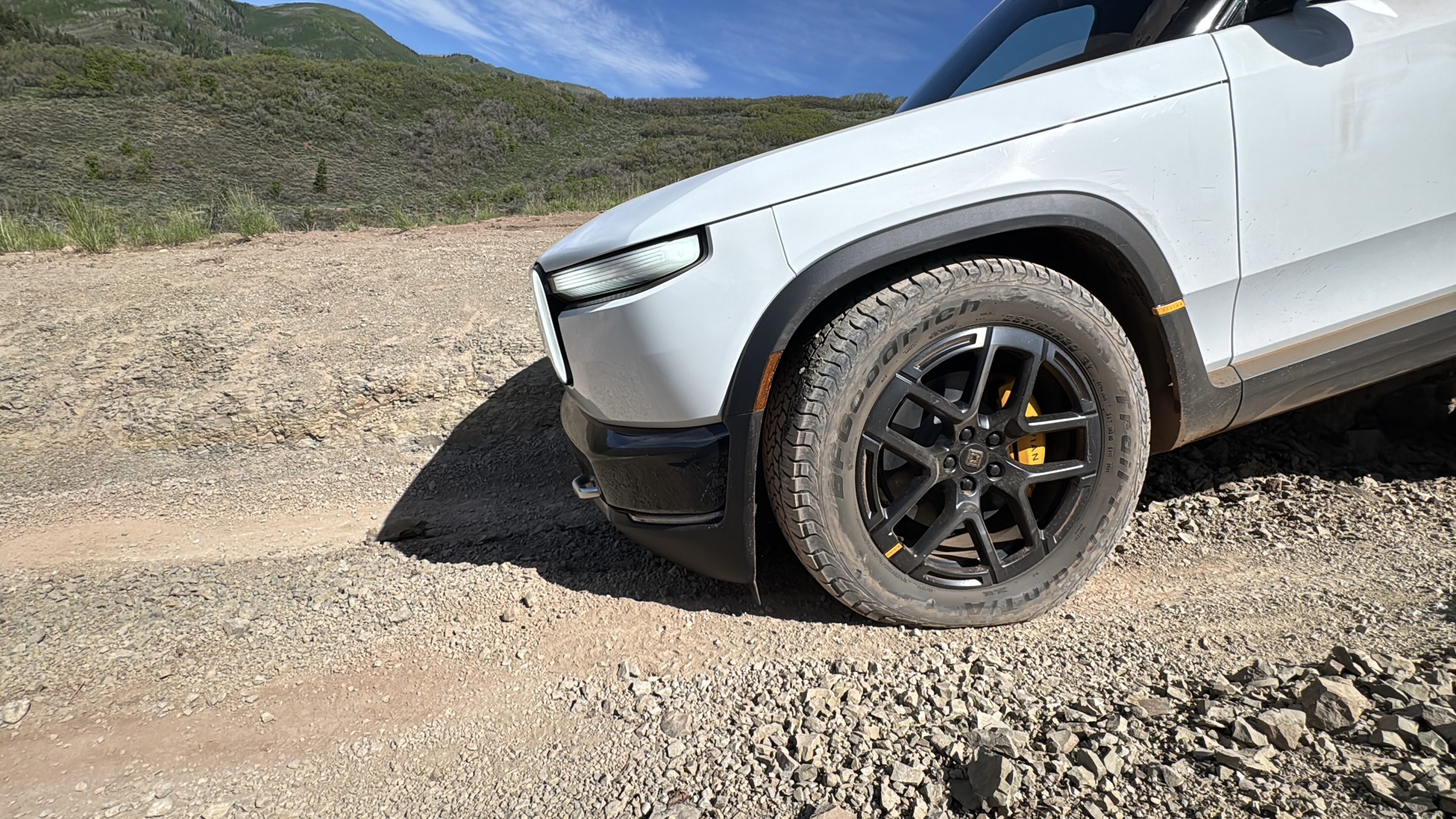
And the belly, too, sometimes managed to get down close to the dirt:

But it really wasn’t the geometry that was a problem on these mild trails. The only areas that seemed to be challenged by the terrain were the suspension and the four-wheel drive/traction control system.
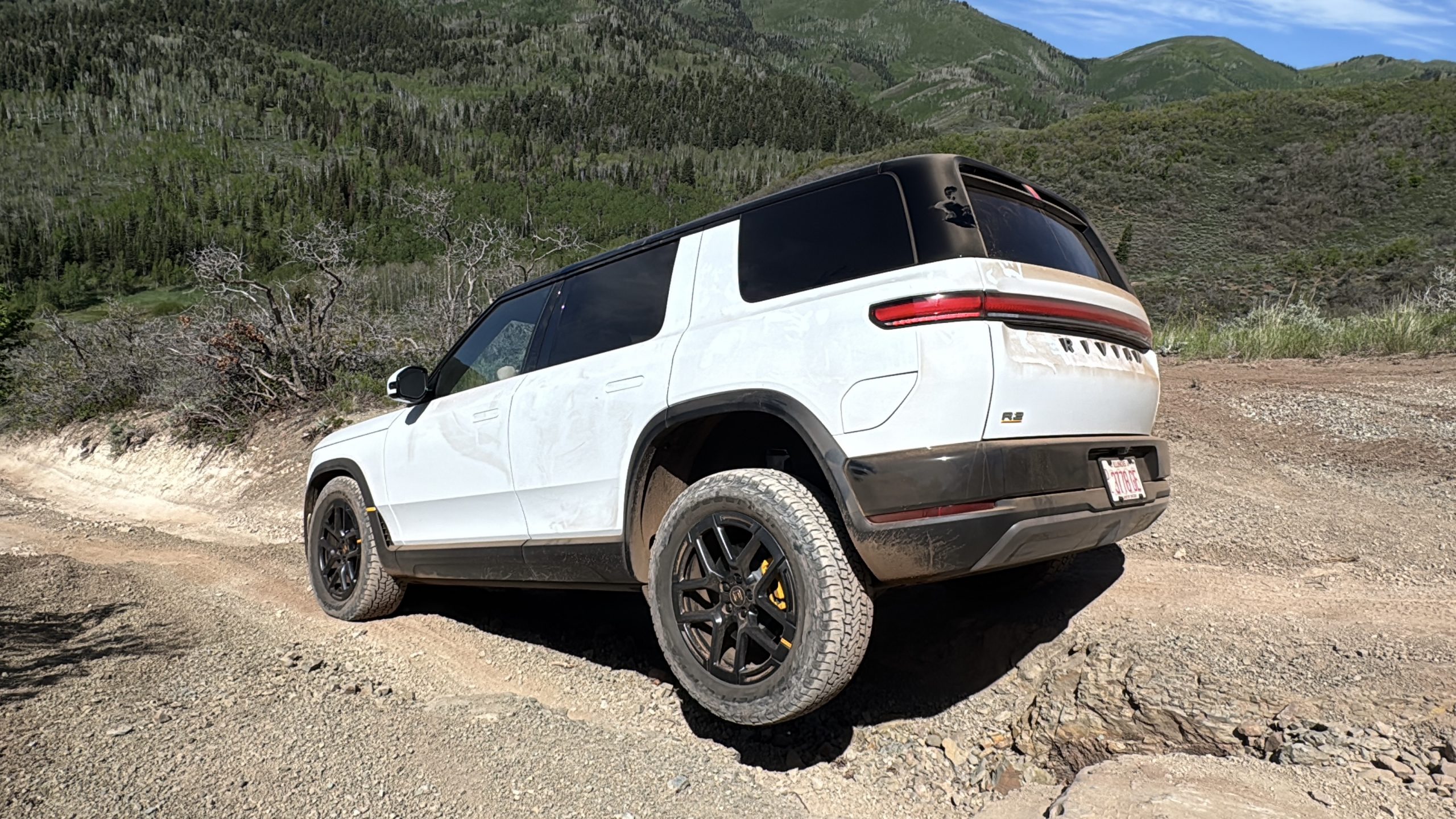
The Rivian R2’s fully independent suspension does not articulate well, and the result of this is that, all too often, those BF Goodrich Trail Terrain T/A tires found themselves trying to grip air instead of rock/dirt. This is a problem because a tire that’s not on the ground cannot assist with propulsion or braking — two things one generally wants to do while off-roading.
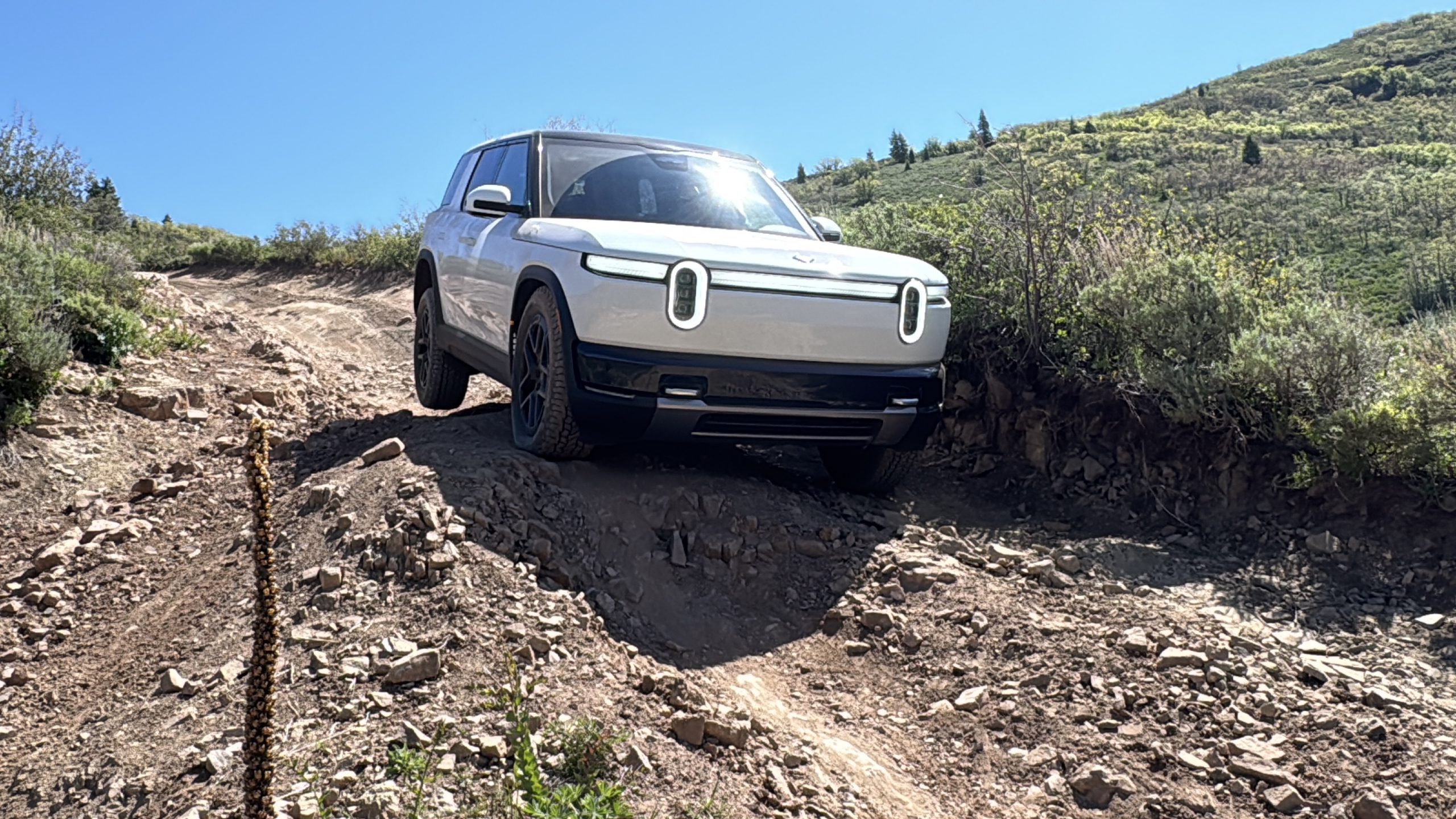
This lack of articulation did not pair particularly well with the R2’s traction control system, which makes do with open differentials front and rear, whereas the R1S can be had with three or four motors — setups that allow for lightning quick torque vectoring on the rear axle. The R2 utilizes what some call a “Brake Lock Differential,” which is basically just strategic application of the brakes to force torque to the wheel on the opposite side of the axle. It’s rudimentary, but usually it works well enough, and has been found on Jeep Wranglers since at least 2007.
The R2’s system isn’t perfect. I noticed something a bit odd when trying to mount the rock you see in the image below:
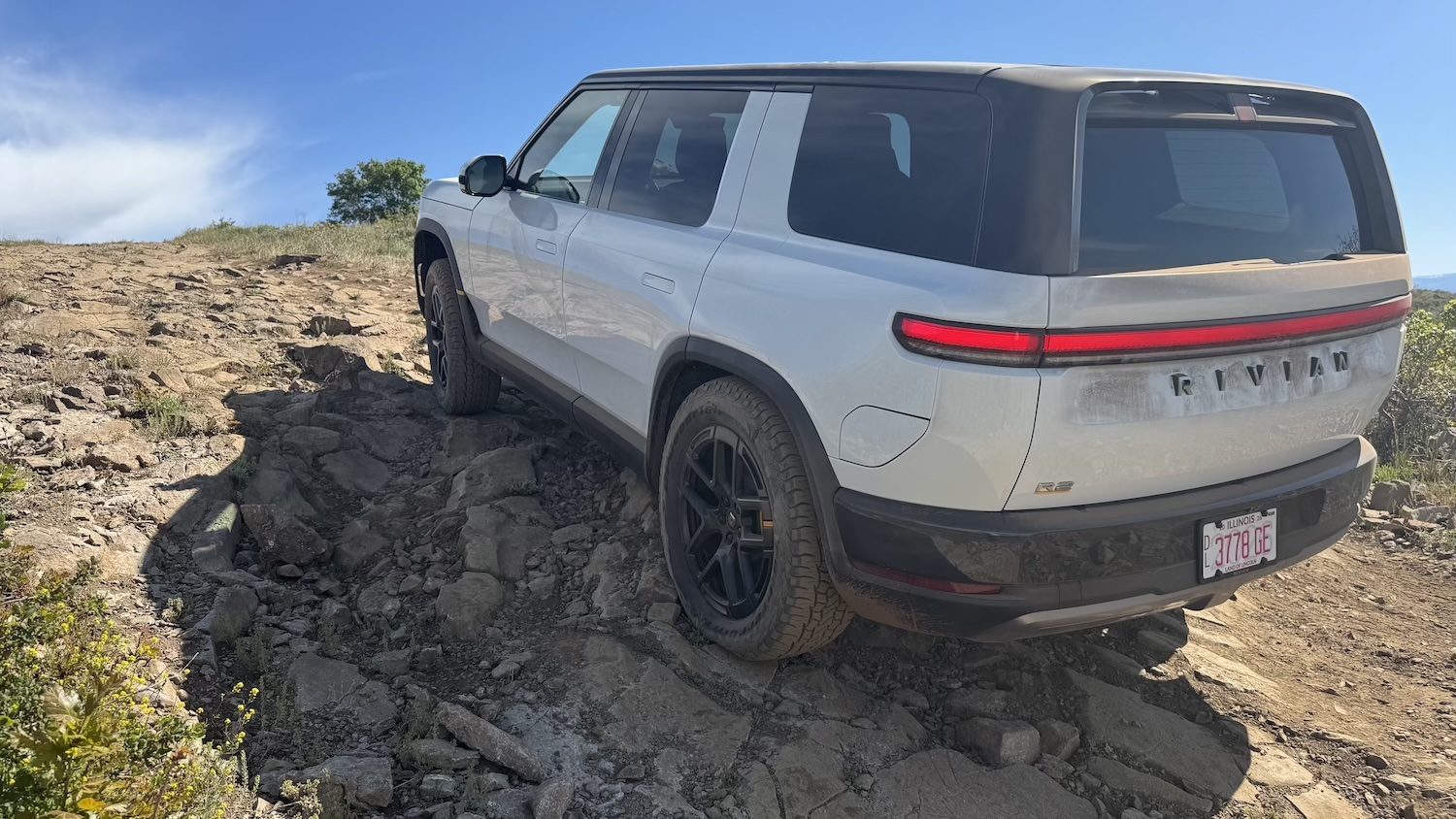
What happened is that, for reasons unknown, only that front left tire seemed to be spinning, while the others were stationary. But that tire was spinning quite slowly, so I pressed deeper on the pedal. I still wasn’t climbing the little rock, so I pressed harder, and harder, and eventually the tire got grip and tried launching the car up and over that rock.
I was able to get on the brake and prevent an overshoot, but the point is that I felt this little climb shouldn’t have been that challenging, especially given that the tires were aired down. That rear axle should have had plenty of grip, and it should have helped propel the vehicle up onto the rock with ease and control.
But this is a challenge with EVs. They’re heavy, they pretty much always feature fully independent suspensions that don’t flex particularly well, and because of the nature of having multiple completely separate drivetrains (two in this case; the R1s have four), you’re limited in how much of the overall system torque you can send to a given wheel, plus the drivetrains have to communicate with one another and with the driver understand vehicle linear speed, driver desire, and on and on. It’s a lot more challenging to develop than, say, a fully-locked drivetrain on an internal combustion engine vehicle.
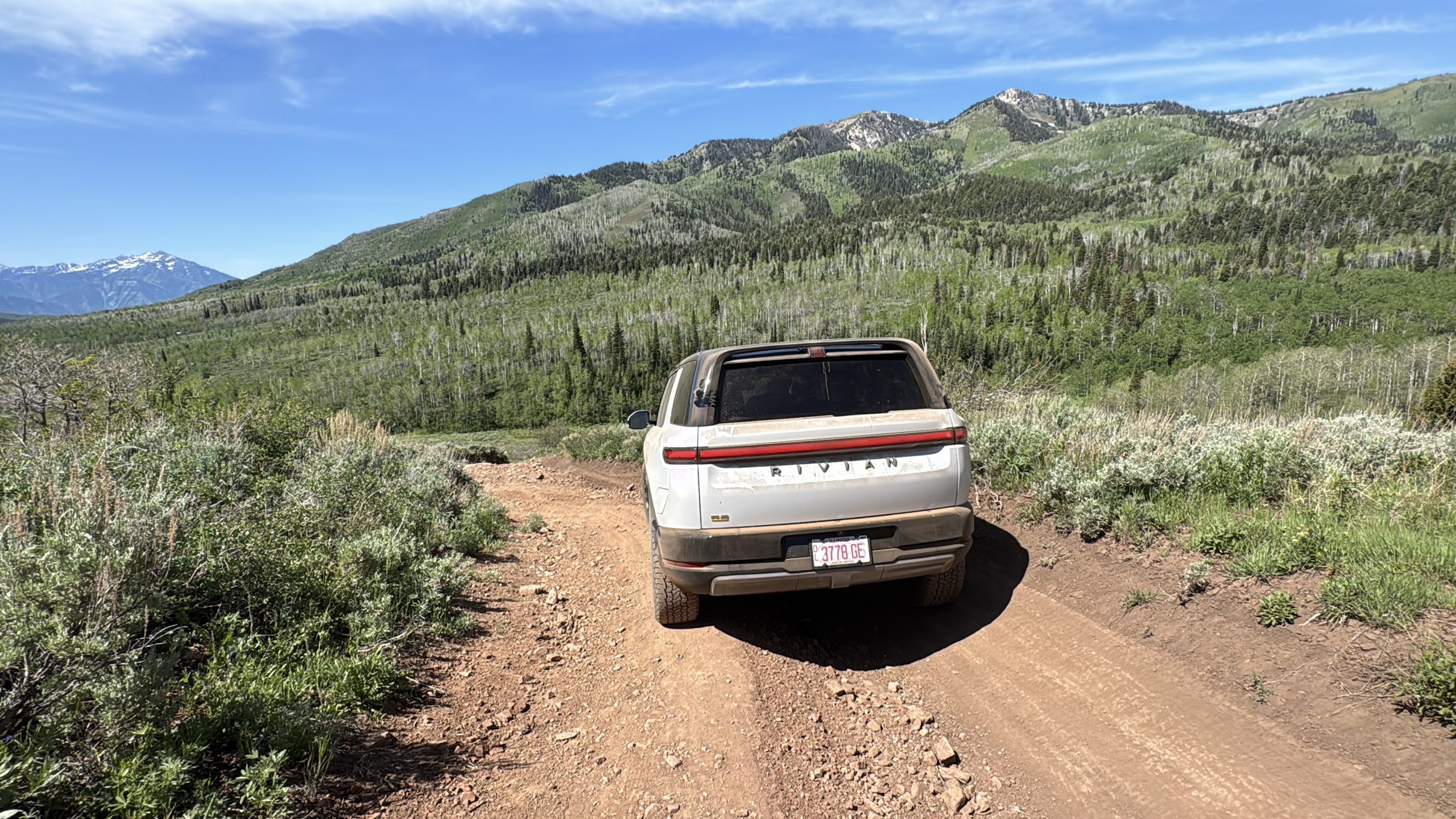
If you look at the video in this section, you’ll see that, climbing down fairly modest rocky trails, the tires would often lock up. This seemed a bit unusual, but it was a result of limited articulation and the driver trying to maintain a certain speed downhill. I have seen similar behavior when using hill descent control over a particularly bumpy, steep downhill grade, though this was a fairly modest trail and not that steep.
I also should mention that, while traveling down these loose grades, my drive partner and I attempted to park in order to switch positions, but we were unable to. We threw the shifter into park and went to open the door, only to notice the vehicle sliding down the grade!
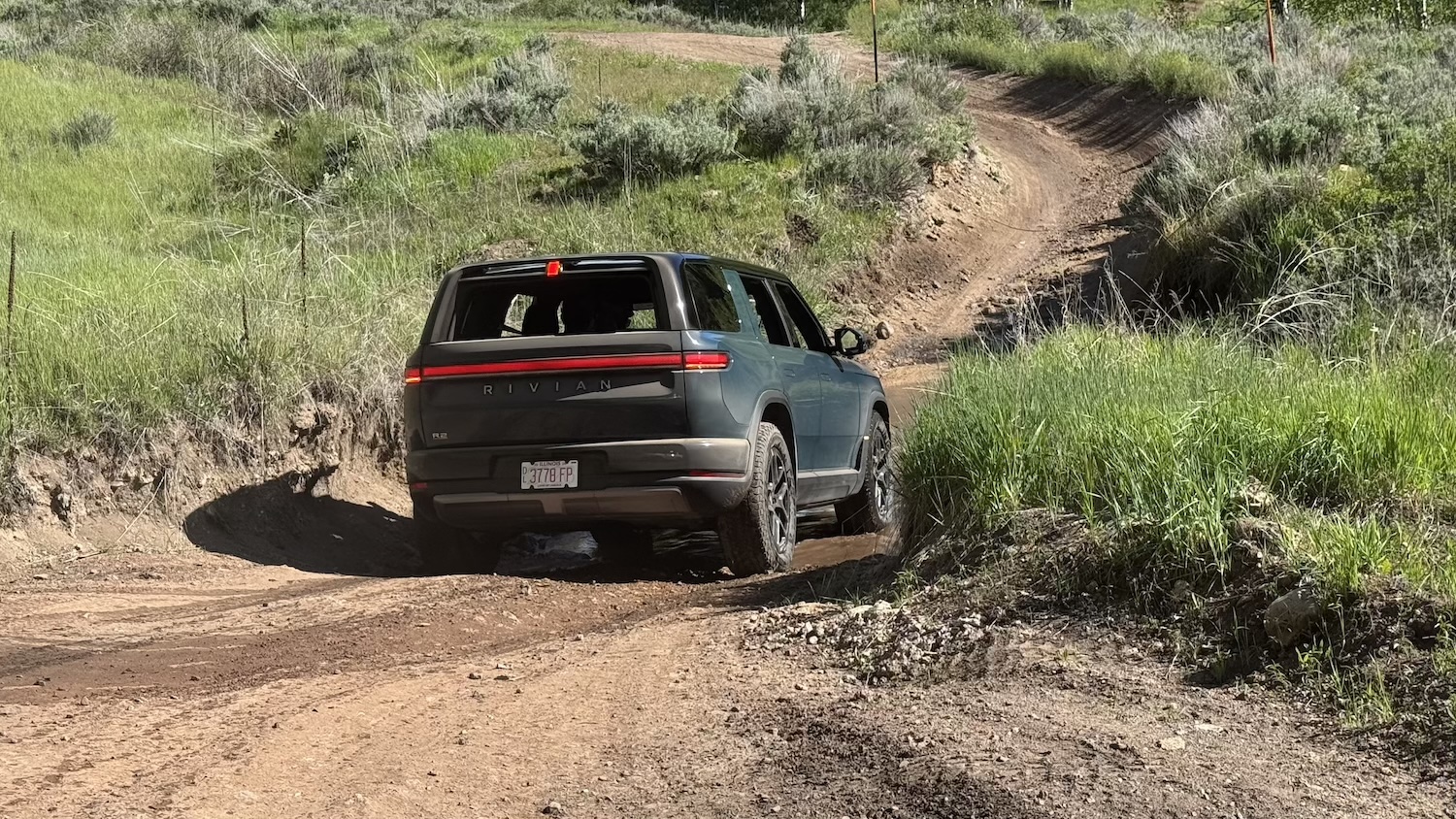
We actually had to drive to flatter parts of the trail in order to park the vehicle because the Rivian R2 (and I’m fairly sure the R1S as well?) only uses caliper-mounted motors to brake the rear wheels. As you can imagine, on a grade, that heavy battery pack tends to just pull those locked rear wheels, while the front wheels do little to encumber forward motion. The inability to park on such a modest grade was something I had never experienced with a four-wheel drive vehicle before.
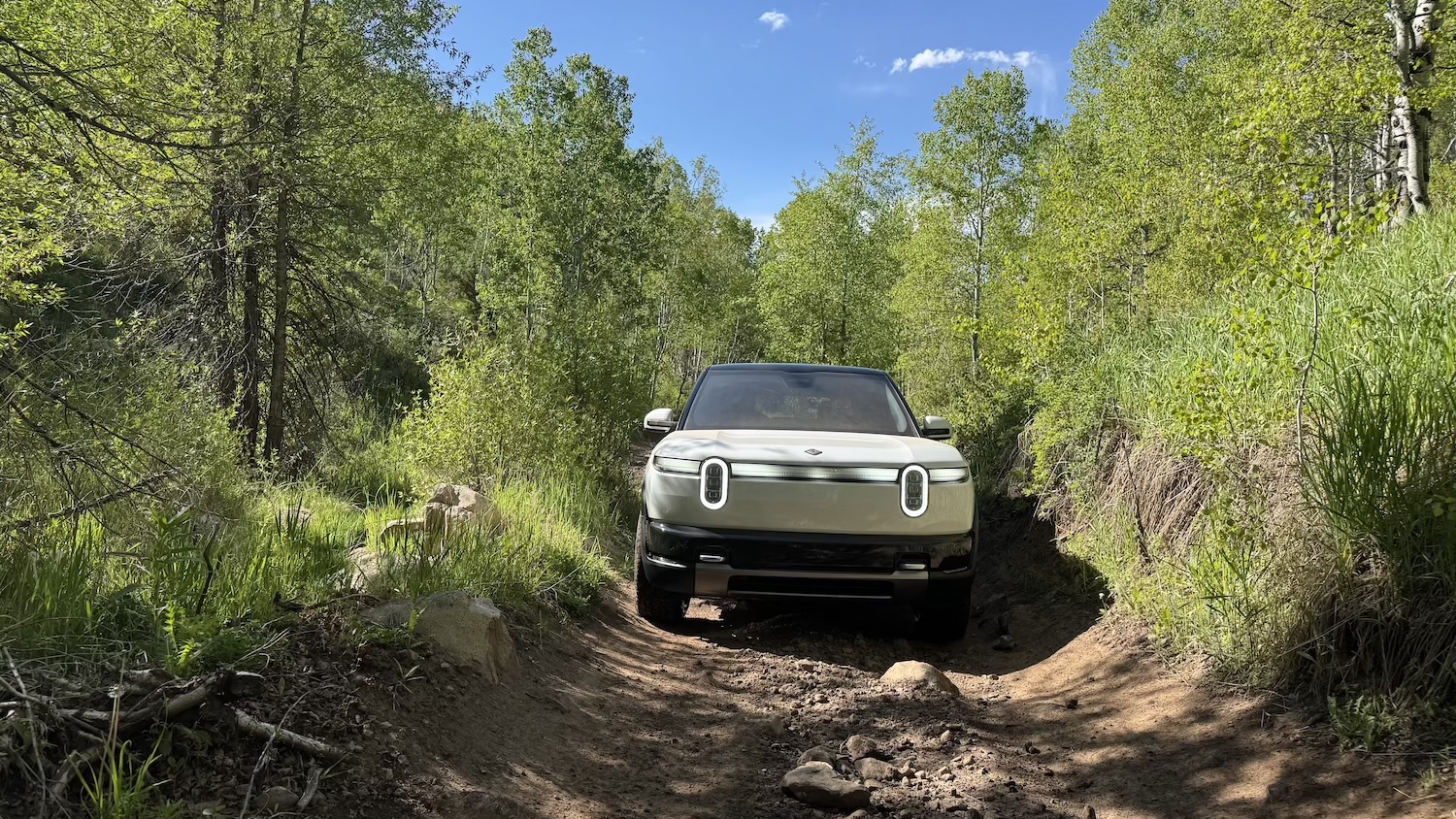
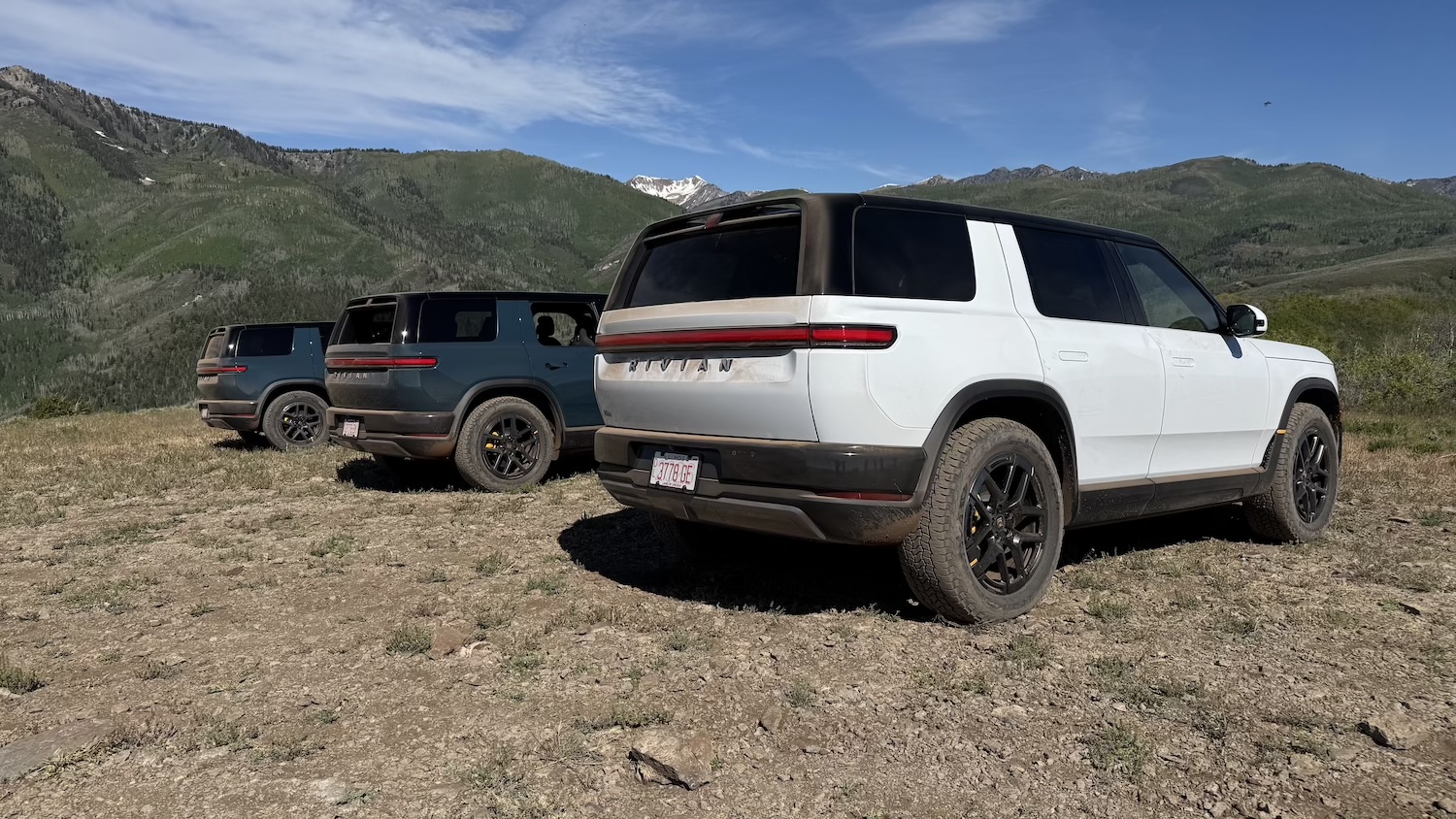
So the R2 has its off-road limitations, but it still got us to the top of our trail, and for most folks who want a vehicle with Subaru Wilderness/Jeep Cherokee-levels of capability, the Rivian definitely delivers, while also offering decent on-road range. It’s pretty much the only vehicle in the space that can do both.
Before I conclude this off-road section, allow me to just say that I wish the R2 had any interior grab-handles whatsoever. It’s a small thing, but especially off-road as a passenger, it’s something you notice.
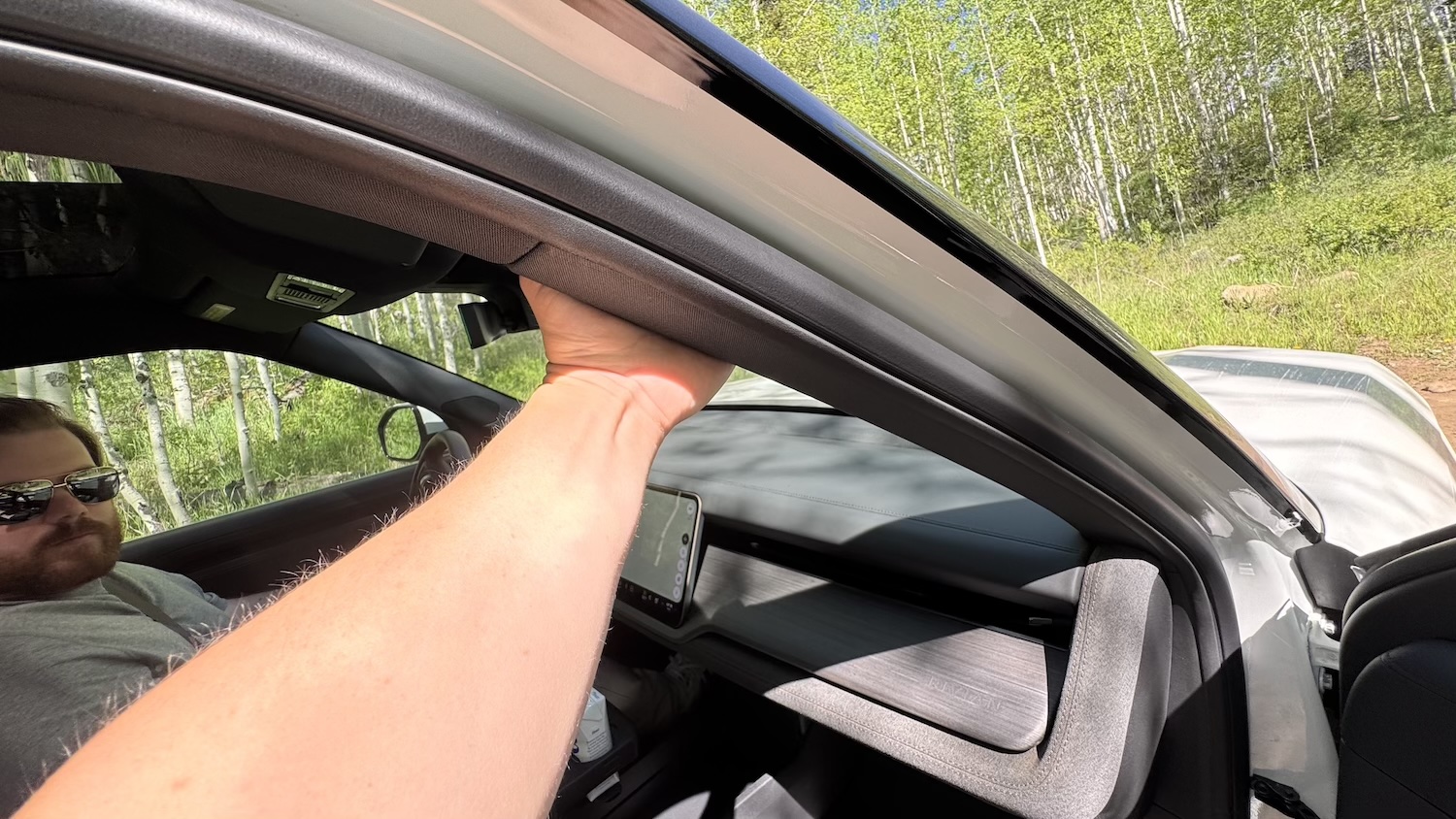
It’s not that I really need it to get into the vehicle, given how low the R2 is, but to stabilize my body as the vehicle bounces over obstacles, a grab-handle tends to be clutch.
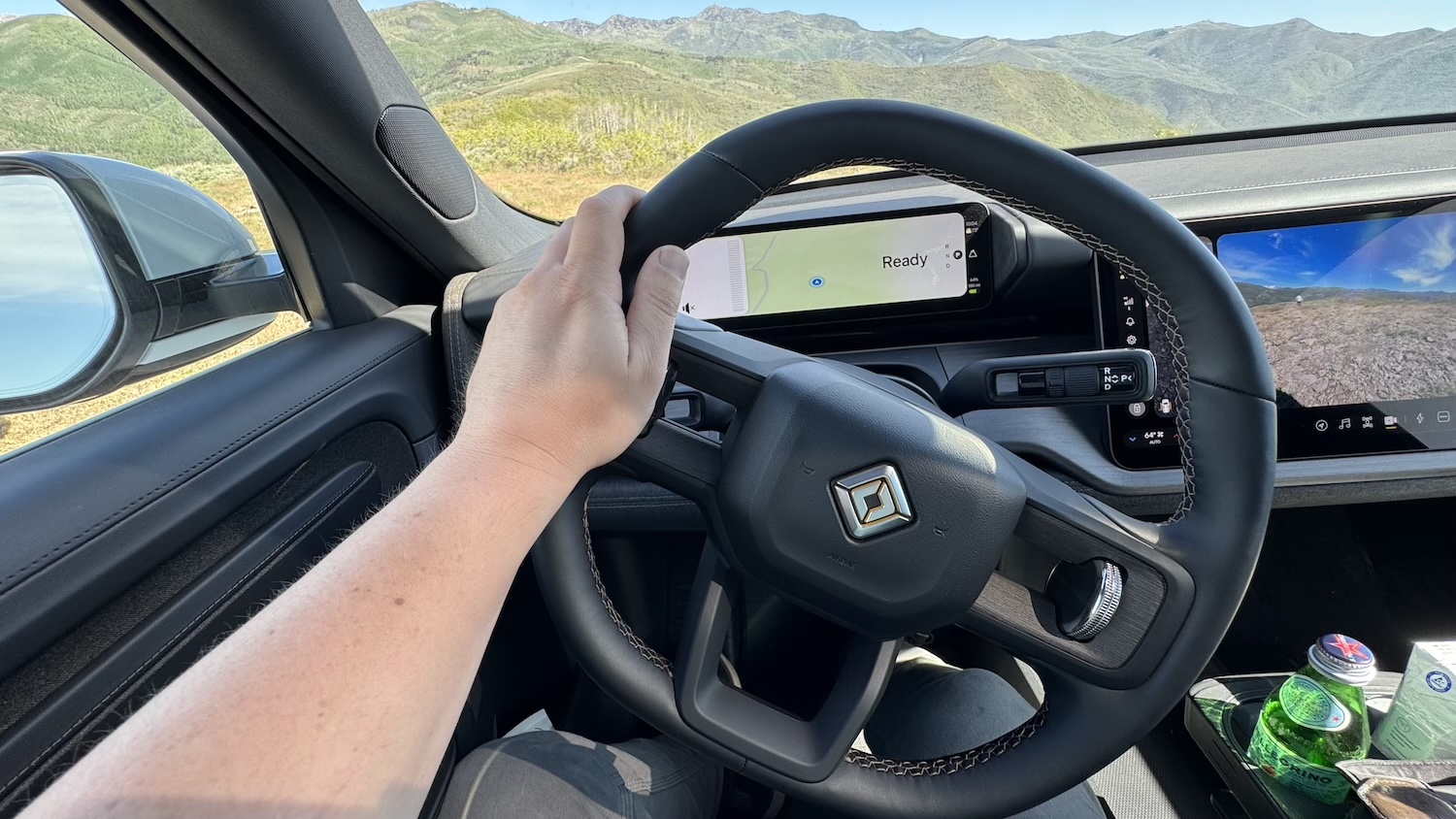
I also found myself accidentally activating those haptic halo wheels as I turned the steering wheel off-road. How big of an issue that is and if, as an owner, I’d change my behavior to avoid doing this, I don’t know.
Conclusion

Right about now, a bunch of media outlets have probably published that the Rivian R2 is a “game changer,” and I won’t lie: My initial headline was similar. But the truth is that I don’t know how to feel about the Rivian R2.
It doesn’t look that special inside or out (especially compared to R1), its range and acceleration figures aren’t mind-blowing for the segment, its off-road capability isn’t amazing, and its pricing isn’t exactly the cheapest in the midsize SUV segment. Is this vehicle really going to sell in volumes that Rivian needs for it to fulfill the role of company-savior? Is there really that much demand for midsize EV SUVs, and how much of R2 sales will be cannibalizing from the R1? (Scaringe thinks the additional visibility all the R2s on the road will give the Rivian brand will ultimately raise all ships, so to speak, and prevent a drop in R1 sales).
I spent a large chunk of my day yesterday contemplating all this, asking around and trying to understand what is drawing so many people in. Why is a modestly off-road capable, shrunken R1 going to be a game-changer for the industry when this segment has competitors with similar performance figures?
The answer really comes down to two things. First and foremost, the R2 benefits from the heavy lifting the R1T and R1S have done over the past decade or so. The R2 isn’t a Chevy, it’s not a Kia, and it’s not a Ford; this is a Rivian, and to understate that would be foolish. This is a luxury brand that, despite being ranked near the bottom of Consumer Reports’ predicted reliability scale, finds itself at the top of that very outlet’s customer satisfaction poll. This is called the Rivian Satisfaction Paradox, and it underscores the strength of the brand.

Rivian put its heart and soul into the R1S and R1T, and while all that development cost the company billions, it also accomplished the hardest and most valuable task one can complete as an automaker: It built a brand. A robust brand. Exactly how robust the brand is about to be put to the test with the R2. We’re also going to learn about how much appetite there is in the market for a cool EV SUV; Scaringe says EV demand is largely being held up by lack of choice; we’ll find out if he’s right.
I think he may be. I think the R2 may not be the cheapest vehicle in this segment, it may not offer the most range, and yes, its styling is derivative and its interior is simple. But it’s the combination of decent off-road capability with good range/efficiency, along with an unmatched cool-factor that will help it stand out in this segment.
I just wrote a 6,000 word review that contained plenty of criticism — the AC could be better, off-road performance isn’t mind-blowing, styling is similar to another car in the brand, the interior could use some switches, and on and on. And yet which car would I personally want to own in this segment? Would it be a Hyundai Ioniq 5? A Tesla Model Y? A Chevy Blazer EV? A Lexus RZ? Maybe a Polestar or a Volvo?
No, it would be the Rivian R2. Forget the spec sheet. The thing is just cool.
All photos David Tracy unless otherwise noted


I will say I read the whole thing. And yet, for me, it pretty much boils down to:
Column shifter! Yay!
No carplay, no buttons, weak AC? Nevermind. Pass.
Struggles to park on mild grade? Runs away.
No article better explains why a membership here matters
Rivian: clever yet dumb. Nobody wants HVAC vents controlled by a screen. Have they never been hot and then cold? Been married? Had a mother? Lived with someone who had hot flashes? I’m not talking about gradual temperature changes, but the “I need cold air blasting me NOW” kind of times. Followed by a swat at the vents to move the air away mere moments later.
Also, doors lacking physical unlatch handles inside is batshit crazy dumb. It’s a problem that was solved. SNL even made that skit about it.
I’ve got money approved to buy an EV and they all have giant screens and SUCK. None of them are landing in our driveway.
will you throw your money at Slate? If not…why?
I would have to drive one and then really think hard about how it would be repaired. I also don’t like giving a Bezos company any money. I doubt I would buy one. I’m leaning towards an old pickup that I will have EV swapped. Crank windows and basic amenities.
So, you make fair points.
However, is there some sort of drop in kit to convert old trucks? If you’re doing the hobby thing, ok. Like, I just bought an old F150.
I have seen nothing that I could do to make it into an EV that would be safe or effective.
Nothing plug & play yet. I’ve been looking into it.
Debose? Garage out of Canada has been working on a drop in solution at least as a hybrid hevy duty pickup
https://www.electricclassiccars.co.uk/ will work with you to convert any vehicle I think you want, however they are in Wales.
There are some conversion companies in the US though Im not familiar with I think any of them… and plan on spending minimum $20k plus to start…
https://www.hybridcenter.org/electric-car-conversion-companies/
I certainly like the ‘resto-mod’ approach in general, with evs as direct competitors with ice vehicle capabilities is still relatively new, and for trucks still on the expensive side for auto manufacturers themselves… if you attempt to convert an ice truck to ev it Will be more limited in capabilities, range especially than its original ice configuration.
And IF you are one of the less than 8% of truck users that tow regularily, sadly in the US there really is only one realistic option in the Chevy Silverado EV / GMC equilivant, with, when towing, still able to go about 200 miles bf recharge needed bc of their giant 200+ kwh hv battery pack.
Personally I love the capabilities of the Silverado EV and used this will be the ‘best deal… I just dont like how flipping huge it is.
You seem to have good knowledge on this. So I have questions.
At what point does the cost of such a conversion outweigh the benefits? Or is this something that the early adopters eat the cost and future swaps are much cheaper?
I snagged a (project) 1989 F-150 with a stick and the 300 specifically so that it is easy to work on. It does not run right now, so ignore my anger and frustration that vacuum lines are a real thing. Assuming I can get ‘er rolling in the coming weeks when I have time…would such old iron be the way to go with swaps, to avoid newer nonsense with wiring?
I’m wondering if there’s a market for something like the Ursa Ag, that has just begun sales out of Canada.
https://wheelfront.com/this-alberta-startup-sells-no-tech-tractors-for-half-price/
1st I Love the Uras Tractor! I 100% want to see the same basic capabilities of an ev car or truck.
+300 miles range at 70 mph and 10-90% recharge in 10 min., ac/heat, radio + maybe satellite radio and a small screen in dash that mirrors your cell screen.
“At what point does the cost of such a conversion outweigh the benefits? Or is this something that the early adopters eat the cost and future swaps are much cheaper?”
IF (intentionally a very big IF), you are experienced hobbiest with converting cars or trucks from ice to ev, I think a car or truck could be converted for a reasonable price less than buying a used ev car or truck as long as you want to use the converted ev as a local run about with real world range from about 150 to maybe 200 miles of range and fast recharging in 30ish min from 10% to 80%. As long as you take your sweat equity as free labor. EVWest in the US has kits that can help convert a classic Car to achieve these stats.
Attempting to convert ice to ev car or truck that can has similar or better range and recharging performance, so say +300 miles of range at 70 mph and recharging times from 10% to 80% in under 20 min… Highly improbable you will be able to convert something yourself or with an existing ev packaged conversion kit anywhere outside of China for a lower price to make it worth the effort yourself…
Even if you lived In China this might be difficult to achieve the reason why is because 1st question is why do it when (in China) there are so many ev makes / model options readily available for direct purchase no need to spin a single wrench?
Just like with responding an ice vehicle with a better engine and trans combo., converting an ice vehicle to ev will mean getting parts from a wrecked ev. Long range Model 3 or model Y or long range Ionic 5 or Ionic 6 being the most available likely donors in the US market for ev car.
For trucks again I’d look for a wrecked Silverado EV 4wt (long range) in particular for its enormous +200Kwh battery pack. I would Love to see someone convert any Classic truck using the innards of a Silverado EV!
My guess (and it is exactly that one person’s guess)… it will be a Solid another 5 years before an ev kit is on the market in the US to convert a truck And able to give 300 miles of range and 10-80% recharge in 20 min. Rason is basic physics.
Even that may be a stretch bc I think the avilabe market will be too small and the price point a kit could be sold at that people would be willing to pay will be too high.
Especially with Ford, Slate Telo and others Finally attempting to make affordable (around $30k base price) ev trucks.
I will wait patiently (actually, I don’t truly care) to see any of these guys come up with something that is function for a vast majority of this country, when viewed by size.
The idea that a functional truck could be more than a novelty is at this point. Not possible. Every example thus far that exists is either vaporware or so ungodly huge it’s not a real option. That includes the GM and Ford beasts.
The idea that a functional offroader could be a true expo or outdoors beast is also vaporware, and not just because Stellantis is filled with deeply stupid people (a la the 4xe nonsense). Battery capacity make a huge leap, perhaps.
Someone who develops a motor/batt system, like a skateboard design, that fits in the bed of a truck and yet allows usable capacity will have a winner. Think of it: RWD to start, batt in the bed, drop a cable down to a motor in the axle. Done. Repurpose fuel filler door to be a charging port. Yes, throttle etc will have to be resolved.
So sad! I really want to like Rivian. You had me going until…
“but the infotainment and most other controls must be accessed through the screen. That includes the HVAC vents”
This is just inexcusable.
I came here to say the exact same thing. I won’t tolerate that.
This was really interesting – but those interior controls are a dealbreaker giant Ipad stapled to the dashboard and it doesn’t even have Android Auto? Pass.
It’s not 100% clear whether the vehicle rolled or slid down the hill, but not rolling down moderate hills when parked should be table stakes for any vehicle built after 1985, and not sliding down moderate hills when parked should be table stakes for any offroadable SUV with appropriate tires. Why did David not immediately return it and call his lawyer?
I think framing this review in terms of compromises is the correct take. And it seems to me that Rivian made all the correct compromises here.
The pricing for the base model is really impressive for what you get.
The picture comparison you share of the competition’s interiors I think is more stark than you make it seem. The Rivian’s design and materials look significantly better, and that includes the Lexus (at least on design, we know Lexus materials are nice).
I prefer the Rivian’s interior layout/airy feel. But the Lexus feels markedly more upscale.
Does anyone know if a vehicle rolling away when parked on a hill would lead to a recall?
A scenario I’m imagining is someone parks on a hill in the morning and it’s dry, later it rains and the Rivian just rolls away killing a small family of ducks.
Did they mention how many reservations they had and how many they expect to build/sell per year?
It does look like they did great with the space in the front and second rows. Other than that I see a number of poor ergonomic choices.
That center console isn’t great. Yes great to have a place for my wife to put her purse, but with those low sides it isn’t going to stay in place well and end up in the driver’s foot well. The little tray also seems like a great idea, other than you can’t open it if something tall is in that front spot. Even if that area is clear you’ve got the cup holder in the way above it that you’ll need to empty and stow for good access. The cup holders themselves aren’t that great with the drop down bar for the bottom. With a closed bottom you can use it for things other than drinks.
Now I don’t mess with the vents that often but my wife does, so yeah it shouldn’t be motorized and controlled by a touch screen. I firmly believe that the only time a motor should be attached to HVAC vents is the old Mazda 626’s party trick, swing mode.
I don’t see any mention or pictures of a frunk. Does that mean it doesn’t have one? If so that is another miss.
The Halo wheels seem like a case of just because you can doesn’t mean you should. It sounds like it isn’t going to be particularly hard to make it scroll while you are trying to push down, over or up.
OK, but: this, or the Scout?
For me, Scout by a mile. The EREV is a game changer and I wish Rivian got onboard.
Great review and writeup David! And I have to agree… if I was shopping for an electric SUV in that segment, is there anything I’d want more than the R2?
I can’t think of anything.
Now having said that, the R2 and the vehicles in that segment are too big for my purposes.
What I’d want for myself is the upcoming R3.
84.7 inches wide? Sheesh, that better include the mirrors. It includes the mirrors, right?
I suppose putting proper door handles on this would have cost them, what, another mile of range?
C&D has it at 75.0 inches wide, so I think you’re right about the mirrors.
Great in-depth article!
Also when I was in the Sixtine Chapel I thought it was quite small…
You are right. A wrap to cover the glass ceiling depicting God delivering the spark of life to Adam would lend to the Sistine vibe and maybe help the AC as well?
Honestly, the R2 seems like a pretty ok deal considering you get an EV with solid range, that I think looks better than virtually any other EV, with great packaging and features for a not completely eyewatering price. It seems oddly fair. Rivian is going to sell a whole lot of these to people who are EV-curious and would normally be drawn to something like a Grand Cherokee. They were smart to keep the price down and simply make it as capable off-road as the usual unibody soft-roaders.
If they can produce the R3 to be a smaller but similarly functional vehicle for less money, that’s when we’ll start seeing Rivians damn near everywhere.
Thanks for the great, technical article as always David!
The big thing I have to ask that you hinted at is how does this really stack up against the others in its price range/class? You said you would take it over them because its cool, I respect that, but would a normie? I bring up the Blazer EV as on paper it really lines up well with this in cost, size, performance, range, while having optional SuperCruise, which to some is the real game changer if you have a long commute.
The Tesla and Hyundai, Lexus are strong competitors too, this really just seems to slide into the pack of EV SUVs without a single thing that sets it apart. Those others either have a cost advantage, luxury advantage, or Automated driving advantage. Is the R2S’ selling point a slightly better than average off roading ability? I guess I get that as its what Subaru leans into.
So end of the story, should Subaru buy Rivian to make its EVs?
I am actually not as excited for the R3 as I was before reading this review, as it may look kinda cool but I shouldn’t expect anything special, given how they did the R2.
This comes from someone that likes Rivian and hopes they succeed. The R2 is just a bit out of my price range or I would have had it on my short list for next vehicle in the upcoming few years.
I don’t know the answer. It’s for this reason that I did not call it a game-changer in my headline. I think it’ll be a big deal for the brand, but will it change the game industry wise? I don’t know.
I appreciate the answer! I agree that it is generally the right direction for Rivian to keep the company going, it’s just hard to discern it out of the pack. The R1T/S do tend to stand out in their high end truck market even against the other super EV trucks like the Hummer and the Cybertruck. I just hoped the R2S could have somehow kept more of that recipe. I would put the R1T as my first choice hands down if I could afford and was looking for a Ev pick up.
“So end of the story, should Subaru buy Rivian to make its EVs?”
More likely it will be VAG buying Rivian as they already made a big investment in the company and are using Rivian to handle their BEV software development and other stuff BEV related.
You are right that Subaru will not be buying Rivian, VAG is the most likely candidate. I was going a bit more tongue in cheek that Subaru doesn’t really have much in the way of EVs and Rivian seems to fill a similar niche of environmentally conscious off-road capable cars.
Great review from start to finish! I’m pretty impressed with the R1 and R2 both engineering and looks wise. I DO want Rivian to succeed and see the R3 happen.
If we were in the market for an EV we’d definitely be checking out the R2. It’s nice to see something that’s big on the inside in a time where everything seems big on the outside and small on the inside.
Yes, you do. They’re called “pianos” and a lot of people have them.
Not that I’m advocating for more piano black in vehicles, but this statement is just silly.
Someone should tell that to the suckers in my area who bought the 7 figure houses on the parade of homes that definitely had visible vents.
This is all marketing BS to avoid admitting the actual reason: They were copying Tesla.
That’s egregious. If it can’t handle traffic lights and signs then it should not be usable on roads with those things. I would expect this kind of flagrant disregard for sanity from Tesla. Disappointing that it comes from Rivian.
I suspected that would be the case when they first revealed those. My truck also has scroll wheels on the steering wheel and I’m not a fan, in part because of the accidental activation of them when making tight maneuvers.
That does not bode well for their mass market adoption. Early adopters and fanboys will forgive terrible reliability. The mass market won’t.
Overall I’m pretty disappointed in this thing. It seems like they spent a ton of time on little stuff and overlooked some really big stuff.
However, 10/10 for this review. I wish I could get something this detailed for every vehicle I’m ever interested in buying.
‘meh. Nobody calls a black piano “piano black”. It’s just a piano. “piano black” specifically refers to plastic trying to look like a piano.
50K for a steering wheel from Renault.
This kind of absolute deep dive is no small part of why I’m a subscriber – just fantastic work.
I wish Rivian would use the round headlights it uses on its Amazon vans rather than the Mr. Krabs headlights on its passenger vehicles, but I understand why it’s their brand signature.
I wouldn’t mind getting one these slightly used in a few years if they are around the 35k-40k range but think I rather wait for the R3X as long as Rivian doesn’t kill all my hopes with their AI talk. Hopefully these sell well enough the R3 does actually come to fruition.
Thank you for finally addressing a question I’ve long had on whether glass roofs were as terrible as I thought they were because of the solar load.
yes they are. I despise them and they should all come with a full cover.
This is the real problem. Not that one might choose to have one, but that one is not offered a great way to cover them when one doesn’t want it.
This is maddening:
“you don’t see vents in elegant homes, so you shouldn’t see them in a Rivian, design Chief Jeff Hammoud told me”
Design Chief Jeff should have spent more time with people who are actually going to buy this, or maybe at least spent time away from his fancy castle without vents. Rivian is trying to produce a more affordable vehicle! That’s a fun adventure vehicle! Why in all of the heck’s was he thinking “elegant” beyond the usual designer arrogance?
Yeah, that sentence stood out to me as well. I don’t utter the words “what a pretentious prick” often, but Design Chief Jeff should have a re-think about what a home is vs a car.
This may be the most useful car review I’ve ever read in the sense that it may actually directly impact and change my decision making.
I’m an early R2 reservation holder and was eagerly awaiting my invitation to order until I read DT’s comments about the A/C. My biggest concern about the R2 is the uncoverable glass roof, and if the AC can’t keep up, that is going to be a deal-braker for me here in Colorado where even in winter direct sun can make a car uncomfortably hot very quickly.
I don’t “get” the glass roof thing in general. Feels like another trend-based design choice that the world will eventually decide was a neat trick for some high-end cars, but not really a rational design choice for mass-market vehicles.
ceramic tint on that roof would be my first stop. I don’t need to see through my roof.
Wouldn’t be surprised if Rivian starts selling a addon sunshade for it.
It would be interesting to see Rivian literally throwing shade at it’s customers.
*inserts drum sting gif*
Also side note I remember seeing Polestar having one for my 2 and yup just looked it up they literally sell one for the 2. Like hey here is this cool but very inconvenient glass roof it will suck on the beating sun so you know what? We will sell you a shade for your inconvenience (which we caused)
It should not be an insurmountable issue. I have an EV with a glass roof, and I have not noticed any issue with the AC keeping up. Hopefully an adjustment before release is enough.
I hope you’re right. It absolutely should not be an issue…but if the heat-pump and\or blower just aren’t quite high enough capacity to keep up with direct sunlight at 10K feet in the summer…I don’t want to be among the owners to figure that out so they can fix it on gen 2.
It’s a big enough concern that I now absolutely need a test drive on a hot, sunny day before I sign on the line, so to speak.
If my white roofed car with the windows cracked was at 125F inside today, I would hate to see what a glass roofed car would be in the summer.
They better hope the interior can survive 150F because that’s what it will get to in the desert southwest.
The bench seat nerd in me thinks that front row console is screaming for a jump seat.