

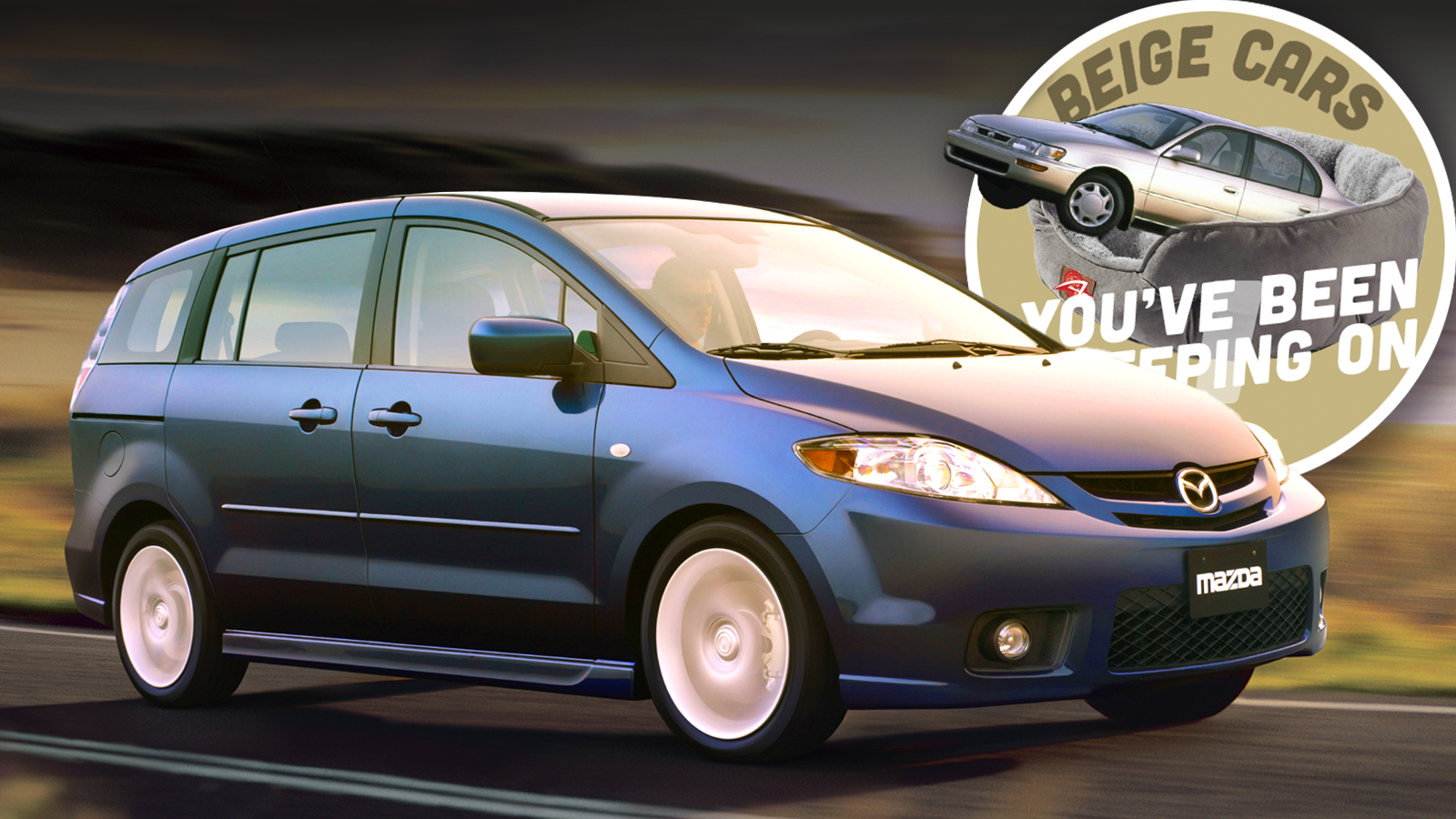
I’m going to say it: Minivans are cool. Just like how a supercar is ruthlessly optimized for going fast, minivans are relentless in their pursuit of practicality. The sliding doors, the folding seats, it all just makes so much sense. However, minivans often aren’t fun to drive. Contrary to their name, most modern models are rather big and hefty. Most, but not all. For nearly half of the past 20 years, Americans could buy a van that weighed less than a midsize sedan and handled almost like a compact car. I’m talking, of course, about the magnificent Mazda 5.
The mid-2000s was Hail Mary time for the minivan segment, in the sense that automakers were trying everything just to make a play stick amid the early rise of the crossover. General Motors had those unusual “Crossover Sport Vans,” Chrysler launched its revolutionary Stow ‘n Go seating system, Nissan made the Quest gloriously strange, and Toyota dramatically upsized its second-generation Sienna.


So what about Mazda? Well, Mazda was about to do the opposite of Toyota. By the 2006 model year, the second-generation MPV had just about finished its production run, and while a third-generation model was ready on deck for Asia and New Zealand, Mazda had other plans for export markets.
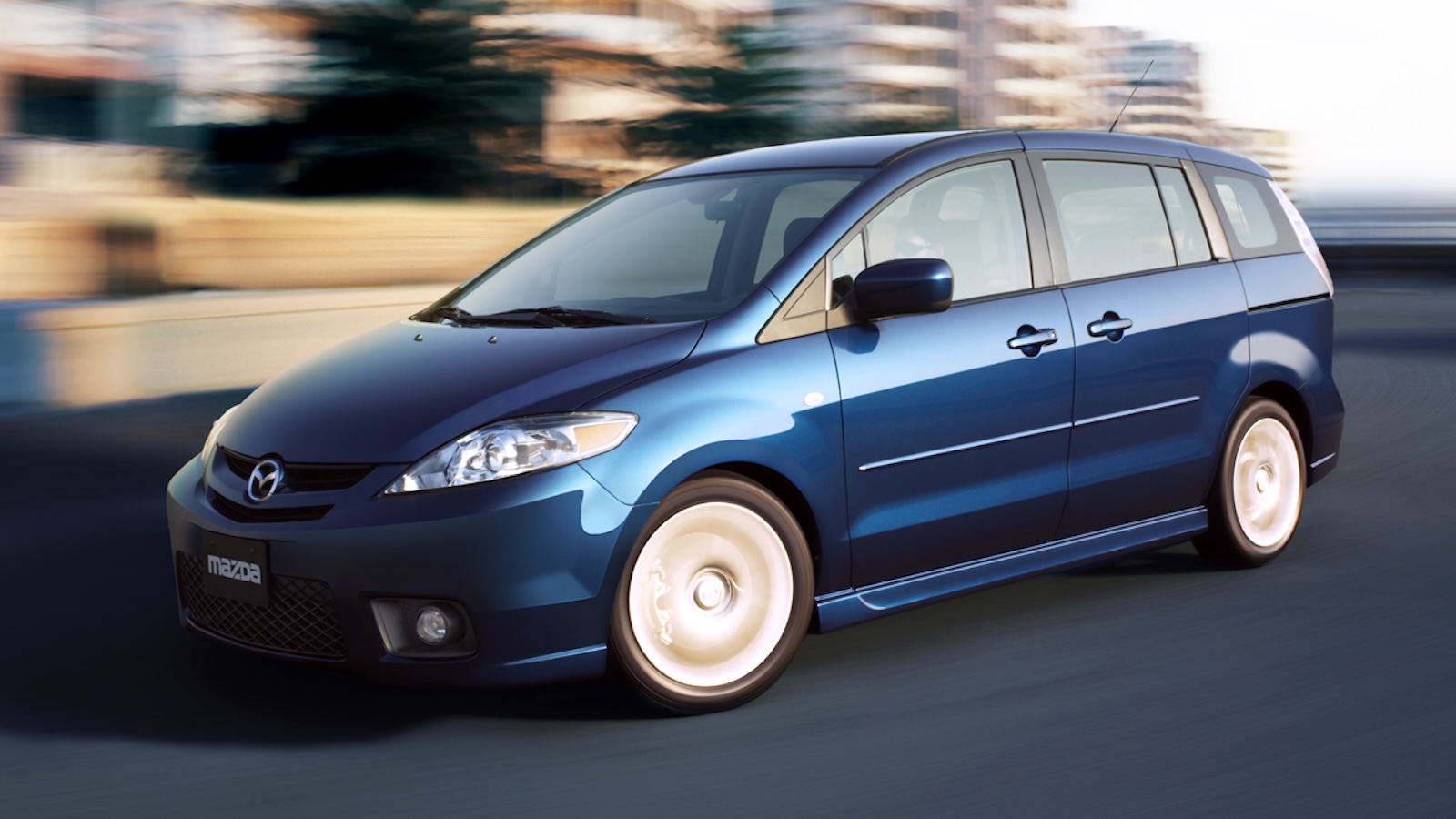
The plan was simple: Take the bones of the Mazda 3 compact car and use them to build a properly mini minivan. We’re talking a machine eight inches shorter and almost three inches narrower than the second-generation MPV, yet roomy enough to be equipped with three rows of seats. A 157-horsepower 2.3-liter inline-four would be borrowed wholesale from the Mazda 3 in the pursuit of greater fuel economy, and the resulting Mazda 5 was nothing like any other minivan sold in America through the second half of the 2000s.
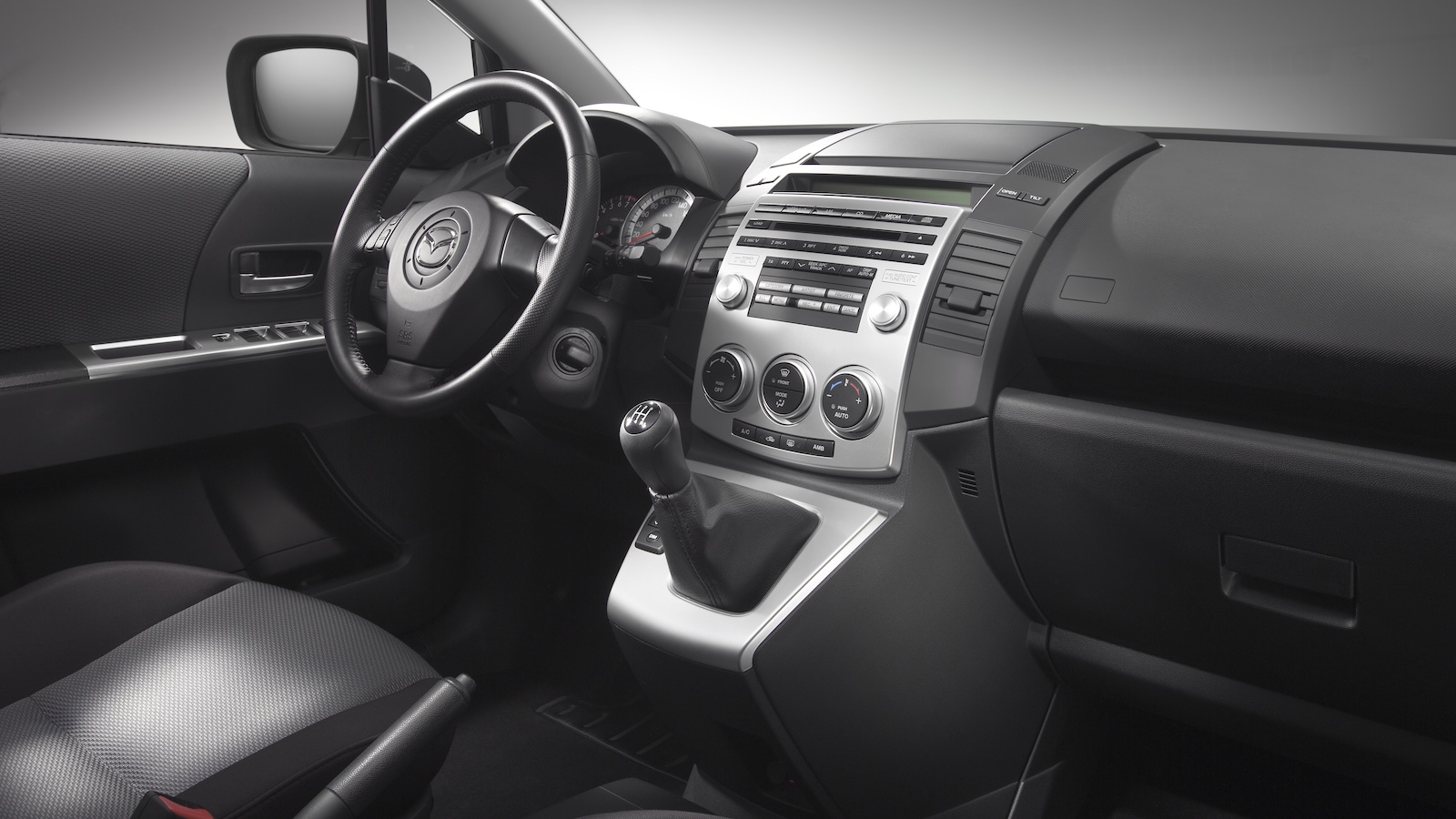
For one, it came standard with a manual transmission, making it the only U.S.-market minivan of its day to let drivers row their own gears. Secondly, the seating arrangement was a bit strange. Not only was it a six-seater with second-row captain’s chairs and a two-place third-row bench, but the seats stowed in a relatively novel manner.
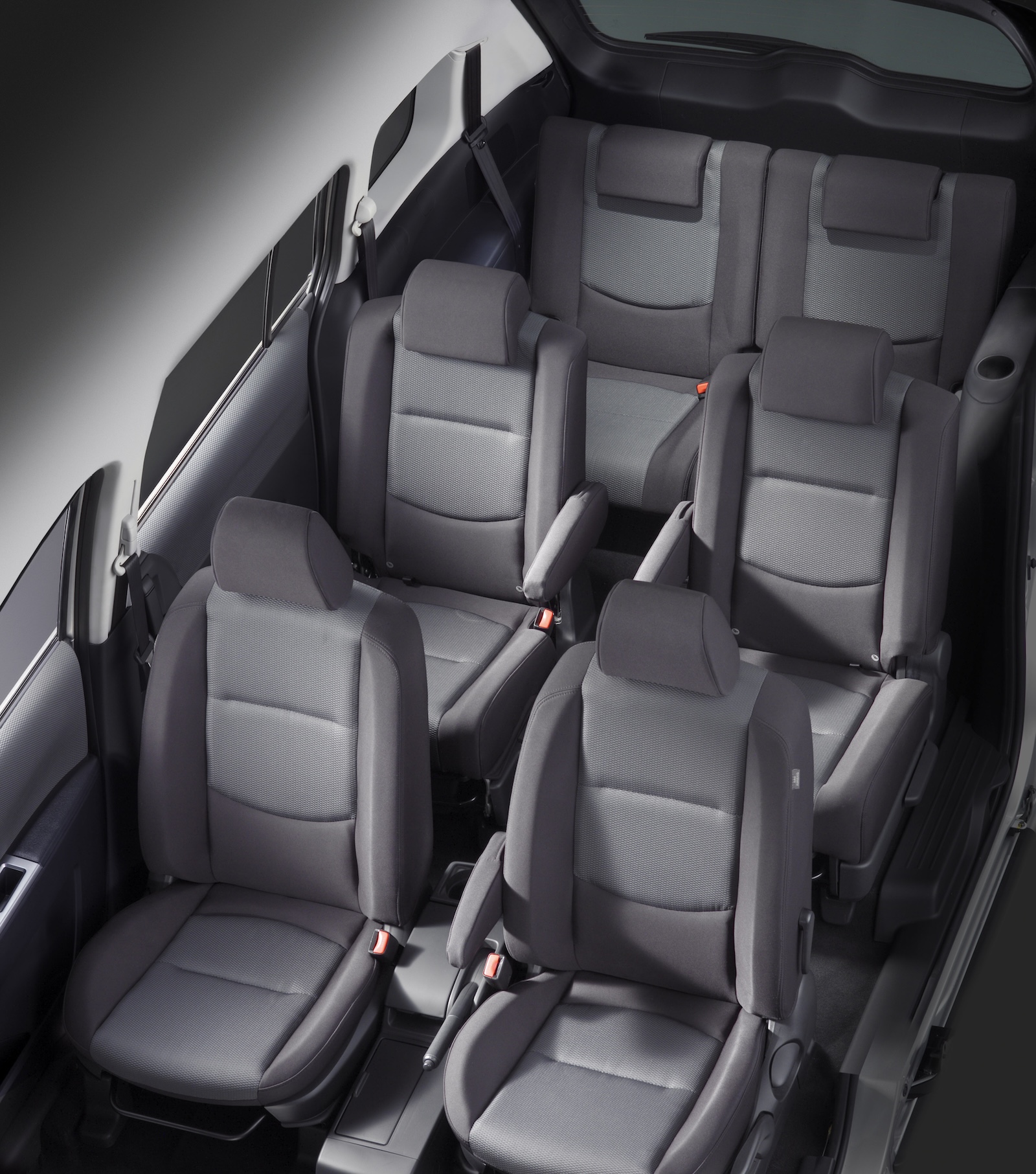
The third row simply folded flat like in a crossover, while dropping the second-row captain’s chairs required flipping up the seat squabs, folding the headrests, then folding the backrests down. The result was an impressive 70.9 cu.-ft. of cargo space with all rear seats folded, and a relatively flat load floor, save for a void between the rear seats that could optionally be filled by a table.
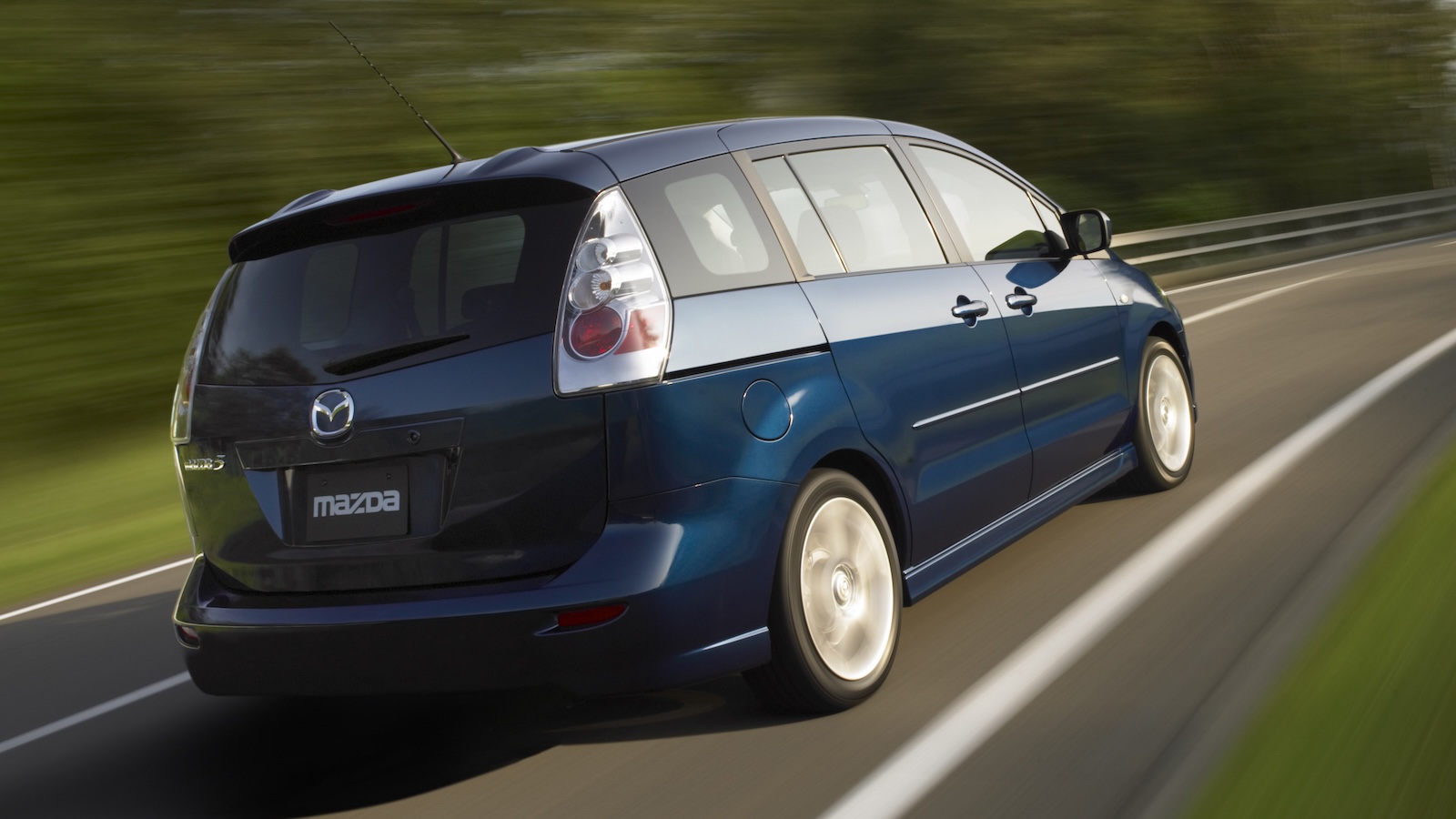
Unsurprisingly, when Motor Trend tested the 2006 Mazda 5, it found that this quirked-up people carrier certainly didn’t drive like other minivans on the market:
Out on the road, the Mazda5 leaves no doubt about its corporate heritage – nor about the fact that it weighs roughly 500 pounds more than a comparable Mazda3s. The suspension bits, electro-hydraulic power steering, and anti-lock disc brakes have been appropriately upgraded to handle the extra mass and payload possibilities, an effort further abetted by semi-sticky, low-profile tires. That combination yields an eminently livable balance of comfort and control, and it does a great job of limiting body roll in corners.
Add in available toys like a moonroof, a CD changer, a navigation system, and automatic climate control, combine that with an EPA highway fuel economy rating of 27 MPG, and the result was a niche but awesome ride for small families and the mildly to moderately outdoorsy. Space inside didn’t rival a Dodge Grand Caravan, and front-wheel drive plus moderate ground clearance meant off-roading was ill-advised, but here was a city-sized sliding-door-equipped machine with up to 1,239 pounds of payload capacity that could swallow bikes whole.
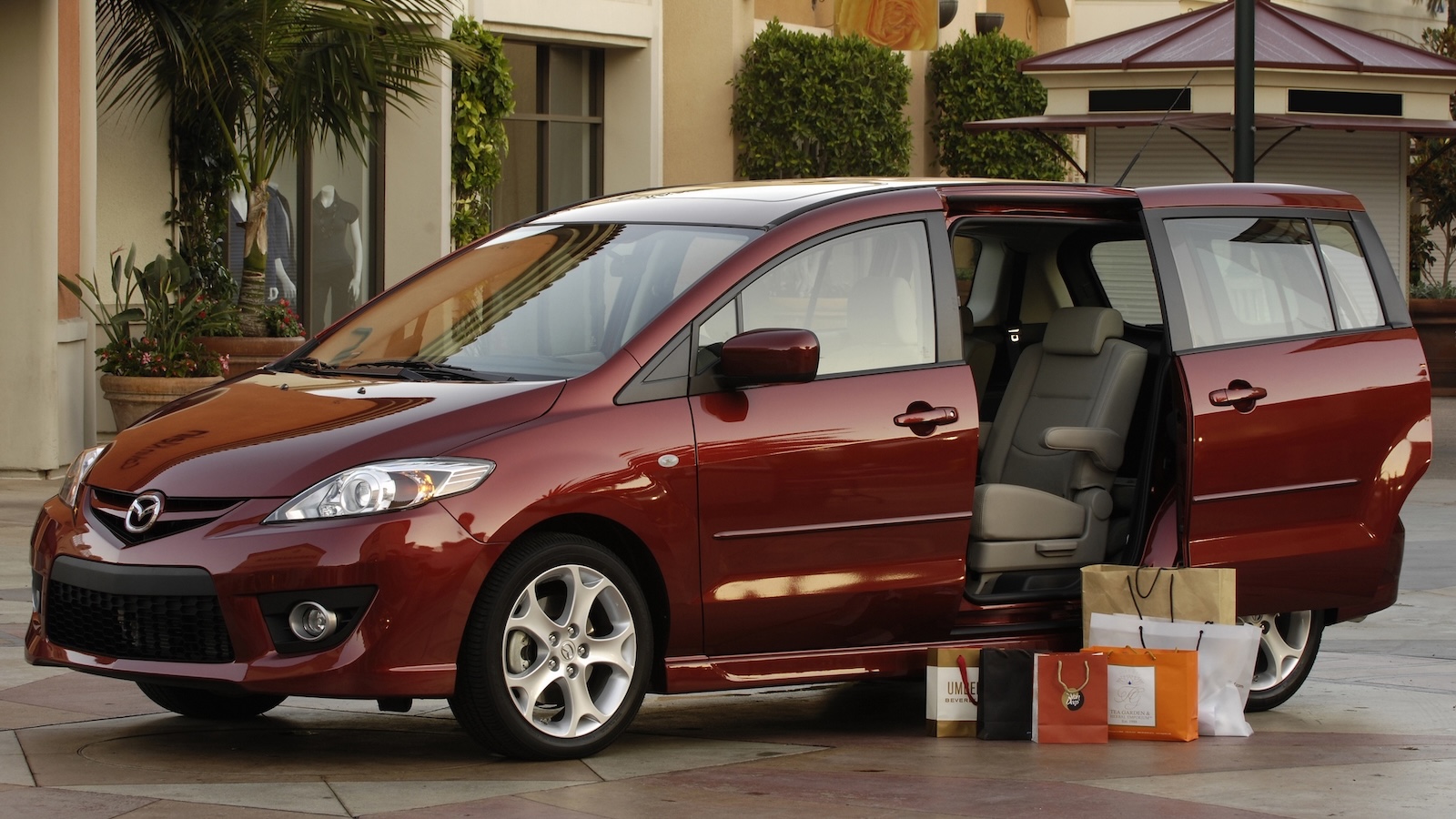
A 2008 update brought in more aggressive bumpers and available LED taillights, but also some real quality-of-life upgrades. The stereo gained an auxiliary input, the second row got air-conditioning vents, and crucially, the optional four-speed automatic was replaced with a five-speed unit. When Car And Driver tested a two-pedal 2008 Mazda 5, it managed zero-to-60 mph in 9.4 seconds. Not quick, but also not uncompetitive. What matters more is that the Mazda 5 remained a delight to drive, as the magazine wrote:
The Mazda 5 might be almost as high as it is wide, but there is nothing square about its ride. The squat look leads to the expectation that it can’t mimic the Mazda 3 in dynamics, but it proves to be a reasonable copycat, thanks in part to its nearly identical curb weight. That makes the 5 about 1000 pounds lighter than the average full-size minivan in our most recent comparison test.
Furthermore, at 0.80 g, the 5 outgripped all those full-sizers on the skidpad. Meanwhile, the electrohydraulic rack-and-pinion steering is accurate and quick at 2.9 turns lock-to-lock, understeer is moderate, and the turning diameter is impressive.
So far, so good. At least if you live in a place that’s sunny. While the first generation of Mazda 5 sold in North America can be a great daily driver, it had one big flaw: rust. After a few years in the salt belt, these little minivans started fizzling like Alka-Seltzers as their sills and rear wheel arches rapidly developed corrosion. By the 2012 model year, it was time for a do-over.
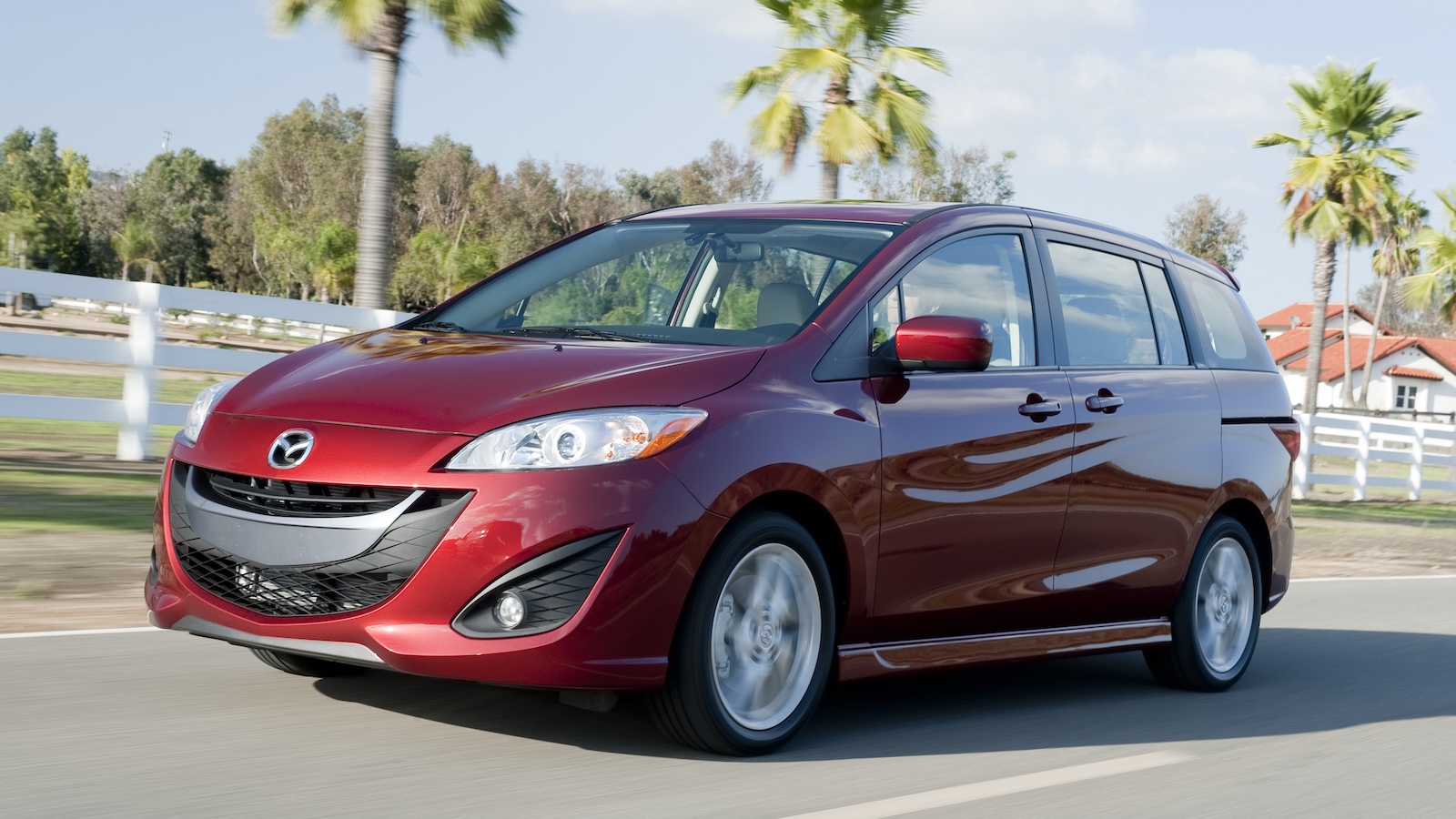
If the 2006 to 2010 Mazda 5 was unusual, the 2012 model was downright zany. It was the only production Mazda ever to use the swooshy character lines of Franz von Holzhausen and Laurens van den Acker’s Nagare design language, but beneath the smiling exterior came a vastly improved model. The old 2.3-liter inline-four went in the bin, and a 2.5-liter unit took its place. The result was an extra five horsepower and 15 lb.-ft. of torque. At these power levels, that’s a noticeable increase.
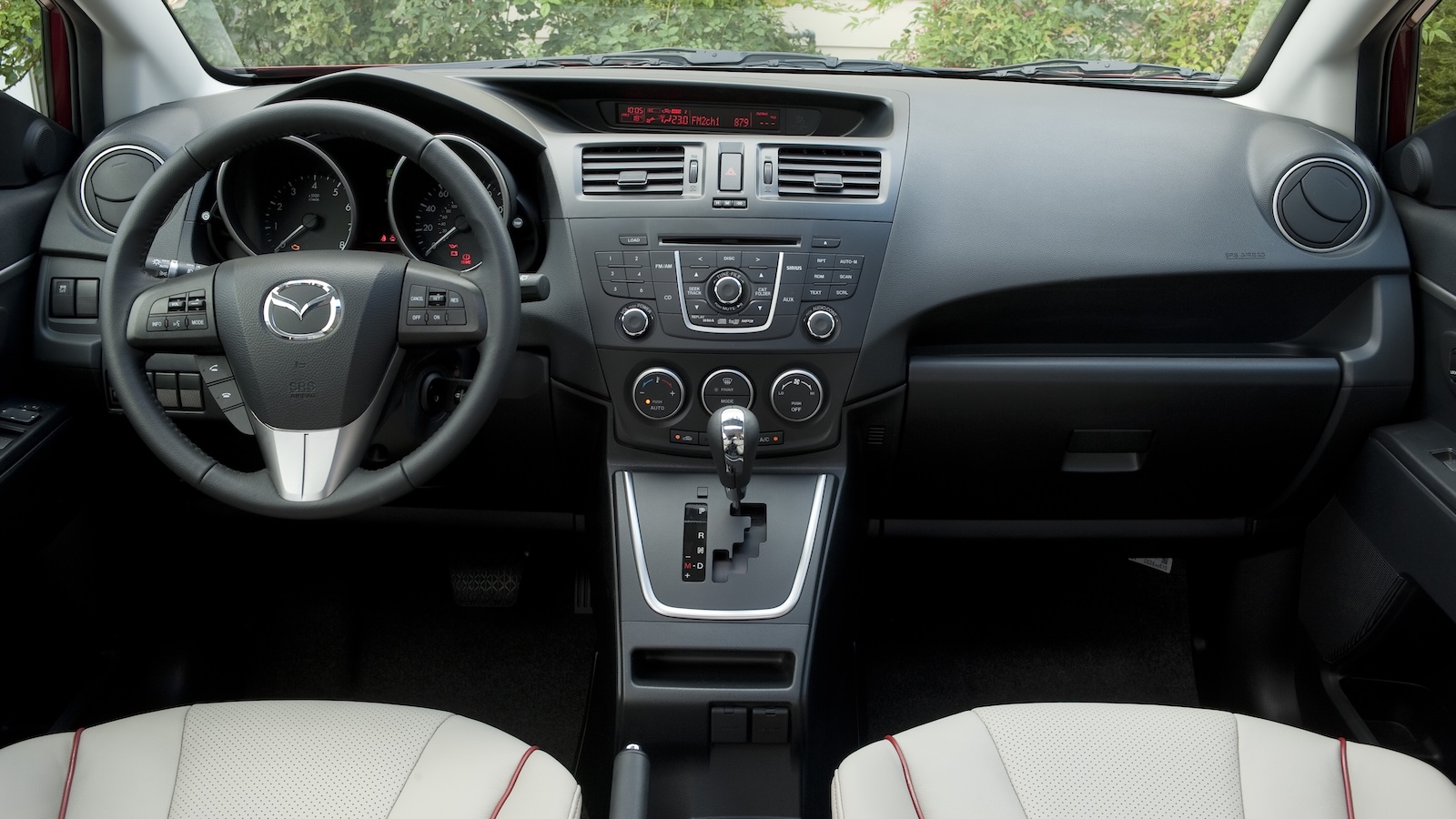
The standard transmission was new too, a six-speed manual in place of the old five-speed. When Car and Driver tested a stick-shift example, the magazine clicked off an 8.3-second run from zero-to-60 mph. That’s not too shabby. Best of all, this heavily revised Mazda 5 kept its character. As the magazine wrote:
The suspension is compliant and comfortable, the smooth ride more reminiscent of the 6 sedan’s than that of the occasionally stiff 3 with which the 5 shares its underpinnings. The steering is precise—it certainly is more direct and provides more feel than you’d find in most small three-row crossovers or in a bigger van—and the 5 feels remarkably neutral, despite an unimpressive 0.78 g on our skidpad. Make no mistake, the 5 is bested by the 3 for smiles per mile, but it is way more gratifying than something with sliding doors has a right to be.
However, perhaps the most critical improvement was greater corrosion resistance. Even in salty climates, these final-generation Mazda 5s are still holding up. Sadly, the overall production run was relatively short. After the 2015 model year, the Mazda 5 bowed out of the U.S. market, although it stuck around in Canada through 2017.
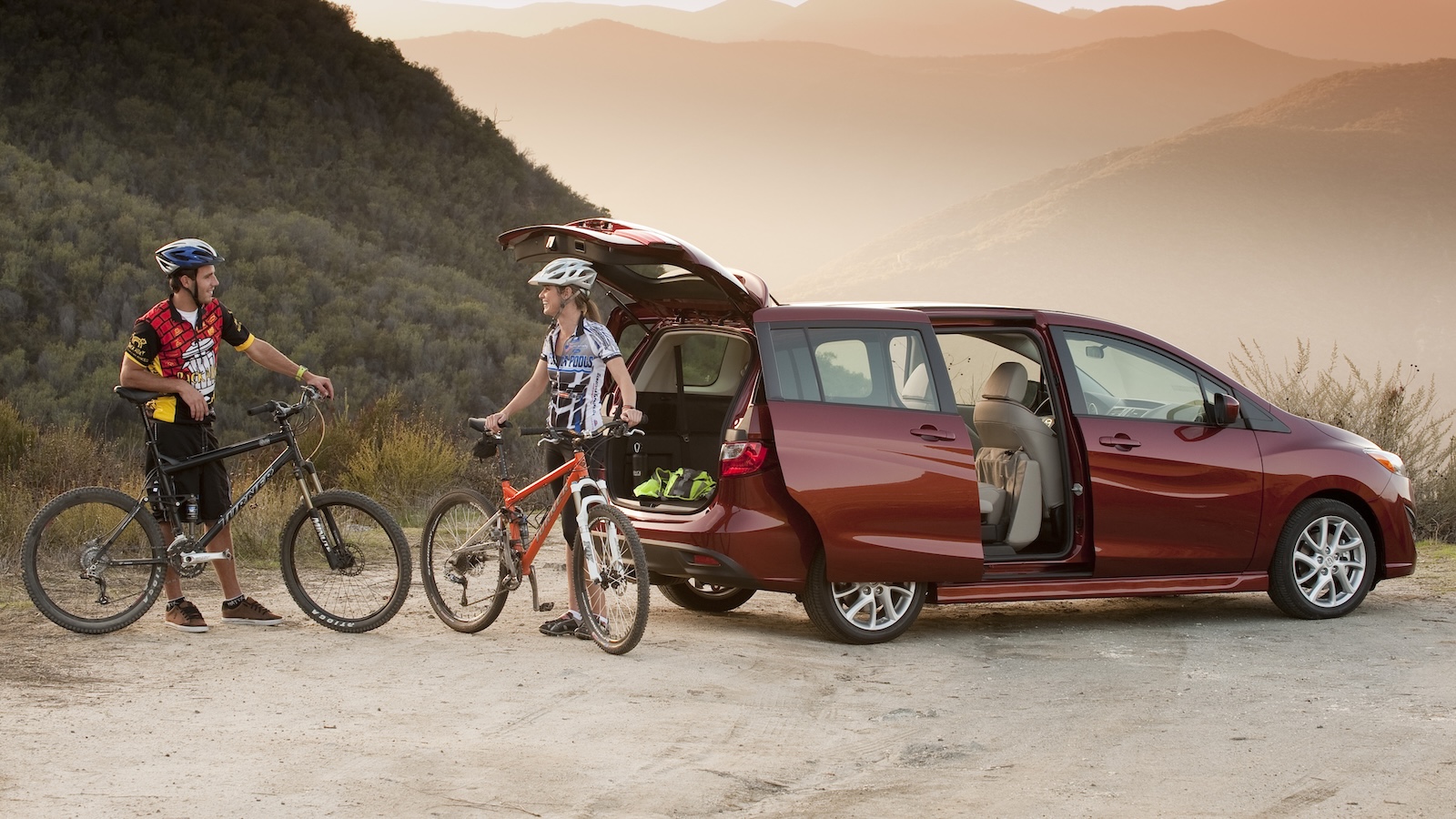
Today, a second-hand Mazda 5 remains a reasonably priced, reasonably thrifty machine with a ton of practicality and the available fun of a manual transmission. They’re excellent used car buys, provided you pick one up that’s in good shape. Oh, and this isn’t enthusiast pandering, this is a make and model of car I’ve legitimately recommended to family. For a few thousand dollars, a Mazda 5 might be the daily driver you need.
Top graphic image: Mazda




I’m on my second one of these now… The first was a cheap but very rusty 2006 (2.3l, 5 spd manual) that I got for cheap (maybe $3k or so I think) when it was 8 years old. It was fun but awful to work on, I had to cut out at least an inch around the rear wheels and make patch panels for the inside of the wheel wells where they had disintegrated. Every time I spun a wrench on it there were more broken bolts than intact ones. It was also pretty tiresome on the highway… Poor sound deadening, an exhaust that took after the rest of the car despite frequent patching, and to hear had the engine spinning at nearly 4000 rpm at 80 mph. Still, it was fun, practical, easy to maneuver and park, and decent on gas.
A few years after selling the first one I was back in the market but got a very rust-free 2012 in 2021 for $5k (so the 3rd Gen swoopy one, 2.5l and 6 spd manual), and it’s been great. The 6th gear really makes a huge difference to noise on the highway even if the sound deadening is still a little lacking, fuel economy is pretty much the same despite the bigger engine, and for a Michigan car there is no rust even now (still own it, it’s my DD at 160k miles). You definitely need to wring it out in the typical slow-car-fast ethos to get to highway speeds quickly, but it’s fun to do so. these really are a great combo of fun, practical, and cheap.
Awesome that an article was written about these, as they are a bit of a sleeper. I have a 2009 with the manual, with around 170K on the clock. Just now, the original clutch release bearing is starting to fail. It has been super reliable and has never left us stranded. We drive it like we stole it, and my eldest son learned to drive manual on it at the age of twelve. Small on the outside, big on the inside, fun to drive, and even has a third row that can fit kids. I wish such a car was still available. We do have a 19 Transit Connect wagon, but the 2.0L and the automatic transmission are a dog. Would have preferred a diesel and stick.
Also see the Ford Transit Connect “Passenger Wagon” version. I just bought a 2020. It’s based on the Focus platform and looks and feels much like the Focus when you’re in the driver’s seat. But you have tons of head room and look back to see 4 or 5 seats behind you, each folds down to make a lot of cargo room as needed. I put my eBike in mine which wouldn’t fit in my Focus. Best of all, it can get 27MPG highway and handles like a Focus. Downsides are mediocre power and transmissions that are often problematic, but from all I’ve read if you change the transmission fluid every 50K or so that helps.
We have a 19 TC, and yeah, the 8F35 started giving us torque converter shudder at 53K. I did three spill and fills and added some Lubegard to remedy. I’ll probably do a drain and fill annually going forward. The chassis is great, but it needs a more willing engine and a manual. The 2.0L always feels like it is complaining unlike the 2.3L in our Mazda 5.
Fell in love with the first gen styling, handling, size, and passenger capacity. I was always looking back and appreciating the styling after parking.
Unfortunately, the early trans self-destructed and bushings and struts wore and started rattling prematurely. Glad I didn’t have to deal with the rust. I was happy to trade it in with the janky trans for a paltry $500.
Would have been interesting to try the later, improved version, but the ownership experience left a sour taste in my mouth for any Mazda.
Good luck finding one now that’s not used up. Even an automatic. I so wanted my parents to buy a Mazda5, which would have been good for their mobility problems, but mom didn’t listen and bought an Outback, which despite “sitting up high” (her words) it was not easy to enter and exit.
TLDR: I twisted my wife’s arm to try a Mazda5 and she fell in love
When my wife got pregnant two years ago I went looking for something safer, more fuel efficient and more spacious than her TJ Wrangler to put the baby in. I’m a diehard Mazda fan and I’ve always thought the Mazda5 was unique, so that was at the top of my list even though my wife was adamant that she didn’t want a van.
While I prefer the looks of the first gen, the second gen had more equipment, I’ve heard that the 2.5L is a better engine and they’re less prone to rust, which is important in Ontario, Canada. While my wife can drive stick, I’ve heard the early second gens share a problematic clutch with the Mazda 3 of the era, so I went looking for a 2012-2017 with the 5AT.
The first one we test drove was rough. Only 150,000 km (95000 miles) but the suspension and seats were worn out, it had lived a hard life, and driving it instantly reinforced to my wife that she didn’t want a van.
I later found a final-year example with just 100,000 km (62000 miles) at a CDJR dealership near us so I convinced my wife to give the Mazda5 one more shot. If this newer, lower mileage, better cared for model was still awful, I’d concede that the Mazda5 wasn’t right for us and look for something else. She relented and we went over to try it out. She ended up really liking it, thank god, but the price was beyond our budget at $15,000 CAD and it had been in a small accident with a repaint on the driver’s side.
I now had a target and I was aiming to spend roughly half what the dealership wanted. After 2-3 months of checking Kijiji, AutoTrader and Marketplace multiple times a day, I struck gold. 2012 Mazda5 GS (base trim with bluetooth calling), 5AT, one owner with all service records, accident free, only 88,000 km (55,000 miles) for $8200 CAD ($6100 USD). It wasn’t cosmetically perfect, and I ended up spending another ~$4000 between two sets of tires/wheels, four wheel brake job, passenger door lock actuator and tint/undercoating. I plan to proactively replace the transmission control unit this summer so it doesn’t go into limp home mode, plus I’ll swap the spark plugs and transmission fluid when it reaches 100,000km.
We both love the van and my wife will even randomly text me about how glad she is to have it. We road tripped it out east last summer to see her sister in Nova Scotia. Me, my wife, our daughter and our labrador mix plus all the crap an eight-month-old baby needs and the van was flawless.
Sure, it could get better fuel economy, the styling is overwrought, and second gens still have some rust issues. However, it’s such a humble, genuine and functional vehicle. We’re both dreading the day it comes time to replace it, because nothing else like it exists on the market currently.
I was considering getting one. I own a Fit. I met someone with one and asked them if I should consider the swap. His response was, “Eh. You’ll sacrifice 12 MPG for something that drives a bit comfier but less fun.” That was kind of all I needed to hear. More cars should have sliding doors though!
I test drove one with a stick when they were new, and liked it a lot. It basically felt as you’d expect: a slightly slower/heavier Mazda 3. Considering how very decent the 3 was (and still is) that’s no faint praise.
I’d totally add a final-generation Mazda 5 to my fleet if a clean one showed up near me with a realistic price.
The Mazda5 is not a great used car. Rust is its biggest issue (See: rear fender, or lack thereof, of any 2000s Mazda). Ours had all kinds of electronics issues, door locks, CD changer, and sunroof. Stiff chassis made it fun in the corners, but I certainly wouldn’t own one now that most are 10+ years old.
Guided my mom through a purchase of one of these back in ’08 to replace a Pilot coming off lease. Dad wasn’t sold until he hopped in the drivers’ seat. What a fantastic vehicle that was just the right amount of room for a family of 5.
Because it was getting a little long-in-the-tooth, they panic bought a new CX-5 during the tariff hoopla started last year, but it mostly collects dust in the driveway, my mom refuses to let the 5 go. Great little car.
I’ve always loved these, and I feel like the Ford Transit Connects were the closest thing in size after these.
We love our Mazda5, but that 2.5L engine gets terrible mileage for its size. I thought we would get the Skyactive engine available on the 2013 Mazda3, but got stuck with the wheezy, holdover 157hp version. It’s okay, but you can’t be afraid to flog it to get up to speed on the freeway ramp. It’s cornering limits aren’t high compared to some newer cars, but it is controllable up to and past its limits.
The space utility and seating positions are amazing. An excellent car for the value. You’ll feel the potholes with the 16 inch wheels, though. I regret that I couldn’t talk my spouse into the 6MT due to an injury at the time we purchased it.
I was very seriously shopping these to replace our ’05 Passat wagon, but then good friends of ours, the husband of which is more into cars than I am, got one (used), and traded it in within 6 months. They found it not only underpowered, but also seriously wind-blown on the highway.
They got a Prius V, and have since upgraded to an Accord hybrid. And we got an Alltrack, which was always a better fit.
Huh, I replaced our 2014 Passat with a 2013 Mazda5 in 2020 and absolutely love it. I’m sad to say I’m about to sell it to a friend, mainly to help her out since we can afford a car payment and she can’t, but also because we wanted a bit more room and towing capacity with my kids hitting the pre-teen years.
Unless you had a high trim motor, that 05 Passat was probably more of a dog than the Mazda. My friend constantly had his foot to the floor. The Prius V is definitely the better car tho
our 2014 mazda 5 did thousands and thousands of miles visiting national parks out west with the ugliest craigslist 20 cu ft cargo carrier up top. I loved her.
These are the best autoX course setting machines ever made. Stuff it full of cones and sit in the middle row and set cones without moving. It was also fun to test courses and set a time of shame for the non-minivan drivers. A modern one of these with a hybrid would be an outstanding car for what most people actually use a car to do.
I have lamented for a couple years that if I could just get a hybrid I would never replace mine. It’s just such a great car.
I was all about trying to buy one. That is until I saw the crash test videos. Yeesh, no thank you. Cute and fun ain’t worth dying over. I say this as someone who has t-boned a camry at 40 mph in a Miata. Not everyone should be driving a tank, but some cars were just abysmal in these crash tests.
I crossed a Nissan Quest off my list as well as a Chrysler T&C when I was minivan shopping. They all folded up like tin cans.
I think that’s a sorta common problem with many vehicles that have large side and/or back openings. And those lacking a B-pillar such as the Honda Element. Of course, people like big openings on cars and vans.
Almost bought one, but just get past owning a mini minivan. I was impressed how it drove and handled. Power was “adequate”. Tons more room inside than you’d ever think. Well designed…