

The story of Honda’s supercar, the NSX, is filled with legend. The original, developed in the 1980s with the help of F1 legend Ayrton Senna, beat Ferraris and Lamborghinis of the time not only on price, but also on performance, comfort, reliability, and practicality. The car’s performance, plus its sharp mid-engine design, classic pop-up headlights, unmistakable rear light bar, and distinct VTEC-equipped V6 soundtrack elevated it to halo car status for enthusiasts around the globe.
Built all the way up until 2005, the NSX wouldn’t see showrooms again for over a decade, when the second-generation NSX, a hybridized, tech-packed masterpiece with two turbos and three electric motors, arrived on the scene in 2017. I remember driving one when it was new, and being blown away by its performance. It was also one of the coolest-looking cars on the road for under a million bucks. This wasn’t always the plan for Honda, though.


As it turns out, Honda wanted to replace the first-gen NSX with a new car soon after the original exited production. That car wasn’t meant to be mid-engine at all, but instead, a front-engine supercar with a naturally aspirated V10, poised to go head-to-head with Toyota’s upcoming halo car, the LFA. Except, it never happened.
The Idea For A New NSX
The plan for a second-generation NSX was already underway before the first car went out of production at the end of 2005. According to subbrand Acura’s own news site, the company confirmed that a “replacement vehicle” was “under development,” teasing a successor to the wildly popular mid-engine supercar. In a speech that month, then-CEO of Honda Motor Company, Takeo Fukui, promised a new NSX would arrive sometime between 2008 and 2009, according to Wards Auto. It was during this speech that the public first learned the new NSX would not get a V6, but instead a mighty V10 powerplant, matching the layout used by Honda’s Formula 1 engines of the early 2000s.

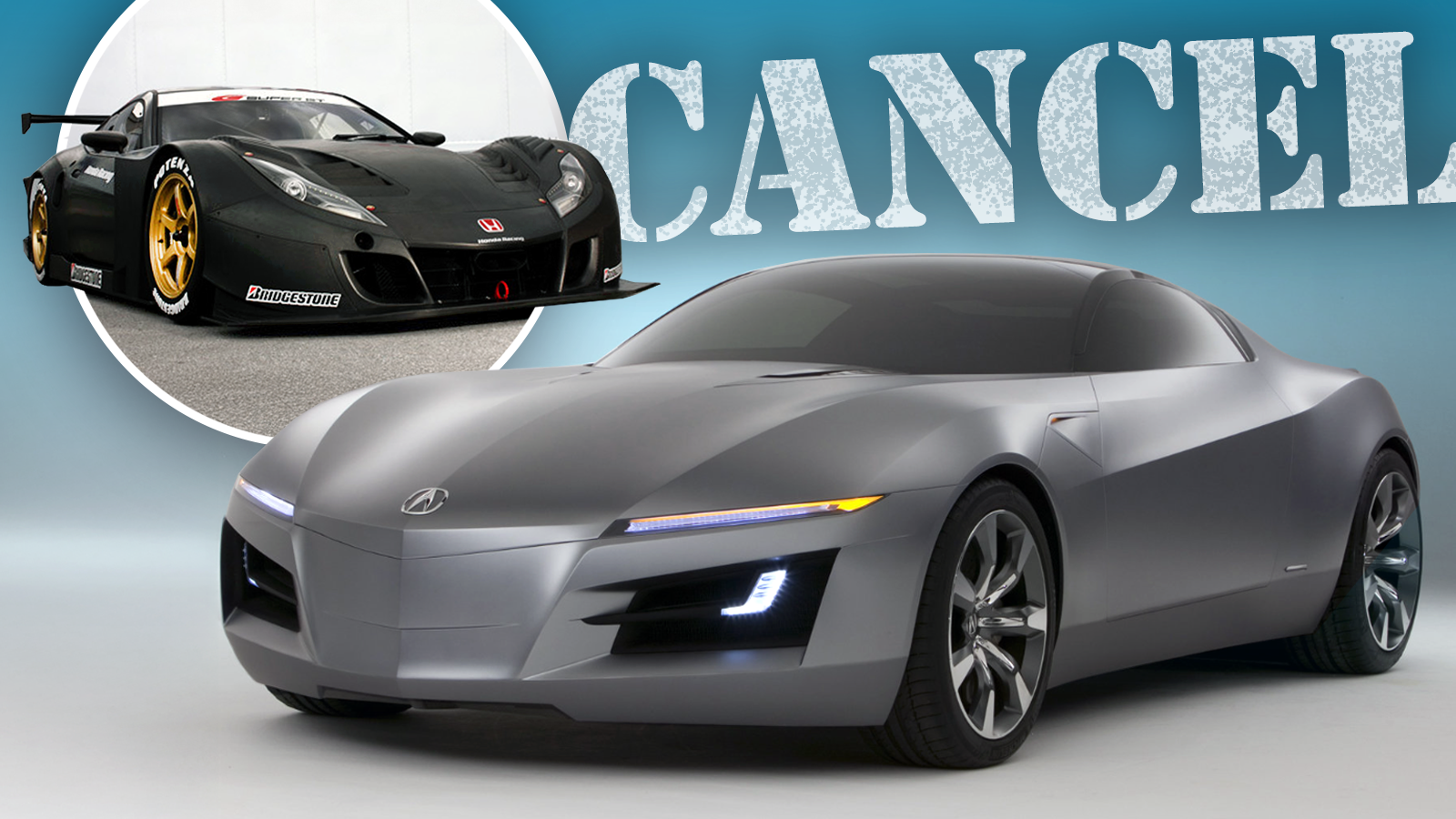
Then, in January 2007, Acura debuted the Advanced Sports Car concept, a front-engine supercar that Honda said, at the time, provided “a preview of the design direction for the successor to the Acura NSX.” Shown at the North American International Auto Show in Detroit, Honda claimed to have a V10 under the hood, paired to a rear-drive-based version of Acura’s Super Handling All-Wheel Drive (SH-AWD).
Though distinctly different, the Advanced Sports Car concept had some NSX-inspired design cues, such as the wrap-around taillight shape, the blacked-out upper portion of the body, and the thin LED headlights, which, according to Honda, were meant to mimic the pop-ups found on the original. From the original release:
“Our intention was to design an exotic sports car that gracefully combines advanced technology and strong emotion,” said Jon Ikeda, principal designer, Acura Design Center. “The technical, machined surfaces and keen-edge design are balanced with sweeping curves and dramatic lines, all of which results in the ultimate exotic sports car.”

Wide and low to the ground with a 108.8 inch wheelbase, the concept is anchored by grippy 19 inch front and 20 inch rear performance tires which are mounted to custom billet-machined, polished aluminum wheels. Powerful, ventilated carbon ceramic brake discs and eight-piston calipers accent the wheels. Bold wheel arches and flares add to the concept’s aggressive appearance.
While the design was promising, Honda reportedly wasn’t pleased enough with the reaction to put it into production. From that Wards Auto article:
Last January, Honda unveiled the Acura Advanced Sports Car concept at the North American International Auto Show, saying it hinted at the new NSX. Fukui told media then to expect a production version at October’s Tokyo Motor Show.

But reports surfaced the auto maker was unhappy with the tepid response to the Detroit concept and sent the car back to the drawing board.
In August, John Mendel, American Honda executive vice president, told Ward’s another version of the supercar concept would bow in Tokyo, but neither a production model nor concept was shown.
The media expected a production NSX to debut sometime in 2008, complete with a front-engine layout and that V10 powerplant. It was even spotted testing on the Nürburgring (video above). But thanks to a global economic recession, Honda’s reborn supercar would never arrive.
That Damn Recession
By late 2008, the housing bubble had burst, sending the economy into a downward spiral that affected virtually every industry. In America, two of the Big Three automakers, General Motors and FCA, had to take emergency loans from the government to stay afloat, leading to the death of brands like Pontiac, Saturn, and Saab. Ford also killed off Mercury to cut down on costs.
While Honda managed to make it out of the worst of the recession in the green, its profits fell by a massive 81% for the fiscal year ended March 31, 2009, according to Fitch Ratings. To mitigate spending, Fukui announced in December 2008 that the NSX project, along with Honda’s Formula 1 engine-making efforts, had been canceled.
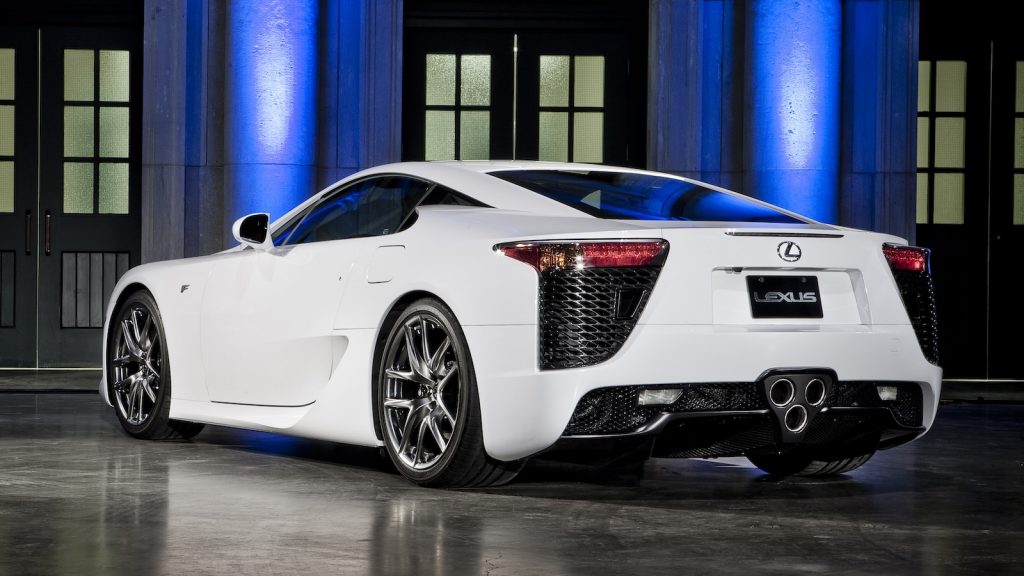
This decision to deny enthusiasts around the globe a chance to see two of Japan’s powerhouses go head-to-head with their own respective V10 supercars (Honda with the NSX, and Toyota with the LFA) doesn’t sit right with me, even 18 years after it happened. I could only imagine how angry the people inside Honda must’ve been, especially because it sounded like the car was nearly ready to go. This nugget from EVO gives just a hint of that frustration:
The death of the NSX V10 might sound like cause for regret, but Takanobu Ito, the man who replaced Fukui as CEO in 2009, was less rueful. Years after the project died he spoke openly about its demise, stating that an NSX should be ‘clever, with a focus on dynamic development’ as if to imply that the front-engined version had neither of these qualities. He also admitted that killing the car, which happened while he was senior managing director, caused such an angry reaction from engineers that in the aftermath of its cancellation he was ominously warned not to visit the R&D labs.
If I had worked for years to develop a V10 supercar only to see it get canceled at the 11th hour, I’d be pretty pissed, too. But the project wasn’t a total waste for Honda.
The Front-Engine NSX Lived On In Racing

Shortly after the second-generation, V10-powered NSX was killed off, Honda’s racing division encountered a problem. The company participated in SuperGT, a Japan-based road racing series that used cars based on production vehicles, mostly from Japanese manufacturers. For the 2010 model year, the rules changed, requiring all cars to run a front-engine, rear-wheel drive powertrain layout. This was an issue for Honda, which, up until this point, had been running first-generation NSXs, which had their engines in the middle.
Instead of pulling out of the series, the motorsport team turned to the then-unused front-engine NSX design and used that car instead. From DrivingLine:
While developing this new race platform, Honda decided to go back to the cancelled second generation NSX project to source as much as it could. The result was an all new front-engine, rear-drive GT car called the Honda HSV-010 GT that debuted for the 2010 Super GT season.

Super GT rules required its race cars to based on a production car, but the HSV-010 was allowed to race because it was technically a “production-ready” car even if it wasn’t actually sold.
The HSV-010 GT carried the same general proportions as those test mules seen at the Nüburgring, but looked almost nothing like that original Acura concept from 2007. The front end sort of reminds me of a TVR Sagaris more than any Honda or Acura. “HSV” stands for Honda Sports Velocity, which I’m not sure means much, but it is cool.
Sadly, instead of bringing the V10 to the racing world, Honda decided to use a V8 based on the engine found in the nearby Super Formula single-seater series (formerly known as Formula Nippon). That’s a tragedy, but at least the car still sounded good. Here’s a video of Honda firing it up and revving it:
Honda ended up fielding the HSV-010 in four seasons of SuperGT, winning the championship in 2010 with Takashi Kogure and Loic Duval at the wheel. But in 2014, the regulations changed again, and Honda retired the car in favor of the NSX Concept-GT, a racing version of what would eventually become the true second-generation NSX, with a mid-mounted inline-four cylinder.

While it’s incredibly sad that Honda never built the V10-powered supercar of my fantasies, I’m happy a version of the car got some time in the spotlight, even if it was just as a race car, and didn’t have the V10. Of course, that won’t stop me from wondering what the world would’ve looked like had this thing actually made production. Sadly, we’ll never know.
Top graphic images: Honda



To be honest, if they made 2nd gen NSX with original powertrain with minor improvement, it would’ve still sold because it is a masterpiece and still better car than most modern cars out there
I’m sad we never got this. A front engined super GT from Honda is exactly the kind of car that they are missing, especially from that era.
More front engined GTs!
Looks like a GM product.
For me, the HSV-10 concept is one of my Gran Turismo heroes. It was my favorite car to drift on the PSP version. I would eat up any news about this and the Mazda Furai because they were reported to some day be real cars people could buy.
I’m not as naive anymore…
As magnificent as this sounds, I don’t think it would have suited the NSX namesake. The original NSX was built to be an “affordable” nimble track vehicle – This chunk of iron would have resulted in one of two outcomes:
If I had a nickel for everytime Honda cancelled a vehicle program because they claimed of a bad economy, I’d have enough money to buy a new Civic Type R. This doesn’t even include the vehicle programs that are non-sportscars which get zero press coverage.
“If I had worked for years to develop a V10 supercar only to see it get canceled at the 11th hour, I’d be pretty pissed, too.”
In my 25 years at Lotus I worked on several Esprit replacements, all doomed to cancellation. And that’s not including the Bahar era one that I had nothing to do with.
I even worked on a skunkworks Esprit project in my own time, only to have the vehicle platform it was based on also get cancelled.
It’s heartbreaking.
Hey at least you didn’t work on the TVR Griffith! The only way to tell people about it is by opening the website and hoping the website is still functional
You’d be surprised at how often we used the phrase “at least we’re not TVR” at Lotus.
I think you’ve got the basis for a Blipshift t-shirt there.
I’m not sure what would be considered a more stable place of employment? TVR or whatever Henrik Fisker is up to.
Wouldn’t have worked, with that design.
The original NSX had that unmistakable rear light bar, it is true, but this was also the design of the 4th Gen Civic – Hatch, and also the 2nd Gen CRX.
As far as they could be on opposite ends of a price sheet, they all had that streamlined, simple elegance that made them beautiful. This was the time when even mass market, generic Hondas were beautiful.
Honda then went through the really not bad looking 5th Gen Civic hatch (and matching Prelude) to a whole decade and a half of panicked blandness, their cars looked like they were apologizing for existing. The NSX and the S2000 couldn’t pull that train on their own.
Then someone startled them and they hurried into designing heavy and tortured powerrangers-like shapes which they got locked into for several more years. The 2nd Gen NSX (my jaw hurts when I force myself to call that thing an NSX) was the product of that era.
A few years ago I rented an Insight in Miami and it took me four days to realize that the front bumper was smashed and not in its original shape on the right side. The front was so tortured that it didn’t hit me that it shouldn’t look like that, and during daylight I only ever approached that car from the left.
The front end on that race car derived from the second gen concept is far better looking that the concept front end. they would have done far better debuting with that design.
Is this the start of a new series called “Honday Hwendsday”??
Hank Hill approved, I tell ya hwat.
I would actually buy that concept NSX, looks stunning and with a V10 it would be perfect
I’d argue they didn’t fail. They just realized that a V10 firebreather isn’t what Honda does. It would have been silly.
Crazy Honda goes all out. V5 GP engines, oval piston V4(8)s, gear driven cams, high-strung engines riding on hp vs torque…
People used to think the HSV-HSV-010 had a V10 from its glorious exhaust note. Some still do, probably. It’s still brilliant, one of the last of the big wide body GT500 Gran Turismo heroes before the shift to the Class l DTM style cars.
2008 was awful. Killed so many cool things.