

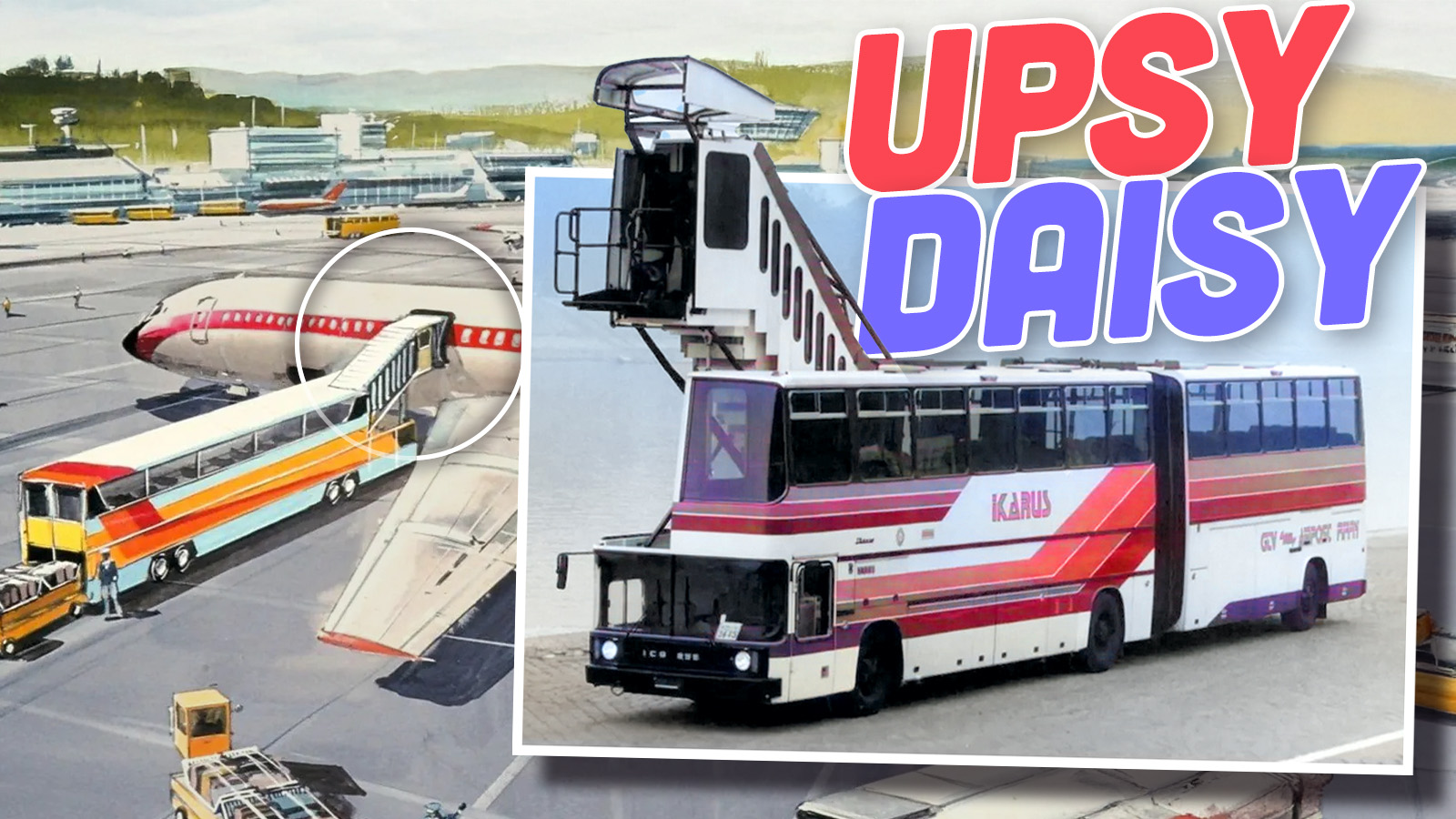
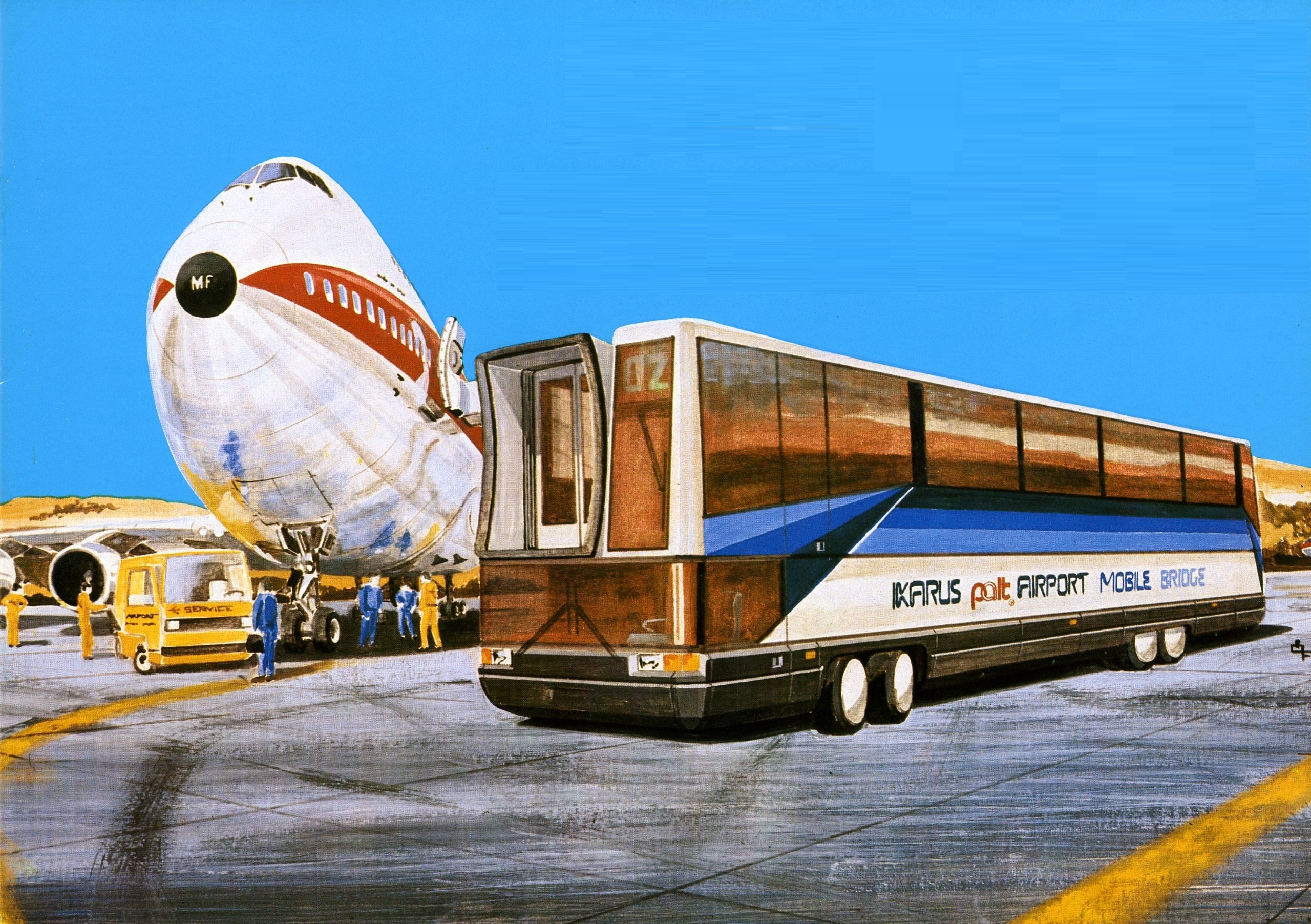
The process of boarding a commercial plane today usually isn’t very exciting. Depending on where you’re flying out of, you might board your plane through a jet bridge, a walkway that leads to a mobile stair, or maybe a bus that leads to a mobile stair. In decades past, several innovators tried to reinvent the airport experience. Perhaps the most ambitious of which was the Ikarus 692 PALT. This marvel of a bus was meant to drive passengers straight from their hotels to a waiting plane. How? The PALT had a built-in jet bridge that connected to a commercial plane on the other side.
Frank Der Yuen’s invention of the jet bridge in 1959 changed how much of the world boarded aircraft. In the decades before the jet bridge, passengers often had to walk out onto the ramp where the plane was parked and then climb a set of mobile stairs into the waiting aircraft. Some planes were designed with airstairs built in so that less infrastructure was needed for loading.


These systems worked, but they had their limitations. If the weather was less than perfect, passengers were cold or wet as they boarded the aircraft. If any passenger had difficulties climbing stairs, that slowed down boarding as they needed help getting into the plane. Airlines figured that if there was a way to protect passengers from the weather and ramp environment, boarding would be quicker, safer, and more comfortable.

It’s hard to pin down which airline or inventor first came up with the idea of the jet bridge. As USA Today notes, United Airlines invented something called the Air Dock in 1954. This was a covered bridge that permitted passengers to walk from the gate to the aircraft without dealing with being on the ramp. In 1959, the airline reached out to the Pacific Iron and Steel Corporation of Los Angeles for a connector between an airport gate and an aircraft that worked like the gangway to a cruise ship. That year, America’s largest airport hubs would get jet bridges serving United Airlines, American Airlines, and Delta Air Lines aircraft. Many of these bridges adopted the design pioneered by Der Yuen.
The jet bridge wasn’t the only solution to the question of how to board planes in the Jet Age. In 1962, Washington Dulles International Airport adopted Eero Saarinen’s mobile lounge concept. The mobile lounge was basically a large bus that contained a lounge inside. Passengers would walk into the lounge, and then the lounge would drive to a waiting aircraft, lifting itself up to permit boarding.

In 1979, Sovam introduced its own concept of a mobile jet bridge with the Aerobus AL150, which was used at Charles de Gaulle Airport in France.
The idea the folks of Ikarus had was far grander than any of these ideas. What if the bus that you caught at your hotel or in the city bypassed the airport entirely and drove you straight to the plane? That was the concept behind the Ikarus “PALT” Airport Handling System, or Passenger And Luggage Together.
Once One Of The World’s Largest Bus Manufacturers
The Ikarus Body and Vehicle Factory is not a well-known producer of buses here in America, but in decades past, it was once one of the largest producers of buses in the world. The Hungarian National Digital Archive tells the manufacturer’s story:
The story of Ikarus goes back to the story of the contracted parent companies, until 1895, when Imre Uhry – son of a wheel- and coach-maker – established his firm under the name Blacksmith Workshop and Coach Factory near Városliget in Budapest. Uhry ploughed back a part of the income into the enterprise and spent it on developing investments, thus basing the future successes of the company. By the mid-twenties, one could found graceful chariot-like buses – fabricated in Uhry’s factory individually with wooden frames – in many Hungarian cities. Although the boom of the firm was broken by the Great Depression at the end of the nineteen-twenties, the company was revived by Uhry’s children owing to the family cooperation and the financial support of relatives; and production could go on.
As of the mid-thirties, the firm gradually employed developments that laid the foundation of switching from retail manufacturing to large-scale machine production. Besides changing wooden-framed to metal-framed vehicles, they also modelled the types produced in large quantities with scale mock-ups as of 1936. During the forties, engineering investments and other developments due to increased vehicle demand in the WWII resulted in company growth. During the war, the predecessor of Ikarus became a large company with an employee headcount of almost one thousand. After the war, the company was nationalized and merged with two other companies.
1947 meant an important milestone in the life of the company: the first Tr-5 model was finished. It was fabricated onto MÁVAG undercarriage, had a mixed metal and wooden car-body, and it had other features like headwall radiator, recessed destination board and pneumatic remotely controlled folding door that was a characteristic part of the city bus transport style until the end of the 1980s.

What helped thrust Ikarus into a global bus powerhouse was its adoption of a conveyor belt-based production line. Each bus would scoot down the line, arriving at workstations prepared with the workers and tools to complete the next step of the build. Constructing the buses on a line, like the way cars were built, meant that Ikarus was able to mass-produce hundreds of buses and ship them across the Soviet Union. The most famous Ikarus was the 200 series, of which more than 200,000 copies were made between 1968 and 2002.
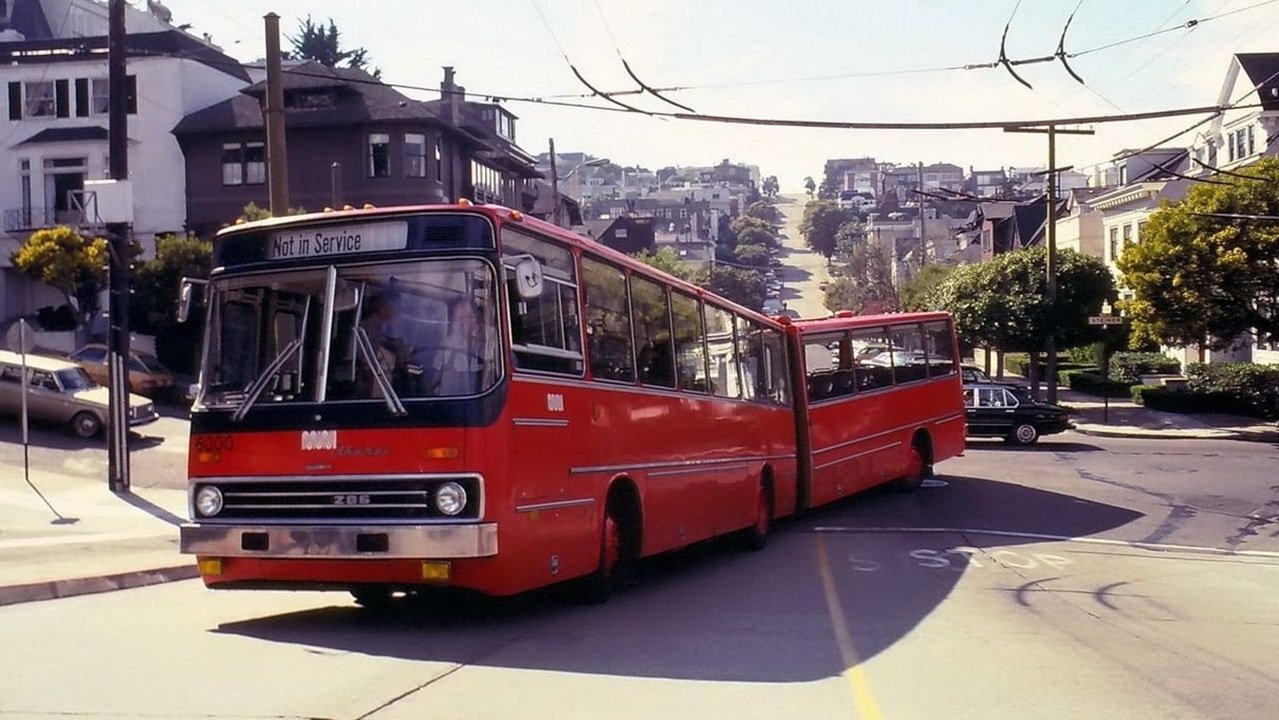
As Buses Magazine reported, at the peak of Ikarus production in the 1970s and the 1980s, the company pumped out 13,000 buses a year. About 80 percent of those went to members of the USSR. Ikarus sold buses in 84 countries, including the United States and Canada. Americans might know Ikarus best for the Crown Coach Corporation’s Crown-Ikarus 286, which is an Ikarus 280 articulated bus adapted for the U.S. market. Over in Canada, this bus was built by Orion Bus Industries and sold as the Orion III.
Yet, for all of its triumphs, not everything Ikarus made was a hit. The buses it invented to revolutionize airports weren’t just a flop, but they apparently never delivered a single real passenger to a plane in a live airport environment.
Combining Different Airport Equipment Into One
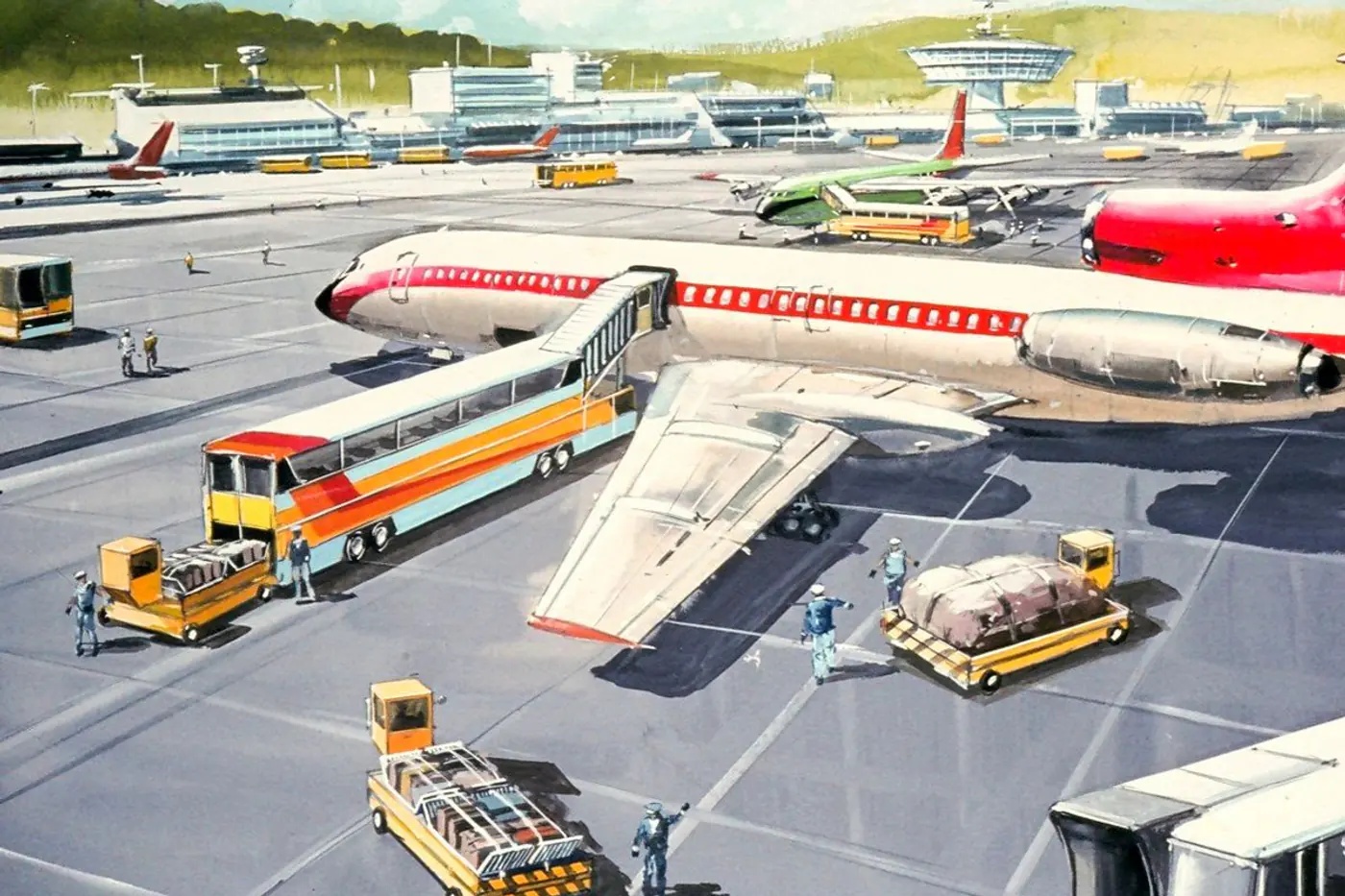
According to the Polaris Ikarus bus history blog, the seeds of the Ikarus PALT project were planted in the 1970s. In January 1974, Antal Gulyás, a designer at Ikarus, wrote a proposal for a futuristic bus. The Ikarus 266 Airoporter had two innovative ideas for its day. Since the bus was intended to drive on the smooth tarmac of airport ramps, it would have a super low floor and ground clearance since the bus wouldn’t be expected to traverse any obstacles. At the front of the bus was an accordion-style bridge that extended out using a hydraulic ram.
The idea of the Airoporter was that one bus could replace two airport vehicles. Instead of having one bus and a stair truck, the bus and the stairs could be combined into one. Ultimately, the Airoporter never went further than an idea, but it was clear that people at Ikarus were thinking about this concept.
The impetus for the PALT system would come from an invention, No. 14605, by engineers Valér Szendrődi, Tibor Vass, Tivadar Varga, Gyula Radics, and Károly Gyurics. This patent, which was filed in 1978, was entitled “Development of a universal, self-stepping bus family suitable for synchronous airport passenger and baggage transport.” Later, as the idea evolved beyond a bus and into an entire airport logistics system, the description changed to “Airport complex person and material handling method and system.”

The Ikarus invention was even more ambitious than the Airoporter. Ikarus determined there was a lot of inefficiency in airport operations because so many vehicles were involved in preparing a plane for departure and arrival. Shuttle buses carted passengers out to the plane, a stair truck or bridge provided access to the jet, and baggage tugs had to haul luggage out from the airport.
Ikarus also saw the whole flying experience as inefficient. Travelers would have to ride a bus from their hotel or the city with their luggage in tow, check their bags, walk to their boarding area, ride a bus, and then climb stairs. What if the bus could replace many of those steps? What if the bus could even bypass the terminal entirely and drive you straight to the waiting plane from your hotel?

To facilitate this, Ikarus designed a double-decker bus where the lower deck was purely for passenger luggage, while the upper deck was for the passengers. The lower cargo compartment was not like the basements that you’d find in a typical bus. In this application, the cargo compartment runs from end-to-end, and Ikarus concocted a special conveyor belt and tray system.
How it worked was that, at your origination point, be it an airport, bus station, or hotel, you’d get your ticket, go through customs, and then dump your bag in the tray. Once the tray was full, the conveyor belt ran the tray straight into the conveyor on the bus. That way, there was no luggage collection or sorting needed. If there wasn’t a way to do ticketing or customs at the origination point, they were supposed to be offered on the bus.
Once all passengers and bags were loaded onto the bus, the bus would drive straight to the plane. At the plane, the bus would use a hydraulic system to lift its built-in jet bridge into place. Then, as passengers walked from the bus interior to the plane interior, a tug would come by towing a special cart meant to retrieve the trays from inside the bus. The tug then brought the carts over to a special cargo loader, which elevated the luggage to the plane.
The First PALT Bus
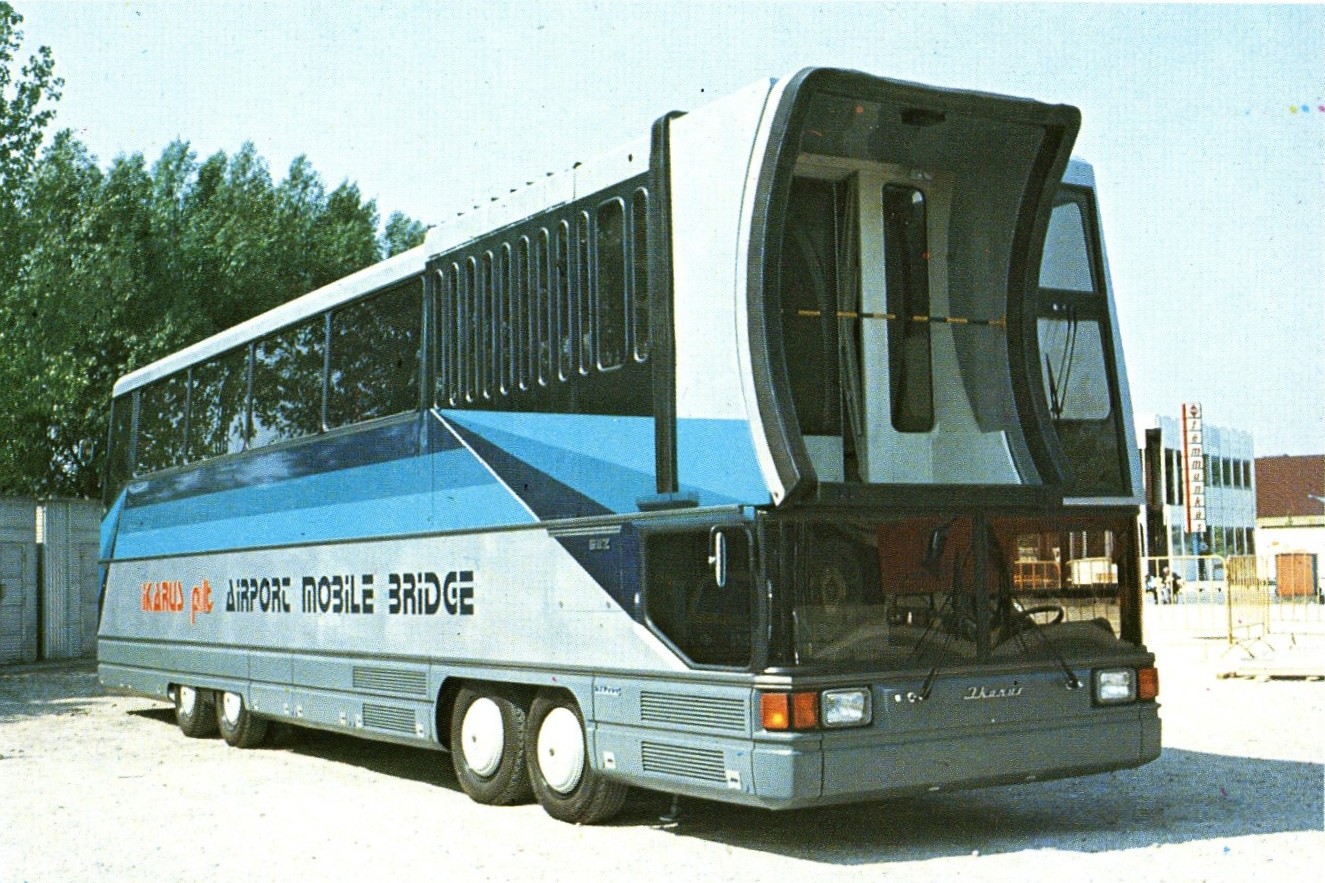
Ikarus presented the concept to the public at airport trade shows in 1980 and 1981. Apparently, the reaction was great enough to justify continuing development. The strategy called for one prototype bus to be built in 1982, a second prototype to be built in 1983, and bus production to begin in 1984. Ikarus produced the first prototype of what it called the Utast és Poggyászt Együtt Mozgató, or UPEM, in 1982. That translates to English as Passengers and Luggage Moving Together. As international interest in the system grew, Ikarus changed the system’s name to English, becoming PALT, or Passengers And Luggage Together.
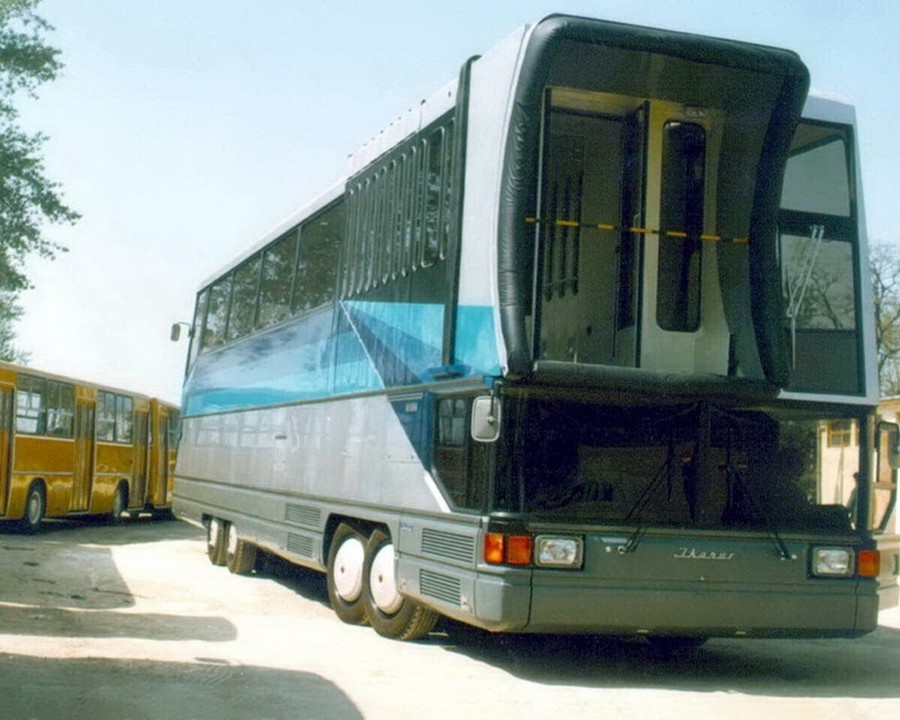
The first PALT bus was called the Ikarus 692.01, and it was a massive, innovative vehicle. The Ikarus 692.01 was designed to replace the shuttle bus, the baggage truck, and the mobile stair. Designed by Ferenc Örsi and developed with help from the Budapest University of Technology and Economics, the bus stood 13 feet high, was 9.18 feet wide, and stretched 46 feet long. Piled on top of the coach’s four axles was a bay large enough to accommodate the luggage of the 150 passengers riding on the upper level.

The bus was designed so that departing passengers would walk through the large doors on the back of the bus, while the conveyor belt system rolled their luggage into the compartment. Once loaded, the bus would drive from the terminal to the apron, where it would drive up to the plane.
At the plane, the hydraulically powered jet bridge would extend to reach the aircraft. Stabilizer jacks would also extend under the bus to create a secure platform. The designers noted that previous attempts to make a jet bridge bus were clunky because the height of each stair within the extendable bridge varied between aircraft. That was believed to be a tripping hazard. To fix it, the Ikarus 692.01’s jet bridge extended out only one small section at a time. The bridge onboard the 692.01 had nine extendable sections. Just enough sections would be raised to reach the aircraft, while the other sections would remain stored. This meant that the stair height was the same, no matter whether the target aircraft was a narrowbody or a widebody.
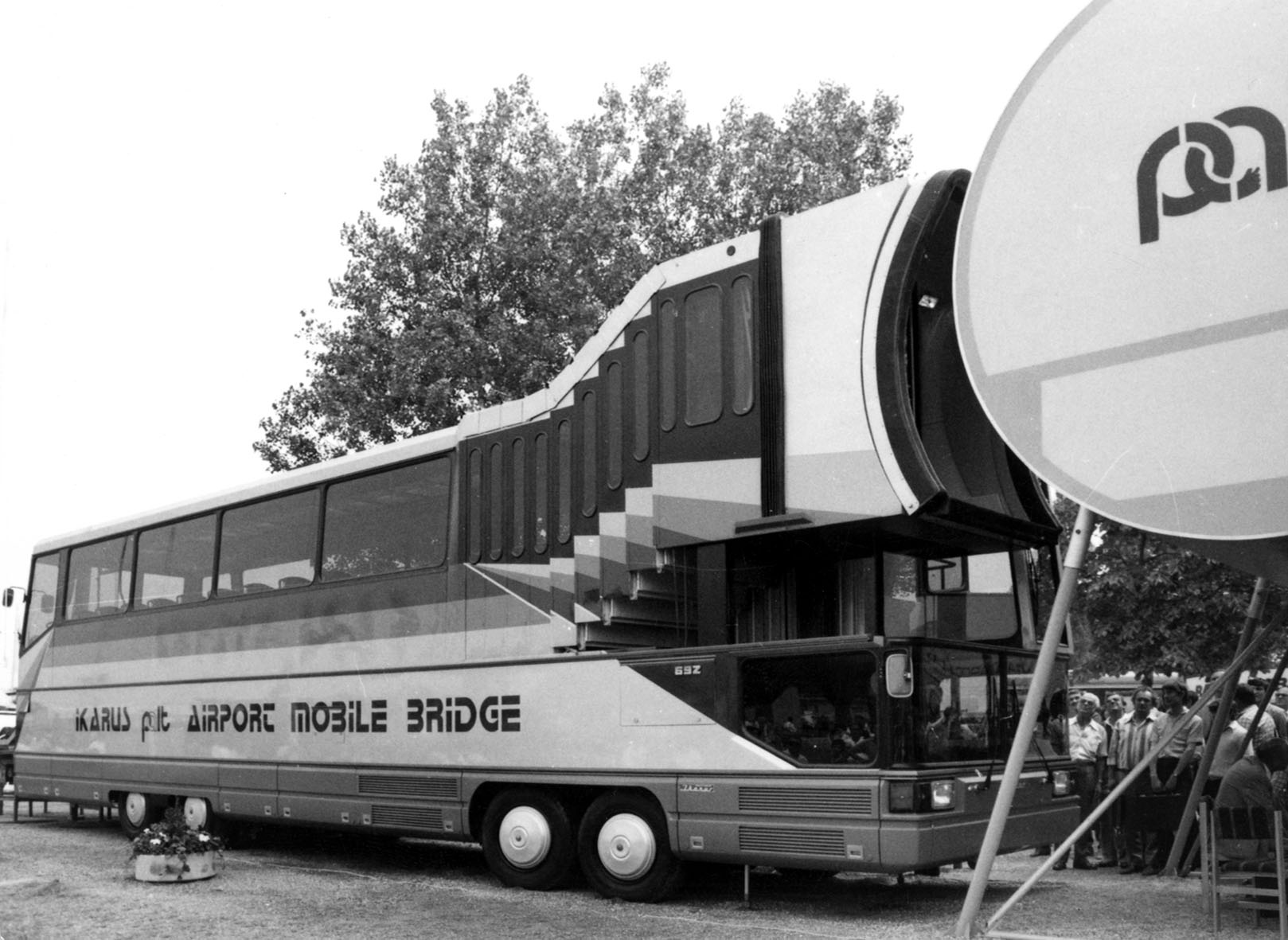
One of the quirks of the 692.01 PALT was that it wasn’t a road vehicle. It weighed a staggering 74,300 pounds and was too large to navigate city streets. Also, it wasn’t exactly fast. Power came from a RÁBA-MAN D2356 HM6U 10.6-liter inline-six diesel with 220 HP on tap. Top speed was a leisurely 37 mph. There were also two driver positions, as the driver can operate the bus on the lower level below the stairs or on the upper level on the other end of the bus.
Building this bus captured the attention of much of Hungary. Soon, the Hungarian government found itself interested in the PALT concept. Then, a consortium was formed between Ikarus, AUTÓKUT, Csepel Car Factory, Transinvest Transportation, UVATERV, and the Licencia Inventions Sales Company to make the airport handling system a reality.
Ikarus and AUTÓKUT designed the buses, UVATERV designed PALT buildings and the baggage system, and Transinvest developed export plans for the production PALT system.
More Than Buses
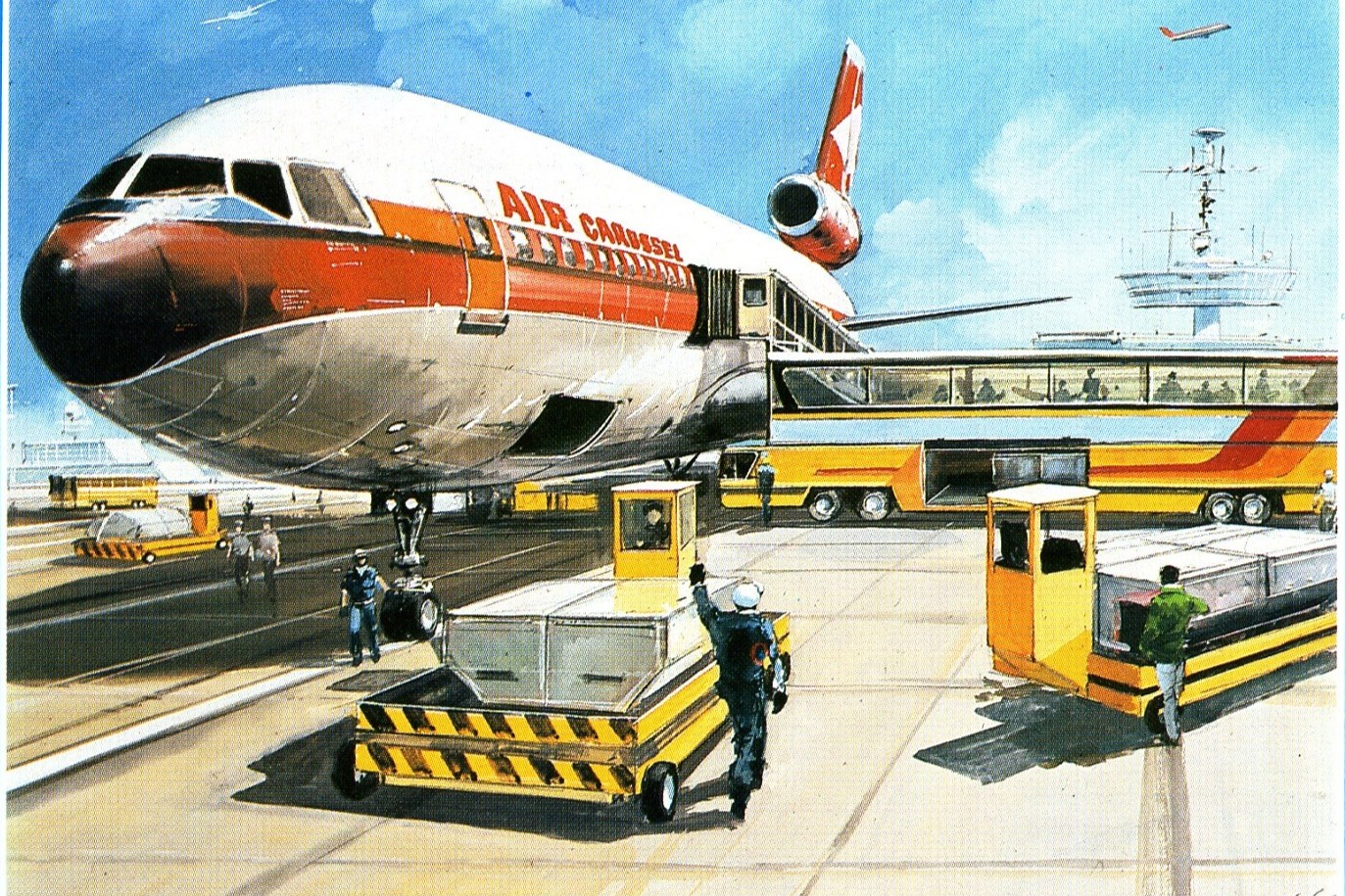
Ikarus and the partner companies brewed up an ambitious plan. There were to be four different kinds of PALT buses. The first type of bus would be an articulated bus that carried passengers and luggage from hotels and from the city to a waiting plane. The second bus was a single-unit transit bus that did not have a luggage compartment, but still drove passengers from the city to a waiting plane. These two buses were expected to drive at up to highway speeds.
The third type of bus lived only at the airport, and drove passengers and their luggage from the terminal to a waiting aircraft. The Ikarus 692.01 was this type of bus. The fourth type of bus was an airport shuttle bus without luggage space, but with a built-in extending jet bridge.
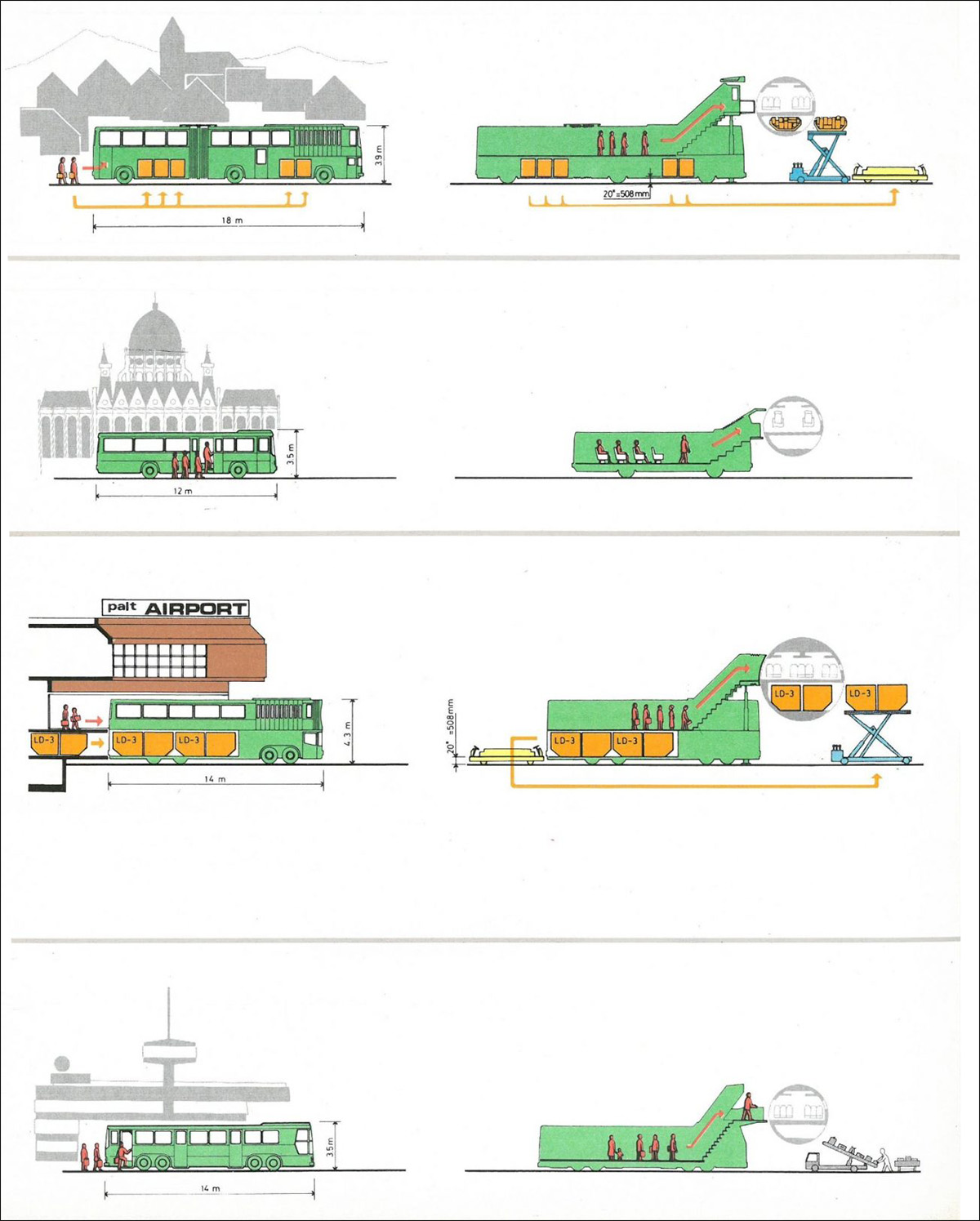
Ikarus saw these four types of buses running four different types of services. The PALT City Service involved setting up ticketing and customs within hotels and bus stops in the city. The bus would drive passengers straight to a waiting plane. The PALT VIP/Crew Service functioned similarly to the City Service model, only the buses were supposed to be more luxurious and served special passengers like celebrities and politicians.
From here, there was the PALT Apron Service, which was supposed to shuttle passengers and luggage from the terminal to a waiting plane. Finally, there was the PALT Transit Service, which utilized a PALT bus to shuttle people around the airport from terminal to terminal or aircraft to aircraft.

Ikarus also proposed different airport concepts, where PALT buses could bypass the airport terminal entirely to reach planes or filter passengers through the airport, onto other PALT buses, and then to the aircraft.
That was the whole twist to the PALT system. The consortium of companies developed an entire ecosystem. In addition to the PALT buses, there were PALT terminals, PALT baggage carts, PALT trays, PALT lift trucks, and PALT ports. While PALT terminal buildings were optional, you needed the rest of the PALT gear in order for the PALT buses to work. All of this adds all sorts of complexity, as you aren’t just replacing vehicles anymore, but existing systems.
The Prototypes
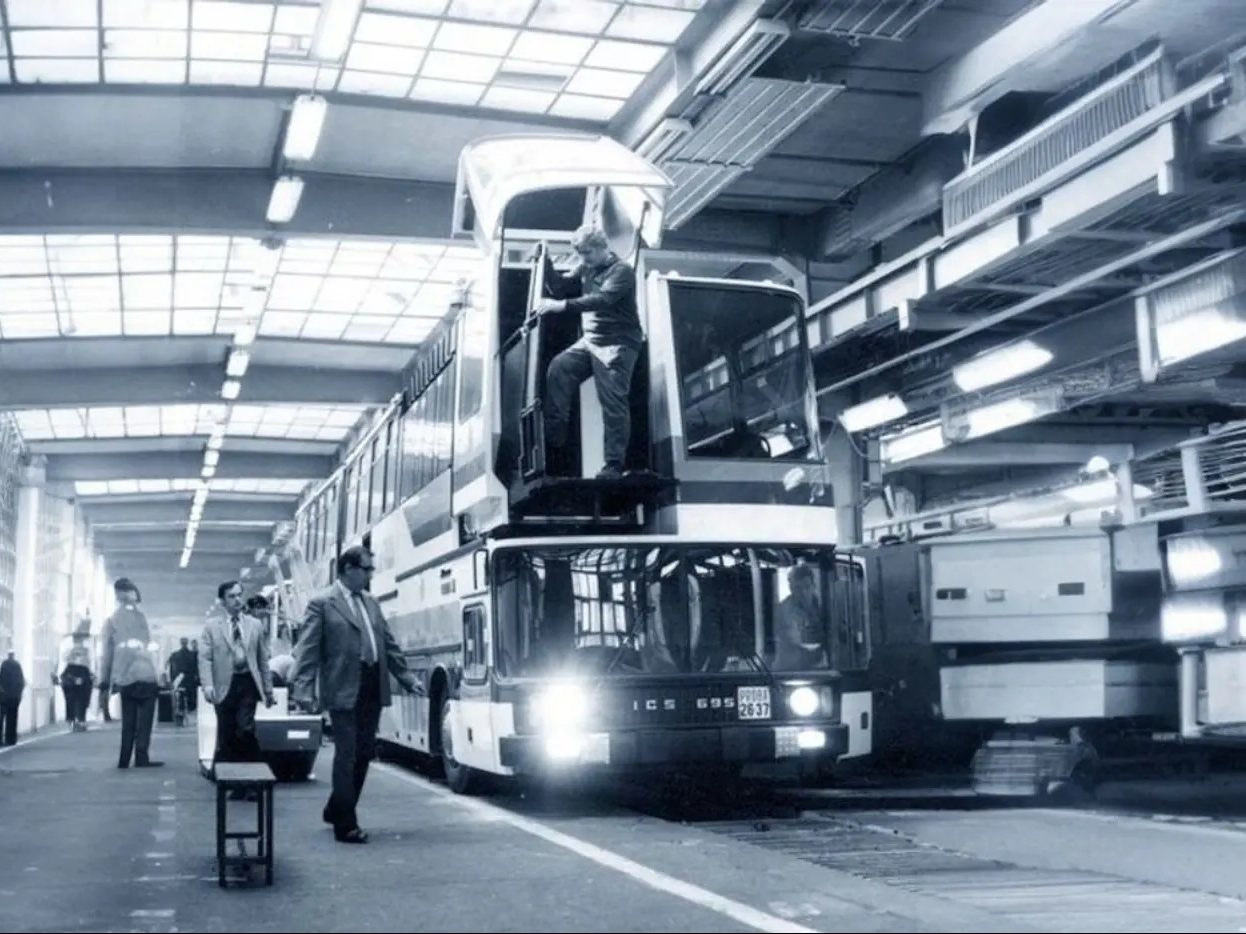
Yet, this was thought to be the future, and these companies pushed on. Subsequent prototype buses were built, including the Ikarus 695.01 and the 695.02. These two articulated buses experimented with where passengers would board the bus. Planned PALT buses included the 692.03 transit bus (no luggage compartment), the 696.01 transit bus with a luggage compartment, and the 697.01 VIP bus. All of the road-going buses would be able to drive faster than 62 mph to be able to run on the highway.
The 1983 Ikarus 695.01 was a beast in its own right. It was a 59-foot-long articulated double-decker bus that carried 110 passengers. The 695.01 was designed with both road travel and international markets in mind. This meant that it weighed a more reasonable 46,300 pounds and stood only 12.8 feet tall. The engine compartment was also designed to accommodate foreign engines for customers in different countries. Power in the 695.01 came from a Steyr Motors 9FU-A turbodiesel with 240 HP on tap. Like many old-school articulated buses, the rear articulating section was a trailer, and the engine powered the center axle. That power reached the axle through a Voith 851 automatic transmission.
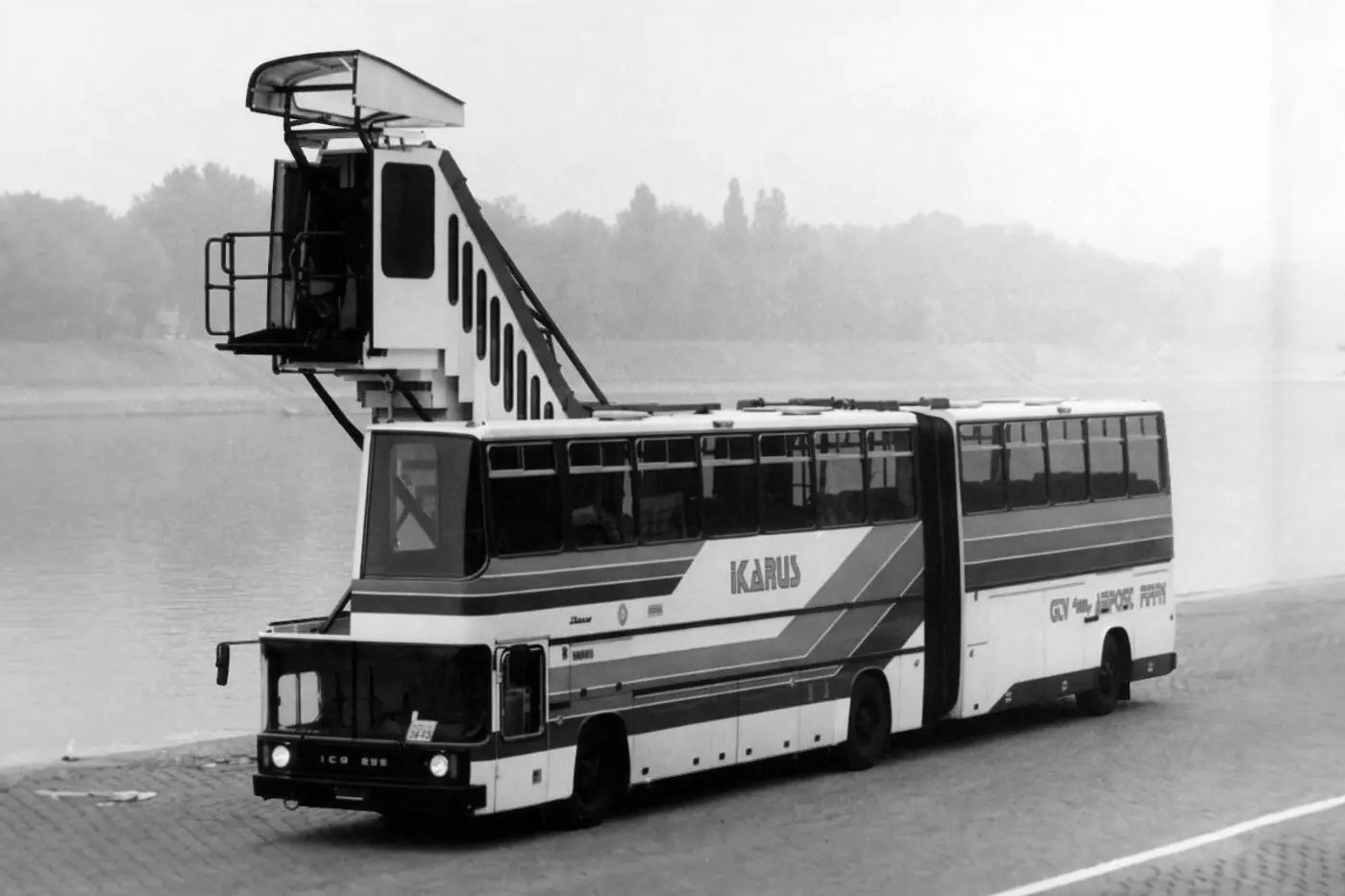
The 695.01 was designed to pair seamlessly with an Airbus A300, as that was the plane that was exceedingly popular in Europe at the time. Ikarus even developed a system that would give the bus driver a measured distance between the bus and the aircraft door to reduce the chances of an accident.
The 1984 Ikarus 695.02 was shorter and featured a RÁBA-MAN D2356 HM6U diesel, but a Soviet Lvov GMP 3-80 automatic transmission. Apparently, this bus was built purely to test the transmission and to gauge Soviet interest in the bus. Ultimately, the Soviet Union wasn’t interested in the 695.02.

The last prototype built for the PALT program was the 1985 692.03 PALT. This was the physical manifestation of the planned PALT inter-terminal bus that didn’t have a luggage compartment. This 55-foot bus was 9.8 feet wide and had a floor that was only 19 inches off the ground. It carried up to 160 people.
A unique feature of this bus was its double-ended nature. There was a driving cab at both ends of the bus, and all four axles steered. Because all tires were steer tires, the bus could turn within its own length. The drivetrain, which was mounted near the front axles, featured a reverser gear after the transmission, which allowed it to drive at top speed in any direction. That said, only one side of the bus had the PALT extendable jet bridge.

Sadly, due to image rights restrictions, I cannot show you the interiors of these buses. But the Polaris Blog has a lot of fantastic PALT interior and structure images of the buses.
The great part about the 692.01, the 692.03, the 695.01, and the 695.02 buses was that they were all functional from their drivetrains to the extendable jet bridges. Ikarus drove them around to trade shows and demonstrated how they could change aircraft boarding. They weren’t just concept vehicles.
The PALT Program Falls Apart
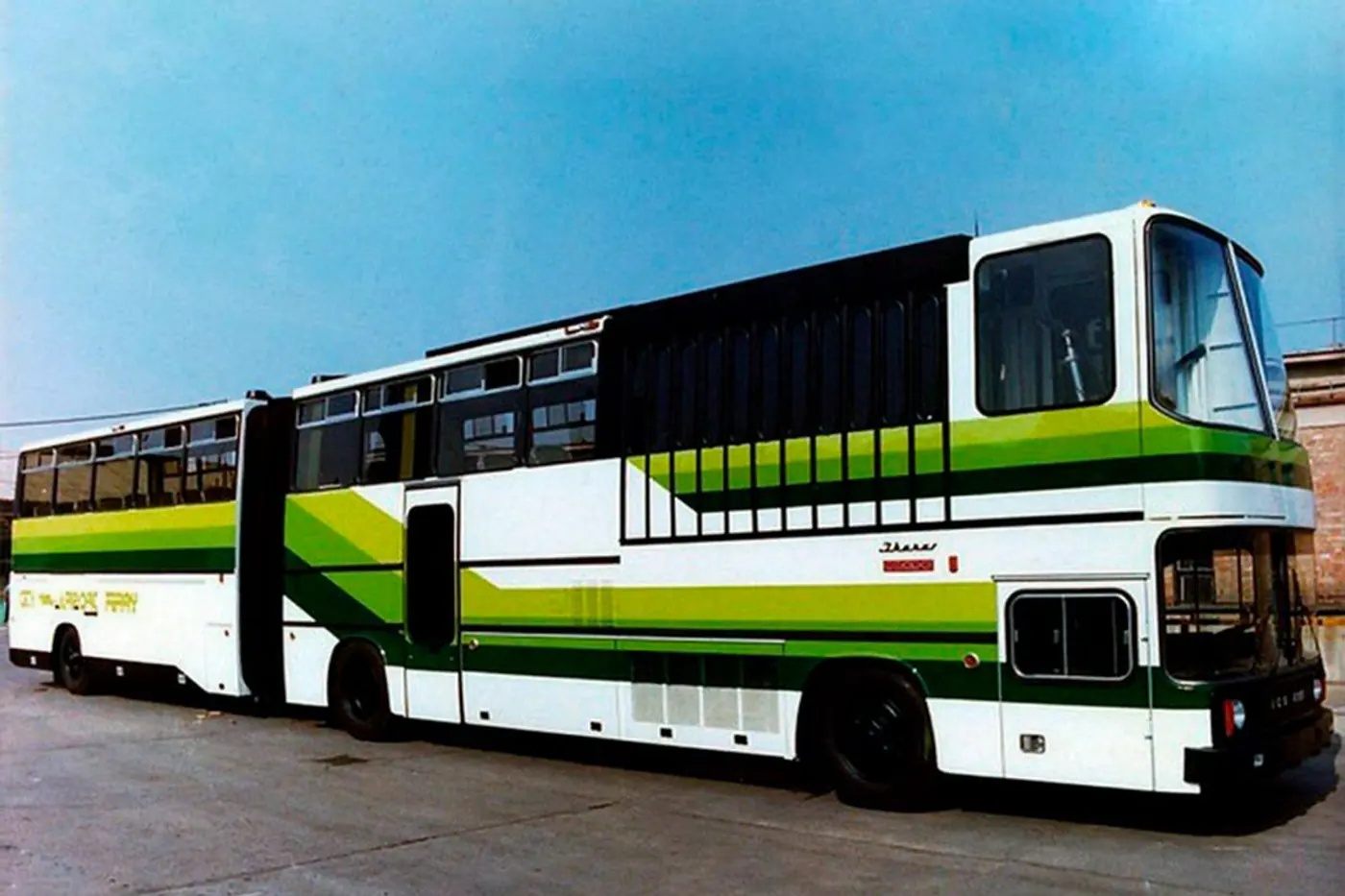
Ikarus and the consortium planned to build even crazier buses, including the 692.05, which would have been so long that it could have ferried 200 passengers to a waiting plane. Ultimately, the 692.05, the 697.01, the 696.01, and other planned variants were never built.
As the Hungarian transportation publication IHO writes, the push to get the PALT system into production was grand, with the Hungarian government and local newspapers touting the PALT system as a great innovation poised to change aviation. Hungarian officials even attended trade fairs as special guests of Ikarus.
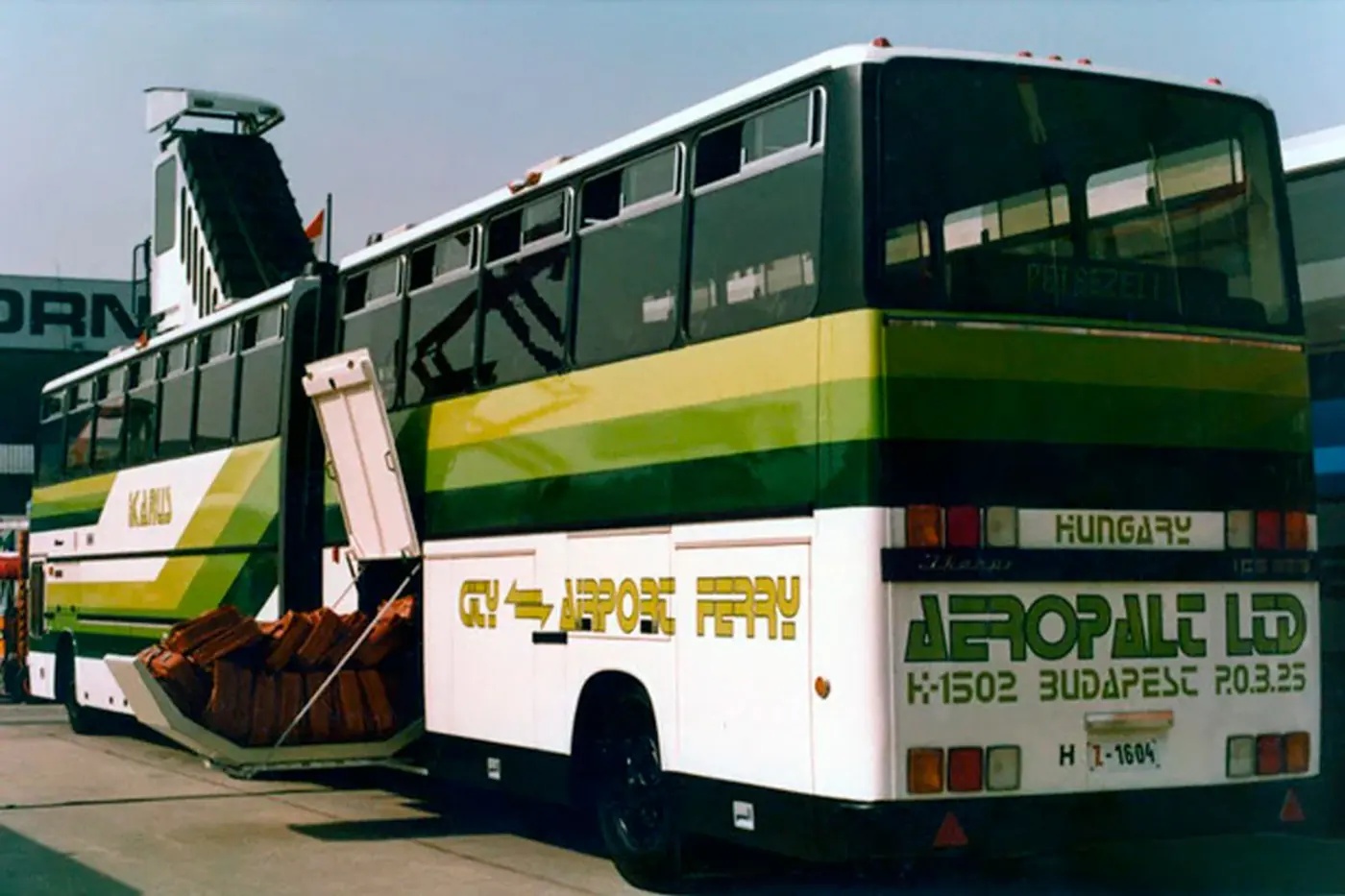
Unfortunately, each of those trade shows ended with the same result. Airports weren’t interested.
The problem was that the PALT system went too far. Ikarus wasn’t interested in selling an airport on just the bus. It sold the PALT as a package deal. You had to get the buses, the luggage trays, the baggage carts, the lift trucks, and all of the other infrastructure to make the buses work. This would have been expensive and would have required an extensive overhaul of the world’s airports.

The other problem was that, in trying to streamline airport operations, Ikarus and the consortium actually made it more complicated. The buses were supposed to combine the shuttle, baggage truck, and stair truck into a single vehicle. However, the PALT design still required a tug to retrieve the luggage from the bus, anyway, defeating the purpose.
Further, the buses would have changed how baggage handling works. In a typical airport, your luggage goes through a handling and sorting system, then starts getting loaded onto the aircraft before boarding begins. In a PALT system, the baggage doesn’t even begin to leave the bus until boarding begins. Then there’s the problem with having giant double-decker buses running around an airport environment to every single plane.
Perhaps the final nail in the coffin was infrastructure. The PALT system was designed to work best with custom-built terminals and bus stations. Airports weren’t interested in adding more buildings just for PALT. Why do all of this work when most of the world has already figured out that the jet bridge works just fine? Even the airports that didn’t have jet bridges for every gate weren’t interested. They already had apron buses, and they already had stair trucks. Why ditch these vehicles when they worked fine?
An Obscure Part Of History
So, in 1986, the PALT program was halted, and then eventually cancelled. The prototype buses were abandoned and forgotten. To illustrate just how much everyone stopped caring about PALT, the image below shows what the Ikarus 695.02 looks like today. It currently lives in the Aeropark museum in Budapest, and there is interest in restoring it to its former glory.

The PALT system was one of those ideas that looked really good on paper. Why have three vehicles when you can condense them into one vehicle? Why have passengers actually visit the terminal when you can turn a hotel into a mini terminal? Why have passengers walk when they can be driven to a plane?
It’s sort of wild that the PALT project even got as far as it did. All of these companies burned tons of cash building prototype buses despite not having any interested parties. It seemed like the companies were thinking that the buses would probably induce demand. Yet, in a way, it’s still really cool that PALT got to the prototyping stage, because it produced some of the weirdest buses in history.
Top graphic images: Ikarus Archive





Was the expectation that all the passengers would stay at the same hotel? Or are there specific hotels intended as “hubs” passengers would make their way to? Along with hundreds of other passengers milling around waiting for their plane busses. You’ll need/want to provide some dining and retail options for all those folks along with the ticket counters and security. So, basically, you’ve just turned a hotel into half of an airport while making half of your actual airport obsolete.
And, in case that doesn’t seem insurmountable (and illogical) enough, this would require an airport to trust the viability of an untested system. Let’s say there turns out to be a surprise problem with the design of one of these many systems. Like the stairs don’t deploy reliably in rain or snow (or countless other possible failures you cannot predict) Now what?
And, in case that doesn’t seem insurmountable (and illogical) enough, how many passengers can fit on the top floor of the luggage bus version? 50? That would take at least a half dozen of these things for a widebody. All idling in front of the hotel. Along with all the other busses for all the other flights scheduled to depart from the same half-airport. For a rough idea, next time you’re at an airport, look at all the planes lined up waiting for the runway. Now imagine each one is 6 busses. That all need to be built and paid for. That go on a never-ending loop through downtown streets.
I’m not sure there’s anything the Autopian crowd loves more than highly specific use case vehicles.
These are beautifully weird and fantastic!!!
Great article 🙂
I’m a bit puzzled by the snarky comments about Icarus not knowing what they were doing. A lot of airport specialists here, it seems.
Airport service vehicles are so specific that this bus wouldn’t have looked out of its element one bit.
A Neoplan Airliner’s ground clearance is like thee inches, it’s 1.5x wider (at least) than a standard bus, costs a bazillion bucks and can’t be used anywhere else but on an airport. Yet they’ve been in business for 65+ years.
This Ikarus is not stranger or much more complex, definitely not more complex than much of the machinery that services airports day in and day out.
My guess is what killed the project is they went raking too wide on it, and my sub-guess is that nobody at the factory believed for a second it will ever sell. It was just a project that fed plenty of people for a lot of time, good ol’ socialist style.
Even though Hungary’s economy was the least socialist of them, it is true.
Maybe the company named after he of the waxen wings should steer clear of the aviation and aviation-adjacent industries.
This taillight moment is presented to you by an old crusty Eastern European(er):
See those taillights? The red ones in the middle?
Look at them carefully, and remember: for decades, those were the only available (available like – you could buy them under the table from a bus driver or help them leave the bus at a red light with a screwdriver and some dexterity) stock taillights that could be integrated in the pitiful attempts we were making at fabricating fairings and cowlings for our unfortunate Mz and Cz motorcycles.
We were as epoxy-efficient as the next guy and there were decent designs out there, and a Wartburg headlight would usually do a decent if uninspiring job in the front fairing, but come time to slam a stoplight on that bike, ant we had two choices: an orange, narrow light from an older Icarus that would get us fined, or the red, almost square taillight from the photo, which was an acquired taste.
The top of the top were the Ruhla rear foglights that came on the East German spec Wartburgs and Trabants (an option they had but the one imported in our neck of the woods didn’t), but they quickly figured out that antitheft bolts went a long way if they wanted to keep them when they visited our country…
The Ruhlas were perfect. Just the right shape, size and color. Pure unobtainium.
Was this designed by people who had never been to an airport before? Even in the 80’s there was some security, and tickets, baggage check-in, general need to wait for flights not starting boarding exactly on time, and of course all the food and stores in the airport. Did they expect the hotel concierge to do all that for them?
Enterprise could do that while going from their airport location to the hotel to drop off their customer’s Oldsmobile Cutlass or Other Fine GM Car.
I was thinking that. Plus the airports this was offered to are the same ones that make bank from concessionaire fees, retail rental, parking, etc etc. To be charitable, at least some of those funds go to maintaining airport infrastructure and what not. Airports would have to reinvent their business model for this to have worked.
I remember the airport in Edmonton used to have these weird busses that had a scissor lift to get up to the plane, they were slow and cold and only held about 40 people at a time
To me it sounds like they started from a let’s solve a soviet and other ssr issue. Then after realizing there is no money there trying to market it to the west. Hungary was part of that sphere so looking around seeing a problem and coming up with this a solution seems plausible. For less developed airports it could be logical.
Dulles certainly had a lot of reasons for the moving lounges. Not to mention possibly being comparable or easier to retro fit to non civil aircraft types.
Soviet had similar approach ideas and probably less money for infrastructure. Build the aircraft to work at the airstrip not the airport to work with the aircraft.
Oh the irony of a company called Ikarus sinking tremendous amounts of cash into an overly ambitious and ultimately doomed project to reimagine the process of flight.
This seems like the same kind of logic that birthed the F-35. “Why do we have all these different complex systems that require their own specialized infrastructure and maintenance protocols? What if instead, we built one system that could do every task using a single integrated platform sharing a common kit of parts? We’ll save billions!” Then we built an even more complex, specialized, and finicky machine that requires everyone who wants it to adopt a series of compromises in the interest of the single platform. Also, it’s way more expensive than we originally thought and it requires you to completely throw away your previous processes.
If only Michael Bluth would have bought one of these instead of the stair car…
Still probably gonna get some hop-ons.
If nothing else the “car” part of the Bluth staircar isn’t nearly as hard to get parts for, probably either a 351W or 300 six in it.
I think they used at least three different trucks from two different generations, so it could well have had both
It kinda looks like there should be a graphic on the side of a coyote running the wrong way.
Then all those shops and cafes in the airport would be out of business…
Won’t somebody think of Hudson News and Wolfgang Puck Express? I would sorely miss my extremely dry sandwich.
Don’t forget the cable news branded shops. I’m still confused why those exist.
As a systems development engineer, I love studying projects like this as it’s a case study in understanding your customer. It’s incredibly easy for engineers to hyperfocus on tiny details like this:
Then completely whiff what airports actually care about and end up like this:
One crappy part of my job is having to tell engineers their idea isn’t worth pursuing not because it’s a bad idea in general, but because that isn’t what the customer asked for.
At the top of the article, I saw the heading picture and thought “Wow! That looks cool, but it would never work with current airport workflows!” Then I got to the bottom of the article, haha.
[I’m in design not engineering] It’s tough, because if you give the customer what they asked for you get shuned for not being being innovative. If you give them something else you’re ridiculed for not following instructions. Design and engineering often clash but I feel like this is a shared reality.
And in this case their potential customers weren’t asking for anything at all. “We have this innovative new solution we’d like to sell you for a problem you don’t have, because we’ve decided this is a better solution from the ground up!”
Not a great way to get customers.
Swooning over some of those color combinations.
New ‘what bus would make the best RV’ just dropped.
Pray you don’t have to find old German TurboDiesel parts in Coeur d’Alene on a Sunday afternoon…
It was designed to accommodate different engines so LS swap it.
This seems to be an early example of a proto-tech bro trying to reinvent an industry without having any understanding of the industry itself.
Sure, they failed to address any of the real world problems with the system, but they made up for it with enthusiasm, you see.
These make a lot more sense in Europe where airports still use large numbers of remote stands and commonly bus people out to the airplanes in lieu of jet bridges. And it was even more common back in the day. Barely a thing in the US, then or now.
But ultimately, this is rather pointless. Stairs and standard low-floor airport terminal buses work just fine getting people to and from remote stands, and are probably faster to load and unload. Hotel direct to airplane is a non-starter in the modern airport security world.
And, yet, I still find many large airports still shuttle people onto busses to transport them out to far-flung areas of the airport tarmac to walk up stairs and get onto planes.
I’d love it if I didn’t have to trudge up those stairs with kids & handluggage in tow – especially when the weather was poor.
US airports that do this mostly use rolling or pivoting covered ramps to get you on and off the airplane at this point. Which are ADA-compliant.
The rest of the world assumes the vast majority of people can climb stairs. I assume they have some sort of chair lift they bring out when they have to.
In the US? I mostly see the bus thing thing in Europe (Frankfurt in particular).
In the US, the only time I’m boarding an aircraft outside is the small regional jets, but even then, there’s covered walkways and mobile ramps up to the door.
Spikedlemon’s use of “handluggage” suggests they’re not in America. Indeed, I climbed a lot of stairs when I flew through France and Germany in 2024!
Normally I’d have said carry-on luggage, but then recalling back to having small kids on airplanes flying places, that you end up carrying so much crap in your hands that I felt handluggage felt more accurate to those situations.
They even do it with International flights in the USA Flew Qantas from Melbourne, Australia to Dallas (USA) a couple of months ago and we allighted through external stairs and busses for a 5minute ride to the terminal. On the way home through LA we also had the same stairs at LAX domestic terminal. It was actually kind of refreshing as it was good weather and we are in good health.
Which is solved by the lifting busses or “mobile lounges” mentioned before. This bus still has stairs and adds the complexity of baggage coming at the same time as boarding.
Wait til you get to a small airport with fewer than five gates in total. Why board a bus when you can just walk from the stairs into the terminal?
I love those. We used to have a company turboprop and small jet for business travel – it was the best way to fly.
Always fun to fly into some tiny airport, greeted by the one guy at the airport who’s got your rental keys that were dropped off earlier that day for you, and you drive off.
This is some serious tunnel vision. The company was so convinced of the rightness of their system, they couldn’t see how it was never gonna work.
Have you met engineers before? As an engineer myself, I can assure you this sort of thing happens a lot, haha.
Honestly, that almost makes it better.
This idea had so many holes in it, but they kept pushing ahead with it anyway. Absolutely bizarre.
This is a bit like the double decker seating idea. On the surface, it seems like it would be a good idea, but there would have to be so many changes, and probably compromises, that no airport or airline would want it.
If you’re referring to the Airbus A380, that didn’t require too many airport changes (other than it can only land at airports with extended runways), but jetways can already handle the height difference between loading the upper and lower decks.
When I flew on one, the gate had dual jetways: one for the upper deck, and one for the lower. For single level aircraft, the dual jetways are separated for First/Business, and Economy class, where First/Business board at the front of the plane, and Economy boards closer to the middle so they don’t have to walk the full length of the aircraft.
The A380’s biggest issue was it came to market right as the traditional “hub-and-spoke” airline business model started to shift back to more “point-to-point” routing. The A380 was intended for linking massive international hubs (and that’s what it does today), but airlines found they could eke slightly better margins by buying larger fleets of smaller, more fuel-efficient aircraft and connecting more airports directly, versus routing all traffic through a hub.
A380s need so many changes to airport infrastructure that only a relative few airports in the world can easily handle them at all. Any gate that one is using was very expensively re-engineered for them – many airports can only accommodate them at remote stands At many airports that only see them occasionally, there are serious operational limitations while they are taxiing. It’s why Boeing so expensively engineered folding wingtips for the 777X – so it fits in the “standard box” set by the 747 many decades ago. Airbus exceeding that expecting the world to just go along was some serious hutzpah. And they were WRONG, as sales of the thing showed. Boeing at least was smart enough to engineer the 747-8 to be a superb freighter too – something the A380 can’t do at all.
The margins aren’t “slightly better” for most airlines, they are “hugely better” to the point that there is one HUGE operator of the thing that has a very unique business model that it happens to fit beautifully (and it’s an airline that doesn’t REALLY have to care about margins either), and nobody else flies more than a handful of them. And even that airline has more 777Xs on order than they have A380s by a wide margin, and plans to replace them with the 777X, because it will be both far more efficient and can fly to far more places. The A380 is a white elephant.
I find both A380 and 757 fanbois to be amusing. Both are really cool planes that just don’t work economically. Though the 757s will probably still be hauling mail around long after the last A380 is carbon fiber and aluminum scrap. They make fantastic freighters, but that is a very, very different business.
I’m not really an A380 fanboy, just pointing out its biggest problem was less the aircraft itself (which had plenty of problems too, as you pointed out), but more to do with the general shift in airline business models.
I’m just glad I got to fly in one while I had the chance. Overall, I prefer the A350s and Dreamliners.
Sorry, I wasn’t really accusing you of being one – but they are DEFINITELY a thing. The 757 fans are worse though. Especially as that airplane doesn’t even give a better passenger experience other than possibly slightly more shove in the back on takeoff if the runway is short. Most of the time, they just do reduced thrust takeoffs and it feels just like a 737. At least A380s are legitimately more comfortable than most, and allow for such silliness as “The Apartment” if you can afford the cash or miles.
But for sure, Airbus massively misread the tea leaves, and got very much focused on “beating Boeing” rather than actually making the best plane for the job. And then the really big problem is that they actually designed the thing for TWO sizes, and only ever built the small one (as big as they are, what’s flying is the small version). So just like the 757, they are overbuilt and too heavy. Shrinks never work out particularly well, you never save enough weight to offset the loss of passenger and cargo capacity, so the economics don’t work. Airbus has made that mistake a couple times too – the A318 and arguably the A319, and the A310.
Second big tea leaves misread by Airbus – the A340 was the first one. How they did not see ETOPS coming is baffling. They had to know Boeing was lobbying HARD for that, and would be successful. So they wasted a TON of money making nearly identical airplanes that could be ordered with two or four engines, and as a result neither was as efficient as it should have been. Which is why the 777 ate the A330s lunch.
Airbus announced an A380F freighter version in 2000, which would have had a 330,000 lb payload capacity, above even the final 747-8F’s 308,000. UPS, FedEx, Emirates, and ILFC all ordered A380 freighters early on, but as delays mounted and costs overran, Airbus suspended work on it in order to focus all resources on what they felt was the “core” passenger variant, the delay triggered UPS and FedEx to cancel their orders entirely, and Emirates and ILFC to convert their slots to passenger planes, after which, Airbus cancelled the freighter entirely and never revisited the idea. At the peak, there were 27 orders + 10 options on the A380F – 10 orders each for UPS and FedEx, 5 for ILFC and 2 for Emirates, plus another 10 options for UPS.
It was all cancelled because it never made sense. The airplane would hit it’s weight limit long before it cubed out – so there was no point in flying something so large that could only take side-loaded pallets. There just isn’t any market for such a thing.
Ultimately, because Boeing never thought the 747 had a long career as a passenger airplane due to the impending supersonic revolution, they from the get-go used their experience gained in competing for what became the C-5 Galaxy contract to ensure that the 747 was a top-notch freight hauler from Day 1 – including the cockpit hump that allowed for the nose door for straight-in loading of oversized cargo. Literally the only reason for the hump. Airbus did not give more than a few passing thoughts to the A380 hauling freight. And so there will be no second career for them, and young airframes are going to the scrappers.
As a landing gear engineer at one of the freight airlines that was interested in the A380, it provided opportunities for a lot of travel to France and England as the components and maintenance programs were being developed. Exciting times.
I think Burt is referring to that crazy double-stacked airline seat that I wrote about. 🙂
Oh derp. Yeah, that tracks. 😀
Holy Banana Stand that is cool.
I’m sure hotels were thrilled at the idea of having to have to cram customs agents, baggage check, security devices, and ticket counters into their lobbies. Especially old, historic ones.
I guess that’s one way to avoid hop-ons.