

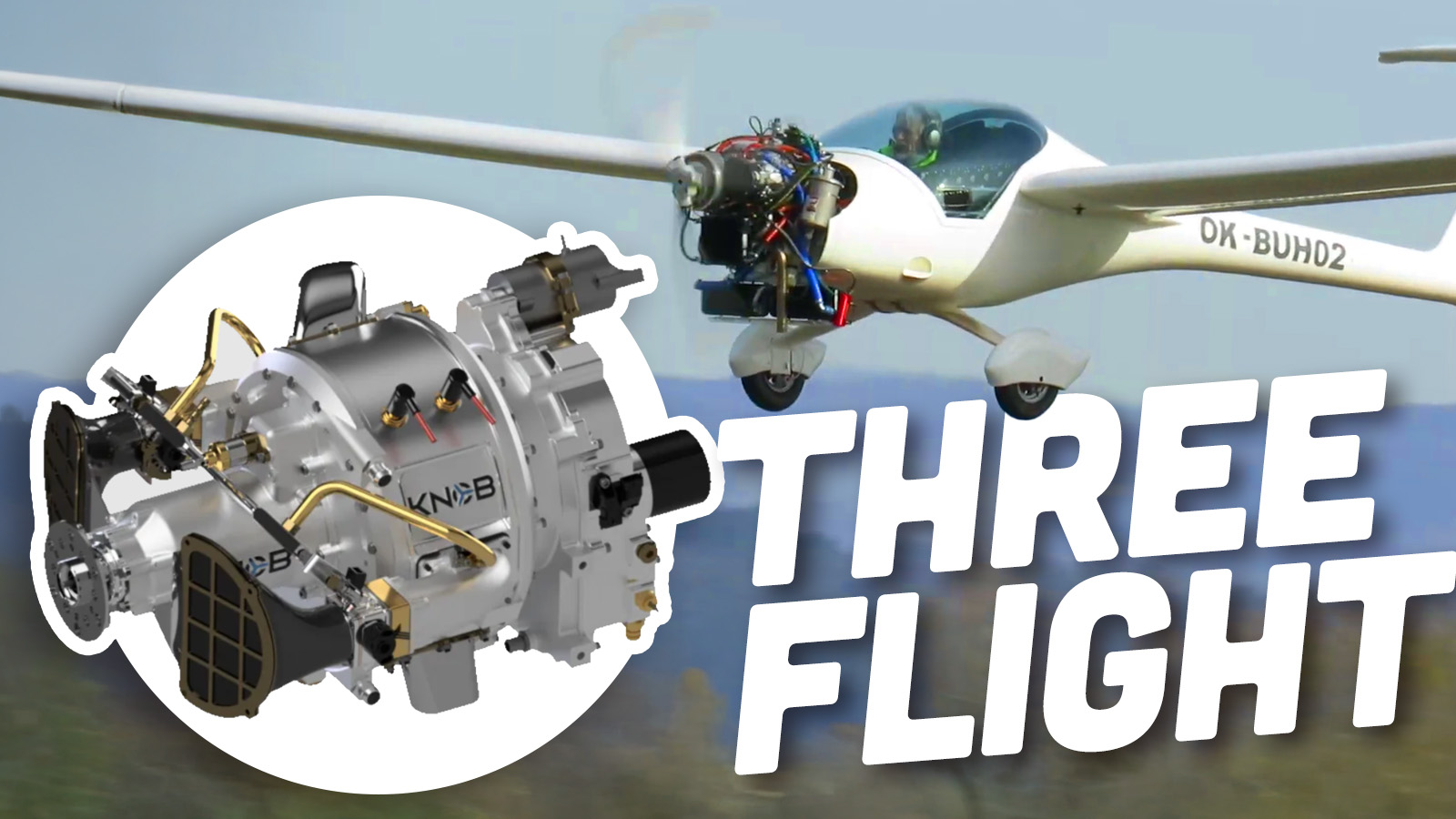
Most of the internal combustion piston engines built for vehicles throughout history have pretty familiar core designs. The majority of fuel-burning vehicles sold today orient their pistons in inline or vee configurations. Boxers and “flat” designs are less common in cars, but remain a mainstay in aviation. There’s also the weird Wankel, which replaces pistons with a spinning Dorito of power. But what if you were to combine some genetics from piston engines and Wankels, then put them into one engine? Meet the Birotary, a crazy new and complicated engine that has three cylinders arranged like a star, a rotating block, a stationary head, and just a dab of Wankel fun.
Some of history’s most complicated engines were built to fulfill specific roles. Perhaps the craziest diesel engine of all time, the three-block, 18-cylinder, and 36-piston Napier Deltic, was designed to give the British Admiralty fast boats to best the Germans in the 1940s. Diesel engines were usually pretty weak back then, so engineers got creative to make power. Then there’s the Commer TS3, the legendary British opposed-piston diesel truck engine that fit into compact spaces and offered a unique sound, good power, and great reliability. Of course, the most common weird engine is probably the Wankel rotary, which was once seen as superior to piston engines for its fewer moving parts and high power-to-weight ratio, among other things.


Like those engines, the Knob Engines Birotary (that’s pronounced sort of like “kuh-nob” not “knob”) hopes to make an improvement in a specific area of transportation. In this case, Knob says it designed this engine to make the ultimate light aircraft engine, one that’s light, powerful, and transmits low vibrations. The awesome thing about the engine that I’m about to show you is that it’s not a concept or something that exists in only virtual reality. A real, running prototype of this engine has been built and has already taken flight in a light aircraft. But how does this weirdo even work? Let’s take a look!
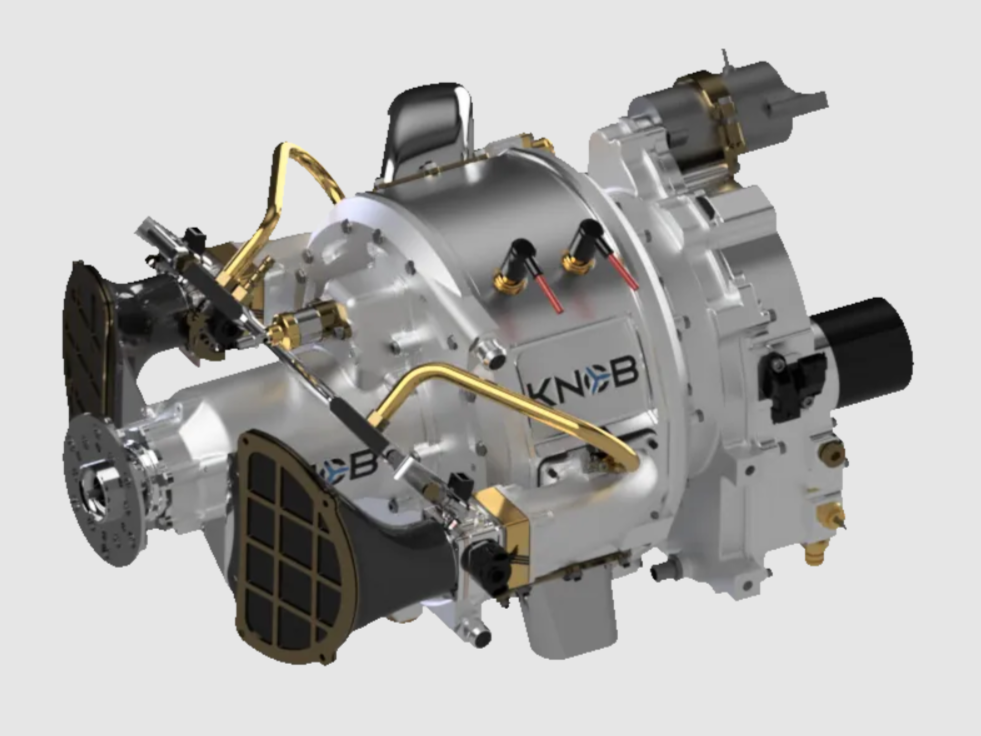
Behind The Engine
The Birotary engine is the work of Vaclav Knob and his team of engineers at Knob Engines. The company was founded in Czechia (Czech Republic) in 2010, and Knob Engines says it has been working on its Birotary from its founding. However, Vaclav says he first came up with the idea back in 1988, and he’s been tweaking it ever since. In 2014, the company says, Vaclav Knob and company managing director Jiri Drahovzal earned patents for the Birotary engine’s design and sealing characteristics in 48 countries.
Here’s the story that Vaclav tells about himself:
Was born 12th June 1964. He graduated from high industry school with a focus on aircraft technology. He also competed four years of studies at university, specializing in engines. All his professional life is focused on research and development in the automotive area. He is the author of patented technology of motor-generator presented on this site.
[…]
After leaving the Czech Technical University in Prague in 1989, where he was studying Transportation and Manipulation Technology, Vaclav has had a broad and highly successful career in engine design, research and development. Strongly influenced by his University study and his inspirational Professor Jan Macek, Vaclav has focused on combustion engine and gearbox design. Today, racing gearboxes and sequential shifting mechanisms developed by Vaclav are being used by many private racing teams.
His developments can be seen in Porsche 996, 997, GT2, GT3, Turbo, Carrera, Boxster, Cayman, also in Mitsubishi Lancer EVO, Toyota Celica, Honda Prelude, and in the vast majority of VW Group automobiles. The shifting mechanism for Porsche was developed by Vaclav in cooperation with “CARTRONIC” and the development center of “Porsche Engineering Group GmbH”. In addition, Vaclav has worked on multiple engine design and development projects for “AUDI AG” and has completed design projects on Ring-Shaped Valve engine and 2-stroke engine with swinging pistons.
Also, before we get into the engineering of this engine, you should listen to it run:
It sounds like Vaclav has quite the history with designing unique machines. Jiri Drahovzal doesn’t note any engineering in his history. Instead, he brings decades of experience in finance, import, export, and business administration to the Knob Engines team. The guys aren’t working alone, either, and have several engineers working alongside them on the Birotary project.
Vaclav also has another outfit called Knobgear, and that company is working in projects beyond the Birotary, including a range extender for electric aircraft and racing transmissions for Volkswagen Group and Honda cars.
Alright, so you know the father of the Birotary. Let’s get into how this thing works.
It’s Not What You Expect
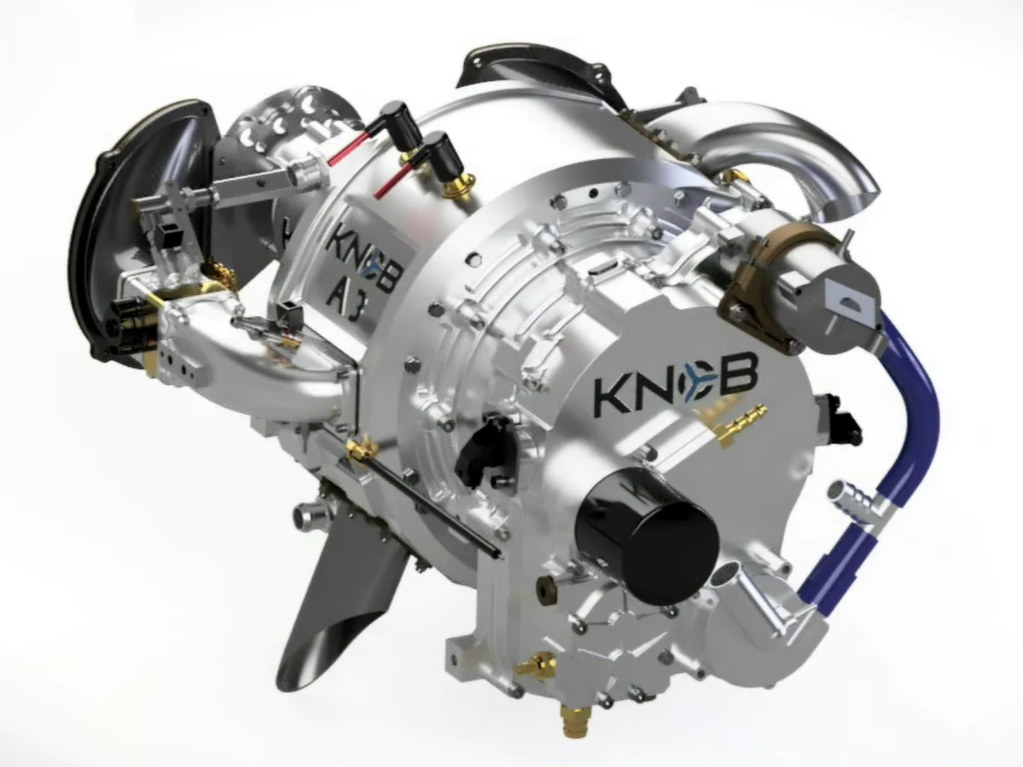
At the core of the Birotary is a set of three cylinders and pistons. These are banked 120 degrees apart, forming a sort of star shape. All three pistons share a central crankshaft. Now here’s the fun part: these pistons and cylinders are housed within a round cylinder block. This entire block spins. As the block spins, each piston is completing its four strokes. Yes, that means the pistons are moving, and the block is moving, too.
While this sounds crazy, it isn’t. Vaclav says that a version of this design already exists in what’s called a rotary engine. By “rotary,” he doesn’t mean Wankel rotary. There is a different kind of rotary engine that’s actually a piston engine.

Here’s what this engine would look like when rotating:
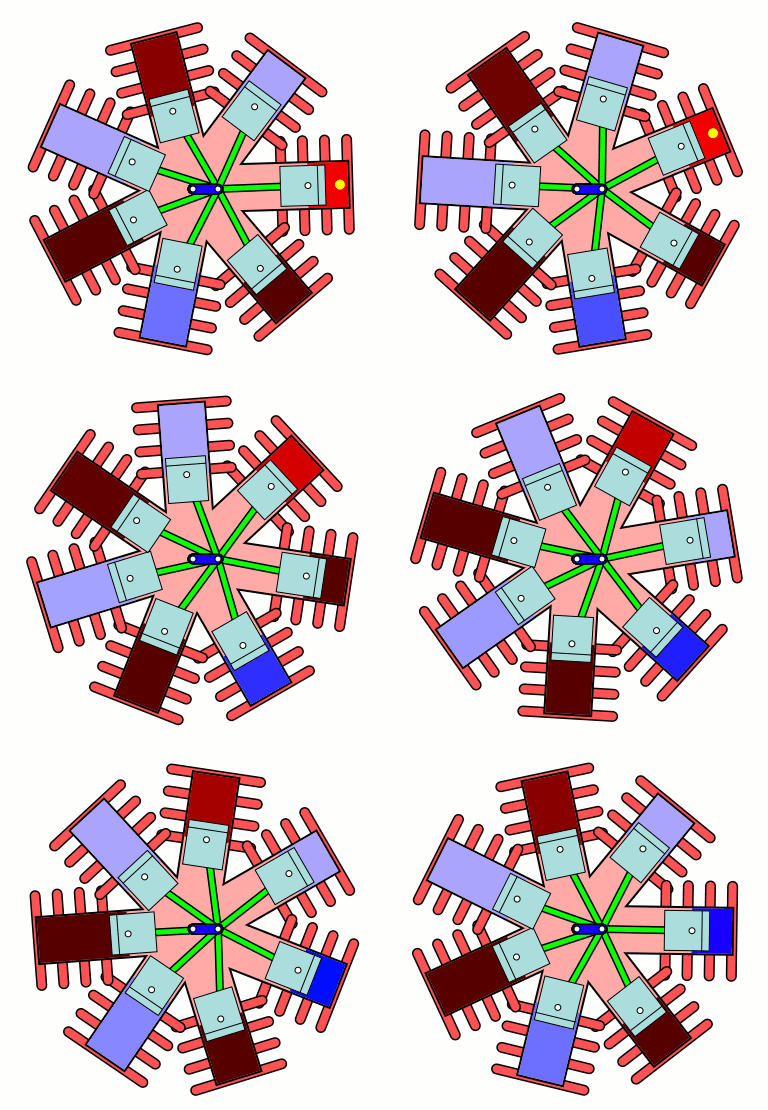
Like this engine, a rotary engine has an odd number of pistons arranged in a sort of radial configuration. What makes this kind of rotary unique is that its crankshaft doesn’t move. Instead, the entire crankcase, with the cylinders and all, rotates around the crankshaft. This kind of rotary engine has been around for more than a century and was often used in aircraft, and sometimes on motorcycles.
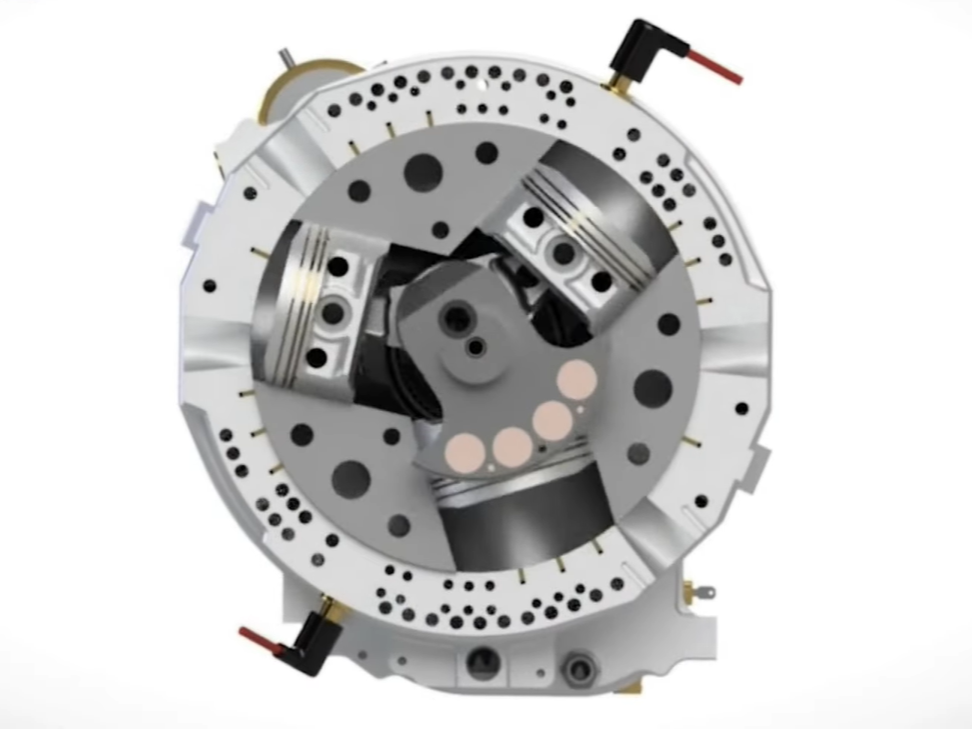
Vaclav’s Birotary has a spinning engine block and a spinning crankshaft. That’s different enough, but the weirdness continues as the engine case doesn’t move. To reiterate, the crank spins, as does an inner engine block and the pistons, but the engine case itself is stationary.
Now that you have a picture of the engine, we can see how it moves. If you’re looking at the front of the engine, you’ll note that the crankshaft spins clockwise and the block spins counterclockwise. Thanks to the counterweight at the end of the crank, this opposite rotation helps in canceling out gyroscopic forces and reaction torque.
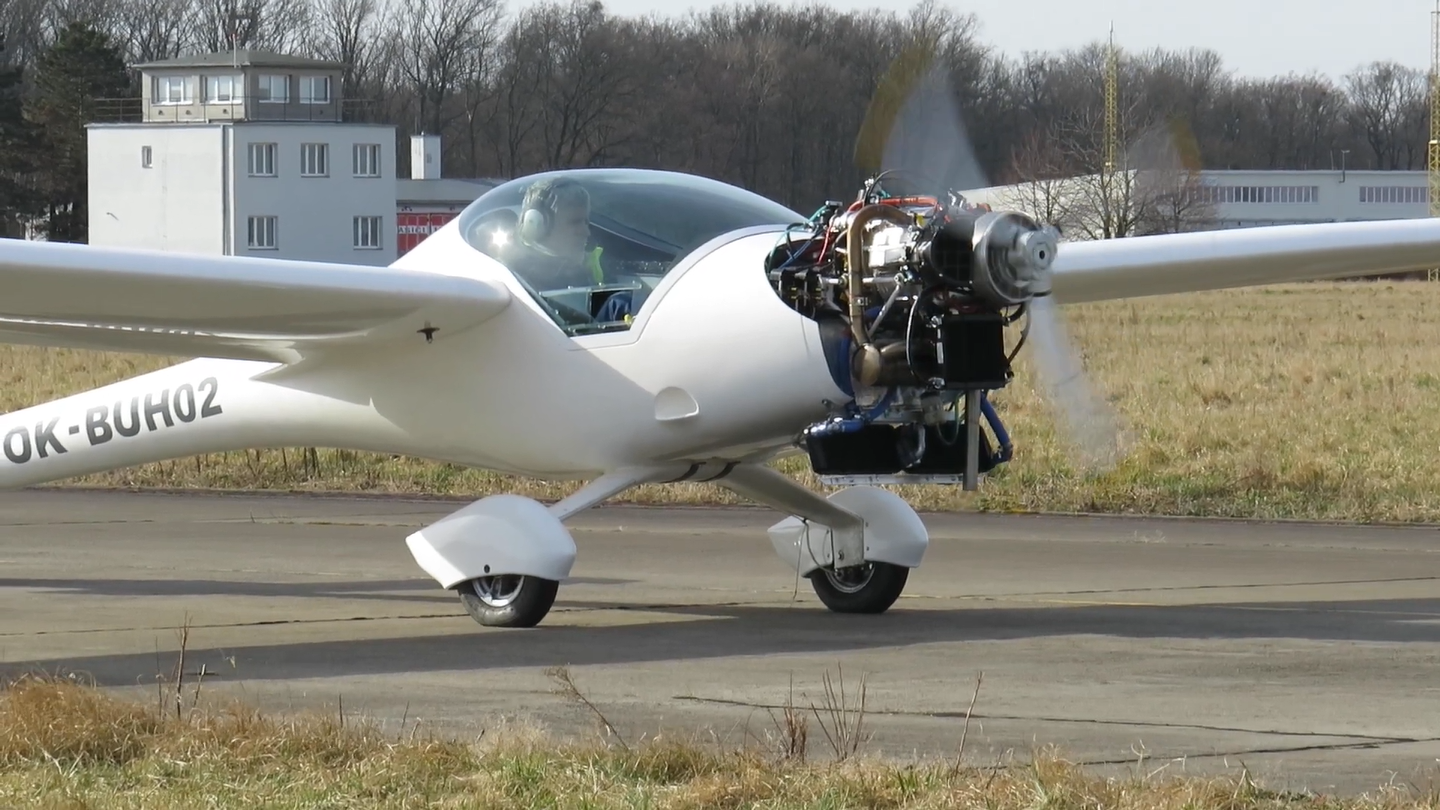
This is especially important for the expected aircraft application. Propeller-driven aircraft like the Cessna 172 that I fly are subject to four primary factors that cause a left-turning tendency. These are propeller slipstream, gyroscopic precession, P-Factor (asymmetric loading) of the propeller blades, and torque. While a lot of this is caused by the action of the propeller, the engine internals, notably the crankshaft, also matter as the aircraft will want to yaw to the left.
This was a huge deal when the aforementioned old-school aircraft rotary reached its apex of design. These engines got huge, and they had gigantic masses of spinning crankcases in addition to titanic propellers, and thus, a ton of left-turning tendency. Here’s a video of the internal workings of the Birotary:
These left-turning tendencies are counteracted with right rudder input. But of course, a goal of many working in this space. is to reduce these tendencies, either through clever angling of the engine or, in this case, making a unique engine. Since the birotary has two large masses spinning in opposite directions, the gyroscopic motion can cancel each other out.
This is also where the Birotary gets its name from, because there are two major rotating masses in the engine. Look, I didn’t create the name. At any rate, Knob Engines thinks this alone will be a pretty huge deal for light aircraft and make them easier and more pleasurable to fly.
It Gets Weirder
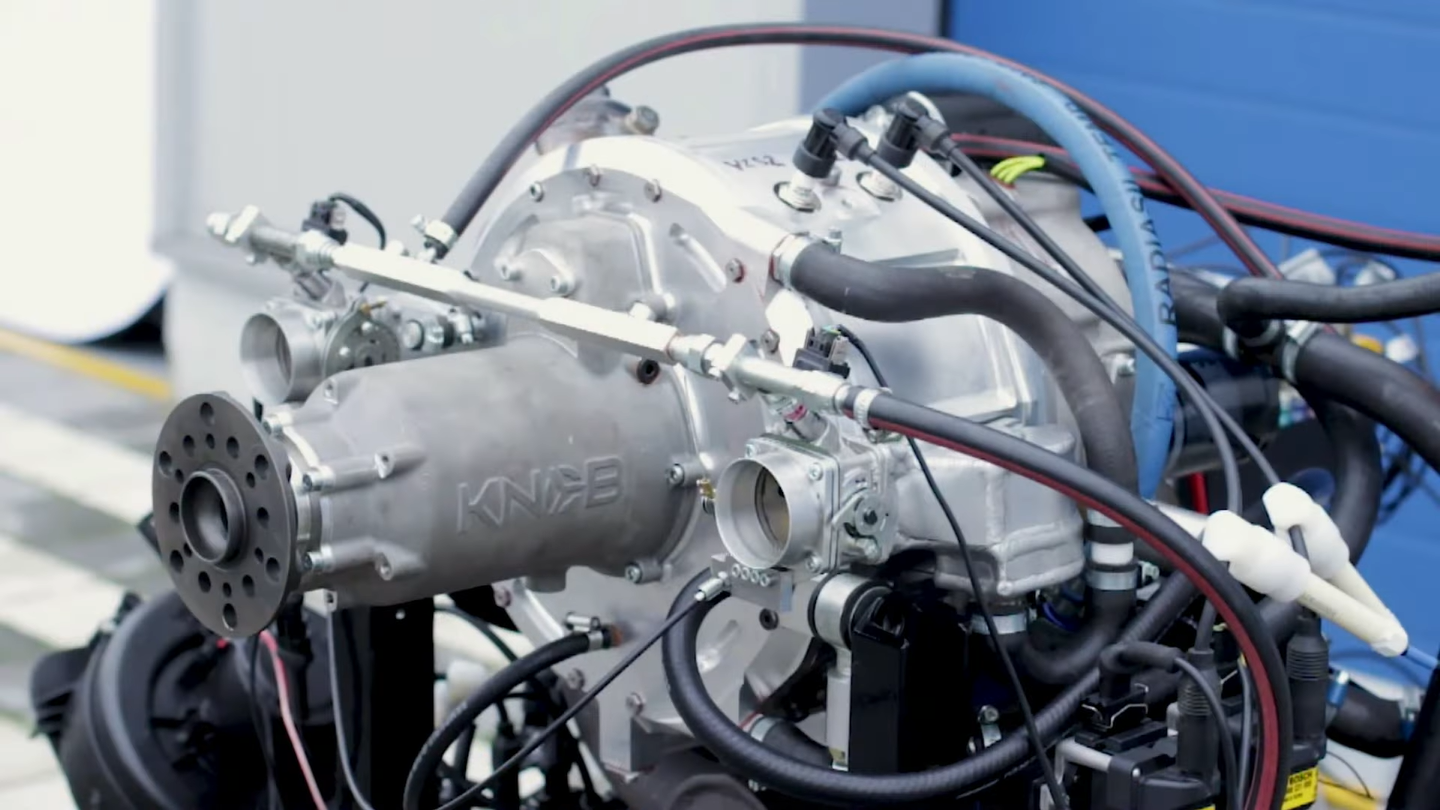
Knob Engines also notes that, by going with this design, the engine technically has fewer parts than a typical piston engine. There’s no valvetrain and its associated components. I’ll let Knob Engines explain:
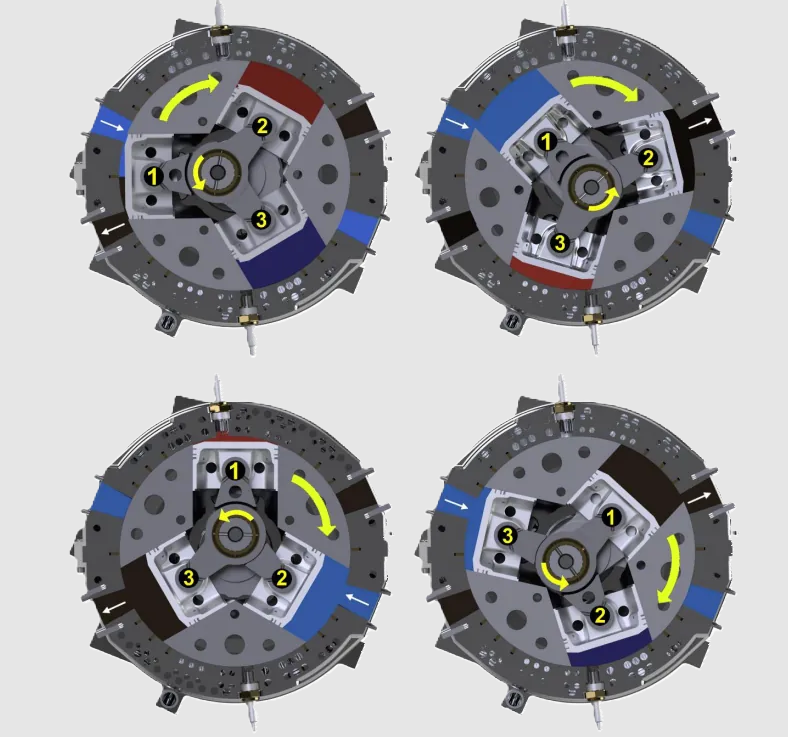
The case is also the cylinder head and has two combustion portions. Each combustion portion is equipped with its own intake and exhaust port, and set of spark plugs. The rotating cylinder block also fulfils the function of slide valvetrain and provides the charge exchange in the cylinders. The cylinder block rotates in opposite direction to the crankshaft. The crankshaft and cylinder block are connected by means of planetary gear set with gear ratio of three (i.e., the crankshaft revolves three times per each cylinder block rotation). This means that for example at 8000 RPM of the engine, the cylinder block rotates at 2000 RPM in one direction and while the crankshaft rotates at 6000 RPM in the opposite direction. The engine completes a four-stroke work cycle once every 720° of relative angle, which means 180° of cylinder block angle plus 540° of crankshaft angle. Each cylinder makes four strokes for every 180° of cylinder block movement, i.e., two full working cycles per block rotation. Figure below shows the engine action trough one four-stroke work cycle.
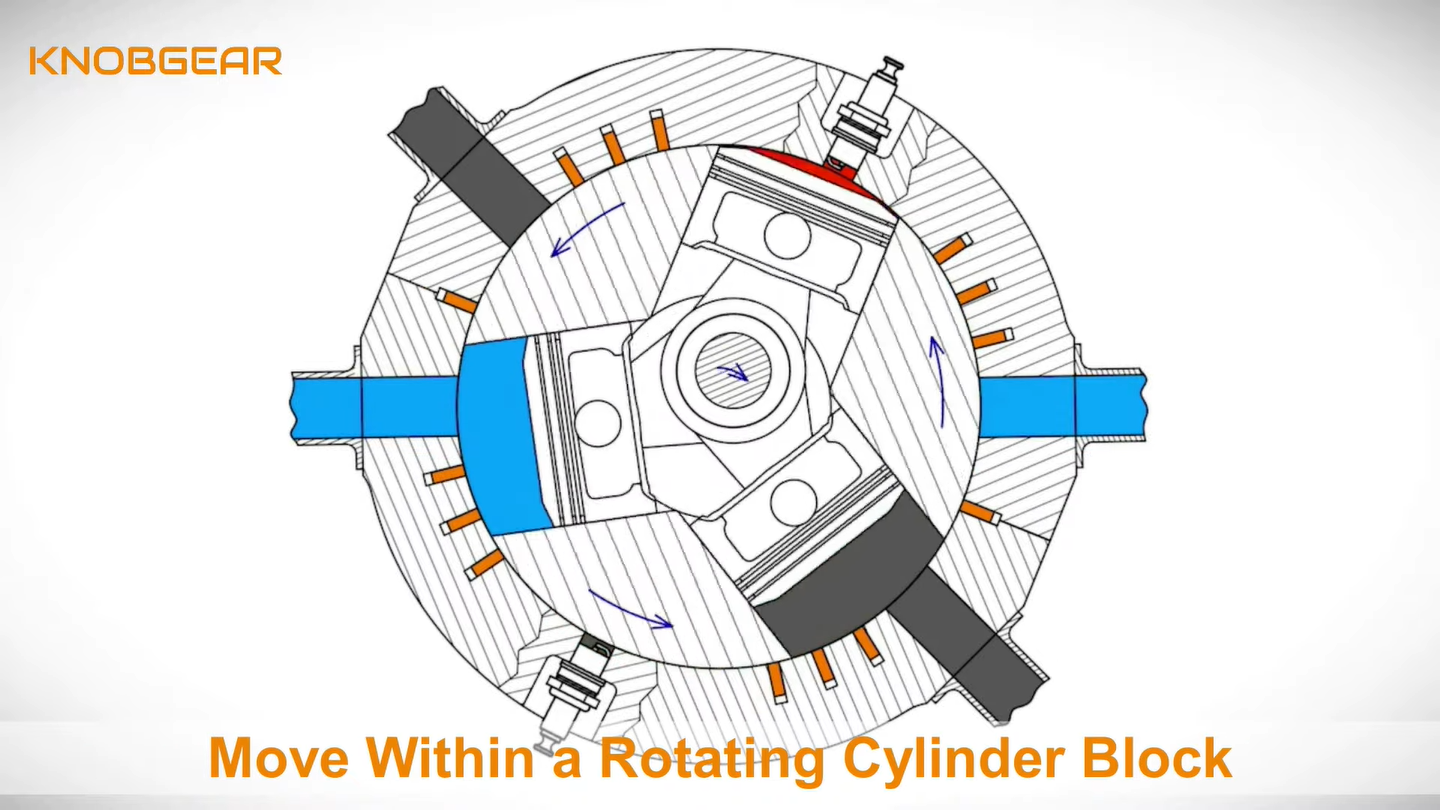
If that wall of text was too much, I’ll simplify it. The stationary engine case has two intake ports, two exhaust ports, and two spark plugs on opposite ends. It’s like an early two-stroke engine in that the air-fuel mix doesn’t enter the combustion chamber until the piston passes by, allowing the mix in. As for firing order, the crank rotates 180 degrees while the block rotates 60 degrees between firing, for a total relative rotation of 240 degrees. The crankshaft speed maxes out at 7,500 RPM while the block tops out at 2,500 RPM.
You may also wonder why there’s a gear reduction going on, and that has to do with the aviation application. Propellers lose efficiency at high RPM due to drag, so gearing the engine down helps keep the prop in a sweeter zone. In this case, the propeller is attached to the spinning block, so the block must move slower than the crankshaft. Indeed, when I’m climbing out of my local airport, my trainer Cessna 172 is usually buzzing around 2,500 RPM.

Another neat part of the Birotary design is its combustion seals. In a Wankel rotary, you have apex seals at the ends of the triangular rotor. Of course, these seals are subject to all kinds of forces as the rotor spins around, and improving apex seal longevity has been a battle of Wankel engine engineers since pretty much its inception.
This engine is different. Not only is there no Dorito of combustion spinning around in there, but the combustion seals are static, on the stationary engine case. Further, the block is a circle spinning inside another circle. In theory, these seals should last a long time, and the engine should have limited blow-by. Here’s what Knob Engines says about that:
The seal assembly comprises of a side seal, transverse sealing strips, joints and springs. The side seal is divided into circular segments always placed between neighboring transverse sealing strips. The transverse sealing strips pass through the side sealing segments notably reaching over the cylinder bore. This solution prevents excessive bending of sealing strips into the cylinder. Joints are located between the side sealing segments and transverse sealing strips. Each sealing element, including its joints, is equipped with its own spring, which presses it towards the cylinder block. Joints also press the elements, which they sit on.
Placement of sealing elements in the stationary case ensures the stable application of force on the sealing elements and this force is unrelated to engine speed, unlike the Wankel rotary engine. This feature facilitates a very high engine speed and high specific output parameters. All the transverse sealing strips and side sealing segments have a surface or tangential contact with the outer, rotational surface of the cylinder block, which decreases contact stresses of the sealing elements and the outer surface of the cylinder block. This surface contact of the seal also requires less seal lubrication and increases its efficiency and durability. The sealing of the high-pressure portion in the cylinder, i.e. between the cylinder block and stationary case, is multiple in both, axial and tangential directions. It ensures high reliability of this Seal assembly of engine in the connection with the cylinder block solution. The side sealing segments are placed on the edge of the cylinder bore thus minimizing the crevice between the cylinder block and stationary case.
The Competition

The Birotor’s primary competitor will be the Rotax 912S, a favorite among light aircraft builders. The Rotax 912 series has been in production since 1989 and features an air and liquid-cooled flat four design. The 912S has two carburetors, a mechanical fuel pump, an output of 100 horses, a speed reduction gearbox, and 1,352cc displacement.
The Knob Engines team is targeting a 750cc displacement, 100 horsepower, and an overall size that’s several inches thinner than a Rotax 912S.
The Knob Engines team has released other important technical notes, too. The engine case is water-cooled, employing liquid channels and a water pump, like your car or motorcycle. The block and its cylinders are cooled through oil.
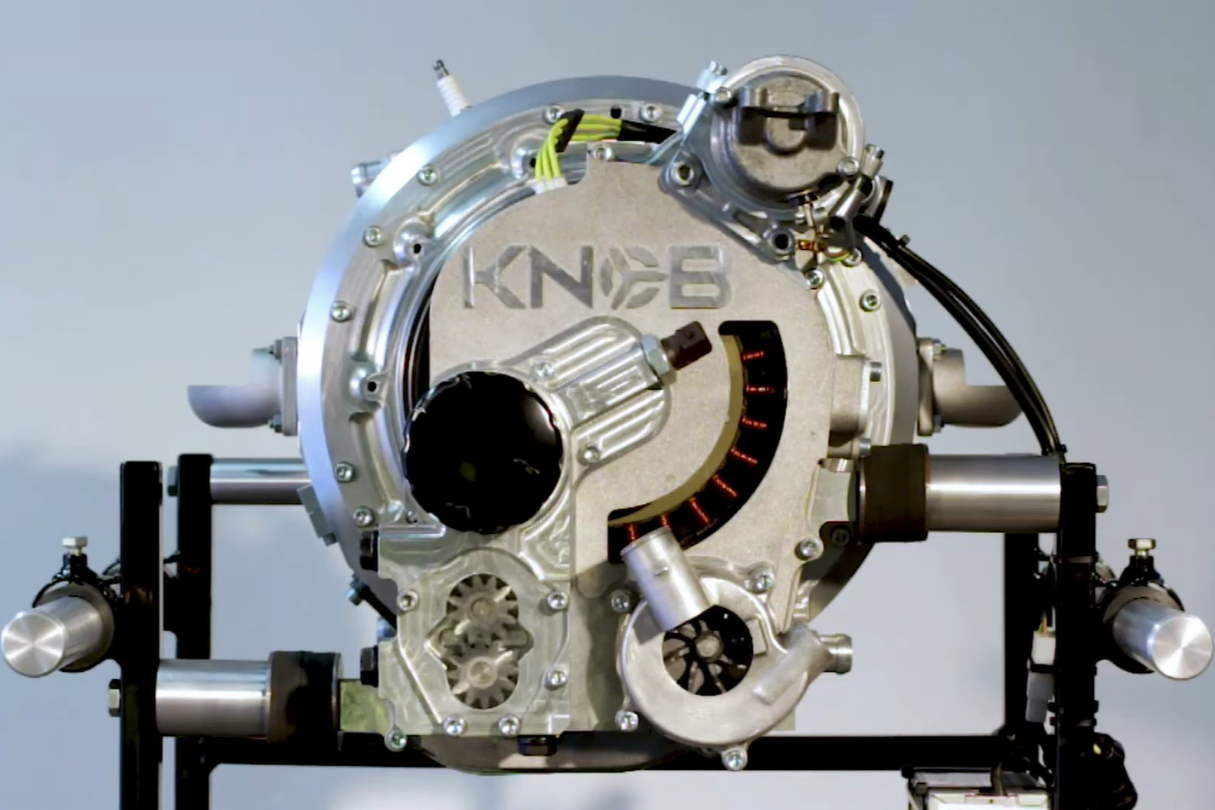
Speaking of oil, lubrication is handled through an oil pump at the back of the engine, which drives oil through the crankshaft and associated internals. However, Knob Engines says that, at least for now, the engine does use some two-stroke oil in its fuel to lubricate the combustion seals.
As of now, the engine has an absolutely tiny bore and stroke. This is why it can rev to the moon, but also enabled the Knob Engines team to design an engine so small that it could be an effective replacement for a typical piston engine in a light aircraft. However, Knob Engines says that bore and stroke could possibly be increased for other options, but that would make for a bigger and heavier engine.
They Can Multiply
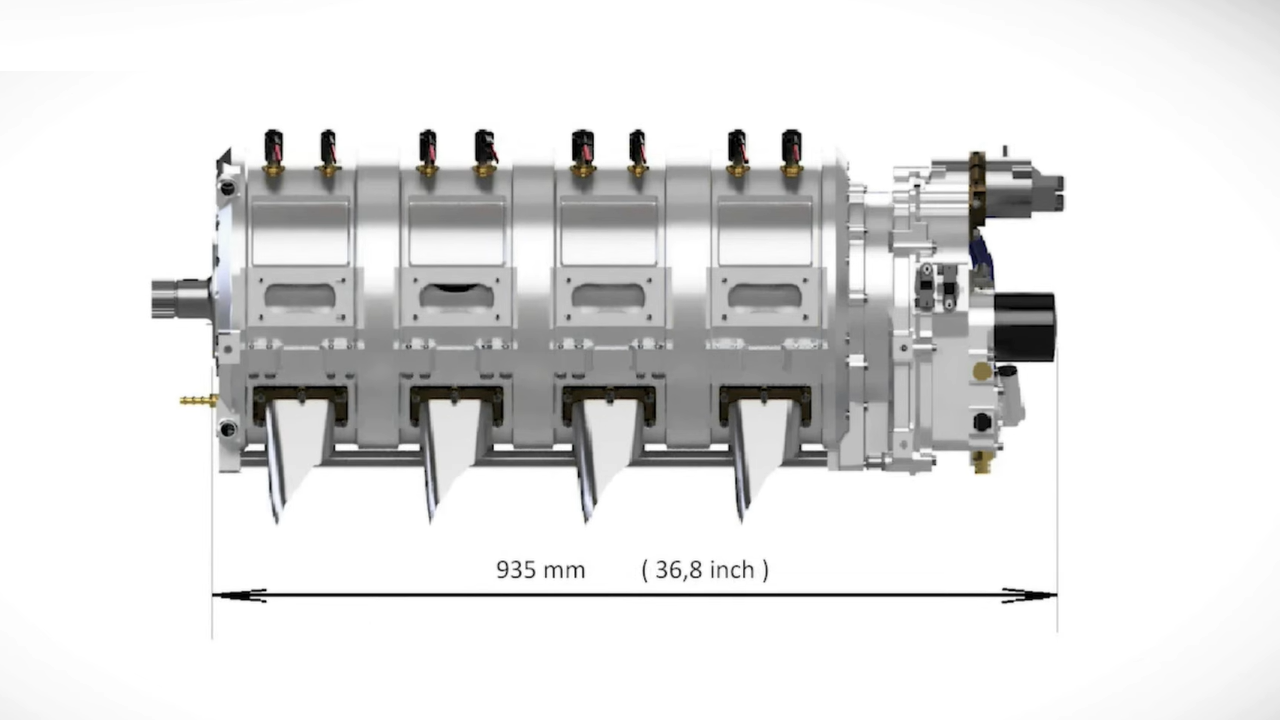
Knob Engines also says that the engine is scalable in perhaps the silliest way possible. If you wanted a bigger and stronger Birotary, you could make versions with multiple spinning cylinder blocks stacked on each other, and each of those blocks could have perhaps as many as 12 cylinders.
Thus, while Knob is focusing on light aircraft for now, the company believes the potential is perhaps endless, and that maybe a Birotary could work in something like a car or a generator. The company is also hoping to hit a time between overhauls (TBO) of at least 2,000 hours, which would be right on the money with the TBO of a Rotax 912.
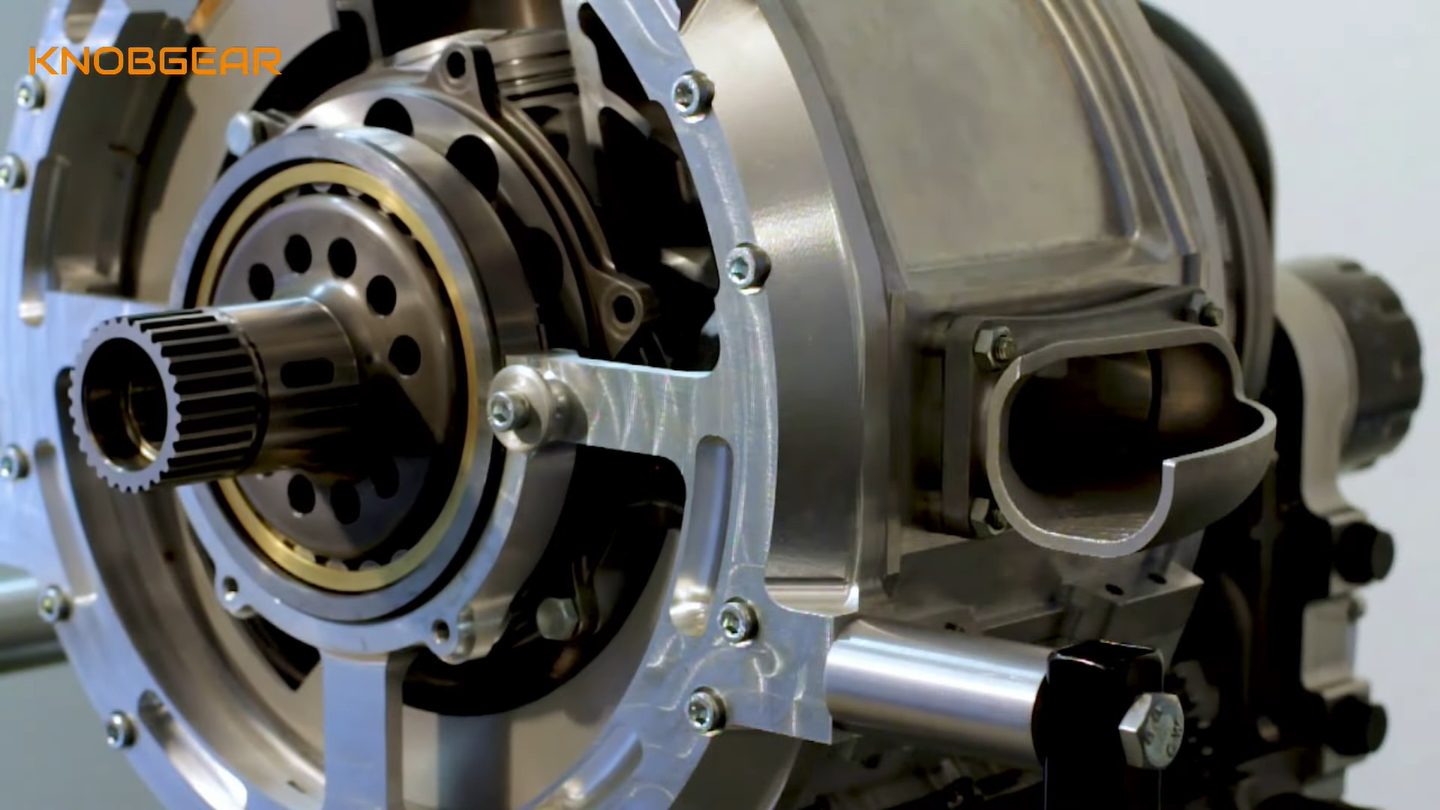
Of course, it’s too early to tell where this project is going and what impacts it could have in aviation and beyond. At the very least, it’s exciting to see that some engineers have cooked up something truly wild. If you want to know more about this engine, click here to watch a YouTube video by Driving 4 Answers that has even more explanation.
This engine is also yet another example of what I said earlier. The Birotary is complicated and weird, but it’s designed to serve a specific purpose. In this case, it’s to make a tiny engine with few vibrations, lots of power, and great balance. I wish these guys all the luck in getting this to market. Who knows, maybe one day someone might try to swap out their Mazda Miata’s engine with a Birotary rather than a GM LS.


overcomplication for the sake of overcomplication (and patenting) always works out in the user’s favor.
Because aviation and added complexity always works out well.
Cool! I love it.
I always love an overcomplicated engine answerring a question nobody asked.
My doubts are on:
TLDR: I applaud the effort, but I will not be buying shares.
Forget balancing the crank, rods and pistons – now you get to balance the block.
Ha.
Theoretically the block would remain in balance by the counter weight on the crank and if any imbalances develop that is what would be adjusted instead.
I see no real advantages here. Torque, P-factor, and precession can all be corrected for very simply with a bit of rudder pressure, which is introduced in the very first flight lesson.
Still, it is a a very intriguing design, especially when stacked with additional layers.
Precession can be corrected, but it’s a force that has to be corrected with aero forces. All else being equal, if you take away the force that has to be countered with an aero force, the plane will fly more efficiently with less drag. How much more efficiently? I am a nuclear engineer, I’ve been to a rodeo and a state fair, and I have stayed at a Holliday Inn, but I am not an aeronautical engineer… So, I dunno.
The advantage is in the reduced weight and GPH burn for the same horsepower compared to the Rotax. We dont know about cost. Lower left turning tendencies are a bonus that might also improve safety.
You’ve still got that big spinny propeller out there, so there’s no way to massage that out of the equation.
Would swapping your traditional engine out for this type be known as a knob job?
I applaud the innovation. I will look forward to seeing detailed test data, particularly specific fuel consumption. I hope you get away from need for lubricants in fuel, ’cause as you know, it drastically reduces octane, greatly reducing acceptable compression ratio, thus greatly reducing thermal efficiency. The Mazda rotary (which has a significant following within the EAA community, due to its weight and relative simplicity) developed only~ 130 psi cranking pressure, which admittedly is vastly higher than, for example, the O-360, at a pathetic 80 psi. The 912, at ~11:1 achieves ~170 psi. – directly relating to fuel efficiency. It will be interesting to see, in the end, what sort of safe cylinder pressures you can pull off as related to many competing design factors including chamber shape, swirl, quench, emissions, the induction limitations associated with piston porting, etc. I sincerely hope that the principal goal is not to solve what thus far seems a second order flight attitude (yaw) issue.
Great write up. Cool to see a company engineering new, non-traditional, IC technology! You’ll never see radical improvements unless you try something radically different. I hope this works out for Knob!
I can see this as a nice option for home builders. It would be nice to see how it holds up to real world use. I like that it produces 100 hp with just 750cc displacement.
My old Cessna 150’s Continental 0-200 was 3.29 liters, and produced the same 100 hp. So that seems like an improvement. It will be interesting to see if they are as reliable as an old 0-200. Also maintenance-wise, when I can some stuck piston rings on the 0-200 I didn’t have tear down the entire engie to fix that problem. So that’s a thought. A&Ps don’t work for free.
I honestly don’t know if I’d want this in an airplane seeing as a boxer engine has years of proven reliability behind it and this sounds rather rube goldberg to me, like there may be fewer moving parts but when they include the engine block it’s not entirely confidence-inspiring. Sort of like how I trust my Toyota with a 1UZ to take me as far as I wanna go as long as I change the timing belt, but if I had a VW with a W8 my heart rate would spike driving to the grocery store. Sure, the idea is cool on paper but in practice most of these novel ideas haven’t been done for a reason.
I drove 3 different VWs for 22 years as my daily driver. Each I maintained myself and each bought when they and over 100k miles and run until dead or nearly dead (260-300k miles).
When the W8 engine was offered in the Passat a sister asked for my opinion and she advised she was cross shopping the W8 Passat with an Audi A4 with the V6.
I recommended if she really was convinced that she wanted a VW product and not go with the safe choice of a Lexus ES…
Than she should choose the Audi under the advice that she should definitely still plan on selling it before it hit 100k miles.
As a gearhead I love the idea of the W8 I certainly couldn’t recommend any non-car person actually live with one.
So is there any selling point besides the lack of torque “steer”?
So it’s a bit thinner than the rotax. Is it lighter? More fuel efficient? And not just like “oh we have a target of being 5% lighter” or something.
What’s the real noticeable difference that will make it worth what is probably going to be a much more expensive engine until they get some economy of scale going? Because not needing a trim tab aint it.
I wanna put three in a row and stick it in a hotrod and watch the looks on people’s faces when I explain it has a 9-cylinder engine.
A 9-cylinder engine with 12 spark plugs.
All I see is complexity for complexity’s sake.
So a more ‘standard’ engine that you’re used to is much more complex, with all that valve train and those extra components stuffed in there, right?
Yeah, but camshafts and valvetrains have a hundred years of development with billions made.
There’s more than one type of complexity.
”Knob Engines also says that the engine is scalable in perhaps the silliest way possible. If you wanted a bigger and stronger Birotary, you could make versions with multiple spinning cylinder blocks stacked on each other”
Isn’t this stacking similar to how Mazda uses 2 or 3 rotors on the RX-7, RX-8, Eunos Cosmo, and 787B?
Or have I completely misunderstood what Mazda was doing?
Nope. They did the exact same thing.
They also say they can have up to 12 cylinders per ‘rotor’, so I guess you could have a stack of four 3-cyls, or a single 12-cyl, or two 6-cyls etc.
So it’s more a combination of the piston way of increasing power (more, bigger, cylinders) and the rotary way of adding more rotors.
The same is also done with radial engines.
This thing hurts my head and if I I remember it, I will be curious what the TBOH is going to be. The Continental O-200 in my Cessna 150 was good for ~2000 hours… about 200,000 miles. And 8,000 gallons of fuel.
I was wondering about rebuilds and maintenance as well. I wonder how hard maintenance will be on these things.
I fully expect most PPL pilots are going to be hesitant to buy an airplane with this engine simply because it IS so different.
I think Knob knows the TBOH, fuel economy And certainly the reliability Have To to be competitive
Also for an overhaul, practically speaking I’m guessing you would need to send it back to Knob or they will need to create a network of certified APIs that are Knob engine overhaul certified
At this point, I’d buy something with a Rotax before this thing. And a correction: TBOH on an O-200 is 1,800 hours. “We regret the error.”
Aren’t the left-turning aspects of light aircraft usually handled by the use of a rudder trim tab? A small piece of aluminum sheet at the bottom of the tail that is deflected to provide a balance against the engine. My Dad’s various Cessna aircraft had this, and he explained that was the function.
My Cessna 150 had elevator trim, but not rudder trim. Some right rudder pressure climbing out… “Step on the ball” was what the instructor taught me. On the turn coordinator.
It was a little weird that Bell Helicopters required left pedal to keep things straight and Eurocopters, the main rotor of which rotate counter-clockwise, require some right pedal to stay straight taking off. I’ve been told that if you’re going to fly helicopters, you are better off if you’ve never flown a fixed wing plane. Because the instincts you learned in them are often not what you should do in a helicopter, regardless of model, when things happen.
The 172 I train in does have a rudder trim tab, but the instructors at the school still teach to use right rudder to overcome the left turning tendency.
One of my favorite engine/gearhead YouTube channels (Driving 4 Answers) just did a feature explaining the birotory engine. Recommend viewing along with all his other engine videos (especially the one where he 3D prints a sort-of working rotary engine).
https://youtu.be/lKM76zxCfiU
The video definitely made the seals easier to understand.
A radial engine for the 21st century is cool, but I’m on Team Electric for aviation as well as automobiles. Can this run on hydrogen, SAF or synthetic fuel?
Electric will never properly work for aviation because :
Batteries are just too damn heavyThey don’t get lighter as the energy stored within them is consumedThey don’t have the energy density (by weight) of liquid fuel (gasoline is roughly 40 to 60 times higher than lithium-ion batteries)If you want to fly a fully-laden 747 across the Atlantic it’s easily done with jet engines and aviation fuel.
If you tried to fly a fully-laden 747 across the Atlantic using electric motors and battery power, how big would those batteries be, and how much would those batteries need to weigh?
I don’t think electric aviation is exclusively limited to battery power though. There are already some VTOL aircraft that use electric ducted fans for propulsion, but have a gas engine to generate the electricity.
That’s complicated, sure, but opens up different aircraft designs not possible with an ICE directly connected to a propeller, fan, etc.
There’s more to aviation than commercial jets. General aviation can go fully electric with a proper charging infrastructure. There are hybrid turboprop designs that could take over regional airline duties, as well as hydrogen fuel cell designs for larger aircraft.
Oh, and very few operators are still using 747s. The Airbus A380 is on its way out as well. The age of jumbo jets is over, so we should stop limiting ourselves to thinking of gigantic, heavy airliners as the standard for air travel.
“Hybrid-electric propulsion leads to better energy management, reducing fuel consumption by up to 5% compared to a standard flight. The electricity can come from batteries or fuel cells that convert hydrogen into electricity.”
https://www.airbus.com/en/innovation/energy-transition/hybrid-and-electric-flight
Up to 5% is rather underwhelming. Especially if that comes at the expense of payload.
But if you’re a commercial airline, 5% off your annual fuel bill is a fuckton of money.
Depends on the compromises. Commercial jets are damned efficient at cruising speeds already so these hybrids likely offer nothing for anything but short flights. It also I think assumes jet fuel costs more than electricity and ignores charging speeds which is likely much much longer than pumping in jet fuel.
Remember your words in a few years, as new developments slowly chip away at your statement. We call that which comes from science and technology…innovation.
I agree, it will likely happen some day, but that day is a very long ways off. Super-capacitors, even if they could be scaled, are still too heavy. The tech that’s likely needed are large, high discharge, metal-air batteries.
I’m sure he will have turned to dust long before that day comes.
You could do it, all the was from NYC to Paris even.
You’d just have to recharge in Newfoundland, Greenland, Iceland, Ireland and England along the way. And God knows how long it would take to recharge an airliner. Might be quicker to take a Clipper ship.
How would this deal with the lubrication of the seals? It seems like it would consume a lot of oil, like the Wankel rotary, as lubricating oil would be swept into the compression/exhaust chambers.
The company says that, at least as of now, they use two-stroke oil in the gasoline for seal lubrication.
Ah. Everyone’s favorite feature of the Wankel (which, as a former RX-8 owner and lover, I can say).
I had the same thought, looking at all that moving surface area. I was not surprised to see it needs 2 stroke additive.
This also makes me wonder if the combustion chamber sealing is up to running at compression ignition engine levels. Use the fuel as lubricant on the sealing surface as well.
Probably not, but in the world of make believe let us pretend… a “Birotary diesel” engine.
It’s fun to see people trying new stuff — and maybe this thing won’t be too complicated as to present novel failure modes at V1. One of my favorite pieces of writing is A History of Aircraft Piston Engines by Herschel Smith. He basically ends in 1958 (when Termite Terrace was effectively shuttered, but that’s another history) but to that point the book somehow communicates a story of technological refinement, the vehicles it makes possible, and the aesthetic, if not artistic, impulses that express themselves, all behind engaging prose. A must-read for anyone interested in how to write about the subject. Heck, I last read the book a quarter-century ago, so maybe I should take my own advice.
I don’t see this being a good idea for a car, but there appear to be some advantages for small aircraft, particularly trainers or other use that doesn’t require range. I wonder what fuel burn is. It’s small displacement, but running at high rpm and with so many firing events per rpm, it’s got to be a fuel-eater. It’s a neat idea.
I’m going to assume that since they aren’t boasting about efficiency gains, you know the answer.
I’d assume it’s about the same efficiency as that Rotax flat-4 it’s competing with, but there might be indirect fuel efficiency gains due to the lighter overall aircraft weight and lower yaw moments to correct. It’s mentioned several times that it’s intended specifically for training aircraft, and U wonder if fuel cost is less of a consideration for those since flights should be quite short.
It does look like it might be TBI, so that’s an improvement over carbs, but it still is going to run far more combustion events per mile traveled than the Rotax. Unless my math is wrong (I’m more of an artist than a mathematician, so that’s quite possible), assuming the same block rpm as the Rotax’s crank rpm (this is a guess based on the manufacturer’s example numbers and what I imagine is a low relative torque output requiring rpm to be on the higher side for a climb out, but for cruising load demands, I have no idea, so I’m just using 2k rpm as a comparison in lieu of better data), “Each cylinder (3) makes four strokes for every 180° of cylinder block movement,” means to me that there are 6 combustion events per rotation (2 per cylinder x 3 cylinders) to the Rotax’s 2. How that equates to fuel volume per event, I don’t know, but that’s a large delta. Of course, it’s also a little more than half the displacement, so let’s say we cut the difference of fuel required per event in half, that’s still an additional combustion event worth of fuel used per rotation. Maybe efficiency gains in fuel and (potentially) breathing negate that disadvantage, IDK and I don’t see how that can be determined with the given info, but my guess is that it uses more fuel per mile. With its benefits in weight and lack of torque effect imparted to the aircraft and in an application where some extra fuel isn’t a significant issue, maybe that’s not important. I think it’s an interesting idea and I’d like to see real world test comparisons.
Finally, thank you for a very thoughtful analysis, devoid of ‘but this’ or ‘that’s not right’ by those threatened by something different.
I’ve never been threatened by something merely because it is new or different, but I find myself increasingly critical of new ideas this last decade or so since they’re so often fall into the categories of quick grabs for investor money using popular current buzzwords or even repackaged old tech from expired patents being passed off as new, disposable and unrepairable junk masquerading as green tech, or electronic gimmicks that offer no benefit of serious value to the consumer (or the environment) while seriously penalizing the consumer to the producer’s benefit. This particular idea strikes me as genuine and of real potential benefit, if likely niche application (which is great, it just means lower volume and greater specific market dependency that makes profitability a greater challenge), and I find that refreshing. Plus, I love seeing different mechanical ideas, whether they’re good or not.
Negatory. While training flights are relatively short, costs are still fairly high for what it is. 100LL av gas is something like $7-8 a gallon, and a typical LSA such as a Cessna 172 can burn 10 gallons per hour cruising at 75% power, so an hour of flight training can easily cost $70 just in fuel.
A small price to pay for the joy of dusting the world with leaded exhaust.
What are your thoughts on the Liquid Piston reverse Wankel? https://www.liquidpiston.com/how-it-works
They were just around the corner when I was in high school and now that I am a grounchy, nearing middle aged careerman with lower back pain, they are still just around the corner.
Every once in a while they pop up to raise more money. The core technology I believe to be sound, but I tend to discount any “new distruptive tech” until I find it behind a Place Order button.
Like this Czech motor?
I tend to agree with you by the way.
At first I thought this would be a followup to @vaimais comment that mentioned this: https://innengine.com – it looks like an opposed-piston barrel/cam engine.
Glad D4A is on your radar—I’m really impressed by his content.
My understanding is that the single engine aircraft space is inherently conservative which is why most everyone is flying around with 40+ yr old designs (running on leaded gas…) even though there are clearly better options, even putting aside “exotic” stuff like this. Sort of like how NASA is still using chips from the 1980s in satellites: better to trade performance for proven reliability than risk something new.
All to say, what are the odds anyone will actually use this, even if they hit all their benchmarks? Not knocking the tech, just curious about the challenges of bringing anything new to market no matter how good it is.
The single engine aircraft industry isn’t totally conservative. Piper offer a diesel version of the Archer, which not only burns less fuel but also has no propeller or mixture control. Plus, Diamond have built their entire lineup around diesels.
But the main reason old airframes are still flying is the old planes were built to last decades with regular maintenance, unlike cars which aren’t designed to last much longer beyond 100K miles. Planes continue to be built that way, since the potential for catastrophe if a plane breaks down while in the air is much higher than with a car on the road.
I get why old airframes (or newly produced old designs) are still here. It’s the engines that surprise me given who wouldn’t want better efficiency, or things like fuel injection and so on. Is it a matter of it just not being worth the effort to modify the aircraft for anything other than the engine it was designed for? My only point of reference is commercial aviation where a NEO program inevitably costs billions of dollars of R&D for the airframe.
If you’re talking about engine swaps for existing aircraft, overhauls are really expensive. Since aircraft ownership is already very expensive, I imagine unless the benefits are obvious, most owner/operators probably wouldn’t think it’s worth it.
100 percent largely in GA it comes down to cost.
Private flying is F@$king expensive.
It is Easier and less costly to overhaul an existing engine (as a 1x cost) than replace the existing engine with Any brand new engine. Keep in mind a brand new small private airplane engine can be easily over $60k
Also when replacing an existing engine that came with the airframe on a certified aircraft (ie not an EAA prototype) there are additional cost concerns with certification / recertification of that airframe with that engine
And there may be additional insurance cost adjustments too
The first production one, if this engine makes it, needs to either go on a Fokker Dr.I or Sopwith Camel replica.
It is the Czech Republic, they might actually have one or two of those in inventory to upgrade.
I was thinking RX7