


The mighty locomotives dominating the rails around the world have permitted some excessively long trains. Over here in America, you’ll find the likes of the Union Pacific Railroad and the Burlington Northern Santa Fe Railway regularly pulling trains over three miles long. An operator in South Africa technically just broke a record. Transnet Freight Rail just pulled a freight train that spanned 4.7 miles in length, carrying 696 cars in the process. This was, on paper, the longest train on record, but there’s one little catch.
Iron ore trains are routinely some of the longest consists in the world. There is a ton of efficiency in moving great amounts of freight with a single train. Putting greater loads into single trains means railroads can run fewer trains, have fewer crews, and make the most of motive power. The railroads say that by running fewer, longer trains, the potential for cars to get hit by trains also drops.


But there is a limit. In most general freight operations, trains must be able to fit into sidings or passing tracks. If these trains stop, they should also be able to avoid shutting down a road. Then there’s the limits of the infrastructure, the locomotives, and the cars. Thus, some of the largest trains in the world operate in remote places where there aren’t people, cars, or many other obstacles in the way. Iron ore trains connect mines off in distant lands to ports for export or to various industries. South Africa and Australia are famous for their iron ore railways that span thousands of miles through the wilderness.

A railroad in Australia’s held the official record for the world’s longest train for over two decades. Now, it’s time for the previous record holder, Transnet Freight Rail of South Africa, to take back the crown. But the win does come with a bit of an asterisk.
South Africa’s National Freight Railroad
Transnet Freight Rail is South Africa’s largest freight railway, and, among other things, it carries cement, steel, coal, minerals, and chrome. The company describes its history on its website like this:
When railway transport was proposed for the harbours in the Cape and Natal. The real catalyst for the country’s railway and harbour expansion, can be attributed to the discovery of diamonds in Kimberly in 1867. South Africa’s state railway system began when the two pioneer railway systems situated in the Cape and Natal became government property in 1872 and 1877 respectively, thus completing the relatively primitive harbours in Durban and Cape Town. Scarcely nine years after the founding of the government railways, both which were rapidly pushed to Kimberly, rumours of massive gold deposits in the Transvaal Republic were confirmed. Almost overnight, economic power had shifted from the colonial south to the republican north.

In 1910 Union was achieved, with the country’s leaders adamant that the railways and harbours should be used to unify and develop South Africa’s economy. The result – the South African Railways and Harbours administration (SAR&H) becoming a proud established arm of the government. A mere 20 years after the establishment of Union, in 1930, South Africa had established itself as a proud and mobile nation. This achievement can be accredited to the opening of efficient mainline passenger links and an impressive network of urban and metropolitan train services.
During the 1970s it was agreed upon by the government that the SAR&H should restructure itself along defined business lines. Integral to the process was a change in the name and image of the organisation, which would appropriately reflect its new vision and mission as a successful state business enterprise. In 1981, the country’s railway, harbour, road transport, aviation and pipeline operations became known as South African Transport Services (SATS). At the same time, the enterprise was restructured into units and divisions, with a strong emphasis on localized management. By the end of 1989, the goal of managing SATS as a private entity was well within reach, and on 1 April 1990, after 80 years of government and parliamentary control, SATS was given company status. A new, limited liability company, representing a vast transport network, was finally born. Its name was Transnet SOC Ltd.

Transnet regularly runs long trains along its Sishen-Saldanha line. A portion of it is pictured above. This is a 535-mile-long freight-only line that connects iron ore mines in the Northern Cape of South Africa to the port at Saldanha Bay. Transnet hauls about 60 million metric tons of iron ore a year, often on trains pulling more than 300 freight cars. Notably, these trains are usually pulled by several locomotives placed throughout the consist (total train). Control of all of these locomotives is handled through radio distributed power, which allows one locomotive crew to control multiple units at the same time through radio signals.
This technology has been around for several decades, and can also be found in a form that uses the physical electrical connections in a train rather than wireless radios. Distributed power allows for the monster trains seen all over the world. If you’ve ever sat at a railroad crossing and saw a locomotive in the middle of a freight train, that train was probably using distributed power to remotely control the locomotive.
The Record Run

This year, Transnet decided to demonstrate just how well radio distributed power can work for an iron ore train. On October 18, Transnet lashed up a number of Class 15E electric locomotives and Class 43D locomotives up to a 696-car train. Each freight car was empty, and Transnet was hauling them from the port back to the mines.

The locomotives in the train were fascinating units. The Class 15E (above), for example, was built by Union Carriage & Wagon of South Africa, and features a design from Mitsui of Japan, electrical components from Toshiba, a frame from DCD-Dorby, a 3′ 6″ rail gauge, and 6,000 horsepower thanks to AC traction motors. About 76 Class 15E locomotives were built for Transnet from 2009 to 2013.
The Class 43D (below) is a product of General Electric, and was built from 2010 to 2015 in America for export to Transnet.
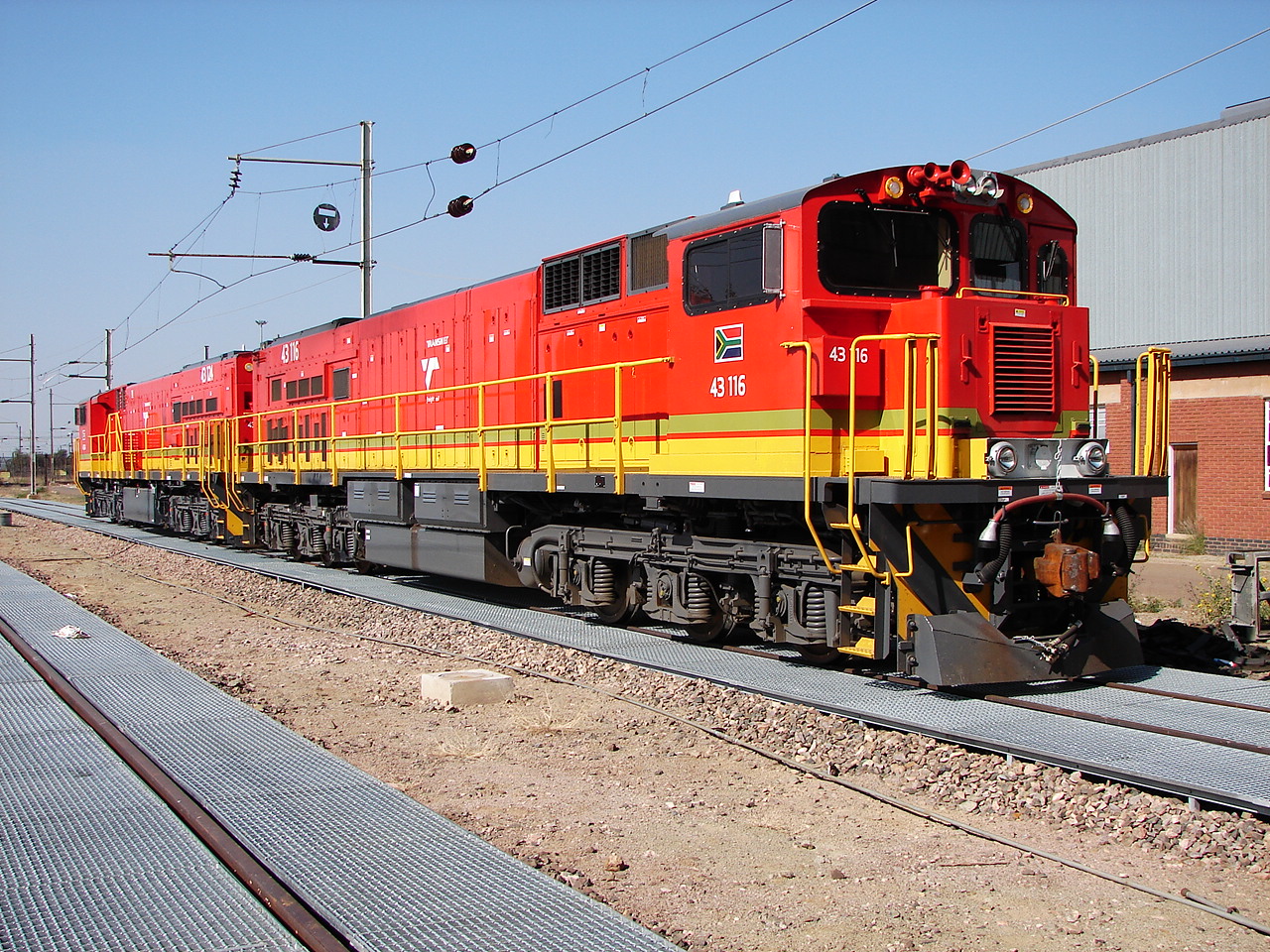
These machines, known to GE as C30ACis, are diesel-electric locomotives and feature GE FDL12 V12 prime movers with 3,300 horses in the stable.
Notably, all of these locomotives feature radio distributed power. When the engineer in the lead locomotive increases the throttle, engages the brakes, or does something else, these actions are transmitted through encrypted radio signals to be received by trailing locomotives. Within a couple of seconds, the following locomotives will adjust themselves to match the lead locomotive.

Transnet said it ran this super-long train in part to show that distributed power can make for some crazy long trains, but, of course, to also score a world record. The current record for the longest train in the world goes to BHP Iron Ore of Australia. The Guinness Book of World Records describes that train:
The longest train ever was 7.353 km (4.57 miles or 24,123 ft 11.61 in) long, and consisted of 682 ore cars pushed by 8 powerful diesel-electric locomotives. Assembled by BHP Iron Ore, the train travelled 275 km (171 miles) from the company’s Newman and Yandi mines to Port Hedland, Western Australia, on 21 June 2001.
The train was also the heaviest ever, weighing an incredible 99,732.1 metric tonnes. It had an amazing 5,648 wheels.
The train was assembled to test out a new train control system, which essentially allows the driver in the front locomotive to control the other seven engines simultaneously, even though they are spaced at intervals of nearly a kilometre along the length of the train. The locomotives were General Electric model AC6000 CW.
For additional context, the world’s longest passenger train was 1.2 miles long.

That 2001 record beat a record set by Transnet in the past, so it’s only fitting for Transnet to take the record back. However, it comes with the caveat that the Transnet consist was dramatically lighter on account of being empty.
To be fair to Transnet, this wasn’t entirely just a publicity stunt. The ore cars did need to be delivered back to the mines. Transnet just chose a bombastic way to do it. Will it be enough to officially earn a record? We don’t know yet. Transnet submitted the evidence of the run to the Guinness folks, and hopes to emerge victorious.

Of course, something like this doesn’t really matter much to people like you and me. As I said, trains longer than three miles are already common, and they’re already using distributed power. However, I would be lying if I said I didn’t think it was cool. I would love to just sit back and watch as a nearly five-mile-long train peacefully snakes its way through the plains. So, world record or not, it’s all good fun. Now, I’d love to see a comically long passenger train, like a real-life Snowpiercer, but preferably without the class tensions.
Top graphic images: Transnet


:However, I would be lying if I said I didn’t think it was cool. I would love to just sit back and watch as a nearly five-mile-long train peacefully snakes its way through the plains.”
Just as long as it doesn’t cross the road I need to take to get to work…
How does this work?
I understand they need less locomotive effort to pull the empty cars fom the port to the mines. So they can couple more of the empty cars to fewer locomotives that way.
But since this is basically a regular service, that would lead to a pile-up of locomotives at the port and a serious locomotive deficit at the mines.
Same with personnel.
So why don’t they use the same train configuration regardless of wether they are filled or not? All material and personnel must make the round trip anyway.
Logistics? The rail yards at either end have to have the capacity to hold and process all of these cars (cause they do it regularly) but due to the length of these runs, organizing where and when to shuttle the cars onto a side rail could be a major PITA? It would greatly depend on how many, and where the side rails are. If the railways were already built out to account for long trains, there may not be many out there.
It may just be simpler to haul a large load once instead of screwing around with the necessary work of allowing multiple smaller trains.
I’m guessing money is the answer. One large train uses fewer paid people. The engineers who will drive the smaller, full trains might be paid less, or nothing, to fly or drive back to the where the loads originate. They must have enough track sidings to store the entire train until needed or this wouldn’t work.
But it might also have been done for publicity, in which case the money isn’t the issue.
You forgot the link: https://www.theautopian.com/the-swiss-just-assembled-the-worlds-longest-passenger-train-and-the-challenges-they-faced-might-surprise-you/
Just as your headline states, world’s longest…Not the world’s heaviest. So let Australia come back with a longer train of empty cars LOL