

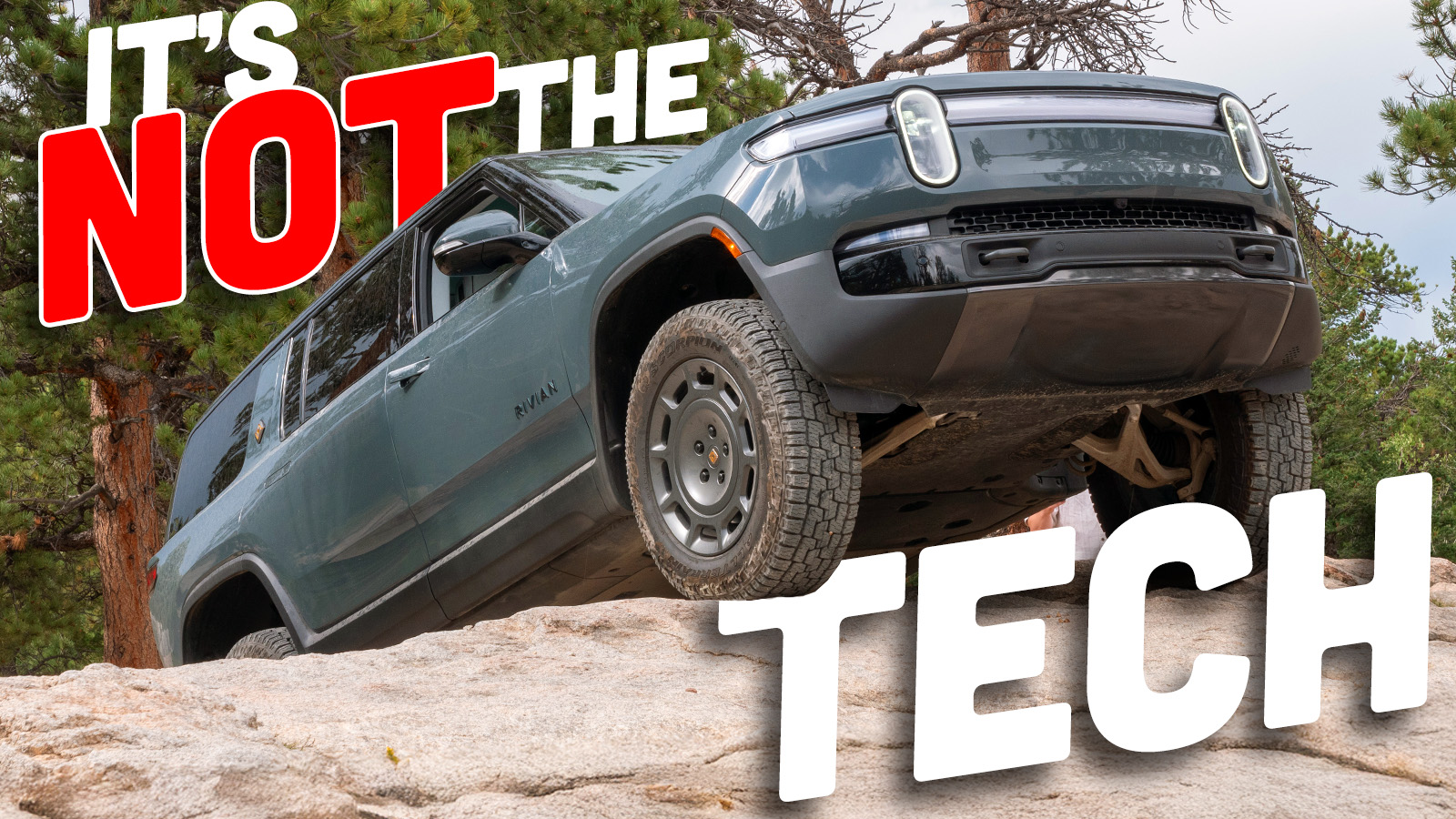
Back in 2021 during Rivian’s very first media launch, I got to test out the company’s Quad Motor four-wheel drive system. What I found is that, on paper, it’s the greatest four-wheel drive system ever, but in reality it was far from it. Tires flared up as the software was unable to properly anticipate traction conditions, and the heavy R1T slid sideways as it kicked rocks out from under its tires. In general the whole thing was far, far more dramatic than it should have been. Fast forward five years and I finally had a chance to drive the newest version of the Quad Motor system. Here’s what I learned.
This past weekend I flew to Colorado to hang out with a bunch of my wife’s friends, their husbands, and their babies. It was a family weekend filled with crying babies, crazy dogs, lots of toys, and pure and utter chaos. I loved every minute.


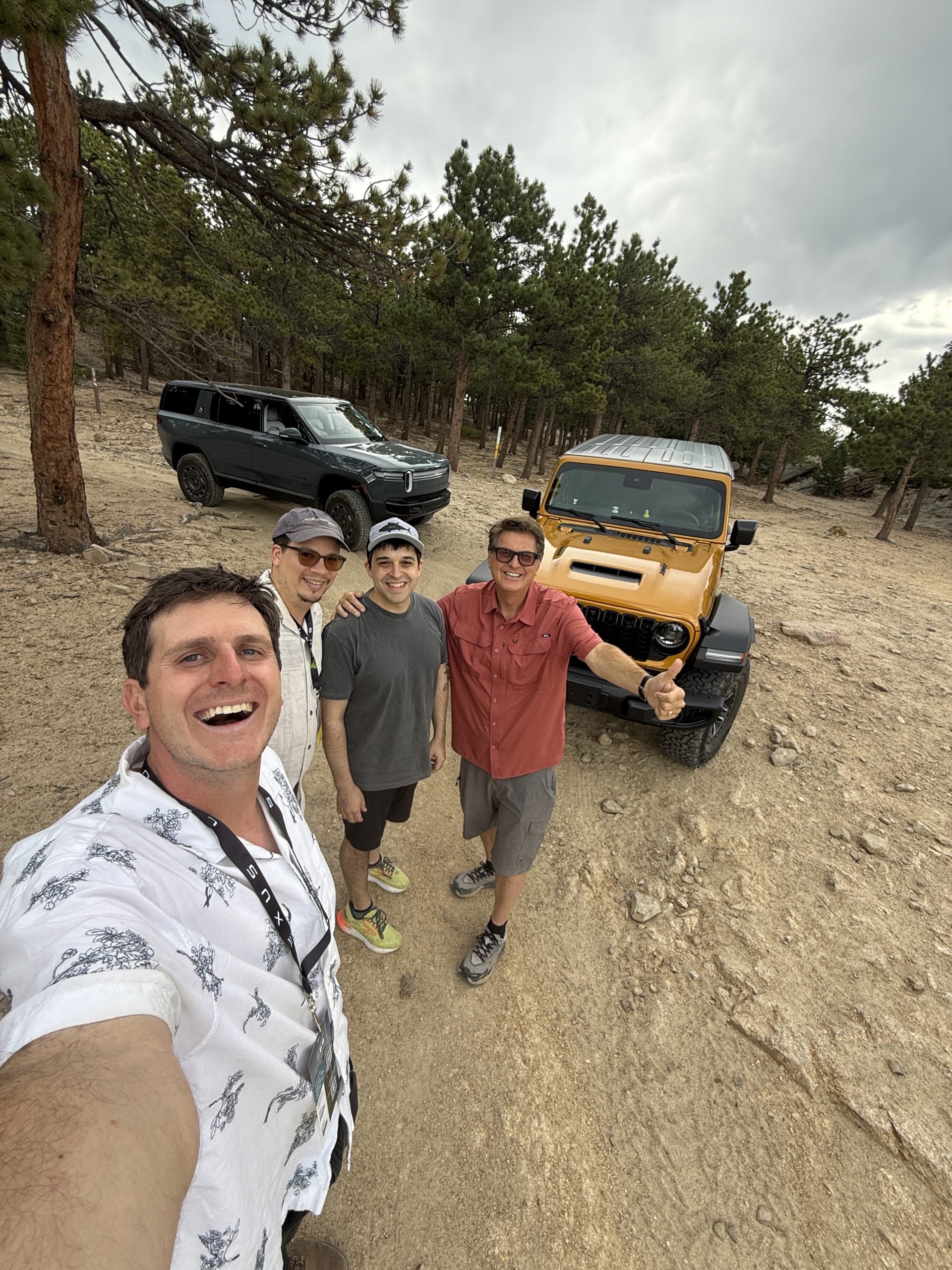
On the first full day of the trip, the moms took the kiddos… somewhere. I probably should have paid closer attention to the agenda, but the point is: We four dads were on our own. Two of the dads went out to the golf course, while the other dad and I — both a bit younger and both significantly less interested in spoiling a good walk — decided to take the press vehicle Rivian had kindly loaned me to some local off-road trails, as Colorado has some absolute gold in them hills.
I’m lucky enough to know Tommy and Roman from The Fast Lane Car/Truck/Off-Road/Classics, a fantastic YouTube channel/network that you should all watch if you don’t already. Tommy told me to meet him at the Overland Expo that was happening that day, then he’d buy me and the other dad lunch, and we’d hit the trails.
View this post on Instagram
Tommy, the kind person that he is, directed me straight to the Toyota booth at the Expo to point out the coolest thing there — something that he knew would be something Autopian readers would appreciate. It was a Toyota Hilux Champ-based 4×4 concept vehicle shown above, as some of you may have read the other day.
Anyway, after the show and after eating bread pudding for lunch (since the other dad, Mickey, and I had foolishly picked up some pulled pork sandwich “snacks” at Buc-ee’s on the way to the Expo), Tommy — driving a Jeep Wrangler Willys 392 — took us west into the mountains, where we met his dad Roman.
I followed Tommy as he led the four of us in two vehicles to one of TFL’s most popular off-road test trails.
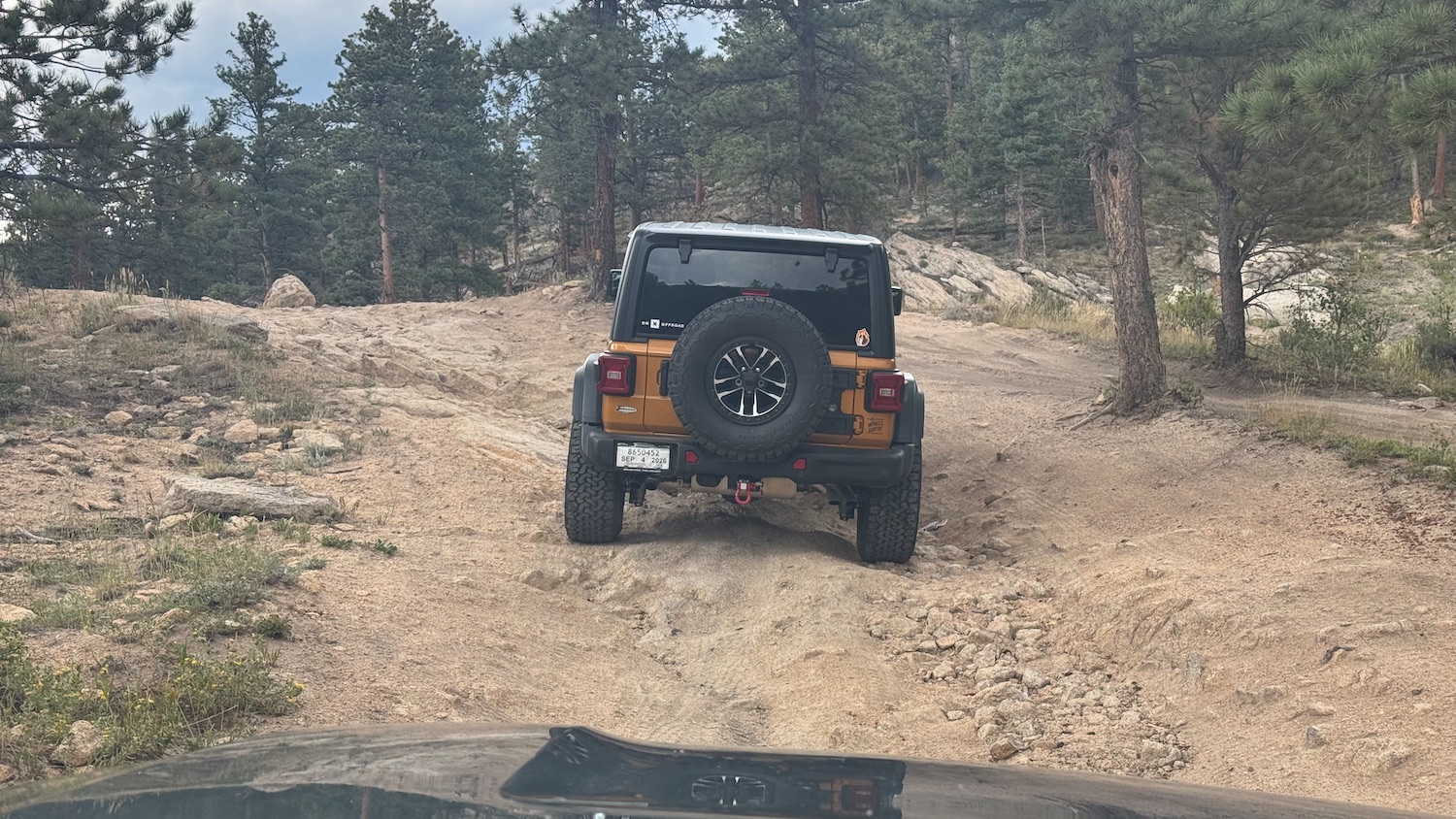
This was rocky terrain, which was perfect, as my aim in borrowing this Rivian R1S was to test the Quad Motor system, since Rivian told me during the R2 media event that the control system has been significantly updated since I’d driven that R1T way back in 2021.
Why The Quad Motor System Isn’t Ideal For Rock Crawling
To give you an idea why I was so intrigued by this updated system, you have to understand some of the challenges that such a complex system introduces. To the layperson, the idea of a four-motor powertrain/drivetrain sounds amazing, as it should allow for extremely granular adjustment of the torque/speed of each wheel to suit the terrain — certainly more granular than clutches, brakes, and other mechanical limited-slip systems found on traditional off-roaders. In reality, though, the R1T I drove five years ago tended to spin/flare up its wheels more than one would want over rocky terrain, making it difficult for a driver to maintain control over particularly technical obstacles and tending to tear up the trail even more than you’d expect a 7,000 pound SUV to.

I described the complexity of the four-motor four-wheel drive system in that old review, using a thought exercise:
To climb that grade at a given velocity (we’ll call it 2 MPH), the vehicle requires a certain amount of torque at the wheels. Imagine you’re driving a Jeep Wrangler Rubicon up this grade, and your foot is pressing the accelerator pedal a given amount, causing you to cruise up the grade at a constant velocity.
Now let’s say the passenger’s-side front wheel hits an ice patch and loses all grip, but the driver maintains the same pedal position. Will the tire slip (i.e. will its tangential speed exceed the vehicle speed)? The answer is: only if the three other tires — with which the tractionless tire is mechanically linked — cannot make up for the lost traction.
In other words, if the three tires with grip have enough traction such that the torque at the three wheels equals the required total wheel torque to ascend the grade, the vehicle will keep moving at a steady rate, and the tractionless tire’s tangential velocity at the tread will likely equal close to the vehicle’s velocity. The ascent will be smooth.
Put more simply, let’s just model the Jeep Wrangler Rubicon’s driveline as one big axle with four tires on it. Torque is being sent through that big axle, and all four tires are spinning at the same rate because they share a common shaft. If one or two or three tires roll over ice, the giant axle will continue moving steadily so long as the friction coefficient between the ground and the tire(s) with grip is capable of producing enough torque against the tire to meet or exceed the wheel torque needed to ascend the grade. (Note: There will be a yaw moment depending upon which tires have grip).
With Rivian’s system, what happens? Well, let’s again say you’re climbing that same hill with the pedal depressed a certain amount. A given amount of current is being sent to the wheels, producing the requisite wheel torque to ascend the grade at 2 MPH.
Now let’s say the passenger’s side tire loses all grip; what happens? Well, the wheel torque there goes to zero, and the wheel slips until the vehicle can pull current from that motor; does the wheel torque at the other three wheels instantly increase like it does with a fully-locked ICE in order to maintain a steady vehicle speed? Not instantly. The vehicle’s electronics have to quickly send more current to the other motors with grip to keep the vehicle moving at a given rate.
How much current do you send each wheel? What if you send too much current to a wheel that doesn’t have quite enough grip, causing wheel-spin? As for the wheel without grip; should it keep spinning at a rate that corresponds with vehicle speed so that it doesn’t have to accelerate once it does get grip? If so, how do you know what the vehicle speed is?
Clearly this is complicated stuff, and getting four motors to mimic the controlled, smooth behavior of a fully locked conventional 4×4 drivetrain is not easy, even with torque command refresh rates in the triple digit-herz (>100 times a second).

Check out that old review, which includes a quote from Principle Engineer of Rivian’s Drive System Mason Verbridge talking about how the control system has to predict the friction coefficient between the tires and the surface, and use that information along with a vehicle reference speed to adjust torque to the wheels. From that story:
Think about that for a second. Rivian’s system has to not only predict the friction coefficient (which is constantly changing!) but it also has to figure out what the vehicle’s speed is, which isn’t easy to do if there’s slip at all corners.
[…]
Verbridge admits there are limitations to the system. “There’s a PID gain loop there… a control reaction time iteration time in your way,” he said. “To your point, it’s not gonna be perfect. How quickly can you go ‘I’m slipping. Stop.’ That’s your limit of the technology.” He notes that the system is quick, but admits that the wheels do flare up a “quarter turn at a time” before the control software brings the wheel speed down.
How Did The New Rivian R1S Quad Do Off-Road?
The Drivetrain
View this post on Instagram
The Instagram video above shows an obstacle that the guys at TFL call the Razor Rocks. You can see right away that the Jeep Wrangler’s solid axle suspension, which could offer significantly better suspension articulation if the front sway bars were unlocked, still did really well, almost flowing over the rocks. Admittedly, I had the R1S in its highest ride-height setting, which meant articulation wasn’t maximized and also the ride quality was rather harsh, but given the size of the R1S I needed as much clearance as I could get, and the R1S flexed well enough given its setup.

Compared to the Wrangler — whose drivetrain mechanically connects all wheels together and therefore avoids wheel flare-ups since each tire’s tangential velocity, whether it has grip or not, is always close to the vehicle speed — the Rivian struggled. Here is the R1S spinning its front left wheel, which is way up off the ground:

Let’s just say all four motors were sending equal torque to the ground as I was approaching the obstacle at 1.5 mph. Once this front left tire lifted off (or just before it), now that motor can no longer help propel the 7,000 pound R1S up the grade. This means the current to the other three motors has to increase to maintain speed, but what if one of them doesn’t have enough traction to handle the increased torque? Then it spins, and then we’ve got a bunch of spinning tires and a system that doesn’t really know how fast the vehicle is moving, so how do you prevent wheels from being spun up too fast?
Like I said, it’s tricky, and someone at Rivian definitely understands this feedback loop/control system way, way better than I. But the point is that, while rock crawling, this four-motor system is not as controlled as a fully locked traditional four-wheel drive system, which can send full engine torque to any single wheel with traction, and which rarely spins up the tires. The R1S’s front left tire, for example, was being spun up despite it having zero traction. The other wheels were not being sent enough torque to propel the vehicle, possibly because I was afraid of putting the pedal farther down, as this could have sent too much power to the ground and launched me forward uncontrollably.
You can see in that video above that the Rivian is trying to figure out the traction conditions, and while it obviously didn’t handle the obstacle as smoothly as the Wrangler, it did get the job done, and I felt like I was safe the whole time. In fact, I was using left-foot braking to try to maintain control, and the vehicle seemed to understand what I wanted. It was very slow to move me forward and up the grade, sure, but it felt methodical and it achieved the goal in a way that made me as the driver feel more comfortable than I felt driving that R1T five years ago at that press event.
One other thing I’d like to mention is that the four-motor system often finds itself confused on even rather simple terrain, especially downhill. As the tires lost grip, it seemed like the regenerative braking that was slowing the vehicle down by adding backwards torque was unable to pull that torque quickly enough, spinning the tires backwards.
Yes, the video above shows the wheels spinning backwards while the vehicle was moving forwards. This, of course, tended to make noise and move rocks, tearing up the trail more than necessary.
So in short: On the rocks, it seems improved, but still nowhere near as controlled as a traditional ICE 4×4 drivetrain.
The Suspension

The Rivian R1S’s suspension is a masterpiece. I’m not a huge fan of fully independent suspensions for rock crawling, mostly because solid axles tend to offer better articulation, durability, and simplicity. But the R1S is a supercar; it’s a 1,025 horsepower luxury machine that can handle far better than anything its size and weight should be capable of handling; solid axles would have made no sense in this application.
What Rivian managed to pull off with this fully independent suspension system is truly remarkable. Here are some of the changes for the new generation of the R1S:
R1S ride and handling advancements are achieved through new air springs with recalibrated front and rear spring rates, new dampers and a new hydraulic roll control system specifically optimized for R1S, similar to those found on supercars.
Yes, the R1S not only has air suspension, but it has cross-linked hydraulic roll mitigation that can force wheels up and down, leading to excellent wheel travel when you need it. You can see in the images above and below that the front left wheel is being forced down to keep it in contact with the rock:

Here’s a close look at that upper control arm drooping hard to get that tire down onto the terra firma:

Ride quality at max ride height isn’t amazing, since there’s not much droop, and the suspension articulation would get dog-walked by a Jeep Wrangler with its front sway bar disconnected, but still — this is a truly amazing off-road fully independent suspension, and as shown in this old Car and Driver video of the sibling R1T, that suspension flex can outdo even a dual solid axle Jeep Gladiator without sway bars disconnected:
The Verdict: What Really Makes The Rivian R1S Quad So Good Off-Road Is The Simple Things
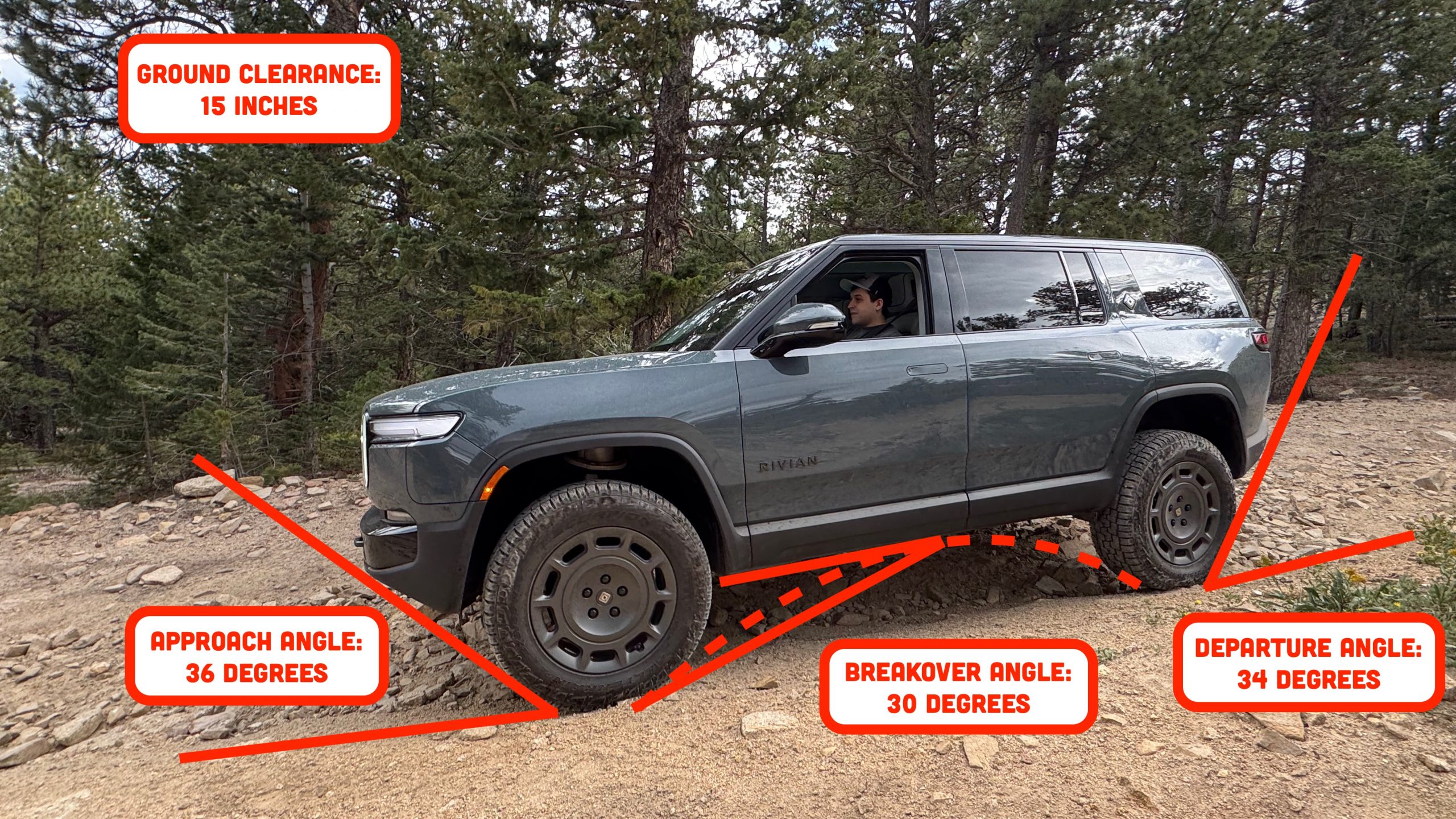
It’s not the Rivian’s fancy four-motor tech that makes it so good, it’s the thing you likely have heard me harp on and on about: “The single most important attribute of a capable off-road vehicle is favorable geometry.” I’ve probably typed that sentence a thousand times, but the R1S is proof positive.

While the vehicle isn’t huge for a three-row SUV, it is huge for a serious off-roader. But the R1S manages to hide that size, offering huge interior dimensions but still maintaining a ridiculous 36 degree approach angle, 34 degree departure angle, 15-inches of ground clearance, and 30 degree breakover angle. These figures mean the Rivian can get its tires up and onto even the steepest, toughest obstacles, and though the four-motor drivetrain takes a bit of buffering to figure out traction conditions, it does eventually get torque to the tires with traction.

And when it comes to off-roading, that’s half the battle. Get tires up onto things, keep the chin, belly, and butt from scraping, and (eventually) provide enough torque to wheels with traction to keep the thing moving along. And the Rivian just does it. I didn’t air down, I didn’t try to optimize ride height or regen settings, I just did the thing superior geometry allows you to do off-road: point and shoot.


So having just 2 electric motors with a lockable mechanical connection between the left and right wheels could possibly have better results?
Then lockers could still be a thing with EVs.
I was thinking the same thing, i.e. 2 motor R1T/R1S might be able to do even better off road bc only two motors to coordinate instead of four motors.
It would be interesting to test 4 motor vs 2 motor R1T/R1S against each other along with ice competetors
Please tell me you informed your Jeep friend about sway bar disconnects! That picture with the front axle hanging in the air is crazy to me. Unless they absolutely never offroad, there’s no reason for this madness.