

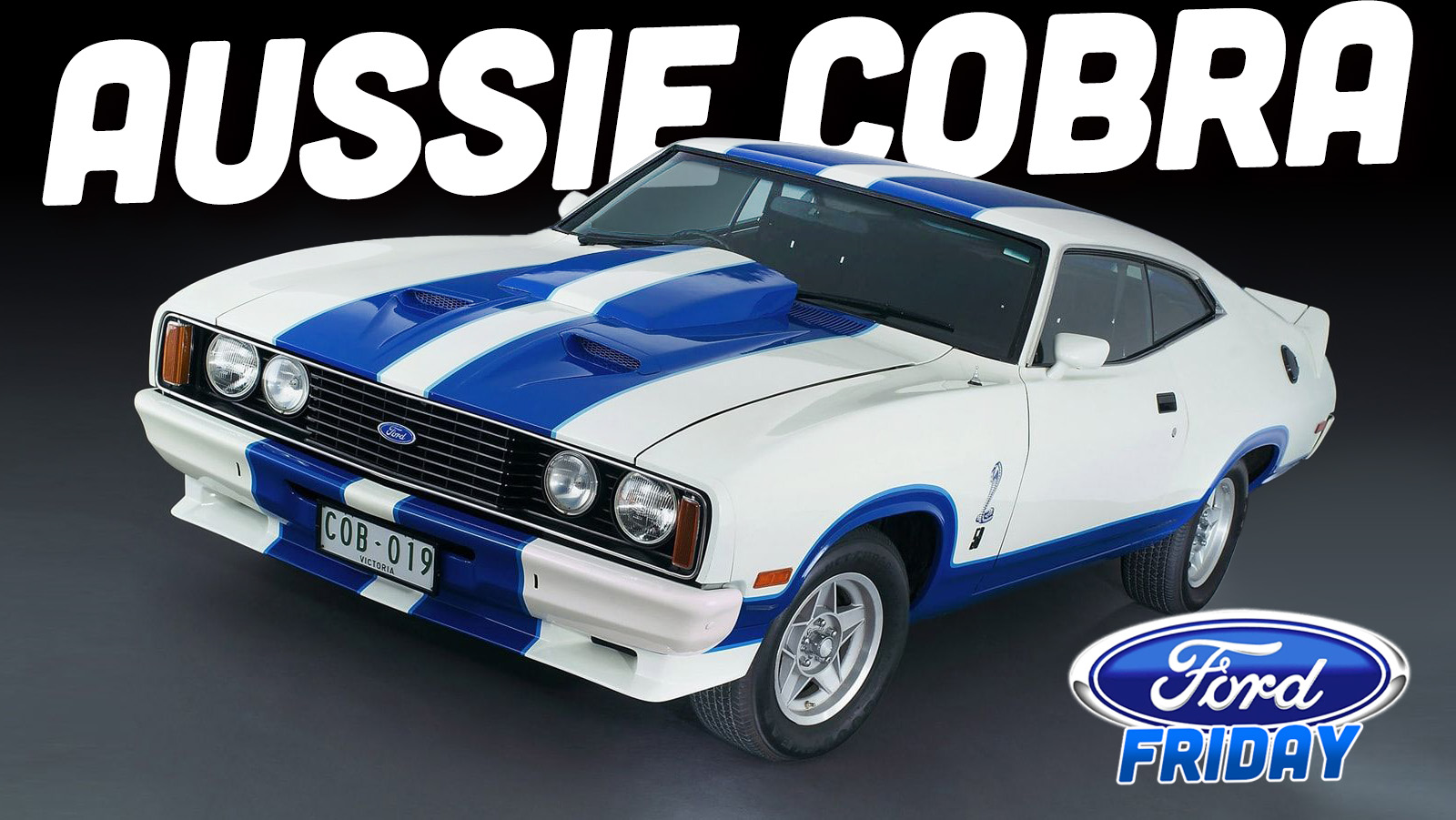
In the Mad Max movie series, the famous hero car is an Australian 1973 Ford XB Falcon coupe introduced to Max as the “last of the V8 Interceptors.” What’s rather ironic is that at almost exactly the time that these famous films were being made in the late seventies, Ford really was discontinuing this last of the pure muscle-coupe Falcons for real.
Thankfully, Ford didn’t let this iconic product fade away unnoticed; it went out with a special version overseen by a member of the Ford family himself and the name of their most famous tuner all over it. Make no mistake: the Mustang II might have diluted Carroll Shelby’s name in America, but Down Under, the 1978 Falcon Cobra was ready to bite.


Life Imitates Art, Or The Opposite
Down in the southern United States, some ex-moonshiners liked to take stripped-out American cars and compete on smooth, slightly banked racetracks for a couple hundred miles or so on a Sunday afternoon. Australians looked at that and quipped “you called THAT racing, mate?”
No, down there a “real” race is run on the Mount Panorama circuit in Bathurst; 23 turns on a track with an elevation change of an absurd 571 feet in a 3.8 mile circuit on public roads that seem rather ill-suited to the family sedans and coupes that participate. What’s more insane is that the annual signature Bathurst 1000 race lasts for a punishing 1000 kilometers (621.6 miles) as the ultimate test of driver and machine, an event that calls to mind the racing on the ‘Ring in the decades before they rationalized it.
For much of modern history, the Bathurst race was synonymous with nine-time winner Peter Brock in GM Holdens, but in 1977 he was denied a victory by Alan Moffat and Jacky Ickx in a fearsome Ford XC Falcon, and an identical sister car came in second place. What a pair of great-looking race cars:
The “XC” Falcon was a facelifted version of the “XB” car most commonly associated with the Mad Max franchise of films.

Other than minor visual details, it’s virtually the same as the XB basis for the Road Warrior rides.

This Coke-bottle shaped body style was introduced in 1972, but 1978 would be the last full year you could buy a street version of this much-loved coupe, or any Falcon coupe for that matter. You see, the much more angular-looking “XD” Falcon that would take over in 1979 was going to be offered as a sedan and wagon, but a two-door version wasn’t coming back.


That’s right: muscle cars might have lived on in Australia, but even legends eventually fade. Thankfully, Ford wasn’t going to let the iconic sporting coupes go out without a bang.
This Wasn’t Farrah Fawcett’s Car, Mate
As I’ve mentioned time and again, when car makers screw up, it can often be good news for enthusiasts. That was seemingly the case in Australia back in March of 1978. That month, Ford would end production of the Falcon coupe for good, but they had a dilemma: there were 400 unsold, unused body shells still left. This sounds like an odd production mistake, but whatever the case, there needed to be some resolution as to what to do with these slick hunks of metal instead of scrapping them. The answer apparently came from a person with the same last name as that on the cars themselves.
During this time, Edsel Ford II was the managing director at Ford of Australia, and he saw that the dominating victory of this exact car in Bathurst a few months earlier should be celebrated and capitalized on. The decision was made to make something special out of these leftover parts, not just brand exposure, but also to make a homologated version for racing in the upcoming season.
As a Ford family member, Edsel was able to invoke the name of Carroll Shelby’s cars to these “leftover” cars and make the ultimate sendoff for this Ford coupe: the Falcon Cobra. There’s Mr. Ford himself Down Under with the creation he was understandably quite proud of:

One thing to note: despite the “Cobra” name, there was no connection with Shelby in the Falcon Cobra, despite the intentional “Shelby look.” First appearing in April of 1978, the Bold Blue-painted bodyshells were masked and sprayed with a Sno White overlay, separated by Olympic Blue stripes; the reverse of how I assumed they’d do that paint job. “Cobra” decals adorned the front fenders just like on a Mustang II Cobra II, but make no mistake: this thing had decent enough performance to back it up.

Not that it was a rocketship, though. The first 200 of the 400 total Cobras featured a 351 (5.8 liter) V8 with 217 horsepower, while the second 200 came with a 302 (4.9 liter) V8 (usually called a “5.0”) that only pumped out 202 horses. In stock form, a Falcon Cobra got to sixty in just under eight seconds; again, not neck-snapping, but great for a big “family sized” coupe and far better than the emissions-strangled 140 horsepower weakling motor in the top Mustang of the time

Plus, the Falcon had it all over the American pony car with equipment like four-wheel disc brakes and 15-inch Bathurst Globe wheels. Limited-slip differential, front and rear spoilers, and dual exhaust were also standard. An automatic was available in addition to the standard four-speed manual.

The black interior had Cobra-specific seat trim inserts in black with blue stripes that match the exterior.


Of course, the street version was just the beginning; it was the means to an end in some ways to keep the racing version alive. All Cobras received a numbered dash plaque, but numbers 002 through 0031 were what became known as the “Bathurst Cobras” with “Option 97.” These Cobras were homologation specials with features like switchable twin radiator fans, a transmission cooler, suspension bracing, and rear wheel body housings reworked for massive rubber. These “Moffat Ford Dealers” race cars looked fabulous in their Shelby-style livery, but sadly couldn’t hold off the mighty “Brocky’s” Holdens in their final competitive years.
Despite that bit of a downer, the Falcon Cobra went down fighting. Plus, we ended up with 400 well-sorted final examples of a car that, right after its passing, would go on to immortality as the vehicular star of one of gearhead’s favorite film dynasties. More than that, it helped redeem the Cobra name that had been relegated to an “appearance” package back in America, even though, ironically, Carroll Shelby had nothing to do with it.
Because Mad Max Tribute Cars Are Played Out
As you’d expect, these Falcon Cobras demand a premium today, selling for anywhere from $150,000 to $230,000 Australian for restored examples – costly, but the history makes such figures seem reasonable. Not bad for cars made from a bunch of bodyshells that were just going to get crushed and sent to the shredder.
As an American, you might think that one of these XC Falcons isn’t something you could ever consider, but that’s not entirely true. It’s reported that around a dozen of these made it to US shores, and one recently popped up on Bring A Trailer. Again, the $89,000 it sold for might seem a bit steep for a car that isn’t the last word in straight-line performance, but I can promise you that if there are Mad Max tributes at your local car show, you’ll be the only one with the real “last of the V8 interceptors”.
Top graphic image: Ford




The designer of this car was Brian Rossi, a lovely guy. He made this car look the business in a transitioning car world in the 70’s down under. When I lived there in the 90’s, I had a red ute version of this car. Red with a matt black hood and a windshield sticker that said “the wraith” (I didn’t add that).
Excellent story @Mr The Bishop! My XC is the wagon version with the 302/C4.
Pedant here though – they are a hardtop, not a coupe as no B pillar.
Just looked at the auction for the 3rd time since it ran.
At 89K I would have considered it a deal. This is truly a rare piece of automotive history here.
The rear half looks very 1971 Torino Coupe, the doors forward look Mustang from the same era.
I really dig it.
And it being a “down under” product is just icing on the cake. Cake.
I don’t think I’ve ever seen a car that embodied the word “muscle” so well. $89K doesn’t seem at all unreasonable to me for something that rare and that cool.
It could have gone a very different way indeed – Malcolm Inglis was director of Sales & Marketing at Ford Australia, and he had put forward a proposal to build a special all black/gold trim ‘Playboy’ hardtop complete with small Playboy Bunny decals and a black interior, which was ultimately rejected since Ford didn’t think it appropriate for a company selling ‘family’ cars.
Bishop, thank you for an illuminating story about both the race and a special car. I have been a lifetime Falcon fan but didn’t know the story of the Cobras. Falcons are such beautifully masculine cars that have always looked like the the offspring of a Mach Stang and a Capri to me. Some people fantasize about owning JDMs but it’s a Falcon I covet, especially a restomoded one. Perhaps I shall own one some day!
Thank you! Yes, I’m sort of obsessed with Aussie cars; such a cool combination of American and European sensibilities in very attractive packages.
Speaking of ADMs and restomods, I came across a fantastic 65 Cuda fastback posted somewhere else that a bloke Down Under restomodded. It’s done in the style of the Jensen in F&F 325:
https://www.streetmachine.com.au/features/charlie-allen-1965-plymouth-barracuda
I’d love to have a fastback and shoehorn a tuned to 1,000+ horsepower Cummins in it. With regard to the body, I’d deck it out like the Mad Max Interceptor with the Concorde front end, deleting useless drag-adding items like the roof spoiler, while fairing the rear wheels like a 1st gen Honda Insight and adding full underbody panels plus a rear diffuser to help with downforce.
Dare I say 50+ mpg @ 70 mph in a musclecar capable of 0-60 mph in under 3 seconds and a top speed approaching 250 mph is possible(whether it is actually stable beyond 170 mph is a different issue).
If I were to build an interceptor, that bitch is going to be as functional as possible in a post-apocalyptic environment, where fuel efficiency is very important, and it’s going to be a mechanical-injection diesel capable of running on as many fuel sources as possible(diesel, kerosene, gasoline, ethanol, methanol, used motor oil, ATF fluid, brake fluid, seed oils, ect). Maybe even set up as a diesel-electric plug-in hybrid with a 1,000+ horsepower EV drive system working in tandem with the Cummins and a 20+ kWh battery pack with solar panels on the roof, hood, and trunk to maybe give 5-10 miles free range per day and maybe 60 miles all-electric range on a full charge. The EV system can make fuel for itself from sunlight and be plugged in wherever there’s still a functioning outlet(no matter how rare), and the Cummins could charge the battery and still run even if an EMP fries everything else.
When both systems work in tandem, the acceleration would be quite something, if sufficient traction can be found. On either system alone, you’re still doing 0-60 mph in under 3 seconds.
With everything, this could be kept under 4,000 lbs.
YOU are a dreamer!
I’m also a builder, at least when I have access to the resources to do so. I currently don’t, which is why I’m working on a microcar in my living room.
I always enjoy Ford’s objectively awkward mashing two animal names together like this.
Props to choosing the wonderful shot from Furiosa. In an age of shameless, distracting cameos and Hollywood generally beating us over the head about continuity, Furiosa did it so deftly.
Ha! I hadn’t thought of the Falcon v Cobra battle. At least there’s not a mongoose involved!
An actual good one has to be Fairlane Cobra for its juxtaposition of stately and menacing. Sounds so much better than multi animals…
Ford and Shelby cut ties in 1970. Ford got the licensing name for Cobra in the 1960’s from Shelby. The blue and white colors was just primarily on the 65 GT-350’s,although used in 1966, other colors were also used. Ford rode the wave by using it on the low performance Mustang II Cobra but the Aussie cars at least gave it some credence.
Zowie!
It should be noted that Allan Moffat passed away just a few weeks ago. He was a legend in Aussie motorsport.
Also Ford never used the “5.0” label for 302s in Australia. As shown in the engine shot in your article, they always called them 4.9s. I absolutely plan to put some Aussie 4.9 badges on the side of my American Ford Fairmont once I V8 swap it just to confuse Americans.
When US manufacturers began referring to engine displacement in liters, Ford realized that the 300 I-6 and the 302 V-8 both were technically 4.9 liters. The alleged reason the 302 was falsely labeled as a “5.0” was to avoid confusion. Otherwise, they’d have had to say that the F-150 came with a choice of 4.9 or 4.9 liter engines.
Yep. That said Ford Australia did sell F-series trucks there which I’m pretty sure had the 300 I-6 available.
Also, the 302/4.9 used in the Falcons from the XA on was unique to Australia as it was a Cleveland, not a Windsor like in the Mustang.
Another fun fact is that the 351/5.8 ‘Cleveland’ produced here in Geelong, was actually used in the De Tomaso Pantera!
Nice cars.
Very cool! I always find it wild that the classic USA racing color scheme has become “Shelby colors” to most people but I guess he did have the most prominent uses of it.
My favorite though is the reverse, white on a blue body. So much so my Mustang is dark blue with white (rocker panel, as it’s not a Shelby) stripes.
Neat story. I’m guessing its value is almost purely nostalgia and rarity though
What are the other reasons for old cars costing money?
Money laundering.
some are genuinely kind of cool, beautiful, performant, special, etc. This is skirting “cool”, but it’s kind of malaise era parts bin
Nostalgia and rarity is a dangerous thing.