

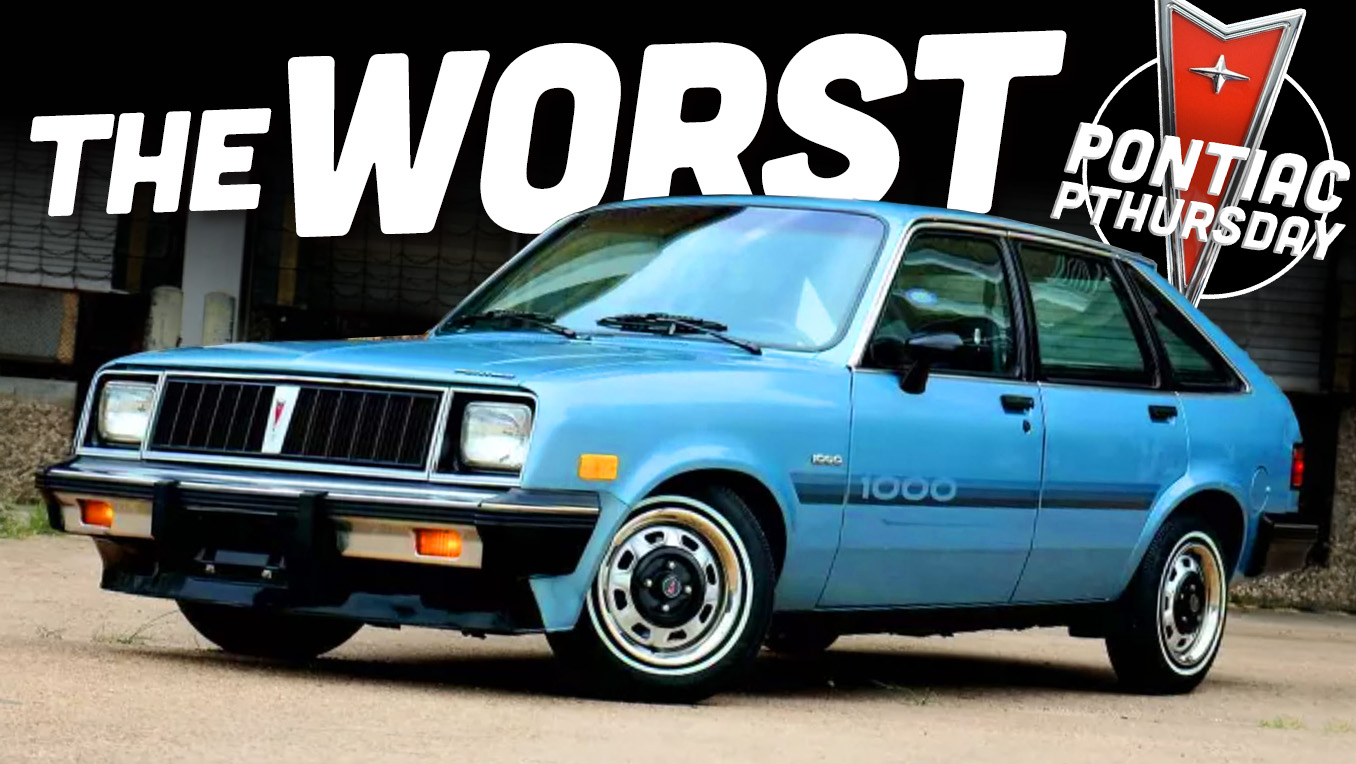
I have to apologize to my fellow Autopians. When I’m wrong, I say I’m wrong.
A little while back, I lambasted the poor Daewoo-made 1988 LeMans, calling it likely the worst vehicle ever to wear the Pontiac badge. I did a similar sort of hit piece on the Vega-based Astre. Both of these were indeed rather poor vehicles, but at least they had some redeeming characteristics; each of them featured rather attractive styling and offered at least relatively competitive performance for the time.


The real Worst Pontiac Ever had no such values; it was pure, unadulterated crap foisted on the public at a time when the brand had no excuses to offer such garbage. My friends, it’s time to look at the T1000.
This Was The Best The World’s Biggest Car Maker Could Do?
As I often do in these posts, when we’re talking about any car, I like to set the stage for the automotive environment at the time. During the weeks that K.C. and the Sunshine Band were insisting you get down on AM radio (tonight, specifically, and also do a little dance), General Motors was about to release a new subcompact car for Chevy to combat the import onslaught. Boy, did those Europeans ever have some good ones.
In late 1975, European carmakers had started the transition into producing rather advanced, space-efficient, front-wheel-drive cars. The soon-to-be-a-Yugo Fiat 128 debuted in 1969, while Renault followed up with the 5/Le Car in 1972. By far the most popular in the United States was Volkswagen’s new-for-1975 Rabbit, the Giugiaro-designed Mark I Golf that would form the template for modern small vehicles.

General Motors had just put the Toronado mechanicals into a front-drive, six-wheeled motor home, so they were poised to take on this challenge: offer the latest technology to the American people at a great price. Did they do it?
Absolutely not. The new 1976 Chevette subcompact featured mechanical specifications that could have been on a car from the fifties. An inline four (at least it was SOHC) sat longitudinally in front, powering the rear wheels connected to a live axle; at least it had coil springs in back instead of leafs. Naturally, the driveshaft passed through a large tunnel that ate into the meager interior space.

Now, basic specifications aren’t everything. The Chevette could have been styled by Bill Mitchell’s team to be a small car icon inside and out, plus the mechanical components might have been massaged to create a fun-to-drive product.

Again, not the story. The GM “T” platform actually began in late 1973 as the new German Opel Kadett. In this form, with small bumpers and unrestricted powertrains, the “T” car wasn’t cutting edge but not that bad. You can see they even got a four-door notchback sedan that looked rather nice with its composite headlights.

Even the two-door hatch base model had nice detailing, like those thin bumpers, and offered reasonable enough performance.

As with many European cars that made the trip over the pond, a lot got lost in the translation. Five-mile-per-hour bumpers and strangling emissions controls limited the 1.6-liter carbureted four in the Chevette to a mere 60 horsepower. Many were bought with the optional automatic transmission and air conditioning, which likely lowered the already glacial 16.9-second zero to sixty time that Road & Track recorded for a manual four-speed car. Don’t even ask about a fifth gear.

The best part was that GM provided an even more soul-sucking version of this true penalty box of a car. Chevy offered a bargain-basement “Scooter” version with argent grey bumpers instead of chrome, and omitted the glovebox door, carpeting, and back seat.
Now, after the second gas crisis in 1979 and the crippling interest rates and inflation of the time, every division of General Motors cried out for an economical small car with a bargain-basement price. Pontiac wanted something a notch below the J-Car 2000/Sunbird to attract entry-level buyers. In 1979, GM’s Opel launched a new Kadett with a transverse front-wheel-drive powertrain and more modern if not earth-shaking looks. This might have been ideal as a little Pontiac, especially when we saw their later 1983 GTE model designed to compete with the VW GTI.

So, when did GM start selling this new, updated Opel in federalized form? They didn’t; the rear-drive Chevy shove-it lived on, and The General offered this now-five-year-old version of a car that was dated when launched in 1975 to Pontiac for the 1981 model year. See? I told you this would be bad.
The T Stood For Terrible
The very least GM could have done to transform Chevette into a Pontiac is swap in a different grille, and that’s exactly what they did to create the T1000. Just the bare minimum.

Eventually, they did replace the Chevette’s cubic taillights with horizontally ribbed units that added the raciness of a Trans Am to your entry-level subcompact. Behold:

Fully reclining seats were a lavish feature that I’m sure were added only because they were omnipresent on any Japanese cheap car. You also got full instrumentation with a speedometer and a tachometer-style gas gauge. Nothing else.

By 1983, Pontiac had dropped the letter prefixes on their cars, so Pontiac’s version of the Chevette was merely the 1000. At least there was some weight savings for losing a letter off the badge, right?

When people talk about the shame of driving an entry-level car, the T1000 is the perfect case study. Don’t take my word for it, though. How about the opinions of the most positive and nicest guy in the whole world? Yeah, even he hated it.
I Did Send Letters To Owings Mills, Maryland
As a twelve-year-old, you likely couldn’t wait to switch on PBS at least one night a week. No, it wasn’t to watch some snooze-inducing “masterpiece” about nineteenth-century British poets that your snotty parents pretended to like; it was to watch crappy early eighties cars getting beat apart by the greatest personality in automotive history: John Davis. I know that I’m not the only Autopian who would weep uncontrollably if ever put face-to-face with the man who put cars ON OUR TELEVISION SETS for God’s sake. You laugh, but this was a big deal to Stranger Things era kids like us.
John Davis was an honest journalist, but he usually tried to find something (I mean anything) positive to say about even the most miserable sleds his team was given to test. You’ll see from this video that he struggled very hard to do that with the Pontiac T-1000 in 1982.
He starts by complementing the deep chin spoiler and “Euro style” black trim.

However, you just know Honest John can’t lie to us, and things go south very fast. This automatic-equipped 1.6-liter T1000 recorded Motorweek’s slowest zero to sixty time in the admittedly rather short history of the show to that point; it was even slower than the five-speed-equipped, Isuzu-diesel-powered Chevette they’d tested a little bit before. Actually, considering how cars in general got faster during the eighties, I bet that Worst Acceleration Record still stands. By the way, Benzheads: they tested a stick 240D that year, and it still beat that T1000’s 30-second time by eight seconds.
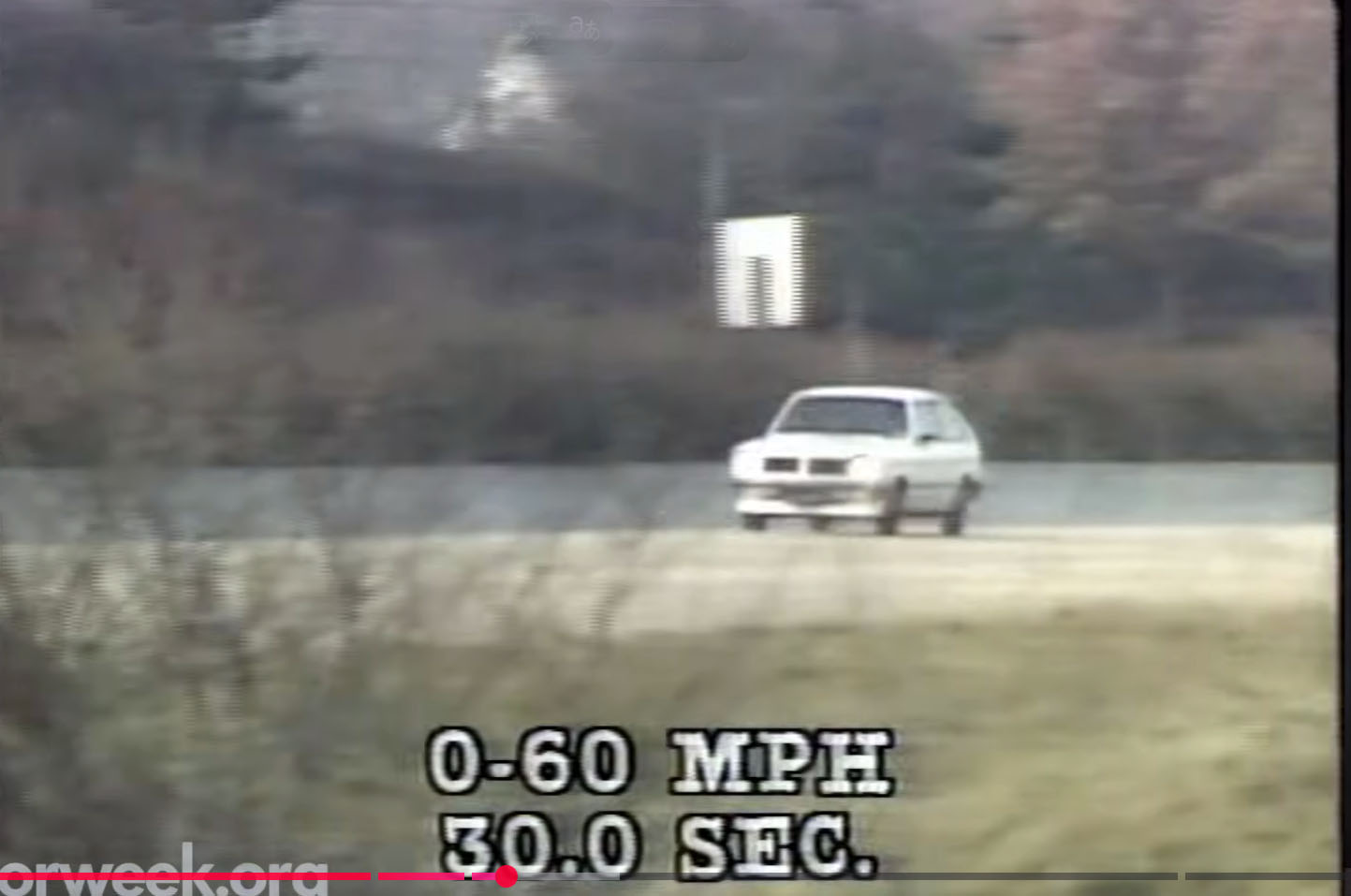
Passing times were also record-breakingly bad. They did mention that up to around 50MPH it wasn’t horrendous, but after that, the three-speed slushbox refused to downshift and the anchor came out.

Wait, it gets worse! Look at the recorded highway miles per gallon. Twenty-five is pathetic, and John is quick to note that cars much larger had generated better figures.
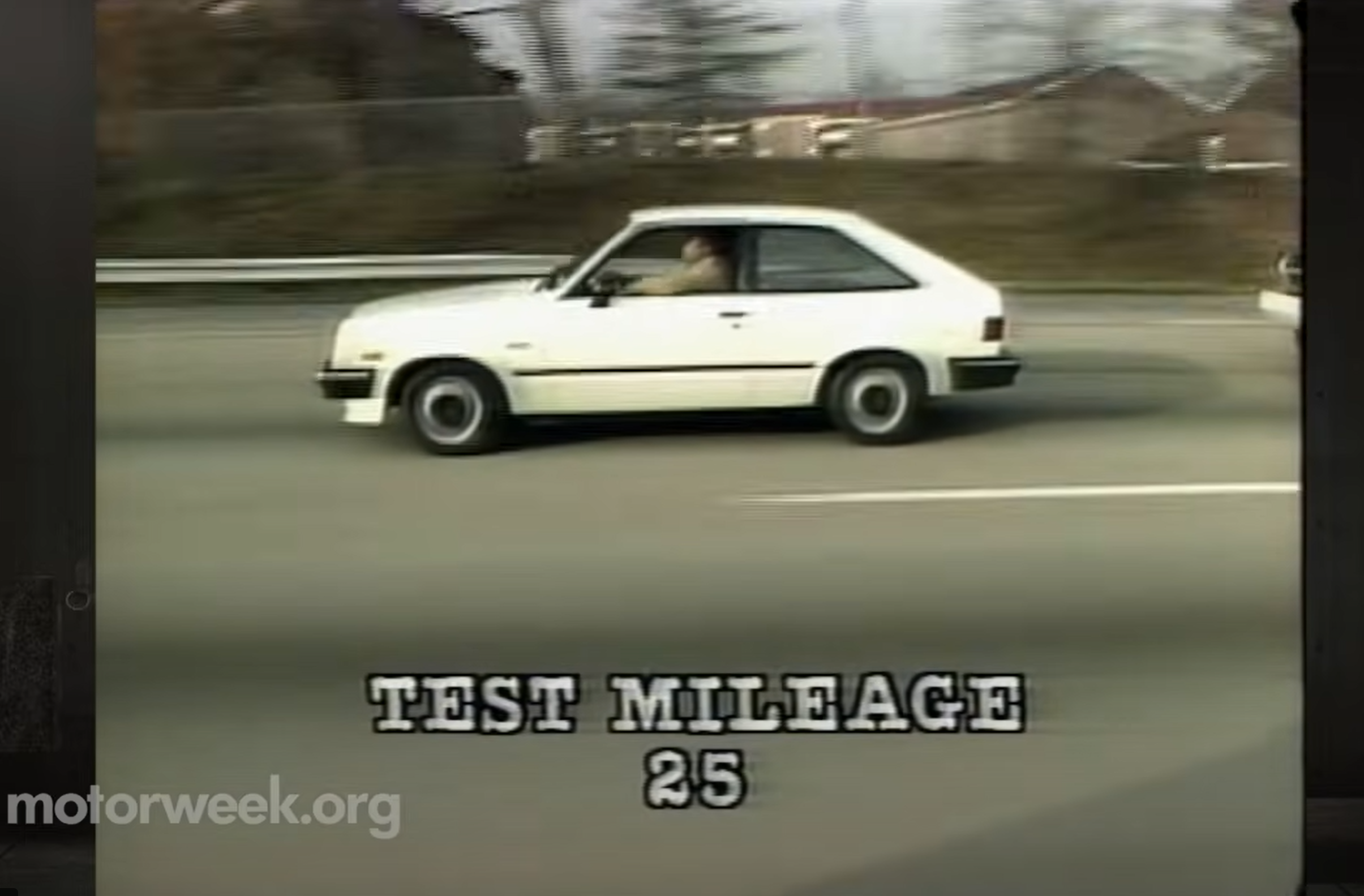
He wasn’t kidding: in ’82 you could have bought a massive palace-on-wheels near-limousine Oldsmobile 98 with the diesel V8 that was rated at 33 MPG highway. We had friends with a similar big diesel Olds, and I can confirm that they regularly got over 25 MPG at a steady 55 in button-tufted opulence. Until the head bolts blew, of course.

The crowning achievement of the little Pontiac Chevette was the price. At the T1000’s base sticker of $5540, you could have bought a number of other cars like a front-drive Tercel (which would be replaced in late 1982 with an all-new but similarly priced car):
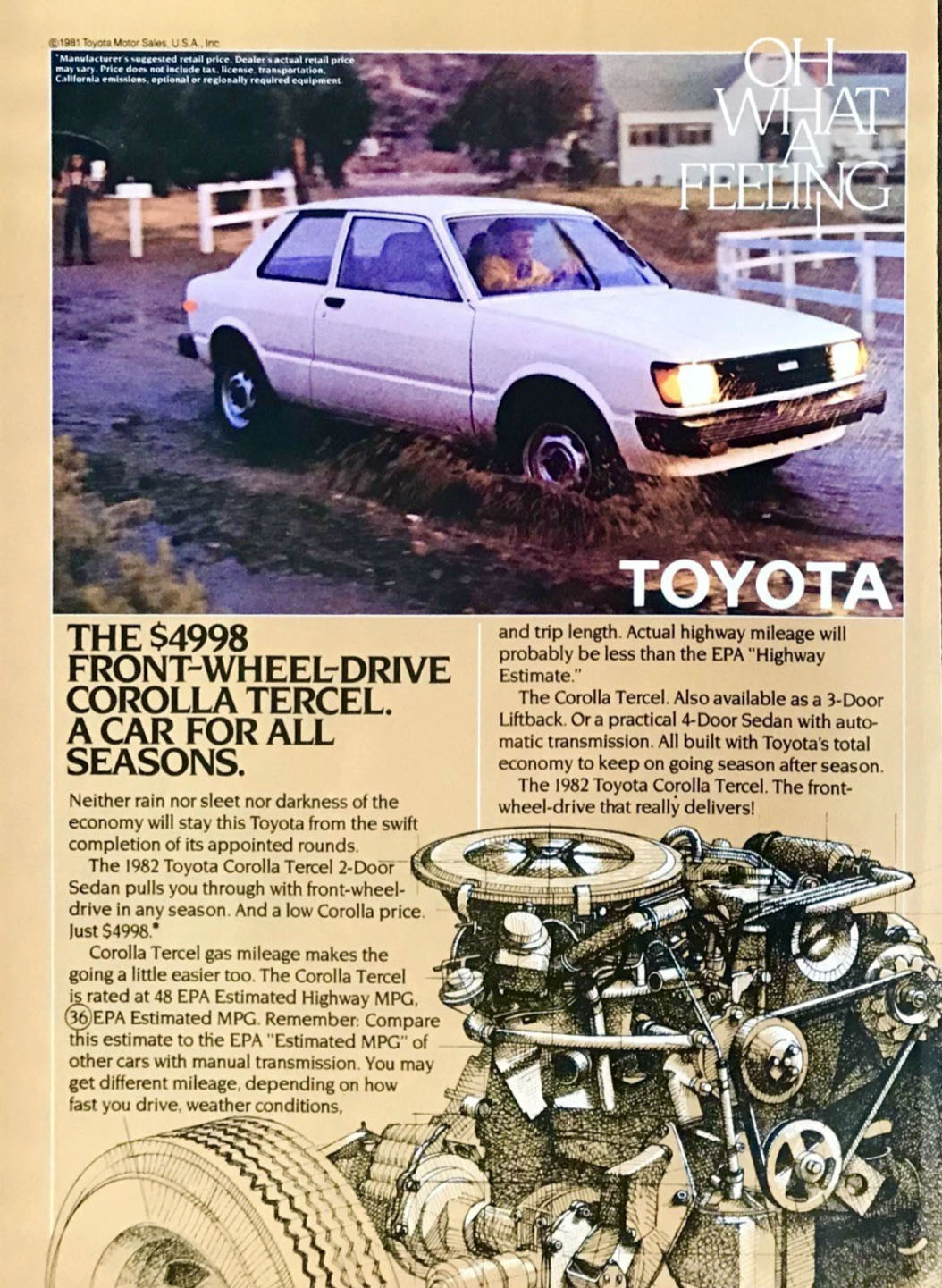
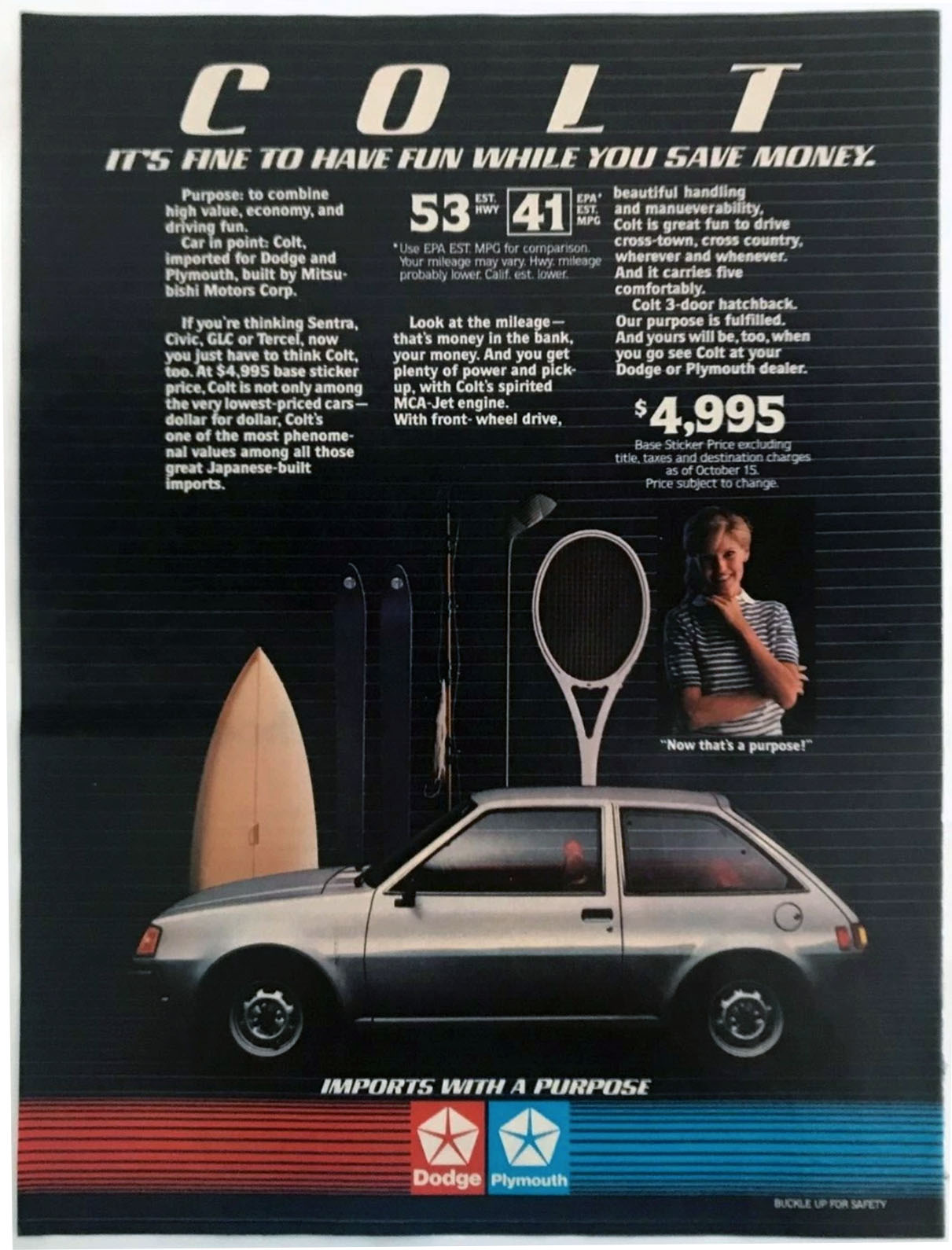
Or maybe a twin stick Mitsubishi “Imported for Dodge” Colt:
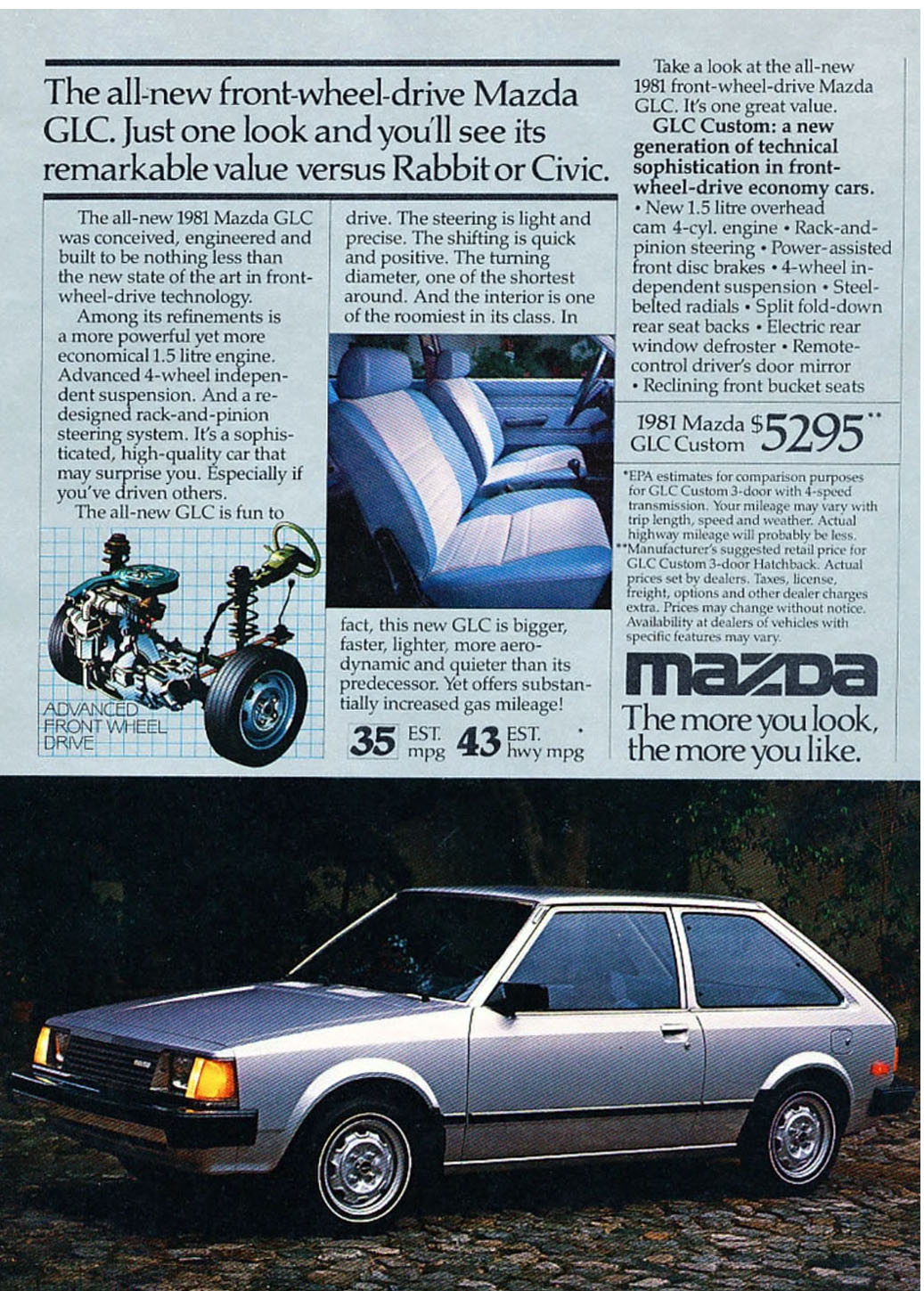
How about a Mazda GLC, which became a front-drive proto-Golf in 1981?
Any of these would be cool cars to have even today: lots of fun to drive, super reliable, and an order of magnitude better than the T1000. So, you’d think nobody would have bought this little “Pontiac” or its identical Chevy twin, right?
Wrong. Admittedly, the T1000 (later 1000) never sold in big numbers; over 60,000 moved in 1981 but sales quickly dropped. The Chevette, however, found 233,000 homes and was the second-best-selling small car of 1982, just behind the Escort. That’s a drop from the year before, when Chevy sold 433,000 of these clunky old subcompacts. Why did people buy them? That’s a question for the ages, but I think there are a few reasons. First of all, they probably got deals on the Chevette while the Japanese cars sold at a take-it-or-leave-it sticker (or, in the case of Hondas, at thousands of precious dollars above). More importantly, I think more buyers back then insisted on American-made products and never considered imports. Such loyalty should have been rewarded with something other than a car with virtually no redeeming qualities. The fact that people purchased a car that was already dated half a decade before it was introduced gave GM little incentive to spend money to find a better product.
The ‘Vette You Don’t Want
Today, it might be easier to find a coach built Hispano Suiza than a decent-condition Pontiac T1000 or 1000. They were used up and very happily sent to the crusher. When they do appear, like the one below that popped up on Craigslist a while back, they don’t go for much. This 1986 Texas car with 60,000 miles was offered at under $5000.

Even at that low mileage on smooth Texas roads, you can see that the front suspension is shot. But hey, at least it has the one saving grace of any American car: a solid air conditioning system complete with “ball cooler” vents. Switching on the A/C must have made that thirty-second zero to sixty “sprint” even worse, if that’s even possible. At least the 1000 has a glove box door, unlike the Chevette Scooter model, but I’m told the latch is so big that it eats up much of the space inside when shut.

Look at that half-arc sweep on the door panel to match the window winder’s path; that’s almost a styling element. Note that by the time of this late model 1000, any chrome-plated metal had been replaced by plastic.

This thing should be in a museum as a warning to future generations, and to make twentysomething car bloggers who think a Nissan Versa is a “piece of crap” shut the hell up. These kids don’t know pain.
We Never Saw The Vibe Coming, Did We?
Hard to believe as it is, the Chevette and 1000 soldiered on until 1987 with very few changes, finally being replaced as the bottom rungs in the lineups with imported cars like the Suzuki Chevy Sprint and Isuzu Chevy Spectrum. Of course, we never received the German version of the front-drive T-Car; Pontiac got the Daewoo edition of the Kadett at a time when cars from the Korean auto industry were still a bit subpar. I reported on that disgrace to the LeMans name a little while back.

Still, I need to apologize to that car, as well as the diesel 6000LE and an Iron-Duke-powered Firebird. Those underwhelming cars don’t have what it takes to claim the title. There can be only one True Worst Pontiac, and the T-1000 is it. Congratulations, you miserable piece of crap.
Pontiac Points: 20 out of 100
Verdict: There’s a reason the antagonist in Terminator 2 was called T-1000; it’s the worst thing you can imagine on earth.


The US car industry simply did not see it coming. Pile on an oil embargo and now they really didn’t know what to do.
There was over confidence, racism, and hubris in there also.
In California in 1982 I bought a 1981 Corolla from an Australian who had to return home and didn’t want to pay 100% import duty. With demand and inflation of the time, I paid the same price ($4100) as he did for it new. [For those who didn’t experience that era, I bought 10% California double tax-free bonds with what meager savings I had.] The car was still a great deal. It was the ultimate base model. I drove it, essentially, trouble-free, until I got my 1986 Toyota MR2. I sold the Corolla to a colleague for $1500.
I never consider a car from the Big 3, although I’ve had dream cars of my youth from them. At the moment, I’m still sporting a Toyota Highlander from 2001 and an Acura TL from 2004. Having a hard time finding some interior parts for the Highlander that need replacement. Just yesterday, I got a laugh from the salvage yard owner, who said that they never get Highlanders. Did find the part online, but it is the wrong color. Toyota Parts says that the part is discontinued.
I owned a 1976 Chevette 4-door automatic, which I bought off a friend for $1 because the automatic transmission would slip going from 1st to 2nd. Well it didn’t take long to figure out that if I manually shifted, it worked just fine. I drove that thing for years, and I’ll tell you, it could not be killed. I eventually gave it to a friend of mine who needed a car. Laugh if you want, but that car was absolutely phenomenal for that time in my life.
And one correction: the engine was a SOHC, with a timing belt. A non-interference engine, I think, so you could take the risk of not changing the belt and only be stranded if it failed.
I’d buy another today and fit a V6 and 5 speed, then do some suspension work and have a real sleeper.
Thanks for valvetrain info – I’ll correct it. Musta had the Iron Duke in my mind!
There’s a theory that MotorWeek’s test T1000 had a defective transmission, apparently at that point they were borrowing demo cars from dealers in the Baltimore ‘burbs that weren’t as well-massaged as press loaners.
All of GM’s light-duty automatic transmissions from that time were defective straight from the factory. I’m only sort of joking–the failure rate was very high. The Motorweek example would have had the TH180, made by Holden.
More validation for the whole “GM builds cars that will run like crap longer than most cars will run at all” thing!
A few years ago, John Davis was the guest speaker at a conference that I go to most years, and I have to admit that I fanboyed *hard*. Somehow I did not get a photo with him. Maybe I was too start-struck.
Cold Start struck.
I recall seeing a pristine T1000 on the road multiple times a few years ago… In New Hampshire, of all places. Absolutely mind-blowing to see A) Someone apparently willingly driving a T1000 in modern times, and B) A clean, non-rusty T1000 in salt country.
Personally, I suspect that sighting was either a glitch in the Matrix, or the sign that we’d jumped into the bizzarro timeline we’re all floundering in now.
I love those glitches. Six or seven years ago I was driving home from Maine and passed a Volkswagen Dasher, a 2-door hatch resplendent in brown. In December. On the very same trip I in New York I was passed by a very early Porsche 924. Again, this was December.
question is, which is worse, this T1000, could be had with manual trans and all had RWD. or the Opel Kadett E via Daewoo South Korea, but badged as the Lemans in 1986
Already wrote about that one a month or two ago
Drove both, flip a coin as to which was worse.
I’ll say this much, Chevettes/Acadians were awful little cockroaches that stuck around far longer than they had any right to, while I’m not sure I’ve seen a LeMans since the 90s. The T-1000 might be a worse Pontiac, but it might be a marginally better car.
Most Chevettes/T1000s fell apart in reasonably short order. It’s the survivors that were frightening. No matter how hard their drivers flogged them, they kept going for longer than they had a right to. It was as if the actual proper way to treat at Chevette/T1000 for longevity was to beat it like a rented mule.
I, like another commenter, worked at a pizza place that had a fleet of Chevette delivery cars (and mind you, this was a bit over 20 years ago, when they were nearly 20 years out of production). Every single one burned about a quart of oil a day (so they never got oil changes because it was always fresh), they all had their own specific issues, but they all had north of 250k kms (I don’t know exactly how much, that’s just the point where their odometers consistently died). I think the only time one ever stranded me was due to a flat tire.
True automotive cockroaches!
The Astre was worse than the Chevette, because it would have several catastrophic failures before 50,000 miles. The styling and handling in the curves were better in the Astre, without a doubt. However, if you had to travel from Seattle to Miami, you would be much more likely to arrive in a Chevette.
“These kids don’t know pain.”
BWAHAHAHAHA!!!
“This thing should be in a museum as a warning to future generations”
*chef’s kiss*
Not only did a lot of Japanese dealers have take it or leave it pricing, but they didn’t even necessarily have cars on the lot to sell you. My brother bought a Sentra in ’85 and the car was on the boat. I don’t recall how long it took to show up. My parents bought an Omni in ’80 after the RX2 got totaled. Not because they wanted one, but they needed a car and couldn’t wait for one to show up at a Japanese dealer. I’m sure more than a few Chevettes/1000s were sold just because they were there.
My sister bought one brand new in 1981. It was sheer and utter garbage. The clutch linkage failed on the way home from the dealership.
She’d been shopping for a Chevette. Our father, ever the deal hunter, found the T1000 on the lot at a Pontiac dealer in one of the tony Connecticut suburbs (Stamford or Greenwich). That fancy-pants dealer had been sitting on the T1000 for months; I’m sure none of their usual customers would even look at it. It was likely forced on that dealer by Pontiac corporate. Long story short, my sister bought it for less than she could get a Chevette at any Chevy dealer.
Somewhat serious question: John says the braking sucked maybe b/c the pads weren’t broken in yet.
If MW was testing new cars, then all cars would be equally handicapped. On the other hand, if they are using press fleets where mileage is all over the place, that’s a serious issue for making fair comparisons.
As it was the first year for MotorWeek they likely didn’t have enough clout to get new cars from the manufacturer. I would love to know how many bad reviews GM saw before making sure Davis had something a bit “fresher” to test.
It never occurred to me there was a time before motorweek. I keep waiting to see JD review the Model T.
That would be hilarious.
“The stopping distance is longer than anything else. But, on the plus side, hardly any fade!” Bless that man.
“This thing is a piece of shit, but it holds that standard consistently!”
My dad had a T1000 in the late 80s. My only two memories of riding in that car were the continental drift like pace of the acceleration, and that it had about a 1″ hole in the driver floorboard. One Sunday on the way to church in heavy rain, he hit a deep puddle and a thick jet of water shot up out of the hole, hitting him directly in the crotch. I think he got rid of the car shortly after that.
Is the 30 second 0-60 actually what it was IRL or did Motorweek have something wrong with theirs? Because that’s like sub-2CV numbers.
My Bro’s article had me seriously contemplating where I could find a good stretch of non-interstate to see what it would take for my 2CV to do it. Sadly, we’re iced and snowed (and most importantly, salted) rn, so that test will have to wait.
You have a 2CV, and are in a place that got snowed in and isn’t used to it? Like, say, North Carolina?
Not really helping dispel those The Bishop-is-Torch theories…
The Bishop’s Brother lives in the same town as Torch.
There’s a theory that the transmission in the Pontiac had some sort of issue, and given how awful the cheap auto transmissions were at the time I’m sure there’s some truth to it.
You’re completely forgetting the Canadian angle to the T1000. It was known as Arcadian in the Great White North, and it went on sale in 1976. Canadian markets often had Chevy or Pontiac dealers, but not both. So many of the lower-tier Chevy models were badge engineered into Pontiacs so they would have a low-priced car to sell. It became extremely easy to bring those models south of the border when there was a perceived need for them (see also: Pontiac Parisanne, Pontiac G3). Ford even did the same thing with the Pinto/Bobcat.
I wonder if this model didn’t already exist in Canada it they would have bothered…probably, but GM didn’t have to put much effort into creating this model and foisting it off on the US market.
The Acadian was mentioned in the article. This car was also sold as a T1000 and 1000 in Canada.
I was just a teenager in 1982 and:
100% it was only Patriotism that sold the junk cars the US car companies were making.I keep telling younger people, no matter how bad you think cars were back then they were actually vastly worse.
Completely true. It’s hard to believe if you didn’t live through it, but growing up in the midwest, if you didn’t drive an American car (and weren’t wealthy – doctors and lawyers were exempt it seemed), people would absolutely consider you dubious.
We drove our then new 1999 Hyundai to the small town my wife grew up in and were nearly run out of town by her family.
I grew up in the southern edge of Michigan, just north of home-of-Studebaker South Bend, Indiana. It was a fairly progressive area, at least, so Japanese cars weren’t anathema, but they weren’t entirely welcomed with open arms, either. Land Cruisers tended to get a special pass; they were just universally recognized as good 4x4s for foul weather and camping and hunting. Other than that, Japanese cars tended to fulfil the “second car” slot. The primary car was invariably something American or occasionally European.
Honda probably was the first to break through into primary car territory with the Accord
My wife’s grandfather’s “around town” car was a dodge omni for that reason.
Omni was what the Chevette should have been
Back then, I had friends from western MI whose parents always drove Chevy Caprices. Imagine my shock when they pulled up one day in an Accord. From then forward, they never bought a Chevy again.
I think there was a reason the nerdy Bob in Stranger Things drove a Camry liftback.
While GM should be ashamed of what they got people to spend money on at the time, you have to give Ford and Chrysler credit for at least trying. The Fairmont was a marginal improvement over the Granada and the sheer amount of vehicles Chrysler managed to get out of the K platform is impressive, even if there were better cars for the money.
That thought pattern is why we find ourselves where we are today. It should have died a generation ago.
Metro Detroit in the 1980’s – you better not have a foreign car. It was a very, very real thing, the hatred and the hell you’d catch with a Japanese car.
One hundred percent correct in this take.
Yeah, my mental image of a typical Chevette buyer is a white haired Korean War vet in his 50s or 60s who was on too tight of a budget for an Oldsmobile. Usually plastered the back of it with patriotic stickers arranged symmetricaly
In college, a buddy purchased a new ‘76 Vega (Kammback?). We once borrowed a Chevette for some reason, and it truly was the worst new car I ever experienced. It made the Vega seem really good! I had a Corolla.
The pizza shop I worked for in college had a “fleet” of delivery-mobiles. All early 80’s hatchbacks, with the passenger seat removed in favor of a large metal box warmed by cans of Sterno. They were all junk.
Most of them were red Chevettes, and, for the most part undiscernible from each other. There was, however, one white Pontiac 100, with blue interior. As crappy as those Chevettes were NOBODY wanted to get stuck with the Pontiac.
On busy nights, where you knew all the cars would be in use (usually 3 on active duty, one in reserve or being repaired) – you’d notice drivers showing up 20, sometimes 30 minutes early for their shifts, so they could make sure to not get stuck with the Pontiac. Some of the..um…more enterprising drivers even went so far as to offer…inducements to the afternoon shift drivers to ensure the keys for the “good” cars were kept off the pegboard near the end of the shift until they could be safely handed off.
In a world of absolute steaming piles of American sub-compact ineptitude, those Pontiacs really did stand alone. The absolute worst of the worst
How is it that a Pontiac with a different grill was substantively worse than the mechanically identical Chevettes? Was the Pontiac an automatic or something?
no idea really, they were all > 10 years old by that point. Tires? Wear and tear? Its not like the Chevettes were fantastic or anything, but the Pontiac was AWFUL
And if after the tragic fire someone had asked the pizzeria owner why the fuck they had kids driving around with lit cans of Sterno in the car, he would have answered that coal takes too long to light.
Eh. They’d probably say “how else are you going to keep the pizzas warm?”
The owner of the Pizzeria also owned the local Dairy queen, the Flower Shop, 2 party stores, and a few other commercial buildings.
I got pulled over one night going through downtown BG (Bowling Green) in one of the pizza mobiles. I was doing 44 in a 25.
Cop comes to my window, and before he even asks for my license he says “What do you think Mr. (pizza shop owner) would say if we told him we pulled one of his drivers over driving so fast through downtown?”
I did not get a ticket. Needless to day, Sterno was not a concern
Our owners used to feed us heffenreffers on Fridays. Stupid on them and us. I used to make $150-175 in tips in 1987 during a 5 or 6 hour shift.
I occasionally indulge the ’80s kid who still lives within by watching some Barker-era Price is Right on PlutoTV.
Just like when I was a kid I watch mostly for the cars. They were usually unapologetic stripper models, with “California Emissions” often the only item on the options list.
I have noticed that Pontiac T1000’s seem to have been disproportionately represented on TPIR.
The phrase “couldn’t give it away” never came closer to being literal.
I always enjoyed the oddball sports equipment prizes that suggested you had a cooler life than you really did – sure, a housewife who knows exactly what that can of beans cost also loves to hang glide.
That said, a classic CHiPs episode does feature Ponch on a similar show, even blowing the showcase showdown when he’s unable to name the price of the commercial version of his motorcycle.
There used to be a Canadian game show called Pitfall hosted by none other than the late, great Alex Trebek. They used to give away cars that, IIRC, came from Eastern Europe: a true “OK, what do I get if I win?” scenario.
They might have been Skodas, but if memory serves, they were a tier below the 1980s Skodas imported to Canada.
At any rate, the show’s company went bankrupt and hosed Alex Trebek out of half his salary.
That’s terrible, poor Alex. I hope things got better for thim.
The producers also failed to compensate Monty Hall for his work on a syndicated version of Let’s Make a Deal. They were monsters.
Wait, this car is the all-time worst Pontiac, yet it still scores 20 out of 100? What are you leaving space for?
It gets 20 automatic points for technically being a Pontiac.
Chevette = 0 Pontiac Points.
hey, a record’s a record.
It’s like the LSAT or SAT. You probably get points just for signing your name.
It’s like a credit score. It goes up to 850, but starts at 300.
With that kind of performance, the government should have banned it from freeways. I hope there’s a car museum somewhere that will snap up one of the remaining T1000’s along with a Chevette and a few similar cars just to remind future car fans of just how bad things got.
Maybe today. I imagine there were plenty of other vehicles (older cars, trucks) on the road that made this thing appear zippy.
Yep. I was reminded of this after seeing a ’61 Mercedes 190D street parked yesterday. These made about 50hp. I once thought of buying a ’73 MB 220D and, as an owner of many slow cars in my life starting with aircooled VWs, this is the most dangerously slow car I’ve ever driven. 0-60 in about 30 seconds in Atlanta traffic, and that was with a 4 speed. Nope! Much later I owned a 300D which could at least keep up with traffic.
It’s just the thing for the Crazy 80’s Car Museum in Dwight, IL.
Went there last summer with my wife. Place is awesome.
I’m planning to make that my first “big” trip in my ’74 Buick Apollo that is almost back together. It’ll be about a 150 mile round trip.
If I recall correctly, they have an Isuzu T car sedan in the back behind a pristine Ford Fairmount, you will not be disappointed!
Many of the cars are automatic as well. not what I would have thought.
I bet the automatic ones were more often purchased by elderly people who drove very little, and therefore they survived in higher numbers.
With that kind of performance, the government should have banned it from freeways.
Coming out of the late Malaise era, the surefire way to get an otherwise lackluster car to sell was to eke out enough power for it to be able to get out of its own way just a bit better then others in its class. Imagine shaving a second or two off of 15-second 0-60 times for bragging rights…
Rural Michigan was hell for gutless penalty-box cars in the ’70s and early ’80s. Rolling hills and blind intersections letting out onto two-lane 55MPH highways were high on the pucker-factor scale. Scooting out into “clear” intersection to find a semi going 60 and gaining on your tail while flogging an underpowered car was Not Fun. The landscape and driving conditions quickly sorted out the safe/not-safe reputations for various cars and engine specs.
I don’t have time right now to look it up, but vividly recall the worst-of-both-worlds diesel with automatic Chevette that Car and Driver continued to reference for years as the slowest thing they had ever tested.
Just waiting for The Bishop to get around to reviewing the 2nd gen Pontiac Phoenix coupe my parents had back in the 80s 🙂
Already did! The V6 model. Faster than that year’s Trans Am. Note that I didn’t say it was good.
Ours didn’t have the V6 but it was painted bright yellow with a moon roof.
I started elementary school in the mid 80’s, and I remember these turds all over the place. My dad even briefly had one as a company car, a tan T1000 2 door. Even by the time I reached high school in the 90’s, they had become a pretty rare sight. A high school friend had one, we called it the “Shit-Vette”.
I’d also say that while infinitely better choices, none of the other cars in this price range would be considered “cool”, other than maybe a VW. And damn, look at that door-fender gap in the Tercel!
Finally, Terminator and Bishop onscreen together!