

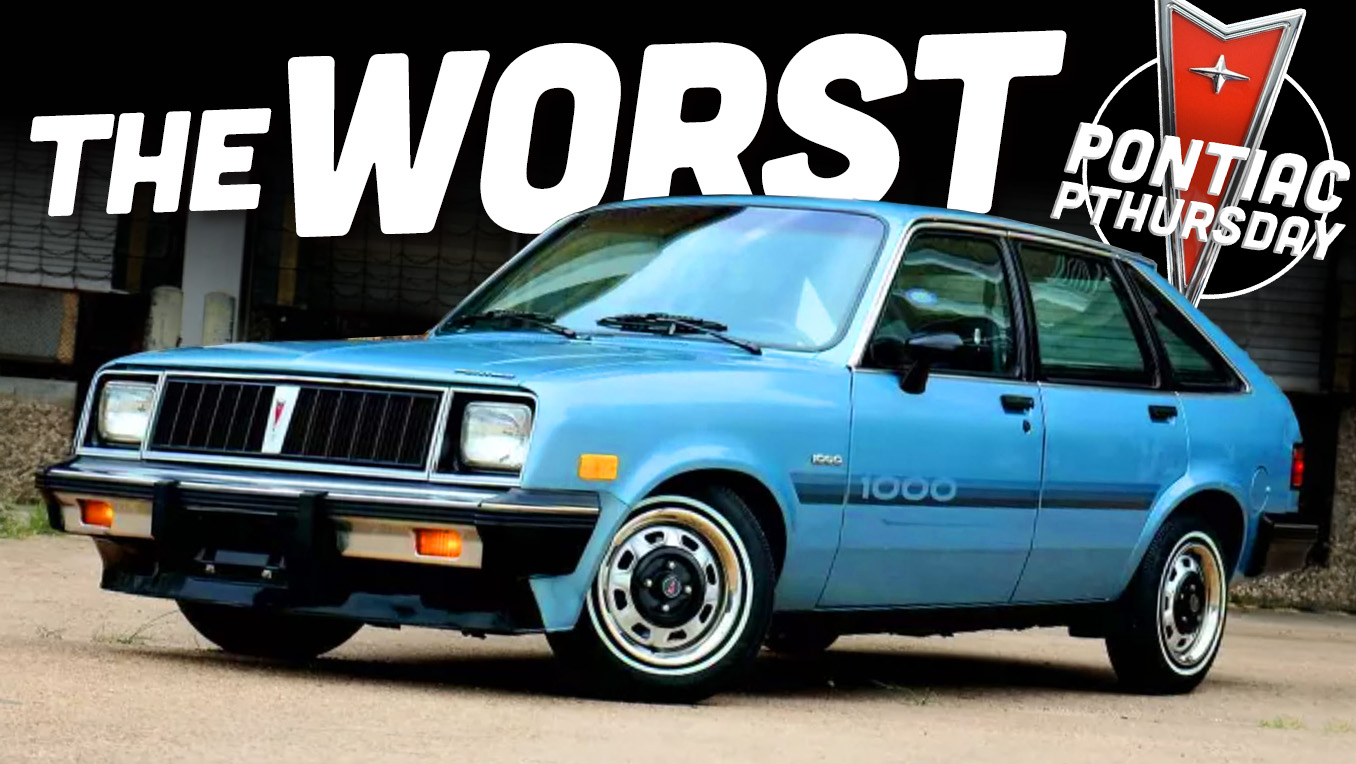
I have to apologize to my fellow Autopians. When I’m wrong, I say I’m wrong.
A little while back, I lambasted the poor Daewoo-made 1988 LeMans, calling it likely the worst vehicle ever to wear the Pontiac badge. I did a similar sort of hit piece on the Vega-based Astre. Both of these were indeed rather poor vehicles, but at least they had some redeeming characteristics; each of them featured rather attractive styling and offered at least relatively competitive performance for the time.


The real Worst Pontiac Ever had no such values; it was pure, unadulterated crap foisted on the public at a time when the brand had no excuses to offer such garbage. My friends, it’s time to look at the T1000.
This Was The Best The World’s Biggest Car Maker Could Do?
As I often do in these posts, when we’re talking about any car, I like to set the stage for the automotive environment at the time. During the weeks that K.C. and the Sunshine Band were insisting you get down on AM radio (tonight, specifically, and also do a little dance), General Motors was about to release a new subcompact car for Chevy to combat the import onslaught. Boy, did those Europeans ever have some good ones.
In late 1975, European carmakers had started the transition into producing rather advanced, space-efficient, front-wheel-drive cars. The soon-to-be-a-Yugo Fiat 128 debuted in 1969, while Renault followed up with the 5/Le Car in 1972. By far the most popular in the United States was Volkswagen’s new-for-1975 Rabbit, the Giugiaro-designed Mark I Golf that would form the template for modern small vehicles.

General Motors had just put the Toronado mechanicals into a front-drive, six-wheeled motor home, so they were poised to take on this challenge: offer the latest technology to the American people at a great price. Did they do it?
Absolutely not. The new 1976 Chevette subcompact featured mechanical specifications that could have been on a car from the fifties. An inline four (at least it was SOHC) sat longitudinally in front, powering the rear wheels connected to a live axle; at least it had coil springs in back instead of leafs. Naturally, the driveshaft passed through a large tunnel that ate into the meager interior space.

Now, basic specifications aren’t everything. The Chevette could have been styled by Bill Mitchell’s team to be a small car icon inside and out, plus the mechanical components might have been massaged to create a fun-to-drive product.

Again, not the story. The GM “T” platform actually began in late 1973 as the new German Opel Kadett. In this form, with small bumpers and unrestricted powertrains, the “T” car wasn’t cutting edge but not that bad. You can see they even got a four-door notchback sedan that looked rather nice with its composite headlights.

Even the two-door hatch base model had nice detailing, like those thin bumpers, and offered reasonable enough performance.

As with many European cars that made the trip over the pond, a lot got lost in the translation. Five-mile-per-hour bumpers and strangling emissions controls limited the 1.6-liter carbureted four in the Chevette to a mere 60 horsepower. Many were bought with the optional automatic transmission and air conditioning, which likely lowered the already glacial 16.9-second zero to sixty time that Road & Track recorded for a manual four-speed car. Don’t even ask about a fifth gear.

The best part was that GM provided an even more soul-sucking version of this true penalty box of a car. Chevy offered a bargain-basement “Scooter” version with argent grey bumpers instead of chrome, and omitted the glovebox door, carpeting, and back seat.
Now, after the second gas crisis in 1979 and the crippling interest rates and inflation of the time, every division of General Motors cried out for an economical small car with a bargain-basement price. Pontiac wanted something a notch below the J-Car 2000/Sunbird to attract entry-level buyers. In 1979, GM’s Opel launched a new Kadett with a transverse front-wheel-drive powertrain and more modern if not earth-shaking looks. This might have been ideal as a little Pontiac, especially when we saw their later 1983 GTE model designed to compete with the VW GTI.

So, when did GM start selling this new, updated Opel in federalized form? They didn’t; the rear-drive Chevy shove-it lived on, and The General offered this now-five-year-old version of a car that was dated when launched in 1975 to Pontiac for the 1981 model year. See? I told you this would be bad.
The T Stood For Terrible
The very least GM could have done to transform Chevette into a Pontiac is swap in a different grille, and that’s exactly what they did to create the T1000. Just the bare minimum.

Eventually, they did replace the Chevette’s cubic taillights with horizontally ribbed units that added the raciness of a Trans Am to your entry-level subcompact. Behold:

Fully reclining seats were a lavish feature that I’m sure were added only because they were omnipresent on any Japanese cheap car. You also got full instrumentation with a speedometer and a tachometer-style gas gauge. Nothing else.

By 1983, Pontiac had dropped the letter prefixes on their cars, so Pontiac’s version of the Chevette was merely the 1000. At least there was some weight savings for losing a letter off the badge, right?

When people talk about the shame of driving an entry-level car, the T1000 is the perfect case study. Don’t take my word for it, though. How about the opinions of the most positive and nicest guy in the whole world? Yeah, even he hated it.
I Did Send Letters To Owings Mills, Maryland
As a twelve-year-old, you likely couldn’t wait to switch on PBS at least one night a week. No, it wasn’t to watch some snooze-inducing “masterpiece” about nineteenth-century British poets that your snotty parents pretended to like; it was to watch crappy early eighties cars getting beat apart by the greatest personality in automotive history: John Davis. I know that I’m not the only Autopian who would weep uncontrollably if ever put face-to-face with the man who put cars ON OUR TELEVISION SETS for God’s sake. You laugh, but this was a big deal to Stranger Things era kids like us.
John Davis was an honest journalist, but he usually tried to find something (I mean anything) positive to say about even the most miserable sleds his team was given to test. You’ll see from this video that he struggled very hard to do that with the Pontiac T-1000 in 1982.
He starts by complementing the deep chin spoiler and “Euro style” black trim.

However, you just know Honest John can’t lie to us, and things go south very fast. This automatic-equipped 1.6-liter T1000 recorded Motorweek’s slowest zero to sixty time in the admittedly rather short history of the show to that point; it was even slower than the five-speed-equipped, Isuzu-diesel-powered Chevette they’d tested a little bit before. Actually, considering how cars in general got faster during the eighties, I bet that Worst Acceleration Record still stands. By the way, Benzheads: they tested a stick 240D that year, and it still beat that T1000’s 30-second time by eight seconds.
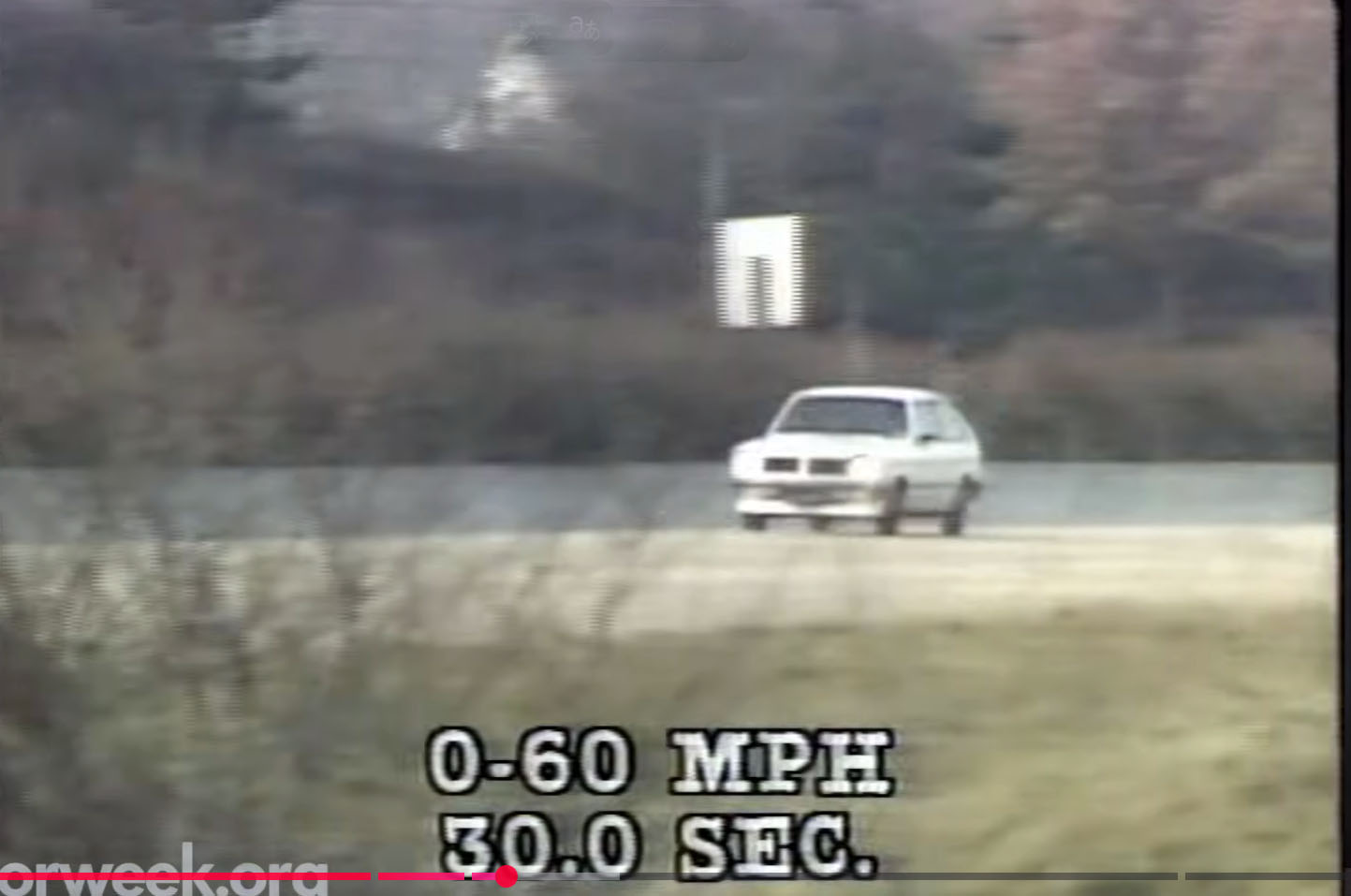
Passing times were also record-breakingly bad. They did mention that up to around 50MPH it wasn’t horrendous, but after that, the three-speed slushbox refused to downshift and the anchor came out.

Wait, it gets worse! Look at the recorded highway miles per gallon. Twenty-five is pathetic, and John is quick to note that cars much larger had generated better figures.
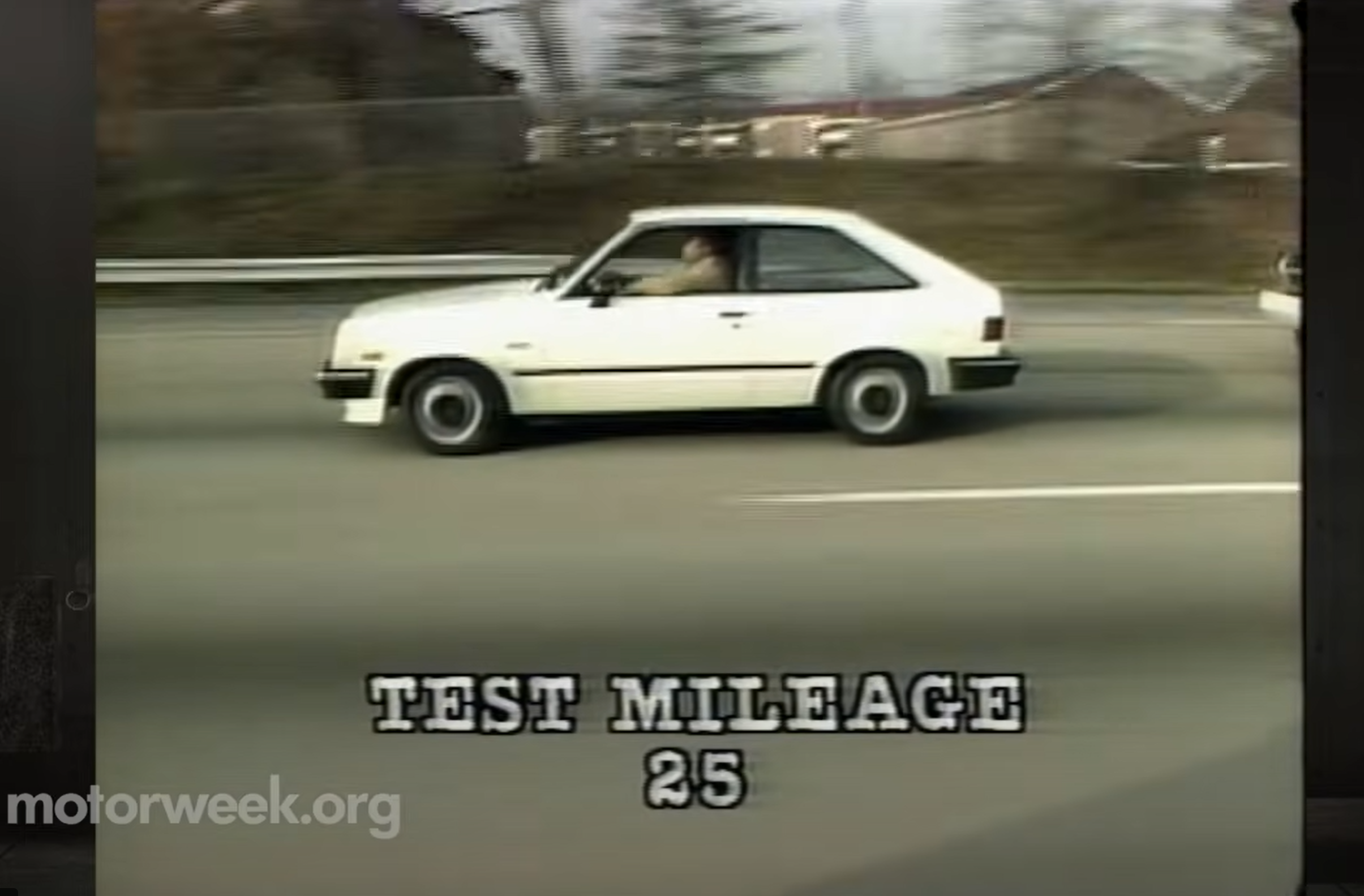
He wasn’t kidding: in ’82 you could have bought a massive palace-on-wheels near-limousine Oldsmobile 98 with the diesel V8 that was rated at 33 MPG highway. We had friends with a similar big diesel Olds, and I can confirm that they regularly got over 25 MPG at a steady 55 in button-tufted opulence. Until the head bolts blew, of course.

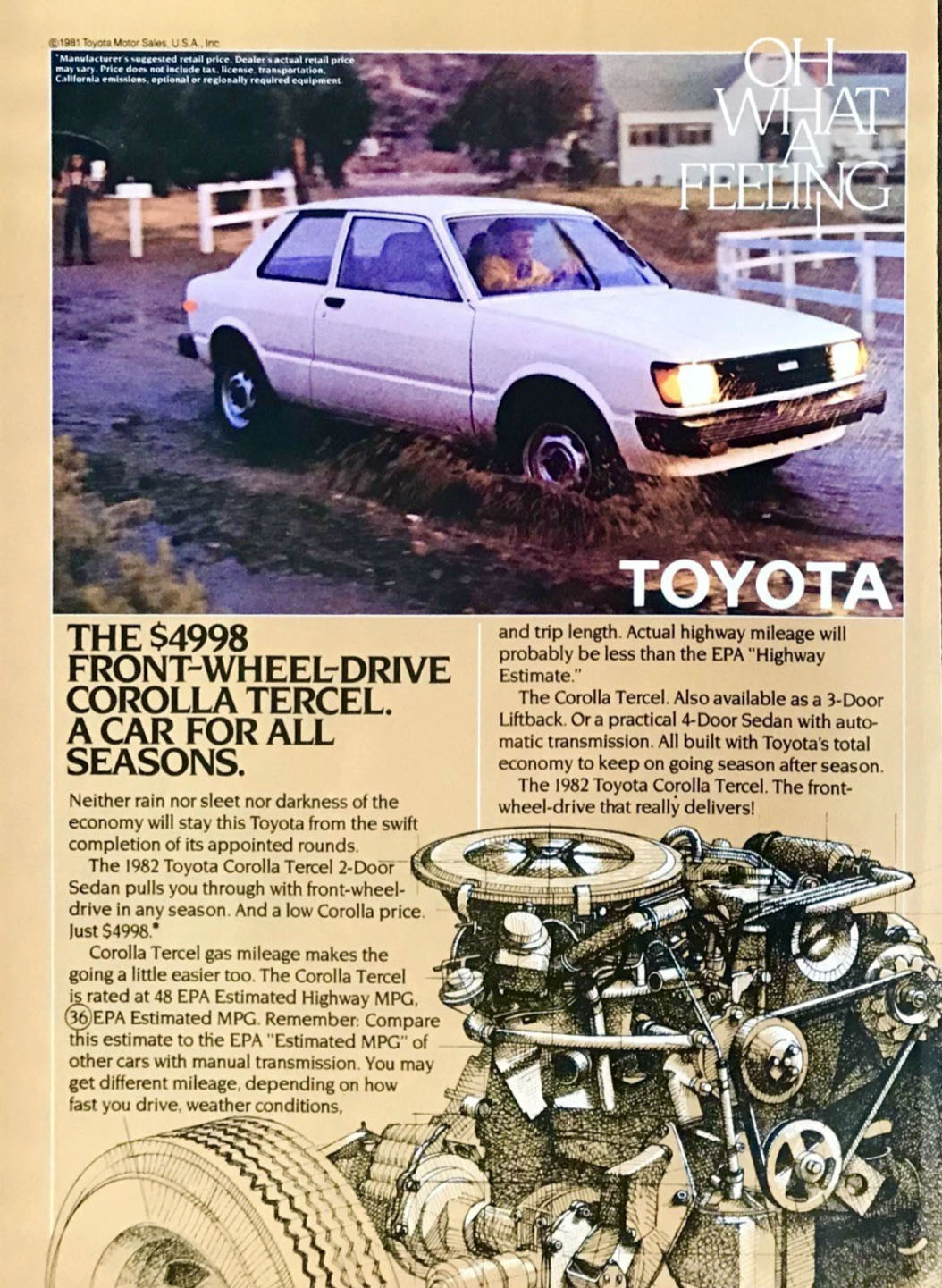
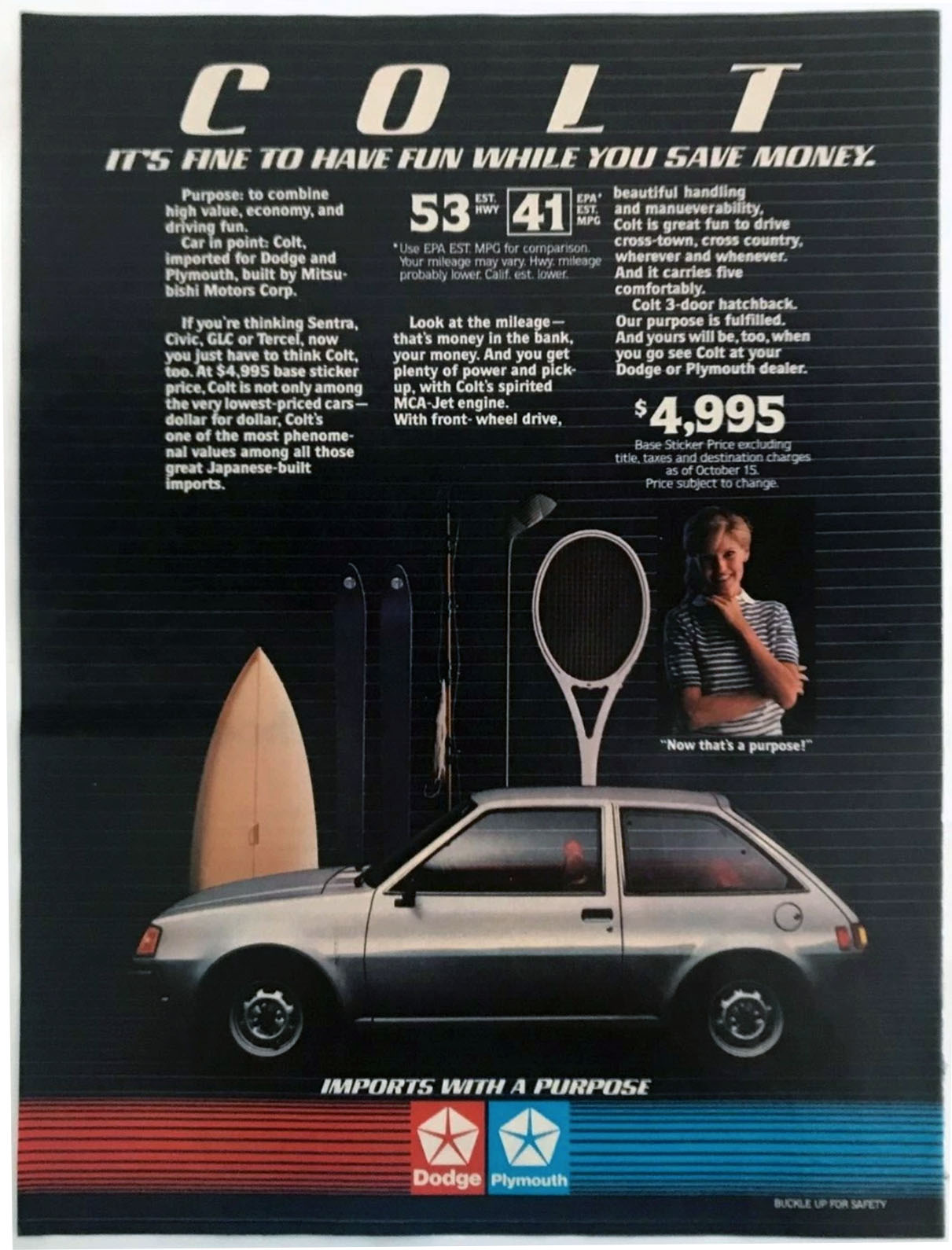
The crowning achievement of the little Pontiac Chevette was the price. At the T1000’s base sticker of $5540, you could have bought a number of other cars like a front-drive Tercel (which would be replaced in late 1982 with an all-new but similarly priced car):
Or maybe a twin stick Mitsubishi “Imported for Dodge” Colt:
How about a Mazda GLC, which became a front-drive proto-Golf in 1981?
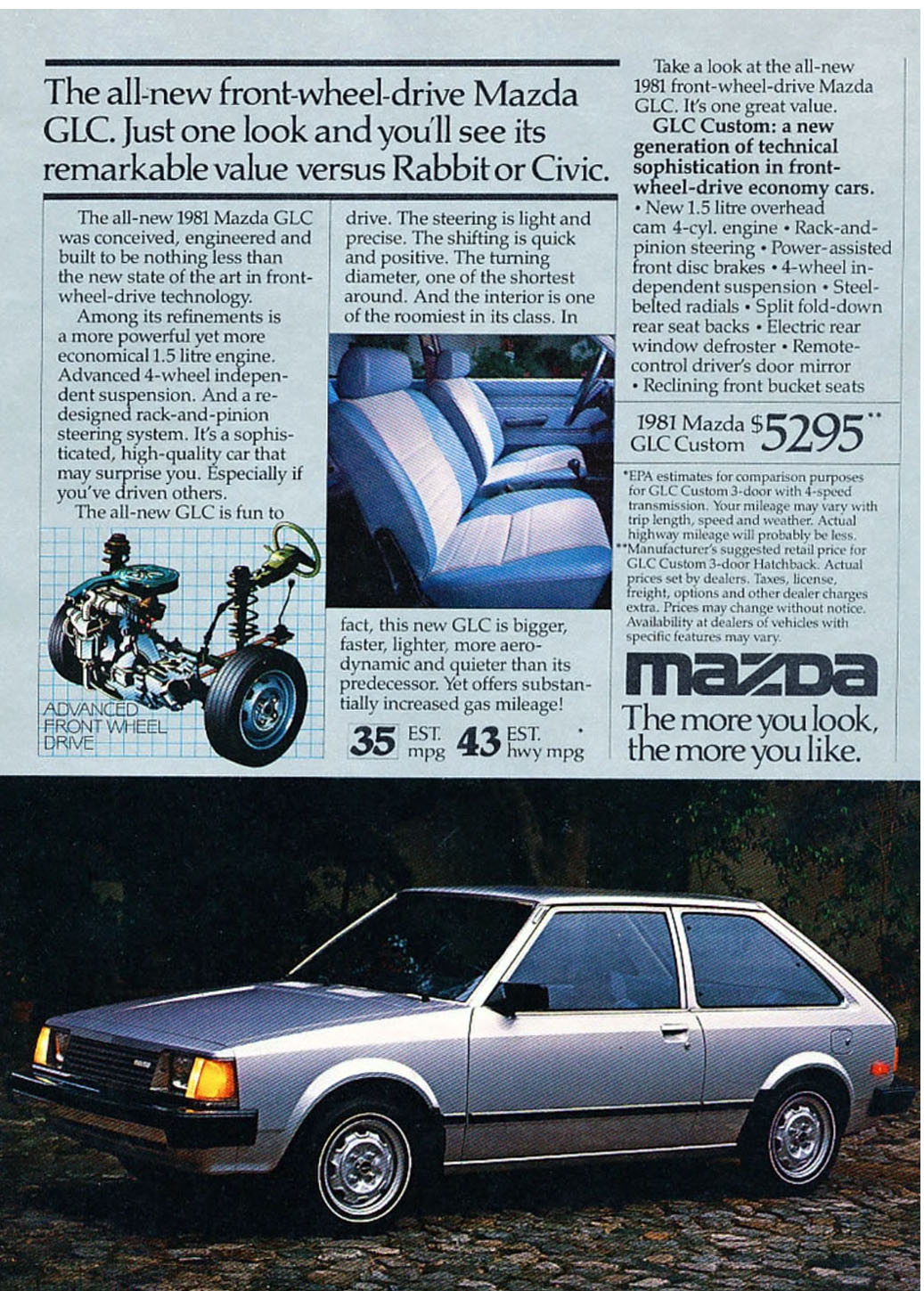
Any of these would be cool cars to have even today: lots of fun to drive, super reliable, and an order of magnitude better than the T1000. So, you’d think nobody would have bought this little “Pontiac” or its identical Chevy twin, right?
Wrong. Admittedly, the T1000 (later 1000) never sold in big numbers; over 60,000 moved in 1981 but sales quickly dropped. The Chevette, however, found 233,000 homes and was the second-best-selling small car of 1982, just behind the Escort. That’s a drop from the year before, when Chevy sold 433,000 of these clunky old subcompacts. Why did people buy them? That’s a question for the ages, but I think there are a few reasons. First of all, they probably got deals on the Chevette while the Japanese cars sold at a take-it-or-leave-it sticker (or, in the case of Hondas, at thousands of precious dollars above). More importantly, I think more buyers back then insisted on American-made products and never considered imports. Such loyalty should have been rewarded with something other than a car with virtually no redeeming qualities. The fact that people purchased a car that was already dated half a decade before it was introduced gave GM little incentive to spend money to find a better product.
The ‘Vette You Don’t Want
Today, it might be easier to find a coach built Hispano Suiza than a decent-condition Pontiac T1000 or 1000. They were used up and very happily sent to the crusher. When they do appear, like the one below that popped up on Craigslist a while back, they don’t go for much. This 1986 Texas car with 60,000 miles was offered at under $5000.

Even at that low mileage on smooth Texas roads, you can see that the front suspension is shot. But hey, at least it has the one saving grace of any American car: a solid air conditioning system complete with “ball cooler” vents. Switching on the A/C must have made that thirty-second zero to sixty “sprint” even worse, if that’s even possible. At least the 1000 has a glove box door, unlike the Chevette Scooter model, but I’m told the latch is so big that it eats up much of the space inside when shut.

Look at that half-arc sweep on the door panel to match the window winder’s path; that’s almost a styling element. Note that by the time of this late model 1000, any chrome-plated metal had been replaced by plastic.

This thing should be in a museum as a warning to future generations, and to make twentysomething car bloggers who think a Nissan Versa is a “piece of crap” shut the hell up. These kids don’t know pain.
We Never Saw The Vibe Coming, Did We?
Hard to believe as it is, the Chevette and 1000 soldiered on until 1987 with very few changes, finally being replaced as the bottom rungs in the lineups with imported cars like the Suzuki Chevy Sprint and Isuzu Chevy Spectrum. Of course, we never received the German version of the front-drive T-Car; Pontiac got the Daewoo edition of the Kadett at a time when cars from the Korean auto industry were still a bit subpar. I reported on that disgrace to the LeMans name a little while back.

Still, I need to apologize to that car, as well as the diesel 6000LE and an Iron-Duke-powered Firebird. Those underwhelming cars don’t have what it takes to claim the title. There can be only one True Worst Pontiac, and the T-1000 is it. Congratulations, you miserable piece of crap.
Pontiac Points: 20 out of 100
Verdict: There’s a reason the antagonist in Terminator 2 was called T-1000; it’s the worst thing you can imagine on earth.





The Tercel has similar power at 67 or so, but even my own heavier 4wd wagon is faster than that. Doubt the auto ones were much worse, but that is better diff gearing for you.