


Back in 2017, Tesla unveiled concept vehicles for what was going to be its future semi-tractor. The Tesla Semi entered limited production in 2022, but Tesla was quiet about just how much its big rig was going to cost once mass production actually started. Now, we know. If you want the 500-mile range Tesla Semi, it’ll set you back $290,000. Somehow, electric semi trucks cost so much that this price is basically a deal.
This month, Tesla quietly updated its page for the Semi. The truck, which is due to enter mass production this year, has published production specifications. Tesla is launching the truck with two trim levels, and the spec sheets for both finally have important information that was missing when limited production started in 2022. We now know how much the Tesla Semi weighs and, perhaps most importantly, how much it’s going to cost.


The Tesla Semi project has taken long enough to reach mass production that Tesla’s take on a big rig is entering a market with existing electric Class 8 trucks from truck manufacturers. How crowded is the market? The Tesla Semi will duke it out against the Kenworth T680E, the Freightliner eCascadia, the Volvo VNR Electric, the Peterbilt 579EV, the Mack LR Electric, and others. But there’s a twist, and it’s that the Tesla Semi is entering the market with impressive specs for a lower price than the average Class 8 electric semi.
Years Of Waiting

It’s been a long road to get to where we are now. Deliveries of the Tesla Semi started in late 2022 with PepsiCo as the pilot customer. Here’s what I wrote in December 2022 about the truck’s development to that point:
Just over five years ago (which feels like it’s been a decade, I know) Tesla unveiled its idea for a semi truck of the future. The Tesla Semi promised to revolutionize the trucking industry with an EV semi capable of hauling a full load 500 miles on a single charge. Development of the Semi has been a rollercoaster. Back in 2018, Musk said that the Semi would have four Model 3 motors and release in 2019. That year came and went without a Tesla Semi, with Musk saying that it would release in 2020. Then, the release date of 2020 became 2021, then 2023 was even hinted at as the release. Along the way, Tesla said, at least in an earnings report, that the delays were due to a limited supply of batteries and the supply chain shortage.
Production has been slow since then. As Forbes reported earlier this month, at least 200 Semis have been built, but most of them are used by Tesla itself. Another 86 or so early units are in the hands of PepsiCo. Walmart, Costco, Sysco, NFI, DHL, Martin Brower, and US Foods have also tested the Semi. These trucks have been putting in real work, too. As InsideEVs reported, 100 of the trucks had driven about 4.6 million miles by late 2024, with one unit reporting 248,000 miles after a year and a half of use. So these trucks are being used for real semi-truck stuff. Tesla also reported a 95 percent uptime for the Semi fleet in 2024.
Yet, mass production has proven to be elusive. In 2024 and then in 2025, Tesla said that mass production was on the way. Tesla then said it was nearing completion on a factory in Nevada where the trucks will be built. When everything is online, Tesla says, the factory will have the capacity to crank out up to 50,000 trucks a year. Mass production is supposed to start in a matter of months. So, what will the fleets that buy these things actually get?
The Semi Got A New Face

The Semi isn’t the same truck it was when I last wrote about it more than three years ago.
Much of the core of the truck is still the same. The Tesla Semi uses a frame developed in-house and three independent electric motors that drive the rear wheels. One motor works continuously while the others can use a clutch to couple into the drivetrain to provide assistance for hill climbs or acceleration. Total drive power is 800 kW, or about 1,072 horsepower.
In 2022, Tesla CEO Elon Musk claimed that just one of the Semi’s football-sized motors produces more power than a single diesel engine in a Class 8 truck. That video is still up on Tesla’s site today, and the claim remains false today as much as it was in 2022. For example, the Frightliner Cascadia, one of the most common semis on the road, can be equipped with a Detroit Diesel DD13 with 525 HP and up to 1850 lb-ft of torque. You can get a Peterbilt 579 with 605 horses under the hood if you fancy it. The point here is that, yes, the Tesla Semi has a lot of power, but it’s not as huge a difference as Elon claimed it is.
Efficiency is rated at 1.7 kWh per mile, and that’s with the truck loaded to 82,000 pounds, the legal limit for electric semis. In 2024, DHL said it loaded up a Tesla Semi to 75,000 pounds and then drove it 388 miles on a single charge, averaging 1.72 kWh per mile. DHL notes that in its testing of the Semi, the trucks moved at speeds above 50 mph for almost half of the time. Logistics provider NFI Industries scored 1.64 kWh per mile in its testing. In other words, Tesla’s claims about efficiency and around a 500-mile range do seem to be realistic.
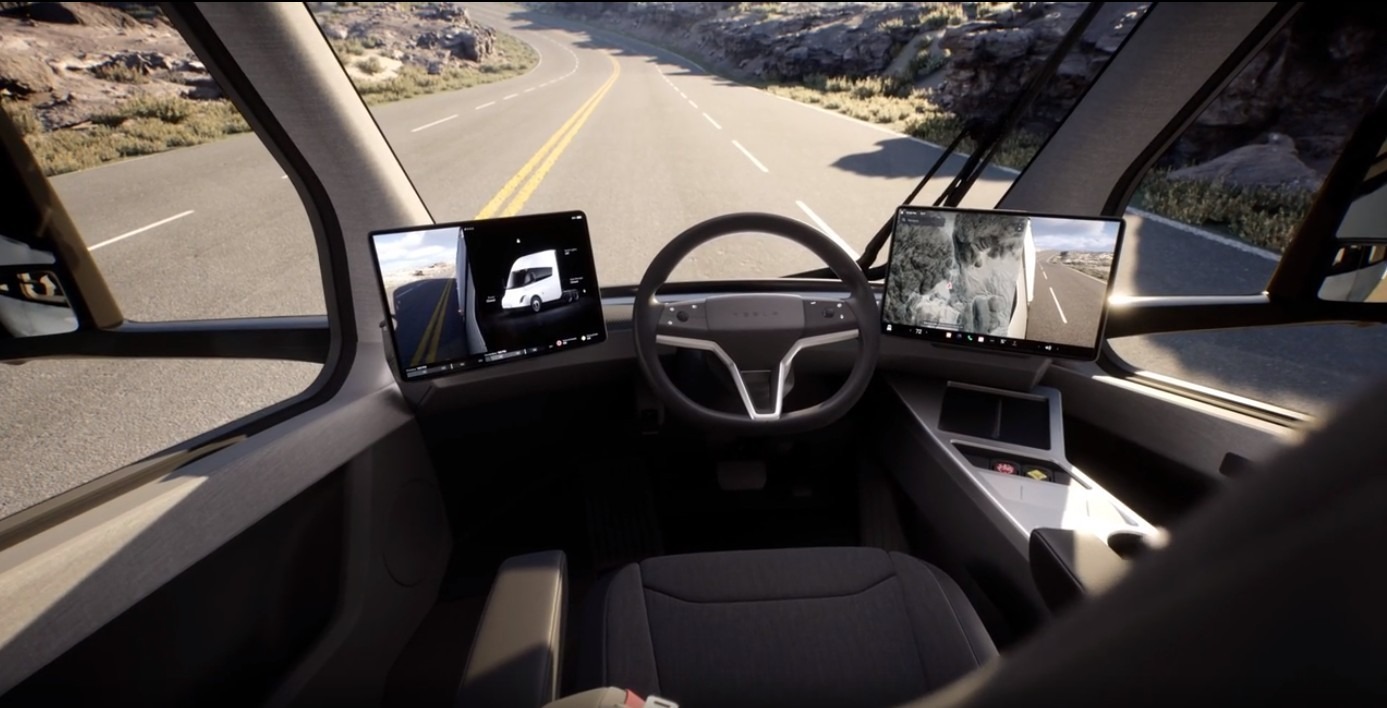
Motor Trend noted that the Semi got an update in early 2025 and then another update in late 2025. The former update had a focus on quality of life. In 2022, I reported how the Semi has a weird central seating position, minivan-style pop-out windows, and a cab so awkwardly huge that the driver has to physically walk to the back to exit the truck. The central seating position and the windows alone were a confusing decision, as it meant that drivers would not have an easy time passing paperwork in and out of the truck.
The engineers at Tesla took input from the people using the rigs for work at PepsiCo and used the feedback to make the truck better at its job. The updated Semi has windows that drop and new mirrors that offer better visibility. Here’s the old windows, for reference:

The new windows don’t solve the fact that the driver would still have to get up from their seat to reach something outside of the truck. As someone who drives big commercial vehicles, I’m not entirely sold on the central seating position as being practical. Admittedly, I’m not a career driver, so maybe there is a benefit I’m not seeing there.
Tesla also equipped the truck with a slightly smaller battery system that weighs less, but still hits the target range figures. Charging is handled through a V-shaped Megawatt Charging System port, which allows for 1.2 MW peak charging speed. That can replenish 60 percent of the truck’s range in just 30 minutes.
Reportedly, Tesla has baked the possibility of a sleeper into the Semi design. It’s unclear if the passenger seat will be changed from its current awkward position in the back of the cab:

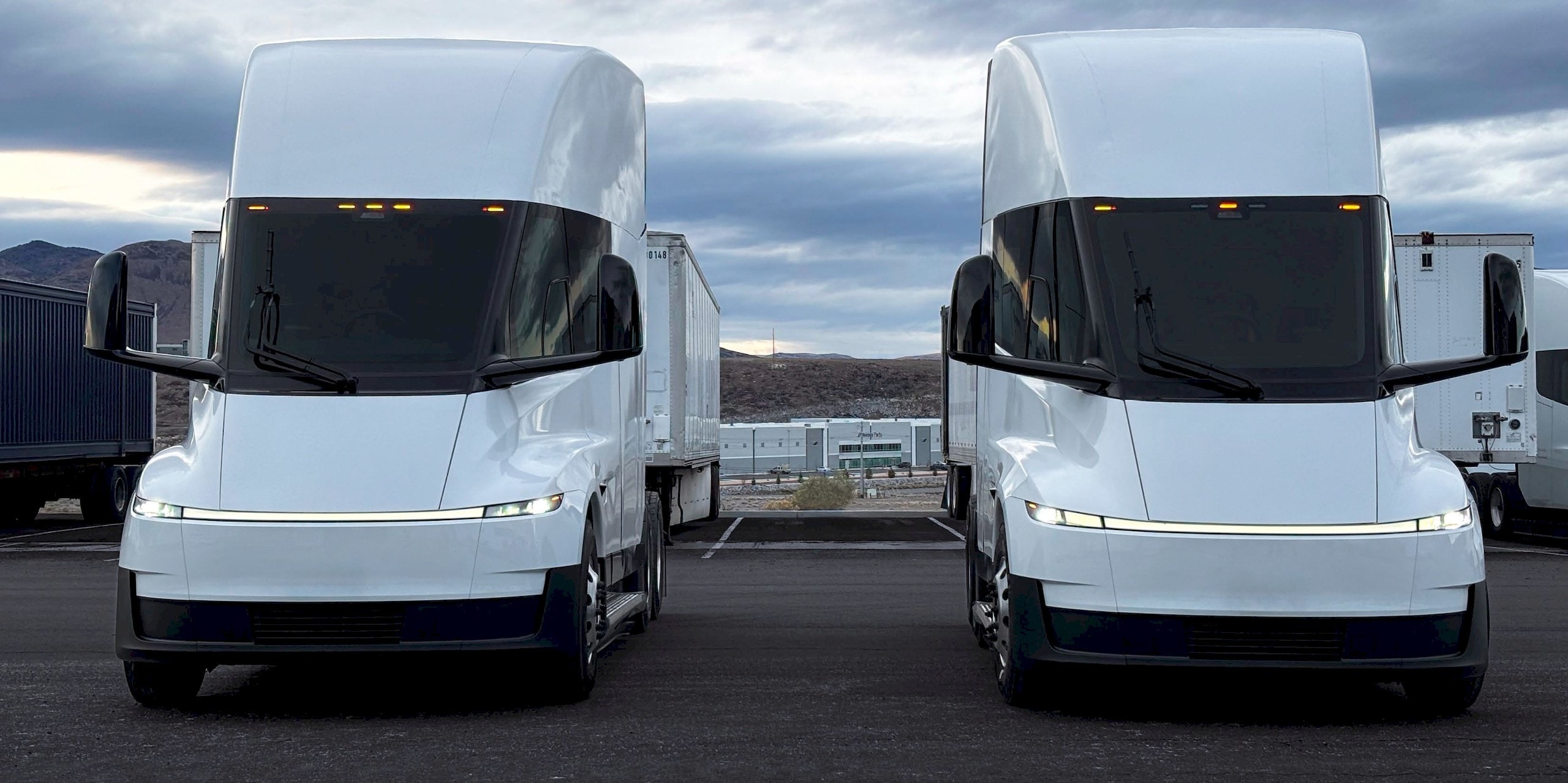
The latter 2025 update, shown at the top of this section, introduced a new, more aerodynamic look for the Semi, plus a chassis update for greater payload. The interesting part about this update is that, despite the supposed aero improvements, efficiency remains the same.
Another change in the updates is an electric power take-off with 25 kW of capacity. This can be used to power equipment in the semi-trailer behind the Tesla Semi. The idea is that maybe there will be a refrigerated trailer that can be powered by the EPTO rather than a diesel engine.
How Much Does It Weigh?
Weight is finally a known figure, too. The Semi will be sold in two versions. The Tesla Semi Standard Range is claimed to have a 325-mile range at 82,000 pounds. The truck itself is advertised as weighing less than 20,000 pounds. The Long Range version claims 500 miles of fully-loaded range and a weight of 23,000 pounds.
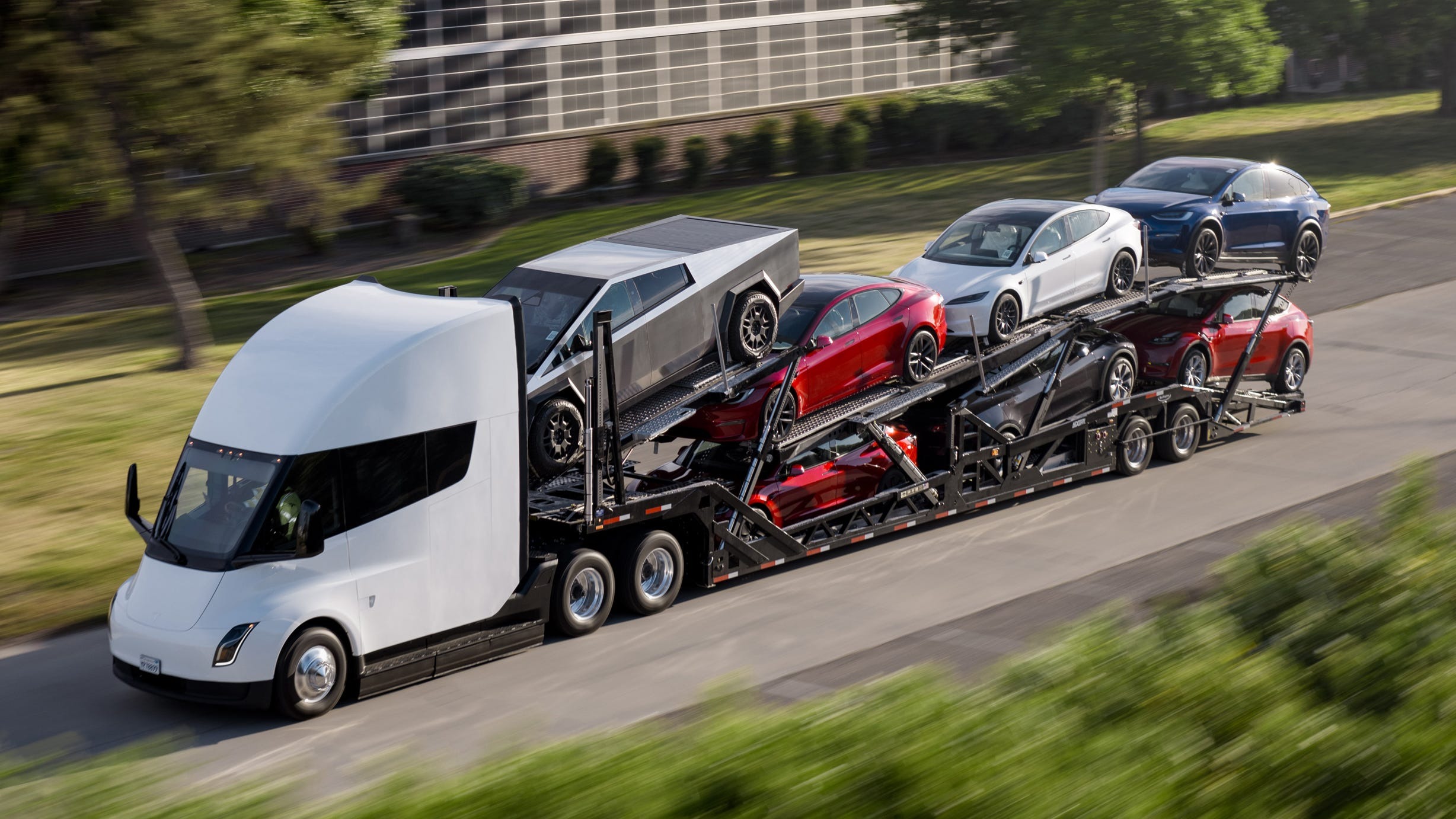
That part is interesting in itself because the tractor’s weight was a huge question. A semi-tractor that’s very heavy cannot carry as much cargo. If you have a Tesla Semi Long Range, you have 59,000 pounds left for cargo and the trailer. A diesel semi with a day cab might weigh around 17,000 pounds or so, so the Tesla Semi is a bit heavier. Some diesels with sleepers weigh more than 20,000 pounds. The government tries to make up for weight differences by allowing electric semis to have a gross weight of 82,000 pounds versus the standard 80,000-pound limit.
The Price
The other big question was the price. In 2017, Elon said that the Semi would cost $150,000 for the Standard Range model and $180,000 for the Long Range variant. The actual price? $260,000 for the Standard Range and $290,000 for the Long Range.
This puts the Tesla Semi in an interesting place. You can get a diesel semi with a sleeper for well under $200,000. For example, you could get a new leftover 2025 Freightliner Cascadia for around $175,000. You can get even cheaper trucks without sleepers. The Tesla Semi is a day cab only for now.
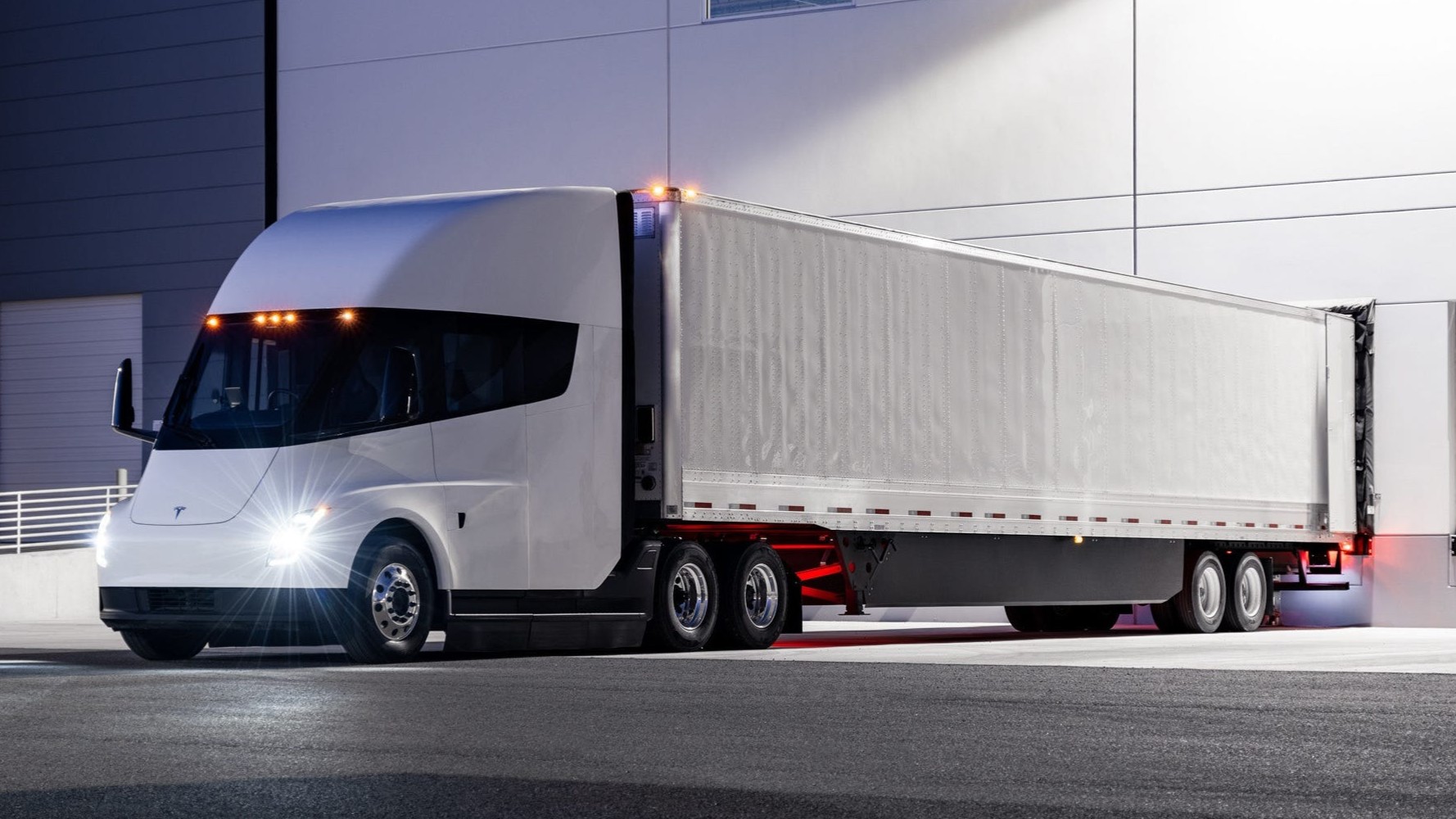
However, as Electrek writes, CARB data suggests that the average selling price of an electric Class 8 semi was $435,000 in 2024. Forbes notes that competing electric trucks cost around $400,000 and many of them don’t have the Tesla’s range. Assuming Tesla doesn’t change the price again, it means the Semi will undercut the competition.
The question, I think, then becomes which truck will be the better choice. As Forbes writes, as of now, the national average price for diesel is $3.60 per gallon, while the national average price for electricity is 18.9 cents per kWh. Keep in mind that public EV charging rates (Tesla plans on building out a Megacharger network) might cost twice the national average or more, depending on the charger and location.
I’ll give an example. Say you charge a Tesla Semi at a spot that charges 40 cents per kWh. 500 miles at 1.7 kWh per mile is 850 kWh. That’s $340 in juice before accounting for charging losses and fees. Now, say you have a diesel that gets 8 mpg. That’s $225 in fuel at the national average to travel the same 500 miles. Multiply that over time, and the diesel might make more sense to take on the long haul, even after accounting for maintenance. However, the math changes if you’re able to charge the truck at a depot and not pay for charging on the road.
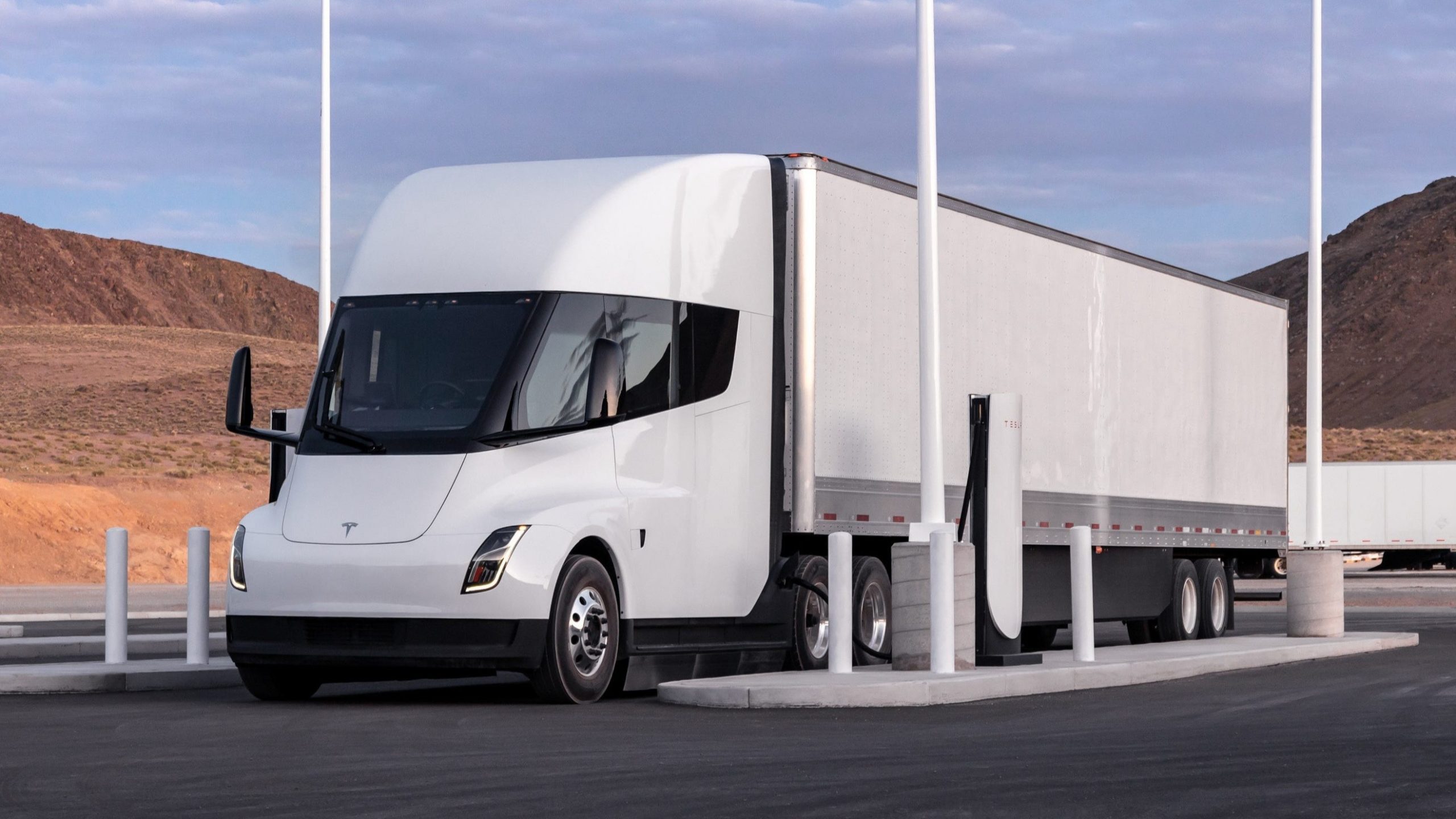
As I have written several times in the past, the trucking industry is highly sensitive to cost. The cost-per-mile to operate one of these trucks will likely be a deciding factor for many operators in either buying these trucks or how far they’ll run. As Forbes notes, DHL plans on using them for short and medium-haul routes. PepsiCo uses its trucks for local and regional deliveries.
Incentives, or the lack thereof, can also be a factor. Unfortunately, as Forbes reported, the federal government has pulled back from supporting zero-emission truck efforts, and demand for electric semis has softened.
Still, Tesla intends to “disrupt” the trucking industry with its Semi. It’s hard to say what’s going to happen with the Tesla Semi. The situation is different now from where it was in 2017. But I guess Tesla will soon find out just how many truckers want a McLaren F1 seating position in their mobile office.
Top graphic image: Tesla


The cab is still an ergonomic disaster area with the center seat and doors a mile away. This is suboptimal for the sort of short haul work electric tractors do where drivers are constantly in and out of the cab.
If I was in the market for an electric semi I’d be more likely to buy a Volvo or Freightliner since they have better cabs and are backed by experienced truck companies rather than a tech startup run by a mad philosopher king.
I wonder if tire life will be a concern fleets spend a bunch on rubber
You are talking about a negligible amount of weight difference, as mentioned in the article.
EVs don’t really go through tires faster, assuming you drive sanely in an EV or gas powered car. Most people that have wear issues typically notice it because they go a little crazy accelerating faster in an EV than they ever did in a previous ICE car early in it’s life because of the novelty factor/ease of rapid acceleration and typically OE tires wear out faster as they almost always start out softer and at less than the more typical 10/32″ of tread depth of replacement tires. For instance, even on my Y Performance, I replaced the factory tires (21″ diameter, that you can’t rotate due to staggered width setup) at 4/32 rear / 6/32 front after about 26-27k miles, but those tires started out at either 8 or 8.5/32 vs the replacements that I can now rotate (swapped to 20″, same wheel/tire size all around) which are 10/32 depth. I have replaced tires on my three previous new cars (Passat TDI, Sonata PHEV and Sonata N Line) all around the same miles.
Said it before and will say it again…..these are great for last mile delivery. Much like the electric Amazon trucks from their distribution facilities.
But, what we really need vs 3 million Semis rolling down the roads? Trains…..lots of investment in rail. Exponentially more efficient moving large loads. Much easier to electrify and more efficient until full electrification.
Yes, there will still be a need for some “just in time” shipping, but there should be no reason a semi is used to move toilet paper, diapers, dog food, canned goods, etc. any further than from a central depot to local stores, etc.
Yes, it will not happen over night, but freight shipping should move to rail.
The environmental impact just to create all the huge batteries needed to fully electrify the nations truck fleets……. 3 million Class 8 trucks in the US alone. 15 million commercial trucks of all sizes in the US. Around 335 million commercial trucks worldwide……
It’s always amazing to me to watch the long freight trains pass. 100+ cars, some or most of them double-stacked is infinitely more efficient to travel long distance.
Agree, Pepsi does this in my area. It can reduce noise and pollution going from major distribution centers to stores. The benefit to the batteries is they can be recycled to new batteries. Scaling recycling is slow due to lack of batteries to recycle currently.
It needs a sleeper. Throw in a induction cooktop, microwave, exhaust fan, and a wet bath while they’re at it.
This is an industry, along with global boat shipping, that needs to be more electric. I don’t care who does it, just hope it happens. If being priced 200k lower gets them a lot of sales, then good job. If not, good try.
Mack made a very weird-looking offset-cab truck that was supposed to be better for visibility. Tesla went… the other direction.
They may or may not having 2 of these testing where I work. Unsure why Tesla choose to test here but I guess we are not a competitor anymore as we shit canned our class 8 electric trucks. Still have our EV school buses and medium duty though. The price might be more then originally planned but as discussed it is still much cheaper then the competition from Freightliner or Volvo also go look at the range figures from those they are awful like 250 miles. If Tesla’s numbers are accurate while fully loaded they are way ahead any of the competition. But obviously as discussed here the diesel is still cheaper for the truck and fueling. Guess this will all depend on how much these companies would pay for charging and long term maintenance.
Remember back when anyone cared? The Tesla Semi was first announced in 2017 and promised in 2019. No one cares anymore, they missed the boat on this so hard now the industry has moved on. Tesla is and has always been basically a fancy pyramid scheme.
Plus Elon’s name is synonymous with Epstein, Trump, and all the other wonderful makings of this worst-case scenario of a world time-line we’re living in. Who would willingly do business with them now?
kinda agree, and personally I’m an Elon hater and would never have a Tesla product in my garage… but I gotta think that the Elon stank doesn’t carry over much to the logistics/trucking sector.
First, as the article notes, the trucking industry is extremely sensitive to any type of cost savings per mile. If a company can charge the truck at their depots and manage any cost savings over diesel, I’d have to imagine it becomes pretty easy for them to ignore Elon’s crazy ramblings and tweets (yes I still call it Twitter, and I’ll die on that hill).
Second, and while I hate to stereotype, I’d wager that most in the logistics industry (both management and drivers) voted for Trump. So again, I don’t think that those associations carry the same negative consequences in the passenger EV market (whereas most EV purchasers tend to vote blue).
So I’ve been in this industry around 20 years (God I’m old)…
What you’re referring to is called “TCO” or Total Cost of Ownership, essentially it’s the Pareto Chart of vehicle ownership over the life of the asset. Anything that reduces total cost increases the value proposition to the customer.
The problem is that with current technology, EVs only offer a good TCO when you consider in Greenhouse Gas Credits (GHG) and tax subsidies. When the government was incentivizing fleets with either purchase credits or fleet GHG reductions for EVs this made sense. However, now, most of those were removed by the current administration. The only places that remains are those who ascribe to California’s CARB standards, and even those are being challenged in the courts now.
No, TELSA makes it’s money off of licensing tech, selling patents and stock. The actual sales of their vehicles are mostly to government agencies and fleets, retail sales are relatively small.
Ultimately the diesel engine still offers a better TCO then electric, mainly because of the cost and energy density of current battery technology.
I wonder how much the TCO is also affected by the sharply rising costs of electricity. Pre-AI boom, electric made more sense than it does today from an economics standpoint (but I could be wrong).
I also have to imagine there’s some big question marks for the TCO of EV truckss at this stage: namely total maintenance cost and longevity. Not sure if there’s good real world data on that stuff yet (maybe there is? I don’t follow this stuff too closely).
Maintenance should be cheaper with the lack of multi gallon oil and filter changes. Brakes should last much longer due to regen. So maintenance should be less.
Thanks for the info. Obviously you have more first hand knowledge about the industry than I do.
That said, my post was primarily about whether the Elon Musk baggage would impact the sale of commercial EV trucks in the same way it has hurt sales of passenger EVs; and I gotta stand by my original sentiment: if a Tesla EV truck makes financial sense for a logistics company, then they’ll be signing on the dotted line regardless of what Elon is spouting (and, if like you said the TCO for EV trucks is > Diesel trucks, then Diesel is gonna win no matter what Elon says).
Like Tesla cars its pushed other makers to put out electric semis so it’s a win even without Tesla. Maybe Tesla can build out a great mega charger network as well.
So, that price could definitely work if they divert some money from:
Probably both of the above combined.
Will every state need to go over to ton mile tax on commercial vehicles to fund highway maintenance? That means that unless there is a significant subsidy for these they are starting out with quite a disadvantage.
This may be the most interesting thing to watch.
I’m with the camp that sees these working for limited applications. Depot to depot. Short haul of loads over 10 tons.
Maybe even some special applications like logging trucks. Might work great for those. They often go up some steep roads empty and come down fully loaded.
Or maybe the initial cost and durability issues will keep them out of the log hauling industry.
Edison Motors has been working on a logging truck (series hybrid) for a few years now. It’s just a small shop tho, so not likely to move the needle much in the overall market.
What, no second seat for the lot lizard? Tesla has not done enough market research…
Maybe that’s going to be the main function of the Tesla-bots
Waifu doesn’t need a seat. It just needs a screen.
As a 20 year veteran of the trucking industry, I fully expect EVs to take over the “city” range, which is typically about a 150km radius from base.
For long haul? The range is laughably short. With current HOS rules, you’ll completely fuck long haul drivers, who are traditionally paid by the mile.
Most long haul trucks have about 2400 miles of range on fuel (300 gallons × 8mpg). If you’re only allowed to drive 13 hours per day, with a minimum 8 hours consecutive for reset, you’ve screwed yourself with EV semis below 800 miles of range.
Either we’re all going to accept hourly pay and longer shipping times, or this isn’t going to work.
Holy cow that’s a lot of range. I never would have guess long-haul trucks can hold that much fuel.
Nevertheless, using electric semis near urban centers while keeping diesel for long-haul makes so much sense. Electrified fleets in and near cities will keep the air cleaner, and they can take over the part of driving where diesels lose out on efficiency.
Range aside, I’m really curious to learn more about driving impressions from veteran drivers.
Normal semis have like 2 million gears (or so), which I would assume makes any change in speed annoying.
Making them an EV, with as close-as-physics-allow one-pedal driving? That sounds like a huge improvement in drivability. Especially for the short routes.
Imagine getting smoked at a light by an EV semi.
The new automatic transmission trucks are pretty much one pedal driving as it is. So, no difference there. It’s the center seat that gets me. I drive a narrow cab Pete, sitting only 2 feet from centerline, and it makes life difficult. A Freightliner Cascadia, where you are sitting on the edge of the truck is so much easier to back and maneuver since you have better sightlines on the driver side.
I remember a story a few years back where people were testing electric semis between Long Beach Terminal and their warehouse. It was saving the electric truck driver over 15 minutes per trip because they could accelerate at the same speed as the cars while they were in traffic and it prevented the cars from continuously cutting them off.
Once all those trucks plug in, we will all be dealing with rolling blackouts.
That is a problem for the electric companies to solve.
Putting together infrastructure and making it work is their job.
With the rates that they charge, they should be producing much better results, instead of just handing out dividends and complaining about the evolution of energy production, distribution and consumption.
I’m happy to collect the dividends
We’ve been running a brand new 44kV trunk line from the city’s backbone, just so we can charge our EV buses.
We’re STILL backing it up with a couple of 2.5mW generators for power outages and peak shaving.
There’s speculation that charging battery cars will drive up demand for diesel generators.
Ours are natural gas powered. The gas line they’ve ran is big enough for me to fit in.
Impressive.
Let’s hope you never need to.
A docko on semi charging points out that many Western states only have limited power to freeway locations, so the common practice of charging the first customer full price for the new supply isn’t viable for truck stops.
Yeah, we’re a municipal transit property, so the tax payers are footing the bill.
Doesnt current law state they can only drive 11 hrs in a day with a 30 min break in there and then need to take a minimum 10 hr break after the 11hrs of driving? So just napkin math if they are driving an average of 60mph so 660 miles a shift and the Tesla range is accurate and also charging times are accurate where you can get 60% back in 30 mins so ~300 miles back on the long range model in that time. I would say the 500 mile range should be fine if you charge after driving for 6-7hrs and take your 30 min break and get 300 miles back. Obviously the charging infrastructure would need to be there though.
Hours of service can vary by location, they can run longer up here in Canada.
That being said, truck drivers don’t normally use rest stops for breaks. They’re for sleep stops to end their day.
That’s only if they’re on route and it makes sense. You’ll regularly find trucks idling on the shoulder of on ramps, in Walmart parking lots, or anywhere the truck fits.
They also spend a LOT of time waiting at the customer for offload. Which is where their midday breaks are often spent.
Source: My family has operated a trucking company for over 40 years. The repair shop for the fleet is where I got started in the trades (after 7 years, I learned you don’t work for family and moved on).
In the US the rule is a 30 min break after 8 hours, so you have to make at least 1 30min stop in your 11 hour day.
They don’t have to take the 30min break until 8 hrs in but they can certainly do it earlier and most probably do since they don’t want to wait 8 hrs between meals.
You eat when it’s convenient. A lot of them carry easily consumed snacks. You make miles when you can, while you can. Stopping for anything other than a delivery, fuel, or for your mandatory rest period is avoided at all costs.
Anyone doing long haul is generally paid on a per-mile basis. Anyone running local in a daycab is typically hourly. Break times are less of a concern for local guys as they’re regularly shunting from delivery to delivery. Lots of time to snack.
Like I said in the US a 30min rest period is required within the first 8hrs of a day so no reason the truck couldn’t be charging during that time regardless of what the driver is doing.
What they do need is moderate speed chargers in the overnight parking areas so the truck can leave at 100% after the 10hrs and the Megawatt chargers for the 30min stops.
There’s every reason it couldn’t be charging. It would require the driver to go off route to find a charger, and very likely take the time to unhook the truck, then hook it back up and do another circle check.
Your 30min break becomes over an hour quickly, and you’ve screwed yourself.
Well many of the pilot locations for the Megachargers are at Pilot/Flying J truck stops. They are located on major freeway interchanges so no going off route any further than a driver of a diesel powered truck when they need to stop for fuel, food or 30min or part of their 10hr break. IE take a 2/3hr break to avoid rush hour traffic, finish your 11 hrs and be able to get back on the road in 7 or 8 instead of the full 10.
There is no reason to believe that a truck hauling a normal legal load would have any reason to unhook to charge. Pilot understands how to build truck stops and I’m certain every installation will be set up for charging with the trailer hooked up. The last thing they want to see is a trailer unhooked on their property. How many times do you see a truck unhook to fill with diesel?
Never see them unhook to fill. But I also see them add 2400 miles of range at the diesel pumps in 10 minutes.
The truck stops are for long stops. Bunk trucks intentionally carry everything except a bathroom to avoid having to rely on dedicated stops.
If you’re one of the folks that only needs to poop every 2 or 3 days, chances are you’re avoiding truck stops for everything except food.
Some trucks are covering 800 miles a day on long legs.
They won’t be able to do that in a truck with 300 miles of range that needs hours to charge, you’ll be out of hours. That loss in miles compounds over the week.
Most truck routes are running on razor thin profit margins. that lost time could mean the difference in that run being profitable at ALL.
Especially when you’re spending an extra 100k on the truck.
Have we factored how much range they lose in cold environments? Especially while keeping a truck cab warm overnight?
A Webasto Airtop 2000 can heat a truck cab comfortably at a burn rate of about 0.06gal/hr. Long haul trucks are typically loaded with two 150gal fuel tanks.
APUs pull a little more at 0.25gal/hr, but they’re also a full tilt generator that can power all accessories and run A/C.
Pure BEV is not practical for long haul. Full stop.
Over the road drivers often work in pairs, so nearly a full day of running.
The front end looks nicer I’ll give it that. Now if they could finally put the Roadster into production…
I’m not surprised they could undercut a bunch of companies with much less EV experience, if any. Tesla’s battery capacity alone probably puts the rest to shame.
The Autopian’s Mercedes has that series of articles on attempts at semi efficiency and yet when I see a modern semi, even Freightliner’s eCascadia…. they barely look different. Yeah you could tell they did some smoothing to features but it looks pretty half-assed. While I think the Tesla Semi is ugly, if I’m buying one then efficiency is the #1 concern, and you can tell they at least tried.
I’m wondering how much of a difference a more aerodynamic cab makes: even if you pull a trailer loaded with a couple of containers, you’ll have a huge vortex at the back, but what if you pull a trailer loaded with two (upper and lower) rows of cars? I’m sure it’s still better to have a slippery cab rather than a square box, but I’m just not convinced that the difference is all that big.
There were some trucks running around maybe 10 years ago? With some attempts at boat-tailing the end of the trailer to reduce that big pocket of air behind them. Either they never met the goals or were axed due to length restrictions. Otherwise the biggest changes I’ve seen have been the skirting on the trailers themselves, and switching to cameras for mirrors with in-the-cab screens. Those reduce drag by something like 8%
They’re called trailer tails, and I found this interesting article speculating why the biggest company stopped making them back in 2021: https://www.ccjdigital.com/regulations/article/15281497/why-stemco-stopped-manufacturing-trailertails
One of the biggest points was that it required the driver to manually deploy them, and I assume stow them before they can open the doors for delivery. And drivers are already working their butts off, so adding more and more tasks for them is a tough sell, especially when diesel gets cheap.
The more you know! The inability to see them is definitely problematic, though with 360 camera availability a growing feature that may decrease, and automating deployment may either make them too expensive, or a more effective solution.
Automatic deployment is definitely a big one, but yeah there’s so much tech out there maybe other areas could be a better use of funds. I have no idea what gives you the most bang-for-your-buck in aero efficiency.
Yeah I guess I’d have to research it more. I thought that even a fraction of a percent increase in efficiency was very welcome with the amount of miles these trucks cover.
I see three unmarked Tesla Semis daily relatively near the Nevada factory. I assume Tesla is testing durability and efficiency, so Tesla’s claim of testing six-figure miles seems plausible.
One hauls a flatbed trailer loaded with concrete blocks, another hauls a run-of-the-mill box trailer, and the third alternates between a plain box trailer and a refer. I don’t see the refer long enough to tell whether it’s diesel or powered by the Semi.
Elon is an idiot for overpromising delivery dates. However, the adults at Tesla Semi seem to be taking appropriate time to work out the bugs. Time will tell.
The interior design looks very inefficient, with all that empty space behind the driver – exactly where a bed/bunk would go, except there’s a door there.
The interior design is a head-scratcher. However, one driver who’s a friend of a coworker, and was speaking off the record, said the ergonomics and visibility are nice, and the lack of a roaring diesel makes for a pleasant work environment.
Am I missing something on the claimed efficiency ratings? A 500kwh pack is rated for 300 mi range, 900kwh rated for 500mi. That’s more like 0.6mi/kwh. Is the city mileage that much higher that they are claiming those efficiency numbers?
I’m in favor electric vehicles, but hope the other companies earn the vast majority of the market share, since Elon Musk has done so many despicable things.
You’ve got the formula flipped upside down. The 1.7 quoted in the article is kWh/mile.
Ah thanks, lysdexia got the best of me again
Well it looks a lot better than the other truck they make.
It does look a lot like a Stormtrooper tho.
Which is appropriate, I guess.
Yeah. But I assume most of them will be painted or wrapped in something besides white.
What do you call a red Stormtrooper?
A Sith Trooper.
What do you call a blue Stormtrooper?
A Stormtrooper Commander.
I want to see when someone turns one of these into a multimillion dollar fully clean RV with 7 kw of solar power on the roof.
There are multiple concepts out there.
What’s interesting is that some 75 year old can trade in a Buick for one of these 70,000 lb RVs (plus 3000 gallons of water) and drive it down the highway at 70 mph without any additional driver’s tests or licenses.
This might be the best case I’ve ever seen for Telsa making FSD work.
The rules around RVs boggle the mind. I needed to get my A licence to tow more than 4500kg (bobcats at work) but anyone can tow more than that if it is a camper. Physics aren’t any different but old Jim can tow his massive camper all across Canada without a worry.
It’s likely cheaper than competitors because the Tesla Semi is being subsidized by California to the tune of $165M. See here: https://www.latimes.com/environment/story/2026-02-09/tesla-semi-california-truck-funding
I’m involved in heavy duty vehicle electrification. The main issue with cost is the low volume. If someone wanted to take the risk and tool up an integrated EV truck chassis for high volume, they could compete on cost with diesel delivery box trucks.
The current state is most manufacturers are buying components from different suppliers and integrating them together. That adds a lot of cost and design complexity. That cost and complexity is reflected in the high prices.
I suspect Tesla took a lot of components that traditional truck OEMs would buy and designed their own components to work as an integrated system. That adds a lot of up front design and tooling costs, but at high volumes will bring down the cost of the final product.
I suspect these are going to be a lot more popular not as OTR but for local, established, routes.
Tier 1 and Tier 2 electrical pricing for industrial customers where I’m at is about 10 cents and 13 cents per kwh, or about $110-120 for a full charge, a net savings of $100 over the diesel. If the trucks on a daily route, that’s a savings of around $30k per year.
A megawatt charger is going to be super hard to come by – I imagine there are truck stops that, even if they’re pulling in 440V power today, are not going to be able to find a 2000-amp electrical service – in the field. But a warehouse or manufacturing plant is far less concerned about charging in 30 minutes and is likely going to be comfortable letting these charge overnight.
Quick Google search reveals it will probably be 1000V for the Mega Chargers.
I don’t see these doing a long haul that requires charging at a “public station”. It’ll be between hubs/ports/distro centers that are within range
Over the road trucks would need to be series hybrids to become electrified with our current battery technology.
Ever used a Hot Shot Trucking Service? (I’ve worked with Fedex Custom Critical.) They typically use a Semi-truck that has been turned into a Box truck. You can tell them from a normal semi-truck box truck by the sleeper cab and the fact that the entire area between the front and rear wheels is nothing but fuel tanks on both sides. These trucks will have two truckers and once they roll out, they basically don’t stop. I wouldn’t be surprised if they have bathrooms on board to limit the stops to once a day to just switch drivers every 12 hours. They carry so much fuel in the hope they can do even cross country trips without a refueling.
It’s going to be a LONG time before these Hot Shot trucks will be EV. However, I could see them switching to hybrid quickly, because they could go further before they have to stop for fuel.
Hybrids don’t really improve the efficiency of constant speed driving except maybe in hilly areas. Hybrids need regen braking events to actually make an efficiency difference, which long-haul driving lacks other than getting to/from on/off-ramps. EREVs exploit the fact that most passenger vehicle owners only drive short distances most of the time but need coverage for long distance outliers (road trips), and offer a slightly inefficient but serviceable solution to those long distance outliers. However, long-haul trucking is consistently long-distance with few short trips, so EREVs don’t work.
The only way I could see a hybrid helping efficiency is indirectly, by allowing the ICE to be more optimized for its ideal cruising RPMs, assuming that the ICE sacrifices some mid-rpm fuel efficiency to output sufficient idle takeoff power and peak high RPM power. A hybrid system could allow for a no-compromise ICE that has poor idle RPM performance which the electric side can make up for, in exchange for marginal efficiency gains at cruising RPM.
Thing is that there are almost always hills and traffic and the like. ( I think trucks might do better with a train style hybrid system than a car style, by the way. ) Trains switched to diesel electric decades ago for a reason and they have, if anything more cruising driving than an interstate truck
Trains moved to series hybrids because starting from a stop and getting up to cruising speed is a much harder problem for them than even trucks, and the transmission required would be huge, heavy, and overly complicated compared to a series hybrid (diesel-electric) setup (adding initial expense and greatly reducing reliability). All those disadvantages seem to outweigh the ~10% loss in transmission efficiency from converting mechanical energy to electric energy then back again.
At least in the US, long distance truckers can stay pinned to the speed limit as long as they avoid traffic found in urban areas, which could be done by taking a bypass or timing to avoid rush hour (obviously not always possible). When they do get stuck in traffic, truck drivers are generally skilled enough to generally maintain a steady speed rather than participate in the impatient stop & go like passenger car drivers do; this increases their fuel economy by reducing/eliminating the very braking events hybrids need to work. So outside of forced stoppages (red lights, stop signs, on/off ramps, highway rest stops, etc), the hybrid system doesn’t have much of an opportunity to recover wasted braking energy. The remaining are for slopes, where they can use regen like a jake brake on downhills and deploy on uphills. The utility of this really depends on how many hills are expected and the battery size. There’s also less of an engine design compromise to be efficient at cruising RPM and powerful at higher RPM than the compromise of cruising RPM to low/idle RPMs. Also, I don’t think shutting off the engine at low loads has as much as an effect in trucks than in passenger cars, and there’s likely less opportunities to do so in a truck anyways.
All of this to say that the gains of any hybrid system in a long distance trucking scenario are probably lower than in passenger cars, and it definitely cannot offset the increased transmission losses of a series hybrid setup (those losses would apply during the 95% majority of time/distance spent at cruising speed). If they were to implement them, I’d imagine they’d use a P0/P1 motor that just bolts onto existing pure-ICE powertrain designs, for a parallel hybrid setup kind of like the F-150 Powerboost’s system.
Kenworth has a concept truck that got 12.8 mpg with 65,000 lbs at highway speeds, a 136% improvement. It’s a 48V mild hybrid, it’s aerodynamic as anything, it’s had a diet of over 7000 lbs. How much of the economy improvement is from the hybrid and how much is from the aero and diet, I don’t know.
I’m not an expert in trucks, but I can’t see why you couldn’t have a hybrid where the truck has the acceleration and hill climbing performance of a 500 hp engine with the fuel economy of a 350 hp engine with a fairly mild hybrid setup.
As for the comment about trains getting rid of a complex transmission, an imagine of a 18 speed gear box shift lever comes to mind. Admittedly, these are marvels in efficiency and truckers can really make them sing, but I wonder for the next generation, just P, D, N and R would be more attractive.
CB Radio Clicks to life:
Big Mac: This is Big Mac, anybody got their ears on?
Tesla Stan: Tesla Stan here, come on back.
Big Mac: Heading up 81. Any Smokeys hiding out there?
Tesla Stan: You know, Big Mac, my Tesla Semi has a full detection system that clues me in to existing police enforcement, as well as road hazards and the status of all weigh stations. Furthermore, it will sense and attach my trailer automatically and completely automate off-load. As a matter of fact, while I’m talking to you on this primitive CB Radio, I’m also playing Call of Duty while my truck comfortably drives me to my destination and I’m not a slave to diesel prices. Let me tell you a few things about my Semi’s touch-sensitive steering yoke…
Big Mac: (imitates fuzz with his mouth) I’m sorry. Signal’s breaking up. (hangs up CB). One more load. One more and I retire. One more.
It’s still all about the infrastructure. Having pull through charging stations are the biggest issue. If they can get that figured out, then these should sell. But no company is going to buy them if there is no charging infrastructure to support them. Especially when charging stations for consumers seem to frequently bug out or cause issues.
I think it will work best for relatively short out-and-back routes where you can get back to where you started on a single charge. Or between distribution centers. Ie: a company like Amazon could go all-in and electrify their loading docks
It’s perfect for last mile LTL delivery from a regional service center.
That is my understanding of this situation, too. Tesla does plan on building out a public charging network for these things, but I think they’ll make the most sense on routes where you end up at a depot or a distro center.
If they could charge at a distribution center while being offloaded, that would be the best scenerio
I agree, these are for the truck drivers that spend every night at home in their own bed.
Yes, a sleeper cab will only add weight that diminishes payload. The lack of a coast-to-coast affordable charging network will keep them short haul.
California should love these, they might be able to do Long Beach to Yuma round trip, so they can offload to a diesel rig.
These would make great yard mules, if they came in shorter wheelbases. Not sure how big of a market that is though.
I work on a 1,200 company site and we use yard mules as inter-building shipping trucks. It’s a ~100 year old site, so the oldest buildings are really tight together, and the short wheelbase and small size is the only way to get trailers into some of the loading docks.
We currently use some absolutely ancient Kalmar Ottawas I think.