


The optimistic view of the future for a car enthusiast in the United States is that the end of global free trade, as we’ve known it, will result in a lot of U.S.-specific cars that are more powerful and unique. The pessimistic view is that our car companies will become more insular and smaller, and we’ll lose out on the fun Japanese and European cars we’ve gotten used to lately.
This is one of those Morning Dumps where I’m not entirely sure how I feel about all of this, so I’m going to work it out in this post. Perhaps I’ll come to some great conclusion, or maybe we’ll all leave more confused!


I’m thinking about this in terms of a global car market that doesn’t really include the United States, and a United States car market with more production and less competitiveness. It’s possible that it doesn’t happen or, if it does happen, it’s not that bad. Rather than a bunch of small stories, I’m going to take the pessimist’s view and the optimist’s view, in turn.
The Pessimist’s View Of America In Global Automotive Trade
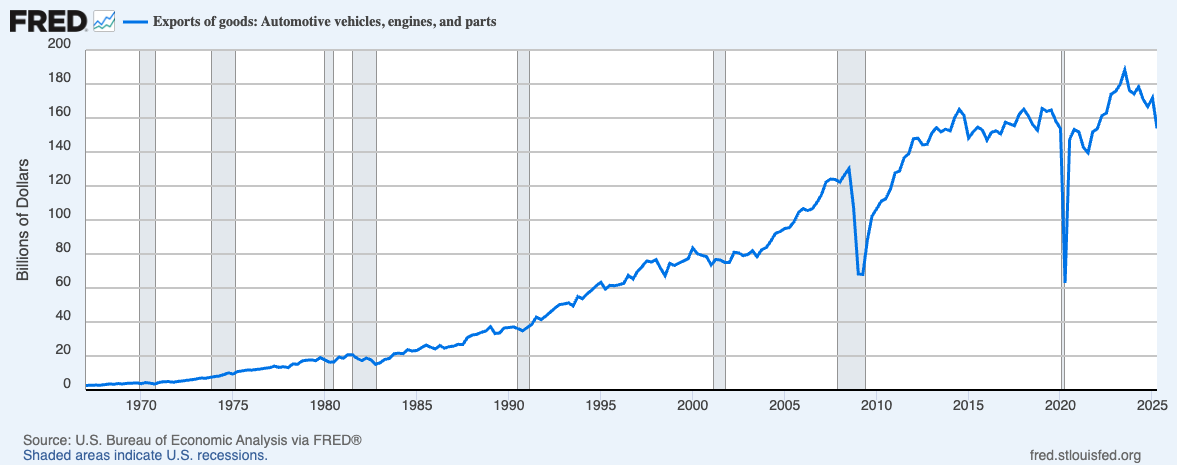
One of the major sticking points between President Trump and the rest of the world when it comes to automotive trade is that, for all the companies that do build cars here, we don’t export nearly enough parts, cars, engines, et cetera. If you look at the chart above, you’ll see that exports, by value, have gone up significantly in recent years.
However, you have to compare that to imports, which are much larger:
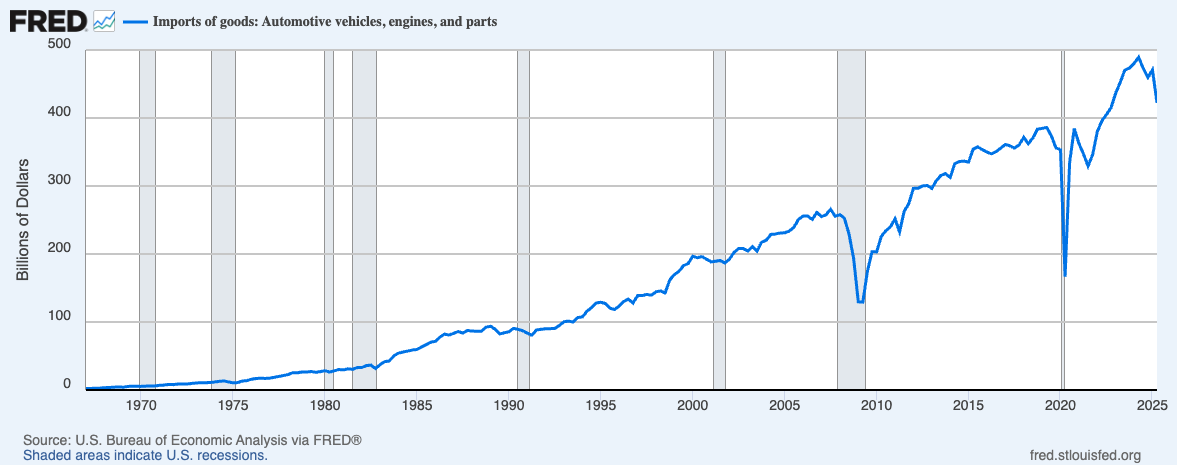
Some of this is practical. America is the second biggest automotive market in the world. We are a wealthy country. I’ve written before about the Theory of Comparative Advantage, but the TL/DR is: sometimes it’s better to let someone else make a product you can make yourself because you might get it cheaper and you can use your industry to create something of much higher value. We could all make t-shirts, but there’s more money in making the machines that make the t-shirts and the software that tracks t-shirt sales.
When it comes to cars, there are many models that might make more sense to build here (and no one is saying it’s a good thing overall to lose a lot of manufacturing), but for various reasons, there are some cars that are going to be cheaper and easier to build elsewhere. Smaller cars, for instance, are often imported because the margins are small and they’re more popular in lower-income countries, so building them there results in cars that are more affordable here, and more logical to produce elsewhere.
For all of the talk of the single, globalized car platform, there is a lack of harmony between safety and emissions regulations in North America and basically everywhere else. Clearing up that lack of harmony, in theory, would be good for the United States, and it seems as though governments like Japan are open to the idea of allowing in American-built cars.
But this is the pessimist’s view, so I’ll explain why that might not be a good thing. Perhaps governments in Japan and Europe are open to the idea of harmonizing regulations because they understand that American cars are already ill-suited for their roads and therefore might not sell that well?
If you drill down into what is being exported, by value, there are two obvious things that you notice. First, it’s that a lot of specifically American-style vehicles. For example, BMW builds many of its SUVs here and exports them to the world. It’s why Germany is one of the biggest importers of America-built cars.
Second, it’s that our biggest automotive trading partner is Canada. As mentioned yesterday, Canada isn’t exactly pleased with the United States at the moment. This is already showing up in trade, as Canada imported more cars from Mexico than from the United States for the first time since Vanilla Ice was an A-List celebrity.
There’s probably no future where Middle Eastern countries aren’t excited about importing Suburbans, but the rest of the world might not be into American cars at any scale (I mean, someone in Japan is definitely going to import an F-150 Raptor and it’s going to be awesome). The planned lowering of fuel regulations, the removal of anything that looks like an incentive to build electric cars, and the pre-existing differences in markets could mean that, rather than being a technological leader, America becomes a backwater of less competitive cars.
Sure, there will be more local production as companies trip over themselves trying to announce more plants here in this profitable market, but you know would benefit from that? China, of course, which is hoping to fill the void left by a suddenly more insular America. This is the view taken by Daniel Howes in The Detroit News:
Near-term, that looks like winning all around, right? Longer-term, as the realities of global competition inexorably reassert, maybe not so much. Retreating into Fortress America — where the rules are comparatively lax and automotive technology is at risk of falling behind China and other foreign rivals — risks losing the long game to win the short one.
By then, a new president presumably will be in the White House; automakers, starting in Detroit, will have decided whether they are content financially and technologically to be regional players in a global industry; and the smart folks from Washington and Solidarity House to the C-suites around town will know whether their potential retreat to capitulation was the right strategic call.
Detroit’s got more proverbial eggs in fewer baskets. More than anytime in at least the last 30 years, it’s banking a greater share of its profitability on a narrower slice of both its product line and geographic footprint. And it’s betting by what it’s doing that it can keep pace with the industry leader in EVs — China — by watching more from the sidelines.
This is what the announcement of all these trade deals (which aren’t deals, so much as outlines for potential deals) hides. Globally, people are fine to make deals with the United States because it’ll likely fall on consumers in the United States to pay them. While placating the Trump Administration, European automakers are going to balance Chinese imports by encouraging more local production for the local market.
As S&P Global Mobility points out in a recent report, that’s exactly what’s happening:
In early September, European Commission President Ursula von der Leyen signaled a renewed focus on small, low-cost cars as part of broader efforts to shape European car market trends in 2025. In addition to reviewing 2035 light vehicle emissions regulations, she announced that the EU’s executive body is working with automakers on a new “Small Affordable Cars” initiative aimed at supporting vehicles that are clean, efficient and price-conscious to meet the surge in global demand.
These “E-cars” would be environmental (clean, efficient and lightweight); economical (low-cost); and European (assembled in the region leveraging Europe’s supply chains). By doing so, the Commission hopes to create conditions which enable automakers to increase the availability of inexpensive European cars and bolster the competitiveness of cars in Europe.
The initiative also responds to the rising threat from vehicle and component imports from China and other markets outside of Europe, highlighting the Commission’s strategic interest in maintaining European strength in the small passenger car segment. Von der Leyen has said “[W]e cannot let China and others conquer this market. . . The future of cars—and the cars of the future—must be made in Europe.”
While there are always exceptions to this–like Tesla and whatever Ford thinks it’s doing with EVs–this is an America that can’t really be a global player. This is a future where Canada joins a European trade regime and eschews American imports for European ones. Toyota and Hyundai might be happy to build profitable and less-efficient cars here, but long-term, our allies could lower their tariffs to 0% and it won’t matter because American cars will be too far behind the rest of the world.

With higher tariffs also comes the reality that it’s maybe no longer great for car companies to give us their fun cars. Instead, we’ll get more specifically American-ized cars. This is the VW Atlas-ization of America. It’s a totally fine big crossover thing, but it’s not the fun cars we want. If the American market is a backwater of low-regulation gas-powered cars, then all we’re going to get is Atlases. Everything is going to become a VW Atlas. This potentially means losing out on both fun electric cars and even interesting gas-powered/hybrid cars like the Mazda3, Subaru WRX, and the BRZ/GR86 twins.
In this world, American car companies are not global players and are instead smaller, more regional automakers. Given the retreat from Europe and the downturn in China for American companies, this was probably already happening. Now it’s just going to happen faster.
While there may be an increase in manufacturing jobs, removing the United States from global trade is going to hurt suppliers and possibly shrink overall automotive employment. Just look at the shorting of supplier Adler Pelzer’s bonds that was reported by Bloomberg. Not great! While it’s a German company, it has operations in the United States.
In this world a smaller America is not a stronger America.
The Optimist’s View Of American Cars In Global Trade
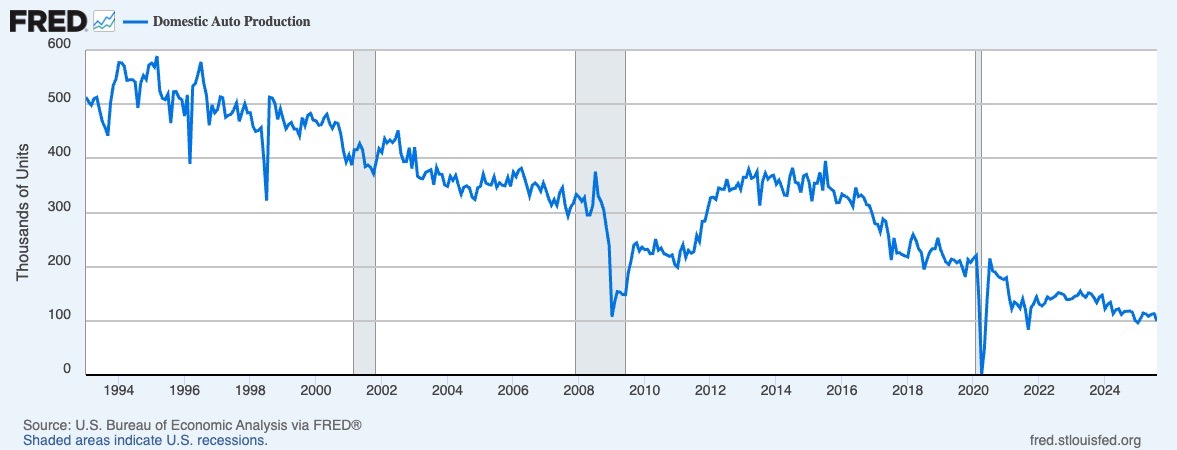
Even former President Biden realized that the loss of manufacturing in the United States, as evidenced above, wasn’t great. His plan was to incentivize the production of electric vehicles here so the country could compete with China.
Unfortunately, America was too late and too slow. China has essentially won. It can build more electric cars faster and cheaper, and, hey, they’re pretty good, too. While American consumers purchased a record number of EVs last quarter by share, with the tax credit gone, that’s going to stop. Even with the tax credit, the curve had already flattened out, and adoption is going to be that much slower.
America is still a wealthy country, and we could benefit in multiple ways here. First, companies building more cars in the United States is a win. That’s more jobs for more workers as we eventually offset imports from other countries with domestic production. While some of these cars aren’t likely to find homes elsewhere–I don’t see Belgium importing a lot of Grand Wagoneers–a RAV4 Hybrid is a RAV4 Hybrid, and it’s totally possible that Japan could find a way to import more of those.
Will those cars get more expensive? That’s the guess, but it hasn’t happened yet at the scale originally feared. Perhaps the increase in jobs in certain parts of the country will boost the economy and offset some of those costs if and when they come. UAW President Shawn Fain, long a Trump critic, has praised the move to end the “free trade” disaster:
This afternoon, the Trump administration announced major tariffs on passenger cars and trucks entering the U.S. market, marking the beginning of the end of a thirty-plus year “free trade” disaster. This is a long-overdue shift away from a harmful economic framework that has devastated the working class and driven a race to the bottom across borders in the auto industry. It signals a return to policies that prioritize the workers who build this country—rather than the greed of ruthless corporations.
“We applaud the Trump administration for stepping up to end the free trade disaster that has devastated working class communities for decades. Ending the race to the bottom in the auto industry starts with fixing our broken trade deals, and the Trump administration has made history with today’s actions,” said UAW President Shawn Fain.
As an enthusiast, this could be a huge win in the long term. The downside of globalized car platforms is that we get a lot of the same kinda boring cars everyone else gets. Without having to worry about as many fuel economy regulations or building cars for consumers in Europe, vehicles like the Golf R can not only continue to exist, but maybe get even better. That’s to say nothing of trucks. Not only will the Hemi V8 come back in the RAM, but there are all sorts of other vehicles that suddenly make a lot more sense.
It also doesn’t necessarily mean that American companies aren’t going to develop better hybrid systems, more EREVs, and even electric cars. Neither GM nor Ford has given up on the idea, and there are still plenty of consumers around the world who would probably rather have an American-built car than a Chinese-built one.
America is a huge car market, and you only have to look at companies like Ford and GM–which have both retrenched here–to see that there’s plenty of profits to be made here over the long run. We may not get all the EVs that the globe gets, but who cares? If EV demand gets strong enough, those countries with trade deals can just sell us their EVs. No one is going to out-truck America, and trucks are where the money is.
What I’m Listening To While Writing TMD
Who better than The Clash to sum up my inner conflict? “Should I Stay Or Should I Go” represents the constant question at the center of life. Also, please note that this famously British band also prefers a giant American car.
The Big Question
Are you an optimist or a pessimist?
Top photo: BYD, GM, DepositPhotos.com





John Updike’s Rabbit was at the core of things when Japanese cars first came in. Then it was the poor quality of US cars which let the Japanese in.
US manufacturers had not been challenged for years, though some protection but also because other car producing nations, Japan excepted, were going down their own rabbit holes of poor quality, design and leadership — British Leyland had three different canteens, depending on which job you did. Guess who got white table cloths and waiters, and who got formica table cloths and slop from buckets….
“The United States And Everyone Else” Is the ignorant, dystopian, delusional view of the current regime hell bent on forming a corrupt concentration of power and influence by promoting division, fear, disinformation, and uncertainty. The U.S.A. benefited (since the Marshal Plan) from being perceived as a source of stability in uncertain times, promoters of human rights, and democracy. We definitely had many missteps along the way, but alliances, and trust we formed were fundamental to being seen as a good neighbor, and attracted the best minds to relocate here as a land of opportunity. As much as I place a lot of the blame for the shockingly fast destruction of good will on the morally bankrupt regime currently misguiding, I believe the wrong incentives have been in place for a long time. The only optimism I have is that public opinion seems to have recognized the danger, and I don’t think the madness will last much longer. Earning back trust and good will from those mistreated will not be easy.
I have to point out that the FRED graph you listed for US Domestic Auto Production is only for vehicles classified as automobiles. It does not included vehicles classified as light trucks – which make up more than 80% of total light duty vehicle sales in the USA.
The following link will show total US vehicle production including trucks. You will see that in the last year we have data (2021) the USA was assembling more vehicles than back in 1975 when we had peak auto worker employment even in the depth of COVID shortages and reduced sales. We just do it with WAY less workers. In 2021 the USA bought 11.8 million vehicles and made 9.2 million vehicles.
https://www.bts.gov/content/annual-us-motor-vehicle-production-and-factory-wholesale-sales-thousands-units