


The optimistic view of the future for a car enthusiast in the United States is that the end of global free trade, as we’ve known it, will result in a lot of U.S.-specific cars that are more powerful and unique. The pessimistic view is that our car companies will become more insular and smaller, and we’ll lose out on the fun Japanese and European cars we’ve gotten used to lately.
This is one of those Morning Dumps where I’m not entirely sure how I feel about all of this, so I’m going to work it out in this post. Perhaps I’ll come to some great conclusion, or maybe we’ll all leave more confused!


I’m thinking about this in terms of a global car market that doesn’t really include the United States, and a United States car market with more production and less competitiveness. It’s possible that it doesn’t happen or, if it does happen, it’s not that bad. Rather than a bunch of small stories, I’m going to take the pessimist’s view and the optimist’s view, in turn.
The Pessimist’s View Of America In Global Automotive Trade
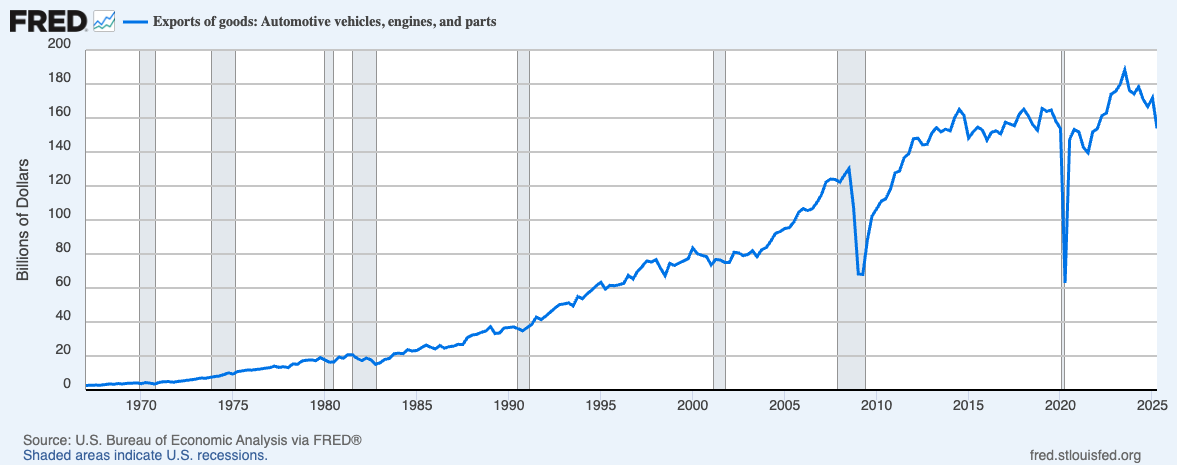
One of the major sticking points between President Trump and the rest of the world when it comes to automotive trade is that, for all the companies that do build cars here, we don’t export nearly enough parts, cars, engines, et cetera. If you look at the chart above, you’ll see that exports, by value, have gone up significantly in recent years.
However, you have to compare that to imports, which are much larger:
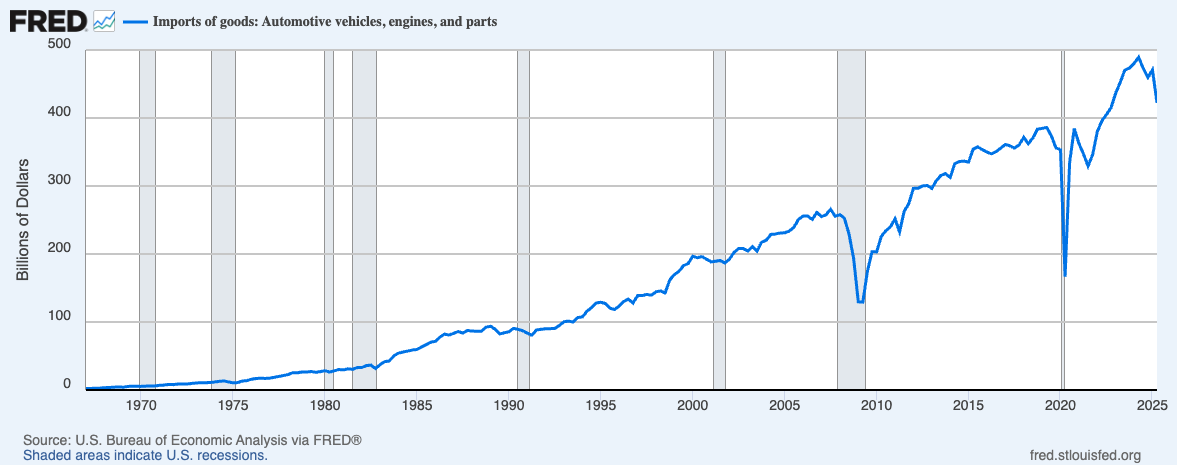
Some of this is practical. America is the second biggest automotive market in the world. We are a wealthy country. I’ve written before about the Theory of Comparative Advantage, but the TL/DR is: sometimes it’s better to let someone else make a product you can make yourself because you might get it cheaper and you can use your industry to create something of much higher value. We could all make t-shirts, but there’s more money in making the machines that make the t-shirts and the software that tracks t-shirt sales.
When it comes to cars, there are many models that might make more sense to build here (and no one is saying it’s a good thing overall to lose a lot of manufacturing), but for various reasons, there are some cars that are going to be cheaper and easier to build elsewhere. Smaller cars, for instance, are often imported because the margins are small and they’re more popular in lower-income countries, so building them there results in cars that are more affordable here, and more logical to produce elsewhere.
For all of the talk of the single, globalized car platform, there is a lack of harmony between safety and emissions regulations in North America and basically everywhere else. Clearing up that lack of harmony, in theory, would be good for the United States, and it seems as though governments like Japan are open to the idea of allowing in American-built cars.
But this is the pessimist’s view, so I’ll explain why that might not be a good thing. Perhaps governments in Japan and Europe are open to the idea of harmonizing regulations because they understand that American cars are already ill-suited for their roads and therefore might not sell that well?
If you drill down into what is being exported, by value, there are two obvious things that you notice. First, it’s that a lot of specifically American-style vehicles. For example, BMW builds many of its SUVs here and exports them to the world. It’s why Germany is one of the biggest importers of America-built cars.
Second, it’s that our biggest automotive trading partner is Canada. As mentioned yesterday, Canada isn’t exactly pleased with the United States at the moment. This is already showing up in trade, as Canada imported more cars from Mexico than from the United States for the first time since Vanilla Ice was an A-List celebrity.
There’s probably no future where Middle Eastern countries aren’t excited about importing Suburbans, but the rest of the world might not be into American cars at any scale (I mean, someone in Japan is definitely going to import an F-150 Raptor and it’s going to be awesome). The planned lowering of fuel regulations, the removal of anything that looks like an incentive to build electric cars, and the pre-existing differences in markets could mean that, rather than being a technological leader, America becomes a backwater of less competitive cars.
Sure, there will be more local production as companies trip over themselves trying to announce more plants here in this profitable market, but you know would benefit from that? China, of course, which is hoping to fill the void left by a suddenly more insular America. This is the view taken by Daniel Howes in The Detroit News:
Near-term, that looks like winning all around, right? Longer-term, as the realities of global competition inexorably reassert, maybe not so much. Retreating into Fortress America — where the rules are comparatively lax and automotive technology is at risk of falling behind China and other foreign rivals — risks losing the long game to win the short one.
By then, a new president presumably will be in the White House; automakers, starting in Detroit, will have decided whether they are content financially and technologically to be regional players in a global industry; and the smart folks from Washington and Solidarity House to the C-suites around town will know whether their potential retreat to capitulation was the right strategic call.
Detroit’s got more proverbial eggs in fewer baskets. More than anytime in at least the last 30 years, it’s banking a greater share of its profitability on a narrower slice of both its product line and geographic footprint. And it’s betting by what it’s doing that it can keep pace with the industry leader in EVs — China — by watching more from the sidelines.
This is what the announcement of all these trade deals (which aren’t deals, so much as outlines for potential deals) hides. Globally, people are fine to make deals with the United States because it’ll likely fall on consumers in the United States to pay them. While placating the Trump Administration, European automakers are going to balance Chinese imports by encouraging more local production for the local market.
As S&P Global Mobility points out in a recent report, that’s exactly what’s happening:
In early September, European Commission President Ursula von der Leyen signaled a renewed focus on small, low-cost cars as part of broader efforts to shape European car market trends in 2025. In addition to reviewing 2035 light vehicle emissions regulations, she announced that the EU’s executive body is working with automakers on a new “Small Affordable Cars” initiative aimed at supporting vehicles that are clean, efficient and price-conscious to meet the surge in global demand.
These “E-cars” would be environmental (clean, efficient and lightweight); economical (low-cost); and European (assembled in the region leveraging Europe’s supply chains). By doing so, the Commission hopes to create conditions which enable automakers to increase the availability of inexpensive European cars and bolster the competitiveness of cars in Europe.
The initiative also responds to the rising threat from vehicle and component imports from China and other markets outside of Europe, highlighting the Commission’s strategic interest in maintaining European strength in the small passenger car segment. Von der Leyen has said “[W]e cannot let China and others conquer this market. . . The future of cars—and the cars of the future—must be made in Europe.”
While there are always exceptions to this–like Tesla and whatever Ford thinks it’s doing with EVs–this is an America that can’t really be a global player. This is a future where Canada joins a European trade regime and eschews American imports for European ones. Toyota and Hyundai might be happy to build profitable and less-efficient cars here, but long-term, our allies could lower their tariffs to 0% and it won’t matter because American cars will be too far behind the rest of the world.

With higher tariffs also comes the reality that it’s maybe no longer great for car companies to give us their fun cars. Instead, we’ll get more specifically American-ized cars. This is the VW Atlas-ization of America. It’s a totally fine big crossover thing, but it’s not the fun cars we want. If the American market is a backwater of low-regulation gas-powered cars, then all we’re going to get is Atlases. Everything is going to become a VW Atlas. This potentially means losing out on both fun electric cars and even interesting gas-powered/hybrid cars like the Mazda3, Subaru WRX, and the BRZ/GR86 twins.
In this world, American car companies are not global players and are instead smaller, more regional automakers. Given the retreat from Europe and the downturn in China for American companies, this was probably already happening. Now it’s just going to happen faster.
While there may be an increase in manufacturing jobs, removing the United States from global trade is going to hurt suppliers and possibly shrink overall automotive employment. Just look at the shorting of supplier Adler Pelzer’s bonds that was reported by Bloomberg. Not great! While it’s a German company, it has operations in the United States.
In this world a smaller America is not a stronger America.
The Optimist’s View Of American Cars In Global Trade
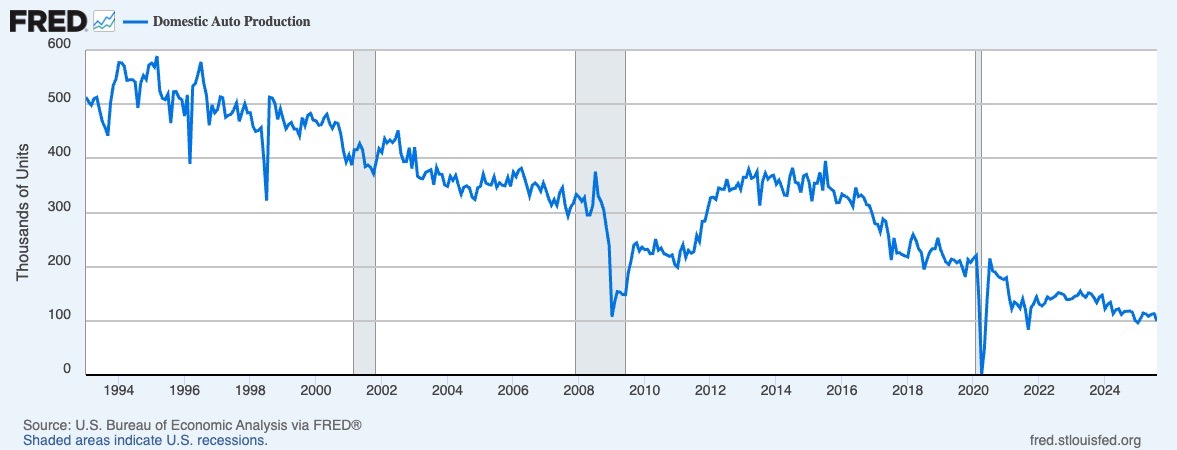
Even former President Biden realized that the loss of manufacturing in the United States, as evidenced above, wasn’t great. His plan was to incentivize the production of electric vehicles here so the country could compete with China.
Unfortunately, America was too late and too slow. China has essentially won. It can build more electric cars faster and cheaper, and, hey, they’re pretty good, too. While American consumers purchased a record number of EVs last quarter by share, with the tax credit gone, that’s going to stop. Even with the tax credit, the curve had already flattened out, and adoption is going to be that much slower.
America is still a wealthy country, and we could benefit in multiple ways here. First, companies building more cars in the United States is a win. That’s more jobs for more workers as we eventually offset imports from other countries with domestic production. While some of these cars aren’t likely to find homes elsewhere–I don’t see Belgium importing a lot of Grand Wagoneers–a RAV4 Hybrid is a RAV4 Hybrid, and it’s totally possible that Japan could find a way to import more of those.
Will those cars get more expensive? That’s the guess, but it hasn’t happened yet at the scale originally feared. Perhaps the increase in jobs in certain parts of the country will boost the economy and offset some of those costs if and when they come. UAW President Shawn Fain, long a Trump critic, has praised the move to end the “free trade” disaster:
This afternoon, the Trump administration announced major tariffs on passenger cars and trucks entering the U.S. market, marking the beginning of the end of a thirty-plus year “free trade” disaster. This is a long-overdue shift away from a harmful economic framework that has devastated the working class and driven a race to the bottom across borders in the auto industry. It signals a return to policies that prioritize the workers who build this country—rather than the greed of ruthless corporations.
“We applaud the Trump administration for stepping up to end the free trade disaster that has devastated working class communities for decades. Ending the race to the bottom in the auto industry starts with fixing our broken trade deals, and the Trump administration has made history with today’s actions,” said UAW President Shawn Fain.
As an enthusiast, this could be a huge win in the long term. The downside of globalized car platforms is that we get a lot of the same kinda boring cars everyone else gets. Without having to worry about as many fuel economy regulations or building cars for consumers in Europe, vehicles like the Golf R can not only continue to exist, but maybe get even better. That’s to say nothing of trucks. Not only will the Hemi V8 come back in the RAM, but there are all sorts of other vehicles that suddenly make a lot more sense.
It also doesn’t necessarily mean that American companies aren’t going to develop better hybrid systems, more EREVs, and even electric cars. Neither GM nor Ford has given up on the idea, and there are still plenty of consumers around the world who would probably rather have an American-built car than a Chinese-built one.
America is a huge car market, and you only have to look at companies like Ford and GM–which have both retrenched here–to see that there’s plenty of profits to be made here over the long run. We may not get all the EVs that the globe gets, but who cares? If EV demand gets strong enough, those countries with trade deals can just sell us their EVs. No one is going to out-truck America, and trucks are where the money is.
What I’m Listening To While Writing TMD
Who better than The Clash to sum up my inner conflict? “Should I Stay Or Should I Go” represents the constant question at the center of life. Also, please note that this famously British band also prefers a giant American car.
The Big Question
Are you an optimist or a pessimist?
Top photo: BYD, GM, DepositPhotos.com


As an employee of a dealership in the US, I have a horse in this race.
It is my unfortunate opinion that the race has already been lost.
My wife and I have listed our house as Step One of our exit strategy. We literally cannot survive this market. I am both disappointed and disgusted at how far we’ve fallen in such a short amount of time.
TL;DR Fuck this shit, we’re out.
I think the optimistic view is standing on the premise of “we’re a wealthy country” which I think is shaky right now. All we need is a couple crashes in unrelated bubbles of the economy (banking, AI etc) not to mention external shocks and the whole thing crashes down. Being a big market may not be enough if the local companies employing millions of people go out of business or shrink rapidly.
In a big picture kind of way, the US auto industry did well when the country was vastly wealthier than the rest of the world but very insular (50’s onward for couple decades) and the opposite tack when they went global (fuzzier here, 80’s 90’s etc). I think the insular approach can’t work in this era because the barbarians are already chewing at the gates. The only way is being a global player and if possible leader. Do what Toyota is doing and you’ll be fine.
US market, if the hoodline isn’t tall enough to hide an entire boy scoots troop and the windows are taller than 10″, it doesn’t weigh at least 8 tons, and it gets more than 16 mpg, we can’t allow it. it disgusts me what our modern vehicles have become. In my handicap spot at Albertsons today, next to me was an early 90’s Honda Accord in pristine condition. I’d upload the pic I took, but this site won’t allow. I just stood and stared at it, reminiscing about the good old days. It was an actual color, I think Honda called it rosewood, it had huge windows, and the cowl came up to my knees. I waited for the owner to come out to enquire about buying it. He said no way! It is garaged and he cherishes it. It had less than 90k. His wife (passed on) picked it out and it was the last brand new car they ever bought. He did take my number, though.
The optimist sees the container as half full.
The pessimist sees the container as half empty.
The engineering bean-counter notices the container was designed twice as big as it needed to be for that amount of liquid and should be made smaller and tucked into an unused space below and behind the A/C compressor, but above the catalytic converter… 🙂
Yuck. I had an Atlas as rental this summer and “totally fine” is being charitable.
Anyone else feel like the pessimistic view is still too optimistic? Like I could see it getting to the point where the electronics needed to run modern fuel injection aren’t available anymore as everyone else has gone electric and we end up like Cuba having to cobble together what ever just to keep our old heaps chugging along.
I think the pessimistic view outlined here is delusionally optimistic.
Optimistic vs pessimistic depends entirely on how I think about this issue.
I am very pessimistic if I think about this from a perspective of economics and politics. I’m not a fan of protectionism, but the real issue is that the US political system is fundamentally flawed. Due to our two party system and the way candidates are chosen (i.e through low turnout primary elections where any unvetted clown can run), we end up with candidates who are selected based on soundbites, social media zingers, and fearmongering. Expertise and good policies are afterthoughts at best. I don’t see this changing anytime soon since this is driven by social media and social media is here to stay.
I am somewhat optimistic if I look at this from the perspective of a car enthusiast. The rest of the world is clearly moving toward electric vehicles. EVs are great transportation appliances, but they feel soulless and bland. It is hard to differentiate EVs without resorting to silly gimmicks like fake shifters and synthetic engine noises. If the US disengages with the rest of the world, this will give our manufacturers incentives to build and develop ICE vehicles. While perhaps unlikely, there is a chance this leads to a best-case scenario where EVs take over the vast majority of driving, yet ICE vehicles remain available for enthusiasts who want them. If the US joined the rest of the world in committing to eliminate ICE vehicles, this couldn’t happen.
I think the pessimistic side of me is winning this argument, but I at least see a scenario where our current situation has an upside for car enthusiasts. This must mean I am an optimistic person at heart – else would I be able to find an upside to this train wreck?
I think we have been basically living in a world similar to that for decades the misfit guys video about his new car company really made alot of good historical points for that. The kei truck is such a good example of the right tool for the job that we just can’t have because it’s not big enough and some politician on the take decided it decades ago.
The kei car is really for Japan but has had success all over because of what it is. Some american cars have had success because they are what they are. In place they can get wavers or don’t have standards and you need something big that can tow alot American trucks are around and if people can afford them they buy them.
If you look at emissions and safety it’s the us and Canada where Canada just complies with us regulations I see Canada going to the Mexican system of dual standards soon so just like Mexico American cars and cars we don’t get in the US.
The Chinese bevs are related I guess. If you really get to the bottom of it companies in the us never put money up to scale the technology that was developed in us labs. The Chinese have done that and will profit from it eventually. The new catl sodium cells and freevoy mixed lfp so sodium packs will really make everyone else hurt. But that’s not to say us companies can’t compete.
There are some big differences in Chinese and American car buyers for one american buyers (except for luxury) typically expect their car to last a decade or beyond. The Chinese it’s less maybe 5 years. The Chinese are hyper focused on incldued tech. They are coming from cars that weren’t that great and didn’t have many features. Where American buyers have had experiences where tech is the thing that holds the car back and fails. I think this is part of why bev hasn’t caught on as much in the us because people are unsure if they will hold up as well.
When the slate was launched this was really made clear as many Americans were onboard and liked they ideas where the Chinese were laughing at the lack of screens and included tech.
It’s funny that kei cars come up because Japan was actually worried not too long ago that they were so dominant in the Japanese market that they risked squeezing out production of cars that could be sold in many more international markets:
https://www.nytimes.com/2014/06/09/business/international/japan-seeks-to-squelch-its-tiny-cars.html?_r=1
A decade later, kei cars are still around, so I guess Japan decided it didn’t need to kill off kei cars, thank goodness. But it’s an interesting mirror of the scenarios facing the US now.
I had forgotten that was a thing. It’s so engrained I’m not sure they can take it away. Some of them do fairly well in export markets too. Byd is supposed to be launching a Bev kei soon that will be interesting to see what happens.
GMC Single cabs exist outside the US. Especially in markets like Saudi Arabia and Qatar.
They exist in the US too if you put your money where your mouth is and just order one.
That is true as well.
Any full size American single cab truck in the last 20 years is still about 215 to 220 inches a mid size single about 190 and now most of the trucklets are about 200 inch long a kei truck is about 135.
Gm doesnt make a regular cab mid size for most markets now so that’s around 215 inches long.
Ford still makes a regular cab ranger in some markets at 205 inches.
I think the world understands the assignment and once things in the US change, everyone will welcome trade back as much as they can. I’m sure we’ll still be traded over but that’s the price we pay for being how we are currently.
More pessimistic than optimistic. Being isolationist feels like trading away long term gains for short term wins. Rather than competing on the merits of our American cars and pitting them against the rest of the world we’d rather put up barriers to give ourselves advantages. This only tempers competition and ultimately innovation. There is no country that has gone that route and come out ahead long term. But hey, maybe we’ll be the first. Like some Wakanda.
We should eliminate all auto regulations, we are supposed to be a free country, if we had a “free” market i would be driving a Toyota Hilux Champ, Toyota Town Ace from Taiwan or a Toyota Land Cruiser 79 series pickup.
I would also be driving a single cab GMC truck as well. In addition to a 79 series.
I like the analysis but disagree on two points that I think would change the picture here:
1) America has not already “lost” the EV race. EVs are still a rapidly changing technology. If America a) invests in EV manufacturing, b) import technology and know-how from foreign manufacturers and c) invests in research and scaling for future technologies like solid-state batteries, then I see a world in which US companies become globally competitive players in the EV space.
2) I think there is less direct correlation between regulatory environment and global competitiveness than is being made here. GM, Ford, and Stellantis are/want to be global companies. There are many cars Americans want that overlap with global markets (i.e., things that aren’t trucks and big SUVs). Developing, homologating, and manufacturing one model for the US and one for the rest is expensive. No matter how few regulatory fines the Big Three have to pay in the next 3 years I don’t think the US is a big enough market on its own to justify those extra costs assuming they want to be global companies and not US-only. Which I think is a good assumption. Ironically, paying fewer fines for trucks now might free up more capital to make EV/hybrid investments…
So to me the optimist/pessimist take is:
1) Are US companies, the US government, and US private capital investing in new technologies? GM and Ford are investing in EVs, Stellantis mostly in hybrids. The government is pulling back but keep in mind that EV manufacturing subsidies stuck around. There are a lot of startups (e.g., in solid state batteries) in the US that get access to our world-beating private capital market. So, mixed bag but not entirely pessimistic.
2) Are GM, Ford, and Stellantis changing their product development cycles over the next 5-10 years? Short term, perhaps. Stellantis is taking advantage of the moment to put an engine it already has into vehicles it already has. But I haven’t seen long term strategy changes away from hybrids/EVs yet. Maybe a slow down, but not a full-on pullback. So again, mixed bag, but mostly optimistic for now.
I’ve been working in China for Chinese domestic manufacturers for the past 12 years. You’ve lost, trust me.
Neither. The reality will be somewhere in between, and who knows what “black swan” events might shift it one way or the other.
Are you under the impression, for some reason, that the Black Swan event isn’t currently being experienced?
Sigh. The US is on the road to becoming economically, technologically and politically isolated. I assume some global financial institutions will also be reluctant to deal with us. We’re going full third world country…amazing the damage that be implemented in under a year. I never thought I would see this in my lifetime, or my children’s.
I recall walking in NIce France and seeing an extension cord across the sidewalk charging an AMI micro car. Then again they don’t have winter there.
My next-door neighbor in California was charging his Leaf that way.
A pessimist is never disappointed.
Thanks for that Clash vid – best part of my lunch. I’ve never thought of a ’59 Caddy as “punk”, but it works.
I’m an optimist to a fault. My wife is a born pessimist. We even each other out pretty well. Since she’s from Brazil, “should I stay or should I go” has become a legitimate question. After finding a nice little house to rent for just $200USD/month outside of Piabetá on our last trip there I realized we could retire about 15 years early and live rather comfortably on the interest of just a $300,000USD lump sum, easily realized by simply selling the house we’re living in, never mind the rental properties or other assets.
Of course if we did that we’d have to put up with the really expensive cars there as a result of Brazil’s tariff policy on automobiles.
Oh wait.
There are some overlapping questions.
Is there an over consumption/over production problem? If you agree there is, I’m optimistic the industry will get cut down to size.
Will consumer choice become even more limited? I’m pessimistic it will. At least in the US. In Canada, there might be an expanding selection.
Will there be a rebirth in the US of one employer towns lurching back and forth from boom to bust? History fuels my pessimism.
Pessimist. All else equal, the Theory of Comparative Advantage is the primary driving factor here. More trade is more better for more people. Adding China to the WTO was supposed to help create strong enough economic ties that armed conflict would be to no one’s advantage. That concept didn’t play out as hoped with China, but there are decades, even centuries, of evidence of effectiveness elsewhere. Isolationism reduces the barrier to starting wars while simultaneously reducing consumer choice and raising costs.
But you’re forgetting all the great news and propaganda that will result from “wars with lower barriers.”
Bt I do agree with your take.
To date we have not had an armed conflict with China – so it looks like that trade interdependency is working.
The most optimistic outcome I can see at this point is that Canada annexes Minnesota and I get out of the increasingly hellish US without having to physically move.
I remember reading about fallen empires in school and wondering how nobody stopped the stupid things they were doing that led to their downfall. Now I’m living it and I still don’t understand.
Thanks for the depressing kick of reality.
Sorry, I’ve also been exposed to “AI this, AI that” all week at work and I’m just emotionally exhausted from watching trainwrecks happen in slow motion.
I find the term AI to be an oxymoron.
Sign me up for this Canadian annexation. In fact, I’ll speak for all of New England, just absorb the entire region. We can be our own province, Nontario.
We can move to the Northwest Angle and succeed!
Don’t leave Wisconsin behind
Yeah! People already think we’re next to Canada anyways.
Become a member just to reward Matt for these TMDs. I’m serious.
Pessimistic for sure. The auto world is moving on and the guy currently running the US wants us to focus on faster horses. EVs have the ability to completely transform cars… and the majority of the US consumers are not going to be held back by guys who want to daily drive pickup trucks with towing capabilities they never use.
Americans will occasionally leave the country and will be frustrated by the quality of cars they get vs. the quality available elsewhere.
I’m not going to lie: the prospects seem depressing.
“Like a Trabant, but big” sounds like the least fun possible combination of automotive attributes.
“Are you an optimist or a pessimist?”
It depends on what subject or issue. For example:
If it’s the future of BEVs.. I’m an optimist.
If it’s about the future of hydrogen vehicles… I’m a pessimist.
If it’s about Canada’s future… I’m an optimist.
If it’s about the USA’s future under Trump… I’m a pessimist.
If it’s about the outcome of future US elections… I’m an optimist.
Love this.
Nice and concise. I, for one, agree entirely.